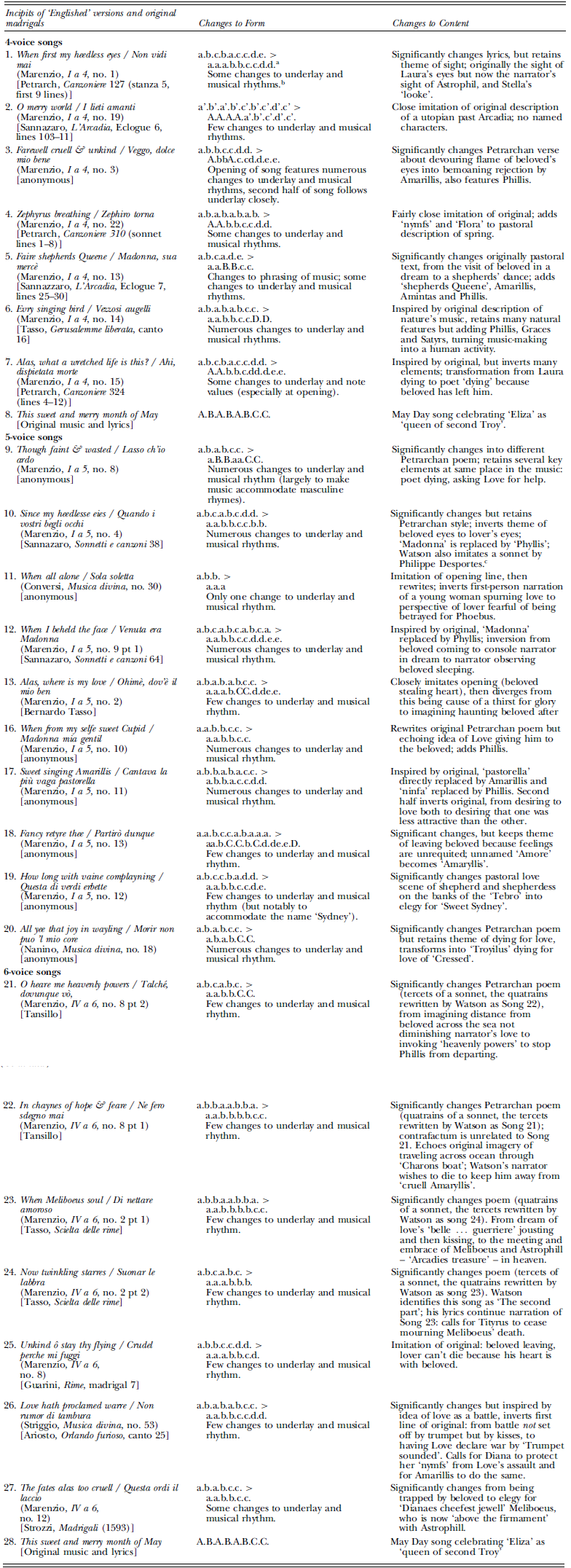
In his preface to Musica Transalpina (1588), the first of the Elizabethan anthologies of ‘Englished’ madrigals, the editor Nicholas Yonge explains the impetus behind his publication: ‘Italian Songs, are for sweetnes of Aire, verie well liked of all, but most in account with them that understand that language.’Footnote 1 For the many music-lovers who wished to sing these songs but could not speak Italian, his collection provides English translations of the madrigals’ original lyrics, from the pen of an anonymous ‘Gentleman’. Within the next decade, four more anthologies of Italian songs with English contrafactum lyrics were published: Thomas Watson’s Italian Madrigalls Englished (1590),Footnote 2 Yonge’s second book of Musica Transalpina (1597) and Thomas Morley’s Canzonets … Celected out of the Best and Approved Italian Authors (1597) and Madrigals … Celected out of the Best Approved Italian Authors (1598). Each collection shares Yonge’s initial goal of making the Italian madrigal more accessible to an anglophone audience.Footnote 3 However, the anthology by Thomas Watson (1555–1592) – a poet best known today for his Petrarchan sonnet cycle Hekatompathia (ἙκατομπαθΊα, 1582)Footnote 4 – announces through its title a rather different approach to ‘Englishing’ than that taken by Musica Transalpina: ‘The first sett, Of Italian Madrigalls Englished, not to the sense of the originall dittie, but after the affection of the Noate’.Footnote 5 Unlike Musica Transalpina’s more literal attempts at translation, the Italian Madrigalls Englished claims that it will not seek to strictly replicate the original Italian lyrics (‘not to the sense of the originall dittie’). Nevertheless, it promises that its new English lyrics will be equally suitable to the music they underlay (‘after the affection of the noate’). The differences between Watson’s contrafacta and the Italian texts they replace can indeed be striking, particularly when the new lyrics directly invoke the poet’s own Latin pastoral poems. In fact, most of the songs in the IME feature characters from either Watson’s celebrated Amyntas (1585), a set of 10 lamentations by the eponymous shepherd on the death of his beloved Phyllis; or his Meliboeus … sivè, Ecloga (1590),Footnote 6 an allegorical elegy for Secretary of State Francis Walsingham (1532–1590), which also mourns the recent loss of Philip Sidney (1554–1586).
Despite the description of his contrafacta as being ‘not to the sense of the originall dittie’, recent analyses of the IME acknowledge that Watson in fact takes a wide variety of approaches to contrafaction in this collection: these range from closer paraphrases of the original lyrics to new verse displaying only a ‘tenuous’ link, if any, to the Italian it replaces.Footnote 7 Nevertheless, scholars tend to prioritise the novel aspects of Watson’s lyrics over their connections to the original Italian poems. The contrafacta are described as texts largely ‘conceived afresh as vehicles for conveying the Italian madrigalists’ art’,Footnote 8 they are ‘almost always quite distant in meaning from the original text’Footnote 9 or indeed are for the most part ‘freely composed lyrics with no resemblance to the Italian texts in rhetoric, substance, or topic’.Footnote 10 We are left with the notion that most of Watson’s contrafacta – or at least those most worthy of study – owe little or nothing to the Italian texts they replace. But in fact, even without ever seeking to directly translate the Italian, Watson remains deeply and consistently invested in the appropriation, manipulation and resignification of the original lyrics set by each of the composers included in the IME – especially Luca Marenzio (1553/4–1599), the composer of twenty-three of the twenty-six Italian madrigals in the collection.Footnote 11 Taking full advantage of a contrafactum’s unique potential to respond to both the text it replaces and the pre-existing music to which it is set, Watson’s goal is to reimagine the prestigious Italian madrigal genre – and the verse to which it is intimately connected – in service to the demands of contemporary English poetry and politics.
Prior emphasis on the distance between Watson’s contrafacta and the texts they replace can largely be ascribed to the two most common methods of analysing the IME: either through a comparison with Yonge’s Musica Transalpina, or through an investigation of the lyrics that commemorate Sidney and Walsingham. In the former case, as in the articles of Laura Macy and William Peter Mahrt, the analysis of an Italian madrigal lyric that appears in an ‘Englished’ form in both the IME and Musica Transalpina tends to highlight the distinction between, on the one hand, Yonge’s attempts at an accurate or faithful rendition of this Italian text, and on the other, Watson’s comparatively freer iteration of the same poetic model. Macy concludes that – unlike the translator of Musica Transalpina – Watson’s ‘choice of words and images is suggested not by the original text, but by Marenzio’s musical figures, reversing the process of creating madrigalisms’.Footnote 12 Although they differ on certain particulars, both Macy and Mahrt agree that Watson, by virtue of his distance from the original Italian poetry, is ultimately able to provide ‘Englished’ lyrics that align more convincingly with the musical rhetoric of his chosen madrigals than did Yonge’s more literal translations.Footnote 13
Other analyses of the IME, interested in the political and propagandist aims of the collection, focus on the work’s dedication to Robert Devereux, earl of Essex, and on the select few contrafacta featuring allegorical elegies for Astrophil (Philip Sidney) and Meliboeus (Francis Walsingham) – contrafacta that employ the same pastoral pseudonyms that featured in Watson’s Meliboeus and its English translation. Katherine Duncan-Jones, noting that these lyrics call for an end to mourning these two important political figures, considers the Astrophil and Meliboeus songs to be a ‘propagandist celebration of Essex and his marriage’ to Frances Sidney – both widow to Philip and daughter of Walsingham – while the IME project as a whole ‘may have been intended to reconcile the queen to Essex’s marriage’.Footnote 14 Paolo Cecchi further argues that these elegies, along with the two encomiastic Latin poems that open the IME (one in praise of Marenzio, the other Essex), promote Essex ‘at once as a potential political successor to Walsingham and as a successor to the intellectual and cultural heritage of Sidney’.Footnote 15 Finally, K. Dawn Grapes has conjectured that the characters in the IME drawn from Watson’s earlier Amyntas are not simply fictional shepherds and shepherdesses, but also ‘likely serve as an allegorical parallel to persons associated with the Sidney–Essex circle’.Footnote 16 The entire contrafactum collection would thus represent a coherent pastoral ‘poetic sequence’ – a unified allegory that ‘may have helped promulgate a perceived dynasty reaching from Sidney to Essex’.Footnote 17
These two approaches to understanding the IME each provide valuable insight into Watson’s reasons for presenting his madrigal contrafacta as ‘not to the sense of the originall dittie, but after the affection of the Noate’. The former illuminates the poet’s desire to demonstrate that ‘a musical rhetoric written to fit one text can be appropriated by a completely different one without losing its appropriateness of style and figure’,Footnote 18 while the latter highlights some of Watson’s explicitly political goals for this collection. Yet both approaches also tend to limit discussion of the IME to analyses of a small and in some ways unrepresentative subset of its madrigals. Of the twenty-six contrafacta and two original songs in the collection, only five contrafacta mention Sidney or Walsingham,Footnote 19 while only three contrafacta share the same original lyrics as Yonge’s selections in his two books of Musica Transalpina.Footnote 20 This is a concern when the conclusions drawn from these few songs are projected outwards to the rest of the collection. On the one hand, focussing on the Astrophil and Meliboeus madrigals not only narrows the aims of the entire publication to a single, specific political agenda revolving around Sidney, Walsingham and Essex,Footnote 21 but also has the ancillary effect of emphasising some of the contrafacta in the IME least related to the Italian poetry they replace – for of course Elizabethan statesmen did not appear in the original madrigal lyrics. On the other hand, focussing on comparisons between Yonge and Watson’s approaches to ‘Englishing’ leads to the notion that Watson’s contrafacta – because less ‘literal’ a replication of the Italian than Yonge’s translations – are consequentially ‘distant’ from and thus minimally concerned with the sense of the original lyrics.Footnote 22 Yet by looking beyond the Sidney and Walsingham contrafacta, or the overlaps with Musica Transalpina, it becomes possible to discern consistent and deliberate trends in the IME’s practice of subverting and resignifying key themes, tropes and formal features of the original lyrics – many of which are excerpts from Petrarch, Sannazaro and other canonical Italian authors.Footnote 23 While some of Watson’s texts do indeed depart significantly from the original verse, far more of the contrafacta of the IME demonstrate a unique desire to respond in great detail to both the poetry chosen by Marenzio, as well as the characteristic text–music relationships of the Italian madrigal.
The central and most crucial element of this response to the original verse is Watson’s specific engagement with the pastoral, one of the most ideologically potent musico-poetic genres of the late sixteenth century. The pastoral characters and themes that pervade the IME are lent further significance through the almost exclusive selection of a stylistically and textually coherent body of madrigals by Marenzio, the great innovator and exemplary composer of the pastoral madrigal style. In many of his contrafacta, Watson carefully reconfigures the pastoral scenes already present in the original lyrics of these madrigals, naturalising Italian Arcadia by repopulating it with recognisable – and recognisably Elizabethan – characters drawn from his own poetry. However, resignifying the pastoral is far from Watson’s only intervention upon the original lyrics: other recurring practices include the erasure of Laura’s presence from his imitations of verse by Petrarch, in order to assimilate these texts into the IME’s pastoral world; as well as the reinterpretation of many of Marenzio’s passages of word-painting through new lyrics that directly respond to or subvert the original text–music relationships. Like other contemporaneous English contrafacta written to foreign songs, such as those by Philip Sidney, Watson’s contrafacta equally engage with the musical representation of fundamental formal features of Italian poetry. Yet unlike Sidney’s efforts, Watson aims to prove not only the capacity of the English language to integrate rhythmic and metrical traits from foreign verse, but also – often through alterations of note values in the music – the capacity of the Italian madrigal to accommodate aspects of native English prosody.
Together, these various manipulations of the ‘sense of the originall dittie’ also clarify the intention behind the moments where Watson’s contrafacta – as detailed by Macy and Mahrt – do seek to diverge more significantly from their Italian models while nevertheless remaining ‘after the affection of the Noate’. By combining the appropriation and naturalisation of key elements of the original lyrics with the creation of convincing new relationships between his contrafacta and Marenzio’s music, Watson argues that English poetry can both learn from and compete with the Italian madrigal’s characteristic integration of verse and polyphonic setting. The twenty-six contrafacta of the IME also pave the way for an even more assertive English appropriation of the madrigal, beyond even the allegorical elegies for the great heroes Sidney and Walsingham: as they are described on the title page, two ‘excellent Madrigalls of Master William Byrds, composed after the Italian vaine’, conclude the four-voice and six-voice sections of the collection. The lyrics shared by these two Byrd madrigals leave little doubt as to Watson’s expectations for the proper manner of naturalising this most Italian of musical styles: the first truly English madrigal to be published is a pastoral song in praise of Queen ‘Elyza’ that eschews many of the most identifiable Italianate formal features, preferring a rhyme and metre that would not have been out of place in a more traditional English song. Beyond honouring the memories of Sidney and Walsingham, or advancing the cause of the earl of Essex, the IME thus also makes a much broader argument about the status of English culture and art. At a time when English authors still sought to prove the quality of their verse and vernacular in comparison to the greatest continental models, Watson’s lyrics impart the message that English poetry – and indeed, the English language itself – is equally suitable to being sung to the most esteemed secular music of the period, is equally capable of evoking Arcadia in the domestic setting of Elizabethan England.
‘Englishing’ Arcadia: Appropriations and Subversions of the ‘Sense of the Originall Dittie’
Whether through their inclusion of characters from Watson’s Amyntas and Meliboeus, or through the more general presence of bucolic landscapes populated by shepherds and nymphs, twenty-two of the twenty-eight songs in the IME incorporate some element of the pastoral in their lyrics.Footnote 24 The process of selecting music for this collection thus appears highly intentional – this is not, like Musica Transalpina, an anthology that spans decades of material in multiple languages.Footnote 25 Rather, it is a work that draws almost solely from three recent publications by a single composer: Luca Marenzio’s Primo libro de madrigali a cinque voci (1580, henceforth I a 5), Madrigali a quattro voci … libro primo (1585, I a 4) and Il quarto libro de madrigali a sei voci (1587, IV a 6).Footnote 26 Indeed, the IME even opens with a Latin poem by Watson in praise of the composer, ‘most skilled in the art of music’.Footnote 27 However, although by 1590 already one of the most prominent madrigalists in Europe, as attested by the many reprints of his music over the previous decade, Marenzio had only a limited presence in England at this time.Footnote 28 Watson’s decision to devote practically the entirety of his collection to this one composer, while in part capitalising on his continental fame, can therefore be equally – if not more readily – explained by a specific musical justification: Marenzio’s status as the greatest proponent of the new pastoral madrigal style in the late 1570s and 1580s. These pastoral madrigals, many returning to the poetry of Jacopo Sannazaro, allied ‘bucolic imagery [with] stylistic simplicity’ of the musical setting – a shift from the madrigal’s earlier dominance by both Petrarchist lyrics and a denser, more serious style of polyphonic writing.Footnote 29 Giuseppe Gerbino has recently discussed how this emergence of a lighter style of madrigal – at times described as a ‘canzonetta-madrigal’Footnote 30 – was part of a broader Italian turn during this period towards an Arcadian aesthetic, wherein ‘simplicity emerged as a new paradigm of cultural sophistication’.Footnote 31 The musical depiction of this ‘facile but aristocratic world of pastoral loves’ was characterised by vivid word painting as well as ‘periodicity, symmetry and repetition, along with an uncompromised avoidance of metric and motivic ambiguity’.Footnote 32 Or, as James Chater has similarly described this period, the ‘emphasis in Marenzio’s works of the early 1580’s is on lightness, grace, and pungent, easily memorable rhythmic motives’.Footnote 33
In prioritising this lighter pastoral style throughout his publications of the 1580s, Marenzio was promoting an aesthetic of particular importance to his patron during the years 1578–86, Cardinal Luigi d’Este of the Ferrarese ruling family.Footnote 34 Already in the 1560s, Luigi and his brother Alfonso II, duke of Ferrara, had been instrumental in supporting the rebirth of pastoral theatre, and during Luigi’s cardinalate (1572–86) many of his social and cultural activities took place near Rome at the Villa d’Este in Tivoli. This magnificent rural estate provided the perfect backdrop for pastoral performances – lavish entertainments projecting wealth and political power, but simultaneously evoking the simplicity of the Golden Age through the ‘natural’ scenery of carefully crafted gardens and fountains. At times – as we will see in one of the IME’s selections – Marenzio’s madrigals from this period do not merely depict a generic pastoral scene, but instead directly evoke his patron’s Roman milieu through references to the Tiber.Footnote 35 Beyond the general implications of employing Marenzio’s music for the vast majority of the IME – exploiting the prestige of one of the most celebrated madrigalists of the period – we must therefore also acknowledge the political implications of specifically repurposing Marenzio’s pastoral madrigals, so crucial to the aesthetic self-representation of contemporaneous Italian aristocrats, and even more particularly to the projection of cultural and political power by the Este family. Even Watson’s choice of songs within Marenzio’s three publications – what Kerman has described as the IME’s avoidance of madrigals ‘too “extreme” for [Watson’s] taste’Footnote 36 – can be understood less as a ‘conservative’ rejection of dissonance and unexpected harmonic progressions than as a calculated decision to unify the IME under the banner of a lively, diatonic and identifiably pastoral musical style.
Indeed, the pastoral was as crucial to Watson’s oeuvre during this period as it was to Marenzio’s. Following Watson’s early Hekatompathia sonnet cycle, all of the poet’s major publications of original verse were in fact pastoral poems set in a single, unified world: 1585’s Amyntas, 1590’s Meliboeus and its English translation, the IME of the same year and the posthumous Amintae gaudia of 1592. Already in Amyntas, a poem lacking any other references to contemporary England, the eponymous shepherd had mourned his beloved Phyllis along the banks of a mythologised Thames.Footnote 37 In the later poems, this Arcadian landscape steadily becomes more infused with topical Elizabethan features and explicitly political intentions. Watson’s 1590 Latin pastoral elegy in memory of England’s Secretary of State, Meliboeus … sivè Ecloga in obitu honoratissimi viri, Domini Francisci Walsinghami, was quickly followed by Watson’s own English ‘translation’ of this text, An Eglogue upon the Death of the Right Honorable Sir Francis Walsingham.Footnote 38 The reasons for this vernacular translation are twofold: Watson desires to make possible a ‘more generall understanding’ of his verse – to encourage a ‘publike sorrow’ and to teach ‘the whole body of this realme … to love, honor, and obey those few, that yet survive, resembling [Walsingham] in high estate, and virtuous condition’.Footnote 39 Allied with this desire to disseminate his political propaganda beyond a small group of educated courtiers appears a more personal goal: to ensure that his work will not once again be stolen by another translator who does not acknowledge Watson’s authorship,Footnote 40 as had been the case with Abraham Fraunce’s popular 1587 translation of Amyntas.Footnote 41
Watson’s pastoral character Amyntas is mentioned only once in the Eglogue, in order to situate this poem along the banks of the same river where ‘chang’d Amintas flow’r … decks the downe’Footnote 42 – an allusion to the Ovidian metamorphosis that concludes Amyntas, wherein the shepherd perishes and is transformed into a blood-red amaranth, planted on the banks of the Thames. Instead of focussing on the fictional characters of Amyntas, Meliboeus and its translation feature a cast of Elizabethan notables under allegorical pastoral names. Further emphasising Watson’s desire to broaden the audience for his vernacular translation, the poet acknowledges ‘that my pastorall discourse to the unlearned may seeme obscure’.Footnote 43 To avoid any ambiguity, all the allegorical names are explicitly identified in the Eglogue’s preface: Meliboeus and Dryas represent Francis Walsingham and his wife Ursula; Tityrus is Thomas Walsingham, both cousin to Francis and a friend of Watson; Astrophil and Hyale are Philip Sidney and his widow, Frances;Footnote 44 Diana is ‘Her Majestie’; and Corydon, Watson himself. Various other English politicians, as well as Watson’s fellow poet Edmund Spenser, are also identified by name within the text. The significance of the pastoral setting is equally unambiguous: as Watson indicates in the same preface, ‘I figure Englande in Arcadia’. The poem itself, a dialogue between Corydon and Tityrus, mourns not only the loss of Francis Walsingham, but also Sidney’s death fighting the Spanish in 1586, before finally turning to the present concern of continuing Walsingham’s political legacy.Footnote 45
Matters of state constantly blend with literary concerns, as Sidney is celebrated as a war hero, yet referred to by his poetic pseudonym: ‘Yong Astrophill, the mirrour of our time’.Footnote 46 Later, alluding to the recently published Faerie Queene and highlighting the epic’s political importance, Corydon/Watson addresses Spenser, asking him to console Diana after her Secretary of State’s passing: ‘sweet Spencer let me leave this taske to thee, / Whose neverstooping quill can best set forth / such things of state, as passe my Muse, and me’.Footnote 47 Crucially, it is a poet who can best perform such a task in this unstable political environment: ‘Tell hir forthwith (for well shee likes thy vaine) / that though great Meliboeus be awaie: / Yet like to him their manie still remaine / which will uphold hir countrie from decaie.’Footnote 48 Corydon then concludes by himself enumerating various members of the Privy Council and their qualities, ostensibly instructing Spenser in what to say to Diana, but effectively accomplishing the very task he had entrusted to his fellow poet.Footnote 49 Meliboeus and its English translation thus impart two messages: despite the loss of Walsingham, the ‘countrie’ remains in capable hands; and despite Watson’s professed deference to Spenser’s Muse, the author of Amyntas announces his arrival as a poet who, like Sidney and Spenser, is directly concerned with – and capable of personally contributing to – the well-being and stability of England.
The Eglogue’s topical and explicitly politicised portrayal of Arcadia helps shed light on Watson’s intentions with the IME of the same year. While the collection opens with a Latin dedication to Essex, the madrigal contrafacta themselves are less explicit in their political message – there is no analogous key explaining the allegorical characters shared with the Eglogue, and many of the songs are devoted to loving shepherds, singing birds and wantoning nature, without allusions to specific Elizabethan courtiers. Nevertheless, the continued use of the vernacular, the integration of characters from Amyntas and the Eglogue, and direct references to Sidney and the Queen point towards complementary, albeit more diffuse, goals for the IME. The aim in appropriating Marenzio’s madrigals is not solely, as it was with the Eglogue, to highlight a particular issue of state. Beyond this narrowly focussed goal, the contrafacta equally seek to disseminate more widely a message of cultural equality with – or even superiority over – Italy, with Watson’s own pastoral poetry championing this cause.
The transformation of Watson’s pastoral verse into a tool for promoting English identity in opposition to its continental rivals culminates with the 1592 Amintae gaudia. In the fifth epistle, Amyntas describes a milk pail he is sending to Phyllis, with images prophesying the defeat of the Spanish Armada and depicting various English naval captains of the sixteenth century – a catalogue of men contributing to the glory and growth of England, not unlike the catalogue of counsellors that concluded the Eglogue. Once again, we return to the banks of the Thames, yet this mythological river now flows directly past Elizabeth’s royal palace, ‘this lofty hall with its conjoined turrets, lapped by the fair Thames’ water … Beneath this roof resides our august, bright-faced Diana, wealthy in riches, wealthy in her people, a pious friend of peace, yet mighty in battle, fearsome to the enemy.’Footnote 50 In the waters around Britain swim ‘monstrous whales’ and ‘savage fish’ – the sunken ships and drowned sailors of the Armada, transformed by Juno. The goddess commands these enemies of the English to ‘shun the sacred shore touching the chill North, inhabited by the Briton, cut off from the world, but not lesser than the Italian in wit, nor unequal in strength’.Footnote 51
Given the emphasis in Watson’s later poetry on portraying England in competition with Italian ‘wit’ and ‘strength’, there could be few acts as ideologically freighted as the inscription of Watson’s own English pastoral characters, dwelling along the banks of his native Thames, into Marenzio’s cutting-edge and identifiably Italian – and indeed Roman – musical Arcadia.Footnote 52 Even when his contrafacta do not feature a close relationship with the original lyrics, as in many of the Astrophil and Meliboeus songs, the significance of this appropriation is evident: because of Watson’s consistent preference for Marenzio’s lighter, pastoral madrigals – songs initially intended to celebrate a patron from one of the most spectacular and prominent Italian courts – the repurposing of such music into pastoral elegies honouring English noblemen makes a bold assertion of the cultural weight of the Elizabethan court. Yet, as we shall now see, the contrafacta of the IME make a much broader claim about the aesthetic qualities of the English vernacular and its verse when they actively respond to the original lyrics, as well as Marenzio’s musical interpretations of these texts. Manipulating and rewriting his various literary models, Watson seeks to redefine the pastoral scenes and landscapes of disparate Italian poets into a coherent and identifiably English Arcadia.
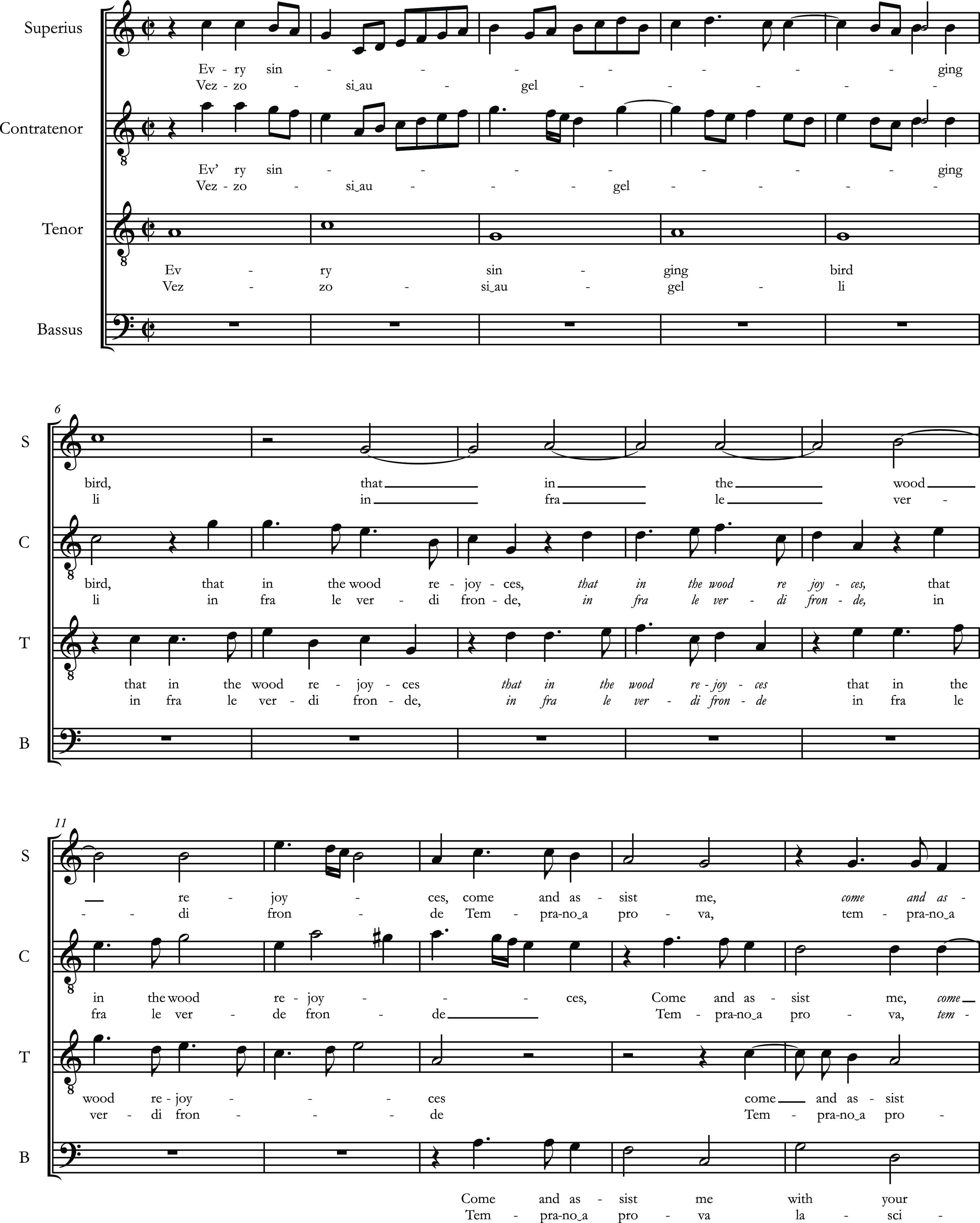
One of Watson’s most pointed appropriations of an Italian pastoral landscape occurs in song 6, Evry singing bird. The madrigal’s original text, Vezzosi augelli, is drawn from canto XVI.12 of Gerusalemme liberata by Torquato Tasso – not only one of Marenzio’s favourite poets but also himself in service to the same Este family.Footnote 53 In the broader context of Tasso’s epic the passage describes the garden of the sorceress Armida,Footnote 54 yet in the isolation of Marenzio’s eight-line excerpt this description becomes a purely naturalistic scene devoid of any human presence, a neutral and universal representation of landscape. Watson’s contrafactum paraphrases much of the first three lines of Tasso’s verse, retaining many of the natural features that Marenzio emphasises and illustrates musically. As in the original madrigal, various melismatic passages thus continue to depict singing birds (bars 1–6), the wind (bars 21–4), leaves (bars 26–9) and water (bars 30–2) (see Example 1 Footnote 55 ).
Vezzosi augelli in fra le verdi fronde
Temprano a prova lascivette note;
Mormora l’aura, e fa le foglie e l’onde
Garrir, che variamente ella percote.
Quando taccion gl’augelli alto risponde;
Quando cantan gl’augei, più lieve scote;
Sia caso od arte, hor accompagna, ed hora
Alterna i versi lor la musica ora.Footnote 56
Evry singing bird, that in the wood rejoyces,
Come & assist me with your charming voices:
Zephirus come too, & make the leaves & the fountaines
Gently to send a whispring sound unto the mountains:
And from thence pleasant Eccho, sweetly replying
Stay here playing, where my Phyllis now is lying,
And lovely Graces, with wanton Satyres come & play,
Dancing & singing, a hornpype or a rundelay.
Evry singing bird / Vezzosi augelli (song 6), bars 1–32

These initial parallels to the natural features in the original text establish, at the beginning of the contrafactum, the expectation of a similarly uninhabited and thus universal pastoral scene. Yet, as the poem proceeds, Watson diverges further and further from the original lyrics, as he gradually populates Tasso’s natural landscape with specific human and human-like characters.Footnote 57 In fact, even from the second line of the contrafactum, the perspective has shifted from a third-person narration to a first-person narrator directly involved in the action. Where Tasso offers a neutral, uninvolved description of his scene, Watson’s narrator directly addresses ‘Evry singing bird’, and asks them to ‘Come & assist me with your charming voices’ (my emphasis). At the same time, the rhyme scheme is altered from the ottava-rima abababcc to the contrafactum’s flat couplets aabbccDDFootnote 58 – distancing the English text from one of the crucial formal markers of Renaissance Italian epic verse. Watson then calls for the wind to ‘come too’ and make ‘a whispering sound’ with the leaves and fountains. What was originally a purely natural musical exchange between the birds and the breeze has already been subtly manipulated into a product of the narrator’s agency, as nature’s music becomes an assistant to human music-making in Watson’s contrafactum.
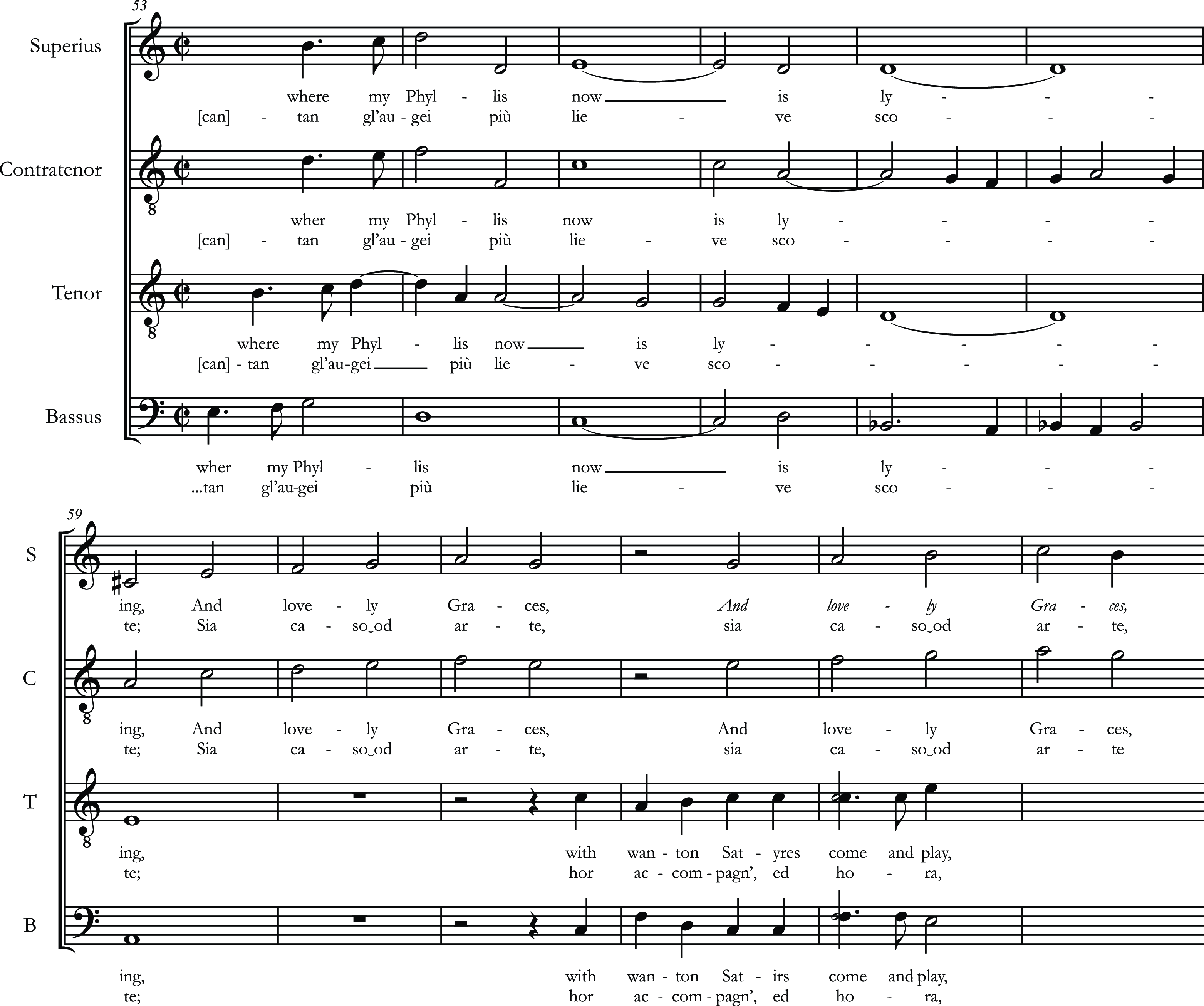
This reorientation of the landscape towards its new human – indeed, English – inhabitants is made fully evident in the sixth line, where Amyntas’ beloved Phyllis appears (see Example 2). Watson transforms Marenzio’s illustration of the breeze’s gentle rustling (‘più lieve scote’) – where each voice slows down and descends to the lower limits of their range (bars 54–9) – into a musical image of the reclining shepherdess (‘Phyllis now is lying’). To join in his music-making, the poet then calls for Graces and Satyrs in line 7, who are introduced with another newly conceived madrigalism: a passage of paired upper voices in slower minims now serves to depict female ‘lovely Graces’, which is contrasted by the paired lower voices evoking the male ‘wanton Satyrs’ in a more energetic crotchet rhythm (bars 59–64). The final line completes this ‘Englishing’ of Tasso’s pastoral landscape, as ‘la musica ora’, the purely natural music of the breeze, is turned into ‘a hornpipe or a rundelay’ (bars 80–90) – the first a typically English dance and the second a French import also long popular in the British Isles. Both terms are also notably present in Spenser’s 1579 Shepheardes Calender,Footnote 59 a literary echo that, combined with the change of rhyme scheme and the shift to a more naturally English masculine rhyme in the final couplet (‘… come and play’ / ‘… rundelay’), transfers a portion of the contrafactum’s literary inheritance away from Italy and towards local models.
Evry singing bird / Vezzosi augelli (song 6), bars 53–64

In featuring the name ‘Phyllis’, song 6 is one of twelve songs in the IME that include one or more of the trio of characters from Amyntas (Amyntas, Phyllis and Amaryllis).Footnote 60 Five other songs feature allegorical characters from Meliboeus: Astrophil (Philip Sidney), Meliboeus (Francis Walsingham), Tityrus (Francis’ cousin Thomas Walsingham) and Diana (Queen Elizabeth),Footnote 61 while Sidney and the Queen are also mentioned by name – ‘Sweet Sidney’ in song 19, along with Queen ‘Elyza’ in the two new madrigals by Byrd (songs 8 and 28). These intertextual and topical references have been frequently acknowledged, yet, as we saw in song 6, it is just as important to consider precisely how the characters from Watson’s pastoral poems are employed in the IME: not simply the fact of their presence, but also their specific placement both within Marenzio’s music and within contrafacta that carefully respond to the Italian lyrics they replace. It is in fact possible to discern several meaningful trends in the placement of characters from Amyntas throughout the IME – as in Evry singing bird, the inclusion of these characters always contributes centrally to a broader and more comprehensive practice of naturalising and resignifying the Italian poetic models.
One of the IME’s signature tactics for appropriating Marenzio’s pastoral lyrics is to have characters from Amyntas replace the generic and unnamed characters present in the Italian. This practice is exemplified by song 17, Sweet singing Amarillis, a reworking of the anonymous text Cantava la più vaga pastorella.
Cantava la più vaga pastorella
Che mai premesse fiori,
E scopriva nel viso almi colori
Una Ninfa di lei molto più bella.
Deh, perché l’alma fatta ad ambe ancella
Non hebbe all’hor duo cori,
Mentr’era a l’un’e a l’altra intento e fiso,
Per lassarne uno al canto e l’altro al viso.Footnote 62
Sweet singing Amarillis, Amarillis
My listning eare incharmed
And my heedlesse eie was deadly harmed,
When I there beheld the wanton looks of Phillis.
Alas, wherefore have not heavenly fates provided,
By whom all things are guyded,
That either Phyllis face were not so brightsom,
Or Amarillis singing were lesse delightsom.
In his contrafactum, Watson retains both the central dilemma described by the narrator of the Italian text – being enamoured of both a singing shepherdess and a beautiful nymph – as well as the basic narrative structure. In the original, this structure consists of first two lines devoted to describing the ‘pastorella’, then two lines for the ‘ninfa’, before a turn in the final four lines where the narrator expresses his wish that he could have two hearts so that he might admire both the shepherdess’ voice and the nymph’s face at the same time. In the opening half of his ‘Englished’ version, Watson repeats the conceit of being charmed first by a beautiful voice, and then by a beautiful face, yet he replaces the generic ‘pastorella’ and ‘ninfa’ of the original with Amaryllis and Phyllis respectively. The second half – opening with the exclamation ‘Alas’ in direct imitation of the Italian’s ‘Deh’ – similarly laments the narrator’s dilemma of being attracted to two women. However, unlike the original, Watson’s wish is not to admire both at once, but to make one less attractive (‘not so brightsom’, ‘lesse delightsom’) so that – we might assume – he can focus all of his attention on the single, more deserving object of affection. The result is a text that bears significant affinity with its poetic model, without in any way translating it directly. The situation and the dilemma are the same, as is the overall structure, yet the narrator’s ‘solution’ to this dilemma differs substantially from original to contrafactum. Most crucially, the stock pastoral characters are named and specified, redefining the situation from a generic and universal pastoral story to a specifically English one, playing out within the world of Watson’s Amyntas.
Another appropriation of a generic pastoral role occurs in song 12, When I beheld the faire face of Phyllis sleeping, which echoes the original text of Venuta era Madonna al mio languire, an excerpt from a poem by Sannazaro.
Venuta era Madonna al mio languire
Con dolce aspetto umano
Allegra e bella in sonno a consolarme;
Ed io, prendendo ardire
Di dirle quanti affanni ho speso in vano,
Vidila con pietade a sé chiamarme,
Dicendo: A che sospire,
A che ti struggi ed ardi di lontano?
Non sai tu che quell’arme
Che fer la piaga ponno il duol finire?Footnote 63
When I beheld the faire face of Phyllis sleeping
I shewd my joy by weeping:
And kissing oft her cheeks with roses stained,
To my self I thus complained,
Now feed your selves my feeble eies with gazing,
While her eies with a clowd of sleepe are kept from blazing,
And thou my hart, whom she hath fired,
Dispaire not of thy desired,
As now mine eies are pleased,
So haply when she awakes, thou shalt be eased.
Watson retains the central conceit of sleep, although in a crucial inversion of the original (‘Venuta era Madonna … in sonno a consolarme’), here it is not the poet sleeping, but the beloved – a beloved who is no longer a generic ‘Madonna’ but has become Phyllis herself. The contrafactum also closely follows the tripartite structure of the Italian, which consists of a narrative introduction (lines 1–3), the lover’s complaint to his lady in his dream (lines 4–5), and the beloved’s consoling response (lines 6–10). However, Sannazaro’s structure is adapted to the inverted circumstances of Watson’s contrafactum – since it is the beloved Phyllis who is asleep, unconscious of the narrator’s presence, he does not address his complaint to her, but to himself (‘To my self I thus complained’). Similarly, the sleeping Phyllis cannot console him, so he must also try to console himself (‘And thou my hart, whom she hath fired, / Dispaire not of thy desired’). As with song 17, the influence of the original lyrics is evident in this ‘Englished’ version, yet so is the impact of Watson’s appropriative treatment – his willingness to reimagine a pastoral scene by approaching it from a different perspective, while further affirming his authorship through the insertion of his well-known pastoral characters.
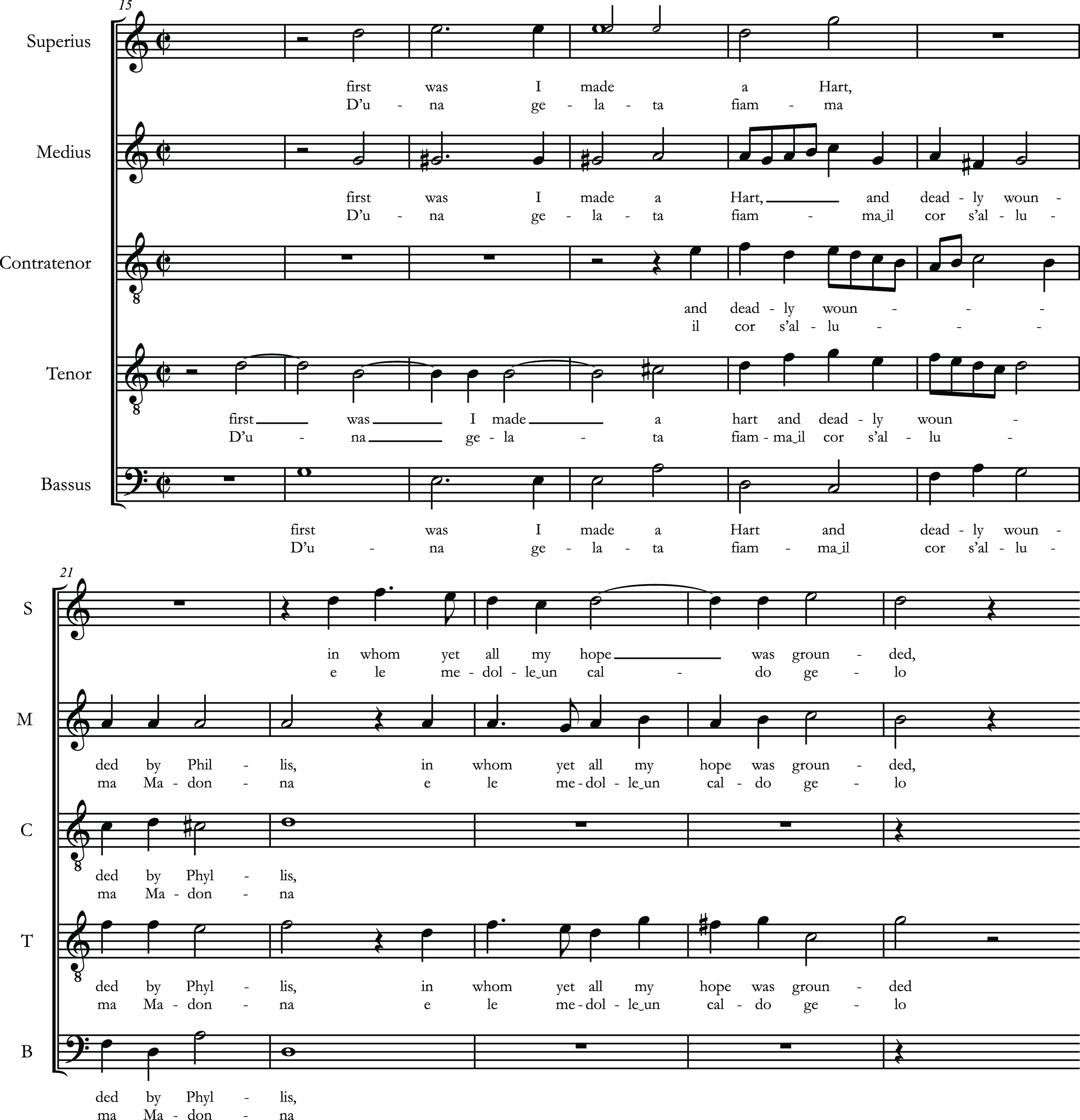
Even contrafacta that do not so closely imitate the original lyrics often feature the same interest in the appropriation and personalisation of generic pastoral roles. In two other songs, both also originally setting Sannazaro texts, Watson takes advantage of Marenzio’s prominent homophonic settings of the word ‘Madonna’ – moments in the music where the text is especially audible – and redefines this anonymous Italian beloved as one of his own pastoral characters. Song 10, Since my heedlesse eies, originally bore the text of the poem Quando i vostri begl’occhi.Footnote 64 At the beginning of the fourth line of Sannazaro’s poem, Marenzio interprets the word ‘Madonna’ as an enjambment of the previous line, ‘D’una gelata fiamma il cor s’alluma, / Madonna’Footnote 65 (see Example 3).
Since my heedlesse eies / Quando i vostri begl’occhi (song 10), bars 15–25

‘Madonna’ thus serves as the cadence for the energetic contrapuntal phrase that sets the end of the third line of verse (bars 19–21), gathering the four voices together before a new phrase begins for the rest of the fourth line, ‘e le medolle un caldo gelo’Footnote 66 (bars 22–5). For the first time in this madrigal, four voices align homophonically as they sing the word ‘Madonna’,Footnote 67 a textural contrast to the previous bars that is compounded by the use of slower and relatively static pitches at this moment. Following Marenzio’s musical phrasing in this passage, Watson creates an even more obvious syntactic enjambment between the third and fourth lines of his contrafactum. Then, at the exact moment of heightened enunciative clarity where ‘Madonna’ was originally invoked, Watson places the name of his own lady Phyllis. ‘First was I made a Hart & deadly wounded / By Phyllis, in whom yetall my hope was grounded’ (my emphasis).
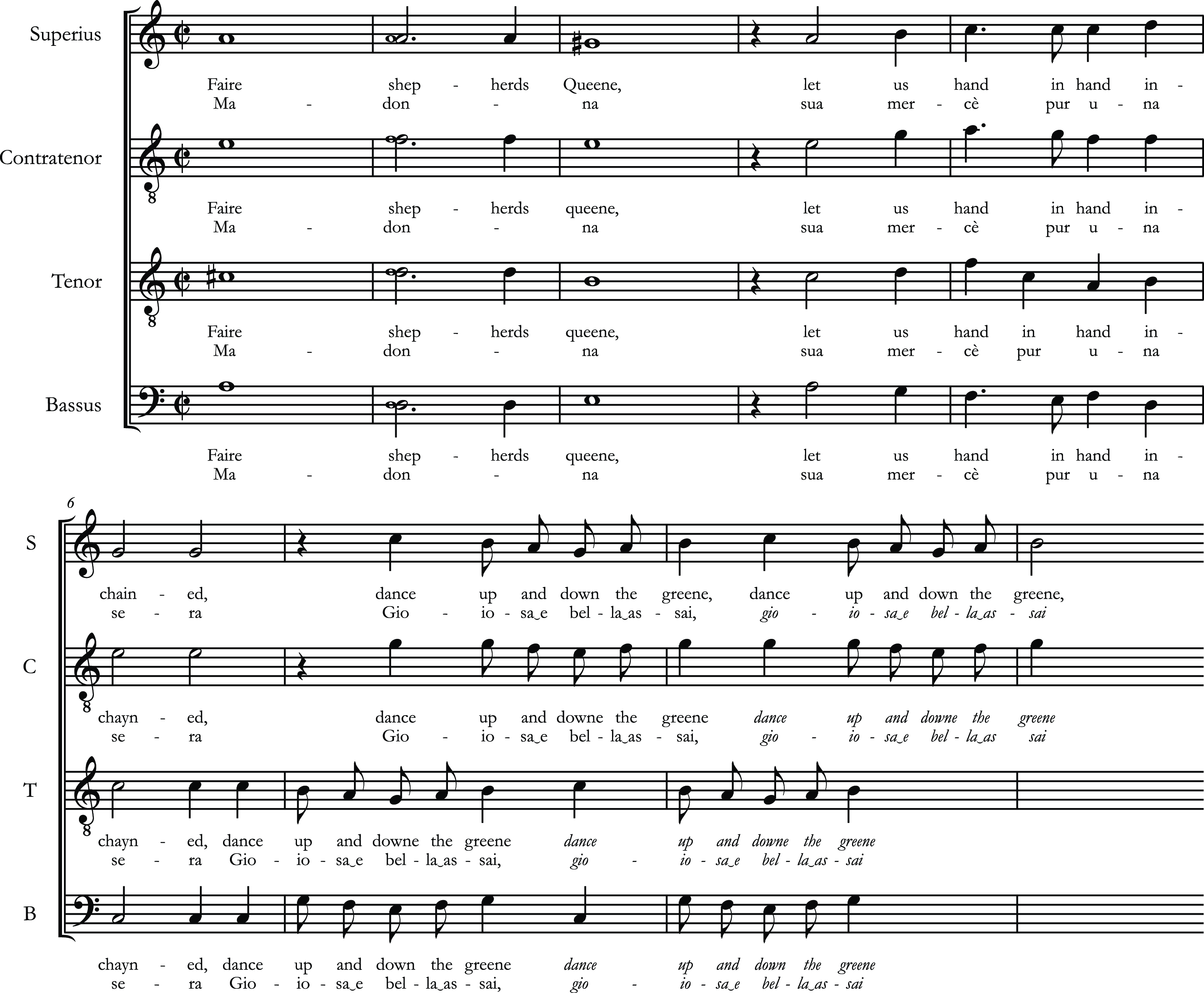
In song 5, Faire shepherds Queene, originally setting Madonna, sua mercè, pur una sera, an excerpt from Sannazaro’s Arcadia,Footnote 68 Watson similarly takes advantage of the emphatic manner in which Marenzio renders an address to the beloved lady. At the opening of the Italian madrigal (see Example 4), all four voices slowly sing the word ‘Madonna’ together, then pause before continuing to declaim Sannazaro’s poetry with a more rapid musical texture, eventually breaking up into imitative pairs of voices (bars 1–9). Watson’s contrafactum bears little resemblance to the original Italian, yet he once again directly replaces Sannazaro’s generic term ‘Madonna’ with a specific pastoral character. This time, it is the ‘Faire shepherds Queene’ – likely a reference to Elizabeth, Spenser’s ‘Queene of shepheardes all’,Footnote 69 who is also identified in Watson’s Eglogue as ‘Diana matchlesse Queene of Arcadie’.Footnote 70
Faire shepherds Queene / Madonna, sua mercè (song 5), bars 1–9

Were it not for the reoccurrence of this naming practice throughout the collection – beyond the examples we have already seen, Watson similarly paraphrases or reinterprets several other Italian texts in the IME while specifying the original’s anonymous beloved as his Phyllis or AmaryllisFootnote 71 – one might assume that Watson was paying little attention to Sannazaro’s poetry in this particular contrafactum. Yet it seems more likely that the poet was entirely aware of the material he supplanted – an excerpt from one of the era’s foundational pastoral texts. For not only does the contrafactum begin by addressing the ‘Queene of shepheardes all’, it also concludes by invoking Amaryllis, Amyntas and Phyllis – the only time all three of the Amyntas characters appear in a single madrigal. In order to ‘figure Englande in Arcadia’,Footnote 72 Watson not only appropriates Sannazaro’s unnamed ‘Madonna’ but transforms an entire passage from L’Arcadia into an Elizabethan pastoral scene, in one of the rare madrigals of the IME to include characters from both the political allegory Meliboeus and the earlier lamentation Amyntas.Footnote 73
The transplantation of Arcadia from Italy to England is even more pointed in song 19, How long with vaine complayning, a contrafactum of Marenzio’s setting of the anonymous Questa di verd’herbette.
Questa di verd’herbette
E di novelli fior tessuta hor hora
Vaga e gentil ghirlanda,
Giovin pastor, ti manda
L’amata e bella Flora,
Che, con le sue caprette,
Sta in riva al Tebro soggiornando e dice,
Ch’ivi or t’aspetta e ti vò far felice.Footnote 74
How long with vaine complayning,
How long with dryry teares, & joyes refrayning,
Shall we renewe his dying,
Whose happy soull is flying,
Not in a place of sadnes,
But of eternall gladnes.
Sweet Sydney lives in heav’n [ô] therefore let our weeping
Be turnd to hymns & songs of pleasant greeting.
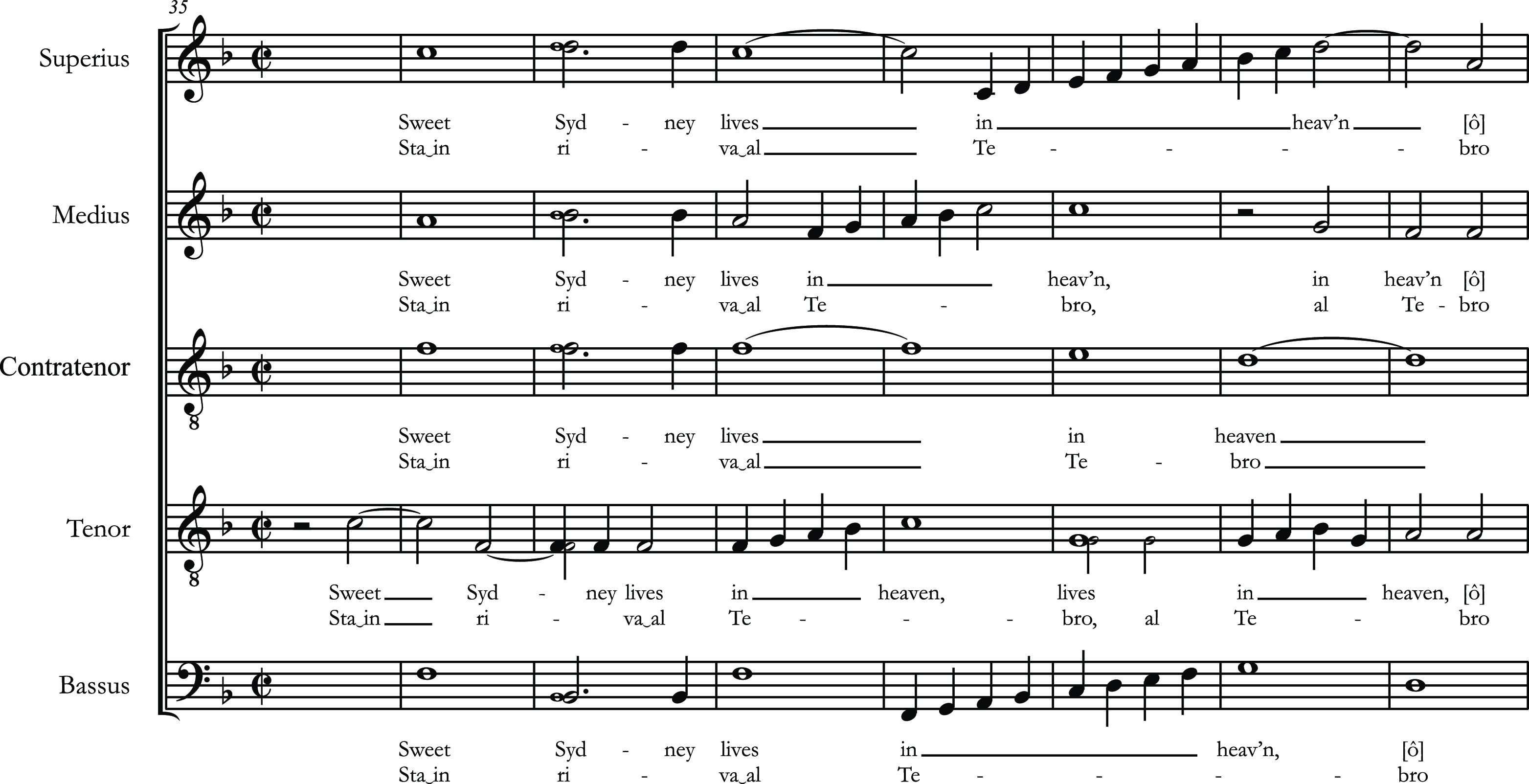
Watson’s approach to this song is unique – not only does he completely transform the madrigal into an elegy for Philip Sidney, but he even refers to the English hero by his actual name (‘Sweet Sydney’) instead of the pastoral pseudonym ‘Astrophil’ that is used in the rest of the collection. Crucially, among Watson’s musical selections for the IME, the original lyrics also stand out through their explicit topical reference: the penultimate line of the Italian text begins ‘Sta in riva al Tebro …’ (bars 35–42). As previously noted, such specific evocations of a Roman milieu helped contribute to the ideological association of Marenzio’s Arcadian madrigals with the ‘utopian space’ of his Este patron’s villa in nearby Tivoli.Footnote 75 It is therefore striking that at this exact moment in the madrigal (see Example 5), Watson places the words ‘Sweet Sydney lives in heav’n’ – replacing a geographical reference alluding to contemporary Italian aristocracy and the composer’s own patronage with an undisguised apotheosis of the noble English warrior-poet, who had himself also authored a pioneering English-language Arcadia.Footnote 76
How long with vaine complayning / Questa di verd’herbette (song 19), bars 35–42

In her analysis of this song, Macy argues that Watson’s decision to place ‘Sydney’s ascent to heaven’ at this point in the music was purely inspired by Marenzio’s rising stepwise figures – originally depicting the Tiber – and that ‘in writing a completely new poem Watson made no attempt to match the key words that inspired Marenzio’s madrigalisms’.Footnote 77 Yet while Watson has indeed made little attempt to literally ‘match’ or translate the original lyrics at this moment, the Italian text and its ‘key words’ – especially the ‘Tebro’ – appear as meaningful to the specific choice of this English phrase as does the musical figure. Just as with the IME’s more transparent imitations and manipulations of Marenzio’s Italian lyrics, it is likely that the unique reference to Sidney by his name in this contrafactum was implemented specifically in response to the original lyrics. In a collection that seeks to ‘English’ the Italian madrigal – to appropriate and naturalise this most prestigious of foreign musical genres – the most explicitly Italian reference in all the madrigals Watson chose becomes the most explicitly English reference in all his contrafacta.
Song 19, transformed from a Roman pastoral scene into an elegy for Sidney, is not the only contrafactum that significantly differs from the original lyrics while nevertheless remaining attentive to them, creating meaning not only through the relationship between new words and pre-existing music, but also through the relationship between the English words and the Italian they replace. At times, as in song 15, But if the countrie Gods, Watson even develops a contrafactum around inversions of key phrases from the original text – phrases emphasised and highlighted by the musical setting. In this madrigal, the Italian lyrics (the sestet of the anonymous sonnet Spuntavan già) offer a description of a lover’s blissful time with his beloved, ‘mio vivo sol’, who speaks to him in the second and third lines of the excerpt, then proceeds to kiss him. In the contrafactum, this moment of joy and erotic union becomes a scene of paranoia and jealousy. Watson’s narrator fears that his beloved – now identified as Phyllis – will be seduced by ‘False wanton Satirs’, which will lead to his demise.
Quando ’l mio vivo sol perch’io non pera
Godi or, mi disse con un dolce riso,
Amante fido, il premio del tuo ardore.
Indi con molti baci sparse fuore
Quante gratie e dolcezze ha ’l paradiso
E quant’ha odor nei fior la Primavera.Footnote 78
But if the countrie Gods seeke to surround thee,
Fly then my sweet Phillis, trust not their smiling,
False wanton Satirs do use much beguyling,
Alas if they but ketch thee the sight will wound me,
And my poore hart, though now it live in pleasure,
Will die with onely feare to leese his treasure.
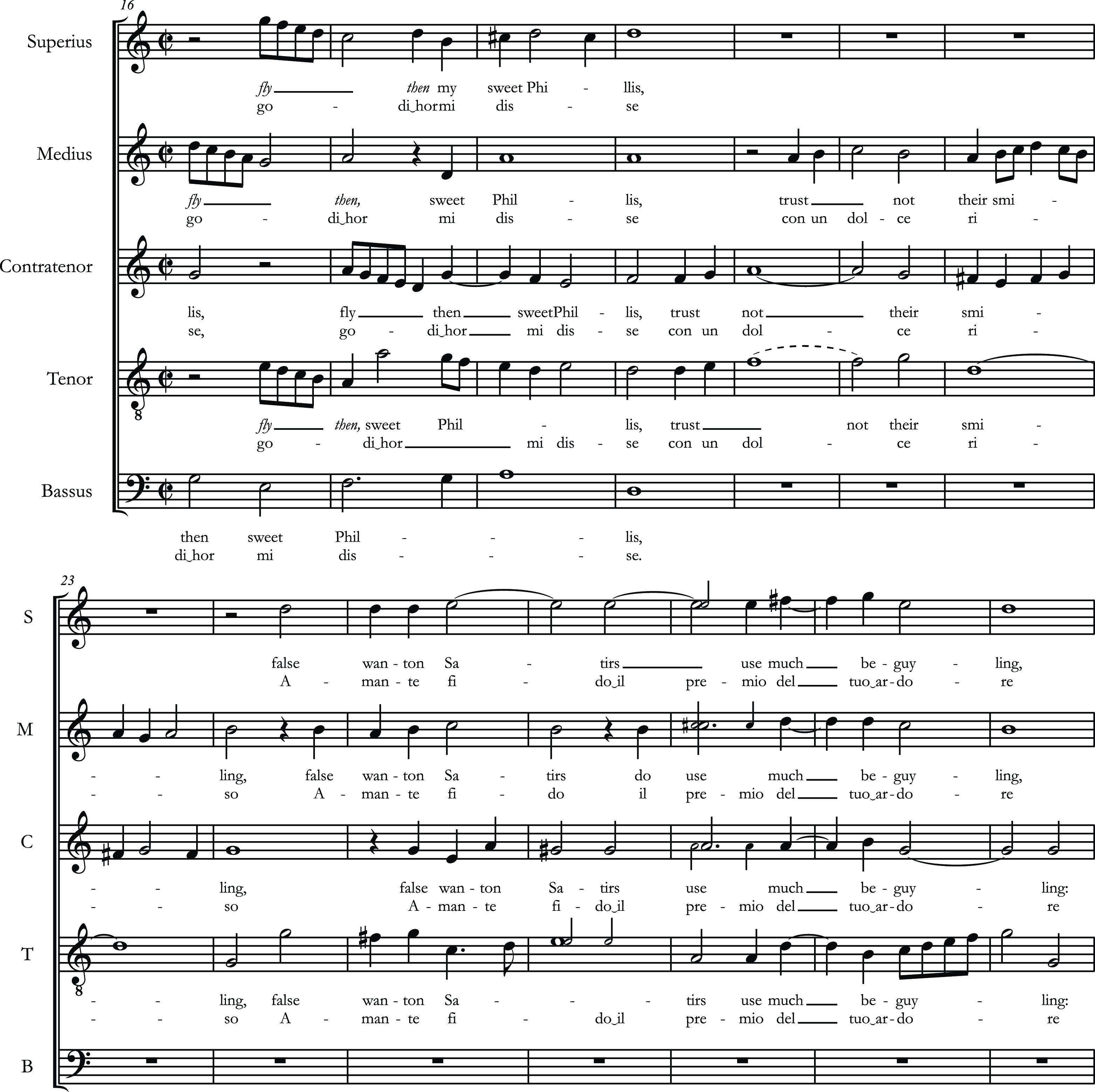
While radically altering the tone in his contrafactum, Watson remains highly alert to the original text. Far from ‘writing a completely new poem’,Footnote 79 Watson consistently presents the Italian poem’s moments of joy in the negative, focussing on words that receive significant attention from Marenzio’s musical setting. The beloved’s repeated call to enjoy her kisses, rapidly rising and falling quavers on the phrase ‘Godi or’, is repurposed to illustrate the lover’s warning to Phyllis to ‘Fly then’ (bars 11–17) from the lustful ‘countrie Gods’ (see Example 6). The term used for the beloved’s sweet smile – ‘riso’ – is directly translated at the same melismatic passage in Watson’s version, but for very different effect: it now becomes the Satyrs’ deceitful ‘smiling’ that Phillis must not trust (bars 22–4). Then, as if in anticipation of these Satyrs usurping the man’s role, the lady’s term for her lover in the Italian, ‘amante fido’, is directly replaced by the words ‘False wanton Satirs’ – at a moment of striking harmony where the Contratenor introduces a rare G-sharp into a song in G (natural) mode (bars 24–6). Subsequently, the original lover’s ‘ardore’ becomes the Satyrs’ ‘beguiling’ (bars 28–9). And finally, Marenzio’s setting of the line ‘Quante grazie e dolcezze ha ’l Paradiso’ – evoking the delight of the beloved’s many kisses through numerous repetitions of this phrase – is repurposed to underline the obsessive mistrust of Watson’s narrator, who repeats over and over ‘And my poore hart, though now it live in pleasure’ (bars 42–59). The erotic consummation suggested by ‘Paradiso’ is directly replaced by the seemingly analogous ‘pleasure’, yet in the contrafactum this is only a momentary, illusory pleasure that Watson’s narrator worries ‘Will die with onely feare to leese his treasure’ (bars 58–76) – it is a pleasure that has already been lost at the mere imagination of the beloved’s infidelity. Thus, as the original Italian ends with a joyous reference to springtime, the season of love and rebirth (‘E quant’a odor nei fior la Primavera’), so ends Watson’s contrafactum, inversely, with the premonition of abandonment and death (‘And my poor hart … / Will die’).
But if the countrie Gods / Quando ’l mio vivo sol (song 15), bars 16–29

In song 11, When all alone my bony love was playing, Watson again repurposes elements of the Italian lyrics to create a contrafactum with a decidedly different message. In the original, an anonymous text set by the composer Girolamo Conversi,Footnote 80 the entire poem consists of the words of a girl who disdains love and prefers to remain alone:
Sola soletta i’ me ne vò cantando.
Ed ho via il core più freddo che giaccio.
E vo d’amor spregiando d’ogni suo laccio.Footnote 81
When all alone my bony love was playing,
And I saw Phoebus stand at a gaze staying,
Alas I feard, ther wold be some betraying.
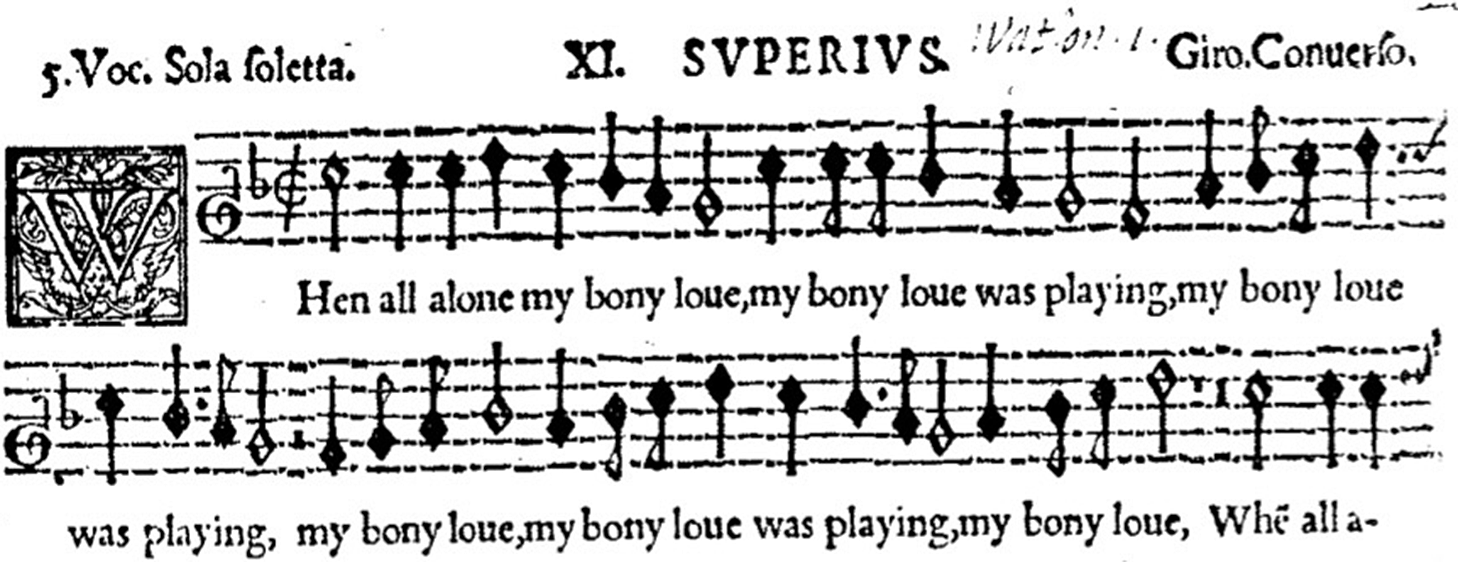
The opening of the poem, ‘Sola soletta i’ me ne vò’, is transparently illustrated by its musical setting, the Superius singing these words alone before the rest of the voices join it to conclude the line of verse (bars 1–5). As Grapes has noted, Watson retains this madrigalism through his contrafactum’s opening words ‘When all alone my bony love …’.Footnote 82 However, while the reuse of the madrigalism seems to promise a similar poem to the Italian original, in the ‘Englished’ version it is no longer in fact the woman declaring her freedom from attachment, but a paranoid, possessive man who speaks. Observing his beloved – or a woman he imagines as his beloved – alone, he is concerned that she will betray him for the onlooking Phoebus. Similarly to song 15, Watson draws inspiration from the original lyrics and their musical illustrations, while simultaneously introducing new themes of jealousy and fear of cuckoldry – thus considerably darkening the tone. Although the contrafactum of Conversi’s madrigal appears to begin as a transparent imitation of the original text, it eventually reverses the entire conceit of the Italian poem: a woman who refuses all amorous attachment is recast as one who seems to make – and break – such attachments all too easily.
In opening his contrafactum with a brief evocation of the Italian lyrics, before proceeding in a new narrative and tonal direction, Watson plays with the expectations of a singer or listener who might be familiar with the original madrigal, or even simply a reader who sees the Italian incipit ‘Sola soletta’ at the top of their partbook (see Figure 1) – what could at first appear to be a straightforward translation soon sets off on an unexpected path.Footnote 83
IME, Superius, sig. Ciir (detail): San Marino, CA, The Huntington Library, RB 14217

Several of Watson’s other contrafacta similarly seek to subvert expectations through their imitation of the original lyrics’ opening lines,Footnote 84 including song 7, Alas, what a wretched life is this?, which transforms Petrarch’s text Ahi dispietata morte, ahi crudel vita.Footnote 85 Neither the original lyrics nor the contrafactum for this song can be described as pastoral: song 7 does not feature named characters drawn from Watson’s other verse, nor does it include any of the generic Arcadian elements seen in many other contrafacta, such as shepherds and shepherdesses, descriptions of nature or evocations of a utopian past. Nevertheless, Watson’s specific appropriations and manipulations of both the content and (as will be discussed later) the form of Petrarch’s verse exemplify the English poet’s aim of creating a coherent collection of contrafactum lyrics, which is even capable of accommodating several non-pastoral works.
Ahi, dispietata morte! Ahi, crudel vita!
L’una m’ha posto in doglia
E mie speranze acerbamente ha spente:
L’altra mi tien qua giù contra mia voglia,
E lei, che se n’è gita,
seguir non posso, ch’ella no ’l consente:
Ma pur ogn’hor presente
Nel mezzo del mio cor madonna siede,
E qual è la mia vita ella se ’l vede.Footnote 86
Alas, what a wretched life is this? Nay, what a death,
Where the tyrant love commaundeth
My flowring days are in their pryme declyning:
All my prowd hope quight faln, & life untwyning:
My joyes each after other, in hast are flying
And leave my hart dying
For her that skornes my crying:
O she from hence departs, my love refrayning
For whom all hartlesse alas I dye complayning.
In analysing this song, Mahrt remarks that although the Italian text is a ‘point of departure’ for Watson, the resultant contrafactum is ‘so altered … as to have lost all the subtle features of paradox and interiority that must have made it attractive to both Palestrina [who also set this text to music] and Marenzio’.Footnote 87 Yet while the alterations to the Italian are indeed extensive, the contrafactum is not simply a casual paraphrase of the original but a conscious literary intervention on Petrarch’s poem, which takes full advantage of the singer or listener’s expectation of how the text should conclude.
At the beginning of song 7, Watson recalls Petrarch’s opening exclamation against death and life, ‘Ahi dispietata morte, ahi crudel vita’, with a similar outburst, although reversing the terms: ‘Alas, what a wretched life is this? Nay, what a death’. Yet as the text proceeds, it becomes clear that these key terms are not being treated as Petrarch treated them – where Petrarch’s ‘morte’ refers to Laura’s death and ‘vita’ to his own life, both Watson’s ‘life’ and (poetic) ‘death’ refers to the narrator himself, who professes that he cannot live while his beloved – still very much alive – ‘skornes my crying’. Beyond the parallel noted by Louise Schleiner between a passage from the ballata’s omitted opening, ‘quando / fioria mia spene’ (‘when my hope was flowering’), and Watson’s ‘My flowring days are in their pryme declyning’,Footnote 88 several further echoes of key passages from the original poem appear throughout the contrafactum, but always serving a different purpose from their role in the Italian. Where Laura’s death has extinguished Petrarch’s hopes, ‘E mie speranze acerbament’ha spente’, the departure of Watson’s beloved similarly impacts his hope, save that death is redirected from the beloved to the lover, and from the real to the metaphorical: ‘All my prowd hope quight faln & life untwining’. Then, where Marenzio illustrates the passage ‘E lei che se n’è gita / seguir non posso’ with overlapping five-note scales passed between voices (bars 39–48), Watson offers an inverted, more literal lyric for this musical depiction of ‘following’ – ‘My joys each after other / in hast are flying’.Footnote 89 The contrafactum’s concluding lines once again evoke the model, only to invert it. In the original, Laura, taken away from Petrarch by death, is nevertheless seated forever in his heart, her continued presence confirmed by her use as the subject of the final clause (‘ella se ’l vede’). Inversely, being abandoned by his beloved has rendered Watson ‘hartless’, his solitude – verging on the solipsistic – confirmed by the redirection of the final clause’s focus to the lover himself ‘I dye complayning’.
In concluding the song in this manner, Mahrt remarks that ‘Watson is thus a strange Petrarchan to have replaced the elegantly poetic death of Laura with the more commonplace madrigalian death, and in the process to have lost her presence entirely’.Footnote 90 Admittedly, Watson’s version may offer a more ‘commonplace’ conclusion for a madrigal text, yet how he transforms his model is telling: his opening line deceptively implying a more faithful paraphrase of the original, the subsequent echoes of Petrarch’s poem, the redirection of ‘death’ from Laura to the narrator himself, the final inversion of Laura’s continued presence into the absence of Watson’s beloved – all reveal the contrafactum’s attentiveness to its model and suggest that ‘los[ing] her presence entirely’ is not incidental to the process of rewriting, but is instead an intentional subversion of expectations. This willingness to personalise and naturalise canonical Italian verse differs radically from Watson’s earlier emphasis on ‘faithful’ imitations – and even direct translations – of texts from the Canzoniere in his Hekatompathia sonnet cycle,Footnote 91 a collection that further elided the distinction between model and imitation by reusing the name Laura to refer to the English poet’s beloved.Footnote 92 In contrast, the contrafactum’s conscious erasure of Laura’s presence aims to transform poetry by Petrarch into a more diffusely ‘Petrarchan’ English verse, so that it might be more readily subsumed into the coherent Watsonian world of the IME. By rewriting Petrarch in this manner, Laura cannot distract attention from Watson’s Amyntas and Meliboeus characters.
Nor is song 7 alone in taking this new and more transformative approach to the poetry – and especially the beloved – of the Canzoniere. All of the IME’s contrafacta on poems by Petrarch feature a similar erasure of Laura’s ‘presence’, while still recalling the original text by retaining other key features. However, each contrafactum rewrites its model in different ways, demonstrating a variety of solutions for resignifying a text – tailored to individual madrigals, yet maintaining an overarching unity of purpose: the integration of Petrarch’s verse into Watson’s collection of Elizabethan pastoral madrigals. Thus, while song 7 evokes a significant amount of Petrarch’s original poem, song 1, When first my heedlesse eyes, thoroughly transforms a passage about the sight of Laura’s eyes into a song about Astrophil and Stella, retaining only the theme of sight.Footnote 93 Not unlike song 19’s transformation of the ‘Tebro’ into an apotheosis for Sidney, the opening song of the IME appropriates another important Italian cultural artefact – a musical setting of Petrarch’s verse about his beloved Laura – and resignifies it as a site for the canonisation of the most important English inheritor of the love sonnet tradition, a song in praise of Astrophil, ‘whose worth exceeds al measure’, and his beloved Stella. Conversely, song 4, Zephyrus breathing, closely imitates the first eight lines of Petrarch’s famous sonnet Zephiro torna, in which the poet describes the return of spring. However, Watson omits the sonnet’s concluding sestet from the IME, even though it was also set to music by Marenzio as the ‘seconda parte’ of the same madrigal – and it is precisely in this sestet that the description of the new season becomes a reminder of Laura’s death. What in Petrarch’s sonnet served as an image of external joy and life, to be contrasted against a deeply personal expression of grief and loss in the second half of the poem, is truncated and transformed into a description of landscape solely serving the construction of Watson’s pastoral world. In every case, Watson does not simply supplant the original madrigal lyrics with ‘commonplace’ love poetry, but actively engages with and manipulates the ‘sense’ of Marenzio’s chosen texts, appropriating the works of canonical Italian authors so that they point to no poet as emphatically as Watson himself.
English Prosody, Italian ‘Noates’
So far, we have largely considered Watson’s responses to the ‘sense of the originall dittie’ as manipulations of what might be described as the content of the Italian lyrics – the IME’s appropriations of pastoral themes, naturalisation of topical and literary references, or re-signification of prominent madrigalisms. But of course, prosodic features of Italian verse can also exert a great influence on the musical setting and are equally important in informing the distinct style of the Italian madrigal. In his study of a contemporaneous contrafactum written by Robert Sidney ‘To a French Tune’, Gavin Alexander outlines how writing contrafacta to songs in other languages could impact both the content and form of English poetry:
Foreign songs could be naturalized either by translating their texts or by supplying words on a new subject. In both cases the major difficulty was to suit English metre, rhythm, and syntax to the patterns of the music. Where the contrafactum translated a foreign text we can register an appreciable impact on the rhetoric and imagery of English verse, forced to say things it might not think for itself.Footnote 94
Considering the specific impact of Italian song, Frank J. Fabry points to two important formal contributions to Elizabethan verse from the popular ‘lighter … more rhythmically oriented forms … (the villanella, the canzonetta, the balletto)’, arriving in particular through the poetry of Philip Sidney and the publications of Thomas Morley: the ‘introduction of trochaics … and the reappearance of feminine rhymes after an absence of nearly two centuries’.Footnote 95 In contrafacta such as those in his Certaine Sonnets, written to largely chordal and homophonic songs, Sidney often sought to write verse following the music’s distinct rhythms – rhythms that were aligned with the original Italian lyrics’ metrical and accentual patterns.Footnote 96 Part of the reason for such an experimental practice was to prove the English language as capable as any of the continental languages in matters of versification. Indeed, according to Sidney’s claims in his Defence of Poetry, his own vernacular, though lacking in first-rate poetry, was in fact structurally superior to other continental and Classical languages because of its greater flexibility in matters of prosody. The English language, he argued, was suitable to both quantitative and accentual verse, and able to rhyme on any one of the last three syllables of a line – latent capabilities only waiting to be unlocked through the careful imitation of foreign exempla.Footnote 97 Similarly exploring the limits of English prosody through contrafaction, Sidney’s brother Robert also saw great potential in his vernacular’s formal versatility: ‘Where the categories of accentual-syllabic [English verse] and syllabic [French verse] seem far apart, Sidney’s flexible, syllabic approach to this text [his contrafactum ‘To a French Tune’] suggests that he felt that English verse, like French, was in practice open to the rhythmic (and accentual) imposition of the music.’Footnote 98
Alexander cites the IME as one of the Elizabethan contrafactum collections ‘whereby the understanding of English metrics could develop under interrogation from the frame of musical rhythm’,Footnote 99 an argument that echoes Louise Schleiner’s claim that writing contrafacta to Italian songs ‘had required [Watson] to develop a rhythmic flexibility not evident in the Hekatompathia’.Footnote 100 However, while Italian prosody does indeed at times influence the form of the IME’s texts – especially in the wide prevalence of feminine rhymes throughout the collection – the accent, rhythm and metre of the original poems are often so altered as to become almost unrecognisable in Watson’s ‘Englished’ versions. Nor is this simply because Marenzio was careless in matching the rhythms of his musical settings with the rhythms of the original lyrics. He does indeed at times repeat portions of the text, omit passages of verse in certain voices or set lyrics melismatically and contrapuntally in ways that serve to obscure some of the characteristic formal properties of the Italian poems. Nevertheless, the madrigals selected for the IME feature numerous homophonic and chordal passages, where the prosody of the original Italian lyrics evidently plays a central role in determining the musical rhythm, and many more passages where individual voices, while not purely driven by the rhythms of the poetry, nevertheless emphasise certain accents in the text through the shape of their melodic lines. Yet even in such passages, Watson does not always adhere to the prescribed rhythmic and metrical patterns – he frequently alters the underlay to accommodate his own lyrics’ unique rhythms, and even adds or subtracts notes of the madrigal to make the music fit a different number of syllables than were in the original Italian poetic line. Often, it is not the English verse, but instead the Italian madrigal that is – to invert Alexander’s phrase – ‘forced to say things it might not think for itself’.Footnote 101
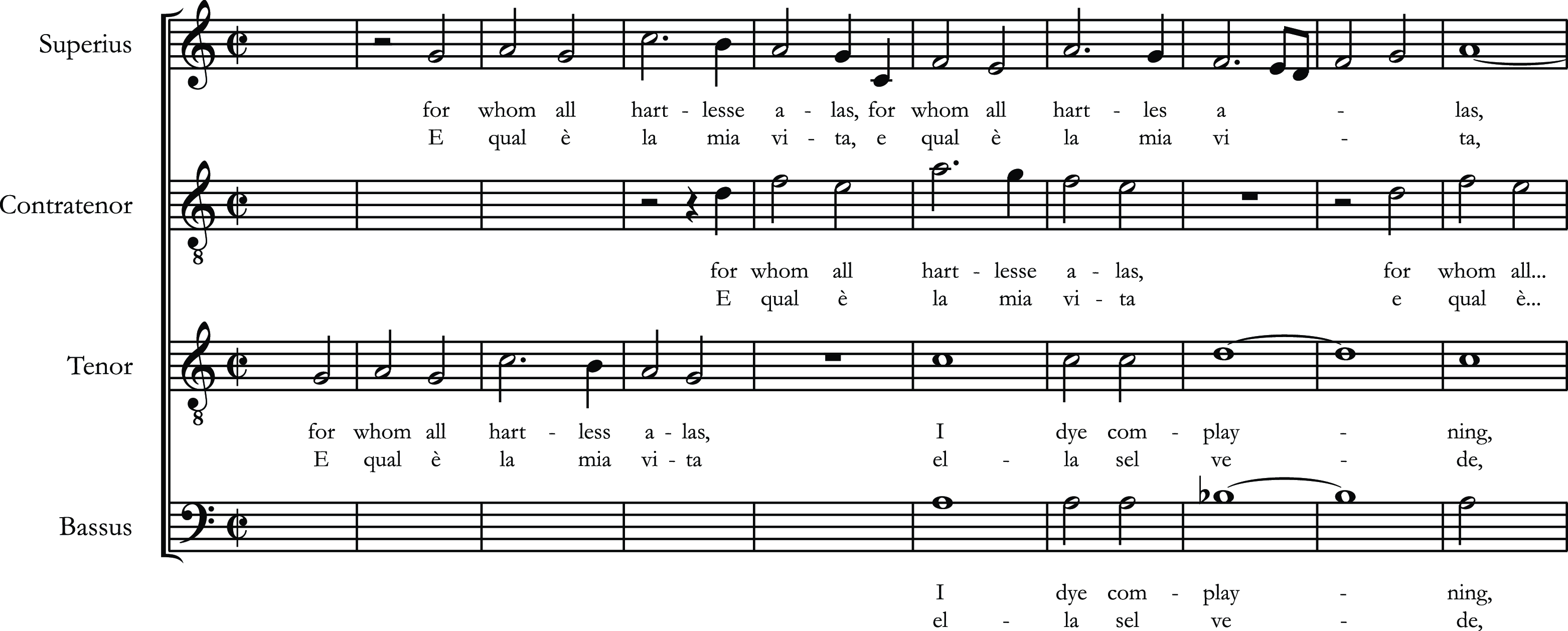
Such a disconnect between the original poetry’s rhythm and Watson’s contrafactum is evident if we return to song 7, Alas, what a wretched life is this? In her analysis of this song, Schleiner argues that attempting to emulate Petrarch’s canzone-form poem, with its varying line-lengths and irregular caesuras, ‘has forced Watson to a new level of rhythmic skill’.Footnote 102 Indeed, Watson’s contrafactum is at times quite attentive to Petrarch’s syntax and metre. Yet curiously, Schleiner illustrates her claim specifically through Watson’s ‘Englishing’ of the final line ‘e qual è la mia vita …’, which he renders as ‘For whom, all hartlesse, alas …’ (see Example 7).Footnote 103
Alas, what a wretched life is this? / Ahi dispietata morte (song 7), bars 64–73

Schleiner rightfully notes that ‘Despite the resulting musical lengthening of the first syllable of “alas,” [e.g. in the Superius, bars 71–2] Watson’s words fit the music better than the original text does at that point, since in Marenzio’s text a strong musical accent repeatedly falls on the unimportant article “la” [e.g. in the Superius, bar 67]’.Footnote 104 However, this very notion that ‘Watson’s words fit the music better’ contradicts Schleiner’s argument for rhythmic correspondence between contrafactum and original poem: Watson’s contrafactum does not follow Marenzio’s rhythmic emphasis of the text when the musical setting fits the accent of the Italian original (on the correctly accented ‘vita’, which becomes the awkward ‘alas’), whereas the accent of the English verse does align with the emphasised notes in the musical rhythm where the madrigal improperly stresses an unaccented syllable of Petrarch’s text (replacing ‘la mia’ with ‘hartlesse’). In neither instance does the contrafactum emulate the original line of verse’s rhythm and placement of accents, or the resultant text–music relationships established by Marenzio – instead, Watson forges a new formal relationship between ‘Englished’ text and musical setting.
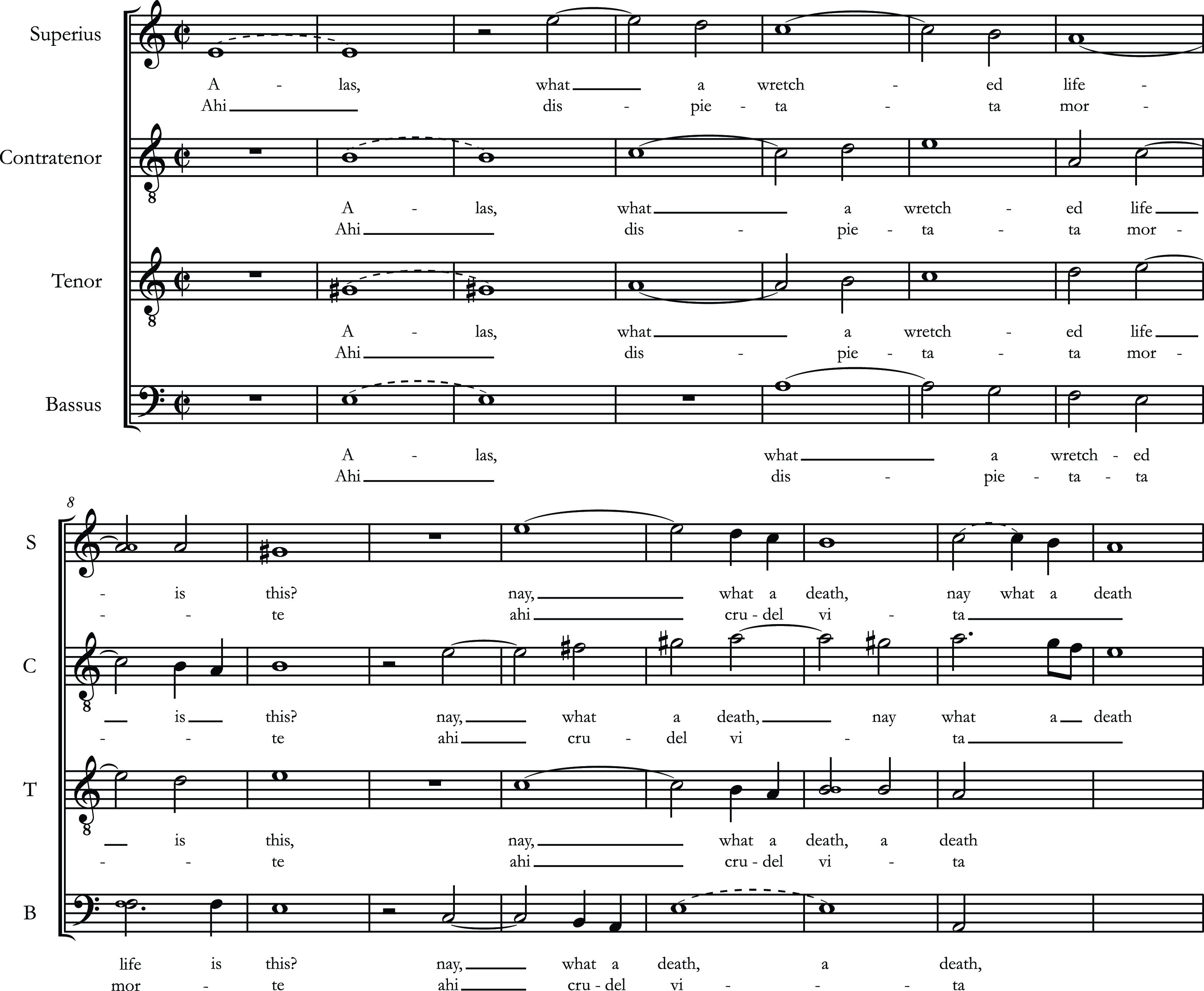
At the beginning of the same song (see Example 8), Watson not only shifts the placement of stressed and unstressed syllables in his opening line, but also adds syllables to the line of verse and textual repetitions not present in the original Italian lyrics. In the first half of the first line of verse (bars 1–9), the seven syllables of ‘Ahi dispietata morte’, accented on the penultimate syllable (‘morte’), become the nine syllables – accented on the final syllable – of ‘Alas, what a wretched life is this?’ This metrical expansion is achieved by two musical alterations: dividing Marenzio’s opening breve into two semibreves to accommodate the syllables ‘A-las’, and adding a second syllable at the cadence where the voices originally sang the single syllable ‘mor-’ of ‘morte’.Footnote 105 Because of these particular alterations, the accents of the English lyrics only align with the Italian half the time, but notably on the important syllables ‘wretched’ and ‘life’. The relationship may be abstracted as below:

Alas, what a wretched life is this? / Ahi dispietata morte (song 7), bars 1–15

The second half of the line (bars 10–15) offers a different alteration of the relationship between textual and musical rhythm: here Watson reduces his ‘Englished’ version from five to four syllables, replacing an Italian feminine rhyme with a more conventionally English masculine rhyme. The final accent of the Italian line ‘… ahi crudel vita’ (emphasised in each voice by a longer note value following two short notes on ‘crudel’) remains musically aligned with the accent of the contrafactum text, also on the fourth syllable – ‘Nay, what a death’. Yet in a significant departure from Marenzio’s text setting, the notes that originally set only the two syllables of the rhyme word ‘vita’ are employed to declaim several additional English syllables (see Example 8): a ‘filling in’ of the underlay by repetitions of either the entire phrase ‘Nay, what a death’ (in the Superius and Contratenor) or simply ‘… a death’ (in the Tenor and Bassus). Although the opening line of the contrafactum thematically echoes Petrarch’s complaint against life and death, Watson’s alterations of the poetic metre and the underlay ultimately creates a very different relationship between textual form and musical setting.Footnote 106 We are far from Schleiner’s claim that song 7 is one of a small group of IME contrafacta that most closely ‘Correspond … syllabically with their Italian counterparts’.Footnote 107
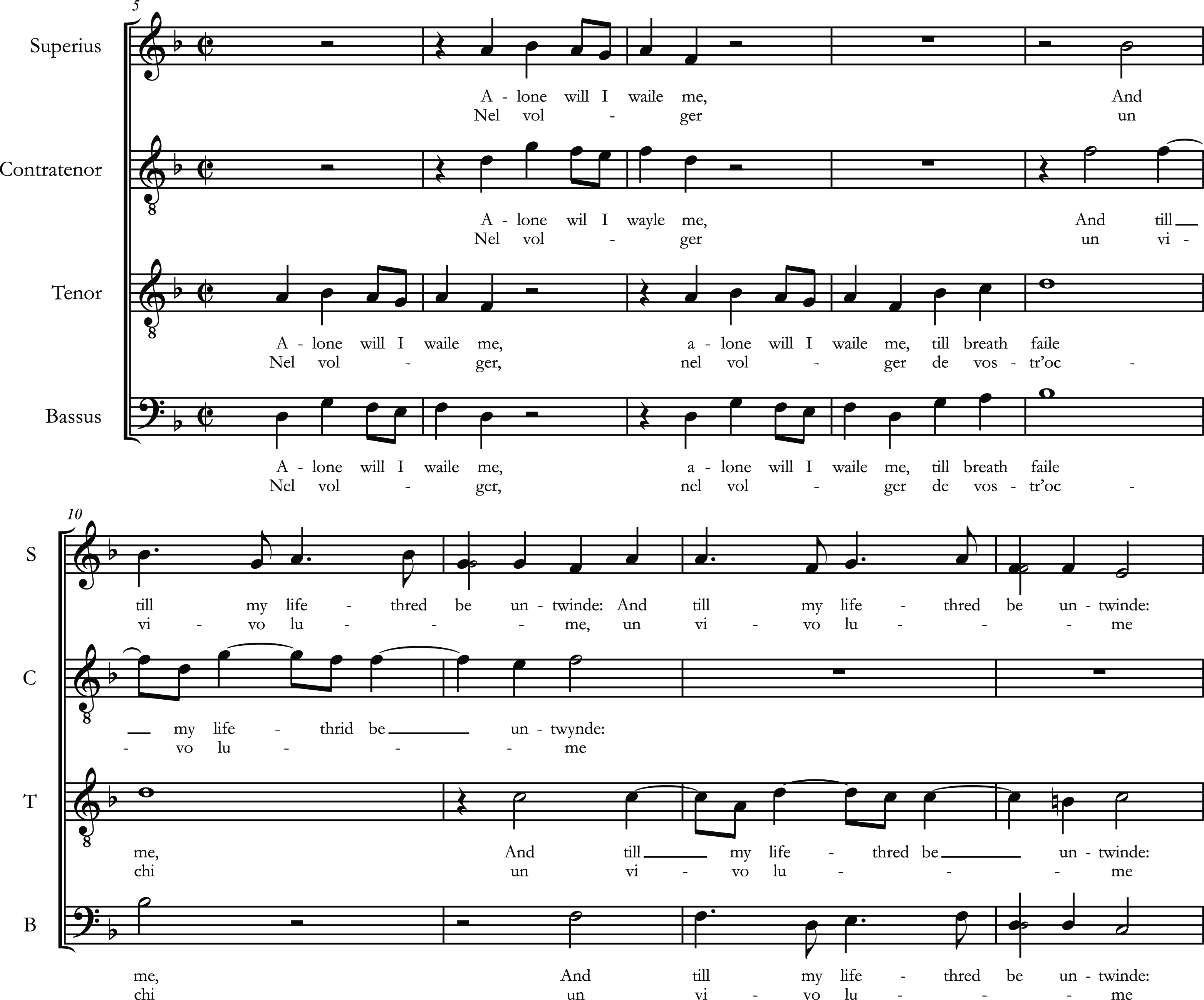
Indeed, song 7 is not an exception, but rather the norm for Watson’s treatment of Italian prosody and its musical representation. Every song in the IME features notable divergences from the original relationship between poetic accent and musical rhythm, often accompanied by significant changes to the underlay of the lyrics. Bars 5–13 of song 3, Farewell, cruel and unkind,Footnote 108 readily demonstrate Watson’s lack of interest in transparently transmitting Italian metre (see Example 9). Here, he breaks up the single twelve-syllable line ‘Nel volger de vostr’occhi un vivo lume’Footnote 109 into the three lines (totalling eighteen syllables) ‘Alone will I waile me, / Till breath faile me, / And till my lifethred be untwined’. The division into three lines of verse is suggested by Marenzio’s setting, which employs three distinct musical phrases for this single line of the Italian poem. However, beyond simply placing rhyming words at the end of each musical phrase, Watson also ‘fills in’ each of the melismas and even subdivides some of the notes in order to accommodate the additional syllables in the lines ‘Alone will I waile me’ (replacing ‘Nel volger’) and ‘And till my lifethred be untwined’ (replacing ‘un vivo lume’).
Farewell, cruel and unkind / Veggo, dolce mio bene (song 3), bars 5–13

This ‘filling in’ of melismas, already seen in song 7, frequently occurs throughout the IME – a stylistic tendency towards a more syllabic declamation that serves to personalise Watson’s ‘Englished’ madrigals by distancing them from Marenzio’s original style of text setting, yet without actually modifying the harmony or melody.Footnote 110 In the final phrase of this passage, Marenzio sets the accented rhyme syllable of ‘lu-me’ on a melisma. (See Example 9, bars 10–13) To better accommodate his masculine-rhymed line, Watson fills in this melisma, a change of underlay that also serves to emphasise the iambic rhythm of ‘And till my life-thred be un-twinde’. While there are slight variations between the voices, Watson’s underlay principles closely resemble those seen at the beginning of song 7: aligning accented syllables with longer note values, ‘filling in’ melismas – especially on feminine rhyme syllables – and subdividing or combining notes when necessary. With all of these changes, the metre of the Italian poem – a typical intermixing of seven- and eleven-syllable lines, with feminine rhyme throughout – is completely obscured in Watson’s English version. Indeed, it is dismissed for a sui-generis poetic form in the contrafactum, featuring highly irregular line lengths and rhyme scheme: a form uniquely suited to Marenzio’s composition, and likely never intended to be printed without the music of this madrigal.
One of Watson’s most unique responses to the original verse form appears in song 2, O merry world. The contrafactum is a fairly close imitation of a famous passage from Eclogue VI of Sannazaro’s Arcadia, I lieti amanti (lines 103–11). Indeed, the English version stands out from other texts in the IME by its lack of novel material or importation of characters from Watson’s other poems – it is as close to a translation as one can find in this anthology.
I lieti amanti e le fanciulle tenere
Givan di prat’in prato ramentandosi
Il foco e l’arco del figliol di Venere.
Non era gelosia, ma sollazzandosi
Movean’i dolci balli a suon di cetera,
E ’n guisa di colombi ogn’hor basciandosi.
O pura fede, o dolce usanza vetera!
Hor conosco ben io che ’l mond’instabile
Tanto peggiora più, quanto più invetera.Footnote 111
O merry world when every lover with his mate,
Might walk from mead to mead & cheerfully relate,
Sowr pleasures & sweet griefs following a wanton state:
Those dais knew no suspect, each one might freely prate,
And dance, or sing, or play with his consociate.
Then lovers usd like turtles to kisse full lovingly.
O hunny dais, & customes of antiquitie:
But the world now is full of so fond jealosie,
That we term charity wanton iniquitie.
Although there are some minor alterations to the content of the text, the English version is notably careful to respect the progression of Sannazaro’s narration and his syntactical structure aligned with the terza-rima pattern. Both the original and the contrafactum consist of two three-line units recalling the past utopia of Arcadia, followed by an exclamation (‘O pura fede, o dolce usanza vetera!’ becomes ‘O hunny dais, & customes of antiquitie’), then two final lines describing the worsened state of the present world. While Schleiner remarks that this is one of Watson’s ‘four best texts rhythmically’,Footnote 112 the contrafactum does not resemble the Italian poem in all its most crucial formal features. Perhaps most evidently, Watson does not follow the terza-rima scheme of the original poem. Yet what is more intriguing here is his reaction to Sannazaro’s use of sdrucciolo lines – lines where the final stress arrives on the antepenultimate syllable. Sdrucciolo lines had been closely associated with fifteenth-century Italian pastoral poetry, but were largely rejected by mainstream, Petrarchan poetics in sixteenth-century Italy, and it was only in the 1580s that madrigal composers returned to setting this ‘verse type so foreign to the madrigal repertory’.Footnote 113 I lieti amanti is one of six texts with sdrucciolo lines set by Marenzio, all of which were written by Sannazaro.Footnote 114 Almost invariably, Marenzio represents each sdrucciolo line ending by a variation on the characteristic rhythm dotted crotchet – quaver – crotchet.Footnote 115 O merry world is the only madrigal with this distinctive feature to appear in the IME, but Watson’s reaction to it appears rather ambivalent: the first four lines of the contrafactum do not fully adhere to Sannazaro’s sdrucciolo rhythm, and instead transform these line endings into masculine rhymes. In line 1, ‘tenere’ becomes ‘with his mate’, and in line 2, ‘ramentandosi’ becomes ‘cheerfully relate’. Nevertheless, in an echo of the sdrucciolo, the third and fourth lines also feature an accent on the antepenultimate syllable: ‘… following a wanton state’ and ‘… each one might freely prate’. However, the subsequent five lines – uniquely in the IME – do in fact end with words stressed on the antepenultimate syllable, thus directly replicating the sdrucciolo rhythm of the original poetry (e.g., ‘antiquitie’, ‘iniquitie’).
While this may appear to be an equivocal, even arbitrary, treatment of a highly marked formal characteristic of Sannazaro’s pastoral poetry, Marenzio’s treatment of these line endings provides an indication as to why Watson chose this particular approach. In setting each of the first four lines of this excerpt from L’Arcadia, Marenzio employs various musical textures that serve to mitigate the impact of the sdrucciolo rhythm. While the five final lines of text each conclude in almost the exact same chordal, homophonic expression of dotted crotchet – quaver – crotchet/minim,Footnote 116 serving to highlight and accentuate the rhythmic particularity of the sdrucciolo (bars 35–6, 39–40, 45–7, 53, 64–5, 68–9), the first four lines are conversely set with longer note values (lines 1 and 4) and overlapping, polyphonic voices (lines 2, 3 and 4) at these moments of sdrucciolo ending. What would seem to be Watson’s most ‘awkward’ adaptation of this rhythm, if simply comparing his text to Sannazaro’s original – where ‘ra-men-tan-do-si / il foco e ’l arco’ becomes the metrically unrelated ‘cheer-ful-ly re-late / Sowr pleasures & sweet griefs’ – in fact occurs at the moment in Marenzio’s setting when the rhythm of the sdrucciolo ending is least apparent. Here, the composer portrays the enjambment between lines 2 and 3 of Sannazaro’s text (an enjambment emulated by Watson’s contrafactum) by overlapping the musical figures for these two lines, without a clear cadential moment to separate the end of line 2 from the beginning of line 3 (bars 6–18) – the only point in the madrigal where a new musical phrase, setting a new line of poetry, begins before all the voices have concluded their utterance of the previous phrase. Every time ‘ramentandosi’ is sung, it overlaps with other words and rhythms, lessening the impact of the sdrucciolo (see Example 10). The difference between such a texture and the clear, chordal treatment of the sdrucciolo at the end of the eighth line of the text (bars 64–5) is evident (see Example 11).
O merry world / I lieti amanti (song 2), bars 9–14

O merry world / I lieti amanti (song 2), bars 60–5

As previously mentioned, one of Sidney’s arguments for the English language’s superiority to other vernaculars was what he perceived as its ability to accept more formal variety in rhyme: unlike Italian, which, he claims, can only rhyme on the penultimate or antepenultimate syllable, and unlike French, which can only rhyme on the final or penultimate syllable, ‘the English hath all three’.Footnote 117 With O merry world, Watson demonstrates that he is capable of rhyming with not only the final and penultimate syllables, as seen in the other contrafacta of the IME, but equally with the antepenultimate sdrucciolo that characterises Sannazaro’s pastoral verse. However, he does not treat this formal feature as an obligation. Where Marenzio’s music allows it, Watson prefers rhymes on the final syllable of the line, thus proving that this markedly pastoral madrigal can also accommodate a formal feature – masculine rhymes – more identifiably English than Italian. What constituted one of the most identifiable formal elements of Sannazaro’s Italian Arcadia – the sdrucciolo rhyme – becomes in Watson’s Arcadia simply one possible choice for rhyming, another claim for independence from the Italian model and an argument for a more characteristically English pastoral style.
These contrafacta demonstrate that – while he was perhaps not always completely successful – Watson was intent on creating felicitous connections between the rhythms of his English verse and Marenzio’s music.Footnote 118 However, Watson does not simply seek to replicate the original prosody of the Italian lyrics he replaces through a one-to-one correspondence or to consistently follow the original rhythms of the madrigals. Just as often, he modifies the madrigals’ underlay or even the values of notes to make the songs accommodate a new poetic accent, a new metre or a new rhyme. Individually, such changes do not always greatly alter Marenzio’s compositions. Yet, when observed in their totality, they present the English singer or composer with a very different idea of how one declaims lyrics in a madrigal, quite far from Marenzio’s original intentions. Considered alongside Watson’s numerous appropriations and manipulations of the content of the original lyrics, these varied responses to the musical representation of Italian prosody seek to undermine the fixity of the relationship between the madrigal and its original lyrics – the idea that a madrigal must necessarily represent a unique and markedly Italian text. The IME thus makes the claim that songs in this prestigious foreign genre are not intrinsically tied to a specific text, language, subject matter or even poetic form. And if these songs can be so dramatically resignified, while still retaining the intimate relationship between text and music for which they are so admired, then the madrigal can begin to be considered not merely a ‘Musica Transalpina’ – a foreign music from beyond the Alps – but equally as an English genre. The lyrics of the IME’s ‘two excellent Madrigalls of Master William Byrds, composed after the Italian vaine’ (as they are described on the title page of the partbooks) confirm this assertive claim for the naturalisation of the madrigal: this is music that is fully suited not only to the English language but also to the distinct political and cultural concerns of Elizabethan England.
The two madrigals written by Byrd, both to Watson’s text This sweet and merry month of May, simultaneously represent both an exception to and a culmination of the IME’s ‘Englishing’ project. Uniquely for this collection, these songs feature original English lyrics set to newly written music by an English composer, and thus constitute the first fully homegrown Elizabethan madrigals. Yet, while the text employed is not a contrafactum written for an Italian madrigal, these two English songs nevertheless play an equally crucial role in advancing Watson’s agenda of appropriating and resignifying Italian art. Published alongside the many compositions of the celebrated Marenzio, the Byrd madrigals make two overlapping claims. First, that English composers are capable of writing madrigals every bit as effective and imagistic as the Italians’. Secondly, that such madrigals – while capably emulating the popular Italian musical style – can nevertheless set a text that in both content and form is explicitly English, and do not require an identifiably Italian or Italianate English text. The result, in alignment with the process of contrafaction and resignification we have witnessed throughout the IME, is an even stronger rejection of the notion of the madrigal as a uniquely Italian art form, reliant on Italian poetry and Italian (or at least continental) composers for its fullest expression.
Musically, both Kerman and Knight agree that Byrd’s IME madrigals, although perhaps ‘more conservative than Marenzio’s’, resemble their Italian counterparts, and capably illustrate many of the characteristic features of the genre.Footnote 119 This stylistic ‘conservatism’, however – like Watson’s taste among Marenzio’s madrigals – we might qualify as not simply Byrd’s idea of ‘the madrigal’, but more specifically, the pastoral madrigal as it appears throughout the IME. For while they do not resemble Marenzio’s more chromatic and experimental works, Byrd’s madrigals evoke many of the ‘ostentatiously simplistic’ tactics employed by the Italian composer in his settings of pastoral scenes, stylistic features that often draw from the lighter canzonetta genre.Footnote 120 For example: short, undeveloped melodic units; the frequent use of repetition; even specific treatments of key words, such as canonic imitation to illustrate the idea of ‘play’ (bars 20–6, song 28), which notably also appears in a work included in the IME, Marenzio’s Spuntavan già, ‘Englished’ as song 14, Sweet hart arise (compare Examples 12 and 13).Footnote 121
Byrd, This sweet and merry month of May (song 28), bars 20–6

Marenzio, Spuntavan già / Sweet hart arise (song 14), bars 56–61

However, in a similarly disingenuous manner to Watson’s promise of lyrics ‘not to the sense of the originall dittie’, while the Byrd madrigals are indeed ‘composed after the Italian vaine’, the text they set is in many ways unabashedly English in both content and form:
This sweet and merry month of May,
While nature wantons in her Pryme,
And Byrds do sing, and Beasts do play,
For pleasure of the joyfull time,
I choose the first for holly daie,
And greet Elyza with a Ryme.
O Beauteous Queene of second Troy,
Take well in worth a simple toy.
Of course, a pastoral May Day song was conventional not only in Watson and Byrd’s homeland, and one can simultaneously hear echoes of Spenser – ‘Is not thilke the mery moneth of May’Footnote 122 – and, as Alfredo Obertello notes, ‘every and no particular Italian poet’.Footnote 123 And for the first five lines, the subject is indeed rather generic: the language of wantoning nature, singing birds, playing beasts – even the term ‘pleasure’ that is Watson’s favourite rhyme-word in the IME Footnote 124 – all serve to integrate this work into the general pastoral tone of the collection, without directly identifying it as an English pastoral song. Yet, beginning in the sixth line, the offer of Watson’s verse to ‘Elyza’ – the first explicit mention of Queen Elizabeth to appear in a madrigal, but not by any means the last – centres the work in contemporaneous England more concretely than almost any of the contrafacta of the IME, with their recourse to pseudonymous characters such as Astrophil, Meliboeus and Diana. In the following lines, ‘O Beauteous Queene of second Troy, / Take well in worth a simple toy’, Watson’s reference to the legendary Trojan lineage of British monarchs makes a direct claim to ‘translatio studii et imperii’ (the transfer of learning and of rule).Footnote 125 As London – Troynovant – takes Rome’s place as successor to Troy, the pastoral madrigal is also transferred from the banks of the Tiber to the Thames, completing the naturalisation of the ‘Tebro’ seen in song 19. The importance of this appropriation is reinforced by Watson’s choice of rhyme scheme: the noble ottava rima of Italian epic verse,Footnote 126 as employed by Tasso in his Gerusalemme liberata, and already seen in the excerpt Vezzosi augelli discussed above. The music only serves to drive this triumphalist message home. In both the four-voice and six-voice versions (song 8, bars 50–5; song 28, bars 59–62), all the singers pause before addressing the queen with a grand homophonic declaration (see Example 14), whose texture recalls the address to the ‘Faire shepherds Queene’ at the beginning of song 5 (Example 4 above).
Byrd, This sweet and merry month of May (song 8), bars 42–55

These last three lines of the poem also encourage an evident allegorical reappraisal of the first five lines, with May Day as a celebration not simply of the return of spring and the rebirth of nature, but also the flourishing of a newly powerful and proud England, now ‘in her Pryme’. Indeed, a three-stanza song written for the earl of Hertford’s entertainment honouring the queen’s visit to Elvetham in 1591, Watson’s Dittie of the Six Virgins, features a refrain echoing the last two lines of This sweet and merry month of May, further aligning pastoral imagery of fertility and growth with topical concerns about England’s stature:
With fragrant flowers we strew the way
And make this our chiefe holliday.
For though this clime was blest of yore,
Yet was it never proud before.
O beauteous Queene of second Troy,
Accept of our unfained joy.Footnote 127
This sense of pride could of course refer to England’s economic, military or political achievements, but it also points to the fulfilment of an artistic promise that, only a decade earlier, remained far more uncertain. At the beginning of Hekatompathia in 1582, a prefatory poem by a ‘C. Downhalus’ called the Muses to Watson’s native land:
Hath Britan soyle no hill, no heath, no well,
No wood, no wit, wherein you list to dwell?
Ladies vouchsafe with pacience once to view
Our lively springs, high hills, and pleasaunte shades,
…
Loe Watson prest to enterteine your powre
In pleasante springs of flowing wit, and skill:
If you esteeme the pleasures of his bower,
Let Britan beare your spring, your grove and hill,
The natural qualities of the English should be an attraction to the Muses, yet in 1582 Downhalus must still encourage the nine ‘Ladies’ to settle in this fertile soil, to recognise the ‘wit and skill’ of pioneering poets such as Watson. Or, as Sidney had put it in his contemporaneous Defence of Poetry, when considering why the gifted English wit had not yet brought forth great poetry, even ‘the fertilest ground must be manured [i.e. cultivated]’.Footnote 129 Nearly a decade later, these May Day songs seem to claim that England’s ‘blest clime’ can finally be proud of its poets – Watson not least among them – who, through the judicious imitation and appropriation of foreign models, have cultivated and guided verse on her soil and made it to flourish.
Both this later Elvetham song and an earlier collaboration between Watson and Byrd, the 1586 broadside A Gratification unto Mr. John Case, for his Learned Booke, Lately Made in the Prayes of Musick,Footnote 130 also share an important formal trait with This sweet and merry month of May. All three of these songs – the three texts that we definitively know Watson wrote to be set to new music – feature the same regular iambic tetrameter, invariably with masculine rhymes. This formal regularity represents a significant departure from his contrafacta’s fluid, irregular metres and rhyme schemes, at times influenced by the Italian poetic models and more frequently by the unique inflections and rhythms of Marenzio’s melodic lines.Footnote 131 In contrast, when writing poetry to be set to new music, Watson seems to prefer a fixed, more traditional metre – one employed in many broadside ballads of the period,Footnote 132 and in one of the eight tunes of Matthew Parker’s Psalter Translated into English Metre.Footnote 133 The opening of the Gratification can be compared to Watson’s two other original English song texts:
Let others praise what seem them best,
I like his lynes above the rest …
This sweet and merry month of May,
While nature wantons in her Pryme …
With fragrant flowers we strew the way
And make this our chiefe holliday …
We must recall that the sixth line of This sweet and merry month of May is ‘And greet Elyza with a Ryme’. Seemingly an innocuous statement, it becomes more consequential given the musical setting for this text: a madrigal ‘composed after the Italian vaine’. One of the few formal properties of Marenzio’s original Italian lyrics that Watson regularly maintains in his contrafacta are feminine rhymes, which were at this time a relative rarity in English poetry.Footnote 134 However, for the first completely English madrigal, which he explicitly identifies as ‘Italian’ in musical style, Watson chooses not to emulate this characteristic feature of Italian prosody in his lyrics, and instead maintains the same iambic tetrameter and masculine rhymes as his earlier Gratification. Here, the use of a more identifiably English metre and rhyme also serves to naturalise the ottava-rima stanza form, making a claim that native English prosody – like native English political and cultural concerns – can provide lyrics just as suitable to the madrigal as a sonnet by Petrarch or a terza-rima eclogue by Sannazaro.Footnote 135 Watson, while genuine in his admiration for Marenzio and the great Italian poets, nevertheless aims to surpass his Italian models with these two ‘excellent’ English madrigals – musical arguments not only that his countrymen are ‘not lesser than the Italian in wit’ but also that, when writing poetry for this most prestigious of musical styles, they can draw as much inspiration from ‘Britan soyle’ as from the canonical exemplars of foreign verse.
Like his earlier Hekatompathia, Watson’s IME has often been referred to as a didactic project, providing models for English artists so they might write poetry and madrigals in a similar style to, and with a similar manner of text–music relationship as, the great Italian works of the period.Footnote 136 Yet, as we have seen, this anthology presents a very specific, narrow definition of the madrigal. The musical selections, centred on the pastoral madrigals of a single composer, are stylistically quite homogeneous, while the contrafactum texts owe as much to Watson’s own prior works and poetic preferences as to the original Italian lyrics. Although these Italian texts remain everywhere influential, and in many ways fundamental to the ‘sense’ of the contrafacta, the collection’s aim is not to provide a transparent window into Marenzio’s lyrical sources or into his personal manner of setting these texts to music. Instead, it models an approach to writing English madrigals – both lyrics and music – that is specific to Watson’s intention of inaugurating an identifiably Elizabethan pastoral madrigal. The IME is thus not, as Joseph Kerman once described it, ‘direct propaganda for Italian art’Footnote 137 but rather propaganda for English art, and for England. At a time when his country increasingly sought to affirm its identity and assert itself beyond the Channel – a time, also, when English culture balanced a measure of aristocratic Italophilia with significant xenophobia and anti-Catholic sentimentFootnote 138 – Watson’s contrafacta promote the ‘Englishing’ of foreign art in a manner that does not aspire to literal translation or faithful imitation, nor strive to completely erase its continental sources. Instead, this process of naturalisation entails a careful resignification of the model through the integration of recognisably English elements – a transplantation of the pastoral madrigal from the courts of Italy to the banks of the Thames.
Appendix
A Brief Description of the Content and Form of the IME Contrafacta