

Autism spectrum disorder (ASD) is a pervasive disorder that is recognised as developmental and functional impairments (e.g., sensory, behavioural, emotional, social, and motor), with a history that is present since early childhood (American Psychiatric Association, 2013). Due to this pattern of symptomatology, people with ASD experience lifelong restrictions on full participation in social, play, leisure activities, and other settings (Tanner, Hand, O’Toole, & Lane, Reference Tanner, Hand, O’Toole and Lane2015), ultimately impacting their Quality of Life (QoL; Chiang & Wineman, Reference Chiang and Wineman2014).
The World Health Organization defines QoL as:
an individual’s perception of their position in life in the context of the culture and value systems in which they live and in relation to their goals, expectations, standards and concerns. It is a broad ranging concept affected in a complex way by the person’s physical health, psychological state, personal beliefs, social relationships and their relationship to salient features of their environment (World Health Organization, 1999).
Investigating the QoL of individuals with ASD is imperative as the latest Australian Government figures reported an estimated 164,000 Australians were diagnosed with ASD in 2015, which represents approximately 1 in 150 Australians (Australian Institute of Health and Welfare, 2017). This is a 42% rise since previously recorded in 2012. With the increasing prevalence of ASD, the demand for effective intervention is fundamental (Oriel, George, Peckus, & Semen, Reference Oriel, George, Peckus and Semon2011).
Understanding psychological and physical wellbeing are important theories behind QoL. The psychological wellbeing of individuals with ASD and how they cope with a psychological stressor was investigated by Roncaglia (Reference Roncaglia2014). The author postulated that in the therapeutic session, the generalisability of conventional psychological techniques such as cognitive behaviour therapy (CBT) could be challenging, as individuals with ASD may often lack communication and theory of mind (i.e., the ability to understand what others are experiencing, feeling, and thinking) skills. Understanding ways to improve the coping mechanisms and styles that underlie stress management among individuals with ASD could assist in better quality support. Therefore, consideration of alternatives to traditional sit-down, language-based therapeutic methods, such as CBT, is essential to ensure treatment effectiveness and best outcomes toward improving the QoL within this population.
A review of 66 group-based social skills training programs led by therapists for people with ASD was conducted by Tanner et al. (Reference Tanner, Hand, O’Toole and Lane2015). In general, group-based interventions included in this review found an increase in participants’ social skills, social communication, and positive interactions, while repetitive/stereotypic behaviours and negative interactions decreased. Moreover, people who participated in group programs showed more improvement than people having individual intervention. Groups that were most effective met regularly for 60 minutes at a time for a total of eight hours. Therefore, it is essential to incorporate ‘group therapy’ as part of the therapeutic plan in the treatment of ASD, to improve social skills and social communication skills, and reduce stereotypic behaviours.
The literature on factors associated with QoL in children and adults with ASD was reviewed by Chiang and Wineman (Reference Chiang and Wineman2014). The authors examined a total of 16 studies and found that behaviour problems, leisure activities, and age were associated with QoL for the majority of the children and adults with ASD. The more behaviour problems a child or an adult with ASD had, the poorer the QoL. Behaviour problems could also have an impact on interpersonal relationships, which is a QoL domain. In contrast, participation in leisure activities (Physical Wellbeing Domain) was positively associated with QoL for children and adults with ASD. This finding highlights the importance of providing leisure activities for children and adults with ASD. Interestingly, Chiang and Wineman (Reference Chiang and Wineman2014) found that QoL of adults with ASD was not essentially determined by the severity of their disability, suggesting that higher functioning adults with ASD do not necessarily have a better QoL than their counterparts with a more severe presentation. Chiang and Wineman (Reference Chiang and Wineman2014) also found age to be negatively associated, stating that the older a child was, the poorer their QoL. Therefore, it is important for paediatric services to adjust intervention programs provided to children with ASD as they progress across different developmental stages.
Physical Activity as a Therapeutic Intervention
While a number of studies have shown physical activity to have multiple benefits (Lochbaum & Crews, Reference Lochbaum and Crews2003; MacDonald, Esposito, & Ulrich, Reference MacDonald, Esposito and Ulrich2011; Oriel et al., Reference Oriel, George, Peckus and Semon2011; Pan, Tsai, & Hsieh, Reference Pan, Tsai and Hsieh2011; Roncaglia, Reference Roncaglia2014; Srinivasan, Pescatello, & Bhat, Reference Srinivasan, Pescatello and Bhat2014; Todd & Reid, Reference Todd and Reid2006; World Health Organization, 1999), participation in physical activity is often a challenge for people with ASD (Pan et al., Reference Pan, Tsai and Hsieh2011). Pan et al. (Reference Pan, Tsai and Hsieh2011) investigated physical activity among middle school-aged children with ASD who took part in physical education classes. Results showed that students with ASD were (a) less physically active than their peers, (b) their physical activity was related positively to their social interaction with peers, and (c) their moderate-to-vigorous physical activity depended on content, physical environment, and instructor-related characteristics. The authors postulated that autistic symptoms, such as difficulties understanding social cues, making eye contact, playing social games, engaging in sharing/turn-taking and reciprocal conversation, and making friends could be attributed to the findings. Such social, behavioural, and motor skill impairments may prevent individuals with ASD from joining in with their peers in school-based exercise and physical activities, which may render them the possibility of developing secondary health problems. Hence, promoting physical activities that involve fewer complex motor skills, and lower demand in social interaction and social communication skills, may improve participation in physical activities (Todd & Reid, Reference Todd and Reid2006).
Traditional approaches to interventions for children with ASD typically focus on behaviour, social communication and academic impairments via predominantly sedentary, table-top activities, and are within highly structured and confined environments (Srinivasan et al., Reference Srinivasan, Pescatello and Bhat2014). Given the increasing research findings highlighting the physical and psychological benefits of exercise, Srinivasan et al. (Reference Srinivasan, Pescatello and Bhat2014) recommended that motor and physical activity-related goals be included within the plan of care for individuals with ASD. The authors provided a list of therapeutic considerations for practitioners who wish to deliver exercise intervention programs to children with ASD. In particular, two important aspects of an exercise intervention were highlighted from this investigation: (1) the structure of the exercise environment, and (2) the nature of the clinician’s interaction. The latter included brief verbal instructions with manual guidance and visual aids, verbal and gestural feedback, and token reinforcements. The authors also concluded that an exercise intervention program should include aspects of aerobic, resistance, flexibility, and neuromuscular training for maximum gains in fitness and body composition. As a sedentary lifestyle is often reported within this population, an exercise therapy-based intervention using visual techniques and a structured program is essential to improve an individual’s physical functioning QoL.
MacDonald et al. (Reference MacDonald, Esposito and Ulrich2011) investigated the sedentary and physical patterns of 72 children with ASD aged between 9–18 years. Results from this study were obtained from ankle movement recordings over a period of seven days, which found physical activity recordings declined the older children with ASD were. Moreover, MacDonald et al. (Reference MacDonald, Esposito and Ulrich2011) recommended that a naturalistic environment is also essential when planning physical activity intervention programs to obtain further positive benefits. These findings highlight the need to incorporate specialised intervention programs across the lifespan that are functional and demonstrate a sense of purpose for people with ASD to identify with.
An example of how to use a naturalistic environment that is repetitive and predictable was observed in Oriel et al.’s (Reference Oriel, George, Peckus and Semon2011) study, which explored physical activity and academic engagement in a specialist school setting. The purpose of their investigation was to determine whether participation in aerobic exercise before classroom activities improved academic engagement and reduced stereotypic behaviours in young children with ASD. Results showed that seven out of nine participants significantly improved in correct responding following 15 minutes of running. Moreover, improvements in academic responding continued for 30 minutes following aerobic exercise. On the other hand, there were no statistically significant improvements in the amount of time on task or in stereotypic behaviours. The authors concluded that the results of this study indicate that aerobic exercise prior to classroom activities may improve academic responding in young children with ASD and found these preliminary results to be consistent with similar findings in older children. Therefore, aerobic exercise delivered in a predictable format may also increase QoL in individuals with ASD by enhancing their school and cognitive functioning.
Lochbaum and Crews (Reference Lochbaum and Crews2003) argued that despite the growing evidence from cardiorespiratory fitness, research investigating the effects of muscular strength training or resistive-type exercise on physiological and psychological outcomes had been largely overlooked. Developing both cardiovascular and muscular fitness was therefore observed by this author among five individuals with ASD and mild intellectual disability, ranging in age from 16 to 21 years. The study aimed to provide evidence that exercise programs that enlisted individuals with ASD and continued over time, were both sustainable and worthwhile. Although a small sample was available, both aerobic and muscular strength-training programs produced positive fitness gains by increasing their aerobic or weight-bearing load and were sustained over 18 training sessions, showing evidence that health benefits were maintainable over time and that using this form of intervention was also valuable.
To date, research-based interventions have typically focused on confronting the core deficits of ASD as separable models; that is, behaviour therapy, speech therapy, and occupational therapy. The aim of the current study was to implement a scientist-practitioner approach to intervention by providing a safe and structured environment where children with ASD could learn to develop and strengthen their muscular-skeletal system, improve their physical fitness, and fortify their psychological coping, to achieve better physical and psychological wellbeing, and ultimately improve their QoL. To investigate these factors, caregiver and adolescent perceptions of QoL were surveyed according to the child’s (1) physical functioning, (2) emotional functioning, (3) social functioning, (4) school functioning, and (5) cognitive functioning.
Method
Setting
The clinic is a multidisciplinary paediatric private practice located in Melbourne’s western suburbs. It is a purpose-built facility housing a large gymnasium and private consulting rooms. The need to implement a sports and recreation group was identified in 2012 following clinical observations of motor difficulties in many individuals who accessed this service and who had a lack of physical activity anecdotally reported by parents. The program ran on a school-term basis for 1 hour per week over 8 consecutive weeks.
Participants
There were six members (four males, two females) with an age range from 10 to 21 years who participated in this group. However, to meet the inclusion criteria, completion of a questionnaire at pre- and post-group was required. Data from a total of four participants (two males, two females) aged from 10 to 16 years were successfully collected and met the inclusion criteria. Participants were all formally diagnosed with an ASD prior to the group and attended a mainstream educational setting.
Procedure
At the centre, a psychologist, occupational therapist or speech pathologist screened all participants for group suitability through observation and were available throughout the program to provide advice concerning individual participants. Through experience, it is important to prescreen, knowing the group dynamics and how best to support individuals within the group, rather than relying on age and expressions of interest alone.
A qualified exercise physical trainer and an educational and developmental psychologist developed an inclusive structured program that incorporated aerobic exercises, body weight training, and social skill development, all tailored according to participants’ developmental needs. All physical exercises focused on functional movements and cardiovascular fitness, while psychological techniques promoted instruction on social mannerisms, group skills, emotional regulation and coping, and modifications to undesirable behaviours. The program focused on prerequisite physical skills such as motor coordination, balance, strength, and agility, while also working on social and emotional issues such as joint attention, anger, anxiety, self-esteem, and group participation.
A weekly visual schedule of the program was presented to the participants at the beginning of the 1-hour session each week. All sessions were structured in a similar format to promote predictability and constituted: a 10-minute warm-up; 20 minutes of functional movement technique allowing for group and individual instruction and practice; followed by a 20-minute workout based on three to four exercises, and which included the newly acquired movement technique. Sessions ended with a 10-minute cool down and stretch. The physical trainer would focus and correct participant movements and technique while the psychologist would provide psychosocial support such as emotional regulation, self-confidence, motivation, and behavioural strategies to participants as required. Visual aides (e.g., hand/footprints to show where to place hands and feet) and positive reinforcement (e.g., token system, high-fives, labelled praise) were implemented as necessary.
An independent ethics review board was not utilised as data was collected to review program effectiveness. However, it is the writer’s opinion that the program design and implementation was conducted within professional code of practices. All parents of the adolescents provide signed consent to research participation.
Measures
The Pediatric Quality of Life Inventory™ Version 4.0 (PedsQL™ 4.0; Varni, Reference Varni1998a, Reference Varni1998b) is a multidimensional scale that was implemented to measure health-related QoL across five domains, these being physical functioning, emotional functioning, social functioning, school functioning and cognitive functioning. Together, this 23-item questionnaire yields a core total and wellbeing score gained through parent report form and/or self-reporting form, which is applicable for healthy school and community populations, as well as paediatric populations with acute and chronic health conditions.
Parents and participants were asked to rate aspects of their functioning on how they felt in the past month according to a 5-point Likert-type scale from 0 (Never) to 4 (Almost always), with questions such as ‘I have low energy’. The total possible score ranges from 0–92, with higher scores reflecting higher health-related QoL. The PedsQL™ has a high internal reliability Total Scale Score (alpha = .88 child, .90 parent), Physical Health Summary Score (alpha = .80 child, .88 parent), and Psychosocial Health Summary Score (alpha = .83 child, .86 parent). The PedsQL™ is reported to be responsive to clinical change over time. It is therefore considered to be a valid measure of QoL in children and adolescents, and acceptable for group comparisons (Varni, Seid, & Kurtin, Reference Varni, Seid and Kurtin2001). Measurement of intervention took place at week 1 of 8 in Term 2 and at week 4 of 8 in Term 4 to reflect pre- and post-intervention. There was a break between group interventions for the duration of Term 3. Therefore, participants had exposure to a total of 12 group intervention sessions over an approximate 6-month period.
Results
Items were reverse-scored and transformed to a 0–100 scale (0 = 100, 1 = 75, 2 = 50, 3 = 25, 4 = 0) so that higher scores indicate better health-related quality of life. Subscale scores were created by adding scores from relevant items and dividing by the number of items. Physical (8 items), emotional (5 items), social (5 items), school (5 items), psychosocial (15 items — emotional, social and school items), total (23 items — physical, emotional, social and school items).
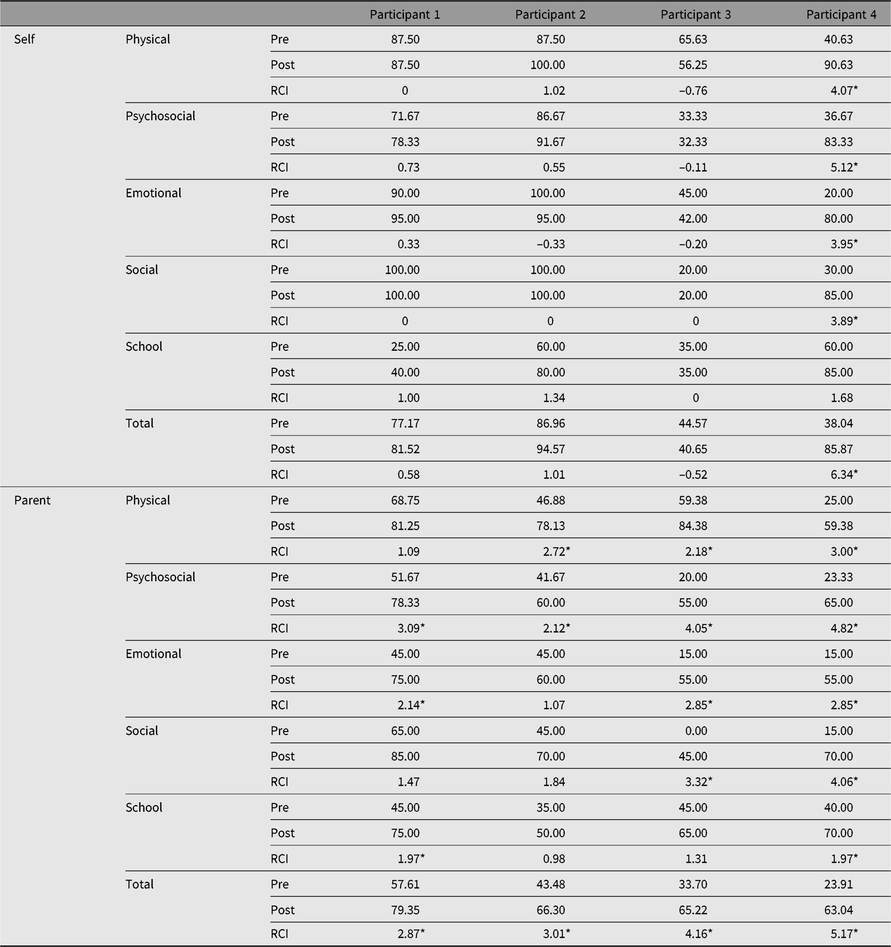
The Reliable Change Index (RCI) was calculated to measure clinical significance by subtracting Time 2 from Time 1 and dividing by the standard error of differences (Jacobson & Truax, Reference Jacobson and Truax1991). Standard deviation (SD) and reliability coefficients (α) were taken from Varni et al. (Reference Varni, Seid and Kurtin2001) to calculate standard error of the differences using the equation √2(SE)² where SE = SD√1–α. Values greater than or equal to 1.96 represent a significant difference at the p < .05 level. Pre- and post-intervention results for parent- and self-reporting on the PedsQL™ are recorded in Table 1.
Pre- and Post-Intervention Measurements of PedsQL™ Parent Reports and Self-Reports

Note: RCI = Reliable Change Index.
* p < .05
Physical functioning
Among the adolescent self-reporting, there was a significant change observed by Participant 4. Three out of four parents reported significant improvement in their child’s physical functioning.
Psychosocial functioning
One participant reported higher ratings on psychosocial functioning at the significant level. All parents reported that psychosocial functioning had significantly improved for their dependent adolescent following intervention.
Emotional functioning
One out of four adolescents self-reported that their emotional functioning significantly improved. Three out of four parents found that emotional functioning had significantly improved for their dependent adolescent following intervention.
Social functioning
One out of four adolescents believed that their social functioning significantly improved. Two out of four parents informed that social functioning had significantly improved for their dependent adolescent following intervention.
School functioning
On the self-report, no adolescents thought that their school functioning had significantly improved, whereas two out of four parents stated that school functioning had significantly improved for their dependent adolescent following intervention.
Overall functioning
Pre- and post-measurement found four out of four adolescents’ scores showed no significant differences. On the other hand, all parents reported that their dependent adolescent’s overall functioning was better following intervention and that the change was achieved at a significant level.
Cognitive functioning
Due to normative data only being available for the PedsQL™ Core Scales, the RCI was unable to be calculated to assess whether the degree of change was significant. Anecdotally, however, all participants and their parents reported that cognitive functioning had improved following intervention.
Qualitative data
Data from the parent feedback form were collected at the end of the treatment program and used to provide qualitative analysis. Parents were asked to provide a rating according to a 5-point Likert-type scale (1 = Very low, 2 = Low; 3 = OK; 4 = High; 5 = Very high), and comment on five themes related to service delivery. These themes were ‘About the program’, ‘Changes in child’s behaviour/development’, ‘About the facilitators’, ‘Administration’, and ‘Future enrolment’.
About the program
Overall, participants described their experience about the program as enjoyable. Three out of four parents rated their child’s level of enjoyment from attending the program as a 5 (Very high), and one parent rated a 4 (High). Additional comments received about the program included ‘… satisfied with everything’; ‘X loves this program — all of it!’; ‘I have seen a big improvement in X’s skills in all areas’; ‘It was great to see a variety of games. You guys were extremely encouraging’.
Changes in child’s behaviour/development
This section asked for parents to comment only. The feedback received was as follows: ‘Confidence has improved and self-development has improved greatly. Confidence in herself and with others’; ‘X is able to shower herself with little prompting, able to get herself changed and interacts with people more freely. X is taking on more challenging things without losing the plot. She has a higher level of self-worth. The change in her over the last six months is amazing’; ‘Yes — he seems to respond to the feeling of belonging. He looks forward to group — the physical aspects as well as the social’; ‘… just the same’; ‘X’s strengths now outweigh his difficulties. He has become a very strong young man who is not afraid to speak up. He is out more and gets involved in things. A big change.’
About the facilitators
In general, parents were satisfied with the facilitators and their approach. Three out of four parents rated facilitators as a 5 (Very high) and one parent rated a 4 (High). Comments received included ‘Nothing to comment — all good’ and ‘Very well supported at all levels’.
Administration
Parents were satisfied with the administration of the program overall. Two out of four parents rated the billing system with a 5, very high satisfaction. One parent found the billing system to be a high level of satisfaction and the other parent did not provide a rating. In terms of how satisfied parents were that the program offered value for money, two out of four parents rated it as a 5 (Very high), and one parent rated it as a 4 (High). There was one parent who did not provide a rating. No further comments were provided by any of the parents.
Future enrolment
Four out of four parents reported that they would like for their child to enrol the next term. They also expressed that they would like to enrol their child in future programs.
There were other incidental findings as a result of the program that are worth noting. For example, the adolescents and their parents formed friendships and support outside of the program. Moreover, the entire group attended a participant’s 18th birthday party. On social media, a parent support group involving all the parents was created and managed by the parents themselves. One of the participants generalised their motor and/or social skill development and has played for a regional basketball team.
It is also worth highlighting that the clinic is located in a lower SES suburb and hence participants were likely to be from a low SES background. This is a significant point to mention as most participants had re-enrolled across the year, indicating that parents saw benefits achieved and value for money.
Discussion
The purpose of this study was to review the quality of intervention planning and delivery to children with ASD, which is key to improve their physical and psychological wellbeing, as these constructs are important to elevate their overall QoL. The present study expands on the understanding of traditional types of intervention that is provided to people with ASD by encouraging practitioners to use a multimodel approach and consider athletic-based programs as part of the individual’s ASD intervention plan.
The preliminary results of the current study showed that athletic-based intervention delivered in a group environment improved the QoL and wellbeing of children with ASD. The aerobic and muscular strength group-training program produced positive psychological, physiological, social, and academic gains. In particular, all parents reported that their adolescent’s Total QoL improved and achieved a significant change due to the intervention received. In addition to this finding, all parents rated their adolescent’s psychosocial functioning as significantly improved. One parent commented how their child coped better with challenges, which has reduced negative responses to stress as a result. These outcomes support Chiang and Wineman’s (Reference Chiang and Wineman2014) interpretation from their research that children with ASD who participate in social skills intervention not only improve their social skills but also their QoL.
In the treatment of ASD, it was recommended by Roncaglia (Reference Roncaglia2014) for practitioners to consider alternatives to conventional psychological practices (e.g., CBT) due to the verbal and cognitive load these techniques may demand. The current study has demonstrated that exercise-based group therapy can be successfully applied to this population. A reliable change for physical functioning and emotional functioning was significantly achieved by three out of four parents surveyed and is consistent with Lochbaum and Crews’ (Reference Lochbaum and Crews2003) study that showed positive physical gains being achieved over time. Therefore, these findings show that aerobic and muscular strength training could be implemented to provide physiological and psychological benefits, which was also observed by Srinivasan et al. (Reference Srinivasan, Pescatello and Bhat2014). It is recommended that further longitudinal studies into exercise-based therapy as an alternative treatment for ASD is necessary to better understand long-term improvement in QoL and how best to implement such a program.
The results that showed a significant change following intervention were found for social functioning and school functioning on two parent reports respectively. A common theme gained from the qualitative data was ‘the sense of belonging’. These findings supports Tanner et al.’s (Reference Tanner, Hand, O’Toole and Lane2015) argument that group-based intervention be included in the ASD therapeutic plan to increase social skills and communication, and to promote positive interactions. The current results are also congruent with Oriel et al.’s (Reference Oriel, George, Peckus and Semon2011) study, which found exercise positively influenced academic engagement and achievement. Together, these outcomes highlight that exercise-based group therapy is an important method to improve occupational functioning and wellbeing in children with ASD.
In terms of adolescent self-reporting on the PedsQL™, only one out of four adolescents achieved scores at a significant different level following group intervention. This was despite positive qualitative outcomes reported outside of the group, such as making friendships and all attending a birthday party, and one participant generalising their skill development to play for a regional basketball team. This participant self-reported improvement and achieved significant results for physical functioning, psychosocial functioning, emotional functioning, social functioning, and total QoL. Given the number of significant results achieved from parent reports, it was surprising not to see this reflected in self-reports. However, a possible explanation for this was provided in Lochbaum and Crews’ (Reference Lochbaum and Crews2003) article. The authors postulated that measuring the psychological wellbeing of an individual with ASD could be problematic due to their motivation and reading comprehension for paper-and-pencil questionnaires. Moreover, recognising many psychological constructs such as anxiety, stress reactivity, and affect, rely on an individual’s ability to be objective. It is also possible that self-reporting data from individuals with ASD may be jeopardised due to rigid thinking and perceptions about themselves or lack of insight about their abilities in comparison to their typically developing peers.
Although we can appreciate the importance of quantitative data, our incidental findings also show strong support for how this program had effectively improved the QoL not only for the participants but also for their parents. As a result of the program, a parent support group that included all the parents was created on social media and managed by the parents themselves. Hence, at the clinical level, athletic-based programs can provide understanding of both physiological and psychological health benefits.
With regard to limitations, the present investigation was restricted in sample size and was vulnerable to barriers associated with physical activity and ASD (e.g., motivation, stereotypical behaviours). Nevertheless, the findings and clinical observations should inspire future research into improving the QoL of children and adolescents with ASD through athletic-based therapy programs. Future research is also needed to define the intensity, mode, and duration of the treatment required to produce the physiological and psychological benefits among the ASD population.
Working with a cohort that finds coping with change difficult means that finding opportunities to maintain stability is essential. The practitioner should consider the structure of the environment, the program goals and schedule, how to set clear expectations and reinforcement, and how to provide an environment that promotes attention focus and engagement. Furthermore, due to the presence of motor impairments in children with ASD, adaptive modifications to exercise equipment or techniques should be considered. These factors were applied during psychological and physical coaching in the current study, as recommended by Roncaglia (Reference Roncaglia2014) and Srinivasan et al. (Reference Srinivasan, Pescatello and Bhat2014), and was found to positively influence factors such as participation, emotional coping, social interaction, and communication.
Conclusion
As ASD is a multifaceted disorder it is argued that a multifaceted therapeutic approach is needed. It is time for practitioners to build on traditional therapies such as behavioural therapy, speech therapy, and occupational therapy, and practise strategies that target various factors associated with ASD and not just the core deficits as single constructs. The use of functional movements and strength-based conditioning techniques used in our program make it practical and achievable to implement, and could be used as a strategy to improve QoL and academic engagement. Current results reflect the importance of quality intervention to improve physical functioning, psychosocial functioning, emotional functioning, social functioning, school functioning, and total QoL. Although preliminary, the significant findings observed provide further weight to the limited research available that argues for the inclusion of exercise-based programs to be included as part of the intervention plan for children and adolescents on the autism spectrum. Despite the narrow research identifying the positives of physical activity as a treatment option among the ASD population, the consensus is that everyone will benefit from a prescription of physical activity (MacDonald et al., Reference MacDonald, Esposito and Ulrich2011). It is envisaged that the positive outcomes of physical and psychological wellbeing would therefore filter into environments such as the individual’s home, classroom, workplace, and the community, and hence, advance their overall QoL.
Acknowledgments
I would like to thank the participants and their parents who agreed to participate in this study. I would also like to acknowledge Ms Amy Rawson for her assistance with statistical analysis and members of our team for their tireless work in contributing to this intervention program.
Financial support
This research received no specific grant from any funding agency, commercial, or not-for-profit sectors.
Conflicts of interest
None.
Ethical standards
The author asserts that all procedures contributing to this work comply with the ethical standards of the relevant national and institutional committees on human experimentation and with the Helsinki Declaration of 1975, as revised in 2008.