1 Introduction
This article is concerned with the choice of the infinitive occurring with the verb help in English. As can be seen from examples (1) and (2), help can occur with either the bare or the full infinitive when used in the active voice.
(1) Sarah helped us edit the book.
(2) Sarah helped us to edit the book. (Quirk et al. Reference Quirk, Greenbaum, Leech and Svartvik1985: 1205)
As in other studies of variation phenomena – e.g. Gries (Reference Gries2003), Bresnan et al. (Reference Bresnan, Cueni, Nikitina, Baayen, Bouma, Kraemer and Zwarts2007), Hinrichs & Szmrecsanyi (Reference Hinrichs and Szmrecsanyi2007), Hilpert (Reference Hilpert2008), to name just a few works in a growing field – the most general questions to be asked in this article are ‘when and why speakers choose one variant over the other’ (Hilpert Reference Hilpert2008: 395).
Before beginning to approach these questions empirically, it should be stated that this article is certainly not the first one to address this case of alternation. A number of works have already yielded important insights on the phenomenon. For instance, it is well known from prior research that the two major varieties of English differ in their use of the present construction, in that the bare variant occurs more often in American than in British English (see e.g. McEnery & Xiao Reference McEnery and Xiao2005). Furthermore, the bare form has been shown to be preferred in more informal settings, while the full form occurs more often in formal registers (see Lind Reference Lind1983; Kjellmer Reference Kjellmer1985). Tying in with these results, McEnery & Xiao (Reference McEnery and Xiao2005) find that the bare form occurs more frequently in speech than in written language. The phenomenon has also been studied from a diachronic perspective revealing that the full-infinitive form is the older variant of the two, while the bare form is the innovation (Mair Reference Mair2002). This finding along with the dialectal difference has led to the assumption that both British and American English follow the same development, with the latter being more advanced (see Mair Reference Mair2002; Rohdenburg Reference Rohdenburg, Tieken-Boon van Ostade and van der Wurff2009). Regarding prior research, it is thus fair to say that a number of works have already postulated and investigated variables driving this alternation. This article, however, aims to shed new light on the phenomenon from both a methodological and a theoretical perspective.
Beginning with methodological issues, it should be stated that in previous studies (e.g. McEnery & Xiao Reference McEnery and Xiao2005) possibly influencing variables were analysed using solely univariate methods. Such a procedure is, however, likely to fail in ‘adequately describing’ (Gries Reference Gries2003: 185) linguistic variation. Therefore, in this study, a multifactorial mixed-effects analysis will be carried out testing the concurrence of a plurality of factors against data. This approach ties in with other works that have shown that variation phenomena are best described by applying multifactorial research methods (e.g. Bresnan et al. Reference Bresnan, Cueni, Nikitina, Baayen, Bouma, Kraemer and Zwarts2007), which can be even further refined by using mixed-effects techniques (Gries & Hilpert Reference Gries and Hilpert2010; Szmrecsanyi forthcoming).
On the theoretical plane, the present alternation presents a particularly interesting case, as the explanatory power of three well-known principles can be tested with it. The first of these is the distance principle (see e.g. Haiman Reference Haiman1983: 782), which states that ‘the linguistic distance between expressions corresponds to the conceptual distance between them’. The workings of this principle can be related to previous treatments of help/help to which discussed a possible semantic distinction between the two forms. Wood (Reference Wood1962), Quirk et al. (Reference Quirk, Greenbaum, Leech and Svartvik1972) and also Dixon (Reference Dixon1991: 199) proposed that the full infinitive variant denotes that the agent of the helping event does not directly take part in the activity in which he or she helps. Therefore, the non-finiteness marker is argued to be preferred in (3) but not in (4):Footnote 2
(3) The book helped me to see the truth. (Wood Reference Wood1962: 107)
(4) Will you help me clear the table? (Quirk et al. Reference Quirk, Greenbaum, Leech and Svartvik1972: 841)
This distinction of a greater involvement of the subject in instances with the marked infinitive can be understood as being a reflection of the distance principle, as the infinitive marker clearly creates more linguistic distance between the subject and the helping event, which could be an iconic reflection of an also greater conceptual/semantic distance (cf. Rohdenburg Reference Rohdenburg1996: 159).
The second principle at work in the present case of variation can be described as a general strategy to avoid identical forms in immediate adjacency and may therefore be termed avoidance of identity (see Rohdenburg & Schlüter Reference Rohdenburg and Schlüter2000; Mondorf Reference Mondorf, Rohdenburg and Mondorf2003). It has been shown that language users give contrast preference over identity in adjacent slots on a number of linguistic levels (see Mondorf Reference Mondorf, Rohdenburg and Mondorf2003; Berg Reference Berg2004; also the overview in Vosberg Reference Vosberg2006: 40–1). One manifestation of this principle, which has been found to influence the choice between infinitives with help, is the so-called horror aequi effect, the avoidance of identical lexical or morphological forms in immediate adjacency (see Vosberg Reference Vosberg2006: 45–6; Rohdenburg Reference Rohdenburg, Tieken-Boon van Ostade and van der Wurff2009: 317). See the following example for an illustration:
(5) Your job as an interviewer is to help the candidate (to) relax. . .
Horror aequi predicts that the bare infinitive is preferred after cases of to help, as, compared to the marked infinitive, it does not feature the repetitive use of to.
Third, the complexity principle put forth by Rohdenburg (Reference Rohdenburg1996: 151) can also be applied to the present case of variation.Footnote 3 It states that ‘in the case of more or less explicit grammatical options, the more explicit one(s) will tend to be favored in cognitively more complex environments’. This claim rests on the assumption that language users perform a tradeoff between economic concerns and the need to be explicit (see Haiman Reference Haiman1983; Hawkins Reference Hawkins, Rohdenburg and Mondorf2003). For the present alternation, its relevance can be exemplified as follows. For reasons of economy, it would be advantageous to produce the bare infinitive, as this requires the production of fewer forms, but with the drawback of not explicitly signalling the infinitive phrase. When producing the full infinitive, the dependency relations between the form of help and the infinitive are explicitly expressed and it can be assumed that parsing is improved, at the cost, however, of processing more form. The complexity principle would predict that in a context of high complexity, the language user will resort to the more explicit full infinitive, while when complexity is low, the more economic bare infinitive will be preferred. What, however, influences the complexity of a given construction? The factor most often mentioned in this regard is the insertion of linguistic material between grammatically related elements. Its effect has been demonstrated for a near-analogous construction, the make-causative in Early Modern English (see Rohdenburg Reference Rohdenburg1995; Rohdenburg & Schlüter Reference Rohdenburg and Schlüter2000), where the preference for the marked infinitive grows with increasing distance between the form of make and the infinitive. The same relation can also be observed with help + infinitival complementation.Footnote 4
(6) The automatic wallpaper pasting machine . . . helps the home decorator to achieve really professional results.
(7) I don't mind talking about it because it helps me get over what happened.
In (6), the object intervening between the form of help and the infinitive is three words long, while in (7), it consists of only one word. Thus, it can be argued that (6) is more complex, and for that reason the more explicit variant was chosen.
While previous works have claimed that help/help to may be influenced by the aforementioned functional principles, no exhaustive empirical study as to their effects exists, especially not one which investigates all their influences at once.Footnote 5 This article will therefore test whether variables attributed to them govern the choice between infinitives, and in doing so also considers previously neglected variables, aiming at an empirically more adequate description of the phenomenon. Furthermore, through the applied multifactorial methodology, the present study can be expected to yield new insights, relevant even beyond the present alternation: due to the monofactorial orientation of prior research on the three principles, also with other cases of variation (e.g. Rohdenburg & Schlüter Reference Rohdenburg and Schlüter2000; Mondorf Reference Mondorf, Rohdenburg and Mondorf2003, Reference Mondorf2009), it is not known how these different constraints compare to each other when acting in concurrence; i.e. questions of their relative strength and importance are largely unanswered. The clarification of these issues could lead to a more detailed understanding of the influences to which language users are subjected and would therefore be highly desirable (see Rohdenburg & Schlüter Reference Rohdenburg and Schlüter2000: 490). In addressing this point, this article will hopefully go one step further in answering the questions when and why speakers make the choices we observe.Footnote 6
Having introduced the phenomenon and the key principles which are hypothesized to underlie the present alternation, let us now turn to the empirical part of the article, which is structured as follows. Section 2 will present the variables that will be tested, drawing on previous research but also suggesting new factors. Section 3 points out the advantages of multifactorial over monofactorial accounts. In section 4, data and methodology are presented. In section 5, the results will be presented and a theoretical discussion of the relative strengths of effects will follow in section 6.
2 Hypothesized conditioning variables
In this section we will present variables known from previous research to influence infinitive marker choice, along with previously neglected variables. The variables’ relation to the three aforementioned functional principles will be pointed out.
2.1 Intervening material between help and the infinitive
As already mentioned above, one factor claimed to influence the choice by virtue of the complexity principle is intervening linguistic material between the form of help and the infinitive; see examples (7) and (8) above. Interestingly, in a previous treatment McEnery & Xiao (Reference McEnery and Xiao2005) provide results from an initial corpus study showing that the number of intervening words has no effect on infinitive choice with help. As their work is based on rather small samples, however, it can be speculated that a statistical analysis of a larger sample would yield different results, which is a hypothesis to be tested in this article.Footnote 7
2.2 Animacy of subject
Lind (Reference Lind1983) found that instances of help + infinitive with animate subjects show a tendency to occur with the bare variant. He attributes this finding to a semantic difference between the two variants (Lind Reference Lind1983: 270), which is in accordance with the distance principle: since it seems natural to associate inanimate subjects with a more indirect or distant involvement in the helping event as compared to animate ones, the to-infinitive is chosen, which creates more linguistic distance to the subject. Since Lind uses only a very small corpus of English detective stories and conducts no tests of significance, this finding is no more than speculative, and it will be interesting to see if it can be replicated here.
A different view is formulated by Mair (Reference Mair2002). He suspects help/help to to be an instance of an incipient grammaticalization process whereby help takes on the more general meaning of ‘contribute to / provide a favourable environment for’ (Mair Reference Mair2002: 124), thereby allowing also inanimate subjects and objects, with the possible endpoint of help becoming an auxiliary (cf. Mair Reference Mair and Aarts1995). His conclusions suggest that the more general, possibly more grammatical semantics with inanimate subject and object correlates with the use of the bare infinitive (Mair Reference Mair2002: 125–6), an assumption which has not yet been empirically assessed, however. This expectation contradicts the aforementioned hypothesis regarding the influence of subject animacy, as according to the distance principle and Lind's data the bare infinitive should be preferred with animate subjects. Note that Mair's assumptions have been contested by McEnery & Xiao (Reference McEnery and Xiao2005: 175–6), however also without conducting a proper empirical analysis.
2.3 Transitive/intransitive use
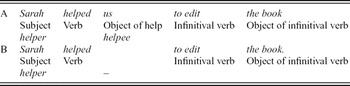
Another factor argued to influence infinitive choice is whether help is used transitively or intransitively. Note that the help + infinitive construction can occur with or without an overtly expressed object of the helping event (cf. A and B in table 1).
Constructional variants of help + infinitival complementation

Several studies found that when the object is overtly expressed, the probability of the bare infinitive increases (Lind Reference Lind1983; Kjellmer Reference Kjellmer1985; McEnery & Xiao Reference McEnery and Xiao2005). However, it is yet unclear how this effect should be explained. Lind (Reference Lind1983: 269) suggests that an analogy with constructions with verbs like see, hear, make, which also employ the bare infinitive as in I heard him say it may be responsible for this. Another explanation which has been suggested by an anonymous reviewer is that in the case of unexpressed objects, the subject is very often inanimate and the to-infinitive is preferred for that reason (see section 2.2 above). The latter explanation would render the present variable epiphenomenal to properties of the subject and thereby attribute it to the distance principle. We will see if the proposed relation between intransitive uses and subject properties can be substantiated empirically.
2.4 Pronoun status of the object NP
Apart from the mere occurrence of an object with help, some of the object's properties may influence infinitive choice; for instance, whether or not it is a pronoun, cf. examples (8) and (9).
(8) Mr Jackson helps me get all my stuff together.
(9) Economic analysis helps the doctor to select the right treatment.
Rohdenburg (Reference Rohdenburg1995: 375, 1996: 155–8) shows for the make-causative construction that the unmarked infinitive is more likely to occur with pronouns, which he interprets as an instantiation of the complexity principle. Following this reasoning, pronouns are assumed to be less complex than other noun phrases, which is why the unmarked infinitive is chosen. Yet it is unclear what properties render pronouns less complex. The most obvious explanation would be that pronouns are generally shorter than lexical NPs. This explanation would, however, merely repeat the hypothesis that the length of intervening material influences infinitive choice (see section 2.1). It is thus possible that the distinction pronoun/lexical NP is epiphenomenal to the distance factor, which is a possibility we will explore. Adding to the scepticism are findings by Lind (Reference Lind1983: 266), who reports that the pronoun/lexical status of the object has no effect on help/help to.
2.5 Animacy of object
Mair (Reference Mair2002) assumes that the bare infinitive has a more general/grammatical meaning which leads us to test the hypothesis that inanimate subjects and objects show a tendency for that infinitive type (see section 2.2). Thus, analogously to the animacy of the subject, differences in the object's animacy could also potentially influence the choice of infinitive.
2.6 The horror aequi effect
As mentioned above, evidence for an influence of horror aequi has been presented by various scholars (McEnery & Xiao Reference McEnery and Xiao2005; Vosberg Reference Vosberg2006; Rohdenburg Reference Rohdenburg, Tieken-Boon van Ostade and van der Wurff2009), instantiating a general avoidance of identity effect. This principle predicts that the bare infinitive is preferred after cases of to help, as in example (5), above.
2.7 Optimal syllable structure
Another effect whereby the repetition of similar elements is avoided concerns the sequence of vowels and consonants. It seems to be a universal principle that an alternation of consonants and vowels – thus a CV structure – is preferable, while consonant clusters and vowel adjacency are dispreferred (see Mondorf Reference Mondorf, Rohdenburg and Mondorf2003). Rohdenburg & Schlüter (Reference Rohdenburg and Schlüter2000) show that in cases of variation, speakers will try to preserve the CV alternation, as in the case of my vs mine in Early Modern English:
(10) in mine opinion (Rohdenburg & Schlüter Reference Rohdenburg and Schlüter2000: 472)
Thus, in the example above, mine would be preferred over my, as this way a consonant–vowel alternation is preserved. While this variable has not yet been tested with the present alternation, it can be applied to cases of help + infinitive:
(11) They are not there to help us (to) avoid heartache or hurt.
In (11), an intervening to would lead to a VV sequence which speakers might try to avoid. It can thus be hypothesized that when the following verb in the infinitive begins with a vowel, insertion of to should be avoided.Footnote 8
2.8 Rhythmic alternation
Similarly, the so-called principle of rhythmic alternation can be attributed to a general striving for contrast, here between stressed and unstressed syllables (see Schlüter Reference Schlüter2005). This principle has been applied to causative make + infinitival complementation by Rohdenburg & Schlüter (Reference Rohdenburg and Schlüter2000) and it has also been shown to trigger the omission of grammatical elements in other cases (cf. Schlüter Reference Schlüter2009). According to this principle, a sequence of stressed syllables is to be avoided, as well as a sequence of lapses, i.e. unstressed syllables. While it has not yet been tested with help/help to, it can be straightforwardly applied to this case of variation:
(12) I help to change this attitude.
In (12), an initially stressed infinitive follows help and the unstressed to works as a buffer between two stressed syllables and thus ensures rhythmic alternation. Hence, it can be hypothesized that if the infinitive begins with a stressed syllable, the insertion of the infinitive marker should be preferred, while initially unstressed verbs should not display this preference.
2.9 Inflectional variant of help
It has been noted in previous works that the inflectional variant of the verb help may influence the choice of infinitive. The most conspicuous finding reported in previous research is that the form helping correlates with the lowest ratio of bare infinitives (Lind Reference Lind1983: 168; Rohdenburg Reference Rohdenburg, Tieken-Boon van Ostade and van der Wurff2009: 317).
3 The concurrence of variables and advantages of multifactorial over monofactorial accounts
One shortcoming of previous studies on the infinitive alternation, with respect to the investigation of the three aforementioned principles, is that their influence has so far solely been investigated individually. For instance, while Rohdenburg & Schlüter (Reference Rohdenburg and Schlüter2000) explore a number of different factors attributed to the functional principles, they show each variable's influence in a different case of variation. Even studies which take into account more than one factor with a single alternation almost always investigate the alternation in a monofactorial fashion, i.e. by looking at one factor at a time (see the studies in Rohdenburg & Mondorf Reference Rohdenburg and Mondorf2003). Such approaches give rise to a number of (potential) problems. One of these concerns the (often pervasive) correlation of variables which may lead to flawed results. Consider the variable ‘object is a pronoun’ mentioned above. This factor correlates with a number of other potentially influential variables, because pronouns are usually also animate and short. Whether all of these properties of the object exert significant influence, or whether some may simply be epiphenomenal to others, cannot be answered through monofactorial analyses, as these approaches are not capable of disentangling correlations. Hence, researchers applying solely univariate methods run the risk of either assigning significance to all variables – even though some of them might in fact be epiphenomenal – or are tempted into overly reductionist explanations, by more or less intuitively choosing only one variable which is then argued to be more relevant than others, without taking into account possibly confounding factors. These pitfalls can only be avoided by applying multifactorial methods (see Bresnan et al. Reference Bresnan, Cueni, Nikitina, Baayen, Bouma, Kraemer and Zwarts2007: 76–82; Hinrichs & Szmrecsanyi Reference Hinrichs and Szmrecsanyi2007: 470). Hence, this is the approach pursued in this article.
Furthermore, univariate methods also preclude the comparative investigation of individual factors, which is why so far it is unknown of what strength and importance individual variables related to the presented functional constraints are. Such an investigation would be highly desirable, however, as it allows for a much more fine-grained analysis of what factors speakers are influenced by (cf. Rohdenburg & Schlüter Reference Rohdenburg and Schlüter2000: 490). For instance, it is not yet known which of the variables that have been suggested as influencing the cognitive complexity of a construction – such as length and pronoun status of an intervening object – contributes how much to the observed distribution of constructional variants. Furthermore, we do not know whether all three proposed principles are of equal importance. It is the aim of this article to address these questions through multifactorial statistical modelling. The construction under investigation in this article seems to be an ideal test case for such an investigation, as a number of variables related to the aforementioned functional principles can be investigated with this one construction.
A further advantage of the methodological approach to be employed here relates to using a mixed-effects variant of multifactorial modelling. Mixed-effects models allow researchers to take into account the grouping structure that may be present in the data (see Gelman & Hill Reference Gelman and Hill2007: 237–49). This refers to the fact that data points are often not independent from each other but can be grouped according to several dimensions. For example, in our case instances of help + infinitive can be categorized according to different genres and also different corpus texts, thus forming groups which are likely to show differing preferences for infinitive realization. In view of the fact that this structure in the data has been shown to further improve statistical accuracy in other cases (Gries & Hilpert Reference Gries and Hilpert2010: 302–3), it is therefore also a promising strategy for the present phenomenon.
4 Data and methodology
The data sample for the current study was acquired from the British National Corpus (BNC). A search that retrieved help in all its inflectional variants followed by an infinitive form with up to seven intervening words was conducted over the complete corpus.Footnote 9 I manually removed false hits (for example, where the noun help, and not the verb form was found) and included every tenth hit for further analysis. Data points in three different contexts were excluded, as in these cases the full infinitive is (near) obligatory. These comprise instances when help + infinitive occurred with it as the provisional subject (cf. Lind Reference Lind1983), all passive constructions (cf. McEnery & Xiao Reference McEnery and Xiao2005) and instances of not-negation (cf. Mair Reference Mair and Aarts1995: 270; Rohdenburg Reference Rohdenburg1995: 378–80).Footnote 10 Furthermore, one data point which involves object extraction was not considered, as this context was identified as another influence on infinitive choice, which can, however, not be researched here due to insufficient occurrences (cf. Rohdenburg Reference Rohdenburg, Tieken-Boon van Ostade and van der Wurff2009: 316–18).Footnote 11 This cleaning-up procedure resulted in 1718 data points which were then coded for the factors mentioned above. The following coding procedure was applied for the individual variables which I refer to using the following abbreviations:
InfVariant: this label was used to indicate whether the infinitive was full or bare, which is the dependent variable whose variance we wish to explain.
SubjAnimacy: relying on Zaenen et al.'s (Reference Zaenen, Carlette, Garretson, Bresnan, Koontz-Garboden, Nikitina, O'Connor, Wasow, Byron and Webber2004) coding scheme, another coder and I independently coded the animacy of the subject, using the following values: inanimate abstract, inanimate concrete, collectively animate, animal, human. A further value ‘unexpressed’ was added for cases when there was no overt subject of help, as in non-finite constructions, such as she is eager to help them or He was involved in helping them come to terms with the problem.Footnote 12
ObjProperties: the object of help in transitive uses was coded for animacy and pronoun status. Regarding animacy, the same coding categories as for the subject were employed. Coding pronoun status and object animacy as values of one category avoids a potentially problematic correlation between variables, as pronouns very often refer to animate referents.Footnote 13 This procedure resulted in ten variable values for transitive uses (the aforementioned animacy categories and classification as to pronoun status), for instance ‘human, pronoun’. When there was no overt object, this variable was coded ‘unexpressed’.
HelpInf: to take into account the horror aequi effect, this label was used when help itself occurred in the infinitive preceding to (yes vs no).
LengthIntv: the number of intervening words between the form of help and the infinitive was entered here as a value of this variable. Of course other measures, such as the number of nodes may also influence the complexity of intervening material and therefore be potentially relevant. Szmrecsanyi (Reference Szmrecsanyi, Purnelle, Fairon and Dister2004), however, has shown that these measures are highly correlated with a pure length measurement and will therefore not be considered further here.Footnote 14
IniStress: this factor was treated as a binary value, thus receiving the coding ‘yes’ when the infinitival lexical verb has initial stress, such as gain or punish, and ‘no’ when the verb was not stressed on the initial syllable, such as pretend or withhold.
IniVowel: in order to determine whether the sequence of vowels and consonants had an effect on constructional choice, the first sound of the infinitival verb was coded as to whether it is a vowel (yes vs no).
InflectedForm: the inflectional variant of help was coded. The variable could thus take on the values helping, helps, helped, help.
In addition, three potential influences that pertain to the grouping structure in the data (see section 3, above) were taken into account. As has been pointed out above, the bare infinitive is preferred in more informal genres, hence the influence of genre was considered. Furthermore, it is conceivable that the choice of infinitive is influenced by particular verbs, as has been shown for other constructional alternations (see Stefanowitsch & Gries Reference Stefanowitsch and Gries2004). Lastly, of course, idiolect may also influence the variation, as some speakers/authors may have a predilection to use one or the other variant. Thus, the following factors were also annotated for every data point:
Genre: every hit was coded for genre using the genre classification in Lee's BNC index (Lee Reference Lee2001).
Verb: the verb in the infinitive form following the form of help was coded, e.g. build.
CorpusFile: in order to take into account authors’ idiolectal preferences, the originating corpus file was coded for every individual data point as an approximation for speaker/author information (cf. Szmrecsanyi forthcoming: 7).
The resulting data frame was then submitted to binary logistic regression using mixed-effects modelling techniques.Footnote 15 Logistic regression has been shown to be the method of choice when dealing with cases of linguistic variation with binary outcomes (see e.g. Szmrecsanyi Reference Szmrecsanyi2006; Hilpert Reference Hilpert2008). It allows for the exploration of how a choice between two categories is influenced by a host of different factors and also reveals the relative strength and importance of each individual variable.Footnote 16 Using its mixed-effects variant allows for an even more fine-grained analysis, as the differences between subgroups in the data – in this case, differences between genres, speakers, or individual verbs – can be accounted for.Footnote 17 This is done by designing a varying intercepts model. The intercept gives a baseline probability of a certain outcome – in our case, the use of the bare infinitive – to which the variables’ effects are then added. In ordinary logistic regression, this term is held constant over all subgroups (e.g. genres) in the data, which is why it is also called constant term. However, when using mixed-effect techniques, it can vary by different groups. Let me explain why this is useful. From prior research we know that all other things being equal, the use of the bare infinitive is more likely in informal than in formal genres (see section 1, above). The varying intercepts approach allows one to take this source of variation into account by assigning each genre its own intercept value, which is achieved by entering the different genres as values of a so-called ‘random effect’. The other two grouping variables Verb and CorpusFile were treated likewise. While it would also be possible to enter Genre, Verb, or CorpusFile as regular ‘fixed effects’, thus regular predictor variables, this procedure would result in an uninterpretable host of values for these three variables (e.g. 509 for Verb), some of which are instantiated by an extremely low number of cases (for instance, some verbs occur only once in the data). The following overview shows the different variables and their categorization in the sentence She helps me to choose them.

In addition to these variables, the interaction term HelpInf × LengthIntv was added since horror aequi should wane with increasing distance (Vosberg Reference Vosberg, Rohdenburg and Mondorf2003: 321). Once all data points were coded this way, an iterative fitting process was conducted, starting with a saturated model including all predictor variables and excluding insignificant predictors in a step-wise fashion – i.e. one at a time – beginning with the least significant variables until only significant variables remained in the model.
5 Results
The model-fitting process resulted in the deletion of the following fixed-effects predictors:
i. IniVowel (p ~ 0.5)
ii. IniStress (p ~ 0.12)
Thus, these variables do not contribute significantly to the alternation under investigation. In other words, whether the following verb has initial stress or not, or whether it starts with a consonant or vowel, does not influence language users in choosing the infinitive type. After removing these predictors, I tested for the variables SubjAnimacy and ObjProperties to check whether all variable values were significantly different from each other. This relates to the question as to whether the fine-grained coding we conducted is really justified on the basis of the data (see Gries Reference Gries2009: 239). It turned out that for SubjAnimacy a binary distinction of animate (comprising of human, animal, collective) vs inanimate (comprising of abstract and concrete) was significant, while more fine-grained distinctions were not motivated by the data. For ObjProperties, I found that differences in animacy generally did not influence infinitive choice significantly. This variable was therefore recoded as a ternary one with the values unexpressed, NP, pronoun. Testing the influences of random effects reveals that Genre (p < 0.001) and CorpusFile (p < 0.05) significantly improve model accuracy, but interestingly Verb (p > 0.8) does not and was therefore excluded. This means that in contrast with a number of other reported syntactic alternations (see Stefanowitsch & Gries Reference Stefanowitsch and Gries2004), no tendency to use the respective variants with specific verbs could be detected.
Our final, minimal adequate modelFootnote 18 is characterized by a C value of 0.86 and Somer's D of 0.72, which illustrate an overall good model fit.Footnote 19 Another way of determining the descriptive accuracy of the model is to calculate the percentage of cases for which the model makes a correct prediction, which is 77.2 per cent. This is quite a large improvement over the baseline value of 51 per cent which we would arrive at without this model, by categorically ‘guessing’ the full infinitive in all cases. An ordinary logistic regression without random effects which was conducted for comparative purposes predicts only 67.9 per cent of the cases correctly. Thus, by applying the mixed-effects analysis, which takes into account the variance between different genres and authors, classification accuracy improves by almost 10 per cent.
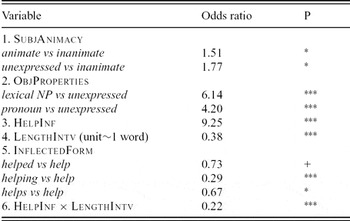
Let us now move on to an interpretation of the individual fixed effects, which are displayed in table 2. In order to explain these, let us go through the columns of table 2 one by one, starting with the leftmost column. Here the different variables and their respective values are displayed. With categorical variables (ObjProperties, InflectedForm, SubjAnimacy), one variable value is always missing, which serves as a default to which the other values are compared. For instance, with InflectedForm, the value for the uninflected form help serves as the default. The rightmost column contains numbers of asterisks which represent the p-value, telling us whether the variable contributes significantly to the observed distribution. In the middle column, odds ratios are given which inform us about the direction and magnitude of the variable's influence. These can take on values between 0 and ∞, with values above 1 denoting a preference for the bare infinitive for the respective variable value and odds ratios between 0 and 1 displaying a tendency towards the marked variant. Now that we know about the statistical concepts, let us have a look at the results of the individual predictors and their values.
Minimal adequate model for infinitive choice (solely fixed effects). Predicted odds are for the bare infinitive

N 1718
df 14
*** p < 0.001, **p < 0.01, * p < 0.05, + p < 0.1
Starting with SubjAnimacy, we see that both variable values are significant and have odds ratios above 1, which denote a preference for the bare infinitive. When the subject is animate, the odds for choosing the bare variant increase as compared to inanimate subjects by 51 per cent, in line with expectations based on the distance principle. Surprisingly, when there is no subject at all (variable value unexpressed), the preference is even higher, which seems to be a contradiction of that same principle. However, since unexpressed subjects most often occur when help is in the infinitive, this is most likely an effect of horror aequi and not a genuine effect of the missing subject, since in these cases the bare infinitive is strongly preferred (see below).
What about the variable ObjProperties? With this variable, the value object unexpressed served as the default for comparison. As mentioned above, distinctions on the animacy dimension did not influence results significantly. However, there is a significant difference between instances with and without object, with the former preferring the bare infinitive. Remember that we mentioned above the possibility that this effect may be due to inanimate subjects very often occurring with unexpressed objects, thus in fact constituting an effect epiphenomenal to properties of the subject (see section 2.3, above). The suggested correlation, however, turns out to be tentative at best. While there is a tendency for inanimate subjects to occur with the intransitive variant of the construction, this constitutes no more than a weak trend (69 per cent of intransitive uses occur with inanimate subjects vs 60 per cent with animate subjects). Most importantly, the fact that the distinction between expressed/unexpressed objects remains a significant predictor in the minimal adequate model strongly suggests that it exerts an influence of its own. Furthermore, there is also a difference between instances with regard to the pronoun status of the object (marginally significant, p = 0.06). Interestingly, when the object is instantiated by a pronoun, the preference for the bare infinitive is weaker than when it is not (odds ratios of 4.2 and 6.1 respectively), which contradicts our assumption that pronoun uses show a preference for the bare infinitive.
Turning to the variable HelpInf, we see that it yields a very high odds ratio, telling us that with to help the bare infinitive is strongly preferred, which is in line with our expectations based on the horror aequi principle, i.e. that a repetition of to should be avoided. This effect is one of the most potent predictors: when help occurs in the marked infinitive, the odds for producing the bare infinitive variant are more than nine times as high compared to when help occurs in finite form.
With LengthIntv, the odds ratio of 0.38 tells us that with every intervening word, the odds for producing the bare variant decrease by 62 per cent, thus in the direction we hypothesized.
Turning to InflectedForm, we see that all variable values are (at least marginally) significant, and all values have odds ratios between 0 and 1. This means that compared to the uninflected form help, all inflected forms prefer the full infinitive. The low odds ratio for helping is particularly interesting, as this finding ties in with previous research which reported a particularly strong tendency for the gerund form to occur with the marked infinitive (see section 2.9, above) which, as Rohdenburg (Reference Rohdenburg, Tieken-Boon van Ostade and van der Wurff2009: 317) suggests, may be due to the analogy with needing and daring which also show a strong preference for the full infinitive in contrast with other inflectional variants of these verbs.
Moreover, the interaction term between HelpInf and LengthIntv is significant. This means that when the length of intervening material between the form of help and the infinitive increases, the horror aequi effect decreases. Hence, it has to be noted that the strong main effect of HelpInf we discussed above exerts its influence only when this length is zero. As soon as there is intervening linguistic material, its effect is reduced. Still, since in most cases there is no intervening element when help occurs in the infinitive (in 62.8 per cent it occurs with LengthIntv = 0), we may still claim that in a majority of cases the effect of HelpInf is very strong, as the interaction with length is effective only in a minority of cases.
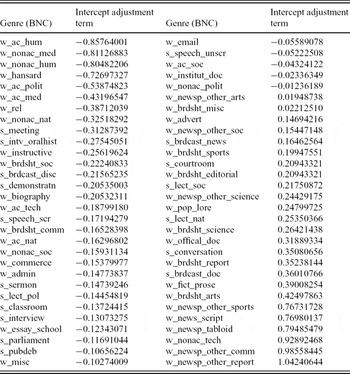
Let us move on to the two random effects that remained in the final model, CorpusFile and Genre. As explained, these do not enter the model as parameters and can therefore not be interpreted like the fixed effects above. However, the random factors result in changes of the constant term or intercept. This is arrived at by assigning each subgroup in the data, e.g. each genre, an intercept adjustment term which denotes its preference for one or the other infinitive variant. Positive values illustrate a preference for the bare variant, while negative ones reflect a preference for the marked variant. Since an influence of genre has been discussed in previous research, the adjustment terms for this variable deserve to be dealt with here briefly (see table A1 in the appendix). Remember that it has been argued that the bare infinitive is a characteristic of informal language (Lind Reference Lind1983; Kjellmer Reference Kjellmer1985) and McEnery & Xiao (Reference McEnery and Xiao2005) claimed it is more often found in spoken language. While an abstract notion such as formality does not, of course, immediately translate into specific genres, some interesting observations can be made. Genres corresponding to written non-fictional texts, both academic and non-academic (w_ac and w_non_ac), lead to strong negative adjustments (top left of table A1), thus favour the full infinitive. At the other end of the scale (bottom right of table A1) are several newspaper genres, which show the strongest preference for the bare infinitive. Thus, while the genre-specific adjustments do not suggest any easy generalizations, the extreme points seem to be made up by journalese and non-fictional prose, respectively, lending some weight to the formality hypothesis. Another interesting observation is that, generally speaking, spoken genres behave more homogeneously than written genres, as for the latter more extreme adjustments are made. Hence, the results do not imply a clear spoken/written difference with regards to infinitive choice, but a more complex situation.
Since no immediately meaningful interpretation is possible for differences across corpus files, the adjustment terms for CorpusFile are not discussed here. However, it should be noted that these contribute significantly to the model as well.
6 Discussion
In this section, I will discuss the results obtained and put them into perspective by elaborating on their relation to the three proposed functional principles that were mentioned above.
In accordance with previous research (see Lind Reference Lind1983), we found that instances with animate subjects show a tendency for the bare infinitive, which can be interpreted to be a manifestation of the distance principle. As animate agents show a potentially greater involvement in the helping event, this smaller conceptual distance correlates with a small linguistic distance achieved by omission of the infinitive marker. This result ties in with earlier assumptions about a possible semantic difference between the two forms, which also stated that the bare form denotes a greater involvement. Interestingly, the results obtained here are at odds with suggestions made in Mair (Reference Mair2002) that the full infinitive tends to not occur with inanimate agents. It therefore seems that the scepticism with regard to this suggestion (see McEnery & Xiao Reference McEnery and Xiao2005: 175–6) is well justified and strengthened by the finding that differences in animacy of the object do not significantly influence the choice of infinitive. While hypotheses as to a possible grammaticalization of the present construction (see Mair Reference Mair and Aarts1995) remain untouched by these results, synchronically the distance principle may better explain our findings than an assumption of a more general semantics with respect to the bare variant.
Turning to differences between transitive and intransitive uses of the present construction, the hypothesis that transitive uses prefer the unmarked infinitive can be confirmed empirically, in accordance with earlier studies (Lind Reference Lind1983; Kjellmer Reference Kjellmer1985; McEnery & Xiao Reference McEnery and Xiao2005). There is, however, no compelling explanation for this variable's influence yet. Since the correlation between intransitive uses and inanimate subjects turned out to be rather weak, the distance principle cannot account for it (see results reported in section 5, above). This basically leaves us with the assumption by Lind (Reference Lind1983: 269) that an analogy with similar transitive constructions with verbs such as see and hear, which also occur with the unmarked infinitive, is responsible for the effect – a hypothesis which is rather difficult to test.
Two variables which were attributed to the complexity principle were tested: the length of intervening material between the form of help and the infinitival verb form and the pronoun status of the object. The expectation is borne out that, with increasing distance, the probability for the full infinitive rises. The present result thus ties in with other robust findings which show that the growing discontinuity of two grammatically related elements leads to choices of the more explicit form (see e.g. Rohdenburg & Schlüter Reference Rohdenburg and Schlüter2000; Hawkins Reference Hawkins, Rohdenburg and Mondorf2003) and disconfirms the results obtained by McEnery & Xiao (Reference McEnery and Xiao2005: 179), where this variable did not reach significance – probably due to small sample sizes.
Surprisingly, regarding pronoun status it was found that object pronouns did not increase the share of bare infinitives. On the contrary, lexical NPs showed a greater tendency for the unmarked infinitive, this trend being however only marginally significant. This finding stands in clear contrast to other studies which showed the opposite to hold in other cases (Rohdenburg Reference Rohdenburg1996). It is important to note, however, that previous studies considered this factor solely in a monofactorial fashion. Implementing this in the present case yields the result that the bare infinitive is in fact preferred with object pronouns (a 64 per cent vs 56 per cent ratio of bare infinitives, respectively). It is here that the chosen multifactorial approach truly pays off, in showing the importance of controlling for possibly confounding variables. The relevant interfering variable in this case is LengthIntv, as obviously there is a correlation between length and the distinction pronoun/lexical NP, as the former always has a length of 1. Once we also consider length in a multifactorial model, the alleged effect of pronoun status disappears, hence it is most likely epiphenomenal to length. Within the logic of the complexity principle this result suggests that the length of the intervening NP influences the complexity of the construction and therefore leads to a preference for the full infinitive while pronoun status does not lead to a decrease in complexity. It would be interesting to further investigate this discrepancy also with other cases of variation.
Regarding the factors subsumed under avoidance of identity, only horror aequi yields a significant influence on the observed distribution. This finding raises the question as to why no such impact of the two other criteria, rhythmic alternation and optimal syllable structure, was found. In order to answer this question, it is useful to first generally explain the avoidance strategy, which is best done by briefly referring to psycholinguistic models of speech production. In interactive activation models of language production (e.g. Stemberger Reference Stemberger and Ellis1985; MacKay Reference MacKay1987), it is assumed that the mental lexicon is organized in a similar way to a neural network, consisting of units or nodes and links between these. These nodes (roughly) correspond to linguistic representations, such as lexemes, morphemes, syllables and phonemes, and are organized in different layers with conceptual nodes at the top and nodes corresponding to phonetic features at the bottom. During production activation is sent through the network via the links, activating those nodes which correspond to the linguistic units which are to be produced. The crucial point for the present explanation is that these nodes share central properties with neurons, viz. that after their activation (corresponding to the firing of a neuron) a period of self-inhibition or recovery follows. During this recovery phase, a node cannot be easily reactivated, which is therefore avoided. For language production, this would mean that the immediate repetition of similar or identical forms should also be avoided, as these make use of the same nodes in the network (see Schlüter Reference Schlüter2005: 260–77). This architectural feature along with the layered structure of the model holds a possible answer for the finding that solely horror aequi – not the other two constraints – yields an effect on the present alternation. The three hypothesized effects are located at different levels in the linguistic hierarchy and thereby in different layers within a node network. With horror aequi denoting the avoidance of repetition of identical lexical elements, it is the node corresponding to the non-finiteness marker to, which represents our dependent variable, which is self-inhibited, which is why an immediate effect is to be expected. The case is different with the principles of rhythmic alternation and optimal syllable structure which concern suprasegmental and segmental alternation because here we are concerned with nodes that are situated at levels below the lexical one, where the investigated variation takes place. Although in connectionist models cross-level effects are explicitly possible via the feeding back of activation (see Stemberger Reference Stemberger and Ellis1985), such effects are indirect and therefore weaker compared to the more immediate self-inhibitory effect of nodes on the same level. The further we move away from the level at which the relevant node is situated, the weaker the expected inhibition effect (see Schlüter Reference Schlüter2005: 285–91), which may explain why only horror aequi was found to be significant in the present model. This relation between the different levels of production may also explain why stronger phonological avoidance effects have been reported with cases of allomorphic variation (Rohdenburg & Schlüter Reference Rohdenburg and Schlüter2000; Schlüter Reference Schlüter, Rohdenburg and Mondorf2003), where the dependent variable itself is a phonological one. It must be pointed out, however, that, conflicting with this interpretation, the principle of rhythmic alternation has been reported to also yield effects at higher levels (see Schlüter Reference Schlüter2005). While the findings for avoidance of identity effects in this study can be explained by the architecture of the speech production system, more research is needed to clarify in which contexts cross-level effects do or do not occur.
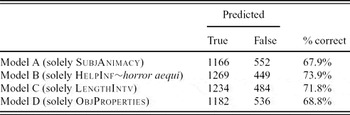
Now that we have discussed the influences of the individual variables, what can be said about the different factors and their relative strengths when acting concurrently? A comparison of the odds ratios showed that horror aequi is the variable which leads to the greatest preferences for the bare infinitive. A second way to compare the influences of variables is to take a look at their relative importance for the investigated distribution. This is not the same as effect size, as it could be the case that a certain variable has a very strong effect, but due to rare occurrence of crucial values it may only be of lesser importance for the explanation of a phenomenon. One way to explore this idea of relative importance is to build alternative models which contain only a subset of significant predictor variables. The predictive accuracy of these reduced models in comparison to the model containing all relevant predictors then tells us about the importance of the retained variables. Table 3 illustrates the predictive accuracy of four alternative models, all of which contain only one predictor variable.
A comparison of four alternative models

In non-statistical terms, if we had to put all our money on just one variable, which one would provide us with the most accurate predictions? The answer is again horror aequi. Also in terms of relative importance this variable outranks all others. Considering only this one variable enables us to predict the choice of infinitive with remarkably high accuracy, not much worse than the accuracy of the model which contained all significant predictors (73.9 per cent of Model B compared to 77.2 per cent of the minimal adequate model). Next in importance is LengthIntv as the predictive accuracy of Model C containing it as the only variable also shows a decent predictive accuracy. As can be seen by the outcomes for Models A and D, properties of the subject and object are of lesser importance for the present alternation. In terms of the functional principles whose influence we wish to explore, horror aequi and increasing complexity through the insertion of intervening material are the two processes which are responsible for the lion's share of variation. Why is horror aequi stronger in terms of effect size and of greater importance than other effects? While its strength, as compared to the other investigated avoidance of identity effects, could be explained by its direct inhibitory effect in contrast to lower-level phonological influences, a comparison with the other variables is complicated by the fact that we are dealing with fundamentally different functional principles, which cannot be easily discussed in a common framework. One reason for the strong influence of horror aequi may lie in the fact that it is rooted in the properties of nodes in speech production models and ultimately neurons, and is therefore a direct result of the ‘hardware’ of the speech production apparatus. By contrast, the tradeoff between explicitness and economy and the iconically motivated distance principle may not be that directly wired into the speech production system. This explanation is at present, of course, only speculative, as it is unclear whether the result obtained for the construction investigated in this article can be generalized to other cases of variation.
7 Conclusion
This article has shown that in the case of help + infinitive complementation factors attributed to the distance principle, the complexity principle and the horror aequi principle can explain the observed variation between bare and full infinitives to a considerable extent. Not all factors are of equal strength and importance, however. The single most influential predictor was found to be horror aequi, which may be explained by its being directly rooted in the neural architecture of the speech production system. On a methodological note, it could be shown that using mixed-effects modelling is more appropriate to describe this alternation than monofactorial approaches and such modelling is superior also to ordinary fixed-effects models. An issue not dealt with in the present article concerns the question of what caused the to-drop with help in the first place. It has been proposed here that infinitive marker omission results from general functional constraints. This naturally raises the question as to whether it is dropped solely with help, or whether there are other verbs with infinitival complements that behave in the same way. At least one such verb has been mentioned in the literature, namely try which also occurs with the bare infinitive, as has been observed by Kjellmer (Reference Kjellmer and Kirk2000). But why should only these two verbs be subject to the constraints described? Mair (Reference Mair and Aarts1995) and Kjellmer (Reference Kjellmer and Kirk2000) argue that both verbs are in the process of becoming modal auxiliaries similar to dare and need, but as we have seen, the assumption that the bare infinitive acquires new grammatical meaning is hard to reconcile with the result that instances with animate agents preferably employ the bare variant. An alternative explanation may be that to-omission is due to the entrenchment of the relevant construction, regardless of its lexical or grammatical function. The reasoning would be that, if a construction becomes more frequent, which has been shown for both help + infinitive and also try + infinitive, it becomes more entrenched, and hence easier to process. The non-finiteness marker thus becomes expendable and it is deleted first in those instances where functional constraints allow for its omission. Whether this proposal can serve as a general explanation has yet to be seen and its exploration should probably involve a diachronic comparison. If one sets the scope even wider, beyond verb + infinitive constructions, other cases come into view where the to can also be dropped. These are pseudo-cleft constructions, such as All we have to do is (to) wait. It remains a task for future research to disentangle the similarities and differences between these alternations, with the aim of yielding an answer to the question as to whether these are effects of different processes or part of the same general development.
APPENDIX
Intercept adjustment terms for the random effect Genre (ordered from most extreme preference for the full infinitive, top left, to most extreme preference for the bare infinitive, bottom right)