Depression and anxiety are major public health burdens with significant consequences, including substance abuse, functional impairment, and physical health problems (e.g., Rice, Lifford, Thomas, & Thapar, Reference Rice, Lifford, Thomas and Thapar2007; Shankman et al., Reference Shankman, Lewinsohn, Klein, Small, Seeley and Altman2009; Sihvola et al., Reference Sihvola, Keski-Rahkonen, Dick, Pulkkinen, Rose, Marttunen and Kaprio2007). Stressful experiences, and in particular, individuals’ cognitive and emotional reactions to stress, play a major role in the development of internalizing symptoms (Almeida, Reference Almeida2005). The transition from adolescence to young adulthood, including the entrance to college for many youth, is a critical developmental stage with unique ties to stress and increasing variability in mental health (Arnett, Reference Arnett2000; Eagan et al., Reference Eagan, Stolzberg, Zimmerman, Aragon, Whang Sayson and Rios-Aguilar2017).
Currently, LatinxFootnote 1 individuals comprise 17% of the US population, and Latinx adolescents comprise one of the fastest growing ethnic minority groups (Stepler & Brown, Reference Stepler and Brown2016; US Census Bureau, 2015). Latinx adolescents may be particularly vulnerable to developing internalizing symptoms owing to increased exposure to stress (e.g., Jardin et al., Reference Jardin, Mayorga, Bakhshaie, Garey, Viana, Sharp and Zvolensky2018; McCord, Draucker, & Bigatti, Reference McCord, Draucker and Bigatti2019; Stein, Gonzalez, & Huq, Reference Stein, Gonzalez and Huq2012), though, see Georgiades, Paksarian, Rudolph, and Merikangas (Reference Georgiades, Paksarian, Rudolph and Merikangas2018) for an alternative account. Despite these potential stress-based vulnerabilities, important protective factors may buffer Latinx youth from risk for internalizing problems, such as perceived social support from peers and family (Neblett, Rivas-Drake, & Umaña-Taylor, Reference Neblett, Rivas-Drake and Umaña-Taylor2012; e.g., Potochnick & Perreira, Reference Potochnick and Perreira2010). Focusing on protective processes among Latinx adolescents across the college transition is vital because they now comprise the largest ethnic minority group on college campuses, but, as a group, Latinx students are the least likely to graduate (Lopez & Fry, Reference Lopez and Fry2013). In addition to serving as a precursor for later health problems, internalizing symptoms has also been tied to college persistence rates (e.g., Arbona, Fan, & Olvera, Reference Arbona, Fan and Olvera2018).
In the present study, we capitalized on an innovative ecological momentary assessment (EMA) design and longitudinal data to examine whether affective reactivity in high school (i.e., within-person relations between stress and negative affect) was associated with depressive and anxious symptoms in college in a sample of Latinx adolescents. Further we examined potential protective pathways by exploring whether family or peer support during the first year of college moderated such relations.
Transition to college
The college attendance rate of Latinx students grew from 22% to 37% between 2000 and 2015 (McFarland et al., Reference McFarland, Hussar, de Brey, Snyder, Wang, Wilkinson-Flicker and Hintz2017). Despite this growing attendance, the 6-year graduation rates of Latinx students are still 10% lower than non-Latinx White students (Snyder, de Brey, & Dillow, Reference Snyder, de Brey and Dillow2019). The transition from high school to college is a distinctive period of identity development and new social and academic opportunities (Azmitia, Syed, & Radmacher, Reference Azmitia, Syed and Radmacher2013), which can be accompanied by academic, interpersonal, and financial challenges (e.g., Beiter et al., Reference Beiter, Nash, McCrady, Rhoades, Linscomb, Clarahan and Sammut2015; Ross, Niebling, & Heckert, Reference Ross, Niebling and Heckert1999). In addition to general daily stressors, many Latinx students experience stress resulting from ethnic-based discrimination, the process of acculturating to norms and expectations of mainstream US culture, and unwelcoming university environments (Aguinaga & Gloria, Reference Aguinaga and Gloria2015; Corona, Campos, & Chen, Reference Corona, Campos and Chen2017; Huynh & Fuligni, Reference Huynh and Fuligni2012; Juang, Ittel, Hoferichter, & Gallarin, Reference Juang, Ittel, Hoferichter and Gallarin2016). Additionally, many Latinx students take on familial and work obligations while attending college, such as translating or assisting family members, which have been linked to higher stress (Sy, Reference Sy2006). These factors may converge in a particularly stressful transition period, thereby contributing to students’ persistence decisions (Aguinaga & Gloria, Reference Aguinaga and Gloria2015) and internalizing symptoms (Arbona & Jimenez, Reference Arbona and Jimenez2014; Sirin, Ryce, Gupta, & Rogers-Sirin, Reference Sirin, Ryce, Gupta and Rogers-Sirin2013). In nationally representative samples of US college students, perceptions of stress are at an all-time high (Eagan et al., Reference Eagan, Stolzberg, Zimmerman, Aragon, Whang Sayson and Rios-Aguilar2017; Pryor, Hurtado, DeAngelo, Palucki Blake, & Tran, Reference Pryor, Hurtado, DeAngelo, Palucki Blake and Tran2010). Moreover, the experience of transitioning to college may exacerbate vulnerability to stressors (Compas, Wagner, Slavin, & Vannatta, Reference Compas, Wagner, Slavin and Vannatta1986), though limited studies have examined this longitudinally in Latinx samples.
Stress, negative affect, and internalizing symptoms
In comparative studies, research has generally shown that Latinx adolescents have higher rates of depressive (Mikolajczyk, Bredehorst, Khelaifat, Maier, & Maxwell, Reference Mikolajczyk, Bredehorst, Khelaifat, Maier and Maxwell2007; Saluja et al., Reference Saluja, Iachan, Scheidt, Overpeck, Sun and Giedd2004), and anxiety (Anderson & Mayes, Reference Anderson and Mayes2010; Varela & Hensley-Maloney, Reference Varela and Hensley-Maloney2009) symptoms than non-Latinx White adolescents. However, there is significant variability in rates of internalizing symptoms among Latinx adolescents when other sociocultural and contextual factors are considered, including stress (e.g., Alegría, Canino, Stinson, & Grant, Reference Alegría, Canino, Stinson and Grant2006, Reference Alegría, Molina and Chen2014; Georgiades et al., Reference Georgiades, Paksarian, Rudolph and Merikangas2018). The relation between stress and depressive symptoms in Latinx adolescents is robust (Grant, Compas, Thurm, McMahon, & Gipson, Reference Grant, Compas, Thurm, McMahon and Gipson2004; McCord et al., Reference McCord, Draucker and Bigatti2019; Romero & Roberts, Reference Romero and Roberts2003). Stress may also play a role in the development and etiology of anxiety (e.g., Bolger & Zuckerman, Reference Bolger and Zuckerman1995), though there have been mixed findings for stress–anxiety associations in Latinx samples (Badiee & Andrade, Reference Badiee and Andrade2019; Hope, Velez, Offidani-Bertrand, Keels, & Durkee, Reference Hope, Velez, Offidani-Bertrand, Keels and Durkee2018). Many studies conceptualize depressive and anxiety symptoms as a joint construct of internalizing or distress (e.g., Sirin et al., Reference Sirin, Ryce, Gupta and Rogers-Sirin2013), rather than focusing specifically on depression and anxiety.
Above and beyond reports of stress experiences, research points toward affect reactivity to stress as a key feature contributing to later internalizing symptoms. Affect reactivity refers to an emotional reaction to stress with symptoms of general distress, such as irritability, restlessness, and interpersonal sensitivity (Zinbarg, Anand, Lee, Kendall, & Nuñez, Reference Zinbarg, Anand, Lee, Kendall, Nuñez, Blaney, Krueger and Millon2015). Negative affect in response to stress is a central theoretical link between stressful experiences and internalizing symptoms (Lazarus, Reference Lazarus1993; Lovibond & Lovibond, Reference Lovibond and Lovibond1995; Pascoe & Smart Richman, Reference Pascoe and Smart Richman2009).Footnote 2 Guided by this theoretical framework, recent research has isolated within-person relations between stress and negative affects at the daily level to better understand how an individual's negative affect changes relative to deviations from one's typical stress level. For example, in a sample of 58 middle-school-aged Latinx adolescents, Santiago et al. (Reference Santiago, Brewer, Fuller, Torres, Papadakis and Ros2017) found a within-person association between daily stress and mood over 1 week of daily diary entries. In the same sample, Torres and Santiago (Reference Torres and Santiago2018) found that daily family stress, but not economic stress, was linked to negative mood. In ethnically diverse samples, research has also shown within-person associations between daily stress/hassles and feelings of anxiety (Yip, Kiang, & Fuligni, Reference Yip, Kiang and Fuligni2008). Most relevant to the present study, we do not know of any study specifically addressing the distal association between these important momentary within-person relations and future internalizing symptoms in an adolescent Latinx sample, though Charles, Piazza, Mogle, Sliwinski, and Almeida (Reference Charles, Piazza, Mogle, Sliwinski and Almeida2013) have shown these distal relations in predominantly non-Latinx White adult samples.
Role of perceived social support from family and peers
There are two primary models that postulate how social support influences psychological outcomes (Cohen & Wills, Reference Cohen and Wills1985). The main effect hypothesis states that support fosters a positive environment, which should have a direct effect on promoting wellbeing and reducing internalizing symptoms, regardless of stress levels. Some research in Latinx adolescent samples has linked perceived family support with psychological health (Campos, Ullman, Aguilera, & Dunkel Schetter, Reference Campos, Ullman, Aguilera and Dunkel Schetter2014), and paternal support with depressive symptoms (Behnke, Plunkett, Sands, & Bámaca-Colbert, Reference Behnke, Plunkett, Sands and Bámaca-Colbert2011). The buffering hypothesis states that support protects, or buffers, individuals from the consequences of stress. In support of the buffering hypothesis, a cross-sectional study of Mexican American college students found that both peer and parental support buffered the association between acculturative stress and anxiety symptoms, although only parental support buffered the association between acculturative stress and depressive symptoms (Crockett et al., Reference Crockett, Iturbide, Torres Stone, McGinley, Raffaelli and Carlo2007).
Theory and empirical evidence suggest that family influences are particularly central in the developmental and cultural ecologies of Latinx adolescents (e.g., Cupito, Stein, Gonzalez, & Supple, Reference Cupito, Stein, Gonzalez and Supple2016). For example, many Latinx adolescents emphasize the role of the family through shared familism values (familismo; Sabogal, Marín, Otero-Sabogal, Marín, & Perez-Stable, Reference Sabogal, Marín, Otero-Sabogal, Marín and Perez-Stable1987), sustain ties to cultural values via family connectedness (Dawson, Perez, & Suárez-Orozco, Reference Dawson, Perez and Suárez-Orozco2012), and routinely engage in family assistance behaviors (Telzer & Fuligni, Reference Telzer and Fuligni2009). As a guiding set of cultural values, familismo encourages family members to support one another (García-Coll & Vázquez García, Reference García-Coll and Vázquez García1995) and likely fosters environments that promote access to the benefits of social support (Corona et al., Reference Corona, Campos and Chen2017, p. 549; Stein, Gonzalez, Cupito, Kiang, & Supple, Reference Stein, Gonzalez, Cupito, Kiang and Supple2015). For example, in an ethnically diverse sample of adults, higher familism values were associated with better psychological health via greater closeness to family members and perceived social support; familism values were higher for Latinx (and specifically Latina women) compared with European and Asian American adults (Campos et al., Reference Campos, Ullman, Aguilera and Dunkel Schetter2014). However, research has also found that peer support becomes more central during college for students of color (Dennis, Phinney, & Chuateco, Reference Dennis, Phinney and Chuateco2005; Juang et al., Reference Juang, Ittel, Hoferichter and Gallarin2016), and peer support may make contributions to Latinx college students’ wellbeing over and above family support (Rodriguez, Mira, Myers, Morris, & Cardoza, Reference Rodriguez, Mira, Myers, Morris and Cardoza2003). Following recent calls in the literature for more longitudinal work in this domain (Campos & Kim, Reference Campos and Kim2017), we considered the roles of perceived support from both family and peers during the first semester of college as potential buffers in associations between affect reactivity in high school and internalizing symptoms in college.
The current study
In the present study, we tested three key questions longitudinally using a novel methodological approach in a sample of Latinx adolescents. Ethnic homogenous samples are advantageous for identifying variability and strengths among a diverse group, relative to ethnic group comparative designs that may reify a deficit framework by focusing only on ethnic minority–majority group differences (Fuller & García Coll, Reference Fuller and García Coll2010; Gallo, Penedo, Espinosa de los Monteros, Arguelles, & Arguelles, Reference Gallo, Penedo, Espinosa de los Monteros, Arguelles and Arguelles2009). First, we aimed to evaluate the within- and between-person associations between momentary stress experiences and negative affect in a Latinx sample during their senior year of high school, which falls at a critical developmental juncture, the transition to college. We hypothesized that at times when participants perceived higher than their typical levels of stress, negative affect would be higher (within-person association; i.e., affect reactivity; e.g., Santiago et al., Reference Santiago, Brewer, Fuller, Torres, Papadakis and Ros2017), and that participants with higher average stress overall would have higher negative affect (between-person association). Second, we evaluated whether adolescents’ negative affect reactivity to stress, as indicated by the within-person relation between stress and negative affect, predicted depressive and anxiety symptoms in the first semester of college. We hypothesized that stronger affect reactivity to stress in high school would be associated with higher levels of depressive and anxiety symptoms (e.g., Charles et al., Reference Charles, Piazza, Mogle, Sliwinski and Almeida2013; Lovibond & Lovibond, Reference Lovibond and Lovibond1995). Third, we aimed to assess the potential buffering capacity of both perceived peer support and perceived family support during the first semester of college, the latter of which may be particularly salient for Latinx populations (e.g., Campos et al., Reference Campos, Ullman, Aguilera and Dunkel Schetter2014). Here, we hypothesized that adolescents who perceived higher degrees of family support would have a weaker association between affect reactivity to stress and depression and anxiety symptoms. We did not have strong theoretical predictions for peer support, and we treat those questions as exploratory.
To test these aims, we used multilevel modeling to examine the within-person relations between stress and negative affect, and we saved the Empirical Bayes slope estimates as indicators of affect reactivity. These estimates were then used as predictors of future depressive and anxiety symptoms in the first year of college. Using these estimates as predictors rather than outcomes is a novel approach. We know of only a few studies that used these estimates in this way (e.g., Bai & Repetti, Reference Bai and Repetti2018; Charles et al., Reference Charles, Piazza, Mogle, Sliwinski and Almeida2013; Leger, Charles, & Almeida, Reference Leger, Charles and Almeida2018). This method allows us to examine change at a deeper level, considering how within-person change at the momentary level relates to future outcomes on a more distal time scale. We describe the analytic plan in detail in the Method section.
Most similarly to the current study, researchers (Charles et al., Reference Charles, Piazza, Mogle, Sliwinski and Almeida2013) examined the long-term effects of affect reactivity to stress on affective outcomes 10 years later. Affect reactivity, measured via multilevel modeling at the daily level, significantly predicted general affective distress, self-reported disorder, and symptom-based diagnosis, although the latter was not significant after controlling for overall daily negative affect on stress-free days. A set of similar studies was conducted using concurrent and logged daily within-person relations between stress and negative affect to predict physical health outcomes (Leger et al., Reference Leger, Charles and Almeida2018; Piazza, Charles, Sliwinski, Mogle, & Almeida, Reference Piazza, Charles, Sliwinski, Mogle and Almeida2013), and are examples of the potential gains in using these slopes as predictors of various outcomes. However, the present study differs from this earlier work in several key ways. First, our sample is comprised of adolescents, differing in age from the samples of adults used in the earlier studies (mean age at Wave 1: 55 in Leger et al., Reference Leger, Charles and Almeida2018; age range 25–74 given in Charles et al., Reference Charles, Piazza, Mogle, Sliwinski and Almeida2013), allowing for direct inquiry into change processes at a critical developmental period. Second, our Latinx sample differs in ethnicity from the prior predominantly non-Latinx White (90–94%) samples. Third, we assessed family and peer support as potential moderators of the relation between affect reactivity and later internalizing, expanding focus to potential buffers that have implications for prevention. Fourth, our EMA data yielded four measures of stress and negative affect per day (26 measurement occasions total), rather than daily measures, assessing the association between stress and negative affect in a narrower time span. Finally, rather than focusing solely on the presence or absence of stress, we assessed the degree of stress at each measurement occasion.
Method
Participants
Participants consisted of N = 209 Hispanic/Latinx adolescents (84.7% Mexican, 8.6% South/Central American; 64.4% female) from over 90 high schools in the southwest US. Participants had varying immigrant generational status, parental education, and social class (see Doane et al., Reference Doane, Sladek, Breitenstein, Park, Castro and Kennedy2018 for a full description). Wave 1 occurred during (spring; 64.5%) or directly following (summer; 34.5%) participants’ senior year of high school (December–July; Mdate = April 27, Mage = 18.10, SDage = 0.41). Wave 2 occurred during the fall of the adolescents’ first year of college (September–December, Mdate = October 20). Recruitment occurred via orientation sessions at a large southwestern university, e-mail, text, and phone calls, partnerships with university and community organizations, and word of mouth. Bilingual services were provided to potential participants and their parents. Inclusion criteria specified that participants needed to obtain acceptance into the university and pay or defer a deposit to indicate intent to enroll, be a high school senior identifying as Hispanic or Latinx, and live within a 60-mile radius from the focal university during their senior year of high school. Of the 239 adolescents that consented to participate, N = 209 formally participated in the study (5.9% did not meet inclusion criteria, 6.7% did not respond after consent).
N = 207 participants provided daily diary data used to estimate within-person associations between stress and negative affect. At the diary level, the overall percent missingness was 14%, which is lower than average for intensive longitudinal studies (Bolger & Laurenceau, Reference Bolger and Laurenceau2013). The most common measurement occasions for participants to be missing on were (a) the final measurement occasion (31 participants) and (b) the final two measurement occasions (11 participants). The median percent missingness on any Wave 1 variable was 9% (M = 15%, SD = 16%), and the median percent missingness per person was 7% (M = 14%, SD = 17%). The percent complete attrition at Wave 2 was 12% (N = 24 participants). Of the N = 185 participants who remained in the study at Wave 2, N = 175 participants provided complete data for all variables involved in the focal regression models of interest. This sample size achieves at least 80% statistical power (Faul, Erdfelder, Lang, & Buchner, Reference Faul, Erdfelder, Lang and Buchner2007) for a regression coefficient between small and medium in size (f 2 = .045) in the most complex regression modeled in the present study. Given that maximum likelihood estimation was used to handle missing data (see the “Statistical analyses” section), which achieves greater statistical power than only using the N = 175 complete cases, this power analysis is conservative.
Procedure
All procedures were approved by the institutional review board as part of a broader longitudinal mixed methods study of the Latinx transition to college. Staff members obtained signed consent; parental consent was also collected if participants were under the age of 18. Forms were presented in the preferred language of the participant and their parent/guardian. During Wave 1, during the spring of senior year of high school for most adolescents, participants responded to a web-based survey, which included measures of depressive symptoms, anxiety symptoms, and participant demographic information including immigrant generation status, sex, and parental education. The survey was distributed either in-home or at a university lab, based on participant preference.
During the following week, participants provided information on stress in the last hour and negative affect using a web-based smartphone (97.5%) or paper and pencil (2.5%). This information was provided four times daily for 7 days: immediately after waking (M = 7:17a.m., SD = 1.70 hr), approximately 3 hr from waking (M = 12:21p.m., SD = 1.85 hr), approximately 8 hr from waking (M = 5:00p.m., SD = 1.68 hr), and at bedtime (M = 11:26p.m., SD = 1.45 hr). Participants initiated reports via links that were saved to their devices or on paper at waking and bedtime. Alerts were sent to participants to complete the two additional diary entries at varying times each day; the first alert was sent out between 2 and 4 hr postwaking (i.e., 2.5 hr postwaking on Monday, 3 hr postwaking on Tuesday) and the second alert was sent out between 7 and 9 hr postwaking. The mean number of complete diary entries provided by each participant was 21.00 (SD = 5.80). Note that an additional diary entry was completed approximately 30 min after waking (not a focus of these analyses; see Doane et al., Reference Doane, Sladek, Breitenstein, Park, Castro and Kennedy2018). The first sample occurred at bedtime on the first day (Moment = 1) and the final sample occurred in the morning on the eighth day (Moment = 26). Throughout the week, participants were reminded and staff were available to answer questions via text, e-mail, or phone. Following the daily diary portion, materials were collected by experimenters.
The second wave of data collection occurred during the participants’ first semester of college. The average length of time between Wave 1 and Wave 2 survey assessments was 171.95 days (SD = 44.60 days; range = 85–313 days). Participants were contacted via e-mail, text, and phone to participate in a follow-up web-based questionnaire assessment. The N = 185 adolescents (89% retention) that completed the Wave 2 questionnaire did not significantly differ from the rest of the sample on key variables, such as Wave 1 depressive symptoms, anxiety symptoms, SES, and immigrant generational status. Participants were compensated for their participation at both waves of data collection.
Measures
The following sections outline the measures used both at Wave 1 (momentary level and standard survey measurements) and Wave 2 (standard survey measurements). When obtaining mean scale scores for the standard survey measures, we allowed for one missing item. However, item-level missingness for any measure was rare (on the relevant measures, no participant skipped more than a single item; the highest item level missingness was 4%).
Momentary stress
Stress at each measurement occasion was assessed by asking participants to “describe the most stressful situation or event you encountered in the past hour” and to rate “how stressful was this event?” on a 10-point scale, with 10 being the most stressful (Adam, Reference Adam2006; Sladek, Doane, Luecken, & Eisenberg, Reference Sladek, Doane, Luecken and Eisenberg2016). For each stressful event reported and rated, participants were also asked to note whether or not the stressor was complete (63.8%) or was ongoing.
Momentary negative affect
Momentary negative affect was measured using the Negative Affect Scale of the Positive and Negative Affect Scale (PANAS; Watson, Clark, & Carey, Reference Watson, Clark and Carey1988). Items assessed the following seven negative emotions: distressed, upset, guilty, afraid, ashamed, nervous, and scared, on a 5-point Likert scale, from 0 (very slightly/not at all) to 4 (extremely). The mean of the seven items (allowing for three missing) was used as a measure of negative affect. Across the 26 measurement occasions, Cronbach's alpha ranged from .74 to .89 (M = .82, SD = .04).
Depressive symptoms
Depressive symptoms were measured at both Wave 1 and Wave 2 using the 20-item Center for Epidemiological Studies Depression Scale (CES-D; Radloff, Reference Radloff1977). Questions probed depressive symptoms over the past week, on a 4-point Likert scale from 0 (rarely or none of the time (less than one day)) to 3 (most or all of the time (5–7 days)). The four items with positive phrasing were reverse scored. The mean of the 20 items (allowing for one missing) was used in analyses as a measure of depressive symptoms. Given that suggested clinical cutoffs for depression from the CES-D are based on the sum scores, rather than the average, a sum scale score was also calculated at both waves to determine the percentage of the sample falling into normal (0–16), mild (16–22), and moderate to severe (>22; Roberts et al. Reference Roberts, Andrews, Lewinsohn and Hops1990) symptom ranges. At Wave 1, the percentages of the sample falling into each category were 58.0%, 17.1%, and 24.9% for the increasing severities, respectively. At Wave 2, the corresponding percentages were 48.9%, 20.0%, and 31.1%. At both waves Cronbach's alpha was .89.
Anxiety symptoms
Anxiety symptoms over the previous week at both Wave 1 and Wave 2 were measured using the 14-item anxiety subscale of the Depression, Anxiety, and Stress Scales (DASS; Lovibond & Lovibond, Reference Lovibond and Lovibond1995). Items were rated on a 4-point Likert scale from 1 (did not apply to me at all) to 4 (applied to me very much, or most of the time). Example items are “I was worried about situations in which I might panic and make a fool of myself” and “I perspired noticeably (e.g., hands sweaty) in the absence of high temperatures or physical exertion”. The mean of the 14 items was used in analyses as a measure of anxiety symptoms (allowing for one missing). Clinical cutoffs are based on the 0–3 scoring of the scale. Thus, to determine the percentage of the sample falling into distinct severities of anxiety symptoms at each wave, items were recoded to be on a 0 to 3 scale and the items were summed. At Wave 1, 59.2% of participants were in the normal range, 7.3% in the mild range, 18.9% in the moderate range, 7.3% in the severe range, and 7.3% in the extremely severe range. At Wave 2, the corresponding percentages were 44.7%, 12.8%, 22.4%, 9.5%, and 10.6% for normal, mild, moderate, severe, and extremely severe, respectively. Cronbach's alpha was .89 and .91, at Waves 1 and 2, respectively.
Perceived social support
Perceived emotional support from family and peers was assessed at Wave 2 with the Multidimensional Scale of Perceived Social Support (Zimet, Dahlem, Zimet, & Farley, Reference Zimet, Dahlem, Zimet and Farley1988). The scale was developed to assess support from several types of supporters, and it has been validated with ethnic minority samples (Canty-Mitchell & Zimet, Reference Canty-Mitchell and Zimet2000). Items were rated on a 5-point Likert scale, from 1 (not at all true) to 5 (very true). For the four items indicating family support, participants were asked to think about parents, brothers and sisters, cousins, aunts/uncles, and grandparents. An example item is “When you feel bad, you get the help and support you need from your family.” The mean of the items (allowing for one missing) was calculated to measure perceived family support. Cronbach's alpha for the current sample was .90. For the four items indicating peer support, participants were asked to think about their friends. An example item is “You can talk about your problems with your friends.” The mean of the items (allowing for one missing) was calculated to measure perceived peer support. Cronbach's alpha was .93.
Additional variables
Additional variables, selected along theoretical lines, were measured and included as covariates in the regression models predicting Wave 2 depressive and anxiety symptoms.Footnote 3 General perceived stress, included to adjust for concurrent levels of stress, was measured in the web-based survey at Wave 2 using the mean (allowing for one missing) of the four-item short form of the Perceived Stress Scale (Cohen & Williamson, Reference Cohen and Williamson1991). Items probed feelings of stress over the past month and were scored on a 5-point Likert scale from 1 (never) to 5 (fairly often). An example item is “How often have you felt that you were unable to control the important things in your life?”. The two positively worded items were reverse coded, before calculating the mean of the items as a measure of perceived stress. Immigrant generation status was measured using a 0–7 scale, where 0 indicates that the participant, both parents, and both sets of grandparents were born outside of the US, and 7 indicates that the participant, both parents, and both sets of grandparents were born in the US (Umaña-Taylor, Alfaro, Bámaca, & Guimond, Reference Umaña-Taylor, Alfaro, Bámaca and Guimond2009). Additional variables measured were participant sex, socioeconomic status (SES, indexed by participants’ self-reported social class; measured on a 1–5 Likert scale, where 1 indicates upper class and 5 indicates working class), and whether the participant was living on campus or at home at Wave 2.
Analytic strategy
For the diary measures at Wave 1, multiple measurement occasions are nested within individuals. Multilevel modeling accounts for this nesting and can isolate both within-person and between-person relations between stress and negative affect. In linear multilevel models, each individual has their own linear change equation, marked by an individual intercept and slope. In the present case, with appropriate centering, these participant-specific regression lines contain valuable information as indicators of affect reactivity: the individual-level concurrent within-person association between stress and negative affect. Notably, these within-person slopes may have important predictive implications for later internalizing symptoms.
Empirical Bayes slope estimates as predictors
Multilevel longitudinal analyses typically only use these individual slopes as outcomes. Importantly, these slopes can be estimated in two ways: ordinary least squares (OLS) and Empirical Bayes (EB). OLS slopes are not suited to use as predictors owing to imprecision and overestimation of between-person variation (see Singer & Willett, Reference Singer and Willett2003). However, EB (model-based) slopes, used presently, represent an alternative, and are more precise than OLS slopes. Multilevel modeling yields fixed effects, which estimate population average effects, and random effects, which estimate how much individuals deviate from these averages. EB slopes effectively are a weighted average of OLS slopes and the population average estimates resulting from the fitted multilevel model. EB estimates take advantage of OLS slopes becoming more precise with decreasing residual variance, placing more weight on the individual-level OLS slope when residual variance is low and placing more weight on the population average estimates when residual variance is high, “borrowing strength” (Singer & Willett, Reference Singer and Willett2003, p. 136).
Statistical analyses
Before fitting models, described below, to assess the three focal aims, a no-change (baseline) model was first fit to the EMA data to ensure that a multilevel model was appropriate. The intraclass correlation coefficient was r = .44, indicating considerable between- and within-person variation among the nested negative affect scores. A three-level no-change model was then fit, with moments nested within days nested within individuals. The intraclass correlation at the day level was r = .03, indicating negligible between-person variation across days, supporting a two-level model.
To test Aim 1, we fit a multilevel model predicting negative affect at each occasion. The Level 1 model can be written as:

NAij represents the negative affect for individual i at time j. MomentCij represents each measurement occasion j for individual i, centered at the first moment (Day 1, evening). Preliminary analyses using a simple multilevel model with Moment predicting NA showed a small general trend of decreasing NA over the 26 measurement occasions (b = −0.005, p < .001). Thus, Moment was included in the model to appropriately detrend the data (Wang & Maxwell, Reference Wang and Maxwell2015). Notably, results were essentially identical when Moment was not included in the model. StressCij represents the stress reported by individual i at time j. Stress was person-mean centered to obtain the relevant within-person association: when an individual experiences higher stress relative to his/her own average, how does this influence negative affect (Hoffman & Stawski, Reference Hoffman and Stawski2009; Wang & Maxwell, Reference Wang and Maxwell2015)? CompleteCij indicates whether the stressor was completed or ongoing for individual i at time j, included as a covariate to control for whether the negative affect was in response to a completed or ongoing stressor, and centered at ongoing stress. εij is the individual-level error for individual i at time j, and β0i, β1i, β2i, and β3i are individual is intercept and slope for Moment, Stress, and Complete, respectively.
The Level 2 model is:


In the Level 2 model, the β parameters are as previously defined. The γ parameters are fixed effects. u 0i, u 1i, u 2i, and u 3i are the random intercept terms and the random slopes for Moment, Stress, and Complete, respectively. MeanStressi is the average stress across all measurement occasions for individual i, included to isolate the between-person from within-person associations between stress and NA (Curran & Bauer, Reference Curran and Bauer2011; Hoffman & Stawski, Reference Hoffman and Stawski2009; Wang & Maxwell, Reference Wang and Maxwell2015). For ease of interpretation, the composite model is:

where the variance components are shown in brackets. This multilevel model was fit using restricted maximum likelihood estimation (REML) in SAS PROC MIXED, with the Satterthwaite approximation to denominator degrees of freedom.
To measure affect reactivity for tests of Aims 2 and 3, we obtained EB estimates of individual slopes measuring the within-person association between stress and negative affect. We followed the approach recommended in Singer and Willett (Reference Singer and Willett2003), which yields the appropriate weighted average between the OLS slopes and population average values. The population parameters in the Level 2 model were replaced with estimates obtained from the multilevel model:

In particular, the fixed effect of stress on negative affect ($\hat{{\rm \gamma }}_{20}$ ) was manually combined with the individual specific random effect ($\hat{u}_{2i}$
 ) using SAS. The resulting EB estimates were saved and used as predictors in the models that follow.
To test Aim 2, a series of hierarchical regression models was run to assess the association between the EB slopes representing adolescents’ affect reactivity in their senior year of high school on internalizing symptoms in the first year of college. The models were fit with full information maximum likelihood estimation using SAS PROC CALIS. In the first level (Model D1), the following covariates were included as predictors of depressive symptoms at Wave 2 (T 2Sympsi): depressive symptoms at Wave 1 (T 1Sympsi), perceived stress at Wave 2 (T 2Stressi), immigrant generation status (ImmGeni), sex (Sexi, coded such that 0 = female, 1 = male), SES (SESi), and whether the participant was living at home or away at Wave 2 (T 2Livei, coded such that 0 = away from home, 1 = at home). In the second level (Model D2), we added the focal predictor of mean-centered affect reactivity (T 1ARCi). An identical series of models (Models A1 and A2) was run, instead predicting anxiety symptoms at Wave 2. The Wave 1 depressive symptoms covariate was replaced by Wave 1 anxiety symptoms in these models.
Finally, to test Aim 3, moderation by perceived social support, we tested another series of regression models. Specifically, in models D3a and A3a, mean-centered perceived family support (T 2SupportCi) and the interaction between affect reactivity and support (T 1ARCi * T 2SupportCi) were added as predictors of depressive and anxiety symptoms, respectively. In models D3b and A3b, mean-centered perceived peer support and the corresponding interaction between affect reactivity and peer support were instead added as predictors of depressive and anxiety symptoms, respectively. A general template for the final four regression models is presented below:

As noted, maximum likelihood estimation was used to estimate both the multilevel models and standard regression models. Maximum likelihood has shown to be state of the art for handling missing observations in longitudinal data, providing maximally unbiased and efficient estimates when data are missing at random (Schafer & Graham, Reference Schafer and Graham2002), even when participants have high degrees of missingness.
Results
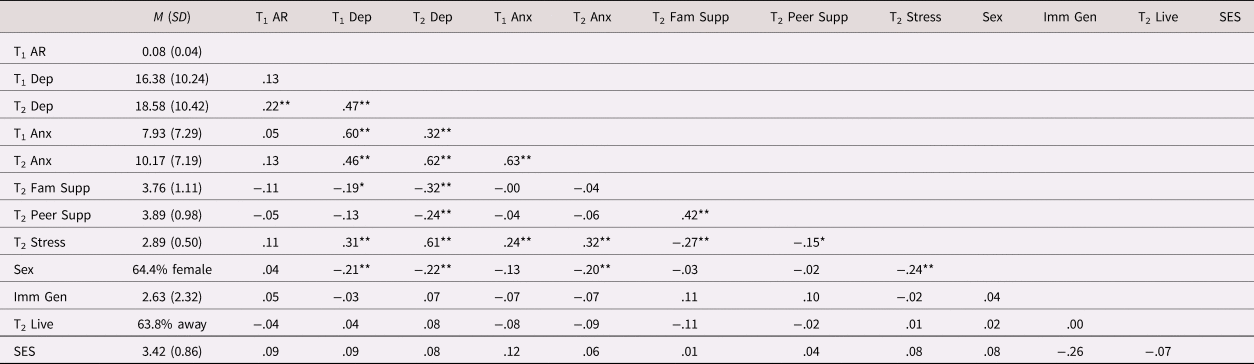
Descriptive statistics and Pearson correlations among study variables are shown in Table 1. The highest correlations were among depressive symptoms, anxiety symptoms, and the perceived Wave 2 stress measure.Footnote 4
Descriptive statistics and correlations among study variables
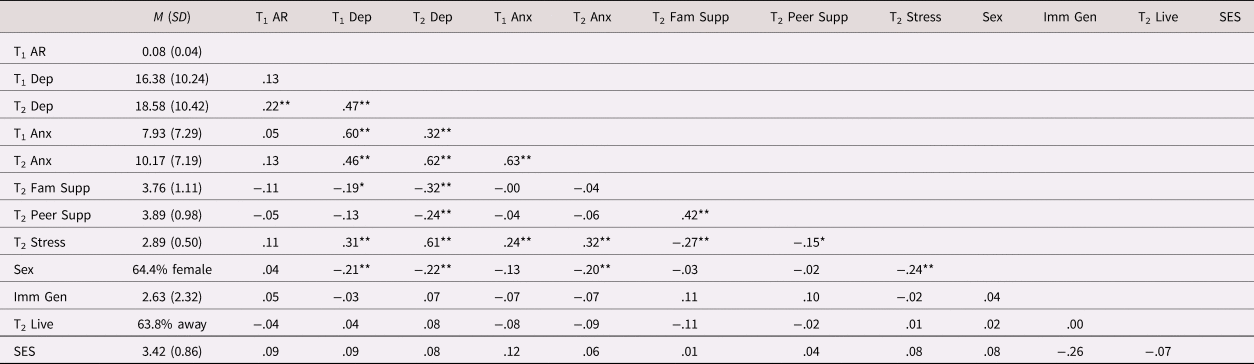
Note. T1 = Wave 1 (spring/summer senior year high school); T2 = Wave 2 (fall first year of college); AR = Empirical Bayes slope representing within-person affect reactivity; Dep = depressive symptoms, Anx = anxiety symptoms; Fam Supp = family support; Peer Supp = peer support, Sex = female (0), male (1); Imm Gen = immigrant generation status; Live = whether living away from home (0) or at home (1), SES = socioeconomic status. For depressive and anxiety symptoms, the mean and standard deviations shown are for sum scores calculated for each participant, owing to increased descriptive interpretability and relation to clinical cutoffs. However, means were used for all measures in analyses.
* p < .05; ** p < .01
Aim 1
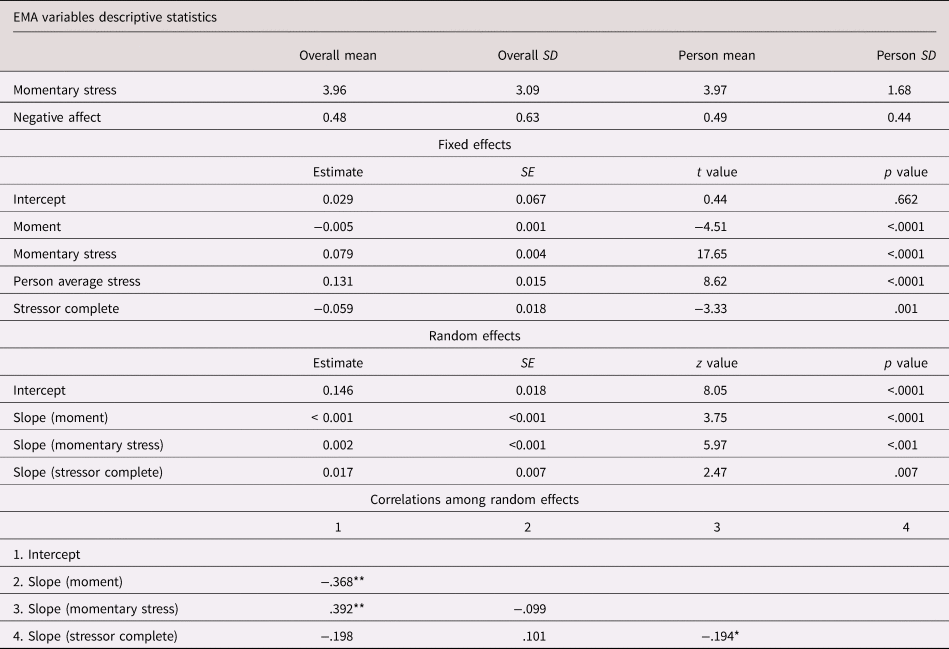
Both fixed effects and random effects describing the relations among variables measured during the EMA assessments are displayed in Table 2. Regarding fixed effects, most focally, there was a statistically significant within-person association between momentary stress and concurrent negative affect. As stress increased relative to an adolescent's average level of stress, there was a corresponding increase in negative affect, controlling for whether or not the stressor was completed or ongoing, b = 0.08, t(174) = 17.65, p < .0001, 95% CI [0.07, 0.09]. A statistically significant between-person association was also found, such that adolescents with higher average levels of stress had higher average levels of negative affect, b = 0.13, t(208) = 8.62, p < .0001, 95% CI [0.10, 0.16]. Moreover, completed events were associated with lower negative affect than ongoing events, controlling for within- and between-person stress, b = −0.06, t(143) = −3.33, p = .001, 95% CI [−0.09, −0.02]. Finally, negative affect had a minor downward trend over time, b = −0.01, t(162) = −4.51, p < .0001, 95% CI [−0.01, −0.00] and thus all other results appropriately controlled for this trend (Wang & Maxwell, Reference Wang and Maxwell2015). Pseudo R 2 for the full multilevel model was 21% (Snijders & Bosker, Reference Snijders and Bosker2012).
Multilevel model relations between stress and negative affect at Wave 1
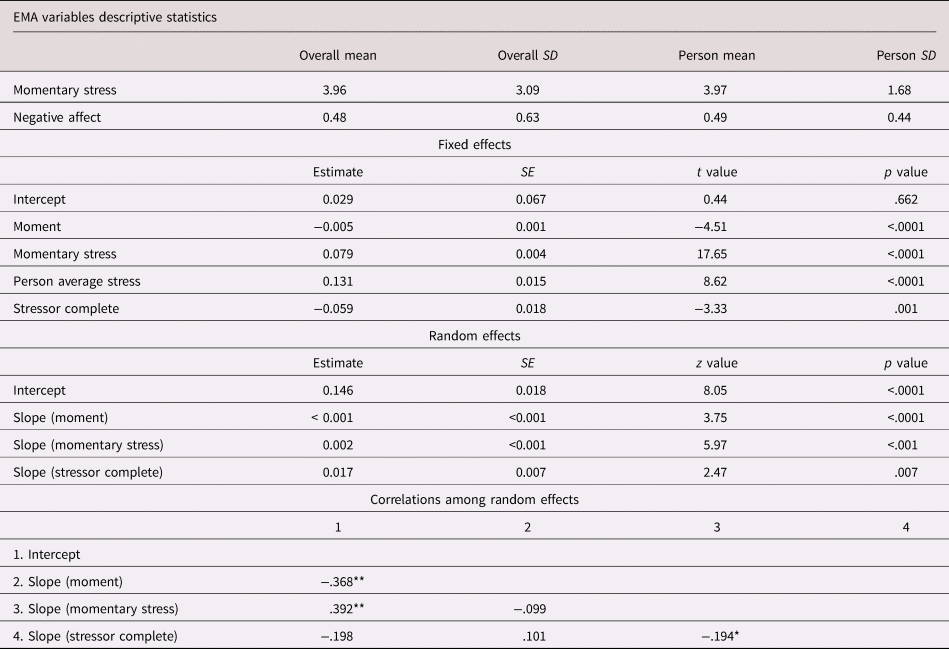
Note. EMA = ecological momentary assessment. Moment is the time variable, centered at the first occasion. Momentary stress was person mean centered to represent the within-person association between stress and negative affect. Stressor complete designates whether the stressor was completed (0) or ongoing (1) at the time of reporting. Person average stress is the mean stress level for each adolescent, averaged across all time points, to represent the between-person association between stress and negative affect.
For correlations, * p < .05; ** p < .01.
Regarding random effects, there was statistically significant inter-individual variation in intercepts (negative affect in response to a stressor at the adolescent's average level of stress; $\hat{\sigma }_{11}^2$ = 0.15, z = 8.05, p < .0001); random slopes for moment (change in negative affect over time; $\hat{\sigma }_{22}^2$
 = 0.0001, z = 3.75, p < .0001), random slopes for stress (within-person association between stress and negative affect, relative to adolescents’ average stress; $\hat{\sigma }_{33}^2$
 = 0.002, z = 5.97, p < .0001), and random slopes for whether the stress was completed or ongoing ($\hat{\sigma }_{44}^2$
 = 0.02, z = 2.47, p = .007). The significant random slope for stress level indicated there was sufficient variability across participants in their individual slopes describing the within-person relation between stress and negative affect, which was used as a predictor in the regression analyses that followed. See Table 2 for correlations among pairs of random intercepts and slopes.
Aim 2: Depressive symptoms
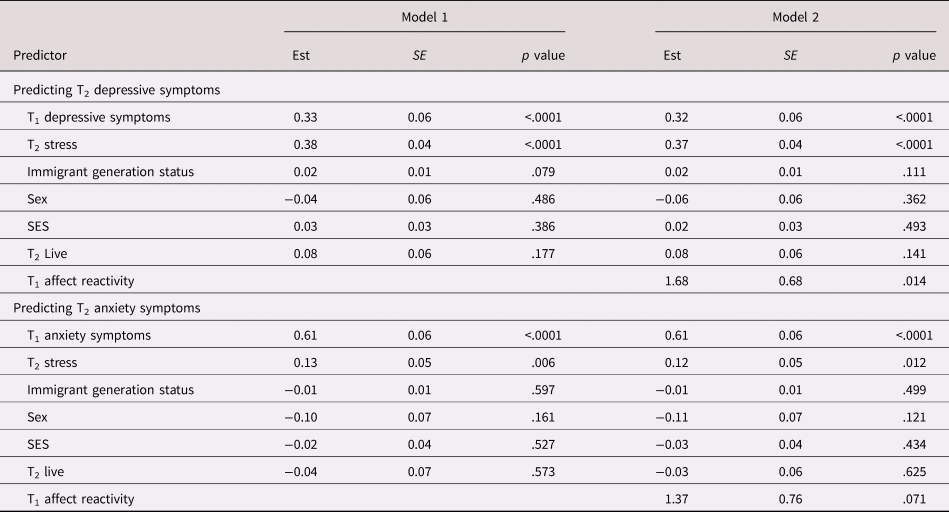
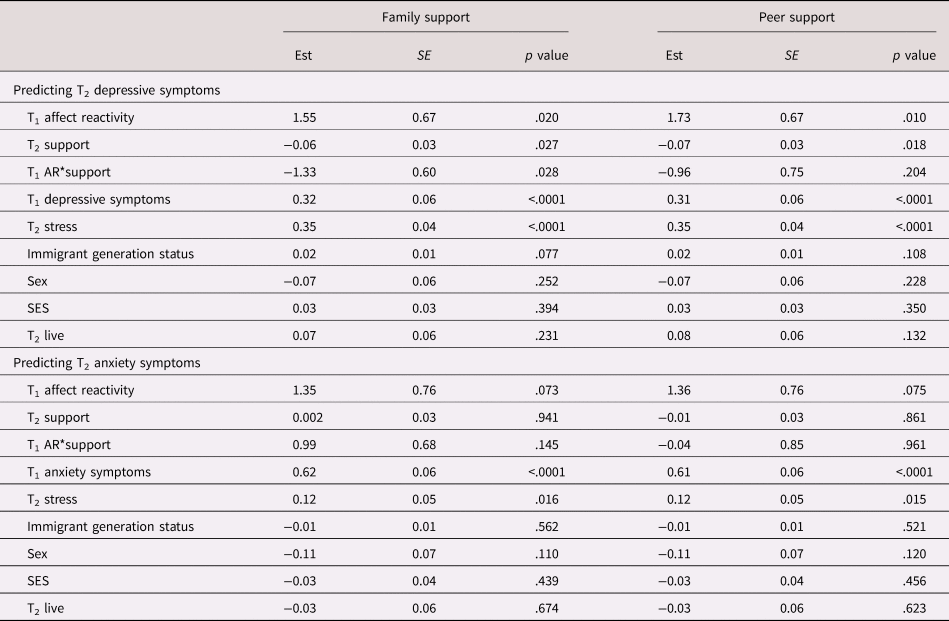
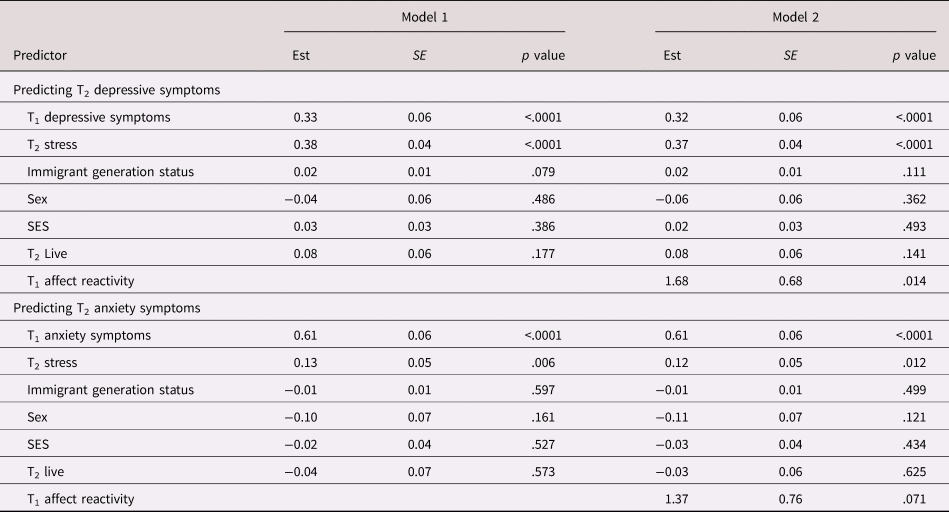
Results for regression models D1 and D2, predicting depressive symptoms at Wave 2, are displayed in the top panel of Table 3. For brevity, only the results for model D2 are described here, given that the slopes for the covariates were essentially identical across the two models. Most importantly, there was a statistically significant association between adolescents’ affect reactivity at Wave 1 and depressive symptoms at Wave 2. Increases in Wave 1 affect reactivity were associated with expected increases in Wave 2 depressive symptoms, controlling for perceived stress at Wave 2, depressive symptoms at Wave 1, immigrant generation status, sex, SES, and whether the participant was living at home or away, b = 1.68, p = .014, 95% CI [0.34, 3.02], ΔR 2 = .015. Higher levels of Wave 1 depressive symptoms, b = 0.32, p < .0001, 95% CI [0.20, 0.44], and higher levels of Wave 2 perceived stress, b = 0.37, p < .0001, 95% CI [0.29, 0.45], were also associated with significantly higher levels of Wave 2 depressive symptoms, controlling for the other variables in the model.
Regression results for Wave 2 depressive (top panel) and anxiety (bottom panel) symptoms
Note. Est = estimate; T1 = Wave 1 (spring/summer senior year high school); T2 = Wave 2 (fall first year of college); Sex = female (0) or male (1); SES = socioeconomic status; live = whether living away from home (0) or at home (1).
Aim 2: Anxiety symptoms
Results for regression models A1 and A2, predicting anxiety symptoms at Wave 2, are displayed in the bottom panel of Table 3. Again, only results for model A2 are described here. There was not a statistically significant association between Wave 1 affect reactivity and Wave 2 anxiety symptoms, controlling for all covariates, b = 1.37, p = .071, 95% CI [−0.12, 2.85], ΔR 2 = .011. In this model, higher levels of Wave 1 anxiety symptoms, b = 0.61, p < .0001, 95% CI [0.49, 0.74], and higher levels of Wave 2 perceived stress, b = 0.12, p = .012, 95% CI [0.03, 0.21], were associated with significantly higher levels of Wave 2 anxiety symptoms, controlling for other variables in the model.
Aim 3: Depressive symptoms
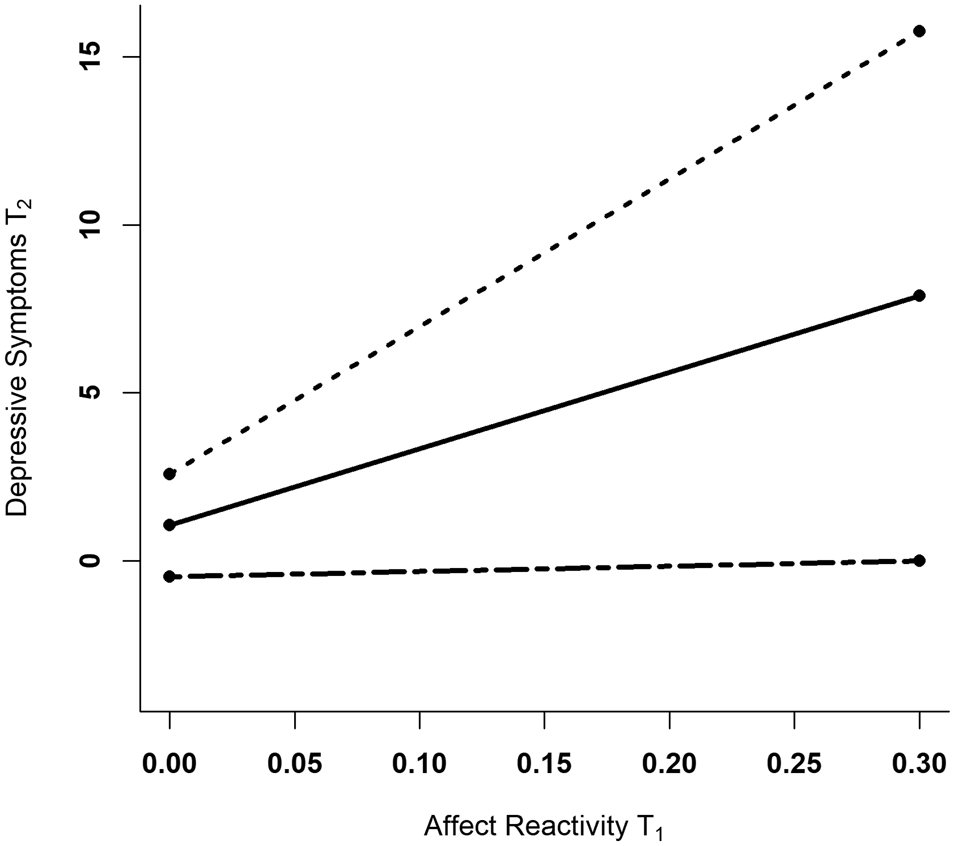
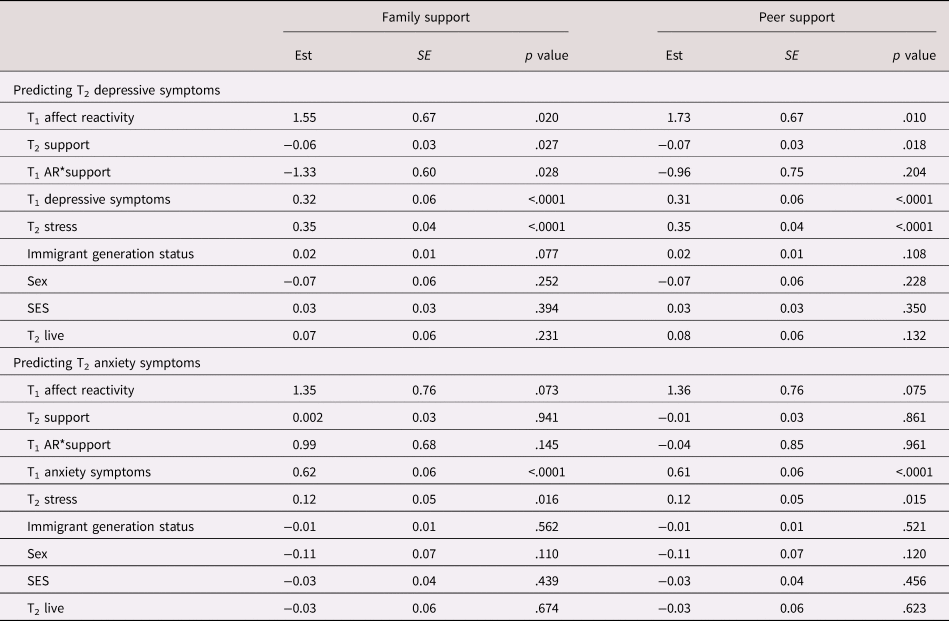
Results considering Wave 2 perceived family (model D3a) or peer (model D3b) support as a buffer to the association between Wave 1 affect reactivity and Wave 2 depressive symptoms are presented in the top panel of Table 4.Footnote 5 Importantly, perceived family support significantly moderated the relation between Wave 1 affect reactivity and Wave 2 depressive symptoms, and this interaction was consistent with buffering. Increases in Wave 2 family support were associated with a weakening of the positive association between Wave 1 affect reactivity and Wave 2 depressive symptoms, controlling for all covariates, b = 1.33, p = .028, 95% CI [−2.52, −0.15], ΔR 2 = .013. This interaction is graphed in Figure 1, depicting the simple slopes of Wave 1 affect reactivity on Wave 2 depressive symptoms for participants at low (−1 SD), moderate (mean), and high (+1 SD) levels of family support.Footnote 6 As is evident in Figure 1, adolescents reporting higher levels of family support experienced a weaker connection between their affect reactivity and later depressive symptoms. Additionally, the simple effect for Wave 2 perceived family support was statistically significant. For participants with average affect reactivity, increases in family support were associated with expected decreases in Wave 2 depressive symptoms, controlling for all covariates, b = −0.06 p = .027, 95% CI [−0.11, −0.01].
Plot showing the nature of the statistically significant interaction between affect reactivity and family support in predicting depressive symptoms at Wave 2. The plot depicts the simple slopes of affect reactivity on depressive symptoms for participants at −1 SD (dotted line), the mean (solid line), and +1 SD values of family support (dashed line).

Moderation results for Wave 2 depressive (top panel) and anxiety (bottom panel) symptoms
Note. Est = estimate; T1 = Wave 1 (spring/summer senior year high school); T2 = Wave 2 (fall first year of college); AR = affect reactivity; Sex = female (0) or male (1); SES = socioeconomic status; live = whether living away from home (0) or at home (1).
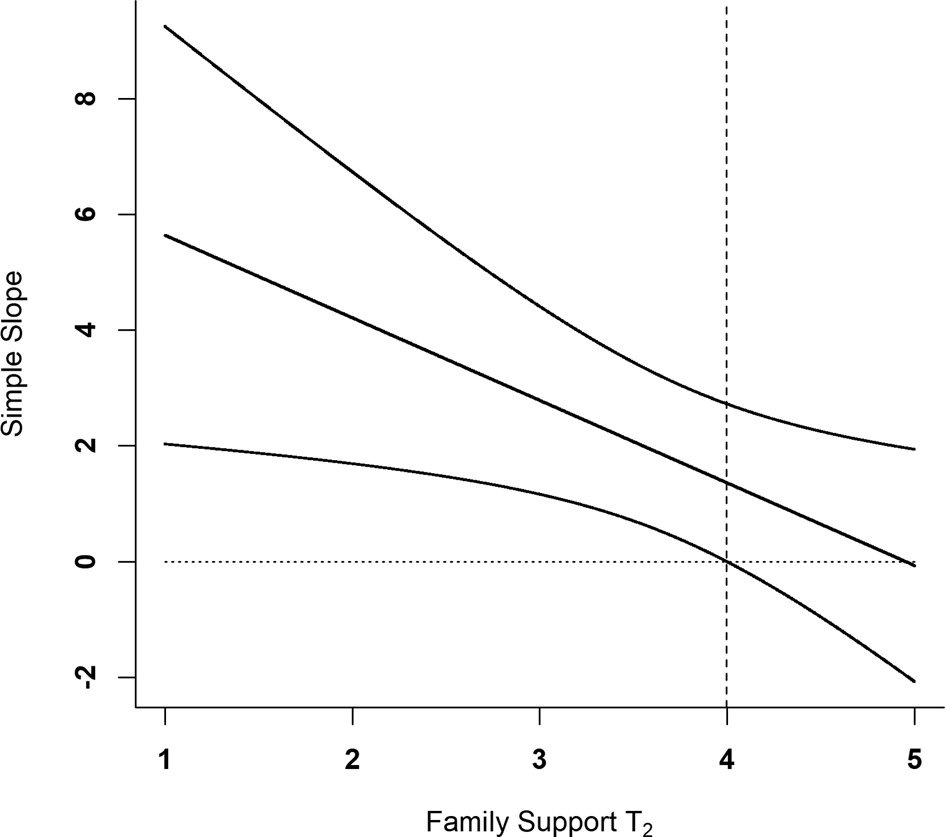
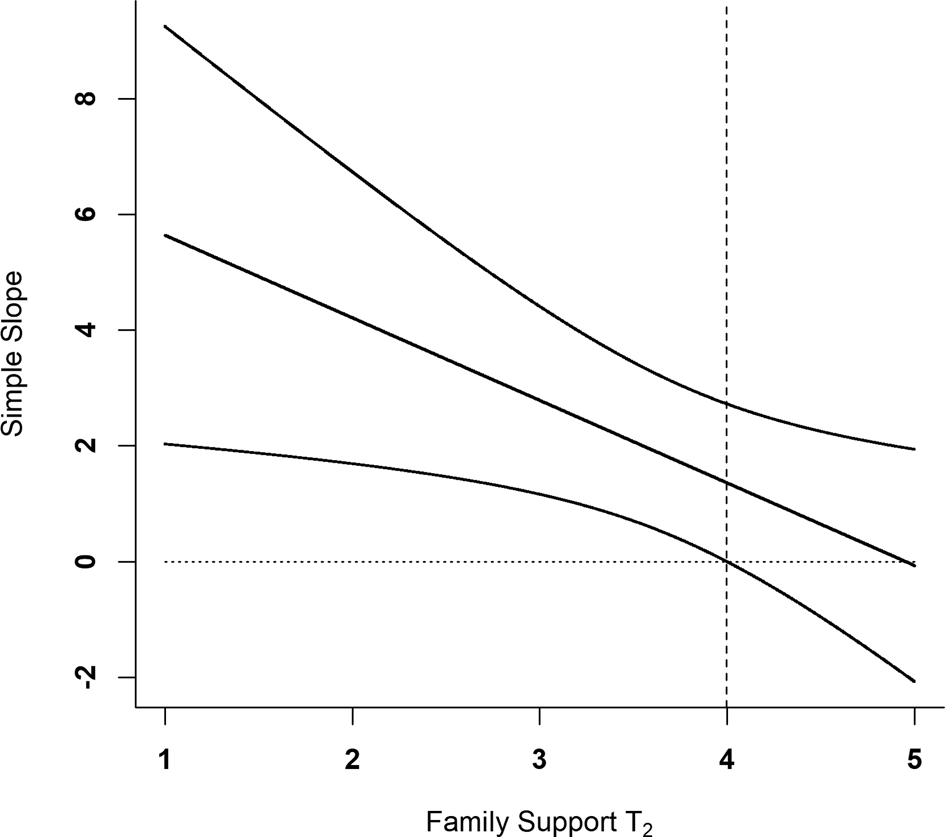
Regions of significance for the buffering association are shown in Figure 2. The plot shows how the simple slope of Wave 1 affect reactivity predicting depressive symptoms at Wave 2 changes as a function of an adolescent's level of perceived family support (solid, bold, regression line). The horizontal line indicates at what level of family support the simple slope would be exactly zero (close to the maximum level of support in the present data), and the dark gray curved lines represent 95% confidence bands around the simple slope. Additionally, Figure 2 shows that this simple slope is statistically significant for low to moderate levels of family support (values less than 4; dotted vertical line) and nonsignificant for high levels of family support, again, consistent with buffering. Regions of significance for values of family support outside of the boundaries of the present data are not shown.
Regions of significance plot for interaction between affect reactivity and family support in predicting depressive symptoms at Wave 2. The focal regression line (plotted as a bold, solid line) depicts how the value of the simple slope of affect reactivity predicting depressive symptoms changes as a function of level of family support, and the curved lines represent 95% confidence bands. The vertical dashed line represents the point at which the simple slope becomes nonsignificant, such that the region to the left of this line is statistically significant, while the region to the right is nonsignificant. In the present data, this corresponds to the positive, statistically significant relationship between affect reactivity and depressive symptoms for individuals with lower levels of support, and the nonsignificant association for individuals with greater levels of support. The horizontal dotted line shows where the simple slope is exactly zero, which occurs at the maximum level of support in the present data.
In the parallel model predicting Wave 2 depressive symptoms with peer support as a moderator, moderation by peer support was not statistically significant, b = −0.96, p = .204, 95% CI [−2.43, 0.52], ΔR 2 = .005. There was a statistically significant association between peer support and depressive symptoms at Wave 2. For participants with average affect reactivity, increases in peer support were associated with expected decreases in Wave 2 depressive symptoms, controlling for all covariates, b = 0.07, p = .018, 95% CI [−0.12, −0.01].
Aim 3: Anxiety symptoms
Results for the regression models considering Wave 2 perceived family (model A3a) or peer (model A3b) support in predicting anxiety symptoms are presented in the bottom panel of Table 4. Wave 2 family support did not have a statistically significant association with Wave 2 anxiety symptoms, b = 0.002, p = .941, 95% CI [−0.06, 0.06], and moderation by family support was not statistically significant, b = 1.00, p = .145, 95% CI [−0.34, 2.32], ΔR 2 = .006.
In the parallel model predicting Wave 2 anxiety symptoms with perceived peer support as a moderator, Wave 2 peer support did not have a statistically significant association with Wave 2 anxiety symptoms, b = −0.01, p = .861, 95% CI [−0.07, 0.06], and moderation by peer support was not statistically significant, b = −0.04, p = .961, 95% CI [−1.70, 1.62], ΔR 2 = .0001.
Discussion
Given the importance of promoting a successful college experience for the growing presence of Latinx adolescents on college campuses, it is paramount to evaluate the relations between stress and internalizing symptoms during the college transition for these adolescents, in addition to focusing on protective factors. In this study of Latinx late adolescents, we assessed the relations between affect reactivity during senior year of high school with depressive and anxiety symptoms in the first year of college, as well as the potential buffering capacity of family and peer social support. Results indicated that affect reactivity, measured using innovative EB estimates from momentary EMA data, was significantly associated with depressive symptoms, but not anxiety symptoms in the following year. This was true even when controlling for immigrant generation status, sex, SES, whether the adolescent lived away from home, current perceived stress, and most importantly, prior depressive symptoms. Moreover, perceived family support, but not peer support, showed evidence of buffering this association. This investigation is the first of its kind among Latinx adolescents at the college transition.
Aim 1: Adolescent negative affect reactivity to stress
We found evidence for both within-person and between-person relations between momentary stress and negative affect during adolescents’ senior year of high school. Such evidence indicates that, at times when adolescents were experiencing greater levels of stress than were typical for them, they experienced greater negative affect in response. Further, adolescents who had higher average stress across the week reported higher negative affect overall. These results are consistent with diary studies focusing on predominantly non-Latinx White adolescents (e.g., O'Hara, Armeli, Boynton, & Tennen, Reference O'Hara, Armeli, Boynton and Tennen2014) and the limited work with Latinx samples (Santiago et al., Reference Santiago, Brewer, Fuller, Torres, Papadakis and Ros2017), and indicate that the relations hold at a momentary in addition to at the daily level identified in other studies.
Importantly, research has not implicated a single mechanism that underlies negative affect in response to stress, and both theoretical and empirical evidence suggests there are likely multiple pathways underlying negative affectivity to stress. For example, studies have linked affect reactivity to biological mechanisms (e.g., the brain-derived neurotrophic factor (BDNF) Val66Met gene; Alexander et al., Reference Alexander, Osinsky, Schmitz, Mueller, Kuepper and Hennig2010; hypothalamic pituitary adrenal axis activity; Dickerson & Kemeny, Reference Dickerson and Kemeny2004; Suarez & Sundy, Reference Suarez and Sundy2017). Cognitive mechanisms involved in the maintenance of negative affect, such as rumination and the inability to remove negative thoughts from working memory (Foland-Ross et al., Reference Foland-Ross, Hamilton, Joormann, Berman, Jonides and Gotlib2013), may also be relevant for affect reactivity. These mechanisms have been linked to increased activation in the dorsal anterior cingulate cortex and posterior cingulate cortex in college students with elevated depressive symptoms (Kaiser et al., Reference Kaiser, Andrews-Hanna, Spielberg, Warren, Sutton, Miller and Banich2015). Certainly, within-person research at the daily or momentary levels is warranted to determine the potential mechanisms and timelines for affect reactivity in Latinx adolescents. In a study using the present sample of adolescents, researchers found that ongoing stress at the momentary level was linked to within-person increases in cortisol (Sladek, Doane, Gonzales, Grimm, & Luecken, Reference Sladek, Doane, Gonzales, Grimm and Luecken2019).
Aim 2: Predicting internalizing symptoms from affect reactivity
Affect reactivity at the daily level has been indicated as a consequence of prior (e.g., O'Hara et al., Reference O'Hara, Armeli, Boynton and Tennen2014), symptom of current (e.g., van Winkel et al., Reference van Winkel, Nicolson, Wichers, Viechtbauer, Myin-Germeys and Peeters2015), and precursor to future internalizing symptoms (e.g., Charles et al., Reference Charles, Piazza, Mogle, Sliwinski and Almeida2013). Our investigation indicated that affect reactivity during the final year of high school significantly predicted future depressive symptoms in the first year of college, even after controlling for prior depressive symptoms. Although the prospective time frame is less than 1 year, elucidating these relations across a pivotal developmental transition period is particularly important. Although focusing on discrimination rather than general stress, in a high school sample of Latinx and African American adolescents, researchers hypothesized that a potential mechanism linking affect reactivity to later mental health issues is the heightened reaction and prolonged initial response to stress (Stein, Supple, Huq, Dunbar, & Prinstein, Reference Stein, Supple, Huq, Dunbar and Prinstein2016). Additionally, a daily diary study found that college students with a previous history of depression showed higher negative emotion following stress in comparison with those without such history (Husky, Mazure, Maciejewski, & Swendsen, Reference Husky, Mazure, Maciejewski and Swendsen2009), though individual differences in this reactivity were not used as predictors of future depression. The present study adds to the existing literature by demonstrating that differences in momentary reactivity to stress were predictive of future depressive symptoms at a critical developmental juncture.
It may be advantageous to consider, then, what ecological contexts may link affect reactivity and depressive symptoms specifically for Latinx adolescents across the college transition. Studies have indicated that the university environment (i.e., “the practices, policies, and behaviors that constitute the working and learning environment”; Castillo et al., Reference Castillo, Conoley, Choi-Pearson, Archuleta, Phoummarath and Van Landingham2006, p. 268), which is a novel context for all college students, is a particularly salient feature in Latinx adolescents’ college experiences, with implications for persistence and mental health (Castillo et al., Reference Castillo, Conoley, Choi-Pearson, Archuleta, Phoummarath and Van Landingham2006; Hurtado & Carter, Reference Hurtado and Carter1997). For example, despite recent changes in access (Snyder et al., Reference Snyder, de Brey and Dillow2019), US college campuses remain predominantly White settings that differ in ethnic composition and cultural norms from many ethnic minority adolescents’ home and secondary school environments (e.g., cultural mismatch hypothesis; Stephens, Fryberg, Markus, Johnson, & Covarrubias, Reference Stephens, Fryberg, Markus, Johnson and Covarrubias2012); thus, the college transition presents an especially important context for identifying developmental mechanisms of depressive symptoms for groups of underrepresented students, including Latinx adolescents. A potential consequence of this cultural mismatch is changes in emotion regulation. A recent study found that acculturative stress predicted both depression and anxiety symptoms in Latinx college students, mediated by difficulties in emotion regulation (Mayorga et al., Reference Mayorga, Jardin, Bakhshaie, Garey, Viana, Cardoso and Zvolensky2018). Mayorga et al. (Reference Mayorga, Jardin, Bakhshaie, Garey, Viana, Cardoso and Zvolensky2018) theorized that accumulating acculturative stress may erode emotion regulation capabilities, leading to mental health symptoms in college. Our work echoes this from another perspective: adolescents who are already more highly emotionally reactive to stress showed higher levels of depressive symptoms in college. Given that difficulties in emotion regulation have been linked to experiences of negative affect in Latinx adults (Archuleta & Lakhwani, Reference Archuleta and Lakhwani2016), it is possible that adolescents with higher reactivity are faced with additional challenges to regulate their emotions in the face of stress. Importantly, we focused on stress more generally, and our findings show that these theories may not only pertain to acculturative stress, but to a variety of daily events for Latinx adolescents.
We did not find evidence for the same prospective relations for anxiety symptoms. The previous research most similar to the present study investigating these relations assessed depression and anxiety jointly (i.e., affective disorder; Charles et al., Reference Charles, Piazza, Mogle, Sliwinski and Almeida2013). Anxiety is indicated as a stress- or fear-reactive set of disorders (e.g., Bolger & Zuckerman, Reference Bolger and Zuckerman1995; Dieleman et al., Reference Dieleman, Huizink, Tulen, Utens, Creemers, van der Ende and Verhulst2015). Some theoretical models posit that youth and adolescents with anxiety function physiologically as if under chronic stress, owing to stress reactivity that does not abate (Dieleman et al., Reference Dieleman, Huizink, Tulen, Utens, Creemers, van der Ende and Verhulst2015). Yet, empirical tests linking affect reactivity and anxiety symptoms in primarily non-Latinx individuals have been mixed (e.g., McLaughlin et al., Reference McLaughlin, Kubzansky, Dunn, Waldinger, Vaillant and Koenen2010; Nelemans, Hale, Branje, Meeus, & Rudolph, Reference Nelemans, Hale, Branje, Meeus and Rudolph2018). A recent daily diary study found that anxious middle-school-aged adolescents experienced more negative affect in response to daily parent- and teacher-related events, though individual differences were not used to predict future anxiety symptoms (Herres, Caporino, Cummings, & Kendall, Reference Herres, Caporino, Cummings and Kendall2018). It is possible that the way that reactivity was assessed in the current study, through negative affect emotional responses to daily stressors rather than a more anticipatory, fear-related response, may be more associated with depressive as opposed to anxious symptoms. In line with this, researchers studying university students noted that the anxiety felt in anticipation of a stressor is more likely to be indicative of trait anxiety than anxiety experienced as reactivity to a stressor (Walker, O'Connor, Schaefer, Talbot, & Hendrickx, Reference Walker, O'Connor, Schaefer, Talbot and Hendrickx2011). Future research should incorporate multiple indicators of stress to understand whether affect reactivity to particular types of stress is differentially predictive of depressive and anxiety symptoms during the transition to college.
Aim 3: Buffering by family and peer support
Aim 3 assessed the buffering capability of family and peer support during adolescents’ first year of college on the association between affect reactivity and depressive and anxiety symptoms. The literature often focuses on negative aspects of Latinx adolescents’ environment that may make the college transition difficult and/or place them at risk for mental health issues later. However, it may be more beneficial to shed light on the adaptive features of these adolescents’ lives during the college transition (e.g., Corona et al., Reference Corona, Campos and Chen2017). The present results illustrate buffering (Cohen & Wills, Reference Cohen and Wills1985), such that perceived family social support in college minimized the negative consequences of affect reactivity in high school on depressive symptoms in college.
In particular, this buffering relationship was shown for family support, but not for peer support. Although these findings are in contrast to the notion that adolescents have often left their family environment and that peers become more salient (e.g., Dennis et al., Reference Dennis, Phinney and Chuateco2005), the findings are compatible with recent empirical work finding that peer support did not moderate the association between stress and depressive symptoms in Latinx college students (Lee, Goldstein, Dik, & Rodas, Reference Lee, Goldstein, Dik and Rodas2020). On a theoretical level, the results are also in line with the literature emphasizing the importance of family in Latinx adolescents’ lives. Placing value or importance on the family is distinct from perceiving support from family members, but the cultural importance of family may shape the implications of perceived support for Latinx adolescents (e.g., Campos & Kim, Reference Campos and Kim2017; Stein et al., Reference Stein, Gonzalez, Cupito, Kiang and Supple2015). For example, familismo may create a context wherein being able to rely on or seeking support after transitioning to college is more available and takes primacy over other forms of support. It is not surprising, then, that family support had a more notable role in buffering support relative to that of peer support. Moreover, given that support was measured during the first semester of college, it is possible that perceived support from peers was not from individuals that the adolescents had such longstanding or trusting relationships with compared with family members. For example, adolescents transitioning to college may be developing new friendships that are in more nascent stages that do not offer deeper levels of support. While our participants did not differ across the college transition in their levels of peer support (Wave 1: 3.894, Wave 2: 3.889), other work has shown that peer support rises in late adolescence and is less stable than family support (e.g., Newcomb, Reference Newcomb1990).
However, peer support may be changing over time, research from ethnically diverse samples suggests that peer support and socialization are especially important during this transition and predict adjustment outcomes for college students (e.g., Azmitia et al., Reference Azmitia, Syed and Radmacher2013; Hurtado, Carter, & Spuler, Reference Hurtado, Carter and Spuler1996). The present findings are similar with respect to main effects, as adolescents in our sample who perceived more peer support still tended to have lower depressive symptoms, regardless of affect reactivity to stress. Consequently, future investigations should disentangle whether peer support operates primarily as a promotive factor during the transition to college (i.e., Azmitia et al., Reference Azmitia, Syed and Radmacher2013) or whether closer measurement of changes in peer support over this transition may serve as a potential buffer between stressors and adjustment outcomes.
Limitations and implications for prevention
There are some limitations to note. First, an alternative approach to measuring affect reactivity would be to consider lagged associations between momentary stress and negative affect, rather than concurrent associations. Some research has implicated lingering negative affect in response to stress as particularly problematic in predicting mental and physical health outcomes (Charles et al., Reference Charles, Piazza, Mogle, Sliwinski and Almeida2013; Leger et al., Reference Leger, Charles and Almeida2018). However, owing to the large variability in the amount of time between assessments (e.g., a few hours vs. overnight), we chose to focus on concurrent associations. Although using several assessments per day contributed to the need to focus on concurrent affect reactivity, we were able to address these relations more frequently than at the daily level, leading to an average of 21 data points to draw on per participant, which is much larger than many previous studies using a similar approach (e.g., Leger et al., Reference Leger, Charles and Almeida2018).
Second, as described below, all variables were measured via self-report, indicating adolescents’ perceptions of stress, negative affect, and support. Although it is illuminating to define these constructs as adolescents perceive them, studies focusing on objective indices of stress reactivity (e.g., physiological response) and different dimensions of family support (e.g., audiotaped conversations between adolescents and family members about the college transition) could offer a different perspective on what was shown presently (see Epel et al., Reference Epel, Crosswell, Mayer, Prather, Slavich, Puterman and Mendes2018). Third, adolescents in the current sample were mainly transitioning to a single institution of higher education, and thus questions pertaining to variability across college/university environments could not be addressed. Fourth, the time frame between waves was shorter than in previous studies (e.g., months vs. years; Charles et al., Reference Charles, Piazza, Mogle, Sliwinski and Almeida2013), although this permitted focusing on the development of internalizing symptoms during an important transition period. Relatedly, although the number of days between waves differed fairly widely across participants (85–313 days), only 20 participants fell outside of the range of 1.5 standard deviations from the average time between surveys (105–239 days).
As the present focus was on the consequences of reactivity to general experiences of stress, future studies should investigate how varying types of stressors (e.g., bicultural stressors) may be associated with differential affect reactivity in Latinx adolescents at this developmental stage. Previous research has indicated ethnic-minority and acculturative stressors, including discrimination and microaggressions, as salient sources of stress for Latinx adolescents (e.g., Arbona & Jimenez, Reference Arbona and Jimenez2014). However, other research has identified academic stress, interpersonal stress, and economic stress as the most frequently reported daily stress by Latinx adolescents (Santiago, Torres, Brewer, Fuller, & Lennon, Reference Santiago, Torres, Brewer, Fuller and Lennon2016). Considering the domains suggested by Rudolph and Hammen (Reference Rudolph and Hammen1999), stressors in the present sample were diverse, encompassing dependent (e.g., “discovering I woke up late and missed school”) and independent (e.g., “ceiling leaked from all the rain when I came home”), and social (e.g., “being told I'm wasting potential by family”) and non-social (e.g., “falling on my knee that I had reconstructed”) dimensions. Consistent with Santiago et al. (Reference Santiago, Torres, Brewer, Fuller and Lennon2016), stressors were commonly academic (e.g., “studying for my math final”), interpersonal (e.g., “had an argument with my girlfriend”), and economic (e.g., “money problems with school”) rather than acculturative in nature, but future qualitative work will be integral to elucidating domain-specific affect reactivity in Latinx adolescents at the college transition.
After identifying the buffering potential of family support for Latinx adolescents transitioning to college, a logical follow-up is to consider how to leverage this potential to mitigate the emergence of depressive symptoms over this transition. Family support may protect Latinx adolescents from stress-based risk for depression and thus may represent a beneficial place to intervene for adolescents displaying high affect reactivity, in addition to promoting more adaptive stress responses. It may also be advantageous to investigate whether high schools and universities could be instrumental in facilitating this support through greater connections with families across the college transition, in ways that are culturally congruous for Latinx students.
Conclusion
Using rigorous methodology, we found that negative affect reactivity to stress at the momentary level was associated with depressive symptoms across the college transition for Latinx adolescents. The college transition can be a transformative period in adolescents’ lives, and experiences within this developmental window can have implications for internalizing symptoms, which may lead to more chronic or recurrent disorder in adulthood and have implications for academic success. Importantly, the present results also suggest that perceptions of family support may play a key role in buffering these associations and are a promising target for preventive interventions aimed at mental health in higher education for Latinx adolescents.
Acknowledgments
We are grateful to the participants and staff of the Transiciones project, especially Jennifer L. Kennedy.
Financial support
This research was made possible by a William T. Grant Foundation Scholar Award to LDD. Any opinion, findings, conclusions, or recommendations expressed in this material are those of the authors and do not necessarily reflect the views of the funding agencies.