Implications
The results of this study show that when evaluating dairy herd health advisory programmes, looking beyond compliance levels and impact on herd health is valuable. It allows identifying the impact on factors that in theory lead to improved herd health advisory services. Furthermore, it provides a more detailed understanding of how Herd Health and Production Management (HHPM) programmes can be used in the field, as the amount of published information available on this subject is scarce. This study provides detailed information for advisors in herd health management and policy makers who would like to develop these programmes.
Introduction
The organic production principles and regulations aim for high levels of animal health and welfare on organic farms (International Federation of Organic Agriculture Movements , 2005; Anonymous, 2007). However, the large variation in production disease levels found on organic dairy cattle farms within and across European countries suggests that there is room for improvement (Krieger et al., Reference Krieger, Sjöström, Blanco-Penedo, Madouasse, Duval, Bareille, Fourichon, Sundrum and Emanuelson2017). Since the 1980s, HHPM programmes were developed to support veterinarians in their role of advisors in disease prevention and health promotion. They require a holistic approach of the farm to be able to optimize animal health and productivity, whilst ensuring animal welfare, food safety, sustainable production and profitability. A HHPM programme is an iterative process involving: (1) setting objectives, (2) herd health monitoring activities, (3) implementation of practices and (4) evaluation of the outcome (Brand et al., Reference Brand, Noordhuizen and Schukken2001). Improving the use of farm-specific animal health planning processes has been identified as a promising way to improve animal health and welfare on organic dairy farms (Vaarst et al., Reference Vaarst, Winckler, Roderick, Smolders, Ivemeyer, Brinkmann and Huber2011). In theory, HHPM programmes allow to design farm-specific and farmer-centred health programmes and promote the farmer–advisor dialogue. Duval et al. (Reference Duval, Fourichon, Madouasse, Sjöström, Emanuelson and Bareille2016b) described a participatory approach that allowed designing farm-specific monitoring tools which farmers intended to use in a HHPM programme. However, so far no information was available on how these indicators were used in a HHPM programme setting. In general, relatively little published information describes HHPM programmes’ actual use in field conditions.
Implementing a HHPM programme on farms can be regarded as a complex intervention. As defined by Craig et al. (Reference Craig, Dieppe, Macintyre, Health, Unit, Michie and Petticrew2008), complex interventions contain several interacting components, involve different organizational levels, demand a number and certain complex behaviours by the persons receiving or delivering it, allow a certain adaptability of the intervention and finally can have a variation of results. HHPM programmes require a certain amount of flexibility to be adapted to farm-specific situations, and are influenced by decision-making processes from both farmer and adviser. Many factors influence the perceived pertinence of advice and ultimately farmers’ decision-making processes whether or not to adopt advice. Preventive health behaviour will, for example, be influenced by the perceived threat of disease and benefits of taking action (Janz and Becker, Reference Janz and Becker1984) or the perceived ability to implement practices (Garforth, Reference Garforth2011). Outcomes of HHPM programmes are depending on the heterogeneity of farms and advisors. Complex interventions may be challenging to evaluate and outcomes of evaluation studies can be difficult to interpret and reproduce. It is thus important to evaluate not only the outcomes, but the complete intervention process (Moore et al., Reference Moore, Audrey, Barker, Bond, Bonell, Hardeman and Baird2015). Process evaluation approaches aim at: understanding how the intervention under study was implemented, identifying causal mechanisms impacting the outcome and contextual factors explaining variation in implementation and results (Oakley et al., Reference Oakley, Strange, Bonell, Allen and Stephenson2006). Although process evaluation approaches are already used for the evaluation of public health interventions (Craig et al., Reference Craig, Dieppe, Macintyre, Health, Unit, Michie and Petticrew2008), it has not been used previously in the context of intervention aiming at promoting dairy herd health and production. Therefore, the objectives of this study were to evaluate the use and impact of a HHPM programme targeting production diseases in dairy cattle in two different advisory contexts using a process evaluation framework.
Material and methods
General approach and study design
An intervention study was performed on 20 certified organic dairy cattle farms in France and on 20 farms in Sweden, with the objective to improve herd health by implementing a HHPM programme. In addition, in both countries 20 organic dairy farms were selected as control herds where no actions were taken. The countries were chosen to represent different contexts in terms of existing organic dairy farming systems and herd health advisory contexts. In Sweden, a mandatory and more standardized character of herd health monitoring and advisory services exists for organic dairy farms, which is non-existent in France (described in detail in Duval et al., Reference Duval, Fourichon, Madouasse, Sjöström, Emanuelson and Bareille2016b).
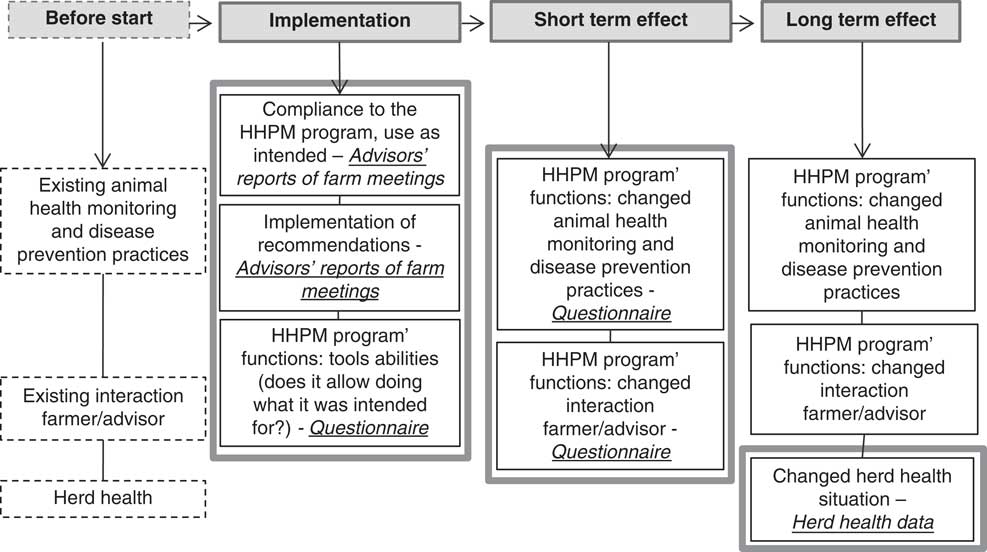
The impact of the HHPM programme was assessed using an adapted form of the process evaluation framework as described by Moore et al. (Reference Moore, Audrey, Barker, Bond, Bonell, Hardeman and Baird2015) (Figure 1). The framework allows evaluation of elements that we hypothesized could influence the impact of the programme on herd health, namely participants’ compliance to the HHPM programme, the programme’ ability to fulfil its intended uses, its ability to influence farmers’ animal health monitoring and disease prevention practices and to stimulate the interaction between farmers and advisors. The effectiveness of the programme in terms of improving herd health in intervention farms was compared with control farms and herd health situations before the intervention.
Process evaluation framework. Different elements can explain the impact of a Herd Health and Production Management (HHPM) programme on herd health advisory services and herd health. The elements that were evaluated during this study are surrounded by thick grey boxes and the origin of the data is described in italics.

The Herd Health and Production Management programme
The main health disorders that are considered to have a negative influence on cows’ health, welfare and production were identified as targets of the HHPM programme. Five health topics were selected: reproductive health and performance, udder health, calf health, locomotor disorders and metabolic disorders.
During an initial meeting (meeting 0) a researcher explained the HHPM programme to the participants. The nature of the tested HHPM programme conserved the general iterative concept of a HHPM programme; meeting 0 was used to set objectives and during the other meetings farmers and advisors were expected to (1) monitor herd health, (2) identify and implement disease preventive practices, if deemed necessary and (3) evaluate them (Supplementary Material S1). However, adaptations were made to the general concept of a HHPM programme by the research team. First, the indicators to be used for herd health monitoring were not imposed and standardized across farms. As described by Duval et al. (Reference Duval, Fourichon, Madouasse, Sjöström, Emanuelson and Bareille2016b), during meeting 0 a participatory approach was followed allowing farmers and their advisors to adapt the monitoring tool by choosing farm-specific indicators and alert thresholds to identify herd health problems targeting the five health topics. This resulted in the design of 40 farm-specific monitoring tools (paper-based or Excel®-sheets). Second, the tools provided for disease prevention by the research team contained lists of objectives to attain, rather than a detailed list of standard recommendations of good management practices that need to be implemented. The implementation of the HHPM programme was expected to lead to an improvement of herd health through: (1) herd health monitoring, (2) early identification of problems, (3) advisors providing farmers with adapted advice and (4) farmers’ compliance with the advice.
Farmers and their advisors were asked to implement the HHPM programme and have at least three meetings per farm in Sweden and four in France over a period of 12 months. Budget limitations prevented to do the same number of meetings in both countries. These meetings were conducted without the researcher, with the objective to mimic as much as possible a real advisory situation.
Participant selection
Organic dairy farmers involved in an ongoing research project were invited to participate in the current study. Inclusion criteria were that farms had to have been certified as organic for at least 1 year before the study, participate in the official milk recording scheme and farmers had to give their consent to participate in the study and share their farm data. Farmers were promised that the data would be treated anonymously. Farmers chose any person that they deemed appropriate as their advisor in herd health (veterinarian or other) to implement together the HHPM programme. In both countries, most often veterinarians were chosen.
Advisors could accompany several farmers, as was the case for one veterinarian in France and for five veterinarians in Sweden. Advisors were paid 1000 euros/farmer from the project budget to accompany farmers in implementing the HHPM programme and to report to the research teams on the farm meetings.
In total, 20 intervention farms were selected in western (the departments Loire-Atlantique and Morbihan) and eastern France (Lorraine region). In Sweden, 20 farms were selected from an area covering almost half of Sweden and with a relatively high density of dairy farms. The 20 French control farms were certified organic dairy farms located in the same geographic areas, with feeding practices, herd size and milk production level comparable with the intervention farms. In total, 20 Swedish control farms were randomly selected out of the certified organic farms present in Sweden. More details of the selection procedure can be found in Duval et al. (Reference Duval, Fourichon, Madouasse, Sjöström, Emanuelson and Bareille2016b).
Herd characteristics, advisor characteristics and a description of existing monitoring activities before the start of the study on the selected intervention farms were described in Duval et al. (Reference Duval, Fourichon, Madouasse, Sjöström, Emanuelson and Bareille2016b). Herd size was on average greater in Sweden than in France. Before the start of the study, herd health monitoring activities were non-existing in 15 out of 20 French farms. Out of 20 Swedish farmers 13 reported to monitor several herd health topics using a different approach than the one proposed in this study. Whether this was done with an advisor and/or in a herd health programme setting was not recorded.
The process evaluation framework and data collection
Evaluation of the compliance to the Herd Health and Production Management programme
The advisors reported after each meeting to the research teams using standardized templates for reporting (Supplementary Material S2). Participants’ compliance to the HHPM programme was evaluated based on the number of meetings and the implementation of monitoring activities as planned, the use of the disease prevention tools after a herd health alert, the proposition of recommendations to improve a deteriorated health situation, the presence of a discussion on recommendations made during the previous meetings and implementation of recommended measures of previous meetings if there were any.
Evaluation of the users’ opinion on the Herd Health and Production Management programme and its functions
The opinion of the participants of the HHPM programme was collected at the end of the intervention period. Each farmer and advisor that had performed at least one meeting after meeting 0 was asked by email to fill in a questionnaire using a web (Netigate®) or a paper form. Only one farmer used the paper format. Questions were related to the different types of possible use that could be made of the monitoring and the prevention tool, possible limits in its use, the value of having regular farm meetings, the influence of the HHPM programme on the relationship between farmer and advisor, the perceived effectiveness on herd health, future use and cost of the HHPM programme (the questionnaire is available upon request from the corresponding author). Mostly, questions with closed answers were used. Answers to questions, where a Likert scale (1 to 6) was used, were transformed into agree or disagree answers for the analysis. The scores 1 to 3 were converted into disagree and scores of 4 to 6 were converted into agree. A maximum of three reminders to fill in the questionnaire were sent. Reasons for not responding to the questionnaire were not recorded.
Evaluation of the Herd Health and Production Management programme’ impact on herd health
To assess the effectiveness of the HHPM programme in terms of improvement in herd health, changes in health situations before and after the intervention were evaluated and compared with the herd health situation in control farms from the corresponding countries. Subsequently, differences between French and Swedish farms were assessed. Farm data from the national recording systems were retrieved to calculate herd health and production indicators in a harmonized way, using the methodology described by Krieger et al. (Reference Krieger, Sjöström, Blanco-Penedo, Madouasse, Duval, Bareille, Fourichon, Sundrum and Emanuelson2017). Data were obtained from the official milk recording schemes, artificial insemination databases and the animal identification and registration databases. The national recording systems are not harmonized and record keeping is different across countries, including the amount of information that is recorded. Therefore, the choice of herd health indicators was determined by data availability in both countries. For example, in contrast to Sweden, in France there is no information available on lameness. As a consequence, this health disorder was excluded from the evaluation even though lameness was one of the five health domains targeted by the HHPM programme.
Nine indicators were retained to calculate herd health and production performances in both countries. For milk production, the average daily milk yield produced per cow per herd was used. Udder health was assessed by using the prevalence of high somatic cell count (SCC), calculated as the proportion of records with a SCC-value >200 000 cells/ml, and the apparent new udder infection risk defined as the proportion of cows with a SCC-value <200 000 cells/ml that changed to >200 000 cells/ml between consecutive test days. Reproductive health and performance indicators were calving interval, defined as the median interval between the last and the previous calving date, and calving to first artificial insemination interval, defined as the median duration of the interval between the last calving and the first artificial insemination after calving. For metabolic disorders, the prevalence of fat/protein ratios >1.5 between 30 and 100 days in milk was used as an indicator of an increased risk of ketosis; the prevalence of fat/protein ratios <1.0 was used as an indicator of an increased risk for sub-acute ruminal acidosis. On-farm mortality of cows, defined as the number of cows, that is after first calving, that died or were euthanized on farm divided by the sum of days at risk of dying, was also used. Finally, calf mortality was measured by the number of calves that died between 1st day and 30 days of life, divided by the sum of days at risk of dying. Regarding both mortality indicators, sold animals were censored at the day of leaving the herd. The herd health and production performance indicators were calculated for two distinct periods. Period 1 is the reference period, from 13 October 2012 to 13 October 2014. Period 2 covers the implementation of the HHPM programme from the median date of meeting 1 (10 December 2014) to 10 December 2015. Between periods 1 and 2, meeting 0 were performed to introduce the HHPM programme on the farms.
Data were randomly missing for certain farms for the calculation of certain indicators in both countries, even though data availability was a selection criterion. In France, for 15 control herds and five herds in the intervention group, milk recording data were missing. In Sweden this data were missing for 13 control herds. For the calculation of the calving interval data from one intervention farm was missing in France, in Sweden this was the case for 17 control farms and one intervention farm. To calculate the indicator interval calving-first artificial insemination, data from one control and one intervention farm was missing in France, in Sweden data were missing for three control farms. To calculate calf mortality, the data of four and two control farms was missing in France and Sweden, respectively.
Statistical analysis
The impact of the HHPM programme on herd health was assessed using linear models (R, r-project.org). Models were specified as follows: Y i =intercept+β 1×country i +β 2×period i +β 3×intervention i +β 4×intervention i ×period i + ɛ i , where Y i was the health outcome of interest and country was the country in which the herd was located (0=France or 1=Sweden). The period was the period in which the health outcome was measured (0=before intervention or meeting 0; 1=after start HHPM or meeting 0), intervention was a variable indicating whether the herd was an intervention farm (0=no and 1=yes) and the interaction between period and intervention. β 1 to β 4 were coefficients measuring the strength of the associations between these explanatory variables and the outcomes. In these models, the value of β 4 was of interest. The normal distribution of the residuals was visually checked. Significance indicated a significant association between intervention and the outcome of interest. Fisher’s tests were performed to compare the results on compliance, health impact and users’ opinion.
Results
Compliance to the Herd Health and Production Management programme
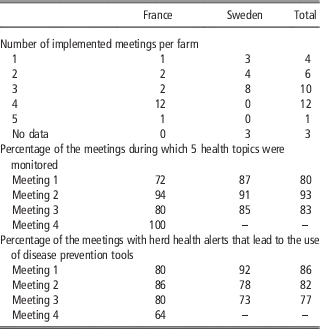
Meeting 0 was implemented in all intervention farms. However, in both countries on two farms no further meetings were implemented. The reason stated by the involved advisors was their lack of time to implement the HHPM programme. Out of the 40 farms 21 performed the number of meetings as planned (Table 1). There was no significant difference in the number of farmers who completed the full number of planned meetings in France (13/20, ⩾4 meetings), compared with Sweden (8/20, ⩾3 meetings) (P value=0.30).
Compliance to the Herd Health and Production Management programme in terms of number of meetings performed after meeting 0, implementation of monitoring activities and the use of disease prevention tools

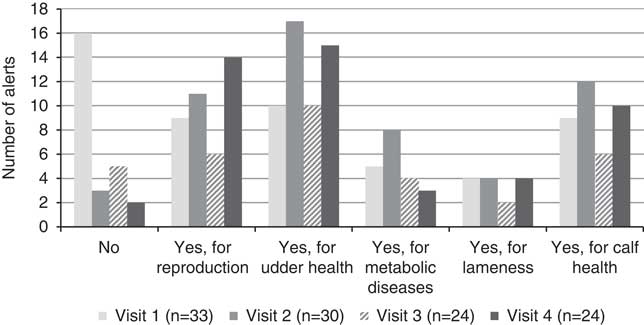
Compliance to monitoring activities on the five health topics was high (Table 1). Across countries, udder health was the domain with the highest number of health alerts, followed by reproduction and calf health (Figure 2). Herd health alerts most often lead to the use of a preventive tool (Table 1). No significant differences were found between France and Sweden. On average during the meetings, 100% of the alerts led to recommendations in Sweden compared to 85% in France (P value=0.48) (data not shown). Prevention tools could also be used without a herd alert, and this was done on 21 farms (data not shown). Identified corrective actions to improve animal health situations were 100% implemented, according to 35% and 27% of the farmers in France and Sweden, respectively (data not shown). This difference was not significant.
Number of alerts per health domain per meeting during the implementation of the Herd Health Management and Production programme in France and Sweden. n=total number of farms for which the data were available.

Participants’ opinion on the Herd Health and Production Management programme and its functions
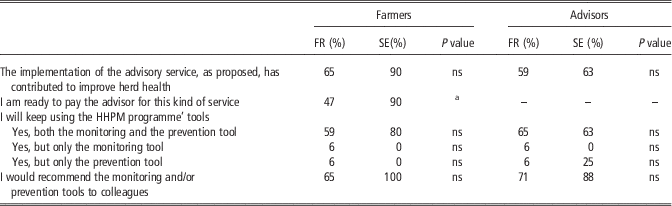
Out of the 18 eligible French farmers 17 answered the questionnaire, in Sweden 11 out of 18 farmers did. All French advisors answered the questionnaire and in Sweden 8 out of 13 advisors did. General appreciation of the tool was evaluated by asking both farmers and advisors whether they were of the opinion that the implementation of the tool during the study had a positive impact on herd health (Table 2). Numerically, farmers were more positive than advisors but this difference was not significant. Not all the farmers were willing to pay advisors for these kinds of services. Swedish farmers were more often willing to pay than French farmers (P value=0.04). Advisors were asked whether their remuneration to implement the HHPM programme corresponded to what they would ask of farmers for this kind of services; 17.6% and 12.5% of the French and Swedish advisors, respectively, replied that they would ask more. In France and Sweden, respectively, 47.1% and 25% would ask less. Although not all French participants expected an improvement of the herd health situation, the percentage of participants answering that they would keep using certain tools was higher than the percentage of participants estimating a positive effect on herd health.
Participants’ perception on the effect of the Herd Health and Production Management (HHPM) programme on herd health and possible future use of the HHPM programme’ tools

FR=France; SE=Sweden.
a P<0.05.
Participants’ opinion of the monitoring and prevention tools’ functions
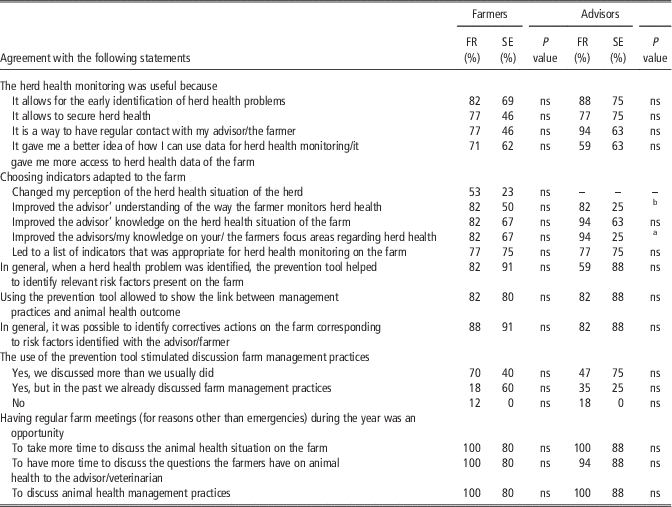
Participants were asked whether the monitoring tool allowed doing what it was intended for. The main country difference was found regarding the statement that the implementation of the tool was a way to have regular contact between farmer and advisor. Numerically this seemed more important in France than in Sweden (P value=0.08) (Table 3). Allowing each farmer to choose the indicators considered appropriate for herd health monitoring in his/her farm, was done with the intention to improve the shared understanding by farmer and advisor on the herd health situation of the farm, farmers’ focus areas regarding herd health and, the way the farmer monitors health. Differences between the two countries were observed, as well as within country as between farmers and advisors. In numbers, farmers were more positive about the effect of the tool on the shared understanding between farmer and advisor, but these differences were not significant. The only significant difference observed between French and Swedish advisors concerned the effect of the chosen indicators on improving their knowledge on the way farmers monitor health and farmers’ focus areas. Participants were allowed to change monitoring indicators during the course of the study. In France six advisors answered ‘no I didn’t identify the need’, eight changed indicators and two replied ‘it might have been useful’. In Sweden 5 out of 10 advisors answering that question had changed indicators or replied that it might have been useful (data not shown).
Participants’ agreement on the fulfilment of intended uses of the monitoring and prevention tools of the Herd Health and Production Management programme and regular farm meetings

FR=France; SE=Sweden.
a P⩽0,001; b P⩽0.01.
The prevention part of the tool was designed to serve different purposes: the identification of risk factors of disease, showing the link between practices and health outcome, identifying corrective measures to improve or secure health and to stimulate discussion between farmer and advisors on management practices. In general, according to the participants, the prevention tool met the functions it was intended to accomplish (Table 3). No significant differences in perception were found between countries or groups of participants.
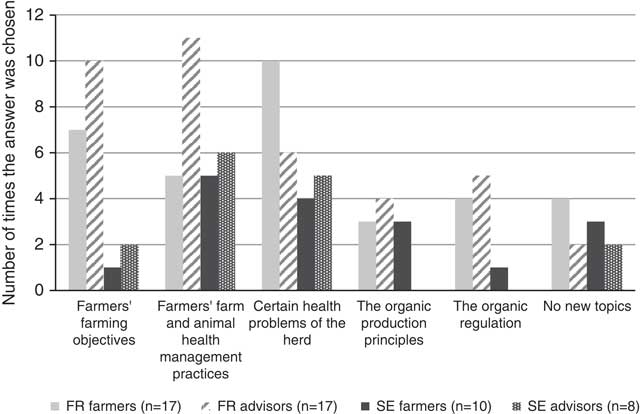
In general, the meetings were considered, by farmers and advisors, as an opportunity to discuss the animal health situation of the farm and questions of the farmer on animal health and animal health management practices (Table 3). Furthermore, French and Swedish advisors acknowledged that during the HHPM programme topics were discussed which they had not discussed in the setting of their usual collaboration (Figure 3). French advisors reported to have learned most often about farmers’ objectives and farmers’ farm and animal health management practices. Swedish farmers learned most often about farmers’ farm and animal health management practices and of certain herd health problems (Figure 4).
Farmers’ and advisors’ experiences of areas which were discussed in-depth for the first time during the implementation of the Herd Health and Production Management programme with the advisors and in which advisors learned new information, respectively. FR=France; SE=Sweden; n=total number of persons from which data were available.

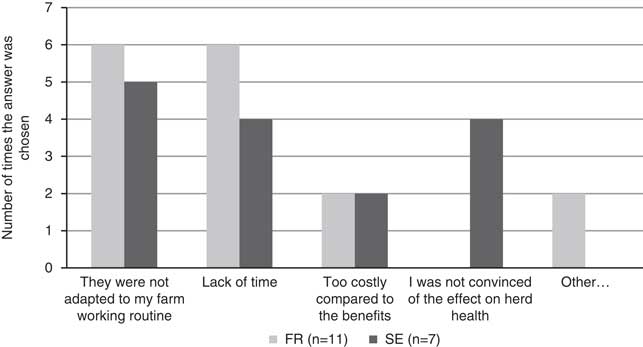
Reasons stated by French and Swedish farmers for not implementing the recommendations (multiple answers were possible). FR=France; SE=Sweden; n=total number of farmers from which data were available.

The Herd Health and Production Management programme’ impact on herd health
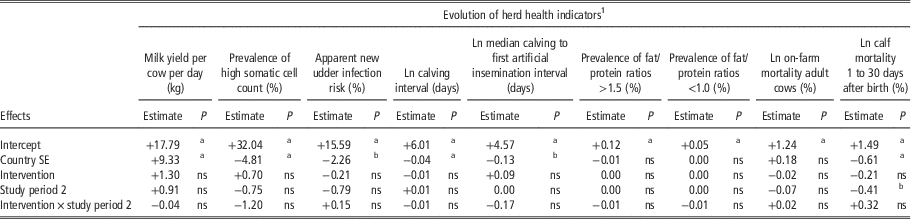
No significant effect of the HHPM programme on herd health in the intervention farms was found (Table 4, additional descriptive herd figures can be found in Supplementary Material S3). The statistical analysis showed no significant difference in the health status changes, before and after the start of the HHPM programme, between the HHPM and the control group or between countries. The average daily milk production was significantly higher in Sweden than in France. The prevalence and the apparent new udder infection risk was lower in Sweden than in France, as well as, calving interval and median calving to first artificial insemination interval. No significant differences were found between countries metabolic disorders’ indicators. Finally, calf mortality was significantly higher in France than in Sweden in contrast to the situation for cow mortality, which in turn was lower in France, but not significantly.
Results of linear models for herd health indicators in the study groups and their evolution after implementation of the Herd Health and Production Management programme in France and Sweden

1 For all models the reference modality was the control group in France (first row, model intercept). For the indicators calving interval, median calving to first artificial insemination interval, on-farm mortality of adult cows and calf mortality from 1 to 30 days after birth the natural logarithm (Ln) of the indicator was modelled. For these indicators the coefficient estimates must be exponentiated to get back to the original scale, and the effects are multiplicative. For example, the calving interval in the control group in Sweden (SE) is exp. (6.03)×exp. (−0.03)=403.4 days.
a P<0.001; b P<0.01.
Discussion
The value of a process evaluation framework
This study was innovative using a HHPM programme which was even more farm centric compared with previous studies, because farmers could chose to use it as suggested, modify it or replace it. In addition, a single-advisory method was evaluated across countries. Finally, the evaluation of the intervention of the HHPM programme, using a process evaluation framework, was an innovative approach in the field of animal health management. As health management interventions were often evaluated mainly based on compliance levels and/or changes in herd health indicators (e.g. Green et al., Reference Green, Leach, Breen, Green and Bradley2007; Bell et al., Reference Bell, Bell, Knowles, Whay, Main and Webster2009; Ivemeyer et al., Reference Ivemeyer, Walkenhorst, Heil, Notz, Maeschli, Butler and Klocke2009). The impact of a health intervention depends on numerous causal mechanism that need to be evaluated (Moore et al., Reference Moore, Audrey, Barker, Bond, Bonell, Hardeman and Baird2015). In this study, an evaluation solely based on compliance and health improvements would have concluded that the HHPM programme failed. However, in general, when meetings were included, the results showed that the HHPM programme was used as intended. Both farmers and advisors agreed that the monitoring and the prevention part of the tool fulfilled most of the functions it was expected to fulfil to ultimately promote health. Moreover, the HHPM programme appeared to be appreciated by most users of the tool, based upon the perceived effectiveness of the intervention on herd health, according to a majority of the respondents of the questionnaire, and their willingness to continue to use (elements) of the tool.
This study illustrates the value of a process evaluation approach in pilot studies, testing complex interventions in small and heterogeneous study populations. Several limits in the study design can explain why no significant herd health improvements were measured in the intervention farms. The initial herd health situations probably differed. If the only objective of the study had been to measure the effectiveness of the intervention on herd health it would have been more appropriate to test the tool in, for example, herds with severe udder health problems. Other studies reported more improvements in animal health in herds with a poorer health level at the start of the intervention (e.g. Green et al., Reference Green, Leach, Breen, Green and Bradley2007; Ivemeyer et al., Reference Ivemeyer, Walkenhorst, Heil, Notz, Maeschli, Butler and Klocke2009). In addition, because of the possible different health problems in different farms, the sample size was probably too small per health disorder, especially with the high amount of missing data, limiting the statistical power. Moreover, the testing period may have been too short to observe an effect of the programme based on the indicators chosen. In other intervention studies similar difficulties were identified (Bell et al., Reference Bell, Bell, Knowles, Whay, Main and Webster2009; Ivemeyer et al., Reference Ivemeyer, Smolders, Brinkmann, Gratzer, Hansen, Henriksen and Walkenhorst2012). The methodological challenges encountered support thus the idea to perform a process evaluation; evaluating both the process and herd health impact. Especially, since large-scale and long intervention studies are often not feasible for financial and organizational reasons.
The Herd Health and Production Management programme’ impact on the dialogue between farmer and advisor
The HHPM programme proved to have characteristics facilitating the development of advisory services that stimulated the farmer–advisor dialogue and thus possibly their mutual understanding. The transfer of information occurred in both directions from farmer to advisor and the other way around. Even in Sweden, both farmers and advisors learned from each other despite the existing advisory context that could lead to expect that Swedish advisors had already more often in-depth knowledge of the herd health situation and farm management than in France. The quality of the farmer–advisor dialogue is considered as a key to success of animal health planning activities (Vaarst et al., Reference Vaarst, Winckler, Roderick, Smolders, Ivemeyer, Brinkmann and Huber2011). The project imposed regular and frequent meetings, which could have been a step forward in itself to stimulate an advisory role for advisors in herd health management on organic dairy farms. French veterinarians have been found to be rarely invited to organic dairy farms and find it difficult to make their role in organic dairy farmers animal health management evolve from a therapeutic role towards an advisory role (Duval et al., Reference Duval, Bareille, Fourichon, Madouasse and Vaarst2016a). This situation might be true for other countries, as has been reported in Denmark (e.g. Vaarst et al., Reference Vaarst, Bennedsgaard, Klaas, Nissen, Thamsborg and Østergaard2006).
Difficulties encountered when evaluating the advisory relationship between farmer and advisor
Information will only be of significance to the receiver if it is built upon his/her existing knowledge (Klerkx and Jansen, Reference Klerkx and Jansen2010), underlining thus the importance of the farmer–advisor dialogue to exchange information with the aim to build new knowledge (co-constructing advice) rather than only exchanging information (like a recipe). The results show that both farmers and advisors perceived that they have acquired knowledge that was new to them. However, the research strategy chosen does not allow to measure if and how that was used to adapt it to farm-specific advice. Research methods such as qualitative research interviews could have been more appropriate to understand that process (Malterud, Reference Malterud2001).
A need for adaptable herd health management tools?
Participants used the possibility to adapt the programme to farm-specific situation (Duval et al., Reference Duval, Fourichon, Madouasse, Sjöström, Emanuelson and Bareille2016b). It has been questioned whether adaptability would only lead to ‘quick and easy solutions’ (Beekhuis-Gibbon et al., Reference Beekhuis-Gibbon, Devitt, Whyte, O’Grady, More, Redmond and Doherty2011). In this study, the freedom to choose indicators did not seem to lead to situations in which farmers set health standards that are relatively easy to achieve, as meetings without an alert were relatively rare.
Testing a tool under field-like conditions to improve its relevance to practice
The process evaluation framework chosen provided useful additional information on the context and implementation of the HHPM programme. A dialogue between designers and end-users that have tested a prototype creates a learning environment in which the response of the tool to ‘field-like’ situations can be discussed (Cerf et al., Reference Cerf, Jeuffroy, Prost and Meynard2012). Moreover, testing the tool and reporting on the context of its implementation should make reports more useful for future users and decision makers (Waters et al., Reference Waters, Hall, Armstrong, Doyle, Pettman and De Silva-Sanigorski2011).
Conclusion
Although compliance to the HHPM programme was not fully fulfilled and no significant effect of the intervention on herd health was demonstrated, the HHPM-tool triggered multiple factors that could promote the dialogue between a farmer and an advisor, and stimulate farmers’ decisions to implement advice on animal health management. The methodological challenges encountered for the evaluation of the HHPM programs’ impact on herd health consolidates the need for specific research approaches for the evaluation of such complex interventions.
Acknowledgements
The authors would like to thank the participating farmers and advisors for their extensive collaboration and feedback. This study received funding from the European Union’s Seventh Framework Programme for research, technological development and demonstration under grant agreement number 311824 (IMPRO), and by the Region Pays de la Loire under grant agreement number 201309596.
Supplementary material
To view supplementary material for this article, please visit https://doi.org/10.1017/S1751731117002841