I Introduction
Esping-Andersen (Reference Esping-Andersen1990, pp. 79–80), writing more than twenty years ago on his approach to the characterisation of welfare states, justified his focus on pensions in the following terms:
‘If an analysis of pensions appears somewhat narrow and pedestrian, keep in mind two circumstances: first, pensions account for more than 10 percent of GDP in many contemporary nations; second, pensions constitute a central link between work and leisure, between earned income and redistribution, between individualism and solidarity, between the cash nexus and social rights. Pensions, therefore, help elucidate a set of perennially conflictual principles of capitalism.’
Put another way, pensions highlight the dynamic relationship between individual and collective approaches to risk in capitalist welfare states (Condon, Reference Condon, Crossman and Fudge2002). But, like the welfare regimes of which they are a part, pensions are not, in this sense, neutral; they reflect, re-inscribe and sometimes challenge social categories of difference, the gender division of labour, stratification and labour market segmentation (O'Connor, Reference O'connor1993; Orloff, Reference Orloff1993a, Reference Orloff1993b; Daly and Rake, Reference Daly and Rake2003; Williams, Reference Williams1995).
Pensions are thus an important lens onto processes and institutions that concomitantly reflect, and shape, equality goals in developed and developing welfare states. They are designed, on one hand, to be a de jure source of income when people are unable to engage in wage labour; on the other they are the de facto link between different stages of the life-course that amplify and extend labour market inequalities. Pensions also reveal how, in contemporary welfare states, socio-economic rights are defined in relation to normative and ideological categorisations, how (and for whom) the state prioritises their distribution, and what these processes reveal about notions of equality and their political and legal institutionalisation. Equality goals are, moreover, subjects of contestation and struggle.
The legal sphere is one in which processes of contestation and struggle, over issues such as access to scheme membership, mandatory and early retirement, vesting rights and conditions, and the inclusion of pension rights in employment contracts and collective bargaining agreements, play out. The establishment of occupational pensions is integrally linked to the normative establishment of the standard employment relationship (SER) (Strauss, Reference Strauss, Arthurs and Stone2013); because pensions, especially but not only occupational pensions, are linked to paid employment, they fall within the ambit of a broad conception of labour law that takes into account the full range of labour market regulatory mechanisms, or what Conaghan (Reference Conaghan2014, p. 8) describes as ‘an increasingly complex array of legislative provisions concerned with allocating individual rights and responsibilities’. Moreover, as I argue in this paper, the study of pensions is not only relevant to understandings of paid employment in labour law. Feminist legal theory also has much to contribute to the analysis of pensions through its analytical foregrounding of the interrelationship of the gender division of labour, spheres of legal regulation and the organisation of production and social reproduction (Conaghan and Rittich, Reference Conaghan, Rittich, Conaghan and Rittich2005; Fudge, Reference Fudge2014), which are fundamental to the evolution of norms of equality.
Contestation and struggle also often relate to the ways in which equality goals, and the measures taken to secure them, are grounded either in formal or substantive notions of equality, and whether different socially constructed categories of difference (e.g. class, gender, ethnicity, race, sexual orientation), and structures of dominance, are accorded equal weight within judgments about what inequality entails and what remedies are legitimate (Fredman, Reference Fredman2009; Fudge, Reference Fudge2007). In this paper I examine how contemporary pension systems are haunted by ‘elusive equality’ by virtue of the ways that equality goals are articulated and institutionalised. I illustrate how these processes of articulation and institutionalisation occur by focusing on the relationship between wage labour, access to pension resources, and the tensions between different notions of equality in pension institutions. I ground my analysis in the ‘feminist theoretical project’ in labour law (Fudge, Reference Fudge, Fudge, McCrystal and Sankaran2012; Conaghan, Reference Conaghan, Morris and O'Donnell1999) and human rights law, which aims, inter alia, to elucidate key differences between formal and substantive approaches to gender equality and to make a normative case for the latter (Fredman, Reference Fredman2009). I also draw on approaches from feminist political economy to argue that the unpaid work of social reproduction is not adequately valued in pension systems (Ginn, Street and Arber, Reference Ginn, Street, Arber, Ginn, Street and Arber2001), and that tightly coupling access to income in older age to labour market attachment reproduces labour market inequalities after retirement (Meyer and Bridgen, Reference Meyer and Bridgen2008). In the course of this analysis I pose three key questions. First, in the context of the principle of the right to equality, what is the nature of the equality or equalities sought? Second, what form of right does this principle entail? Finally, if substantive equality is a desired outcome of the definition and distribution of socio-economic rights, including pension rights and resources, are systems that link income to labour market attachment the best way to achieve it?
The remainder of the paper is in five parts. The second part briefly discusses the nature and organisation of pension systems and provides an overview of different pension regimes. From there I move on to a discussion of concepts of equality, and make an argument for a substantive model of pension equality. I then focus on the case-study of the UK to explore the gender pension gap and other forms of pension inequality. I conclude with some thoughts on alternative ways of distributing socio-economic rights over the life-course.
II The design of pension systems
Pensions are designed to provide an income for those deemed unable to participate in paid work. They generally cover individuals with an infirmity, injury or disability that prevents them from undertaking wage labour (disability pension), or those too old for the labour market (old-age pension). Both categories are socially constructed and historically contingent (see, for example, Thane, Reference Thane, Clark, Munnell and Orzsag2006a). Although a number of typologies exist for describing pension regimes, the simplest distinction is between Bismarkian and Beveridgean regimes. The former, named after the German conservative statesman Otto von Bismark, is generally understood as a social insurance based model in which pension income is tightly linked to contributions and income (generally from labour market participation). The latter, named after the British politician William Beveridge, usually refers to a system with a universal flat-rate component and a degree of redistribution in the contributory employment-related element (often in the form of lower replacement rates for high earners relative to low earners). This distinction is important to the degree that it signals the importance of historical trajectories of development (if not, necessarily, path dependence) and the relative importance of universal coverage (equality) versus the contributory principle (equity).
There has always existed a tension, in capitalist welfare states, between capital's need for workers compelled to commidify their labour and the societal discord (and, potentially, revolutionary politics) produced by the presence of large groups of people unable to do so – and thus historically consigned to poverty. Many of the first European pension schemes were for soldiers. In Victorian England, it was elderly women, frail and without means, who were constructed as the ‘deserving poor’ in need of a pension income. In the contemporary context pensions can be provided by employers or the state or organised privately through individual or collective savings or insurance schemes. In practice, the pension systems of most modern welfare states comprise a public (state-provided) component organised at the national scale, an employment-linked component and a private (savings) component; this structure is relatively recent, however, linked to the development of welfare policies and programmes from the 1930s through the postwar period. As I have argued elsewhere (Clark, Strauss and Knox-Hayes, Reference Clark, Strauss and Knox-Hayes2012; Strauss, Reference Strauss, Arthurs and Stone2013), pension systems emerged out of the institutionalisation of the Fordist social compact and standard employment relationship, both of which also had as their foundations the male breadwinner model and gendered division of labour in which women were responsible primarily for the unpaid work of biological and social reproduction.
National pension systems are generally structured around interrelated tiers or pillars; the first comprises basic, targeted and minimum pensions designed for poverty alleviation; the second, income replacement pensions; the third, voluntary, private savings schemes (see Strauss, Reference Strauss, Arthurs and Stone2013, for an overview; also OECD, 2005, 2009). These parts are interrelated in the sense that total income in older age is – in theory, in most pension systems – drawn from all three (plus other savings and assets). In reality, different national pension regimes are informed to a greater or lesser degree by decommmodification goals, meaning mandatory first and second tiers provide the pensions that the majority of people live on in older age (Esping-Andersen, Reference Esping-Andersen1990; on convergence trends and privatisation, see Bridgen and Meyer, Reference Bridgen and Meyer2009; Pedersen, Reference Pedersen2004).
If the trend after World War II was, to greater or lesser degrees in the industrialised economies, decommodifying (towards lessening vulnerability to market forces through the introduction of socio-economic and labour rights), the fundamental tension between capital and labour was not resolved. For the capitalist state it was, and is, imperative that pensions not act as a disincentive to remaining in the labour market for those seen as able to work. Thus, public pensions have typically been framed as residual, while employment-linked pensions were understood as both tools to aid in the recruitment, retention and eventual exit of valued workers (by employers) and deferred wages (by employees). At the same time they have been historically blind to unwaged work performed in the home and the community – the work of social reproduction. Occupational pensions, which rewarded paid employment, were thus encouraged (and in many cases subsidised) by the state and valued by employers and employees, at least for a period. The gender division of labour during this period, however, meant that adult women typically had access to occupational pension income only through their husbands (Thane, Reference Thane, Pemberton, Thane and Whiteside2006b). For racialised workers, ethnic minorities and those with disabilities, segmented labour markets could also result in a lack of access to occupational welfare.
Since the late 1970s, however, there has been an increasing trend – linked to neoliberal ideology and social policy, economic and financial globalisation, and to a lesser extent demographic change – towards the individualisation and privatisation of pensions (Strauss, Reference Strauss2011; Foster, Reference Foster2010). Path dependence is only partly responsible; while these trends have been clearly observable in countries with a historically larger role for private pensions, they are also in evidence in traditionally social democratic or corporatist regimes (Pedersen, Reference Pedersen2004). In many countries, including the US and UK, the majority of retirees nevertheless gain an equal or greater share of their income from public schemes like social security and the British state pension than from private pensions (including those provided by an employer), unless they are in the highest income brackets. Women, many of those belonging to ethnic minority groups, and people with disabilities are more likely than White men to depend on public pension income in retirement.
The principle of the right to equality has impacted on the evolution of many national pension systems, and in some cases has been spurred by precedents set at the supranational level. In relation to the UK, for example, the European Court of Justice (ECJ) ruled in favour of part-time workers in relation to the referred case Shirley Preston and others v. Wolverhampton Healthcare NHS Trust and others and Dorothy Fletcher and others v. Midland Bank plc (2000),Footnote 1 against a two-year limit regarding service, in part because it could contravene Article 141 (Equal Pay).Footnote 2 The introduction of credits for caregivers in diverse countries including the UK, Finland, Canada and Japan has been largely spurred by the smaller state and private pensions that accrue to many women due to interrupted labour market attachment over the life-course (Fulz, Reference Fulz2011).Footnote 3 Yet parallel developments in pension systems continue to challenge equality principles, highlighting the ways in which the design (and ongoing redesign) of systems of social and occupational welfare are often riddled with ‘deep-seated conceptual confusion and a lack of consistency’ (Barnard and Hepple, Reference Barnard and Hepple2000, p. 583). The gender pension gap has endured even as women have overtaken men as members of occupational pensions in countries such as the UK. More women than men live in poverty in older age in most OECD countries. In concrete ways, the evolution of pension systems reflects societal struggles over conflicting notions of equality and distributional justice.
III Substantive equality and access to pension resources
In the decades since the bedding-in of many contemporary pension systems in the 1940s and 1950s there have been at least two sets of processes, distinct from but intersecting with processes of financialisation and privatisation, individualisation and neoliberal welfare retrenchment, which have had implications for political, economic and legal discourses related to pension reform (see, for example, Blackburn, Reference Blackburn2002; Clark, Reference Clark2003; Condon, Reference Condon2001; Strauss, Reference Strauss, Clark, Dixon and Monk2009). One is the increased participation of women in wage labour and the related struggles to gain equal pay for equal work. The second is the recognition that the gender division of labour and women's responsibility for unpaid domestic and care work renders their patterns of labour market attachment over the life-course different from those of the full-time, permanent worker assumed by the standard employment relationship. The latter has resulted in campaigns to make unpaid care work (but not usually domestic work) ‘count’ in relation to the accrual of pension rights. As Fudge (Reference Fudge, Fudge, McCrystal and Sankaran2012, p. 5) has pointed out, these processes have had implications for men too: ‘In the early 1980s, the two-fold feminization of labour (the increase in labour market participation rates of women and the deterioration in jobs caused by economic restructuring) and a policy emphasis on flexible labour markets undermined the male employment norm.’ The pension related outcomes of these shifts can be seen in the collapse of pension scheme membership among employed men (especially those on low incomes) in the UK.
Concomitant with these shifts has been the struggle for, and gradual recognition of, the right to equality in pension systems and the slow and uneven embedding of this right through the political and legal processes of institutionalisation, as suggested by the examples discussed above. But, as Fredman (Reference Fredman2007) has suggested, the nature of the vision of equality that underpins how distributional decisions are made in relation to socio-economic rights determines whether the right to equality is one that is genuinely progressive (advancing goals of redistribution and social justice) or one that simply reinforces the status quo. Moreover, as both Fredman (Reference Fredman2007) and Barnard and Hepple (Reference Barnard and Hepple2000) have pointed out, procedural models of equality may in fact lead to a levelling down in relation to socio-economic and labour rights. ‘A claim to equal treatment can be satisfied by depriving both the persons compared of a particular benefit … as well as by conferring the benefit on them both’ (Barnard and Hepple, Reference Barnard and Hepple2000, p. 563). In relation to pensions there are clear examples of this notion in discourses around pension retrenchment in the British public sector; pensions for those employed by the state should be levelled down to equalise conditions between those in the public and private sectors.
The distinction between the different concepts of equality, and the frameworks they engender, is a distinction between formal (or procedural) and substantive equality. Fredman (Reference Fredman2009, p. 419) identifies four key dimensions of substantive equality in relation to her project of engendering socio-economic rights. They are: that the concept of substantive equality is grounded in a recognition of existing power structures and the way that gender operates within them; second, that it is not reducible to equal treatment; third, that it moves away from the need for a male norm or comparator; and fourth, that it aims to ensure more than simple consistency of treatment. She acknowledges that what substantive equality does entail in the context of gender is not axiomatic. Rather, it is and must be the subject of feminist debate and political struggle. Contrasted with formal equality, however, which aims only to ensure that two similar individuals are similarly treated (and which does not stipulate that the outcome must be progressive), substantive equality is transformative. The goal of substantive equality is to transform social relations and the related political–legal mechanisms of distribution such that resources, capabilities and the exercise of power cease to be concentrated in the hands of the few solely because of their gender, class and/or race.
The limits of formal equality are clear when looking at the examples of social security and pensions: ‘Firstly it assumes that the aim is to treat everyone on their merits, regardless of their gender … the result is to entrench disadvantage. For example simply extending the right to social security … ignores the fact that women have interrupted work patterns and are often engaged in precarious and informal work’ (Fredman, Reference Fredman2009, p. 418). In other words, if the nature of the concept of equality that underpins a notion of the right to equality is formal or procedural, the outcome will be formal rather than transformative. If the nature of the right is also formal or procedural, then the form of political or legal process it generates to guarantee that right will also be formal or procedural. In this sense there is a double set of categories at play in understanding equality and socio-economic rights.
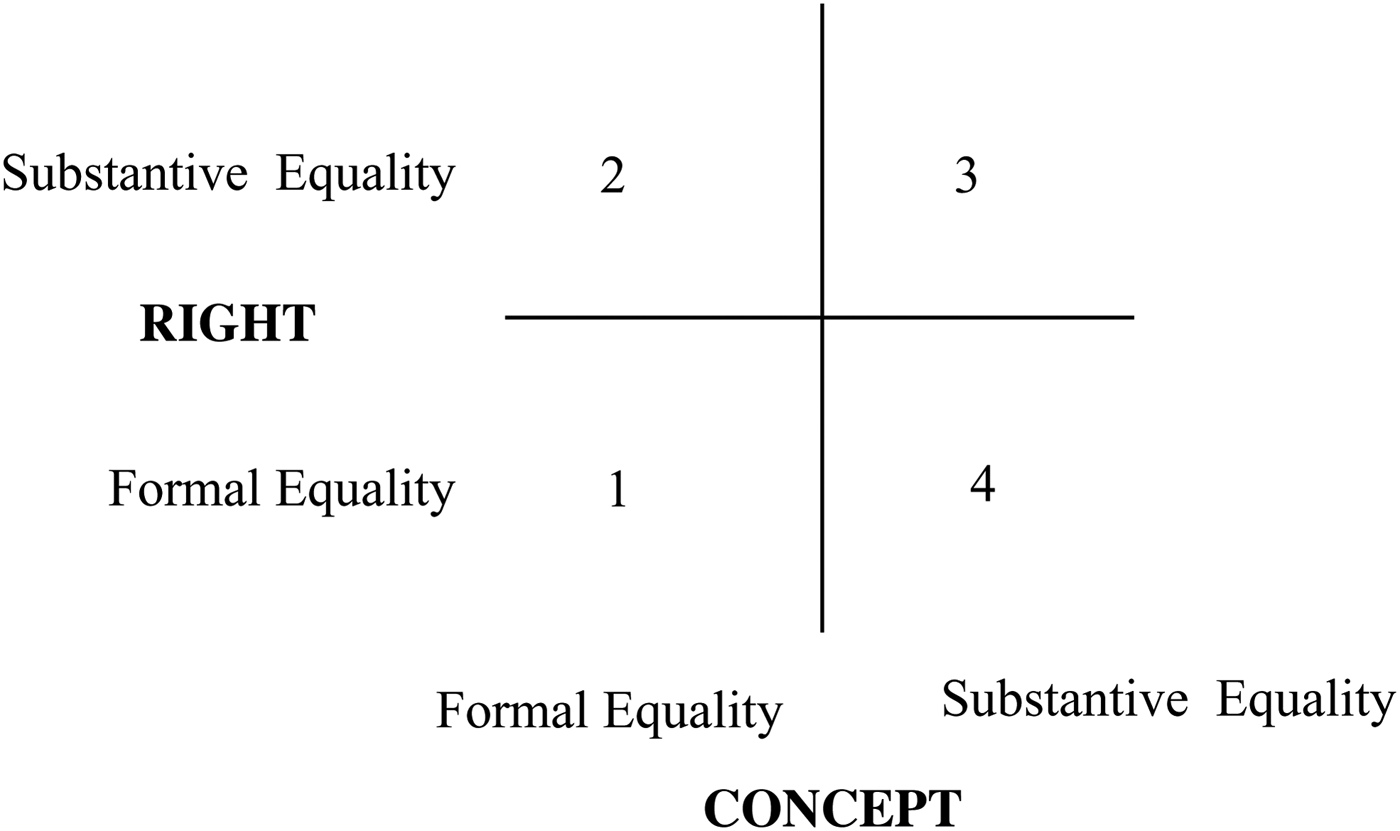
As Figure 1 suggests, the governing model of equality for the distribution of socio-economic rights might be purely formal (quadrant 1), to the extent that both the notion of equality and the form of right it underpins are institutionalised in a formal or procedural way. An example of this would be a concept of equal pay based on the idea that everyone who is an adult should be given equal access to the labour market to compete for the most highly remunerated jobs – and the right this entails is the ‘right to work’ wherein everyone is compelled to commodify their labour. Quadrant 2 represents cases that embed a formal notion of equality through a substantive right. This might be where equal pay is sought through affirmative action policies to transform historical forms of labour market segmentation, in the hopes that the outcome will be to equalise pay by getting women or ethnic minorities into positions of authority (without directly addressing the transformation of pay structures). Quadrant 4, where formal equality typifies the nature of the right but the related notion of equality is (at least potentially) transformative describes, for example, the rights engendered by Article 11(1d) of the Convention on the Elimination of All Forms of Discrimination against Women (CEDAW) (1979), which includes the ‘right to equal remuneration, including benefits, and to equal treatment in respect of work of equal value, as well as equality of treatment in the evaluation of the quality of work’. This could be used as the basis for radically transforming how, and what kind of, work is valued and remunerated; instead it tends to generate a legal right to equal pay for equal work on the basis of a male comparator. In Figure 1, then, only quadrant 3 represents substantive equality across both dimensions.
Dimensions of equality: concept and right

Where pensions are concerned, formal or procedural notions of equality have dominated to a greater or lesser extent (in different schemes and systems) in relation to the privileging of access and opportunity over outcome, and in relation to equity over equality. First, equality of access is implicitly or legally defined in relation to comparators with only limited recognition of how gender can shape pathways to pension rights. So while the right of companies to exclude part-time workers from employer-provided private pension schemes in the UK was eventually rescinded, temporary workers with contracts of less than two years may still be excluded.
Second, equality of opportunity operates on the premise that as long as women are not excluded from joining a scheme explicitly on the basis of their gender, it is acceptable that they only have access to the high levels of pension income if they work the same hours as, and earn the same pay as, full-time highly remunerated male colleagues. The reality that women's primary responsibility for caring and unpaid domestic work means that many work part-time in the UK, and the existence of the gender pay gap, are not considered sufficient to challenge the robustness of the principle of formal equality.
Finally, the equity principle in contributory pensions relates to the notion that what individuals get from a pension system should be related to what they put in, and that what they put in can only be counted in terms of monetary contributions. This means in practice that a highly paid employee will get more from a pension system than a low paid one, regardless of need. Anyone who provides unpaid social reproductive labour from which an employee benefits, but who does not earn a wage from the firm, cannot accrue any benefits in that scheme in their own right.
An obvious related point in the context of these particular articulations of formal equality is that the choice of comparator – an employee must be compared with another employee – discounts anyone who is not in paid work. In other words, in systems where a non-contributory element is a basic or minimum pension, and income in retirement is supposed to come, in the main, from a contributory earnings-related pension, those with minimal or intermittent experiences of formal employment are unlikely to build up enough of a pension on their own to guarantee an adequate level of income in retirement. This has historically been, and in many cases continues to be, a problem for women, but may increasingly affect young people who are experiencing long periods of unemployment, as well as low-paid, temporary and precarious workers (both men and women). Patterns of inequality and polarisation in labour markets, coupled with retrenchment in occupational pension systems, is producing complex patterns of inequality that call urgently for both the engendering of socio-economic rights, and a substantive notion of equality that recognises intersecting social identities and interlocking relations of subordination.
IV Comparing pension systems
There is, nevertheless, enormous variety in national pension systems and the extent to which they are informed by the notion of the right to equality. Many pension systems are also characterised by high levels of complexity. The extent to which comparisons can be made between systems vis-à-vis equality goals is therefore circumscribed by factors such as a lack of parallelism in system design and structure. In addition, the absolute distribution of resources among those in older age groups in all countries comprises overlapping systems of benefits, entitlements and income transfers. The different roles that pension systems play in this absolute distribution must therefore be borne in mind when comparing metrics like pension income, which do not equate with levels of total income or with access to resources (which may include benefits in kind such as subsidised housing, transport and fuel). Nor do such comparisons take account of the distribution of wealth and assets. For this reason it is useful to look at alternative measures of poverty, such as the Gini coefficient, alongside pension data, even if it too is limited in what it captures.Footnote 4
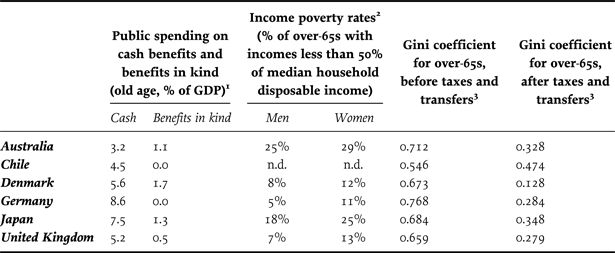
With these caveats in mind, in what follows I offer an illustration of outcomes in different pension systems to provide some context for my discussion of pension equality and inequality. In Table 1, levels of public spending are illustrated in relation to income poverty rates and Gini coefficients for a selection of OECD countries. If we look at income poverty rates first, we see that a higher proportion of women have incomes that are less than 50 per cent of median household disposable income in all of the countries in the table, ranging from a gap of about 4 per cent in Australia and Denmark to 6 per cent in the UK and Germany and 7 per cent in Japan. Belgium (not shown in Table 1) has the smallest income poverty differential at less than 1 per cent, while the US and Italy have a differential of 8 per cent, and Norway one of nearly 10 per cent (OECD, 2011a).
Old-age benefits and poverty rates in selected OECD countries
notes:
1Social Expenditure – Aggregated Data MetaData: Public Expenditure on Old-age and Survivors Cash Benefits, in % GDP, 2007, online: <http://stats.oecd.org/Index.aspx?DatasetCode=POVERTY#))>.
2Income Poverty Rates (OECD, 2011b, p. 149).
3Income distribution – Inequality MetaData: Income Distribution – Inequality – Country Tables, OECD StatExtracts, online: <http://stats.oecd.org/> (last accessed 11 September 2012).
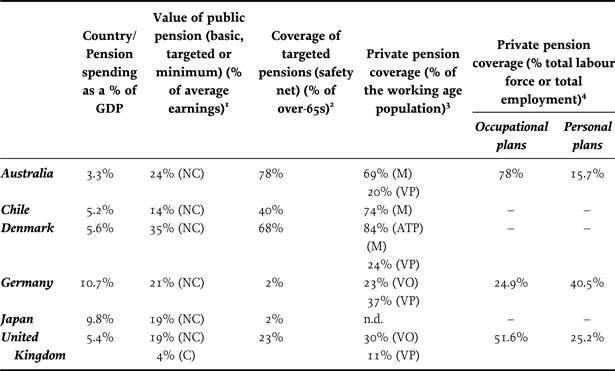
Germany, a Bismarkian system, has the highest levels of public spending both on cash benefits (Table 1) and pensions (Table 2), yet has more women living in income poverty and with a higher Gini coefficient among the over 65s than the UK. Denmark has lower levels of spending on cash benefits and pensions than Germany, and a lower Gini coefficient, but almost the same level of female pensioner income poverty (suggesting that overall female poverty might be lower but a proportion of the difference is made up from benefits-in-kind). Finally, and perhaps counter-intuitively, the UK has the lowest proportion of female pensioners living in income poverty of the countries in Table 1, but a higher Gini coefficient than Germany or Denmark, suggesting that fewer older women have incomes of less than 50 per cent of the median than in other countries but that overall inequality between groups of pensioners is higher.
Pension systems in selected OECD countries, mid-2000s
notes:
1,2Pensions at a Glance 2011: Retirement-income Systems in OECD and G20 Countries – © OECD 2011 (OECD, 2011a). Coverage data are for the most recent year available. The coverage data for Chile comprises different programmes. NC = Non-contributory; C = Contributory. The source figure contains data on both targeted (safety net) and minimum (contributory) pensions, but none of the selected countries have the latter.
3Table 4.1. Coverage of Private Pension Schemes by Type of Plan, 2010, OECD Private Pensions Outlook 2012 (OECD, 2012b). M = Mandatory; VP = Voluntary Personal; VO = Voluntary Occupational.
4Table 4.1. Coverage of Private Pension Schemes by Type of Plan, 2010, OECD Private Pensions Outlook 2012 (OECD, 2012b). Blank cells indicate that no data is available.
Thus, as Table 1 and Table 2 illustrate when taken together, it can be challenging to make generalisations and draw conclusions about the equality effects of pension systems because of their complexity, their interactions with other assistance and tax and benefit programmes, and their different prioritisation of spending on progressivity. The latter can be characterised in relation to trade-offs between insiders and outsiders, and/or between equity and equality.
In the case of Japan, for example, a relatively high proportion of public spending on pensions goes to reward high and medium earners with uninterrupted full-time careers, sometimes with a single employer (the ‘salary man’ model) (Table 2). Public pension coverage is very low, and relatively ungenerous. This model thus prioritises the welfare of labour market insiders (full-time permanent employees, usually men) over outsiders (part-time and precarious workers and those without a history of paid work, often women). It also weakly conforms to a model that prioritises equity over equality, in the sense that those who contribute the most over the life-course are rewarded with the largest pensions. Pensions and other transfers have relatively weak effects on overall poverty among the over-65s, as measured by the Gini coefficient (Table 1).
Denmark, on the other hand, spends a smaller proportion of GDP on pensions but has higher rates of public pension coverage and a more generous basic pension. These factors, along with high levels of occupational pension coverage (and, lest we forget, labour market participation), and generous in-kind benefits such as housing transfers, have a significant effect on overall poverty among the older population. Historically, in the context of social democracy, this has been characterised as a universalist equality-based approach to pension policy and pension design. In reality, universalist tendencies and substantive equality outcomes have been tempered by an equal emphasis on labour market participation encouraged through generous maternity and parental benefits and widespread employment of women in the public sector. Women therefore still have lower incomes in retirement, but this is compensated by non-pension old-age benefits that seek to embed more substantive forms of social and gender equality outside (though overlapping with) the design of the pension system.
V A case-study of the gender pension gap: the UK pension system
The UK has a public pension system, the British state pension, characterised by contributory and needs-based (safety net) components. The public system still makes up over half, on average, of both women's and men's income in retirement, although women on average rely on it more, even though they often have lower pensions. Because of the contributory principle, men still accrue larger public pensions than women over the life-course, even though credits have been introduced to compensate for time spent out of the labour market on unpaid care work. Recent reforms to the pension system have bolstered the state pension, mostly at the expense of the earnings-related state second pension (now being phased out) – a tacit recognition on the part of the government that its stated goal of replacing the public pension with private savings as the main source of income in retirement is receding. In the UK, the public pension system is complemented by private, voluntary pensions, which include employer provided (occupational) pensions, and individual (personal private) pensions. A newly introduced public occupational scheme, with defined contributions and based on individual accounts, was recently introduced to address the problem of declining levels of coverage by employer pensions (especially in the private sector).
5.1 The gender pension gap in the UK
The gender gap in pensions is a less widely used, and less standardised, indicator than the gender pay gap. It is measured in different ways. One indicator is the average difference in average incomes from all pension ‘pillars’ post-retirement (Flory, Reference Flory2012); another is the average difference in average incomes from all occupational and personal pensions and annuities (private pension income or PPI) (Bardasi and Jenkins, Reference Jenkins and Bardasi2010). The gender pension gap is also occasionally used to describe the different rates of coverage between men and women in pension systems, like that of the UK, in which occupational pension provision and membership have historically been voluntary. Different definitions can suggest quite different trends. In the UK, for example, recent data show that women overtook men in the context of membership of a current employer's occupational pension scheme in 2000/2001 (ONS, 2012b, p. 10). Men's membership fell from a 66 per cent of male full-time employees in 1983 to 53 per cent in 2010, while full-time women's membership rose from 55 per cent in 1983 to 57 per cent in 2010 (p. 9). The key trend, despite the closing of the gender gap in membership, is men's falling rates of coverage rather than a marked increase in women's occupational pensions. Moreover, using another measure of the gender gap, women aged thirty-four to forty-four in defined benefit (DB) pension schemes had median pension wealth in 2008/2010 of £77,900, while men of the same age group had median pension wealth of £157,000 (ONS, 2012a, p. 6).
5.2 Trends in the UK pension system
What is the relationship of patterns in the gender composition of pension coverage and asset distribution with broader issues of access and adequacy? A major trend in the context of the UK pension system has been the near-complete collapse of private sector defined benefit occupational coverage in the last decade. Membership in the private sector fell from 46 per cent in 1997 to 32 per cent in 2011, and DB membership from 34 per cent in 1997 to 9 per cent in 2011 (ONS, 2012c, p. 5). Many workers are members of schemes that are closed to new members, or that are closed to new contributions. This abandonment of private sector workers by their employers has knock-on effects for the public sector where membership of occupational DB schemes, many still final salary, remains high (over 80 per cent for both men and women). The government is seeking to reform public sector pensions through increasing contributions, extending the retirement age, and moving to an average earnings (rather than a final salary) formula, and is doing so in part through a discursive attack which, with the aid of sections of the media, paints public sector pensions as ‘gold plated’ and ‘unaffordable’.
The biggest effect of these changes has been to increase inequality between groups of workers. Employees of large firms and those in the higher professional occupations are most likely to belong to an occupational pension plan, but the most striking pension gap exists between workers in different earnings bands. In 2011, around 74 per cent of men and about 82 per cent of women earning £600 a week or more belonged to an occupational pension; the proportions were 25 per cent for women earning less than £300 per week and 15 per cent for men in the same earnings bracket (ONS, 2012c, p. 22). In the period 2008/2010, 26 per cent of households had no pension wealth, but the 10 per cent of households with the highest pension wealth had more than seven times as much as the bottom 50 per cent of those with some pension wealth (ONS, 2012a, p. 1). The Gini coefficient in the UK, which has in any case increased from 0.338 (before taxes and transfers) in the 1970s to 0.512 in the 2000s, is based on equivalised household market income and fails to take into account huge inequalities in assets. Recent analyses focusing on long-term trends in inequality, such as the hugely popular book by Thomas Picketty (Reference Picketty and Goldhammer2014), focus on the importance of wealth and assets over an analytical reliance on income; as suggested above, pension systems can exacerbate inequality when they reinforce and extend labour market and income advantages, but also when they align with policies that consolidate and preserve wealth not directly derived from employment income.
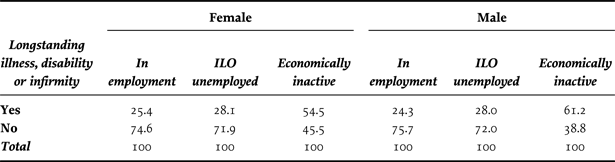
Yet gender and class are not the only axes of inequality to cut across the distribution of pension rights and assets. Ethnicity and race, and disability and illness, both affect the likelihood of being in paid employment. For example, in 2001 around 61 per cent of Black (Black Caribbean and Black African) men were employed, compared with around 63 per cent of Black women, and 67 per cent of White men (Clark and Drinkwater, Reference Clark and Drinkwater2007, pp. 5–6). Yet, as Table 3 shows, employed Black women have the highest levels of occupational pension scheme membership of any group represented because of their high levels of public sector employment. This means, of course, that Black women are also particularly vulnerable to retrenchment in, and privatisation of, public sector jobs. At the same time, of those female respondents to the General Household Survey (ONS, 2008) who reported being in employment, 25 per cent identified as having a disability or long-term illness, but 55 per cent of women who characterised themselves as economically inactive made the same identification (Table 4). This suggests that the disabled and long-term ill are less likely to have access to an occupational pension because of lower levels of labour market participation.
Percentage of those in work who belong to employer's pension scheme, by gender and ethnicity, UK, 20061,2
source: General Household Survey, 2006, (ONS, 2008) weighted data.
notes:
1The whole section on pensions (apart from the last question) is only asked of those in paid work (including those temporarily away from job or on a government scheme), but excluding unpaid family workers.
2The table is based on the category of respondents who answered ‘yes’; in this variable (EmPenShm: Belong to pension scheme) 5.2 per cent of respondents answered ‘no’ to the question “Do you belong to your employer's occupational pension scheme’.
3This category is an aggregate of Indian, Pakistani, Bangladeshi and Any other Asian background.
4This category is an aggregate of Black Caribbean, Black African, and Any other Black background.
5This category is an aggregate of White and Black Caribbean, White and Black African, White and Asian, and Any other Mixed background.
6This category is an aggregate of White British and Any other White background.
Employment status of respondents with a long-standing illness, disability or infirmity, by gender, 2006
dataset: General Household Survey, 2006, (ONS, 2008), weighted data.
These trends point to complex new patterns of inequality at the intersection of gender, class, ethnicity and ability. Moreover, youth unemployment, the rise of precarious work, and longer periods of education all mean that younger cohorts are likely to have increasingly more diverse, and polarised, patterns of labour market attachment. In the UK, the recent recession has seen increases in temporary and part-time work, especially for men, which will have implications for pension membership and accrual (Strauss, Reference Strauss, Arthurs and Stone2013). Youth unemployment in Europe stood at 24 per cent in 2011 for the EU-27, ranging from around 8 per cent in the Netherlands to 46 per cent in Spain; for the UK it was 21 per cent (European Commission, 2012). Linking income in retirement to earnings, and reinforcing traditional notions of equity – the idea that those who contribute more should get bigger pensions – ignores, or wilfully reinforces, labour market inequalities and patterns of segmentation. Moreover, as I have argued elsewhere, the ideological and political shift towards the individualisation and privatisation of occupational pensions is premised on models of risk and reward that are grounded in models of financial rationality and risk-taking that are themselves highly gendered and drivers of inequality (Strauss, Reference Strauss2008, Reference Strauss, Clark, Dixon and Monk2009).
VI An equality agenda for pensions?
What this paper has demonstrated is that while pension systems are informed in different and uneven ways by notions of equality, that equality is seldom substantive across more than one dimension. Pace Fredman (Reference Fredman2009) and Fudge (Reference Fudge2007), I have shown that existing conceptions of socio-economic rights as they relate to pensions, and the legal and political–economic rights they generate and embed through institutionalisation, are often formal or procedural precisely because they fail to transform – and in fact may serve to reinforce – existing inequalities. This process of reinforcement applies to categories of social difference and the naturalisation of racialised and gendered divisions of labour, as well as to patterns of income and class inequality and labour market segmentation. This is not to say that pensions have not contributed significantly to the decrease in poverty among older age groups. But growing inequality among pensioners as a group reflects the limits of the right to equality within this broader set of processes; in the UK, where private pension membership is becoming more polarised, these limits are becoming ever starker.
If the changing nature of labour markets and the decline of the SER has prompted the ongoing questioning in labour law of its purpose, focus and boundaries (Davidov and Langille, Reference Davidov and Langille2006, Reference Davidov and Langille2011), similar issues attend the role of occupational pensions. What should pensions be for? Should public provision be confined to a minimal safety net designed simply to keep older people above the poverty line? Should those with long-term, full-time, highly paid jobs reap the greatest rewards from occupational pensions to reflect their occupational status? I would argue that answering ‘yes’ to either question, and certainly to both, troubles not only the right to equality of outcome (the equitable distribution of resources) but also the right to equality of opportunity. For systems that cement, prolong and institutionalise the inequalities inherent in labour markets through the extension of occupational hierarchies into retirement will always be likely to generate new inequalities even as old ones narrow through equality of opportunity for some. Thus, in the UK, current trends suggest that as the gap in pension assets between highly remunerated men and women has started to close, the gap between men and women in the highest income brackets and those in the lowest is widening. Moreover, the most widely used measures of inequalities in resource distribution among people in different socio-demographic groups – between men and women (the gender gap in pensions) and between older and younger cohorts (over-60s and over-75s, for example) – often fail to confront evolving inequalities between, for eample, ethnic and racial groups, and differently abled people, or between residents of polarised regions or neighbourhoods. Moreover, in both labour law and the study of pension systems, according equal analytical weight to the unpaid work of social reproduction (Conaghan, Reference Conaghan2014) opens up and expands the scope of conceptions of equality and inequality in labour markets.
A vision of a pension system grounded in substantive equality must be underpinned by a concept or model of equality that is more-than-formal, and must propose and enact rights that are more-than-formal. In doing so it must therefore seek to transform existing socio-economic relations and structures of power beyond simply acknowledging the diversity of women's life-courses, and compensating ‘for relative disadvantages in the division of paid and unpaid work and care provision’ (Vlachantoni, Reference Vlachantoni2012, p. 104). This entails the revaluation of the relative importance of productive and socially reproductive work, the active rebalancing of the gender division of labour, and the contestation and reworking of the linkages between socio-economic value and the nature and distribution of socio-economic rights.
To conclude, what I am arguing is that a notion of the right to pension equality that assumes that equitable outcomes will flow from a convergence on a single model of full-time, professional, well-remunerated work with an employer who provides an occupational pension plan, is clearly flawed and does not account for the realities of contemporary labour markets. Perhaps more radically, I am suggesting that equality in pensions can instead be gained by de-linking income in retirement from labour market participation. Although this paper is not intended to make policy prescriptions, a basic income coupled with progressive taxation – including the removal of tax-favoured status for private pension contributions, which is mostly regressive – that accounts not only for income, but for unearned wealth and assets, could be a more direct route to equality. In order to not subsidise the complete demise of all occupational pension provision, this could include significant contributions to a public income scheme by all employers who do not provide a pensions – but should also include redistributive measures aimed at tackling inequalities in assets as well as in income. As Kathi Weeks (Reference Weeks2010) and Nancy Fraser (Reference Fraser2009) have reminded us, in contributions that mirror debates in labour law about the recognition of unpaid work and feminism's relationship with work and labour markets, we need to move beyond arguments that solely reinforce the liberal celebration of more and better paid wage labour, and instead question how we can transform, support and reward all of the vital work, paid and unpaid, that makes a contribution to our societies.