Reconstruction was an uncertain time in New York City, the nation's foremost metropolis, riddled with political corruption and rocked by popular protest. Stabilizing efforts took numerous forms, including the brutal suppression of workers' rallies and the prosecution of municipal politicians and officials.Footnote 1 Public faith in the criminal justice system and its capacity to prosecute and punish criminals had also reached a low ebb by the 1870s, prompting the state government to investigate the district attorney's office in New York County and its court system.Footnote 2 In the words of a veteran member of the city's criminal bar, the “deplorable uncertainty” of punishment was making “a mockery of justice.” A Columbia University medico-legal expert agreed, claiming that murder, “if not yet cultivated as one of the fine arts … [was] a matter of daily occurrence.” High-profile trials in the wake of the Civil War tested public and professional criticism of jury independence, particularly jurors' disinclination to find killers guilty of murder, compounded by defense attorneys' growing use of “moral” and “emotional insanity” defenses.Footnote 3 Every time apparently sane killers, such as William McFarland (tried and acquitted on grounds of “temporary insanity” in 1870 for the murder of his former wife's lover)Footnote 4 escaped conviction on the basis of questionable insanity defenses, newspapers announced “the insanity dodge,” and medico-legal experts squabbled over the growing problem of “feigned insanity.”Footnote 5 Occasionally Manhattan's murderers did face the gallows, especially the poor and friendless, as the execution of William Foster in March 1873 confirmed,Footnote 6 but it seemed that well-financed and well-defended murderers, like Edward Stokes, murderer of financier Jim Fisk, could exploit the technicalities of the law if the vagaries of medicine failed to secure acquittals.Footnote 7 A justice system of this sorry character had little hope of deterring would-be murderers, the New York Times despaired: “MURDER AND HANGING-Examples Wanted-Strangle All Our Murderers Together.”Footnote 8
Eric Monkkonen's landmark study of homicide in New York City confirmed that these perceptions were valid, considering that the city's murder conviction rate over the nineteenth century was only 11 percent.Footnote 9 “The city punished extraordinarily lightly,” he claimed, because New York jurors were “hard to persuade” to convict on murder charges.Footnote 10 Similar statistics appeared over a century earlier in the Times, driven by an editor on a campaign to prove that the criminal justice system was failing to punish homicide efficiently and effectively.Footnote 11 In 1872 investigative journalists used coroner's files and records of the district attorney's office to trace the progress of suspected murder cases, and the evidence was damning: 139 murders had occurred between 1870 and 1872, 118 of which had reached the district attorney's office for disposition; of that number only sixty-one had been brought to trial. Jurors had found forty-four of the sixty-one murder suspects guilty, though a mere six killers had been convicted of murder in the first degree. The remaining men and women had been found guilty on lesser charges of second-degree murder or manslaughter. A follow-up exposé revealed that four men had been hanged for murder between 1869 and 1873, over which time two hundred murders had occurred in the city. Aside from those four it appeared that most of New York's murderers had little to fear from the law: “The rule appears to be established by the judicial record that the taking of human life is to be followed by not more than three years restraint in State Prison, [and] even that moderate term will be found to be below the average of the sentences.”Footnote 12 Murderers spent so little time in jail, it was thought, because governors were too liberal in their use of pardoning. As a result, “there can be no steady regular working of prison discipline until the feeling exists … that when [prisoners] are once sentenced … they shall be enclosed with the iron gates of the prison until their time is out.”Footnote 13 The message these reports sent to jurors, prosecutors, courts, and the executive was clear: the prosecution and punishment of murder in New York was a “disgrace.”
Thus there was sound reason for New Yorkers to predict that the assailant who shot and killed Mansfield Walworth on June 3, 1873, would never be indicted for, let alone convicted of, murder.Footnote 14 Yet this case was exceptional from the start. The shooter was the victim's eldest son, Frank Walworth, and he made no attempt to conceal his deed. Indeed, the handsome, well-dressed nineteen year old had walked to a midtown police precinct, handed in his gun, and informed the desk sergeant that he had just killed his father, whose body lay in a pool of blood in a nearby hotel room. The police promptly arrested him for murder and the coroner interviewed the prisoner, who disclosed that “family troubles,” specifically Mansfield Walworth's repeated threats to kill members of his family, had prompted the shooting. Although the prisoner later claimed that he had acted in self-defense, fearing that his father was about to attack him when he fired, the coroner's inquest on June 6 determined that the evidence was sufficient to warrant Frank Walworth's prosecution. On June 9 the grand jury returned a true bill for murder in the first degree; on June 11 the prisoner was arraigned and indicted; on June 24 the trial opened; on July 2 the jury returned a verdict of murder in the second degree; and on July 9, 1873, Frank Walworth boarded the train for Sing Sing State Penitentiary for the term of his life, the state's mandatory sentence for second-degree murder. Although some, including the judge, thought that the evidence could have supported a conviction for murder in the first degree no one considered anything amiss in the case's prosecution.Footnote 15 Indeed, the criminal justice system had performed admirably, proving that the city had the capacity to render justice swift, sure, and fair. “A wholesome conviction,” one editor nodded in approval.Footnote 16
What made this verdict particularly wholesome was the signal it sent that elites, like their social inferiors, must face the consequences of their actions. Justice was blind in New York, not just on the state's great seal but in its courts of law, where the jury in this case, along with the prosecution and judge, had served the people admirably. Walworth was an unusual figure in the criminal courtroom, more like McFarland and Stokes—well-connected and well-defended white men—than the doomed Fosters of the world, or the convicts to whom he was manacled in the prison car. Referring to his handcuffs, he commented to a reporter, “These bracelets are the starchiest I have ever worn.”Footnote 17 His mother, Ellen Walworth, had overseen Frank's classical education and had, by all accounts, reared a cultivated young gentleman, never in trouble with the law. The Walworth family was highly respectable (with the exception of Mansfield): lawyers and judges on Frank's father's side and military heroes and politicians on his mother's. Prior to the murder, the Walworth name was known chiefly in association with its recently deceased head, Reuben Hyde Walworth, the judge who had served as the state's last chancellor before the 1846 Constitutional Convention abolished the Court of Chancery. Since the patriarch's death in 1867 the family had drifted into genteel poverty, but Ellen Walworth managed through her connections to enlist senior members of the bar to represent her son pro bono. And she made an important maternal concession: she would testify on her son's behalf to support his claim that a sense of duty toward his mother, not malice toward his father, had prompted the encounter. In a steady voice she narrated the tragic tale of a marriage that had ended in divorce, after which her former husband had repeatedly vowed to kill her, in addition to their sons, Frank, and his younger brother, Tracy. Aware of his father's murderous threats, Frank had confronted him, demanding that he desist.Footnote 18 Such anxieties would test any son, but the defense provided a leading medical witness, psychiatrist John P. Gray, to testify that the defendant was further burdened with epilepsy. Thus, whether Frank Walworth appeared to be a chivalrous youth or an enfeebled young man incapable of controlling his impulses, he made a plausible candidate for an outright acquittal, an acquittal on the ground of insanity, or a conviction, at most, for manslaughter.Footnote 19
Had the jury overlooked the evidence against the defendant—that Walworth had arranged a meeting with his father, concealed a pistol, and shot an unarmed man at close range, showing not the slightest remorse afterwards—the case might have drawn the attention of historians interested in the operation of “the unwritten law.” But Frank Walworth, against the odds, was convicted. Hendrik Hartog, the only scholar to have written on the murder, effectively ruled it out of consideration as an unwritten law case: “Whatever exemption husbands had from the ordinary rules of criminal responsibility would not be extended to sons … Husbands' rights were not general male rights.”Footnote 20 Hartog's work built on Robert Ireland's pioneering research, which framed the unwritten law as a practice that exonerated men, usually husbands or ex-husbands, who murdered rivals involved in scenarios of adultery, seduction, or sexual insult. Starting with the 1859 acquittal of Daniel Sickles for the murder of Barton Key, his wife's paramour, high-profile cases brought the custom to nationwide attention, as did a cluster of similarly notorious cases that followed, characterized by the defense strategy of asking jurors to imagine how they might act if similarly provoked to restore their wounded manly pride.Footnote 21 Recent studies of gendered patterns of exoneration have broadened this concept to incorporate what some have called the “the new unwritten law,” through which male jurors in the late nineteenth and early twentieth century regularly took pity on abused women who murdered violent and abusive husbands. Similarly Roth's work shows that nineteenth-century jurors were reluctant to convict relatives or neighbours who resorted to lethal violence to protect individuals (typically women) when they appeared unable to defend themselves or if the law appeared to offer no relief: acquittals or convictions for manslaughter were typical in such cases.Footnote 22 Still, defence lawyers' stories of tormented husbands, victimized wives, or heroic saviors led to acquittals only when jurymen found “preemptive violence” narratives coherent and persuasive.Footnote 23
Although the Walworth trial ended in a guilty verdict, the defendant's pardon four years later suggests that the analysis of the unwritten law can be enriched by approaching such cases as dramatic events in which manhood's multiple meanings were articulated though stark characterizations: the libertine, the scoundrel, the brute, the wronged husband, the righteous avenger.Footnote 24 Richard Maxwell Brown's studies of vigilantism confirm that violent incidents provoked by questions of gender and honor—not just sexual honor, and not just murders committed by husbands and lovers—expressed a widely shared view in the nineteenth century that the written law did not and should not apply in situations where the abused and dishonored were under threat.Footnote 25 Indeed this capacious interpretation of honor-based violence and its informal authorization draws on a frequently cited 1906 definition of the unwritten law, published by Thomas J. Kernan, a lawyer who attempted to chart the full range of “jury-made lawlessness” in U.S. culture. He reckoned that there were ten “principles” on which jurors ignored legal rules, only one of which was the husband's right to avenge sexual dishonor. Another one of his principles, which unwritten law studies overlook, is one that influenced the ultimate outcome of the Walworth case, in which a son took violent exception to his father's foul words. Kernan confirmed that Americans understood “opprobrious epithets, which constitute a mortal insult,” (the sort Mansfield Walworth uttered) as “equal to a blow, and any of them justifies an assault.”Footnote 26
The incorporation of the postconviction phase of criminal cases provides an avenue to extend the unwritten law's analysis in U.S. legal history. Charge bargaining, dismissals, acquittals, and convictions on lesser charges were only some of the processes through which cultural norms shaped the fate of murderers: postconviction pardoning was another. It was no surprise to Frank Walworth's contemporaries that a governor would exercise his pardoning power to free this murderer from prison, since executive justice's role in the operation of criminal justice was openly acknowledged in the nineteenth century. As Justice Joseph Story's authoritative treatise on constitutional law, in its fourth edition by the time of the Walworth case, proclaimed, “the power to pardon … being a fit one to be intrusted to all governments, humanity and sound policy dictate that this benign prerogative should be as little as possible fettered or embarrassed.”Footnote 27 Stretching the analysis of honor-based exoneration allows us to see what historical actors understood: executive justice, along with jury nullification and the insanity “dodge,” mediated a field of justice between “formal legal rules and the unofficial world of norms, customs, common sense and social codes.”Footnote 28 The state's highest office formally accommodated this world by assigning executive officers the responsibility to dispense mercy at their discretion. Clemency's field was, and remains, constitutionally prescribed yet unbound by legal rules. As Austin Sarat and Nasser Hussain argue, executive justice is “lawful lawlessness”: it is “authorized discretionary action,” which differs from other “areas in the law where discretion not only exists but is also legally sanctioned,” since it is exercised by an individual and “total.”Footnote 29
In nineteenth-century New York the individuals granted authority to dispense mercy were the state's governors. Working with his pardon clerk, each governor deliberated over pardon petitions, judging the circumstances of each offense and offender, his family, and community against cultural notions of blameworthiness and merit. This practice prevailed before a system of parole and its associated rules bureaucratized prisoner release procedures late in the nineteenth century; it was the personalized decision-making process through which Gov. Lucius Robinson would pardon Frank Walworth four years after a jury convicted him.
The enormous powers and great responsibilities of the men elected as executive officers have, as yet, attracted far less scholarly attention than the behavior of juries in unwritten law cases. Because modern legal historians focus on law's imposition of pain and death over its capacity to temper harsh justice,Footnote 30 the history of mercy in the recent past is spotty compared to its analysis in ancient, medieval, and early modern histories. This is particularly the case in U.S. historiography in which, Vivian Miller remarks, “full length historical treatments of clemency in its wider social and cultural context are conspicuous by their absence.”Footnote 31 This lack of interest is curious considering the growing appreciation among legal scholars of the ways in which local norms and patterned prejudices, and not just legal doctrine, determine criminal responsibility.Footnote 32 Nowhere are culture and politics more clearly at play than in the operation of executive justice, an integral feature of modern Western criminal law, despite its historiographical neglect. And nowhere is justice more personal, or less rule-bound, than the decision of one individual to pardon another.
Executive justice in the nineteenth century was not so much lawless law as compensatory justice determined by men's judgements of criminals' characters and their crimes. As governors considered the nature and circumstances of the crime and the individuals caught up in it, widely shared understandings of excuse, mitigation, and blameworthiness guided their opinions.Footnote 33 Masculine sentiment played no less a critical role in the history of clemency than it did in trials; indeed, petitions for clemency were “dialogic” in the sense that they were articulated in anticipation of the chief executive's consideration.Footnote 34 Although judges could and did rein in defense lawyers who implored jurors to put themselves in the place of men who had struck out against romantic rivals, or to exonerate the killers of brutes and libertines, no doctrine or rules limited what could be expressed to governors, or the language in which feelings could be uttered. Far from the irrelevance of gender in the clemency process, as historical actors protested (and as gender-blind historical scholarship leaves unprobed), it would be extraordinary for men's feelings to have played no role in the field of nineteenth-century discretionary justice.Footnote 35 The persistence of “sentiment” in nineteenth-century legal reasoning has been well established, but closer attention to the law's masculine agents is critical to determine how men constructed hierarchies of masculinity in the course of considering clemency.Footnote 36 Claims raised in petitions and applications influenced the ways in which governors distinguished between the deserving and the undeserving, but their decisions also expressed gender norms through which differences between men were drawn on the basis not just of class, race, age, or religion but also, critically, of character.
The case of one pardoned murderer, Frank Walworth, interpreted from trial to release, suggests new ways of thinking about criminal justice's variegated nature at a point when “the transformation of American law” was gaining momentum. The aspiration of nineteenth-century legal modernization, Morton Horowitz writes, was to move from judge-made law and jury-made verdicts toward scientific objectivity, purged of idiosyncrasy and personal interestedness: “Through a process of systematization, integration, and abstraction of legal doctrine,” legal modernizers “refined and tightened up what had previously been a loosely arranged, ad hoc system of legal classification.”Footnote 37 The notoriety of unwritten law trial verdicts as well as political and professional concern over prosecutorial laxity in Reconstruction-era New York provides contrary evidence of the vitality and persistence of community justice norms. The endurance of executive justice, a practice with roots in monarchical privilege, further substantiates the period's sluggish modernizing move. Although legal reformers put gubernatorial mercy in their sights after the Civil War, their charges of unaccountability and sentimentality failed to strike. The Walworth pardon, and pardoning practice more broadly, confirmed that an ancient model of executive justice survived mounting efforts to modernize New York's criminal justice system.
Unheeded Claims of Exculpation
Was the killing of Mansfield Walworth a crime, the act of a madman, or a noble expression of filial duty? Over the spring and summer of 1873 this question absorbed New Yorkers, fed by front-page and multicolumned stories in the metropolitan press.Footnote 38 Frank Walworth certainly believed himself blameless (“I am guilty of no crime”),Footnote 39 but he would have to face a jury to determine whether this domestic homicide could be excused in anyone's mind but his own. In a city that provided a steady stream of homicides (Mansfield Walworth was one of three people killed on June 3)Footnote 40 this case stood out immediately, not simply on account of the family's status but because the killing was a “parricide.”Footnote 41 Then as now the murder of parents was a rare form of violence between intimates, and owing to its rarity the sort of homicide that is typically viewed as “symptomatic of social, cultural political, familial, and individual failure.”Footnote 42 As the Herald announced, “There have been in the city of New York, within the past seven or eight years, some three or four cases of matricides, a score of uxoricides, several fratricides, and hundreds of homicides but not one parricide, at least not one that has been determined to be such.”Footnote 43 The press's construction of the murder as a family “tragedy” connected the case to wider fears about the apparent breakdown in family relationships, assailed over the mid-nineteenth century by woman's rights campaigners, free lovers, evangelicals, and individual women exercising their newly inscribed legal rights to leave unhappy marriages.Footnote 44
Frank Walworth's confession provoked near-universal condemnation, and public disapprobation of the defendant indicated that a son's intentional killing of a father circulated in an orbit of meaning a galaxy apart from homicides committed by disheartened and dishonored husbands. As women pressed for civil and political equality with men (during the course of the Walworth trial Susan B. Anthony was convicted for illegal voting) this murder raised troubling questions over shifts in generational power relations as well: “Of all the crimes that shock the souls of men,” the Herald intoned, “none has ever been held in greater abhorrence than parricide, which is by all odds the most complete and terrible inversion, not alone of human nature but of brute instinct.”Footnote 45 “SHOCKING PARRICIDE” was the dramatic headline that befitted a murder that had shattered a social circle accustomed more to judging than to being judged. Walworth was no ruffian, no habitual criminal or ragged immigrant; on the contrary, his upbringing and heritage, which included military and legal giants, appeared impeccable. As the Chicago Tribune editorialized, “Such a deed would be sufficiently awful were the parricide and his victim the degraded inhabitants of the slums of New York, but it gains a ghastly illumination from the illustrious descent, high breeding, and elegant life of the Walworth family.” Prosecutorial discourse at trial was equally condemnatory. Parricide, Assistant D.A. Rollins opened for the people, was “a crime so revolting to nature that many nations considered it impossible.” District Attorney Benjamin Phelps used more temperate but equally damning words in his closing statement, in which he sermonized that it was “not for the son to set himself up as arbiter, judge and executioner between his parents.”Footnote 46
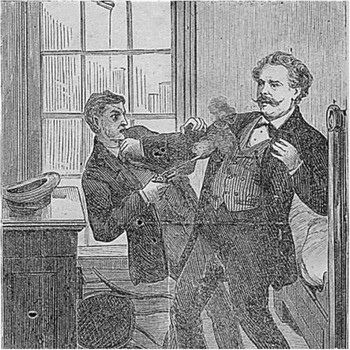
An artist's engraving of the murder scene, stressing the son's smaller stature but lending the “parricide” a menacing look. Source: Anon. The Walworth Parricide! A Full Account of the Astounding Murder of Mansfield T. Walworth, by his son, Frank H. Walworth, with the Trial and Conviction of the Parricide, and his Sentence for Life to the State Penitentiary at Sing Sing. (New York: T. O'Kane, 1873).

Although Frank Walworth's homicide fit a broader pattern of intimate homicide in this period—killings of abusive husbands, in which both the public and jurors found compelling grounds for sympathy—the casting was awry in this case.Footnote 47 Patricide introduced an unfamiliar script in the established genre of unwritten law cases. Frank Walworth's defenders hoped that his justification for his action, along with his physiological infirmity, might soften the jurors' hearts. By exposing the parents' domestic disharmony, the father's verbal abuse, physical assaults, and written threats, as well as the defendant's epileptic condition, the defense hoped to avoid a conviction. But they hoped for more than that—they presented Frank Walworth as honorable, far more honorable, indeed, than the cuckolds who slew their romantic rivals. So the defense used the same tactics to constitute a different sort of community of men, jurors who understood, they hoped, the duties and obligations of manly honor outside the realm of marital unions but within the bound of family relations.Footnote 48
A stellar legal team, led by the esteemed Charles O'Conor, presented this double defense of deliberate but deranged homicide. By the 1870s, O'Conor was hailed as one of the nation's leading lawyers, often called “the Nestor of the Bar.”Footnote 49 Indeed, many commentators, including opposing counsel, acknowledged that the legal talent was stacked in the defendant's favor. Aside from O'Conor, who emerged from retirement to take the case and made no secret of the fact that he was working pro bono, Walworth's team included William Beach and ex-D.A. Samuel Garvin. The latter had been the prosecutor in the McFarland case, in which Noah Davis, now the judge presiding over the Walworth trial, had been his second. Beach was a major figure in the state's criminal bar, and he had recently defended General Cole, who was acquitted in 1867 for killing his wife's lover, after Beach presented a convincing defense of “emotional insanity.”Footnote 50 Together these elder legal statesmen shouldered the defense of a client who had confessed to what seemed, to many, to fit the definition of a planned and deliberate homicide.
Frank Walworth admitted that he had boarded a train from his home in Saratoga Springs to New York, and then taken a hansom cab to his father's room in upper Manhattan, where he left him a note: “I want to try to settle some family matters.” That he had packed a gun on his journey, and no luggage or toiletries, suggested strongly that “the law of the pistol” was the means he had chosen to accomplish his goal.Footnote 51 He insisted, though, that he had needed to arm himself because he knew that his father was in the habit of carrying a revolver, and because he was aware of the letters Mansfield had sent to Ellen Walworth, in which he had threatened to murder her, and other members of the family, including Frank. One letter had even arrived with bullets and gun powder. Thus, when his father turned up at Frank's hotel room, promising to cease his threats, Frank doubted his word. As Mansfield reached for his breast pocket, Frank fired, assuming his father was reaching for a gun, he claimed. But he shot again, and again, and again, as his father grappled with him before slumping to the floor. However frightened or agitated the shooter may have been at that fatal moment, every witness at the hotel testified that Frank Walworth had appeared preternaturally calm and businesslike—gentlemanly—in his comportment as he arranged to turn himself in. Before he left the hotel he settled a bill and sent a telegram to his uncle: “I have shot father. Look after mother.”Footnote 52 His aloof demeanor in the courtroom damned him in the eyes of the press: “It would be difficult to imagine a cooler or more premeditated murder.”Footnote 53
The greatest challenge the defense team faced was near-universal revulsion over patricide. Their best defense, they determined, was to expose the apparently respectable Walworths' darkest secrets: marital cruelty, divorce, and madness, all of which the family was prepared to admit to save Frank. The most explosive evidence came from the victim, however, in the form of the letters he had written since the divorce. It took repeated arguments from O'Conor before Judge Davis, known for his strict observation and enforcement of legal procedure, finally allowed into evidence the letters that laid out his homicidal threats and gave a strong impression of the writer's madness. As evidence for the defense, they helped explain why the son might imagine that he was defending his mother, even though she was safely at home, 200 miles north of Manhattan at the time of the murder; from the prosecution's perspective they failed to support a defense of self-defense. Frank Walworth had gunned down an unarmed man, and the district attorney made much of the fact that the sole item recovered from the victim's clothing was the note that had summoned him to his doom: “All we have of Mansfield Tracy Walworth is this poor note, found next to his heart, stained with blood that came welling from that heart, from a wound that his eldest boy had inflicted.”Footnote 54
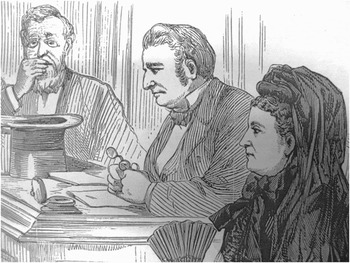
Drawing on the strategy favored by defense counsel in cases of women's spousal murders, Walworth's lawyers attempted to push back the time frame of the murder, to the years of abuse that had compelled Ellen Walworth to file for divorce.Footnote 55 As O'Conor read aloud the dead man's vindictive missives, the workings of a twisted mind echoed eerily in the hushed courtroom. Mansfield Walworth had achieved moderate success as a writer of sensation fiction and gothic novels, and his fevered imagination took full flight in letters marked by profanity, blasphemy, and bloody threats.Footnote 56 In August 1872, enraged by the divorce decree that had granted Ellen custody of their children and ordered him to pay for their maintenance (which he refused to do), he wrote that he had twice been on the verge of traveling to Saratoga to “blow her brains out.” Many more of that ilk had arrived, and on May 30, 1873, Frank had snatched the last letter to keep his mother from reading it: “I will, and so help me by the demons who wait upon the persecuted, and the proud-spirited and the revengeful—I will, when stripped by you of my property—and you mean it—at last plunge my dagger into Frank and Tracy's heart, and cut off the Walworth name forever.”Footnote 57 The son's knowledge of his father's threats had “affected” his client's capacity to form criminal intent, O'Conor claimed, so much so that “he was not sound at the time of his interview with his father.” On account of Frank Walworth's epileptic affliction and his “state of his mind,” the defense argued, he was “not responsible.” Thus, the defense asked the jury to consider two plausible bases for an acquittal: one that fit a desperate son, burdened by the weight of filial duty, and fearing imminent death; the other that fit a defendant of unsound mind, aggravated by his nervous disorder.
Once O'Conor stated this claim, Judge Davis demanded that he present a formal defense of insanity. This left the jury to consider a defense that pinned a domestic tragedy to expert opinion on the relationship between epilepsy, insanity, and criminality.Footnote 58 In many respects the defense could have selected no better expert than Dr. John P. Gray.Footnote 59 One of the most called-upon medical men of his day, he was superintendent of the Utica Asylum in upstate New York and the longtime editor of the American Journal of Insanity. The defense placed Gray in an unfamiliar seat, since he was known for holding the line against his fellow doctors, such as William Hammond, who proffered theories of moral, emotional, and temporary insanity.Footnote 60 In most criminal cases Gray had appeared as a witness for the prosecution and he was well known in the medical fraternity for his hostility toward the concepts of moral and emotional insanity.Footnote 61 Earlier in 1873 he had interviewed a convicted murderer awaiting execution and determined that the man was feigning insanity; on his appraisal the state proceeded with the execution.Footnote 62 Consequently, the die-hard organicist's appearance on behalf of an indicted murderer carried considerable weight. Frank Walworth suffered from epilepsy, Gray confirmed, and a boy like this, marked by epilepsy's “mental impairment” could well act unpredictably. Although the prosecution's medical experts (three to the defense's one) questioned the defense theory, that the defendant's mind was enfeebled at the precise moment of the shooting, they concurred that “there is a mental deterioration [in epileptics] generally going on gradually and leading ultimately to the entire failure of mind.”Footnote 63 As the Herald remarked, “all the witnesses [agreed] that epileptic attacks are attended by unconsciousness and a want of responsibility.”Footnote 64 Yet none of the doctors, not even Gray, could say for certain whether the defendant's history of epilepsy had led directly to this act of violence. A person suffering from epilepsy, Gray stated, “would be liable at any time to an attack in which the will would be wholly impaired,” but that was as far as the doctor was prepared to go. Against his tone of uncertainty the prosecution's medical witnesses struck a common-sense chord: could the defendant have turned himself in and recalled minute details of the events leading up to and culminating in the murder had he not been fully conscious of his act and fully in command of his will?Footnote 65
All of this medical talk in relation to criminal responsibility appeared to convince no one, including Charles O'Conor, whose closing address barely mentioned insanity. Instead he led the jury to consider the moral chasm that existed between a contemptible father and an admirable boy. The story he made of the case was a domestic fable in which polarized codes of masculinity—one pure-hearted, chivalrous, and possibly misguided; the other wicked, malicious, and likely mad—had collided with fatal results.Footnote 66 Provocatively he invited the jurors to question the Fourth Commandment when he asked: “Was it possible for this youth to honor his father?” To have acted thus “would have been a violation of every feeling of humanity for a child to honor such a parent.” The defendant's devotion to his mother and concern for her happiness and safety was praiseworthy, and it had rightly inspired him to champion her cause: “Every instinct taught him to stand ready to risk life and everything to defend his mother against such a wild beast.” Frank Walworth was not just innocent, he was heroic: “It was the highest, holiest duty of a child to protect his mother.”Footnote 67 True, he had defied man-made law but he had fulfilled a higher law—that of filial chivalry. Surely this tragic tale of evil at the heart of a respectable family provided all the jury needed to acquit.
Men listen in shock as the victim's foul and threatening letters are read aloud. Source: Frank Leslie's Illustrated Newspaper, 12 July 1873, 287.

The rule of law triumphed over O'Conor's exculpatory narrative, however. His fable fell flat with the jury and it offended the Judge, who reminded the courtroom audience that the victim, not the murderer, deserved sympathy: “What terrible thoughts must have rushed upon him when he received the leaden messenger of death in his bosom from the hands of his eldest boy. I shudder to think of it.” As he sentenced Walworth to a life term in Sing Sing State Penitentiary, Judge Davis admonished him to atone for his sins: “I think you ought to devote your whole life to repentance such as God only can accept for so horrible a crime.”Footnote 68 The Times, the Tribune, and the Herald shared the judge's view that O'Conor had effectively asked the jury to endorse father slaughter. Frank Walworth was a self-absorbed killer, a “morbid boy, who committed an unnatural and inexcusable crime.” Had this story of sham heroism convinced the jury, an editorial warned, an “acquittal would have been an invitation to every youth having a dissolute or tyrannical father to slay him.”Footnote 69 Equally, a move to secure a pardon for the justly convicted murderer would be “the greatest blow to law and order ever delivered by the Executive of this State. We might as well open the doors of Sing Sing at once and let everybody out. Honest people might then ask to be taken in as the only available place of shelter against the ill-used class to which WALWORTH belongs.”Footnote 70 Nevertheless, the acknowledged status of the murderer's family and the noted tendency for governors to pardon murderers left little doubt that Walworth's life would end outside a Sing Sing cell. Even the judge was prepared to admit, after he announced the mandatory sentence, that the murderer's fortunes might change, “at some future day, through Executive clemency.”Footnote 71
From Criminal Responsibility to Blamelessness
Frank Walworth's conviction for murder “perpetrated intentionally but without planning or deliberation” gladdened law reformers who had predicted that a revised definition of murder would render the prosecution of murder more certain. Reporters who interviewed the jurors after they were dismissed claimed that nine or ten of the men had initially considered the defendant guilty of murder in the first degree, but the remainder had thought the killing amounted to manslaughter; in less than four hours they had reached a compromise and pronounced Walworth guilty of murder in the second degree: “Never, within the memory of this generation, has any great criminal issue been so promptly and satisfactorily tried in New-York,” the Tribune announced the morning following the conviction.Footnote 72 Henry Clinton, the lawyer who had drafted the bill that had redefined the degrees of murder, wrote to the New York Times to commend the verdict. Drawing on his thirty years' experience before juries, he believed that “there would have been no conviction at all; or, if any, one not higher than manslaughter in the third degree” had the law not come into effect several days before the murder. Juries have always had a desire “to do substantial justice,” Clinton claimed. Now, aided by this statute, they could do so “without committing perjury.”Footnote 73 Walworth's conviction with its mandatory sentence was especially reassuring because it confirmed that New York had one law that applied to the rich and influential as well as to the poor and friendless—no matter how masterful the defense or how grand the medical authority. Frank Walworth had learned the universal lesson in a law-abiding republic, that “the law is the proper remedy for evils.”Footnote 74 Here Clinton sided with the prosecution, and likely the jurors' belief, that the Walworths, a family stocked with lawyers and judges, had had every legal resource at their disposal to protect themselves from a disgruntled and possibly demented family member. Securing a peace bond or committing Mansfield Walworth to an asylum would have been the appropriate course, as the verdict suggested; instead, his son had willfully violated divine law and knowingly acted contrary to the written law. Thus the jury's verdict was right and proper.
As soon as the sentence was pronounced, the Walworths began to work in the realm of “lawless law,” though not unlawfully, as Frank had done. The family opted to seek substantive justice through the executive rather than pursue a legal appeal. A court-based course, after all, could easily have failed, or led to the ordeal of a second trial. And appeals were costly. O'Conor wrote immediately to Gov. John A. Dix, former Union general, to inform him that the family planned to seek executive clemency, and that he had “determined not further to agitate any legal questions in the Courts.” O'Conor was not so indelicate as to state that he was unwilling to continue to represent the Walworths pro bono; rather, he portrayed them as ordinary supplicants: “None of them now occupy any position which socially or otherwise affords them any means of influencing the action or opinions of men.” Thus the “old method of appeal[ling] to executive clemency,” was their only hope, one in which the eminent lawyer placed great faith. Although Frank Walworth was technically his client, O'Conor wrote now on behalf of Ellen Walworth, for whose sake he hoped the governor might issue a pardon. Drawing on the conventions of melodrama, he declared that he was “impelled by admiration of the noble mother who with her little family has had to endure so much wrong and now stands in the shadow of impending degradation.” Such sentimentalism did not undercut the sense in which O'Conor wrote to Dix man to man, fully prepared to ingratiate himself to the new governor, whose pardoning predilections were hardly liberal.Footnote 75 He ended by expressing his “full confidence in Your Excellency's considerate review” and in the retired general's “elevated sentiments of justice and humanity.”Footnote 76
Pardon petitioning was shaped by deeply entrenched customs of supplication, particularly in New York where no rules or statutes restricted the content of petitions, their style, or their authors. By the time that Walworth's sentence was reviewed, other states, including New Jersey, Massachusetts, and Pennsylvania, had introduced courts of pardon and pardon boards along with clemency petition requirements, and this meant that formal pardon applications were drafted in most cases by lawyers.Footnote 77 Calls to establish a similar system were voiced in 1867 at the New York State Constitutional Convention. New York ought, at the very least, to attach conditions to pardons as a matter of course, so that the threat of reimprisonment could be wielded to make “good citizens” of convicted criminals. But New York's “old method” remained in place.Footnote 78 Ironically this meant that anyone, including women, could find a voice in the postconviction disposition of criminal cases, whereas trials prohibited women from assuming any role other than that of witness. This is how Mrs. Walworth had appeared at her son's trial, responding to counsels' questions. Wearing her widow's veil and striking the pose of the abused wife saved by her son's manly action, she had testified: “There was no male person in my house who could protect me except my son.” Back home, writing in her own confident hand, she catalogued the evidence she considered pertinent to the clemency review. And she issued forthright requests for governors to use their executive power. When Dix refused to grant Frank Walworth a pardon before his gubernatorial term ended in 1874, O'Conor drifted off stage —and Ellen Walworth stepped forward.
The incoming governor, Samuel Tilden, came to know her straight away. Signing her letters, “Ellen H. Walworth,” she wrote the governor at length, detailing her claim that Frank had respected his father; that he had felt nothing but pure-hearted love for his family; that his epilepsy was far more severe than the trial had revealed; and that his imprisonment had had an alarming effect on his physical and mental health. On the one hand, her appeals were classic narratives of the abject mother.Footnote 79 Although her letters were considerably more literate than the typical mother's appeal, they were driven by the same maternal worry: “If you could realize for one moment the horrible torture and anxiety that I suffer at this time, and the despair that faces me if something is not done soon for my child you would willingly aid me yet a little longer.” On the other hand, she had the temerity to question the conduct of the trial and to call upon Tilden to do his duty: “My son's unfortunate condition of mind was entirely ignored in the verdict against him … the verdict was therefore a cruel injustice and a mistake in the administration of justice the law—a mistake which the pardoning power enables [the governor] to correct.” Tilden granted Mrs. Walworth several interviews and agreed in 1876 to commission medical experts to assess her son's medical and mental condition, but he refused, like his predecessor, to grant a pardon.
The incoming governor, Lucius Robinson, became her next target once he assumed office in 1877. He, too, granted the determined widow an audience, and she wrote to him afterwards to remind him of the governor's role in the pardon process: “It is your privilege—your right. I know you will not forget this.”Footnote 80 Her persistence and assertiveness led one upstate paper to identify Ellen Walworth as “a very artful woman,” who had “overinfluenced” Governor Robinson and “blinded” his judgment.Footnote 81 Womanly feelings, it appeared, had corrupted the normal processes through which men formed rational opinions.
This critical comment, one of the few public objections to the process that led to Walworth's pardon, was predicated on an idealist notion of executive justice as men's business and therefore unsentimental. Sociolegal scholars and gender historians have demonstrated the hollowness of those ideals in studies of cases in which executive mercy in the nineteenth century favored women, particularly women who killed men who they claimed had wronged them. This brand of clemency expressed the paternalism of governors and mercy bureaucrats who stretched notions of self-defense to exonerate members of the weaker sex.Footnote 82 In New York State, for instance, juries convicted eight women of murder in the first degree between 1860 and 1908, and governors spared all but two the death penalty. Executive mercy apparently reinforced the wide cultural purchase of manly protectiveness toward women who faced the wrath of the law. Yet women's high commutation rate—75 percent—is based on a tiny number of cases. This points to an issue that historians of paternalistic justice and the “new unwritten law” have failed to underline: the vast majority of pardon and clemency petitions that filled governors' agendas were cases involving men.
Although women were pardoned at higher rates than men, men significantly outnumbered women as actual recipients of mercy, simply on account of the far larger proportion of men convicted and imprisoned for criminal offences. The female offender was the exception in a decision-making system devoted to making exceptions; the male offender was the rule. This was particularly the case with prisoners serving sentences for crimes of violence. Between 1860 and 1908, for instance, 94.6 percent of prisoners petitioning for mercy while serving life sentences for murder in the second degree were men.Footnote 83 Frank Walworth's crime was unusual and his conviction a surprise, but in this critical respect he was typical: a man whose candidature for clemency hinged on the decision of another man whose office carried with it the "privilege and right" to pardon.
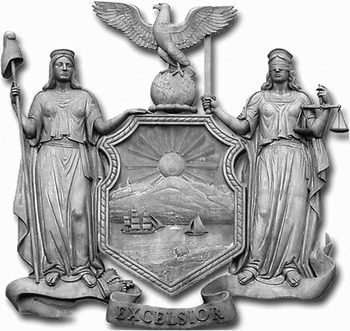
Analyzing Frank Walworth's 1877 pardon opens up the workings of the unwritten law beyond the adversarial trial, with its rules and procedures, to an idiosyncratic yet custom-driven decision-making process, in which a handful of men searched their hearts and minds for just results.Footnote 84 Ellen Walworth was not the person who created this custom or who made the pardon possible: it was the constitutional authority and state's traditions that lay behind the man who held chief executive office. Clemency in New York was, from the first state constitution in 1777, a deeply personal practice, in which the elected governor, assisted by his appointed pardon clerk, read petitions, met with prisoners and their representatives, consulted legal and medical authorities, solicited opinions from community leaders, and ultimately decided who did, and who did not, merit mercy.Footnote 85 Twelve years passed between Frank Walworth's pardon and the establishment of a formal parole system in New York, and it would be a half century before the state constitution was amended to assign the state parole board responsibility to advise the governor on pardon petitions.Footnote 86 On the state flag, “Justice” was feminine, a mythical figure, blindfolded, holding her scales evenly; in the executive chamber, justice was masculine: open-eyed, open-hearted, and prepared to tip the scales as men saw fit.
The Great Seal of the State of New York. Note that ‘Liberty’ kicks aside a crown, the symbol of monarchy. Source: http://www.nycourts.gov/stateseal.shtml.

Despite the quickening pace of legal modernization in New York over the nineteenth century, the governor's responsibility over the pardoning of convicted offenders lagged behind, a sign of the republic's monarchical heritage. Even though Blackstone described the sovereign's power to dispense mercy as “most amiable,” Chief Justice Story believed that the holders of executive office in the United States would administer it wisely: “If the power should ever be abused, it would be far less likely to occur in opposition, than in obedience to the will of the people.”Footnote 87 Since governors and presidents were elected officeholders, Story believed it was against their own interests, and contrary to the spirit of democracy, to dispense mercy in a manner out of keeping with public sentiment. In many respects, New York had led the nation as a modern innovator when it codified the criminal law, flowing from a recommendation of the 1821 Constitutional Convention, and replaced the antiquated Courts of Chancery with a single Supreme Court of Law and Equity in 1847.Footnote 88 Penal statutes were modernized as well. In 1860, legislators introduced the first statutory distinction between degrees of murder. The title of this statute had a perfectly Benthamite ring: “An act in relation to capital punishment and to provide for more certain punishment of the crime of murder.” Because the text's wording had prompted judges to interpret the statute narrowly, amendments were introduced in 1861, 1862, and finally in 1873, when chapter 644 of the Laws of New York became law, just six days before Frank Walworth shot his father. This new definition of murder in two degrees aimed to shape jurors' conduct, in particular the notorious tendency for juries, especially in New York City, to disagree or to acquit on dubious grounds.Footnote 89 It provided a clearer distinction between planned and deliberate murder (first-degree) and second-degree (deliberate but spontaneous) murder, the latter to be punishable by the mandatory penalty of life imprisonment.Footnote 90 New York legislators were evidently prepared to innovate, though not when it came to the governance of clemency. Executive justice sat alongside, rather than within the project of legal modernization.
Frank Walworth's pardon was granted toward the end of an era during which executive justice remained as personal as it was political. For prisoners found guilty of any crime, as trivial as public intoxication and as serious as murder, the constitution empowered the governor to “grant reprieves, commutations and pardons after conviction.”Footnote 91 His actions were accountable only to the extent that he was constitutionally obliged to communicate his decisions annually to the legislature, “stating the name of the convict, the crime of which he was convicted, the sentence and its date, and the date of the commutation, pardon, or reprieve.” Like the kings of pre-Revolutionary times, governors could dispense mercy for any reason they might “think proper,” though unlike hereditary monarchs, they exercised the powers of office at the pleasure of the people.Footnote 92 Mercy's modernization in New York would only begin in the Gilded Age, when the Board of Commissioners for Paroled Prisoners was established in each prison in 1889, followed by a statewide board in 1901, which, along with the introduction of indeterminate sentencing, relieved the governor of the burden of a growing case load and established protocols for the commutation of sentences and the supervision of released prisoners. Even still, these managerial changes preserved the governor's rights and responsibilities.Footnote 93
In New York, the power to pardon covered every criminal offence (save treason) and governors' willingness to exercise it for murder was no exception. Indeed, Monkkonen discovered that governors pardoned almost one third of murderers convicted in New York County's courts over the nineteenth century.Footnote 94 Had they reserved mercy for wounded women who killed, or for well-connected gentlemen murderers from highly respectable families, that rate would have been negligible. Pardoned criminals were overwhelmingly men of little education, wealth, or position, who managed, nevertheless, to find relatives, respectable citizens, or prison officials to speak up for them, or to impress the governor or his pardon clerk when they made in-person prison visits. Although the pardon clerk processed correspondence and communicated frequently with prison officials, governors reported that they also met with persons petitioning on behalf of prisoners and visited prisons to talk with keepers and convicts. As each governor took office, he had to develop a relationship with his clerk (one man served as clerk between 1871 and 1883), both relying on his expertise and exercising authority over decisions.Footnote 95 These two men had a great deal of power, but with that came the expectation that the governor “demonstrate generosity, chivalry, and benevolence and … responsible behavior to the less fortunate.” As Miller notes in her analysis of Florida's pardon board, clemency had a patrician air—it expressed “male attitudes toward ‘respectable’ white and black social inferiors.” Frank Walworth was the social equal of the governors who reviewed his case, and the individuals who petitioned for his release (including senators and representatives) were a cut well above the ordinary. Yet in case after case and in year after year, governors found cause to pardon convicted criminals, including murderers, who had come from the poorest homes and communities in the state, men who could barely read or write, let alone quote Byron or compose sonnets, as Frank did during his imprisonment.
Governors were obliged by law to produce annual accounts of their clemency decisions. Their reports varied in style, between and within governors' terms: some provided minimal information in tables that showed the names of offenders, their original sentences, and the date of their pardons, commutations, or reprieves; others were mini case narratives that traced the crime, the trial, the prisoner's circumstances, the appeals made on his or her behalf, and the nature of community sentiment.Footnote 96 Executive clemency reports appeared periodically in assembly and senate documents (which newspapers, particularly the Times, published), and they also appeared in governors' public papers, which each officeholder published at the end of his term. These accounts illuminate a striking consistency in the rationales provided as deciding factors in favor of pardoning. Whether offenders were imprisoned for murder or for nonlethal violence, property crime or morals offenses, governors focused on three questions: the nature of the crime, the character and health of the prisoner, and the respectability of the parties agitating for their release.Footnote 97
When Governor Robinson turned to Frank Walworth's case, he took each of these factors into account. Although the Walworth family's powerful legal allies and political connections undeniably assisted Frank's cause, his pardon cannot be interpreted mechanistically, as the inevitable outcome of race and class privilege.Footnote 98 Had that been the case, it would not have required three governors' terms, the prisoner's declining mental and physical health, and a persistent behind-the-scenes campaign to secure his release. And class carried disadvantages as well, particularly in highly publicized cases such as Walworth's. A hasty pardon during Dix's term, or during Tilden's term, as the depression deepened and cries for social justice for the poor grew shrill, would have soured the wholesome conviction. When Governor Robinson relented he was under no political pressure to dispense mercy in this case, especially since his predecessors had held firm. As the Committee on the Pardon Power had reported at the 1867 Constitutional Convention, concerns about the executive's overwork, not suspicions of injudicious or corrupt pardoning practice, had prompted its review of clemency. In its final report the Committee concluded that New York's governors had exercised their authority “carefully, judiciously and conscientiously,” and Robinson clearly recognized the need to maintain that impression.Footnote 99
Like other prisoners pardoned in the 1870s, this convicted murderer had to wait and he had to suffer, but not to the extent that the statute dictated. In this and in other respects, Walworth was a typical clemency candidate. In July 1873, O'Conor's pardon request to Governor Dix had initiated a standard practice, in which the pardon clerk contacted the district attorney (in this instance D.A. Phelps): “Application having been made to the Governor … I respectfully request you (in pursuance of chapter 310 Law 1849) to furnish the Governor with a concise statement of the case as proven on the trial, together with any other facts or circumstances which may have a bearing in the question of granting or refusing pardon. Be pleased also to state the previous character of the convict.”Footnote 100 The formality of the letter and its reference to legal regulations also expressly recognized and authorized the recipient to express his impressions: circumstance and character would be weighted equally with fact.
The governors in this era who published their reasons for granting clemency made this combined basis of discernment clear. Pardons were granted most often, as the 1867 Committee had found, to men who were seriously ill (“if his confinement is protracted [he] will become incurable”), or to those whose families were suffering as a result of the criminal's imprisonment (“the destitute condition of the wife”). The language of compassion these statements expressed, repeated over and over in clemency accounts, chimed with Justice Story's ethical justification of clemency, without which, he declared, “justice would assume an aspect too sanguinary and cruel.”Footnote 101 But governors' clemency reports also bear witness to the persuasiveness of character references. If district attorneys and judges were unwilling to vouch for the merits of an offender, as was the case when Phelps was contacted in regard to Walworth less than a month after his conviction, citizens held in high esteem could persuade the governor that prisoners' prior good character made them fit candidates for mercy (“Petitioned for by many of the leading citizens of the county”). Ultimately every pardon statement expressed the governor's opinion, explicit or implied, that the convict's time served had expiated the crime (“The prisoner has suffered sufficiently for this offence”).Footnote 102 Executive clemency in this period echoed a centuries-long decision-making tradition, in which pardon decisions turned on men's feelings about what it took for a convicted criminal to be worthy of freedom.
Four years after the trial, the case of a young killer of exemplary character, now weakened in mind and body, had drifted to the periphery of public concern, but his pardon had to be managed in light of previous practice and rising expectations of procedural fairness. One way to blunt potential criticism was to dress executive justice with the authority of professional expertise. As Frank Walworth languished in prison, the New York State Bar battled against closed-door dealings in civic and state government and worked against unprofessionalism in the judiciary, particularly in the city of New York. Similar attempts were underway to elevate professional standards in forensic medicine, led by the Medico-Legal Society of the City of New York. Chartered in 1868, it lobbied for a state lunacy commission, which the state government established in 1874.Footnote 103 The first commissioner, Dr. John Ordronaux, a Columbia University professor and an expert on criminal lunacy and epilepsy, was the official who signed the “lunacy certificate” that led to Frank Walworth's reassignment in 1874 to the Asylum for the Criminally Insane at Auburn.Footnote 104 This scientific assessment, administered through modern bureaucratic procedures, helped to construct this prisoner as a fit subject for mercy, but the governor remained the only man authorized to pardon Walworth.
Although Lucius Robinson, who held office from 1879 to 1880, favored a brief style of reporting in his annual accounts of his pardons, commutations, and reprieves, he made an exception for Frank Walworth. “A statement of the reasons which have led to the exercise of executive clemency,” he began, “is due to the community.”Footnote 105 The account that followed was a remarkably revealing declaration of 1,811 words, which each of the state's major daily newspapers published, many of them in full. Unlike Illinois governor J. P. Altgeld, who lost office after he pardoned three men whom he considered wrongfully convicted for murders of policemen in Chicago's Haymarket Riots, Robinson steered clear of criticizing the law, the judge, or the jury in the Walworth case.Footnote 106 Besides, he stated, the pardon was never meant to “revise criminal judgments.” Its purpose was loftier: “Where the law, by its necessarily unbending rules, works hardship in view of circumstances not within the lines of legal evidence, where punishment, although technically proper, is yet morally unjust, there the power of pardon finds its legitimate field.” The governor understood his power to pardon as a means to protect society from the possibility of persecuting criminals through the strict application of penal statutes. Happily, Robinson stated, “executive clemency, acting outside the strict letter of the law” could “relieve the community from the imputation of unfairness and the accused from hardship.”Footnote 107 No clearer definition of executive justice Americana—a form of law “higher than those who administer it,” yet of the people and for the people—could have been scripted.Footnote 108 By pardoning Walworth, Robinson relieved the tension that lingered after the jury's verdict, between law's imperatives and competing strains of justice attuned to the code of chivalric manliness and to domestic ideals. Acting above and beyond the law, but within his constitutional rights and responsibilities, the governor considered opposing readings of Mansfield Walworth's death, one that defined it as a punishable criminal offence, and the other that pictured it as a pardonable killing of a tyrant who deserved to die. And so, without denying the former reading, Robinson endorsed the latter.
Stylistically, Robinson's pardon followed the “tales” that Natalie Zemon Davis analyzed from sixteenth-century France. Four centuries and a democratic revolution later the pardon remained, as Justice Marshall had ruled in 1833, “an act of grace, proceeding from the power entrusted with the execution of the laws, which exempts the individual, on whom it is bestowed, from the punishment the law inflicts for a crime he has committed. It is the private, though official act of the executive magistrate.”Footnote 109 In the state governor's chamber, unlike the courtroom over which the judge had presided and in which law had prevailed, the fable of the noble defendant and the monstrous victim could be narrated without becoming snared in the rules of evidence. Similarly the defense's star medical witness, Dr. Gray, reappeared, freed from the realm of supposition over Frank Walworth's mental state at the moment of the shooting; three years after the trial he was commissioned to assess the prisoner's physical and mental conditions. Gray's 1876 report detailed Walworth's declining condition in the Auburn Asylum, and Robinson complimented it for its “great clearness and precision.” He was convinced by this evidence that Walworth's continued imprisonment would “result in complete idiocy.”Footnote 110 With the medical diagnosis decoupled from the question of criminal responsibility, medical science and manly sentiment could clasp hands.
“The highest medical authorities” had provided Robinson with persuasive grounds to pardon Walworth, especially as it was customary for governors to pardon prisoners suffering from serious diseases. However, the pardon statement devoted far more space and emotion to the “melancholy record of the tragedy for which he was convicted.” Like Walworth's counsel, Robinson dwelled on the family's breakdown and he moved the case's time frame even further into the past, back to Frank's boyhood as a “quiet, well-behaved child,” who was known for his “affectionate devotion to his mother.” Then there were the “most reputable citizens” of Saratoga Springs (newspaper editors, lawyers, judges, doctors, businessmen), who had attested to “the blameless purity of his entire life up to the very day of the fatal encounter with his father.” Delicately avoiding the word “murder,” the pardon statement placed the son on the side of good. Frank Walworth was everything a parent could have hoped for; Mansfield, in contrast, was a self-declared “desperado,” who had forfeited all claims to respect as a father and as a husband. Like a dark character who had leapt from the pages of his own gothic novels, Mansfield was the very embodiment of evil: “For years he had devoted his life to a systematic course of threats and abuse toward his wife, which for malignity, bitterness and brutality are fortunately seldom equaled.” Witnessing his father's violent treatment of his mother had driven the son to madness, though not as the M'Naughten Rule defined it. Frank was no coward: despite his “infirmity of mind” and his “slight and feeble” frame, he had bravely confronted his father, “a man of large proportions and strength.” With a stroke of his pen Robinson redefined criminal intent as manly motive: “The son grew at length to the age when he demanded, as was his right, that his father should cease to persecute his mother.”
In the governor's pardon tale young Walworth became the white knight, on a quest to slay the dragon and to serve as his mother's champion. Or the shooting had been caused by “insanity, attendant upon one of his epileptic paroxysms.” Or he had truly feared that his father was reaching for a revolver and fired in self-defense. In the generous field of executive justice, the cause of the shooting sank into insignificance; what mattered now, after his conviction, was the executive's decision that the prisoner was “not legally responsible for it.” Robinson went so far as to name the victim the guilty party, an interpretation that Judge Davis had warned the defense to abjure. Because Mansfield Walworth had led a life of “violence and threats” he had come to his death “as if he had himself discharged the fatal shot,” Robinson concluded. Consequently the continued incarceration of this convicted murderer would “ill-befit the dignity of the law or the civilization and humanity which belong to the age.”Footnote 111 There is no way to know whether or not Robinson truly felt these sentiments, but their similarity to the pleas for sympathy, common in defense characterisations of cuckolded husbands, is striking. Men's capacity to appreciate and excuse honor-related masculine violence was widely shared, from the plebeian street fighters who operated according to notions of the fair fight, to the stiff-collared men who dwelled in the executive mansion.
Robinson's pardon of Frank Walworth in August 1877 caused only a ripple of discontent. And there is nothing to suggest that Robinson's decision, announced early in his term, harmed his career. In contrast, his criticism of corruption in the state Democratic Party led to his defeat in the 1879 election and his retirement from politics.Footnote 112 The governor correctly gauged that pardoning a young man who had risked death to protect his mother and his siblings might appear to have suffered sufficiently for his father's death. With few exceptions the pardon met with approval, strongest in Saratoga Springs, where the Saratogian called the decision an “act of justice too long deferred.” More surprisingly metropolitan papers that had earlier applauded Walworth's conviction now appeared to accept the outcome. One of them, the World, endorsed Robinson's decision and shared his low opinion of the victim: “The present condition of Walworth, a mere wreck, where it is useless to continue to punish for the commission of a crime, has been the chief motive for the governor's action. In estimating the justice of the pardon popular feeling, however, will be apt to go back to the circumstances of the homicide, remembering that the killing of the father was the deed of a boy driven to insane desperation at the thought of wrongs inflicted on his mother.”Footnote 113 Who could forget Mansfield Walworth's “horrible imprecations” in the letters Frank had intercepted?Footnote 114 Pressing upon the mind of sensitive son, the father's offensive words had “justifie[d] an assault.”Footnote 115 This editorial, which defined Mansfield Walworth's “opprobrious epithets” as a “mortal insult” to a virtuous woman, was precisely the sort of evidence that Kernan gathered to compose his “principles” of honor-based “lawless” culture.
Despite the sentiments that drove the pardoning process an assumption prevailed among the legal fraternity that feelings, let alone sentimentalism, ought not to sway clemency reviews. Feelings were inappropriate, unmentionable, and unbecoming in the holder of executive office. An 1873 editorial in the Albany Law Journal argued that the state constitution had never granted the executive discretion to pardon “simply on the ground of personal feeling, or rather on emotional grounds.” Thus it repeated the call, tabled by some delegates at the 1867 Constitutional Convention, to streamline clemency by establishing a judicial council equipped to review cases on a rational basis.Footnote 116 Until then the editor hoped that the governors would grant pardons exclusively to prisoners for whom reasons could be found to bestow mercy. Indeed, Robinson forestalled such criticism by distancing himself from the prisoner's family and leaving Ellen Walworth's name off the list of citizens who supported Frank's release, even though she had written more often and had received more audiences than any other individual with the governor. Aside from several other medical men “of high scientific attainments,” Robinson attached himself to leading public intellectual William Cullen Bryant, who had opined that a jury today, were it conversant with all the evidence, would acquit. The man whose opinion Robinson granted the greatest authority was State Supreme Court Justice Augustus Bockes, whose letter urging clemency the governor cited in full. Bockes, a fellow resident of Saratoga Springs, had instructed the defence at the trial, and he claimed that it was Mansfield Walworth's “frequent, almost daily barbarities” that had “arouse[d] the utmost indignation in the mind of a high-minded son.” Any young man with “high ideas of duty” might have acted thus if forced to witness the “systematic, persistent, malignant persecution of his mother, whom he adored.” It was one thing for defense counsel in criminal trials to stir emotions by imploring male jurors to imagine a cuckolded husband's anguish, or by calling on their fellow men to rally manfully to protect a wounded woman from the law's wrath; it was quite another for an executive officeholder to admit that his pardon deliberations were based on his heart as much as his head. Yet Robinson's public announcement of a pardon decision, constructed as the just resolution to a domestic “tragedy,” took its inspiration from O'Conor's melodramatic defence and Bockes's heartfelt petition, in addition to Ellen Walworth's demands for procedural justice. Like the defense lawyers and jurors in trial-based unwritten law cases of the late nineteenth and early twentieth century, Robinson drew a clear line between manly and unmanly violence, and he fretted over the ways in which the sanctity of the home and the virtues of a woman had been violated. The words “fact” and “reason” float in Robinson's pardon statement above weightier, emotion-laden words: melancholy, tragedy.
Conclusion
The Walworth patricide disturbed and perplexed the reading public that followed the case, thanks in no small measure to the trial's locus in the nation's newspaper hub. From the summer of 1873, when Frank Walworth was tried, convicted of murder in the second degree, and sentenced to life in prison at Sing Sing State Penitentiary, the crime was big news. Once he was declared a lunatic and transferred to the Auburn Asylum, he might have been forgotten had it not been for the governor's highly publicized pardon in 1877. From that point few stories appeared, with the exception of a short one on May 5, 1881, the day Walworth passed his exams and was admitted as a member of the New York Bar. One upstate paper laced its good wishes with sarcasm: “Frank Walworth, who served several years in prison for shooting his father, was admitted to the bar in Ithaca last week. He should be an expert in murder cases.”Footnote 117
Histories of the gender dynamics at play in late nineteenth- and early twentieth-century “unwritten law” trials have provided compelling evidence of the ways in which American lawyers and juries, as well as judges, drifted off the page of the written law to its forgiving borderland. In comparison, we know little about the ways in which executive officers also pondered the question of how and under what circumstances violence in defense of the family is to be condemned, excused, or praised. A combination of legal, medical, and political actors, in addition to exhortations from Frank Walworth's family and friends, were necessary to exonerate a son forced to choose between paternal respect and filial love. But none of these postconviction proceedings would have occurred had the jurors failed to act according to the written law. This trial occurred precisely at the moment when New York legislators acted upon political and legal concerns about uncertainty in the prosecution of murder. Medical experts seemed endlessly inventive when it came to finding ways to erode criminal intent, and jurors were committing ‘perjury’ to steer clear of sending defendants to the gallows. A new state' had been introduced to bring killers to evenhanded justice. Even Governor Robinson acknowledged the legality of the verdict in the state's first test case of the new murder law by conceding that the conviction of Frank Walworth was “technically proper.” Nevertheless the pardon provoked little disapproval at a time before executive mercy's bureaucratization in New York. By the early twentieth century, governors' reports would express the values and procedures of a new disciplinary apparatus in modern managerial terms: “The Parole Board has recommended clemency for him, and in view of all the circumstances I have deemed it just to modify the sentence so that a parole may be granted if the Board think proper.”Footnote 118 Public concern about the personal character of executive justice would ultimately bring about these procedural changes, but it had yet to gain traction in the 1870s.
Focusing on the postconviction workings of the criminal legal process underlines that acquittals and appellate reversals are but one means to explore the operation of exculpatory justice broadly, and the unwritten law specifically. This phase is generally more difficult to trace beyond the public actions of pardon petitioners, since executive decision making is typically opaque, but this does not always hold. Governor Robinson's unusually detailed explanation for his decision to pardon Frank Walworth indicates the ways in which the personal and the political, the medical and social, the legal and the cultural pervaded the wider practice of pardoning. In this particular case an executive decision accomplished what a criminal trial verdict could not: disapprobation of murder; vindication of medical authority; endorsement of provocation claims; and condemnation of the victim.
For historians interested in the deeply rooted features of criminal justice that resisted law's modernizing pull, the Walworth case, from prosecution to pardoning, is exemplary. Criminal indictments and trials provided the most obvious means to apply the law fairly and fully, and appeal procedures were established to ensure the legality of convictions, but executive justice was a well-established and widely accepted remedy for the correction of perceived injustice. The administration of executive justice entailed gendered calibrations of character and motivation in every instance. The governor's public announcement of the reasons for his decision in this case was unusually explicit, but his appraisal of Walworth's motive demonstrates how the unwritten law of executive justice excused a broad array of crimes involving emotional intimacy.
The Walworth case also reveals the endurance of sentiment broadly as a factor in the transformation of American law, and masculine sentiment in particular. Although Horowitz notes that procedural reforms helped to expose enduring premodern traditions, the degree to which feelings, and the feelings of men, in particular, lingered in the law were not his concern. Walworth's pardon, read in the context of routine pardoning practice, is a potent reminder that it took men to judge men (and on rare occasions, women) fit for punishment or pardons. Despite Ellen Walworth's moral authority as a suffering mother, the men she petitioned knew that it would take an all-male legal cast, aided by medical men, to release her son. As “science, progress, and reason were fetishized as forms of transcendent value within the culture of modernity” culture continued to inform and find expression through criminal legal processes, as recent work in the sociology of punishment emphasizes.Footnote 119 But culture must always be localized and historicized. In Reconstruction-era New York the codes of masculinity through which men in the justice system, from police to pardoners, acted and judged one another disrupted and syncopated the rhythms of law's modernization. Sentiment and custom, men's feelings and practices, were preserved in the executive chamber, where life and death decisions were made by men of flesh and blood. In the Walworth case, a governor, not the great seal's “Justice,” was deeply moved by the plight of a “boy” forced to witness his mother suffer terrible abuse. Unconstrained by the rules of evidence and tied by the loosest of constitutional guidelines concerning the posttrial disposition of convicted criminals' fates, pardoning was “lawful lawlessness,” a manly act of grace but legal all the same.Footnote 120