Implications
A group housing system with electronically controlled crates and conventional single farrowing systems were compared with regard to the growth performance and agonistic behavior of weaned and weight sorted pigs during rearing. This study confirms that mixing piglets during lactation reduces agonistic behavior after weaning and improves animal welfare without significant effect on performance during rearing.
Introduction
Group housing for gestating sows was predefined as a consequence of the European Union Council Directive 91/630/EEC amended by Council Regulation (EC) No. 806/2003 (2003). This provision targets increased animal welfare by allowing more social interaction and free movement based on natural behavior. In farrowing systems, pens with crates are built to improve piglet survival (Cronin and Smith, Reference Cronin and Smith1992) but keeping sows in crates has been increasingly criticized in public discussions. Alternative farrowing systems such as loose housing pens or group housing (GH) systems can affect the performance of weaned pigs during rearing. Bünger (Reference Bünger2002) assessed higher body weights (BWs) after rearing for weaned pigs from GH compared with pigs from loose housing systems. Likewise, Hessel et al. (Reference Hessel, Reiners and Van den Weghe2006) and Reiners (Reference Reiners2009) detected advantages concerning the growth performance of weaned pigs during rearing when single housed litters were mixed 10 or 12 days after farrowing. The enhanced performance of mixed pigs said to be caused by a higher voluntary feed intake and reduced agonistic behavior immediately after weaning (Hessel et al., Reference Hessel, Reiners and Van den Weghe2006; Pluske, Reference Pluske2006). Furthermore, the weaning weight could affect weight gain during rearing. McConnell et al. (Reference McConnell, Eargle and Waldorf1987) and Bruininx et al. (Reference Bruininx, van den Peet-Schwering, Schrama, Vereijken, Vesseur, Everts, den Hartog and Beynen2001) detected that heavy pigs grew significantly faster than light pigs during the rearing period. McConnell et al. (Reference McConnell, Eargle and Waldorf1987) assessed that small pigs did not make compensatory gains and the growth curves of the light and heavy groups of pigs remained parallel.
Under commercial conditions, unacquainted weaned pigs are often mixed and sorted by weaning weight. However, it should be noted that such a management strategy can influence the pigs’ agonistic behavior. Rushen (Reference Rushen1987) assessed more frequent and longer fights when the difference in weight between the pigs was small (<0.05 kg) than when it was large (<3.0 kg). Furthermore, D'Eath (Reference D'Eath2005), Hillmann et al. (Reference Hillmann, von Hollen, Bünger, Todt and Schrader2003) and Li and Wang (Reference Li and Wang2011) suggest that the farrowing environment affects the behavior of pigs due to their experience with acquainted littermates in small groups or unacquainted littermates in large groups. Unacquainted weaners from single housing (SH) systems have to determine a new hierarchy and thus have an effect on agonistic behavior and weight performance (Li and Johnston, Reference Li and Johnston2009). In various studies, it has been found that aggressive behavior is caused by different housing conditions, but also by various BWs, changes in space or group sizes or the degree of familiarity (Jensen, Reference Jensen1994; Turner et al., Reference Turner, Roehe, D'Eath, Ison, Farish, Jack, Lundeheim, Rydhmer and Lawrence2009; Stukenborg et al., Reference Stukenborg, Traulsen, Puppe, Presuhn and Krieter2011). As a result of agonistic behavior, skin lesions can occur after mixing foreign litters (Pitts et al., Reference Pitts, Weary, Pajor and Fraser2000; Turner et al., Reference Turner, Farnworth, White, Brotherstone, Mendl, Knap, Penny and Lawrence2006; Puppe et al., Reference Puppe, Langbein, Bauer and Hoy2007).
In the present study, weaned pigs from GH and SH systems were sorted by weight and kept in the rearing area. The aim of the study was a comparison of their growth performance and the duration and frequency of agonistic behavior in connection to the interaction between the farrowing environment and weaning weight class immediately after weaning.
Material and methods
Animals and housing
The data were collected on the agriculture research farm Futterkamp of the Chamber of Agriculture of Schleswig-Holstein between November 2009 and March 2010. The study was carried out with 240 weaned pigs from two different farrowing systems (GH and SH) with 120 crossbred pigs each (Piétrain × (Large White × Landrace)).
Six sows (2nd to 8th parity) and their piglets were kept together in the GH. Each GH-sow had an individual single pen with farrowing crate (4.7 m2). The crates had electronically controlled gates (ear tag). GH-sows could move out of the crates over a flexible step into a shared running area (13 m2) except 3 days ante partum (a.p.) until 1 day post partum (p.p.). GH-piglets could leave the single pens after the removal of the flexible steps 5 days after the calculated farrowing date. Sows and their piglets in SH were kept separately from foreign litters in conventional farrowing pens with crate (5.2 m2). Solid feed was given to the piglets from day 10 onwards.
The study consisted of three batches including 120 pigs from GH and SH (Batches 1 and 3: 48 pigs/4 pens; Batch 2: 24 pigs/2 pens). Data from 30 weaned litters in total were available. In all three batches, the piglets were weaned on day 26 after farrowing (0830 to 1100 h). The pigs were moved to eight identical rearing pens with a size of 1.6 m × 2.8 m (0.37 m2 per pig) for 12 pigs each. GH- and SH-pigs were kept separately and sorted into the pens according to their weaning weight. Two heavy (>9 to ⩽12 kg), four medium (>7 to ⩽9 kg) and two light pigs (5 to ⩽7 kg) were chosen for the study from each litter. The average weaning weights of the different weight groups were 10.0 kg (s.d.: 0.67), 8.1 kg (s.d.: 0.59) and 6.3 kg (s.d.: 0.55). Piglets within one litter had the same mark on their backs. Female and castrated pigs were reared together in equal shares. Three pigs died during the rearing period, which resulted in a mortality rate of 1.3%.
The daily feed demand was controlled by the filling level of the feeding trough (sensor scan every 20 min between 0600 and 2200 h). An empty trough was refilled with a portion of 1.4 kg. The dry feed was mixed with water in a rotation distributor and supplied into the trough as liquid feed. The feeding portions of 1 day were added up and saved in the database of the agriculture research farm. Two sorts of rearing feed were used in accordance with the German norm (Gesellschaft für Ernährungsphysiologie, 2006). Feed 1 with 14.6 MJ ME/kg and 18.5% CP (1.45% lysine) was fed from days 1 to 14. Feeds 1 and 2 were mixed for about 4 days. Feed 2 with 13.4 MJ ME/kg and 17.5% CP (1.25% lysine) was fed from day 18 until the end of the rearing period. The pigs had free access to water by using a nipple drinker. Climate cover plates were used for heat insulation in the lying area. The floor was designed with plastic slats. The degree of perforation was 10% in the lying area (48% of the pen) and 40% in the activity area (52% of the pen). A climate computer regulated ventilation and heating during rearing in dependence of a climate cycle. The climate cycle started with 28°C in week 1 and dropped continuously to 22°C in week 7 in accordance with the thermo neutral zone of the pigs. The lights (80 lux) were switched on at 0600 h and switched off at 2000 h.
Recorded traits
The individual BW of the pigs was measured at weaning (week 1) and during rearing (in weeks 2, 3 and 7). The daily feed intake per pen was stored electronically in the database of the agriculture research farm. The average feed conversion ratio (FCR) per pen was analyzed on a pen basis over the whole rearing period (weeks 1 to 7). The pigs were videotaped for 40 h after weaning from Wednesday 1600 h until Friday 0800 h (HeiTel Digital Video GmbH, Kiel, Germany). Owing to technical problems, videotapes of Batch 2 could not be used. In consequence, the agonistic behavior of 192 pigs of Batches 1 and 3 was analyzed. One trained observer viewed the videotapes and documented the duration and number of agonistic behavior per pen and hour by continuous sampling. Agonistic behavior in the present study was defined as a physical contact between two pigs with biting, pushing, circling and/or fleeing initiated by one of the pigs (Puppe, Reference Puppe1998; Colson et al., Reference Colson, Orgeur, Courboulay, Dantec, Foury and Mormede2006; Li and Johnston, Reference Li and Johnston2009). A fight was defined when it took at least 3 s. An interruption of 8 s between fight sequences of the same pigs was documented as two fights (Puppe, Reference Puppe1998). The end of a fight was established when one pig fled or stopped fighting. The number of fights (NF) and the fight duration (FD) per pen and hour were observed to assess agonistic behavior (Li and Johnston, Reference Li and Johnston2009; Stukenborg et al., Reference Stukenborg, Traulsen, Puppe, Presuhn and Krieter2011).
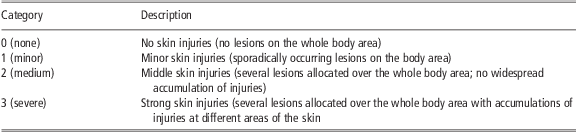
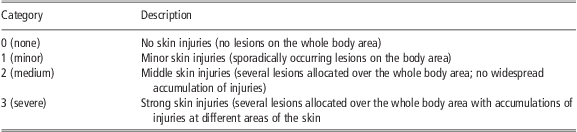
Lesions of the integument were assessed by one observer for the snout, shoulders, ears and flanks separately (McGlone, Reference McGlone1985) at weaning (LS 1) and 48 h after weaning (LS 2). The lesion scores include four categories of injuries: none, minor, medium and severe lesions of the integument, referring to Stukenborg et al. (Reference Stukenborg, Traulsen, Puppe, Presuhn and Krieter2011; Table 1).
Description of the lesion score categories for skin injuries at snout and shoulders at weaning and 48 h after weaning (Stukenborg et al., Reference Stukenborg, Traulsen, Puppe, Presuhn and Krieter2011)
Statistical analysis
The statistical analysis of the recorded traits was conducted with the SAS® statistical software package (SAS® Institute Inc., 2008). The model for BW gain was designed with the fixed effects batch, housing system, sex, weaning weight and week. The batch was subdivided into three classes (1, 2 and 3). The housing system was given the categories GH, SH, sex involved female and castrated pigs, weaning weight had three classes with average weights of 6, 8 and 10 kg per pen. The week (1, 2, 3 and 7) was included as linear, quadratic regression. The fixed effects were tested for significance with the procedure MIXED in SAS® (SAS® Institute Inc., 2008). Fixed effects were added to the model, stepwise, Maximum Likelihood (ML) was used to test the different models. Interactions between the fixed effects had no significant effect and were excluded. Comparison of the different models were performed with the fit statistic Akaike's information criteria corrected (AICC; Hurvich and Tsai, Reference Hurvich and Tsai1989) and the Baysian information criteria (BIC; Schwarz, Reference Schwarz1978). The smallest values of AICC and BIC were preferred (Littell et al., Reference Littell, Milliken, Stroup, Wolfinger and Schabenberger2006) without making a statement about the underlying significance. The final model for BW contained the fixed effects batch, housing system, weaning weight and week as linear, quadratic regression nested within housing systems and the random effect of the pig. The error covariance was modeled due to the fact that repeated measurements within the growing period were assumed to contain autocorrelated repeated measures. The covariance of the residual term was modeled with the spatial (exponential) structure (sp(exp); Littell et al., Reference Littell, Milliken, Stroup, Wolfinger and Schabenberger2006). The significance of differences in the least square means was adjusted with the Bonferroni correction. The analysis of FCR was based on 20 observations in total. Because of this fact the model was reduced to the fixed effects housing system and weaning weight. The analysis of the agonistic patterns used the pen as the observation unit as the pigs had no individual marks on their backs. FD per pen and hour was not normally distributed. In consequence, an approximated normal distribution was obtained after log-transformation. The NF per pen and hour was measured as count data. A linear model with Poisson distribution, log link function and overdispersion was fitted to these data using the procedure GENMOD (Minkenberg, Reference Minkenberg2009). Back transformations of values were performed when the least square means were presented. The final models for the NF and FD contained the fixed effects batch, housing system, weaning weight and hour (1, …, 40). The model of FD was added with the interaction between housing system and weaning weight class. The lesion scores were evaluated as the difference (LSD) between LS 2 and LS 1. No changes in the lesion scores were documented with LSD = 0. A negative LSD (LSD < 0) represented fewer skin lesions 48 h after weaning in relation to weaning, whereas LSD > 0 represented more new skin lesions 48 h after weaning compared with weaning. The Wilcoxon rank-sum test in the procedure NPAR1WAY (SAS® Institute Inc., 2008), was used to identify significant differences in the intensity of new skin lesion at the snouts and at the shoulders of weaned pigs, which were reared in group and single farrowing systems. The LSD was not obviously influenced by the weaning weight class.
Results
Growth performance and FCR
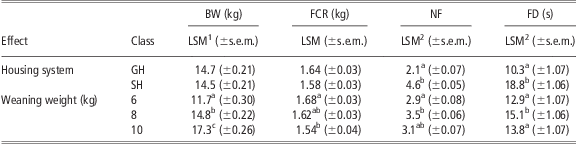
The effect of the batch was significant and resulted in reduced growth performance in Batch 2 (Batch 1: 15.1 kg (s.e.m.: 0.23), Batch 2: 14.1 kg (s.e.m.: 0.32), Batch 3: 14.6 kg (s.e.m.: 0.23)). The BWs of weaned GH- and SH-pigs during the rearing period did not differ significantly (Figure 1; Table 2). The results of the linear, quadratic regression of the weaning weights of GH- and SH-pigs were similar (GH: 7.8 kg v. SH: 7.7 kg). During the whole rearing period, the increasing curves of the BWs for GH- and SH-pigs strayed without obvious differences. In week 7, GH-pigs weighed 29.4 kg and SH-pigs had a BW of 28.6 kg (P > 0.05). The effect of the weaning weight classes (6, 8 and 10 kg) was significant (Table 2). Heavy pigs had the highest BW during rearing with 17.3 kg (s.e.m.: 0.26) in comparison to light pigs with 11.7 kg (s.e.m.: 0.03) and medium pigs with 14.8 kg (s.e.m.: 0.22). The interaction between the housing system and weaning weight class did not affect the BW during rearing. The FCR per pen tended (P = 0.097) to be higher for the GH-pigs in relation to the SH-pigs (Table 2). A significant influence for FCR was detected between pigs with weaning weights of 6 and 10 kg. Pigs with weaning weights of 8 kg were not different from light and heavy pigs, respectively.
Least square means of the linear, quadratic growth development of weaned pigs from group or single housing system (GH, SH) during rearing.

LSM and s.e.m. of BWs, FCR, NF and FD per pen and hour of weaned pigs during rearing depended on housing conditions (GH and SH) and weaning weight classes (light, medium and heavy)
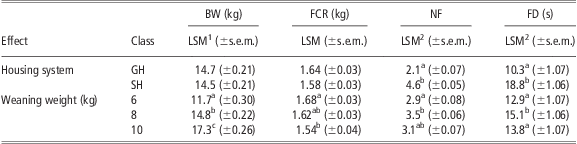
LSM = least square means; s.e.m. = standard error of means; BWs = body weights; FCR = feed conversion ratio; NF = number of fights; FD = fight duration; GH = group housing; SH = single housing.
1Values with different letters differ significantly (P < 0.05).
2Different letters of back-transformed values refer to log-transformed values.
FD and NF
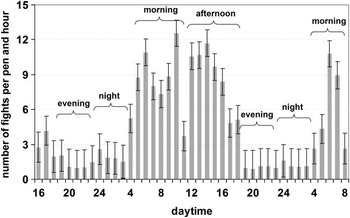
Agonistic behavior depended on the time of day. The least square means of NF for the observation period showed a bimodal circadian of the day (Figure 2). This trend started at the day of weaning and continued until the end of the observation period. Activity times with more than nine fights per pen and hour were recognized in the morning and in the afternoon. Periods with less than three fights per pen and hour occurred during the evening and night. The batch did not affect the agonistic behavior, whereas the farrowing system did have an influence on the FD and the NF. The GH-pigs fought significantly (P < 0.05) less with 2.1 fights per pen and hour (s.e.m.: 0.07) compared with the SH-pigs with 4.6 fights per pen and hour (s.e.m.: 0.05; Table 2). Light pigs fought significantly less compared with medium pigs, while heavy pigs were not different with P > 0.05, respectively. Furthermore, a FD was recorded at 10.3 s per pen and hour (s.e.m.: 1.07) for the GH-pigs and was significantly (P < 0.05) shorter than for the SH-pigs with an FD lasting 18.8 s per pen and hour (s.e.m.: 1.06). The weaning weight class influenced the FD per pen and hour and medium pigs fought for a significantly longer period in comparison to light and heavy pigs.
Least square means and standard error of the means of the number of fights per pen and hour in the observed 40 h after weaning for pigs from group and single housing system.

LSD
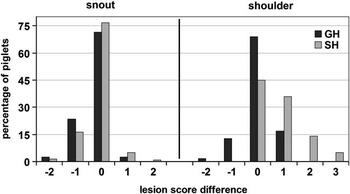
In total, 71.4% of the snouts of the GH-pigs and 76.6% of the SH-pigs were assessed with no changes (Figure 3). Healing of the snout injuries (LSD classes −2 and −1) was observed with 26% for the GH-pigs and 17.7% for the SH-pigs. New lesions at the snout occurred marginally (GH: 2.5% and SH: 5.7%). The LSD of the snouts of the GH- and SH-pigs was not significantly different (P > 0.05). The developments of scratches at ears and flanks between GH- and SH-pigs were comparable with the LSD classes of the shoulders. However, the greatest number of lesions occurred at the shoulders. After weaning, the shoulders of the GH-pigs had significantly lower values (P < 0.05) for the LSD compared with the shoulders of SH-pigs. The pigs in GH had more observations for healing shoulders lesions with LSD classes −2 and −1 (14.3% v. 0% SH-pigs; Figure 3). No changes of the integument were recognized for 68.9% of the GH-pigs v. 45.4% of the SH-pigs. In consequence, the amount of observations for LSD in class 1 was lower for the GH-pigs (16.8%) compared with the SH-pigs (34.5%). The worst lesions at the shoulders were documented only for the SH-pigs with 14.3% in LSD class 2 and 5.9% in class 3.
Percentage of lesion score difference (lesion score 48 h after weaning minus lesion score at weaning) at the snout and shoulders between weaning and 48 h after weaning of pigs from group and single farrowing system (GH, SH).

Discussion
Growth performance and FCR
In the present study, piglets were mixed 5 days p.p. and had no significant differences from unmixed piglets concerning their BWs at weaning or after the rearing period. The time of mixing the piglets could be one influencing factor. Lactating sows and their piglets in a semi-natural environment return to the sounder on average 10 days p.p. (Jensen and Redbo, Reference Jensen and Redbo1987). However, Rantzer et al. (Reference Rantzer, Svendson and Westroem1997) compared GH-pigs, which were first mixed on day 7 p.p., with SH-pigs, which were not mixed during lactation and rearing. These GH-pigs had a lower growth rate (P < 0.05) with 152 g per day in relation to the SH-pigs with 181 g per day after 4 weeks of rearing. In contrast, Hessel et al. (Reference Hessel, Reiners and Van den Weghe2006), Kutzer et al. (Reference Kutzer, Bünger, Kjaer and Schrader2009) and Reiners (Reference Reiners2009) mixed SH-piglets from three different litters together from day 10 or 12 p.p. Hessel et al. (Reference Hessel, Reiners and Van den Weghe2006) and Reiners (Reference Reiners2009) detected that mixed SH-piglets had a significantly increased weight gain (P < 0.05) of 1 kg during a rearing period of 5 weeks compared with those initially mixed at weaning. In addition, Kutzer et al. (Reference Kutzer, Bünger, Kjaer and Schrader2009) included a GH system in their study and detected significantly higher BWs for GH-pigs (23.8 kg) after a rearing period of 5 weeks compared with SH-pigs (21.0 kg) and mixed SH-pigs (21.8 kg). Furthermore, Rantzer et al. (Reference Rantzer, Svendson and Westroem1997), Hessel et al. (Reference Hessel, Reiners and Van den Weghe2006) and Kutzer et al. (Reference Kutzer, Bünger, Kjaer and Schrader2009) did not assess different weaning weights (P > 0.05) of GH-, mixed SH- and SH-pigs. Therefore, mixing piglets during lactation may have no effect on weaning weights but affect the weight performance during rearing. Mixing piglets on day 5 p.p. had no significant effect on their weight performance during rearing, whereas other studies suggest that mixing between day 10 and 12 p.p. increases weight gain during rearing.
BWs and FCR during rearing in the present study also depended on the weaning weights (light, medium, heavy). Bruininx et al. (Reference Bruininx, van den Peet-Schwering, Schrama, Vereijken, Vesseur, Everts, den Hartog and Beynen2001) assessed a significantly higher daily weight gain of 345 g for heavy pigs (weaning weight: 9.3 kg) in comparison to 298 g for light pigs (weaning weight: 6.7 kg) between the 14th and the 35th day in the rearing pen. Likewise McConnell et al. (Reference McConnell, Eargle and Waldorf1987) suggested that the daily gain of light pigs (3.6 kg) with 136 g v. heavy pigs (6.4 kg) with 233 g differed significantly (P < 0.05) during 28 days of rearing. In conclusion, the GH- and SH-pigs in the present study had similar BWs at weaning and after rearing, but their weaning weight affected their BW during rearing.
FD and NF
A bimodal circadian rhythm was observed for the NF and confirmed the statement of Stukenborg et al. (Reference Stukenborg, Traulsen, Puppe, Presuhn and Krieter2011). However, in contrast to Stukenborg et al. (Reference Stukenborg, Traulsen, Puppe, Presuhn and Krieter2011), different peaks during the activity time in the morning were detected in our study. The reason could be seen in the feeding pause between 2200 and 0600 h, whereas pigs in the study of Stukenborg et al. (Reference Stukenborg, Traulsen, Puppe, Presuhn and Krieter2011) were fed ad libitum all day long. Thus, it seems that feed should not be limited to reduce conflicts over the resources of pigs. In the present study, the group farrowing system reduced the NF per pen and hour and shortened FD of the pigs immediately after weaning. Mixing pigs during lactation reduced fighting after weaning because new hierarchies did not need to be established (Friend et al., Reference Friend, Knabe and Tanskley1983; Pitts et al., Reference Pitts, Weary, Pajor and Fraser2000; Weary et al., Reference Weary, Pajor, Bonenfant, Fraser and Kramer2002). Likewise, Hessel et al. (Reference Hessel, Reiners and Van den Weghe2006) and Reiners (Reference Reiners2009) determined lower rates of agonistic behavior after weaning between SH-pigs commingled 48 h before weaning, compared with SH-pigs mixed at weaning (P < 0.05). Simultaneously, imposing stressors such as a new environment, separation from the dam, changes in diet and mixing non-littermates accentuated the distress response at weaning (Hessel et al., Reference Hessel, Reiners and Van den Weghe2006; Pluske, Reference Pluske2006). These stress factors were disentangled for the GH-pigs in the present study since agonistic behavior between unacquainted GH-pigs had already occurred during lactation.
Furthermore, Li and Wang (Reference Li and Wang2011) reported on similar results with 1.5 fight per hour for GH-pigs v. 3.8 fights per hour for SH-pigs (FD: GH, 4.5 s v. SH, 18.3 s). In contrast to the present study, Li and Wang (Reference Li and Wang2011) mixed familiar and unfamiliar GH- or SH-pigs from different groups into pens with nine pigs each at an age of 8 weeks. The authors concluded that pigs originated from GH were less aggressive and more tolerant to unfamiliar pigs compared with pigs from SH due to the pig's experience of a large social group during lactation.
In this study, weaning weights also seemed to influence agonistic behavior. A fewer NF per hour in pens with light pigs and the longest FDs per hour in pens with medium pigs were detected. Li and Johnston (Reference Li and Johnston2009), however, observed that different BWs at weaning did not affect behavior in familiar groups but increased aggression-induced injuries in unfamiliar groups. Finally, mixing unacquainted litters during lactation is effective in decreasing agonistic behavior and skin lesions immediately after weaning. The interaction between the farrowing environment and the weaning weight category did not affect the growth performance and the numbers of fights.
LSD
In general, the intensity of skin lesions is said to depend on the body area, and the front of the body is the most stressed region in all age groups (McGlone, Reference McGlone1985; D'Eath, Reference D'Eath2005; Stukenborg et al., Reference Stukenborg, Traulsen, Puppe, Presuhn and Krieter2011). This could be confirmed by the results of the present study. More skin lesions were observed on the shoulders of the GH-pigs before weaning in comparison to the SH-pigs. In contrast, the GH-pigs had fewer new scratches after weaning. These results are in accordance with the findings of NF and FD. GH-pigs fought less compared with SH-pigs, which resulted in fewer skin lesions after weaning. Rantzer et al. (Reference Rantzer, Svendson and Westroem1997) and Parratt et al. (Reference Parratt, Chapmann, Turner, Jones, Mendl and Miller2006) verified less of agonistic patterns in the pens with GH-pigs. Andersen et al. (Reference Andersen, Nævdal, Bakken and Bøe K2004) added that unacquainted pigs in groups of six and 12 pigs fought significantly less compared with pigs in groups of 24. It would be interesting to discover whether SH-pigs in groups of 24 (or more) also had a significantly greater fight activity compared with GH-pigs. The LSD could be used as a less expensive and time-saving parameter to determine the intensity of agonistic behavior of weaned pigs compared with the effort of videotapes.
Conclusion
The present finding suggests that mixing piglets in a GH system (5 days p.p.) has no influence on growth performance at weaning or after rearing compared with piglets from single pens with crates, however, BW is significantly affected by weaning weights (light, medium, heavy). The interaction between weaning weight classes and the farrowing environment had no influence on the weight performance or the NF. Keeping lactating sows and their piglets in groups can be said to improve the animal welfare of weaned pigs due to the reduced NF and shorter FDs, which result in fewer skin lesions during the first 2 days after weaning.
Acknowledgments
This work was financially supported by the German Federal Ministry of Food, Agriculture and Consumer Protection (BMELV) through the Federal Agency for Agriculture and Nutrition (BLE), grant number 2807UM005.