INTRODUCTION
Acute behavioural disturbance is common in acute psychiatric inpatient units and can occur in the context of psychiatric illness, physical illness, substance misuse or personality disorder. There are also disturbances that can arise from situations associated with institutional and shared living arrangements in psychiatric hospitals. Such behaviour can pose a danger to the patient and others. Recourse to rapid tranquilization (RT) is necessary when appropriate psychological and behavioural approaches to de-escalate behaviour have failed. Though often used in an inpatient setting it is, essentially, a treatment of last resort (Taylor et al. Reference Taylor, Paton and Kerwin2007).
RT is the use of medication to calm or lightly sedate the service user, reduce the risk to self and/or others and achieve an optimal reduction in agitation and aggression (NICE, 2005).
Although not the overt intention, it is recognized that in attempting to calm or lightly sedate the service user, RT may lead to deep sedation or anaesthesia. For this reason it is important that it is used in line with evidence based practice and with due regard to possible physical consequences to the patient. To this end the 2gether NHS Foundation Trust’s RT policy is based on NICE guidance which includes standards for pharmacological intervention (standards 1–6), required physical observations following RT being given (standard 7) and environmental considerations (standard 8).
AIM AND METHODOLOGY
The aim of this audit was to scrutinize clinical practice in the 2gether NHS Foundation Trust with reference to the trust’s RT policy, and use this audit as a tool to optimize best practice.
Participants
No register is held in the hospital of RT incidents alone; indeed in can be very subjective as to when giving an agitated patient prn medication (medication given if necessary) can be considered ‘RT’. The authors therefore decided that the best way to get a sample of patients who had needed ‘proper’ RT was to look at PMVA (Prevention and Management of Violence and Aggression) incidents. These are situations in which more often than not RT is going to be used.
The authors sampled 50 successive PMVA incidents that occurred at all the acute psychiatry wards (66 beds) for adults of working age including the PICU (10 beds) at Wotton Lawn Hospital and Montpellier Low Secure Unit (12 beds) in Gloucester over a four month period between 21.10.2008 and 23.02.2009.
Data collection
Two authors scrutinized the patient notes and collected data using an audit proforma (see Appendix 1 at http://journals.cambridge.org/jpi).
RESULTS
There were 50 PMVA incidents involving 25 individual patients.
The authors could not locate the notes of three patients and the record for a fourth patient was incomplete, and hence 46 PMVA incidents were reviewed. In 40 PMVA incidents some form of RT was given (87%).
Patient demographics
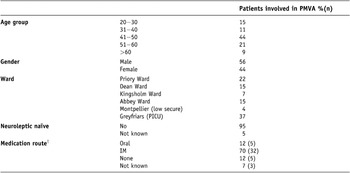
Data were collected on the demographics of the study group and are shown in Table 1. Most of the patients involved in PMVA episodes were in the age range 41–50 years (44%). There were similar numbers of males and females. The incidents occurred on a number of wards: Priory, Dean, Kingsholm and Abbey wards are acute psychiatry wards for adults of working age. Montpellier is a low secure inpatient unit for recovery and rehabilitation of male patients of working age whose psychiatric conditions require treatment in conditions of security, and aims to move patients on to independent living with a better quality of life. Greyfriars is a psychiatric intensive care unit. There were no recorded instances of neuroleptic-naïve patients involved in PMVA episodes. In the majority of episodes where RT was given, medication was administered intramuscularly (32, 80%).
Percentages of patients involved in PMVA incidents according to demographics (N=46)*

*Due to rounding up or down, numbers may not add up to 100%; where the totals for the analysis are less than the total sample i.e. 46, there was missing data, i.e. no response.
†Medication data missing for 1 event
The primary diagnosis by ICD-10 code was recorded (number of PMVA incidents in parenthesis):
• F20–F29 Schizophrenia, schizotypal and delusional disorders (22) 48%
• F31 Bi-polar affective disorder (13) 28%
• F99 Unspecified mental disorder (5) 11%
• F84.5 Asperger’s syndrome (2), 4%
Other diagnoses included: borderline learning difficuties (2) 4%, borderline personality disorder (2) 4%, chronic adjustment syndrome (2) 4%.
AUDIT CRITERIA
The data gathered was assessed with reference to the 2gether NHS Foundation Trust Guidelines for the Management of Violence & Disturbed Behaviour in Relation to In-patients, produced in November 2008.
Audit criterion 1
Patients accepting oral medications should be given Lorazepam 2–4 mg with or without the following antipsychotics:
(a) Haloperidol 5–10 mg, or
(b) Olanzapine velotab 10 mg, or
(c) Risperidone liquid or quicklet 1–2 mg
100% (5) of RT episodes in the audit sample were compliant as all 5 patients who accepted oral medications were administered medications as per this criterion.
Audit criterion 2
Patients refusing oral medications should be given the following antipsychotics intramuscularly with or without Lorazepam 1–4 mg intramuscularly:
(a) Olanzapine 10 mg, or
(b) Haloperidol 5–10 mg.
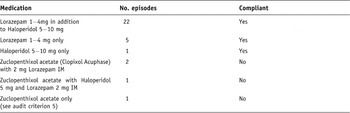
88% (28 out of 32 episodes in which IM medication was administered) of RT episodes in the audit sample, where patients refused oral RT, were compliant with this criterion as shown below in Table 2.
Medications administered in RT episodes where patients refused oral RT

Audit criterion 3
Each patient could be administered up to 3 doses of the medications recommended for use in RT but there should be an interval of 45 minutes between each administration.
All RT episodes in the audit sample were compliant with this criterion.
Audit criterion 4
Parenteral benzodiazepine should not be administered until at least 1 hour after parenteral administration of Olanzapine.
All RT episodes in the audit sample compliant with this criterion.
Audit criterion 5
Zuclopenthixol acetate (Clopixol Acuphase) should not be used for RT.
85% (34) RT episodes in the audit sample compliant with this criterion. Zuclopenthixol acetate (Clopixol Acuphase) was administered in 6 (15%, n = 40) episodes of PMVA. Two of these were planned administrations of the drug. In two episodes, patients were given Zuclopenthixol acetate (Clopixol Acuphase) with 2 mg of Lorazepam (IM). In one episode, a patient received Zuclopenthixol acetate (Clopixol Acuphase), 2 mg Lorazepam IM plus 5 mg Haloperidol. In one other episode the patient was given Zuclopenthixol acetate (Clopixol Acuphase), but the prescription chart could not be found and it is therefore not known whether other medications were administered at this time.
Audit criterion 6
If a patient does not respond to the previous treatment regimes then second line RT has to be authorized by a consultant psychiatrist. This includes the following:
(a) Diazepam up to 10 mg by slow injection (1mg/1minute), which can be repeated up to a maximum of 3 times at 10 minute intervals until adequate response.
(b) Amylobarbitone up to 250 mg intramuscularly as a single dose.
(c) Paraldehyde 5–10 ml intramuscularly as a single dose.
(d) Electroconvulsive treatment (ECT) daily up to 3 days.
All 40 RT episodes were compliant with this criterion because none of the RT episodes in the audit sample involved second line RT.
Audit criterion 7
Physical observations: If the patient is ambulatory, temperature, pulse, blood pressure and respiratory rate should be recorded every four hours. A visual check of respiratory rate, ease of breathing, skin colour and evidence of dystonias or other significant side effects should be made every 10 minutes for the first 4 hours after the RT has been administered. A nurse must be present by the side of an unconscious patient at all times and these checks made every 15 minutes until the patient is ambulatory.
All patients involved in PMVA incidents must have a medical (physical) examination by a doctor within 24 hours. This usually involves a full physical examination including all systems and examination for possible injuries that may occur during the PMVA incident. If the patient refuses an examination a clear entry must be made in the health record stating why the examination did not take place and further attempts to complete the examination must be made on at least a daily basis.
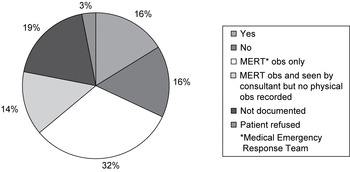
16% (6) of RT episodes in the audit sample were compliant with this criterion as detailed in Figure 1.
Physical observations (n=37)

Audit criterion 8
Private location: RT is likely to be distressing for the patient involved and for other patients, visitors and relatives to witness. Every reasonable effort should be made to ensure that RT is delivered in a private area of the ward where maximum attention can be paid to the dignity of the individual.
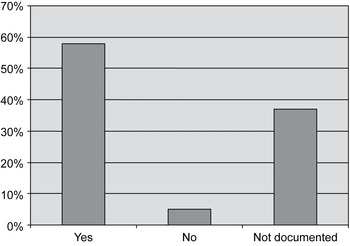
58% (23) RT episodes had evidence to demonstrate compliance with this criterion as shown in Figure 2.
RT administered in a private location

DISCUSSION
In 6 episodes (15%) Zuclopenthixol acetate (Clopixol acuphase) was administered during a RT incident. Of these, 2 episodes were planned administration of Zuclopenthixol acetate but PMVA procedure had to be followed due to the patient’s refusal/reluctance to accept it. It could be argued that these episodes were not RT within the definition used.
There was no documentary evidence on whether PMVA procedure was followed for planned administration of Zuclopenthixol acetate in the other 4 episodes or whether it was administered for RT. One reason for believing that it may have been administered for RT was that the patients were very behaviourally disturbed just before administration of this medication. These episodes were included as RT in the absence of definitive evidence that it was planned administration. It is therefore significant that, at least by the measures that could reasonably be applied to an audit, Zuclopenthixol acetate could have been used in the RT context. This suggests that where treatment is being given in the absence of consent on a planned basis, the characteristics of this needs to be clearly recorded. Moreover, this could illustrate some of the difficulties in conclusively defining RT and separating this from other episodes of enforced treatment within any RT policy.
The audit also suggested that there may have been a very low number of patients (16%) having had the appropriate and adequate physical observations after a RT incident. In 46% of the sample, there was documentary evidence of a MERT (Medical Emergency Response Team) assessment (which includes physical observations) during the process of PMVA but not afterwards. Usually the following were checked: blood pressure, pulse and oxygen saturation using pulse oximetry. Often disturbed patients refuse physical observations following an RT incident and it may well be that such events weren’t recorded in the notes. Also, some patients may not appreciate frequent physical observations and may become hostile and agitated when they are attempted. In such situations, it may be a clinical decision not to carry out physical observations as frequently as required by RT policy in the patient’s best interest although there should be documentary evidence in the notes of this.
All clinical staff in the inpatient units should be made aware of the RT policy and the importance of documenting appropriate and adequate physical observations following an RT incident and any departures from the policy. In the case of this audit, such areas would include the physical examination within 24 hours of all those subject to PMVA and general observations following an RT episode.
There was evidence that 58% of the patients had RT in a private location. Sometimes, it may be difficult to remove a patient to a private area for RT due to very disturbed behaviour or the patient’s refusal to do so. It may also be the case that the location of RT wasn’t documented in the notes for incidents that were actually done in a private location.
If a patient cannot be removed to a private area for the purpose of administering RT then attempts should be made to remove other patients from the area where it is administered and this should be documented in the notes.
This issue may also highlight an important area of RT practice which may not often be covered in the RT policies. Implementing RT can often involve restraint techniques and be very distressing for all those involved. Non medical considerations, for example the location within a ward that the RT is administered or the gender of the staff implementing restraint should also be considered important components of any RT policy.
Overall this audit could suggest need for further developments in two areas of practice. Firstly there is a need for clear definitions of RT, in particular differentiating RT from other episodes requiring the enforcement of medication. Secondly, the importance of physical observations to be implemented or clear rationale to be documented for when this is considered inappropriate.
CONCLUSION
This audit looked at a very important aspect of managing behaviourally disturbed patients in acute psychiatric inpatient wards for adults of working age and a low secure unit for recovery and rehabilitation in the 2gether NHS Foundation Trust. It showed a high compliance rate with all standards for medication administration during RT but the compliance rates for two standards (administration of RT in a private location and adequate physical observations of patients following RT) were very low (58% and 16 % respectively). The authors believe there could be a number of reasons for this including: difficulty in removing very aggressive or violent patients to a private area, patients’ refusal of physical observations, team decision to do less frequent physical observations on hostile patients, and lack of contemporaneous documentation. The authors presented the audit findings to medical colleagues in the trust and the report has been disseminated to the Trust Clinical Governance Committee, appropriate clinical leads and trainers, for action on the recommendations. This audit will be repeated in 12 months’ time.
DECLARATION
The authors have been granted permission by the 2gether NHS Foundation Trust Audit Department and local Research and Development Support Unit to submit this audit report for publication in peer reviewed journals. The authors also wish to declare that this is not a research project because it did not look at any new intervention and it is also not a service development project because it only compared current clinical practice against agreed standards for best practice and made recommendations to optimize compliance with these standards.