Based on evolutionary and cultural psychological perspectives for a broader understanding of facial expressions of emotion, it is reasonable to assume the existence of facial expressions associated to basic emotions, which have evolved for certain functional and adaptive reasons. The smile, as one of these facial expressions, is a universal display (Darwin, Reference Darwin1872; Ekman, Reference Ekman1992) that can be seen as having an adaptive value, probably serving a social function, since it generally signals positive engagement in a social interaction (Bowlby, Reference Bowlby1969). According to Mehu, Little, and Dunbar (Reference Mehu, Little and Dunbar2008), smiling positively affects the perception of personality traits in adulthood in a way that could be adaptive to the sender of the signal and is essential in order to be part of the social environment.
Smiling is generally observed in many different contexts as a signal of deference, appeasement, and friendliness (Goldenthal, Johnston, & Kraut, Reference Goldenthal, Johnston and Kraut1981; Mehu et al., Reference Mehu, Little and Dunbar2008), and has been linked to a variety of positive social consequences, including parental care (Lavelli & Fogel, Reference Lavelli and Fogel2005; Mendes & Pessôa, Reference Mendes, Pessôa and Seidl-de-Moura2013; Messinger, Fogel, & Dickson, Reference Messinger, Fogel and Dickson1999). In this sense, it can be considered a behavioral predisposition individuals have as members of our species. However, its basic pattern is improved and perfected by experience, throughout development, and based on the culture’s beliefs and codes (Keller & Otto, Reference Keller and Otto2009).
Emotional expressions are evolutionary solutions contextually sensitive, so that locally defined competencies result in a pattern adaptive to the context (Dezecache, Mercier, & Scott-Phillips, Reference Dezecache, Mercier and Scott-Phillips2013). In line with these considerations, in order to increase knowledge about smiling in the early stages of life, it is necessary to take into account the cultural environment in which infants’ development take place, their developmental niche (Harkness & Super, Reference Harkness and Super1996), with special attention to their early social interactions, as well as to mother-infant affective interchanges.
In interactions with their mothers newborns observe and mimic their facial expressions (Holodynski & Friedlmeier, Reference Holodynski and Friedlmeier2006). Caregivers, on the other hand, monitor, imitate and emphasize their infants’ emotional displays, leading babies to develop fine-tuned emotional expressions (Gergely & Watson, Reference Gergely, Watson and Rochat1999). Emotional development progresses and the ability to express emotions is enhanced through these interactional dynamics (Wörmann, Holodynski, Kärtner, & Keller, Reference Wörmann, Holodynski, Kärtner and Keller2012). This is the cradle for the development of social smiling in infants (Kärtner, Holodynski, & Wörmann, Reference Kärtner, Holodynski and Wörmann2013).
Babies’ smiles are considered an index of their cognitive, social and emotional development (Fogel, Hsu, Shapiro, Nelson-Goens, & Secrist, Reference Fogel, Hsu, Shapiro, Nelson-Goens and Secrist2006; Messinger, Cassel, Acosta, Ambadar, & Cohn, Reference Messinger, Cassel, Acosta, Ambadar and Cohn2008), being manifested with different morphologies and displaying different types and levels of positive emotions (Fogel, Nelson-Goens, & Hsu, Reference Fogel, Nelson-Goens and Hsu2000; Messinger, Fogel, & Dickson, Reference Messinger, Fogel and Dickson2001). These last two cited studies defined four different types of smiles based on co-occurrences of infant facial units: simple smile (without cheek raising or mouth opening), Duchenne smile (with cheek raising), play smile (with open mouth) and duplay smile (with cheek raising and open mouth). They verified that smiling can reflect different positive emotions depending on co-occurring facial actions and the dynamics of the social process during mother-infant interactions and games.
Nowadays it is known that relevant qualitative and quantitative changes occur in the smile ontogenesis at around two months of age. At that time, social smile (smiling elicited by the human face - Lavelli & Fogel, Reference Lavelli and Fogel2005; Messinger et al., Reference Messinger, Fogel and Dickson2001) emerges, and the frequency of smiles increases. These social smiles may present any of the above defined morphologies. In contrast, according to Messinger et al. (Reference Messinger, Cassel, Acosta, Ambadar and Cohn2008), we still know little how early smiles unfold in time, and the features of early smiles that communicate positive affective intensity. It is assumed, however, that infants’ smiling, more than communicating positive engagement and joy, promotes affiliative interaction and positive emotional responses from people around them (Fogel et al., Reference Fogel, Nelson-Goens and Hsu2000).
The emotional involvement of mothers and their babies has been a subject of investigation for many researchers in recent years, with some studies focusing on babies’ smiles during the dyadic exchanges (Lavelli & Fogel, Reference Lavelli and Fogel2002, Reference Lavelli and Fogel2005; Mendes, Seidl-de-Moura & Siqueira, Reference Mendes, Seidl-de-Moura and Siqueira2009; Messinger, Mattson, Mahoor, & Cohn, Reference Messinger, Mattson, Mahoor and Cohn2012; Seidl-de-Moura et al., Reference Seidl-de-Moura, Ribas, Seabra, Pessôa, Nogueira, Mendes and Vicente2008). During mother-infant interactions, in the second and third months of life, babies’ smiles become progressively associated to maternal speeches and mothers’ smiles (Lavelli & Fogel, Reference Lavelli and Fogel2002). Infants temporally coordinate communicative actions and provide evidence that facial expressions, particularly smiles, are central to early infant communications and affective exchanges. The ability to coordinate expressive behaviors is crucial to the development of social and emotional communication (Lin & Green, Reference Lin and Green2009; Yale, Messinger, Cobo-Lewis, & Delgado, Reference Yale, Messinger, Cobo-Lewis and Delgado2003). It is evident babies’ ability to react to their mothers’ behaviors and facial expressions, as well as to organize their behavior according to the behavior of the person with whom they interact.
As observed by Mendes et al. (Reference Mendes, Seidl-de-Moura and Siqueira2009), since the second month postpartum, infants can answer contingently, with smiles, to mothers’ affective behaviors (smiles, kisses, affective touches, and maternal speech/vocalizations directed to the infant). In this longitudinal research, two babies (one girl and one boy) were accompanied weekly during their first six months of life, offering data on the ontogeny of smile in the early months of development. It was observed that each baby had a particular tendency to smile, with smiles of one or two predominant types, displaying little modification with the passage of time. It was also verified a positive linear trajectory tendency for the babies’ smiles, signaling a clear increase in frequency over time during the study period.
The authors mentioned above emphasize the relevance of mothers’ affective engagement for the development of children’s emotional expression. Their results indicated a high contingency index between babies and mothers’ smiles from, at least, the second month postpartum. In addition to mothers’ smiles, their kisses, affective touches and speech/vocalizations also elicited contingent smiles in their babies. In relation to developmental trajectories, this study has shown that from two months after birth a variety of combinations of contingent behaviors (babies’ smiles and maternal affection behaviors) was exhibited. Taken together, these evidences present some features of the ontogeny of child smiling and a strong association between the smiles of babies and their mothers’ affective behaviors.
Bigelow and Rochat (Reference Bigelow and Rochat2006) investigated levels of social contingency in young infants and reported that they presented contingent responsiveness for smiles and vocalizations, while attending to the partner present in their maternal interactions. The authors discussed that familiar contingency levels are embedded in mother-infant routines in face-to-face interactions that become established over the infants’ first months of life, particularly when they are two-months-old, when infants’ interest in face-to-face interactions emerges.
Kärtner, Keller, and Yovsi (Reference Kärtner, Keller and Yovsi2010) argued, however, that it is during the 2nd and 3rd months of life that culture-specific differences in the modal patterns of contingent responsiveness emerge. They studied mother-infant interactions in the Nso (Cameroon) and Münster contexts, and interpreted this differential development as the result of the interplay between maturational processes associated with the 2-month shift that are selectively integrated and reinforced in culture specific mother–infant interaction.
From a neuroscientific approach, Strathearn, Li, Fonagy, and Montague (Reference Strathearn, Li, Fonagy and Montague2008) examine the linkage between infants’ emotional expressions and mothers’ behaviors and reactions. They showed how mothers’ brains respond to their babies’ facial expressions, comparing facial expressions of joy, sadness and those considered emotionally neutral, displayed by both their babies and other children. Brain regions involved in reward processing associated with dopamine were activated when mothers saw the face of their children compared to the faces of unknown babies. These regions are involved with emotional, cognitive and motor processing, which suggests, according to the authors, an extensive activation of neural networks. However, only expressions of joy activated nigrostriatal brain regions interconnected by dopaminergic neurons. Additional analyses revealed that the activation of these regions was associated with babies’ positive affection.
Despite progress achieved in research, there is still much to be explored in relation to the ontogeny of smile, the meaning of its different morphological conformations, its role in mother-infant interactions, and in relation to intra and intercultural variations. Some studies show evidence about morphological features of infants’ smiles, their manifestation and changes in early stages, and about smiles taking part in sequence organized communicative expressions between mothers and infants. However, most of these studies are conducted in American or European contexts. Evidence found by Mendes et al. (Reference Mendes, Seidl-de-Moura and Siqueira2009) showed developmental changes in Brazilian babies smiling and intense associations between infants’ smiles and maternal affective behaviors, although in a small sample size. It seems necessary to investigate these contents in a relatively great sample from cultural diverse environments, such as these constituting the Majority World (an expression coined by Kagitçibasi, Reference Kagitçibasi2007), and not only in the WEIRD societies, as it is warned by Henrich, Heine, and Norenzayan (Reference Henrich, Heine and Norenzayan2010).
Thus, based on accumulated evidence and in a socio-cultural and evolutionary approach, we considered important to investigate patterns of babies’ smiles and of associations between mothers and infants’ affective behaviors in the urban context of Rio de Janeiro. It is a cosmopolitan city, in a Latin American country, and part of the Majority World. It was the country’s capital for two centuries (until the 1960’s), and receives migrants from several states, especially from the northeast of the country. Rio de Janeiro is the second largest city of Brazil (with a population of 6.429.923 inhabitants - according the Brazilian Census Bureau (IBGE, 2013) -, and an IDH of .730 – data from United Nations Development Program (UNDP, 2013).
The purpose of this study is to observe groups of babies aged 1, 2 and 5 months-old and their mothers and characterize the smiles of babies and the relationship between these facial expressions and maternal affective behaviors in these three moments of early development. In addition, this transversal research may allow to be made some inferences about a developmental sequence in the first months of life. This way, this study aims: (a) to investigate patterns of smiles’ display, and possible changes in these patterns comparing these three moments in early development; (b) to analyze patterns of association between babies’ smiles and their mothers’ affective behaviors, and (c) to assess whether babies smile contingently in response to maternal affective behavior, and whether we can identify patterns of responses based on the type of babies’ smiles.
Method
Participants
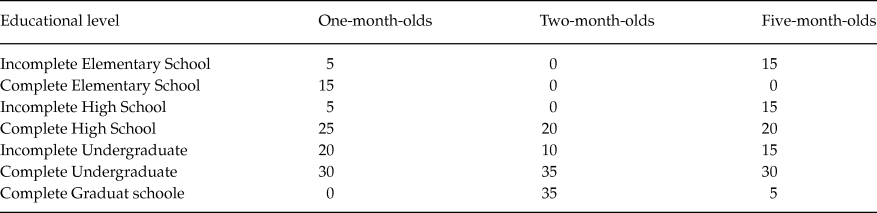
Participants were 60 Brazilian mother-infant dyads. The mothers lived with the babies’ fathers in the same household. Babies were considered healthy (through medical records and/or parents’ reports), and the result of an uneventful pregnancy. Three groups of babies at different stages in the initial development participated in the study. The first group consisted of one month-old infants, the second group was constituted by two months-old infants, and the third one had five months-old infants. Twenty dyads were selected for observation from each of the three stages of babies’ development defined. Some socio-demographic information is shown in Tables 1 and 2.
Distribution by sex of the baby and the mother’s age

Distribution by the mother’s educational level

Procedure
The study followed Brazilian regulations for research with Human Subjects and it was approved by the ethical committee of the University of the State of Rio de Janeiro.
Data collection
Part of the data was collected and another part was extracted from the authors’ database, as will be explained below.
Mothers of two months-old infants, whose babies were considered healthy, were invited to participate. Those who accepted were informed about the nature of the study, the confidentiality of information, the restricted use of the images recorded on video, and the voluntary character of their participation. The ones who agreed to participate signed an Informed Consent Form. Data was collected though observation in natural environment. The mother-infant dyads were visited once in their homes and observations were video recorded during 20 minutes. The observations preferably occurred at times when the baby was awake, and both were alone. Mothers were asked to behave and interact with their baby as much as possible in the usual way, ideally trying to act as if the observer was not present.
The images of the dyads with one and five months-old babies were extracted from the collection of images maintained by the authors. This data had been collected following a similar protocol as the one described above. For each one of these dyads, we randomly selected 10 minutes from the sequence of images available for future analyses. All mothers and babies were filmed using a portable manual camcorder (JVC Compact Vhs Gr-axm4).
Data Reduction - Coding
Maternal affective behaviors and babies’ smiles were coded according to categories defined in the literature. For each dyad, 10 minutes of observation were coded. For two months-old infants 10 minutes of the 20 minutes videotaped were selected randomly, while the others were not considered.
Video excerpts selected for analysis were seen from the beginning to the end to identify the desired behaviors (babies’ smiles and mothers’ predefined behaviors), according to the specified categories. These categories were based on recent studies. For babies’ smiles, the categories were based on definitions of Fogel et al. (Reference Fogel, Nelson-Goens and Hsu2000), Messinger et al. (Reference Messinger, Fogel and Dickson2001), and they are the same defined by Mendes et al. (Reference Mendes, Seidl-de-Moura and Siqueira2009). For mothers’ affective behaviors it was used a set of definitions proposed by Mendes et al. (Reference Mendes, Seidl-de-Moura and Siqueira2009) and Seidl-de-Moura et al. (Reference Seidl-de-Moura, Ribas, Seabra, Pessôa, Nogueira, Mendes and Vicente2008). The categories adopted were the following:
Babies’ smiles – there are four categories of smiles, different in their morphological features
They are classified depending on the combination of facial action units (AU), in accordance to FACS coding system. There is also one undefined category (5).
-
Simple (ss) – involves lip corner raise (only AU12 involved) that pulls the lips upward and toward the side of the face.
-
Duchenne (sd) – involves lip corner raise (AU12) and cheeks raise (AU6), with eyes constriction.
-
Ample (sa) – involves lip corner raise (AU12) and jaw drop (AU26/27).
-
Mixed (sm) – includes lip corner raise (AU12), jaw drop (AU26/27), and cheek raise (AU6).
-
Undefined (si) – unclassified smile as a result of visual limitation. Because of the naturalistic observational data and the low resolution of some images, undefined code was adopted when the type of infants’ smiles were not sufficiently clear.
Mother’s behaviors – four different kinds of affective behaviors have been selected for classification of mothers’ behaviors, in accordance with the objectives in this study
-
Smile (so) – smile directly addressed to the baby. For the purposes of this study, it was not necessary to identify the different types of mothers’ smiles. Any smile directly addressed to the baby, as well as eventual laughs were considered. The latter were coded even when not appearing in the video image, but when the sound was audible. Their durations were registered through the sound heard.
-
Speech/vocalization (fv) – all mother’s speech and vocalizations directly addressed to the baby (including sounds of toys, animals or vocal games) were considered. The following were excluded: mother’s speech addressed to other people, vegetative sounds like whispers, hiccups, belches, yawns, sneezes, coughs, tongue smacking, and whistling.
-
Affective touch (ta) – intentional touch of any part of the baby’s body with any part of the mother’s body, related to affective expressions, excluding daily activities related to the baby’s care (diaper changing, bathing, etc.) This category (ta) does not depend on the baby being in the mother’s arms or lap.
-
Kiss (be) – touching any part of his body with the lips. When the mother touches the baby with her lips or face, but not seeming like a clear kiss, the code adopted was (ta).
Data codification was based on the following two-component structure: (a) Component 1 – directed to the baby’s smiles, mutually exclusive behaviors and exhaustive codification; and (b) Component 2 – considering mother’s behaviors that are not mutually exclusive and the codification is not exhaustive.
Infants’ smiles and mothers’ affective behaviors were assessed during separate viewing by a trained coder (the first author), who is experienced in coding infant behaviors. For each part selected, the coder first viewed the tape and assessed the infant’s smiles continually in time. Then, the coder watched the videotape, pausing when a category changed, so she could record the smile category and the time displayed in the digital clock on the screen. Coding was done with mutually exclusive and exhaustive categories (the offset of the prior category is the onset of the succeeding category).
In the second viewing, the coder watched the tape until a defined category for mother’s behaviors was identified, without consultation to the previous coding of infant’s categories. For instance, if the mother started to caress the baby’s face, the coder would take note of the precise time (in minutes and seconds) when the behavior started and finished, and the behavior code. Obviously, simultaneous affective behaviors were possible and expected.
Reliability
Inter-rater reliability was calculated on a random sample of 20% of the observations (mother-infant dyads). Cohen’s Kappa, which measures agreement (correcting for random agreement) on the duration of all codes within a particular coding category, were calculated with a data-analysis pack, the GSW– Gseq for Windows (see Bakeman, Deckner, & Quera, Reference Bakeman, Deckner, Quera and Teti2005).
Reliability coder worked independently and was blind to the study’s hypotheses. The Kappa for the infants’ smile coding was .64, and the Kappa for the mothers’ behavior coding was .72, both considered acceptable mean values of reliability.
Data analysis
Durations for each target-behavior registered and the relative frequencies of behaviors (frequency/duration of observation) for each category were calculated and used in the analyses. Correlations between the target-behaviors were calculated. Descriptive statistics furnish global results for each group of dyads (one month-old infants, two months-old infants, and five months-old infants). To verify whether the relative frequencies of babies’ smiles differed among the three groups, ANOVAs with infants’ age as the between-subjects factor, and the relative frequencies of the infants’ smiles - considering both, the total of smiles and the amount of each type of smile - as variables of interest were carried out. As an exploratory analysis, using an Univariate General Linear Model (GLM), we compared the total of smiles for the three groups of infants (dependent variables), using their age as a factor and controlling for mothers’ age and educational level, and for the total of mothers’ affective behaviors. GSW was used in the contingency analysis between babies’ and mothers’ behaviors. Contingent analyses using Yule’s Q were conducted, considering a one-second latency window (the onset of mother’s behavior and the next second).
Results and discussion
Quantitative analyses were performed to achieve the three objectives of this study. Results and discussion will be presented for each objective, followed by a global discussion.
-
(a) The first objective was to investigate smiling patterns in three developmental moments in early infancy.
Descriptive statistics show that some patterns of exhibition were found for babies’ smiles, considering their frequency, duration, and morphology. Differences were also identified among the three distinct moments of development observed in this study, characterizing each of these moments.
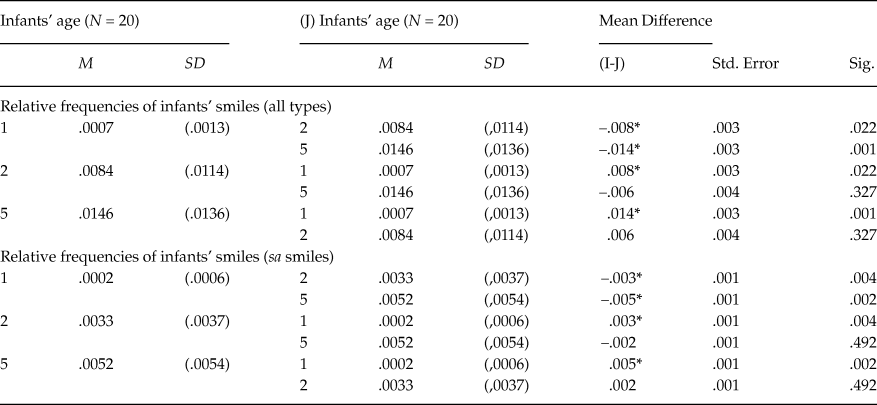
The amount of time the babies smiled throughout the observation indicated that one month-old infants smiled briefly. They smiled for a period of 15% of the observation time on average. Two months-old babies smiled for a period of almost 2% of the observation time, and five months-old babies smiled for a period of a little more than 3% of the observation time (see Table 3). In all these three groups, the means obtained were well below the reported by Messinger et al. (Reference Messinger, Fogel and Dickson2001). According to the authors, one to six month-olds smiled for a fifth of the total time of five minutes interactions with their mothers. In that study data had been collected, however, in a structured situation in which mother sat with the baby on her lap during five minutes, and was instructed to talk and play with him/her as she usually did. It is possible that the type of situation proposed and the fact that it was a shorter time interval for each session has fostered a different result. It should be also considered that in our study mothers did not necessarily had remained close to their babies, or had interacted with them during the whole period of observation. Removing moments where mothers and infants were more than around half a meter away from one another might change the results making them closer to those of Messinger et al. (Reference Messinger, Fogel and Dickson2001).
Means of relative durations and frequencies of infants’ smiles

a = Relative duration = duration of all types of smiles/duration of observation;
b = Relative frequencies = frequency of all types of smiles/duration of observation.
Regarding the relative frequencies of exhibited smiles (frequency/duration of observation) in the Table 3, the values show an increasing trend in the number of smiles at older ages. The ANOVA analysis (relative frequencies of the infants’ smiles as variables of interest and infants’ age as a factor) revealed significant differences among the three groups, F(2, 59) = 9.18, p < .05. Post-hoc tests were conducted and the results (see Table 4) indicate that the means were significantly different between one month-old infants and two month-old and between one month-old and five month-old infants. Hence, we can conclude that the means of relative frequencies of the infants’ smiles for five month-old infants is significantly different (and higher) than that of one month-old infants. Messinger et al. (Reference Messinger, Fogel and Dickson2001) also reported an increase in the occurrence of smiles between one and six months of life. Taking together these two partial results (duration and relative frequency) revealed that in the period of observation in this study older babies smiled more than younger ones. In this respect, our results converge with those reported by this study that was developed in another cultural context.
Variable scores of relative frequencies of infant’s smiles in the three groups (infants’ age)

Note: * = The mean difference is significant at the .05 level.
Concerning the different types of smiles, it was similarly revealed a greater relative frequency of episodes in older babies for all types analyzed (ss, sa, sd e sm). This result both converges and diverges from that reported by Messinger et al. (Reference Messinger, Fogel and Dickson2001). The authors showed an increase over the age for all kinds of smiles, in specific periods of mother-infant interactions, with the exception of ample smile (sa). Our results showed a higher frequency – of at least nine times - for types ss and sa, when the second group (two months-old infants) was compared to the first (one-month-old infants). For the type sm it was found an increase of a little over four times when we compared the third group (5 months-old infants) to the second. It was not observed any sm smile for the first group. The ANOVA analysis showed a significant effect of the babies’ age, as a factor, only for sa, F(2, 59) = 8.89, p < .05. Post hoc tests (see Table 4) revealed significant differences between the means for the first and the second group, as well as between the means of the first and the third group but not between the second and the third group.
It is possible to think of an ongoing developmental process, with an increase in frequency over time on the display pattern of at least the ample smile (sa), although other types have also shown higher frequencies in older babies. Investigations of the significance and the ontogenesis of the various morphologies of smiles, as well as the patterns of situations in which they are manifested, are still scarce and represent a challenge in the field of emotional expressions that researchers such as Fogel et al. (Reference Fogel, Nelson-Goens and Hsu2000), Messinger et al. (Reference Messinger, Cassel, Acosta, Ambadar and Cohn2008), and Messinger et al. (Reference Messinger, Mattson, Mahoor and Cohn2012) are trying to overcome.
Overall, these results indicate that two month-olds presented higher relative frequency and duration of smiles than the one month-olds, and fewer values of these measures in comparison to the five month-olds. In addition, two month-olds and five month-olds showed not only relative frequency and duration of smiles higher than the group with one month of life, but also displayed greater diversity in types of smiles. In contrast to the group of babies with one month of life, the other two groups presented all analyzed smile types (ss, sa, sd and sm). Similar results were found by Messinger et al. (Reference Messinger, Fogel and Dickson2001) with American babies, signaling a possible trend, regardless of the cultural environment. The presence of different types of smiles so early may be universal, while the intensity and the situations in which they occur may vary in different contexts.
-
(b) The second objective was to analyze patterns of association between babies’ smiles and their mothers’ affective behaviors.
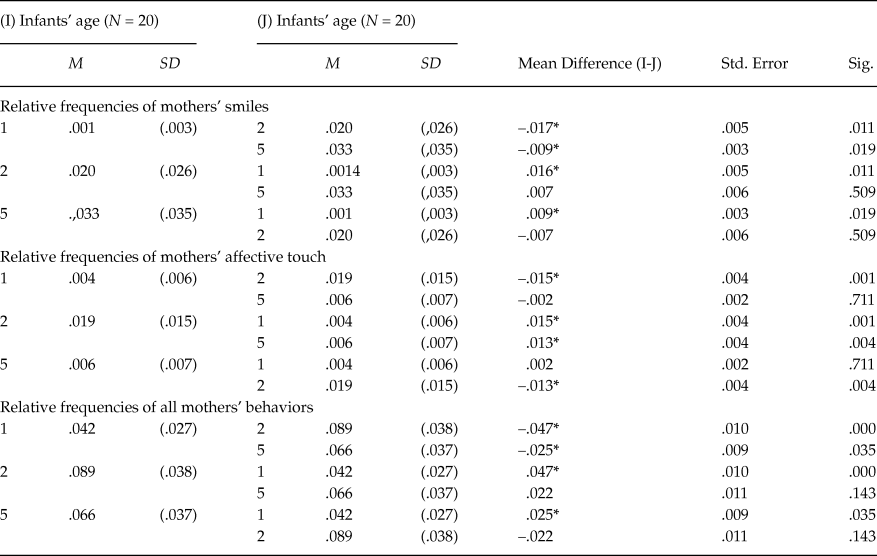
Differences between means were calculated for maternal behaviors in order to assess whether there were intergroup differences and if these were followed by the differences found in the babies’ behaviors. For mothers’ smiles it was found a significant effect for the group factor - the babies’ age, F(2, 59) = 6.03, p < .05. Post hoc tests (see Table 5) indicated significant differences between the means of mothers’ smiles comparing one month-olds and two month-olds, and between the means of mothers’ smiles comparing one month-olds and five month-olds. The means of mothers’ smiles of two month-olds were higher than those of one month-olds, and the means of mothers’ smiles of five-month-olds were higher than those of one month-olds. These results suggest that mothers of older infants smiled more frequently. The same trend was found when the observed affective behaviors were considered as a whole. The analysis also showed a significant effect for the factor babies’ age, F(2, 59) = 10.43, p < .05, indicating that mothers of older children emotionally touched more their babies than the others (see Table 5). In regards to mothers’ affective touch it was also observed a significant effect for the factor babies’ age, F(2, 59) = 13.40, p < .05. Post hoc tests (see Table 5) indicated only differences between the means of mothers of one month-olds and two-month-olds, and between the means of mothers of two month-olds and five month-olds.
Variable scores of relative frequencies of maternal behaviors in the three groups (infants’ age)

* The mean difference is significant at the .05 level.
According to these results, maternal affective behaviors presented at the different moments in development considered in this study showed variations of frequency analogous to the variations found in the babies’ smiles. Thus, there seems to have a mother-infant synchrony regarding the differences in the behaviors observed among the different ages. Such mother-infant sync could indicate an association between mothers and babies’ behaviors, so that, at each developmental moment, the mother and baby adjust each other about their possibilities and needs to express affection.
-
(c) The third objective in this study was to evaluate whether babies smile contingently responding to affective maternal behaviors, and if there is some characteristic pattern for each age related to the typology of babies’ smiles.
As some preliminary analysis for this item, correlations between the types of babies’ smiles and mothers’ affective behaviors were calculated. When the Bonferroni correction was applied, and considering a p < .007, some significant correlations were observed. One significant association was found between simple smile (ss) and kiss (r = .48), and between simple smile and maternal smile (r = .70), regardless of the baby’s age. One can assume that the greater presence of certain maternal behaviors, such as smiles and kisses, is associated with an increase in babies’ smiles.
For the contingency analyses we adopted methods frequently used in current research in this field. Contingency between the target mothers’ behaviors (so, be, ta, fv) and expressions of babies smiling was analyzed using a one-second latency window (the onset of maternal behavior and the second later). For each pair consisting of maternal behavior and the response of the baby (smile) we calculated the value of Yule Q (an index that ranges from zero to a).
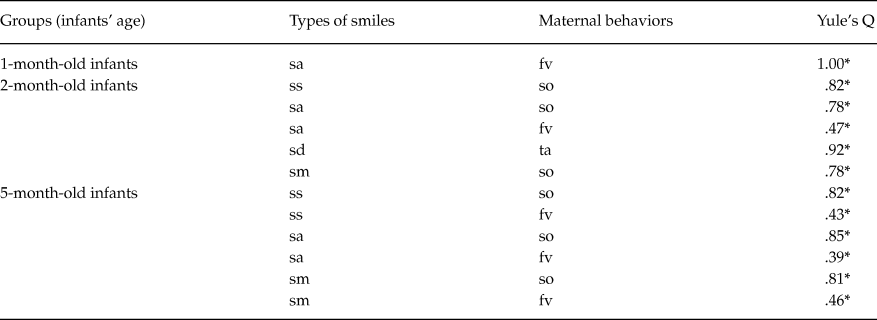
The one month-old dyads almost did not show this trait in their interactions, with the exception of the contingency between the ample smile (sa) and the speech/vocalization (fv) (Yule Q = 1.00, p < .05). For the two and five month-olds, all kinds of babies’ smiles were contingent with some maternal behavior observed, with the only exception for kissing (see Table 6).
Yule’ Q values by infants’ age

Note: * p < .05.
The group of two month-olds contingently responded with smiles to all kinds of maternal behaviors (with the exception of kissing), such as affectionate touches, speech, vocalizations, and in particular to mothers’ smiles. Babies responded contingently to touches of affection with Duchenne smiles (sd), to speech/vocalizations with ample smiles (sa), and to smiles with simple smiles (ss), ample smiles (sa), and mixed smiles (sm).
Five months-old infants responded contingently to their mothers’ speech/vocalization (fv) and smiles (so). Babies responded to these two types of behaviors with simple smiles (ss), ample smiles (sa), and mixed smiles (sm). Significant contingency was not identified between Duchenne smiles (sd) and any of mothers’ behaviors for this group of babies. Nor it was identified contingent response of these babies to affectionate touches or kisses.
One aspect to be highlighted in the results refers to the high scores achieved by Yule Q maternal smile. These scores seem to indicate that by the second and fifth months of life babies’ smiles are predominantly contingent to mothers’ smiles. Maternal smile has been reported in the literature as a powerful elicitor of babies’ smiles (Lavelli & Fogel, Reference Lavelli and Fogel2005; Mendes et al., Reference Mendes, Seidl-de-Moura and Siqueira2009; Messinger, et al., Reference Messinger, Fogel and Dickson2001) in different cultural contexts as the Italian, Brazilian and American ones.
Results pointed to various types of smiles (ss, sa, sm and sd) as contingent responses to maternal affective behaviors. Similarly, almost every target behaviors of mothers (with the exception of kissing) elicited babies’ smiles. For both two month-olds and five month-olds mothers’ smiles elicited different types of babies’ smiles.
Exploratory analysis
As an exploratory analysis, considering socio-demographic information of the mother (mothers’ education and age), it was considered appropriate to examine the difference among groups controlling for specific variables. GLM Univariate analysis was used to test the effect of certain variables on the display of smiles at different ages. We compared the total of smiles for the three groups of infants, controlling for mothers’ age and educational level. Then, the same analysis was performed controlling for the total of mothers’ affective behaviors. glm Univariate analysis was conducted because there were no significant correlations between the dependent variables.
While it was not found a significant effect for maternal age and educational level, it was found a significant effect for babies’ age F(2, 59) = 8.53, p < .05. It was also found a significant effect of mothers’ affective behaviors on the manifestation of the total of babies’ smiles, F(1, 59) = 22.07, p = .001, power = 1,00 (relative frequencies of all maternal behaviors- encompassing all types - as a factor, and relative frequencies of all infants’ smiles-encompassing all types - as dependent variable). Hence, mothers’ age and educational level do not impact the manifestation of their babies’ smiles (in total and for any type). However, the extent to which mothers express affection has a positive effect on their babies’ emotional expressions.
The importance of mother-infant interactions for children’s social, emotional and cognitive development was supported by the results in this study. Results may also indicate an ongoing process of complexification and expansion of a babies’ ability to coordinate signals expressed during social interactions (Lin & Green, Reference Lin and Green2009; Seidl-de-Moura et al., Reference Seidl-de-Moura, Ribas, Seabra, Pessôa, Nogueira, Mendes and Vicente2008; Yale et al., Reference Yale, Messinger, Cobo-Lewis and Delgado2003).
This study focuses on the ontogenesis of smiling and its association with mothers’ affective behaviors. First, we must highlight the measures of general relative frequencies and the relative frequencies by type of smile. Babies in the three groups smiled on average over a small portion of the observation time, which is not surprising because a smile is an episodic behavior. However, both the mean durations and the midrange frequencies of smile for two month-olds were higher than those of one month-olds. Similarly, it was found that these values for five month-olds were higher than the values for one month-olds. It seems that throughout development exhibitions of joy and pleasure are enlarged as a result of experience and social interactions in which the baby participates.
The trends presented by the measures when the three groups of babies are compared indicate a higher relative frequency of smiles in the oldest group considering all the analyzed types (ss, sa, sd e sm). One might think such outcomes in the light of the changes observed at two months of age, in diversified cultures, when babies’ communicative actions become progressively coordinated, specially the facial expressions, as the smiles, and increase some social and cognitive skills, as the capacity to organize their behavior according to the behavior of the person with whom they interact.
Mendes et al. (Reference Mendes, Seidl-de-Moura and Siqueira2009), studying a Brazilian context, also found a change in pattern at around two months of age, in which frequency and duration of smiles rose, and a highest diversity of types is exhibited. Similarly, Messinger et al.’s study indicated that with age specific types of smiling rose during certain periods of interaction, considering American mother-infant dyads. However, this does not happen with the ample smile (sa) (Messinger et al., Reference Messinger, Fogel and Dickson2001). Further investigation about developmental changes and the exhibition of specific types of infants’ smiles in different cultural environments is required.
For one month-old infants, the highest average ratio for the simple smile reveals a predominance of this type of smile. For the two months-old babies, although this dominance continues, it increases the frequency of ample smiles (sa). Five month-olds showed a balanced distribution for simple (ss) and mixed (sm) smiles, followed by ample smile (sa). However, the preponderance of ample smiles continues for this age group. Future studies that include other variables, such as specific periods of interactions and different circumstances in which smiles are shown, can help understanding both their mechanisms of expression and their meaning taking into account culture-specific patterns.
The average ratio for the mixed smiles (sm) (morphologically more complex) is higher for two month-olds than for one month-olds, and higher for five month-olds than for the other two groups. One can speculated that the increasing display of varying types of smiles, particularly those with more complex morphology, are a function of maturation and factors of interaction with the environment, especially of social interactions. Although smiles with cheek raise are present since the beginning of life, as related by Messinger et al. (2002), they may become more common in older babies.
As occurred with babies’ smiles, significant differences in average were also found for the total of maternal affective behaviors (especially for mothers’ smiles) among the groups, with higher values for the older babies. As these intergroup mean differences for mothers largely followed the differences found for babies (that can be understood as dynamic changes resulting from the increase in age), this may suggest that mothers and babies’ behaviors are tuned.
The association between mothers and their babies’ behaviors was also verified through correlation tests. The correlation between simple smiles (ss) and mothers’ smiles was the highest found. However, mothers’ kisses also correlated significantly with this type of babies’ smile. Accordingly, the more frequent are certain behaviors on the part of mothers, such as smiling and kissing, the more the display of babies’ smiles will be encouraged. We still do not know, nevertheless, what causes the relations involving certain types of smiles instead of others. Even so, authors agree about the importance of early social interactions in the ontogenesis of smile. According to Kärtner et al. (Reference Kärtner, Holodynski and Wörmann2013) and Wörmann et al. (Reference Wörmann, Holodynski, Kärtner and Keller2012), the development of social smiling depends on the dynamic relationship between infants and caregivers’ communicative behavior. These authors defend the idea that there are features in caregivers’ communicative practices that bias the communicative system towards positive affectivity.
Contingency analysis indicated that almost all of mothers’ behaviors (with the exception of kissing) elicited contingent reaction in babies. In addition, a variety of types of smiles appeared in response to maternal affective behaviors. It is possible to think that kissing provides in some socio-cultural contexts a sense of maternal warmth and sensitivity and does not serve the communication of affect. In other socio-cultural contexts, kissing could have the meaning associated to proximal contingencies (addressing the sense of touch and the vestibular sense; e.g., stroking or patting, kissing or by body contact), as defined by Kärtner et al. (Reference Kärtner, Keller and Yovsi2010) and observed in the rural Cameroon, and has an influence on contingency of infant’s smiling at it. It not seems to be the case in our study.
The presence of contingent behaviors between the baby and the mother was more intense in the groups of babies with two and five months of life, which seems to indicate the development of social, cognitive and emotional skills not previously available. It is important, once again, highlight the possible cultural differences. According to Kärtner et al. (Reference Kärtner, Keller and Yovsi2010), for instance, infants from the Münster group experienced more visual contingencies than did infants from the Nso one, and, on average, these visual contingencies increased with age, while the same was not observed for auditory and proximal contingencies and this cross-cultural developmental divergence is attributed to ethno-theoretical underpinning.
In addition to the results from statistical analysis, it should be noted other aspects that could be observed with respect to how, in general, mothers deal emotionally with their babies in everyday life. Despite individual differences in style, it was especially common for mothers to transmit affection to their children. Through touches of affection, affectionate talks, kissing, and smiling mothers transmitted affection to their babies, from whom they expected appropriate reactions. It was particularly evident the prevalence of mothers’ behaviors with the aim of eliciting smiles in their children, many times verbally asking them to smile, what seems to be an inclination in some urban contexts like German urban middle-class, but not in other like rural Nso (Kärtner et al., Reference Kärtner, Holodynski and Wörmann2013).
Considering that babies maintain contact with their mothers’ emotional expressions and affective manifestations in the interactions established between them, the role of these interactions for babies’ emotional development is crucial. Mothers and babies’ behaviors seem to regulate both of them. Because babies are sensitive to social contingency, the emergence of social smile at around the second month of life functions as a powerful stimulus for interactions (Bigelow & Rochat, Reference Bigelow and Rochat2006; Kärtner et al., Reference Kärtner, Keller and Yovsi2010; Mendes et al., Reference Mendes, Seidl-de-Moura and Siqueira2009). In this way the reciprocity in emotional exchanges is enriched. Overall, the results found in this investigation indicate a strong association between behaviors manifested by mothers to convey affection and the emergence and increased frequency of babies’ smiles. Although this association appears to be established early in life, it becomes more complex and richer over time in ontogenesis.
This study provides new data on how infant’s smiles and the relationship between their expressions and mothers’ affective behaviors are present at one (a relatively unexplored period of life), two and five months of life in a group of babies in the city of Rio de Janeiro. Despite the contributions it has to give, this is a cross-sectional investigation, and, in this sense, it only allows for certain inferences regarding a developmental sequence in the first months of life. The results are consistent with those reported by Mendes et al. (Reference Mendes, Seidl-de-Moura and Siqueira2009) in a longitudinal study with Brazilian babies observed from the second week to the sixth month of life. In that case, however, only two babies and their mothers were involved, while in our study 60 dyads mother-infants participated. The use of a microgenetic research design, in which intensive observations were performed at three different ages, but within a rapidly changing developmental period, allowed us to conduct a fine-grained examination of the possible early change processes and patterns in the infants’ smiles and in their relationship with mothers’ specific behaviors, in a particular Brazilian cultural context.