




No CrossRef data available.
Article contents
Sex hormonal modulation of hemispheric asymmetries in the attentional blink
Published online by Cambridge University Press: 04 May 2005
Abstract
The present study examines differences in functional cerebral asymmetries modulated by gonadal steroid hormones during the menstrual cycle in women. Twenty-one right-handed women with regular menstrual cycles performed a double-stream rapid serial visual presentation (RSVP) task, with one stream in each visual field, during the low steroid menses and the high steroid midluteal phase. They were required to detect a target item, and then a probe item, each of which could appear in either stream. If the probe item appeared 200 ms after the target, detection of the probe was impaired—a phenomenon known as the “attentional blink.” This occurred in both streams in the midluteal phase, but only in the right visual field during menses. Thus low steroid levels appeared to restrict the attentional blink to the left hemisphere, while high levels of estradiol and progesterone in the midluteal phase appeared to reduce functional asymmetries by selectively increasing the attentional blink in the right hemisphere. This effect appears to be mediated by estradiol rather than progesterone, and it is compatible with the assumption of a hormone-related suppression of right hemisphere functions during the midluteal phase. (JINS, 2005, 11, 263–272.)
Information
- Type
- Research Article
- Information
- Journal of the International Neuropsychological Society , Volume 11 , Issue 3 , May 2005 , pp. 263 - 272
- Copyright
- © 2005 The International Neuropsychological Society
INTRODUCTION
Cognitive performance and functional cerebral asymmetries in women appear to be modulated by fluctuations of sex hormone levels over the menstrual cycle (e.g., Altemus et al., 1989; Hausmann & Güntürkün, 2000; Hausmann et al., 2002; Heister et al., 1989; Purdon et al., 2001; Rode et al., 1995; Sanders & Wenmoth, 1998), although there are inconsistencies in the reported results. Some studies have shown greatest asymmetries during the high steroid phase, mostly in the midluteal phase—these includes studies of figure recognition (Bibawi et al., 1995), dichotic listening (Hampson, 1990a, 1990b), and spatial bisection (McCourt et al., 1997). Other studies, including those on decisions about faces (Heister et al., 1989) and figural comparisons (Rode et al., 1995), have shown most pronounced lateralization patterns during menses, when steroid concentrations are low.
One possible reason for these inconsistencies is that instead of assessing the serum concentrations of steroidal hormones directly, investigators have estimated the position in the cycle by counting days backwards from the predicted start date of the next menstruation, so that cycle phases were not properly validated. The few studies (Hausmann & Güntürkün, 2000; Mead & Hampson, 1996; Rode et al., 1995) that have included hormonal assays from blood samples of participating women had to exclude about 23–27% of the sample because these women were not in the expected cycle phases.
A second possible reason for these inconsistencies is that hormonal effects on functional cerebral asymmetries may be task dependent (Hampson, 1990a, 1990b; Heister et al., 1989; Mead & Hampson, 1996; Rode et al., 1995; Sanders & Wenmoth, 1998). Different properties of a specific task, such as task difficulty, modality, or degree and direction of hemispheric specialization, all appear to influence cycle-related effects on functional asymmetries. Studies that have employed tasks involving processing for which the right hemisphere is superior are associated with greater asymmetry during the menses, when steroid levels are low (Heister et al., 1989; Rode et al., 1995; Sanders & Wenmoth, 1998), whereas those tasks associated with greater asymmetry during the high steroid midluteal and follicular phases, respectively, are thought to involve processing for which the left hemisphere is superior (Bibawi et al., 1995; Hampson, 1990a; Sanders & Wenmoth, 1998). Contrary to these findings, however, Hausmann and Güntürkün (2000) observed for left-hemisphere as well as for right-hemisphere dominated tasks a greater cerebral asymmetry during menses and a more symmetrical functional organization during the midluteal phase. Thus, they proposed that cycle-related modulation of lateralization patterns act independently of task or hemisphere, and appear in prototypical left- as well as right-hemispheric tasks.
High serum levels of midluteal steroid hormones appear to be the key agents for this effect, although it is unclear whether estradiol or progesterone is the key hormone, and which hemisphere is more modulated by these hormones. For example Hausmann and Güntürkün (2000) and Hausmann et al. (2002) hypothesize that progesterone, in particular, reduces cerebral asymmetries by diminishing the cortico-cortical transmission via the corpus callosum. On the other hand, a few studies (Hampson, 1990a, 1990b; Mead & Hampson, 1996; Sanders & Wenmoth, 1998) suggest that estradiol, rather than progesterone, is the important agent influencing the degree of asymmetry, such that high levels of estradiol suppress right-hemisphere function while enhancing left-hemisphere function.
In the present study, we examined functional cerebral asymmetries in the so-called attentional blink (AB). This phenomenon is apparent under rapid serial visual presentation (RSVP), where visual items are presented at rates of 6–20 items/s, but typically at 10 items/s with stimulus onset asynchrony (SOA) of 100 ms. Participants are required to detect a target item and then a probe item in a stream of distractors. The AB refers to the deficit in detecting a probe item if it occurs within 100–450 ms of the target. One explanation is that the target item continues to consume resources, preventing processing of the probe (Broadbent & Broadbent, 1987; Chun & Potter, 1995; Raymond et al., 1992; Shapiro et al., 1994; Taylor & Hamm, 1997). Detection of the probe under these conditions may be contrasted with detection under a control condition in which the target is ignored, and only the probe is to be detected. In this case the probe is detected with high accuracy. In a previous study (Holländer et al., 2004) in which RSVP streams were presented simultaneously in the two visual fields, we found that the AB was apparent mainly in the right visual field (RVF), suggesting that the left hemisphere is more prone to the AB than the right.a
A reanalysis of these data (unpublished) for sex differences (7 men and 9 women) revealed a marginally significant interaction between sex and visual half field [F(1,14) = 4.028, P = .065]. Multiple post-hoc comparisons resulted in a significant difference (P < .05) between males and females regarding the AB in the LVF, with males showing a less pronounced AB than women. Furthermore, men showed a functional cerebral asymmetry with the AB occurring largely in the RVF (P < .05). The failure to show this functional asymmetry also in women may be due to the fact that the test sessions were realized regardless of cycle phase.
One previous study suggesting that steroid hormones might influence attention is that of McCourt et al. (1997). In their task participants were required to point with a push-button laser pointer toward a vertical line on a wall that exactly coincided with the participants' midsagittal plane. They tended to err to the left of the line, implying right-hemisphere activation. McCourt et al. found that this bias was increased during the luteal phase compared to the menstrual phase. In this study, however, the task was one of spatial attention, not temporal attention, and the authors did not provide hormonal assays to verify hormonal levels.
The present study was designed first to replicate the right-hemispheric advantage in RSVP processing, and second to examine hemispheric asymmetries in the AB at different phases of the menstrual cycle in women. Blood assays of gonadal steroid hormones for all participating women during each session ensured a validation of cycle phase and made it possible to test which hormone is most associated with hemispheric asymmetries.
METHODS
Participants
Twenty-one healthy, normally cycling women, with regular menstrual cycle (26–30 days) volunteered to participate. None of the women used oral contraceptives, hormonal replacement, or any other medication that could affect the central nervous system. Their ages ranged from 19 years to 42 years, with a mean age of 27.3 years (SD = 6.78). All were right-handed, as determined by the Edinburgh Handedness Inventory (Oldfield, 1971). The asymmetry-index (LQ) used by this test is calculated as [(R − L)/(R + L)] × 100, and ranges from extreme sinistrality (−100) to extreme dextrality (+100). The LQs ranged from +54 to +100, with a mean of +82.45 (SD = 16.81). All participants, recruited by announcement, were naive as to the hypothesis and were paid for their participation.
Acquisition of Cycle Phase/Mood
Each woman was tested twice, once during the menses and once during the midluteal phase, in a counterbalanced order. Ten women were first tested during the menstrual phase, and later tested during the midluteal phase, and eleven women vice versa. Both testing sessions were run at the same time of day for any given participant to reduce any potential influence of circadian rhythms. Each participant undertook both the control and the experimental condition in each session, with half completing the control task first, and half completing the experimental task first. Subsequent analysis of the results failed to show any main effect or interactions attributable to the order (control/experimental vs. experimental/control).
At the beginning of the first session the participants were informed about the general procedure, and then data on handedness and menstrual cycle were collected. Additionally, their current mood was assessed by using the State-Trait-Cheerfulness-Inventory (STCI-S18; Ruch et al., 1997) to register and control potential premenstrual changes (PMS) caused by gonadal hormones (e.g., Daly et al., 2001; Man et al., 1999; Reilly & Kremer, 2002) that might influence cognitive performance (e.g., Boyle, 2002; Erez & Isen, 2002; George & Zhou, 2002; Zenasni & Lubart, 2002). The STCI-S18 is an instrument measuring the three concepts of cheerfulness, seriousness, and bad mood. The concept of “cheerfulness” represents positive affect, such that participants with a high score describe themselves as being “in good spirits”, “in a mirthful mood”, or “feeling merry”. This was also manifest as readiness to change behavior, as in “I am ready to have some fun”. The concept of “seriousness” is here understood as the readiness to perceive, act, or communicate seriously. The actual mental attitude is measured by items such as “I'm prepared to do a task in earnest”, “I am not prepared for any silliness or nonsense”. The concept of “bad mood” is defined by the two elements of sadness/melancholy and ill-humor, such as “I am in a bad mood”, “I am sad”, “I am in a grumpy mood”. Each concept included six items and the answer was given on a 4-rating-scale, which was coded as follows: “strongly disagree” = 1, “moderately disagree” = 2, “moderately agree” = 3, and “strongly agree” = 4.
The women were tested during the low steroid menses (cycle day 2–3) and the high steroid midluteal phase (cycle day 21–22), to yield the largest differences in progesterone and estradiol levels. Directly after every session a blood sample was collected. Serum levels of estradiol and progesterone were analyzed by an immunoassay using chemiluminescence detection (ARCHITECT®, Abbott Laboratories, Abbott Park, Illinois) and were performed by an independent professional blood analysis laboratory (MedLab, Auckland, New Zealand). The assessment of serum gonadal sex hormone levels of each woman provided validation of individual cycle phases. To plan the dates for the experimental sessions, the participants were required to confirm the onset of menses for the first session or for the second session, depending on group.
Stimuli
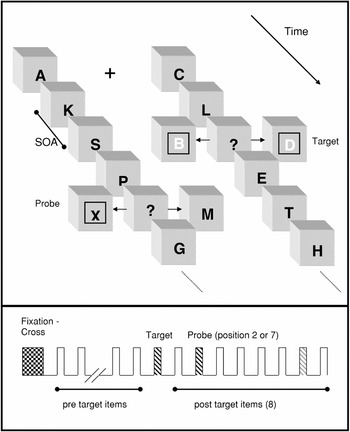
Each trial consisted of a series of successively presented uppercase letters presented in black against a light grey background with the exception that the target letter was white on a light grey background. The letters were presented in two simultaneous rapid serial visual presentation (RSVP) streams. The center-to-center distance between the two streams was 5-deg visual angle, which was small enough that participants could identify items in either of the two locations without resorting to eye movements. Letters were 1 deg of visual angle in height. Each letter was exposed for 50 ms and the stimulus onset asynchrony (SOA) was 100 ms, producing a presentation rate of 10 letters/s. The streams consisted of 11–12 letters (a number selected randomly at run-time) and ended with the symbol “@”. The number of pretarget letters was randomly chosen by the computer on each trial and varied between two and three letters. Eight letters always succeeded the target item, with the ninth item (@) as a mask. The probe was presented only at posttarget positions 2 or 7 with equal probability. These two posttarget positions were chosen because our earlier study showed the most severe impairment of probe detection at posttarget position 2 and no impairment at position 7 (Holländer et al., 2004). Comparison of probe detection between these positions should therefore provide the most sensitive measure of the AB. On half the trials the target was in the left visual field (LVF) and on half it was in the right visual field (RVF), and the probe could appear in the same visual field or in opposite visual fields with equal probability. Altogether there were 128 trials for each of the control and experimental conditions (Table 1).
There were 128 trials for each of the control and experimental conditionsa

The distracters were selected randomly from among all letters of the alphabet except B, D, and X, with the restriction that no letter was presented twice within a visual field. Three of these letters were designated as targets. The target item could be a white “B” or “D” and the probe, which was presented on 50% of the trials, was a black “X”. The participants were seated at a comfortable distance of 57 cm from the computer screen.
Procedure
Each trial began with a small, black fixation cross in the center of the screen, and the letters then appeared on either side (Figure 1). The cross appeared 1000 ms before the trial started and was present during presentation of all letters. The participants were instructed to keep their gaze on the fixation cross at all times. Each trial was initiated by pressing the space bar on the computer keyboard.

Schematic representation of stimulus presentation in the dual RSVP task.
The participants were tested within each session under both an experimental and control condition in a balanced order. Therefore, the 128 trials were administered twice within each session, but the instruction was changed.
In the experimental condition, the first task was to locate and identify the white letter (target) presented in one of the two visual fields. The participants were asked not only whether the target was in the LVF or RVF, but also whether it was a “B” or “D”. The second task was to report whether or not a black “X” (probe) was present on one of the two trials, and which visual field it occurred in. In the control condition, the same displays were used but participants were told to ignore the white letter (target) and decide only whether the black “X” (probe) had been presented.
The participants responded at the end of each trial by typing their decisions on the keyboard, giving the response to the target item first. Response keys differentiated both the B/D decision and the left/right visual field position; A and S keys were used for B/D on the left, and the K and L keys indicated B/D on the right. Similarly, probe present responses were made using the X and M keys to indicate probes present on the left or right. When no probe was presented, the spacebar was pressed to initiate the next trial. The participants were allowed to take as much time as they needed to respond as accurately as possible.
RESULTS
To properly validate the cycle phases, the results were analyzed only for participants whose progesterone levels were at least twice as high in the midluteal as in menstrual samples. The level of estrogen is expected to be between 370–920 nmol/l during the midluteal phase and 35–185 nmol/l during the menses, and the level of progesterone between 10–100 nmol/l during the midluteal phase and 0–10 nmol/l during the menses (e.g., Rode et al., 1995). Two participants had to be excluded from further analyses because their steroid levels did not meet this criterion. The mean levels of progesterone for the remaining 19 women were 1.03 nmol/l (SD = 0.50) in the menstrual and 32.04 nmol/l (SD = 16.02) in the midluteal phase. The mean values of estradiol were 181.95 pmol/l (SD = 41.12) in the menses and 564.42 pmol/l (SD = 188.05) in the midluteal phase. Paired t-tests revealed significant differences between phases for both progesterone, t(18) = −8.34, P < .001, and estradiol levels, t(18) = −8.73, P < .001.
Target Identification
Correct performance in target identification was analyzed using a 2-way ANOVA with Cycle Phase (menses/midluteal), and VHF (left/right) as within-participant factors for the experimental condition. The ANOVA revealed a significant main effect of Cycle Phase, F(1,18) = 5.17, P < .05, with more accurate target identification during menses than during midluteal phase (89.56% ± 2.05 vs. 85.69% ± 2.90). There was no significant main effect of VHF, F(1,18) = 0.10, n.s., and no significant interaction between Cycle Phase and VHF, F(1,18) = 1.58, n.s.
Probe Detection
Since we wanted to examine the effect of the target identification on probe detection, only trials on which the target was successfully identified were included in the following analyses.b
We analyzed only trials in which the probe and target appeared in the same stream, and excluded those in which they were in opposite streams to ensure measurement of the AB itself. Including the opposite stream condition was important to avoid the target acting as a prime for the stream the probe will appear in. However, there is doubt as to whether deficits in attention under the opposite-streams condition can be attributed to the AB itself (Peterson & Juola, 2000), or to the combined effects of an AB and task/attention switching (Breitmeyer et al., 1999; Jiang & Chun, 2001; Potter et al., 1998; Visser et al.,1999; Weichselgartner & Sperling, 1987), or to delays caused by attentional cuing, combined with the luminance changing from a noninformative to an informative cue (Klein & Dick, 2002; Lambert & Duddy, 2002). It was not possible to replicate our previous findings (Holländer et al., 2004) with the design of the present study, because the probe could only appear at posttarget positions 2 and 7.
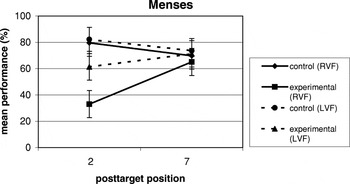
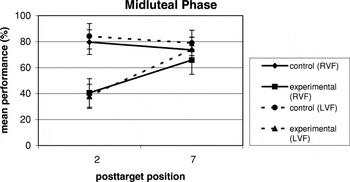
The mean percentage of trials in which the target was correctly detected is plotted for each serial position of the probe for both hemispheres for both conditions in Figure 2 (menses) and Figure 3 (midluteal phase).

Mean performance of correct report of the probe when the target and the probe were presented in the LVF and RVF, given that the target item was correctly reported, as a function of both posttarget positions of the probe, shown separately for experimental and control conditions in the menses. The probe was presented at posttarget positions 2 and 7 only, which is equivalent to a stimulus onset asynchrony (SOA) of 200 ms and 700 ms, respectively.

Mean performance of correct report of the probe when the target and the probe were presented in the LVF and RVF, given that the target item was correctly reported, as a function of both posttarget positions of the probe, shown separately for experimental and control conditions in the luteal phase. The probe was presented at posttarget positions 2 and 7 only, which is equivalent to a stimulus onset asynchrony (SOA) of 200 ms and 700 ms, respectively.
The 2 × 2 × 2 × 2 ANOVA with Cycle Phase (menses vs. midluteal), Condition (control vs. experimental), VHF (LVF vs. RVF), and Posttarget Position (2–7) as within-participant factors revealed significant main effects of VHF, F(1,18) = 10.342, P < .01, Condition, F(1,18) = 127.623, P < .001, and Posttarget Position, F(1,18) = 39.381, P < .001, but no significant main effect of Cycle Phase. The 2-way interaction between Condition and Posttarget Position was significant, F(1,18) = 109.759, P < .001. No other 2-way interaction was significant. There were significant 3-way interactions between Cycle Phase, Condition, and Posttarget Position, F(1,18) = 4.775, P < .05, and between Cycle Phase, VHF, and Posttarget Position, F(1,18) = 4.519, P < .05. No other 3-way interaction was significant. The 4-way interaction between Cycle Phase, VHF, Condition, and Posttarget Position was also significant, F(1,18) = 6.320, P < .05. Multiple post-hoc comparisons using Scheffé's correction were made at both posttarget positions between conditions for the left and right hemisphere for each menstrual cycle phase separately. This resulted in significant differences (P < .001) between conditions during the midluteal phase at position 2 for both hemispheres, and during the menses for the left hemisphere only.
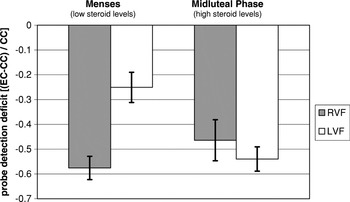
The significant Condition × Posttarget Position interaction indicates that the AB is present for posttarget position 2 only, with a significant difference between the control and experimental conditions. For analyzing hemispheric differences, we therefore only included posttarget position 2. Since the AB is defined by the difference between the experimental task performance and control task performance, we computed the expression [(EC − CC)/CC] for each participant in each cycle phase for each visual field, where CC is detection rate under the control condition and EC the rate under the experimental condition. These values are plotted in Figure 4.

Mean error [(experimental condition − control condition)/control condition] when the target and the probe were presented in the LVF (right hemisphere) and RVF (left hemisphere), as a function of menstrual phase. Hormone-dependent reductions of the right-hemisphere advantage occur during the midluteal phase.
These data were subjected to a 2 × 2 ANOVA with Cycle Phase and VHF as repeated measures, to examine the modulation of functional cerebral asymmetries by gonadal hormones for posttarget position 2 only. A significant main effect of VHF was found, F(1,18) = 4.564, P < .05, with higher probe detection in the LVF (right hemisphere) than in the RVF (left hemisphere). There was also a highly significant interaction between Cycle Phase and VHF, F(1,18) = 20.134, P < .001, as shown in Figure 4. The AB in the RVF was stable at both phases of the menstrual cycle, whilst a strong impairment in the probe detection was only observed in the LVF during menses. The main effect of menstrual cycle was not significant.
To further characterize this interaction, visual-field differences were compared separately for the menstrual and midluteal phase. There was a significant advantage for the LVF (right hemisphere) during the menses, t(18) = −5.154, P < .001, but no significant functional asymmetry during the midluteal phase, t(18) = .917, n.s. Conversely, there was a significant phase difference for the LVF (right hemisphere), t(18) = 3.417, P < .01, but not for the RVF (left hemisphere), t(18) = −1.505, n.s.
Hormone/Behavior Relationships
We computed a multiple regression, with attentional blink in the LVF and RVF as dependent variables, and estradiol and progesterone levels as predictors, in order to determine which hormone had the stronger effect on performance. Since estradiol and progesterone levels within each phase showed only small interindividual variation, we carried out the analysis separately for each session, thereby combining the two phases. Paired t-tests revealed no significant differences in AB between session one and session two for the RVF, t(18) = .370, n.s., and LVF, t(18) = .737, n.s. There were also no significant differences between session one and session two for progesterone, t(18) = .87, n.s., levels and estradiol levels, t(18) = .46, n.s.
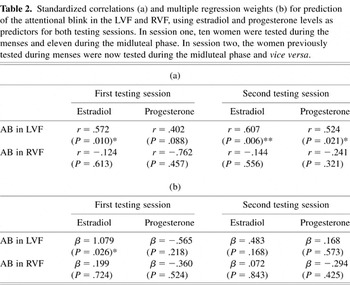
Correlations between each of these steroid hormones and the AB in each visual field are shown in Table 2(a). For the LVF only, these show significant correlations with estradiol for both sessions, and with progesterone only in the second session. The AB in the RVF was not significantly affected by hormone levels.
Standardized correlations (a) and multiple regression weights (b) for prediction of the attentional blink in the LVF and RVF, using estradiol and progesterone levels as predictors for both testing sessions. In session one, ten women were tested during the menses and eleven during the midluteal phase. In session two, the women previously tested during menses were now tested during the midluteal phase and vice versa.

To further investigate which of the two hormones most affected the AB, multiple regressions were also carried out, in which levels of estradiol and progesterone were included as predictors. The results are shown in Table 2(b), and show significant prediction of the AB in the LVF in both session one F(2,16) = 5.120, P < .05, R2 = .39, and session two, F(2,16) = 4.927, P < .05, R2 = .38. However, as shown in Table 2(b), the regression weights were consistently higher for estradiol than for progesterone, although significant only in session one. The AB in the RVF was not significantly affected by hormone levels in either session one F(2,16) = .340, n.s., R2 = .04, or session two, F(2,16) = .513, n.s., R2 = .06.
Effects of Mood
The participants did not significantly differ in mood between the menstrual and the midluteal phase. There were no significant differences for the concepts “cheerfulness” (meanmenses = 2.64, SD = .77; meanmidluteal = 2.77, SD = .97), t(18) = −.416, n.s., “seriousness” (meanmenses = 2.87, SD = .39; meanmidluteal = 2.71, SD = .47), t(18) = 1.430, n.s., and “bad mood” (meanmenses = 1.67, SD = .76; meanmidluteal = 1.73, SD = .75), t(18) = −.279, n.s. We computed a multiple regression for session one and two, with the three concepts of mood as dependent variables, and estradiol and progesterone levels as predictors, to examine the hormone/mood relationship. In neither session did the regression approach significance.
DISCUSSION
Overall, the results show an AB for posttarget position 2 (equates to SOA = 200 ms), replicating previous findings of an AB occurring between 100 and 450 ms after target presentation (Broadbent & Broadbent, 1987; Chun & Potter, 1995; Raymond et al., 1992; Shapiro et al., 1994; Weichselgartner & Sperling, 1987). Moreover, the outcome confirms the results of a previous study (Holländer et al., 2004) that the AB deficit occurs largely in the RVF. This suggests a right-hemispheric advantage in processing the probe in RSVP. Our findings receive indirect support from a study by Shapiro et al. (2002), who examined the AB in patients with lesions in the inferior parietal lobe (IPL) and superior temporal gyrus (STG) in either the left or in the right cerebral hemisphere. Both groups showed an enhanced AB, although right-hemisphere patients with neglect performed the AB task more poorly than their left-hemisphere counterparts.
More interestingly, this study showed that the hemispheric asymmetry in the AB fluctuates over the menstrual cycle, and is therefore modulated by gonadal steroid hormones. Steroid hormones have been shown to affect various cognitive processes, especially verbal, visual, semantic memory, and motor coordination (e.g., Asthana et al., 2001; Daniel & Dohanich, 2001; McEwen, 1999; McEwen & Alves, 1999; Shaywitz et al., 1999). Furthermore, they are psychotropic agents in relation to neuropsychiatric disorders (Berk & Stein, 2002; Janowsky et al., 1998; Osterlund & Hurd, 2001; Ozcan & Banoglu, 2003; Payne, 2003; Seeman, 1997; Walker, 2002) and have neuroprotective effects in aging and dementia (Schneider et al., 1996; Xu et al., 1998).
Further evidence for modulations of hemispheric asymmetry by steroid hormones during the menstrual cycle comes from studies comparing normal cycling women with postmenopausal women. For example, Hausmann and Güntürkün (2000) tested in addition to normally cycling women postmenopausal women in corresponding time intervals of 14 days using lexical decision, figural comparison, and face discrimination tasks. Postmenopausal women showed a remarkably stable lateralization pattern over time for three VHF tasks, which was virtually identical to those of young men.
In the present study, a reduced functional asymmetry for the AB was found during the midluteal phase in normal cycling women. This is in agreement with the idea of a reduced functional asymmetry during the midluteal cycle phase in tasks with a right-hemisphere advantage (Heister et al., 1989; Rode et al., 1995; Sanders & Wenmoth, 1998). Only one study, that of McCourt et al. (1997), shows greater hemispheric asymmetry during the luteal phase than during the menstrual phase using a right-hemispheric spatial attention task. The latter study, however, concerned spatial attention, not temporal attention, and the authors provided no hormonal assays. In the present study, no AB (and therefore high dual-task performance) was present for the right hemisphere during the low steroid menses, which resulted in a strong left-hemisphere dominated asymmetry in the AB during menses. At higher steroid levels during the midluteal cycle phase the LVF advantage in probe detection was reduced. The left-hemispheric performances revealed a constant AB during both menses and the midluteal cycle phase. Therefore women showed a more male-like asymmetry pattern during the menses than during the midluteal phase (see footnote b), which was also proposed by Hausmann and Güntürkün (2000).
The present results support the assumption of a hormone-related suppression of right-hemisphere functions in the midluteal phase (Hampson, 1990a, 1990b; Heister et al., 1989; Mead & Hampson, 1996; Sanders & Wenmoth, 1998). For example, Sanders and Wenmoth (1998) found reciprocal shifts in the lateralization of a left-hemispheric (consonant-vowel identification) and a right-hemispheric task (musical chord recognition) during the menstrual cycle and showed that it was the right hemisphere that was most affected. In contrast, some studies (Bibawi et al., 1995; Chiarello et al., 1989; Rode et al., 1995) suggest that the left hemisphere, in particular, is activated by gonadal hormones or that the hemisphere less specialized for a task, that is, the left hemisphere in right-hemisphere tasks (figural comparison and face discrimination), is selectively modulated by steroid hormones during the midluteal cycle phase (Hausmann & Güntürkün, 2000; Hausmann et al., 2002).
A hormonal modulation of neuronal processes selectively within the right hemisphere would suggest that biochemical characteristics (e.g., transmitter systems) accompanying a specific function are lateralized. Some biochemical left–right asymmetries are known to exist, such as that for striatal dopamine D2 receptors (Larisch et al., 1998), but the functional basis for lateralized hormone-sensitive tasks presented here remains rather speculative.
However, there are not only inconsistencies as to which hemisphere is affected by steroid hormones, but also as to whether progesterone or estradiol is the key agent in modifying hemispheric asymmetries. There are some studies that have shown that fluctuations in progesterone level within the menstrual cycle have important impacts on functional cerebral asymmetries (Hausmann & Güntürkün, 2000; Hausmann et al., 2002; Heister et al., 1989). Hausmann et al. (2002) hypothesize that especially progesterone reduces cerebral asymmetries, presumably due to their glutamatergic and GABAergic effects which might diminish the cortico-cortical transmission via the corpus callosum. Alexander et al. (2002) also discuss their results in the light of the progesterone-mediated decrease in intrahemispheric communication, since their findings are inconsistent with the proposal that high estrogen levels in the luteal phase will suppress right-hemisphere function while enhancing left-hemispheric function.
On the other hand, a few studies (Hampson, 1990a, 1990b; Mead & Hampson, 1996; Sanders & Wenmoth, 1998) suggest estradiol, rather than progesterone, to be the important agent underlying the degree of asymmetry. For example, Hampson (1990b) found larger asymmetries in a dichotic listening task correlated with high concentrations of estradiol. Mead and Hampson's (1996) results of a face recognition task and a rhyming words task are consistent with the notion of relative suppression of right-hemispheric function under higher levels of estradiol.
Further evidence for estradiol as a key agent also comes from studies of transsexuals. In a study by Van Goozen et al. (1995), male-to-female transsexuals after treatment with estradiol and antiandrogens showed a rapid shift from male-typical functional cerebral asymmetry to female-typical more symmetrical pattern. On the other hand, Miles et al. (1998) found a specific influence of estrogen on verbal memory tasks, but not in other cognitive tasks including mental rotation and controlled associations.
In our study, the AB was positively correlated with estradiol as well as with progesterone, although multiple regression showed the beta weights to be constantly higher for estradiol. Therefore, estradiol seems to be the key hormone, showing a positive correlation with the AB in the LVF, resulting in a reduced functional asymmetry during the midluteal phase where estradiol levels are higher. Although the multiple regression revealed marginal relationship between progesterone and the AB, this need not mean that progesterone has no influence.
A recent pharmacological study showed that benzodiazepines, especially diazepam, increased both the magnitude and the duration of the AB (Boucart et al., 2000). Progesterone has similar agonistic effects as diazepam on the GABAA receptor (Smith et al., 1987a, 1987b, 1988; Smith, 1991), which supports the functional significance of GABAA receptors in RSVP tasks. There is also evidence that steroid hormones modulate cholinergic, serotonergic, and catecholaminergic neurotransmission (Asthana et al., 2001; Cummings & Coffey, 1994; McEwen & Alves, 1999; McEwen & Woolley, 1994).
To summarize, the finding that the right hemisphere showed an increased AB during the midluteal cycle phase suggests that hemispheric performances are modifiable due to the effects of gonadal steroid hormones, in particular estradiol. Alterations of the functional configuration of one hemisphere might result from hormonal effects on the neuronal network mainly within one hemisphere, or by altering interhemispheric interactions via the commissural system.
ACKNOWLEDGMENTS
This work is supported by Human Frontiers Science Project Grant (3493019/9153) to A. Holländer, by grant HA 3285/1-1 of the Deutsche Forschungsgemeinschaft (DFG) to M. Hausmann, by grant of The University of Auckland Research Fund (3601739/9353) to M. Hausmann, and by grants from the Marsden Fund of New Zealand and the Human Frontiers Science Project to M.C. Corballis. We thank all participating women for their help and cooperation.
References
REFERENCES
Alexander, G.M.,
Altemus, M.,
Peterson, B.S., &
Wexler, B.E.
(2002).
Replication of a premenstrual decrease in right-ear advantage on
language-related dichotic listening tests of cerebral laterality.
Neuropsychologia,
40,
1293–1299.Google Scholar
Altemus, M.,
Wexler, B.E., &
Boulis, N.
(1989).
Changes in perceptual asymmetry with menstrual cycle.
Neuropsychologia,
27,
233–240.Google Scholar
Asthana, S.,
Baker, L.D.,
Craft, S.,
Stanczyk, F.Z. et al.
(2001).
High-dose estradiol improves cognition for women with AD: Results of
a randomised study.
Neurology,
57(4),
605–612.Google Scholar
Berk, M. &
Stein, D.
(2002).
Reproductive hormones as psychotropic agents?
South African Psychiatry Review,
5,
20–22.Google Scholar
Bibawi, D.,
Cherry, B., &
Hellige, J.B.
(1995).
Fluctuations of perceptual asymmetry across time in women and men:
Effects related to the menstrual cycle.
Neuropsychologia,
33,
131–138.Google Scholar
Boucart, M.,
de Visme, P., &
Wagemans, J.
(2000).
Effect of benzodiazepine on temporal integration in object
perception.
Psychopharmacology,
52,
249–255.Google Scholar
Boyle, G.J.
(2002).
Prediction of cognitive learning performance from multivariate
state-change scores.
Australian Educational and Developmental Psychologist,
3,
17–21.Google Scholar
Breitmeyer, B.G.,
Ehrenstein, A.,
Pritchard, K.,
Hiscock, M., &
Crisan, J.
(1999).
The roles of location specificity and masking mechanisms in the
attentional blink.
Perception and Psychophysics,
61(5),
798–809.Google Scholar
Broadbent, D.E. &
Broadbent, M.H.P.
(1987).
From detection to identification. Response to multiple targets in
rapid serial visual presentation.
Perception and Psychophysics,
42,
105–113.Google Scholar
Chiarello, C.,
McMahon, M.A., &
Schaefer, K.
(1989).
Visual cerebral lateralization over phases of the menstrual cycle: A
preliminary investigation.
Brain and Cognition,
11,
18–36.Google Scholar
Chun, M.M. &
Potter, M.C.
(1995).
A two-stage model for multiple target detection in rapid serial
visual presentation.
Journal of Experimental Psychology: Human Perception and
Performance,
21,
109–127.Google Scholar
Cummings, J. &
Coffey, C.
(1994).
Neurobiological basis of behaviour. In
C. Coffey &
J. Cummings (Eds.),
Textbook of geriatric neuropsychiatry (pp.
71–96).
Washington, DC:
American Psychiatric Press.
Daly, R.C.,
Schmidt, P.J.,
Davis, C.L.,
Danaceau, M.A., &
Rubinow, D.R.
(2001).
Effects of gonadal steroids on peripheral benzodiazepine receptor
density in women with PMS and controls.
Psychoneuroendocrinology,
26(6),
539–549.CrossRefGoogle Scholar
Daniel, J.M. &
Dohanich, G.P.
(2001).
Acetylcholine mediates the estrogen-induced increase in NMDA
receptors binding in CA1 of the hippocampus and the associated improvement
in working memory.
Journal of Neuroscience,
21,
6949–6956.CrossRefGoogle Scholar
Erez, A. &
Isen, A.H.
(2002).
The influence of positive affect on the components of expectancy
motivation.
Journal of Applied Psychology,
87,
1055–1067.Google Scholar
George, J.M. &
Zhou, J.
(2002).
Understanding when bad moods foster creativity and good ones
don't. The role of context and charity of feelings.
Journal of Applied Psychology,
87,
687–697.Google Scholar
Hampson, E.
(1990a).
Variations in sex related cognitive abilities across the menstrual
cycle.
Brain and Cognition,
14,
26–43.Google Scholar
Hampson, E.
(1990b).
Estrogen-related variations in human spatial and articulatory motor
skills.
Psychoneuroendocrinology,
15,
97–111.Google Scholar
Hausmann, M.,
Becker, C.,
Gather, U., &
Güntürkün, O.
(2002).
Functional cerebral asymmetries during the menstrual cycle: A
cross-sectional and longitudinal analysis.
Neuropsychologia,
40,
808–816.Google Scholar
Hausmann, M. &
Güntürkün, O.
(2000).
Steroid fluctuations modify functional cerebral asymmetries: The
hypothesis of progesterone-mediated interhemispheric decoupling.
Neuropsychologia,
38,
1362–1374.CrossRefGoogle Scholar
Heister, G.,
Landis, T.,
Regard, M., &
Schroeder-Heister, P.
(1989).
Shift of functional cerebral asymmetry during the menstrual
cycle.
Neuropsychologia,
27,
871–880.CrossRefGoogle Scholar
Holländer, A.,
Corballis, M.C., &
Hamm, J.P.
(2004).
Visual-field asymmetry in dual-stream RSVP.
Neuropsychologia,
43(1),
35–40.CrossRefGoogle Scholar
Janowsky, D.S.,
Halbreich, U., &
Rausch, J.
(1998).
Association among ovarian hormones, other hormones, emotional
disorders, and neurotransmitters.
Journal of Clinical Psychiatry,
59 (Suppl. 5),
85–106.Google Scholar
Jiang, Y. &
Chun, M.M.
(2001).
The influence of temporal selection on spatial selection and
distractor interference: An attentional blink study.
Journal of Experimental Psychology: Human Performance and
Perception,
27(3),
664–679.Google Scholar
Klein, R.M. &
Dick, B.
(2002).
Temporal dynamics of reflexive attention shifts: A dual stream rapid
serial visual-presentation exploration.
Psychological Science,
13(2),
176–179.CrossRefGoogle Scholar
Lambert, A. &
Duddy, M.
(2002).
Visual orienting with central and peripheral precues: Deconfounding
the contributions of cue eccentricity, cue discrimination and spatial
correspondence.
Visual Cognition,
9,
303–336.CrossRefGoogle Scholar
Larisch, R.,
Meyer, W.,
Klimke, A.,
Kehren, F.,
Vosberg, H., &
Müller-Gärtner, H.-W.
(1998).
Left-right-asymmetry of striatal dopamine D2 receptors.
Nuclear Medicine Communications,
19,
781–787.CrossRefGoogle Scholar
Man, M.S.,
MacMillan, I.,
Scott, J., &
Young, A.H.
(1999).
Mood, neuropsychological function and cognitions in premenstrual
dysphoric disorders.
Psychological Medicine,
29,
727–733.Google Scholar
McCourt, M.E.,
Mark, V.W.,
Radonovich, K.J.,
Willison, S.K., &
Freeman, P.
(1997).
The effects of gender, menstrual phase and practice on the perceived
location of the midsagittal plane.
Neuropsychologia,
35(5),
717–724.CrossRefGoogle Scholar
McEwen, B.S.
(1999).
The molecular and neuroanatomical basis for estrogen effects in the
central nervous system.
Clinical Review,
84,
1790–1797.Google Scholar
McEwen, B.S. &
Alves, S.H.
(1999).
Estrogen actions in the central nervous system.
Endocrinological Review,
20,
278–306.Google Scholar
McEwen, B.S. &
Woolley, C.
(1994).
Estradiol and progesterone regulate neuronal structure and synaptic
connectivity in adult as well as devleoping brain.
Experimental Genrontology,
29,
431–436.Google Scholar
Mead, L.A. &
Hampson, E.
(1996).
Asymmetric effects of ovarian hormones on hemispheric activity:
Evidence from dichotic and tachistoscopic tests.
Neuropsychology,
10,
578–587.Google Scholar
Miles, C.,
Green, R.,
Sanders, G., &
Hines, M.
(1998).
Estrogen and memory in a transsexual population.
Hormones and Behavior,
34(2),
199–208.CrossRefGoogle Scholar
Osterlund, M.K. &
Hurd, Y.L.
(2001).
Estrogen receptors in the human forebrain and the relation to
neuropsychiatric disorders.
Progress in Neurobiology,
64(3),
251–267.CrossRefGoogle Scholar
Oldfield, R.C.
(1971).
The assessment and analysis of handedness: The Edinburgh
Inventory.
Neuropsychologia,
9,
97–113.CrossRefGoogle Scholar
Ozcan, M.E. &
Banoglu, R.
(2003).
Gonadal hormone in schizophrenia and mood disorders.
European Archives of Psychiatry and Clinical Neuroscience,
253,
193–196.Google Scholar
Payne, J.L.
(2003).
The role of estrogens in mood disorders in women.
International Review of Psychiatry,
15,
280–290.CrossRefGoogle Scholar
Peterson, M.S. &
Juola, J.F.
(2000).
Evidence for distinct attentional bottlenecks in attention switching
and attentional blink tasks.
Journal of General Psychology,
127,
6–24.CrossRefGoogle Scholar
Potter, M.C.,
Chun, M.M.,
Banks, B.S., &
Muckenhoupt, M.
(1998).
Two attentional deficits in serial target search: The visual
attentional blink and an amodal task-switch deficit.
Journal of Experimental Psychology: Learning, Memory, and
Cognition,
24(4),
979–992.Google Scholar
Purdon, S.E.,
Klein, S., &
Flor-Henry, P.
(2001).
Menstrual effects on asymmetrical olfactory acuity.
Journal of the International Neuropsychological Society,
7,
703–709.Google Scholar
Raymond, J.E.,
Shapiro, K.L., &
Arnell, K.M.
(1992).
Temporary suppression of visual processing in an RSVP task: An
attentional blink?
Journal of Experimental Psychology: Human Perception and
Performance,
18,
849–860.Google Scholar
Reilly, J. &
Kremer, J.
(2002).
PMS: Moods, measurements and interpretation.
Irish Journal of Psychology,
22,
22–37.Google Scholar
Rode, C.,
Wagner, M., &
Güntürkün, O.
(1995).
Menstrual cycle affects functional cerebral asymmetries.
Neuropsychologia,
33,
855–865.CrossRefGoogle Scholar
Ruch, W.,
Köhler, G., &
van Thriel, C.
(1997).
To be in good or bad humor: Construction of the state form of the
State-Trait-Cheerfulness-Inventory—STCI.
Personality and Individual Differences,
22,
477–491.Google Scholar
Sanders, G. &
Wenmoth, D.
(1998).
Verbal and music dichotic listening tasks reveal variations in
functional cerebral asymmetry across the menstrual cycle that are phase
and task dependent.
Neuropsychologia,
36(9),
869–874.CrossRefGoogle Scholar
Schneider, L.S.,
Farlow, M.R.,
Henderson, V.W., &
Pogoda, J.M.
(1996).
Effects of estrogen replacement therapy on response to tacrine in
patients with Alzheimer's disease.
Neurology,
46,
1580–1584.CrossRefGoogle Scholar
Seeman, M.V.
(1997).
Psychopathology in women and men: Focus on female hormones.
American Journal of Psychiatry,
154,
1641–1647.Google Scholar
Shapiro, K.L.,
Raymond, J.E., &
Arnell, K.M.
(1994).
Attention to visual pattern information produces the attentional
blink in rapid serial visual presentation.
Journal of Experimental Psychology: Human Perception and
Performance,
20,
357–371.Google Scholar
Shapiro, K.,
Hillstrom, A.P., &
Husain, M.
(2002).
Control of visuotemporal attention by inferior parietal and superior
temporal cortex.
Current Biology,
12,
1320–1325.Google Scholar
Shaywitz, S.E.,
Shaywitz, B.A.,
Pugh, K.R.,
Fulbright, R.K.,
Skudlarski, P.,
Mencl, W.E.,
Constable, R.T.,
Naftolin, F.,
Palter, S.F.,
Marchione, K.E.,
Katz, L.,
Shankweiler, D.P.,
Fletcher, J.M.,
Lacadie, C.,
Keltz, M., &
Gore, J.C.
(1999).
Effect of estrogen on brain activation patterns in postmenopausal
women during working memory tasks.
JAMA—The Journal of the American Medical Association,
281(13),
1197–1202.Google Scholar
Smith, S.S.
(1991).
Progesterone administration attenuates excitatory amino acid
responses of cerebellar purkinje cells.
Neuroscience,
42,
309–320.Google Scholar
Smith, S.S.,
Waterhouse, B.D.,
Chapin, J.K., &
Woodward, D.J.
(1987a).
Progesterone alters GABA and glutamate responsiveness: A possible
mechanism for its anxiolytic action.
Brain Research,
400,
353–359.Google Scholar
Smith, S.S.,
Waterhouse, B.D., &
Woodward, D.J.
(1987b).
Locally applied progesterone metabolites alter neuronal
responsiveness in the cerebellum.
Brain Research Bulletin,
18,
739–747.Google Scholar
Smith, S.S.,
Waterhouse, B.D., &
Woodward, D.J.
(1988).
Locally applied estrogens potentate glutamate-evoked excitation of
cerebral purkinje cells.
Brain Research,
475,
272–282.Google Scholar
Taylor, T.L. &
Hamm, J.P.
(1997).
Category effects in temporal visual search.
Canadian Journal of Experimental Psychology,
51,
36–46.Google Scholar
Van Goozen, S.H.M.,
Cohen-Kettenis, P.T.,
Gooren, L.J.G.,
Frijda, N.H., &
Van de Poll, N.E.
(1995).
Gender differences in behaviour: Activating effects of cross-sex
hormones.
Psychoendocrinology,
20,
343–363.CrossRefGoogle Scholar
Walker, E.F.
(2002).
Adolescent neurodevelopment and psychopathology.
Current Directions in Psychological Science,
11,
24–28.CrossRefGoogle Scholar
Visser, T.A.W.,
Bischof, W.F., &
Di Lollo, V.
(1999).
Attentional switching in spatial and nonspatial domains: Evidence
from the attentional blink.
Psychological Bulletin,
125(4),
458–469.Google Scholar
Weichselgartner, E. &
Sperling, G.
(1987).
Dynamics of automatic and controlled visual attention.
Science,
238,
778–780.CrossRefGoogle Scholar
Xu, H.,
Gouras, G.K.,
Greenfield, J.P.,
et al.
(1998).
Estrogen reduces neuronal generation of Alzheimer
[beta]-amyloid peptides.
Nature Medicine,
4,
447–451.Google Scholar
Zenasni, F. &
Lubart, T.
(2002).
Effects of mood states on creativity. Current Psychology
Letters:
Behavior, Brain and Cognition,
8,
33–50.Google Scholar

There were 128 trials for each of the control and experimental conditionsa
Schematic representation of stimulus presentation in the dual RSVP task.
Mean performance of correct report of the probe when the target and the probe were presented in the LVF and RVF, given that the target item was correctly reported, as a function of both posttarget positions of the probe, shown separately for experimental and control conditions in the menses. The probe was presented at posttarget positions 2 and 7 only, which is equivalent to a stimulus onset asynchrony (SOA) of 200 ms and 700 ms, respectively.
Mean performance of correct report of the probe when the target and the probe were presented in the LVF and RVF, given that the target item was correctly reported, as a function of both posttarget positions of the probe, shown separately for experimental and control conditions in the luteal phase. The probe was presented at posttarget positions 2 and 7 only, which is equivalent to a stimulus onset asynchrony (SOA) of 200 ms and 700 ms, respectively.
Mean error [(experimental condition − control condition)/control condition] when the target and the probe were presented in the LVF (right hemisphere) and RVF (left hemisphere), as a function of menstrual phase. Hormone-dependent reductions of the right-hemisphere advantage occur during the midluteal phase.
Standardized correlations (a) and multiple regression weights (b) for prediction of the attentional blink in the LVF and RVF, using estradiol and progesterone levels as predictors for both testing sessions. In session one, ten women were tested during the menses and eleven during the midluteal phase. In session two, the women previously tested during menses were now tested during the midluteal phase and vice versa.
 You have
Access
- 50
- Cited by