Positive organizational scholarship, an emerging domain of inquiry in management research, attends to the positive, rather than negative, aspects of individual employees and their work environments (Luthans & Avolio Reference Luthans and Avolio2009; Abbas, Raja, Darr, & Bouckenooghe, Reference Abbas, Raja, Darr and Bouckenoogheforthcoming). Despite this increased interest in positive organizational scholarship, more remains to be discovered about employees’ capacities to engage in positive behaviors (Halbesleben, Harvey, & Bolino, Reference Halbesleben, Harvey and Bolino2009). While many organizations emphasize the negative impact of increased work stress and burnout among information technology professionals (Jung, Reference Jung2013), the promotion of work engagement among IT professionals has received less attention in spite of its crucial importance to organizational performance (Bakker, Demerouti, & Schaufeli, Reference Bakker, Demerouti and Schaufeli2005; Xanthopoulou, Bakker, Demerouti, & Schaufeli, Reference Xanthopoulou, Bakker, Demerouti and Schaufeli2009a, Reference Xanthopoulou, Bakker, Demerouti and Schaufeli2009b). In this paper, we explore how self-regulation of emotions (i.e., personal resources), and trust in supervisor and social interaction (i.e., social resources) foster work engagement among IT professionals in Ukraine.
The Ukrainian IT services industry has boomed over the last 10 years, and in 2011 it was ranked fourth in the world based on the number of IT professionals (Yevtushenko & Vakht, Reference Yevtushenko and Vakht2011). With over 16,000 new IT professionals graduating into the field every year, and with 25,000 developers working for the IT outsourcing industry, this segment of the corporate sector promises to drive Ukraine's economic success (Marks, Reference Marks2012). Despite this rapid growth in the supply of IT talent, the need for technology professionals is still expanding quickly, causing staffing problems in the IT labor market. This supply–demand gap makes job-hopping among IT professionals easier because job opportunities are plentiful. The retention of engaged and committed employees is an area of great interest to Ukrainian organizations: a business that can select and retain highly engaged IT workers is more likely to foster and maintain its continuity for success than a business with high IT turnover (Maznyuk & Sergiychuk, Reference Maznyuk and Sergiychuk2012). Investigating what makes IT professionals more likely to exhibit strong work engagement is thus of high interest to both HR practitioners (Shuck, Ghosh, Zigarmi, & Nimon, Reference Shuck, Ghosh, Zigarmi and Nimon2013) and to organizational decision makers (Bakker, Reference Bakker2009).
In an attempt to clarify the mechanisms that yield sustained levels of employee work engagement, several studies have adopted the notion that high levels of resources are required (Macey & Schneider, Reference Macey and Schneider2008). The majority of these studies focused on the replenishing effects of job resources such as job control, opportunities for development, and participation in decision making (Crawford, LePine, & Rich, Reference Crawford, LePine and Rich2010). A second group of research explored the effects of personal resources, including self-efficacy and self-esteem on work engagement (Xanthopoulou et al., Reference Xanthopoulou, Bakker, Demerouti and Schaufeli2009a,Reference Xanthopoulou, Bakker, Demerouti and Schaufeli2009b). Overall, these studies captured the role of job design characteristics and cognitive self-regulatory mechanisms as driving forces of work engagement, yet few have considered the role of self-regulation of emotions in work engagement (Davies, Stankov, & Roberts, Reference Davies, Stankov and Roberts1998; Wong & Law, Reference Wong and Law2002). This is surprising because engagement, characterized by the employees’ vigor, dedication, and absorption (Bakker et al., Reference Bakker, Demerouti and Schaufeli2005), is a positive affective motivational state of fulfillment in employees. Increased levels of burnout and emotional exhaustion, which are caused by a more challenging work climate, have been found to be detrimental for IT professionals’ work motivation (Jung, Reference Jung2013). This suggests that the ability to control the experience of negative emotions and support the rapid recovery from the distress that accompanies these emotionally laden experiences is a pivotal personal resource that should not be overlooked. So, while previous studies have explored the role of cognitive self-regulatory mechanisms (Judge, Locke, Durham, & Kluger, Reference Judge, Locke, Durham and Kluger1998), like self-efficacy and self-esteem in shaping work engagement, the role of the affective side of self-regulation has remained uncharted territory. In an attempt to close this gap in the research, this inquiry focuses on self-regulation of emotions as a personal resource/ability, which enables a quicker recovery from distress and a faster return to a positive psychological state (Davies et al., Reference Davies, Stankov and Roberts1998; Wong & Law, Reference Wong and Law2002).
Apart from its immediate beneficial impact on work engagement, several lines of research suggest that a person's ability to control one's emotions enhances the quality and stability of their social relationships (e.g., Caspi, Reference Caspi2000; Eisenberg, Fabes, Guthrie, & Reiser, Reference Eisenberg, Fabes, Guthrie and Reiser2000; Brissette, Scheier, & Carver, Reference Brissette, Scheier and Carver2002). When employees with strong self-regulation of emotions have built up trustworthy and strong relationships with their supervisors, they establish high quality exchanges that result in greater access to resources, information, and eventually a stronger engagement and commitment toward work (Dutton & Heaphy, Reference Dutton and Heaphy2003; Rispens, Greer, Jehn, & Tatcher, Reference Rispens, Greer, Jehn and Thatcher2011). This suggests that self-regulation of emotions not only has a direct influence on work engagement but also indirectly replenishes work engagement through the mechanism of social resources. In response to existing research, this study examines the mediating effects of trust in supervisor and social interaction, which are both components that reflect the quality of social exchanges. Hence, determining the joint effects of personal and social resources responds to the call for a more comprehensive understanding of how work engagement develops (e.g., Xanthopoulou et al., Reference Xanthopoulou, Bakker, Demerouti and Schaufeli2009a,Reference Xanthopoulou, Bakker, Demerouti and Schaufeli2009b). A useful theory that enables us to explain the combined effects of self-regulation of emotions, trust in supervisor, and social interaction is the Conservation of Resources Theory (COR) (Hobfoll, Reference Hobfoll1989,Reference Hobfoll2002). According to COR, resources tend not to exist in isolation, but rather aggregate and create resource caravans. For example, individuals with strong personal resources tend to have stronger social resources in the form of better social support systems, larger friendship networks, and trustworthy relationships (Caspi, Reference Caspi2000; Brissette, Scheier, & Carver, Reference Brissette, Scheier and Carver2002).
Taken together, we thus seek to make the following contributions to the field. First, to our knowledge, this is the first inquiry that explores work engagement among Ukrainian IT professionals in a labor market characterized by a negative supply–demand gap. Second, we identify and examine the role of self-regulation of emotions as a critical personal resource that influences work engagement. In short, by incorporating an employee's ability to control emotions, we address an important gap in literature by highlighting the valuable role of affective self-regulatory mechanisms in the development of work engagement. Third, this study not only addresses the direct effect of self-regulation of emotions, but also examines the role of social resources (i.e., trust in supervisor and social interaction) to fully capture the dynamics at play in shaping work engagement. Finally, the study grounds its conceptual model (see Figure 1) and hypotheses in one unifying theory, the COR Theory.
Hypothesized model

THEORY AND HYPOTHESES
COR Theory
The COR Theory provides a framework that explains how employees handle stressful situations (Hobfoll, Reference Hobfoll1989; Quinn, Spector, & Lam, Reference Quinn, Spreitzer and Lam2012). It has been used to predict various work-related outcomes such as burnout or commitment as well as predict behaviors that occur beyond the workplace, including reactions to traumatic events, war, or disasters (Freedy, Saladin, Kilpatrick, Resnick, & Saunders, 1994). A basic mechanism in COR pertains to the overall energy that employees put into their work (Hobfoll & Shirom, Reference Hobfoll and Shirom2001; Quinn, Spreitzer, & Lam, Reference Quinn, Spreitzer and Lam2012). When employees’ energy levels are depleted by disruptive or negative emotionally laden work-related events (Hobfoll & Shirom, Reference Hobfoll and Shirom2001), employees’ psychological defense mechanisms may break down. This may leave employees resorting to negative attitudes such as burnout or counterproductive behaviors (Hobfoll, Reference Hobfoll2002; Little, Nelson, Wallace, & Johnson, Reference Little, Nelson, Wallace and Johnson2011). However, if employees can instead tap into resources that enable high energy levels, they produce positive organizational behavior that is beneficial to both the individual and the organization (Little et al., Reference Little, Nelson, Wallace and Johnson2011).
Although originally rooted in stress literature, COR can be a very useful framework to explain employees’ work engagement. This is because work engagement has been described in terms of the physical, cognitive, and emotional energy invested in work (Kahn, Reference Kahn1990). In COR Theory, energy is treated as a scarce type of intrinsic resource (Hobfoll & Shirom, Reference Hobfoll and Shirom2001) that needs to be replenished frequently to deal with job demands such as work-load and goal-disruptive events. So, the basic principle is that people must invest resources in order to protect against potential resource loss, recover from resource losses, and gain resources. A corollary to this theory is that those with greater resources are less vulnerable to resource loss and more capable of orchestrating resource gain. Conversely, those with fewer resources are more vulnerable to resource loss and less capable of resource gain. Thus, without this uninterrupted flow of resources it becomes difficult for people experiencing difficulties to recover or cope with demands, which results in decreased levels of motivation and heightened burnout levels. When resources are abundant, people are more resilient and confident in coping with new challenges. This implies that work engagement, with all of its associated stresses requires a continuous supply of resources (Macey & Schneider, Reference Macey and Schneider2008).
COR Theory distinguishes between different types of resources including personal, job, and social resources (Hobfoll, Reference Hobfoll2002). We argue that an important personal resource for work engagement is employees’ self-regulation of emotions or their ability to control and recover from negative and energy depleting feelings and emotions (Gross, Reference Gross1998). COR has also highlighted the energy replenishing effects of social resources in the form of high quality work relationships (Hobfoll, Reference Hobfoll1989,Reference Hobfoll2002). This research in general suggests that the nature of the relationships between followers and their leader is critical to understanding how the former fulfill their potential and become self-motivated (Epitropaki & Martin, Reference Epitropaki and Martin2005).
Despite the relevance of personal and social resources in this inquiry, we must not only explore their independent effects on work engagement but also examine the potential for dynamics taking place between the personal and social resources. More specifically, COR suggests that resource investment and building energy reservoirs for work engagement depends in large part on the pool of resources available and individuals’ abilities to access those resources (Hobfoll, Reference Hobfoll2002). This is tied to the concept of resource caravans (Hobfoll, Reference Hobfoll1989, Reference Hobfoll2002), which suggests that different types of resources may impact each other's effects. For example, it has been advocated that a strong supply of personal resources help individuals to develop social support and larger friendship networks (Brissette, Scheier, & Carver, Reference Brissette, Scheier and Carver2002). Therefore, the personal resources help develop an even stronger supply of social resources. Drawing from this line of research, in this study we explore how the positive influence of self-regulation of emotions on work engagement is mediated through social resources.
Self-regulation of emotions and work engagement
In the past, emotions have been ignored in the study of organizational functioning because of the prevalent view that the work environment is a rational one, a place where feelings and emotions get in the way of sound decision making (Grandey, Reference Grandey2000). Recently, however, it has been demonstrated that employees’ emotions, knowledge of emotions, and ability to manage and regulate these emotions help to better explain individual behaviors and their effects on organizational outcomes (Zeidner, Matthews, & Roberts, Reference Zeidner, Matthews and Roberts2004; Côte & Miners, Reference Côte and Miners2006).
The notion of emotion regulation comes from the development psychological literature, which was later adopted by Gross for use in social psychology and industrial and organizational psychology (Lawrence, Troth, Jordan, & Collins, Reference Lawrence, Troth, Jordan and Collins2011). According to Gross (Reference Gross1998: 275), emotion regulation is defined as ‘the processes by which individuals influence which emotions they have, when they have them, and how they experience and express these emotions.’ Another stream of research on emotion regulation emerged from Mayer and Salovey's work on emotional intelligence (EI) (Lawrence et al., Reference Lawrence, Troth, Jordan and Collins2011). According to Mayer and Salovey (Reference Mayer and Salovey1997) and Davies et al. (Reference Davies, Stankov and Roberts1998), emotional intelligence is ‘a subset of social intelligence that involves the ability to monitor one's own and others’ feelings and emotions, to discriminate among them and to use this information to guide one's thinking and actions’ (Salovey & Mayer, Reference Salovey and Mayer1990: 189). They argue that emotion regulation is a building block of emotional intelligence. More specifically, EI is a conceptual space that differentiates between perception, recognition, and understanding of emotions (i.e., awareness), and the regulation/utilization or management of emotions. Both the abilities of ‘awareness of emotions’ and of ‘regulation of emotions’ thus represent different branches of EI, with emotion regulation representing the highest level or the integrated form of EI. Building further on this conceptualization, Wong and Law (Reference Wong and Law2002) developed a measure for emotional intelligence that is comprised of four distinct dimensions: self-emotional appraisal, others’ emotional appraisal, self-regulation of emotions, and use of emotions. Contrary to Gross's (Reference Gross1998) definition of emotion regulation, Wong and Law (Reference Wong and Law2002) place less emphasis on the process-related character of emotion regulation. Instead, they define it as an ability of a person to regulate his or her own emotions. A person with a high ability in this area would have better control of his or her emotions and would be less likely to lose his/her temper.
We mainly tap into the second stream of research, which focuses on emotion rather than rationality. This is because our key outcome variable of work engagement is a ‘positive organizational behavior’ concept, and a growing body of positive organizational behavior literature has shown the constructive effects of self-regulation of emotions, as a higher level form of EI, on individual outcomes encompassing positive job attitudes (Wong & Law, Reference Wong and Law2002; Zeidner, Matthews, & Roberts, Reference Zeidner, Matthews and Roberts2004), and extra-role behaviors (e.g., Barczak, Lassk, & Mulki, Reference Barczak, Lassk and Mulki2010). Drawing from the earlier introduced COR Theory (Hobfoll, Reference Hobfoll2002) we propose that self-regulation of emotions is a key personal resource that fuels motivation and enables effective management of the daily challenges that accompany work. Put differently, control of one's emotions is a self-regulatory mechanism that mediates the link between the triggering of an emotional event and subsequent behavioral actions (Jordan, Ashkanasy, & Hartel, Reference Jordan, Ashkanasy and Hartel2002) by influencing the level of energy and coping efforts used to handle these events. Also, self-regulation has been shown to increase recovery from psychological distress and enables a person to return quickly to a positive psychological state after being upset (Law, Wong & Song, Reference Law, Wong and Song2004). In short, the ability to control one's emotions helps to adjust one's behavior, increases impulse control, reduces the potential for anti-social acts (Caspi, Reference Caspi2000; Lopes, Brackett, Nezlek, Schütz., Sellin, & Salovey, Reference Lopes, Brackett, Nezlek, Schütz, Sellin and Salovey2004; Lopes, Nezlek, Extremera, Hertel, Fernandez-Berrocal, Schütz, & Salovey, Reference Lopes, Nezlek, Extremera, Hertel, Fernandez-Berrocal, Schütz and Salovey2011), and creates the conditions for psychological safety and positive work experiences (Bakker, Shimazu, Demerouti, Shimada, & Kawakami, Reference Bakker, Shimazu, Demerouti, Shimada and Kawakami2011). Based on these observations, we formulate our first hypothesis:
Hypothesis 1: Self-regulation of emotions will be positively related to work engagement.
The mediating role of social resources
While research on the antecedents of work engagement reveal that organizational forces are a significant predictor of the degree of employee engagement, this is not always the case for individual factors (Simpson, 2009). This observation may be an indication that types of resources mediate each other's effects (e.g., Xanthopoulou et al., Reference Xanthopoulou, Bakker, Demerouti and Schaufeli2009a,Reference Xanthopoulou, Bakker, Demerouti and Schaufeli2009b). Building on the COR Theory (Hobfoll, Reference Hobfoll2002), we argue that the relationship between self-regulation of emotions (personal resources) and work engagement is mediated by social resources. A central principle of COR is that resources tend to accumulate, thus creating resource caravans (Hobfoll, Reference Hobfoll1989,Reference Hobfoll2002). Applied in this context, we therefore anticipate that personal resources such as self-regulation of emotions strengthen social resources such as trust in supervisor and social interaction. This, in turn, enables the build-up of the energy reservoir required to fuel the positive emotional state that characterizes work engagement. For example, Caspi (Reference Caspi2000) found that the ability to control one's emotions is associated with high-quality relationships because it facilitates communication and also coordinates social encounters through social appraisal and interpersonal reinforcement (Keltner & Haidt, Reference Keltner and Haidt2001; Parkinson, Fischer, & Manstead, Reference Parkinson, Fischer and Manstead2005). More specifically, people with the ability to self-regulate emotions are going to work hard to control emotional expressions of anger, sadness, or distress when such expressions may be relationship threatening (Jensen-Campbell & Graziano, Reference Jensen-Campbell and Graziano2001).
Furthermore, previous research suggests that people prefer to interact with others who express positive affect and control their negative emotions (Furr & Funder, Reference Furr and Funder1998; Mischel & DeSmet, Reference Mischel and DeSmet2000). People who regulate their emotions well are likely to experience fewer negative interactions with others because they not only control their negative energies, but also understand others’ emotions well. For example, Lopes et al. (Reference Lopes, Nezlek, Extremera, Hertel, Fernandez-Berrocal, Schütz and Salovey2011) demonstrated that individuals who were able to control or regulate their emotions were also able to enhance their own affective experiences. This then influenced others’ affective experiences and the emotional tone of an interaction, engendering trust, emotional support, friendship, and closeness.
Positive social interactions and trust foster a strong sense of belongingness among group members. When employees feel that their co-workers are sympathetic and concerned about their welfare and interest, they will demonstrate higher levels of work engagement (Chugtai & Buckley, Reference Chugtai and Buckley2008). Work engagement is developed more readily in an environment where supervisor and co-workers support each other and show concern and mutual respect for each other (Chugtai & Buckley, Reference Chugtai and Buckley2008). Such an environment where social support and trust is fostered by the fellow employees helps in enhancing employees’ self-determination and interest in their work (Deci, Connell, & Ryan, Reference Deci, Connell and Ryan1989).
Finally, interpersonal relationships among employees that are trust-based and supportive engender psychological safety (Kahn, Reference Kahn1990). Individuals who feel psychologically safe will dedicate their energies and involve themselves deeper in their work. Social support from co-workers and superiors therefore facilitates work engagement (Schaufeli & Salanova, Reference Schaufeli and Salanova2007). As trust is considered as one of the most significant factors that affect individuals’ behavior (McAllister, Reference McAllister1995; Kramer, Reference Kramer1999), employees who enjoy trusting relationships with their supervisors perform their tasks with dedication (Gill, 2008). In the absence of social support and trust, employees tend to disengage from their work (Schaufeli & Salanova, Reference Schaufeli and Salanova2007). Therefore, it is more likely that employees would be more motivated to engage in their tasks with greater vigor and dedication once they realize that their supervisors and co-workers are trustworthy and supportive. Hence, we formulate the following hypotheses:
Hypothesis 2a: Trust in supervisor will mediate the relationship between self-regulation of emotions and work engagement.
Hypothesis 2b: Social interaction will mediate the relationship between self-regulation of emotions and work engagement.
METHODS
Data collection and sample
The study sample consisted of IT professionals working in four well-established IT companies in Ukraine. We gained access to the study sample through the use of personal and professional contacts, who then made these organizational units available for sampling. Surveys in the Russian language were distributed electronically to IT professionals holding a non-managerial position in their company. A cover letter in the survey was provided to explain the purpose and scope of the study and to assure respondents that their participation in the study would be anonymous and voluntary. Of the 393 professionals invited to participate, we received 296 usable responses, representing a response rate of 75%. The respondents had a mean age of 31.68 years (SD = 8.86) and 54% were male. Approximately 39% of the total responses were received from the first company, with 26.5, 15, and 19.5% from the second, third, and fourth companies, respectively. Mean tenure with the organization was 5.79 years (SD = 5.11), and the average number of companies the respondents had previously worked for was 3.06.
Translation procedure measurement instrument
As the business language in the four companies is Russian, the English measurement scales had to be translated. To optimize the translation from the source language (English) to the target language (Russian) and vice versa we selected original scales in English that are characterized by: (1) the usage of short and simple sentences and avoidance of unnecessary words; (2) the reliance on the active rather than the passive voice because the former is easier to comprehend; (3) the avoidance of metaphors or colloquialisms; and (4) the usage of specific rather than general terms (van de Vijver & Hambleton, 1996). The quality of the translations of scales in our study also benefited from the fact that two bilingual persons participated in the translation process. As both translators combined their linguistic, psychological, and culture-specific expertise during the translation process, the quality of such a translation should be superior to a translation–back-translation approach with only one bilingual translator (Hambleton & Kanjee, Reference Hambleton and Kanjee1995). First, one of the authors, fully proficient in both English and Russian, translated the survey from English to Russian. Then, another independent bilingual translator back-translated the Russian version into English. In the third and final step, the two English versions were compared by the first translator to assess their equivalence and resolve discrepancies (Hambleton & Patsula, Reference Hambleton and Patsula1998). When discrepancies were present, they were often very minimal, and were resolved after consultation with the author(s). For the translation, a decentering technique was used that avoids word-for-word translation and instead focuses on the preservation of meaning across languages (Brislin, Reference Brislin1970). The result of such translation technique guarantees a balanced treatment of psychological, linguistic, and cultural considerations.
Measures
Unless otherwise noted, the response scales were anchored by 1 = ‘strongly disagree,’ and 5 = ‘strongly agree.’
Work engagement
Work engagement was measured with a 9-item scale developed by Schaufeli, Bakker, & Salanova (Reference Schaufeli, Bakker and Salanova2006). This scale is an abbreviated version of the original 17-item Utrecht Work Engagement Scale and exhibits excellent psychometric properties. As the 3 factors of work engagement (vigor, dedication, and absorption) are very highly correlated, it has been suggested that rather than computing three different scores for these factors, researchers should use the total 9-item score as an indicator of work engagement (Sonnentag, Reference Sonnentag2003; Schaufeli, Bakker, & Salanova, Reference Schaufeli, Bakker and Salanova2006). Respondents were asked to read each of the nine statements and determine the frequency of a feeling on a 7-point scale that ranged from 0 (never) to 6 (always). Examples of statements are: ‘At my job, I feel strong and vigorous,’ ‘When I get up in the morning, I feel like going to work,’ and ‘I get carried away when I am working.’ The 9 items were averaged for an overall score. The reliability of this scale was 0.89.
Self-regulation of emotions
We averaged the 4 items from the Wong and Law Emotional Intelligence scale developed by Wong and Law (Reference Wong and Law2002) for the measure of self-regulation of emotions (Cronbach's α = 0.84). The response format of the Wong and Law Emotional Intelligence is a 7-point Likert-type scale (1 = ‘totally disagree,’ 7 = ‘totally agree’). Examples of items include: ‘I am able to control my temper and handle difficulties rationally’ and ‘I have good control of my own emotions.’
Social resources
Adopted from previous studies, social resources were measured with 2 scales based on ‘trust in supervisor’ and ‘social interaction’ (Tsai & Ghoshal, Reference Tsai and Ghoshal1998; De Clercq & Sapienza, Reference De Clercq and Sapienza2006). Trust in supervisor was measured by 4 items (Cronbach's α = 0.86), whereas social interaction was comprised of 5 items (Cronbach's α = 0.78). Examples of items are: ‘My supervisor(s) always keep the promises they make to me’ and ‘I maintain close social relationships with my supervisor(s).’
Assessment of measures and common method bias
To check for construct independence and to determine the discriminant validity of all the variables involved, we performed confirmatory factor analyses on all four constructs. First, we tested a 4-factor model with all factors loading separately, which provided good fit to the data (χ2/df = 1.693; RMSEA = 0.05; incremental fit index = 0.96; comparative fit index = 0.97). The significant factor loadings (t>2.0; Anderson & Gerbing, Reference Anderson and Gerbing1988) and magnitude of average variance extracted (AVE > 0.50; Bagozzi & Yi, Reference Bagozzi and Yi1986) provided evidence of the convergent validity of the scales. We also found support for the discriminant validity of the constructs: none of the confidence intervals for the correlations between constructs included 1.0 (p < .05) (Anderson & Gerbing, Reference Anderson and Gerbing1988) and the average variance extracted estimates of the constructs were greater than the squared correlations between corresponding pairs of constructs (Fornell & Larcker, 1981). Next, we tested several alternative models. In each case, χ2 difference tests indicated that the 4-factor model was a better fit than the following alternative models: (1) a 3-factor model by merging the two scales that captured social resources (Δχ2 = 23.72, Δdf = 1; p < .001); (2) a 2-factor model by merging the social resources and self-regulation of emotions (Δχ2 = 57.73, Δdf = 2; p < .001); and (3) all four constructs in the original model as a single factor (Δχ2 = 115.83, Δdf = 3; p < .001). These confirmatory factor analysis results provide additional support for the discriminant validity of the measures.
We conducted several procedures and diagnostic analyses to address the potential for common method bias. First, following previously recommended procedures (Podsakoff, MacKenzie, Lee, & Podsakoff, Reference Podsakoff, MacKenzie, Lee and Podsakoff2003; Spector, Reference Spector2006; Conway & Lance, Reference Conway and Lance2010), we assured the participants of complete confidentiality, repeatedly assured them throughout the survey that there were no right or wrong answers, reminded them to answer the questions as honestly as possible, and used previously validated scales with clear and unambiguous items that did not overlap with one another. In terms of analyses, we first estimated a confirmatory factor analysis model in which all the indicator variables loaded on one general method factor. This 1-factor model yielded very low fit (GFI = 0.74; CFI = 0.75; RMSEA = 0.31; and SRMR = 0.27). Second, we applied the partial correlation procedure suggested by Lindell and Whitney (Reference Lindell and Whitney2001). We used a 3-item measure of respondents’ self-awareness insight (i.e., ‘To what extent are you aware of your own values and beliefs?’; ‘How likely are your friends to say that you know yourself well?’; ‘To what extent do you understand how your characteristics and your experiences have led to you becoming the person you are today?’) as the theoretically unrelated marker variable, and then partialled out the effect of this variable from the relationships among the focal constructs. Using Olkin and Finn's (Reference Olkin and Finn1995) significance test, we found that no partial correlations were significantly smaller than the corresponding zero-order correlations (Lindell & Whitney, Reference Lindell and Whitney2001). This observation further alleviates concerns related to the use of single respondents in our study.
RESULTS
Descriptive statistics and correlations
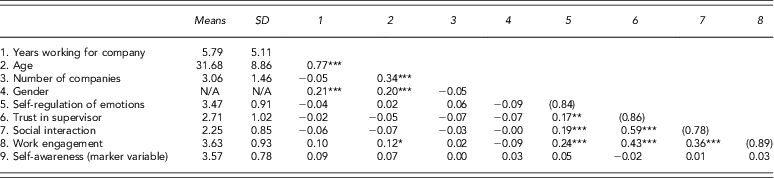
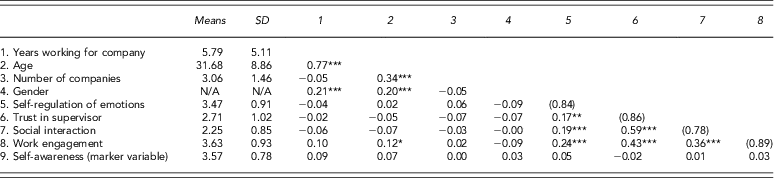
The means, standard deviations, and correlations for our key variables appear in Table 1. All of the zero-order bivariate correlations trended in the expected directions.
Means, standard deviations, correlations, and reliabilities
Notes. N = 296.
***p < .001; **p < .01; *p < .05.
Regression analyses
We tested our hypotheses using hierarchical ordinary least squares regression. In our regression analysis, we controlled for the age and gender of respondents, the total number of years spent working for the current company, the number of companies that respondents had previously worked for, and the current company that employs them.
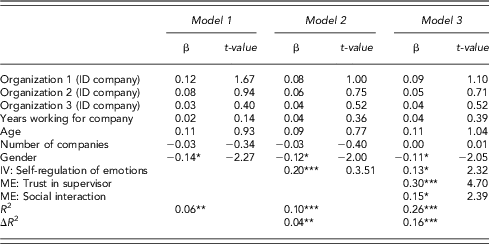
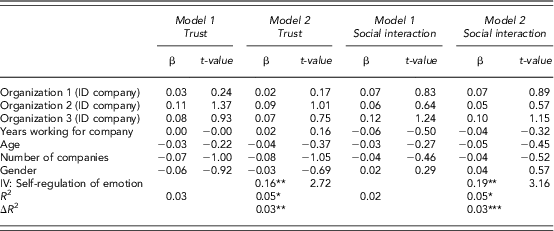
Tables 2 and 3 display the results of our regression analyses. As specified in Hypothesis 1, there was a significant positive relationship between self-regulation of emotions and work engagement (Table 2, model 2: β = 0.20, p < .001). To examine whether social resources such as trust in supervisor and social interaction mediate the link between self-regulation of emotions and work engagement, we used two statistical approaches. First, we tested whether trust in supervisor (Hypothesis 2a) and social interaction (Hypothesis 2b) mediate between the EI dimension ‘self-regulation of emotions’ and work engagement using the Baron and Kenny (Reference Baron and Kenny1986) four-step method. Step 1 showed that our independent variable is correlated with work engagement (Table 2, model 2). In all cases, the second condition was also met. More specifically, self-regulation of emotions was significantly related to trust in supervisor (Table 3, model 2: β = 0.16, p < .01) and social interaction (Table 3, model 2: β = 0.19, p < .01). In addition, the third condition was fulfilled for both mediator variables with significant relationships between trust in supervisor and work engagement (Table 2, model 3: β = 0.30, p < .001) and social interaction and work engagement (Table 2, model 3: β = 0.15, p < .05).
Results of regression analyses for work engagement
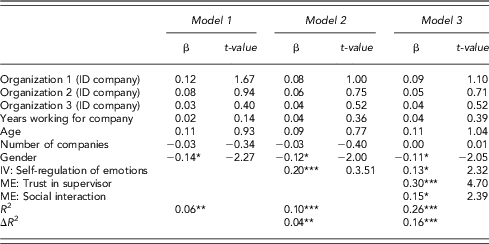
Notes. N=296; control variables are organizations 1–3, years working for company, age, number of companies, and gender.
ME=mediator.
***p < .001; **p < .01; *p < .05.
Results of regression analyses for trust in supervisor and social interaction
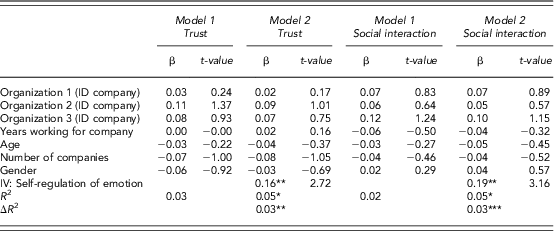
Notes. N = 296; control variables are organizations 1–3, years working for company, age, number of companies, and gender.
***p < .001; **p < .01; *p < .05.
To establish that trust in supervisor and social interaction completely mediate the relationship between self-regulation and work engagement, the effect of self-regulation of emotions on work engagement should be zero when both social resources are controlled for. This was not the case, but because the first three conditions were met, we concluded that there was partial mediation. In addition, we used the Arioan version of the Sobel test (Baron & Kenny, Reference Baron and Kenny1986) to assess distal mediation (MacKinnon, Lockwood, Hoffman, West, & Sheets, Reference MacKinnon, Lockwood, Hoffman, West and Sheets2002). One-tailed tests again found statistical evidence to suggest that trust in supervisor (Aroian test statistic=2.30, p < .01) and social interaction (Aroian test statistic = 1.86, p < .05) mediate an indirect relationship between the self-regulation of emotions and work engagement.
One of the issues with the Sobel test for mediation (1992) is that it assumes a normal distribution of the indirect effect. Yet, as Edwards and Lambert (Reference Edwards and Lambert2007) point out, an indirect effect is not normally distributed even though the variables constituting the indirect effect are normally distributed. Hence, the bootstrapping approach developed by Preacher and Hayes (Reference Preacher and Hayes2004) may provide a better alternative to test mediation because it generates confidence intervals that help researchers avoid the power problems caused by asymmetric and other non-normal sampling distributions of an indirect effect. As Table 4 indicates, the results based on bootstrapping are statistically significant with a 95% confidence interval around the indirect effect not containing zero, extending the results presented earlier regarding simple mediation based on Baron and Kenny's approach (Reference Baron and Kenny1986). These findings indicate that both trust and social interaction mediate the relationship of self-regulation with work engagement.
Bootstrapping results for indirect effects (simple mediation)

DISCUSSION
To gain a better understanding of how organizations can infuse positive attitudes and encourage motivation among their employees (Luthans & Avolio, Reference Luthans and Avolio2009), we have investigated the relationship between self-regulation of emotions, social resources such as trust in supervisor and social interaction and work engagement of followers. This study thereby recognizes the contributions that a specific self-regulatory mechanism like regulation of emotions, which has received relatively little prior attention, can make in fostering a highly motivated workforce (Bakker et al., Reference Bakker, Shimazu, Demerouti, Shimada and Kawakami2011). Furthermore, we investigated the mediating role of social resources in translating self-regulation of emotions into enhanced work engagement. Taken together, this study is among the first to highlight the significance of social resources in mediating the relationship between emotion regulation and work engagement. Overall, this inquiry is an attempt to bring greater nuance to our understanding of the combined influence of personal and social resources on work engagement.
We extended the typical reach of COR Theory (Hobfoll, Reference Hobfoll1989, Reference Hobfoll2002), which has mainly been used in stress literature, by using it as a unifying framework to explain the relationships between our key variables. Consistent with Hobfoll's COR Theory (2002), resources tend to act in caravans. That is, people with existing resources amplify their other resource categories, which make them less vulnerable to external challenges. In support of our hypotheses, our analyses suggest that self-regulation of emotions has both positive direct and indirect effects on work engagement through ‘trust in supervisor’ and ‘social interaction.’ The findings of our study show that self-regulation of emotions is not only an important personal resource for work engagement, but also strongly correlates with the social resources of trust in supervisor and social interaction. These observations are in support of previous studies that found evidence of a positive influence of personal and social resources on work engagement (Hakanen, Schaufeli, & Ahola, Reference Hakanen, Schaufeli and Ahola2008; Xanthopoulou et al., Reference Xanthopoulou, Bakker, Demerouti and Schaufeli2009a, Reference Xanthopoulou, Bakker, Demerouti and Schaufeli2009b; Tims, Bakker, & Xanthopoulou, Reference Tims, Bakker and Xanthopoulou2011). Finally, the results are also in support with one of the main premises of perceived organizational support in that positivity ensuing from high-quality relationships with supervisors (trust in supervisor and social interaction) unlocks and elevates new resources in individuals – here in the form of work engagement – so that individual, group, and organizational capabilities are broadened and capacity is built and strengthened (Dutton & Sonenshein, Reference Dutton and Sonenshein2009).
Limitations
This study has several limitations that warrant attention. For example, the study is based solely on self-reported data, which is known to have certain limitations such as common method bias (Podsakoff et al., Reference Podsakoff, MacKenzie, Lee and Podsakoff2003). The general and automatic condemnation of cross-sectional self-report methods, however, have been found exaggerated (Lindell & Whitney, Reference Lindell and Whitney2001; Spector, Reference Spector2006) to the extent that it may have become a methodological urban legend (Spector, Reference Spector2006). In fact, Conway and Lance (Reference Conway and Lance2010) note that studies drawing from self-reported data can be valuable if steps are taken to minimize the potential for common method variance. We relied on different procedures to minimize these effects: anonymity was established to reduce evaluation apprehension; unambiguous items were used; reliability and construct validity information for measures was provided; items measuring different concepts are spread throughout the questionnaire; and an electronic questionnaire was used that prevented respondents from going back to previous pages and editing answers once they had entered a new page. These design procedures may all have contributed to diminish effects of common method variance (Podsakoff et al., Reference Podsakoff, MacKenzie, Lee and Podsakoff2003). Finally, to test whether or not our conclusions in this study were influenced by common method variance, we employed Lindell and Whitney's (Reference Lindell and Whitney2001) marker variable technique. We used self-awareness insight (a 3-item measure) as the theoretically unrelated marker variable, and then partialled out its effects from the relationships among the focal constructs. Using Olkin and Finn's (Reference Olkin and Finn1995) significance test, no partial correlations were found to be significantly smaller than the corresponding zero-order correlations, in rejection of the presence of common method bias. Thus, although our data collection technique was not ideal, our conclusions were apparently not influenced by method variance. However, we still acknowledge the limitation of the correlational nature of the research design.
Another potential limitation of this study pertains to the character of work engagement (our dependent variable) and how we measured it. Given that work engagement is a mental state, it reflects how an individual feels about him/herself and the work context at a certain point in time. In contrast to traits or individual dispositions, states are less stable and may fluctuate over short periods of time (Xanthopoulou et al., Reference Xanthopoulou, Bakker, Demerouti and Schaufeli2009b). In the light of this, work engagement is likely to be subject to changes in the work environment (Sonnentag, Reference Sonnentag2003). As a result, if the state-related character of work engagement is to be captured, it needs to be measured in a multiple wave or longitudinal manner. Owing to limited resources, we were constrained to a cross-sectional study design that captured data from a single source.
Practical implications
This research provides important guidelines for companies and HR professionals, with regard to the need to build an engaged employee base in their organizations. The development of an engaged workforce increasingly has become a priority for human resource practitioners, who note the effective contributions of high engagement levels to enhanced customer satisfaction ratings and superior financial performance (Ketter, 2008). Credible and meaningful guidance for HR professionals must be based on sound empirical evidence (Shuck & Wollard, Reference Shuck and Wollard2010). Yet, even as many organizations try to promote engagement among their employee base, a shortage of theory-driven studies are available to inform organizations about how to realize this objective (Shuck et al., Reference Shuck, Ghosh, Zigarmi and Nimon2013).
This study explicates two critical enablers of work engagement: self-regulation of emotions and social resources. First, where previous research has been concerned with crafting the right context that fosters the development of work engagement (Bakker et al., Reference Bakker, Shimazu, Demerouti, Shimada and Kawakami2011), this study shows that the characteristics of employees may also be important in shaping their work engagement. For example, the positive relationship between the self-regulation of emotions and work engagement inclines us to suggest that interventions should not only occur at the work-group level and focus on the empowerment of positive high quality relationships with supervisors, but that they should also include individual-level intervention programs aimed at building the self-regulatory capabilities of employees (Bakker et al., Reference Bakker, Shimazu, Demerouti, Shimada and Kawakami2011). For example, Cherniss and Goleman (Reference Cherniss and Goleman2001) provided an overview of different training methods that might be deployed to improve self-regulation of emotions.
In addition to introducing training programs to enhance self-regulation of emotions, management may also consider hiring employees with strong emotion regulation capabilities (Jacobs, Reference Jacobs2001). By recruiting employees with strong emotion regulation, the positive energy that characterizes these employees activates not only improve work engagement, but will also get channeled into more positive relationships with supervisors, for example, trust in supervisor and social interaction, which in turn leverage the resources or energy required to activate the positive emotional attachment that employees might have toward their work.
Future research
This paper only emphasized the impact of affective motivational self-regulation on work engagement. Future research would benefit from examining its incremental predictive value by controlling for the cognitive aspects of self-regulation such as self-efficacy and self-esteem. Although some studies have examined the impact of self-efficacy and self-esteem on work engagement (Xanthopoulou et al., Reference Xanthopoulou, Bakker, Demerouti and Schaufeli2009a,Reference Xanthopoulou, Bakker, Demerouti and Schaufeli2009b; Tims, Bakker, & Xanthopoulou, Reference Tims, Bakker and Xanthopoulou2011), none of these studies has accounted for the combined effects of cognitive and affective self-regulation.
Another significant finding of this study was that people are able to craft their social resources through the self-regulating mechanism of emotion regulation. The process by which employees initiate changes in their job resources and job demands is called ‘job crafting’ (Wrzesniewski & Dutton, Reference Wrzesniewski and Dutton2001) and mainly addresses how certain job resources can be mentally (re)designed to boost work engagement (Tims, Bakker, & Derks, Reference Tims, Bakker and Derks2012). This area of research is relatively new, making our findings very promising in the sense that personal resources could be an important mechanism for shaping job resources. Despite the findings of our model, and given that the current design did not allow for a more robust test of the resource caravans principle, we would like to propose that future research should also consider the possibility of reciprocal relationships between personal and job resources (Xanthopoulou et al., Reference Xanthopoulou, Bakker, Demerouti and Schaufeli2009a).
Acknowledgements
We would like to acknowledge the valuable feedback provided by Stephen Teo and the anonymous reviewers in preparation of this manuscript.
Appendix
Trust in Supervisor (Social Resources)
1. My supervisor(s) can always be trusted to do what is right for me.
2. My supervisor(s) always keep(s) the promises they make to me.
3. My supervisor(s) are perfectly honest and truthful with me.
4. My supervisor(s) are truly sincere in their promises.
Social Interaction (Social Resources)
1. My supervisor(s) would not take advantage of me, even if the opportunity arose.
2. I spend significant time together with my supervisor(s) in social situations.
3. I maintain close social relationships with my supervisor(s).
4. I know my supervisor(s) on a personal level.
5. My relationship with my colleagues is very informal.
Self-Regulation of Emotions
1. I am able to control my temper and handle difficulties rationally.
2. I am quite capable of controlling my own emotions.
3. I can always calm down quickly when I am very angry.
4. I have good control of my own emotions
Work Engagement
1. At my work, I feel bursting with energy.
2. At my job, I feel strong and vigorous.
3. I am enthusiastic about my job.
4. My job inspires me.
5. When I get up in the morning, I feel like going to work.
6. I feel happy when I am working intensely.
7. I am proud of the work that I do.
8. I get carried away when I am working.
9. I am immersed in my work.