Federalist enforcement machinery ground out at least seventeen verifiable indictments. Fourteen were found under the Sedition Act, and three were returned under the common law … .
James Morton SmithFootnote 1A spate of recent books, and even a smash Broadway musical (Hamilton), have celebrated the Federalist Party for state-building, active government, decisive leadership, forward-looking plans, and other political virtues. However, the rehabilitation of the Federalists cannot succeed without successfully confronting the Alien and Sedition Acts, which the Hamiltonian Federalists sponsored and which the recent books tend to speak softly about (and to which the musical does not give a song).
The Sedition Act of 1798 was increasingly viewed as the Achilles’ heel of the Federalists, with its criminalization of “writing, printing, uttering or publishing any false, scandalous and malicious writing or writings against the government,”Footnote 2 and with the usual list of fourteen prosecutions under it of newspaper editors and other individuals. But what if there were more than twice as many people prosecuted; what if the Federalists had a second Achilles’ heel?
The controversy over the Sedition Act involved whether the First Amendment's protections were narrow or broad, and brought into conflict two contradictory views of freedoms of press and speech. The narrow view, most forcefully stated by Sir William Blackstone and Lord Chief Justice Mansfield, was that “liberty of the press … consists in laying no previous restraints upon publications, and not in freedom from censure for criminal matter when published” (seditious libel).Footnote 3 That view also was that liberty of speech similarly left criticism of government unprotected (seditious words).Footnote 4 The Sedition Act was interpreted to prohibit both. That narrow view was adopted by a number of the United States Supreme Court justices as they presided over prosecutions under the Sedition Act during 1798–1800, although it had not been adopted by any of them before.Footnote 5 The opposing liberal view, articulated by James Madison and Thomas Jefferson in the Virginia and Kentucky Resolutions during the crisis of 1798, was that liberties of press and speech were mockeries if they did not protect criticism of government and protect against subsequent restraints such as seditious libel prosecutions.Footnote 6
The stakes in the controversy went well beyond the Sedition Act and the First Amendment and a right to criticize government. They included whether Americans had a right to publish opposition newspapers and to establish an opposition party, and the outcome of the nation's first effort to suppress that opposition. They included the growth of the nascent political parties toward maturity, the Federalist loss of power to the Republicans in the election of 1800, and America's first peaceful transfer of political power between parties. The stakes in the controversy also included provoking Republican thought to articulate a liberal view of First Amendment freedoms, and stimulating thought about the proper response to an administration's violation of the Constitution.
The Canon of Recognized Prosecutions and the Suspicions of Additional Ones
In those partisan prosecutions, beginning even before the Sedition Act took effect, the leading Republican newspaper editors in America's two largest cities, Benjamin Franklin Bache of Philadelphia's Aurora, and John Daly Burk and James SmithFootnote 7 of New York's Time Piece, were arrested and charged with seditious libel under federal common law. Shortly after the Sedition Act was signed by President John Adams,Footnote 8 the owners or editors of three more Republican newspapers were prosecuted: Congressman Matthew Lyon, owner of a Vermont newspaper,Footnote 9 Thomas Adams, editor of Boston's Independent Chronicle, and William Durrell, editor of the Mount Pleasant Register in New York.Footnote 10 Also prosecuted were supporters of a liberty pole (called a “sedition pole” by most Federalists), Benjamin Fairbanks and David Brown in Dedham, Massachusetts,Footnote 11 and tavern critics of President Adams, Luther Baldwin and Brown Clark in Newark.Footnote 12 Then a lull in prosecutions occurred until mid-1799, as the deadline approached for filing cases in order to reach trial before the elections of 1800, when four more prosecutions were launched of Republican newspaper editors: William Duane, Bache's successor at the Philadelphia Aurora,Footnote 13 Ann Greenleaf of the New York Argus,Footnote 14 Charles Holt of the New London Bee, and Anthony Haswell of the Vermont Gazette;Footnote 15 in addition to prosecution of a state legislator, Jedidiah Peck, for circulating petitions denouncing the Sedition Act as unconstitutional.Footnote 16 Finally, in the spring of 1800, Justice Samuel Chase turned his circuit ride into a search and destroy mission for sedition, leading to indictments and trials of two more editors and writers: Thomas Cooper of the Northumberland Gazette, Footnote 17 and James T. Callender for his book The Prospect Before Us.Footnote 18
Those three common law seditious libel prosecutions and fourteen Sedition Act prosecutionsFootnote 19 are the canon of prosecutions discussed in the three booksFootnote 20 and various chapters and articles about,Footnote 21 and the briefer discussions of the Sedition Act.Footnote 22 Recent scholars generally continue to describe only those prosecutions,Footnote 23 and to number approximately fourteen Sedition Act prosecutions and three common law ones.Footnote 24
However, there has always been a suspicion that there may have been at least a few additional prosecutions.Footnote 25 Republican newspaper articles in late 1799 referred to twenty-two prosecutions (without identifying most).Footnote 26 Frank Anderson, in the earliest study of the Sedition Act, after noting between fifteen and seventeen indictments, said that there were “about 24 or 25 persons arrested” (also without identifying the additional ones),Footnote 27 an estimate that is periodically quoted (although the additional arrestees are still not identified).Footnote 28 In the leading book on the Sedition Act, James Morton Smith devoted a page to possible cases (mentioned in partisan newspapers or letters) that he was “unable to track down” and confirm, despite his prodigious scholarship on the Act. He listed the possible cases of “Editor Schneider,” Benjamin Mayer and Conrad Fahnestock, Judah Spooner, “Dr. Shaw,” James Bell, Dr. John Tyler, Dr. John Vaughn, and “a person identified only as Lespenard.”Footnote 29 Julius Goebel identified Shaw as Dr. Samuel Shaw of Vermont, with a footnote citation to federal court records, though he only devoted a sentence to the case in his seminal history of the early Supreme Court.Footnote 30 Maeva Marcus identified Lespenard as Lespenard Colie, citing court records.Footnote 31 Phillip Blumberg, noting that all those cases (except Shaw) were still “unconfirmed cases,” recently gave a useful five page summary of what was known about them from Smith's sources and some additional newspaper references.Footnote 32
Surprisingly, no one thoroughly combed through the unpublished papers of Timothy Pickering, the secretary of state during most of the years the Sedition Act was in force,Footnote 33 who was the official in charge of its enforcement.Footnote 34 Although a dozen of his letters about recognized cases, which appeared in an index to the Pickering papers, were regularly cited, another dozen dealing with recognized cases were never cited, nor were eighteen letters dealing with the additional cases, attempted indictments, and instructions to prosecute that are discussed in this article.
Further, no one writing about the Sedition Act noted that the case reports of the Fries RebellionFootnote 35 trials referred to the nontreason cases as generally being brought under the Sedition Act,Footnote 36 or that the unpublished federal court records confirmed that all of the nontreason Fries cases were brought under the act.Footnote 37 Those federal court records show that four of the Fries Rebellion prosecutions were brought under Section 2 of the Sedition Act (criminalizing “writing, printing, uttering or publishing any false, scandalous and malicious writing or writings against the government,” Congress, or the president), and that the remaining nontreason prosecutions were brought under Section 1 of that Act (criminalizing conspiracies and combinations “to oppose any measure or measures of the government” or, among other things, to “counsel, advise or attempt to procure any … unlawful assembly, or combination … .”). Four Fries Rebellion scholars did briefly point out that conspiracy charges against Fries rebels used the statutory authority of the Sedition Act,Footnote 38 something that “historians previously have overlooked;”Footnote 39 however, those observations were not picked up in Sedition Act writings. The first of those Fries Rebellion authors, Dwight Henderson, devoted a page of his article to mentioning Langford Herring, Jacob Eyerman, Morris Llewellyn and codefendants, and Benjamin Mayer and Conrad Fahnestock, without tying their cases to the Sedition Act.Footnote 40 The second, Paul Newman, in the leading book on the Fries Rebellion, devoted a page to mentioning the Benjamin Mayer/Conrad Fahnestock case and the Morris “Schwelein” et al. case as involving sedition, although not the Sedition Act, and the Jacob Eyerman case as involving the Sedition Act, without a specific citation.Footnote 41 Two other Fries Rebellion authors, Whitman Ridgway and Robert Churchill, although not mentioning any specific Sedition Act cases, noted in single sentences that some prosecutions used Section 1 of that act, and observed that it was “normally not associated with the Northampton Insurrection” by historians.Footnote 42 Apart from those scholars, subsequent discussions of the Fries Rebellion joined earlier onesFootnote 43 in silence on any involvement of the Sedition Act.Footnote 44
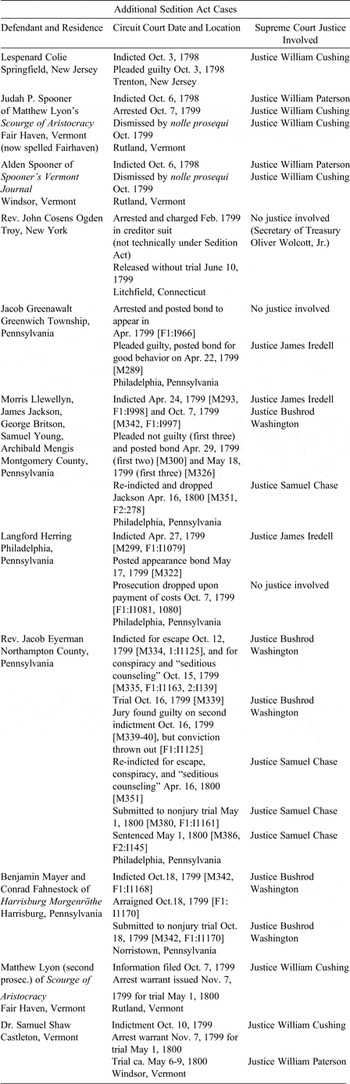
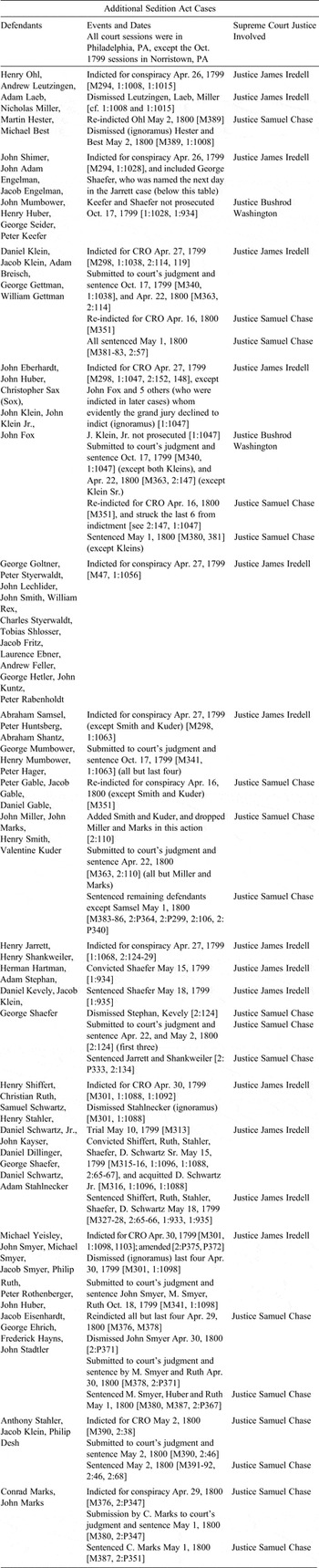
More than half of Smith's unconfirmed cases, four other prosecutions, and three other Henderson–Newman references, in addition to eleven other Fries Rebellion cases, should now be deemed confirmed and added to the canon of Sedition Act prosecutions. The test for confirmation is support in federal court records or prosecutor records, and those records have been located to confirm the prosecutions discussed in the next two parts. The prosecutions in the first of those parts (Table 1) were brought under the Sedition Act's second section criminalizing spoken or printed words, whereas those in the second of those parts (Table 2) were brought under the act's first section criminalizing unlawful conspiracies and combinations to oppose federal laws or to counsel, advise, or attempt that. All were in federal circuit court, where an individual Supreme Court justice presided with a district court judge, except the de facto case against John C. Ogden. In addition, attempted indictments in at least three other cases, and instructions to prosecute in at least six other cases (involving eight individuals) under the Sedition Act, can be documented, as discussed in the following two parts (Tables 3 and 4).
Prosecutions for Seditious Words Under Sedition Act § 2

Bracketed citations beginning with F refer to Criminal Case Files of the United States Circuit Court for the Eastern District of Pennsylvania, 1791–1840 (National Archives, Philadelphia Record Group 21, microfilm M986, rolls 1 and 2); 1: or 2: refers to the microfilm roll; the stamped page number is used (indicated by P) for the pages that contained one (2:277–379), and the microfilm image number is used otherwise (indicated by I), as no continuous number appears on those pages.
Bracketed citations beginning with M refer to Original Minutes of the Circuit Court of the United States of America for the Middle Circuit, October Session 1790 to April 1799 (National Archives, Philadelphia Record Group 21, microfilm M932, roll 1); the stamped page number is used rather than the handwritten page number (which restarts with 1 for every yearly term).
Prosecutions for Opposing Government Under Sedition Act § 1

Abbreviations are the same as in Table 1. CRO refers to charges of conspiracy, rescue, and obstruction.
These additional cases show other victims during the crisis of the First Amendment in 1798–1801, and demonstrate that Sedition Act prosecutions, and accompanying chilling of First Amendment rights, occurred on more than twice the scale previously understood.
Eleven Additional Cases under the Sedition Act for Spoken or Written Words
In addition to the canon of seventeen familiar prosecutions, there were eleven additional cases prosecuting sixteen defendants, who were alleged, under the Sedition Act's second section, to “write, print, utter or publish, … or knowingly and willingly assist or aid … any false, scandalous and malicious writing or writings against the government of the United States, or … Congress … or the President … , with intent to defame” them. Those eleven additional cases are listed in Table 1.
Lespenard Colie: Seditious Words “Damning the President” and Supporting the French
When Luther Baldwin was charged under the Sedition Act for wishing that celebratory cannon fire had hit President Adams’ posterior, and Brown Clark was charged for joining in that wish, there was a third defendant who Smith said was “identified only as Lespenard.” He remained missing from academic writings about the Sedition Act until he was identified as Lespenard Colie by Maeva Marcus in the Documentary History of the Supreme Court, based on court records.Footnote 45 Colie's case still remains missing elsewhere.
Hannah Cushing, the wife of Justice William Cushing, accompanied his circuit ride and sat in the New Jersey courtroom when the grand jury found a third indictment “for seditious words,” and when that third person pleaded guilty, as she told Abigail Adams 5 days later. That defendant, Lespenard Colie, said “some what like this—that if the French came he would join them & fight for a shilling a day, & would deliver up any that were inimical to them—& for D_____g the P________ &c.”Footnote 46 Justice Cushing had opened court with a rousing grand jury charge, warning that it is not “possible for any free government to stand the shock of such perpetual, inveterate, malicious, hostile attacks” as unceasing calumnies, and that seditious libel is “a dangerous offence in all societies” and is not allowed by liberty of the press “unless the liberty of the press comprehends a right to print and propagate scandalous and malicious falsehoods, to the injury of the public.”Footnote 47 Under his charge, free government could not stand if people were “damning the President.”
The 1798 court records confirm that Colie initially pleaded not guilty, but immediately withdrew that plea and pleaded guilty. Cushing imposed a $40 fine, plus court costs, but did not impose a prison sentence, other than leaving Colie “committed until the fine and costs are paid.”Footnote 48 That was one of the only three Sedition Act sentences that did not require imprisonment (along with those of Luther Baldwin and Brown Clark, in the same court), and the second-lightest fine after that of Benjamin Fairbanks, although it was the only Sedition Act prosecution of a French citizen or ex-citizen in an era of widespread Gallophobia.Footnote 49 News coverage took two and a half months to appear, when a New Jersey Republican newspaper listed “Mr. Colie of Springfield” among the individuals who had been arrested under the Sedition Act.Footnote 50 It said nothing more.
Judah P. Spooner, Printer of the Scourge of Aristocracy: Publishing the Barlow Letter Criticizing the Government
The twelve prosecutions of newspaper editors and printers, among the recognized seventeen prosecutions, were not the only such prosecutions. Prosecutions can also be confirmed of Judah P. Spooner, printer of the Scourge of Aristocracy and of Republican pamphlets; Alden Spooner of Spooner's Vermont Journal; Benjamin Mayer and Conrad Fahnestock of Harrisburg Morgenröthe; and Matthew Lyon in an unrecognized second prosecution.
Judah P. Spooner was a printer who had established the first newspaper in Vermont, the Vermont Gazette, in 1778. In the mid-1790s, he moved to Fairhaven and printed the Farmer's Library, until it ended in April 1798.Footnote 51 His print shop also printed almanacs and pamphlets as he had opportunity, although on a very limited basis compared with his brother, Alden Spooner.Footnote 52 In mid-1798, he began printing a new newspaper, Matthew Lyon's colorfully named Scourge of Aristocracy. Footnote 53
Period newspapers reported that its printers, Judah P. SpoonerFootnote 54 and also James Lyon,Footnote 55 were arrested and indicted under the Sedition Act. However, the leading historian of the Sedition Act concluded that “there seems to be no basis for these assertions,”Footnote 56 and historians have not disagreed. To the contrary, court records establish an indictment and arrest of Spooner.
Judah P. Spooner was indicted in October 1798,Footnote 57 although he was not arrested for trial until a year later, for violating the Sedition Act by printing a “seditious libel entitled Copy of a letter from an American diplomatic character in France to a member of Congress.” That was the letter from Joel Barlow in Paris that was the second ground for indicting Republican Congressman Matthew Lyon a day earlier. That letter was alleged to “defame the government of the United States, and John Adams, and … one house of the Congress” by calling Adams’ speech about France's rejection of the new American ambassador a “bullying speech,”Footnote 58 and the Senate's response to him a “stupid” one with more “servility” than Parliament ever showed to George III. Barlow's letter went on to say that the people of France instead expected the Senate's response to be to send Adams “to a madhouse.”Footnote 59 Although Benjamin Franklin had once said that Adams was “always an honest man, often a wise one, but sometimes, and in some things, absolutely out of his senses,”Footnote 60 such sentiments would have been criminal in the era of the Sedition Act. Spooner's indictment was sparingly reported in October 1798, but then was extensively reported in October 1799 as a new event, when he was arrested.Footnote 61 During the week and a half court term in October 1799, the government entered a nolle prosequi of the case, with the consent of Justice Cushing.Footnote 62 The reason for the dismissal appears to be Spooner's identification of the role of Dr. Samuel Shaw, and willingness to testify in his later trial, as is suggested subsequently in the discussion of the Shaw case.
James Lyon was not in fact indicted, Spooner's brother was, in a separate case for a separate offense.
Alden Spooner: Publishing Matthew Lyon's Letter in Spooner's Vermont Journal
Alden Spooner also co-founded a newspaper, the Vermont Journal, in 1783, and was its sole editor from 1788 through 1817, until just before he retired.Footnote 63 By the late 1790s, it was a strongly Republican voice.
Spooner was indicted the same day as his brother in October 1798 for violation of the Sedition Act, for his separate publication in his separate newspaper (in Windsor, Vermont) of a different article,Footnote 64 a prosecution that has never been mentioned in Sedition Act publications, but is confirmed in federal court records. What he published in Spooner's Vermont Journal was Matthew Lyon's own letter criticizing the president, which was the first ground for indicting the congressman the day before (notwithstanding that the letter had been written 3 weeks before passage of the Sedition Act). That letter lamented that President Adams caused every consideration of public welfare to be “swallowed up in a continual grasp for power, in an unbounded thirst for ridiculous pomp[,] foolish adulation or selfish avarice.”Footnote 65 That fell within the Sedition Act's prohibition of any writing, printing, uttering, or publishing against the president.
Spooner, like his brother, was arrested a year later, as a few newspaper articles reported in a single sentence.Footnote 66 However, his case too was dismissed by a decision not to prosecute in October 1799.Footnote 67 The likely reason is that he agreed to testify that Lyon wrote the letter, if Lyon was later found in Vermont and arrested under his second prosecution that began the same month.
Rev. John C. Ogden: Delivering Petitions Supporting Matthew Lyon During His Imprisonment
(A Case Tantamount to a Sedition Act Prosecution, but Not Technically under the Act)
Rev. John Cosens Ogden, then of Troy, New York, was an Episcopal ministerFootnote 68 and ecclesiastical critic of the Federalist clergy of New England, whom he called the “New-England Illuminati,”Footnote 69 and of the Federalists generally. Although his arrest was not explicitly under the Sedition Act, it must be considered whether the arrest was a de facto Sedition Act arrest because it was ordered by Secretary of the Treasury Oliver Wolcott, Jr. immediately after Ogden delivered petitions to President Adams on behalf of Representative Matthew Lyon, the first person brought to trial under the act, asking for Lyon's release and censuring the act.Footnote 70 The arrest for debt avoided the indelicacy of arresting Ogden for “seditious” petitions, in view of the First Amendment freedom of petition, and also avoided the need to wait for the next sitting of the federal circuit court. Ogden had compounded his transgressions, in Federalist eyes, by writing essays on Lyon being subjected to “tyranny” and “dragged … as the first victim to the altar of the sedition law,” being subjected to barbarity by “an inhuman federal marshal,” suffering in an unheated cell with open windows during the frigid Vermont winter, and suffering wrongful conviction through judicial bias.Footnote 71 James Morton Smith devoted a page to Ogden's mission and arrest, although he did not treat it as tantamount to a Sedition Act prosecution.Footnote 72 However, there is much reason to believe that it was, when additional facts are considered.
Ogden's own account was that he carried to the president “the petitions of the people of the western district of Vermont in behalf of Colol. Lyon,” leaving Adams “offended at my interference,” and that in “revenge” for the mission “Oliver Wolcott … has cast me into prison for a small sum due honestly to him.”Footnote 73 Ogden wrote to Jefferson from “Litchfield prison” about “my embassy in support of Colol. Lyon,”Footnote 74 and Jefferson had already written to Madison that “a petition has been presented to the President signed by several thousand persons in Vermont, praying a remitment of Lyon's fine,” which Adams had rejected.Footnote 75
The Aurora published the first Republican account, reporting that “Rev. J.C. Ogden, who some time ago presented a petition from Matthew Lyon's constituents to the President of the United States, upon his return to Litchfield in Connecticut, has been arrested by a Mr. Woolcot, and put into prison for a demand of 200 dollars!”Footnote 76 Other Republican newspapers reprinted the article.Footnote 77 The Gazette of the United States published the first Federalist account, countering that Ogden was “imprisoned in Litchfield for debt,” as one of the “martyrs to Jacobinism” and an “idle vicious spendthrift,”Footnote 78 and other Federalist newspapers replaced that invective with sarcastic acknowledgments that Ogden was returning from “the pious errand of carrying Lyon's petition to the President.”Footnote 79 Thus, there was agreement on the petition, the arrest, and the imprisonment.
Ogden's arrest and 4 month imprisonment in Litchfield, Connecticut are confirmed by court records, which have not been heretofore located, and by Wolcott's own correspondence. Wolcott arranged for his brother, Frederick, a Litchfield attorney and clerk of the court, to arrest Ogden and to jail him for nonpayment of the old debt, listing Oliver Wolcott, Jr. in the court filings as plaintiff.Footnote 80 Frederick advised his brother to leave the “vile, lying rascal” in prison, and, noting that Ogden may take “the poor prisoner's oath” which would avoid having to pay for jail room and board, asked “whether it be your wish that I support him in prison” by paying Ogden's jail charges.Footnote 81 The secretary of the treasury obviously approved, because Frederick paid those costs.Footnote 82 Ogden entered the jail before February 12, 1799, and remained there until his release on the June 10.Footnote 83 Ogden devoted his time in jail to flaying the area's Federalist clergy and challenging Connecticut's debtor laws,Footnote 84 and to describing the squalor of one of his cells,Footnote 85 while remarking ironically about Wolcott paying for his lodging in jail. Federalist papers confirmed the continued imprisonment, as the Gazette of the United States stated that “[t]he clerical lunatic, confined in Litchfield jail, for money squandered away, is week after week filling the pages of ‘the Humbug’ with his soporific lucubrations.”Footnote 86 Not surprisingly, attorney Frederick Wolcott obtained a judgment against Ogden for $187.50, signed by clerk of the court Frederick Wolcott (his other vocation), while Ogden was in jail without legal defense.Footnote 87 Frederick Wolcott later got Ogden to sign a new demand note for that amount, on June 10, 1799 in order to be released that day, which meant that “unless he, immediately quit this part of the country I will again attach and confine him.”Footnote 88 The few scholars mentioning it have accepted the substance of this account; that Ogden delivered the Sedition Act petitions, and that Wolcott promptly arranged for his arrest.Footnote 89
The connection between Ogden's mission delivering petitions supporting the first notable Sedition Act victim and opposing the act itself, and his arrest, is strongly supported by circumstantial evidence.Footnote 90 The Wolcott debt was 14 years old,Footnote 91 and Wolcott had not taken any action on it until Ogden's mission, although Ogden was periodically in Connecticut because his family continued to live there; but then Wolcott took immediate legal action when Ogden set forth on his return trip from delivering the petitions for Lyon. Moreover, Wolcott was willing to pay $76 and then additional jail costs,Footnote 92 to jail Ogden for an obviously uncollectible debt of ₤60 (in “soldiers notes”) plus interest; his brother Frederick confirmed it was uncollectible.Footnote 93 Further, reports about Ogden “plotting against his country” were being sent by others to Secretary of State Timothy Pickering.Footnote 94 Republican newspapers certainly saw it as a de facto prosecution under the Sedition Act: “This confinement was undoubtedly preconcerted in Philadelphia, on the part of Mr. Secretary” Wolcott, Federalist members of Congress, and “Mr. Pickering,” primarily “for delivering the petitions … in behalf of Col. Lyon” for pardon from his Sedition Act sentence.Footnote 95 It is difficult to see the prosecution for the old debt as anything else, because Ogden had long been a penniless itinerant minister, quite unlikely ever to have funds to pay the debt.
Jacob Greenawalt: Speaking against the Government by Speaking against Taxes
The Sedition Act prosecutions for seditious words, as contrasted with seditious publications, were not limited to Matthew Lyon (for reading the Barlow letter in a speech), David Brown (for itinerant speeches), Luther Baldwin and Brown Clark (for wishing a cannon salute had hit the posterior in chief), or liberty poles. They also included cases for seditious words against Lespenard Colie, Jacob Greenawalt, and, as will be discussed, Langford Herring and Rev. Jacob Eyerman.
When prosecution of Fries Rebellion participants began, Jacob Greenawalt of Greenwich Township, PennsylvaniaFootnote 96 was arrested under the Sedition Act and required to appear in federal circuit court in April 1799. The case has not appeared in Sedition Act discussions because his arrest was buried in the recognizance bond book in the federal court records, where his arrest was “to answer” as a defendant.Footnote 97 Greenawalt appeared as required, and evidently pled guilty, because his next entry in the court records showed him posting a bond for good behavior, personally of $2,000 and by two friends each of $1,000, to last a year.Footnote 98
His offense was threatening to tie the tax assessor “fast to the liberty pole, and keep him there till he gave an account of the money or duties they had paid on stills,” and asserting that the assessor improperly “spent the excise money on drink, or on idle women.” Moreover, Greenawalt declaimed that there were “nothing but mean & dirty ragamuffins for officers in government,” presumably referring to tax assessors and excise officers.Footnote 99 His outburst apparently occurred in January 1799.Footnote 100 It was deemed to amount to speaking “against the government of the United States, or either house of the Congress …” in violation of the Sedition Act.
Morris Llewellyn, James Jackson, George Britson, Samuel Young, and Archibald Mengis: “Seditious Combinations” in Raising a Liberty Pole and Challenging the Constitutionality of the Sedition Act
The Sedition Act prosecution of Benjamin Fairbanks and David Brown for raising a liberty pole in June 1799 turns out not to be the only one for that “heinous an offense.” And the prosecution of Jedidiah Peck for petitioning against the constitutionality of the Sedition Act itself in September 1799 turns out not to be the only one based expressly on questioning its constitutionality.
Morris LlewellynFootnote 101 and four other individuals in Pennsylvania were presented (indicted) by a federal grand jury in late April 1799 for raising a liberty pole, with a “seditious label” on it saying “the constitution sacred, no gag law, liberty or death.”Footnote 102 That presentment alleged that erecting that liberty pole, and writing and publishing the “false, scandalous and malicious writing” on it, combined and conspired to stir up sedition and to impede the Sedition Act (the “gag law”).Footnote 103 The case was widely mentioned in newspapers as one involving “seditious combinations.”Footnote 104 The first three defendants were arraigned, and pleaded not guilty a week later, and the first two posted bonds.Footnote 105 The presiding judge, who charged the grand jury, was Justice James Iredell.Footnote 106 During the next court session in October 1799, a new presentment came from the grand jury on the same grounds, after a charge from Justice Bushrod Washington.Footnote 107 The main substantive change was to shorten the quotation of “seditious words” to just “no gag law,”Footnote 108 showing that challenging the Sedition Act was as grave a crime as raising a liberty pole (although there had been countless numbers of liberty poles during the Revolution). However, it turned out that the federal marshal's commission had expired, which voided all summonses, arrests, and court actions in the October term,Footnote 109 although Judge Richard Peters told Pickering that he and Justice Washington did “not say anything about the true reason of our breaking up” and instead gave an ambiguous reason (“an error in the proceedings”) and a pretextual reason (a “small number of jurors attending”).Footnote 110 Consequently, the defendants, except for James Jackson, were re-indicted by the grand jury on the same grounds in April 1800.Footnote 111
However, the defendants were not located by the marshal during that April 1800 court term, according to the arrest warrant,Footnote 112 doubtless to the chagrin of the presiding judge, Justice Samuel Chase.Footnote 113 Their case was not brought to trial during the October 1800 session either,Footnote 114 evidently for the same reason.
Langford Herring: “Seditious Expressions” Criticizing President Adams and the Federal Tax
The Sedition Act prosecutions against John Daly Burk and James Smith, Anne Greenleaf, and Jedidiah Peck proved not to be the only ones dismissed or suspended permanently. The prosecution of Langford Herring was also dismissed (although he had to pay costs as part of the agreement), as were those of Judah P. Spooner and Alton Spooner. Herring's case paralleled the prosecution of the Fries Rebellion participants charged with forcibly blocking assessors from determining and collecting taxes; his offense was criticizing those taxes and the president who signed them into law.
Langford Herring, of Philadelphia, was indicted for “seditious expressions” in conflict with the prohibition of the Sedition Act, by a federal grand jury in April 1799,Footnote 115 after Iredell's charge. The “seditious words” were the following: “damn the President … and all those who take his part … . I look upon him … to be an enemy to the government . . . . [T]he heavy weight of taxes particularly the stamp act is owing to his influence . . . . The law … . laying duties on stamped vellum parchment and paper has been passed and put in force to the great injury of the people …”.Footnote 116
Tracking the prohibition of the Sedition Act, Herring's words were alleged to “defame the said President of the United States and to bring him into contempt and disrepute[,] to render the laws of the said United States odious to the citizens thereof[,] and to excite opposition and resistance as well to the public acts and measures of the said President . . . .”Footnote 117
The federal attorney agreed to cease prosecuting the case, effective upon Herring's payment of costs.Footnote 118 The reasons were not given, but because that did not happen with any Fries Rebellion cases, that lenient disposition casts doubt on one author's treatment of the case as a Fries Rebellion case.Footnote 119 The indictment alleges that Herring's statements were made in December 1798, before resistance peaked or the rescue occurred, although his statements were about the challenged house tax and valuation law. An article in the leading Republican newspaper described Herring as a Philadelphia resident, not a Bucks or Northampton County resident.Footnote 120 The day after Herring's second offense that was charged in the indictment, the Aurora reported that “Lankford Heron, Brick-maker, a native of Virginia, was taken out of his house in Hickory Lane” and was brought before an alderman, “who committed him to the city gaol for damning the President, all that took his part, and [all] that wore the Black Cockade”Footnote 121 (the Federalists). Whatever happened with the city prosecution, the federal attorney's indictment was 4 months later during the federal circuit court in Philadelphia. Therefore, Herring's was a Sedition Act prosecution, but not one of participants in the Fries Rebellion.
Herring was not as fortunate the next year. He was indicted for four larcenies, and found guilty of three, if the report of the most strident Federalist newspaper can be believed.Footnote 122 They were probably not his first.Footnote 123
Rev. Jacob Eyerman: “Seditious Counseling” and a Combination and Conspiracy against the House Tax
Rev. Ogden was not alone in using his pulpit to smite the Federalist Philistines and the Sedition Act.
Rev. Jacob Eyerman, a German Lutheran preacher in Pennsylvania, exhorted his congregations and acquaintances to resist the house tax and the assessors, and branded the tax unjust and unconstitutional.Footnote 124 Nicknamed “the seditious parson of Northampton” in some press reports,Footnote 125 he was one of the tax protesters who were arrested and then escaped in the rescue of March 1799. He fled unsuccessfully to New York where he was rearrested,Footnote 126 under instructions from Pickering to arrest “the insurgent German preacher” who “wears a clerical garb to cloak his licentiousness in morals as well as politics.”Footnote 127 Consequently, he was indicted for escape, and was indicted a second time 3 days later for escape, conspiracy, and “seditious counseling,” in October 1799.Footnote 128
Describing that seditious counseling, the indictment said that Eyerman “did counsel, advise and attempt to procure an unlawful assembly and combination” to impede valuation for and collection of the house tax,Footnote 129 essentially quoting part of Section 1 of the Sedition Act, although not citing it. The prosecutor, in his closing argument, made that explicit by saying that the charge was violation of the Sedition Act.Footnote 130 In his trial only 1 day after the second indictment, Eyerman had no counsel and presented no defense, and Justice Bushrod Washington told the jury that “the proof is as clear against him as any thing can possibly be” on the combination or conspiracy, noting that many witnesses “proved” that “he was the prime cause” of resistance.Footnote 131 Not surprisingly, the jury found Eyerman guilty of all counts in only 15 minutes,Footnote 132 but the conviction had to be thrown out because of the problem of the federal marshal's commission.Footnote 133
In the next court session, Eyerman was re-indicted for escape, conspiracy, and seditious counseling, in April 1800.Footnote 134 Having been unsuccessful with the October jury, Eyerman chose to “submit to the court protesting his innocence” at the beginning of May 1800.Footnote 135 His bad luck persisted, as the presiding judge was Justice Samuel Chase. Chase sentenced him that same day to be “fined fifty dollars and imprisoned one year,” and before release to post recognizance bonds “himself in one thousand dollars and two sureties in five hundred dollars each for his good behaviour,” plus costs of prosecution.Footnote 136
Benjamin Mayer and Conrad Fahnestock: Publishing an Essay Questioning a Treason Charge
Jacob Greenawalt, Morris Llewellyn and his codefendants, and Jacob Eyerman were not the only ones during the Fries Rebellion who were charged under the Sedition Act with criticizing the government and taxes.
Benjamin Mayer and Conrad FahnestockFootnote 137 were the editors and printers of a German language newspaper in rural Pennsylvania, the Harrisburg Morgenröthe,Footnote 138 which, because of its Republicanism, was sometimes called the “Dutch Aurora.”Footnote 139 They founded the paper in March 1799, and edited it together for 5 months until Fahnestock left the partnership soon after trouble arrived.Footnote 140
They were arrested in August 1799 for publishing a “‘false, scandalous and malicious’ libel” and were required to post $4,000 bond each to assure their appearance in federal court in mid-October 1799, according to newspaper reports.Footnote 141 Soon after, they were presented by the federal grand jury,Footnote 142 presided over by Justice Washington, for publishing a newspaper essay critical of the government's prosecution of John Fries.Footnote 143
Their offending essay challenged the Fries prosecution on, among other grounds, the ground that treason is narrowly defined in the Constitution and by statute to be levying war and aiding the enemy, whereas Fries’ actions, in rescuing people arrested for noncooperation with the valuation law and the house tax, were far short of levying war.Footnote 144 Further, English law and an American statute both treated rescue of a person accused of treason as a less serious crime, not as treason, and rescue of the people accused only of obstructing assessors from entering houses and land and collecting taxes was less serious still.Footnote 145 Because Fries’ actions were far less serious than treason, his prosecution and conviction for high treason “cannot have been according to law” and “must rest on another foundation,” perhaps the “expedience” that “produced the sedition and alien bills.”Footnote 146
The indictment characterized that newspaper essay as serving “to vilify and defame the Government of the United States and the administration of justice,” by claiming they “were actuated by unlawful motives and not by the duty imposed on them by the Constitution,” and by weakening their authority and exciting opposition.Footnote 147 In other words, the indictment claimed that the essay was a seditious libel, in violation of the Sedition Act; it brought into “contempt” the “United States and the judicial courts … to the great scandal and infamy of the judges and jurors.”Footnote 148 The cover sheet to the indictment, and the court's minutes, described the crime as “libel on the administration of justice.”Footnote 149
Mayer and Fahnestock pleaded not guilty.Footnote 150 However, the same day that they were indicted they agreed to “submit to the Court protesting their innocence,” in October 1799.Footnote 151 That amounted to waiving a jury trial, and agreeing to a bench trial instead, as regularly occurred in other Fries Rebellion cases.Footnote 152 However, Justice Washington did not sentence them because of the problem with the marshal's commission, and the April 1800 session apparently did not bring their case up for sentencing either,Footnote 153 perhaps because the available days before Justice Chase had to depart for the next circuit court were consumed by the second Fries trial, the Fries rebel trials and sentencing, and more pressing cases such as the Thomas Cooper trial.
Matthew Lyon (Second Prosecution): Writing His Letter from Prison Criticizing His Trial
Matthew Lyon, who was the first person tried under the Sedition Act in October 1798, and who was carried from trial to prison for the winter, was subjected to a second prosecution a year later. That second prosecution has been unnoticed in Sedition Act studies,Footnote 154 other than Smith's footnote saying that two newspapers “reported that ‘two other bills for sedition were cut and dry for Mr. Lyon,'” but that Smith had not found any official corroboration.Footnote 155 That corroboration appears in the original federal court records.
Lyon's second prosecution was indeed filed in October 1799 under the Sedition Act (by an information, not an indictment), and was followed by an arrest warrant the next month, in federal circuit court in Vermont.Footnote 156 The basis was his letter written from jail and published the preceding January, as part of his campaign for re-election to the House of Representatives, which was characterized in the information as a seditious libel toward the government and the federal courts.Footnote 157 It inveighed against Lyons’ imprisonment by “the oppressive hand of usurped power,” the marshal heaping indignities like “a hard-hearted savage” practicing “barbarity,” the “ransom” of a $1,000 fine plus costs that the court required to be paid before Lyon would be released, and his 4 month prison sentence until “the measure of federal vengeance is filled up.”Footnote 158 His other letters from prison doubtless nettled the federal attorney and secretary of state every bit as much, as Lyon insisted that he was not guilty, that he was convicted under “unconstitutional laws,” and that “patriots of Virginia and Kentucky” were opposing them through their resolutions.Footnote 159 A large proportion of the nation's newspapers reported that re-indictment in October 1799.Footnote 160 However, Lyon was never rearrested or retried, because suspecting another indictment might be afoot, he “took care to elude the pursuit of the marshal, by leaving the state” and proceeding straight to Congress, as a number of newspapers noted.Footnote 161
Dr. Samuel Shaw: Assisting Publication of the Barlow Letter Criticizing Adams and the Senate
All the preceding Sedition Act prosecutions resulted in convictions, except the few that were dismissed because the defendant died, entered a deportation agreement, left the target newspaper, entered a plea bargain, or eluded arrest until Thomas Jefferson took office. However, there was a lone acquittal in a Sedition Act trial. The case continues to be generally listed as unconfirmed,Footnote 162 but was confirmed by Goebel.Footnote 163
Dr. Samuel Shaw was a medical doctor, who moved from Massachusetts to Castleton, Vermont in 1789, and later served in Congress from 1808 to 1813.Footnote 164
He was indicted in October 1799, 3 days after Lyon's second indictment, for seditious libel against “the Government and … President and Congress of the United States,” by “writing uttering and publishing” what the indictment identified as A Copy of a Letter from a Diplomatic Character in France to a Member of Congress in Philadelphia. Footnote 165 That was the letter from Joel Barlow that had been the second ground for indicting Matthew Lyon a year before, and that had been the basis for indicting Judah Spooner at the same time. The same extracts from the Barlow letter were cited, such as the “bullying speech” by the President, the obsequious response of the Senate, and the French surprise that Adams had not instead been sent “to a mad house.”Footnote 166 The cited version was a pamphlet reprinting the Barlow letter, and although the pamphlet did not indicate that it was published by Lyon's press, no one denied that,Footnote 167 and Federalist publications soon spread the allegation that it was,Footnote 168 as well as the text of the letter.Footnote 169
The indictment did not specify how Shaw was responsible for the Barlow pamphlet. Shaw was a physician, not a printer.Footnote 170 The strongest clue is that the prosecution of Judah P. Spooner, the printer of Lyon's newspaper, for the same pamphlet was dropped in October 1799 at approximately the time that Shaw was indicted, and that Spooner was subpoenaed and actually appeared as a witness in Shaw's case.Footnote 171 Under prevailing libel law, a printer was dismissed if he identified the responsible person, whether an anonymous author, an anonymous printer, or an improper discloser. Shaw's role was not to provide the letter to Matthew Lyon, becaue Lyon had testified that he had received the Barlow letter from one senator and heard of it from another. The most likely connection is that Shaw financed or prompted its publication by Judah Spooner and James Lyon (the printer son of Matthew Lyon). Matthew Lyon needed financial help for his press, because at trial he testified that he could not afford a high bail,Footnote 172 and 3 months later wrote in one of his prison epistles that he could not pay his “ransom” (release bond) without arranging a lottery.Footnote 173 Another clue is that James Lyon, writing to Jefferson about Shaw 2 ½ years later, was far too effusive to be describing a mere friend or family doctor.Footnote 174
Shaw was arrested and brought to court for arraignment in November 1799, and after pleading not guilty, was required to post a recognizance bond in February 1800, assuring his appearance at trial in May.Footnote 175 The case was extensively mentioned in newspapers, but only as a one sentence aside to reports of Matthew Lyon being prosecuted anew and Anthony Haswell being “bound over” for trial. That report was that in October 1799 an “[i]nformation was also filed in the same court against Dr. Shaw, of Castleton, for sedition.”Footnote 176
Shaw was tried and acquitted in the May 1800 session of the circuit court, with Justice William Paterson presiding (at the time when Haswell was tried and convicted), and the United States was required to pay his attorney fees and other costs of $155.20.Footnote 177 Several newspapers reported that “Doctor Shaw of Castleton, was likewise tried for sedition, and acquitted.”Footnote 178 This was the only acquittal under the Sedition Act.
These eleven cases prosecuting sixteen individuals are not the only ones to be added to the canon of fourteen confirmed prosecutions under the Sedition Act and three under common law, however, because eleven more cases also can be confirmed under its first section.
Eleven Additional Cases under the Sedition Act for Conspiracy to Oppose Government During the Fries Rebellion
The Fries Rebellion began with obstruction of federal assessors seeking to measure houses under the new direct tax that Congress passed in 1798 to finance the military buildup approved that year,Footnote 179 and ended with an armed rescue of arrested tax opponents in rural Pennsylvania in early March 1799.Footnote 180 John Fries and other leaders were charged with treason for leading 100–400 armed men to rescue twenty-two individuals, who had been arrested for resisting and preventing federal assessors from valuing houses, and resisting and preventing the federal marshal from arresting tax opponents.Footnote 181 Both the initial trial and the retrial of Fries led to his conviction for treason.Footnote 182
The leading work on the Fries Rebellion, by Paul Douglas Newman, paints a very different picture from a treasonous army of tax insurrectionists.Footnote 183 He instead portrays the “rebellion” or “insurrection” as the spin of Federalists eager to justify and use the new army weeks after the tax protest ceased, to stamp out a French-inspired plot that did not exist, and to raise a stern warning against future challenges to the new federal government.Footnote 184 By contrast, Newman points out that the basis of opposition was constitutional, that “not a single assessor or any federal official came to harm,” and that there was “absolutely no interpersonal violence, outside of threats.”Footnote 185 At the time of the rescue, Fries and his armed followers repeatedly sought to bail out the prisoners legally, and only when the federal marshal resolutely refused did they free the prisoners “without gunfire, fisticuffs, or bloodshed.”Footnote 186 Newman's position is supported by testimony of various witnesses in the trial record that throughout the day of rescue there was no violence, but instead consistent proposals to provide bail, and that after President Adams’ proclamation demanding that the “insurgency” end, the protesters met and “unanimously agreed … to desist from opposing any public officer … and to give due submission to the laws,”Footnote 187 weeks before the army arrived and the trials began.
Because John Fries and other ringleaders were not charged under the Sedition Act, writers on the Sedition Act have not examined or identified the charges brought against some Fries Rebellion participants as being under the Sedition Act (though two writers on the Fries Rebellion did: Newman and HendersonFootnote 188). Period newspapers did not mention the Sedition Act either.Footnote 189 Among the nontreason cases, only the Llewellyn indictment expressly stated that the crime was under that act.Footnote 190
However, the John Fries trial records and the Chase impeachment transcripts show that the nontreason cases related to the Fries Rebellion were brought under the Sedition Act. In his grand jury charge, Justice Iredell stressed that the Sedition Act prohibited “combinations to defeat the execution of the laws.”Footnote 191 In Rev. Jacob Eyerman's case, prosecutor William Rawle pointed out that combination and conspiracy charges were under the Sedition Act.Footnote 192 (Rawle was the federal attorney who prosecuted the most Sedition Act cases.Footnote 193) In the second John Fries trial, as it was described in the subsequent impeachment trial, Justice Chase stated that others were “charged with seditious combinations,” and Rawle noted the “cases of sedition” such as one morning when “twenty-one persons were brought to the bar for seditious combinations,” which were “cases of sedition.”Footnote 194
The unpublished court records confirm that all of the nontreason cases in connection with the Fries Rebellion were prosecuted under the Sedition Act. In addition to the four cases that were brought under Section 2 of the Act for seditious words or publications (the Jacob Greenawalt, Morris Llewellyn, Rev. Jacob Eyerman, and Benjamin Mayer and Conrad Fahnestock cases), the other nontreason cases all were brought under Section 1 of the Sedition Act, although the presentments or indictments for those nontreason cases did not refer specifically to the act. Those other cases all charged that groups of defendants did “unlawfully combine and conspire together with intent to impede” the valuation and tax laws, or arrests of protesters, and “did counsel advise and attempt to procure an insurrection riot and unlawful assembly.”Footnote 195 The only federal statute making conspiracy and obstruction criminal at the timeFootnote 196 was Section 1 of the Sedition Act, which made it a crime to
unlawfully combine or conspire together, with intent to oppose any measure or measures of the government of the United States, which are or shall be directed by proper authority, or to impede the operation of any law of the United States, or to intimidate or prevent any person holding a place or office in or under the government of the United States, from undertaking, performing or executing his trust or duty; and if any person or persons, with intent as aforesaid, shall counsel, advise or attempt to procure any insurrection, riot, unlawful assembly, or combination, . . . he or they shall be deemed guilty of a high misdemeanor, and on conviction … shall be punished by a fine not exceeding five thousand dollars, and by imprisonment during a term not less than six months nor exceeding five years . . . .Footnote 197
The nontreason indictments essentially tracked that statutory language, and occasionally referred to sedition.Footnote 198 Although these Section 1 prosecutions were not of words or publications, they were brought under the Sedition Act, and were for opposing the government. Moreover, they were only prosecutable as federal crimes under the Sedition Act, and were only capable of enactment in such sweeping form as part of the partisan push to enact the Sedition Act.
The nontreason prosecutions in connection with the Fries Rebellion, in addition to the four already discussed under Section 2 of the Sedition Act, were ultimately grouped into eleven cases prosecuting eighty-three defendants who were alleged to combine or conspire to oppose government in violation of Section 1 of the Act. Those cases are summarized in Table 2.
Summary of the Eleven Presentments or Indictments During the Fries Rebellion for Conspiracy and Obstruction Violating the Sedition Act
In each of these nontreason cases, the indictment or presentment contained at least one count of criminal conspiracy, at least one of criminal obstruction, and at least one of counseling, advising, or attempting a riot or unlawful assembly, which were the offenses prohibited by Section 1 of the Sedition Act. Both the conspiracy and the obstruction were alleged to be against the direct tax law and against the valuation law. Five indictments added a count of rescue (the Daniel Klein, John Eberhardt, Henry Shiffert, Michael Yeisley, and Anthony Stahler cases). Because the eleven cases were similar, the relevant events, dates, and sources are given in Table 2, and the facts are masterfully summarized by Newman.
By Newman's count, forty-four individuals were indicted for conspiracy, thirty-two for conspiracy and rescue, and one for seditious statements, in addition to the treason prosecutions.Footnote 199Table 2 lists eighty-three individuals (excluding the eleven treason indictments), in addition to the preceding table's list of nine Fries defendants, increasing Newman's total by sixteen. Thirty of the convictions and sentences are usefully summarized by Henderson in a table,Footnote 200 and five convictions from 1799 should be added to his tally.Footnote 201 The conviction rate was strikingly high, in large part because very few of the defendants had legal counsel, because most agreed to waive a jury trial when pressed by the federal judges, and because the sentencing judge for most was Chase.
The Fries Rebellion Cases under the Sedition Act Presided over by Justice James Iredell
Justice Iredell presided over the April 1799 term of the circuit court, joined by District Judge Richard Peters.Footnote 202 The court showed its advance commitment to indict and try a large number of Fries Rebellion participants by taking the unusual step of having fill-in-the-blank indictments for treason printed and ready for the grand jury to use; and they were not wasted.Footnote 203 The court also had fill-in-the-blank indictments for criminal conspiracy and obstruction handwritten, although not printed, with blanks for defendants’ names;Footnote 204 and these were not wasted either. At least nine indictments were approved by the grand jury for groups of defendants ranging from five to thirteen people (in addition to the Greenawalt and Llewellyn cases). To prepare for mass arraignments and trials and under instructions from Pickering,Footnote 205 Peters had issued arrest warrants for at least 142 individuals, requiring them to travel to Philadelphia to provide bonds and sureties for their appearances at the court session.Footnote 206 Approximately half of those arrest warrants were for appearances as defendants to answer or be arraigned, and half were for appearances to testify. During the first week of the circuit court, Peters took the unusual step of skipping court in order to issue warrants in the field.
The April 1799 session began with Iredell's grand jury charge, which declared that liberty of the press was limited to liberty from prior restraints (quoting Blackstone that “liberty of the press … consists in laying no previous restraints upon publications, and not in freedom from censure for criminal matter when published”). After pointing out that the Sedition Act criminalized combinations to defeat execution of the laws, Iredell informed the grand jury that of “the offenders” “many certainly have been guilty of combinations to resist the laws of the United States.”Footnote 207 The grand jury promptly indicted John Fries, whose trial was set to begin May 1,Footnote 208 and soon indicted nine others for treason and many for combinations and conspiracies under the Sedition Act, in addition to indictments in three unrelated criminal cases.Footnote 209 By the end of the 5 week session, Iredell had overseen indictments of the defendants in the first nine conspiracy and obstruction cases listed in Table 2 (as well as of Greenawalt for criticizing a federal official, Llewellyn and others for the “seditious label” on the liberty pole, and Herring for “seditious expressions”Footnote 210), and had tried, convicted, and sentenced George Shaefer, Henry Shiffert, Christian Ruth, Henry Stahler, and Daniel Schwartz, Sr.Footnote 211 Iredell also granted a new trial to Fries because of a prejudiced juror.Footnote 212 Although the juror had said before the trial “that Fries ought to be hanged,” Pickering decried the grant of a new trial, because “that juror only thought and spoke as every other person did who was equally informed of the facts.”Footnote 213
The Fries Rebellion Cases under the Sedition Act Presided Over by Justice Bushrod Washington
Justice Washington presided over the October 1799 term, joined by Peters.Footnote 214 The court oversaw the Sedition Act indictments of Jacob Eyerman for “seditious counseling,” of Mayer and Fahnestock for their newspaper's essay, of William Duane for the Aurora's claim of British influence in appointing a high government official (which the court dismissed), and, as a re-indictment, of Morris Llewellyn et al.Footnote 215 Various defendants “submitted to the Court” for its determination of their case and sentencing,Footnote 216 but none of those found guilty was sentenced during the October 1799 term because of the judges’ unannounced conclusion that all proceedings were defective because of the marshal acting under an expired commission. Judge Peters lamented over that, describing it to Pickering as “the blowing up of the court.”Footnote 217
The Fries Rebellion Cases under the Sedition Act Presided over by Justice Samuel Chase
Justice Chase presided over the April 1800 term, joined by Peters.Footnote 218 Chase's grand jury charge similarly limited the scope of freedoms of press and speech (the minority must “surrender up their judgment and will to the decision of a majority,” leaving it “the duty of every citizen to submit to it; and to give up his private sentiments”), told the panel that “it is your bounden and indispensable duty to present” any violations of law in the “late insurrection,” and urged them to support “our illustrious patriotic and beloved President” and “your federal government, and the present administration thereof” lest it fall.Footnote 219 The grand jury did just that, and indicted or re-indicted forty-five defendants for either conspiracy or conspiracy-rescue, by the court's tally,Footnote 220 re-indicting most of the first nine cases (in addition to Llewellyn and Eyerman) and later indicting the last two cases in Table 2 as soon as the individuals were acquitted of treason charges.Footnote 221 The grand jury issued nine indictments or re-indictments for treason,Footnote 222 which were encouraged by a supply of new fill-in-the-blank printed indictments,Footnote 223 although only Fries and two others ultimately were convicted of that offense.Footnote 224 The court also oversaw the second Fries trial and greatly shortened it at the cost of violent objection by the defense attorneys, as Chase announced an opinion excluding testimony and argument about the meaning of treason (which became the first of the eight counts for his impeachment); the defense attorneys thereafter walked out of the trial and left Fries defenseless.Footnote 225 Chase raised mass sentencing to an art form, by in parts of 2 days sentencing thirty individuals in Sedition Act conspiracy, combination, and sometimes rescue cases to fines ranging from $40 to $1000 and prison terms from 6 months to 2 years, suspending none.Footnote 226 In most of these Sedition Act cases, each defendant “retract[ed] his plea of non cul. [not guilty] and submit[ted] to the Court protesting his innocence,”Footnote 227 usually followed by Chase's stiff sentence.Footnote 228 Each sentence provided for continued imprisonment, after the end of the specified half-year to 2 years, until fines were paid and substantial bonds were posted. Those conspiracy sentences paled compared to the treason sentences, however, as Fries and two others were sentenced to death by hanging only 3 weeks afterward.Footnote 229
Chase's tolerance level for sedition was shown by his overseeing, in the midst of this circuit sitting, the newest indictments of William Duane of the Aurora, although he was not found for arrest or trial, and the indictment and trial of Thomas Cooper,Footnote 230 in which Chase reversed the presumption of innocence to require that a Sedition Act defendant must prove every defense “to the marrow.” When the Pennsylvania Circuit Court adjourned, Chase rode forth to Maryland, where he pressed the grand jury to indict the editor of “one of the most licentious presses in the United States,”Footnote 231 and then rode onward to indict and try James Callender in Richmond, where Chase reportedly vowed he “would teach the lawyers in Virginia the difference between the liberty and the licentiousness of the press.”Footnote 232
Several weeks after the circuit court ended its session in early May 1800, President Adams issued pardons of Fries and the other two defendants convicted of treason, averting their hangings.Footnote 233 Those pardons became a major factor in the High FederalistFootnote 234 split from Adams in the election of 1800. The other Fries Rebellion defendants who received sentences had to serve them, except for a few pardoned by Adams in early 1801.Footnote 235
These conspiracy and conspiracy-rescue cases under the Sedition Act show several things about the early justices. Justice Iredell presided over the indictments and trials not only of the largest number of Fries Rebellion defendants, but also of the largest number of Sedition Act defendants when these cases are added in, although he is nearly invisible in books, chapters, and articles on the Sedition Act. Justice Chase, who is far from invisible, presided over the largest number of Sedition Act sentencings, both for Sedition Act cases in the Fries Rebellion (mostly because Justice Washington ended his court session without passing sentences) and for the Sedition Act generally. The number of Sedition Act cases involving Section 1 conspiracy and conspiracy-rescue was only about half the number of Sedition Act cases involving Section 2 words and publications; however, the number of defendants, convictions, and sentences was almost twice as many for Section 1 as for Section 2, because most of the former cases involved multiple defendants whereas most of the latter cases did not. The administration gained temporary partisan points by tying sedition to the Fries Rebellion, but in the process helped lose the crucial state of Pennsylvania to the Republicans in 1800. More broadly, the Adams administration's support of the Sedition Act, as well as its split from the High Federalists, proved fatal for the Federalist Party.
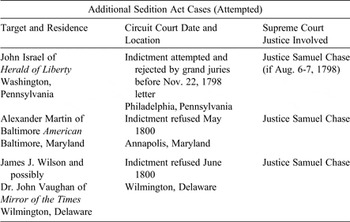
Attempted Indictments for Three Additional Sedition Act Prosecutions
In addition to those prosecutions, attempts were made to get indictments to initiate at least three additional Sedition Act prosecutions, which grand juries refused. All three were against Republican newspaper editors, and a possible fourth was against a newspaper's owner as well. Table 3 summarizes them.
Attempted Indictments Under the Sedition Act

John Israel of the Herald of Liberty: Sedition by Printing a Mocking Prayer for the President
One unrecognized prosecution is confirmed in Judge Alexander Addison's letter to Timothy Pickering, the chief enforcement officer for the Sedition Act. Addison sent copies of the pamphlet reprinting his jury charge supporting the Sedition Act (the one that influenced Justice Bushrod Washington),Footnote 236 and urged new federal efforts to prosecute John Israel, publisher of a Republican newspaper.
Addison's report was that “the predominancy of Jacobinism here” in western Pennsylvania, and the widespread belief “that government is pursuing a systematic plan to deprive them of all their liberties,” resulted from “a newspaper printed in this town [Washington, Pennsylvania] by a son of Israel Israel” [John Israel].Footnote 237 “It threatens the fall of the federal paper here … and the fall of federal principles,” Addison wrote. He “had once determined to bind him [Israel] over to the federal court for publishing the Kentucky Resolutions,” but found they had already been printed in local newspapers. He also hoped that a grand jury “would have presented him for an impious mocking prayer for the President on the fast day, but two grand juries charged with it refused to find the bill” (a true bill of indictment).Footnote 238 The prayer he referred to indeed mocked President Adams, saying that he “threw of[f] the mask, and endeavoured to gull the people,” that he used “many artifices … to obtain the Presidential chair,” and that he prayed for “placing the crown upon the head of thy unworthy servant” or at least on “the head of my son Quincey.”Footnote 239 Addison found that a clear Sedition Act violation.
Addison added that a county court judge wrote a “seditious address to Mr. Gallatin [the author's representative in Congress] pointedly censuring as unconstitutional and oppressive the Alien and Sedition Acts and … the Stamp Act” (the new tax law), and that the address was “triumphantly published in Israel's Herald of Liberty just before the election and contributed not a little to inflame the passions of the people and promote the unfavorable result” (something that Addison viewed as aggravating the publication of seditious libel).Footnote 240 What Addison found to be seditious was the statement in the letter that the “Sedition Bill” was “unconstitutional, because it goes to an abridgment of the liberty of speech and of the press—rights expressly guaranteed by the Constitution.”Footnote 241 The judge ended the letter to Pickering by suggesting another attempt at federally prosecuting Israel and others by informations, because indictments were not being approved by grand juries: “some measures ought to be taken to prevent the too obvious effects of this slander,” and perhaps “the deputy attornies of the United States ought to have express instructions to watch these offences and give information of them or some other method for counteracting detecting and suppressing of them it becomes not me to suggest.”Footnote 242
John Israel was the publisher of the Herald of Liberty in Washington, Pennsylvania,Footnote 243 the most combatively Republican paper in western Pennsylvania,Footnote 244 and in August 1800 he also founded and became the editor of the Tree of Liberty in Pittsburgh.Footnote 245 If challenging the constitutionality of the Sedition Act was sedition, Israel was a prince of sedition, as he repeatedly made that challenge. As soon as word arrived of its enactment, he published three items in sequence on a page: the words of the First Amendment (under the caption “Freemen of America Attend!”), the Sedition Act, and an essay that such laws “in opposition to the Constitution” are not binding.Footnote 246 Israel continued to print criticism of the Act,Footnote 247 including the Kentucky Resolutions and then the Virginia Resolutions,Footnote 248 along with outraged coverage of Sedition Act cases.Footnote 249
Addison's statement to Pickering that twice a bill of indictment was attempted against Israel, but “two grand juries charged with it refused to find the bill,” appears to refer to prosecution in federal courts, not state courts, for several reasons, although they are not conclusive.Footnote 250 Addison was writing to the federal chief enforcement officer for the Sedition Act. He complained of publications violating a federal law, the Sedition Act, which prohibited “writing, printing, uttering or publishing against … the president … to defame the said President, or to bring [him] into contempt.”Footnote 251 He lamented that the grand juries declined to indict criticism of the president, which violated that act, in the form of the “impious mocking prayer for the President on the fast day,” which Israel had published at the end of April 1798.Footnote 252 The reference was preceded by Addison's statement that he “had once determined to bind him [Israel] over to the federal court for publishing the Kentucky Resolutions,” and it was followed by his suggestion that “the deputy attornies of the United States” be instructed to prosecute such cases. If Addison meant that one or more federal grand juries refused to indict Israel, that would have occurred at the circuit court session in Philadelphia on August 6–7, 1798, 3 weeks after the Sedition Act was signed into law, as the court did not have any judges present in its October 11 session because of a yellow fever epidemic.Footnote 253 That would help explain why the special session of the court was held in August 1798, which remains a subject of uncertainty (although the sketchy court records do not mention Israel),Footnote 254 particularly as Chase was the Supreme Court justice in attendance, who soon became the most zealous justice in prosecuting Republican newspaper editors under the Sedition Act.
Alexander Martin of the Baltimore American: “Licentious” Republicanism
Secretary of State Pickering instructed Zebulon Hollingsworth, the United States attorney for Maryland, to procure a virulent newspaper, the Baltimore American, daily, and “to prosecute the publisher, for every libel upon the Government or its officers, which may appear therein either originally or by republication.” He asked to be notified of each prosecution, so he could arrange parallel prosecutions “against the original libellers.”Footnote 255 The publisher of Baltimore's American and Daily Advertiser was Alexander Martin.Footnote 256 Although his paper was a mouthpiece for Republicanism,Footnote 257 Pickering's instructions remained unfulfilled for 9 months.
Justice Chase, when he held circuit court in Baltimore in May 1800,Footnote 258 sought to correct that prosecutorial failure by pressing the grand jury to indict the editor of Baltimore's Republican newspaper. One newspaper in Baltimore reported that Chase, when he informed the grand jury there that “one of the most licentious presses in the United States was supported in Baltimore,”Footnote 259 was trying to gain approval of “an indictment” that the federal attorney already “had prepared against the Editor of the American” (Alexander Martin of the American), which the grand jury refused to approve.Footnote 260 The federal court records do not contain a draft indictment against Martin (and typically would not contain a draft unapproved by the grand jury).Footnote 261
James J. Wilson and Possibly Dr. John Vaughan: The “Seditious” Mirror of the Times
Another of the grounds for impeachment of Justice Chase was his insistence that a Delaware federal attorney and grand jury indict “a most seditious printer, unrestrained by any principle of virtue,” in Wilmington.Footnote 262 The district judge who had sat with Chase (and who had since seen the Republican light) later testified that when the grand jury did not find anyone warranting indictment, Chase refused to discharge them and required them to stay another day, and instructed the federal attorney to collect and investigate copies of the newspaper. Moreover, he recalled Chase telling the grand jury that “you have in this state a seditious printer who is in the constant habit of abusing the government,” that “it was high time that these seditious printers should be corrected,” and when the federal attorney and grand jury found none, that “it was hard he could not get a single man indicted in Delaware, whereas he could in every other place.”Footnote 263 This incident occurred as Chase, having ended the circuit court in Richmond, held court in Wilmington, Delaware in late June 1800,Footnote 264 and it was similarly reported at the time in Republican newspapers.Footnote 265
The person Chase sought to indict has been understood to be James J. Wilson, the printer of the Republican newspaper in Wilmington, the Mirror of the Times.Footnote 266 Wilson had established the paper at the end of November 1799,Footnote 267 as a staunchly Republican voice, publishing “attacks on President Adams, the Sedition Law, and the ‘New England Illuminati'” (the term John C. Ogden popularized for that region's Federalist clergy).Footnote 268 Two months later, a High Federalist complained to Pickering that he was “almost delirious at seeing our once happy country disordered” by “our little Jacobin paper” and articles in it by Ogden.Footnote 269 Contemporaneous newspapers and the impeachment testimony said that Chase, although sparing no effort, failed to get an indictment of the “seditious printer,” and the circuit court records do not show any indictment either.Footnote 270 Wilson got in the last word, writing that if the “great beast” by which he had “been already Chased, should in some future circuitous ramble in search for sedition, … lay his pestiferous paw upon me, and chant in my ear his favorite air, ‘two hundred dollars fine, and six months imprisonment,' no one can imagine what an awkward figure I should make.”Footnote 271 A decade and a half later, Wilson became the first printer to be elected to the United States Senate.Footnote 272
A letter by Dr. John Vaughan to Thomas Jefferson in early 1801 exulted that Vaughan had passed through “attempted persecutions under the, ignoble, sedition law.”Footnote 273 Smith found the report unconfirmed as he did not come across any court record of a prosecution or any further details.Footnote 274 Nothing has been added in other Sedition Act discussions. Why would a physician such as VaughanFootnote 275 face potential prosecution under the Sedition Act? A clue is that he wrote to Jefferson from Wilmington, Delaware, and was a dedicated Republican.Footnote 276 Although Brigham does not list Vaughan under his description of the Mirror of the Times, “Vaughan & Coleman” appeared as owners of the Delaware Gazette on its masthead,Footnote 277 and Brigham identified its owners as John Vaughan and Daniel Coleman (without suggesting who they were). He also said that the Delaware Gazette, in September 1799, announced that its successor would be the Delaware Gazette and Mirror of the Times, and that was just before Wilson started the Mirror.Footnote 278 The Vaughan who co-owned the Gazette and Mirror was identified by a leading Delaware historian as one and the same as Dr. John Vaughan.Footnote 279 Therefore, Dr. Vaughan's brush with possible prosecution under the Sedition Act came from financing and owning the Mirror of the Times, and his claimed near prosecution was connected to James J. Wilson's. As with Wilson, the circuit court records show no indictment.
Instructions To Bring Six Additional Sedition Act Cases
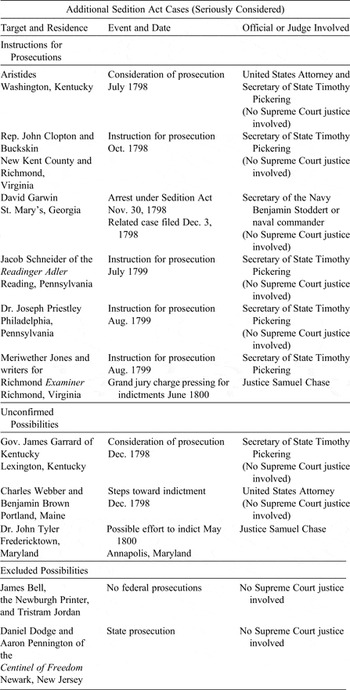
Secretary of State Pickering instructed that five additional cases be initiated under the Sedition Act, prosecuting seven individuals, and the secretary of war apparently gave the instruction for a sixth, although they did not actually progress to indictments or arrests. Those were of a pseudonymous author called Aristides, Virginia Representative John Clopton and a writer describing Clopton's views, newspaper editor Jacob Schneider, Republican writer and activist Dr. Joseph Priestley, and newspaper editor Meriwether Jones as well as writers. Documentation appears in Pickering's official papers. The instructions to prosecute Schneider, Priestley, and Jones were given in July and August 1799, close to the time Pickering sent form letters to the United States attorneys instructing them to take “measures to correct [printers] by legal process” because of their “audacious calumnies against the Government”Footnote 280 (which led to prosecutions of Duane, Greenleaf, Peck, and others), obviously designed to quash or intimidate opposition before the 1800 elections.
In addition, there is some evidence that prosecutions under the Sedition Act were seriously considered, or attempted, in three cases (one involving two people), although they are not confirmed by federal court records or Pickering instructions. On the other hand, several other rumored prosecutions lack confirmation, or were not under the Sedition Act. These instructions to prosecute, and seriously considered cases, are summarized in Table 4.
Instructions for Prosecutions and Unconfirmed Prosecutions

Therefore, instructions for Sedition Act prosecution were given by Pickering or a colleague in the first six cases. There were unconfirmed steps toward prosecutions in the next three instances, but the remaining alleged prosecutions were not Sedition Act prosecutions.
Aristides: A “Seditious” Essay
The ink on the Sedition Act was barely dry, having just been signed a week before, when an essay by Aristides in a Kentucky newspaper was forwarded to Pickering by a federal prosecutor.Footnote 281 The letter from William Rawle, the United States attorney, attached a letter from Parker Campbell, who he said “prosecutes for the United States under deputation from me.” Campbell's letter in turn attached a “seditious” essay by Aristides, published in “a paper printed by Hunter & Beaumont in Washington, Kentucky,” which was “in my opinion more highly inflammatory” than any Campbell had yet seen, because it called on westerners in case of open war with France “to separate from the east, and directly to oppose the measures of the administration.”Footnote 282 The newspaper printed by Hunter and Beaumont was the very Republican Mirror.Footnote 283 Rawle was suggesting that Pickering give instructions to prosecute Aristides, the newspaper, or both. However, no evidence has surfaced of an actual prosecution, perhaps because Aristides remained unidentified and Kentucky appeared a difficult venue for prosecution.
Representative John Clopton and Buckskin: Assertedly Calling the President a Traitor Who Bought Congress
Representative John CloptonFootnote 284 of Virginia understood his own letters to constituents to be referred to among the “circular letters of several members of the late Congress” that were condemned by a Richmond grand jury in 1797. That grand jury's presentment called them “a real evil” that disseminated “unfounded calumnies against the happy Government of the United States.”Footnote 285 Clopton responded with a new circular letter that condemned the grand jury's action as “an attack upon the common right of every individual to a free exercise of opinion” under “the principles of our constitution” protecting “that valuable right,” turning letter writing into “a species of criminality,” and leading “to the exclusion of the great body of the people from knowledge of the measures of their government.”Footnote 286 That response, in turn, generated a critical article that Pickering read with interest.
Three months after the Sedition Act became law, Pickering found a newspaper article by a pseudonymous BuckskinFootnote 287 to warrant examining the printer “with a view to the prosecution of the writer,” and ultimately the prosecution of Clopton. Pickering listed what the article said about Clopton that warranted a Sedition Act prosecution: Clopton “wrote not only public circular letters to his constituents but private ones ‘too violent to be made circular',” which called “the President of the United States a traitor—says he is grasping at absolute power—that he has bought a majority of the House of Representatives.”Footnote 288 Pickering also instructed officials to retrieve the original letter from its recipient, William Pollard.Footnote 289 Successfully derailing the prosecution, Clopton had already obtained a declaration from Pollard, “supposing myself to be the person alluded to in a piece signed ‘Buckskin',” that he had “no knowledge of any letter having been written by Mr. Clopton” saying those things.Footnote 290 However, Clopton was not as successful in fighting to retain his congressional seat, as the Federalists supported John Marshall against him and won the seat.Footnote 291
David Garvin: “Damned the President for an Old Fool”
An arrest under the Sedition Act was seen by Georgia Governor James Jackson, a Republican, as outrageous enough to be mentioned in his annual address to the state legislature. It has not appeared in any Sedition Act discussions. In early January 1799, Jackson described
a charge against an officer of the United States galley, for landing his men to take a citizen under the sedition act of the United States, as that officer is said to have declared, by order of the secretary of the navy department. Although I cannot believe the secretary ever issued such an order, and forbear to comment on the propriety of the law, I cannot help observing that an attempt of this nature, by a military or naval officer, in a place where the law is open, and the civil magistrate bound to take cognizance of offences against the union, is not only opposed to the constitution of the United States, but tends to foment jealousies ill suited to our present situation, when unanimity is so necessary; and whilst it impresses the idea of oppression, instead of that protection which I am certain the galley was intended for, operates to awaken apprehensions of an act, supposed by many not to be constitutional [the Sedition ActFootnote 292]. …Footnote 293
The galley was one of two naval vessels built in Georgia to protect the Georgia coast and harbors, as the secretary of the navy noted in War Department records.Footnote 294 The Secretary, Benjamin Stoddert, became aware of Jackson's complaint, probably through extracts printed in the Aurora.Footnote 295 In response to Stoddert's letter, Jackson replied that the “commander of a galley” was “Captn. Randolph,” that the “person injured” was “David Garwin” of St. Mary's, Georgia (a coastal town), and that Garwin's affidavit and several witnesses’ statements were enclosed.Footnote 296 The War Department records, which are reproduced online, do not appear to contain those documents; however, the nearest newspaper did.
David Garvin (as his name is correctly spelled) and Capt. John F. Randolph each wrote statements and published them in the Columbian Museum & Savannah Advertiser. Randolph alleged that “Citizen Garvin” was part of “a French faction,” and that his infraction was that he “damned the President for an old fool.”Footnote 297 Garvin submitted an affidavit of seven witnesses, who signed in front of a justice of the peace, claiming the following facts:
That they were present in the town of St. Mary's, on the 30th day of November 1798, and saw an armed force come from on board the Savannah galley, then lying in the river opposite the town, and attempted to make a prisoner of David Garvin, a citizen of the said State–Captain John F. Randolph, ordered his Lieutenant, Shaw, who appeared intoxicated, to take the said Garvin, and carry him on board the said galley, and confine him in irons . . . . The citizens then present, seeing the impropriety of Capt. Randolph's conduct, disarmed the party, and obliged them to go on board the said galley.Footnote 298
It is easy to confirm that Randolph was captain of a Savannah-based galley as of late November 1798,Footnote 299 and that William Moubray, before whom the affidavit was signed, was a justice of the peace.Footnote 300
Garvin also wrote that, the day after his arrest, he caused Randolph and his next in command to be “taken with a states warrant, and carried before three magistrates, who demanded his authority for his conduct.” Randolph claimed to have “private orders from the Secretary of the Navy, but shewed none,” instead going on the offensive by calling Garvin “a seditious person.”Footnote 301 Garvin's account was reprinted by a number of Republican newspapers in addition to the Aurora.Footnote 302
The attempted prosecution spurred by Garvin of Randolph can be confirmed in court records for the county where St. Mary's was located (Camden County, Georgia). In the next sitting of the superior court, John F. Randolph and John Shaw (his lieutenant) were indicted for riotFootnote 303 on March 10, 1799, and a bench warrant was issued to require their appearance at the next superior court session. In the next sitting, the court fined Capt. Randolph $50, on October 10, 1799.Footnote 304 Although the court's minutes do not show whether there was a trial or a plea, an entry in its miscellaneous records shows that there was a trial, because six witnesses are listed, and then Randoph is said to be “guilty of the afs.” (the aforesaid riot).Footnote 305 That superior court case matches Garvin's account that he caused Randolph and his next in command to be taken with a warrant, and carried before three magistrates.
Continuing attempts by Randolph to prosecute Garvin also can be confirmed in court records. Three days after the arrest, a case was filed in the inferior court under the style “Jn. F. Randolph vs[.] David Garvin,” and was carried over to the June 1799 term. The case was dismissed by the four sitting justices in the following court term, on January 8, 1800.Footnote 306 That inferior court case does not appear to be a Sedition Act prosecution, because it was not in federal court and was not brought by the federal government as plaintiff. However, it corroborates what occurred 3 days earlier: that Randolph tried to arrest Garvin and have him prosecuted under the Sedition Act. Randolph may have been the plaintiff because he claimed that Garvin slandered him in the altercation, or perhaps because he could not get anyone else to prosecute Garvin. The federal circuit court would not meet until April 1799, the state's indisposition to prosecute was shown by its governor and its legislature opposing the Alien and Sedition Acts,Footnote 307 and the county's indisposition to prosecute Garvin was shown by its prosecution of Randolph instead.
It is particularly noteworthy that no mention of the case, or of the Stoddert letters, appears in the complete papers of the War Department (or in books on the Quasi-WarFootnote 308). The Georgia governor responded to a letter from Stoddert, and Randolph claimed to have another one. The letters may have disappeared because of the political implications of this lone case involving the military enforcing the Sedition Act. The Republican press was quick to pick up on the case as an illustration of the danger of a standing army; most of the articles on the case were captioned “Standing Army.” This is also the only case involving the Sedition Act south of Richmond, Virginia, where the Callender prosecution occurred.
Jacob Schneider of the Readinger Adler for Republican Activism
Jacob Schneider, the editor of the Readinger Adler in Pennsylvania,Footnote 309 an ardently Republican newspaper in the German language,Footnote 310 was also the subject of Pickering instructions to prosecute. Pickering sent the federal attorney an article, “An Address to the Germans in the County of Cumberland,” from a “newspaper printed in Reading by one Schneider in the German language.” He accompanied it with the instruction that “[i]f any passages in the address in your opinion do make the printer liable to a prosecution, I pray you to direct its being commenced.”Footnote 311 In Pickering's eyes, Schneider's sins were grave, because the article urged German-Americans to vote against High Federalist James Ross, and for Republican Thomas McKean in the gubernatorial race, among other reasons because Ross had supported the Sedition Act.Footnote 312 Schneider only escaped prosecution because the Fries Rebellion cases overwhelmed Rawle for the rest of the year.
However, zealous Federalists did take action, as a detachment of the state militia that had been called up by Adams, upon reaching eastern Pennsylvania to crush the already dissolved “rebellion,” demanded that Schneider disclose the author of an article. When he refused, they violently seized him, dragged him from the newspaper office to the public market, and started to administer twenty-five lashesFootnote 313 until another detachment arrived and stopped the extrajudicial proceeding. Interestingly, Robert Goodloe Harper, a House of Representatives sponsor of the Sedition Act, led the first detachmentFootnote 314 and, although denying much of Schneider's account, admitted that he was taken to the marketplace and given “six lashes.”Footnote 315
Dr. Joseph Priestley for “Meddling with Our Government”
Dr. Joseph Priestley, the philosopher-theologian, appears to have been the subject of another Pickering instruction to prosecute. In August 1799, Pickering protested that Priestley's conduct as a Republican activist was “wholly unpardonable,” and that “ambition influences him, like the mass of seditious, turbulent democrats.” Pickering also suggested that the Alien Act should apply to Priestley (a British citizen), objecting that “[t]he indecency of these strangers thus meddling with our government” did not need “animadversion.” He concluded with his desire for action by the federal attorney: “I hope … that Mr. Rawle will prosecute both.”Footnote 316
Although Priestley's meddling did not need animadversion generally, it required animadversion to President John Adams. Pickering said Priestley's meddling was intolerable in two areas: his “discontented and turbulent spirit” as shown by his attending “the democratic assembly on the 4th of July,” and his “indecency in getting Mr. [Thomas] Cooper's address printed,” Cooper being an “opposition man”Footnote 317 who was later prosecuted under the Sedition Act for that address.Footnote 318 However, Adams vetoed deporting Priestley under the Alien Act, and Rawle was still too enmeshed in Fries Rebellion prosecutions to prosecute Priestley under the Sedition Act.
Meriwether Jones and Writers: The “Jacobin” Richmond Examiner
Whereas the prosecution of James Callender, a part-time writer for the Richmond Examiner, for his independent writing of a book is the best known case under the Sedition Act, the planned prosecution of Meriwether Jones, the editor,Footnote 319 has escaped notice. However, Pickering gave instructions to the federal attorney for Virginia, in mid-August 1799, that the Examiner “be examined as often as it issues from the press, and whenever it contains any libellous [sic] matter against the government or its officers, either originally or by republication, that the Editor or Editors may be prosecuted.”Footnote 320 As in letters to other federal attorneys sent at the same time, Pickering added that prosecutions should be filed against “authors of libels as well as the editor or editors of the paper,” and that when prosecutions were of republished libels he should be notified in order to arrange further prosecution “against the original libeller” as well.Footnote 321
Pickering's assault was assisted by Justice Bushrod Washington. Pickering asked him “who at Richmond would undertake to see this done, and who he would recommend to join you as counsel in this prosecution,” and Washington had given recommendations.Footnote 322
The editor who had attracted Pickering's attention was Meriwether Jones, a Richmond attorney and committed Republican. A month later, Pickering wrote to one of Pennsylvania's senators that the Examiner was “edited by a Mr. M. Jones” as a “Jacobin” newspaper, the mouthpiece of “the violent party in that state,” to “vilify the federal government and probably to destroy it.”Footnote 323 He condemned Jones for publishing letters from Talleyrand and Pinchon, allegedly received “directly from Paris” by “some of our domestic traitors,” and he left no doubt of his loathing of France.Footnote 324 Pickering soon repeated his condemnation in a letter to an American ambassador, describing the Examiner as “a virulent Jacobin paper,” and decrying that “the infamous wretch Callender is the actual editor.”Footnote 325 However, Governor James Monroe had foreseen that “an attempt will be made to carry the sedition law into effect here, as an electioneering trick,” and continued to “endeavor to keep them [the editors of two Richmond papers] within suitable limits, in their publications,”Footnote 326 apparently by private warnings. For that and other reasons, despite Pickering's instructions and wishes, Meriwether Jones was never indicted, even when Justice Chase pressed for Virginia prosecutions under the Sedition Act, although Chase snared Callender in his net.
Governor James Garrard: Unconfirmed Serious Consideration of Prosecution for Supporting the Kentucky Resolutions and Questioning the Sedition Act
Governor James Garrard of Kentucky drew Pickering's notice with his support of the Kentucky Resolutions and his November 1798 speech calling the Sedition Act unconstitutional under “that clause which forbids the enacting of any law abridging the freedom of speech or of the press.”Footnote 327 Pickering wrote to a High Federalist confidant, Rufus King, that “[i]n Kentucky the Governor has made to the General Assembly a very impudent and inflammatory speech” that Pickering found to “misrepresent … the Alien and Sedition Laws.” Fortunately, he added, the people of Kentucky “remain uncontaminated.”Footnote 328 Garrard was skirting disaster, but no evidence has surfaced of instructions being sent to federal prosecutors for his arrest.
Charles Webber and Benjamin Brown: Unconfirmed Steps Toward Prosecution for Raising a Liberty Pole and Burning the Alien and Sedition Acts
Charles Webber and Benjamin Brown, of Vassalborough, Massachusetts (in the part that later became the state of Maine), led the raising of a liberty pole at Webber's house and the burning of the Alien and Sedition Acts at its base, on the middle day of November 1798, bringing serious consideration of a prosecution that discussions of the Sedition Act have never noted. Mirroring the bitter partisan divisions of the period, Republican newspapers reported that “a large majority of the inhabitants of the south parish” assembled to raise “a liberty pole” and to toast the “glorious tree of liberty,”Footnote 329 while Federalist newspapers recounted that the “sedition pole” and burning of the ActsFootnote 330 were by “a small number of Jacobins” at Webber's house.Footnote 331 Soon Federalist reports added that the “ringleaders” were Charles Webber and Benjamin Brown, and that the “arm of government ought to punish these Jacobins immediately.”Footnote 332 The federal attorney for the district, Daniel Davis,Footnote 333 heeded that call and promised that if evidence warranted prosecution “to cause the principal offenders to be arrested and bound over for trial”; reportedly “[m]easures for this purpose were taken without delay.” When Webber and Brown learned of them, they signed a “Recantation” to “publicly declare our unfeigned sorrow for the part we took in those proceedings” that tended to “bring the authority and laws of the [United States] into contempt,” in exchange for Davis consenting to “relinquish the prosecution.”Footnote 334 Davis was true to his word, as no pleadings appear in surviving records of the federal circuit court.Footnote 335
Dr. John Tyler: Unconfirmed Attempt To Prosecute for Republican Essays
Dr. John Tyler, a physician and surgeon in Frederick (then called Fredericktown), Maryland and one of the first American surgeons to operate on cataracts,Footnote 336 found himself close to danger because of his essays published in the newspapers.Footnote 337 An acquaintance in Frederick wrote to James Madison, in June 1800, that “Doctr. John Tyler,” a Republican, penned a private letter that Federalists “have published … with such comments as their malice suggested, and forwareded [sic] it to the Genl. Government in hopes to have the Docr[.] prosecuted under the Sedition Law . . . .”Footnote 338 That likely was Tyler's letter, finally published 4 days later in Newark, New Jersey, decrying “Federalists” who were “practising every art and every deception, to mislead the judgment, and impose on the candor of the public” for Adams and against Jefferson.Footnote 339 Tyler's enemies were unsuccessful in prosecuting him, as there is no evidence of an indictment in the circuit court records.Footnote 340 They were equally unsuccessful in intimidating him, as he soon stood as a presidential elector for Jefferson,Footnote 341 and published at least seven more pre-election essays that declared the Sedition Act unconstitutional, opposed Adams, supported Jefferson, and proclaimed the right to investigate and condemn officials.Footnote 342 However, the threat of prosecution was very real, because Justice Chase held circuit court in Baltimore in May 1800,Footnote 343 and actively sought indictments of Republican newspapers and writers.
James Bell, the Newburgh Printer, and Tristram Jordan: Not Federal Prosecutions
Smith mentioned the case of James Bell as another arrest and prosecution possibly under the Sedition Act,Footnote 344 citing a news report in July 1798 that “Mr. James Bell has been apprehended for uttering treasonable expressions, and held in bail for trial.”Footnote 345 That was not a Sedition Act prosecution, however, because treason was not an offense under the act, and because Bell's name does not appear in Pennsylvania circuit court records. Further, Bell's expressions occurred on July 3, 11 days before the Act was effective, as the source report shows.Footnote 346
A Republican newspaper in December 1798 printed a list of thirteen arrests under the Sedition Act, including a “printer in Newburgh.” Eight were in the standard list of seventeen prosecutions, two are among this article's additions (Colie and Judah Spooner), and only one was in error (“it is said” Matthew Lyon's son).Footnote 347 That “printer in Newburgh” likely meant the publisher of the Mirror in Newburgh, New York, who was Philip Van Horne until a November 1798 transition to Joseph W. Barber.Footnote 348 Efforts to locate a case have failed.Footnote 349
Tristram Jordan was brought before the Massachusetts legislature in January 1799 for alleged “seditious expressions.”Footnote 350 The statements at issue were “that John Adams ought to have lost his head a year ago, that he was the cause of all the depredations on our commerce, that he duped President Washington to sign the cursed British treaty, and then persuaded him to resign that he might get his place.”Footnote 351 However, no legal prosecution was contemplated; instead, the issue was whether the legislature would remove Jordan from his position as a justice of the peace. The next month, the issue was resolved by Jordan “formally and solemnly disavow[ing] all knowledge of ever having spoken” those words, and declaring that they were “opinions upon political subjects, which he never embraced.” Upon that recantation, he was not removed,Footnote 352 which was a state legislative matter, not a federal prosecution.
Daniel Dodge and Aaron Pennington of the Centinel of Freedom: State, Not Federal, Prosecution
The prosecution of Daniel Dodge and Aaron Pennington of the Centinel of Freedom in Newark, New Jersey,Footnote 353 a vocal Republican newspaper,Footnote 354 was cited as a Sedition Act case in Carl E. Prince's study of Federalist New Jersey.Footnote 355 Those editors printed a letter to the governor of the state laden with invective such as about his “shower of filthy, bilious, and excrementitious matter,”Footnote 356 and then refused the governor's demand that they disclose the anonymous author, which led a state court judge to arrest them and require them to post bond.Footnote 357 The editors reported that the grand jury refused to indict them in a state court.Footnote 358 Federalist young men were not as forgiving, as they tricked Pennington into a tavern and beat him,Footnote 359 nor was the Federalist postmaster, who soon sued the editors for libel.Footnote 360 Dodge and Pennington tempted the federal government not to be forgiving either, as the Centinel heaped unrelenting criticism on the Sedition Act as unconstitutional.Footnote 361
The editors were then summoned for court. The charge was reprinting remarks by Dr. Rogers from the Time Piece Footnote 362 (whose editor had been prosecuted for seditious libel beginning with an early July 1798 arrest), who had warned of the “impolicy of being engaged in a war” with France because its revolution had fulfilled “ancient prophecies,” or of supporting Britain because of “the punishment which awaits her for the multitude of her crimes.”Footnote 363 The cumulative effect of “the persecution [and] prosecution” of the editors, and the “declining health of Mr. Aaron Pennington,” led them to leave the newspaper and transfer control to successors, in early October 1799.Footnote 364
Prince understood the court to be a federal court. He doubtless relied on newspaper reports of a requirement to post recognizance bonds assuring their appearance before a “Justice of the Supreme Court,” and to have consideration of an indictment by a “grand jury of the country,” for a charge that was similar to some Sedition Act charges. However, the reference to a “Justice of the Supreme Court” was identified in other newspapers as a justice of the state supreme court, Elisha Boudinot.Footnote 365 The prosecutor listed in the original article, William Halsey, was not the federal prosecutor. Most importantly, the case does not appear in the minutes or surviving records of the federal circuit court for New Jersey. Blumberg appears to be correct in concluding that any actual case was “most likely brought under New Jersey criminal common law.”Footnote 366
Conclusion
These additional prosecutions more than double the number of confirmed prosecutions under the Sedition Act, from the recognized prosecutions of fourteen individuals (plus federal common law libel prosecutions of three more) to added prosecutions in eleven additional cases of seventeen more individuals plus prosecutions in eleven conspiracy cases of eighty-three individuals. These numbers exclude the three attempted indictments that grand juries refused, and the six instructions to prosecute that, for one reason or another, did not result in indictments.
A doubled number of prosecutions commensurately increases the magnitude of the Federalist administration's efforts to suppress dissent, and of the suffering inflicted on citizens for exercising their First Amendment freedoms. Included in the recognized seventeen prosecutions were eleven against newspapers and one against a newspaper writer's book. Added are prosecutions of Judah P. Spooner who printed Matthew Lyon's Scourge of Aristocracy (for a “seditious” pamphlet), Alden Spooner of Spooner's Vermont Journal, Benjamin Mayer and Conrad Fahnestock of Harrisburg Morgenröthe (the “Dutch Aurora”), and Matthew Lyon in an unrecognized second prosecution (for a “seditious” letter disparaging his trial); as well as attempted indictments of John Israel of Herald of Liberty, Alexander Martin of Baltimore's American, and James J. Wilson of Wilmington's Mirror of the Times (and possibly Dr. John Vaughan, also); and instructions to prosecute Jacob Schneider of the Readinger Adler, and Meriwether Jones and one or more authors of the Richmond Examiner. Most of those prosecutions of opposition newspaper editors and publishers involved an unexpected arrest that could prevent publication for months, and an unhealthful jail that could bring illness or death, necessitating a strong measure of courage to run a Republican newspaper. The additional prosecutions also show a broader administration attack against seditious words (such as Matthew Lyon for reading the Barlow letter in a speech, David Brown, the “apostle of sedition” for his declamations, and Luther Baldwin and Brown Clark for wishing that celebratory cannon fire had hit the president's posterior). Added are Lespenard Colie “damning the President,” Jacob Greenawalt speaking against high taxes, Langford Herring saying “seditious expressions” against both, and Rev. Jacob Eyerman preaching “seditious counseling.”
The partisan nature of the recognized Sedition Act cases was also true of the additional cases. All of the canon of seventeen prosecutions was against Republicans, and the additional ones were as well. The sentences remained harsh.
Those who would rehabilitate and defend the Federalist Party must deal with that partisan nature of the treatment of press and speech, and with its increase in the additional cases. Nor can that defense be based on the contention that everyone held the dominant Federalist view of freedoms of press and speech and of seditious libel until 1798, because a minority of the Federalist party itself did not,Footnote 367 and well before 1798 many Americans and British held Madisonian broad views of those freedoms and of seditious libel.Footnote 368
The Supreme Court justices who actually presided over Sedition Act proceedings, other than brief arraignments, increase from the three who did so in the recognized prosecutions (Justices William Paterson, Bushrod Washington, and Samuel Chase) to two others in the additional prosecutions (Justices James Iredell and William Cushing). Iredell presided over Jacob Greenawalt's guilty plea and apparently his sentence, Morris Llewellyn et al.'s indictment, Langford Herring's indictment, and substantial parts of nine of the Sedition Act conspiracy cases. Cushing presided over Lespenard Colie's indictment and plea, Matthew Lyon's second information or indictment, and Dr. Samuel Shaw's indictment. As the additional cases are considered, Justice Alfred Moore continues to have steered clear of any involvement in Sedition Act prosecutions, most likely because he opposed the Sedition Act.Footnote 369 The numbers of Sedition Act cases presided over by Paterson, Washington, and Chase also are increased.Footnote 370 Paterson's five cases are increased by the Judah P. Spooner indictment, the Alden Spooner indictment, and the Dr. Samuel Shaw trial. Washington's three cases are expanded by the Morris Llewellyn et al. re-indictment, the Jacob Eyerman indictment and trial, and the Benjamin Mayer and Conrad Fahnstock indictment and trial. Chase's four cases are increased by another Llewellyn re-indictment, the Eyerman re-indictment and trial, and involvement in eight of the Sedition Act conspiracy cases, as well as the attempted indictment of John Israel along with those of Alexander Martin and James J. Wilson, and possibly of Dr. John Vaughan and Dr. John Tyler.
Those who would defend Supreme Court Justices Iredell, Cushing, Paterson, Washington, or Chase face a greater burden with the additional number of Sedition Act cases they handled. They usually showed antagonism toward opposition writing and speech through harsh sentences, as well as by their newly found Blackstonian views of freedoms of press and speech. The justices passing sentence on Sedition Act cases in connection with Fries Rebellion also showed their comparative animosity toward writing, printing, uttering, or publishing against the government (Section 2) compared with nonverbal opposition to the government (Section 1), by how frequently the maximum or minimum fine or prison sentence was imposed. Many Section 2 sentences reached or approached the maximum of a $2,000 fine and 2 years’ imprisonment, whereas no Section 1 sentence came anywhere near the maximum sentence of a $5,000 fine and 5 years’ imprisonment (the longest was $1,000 and 2 yearsFootnote 371).
Broader discussions of 1798–1801 might gain a little more illumination from the increased number of Sedition Act prosecutions. It was likely a factor in the growth of Republican newspapers and perhaps of subscribers during 1798–1801, the rapid growth of the Republican Party after war fever subsided, the silence of many other leaders on the Alien and Sedition Acts and the prosecutions, the steady transition of officeholders from the Federalist to the Republican Party during 1798–1801, the Jeffersonian revolution of 1800 particularly below the presidential level, and the surprisingly rapid demise of the Federalist Party.
Where might further study go? A search for any additional Sedition Act prosecutions could be made by further review of Timothy Pickering's papers dated 1798–1801 (my review was imperfect because of his notably bad handwriting). Such a search could also be made by a review of papers of the federal attorneys such as William Rawle (at the Historical Society of Pennsylvania) and of the federal district judges such as Richard Peters. Further search could also be done in each Republican newspaper during that period, particularly after a skipped issue or closure that might indicate arrest of the editor. An unrelated project would chart the correlation in books, especially biographies, and articles between favorable views of the Federalists and silence or de-emphasis on the Sedition Act.
Additional References to These Unrecognized Sedition Act Cases