Introduction
Despite suggested health advantages of the traditional type egg – i.e. from hens raised on ‘wild’ foods naturally rich in key nutrients such as n-3 polyunsaturated fatty acids (PUFA) and carotenoids – over modern industrially-produced eggs high in n-6 PUFA, and flexibility of egg composition depending on feed, the current experience with ‘designer’ eggs has not yet provided evidence about their health effects. Some beneficial modifications may suggest it is possible to improve the nutritional and functional impact, enabling 'tailor-made' eggs to be produced, and justifying health claims according to their composition and compatibility with various populations.
Numerous epidemiological and clinical studies suggest a relationship between high n-6 PUFA intake and n-6:n-3 PUFA ratio and risk of developing chronic diseases associated with Western dietary patterns (Simopoulos, Reference SIMOPOULOS2008). These have been observed at high rates in Western countries such as the United States, Northern Europe, and Israel (Harris et al., Reference HARRIS, MOZAFFARIAN, RIMM, KRIS-ETHERTON, RUDEL, APPEL, ENGLER, M, ENGLER and SACKS2009; Dubnov and Berry, Reference DUBNOV and BERRY2003; Hu and Willett, Reference HU and WILLETT2002; Yam et al., Reference YAM, ELIRAZ and BERRY1996), as well as other parts of the developed world.
High intake of n-6 PUFA-rich eggs has been found to induce increases in low-density lipoprotein (LDL) oxidation (Levy et al., Reference LEVY, MAOR, PRESSER and AVIRAMERICAN1996; Levy et al., Reference LEVY, SHAPIRA, MAOR, PRESER, MOSHE and AVIRAM1997; Shapira, Reference SHAPIRA2004). Oxidised LDL has been suggested to play a key role in the pathophysiology of atherosclerosis (Steinberg et al., Reference STEINBERG, PARTHASARATHY, CREW, KHOO and WITZTUM1989; Stocker and Keaney, Reference STOCKER and KEANEY2004). LDL PUFA, mostly the phospholipid (PL) and cholesteryl ester (CE) fractions, are readily oxidised in vivo and may stimulate inflammatory processes, further facilitating LDL oxidation (Kaplan and Aviram, Reference KAPLAN and AVIRAM1999; Kratz et al., Reference KRATZ, CULLEN, KANNENBERG, KASSNER, FOBKER, ABUJA, ASSMANN and WAHRBURG2002). LDL susceptibility to oxidation is influenced by the balance between antioxidants (i.e. vitamins E and A, carotenoids, and selenium; Chancharme et al., Reference CHANCHARME, THEROND, NIGON, ZAREV, MALLET, BRUCKERT and CHAPMAN2002; Reaven and Witztum, Reference REAVEN and WITZTUM1996; Stocker and Keaney, Reference STOCKER and KEANEY2004), oxidation-resistant constituents (i.e. monounsaturated fatty acids, MUFA (Aviram and Eias, Reference AVIRAM and EIAS1993; Baroni et al., Reference BARONI, AMELIO, SANGIORGI, GADDI and BATTINO1999; Hargrove et al., Reference HARGROVE, ETHERTON, PEARSON, HARRISON and KRIS-ETHERTON2001; Mata et al., Reference MATA, VARELA, ALONSO, LAHOZ, DE OYA and BADIMON1997), and pro-oxidants (i.e. n-6 PUFA; Kratz et al., Reference KRATZ, CULLEN, KANNENBERG, KASSNER, FOBKER, ABUJA, ASSMANN and WAHRBURG2002; Reaven and Witztum, Reference REAVEN and WITZTUM1996).
High intake of n-3 PUFA has been suggested as beneficial in reducing the risk of a number of human disease conditions, including type 2 diabetes mellitus, neurological disorders and cardiovascular disease (CVD) (Hu and Willett, Reference HU and WILLETT2002; Lewis et al., Reference LEWIS, SEBURG and FLANAGAN2000; Nettleton et al., 2004; Seo et al., Reference SEO, BLANER and DECKELBAUM2005; Simopoulos, Reference SIMOPOULOS2008; Weisman et al., Reference WEISMAN, MOTRO, SCHWAMMENTHAL, FISMAN, TENENBAUM, TANNE and ADLER2004). N-3 long-chain PUFA (LCPUFA), eicosapentaenoic acid (EPA, 20:5 n-3) and docosahexaenoic acid (DHA, 22:6 n-3) in particular, compete with arachidonic acid (ARA, 20:4 n-6) in metabolic pathways, reducing its resultant pro-inflammatory icosanoids (Seo et al., Reference SEO, BLANER and DECKELBAUM2005; Weisman et al., Reference WEISMAN, MOTRO, SCHWAMMENTHAL, FISMAN, TENENBAUM, TANNE and ADLER2004). Moreover, n-3 PUFA – as well as n-9 MUFA and certain antioxidants, may protect endothelial cells, and have been inversely correlated with inflammatory effects and endothelial dysfunction associated with post-prandial lipemia/hypertriglyceridemia (Rivellese et al., Reference RIVELLESE, MAFFETTONE, VESSBY, UUSITUPA, HERMANSEN, BERGLUND, LOUHERANTA, MEYER and RICCARDI2003; Hennig et al., Reference HENNIG, TOBOREK and MCCLAIN2001; Goodfellow et al., Reference GOODFELLOW, BELLAMY, RAMSEY, JONES and LEWIS2000; Bruckner, Reference BRUCKNER1997).
Where modern industrially-produced eggs in some western countries, notably America and Israel, typically have very high content of n-6 polyunsaturated fatty acids (PUFA) relative to n-3 PUFA (n-6:n-3 PUFA ratio ≥17.4:1), traditionally-produced eggs contained significant amounts of n-3 PUFA and LCPUFA, as well as a variety of antioxidants and phytonutrients (Yannakopoulos et al., Reference YANNAKOPOULOS, TSERVENI-GOUSI and CHRISTAKI2005; Simopoulos, Reference SIMOPOULOS1999). As egg fatty acid (FA) profiles are highly dependent upon the formulation of the feed given to laying hens (Sosin et al., Reference SOSIN, BOROWIEC, STRZETELSKI and SMULIKOWSKA2006; Yannakopoulos et al., Reference YANNAKOPOULOS, TSERVENI-GOUSI and CHRISTAKI2005; Lewis et al., Reference LEWIS, SEBURG and FLANAGAN2000; Nitsan et al., Reference NITSAN, MOKADY and SUKENIK1999), they could be altered to provide a significant source of n-3 PUFA and LCPUFA. However, modern western high n-6 PUFA feed may competitively inhibit enzymatic transformation of n-3 PUFA to LCPUFA (James et al., Reference JAMES, GIBSON and CLELAND2000). Recent agricultural research has shown that it is possible to modify egg composition by decreasing n-6 PUFA or increasing n-3 PUFA, n-9 MUFA, and/or antioxidants (Yannakopoulos et al., Reference YANNAKOPOULOS, TSERVENI-GOUSI and CHRISTAKI2005; Surai et al., Reference SURAI, MACPHERSON, SPEAKE and SPARKS2000; Jiang and Sim, Reference JIANG and SIM1993). Eggs have been found to be highly effective in fatty acid (FA) and antioxidant accretion from hen feed and delivery to consumers, as shown by increased n-3 PUFA cellular levels (Makrides et al., Reference MAKRIDES, HAWKES, NEUMANN and GIBSON2002), modified n-6:n-3 PUFA ratio (Weill et al., Reference WEILL, SCHMITT, CHESNEAU, DANIEL, SAFRAOU and LEGRAND2002), and increased blood n-9 MUFA (Shapira and Pinchasov, Reference SHAPIRA and PINCHASOV2008). Consumers of modified eggs, which have enhanced n-3 PUFA or n-9 MUFA at the expense of n-6 PUFA, may lend a health advantage (Shapira and Pinchasov, Reference SHAPIRA and PINCHASOV2008; Bourre and Galea, Reference BOURRE and GALEA2006; Surai et al., Reference SURAI, MACPHERSON, SPEAKE and SPARKS2000).
Although recent research has suggested that consumption of up to seven eggs/week is unlikely to increase CVD risk (Djoussé and Gaziano, Reference DJOUSSÉ and GAZIANO2008; Hu et al., Reference HU, STAMPFER, RIMM, MANSON, ASCHERIO, COLDITZ, ROSNER, SPIEGELMAN, SPEIZER, SACKS, HENNEKENS and WILLETT1999), correlations to negative effects may still be found in specific populations, notably diabetics (Djoussé and Gaziano, Reference DJOUSSÉ and GAZIANO2008; Qureshi et al., Reference QURESHI, SURI, AHMED, NASA, A.A. and KIRMANI2007; Hu et al., Reference HU, STAMPFER, RIMM, MANSON, ASCHERIO, COLDITZ, ROSNER, SPIEGELMAN, SPEIZER, SACKS, HENNEKENS and WILLETT1999), and those with increased LDL oxidation risk, such as hypercholesterolemia, general oxidative stress, abdominal obesity (Knopp and Paramsothy, Reference KNOPP and PARAMSOTHY2006), impaired glucose tolerance (Schwab et al., Reference SCHWAB, SARKKINEN, LICHTENSTEIN, LI, ORDOVAS, SCHAEFER and UUSITUPA1998), and diabetes mellitus (Dimitriadis et al., Reference DIMITRIADIS, GRIFFIN, COLLINS, JOHNSON, OWENS and TOMKIN1996). As eggs have a high capacity to yield n-3 PUFA/LCPUFA, n-9 MUFA, and antioxidants in amounts that can affect blood levels in consumers (Shapira and Pinchasov, Reference SHAPIRA and PINCHASOV2008; Makrides et al., Reference MAKRIDES, HAWKES, NEUMANN and GIBSON2002; Jiang and Sim, Reference JIANG and SIM1993), such modifications may reduce the potential risk as compared to consumption of high n-6 PUFA generic eggs. The present paper details examples of how ‘designer’ eggs could be relevant to different health purposes and, if properly targeted and wisely consumed, may provide a significant nutritional and functional advantage, justifying differential recommendations regarding quality and quantity for various populations.
N-3 PUFA egg fortification: nutritional significance to the human diet
In light of the important benefits of adequate n-3 PUFA (especially n-3 LCPUFA) and low dietary n-6:n-3 PUFA ratio associated with various medical conditions (Hu and Willett, Reference HU and WILLETT2002; Lewis et al., Reference LEWIS, SEBURG and FLANAGAN2000; Nettleton et al., 2004; Seo et al., Reference SEO, BLANER and DECKELBAUM2005; Weisman et al., Reference WEISMAN, MOTRO, SCHWAMMENTHAL, FISMAN, TENENBAUM, TANNE and ADLER2004), as well as the needs of various populations, the question regarding n-3 PUFA fortification' of eggs for a wider range of consumers is worth addressing. A controlled study comparing eggs produced with either standard feed high in n-6 PUFA (particularly linoleic acid, LA) or the same feed supplemented with alpha-linolenic acid (ALA, 18-3 n-3) from 5% extruded linseed (Weill et al., Reference WEILL, SCHMITT, CHESNEAU, DANIEL, SAFRAOU and LEGRAND2002) showed increases in total n-3 PUFA by 3.8-fold that of control eggs (258.2 vs. 67.3 mg/egg), ALA by 6.4-fold (156.7 vs. 24.5 mg), and DHA by 2.4-fold (101.6 vs. 42.8 mg). Correspondingly, the ratio of total n-6:n-3 PUFA was reduced 3.6-fold from the control, LA:ALA by 5.7-fold, and LCPUFA ARA:DHA 3.0-fold (Table 1). N-3 PUFA increased 3.4-fold after the first week of feeding the fortified diet, then gradually to 3.7- and 4.0-fold after the third and fifth weeks, respectively, while n-6 LCPUFA ARA was slightly reduced, to 0.79 of the control.
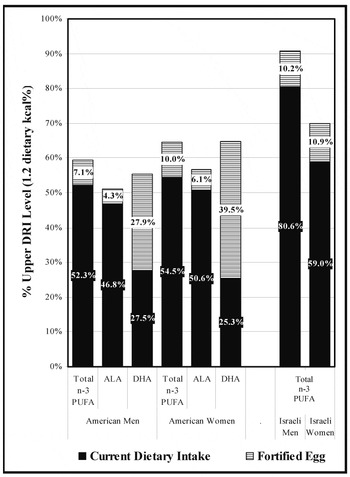
Egg contribution as a percentage of daily recommendations (% Dietary Reference Intakes (DRI)) for humans as calculated by comparing FA contents to dietary intake of American (Ervin et al., Reference ERVIN, WRIGHT, WANG and KENNEDY-STEPHENSON2004) and Israeli (ICDC, 2004) populations, and to DRI (Institute of Medicine, 2002) for adults aged ≥19 years (ALA 0.6-1.2% daily kcal intake, and LCPUFA 0.06-0.12%), showed. %DRI of DHA provided in the high n-3 PUFA-modified egg may be highly relevant to western countries such as the United States and Israel, that have high total n-6 PUFA intakes. Its DHA contribution equalled approximately 27.9% and 39.9% of the upper DRI (0.12% kcal) for American and Israeli men, respectively (vs. control eggs 11.8% and 16.8%), and 39.5% and 42.8% for women (vs. 16.7% and 17.8%, respectively), while total n-3 PUFA and ALA contributed a much lower % DRI (Figure 1).
N-3 PUFA in current diets and in fortified eggs as %upper DRI (kcal%) levelsa calculated for American (total, ALA, DHA) and Israeli (totalb) men and women.
a DRI ranges: total n-3 PUFA and/or ALA=0.6-1.2 kcal%, DHA=0.06-0.12 kcal% of daily kcal intake for Americans (CDC, 2006) and Israelis (ICDC, 2003)
b Information for Israeli intake is limited to major FA classes

Egg cholesterol content was compared to current United States guidelines (≤300 mg/day) and to current consumption (Ervin et al., Reference ERVIN, WRIGHT, WANG and KENNEDY-STEPHENSON2004; ICDC, 2004). In response to cholesterol consumption, blood levels vary widely, and substitution of ‘designer’ for regular eggs does not provide additional dietary cholesterol changes. The ‘individual risk’ approach to egg consumption guidelines appears to be most relevant including with regard to amounts and type of egg (regular or modified).
The highly effective incorporation and transformation of supplemental ALA into egg yolk lipids (Nitsan et al., Reference NITSAN, MOKADY and SUKENIK1999) enables fortified eggs to provide a significant dietary source of DHA. Although lower than coldwater marine fatty fish – DHA in one egg equalling approximately 25% the average daily amount that could be obtained by two 100 g servings/week of wild marine salmon – it does not present the drawback of increasing scarcity and environmental contaminants associated with marine harvesting (Foran et al., Reference FORAN, GOOD, CARPENTER, HAMILTON, KNUTH and SCHWAGER2005). The substantial increase in egg n-3 LCPUFA is in accordance with previous studies (Lewis et al., Reference LEWIS, SEBURG and FLANAGAN2000; Sosin et al., Reference SOSIN, BOROWIEC, STRZETELSKI and SMULIKOWSKA2006; Yannakopoulos et al., Reference YANNAKOPOULOS, TSERVENI-GOUSI and CHRISTAKI2005), demonstrating the exceptional effectiveness of the egg for transforming ALA (18:3 n-3 PUFA) to DHA (22:6 n-3 LCPUFA), even in a high n-6 PUFA feed, and without an accompanying increase in n-6 LCPUFA, primarily ARA (Table 1). Because conversion of ALA to DHA in humans can be quite low (0.05-4.0%) (Burdge and Calder, Reference BURDGE and CALDER2005) – and there is enzymatic competition with high levels of n-6 PUFA LA, as n-6 and n-3 undergo transformation via the same enzyme (James et al., Reference JAMES, GIBSON and CLELAND2000), alternative sources of preformed n-3 LCPUFA are particularly important in light of their general scarcity for some populations (Endevelt and Shahar, Reference ENDEVELT and SHAHAR2004; Lewis et al., Reference LEWIS, SEBURG and FLANAGAN2000). Of note, modification of eggs to enhance n-3 PUFA content has not been associated with negative effects (Jiang and Sim, Reference JIANG and SIM1993; Lewis et al., Reference LEWIS, SEBURG and FLANAGAN2000; Makrides et al., Reference MAKRIDES, HAWKES, NEUMANN and GIBSON2002). Feed cost analysis showed slightly greater total feed cost/egg, translating to an increase of 2.0-2.5% in total egg cost, subject to market feed prices.
N-3 PUFA-fortified egg for perinatal nutrition supplementation
Beyond the unique innate nutritional composition of hens eggs, including high quality protein, fats, and essential vitamins and minerals, including choline, iron, and selenium (Table 2), levels of some of these nutrients can be further enhanced to meet specific perinatal requirements (Crawford, Reference CRAWFORD2006), i.e. for n-3 PUFA (Bourre, Reference BOURRE2006a; Reference BOURRE2006b; Bourre, Reference BOURRE2005; Yannakopoulos et al., Reference YANNAKOPOULOS, TSERVENI-GOUSI and CHRISTAKI2005; Makrides et al., Reference MAKRIDES, HAWKES, NEUMANN and GIBSON2002; Borod et al., Reference BOROD, ATKINSON, BARCLAY and CARLSON1999; Jiang and Sim, Reference JIANG and SIM1993), which are increasingly scarce, especially marine n-3 LCPUFA (Endevelt and Shahar, Reference ENDEVELT and SHAHAR2004; Lewis et al., Reference LEWIS, SEBURG and FLANAGAN2000).
N-3 PUFA and LCPUFA (particularly DHA) are of primary interest for the perinatal period, as they are required in higher levels during pregnancy and lactation and are progressively depleted (Makrides and Gibson, Reference MAKRIDES and GIBSON2000), especially in conditions of combined multiparity and dietary inadequacy (Prentice et al., Reference PRENTICE, JARJOU, DRURY, DEWIT and CRAWFORD1989), and are essential for optimal brain development during the peak foetal and infancy periods (Bourre, 206b; Singh, Reference SINGH2003). The dramatic increases in egg total n-3 PUFA and DHA attained by linseed diet fortification (Shapira et al., Reference SHAPIRA, WEILL and LOEWENBACH2008) reached up to 18-20% and 73-78% of pregnancy-lactation DRI, respectively, exemplify how significantly egg composition can be adapted to serve as a reliable and clean source for maternal, foetal, and infant needs. Fortified eggs may supply a significant amount of the daily intake recommendations in pregnancy and lactation for vitamins A (9.0-15.2%) and E (51.6-65.3%), and minerals iodine (15.2-20.1%) and selenium (33.7-39.3%). Meeting recommendations for children (1-3 years) are even more successful when supplying designer eggs in their daily food intake (Shapira, Reference SHAPIRA2009).
Epidemiological studies suggest that concern regarding hypercholesterolemia may be lower during childbearing years (20-44), as it has been reported among 10.4% of American women in this age bracket (CDC, 2006). Total cholesterol intake in this group averages 241 mg/day, median 185 mg/day (Ervin et al., Reference ERVIN, WRIGHT, WANG and KENNEDY-STEPHENSON2004) – vs. DRI ≤300 mg/day – concurrent with intake of 0.7 egg/day (AEB, 2008).
Egg allergy incidence has recently been noted to equal cow's milk allergy (Bhombal et al., Reference BHOMBAL, BOTHWELL and BAUER2006), and egg exclusion to not always eliminate allergen passage from mother to foetus. Rather, early-life exposure has unexpectedly been observed to modulate immune responses, and even be somewhat protective (Vance et al., Reference VANCE, LEWIS, GRIMSHAW, WOOD, BRIGGS, THORNTON and WARNER2005). Furthermore, as high n-3 PUFA consumption during pregnancy (Sausenthaler et al., Reference SAUSENTHALER, KOLETZKO, SCHAAF, LEHMANN, BORTE, HERBARTH, VON BERG, WICHMANN and HEINRICH2007) and lactation (Palmer and Makrides, Reference PALMER and MAKRIDES2006) was recently suggested to decrease general allergy risk in human offspring, high n-3 PUFA eggs may provide an advantage relative to regular eggs in reducing rather than increasing allergy risk.
Egg modifications vs. CVD risk
high n-3 egg vs. dyslipidemia and endothelial function
Postprandial lipemia can be used as a model representing the advantage of high n-3 PUFA eggs vs. CVD risk in reducing postprandial triglyceride levels, attenuating inflammatory response and protecting endothelial function (Shapira, Reference SHAPIRA2008). The postprandial triglyceridemia response has been shown to be reduced by adding n-3 PUFA to either high-fat, high-MUFA, or high-saturated FA (SFA) meals (Rivellese et al., Reference RIVELLESE, MAFFETTONE, VESSBY, UUSITUPA, HERMANSEN, BERGLUND, LOUHERANTA, MEYER and RICCARDI2003). This modificaton is correlated to improvements in endothelium-dependent (Goodfellow et al., Reference GOODFELLOW, BELLAMY, RAMSEY, JONES and LEWIS2000; Okuda et al., 1997) and endothelium-independent flow (Mori et al., Reference MORI, WATTS, BURKE, HILME, PUDDEY and BEILIN2000). This effect may be mediated by increased membrane fluidity of endothelial cells, and promote synthesis and/or release of nitric oxide (Anderson et al., Reference ANDERSON, JONES and GOODFELLOW2001; Goode et al., Reference GOODE, GARCIA and HEAGERTY1997). N-3 PUFA may reduce vascular inflammation, as suggested by a positive correlation with decreased inflammatory activity in cells (De Caterina et al., Reference DE CATERINA, LIAO and LIBBY2000). The reduction in plasma triacylglycerides after increased n-3 LCPUFA intake has been demonstrated to have a favorable impact on LDL size (Griffin et al., Reference GRIFFIN, SANDERS, DAVIES, MORGAN, MILLWARD, LEWIS, SLAUGHTER, COOPER, MILLER and GRIFFIN2006). The egg's capacity as an effective vehicle for n-3 PUFA and antioxidant delivery suggest that fortified eggs may contribute significantly to a reduction of postprandial CVD risks, yielding a particular advantage over typical western eggs high in n-6 PUFA (Shapira, Reference SHAPIRA2008), exemplifying key interrelationships between protective nutrients vs. risk factors (Hennig et al., Reference HENNIG, TOBOREK and MCCLAIN2001).
anti-oxidative egg modification vs. LDL oxidation
The potential for modifying egg composition specifically to limit the recently identified effect of increased human LDL oxidative response following high consumption of high n-6 PUFA eggs was assessed in a controlled study (Shapira and Pinchasov, Reference SHAPIRA and PINCHASOV2008). Key biochemical measures were evaluated in human subjects consuming eggs produced with either standard feed high in n-6 PUFA (LA 3.1% FA) based on corn (50.0%) and soy (31.0%) (‘HPUFA-regular’ – control), or feed with reduced n-6 PUFA (LA 1.4% FA) and much higher n-9 MUFA (oleic acid [OA] > 36.9% FA) and antioxidants. The latter diets were based on milo (62.1%) and a vegetal antioxidant premix enhanced with vitamin E and carotenoids ('HMUFA-HAOX'). Experimental egg cholesterol ranged from 213-230 mg/egg in all types; vitamin E ranged from 1.0-2.0 mg in HPUFA-regular to 5-10 mg in HMUFA-HAOX, and carotenoids 350-800 μg/egg, respectively.
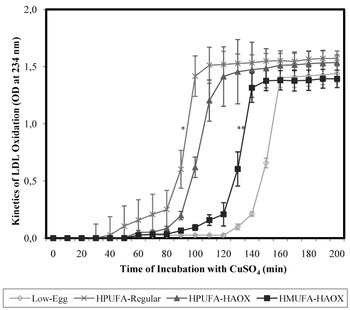
Following consumption of two eggs/day of either type for three consecutive weeks each, consumers’ LDL oxidisability was comparable to the low oxidation levels observed at baseline ('low-egg' – 2-4 HPUFA-regular eggs/week). The baseline length of lag-time to LDL oxidation was shortened with two HPUFA-regular eggs (by 28.8%, p<0.01), indicating increased oxidisability, whereas with two HMUFA-HAOX eggs/day lag-time was numerically 6.6% shorter, and 31.0% (p<0.01) longer than with two HPUFA-regular eggs/day. Similar results were observed when conjugated diene formation was measured by optical density (OD) at 234 nm (Figure 2).
Kinetic analysis of LDL oxidation in blood following low-egg regime and two eggs/day of HPUFA-regular, HPUFA-HAOX, or HMUFA-HAOX (n=17).
*p<0.01 (vs. low-egg); **p<0.01 (vs. HPUFA-regular)

The finding that reducing egg PUFA (n-6 LA) and increasing MUFA (n-9 OA) and antioxidants (vitamin E and carotenoids) limited the increased LDL oxidisability observed with high n-6 PUFA regular egg consumption shows the potential of designing anti-oxidative eggs with synergistic compositions for reducing LDL oxidation. The anti-oxidative success of the HMUFA-HAOX egg composition was consistent with a previous study suggesting the protective potential of a diet high in MUFA and vitamin E against LDL oxidation (Reaven et al., Reference REAVEN, GRASSE and TRIBBLE1994). However, the unexpected larger changes in LDL oxidation response (±30%) following relatively minor dietary FA changes (egg OA, LA ±1-3 g, ±15-25% of daily intake), emphasises the close inter-relationship between egg and LDL compositions. This, in turn, may suggest unique functional potential for egg in regulating cholesterol metabolism, including potential for reducing LDL susceptibility to oxidation (Shapira and Pinchasov, Reference SHAPIRA and PINCHASOV2008).
Conclusions
Beyond the egg's inherent nutritional contribution, studies reflect the flexibility of its composition, which is highly feed-dependent, and may suggest further potential for nutritional as well as functional enhancement by simple and low-cost methods of modifying feed. Close relationships between egg yolk lipids and lipoprotein composition, much beyond their nutritional significance and their physiological effects – i.e. on LDL oxidation – may suggest significant health potential for egg modification. These effects may ultimately impact qualitative measures and quantitative recommendations for egg composition. Health-oriented agriculture may be relevant in medical areas, including risks directly associated with egg consumption, i.e. increased plasma cholesterol and LDL oxidation, and for combating general risks of CVD, i.e. postprandial lipemia, endothelial dysfunction, and inflammation. It is also relevant for perinatal health of child and mother, including optimal brain development – where it can make a significant supplemental dietary contribution – and maternal replenishment, well-being, and functioning.
High n-3 PUFA eggs may become an increasingly important source of n-3 LCPUFA, given increasing scarcity and lack of sustainable harvesting of marine fish (Jenkins et al., Reference JENKINS, SIEVENPIPER, PAULY, SUMAILA, KENDALL and MOWAT2009), traditionally relied upon (Foran et al., Reference FORAN, GOOD, CARPENTER, HAMILTON, KNUTH and SCHWAGER2005), as well as contamination and associated health risks resulting in their being cautioned against during pregnancy and lactation (Oken et al., Reference OKEN, KLEINMAN, BERLAND, SIMON, RICH-EDWARDS J.W. and GILLMAN2003). Further, farmed fish increasingly contain high n-6 LCPUFA levels (Weaver et al., Reference WEAVER, IVESTER, CHILTON, WILSON, PANDEY and CHILTON2008), which may unexpectedly exacerbate rather than ameliorate high n-6:n-3 PUFA dietary and tissue ratios. High-antioxidant eggs may become an essential source for effective delivery of such nutrients as lutein and carotenoids, essential for eye and skin health, and additional phytonutrients, otherwise limited in typical diets (Bourre and Galea, Reference BOURRE and GALEA2006).
Where an individual approach to the cholesterol concern seems to be most relevant – i.e. for cholesterol hyper-responders (Greene et al., Reference GREENE, WATERS, CLARK, CONTOIS and FERNANDEZ2006), hypercholesterolemics, and diabetics (Djoussé and Gaziano, Reference DJOUSSÉ and GAZIANO2008; Qureshi et al., Reference QURESHI, SURI, AHMED, NASA, A.A. and KIRMANI2007; Hu et al., Reference HU, STAMPFER, RIMM, MANSON, ASCHERIO, COLDITZ, ROSNER, SPIEGELMAN, SPEIZER, SACKS, HENNEKENS and WILLETT1999), including gestational diabetics, or per reproductive stage – a differential approach to specific designer eggs may be relevant. While the anti-oxidative egg higher in n-9 MUFA and antioxidants may not be optimal for peak brain development (Shapira, Reference SHAPIRA2009), it may have anti-LDL oxidation and heart benefits. Eggs with more n-3 LCPUFA and additional nutrients would be the preference for perinatal health. Moreover, results from two recent large prospective United States cohort studies (Physicians' Health Study I, 1982-2007, and Women's Health Study, 1992-2007) showed a correlation between daily or greater egg consumption and risk of developing type 2 diabetes mellitus (Djoussé et al., Reference DJOUSSÉ, GAZIANO, BURING and LEE2009), which may suggest benefits of eggs with anti-oxidative (Shapira and Pinchasov, Reference SHAPIRA and PINCHASOV2008) and high n-3 PUFA (Ohman et al., Reference OHMAN, AKERFELDT, T, . NILSSON, ROSEN, HANSSON, CARLSSON and LARSSON2008) compositions vs. measures associated with diabetes risk, further suggesting potential directions for egg design.
Research regarding benefits and practical possibilities of producing eggs designed specifically to support specific health areas, such as CVD and perinatal nutrition for brain development – produced simply and economically, and therefore having wide-ranging and popular applicability – is highly warranted. The scope of the relevance of tailored egg consumption may expand significantly in this capacity. Future optimisation of guidelines may combine qualities of egg composition with quantities for egg consumption recommendations, for the general population, specific subgroups, and individual requirements, and may affect the debate regarding the nutritional benefits of eggs in general.