The symptomatology of paranoid personality disorder (PPD) centers around pervasive distrust and suspicion of others (American Psychiatric Association, 1994). PPD is one of the most common types of personality disorders. A recent epidemiological study based on a community sample of adults (18 years and older) in the United States reported that 4.4% of the general population had PPD, the second most prevalent personality disorder following obsessive–compulsive personality disorder (Grant et al., Reference Grant, Hasin, Stinson, Dawson, Chou and Ruan2004). Similarly, in a study of a Norwegian community sample of adults (aged between 18 and 65), the prevalence rate of PPD was 2.4%, the second most prevalent category following avoidant personality disorder (Torgensen, Kringlen, & Cramer, Reference Torgensen, Kringlen and Cramer2001). Although PPD is a relatively prevalent type of personality disorder, its correlates and development are understudied (Cohen, Crowford, Johnson, & Kasen, Reference Cohen, Crowford, Johnson and Kasen2005).
Personality disorders, including PPD, are often treated as a form of adult psychopathology (Cohen, Reference Cohen2008). This view is consistent with the Diagnostic and Statistical Manual of Mental Disorders—Fourth Edition (DSM-IV; American Psychiatric Association, 1994), in which the diagnosis of personality disorder is typically deferred until after adolescence. However, it is unlikely that manifestations of PPD suddenly appear only during emerging adulthood. Even before the emergence (or diagnosis) of a psychopathological disorder, there are pathways signifying adaptational compromises that probabilistically forebode later psychopathology (Cicchetti & Cohen, Reference Cicchetti, Cohen, Cicchetti and Cohen1995; Cicchetti & Rogosch, Reference Cicchetti and Rogosch2002; Sroufe, Reference Sroufe1997). The central question that guided this study was: Do individuals who eventually manifest high levels of paranoid symptoms in adolescence differ from their peers in their development of behavioral disturbances earlier in life? In particular, we focused on childhood history of maltreatment, peer relations, and externalizing problems in individuals who developed varying levels of PPD symptoms in adolescence.
Child Maltreatment, Peer Relations, Early Maladaptations, and Later Paranoid Symptoms
A core characteristic of PPD is distrust. Because of difficulty in trusting others' loyalty and commitment, individuals with PPD tend to have problems in forming relationships (American Psychiatric Association, 1994). This fractured trust in others is likely to be a product of betrayal and problems in important social relationships. Events involving victimization by significant others could potentially render children prone to become suspicious about others' loyalty and trustworthiness. Such traumatic events in childhood include child maltreatment and peer victimization. Indeed, child maltreatment has been linked to later personality disorders (e.g., Battle et al., Reference Battle, Shea, Johnson, Yen, Zlotnick and Zanarini2004; Johnson, Cohen, Brown, Smailes, & Bernstein, Reference Johnson, Cohen, Brown, Smailes and Bernstein1999), including PPD (Grover et al., Reference Grover, Carpenter, Price, Gagne, Mello and Mello2007; Johnson et al., Reference Johnson, Cohen, Brown, Smailes and Bernstein1999, Reference Johnson, Cohen, Smailes, Skodol, Brown and Oldham2001). For example, the findings from the Children in the Community (CIC) Study, a community-based longitudinal study, demonstrated that childhood neglect was significantly associated with elevated levels of paranoid symptoms in young adulthood (Johnson et al., Reference Johnson, Cohen, Brown, Smailes and Bernstein1999).
In fact, research has shown that victims of child maltreatment tend to exhibit paranoid-like reactions, such as hyperarousal, excessive vigilance, and anxiety in social settings. The literature on social cognition and child maltreatment has documented maltreated children's hypervigilance toward negativity in social interactions. For instance, research has demonstrated that abused children tend to be excessively reactive to expressions of anger in faces (Pollak, Cicchetti, Hornung, & Reed, Reference Pollak, Cicchetti, Hornung and Reed2000; Pollak & Kistler, Reference Pollak and Kistler2002; Pollak & Sinha, Reference Pollak and Sinha2002) and voices (Pollak, Vardi, Putzer Bechner, & Curtin, Reference Pollak, Vardi, Putzer Bechner and Curtin2005), are more attentive to threatening stimuli (Rieder & Cicchetti, Reference Rieder and Cicchetti1989), and demonstrate inattention to positivity (Ayoub et al., Reference Ayoub, O'Connor, Rappolt-Schlichtmann, Fischer, Rogosch and Toth2006). Furthermore, maltreated children are likely to attribute hostility to others' behavior (Weiss, Dodge, Bates, & Pettit, Reference Weiss, Dodge, Bates and Pettit1992) and to verbally or physically retaliate as a reaction toward other people who may or may not have malicious intent (Teisl & Cicchetti, Reference Teisl and Cicchetti2008). Together, this empirical evidence suggests similarities between the developmental sequalae of child maltreatment and paranoid symptoms. Therefore, we expected that adolescents with a history of maltreatment would be more likely to exhibit elevated levels of PPD symptoms.
Peer victimization is another form of traumatic social experience in childhood that may lead to a general propensity for distrust toward others. Little is known about the role of peer victimization in the development of PPD. However, the experience of peer victimization may be associated with paranoid symptoms because children who are frequent victims of peer harassment tend to be hypervigilant for threatening cues in social interactions (Rosen, Milich, & Harris, Reference Rosen, Milich and Harris2007; Schwartz et al., Reference Schwartz, Dodge, Coie, Hubbard, Cillessen and Lemerise1998). Indeed, chronic victims of peer aggression often come to view others as provocative, and become reactively aggressive (Schwartz et al., Reference Schwartz, Dodge, Coie, Hubbard, Cillessen and Lemerise1998). Because our knowledge on the association between peer victimization and paranoid symptoms is scant, the examination of this topic is an additional component of this study. We expected adolescents with elevated levels of PPD symptoms would be more likely to have a history of peer victimization during childhood.
Paranoid thinking appears to be closely related to behavioral aggression because individuals with pervasive distrust and suspicion toward others may perceive a need for self-protection. Indeed, antisocial and aggressive behaviors appear to be a hallmark of psychosocial maladaption among adults with PPD (Berman, Fallon, & Coccaro, Reference Berman, Fallon and Coccaro1998; Johnson et al., Reference Johnson, Cohen, Smailes, Kasen, Oldham and Skodol2000). For instance, childhood conduct problems have been shown to be an independent predictor of Cluster A personality disorder (personality disorders of an odd or eccentric nature including paranoid, schizoid, and schizotypal personality disorders) 10 years later (Bernstein, Cohen, Skodol, Bezirganian, & Brook, Reference Bernstein, Cohen, Skodol, Bezirganian and Brook1996). Johnson et al. (Reference Johnson, Cohen, Smailes, Kasen, Oldham and Skodol2000) reported that adolescents with PPD tended to commit a wide range of violent acts and criminal behavior in early adulthood. In the peer context, Coolidge, DenBoer, and Segal (Reference Coolidge, DenBoer and Segal2004) found that bullying behavior and PPD may be linked in middle school-aged children. Although these studies are informative, questions remain as to how aggressive behaviors evolve as children approach the age at which PPD is typically diagnosed. This study reexamined the link between the development of behavioral aggression (i.e., bullying and general externalizing problems) and PPD symptoms in a prospective study.
In addition, we were interested in the childhood peer-perceived social behavior of youths who manifested elevated levels of PPD symptoms in adolescence. Because PPD is a disorder whose problems unfold in social settings, interpersonal deficits may be already emerging in the childhood peer context. We expected that children who displayed high levels of paranoid symptoms in adolescence would have more negative peer social behavior in childhood than those with milder PPD symptoms.
The Present Study
The present study addresses a theoretically important issue about the development of PPDs: whether children who eventually develop elevated PPD symptoms in adolescence differ in their developmental profile of behavioral disturbances in childhood. Specifically, we examined the differences in the history of child maltreatment, peer victimization, bullying, externalizing problems, and social behavior in childhood among individuals who eventually developed high, moderate, or low levels of PPD symptoms in adolescence. The following hypotheses were investigated:
1. children who developed elevated levels of paranoid symptoms in adolescence would be more likely to have experienced maltreatment in childhood,
2. children who had elevated paranoid symptoms in adolescence would be more likely to have experienced peer victimization in childhood,
3. children who had elevated paranoid symptoms in adolescence would be more likely to have shown upward age trajectories of general externalizing problems and peer aggression (i.e., bullying) during childhood, and
4. children who had elevated paranoid symptoms in adolescence would be more likely to have had negative social behavior with peers in childhood.
Methods
Participants
The present study was based on a longitudinal study of 174 children (94 maltreated, 80 nonmaltreated children) who participated at least once in the annual summer camp program between 1993 and 2002. There were two criteria for inclusion in this study: (a) children attended the summer camp at least once between their ages of 9 to 12 during the study period, and (b) they participated in the assessment of personality disorders in adolescence. The average age of participants at the time of personality disorder assessment was 15.30 (SD = 1.52). There were 69 girls and 105 boys.
The summer camp was designed to provide maltreated and nonmlatreated children from families of low socioeconomic background a recreational experience in which researchers could observe children's behavior and peer interactions in an ecologically valid setting (Cicchetti & Manly, Reference Cicchetti, Manly, Brody and Sigel1990). Parents provided informed consent for their child's participation at summer camp and permission for checking any Department of Human Services (DHS) records pertaining to the family. Maltreated children were identified by the county DHS as having documented histories of abuse and/or neglect. Because maltreated children were predominantly from families with low socioeconomic background, demographically comparable nonmaltreated children were recruited from families receiving Temporary Assistance for Needy Families. Their nonmaltreatment status was verified by the DHS records. Trained research assistants also interviewed mothers of children recruited for the nonmaltreatment group to confirm the absence of prior maltreatment experience. Each year the camp was held, maltreatment status was checked with the DHS records. In this report, children from families without any history of documented abuse and/or neglect were included in the nonmaltreatment group. Previous work based on a similar sample documented that children in the maltreatment and nonmaltreatment groups were comparable on family demographic characteristics (Manly, Kim, Rogosch, & Cicchetti, Reference Manly, Kim, Rogosch and Cicchetti2001).
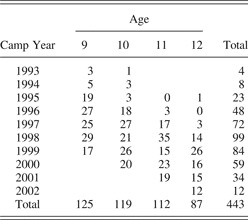
Across the years from 1993 to 2002, participants were allowed to attend the camp in any years. As a result, the data structure employed in this current report did not assume invariance of timing of assessment across individuals. Table 1 illustrates the data used in the current investigation; 174 participants contributed 443 observations over time, covering ages 9 to 12. Seventy-nine percent of the sample participated in two or more camps during 4 years. The number of camps participants attended did not differ by cohort, F (8, 165) = .75, ns. Furthermore, neither cohort nor the number of attended camps was significantly associated with the levels of PPD symptoms or any other study variables (rs < .07, ns).
The number of participants by year and age (N = 174)

Procedures
At the camp, children took part in a variety of recreational activities in a small group setting. Children were assigned to a group of eight same-age peers, and approximately half of the group members were maltreated. Each group was staffed by two to three trained camp counselors, who were unaware of the maltreatment status of children and the research hypotheses. Camp activities lasted 7 hours per day, providing 35 hr of intensive interaction among children and counselors during a week-long program (for detailed camp procedures, see Cicchetti & Manly, Reference Cicchetti, Manly, Brody and Sigel1990). Children provided signed assent for research participation.
In a subsequent follow-up study during adolescence of prior children who had attended the camp, adolescents were individually interviewed and completed a variety of measures. As part of the research battery, the OMNI-IV was administered to assess personality disorders.
Measures
Assessments in childhood
Child maltreatment
DHS records pertaining to the family were used to verify the presence and absence of child maltreatment. DHS records were checked annually to document any subsequent maltreatment occurrences. DHS maltreatment records were coded according to the Maltreatment Classification System (Barnett, Manly, & Cicchetti, Reference Barnett, Manly, Cicchetti, Cicchetti and Toth1993). The subtypes of maltreatment that were classified included neglect, emotional maltreatment, physical abuse, and sexual abuse. In the current sample, we did not find any significant association between paranoid symptoms and the type or the number of maltreatment subtypes children experienced. Therefore, in this report, we used a global index of child maltreatment, coding nonmaltreated children as 0, and maltreated children as 1.
Longitudinal assessments in childhood (ages 9–12)
Peer victimization and bullying
Camp counselors, who observed children approximately 35 hr during the camp, reported each child's behavior associated with bullying and victimization using the Mt. Hope Family Center Bullying–Victim Questionnaire (Shields & Cicchetti, Reference Shields and Cicchetti2001). This 10-item questionnaire consisted of 5 items assessing bullying and 5 items for victimization. Bullying was defined in terms of systematic attempts to dominate peers via manipulation, coercion, and aggression, and victimization was defined as submissive, ineffective responses to peer aggression and dominance (Olweus, Reference Olweus, Pepler and Rubin1991). This scale has been used in previous studies based on a similar sample (Shields & Cicchetti, Reference Shields and Cicchetti2001). A sample item for the bullying subscale includes “manipulates or exploits peers by deceiving them, controlling resources, taking possessions, cheating at games, etc.” The reliability coefficient ranged from .93 to .95 across the study period, with an average of .94. For the victimization scale, a sample item includes “tends to be gullible or vulnerable, is easily exploited.” The Cronbach α ranged from .63 to .83 over the study period, with an average of .71. The counselors rated each child using a 4-point scale ranging from never (1) to always (4). Scores were computed by averaging across counselors' ratings.
Externalizing problems
The camp counselors rated children's behavior problems using the Teacher's Report Form of Child Behavior Checklist (TRF; Achenbach, Reference Achenbach1991). The TRF is an extensively used and well-validated assessment to evaluate child and adolescent symptomatology. The TRF is composed of two broadband dimensions of child symptomatology: internalizing and externalizing problems. This investigation focused only on externalizing problems. For each child in respective groups, two to three camp counselors individually rated the frequency of occurrence of a listed 118 problem behaviors on a 3-point scale ranging from not true to very true. The scores were averaged across raters. Previous work with a similar sample has demonstrated acceptable interrater reliabilities for externalizing problems, ranging from .83 to .91 (Manly et al., Reference Manly, Kim, Rogosch and Cicchetti2001).
Peer social behavior
At the end of each camp week, children were asked to rate the other children in their group using a sociometric measure (Coie & Dodge, Reference Coie and Dodge1983). Children were instructed to individually nominate one peer who best fitted the description of six characters: “a fighter,” “a cooperative child,” “a disruptive child,” “a leader,” “a child who starts fights,” and “a shy child.” A photograph of the group was used to facilitate administration. Children were assured that their nominations were kept confidential. Nominations were based on approximately 30–35 hr of interactions. Previous studies have shown that nominations made by familiar and unfamiliar peers are significantly correlated (Coie & Kupersmidt, Reference Coie and Kupersmidt1983). The total number of nominations each child received from their peers was counted. The raw number of nominations each child received was standardized to correct for differences in group size. Because the peer nomination measure required standardization in computing the scores, they were not suited to detect mean level changes in their scores over time. Therefore, we averaged the standardized scores across four age periods to summarize peer-appraised social behavior for each child during childhood.
Assessment in adolescence
PPD group classification by the levels of PPD symptoms
The OMNI-IV Personality Disorder Inventory (Loranger, Reference Loranger2001) was administered when camp participants were in adolescence (mean age = 15.30). The OMNI-IV is a self-report questionnaire that consists of 210 items focusing on the symptoms of 10 personality disorders defined by DSM-IV. The current study is based on the subscale for PPD. Participants were asked to describe their characteristics or experiences in the past 5 years using a 7-point Likert scale. The OMNI-IV Software System was used to transform the raw scores into linear T-scores based on the OMNI-IV normative sample. Cases with T-scores equal to or greater than 70 on the PPD subscale indicate a clinically significant level of personality disturbance. In this sample of adolescents, however, there were only five individuals whose T-scores exceeded 70. To better capture the distribution, T-scores were then classified into three levels. T-scores below 44 were classified to low PPD symptoms, T-scores from 45 to 54 to moderate PPD symptoms, and T-scores at or above 55 to high PPD symptoms. Based on this classification, we identified 65 children in the low PPD symptom group, 54 in the moderate PPD group, and 55 in the high PPD group.
Analytical strategies
Because the primary goal of the present investigation was to examine the differences in the developmental profiles of adolescents with varying levels of PPD symptoms, we first grouped adolescents into three groups (low, moderate, and high) to capture heterogeneity in adolescent PPD symptoms, and then to ascertain the group differences with potential childhood correlates of PPD. In particular, we were interested in whether three groups had distinctive childhood profiles on experience of child maltreatment, peer victimization and bullying, peer social behavior, and general externalizing problems.
The results are organized into three major sections. First, to test whether children who eventually developed high levels of PPD symptoms had experienced child maltreatment earlier in life (Hypothesis 1), we performed a chi-square test. Second, we examined the differences among three PPD groups in the trajectories of peer victimization and bullying, and general externalizing problems between ages 9 and 12 (Hypotheses 2 and 3). We first present descriptive statistics of these variables, then report results based on multilevel modeling using SAS PROC MIXED (Littell, Milliken, Stroup, & Wolfinger, Reference Littell, Milliken, Stroup and Wolfinger1996; Singer, Reference Singer1994). Multilevel modeling is suited for the present investigation because it does not require the invariance in timing of assessment across participants while examining within-individual changes (Raudenbush & Bryk, Reference Raudenbush and Bryk2002). Third, we investigated the PPD group differences in the indices of childhood social behavior (Hypothesis 4) using an omnibus multivariate analysis of covariance (MANCOVA), which was followed up with a series of univariate analyses of covariance (ANCOVA) and post hoc comparisons.
Results
Symptoms of PPD and child maltreatment
To examine whether children who developed higher levels of PPD symptoms in adolescence were likely to have experienced child maltreatment earlier in life, we performed a 2 (with vs. without maltreatment history) × 3 (high, moderate, low levels of PPD symptoms) chi-square test. The results indicated the likelihood of being maltreated in childhood significantly differed by the PPD groups, χ 2 (2, n = 174) = 6.62, p < .05. For nonmaltreated children, the distribution of the low, moderate, and high PPD groups was 46%, 23%, and 31%, respectively. For maltreated children, these values were 30%, 38%, and 32%, respectively. The general pattern of the distribution implied that the group of nonmaltreated children was slightly overrepresented by children with low PPD symptoms. The descriptive results for maltreated children were suggestive in that the group of maltreated children was marginally overrepresented by children in the moderate or high PPD groups. To further examine the pattern of the results, we performed logistic regression to compute the odds of having a history of child maltreatment by the PPD symptoms levels. Sex was included as a covariate. The odds ratio of having a history of child maltreatment for the moderate and high PPD symptom groups was 1.96 (95% confidence interval, 1.04–3.69, p < .05), in comparison to the low PPD group. This finding indicated that having a history of child maltreatment was more prevalent in the moderate and high PPD groups than in the low PPD group.
PPD group differences in childhood developmental profiles
Changes in childhood peer victimization, bullying, and externalizing problems by the PPD groups
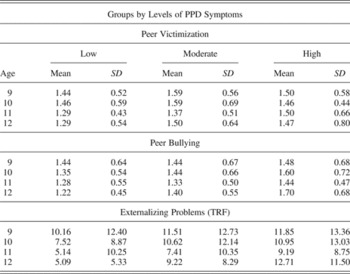
One theoretically important question is whether children who eventually developed elevated levels of PPD symptoms in adolescence had already shown early behavioral signs of problems in childhood. Table 2 presents the means and standard deviations of childhood peer victimization, bullying, and general externalizing problems by the PPD groups.
Descriptive statistics of the study variables

Note: PPD, paranoid personality disorder assessed in adolescence; TRF, Teacher's Report Form (Achenbach, Reference Achenbach1991).
We performed a series of multilevel modeling analyses with SAS PROC MIXED to investigate whether individuals who developed low, moderate, or high PPD symptoms in adolescence had differed in these problem behaviors during childhood. As preliminary steps (not shown), we examined alternative models for growth curves, including linear and quadratic terms. The quadratic term did not reach statistical significance either for peer victimization (b = .01, ns), or bullying (b = .01, ns), or externalizing problems (b = .50, ns). Therefore, we retained only the linear term in the following analyses. We also tested a series of interaction terms with the child's sex (Age × Sex, PPD Group Status × Sex, Age × PPD Group Status × Sex), but none of these terms was statistically significant. For the parsimony of the models, we omitted these interaction terms from the subsequent analyses.
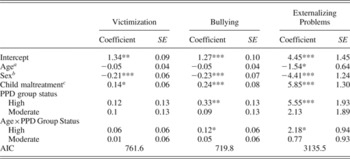
The results for the fixed effects from multilevel modeling are summarized in Table 3. To simplify the interpretation of the intercepts, age was centered at 12 years old and the reference was nonmaltreated males in the low PPD group. Child sex and maltreatment status were included as covariates. For peer victimization, there was no systematic pattern of growth during the period between ages 9 to 12. Sex was significantly associated (b = −.21, p < .001), indicating that on average, boys were more likely than girls to be victimized by peers during this period. Child maltreatment was also a significant correlate (b = .14, p < .05); on average, maltreated children were more likely than nonmaltreated children to be at risk for peer victimization. Contrary to our expectations, neither the main effect of the PPD group status nor its interaction with age was significantly associated with trajectories of peer victimization.
Fixed effects from growth curve models for peer victimization, bullying, and externalizing problems between ages 9 and 12 by history of child maltreatment and levels of paranoid personality disorder (PPD) symptoms in adolescence

Note: The reference of PPD group status is the low paranoid group whose t scores on OMNI-IV were below 45. AIC, Akaike information criterion.
aAge is centered at age 12.
b0 = male, 1 = female.
c0 = no history of child maltreatment, 1 = with history of child maltreatment.
*p < .05. **p < .01. ***p < .001.
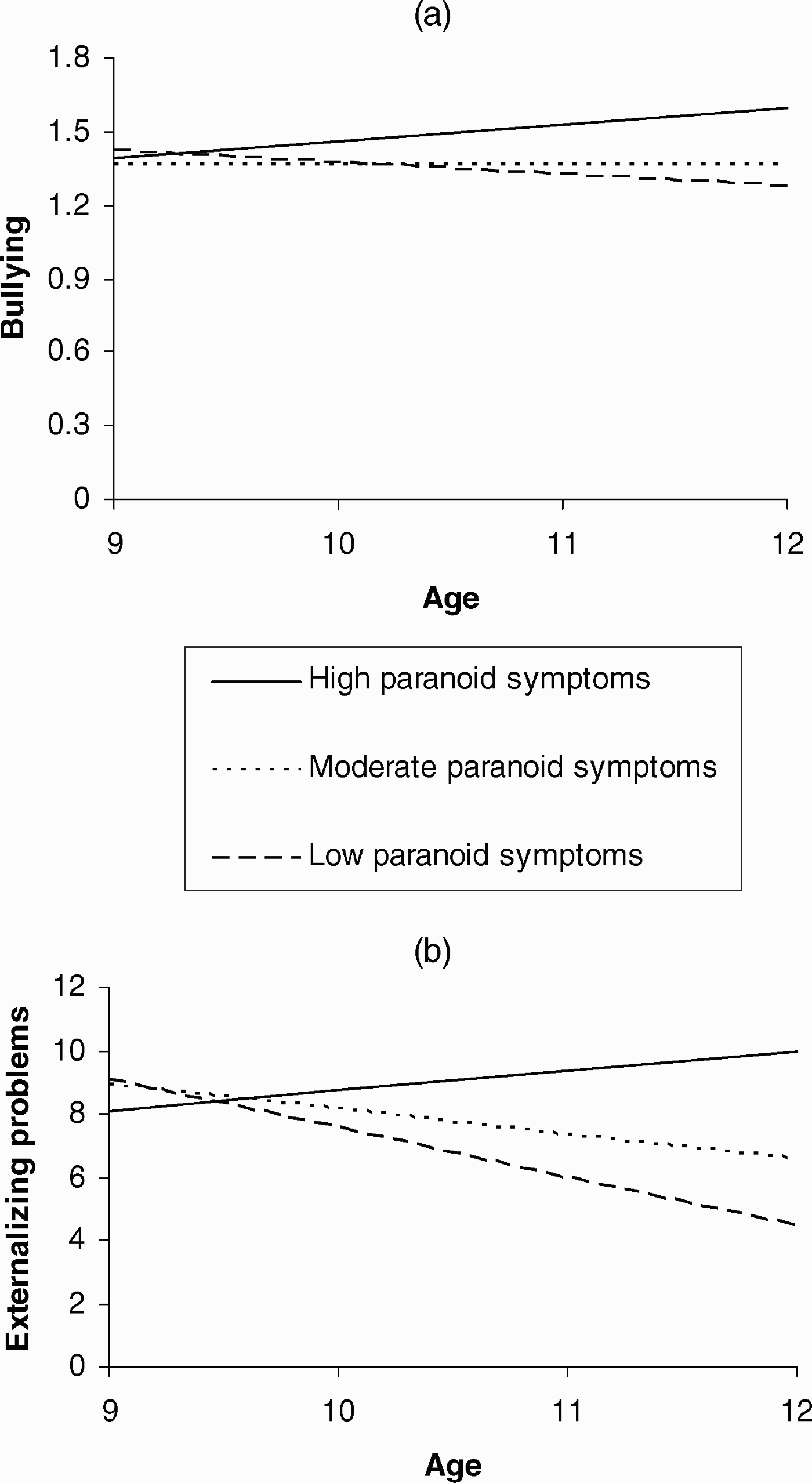
In predicting changes in peer bullying, there was a significant main effect for sex (b = −.23, p < .001), indicating girls showed fewer bullying behaviors than boys. Child maltreatment (b = .24, p < .001) was also significant, with maltreated children being more likely to bully their peers, relative to nonmaltreated children. Of importance for this study, the main effect for the high PPD group status (b = .33, p < .01) and its interaction with age (b = .12, p < .05) were significant. Figure 1a illustrates these findings. This finding indicated that children who manifested high levels of PPD symptoms in adolescence tended to have a history of bullying behaviors that aggravated over time. Their bullying had become increasingly severe with age during the ages between 9 and 12, and by age 12 they were significantly more likely than the low PPD group to bully their peers.
Estimated age trajectories of (a) bullying and (b) externalizing problems by the groups with low, moderate, and high levels of paranoid symptoms.
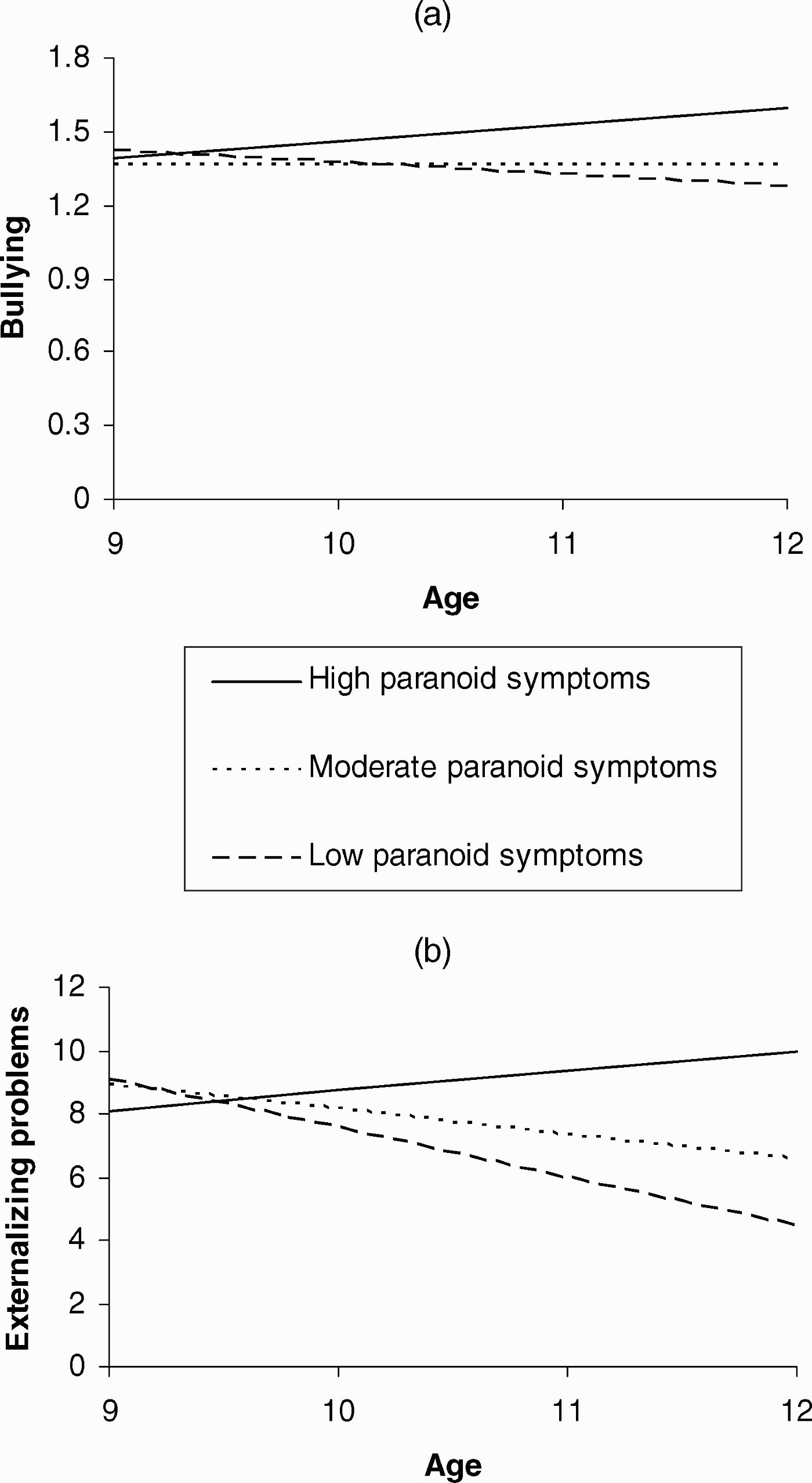
Externalizing problems declined from ages 9 to 12 (b = −1.54, p < .05). Child maltreatment had a significant main effect (b = 5.85, p < .001), indicating that maltreated children, on average, had higher TRF scores than nonmaltreated children. Of importance, the high PPD group had significantly higher externalizing problems than the low PPD group (b = 5.55, p < .001). Furthermore, the rate of growth significantly differed between the high and low PPD groups (b = 2.18, p < .05). These main and the interaction effect are summarized in Figure 1b. These findings altogether suggest that compared to the low PPD group, the high PPD group had an upward growth in externalizing problems between ages 9 to 12, whereas externalizing problems of other groups slowly declined. This increasing trend resulted in their higher levels of externalizing problems as they reached age 12. In other words, children who developed high levels of PPD in adolescence had already shown behavioral problems in childhood and the divergence between the high and low PPD groups had widened over time.
Peer-perceived social behavior
As mentioned earlier, the peer nomination measure required standardization. Thus, these data were not suited to detect mean changes over time. Therefore, we averaged the standardized scores across four age periods to summarize peer-rated social behavior. We then performed a MANCOVA with sex and maltreatment status entered as covariates, the PPD groups as the independent variable, and peer nomination variables as the dependent variables. This analysis was designed to investigate whether children who developed high levels of PPD symptoms in adolescence had differed from their peers in terms of their social behavior in the peer context during childhood. Results of the omnibus MANCOVA included a significant overall F for maltreatment, F (5, 163) = 5.60, p < .001. Of importance, a significant omnibus F was noted for the PPD group status, F (10, 326) = 2.32 p < .01.
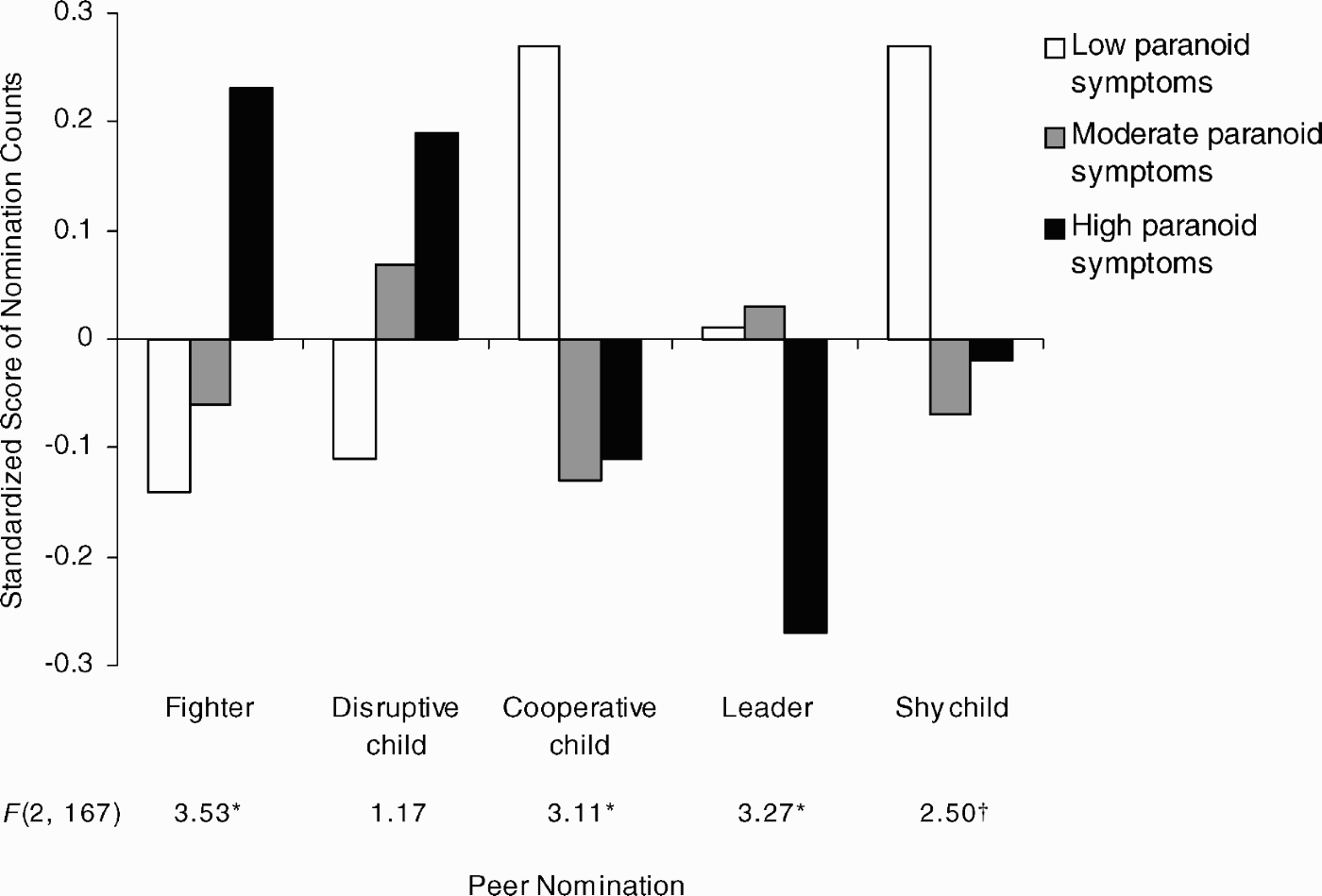
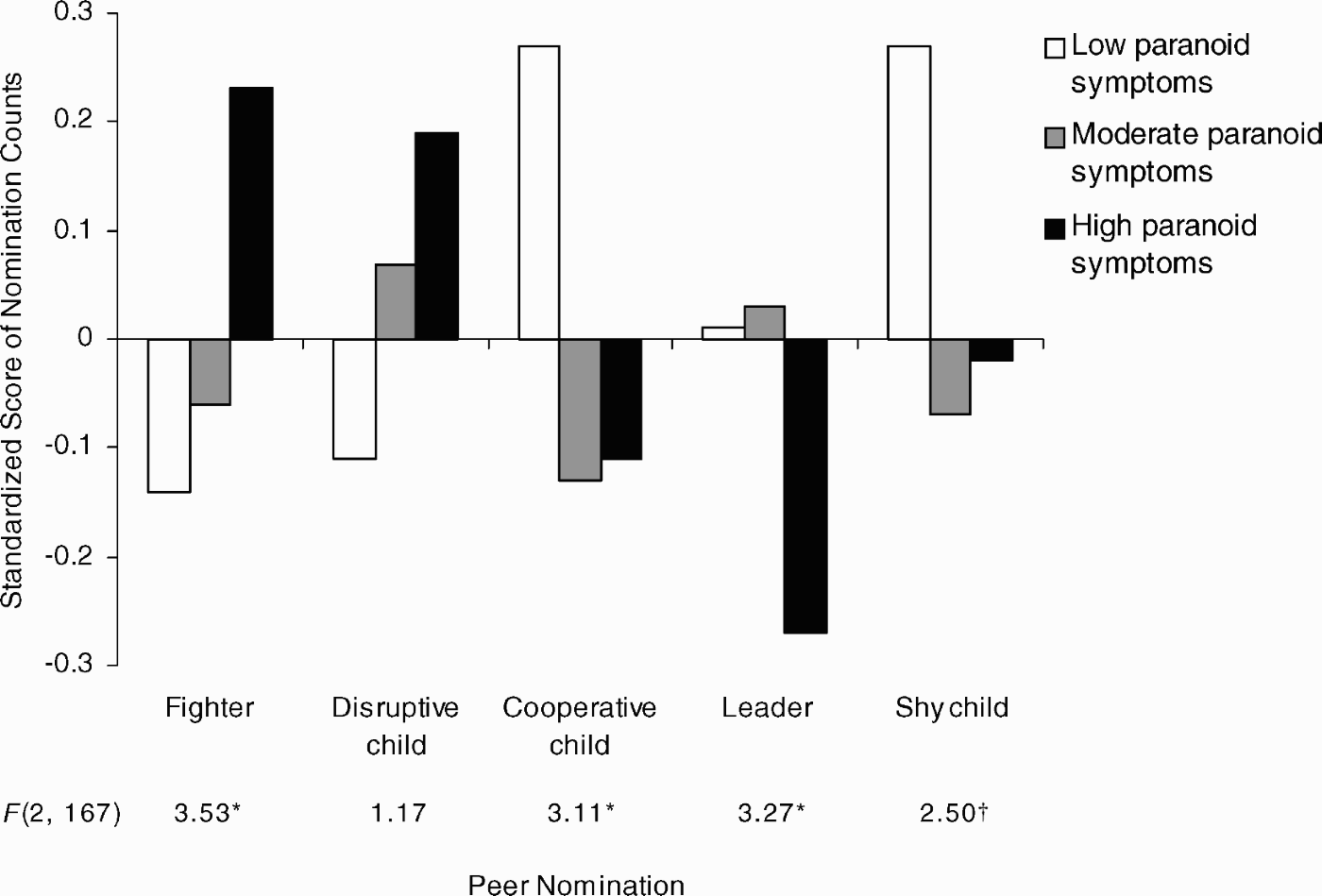
To more closely investigate the associations between the PDD group status and the peer-rated social behavior, the omnibus MANCOVA was followed up with a series of univariate ANCOVA. Figure 2 presents the results of analyses of variance and means of standardized scores for the peer-nomination variables by the PPD groups. Results from an ANCOVA indicated significant differences among the PDD groups on peer nomination for fighter, F (2, 167) = 3.53, p < .05, cooperative child, F (2, 167) = 3.11, p < .05, and leader, F (2, 167) = 3.27, p < .05. A marginally significant difference was observed for peer nomination of shy child, F (2, 167) = 2.50, p < .10, and no group difference was detected for disruptive child. Post hoc comparisons were then conducted to further examine the PPD group differences on peer nomination of fighter, cooperative child, and leader. Results revealed that children in the high PPD group (M = 0.22, SD = 0.86) received more nominations for fighter than children in the moderate (M = −0.06, SD = 0.70, p < .05) or low PPD groups (M = −0.14, SD = 0.73, p < .05). In addition, children in the high PPD group received fewer nominations for cooperative child (M = −0.11, SD = 0.79) than children in the low PPD group (M = 0.88, SD = 0.88, p < .05). For peer nomination for leader, children in the high PPD group received the fewest nominations (M = −0.27, SD = 0.77) compared to the moderate (M = 0.03, SD = 0.82, p < .05) or low PPD groups (M = 0.01, SD = 0.65, p < .05). Overall, these findings indicated that children who grew up to have higher levels of PPD symptoms in adolescence had already developed negative social behavior in childhood such that they were perceived as someone who liked to fight, behave uncooperatively, and were not leaders.
Mean standardized scores of peer nomination by the groups with low, moderate, and high levels of paranoid symptoms. *p < .05. †p < .10.
Discussion
This study was designed to investigate how individuals who developed varying levels of PPD symptoms in adolescence differed in their developmental profile in childhood. By using longitudinal data reported by multiple sources of information, we enhanced our understanding of how childhood history of maltreatment, peer relations, and externalizing problems leads to adolescent paranoid symptoms.
Several important findings emerged. First, the group of children who exhibited higher levels of paranoid symptoms in adolescence was more likely to have a history of child maltreatment than those with milder paranoid symptoms. This observation converges with previous studies identifying child maltreatment as a potential risk factor for later personality disorders (Battle et al., Reference Battle, Shea, Johnson, Yen, Zlotnick and Zanarini2004; Grover et al., Reference Grover, Carpenter, Price, Gagne, Mello and Mello2007; Johnson et al., Reference Johnson, Cohen, Brown, Smailes and Bernstein1999, Reference Johnson, Cohen, Smailes, Skodol, Brown and Oldham2001).
How child maltreatment affects later paranoid symptoms still requires additional investigation. One possible explanation is that affective and cognitive processes of maltreated children eventually develop into general mistrust and suspicion toward others. The literature on the developmental sequelae of child maltreatment has documented mounting evidence that maltreated children tend to be hypervigilant and perceptually biased toward negativity when processing others' emotional states (Pollak et al., Reference Pollak, Cicchetti, Hornung and Reed2000, Reference Pollak, Vardi, Putzer Bechner and Curtin2005; Pollak, Cicchetti, & Klorman, Reference Pollak, Cicchetti and Klorman1998; Pollak, Cicchetti, Klorman, & Brumaghim, Reference Pollak, Cicchetti, Klorman and Brumaghim1997; Pollak & Kistler, Reference Pollak and Kistler2002; Pollak & Sinha, Reference Pollak and Sinha2002). Psychological states, such as being preoccupied with hidden motives of others, feeling doubts about others' behavior without sufficient basis, and mistrusting others (all of which are primary symptoms of PPD) also require affective–cognitive information processing that is excessively attuned to negativity in interpersonal relationships. The similarities in the information processing styles by maltreated children and adult patients with PPD provide suggestive evidence that there may be a prospective pathway from maltreatment in childhood to later PPD via the compromised affective–cognitive information processing. It is important to note that the paranoid tendency of abused children may not be pathogenic per se. In fact, in the chaotic context where supposedly trustworthy others become perpetrators, it may be indeed adaptive to be vigilant about trusting others (Cicchetti & Lynch, Reference Cicchetti, Lynch, Cicchetti and Cohen1995; Rogosch, Cicchetti, & Aber, Reference Rogosch, Cicchetti and Aber1995). However, it may become pathologically paranoid when the tendency of mistrusting others becomes so pervasive that it extends to nonthreatening interpersonal relationships.
Attachment theory may provide an additional explanation of how maltreated children later develop an elevated tendency for paranoia. According to attachment theory, a child organizes an internal working model representing the relationship among self, the attachment figure, and the external world through affective and social experiences with primary caregivers (Bowlby, Reference Bowlby1980). Later experience is interpreted on the basis of the internal working model, which provides continuity between earlier experience and later outcomes. Hence, unresponsive, rejecting, and violent parenting, which is overwhelmingly representative of parents of maltreated children (Rogosch, Cicchetti, Shields, & Toth, Reference Rogosch, Cicchetti, Shields, Toth and Bornstein1995), may foster the development of insecure internal working models in the children that color their later interpersonal experience in a paranoid-laden way. In fact, one study of psychiatric patients linked attachment and paranoid personality, showing that adolescents with paranoid personality traits were likely to have an insecure attachment (Rosenstein & Horowitz, Reference Rosenstein and Horowitz1996). Future research is encouraged to investigate attachment as a mediator of later emergence of paranoid personality.
Second, compared to adolescents with milder paranoid symptoms, adolescents with higher levels of paranoid symptoms had a childhood history of notable behavioral disturbances. Overall, these children engaged in higher levels of externalizing problems and bullying behavior toward peers. Their behavioral problems aggravated over time; indeed, by age 12, their externalizing and bullying behaviors were significantly higher than that of children in the low PPD symptom group. This finding not only converges with previous studies showing early behavioral problems and aggression as an independent predictor of later PPD (Bernstein et al., Reference Bernstein, Cohen, Skodol, Bezirganian and Brook1996) but also extends the research by indicating that the divergence between the high and low PPD groups gradually widens over time during the transition from childhood to adolescence, possibly forecasting the emerging PPD. It was interesting that we did not find any significant association between childhood peer victimization and later paranoid symptoms. Adolescents with high paranoid symptoms were no more likely to evidence experience of peer victimization in childhood than were adolescents with fewer paranoid symptoms. Together, these results suggest that children at risk for developing PPD are likely to behave aggressively toward peers even in the absence of risk for being victimized. Children who traverse the pathway to PPD may use aggression as a means for preemptive self-protection.
Third, we found that adolescents with high paranoid symptoms had negative peer social behavior in childhood. Results on childhood peer nominations indicated that compared to adolescents with milder paranoid symptoms, teens with high paranoid symptoms were rated as being less cooperative, quick in initiating fights, and lacking leadership. Given that these peer evaluations were made after only a week of interactions in a new social setting, their negative social behavior may reflect pervasive interpersonal deficits. It is interesting to note that there was no PPD group difference in two peer nomination indices, that is, “shy child” and “disruptive child.” This pattern of findings may suggest that individuals at risk of developing PPD do not simply have a general propensity for unfavorable social behavior; rather, their deficits are concentrated on interpersonal problem solving skills, such as cooperation and guidance, which require trust and reliance on others.
The credence of the findings in this report is enhanced by several methodological strengths adopted in the study. First, this study used multiple sources of information to create a design whereby no informant provided more than one piece of information of substantive interest in each statistical model. This mismatched informant design is one of the effective ways to address the issue of shared method variance (Bank, Dishion, Skinner, & Patterson, Reference Bank, Dishion, Skinner, Patterson and Patterson1990). Second, although no longitudinal design alone can establish causal effects, the longitudinal design of this study assures the sequence of events.
Several caveats of the study need to be noted. First, the focus of the present study was symptom-level of PPD, rather than its clinical diagnosis. In fact, the majority of the current sample did not manifest clinical levels of PPD, with only five individuals meeting criteria for a clinical diagnosis of PPD. The clinical implications of this study may be limited. Second, paranoid symptoms were not followed longitudinally. Multiple assessments of paranoid symptoms over time are expected to bear fruit for understanding of its developmental course. Third, the present sample was recruited from families characterized by a low socioeconomic background. Generalization of the findings to middle and upper class families requires additional investigation. Fourth, because of the selected scope of this study and the sample size, we did not extend this study to address the issue of comorbidity. There is, however, an increasing awareness that personality disorders tend to overlap with other disorders in Axis I (Clark, Reference Clark2007; Cohen, Reference Cohen2008; Crawford et al., Reference Crawford, Cohen, First, Skodol, Johnson and Kasen2008). Future studies should take comorbidity into account.
These limitations notwithstanding, the current investigation underscores the importance of a developmental perspective in that the processes underlying the path into adulthood PPD are well underway in childhood and adolescence. Our study demonstrated that adolescents who displayed high levels of paranoid symptoms had a distinctive childhood history: compared to adolescents with milder PPD symptoms, they had higher odds of having a history of maltreatment, manifested elevated levels of behavioral disturbances (e.g., bullying and externalizing problems), and were perceived by peers as someone with unfavorable social behavior. Furthermore, their behavioral problems appear to exacerbate over time, which may forecast diagnosable PPD. These findings have important implications for early identification of youths at risk for later PPD. Our knowledge on PPD may be enhanced by understanding how behavioral disturbances unfold well before a formal diagnosis is made.