INTRODUCTION
Carangids (Family: Carangidae) are pelagic fishes widely distributed in the Indo-Pacific region. Altogether 140 species of carangids belonging to 32 genera have been reported in world waters (Smith-Vaniz et al., Reference Smith-Vaniz, Collette and Luckhurst1999; Smith-Vaniz, Reference Smith-Veniz and Carpenter2003). Although the family Carangidae is represented by more than 50 species in Indian waters, about 36 species from 21 genera have been found to support the carangid fishery (Kasim, Reference Kasim, Joseph and Jayaprakash2003). According to Anonymous (2014), carangids hold a significant position with a contribution of 6.5% of the annual marine fish landings of 3.78 million tonnes in Indian fisheries. Most of the landings of carangids are by-catch of a variety of gears such as trawl nets, drift and bottom set gillnets, hook and line, shore seines, ring seines and purse seines operated in coastal region. It constitutes about 2.8% of the total gill net catch at various landing centres of both the coasts. Among scads, Decapterus dayi (Round scads) forms the major part of the catch (43.5%) in non-selective trawl along the Indian coast; whereas Selar crumenophthalmus (Bloch, 1973; Bigeye scad/Selar scads) forms a minor part (8.9%) of the catch (Kasim, Reference Kasim, Joseph and Jayaprakash2003).The bigeye scad also known as Atule forms a valuable unit of small-scale subsistence and commercial catch in the Caribbean, South East Asia and South Pacific (Dalzell & Penaflor, Reference Dalzell and Penaflor1989) and also in the south-west Indian Ocean (Roos et al., Reference Roos, Roux and Conand2007).
Population dynamics serves as an important tool for effective management practices by providing significant input in decision making on sustainable management of the fish stocks. The output of population dynamics gives indications on the level of exploitation and the indicators of declining stocks (Sparre & Venema, Reference Sparre and Venema1998). The fundamentals of fishery management outcomes are favourably dependent on the estimation of growth, mortality and recruitment patterns (Sissenwine et al., Reference Sissenwine, Brown and Brenna-Hoskins1979).
The population dynamics of bigeye scad have been well studied in world waters. The fishery and biology of the species was investigated by Kawamoto (Reference Kawamoto1973) in Hawaii waters, Dalzell & Penaflor (Reference Dalzell and Penaflor1989) in Philippine waters and Roos et al. (Reference Roos, Roux and Conand2007) off Reunion Island, south-west Indian Ocean. The overexploitation of bigeye scad has been reported from many waters including Bangaa faru, Maldives (Adeeb et al., Reference Adeeb, Fadzly and Md Sah2014). Recently, investigations on genetic diversity, population genetic structure and demographic history of the species were carried out in Sulu-Celebes Sea (SCS), bordered by Indonesia, Malaysia and the Philippines, for formulation of policies for conservation of this small pelagic resource in the SCS region (Pedrosa-Gerasmio et al., Reference Pedrosa-Gerasmio Ivane, Agmata Altair and Santos Mudjekeewis2015). In India, no attempt has made to study the population parameters and stock status of bigeye scad. Therefore, the present study was undertaken to assess the age, growth, mortality and exploitation of the species from Mumbai waters, north-west coast of India. This study would help in deriving management strategies for the management of pelagic resources under the multispecies and multi-stakeholder system in Indian waters.
MATERIALS AND METHODS
The length frequency data were collected from commercial catches at three selected landing centres off Mumbai, i.e. New Ferry Wharf, Sassoon Docks and Versova (Figure 1) during September 2008 to August 2009. The samples were obtained from catches of shrimp trawls with cod end mesh size of 15 mm. Random selection of the fish specimens was done while sampling.
Location map of Mumbai showing sampling sites.

The total length and body weight were measured in millimetres (mm) and grams (g), respectively. The sexes were confirmed by the presence of ovary and testis. The Length–Weight Relationship (LWR) was derived for males and females separately by following the Le Cren (Reference Le Cren1951) equation:
 $$W\, = \,{\rm} a \times {L^b}$$
The data analysis was carried out by following non-linear regression analysis using Statistical Analysis System (SAS) software (SAS, 2008). To test ‘b’ values against the value of ‘3’, Student's t-test was employed to predict any significant deviation (Snedecor & Cochran, Reference Snedecor and Cochran1967). The t-statistic was calculated as follows:
 $$t\; = \displaystyle{{(b - 3)} \over {Sb}}$$
where, Sb = Standard error of ‘b’ = Sb = √(1/(n−2)) × [(Sy/Sx)2 − b 2], Sx and Sy are the standard deviations of x and y, respectively. The t-value was compared with t-table value for (n−2) degrees of freedom at 5% significance level. The analysis of covariance was performed to determine the existence of differential growth pattern between the sexes (Snedecor & Cochran, Reference Snedecor and Cochran1967).
Index of well-being or condition of fish is measured by the unit called condition factor ‘Kn’. Fulton (Reference Fulton1902) proposed the use of a mathematical formula that could quantify the condition of a fish as follows:
 $$Kn = \displaystyle{W \over {{L^3}}} \times {10^N}$$
The length frequency data were grouped and the data were analysed using FiSAT (FAO-ICLARM Stock Assessment Tools) software program (Gayanilo et al., Reference Gayanilo, Sparre and Pauly1996). The von Bertalanffy's Growth Function (VBGF) parameters i.e. asymptotic length (L∞) and growth coefficient (K) were estimated by ELEFAN-I (Electronic LEngth Frequency ANalysis) program in FiSAT. The 3rd VBGF parameter, age at zero length (t 0) was estimated following Pauly (Reference Pauly1979) equation:
 $$\eqalign{{\rm Log1}0( - {t_0}) = & - 0.{\rm 3922} - 0.{\rm 2752} \times {\rm Log1}0(L\infty ) - {\rm 1}.0{\rm 38} \cr & \times {\rm Log1}0(K)}$$
Where, L∞ in cm and K in year−1. The length attained by the species at different ages was estimated by using the von Bertalanffy growth equation:
 $$Lt = L\infty [{\rm 1} - {\rm exp} \{ - K \times (t - {t_0})\} ]$$
The longevity of the species was calculated by using the inverse von Bertalanffy growth equation (Sparre & Venema, Reference Sparre and Venema1998) as given below:
 $$t(L) = {t_0} - \displaystyle{1 \over K} \times {\rm ln}\left( {1 - \displaystyle{{{L_{{\rm max}}}} \over {L\infty}}} \right)$$
The growth performance index (Φ’) was estimated using the Pauly & Munro (Reference Pauly and Munro1984) equation as follows:
 $$\Phi ^{\prime} = {\rm Log1}0{\rm (}K{\rm )} + {\rm 2} \times {\rm Log1}0(L\infty ),$$
where, L∞ in cm and K in year−1.
The total instantaneous mortality rate (Z) was calculated by length converted catch curve (Pauly, Reference Pauly1983) using FiSAT. The instantaneous natural mortality rate (M) was estimated following the Pauly (Reference Pauly1980) equation as below.
 $$\eqalign{{\rm Log(}M{\rm )} = & -0.0066-0.279 \times {\rm Log(}L\infty {\rm )} + 0.6543 \times {\rm Log(}K{\rm )} \cr & + 0.4634 \times {\rm Log(}T{\rm )}}$$
where, L∞ in cm, K in year−1 and T is the mean annual water temperature in degrees Celsius (°C). Fishing mortality rate (F) was obtained from the relation F = Z−M.
The probabilities of size at capture at 25, 50 and 75% were calculated by backward extrapolation of linear length converted catch curve which used for the estimation of Z using FiSAT. The exploitation ratio (E) was calculated as E = (F/Z) (Beverton & Holt, Reference Beverton and Holt1957; Ricker, Reference Ricker1975).
RESULTS AND DISCUSSION
Length weight relationship
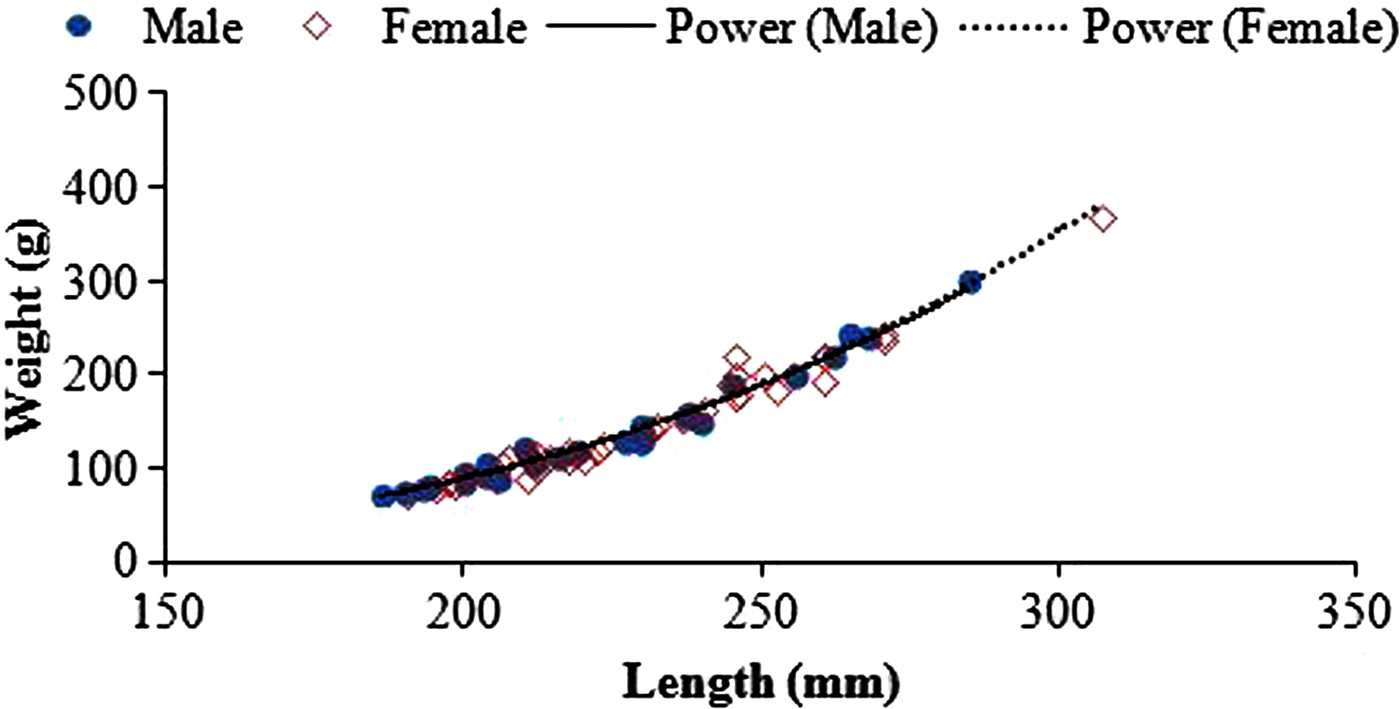
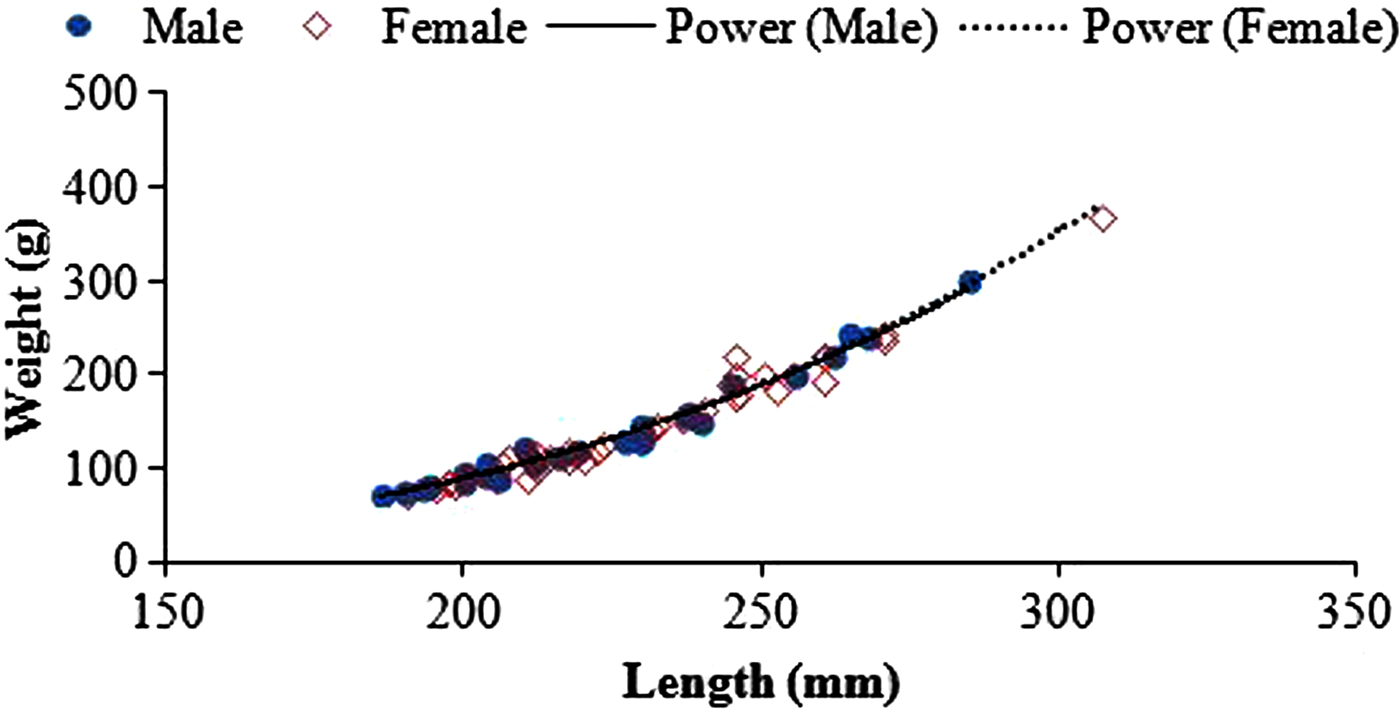
A total of 28 and 42 randomly selected specimens of males and females were collected, with total length and weight ranging from 186–285 mm and 72.16–300 g for males and 190–307 mm and 74.15–370.00 g for females. A scatter diagram showing the allometric relationship is given in Figure 2. The LWR for male and female were established as W = 0.000002 × L 3.34 (R 2 = 0.98) and W = 0.000001 × L 3.39 (R 2 = 0.97), respectively (Table 1). The analysis of covariance to test the slope of the LWR derived for males and females showed no significant difference (P > 0.05) between the sexes. A common LWR was established for both sexes as W = 0.000001581L 3.37 (R 2 = 0.97). The test of significance of slope with b = 3 revealed the existence of positive allometric growth for both sexes (Table 1). Roos et al. (Reference Roos, Roux and Conand2007) reported lower estimates of ‘a’ and ‘b’ values as 0.000004 and 3.26, respectively from south-west Indian Ocean, indicating the existence of differential growth in different environmental conditions.
Fitted length–weight relationship of bigeye scad from Mumbai, north-west coast of India.
Population parameters of bigeye scad from different geographic locations.

Condition factor
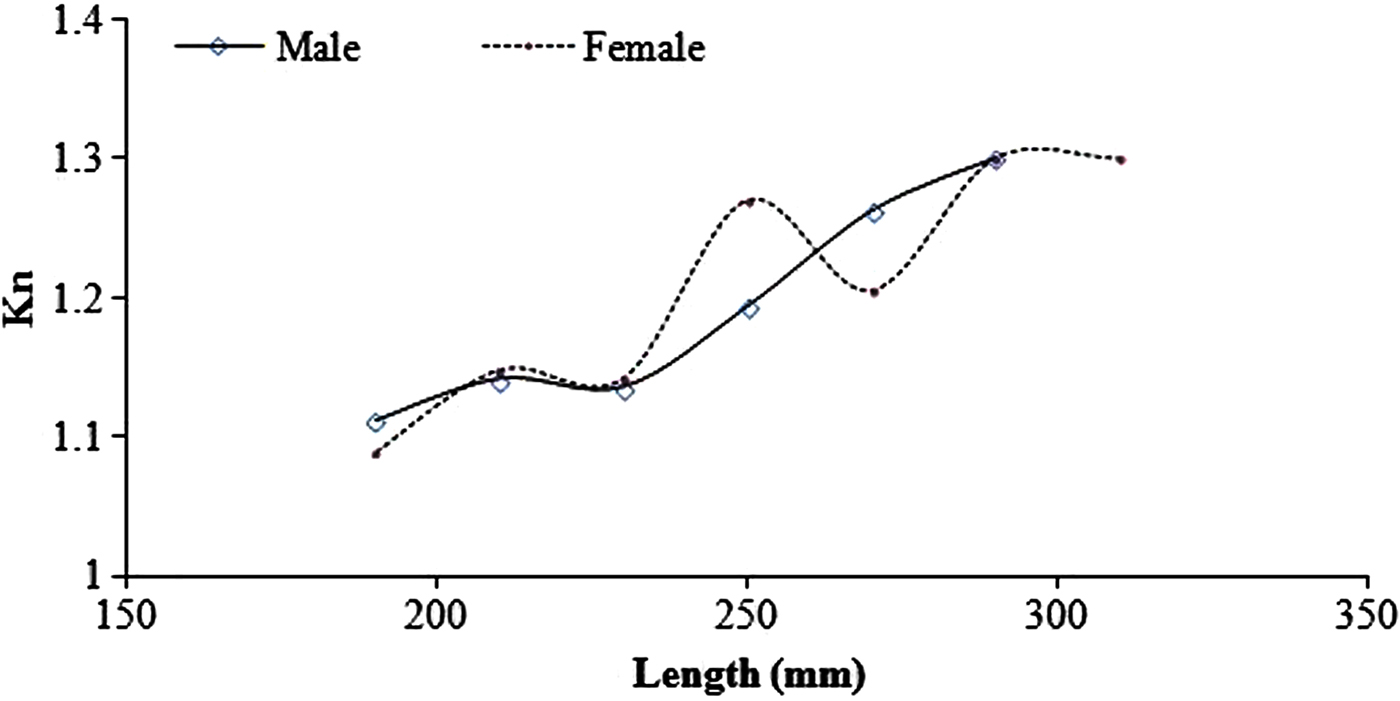
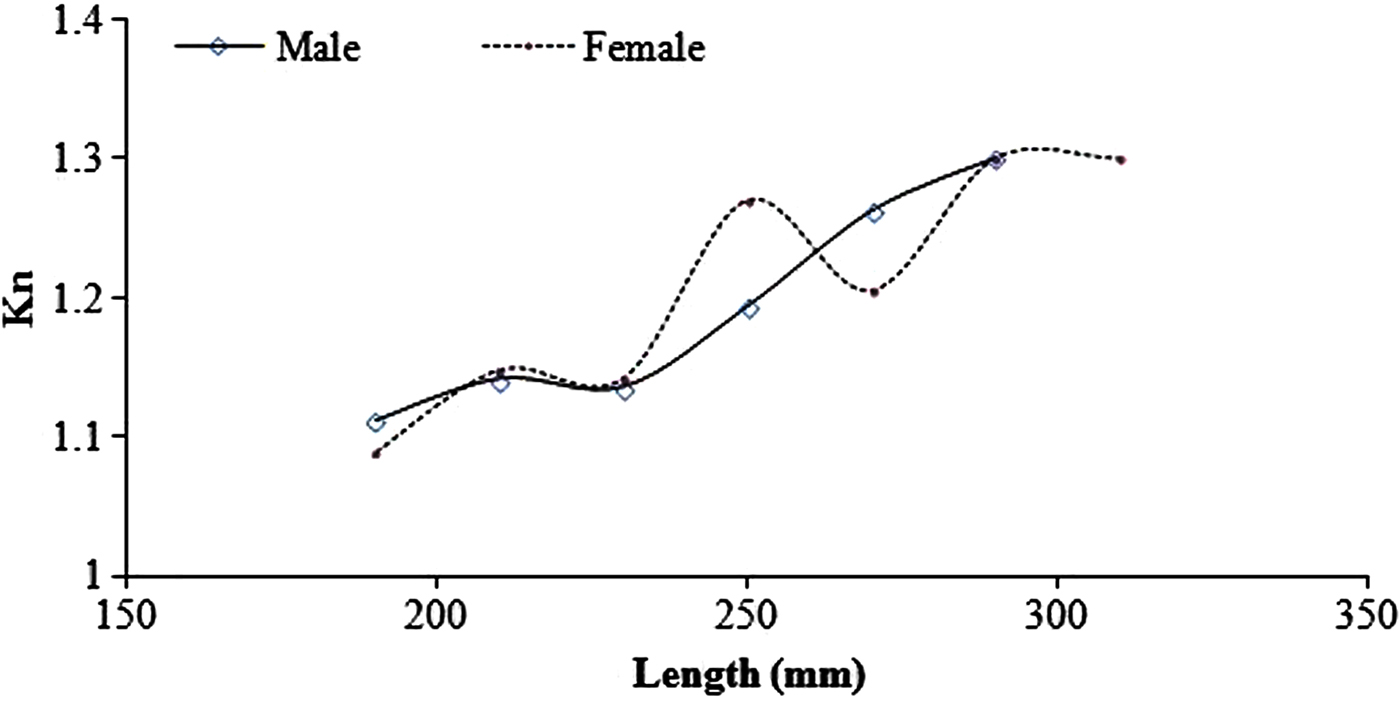
The condition factor ‘Kn’ allows quantitative comparisons of the condition of individual fish within a population, individual fish from different populations and two or more populations from different localities. ‘Kn’ may also be used as an index of the productivity of water. The Kn value is greatly influenced by the stage of development of the reproductive organs. The mode in the Kn values can be taken to be an index of gonadal maturity and spawning season or better feeding conditions (Anderson & Gutreuter, Reference Anderson, Gutreuter, Nielsen and Johnson1983). The length-wise distribution of Kn for different size groups for males and females were determined. The lowest value of Kn indicates extremely poor condition, while the highest value shows excellent condition of the specimen. The Kn value ranged from 1.1–1.3 for both the sexes. The length-based analysis revealed that smaller size groups were in a poor condition. The males remained in a good condition round the year and across all the size groups, unlike females. This might be due to the significant weight loss of females due to spawning stress (Figure 3).
Length-wise distribution of condition factor (Kn) of bigeye scad.
Size composition
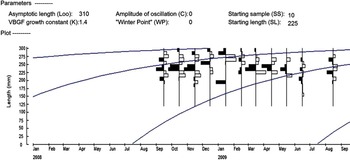
The length frequency table was formulated with 769 randomly measured specimens from the commercial catch. The minimum and maximum lengths that appeared in the commercial landing were 128 and 294 mm, respectively. The young ones were recorded during June–November with distinct peak during June. The older length groups were recorded mostly during November–February. The length group from 200 to 240 mm (i.e. 0+ age group), was the main contributor to the commercial catch (Figure 4).
Restructured length frequency data showing transformation into peaks (black) and troughs (white) with growth curves of bigeye scad.

Age and growth
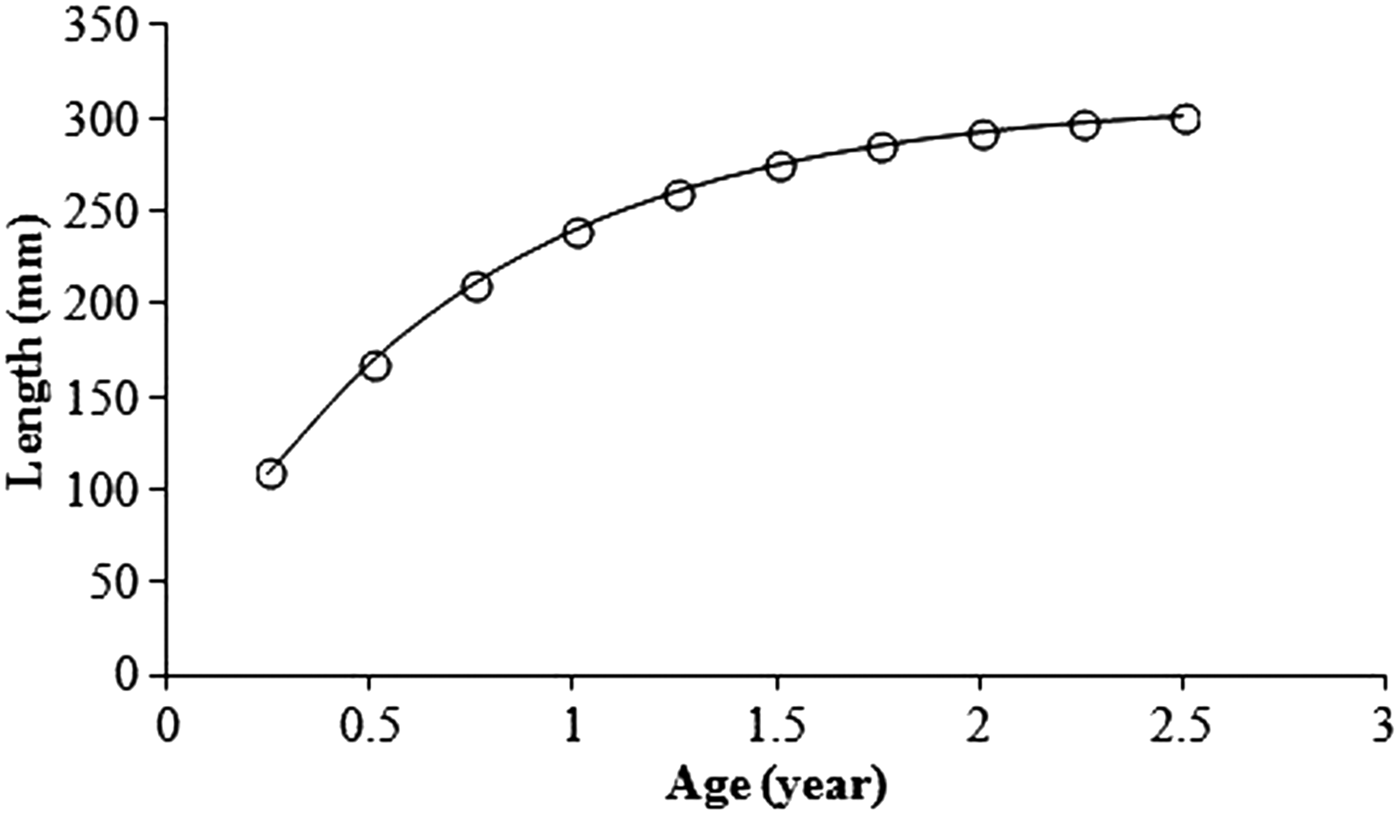
The maximum size (L max) of the species was recorded as 294 mm. The von Bertalanffy growth parameters L∞, K and t 0 were estimated as 310 mm, 1.4 year−1 and −0.059 year, respectively (Table 1), indicating bigeye scad as a fast-growing species. The derived VBGF was Lt = 310 mm [1−exp {−1.4 year−1 × (t−(−0.059 year))}]. Bigeye scad attains 240 and 293 mm of total length during its first and second years, respectively (Figure 5). However, a total length of 230 mm in 12 months was reported for this species in Philippine waters (Dalzell & Penaflor, Reference Dalzell and Penaflor1989). The various growth parameter estimates from Indian waters and elsewhere are summarized in Table 1. These parameters cannot be compared directly but may be validated through estimate of growth performance index (ø’). The growth performance index was 3.13. The present estimate of ø’ is higher than the estimates of Roos et al. (Reference Roos, Roux and Conand2007) and Adeeb et al. (Reference Adeeb, Fadzly and Md Sah2014), while it is very close to the findings of Dalzell & Penaflor (Reference Dalzell and Penaflor1989) from Philippines waters. The variance of the parameters among the same species can be hugely subjective depending on the environmental conditions in which the species is living (Sparre & Venema, Reference Sparre and Venema1998). In other words, this difference in growth may be complying with the nature of stock and level of exploitation.
Fitted von Bertalanffy growth curve of bigeye scad from Mumbai, north-west coast of India.

Longevity
The age corresponding to the recorded L max (294 mm) from the commercial catch was 2+ years, indicating the fishable lifespan or the longevity of bigeye scad in Mumbai waters. Hence, bigeye scad is a short-lived species; this has also been reported by Dalzell & Penaflor (Reference Dalzell and Penaflor1989) in Philippine waters and Roos et al. (Reference Roos, Roux and Conand2007) in the south-west Indian Ocean.
Mortality
The instantaneous rates of mortality i.e. Z, M and F were 4.62, 2.21 and 2.41 year−1, respectively (Table 1). The higher fishing mortality rate over M indicates overexploitation of stock in the lagoon. Dalzell & Penaflor (Reference Dalzell and Penaflor1989) and Roos et al. (Reference Roos, Roux and Conand2007) also observed a rapid and short life cycle and also higher fishing mortality rate of this species (Table 1). Adeeb et al. (Reference Adeeb, Fadzly and Md Sah2014) reported low value of fishing mortality might be due to the over-estimation of natural mortality in Maldives waters.
Size at capture
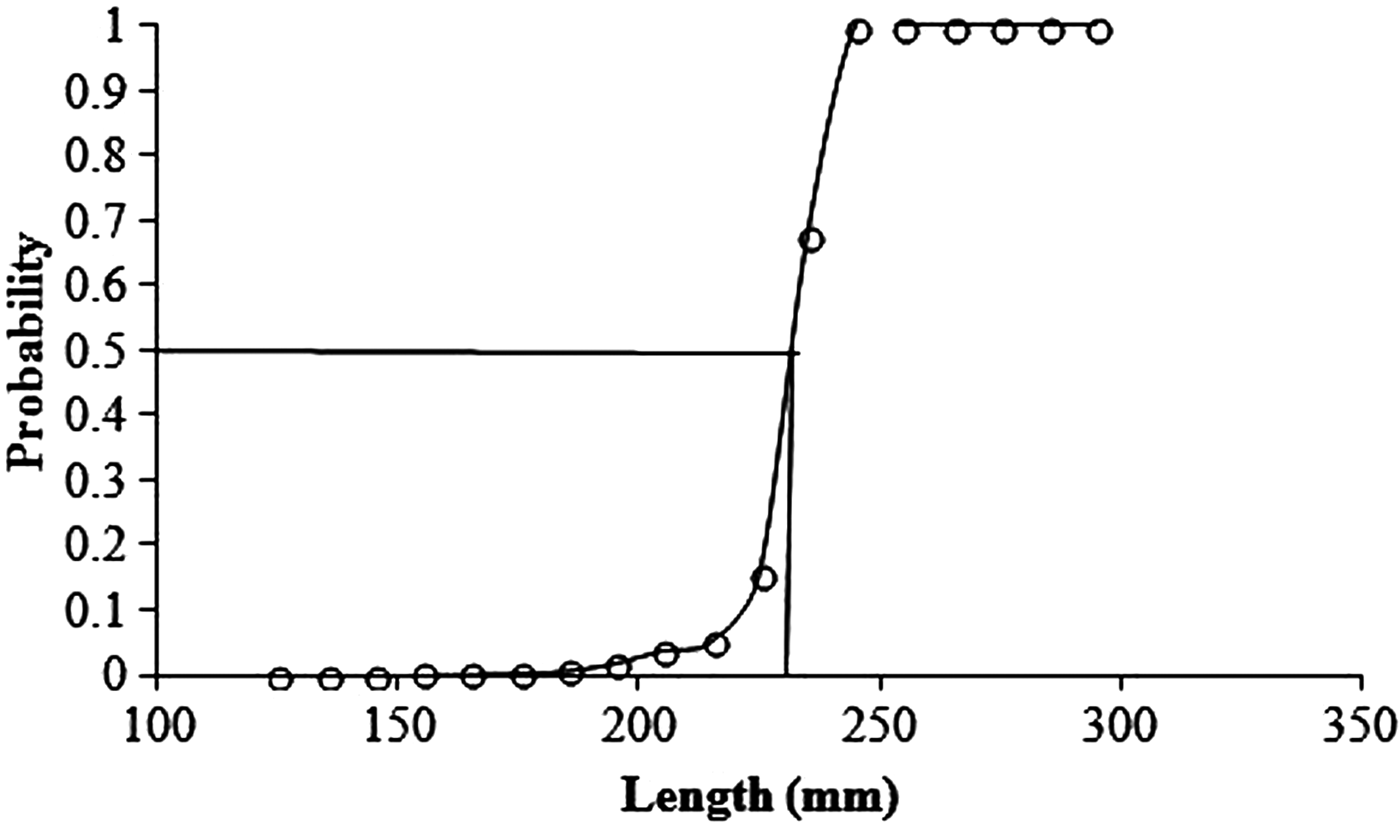
The probability of capture at 25, 50 and 75% was estimated as 227, 240 and 254 mm, respectively (Figure 6). The size at first capture (L c), capture at 50% level of probability, revealed that 50% of the population was caught at the TL of 240 mm. The present L c is a little higher than the findings of Dalzell & Penaflor (Reference Dalzell and Penaflor1989) from Philippines waters (132–237 mm). However, ‘L c’ is a factor of gear selectivity, the differences in estimates in different waters occurs due to the variation in mesh sizes of gear under operation in the sampling area and sampling period. The selection curve is in reality a resultant curve, that is, an apparent selection pattern generated through the interaction of recruitment process and selection effects (Gulland, Reference Gulland1983).
Length at capture at different probability levels of bigeye scad from Mumbai, north-west coast of India.

Recruitment
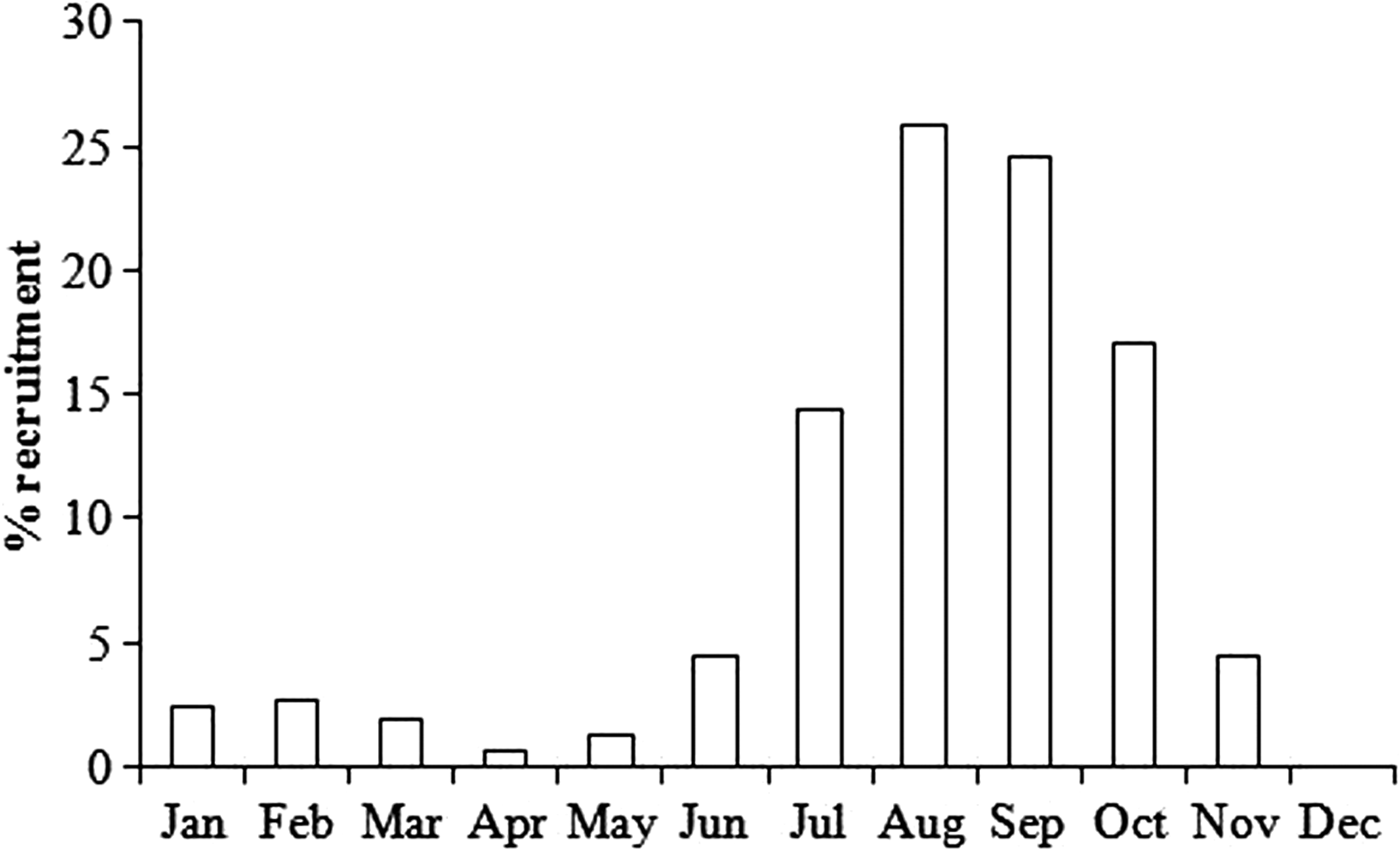
The minimum length reported in the commercial catch was considered as length at first recruitment (Lr) and was reported as 128 mm. The recruitment was continuous and throughout the year with a single pulse during August. Nearly 50% of the recruitment took place during August and September (Figure 7). This is supported by the phenomenon of occurrence of juveniles almost throughout the year especially during June–November. The bimodal recruitment pattern was reported in Philippines (Dalzell & Penaflor, Reference Dalzell and Penaflor1989) and in Maldives (Adeeb et al., Reference Adeeb, Fadzly and Md Sah2014) waters with one major and minor peaks of 4–5 months difference. The disparity in the recruitment might be due to the underrepresented juvenile fish as a result of gear selectivity.
Recruitment pattern of bigeye scad from Mumbai, north-west coast of India.

Exploitation
The exploitation ratio (E) was estimated as 0.52. The ratio F/Z or exploitation ratio is a measure of the intensity by which a fish stock is exploited. Gulland (Reference Gulland1971) has suggested that if a stock is optimally exploited, then fishing mortality is equal natural mortality or F opt = M and E = 0.5. Pauly (Reference Pauly1984), based on Beddington & Cooke (Reference Beddington and Cooke1983), has proposed a more conservative optimum fishing mortality where F opt = 0.4M or E = 0.3. By both these definitions, the stock of bigeye scad would appear to be overexploited. Therefore, presently it is suggested that the fishing pressure should be reduced by 4% from the present level of effort for the sustainable harvest of the stock from Mumbai waters. The overexploitation of the bigeye scad stock was also reported in Philippines (Dalzell & Penaflor, Reference Dalzell and Penaflor1989) and Maldive waters (Adeeb et al., Reference Adeeb, Fadzly and Md Sah2014).
To conclude, the stock of bigeye scad is optimally overexploited in Mumbai waters. As it comes as a by-catch of trawl net and of course of gill net (fewer landings), it would be imperative to estimate the optimum mesh sizes as well as standardization of fishing effort for the multi-fleet and multispecies fishery in north-west Indian waters. The data do have a drawback in the sense that the number of fish sampled for length, weight and for growth happen to be comparatively low as this species is not a very common species among the multispecies carangid group. However, since no study has been done on the growth of this species from Indian waters, the present investigation would certainly fill gaps in the knowledge of carangids in general and S. crumnopthalmus in particular. The present parameter estimates are found to be different from the earlier studies of Dalzell & Penaflor (Reference Dalzell and Penaflor1989), Roos et al. (Reference Roos, Roux and Conand2007) and Adeeb et al. (Reference Adeeb, Fadzly and Md Sah2014) in most of the cases, indicating the unique nature of the stock in Mumbai waters. Hence, the generated information could be used as an input in ecosystem-based fisheries management models in Indian waters, which was not available previously.
ACKNOWLEDGEMENTS
The authors are thankful to the Director, ICAR-Central Institute of Fisheries Education, Mumbai for providing facilities for carrying out the research work.
FINANCIAL SUPPORT
The financial support provided by the Indian Council of Agricultural Research (ICAR), New Delhi, India and Central Institute of Fisheries Education (CIFE), Mumbai, India during the doctorate programme is gratefully acknowledged.