Introduction
The promotion of healthy or successful aging has become an issue of considerable importance as population aging leads to increasing numbers of older adults across all societies (Kalache et al., Reference Kalache, Baretto, Keller and Johnson2005). While there is no single, universally agreed definition of healthy or successful aging, there is some agreement about its core elements (Depp and Jeste, Reference Depp and Jeste2006). Common to many definitions of successful aging are the absence of physical disability, subjective health and psychological well-being, social functioning, and an absence of cognitive impairment (Depp and Jeste, Reference Depp and Jeste2006; Britton et al., Reference Britton, Shipley, Singh-Manoux and Marmot2008). It is likely that many factors contribute to successful aging, including genetic predisposition (Kirkwood, Reference Kirkwood and Johnson2005) and physical health (Britton et al., Reference Britton, Shipley, Singh-Manoux and Marmot2008). Some of these factors, such as chronic physical conditions, may not be readily modifiable, while others, and most notably, psychological and attitudinal factors, may be more amenable to change.
Attitudes are beliefs that have an evaluative component, and have long been of interest to psychologists and those interested in health promotion, because a large body of evidence points to the powerful effects that subjective evaluations and attitudes can have on a wide range of future behaviors and health outcomes. This is because attitudes have the potential to activate responses to external triggers, such as symptoms of ill health or other physical experiences. For example, Idler and Kasl (Reference Idler and Kasl1995) reported that older individuals who rated their health as poor were two and a half times more likely to be in poor health up to six years later, after adjusting for baseline physical health and number of chronic health conditions. In a series of studies investigating the role of internalized negative attitudes toward aging, Levy and colleagues have demonstrated the significant influence of attitudes on a range of outcomes, including engagement in cognitive performance and preventive health behaviors (e.g. Levy, Reference Levy2003). It has been found that individuals with more positive perceptions of their own aging engaged in more preventive health behaviors in subsequent years, and that this effect remained, after controlling for the contribution of age, functional health, gender, education, race, and self-rated health. They suggest that such internalized negative aging stereotypes can act without the awareness of the individual and serve to reduce self-efficacy beliefs. A study by Quinn et al. (Reference Quinn, Laidlaw and Murray2009) found that participants who endorsed more positive views of aging also endorsed higher levels of health-related behaviors, such as exercising and taking vitamins, and higher subjective well-being as measured by the 12-item General Health Questionnaire (GHQ-12).
The relationship between attitudes to mental health, however, has received little attention. Recent studies by Law et al. (Reference Law, Laidlaw and Peck2010) and Quinn et al. (Reference Quinn, Laidlaw and Murray2009) have examined the attitudes of older people toward depression; Law et al. found that those who had more negative attitudes toward aging were more likely to endorse a belief that depression is an understandable and normal part of getting older, and suggested that such beliefs may lead to a pessimism that hinders older adults from engaging with treatment for depression. This is consistent with the work of Quinn et al. (Reference Quinn, Laidlaw and Murray2009), who also found that negative attitudes toward aging were associated with negative attitudes toward depression. Chachamovich et al. (Reference Chachamovich, Fleck, Laidlaw and Power2008) examined an alternative hypothesis, namely that depression would be associated with more negative attitudes. Using the Attitudes to Aging Questionnaire (AAQ) in a large sample (N = 4,316), the authors reported that both major depression and subsyndromal depression were associated with more negative attitudes toward aging. To our knowledge, however, no study to date has examined the hypothesis that attitudes might contribute to the experience of depression and other aspects of mental health, such as anxiety. This question is of both theoretical and clinical interest; if attitudes do exert an influence on well-being beyond that accounted for by mood or physical health, they may provide a useful target for intervention to be incorporated into health promotion activities.
The development of an instrument that measures older people's attitudes to their own aging, the AAQ (Laidlaw et al., Reference Laidlaw, Power, Schmidt and WHOQOL-OLD Group2007), provides a means to examine the relationship between attitudes to aging and both physical and psychological well-being as markers of successful aging. Our aim was to determine whether attitudes to aging are associated with mental and physical health, as well as satisfaction with life in a large sample of older adults, after taking into account the role of possible confounding factors such as demographics. We hypothesized that more positive attitudes to aging as measured by scores on the AAQ would be associated with lower levels of depression and anxiety, after controlling for self-reported physical health. We also hypothesized that more positive attitudes to aging would be associated with better self-reported physical health after controlling for symptoms of depression and anxiety. Finally, we hypothesized that more positive attitudes to aging would be associated with greater satisfaction with life, after controlling for symptoms of depression, anxiety, and self-reported physical health.
Methods
Participants
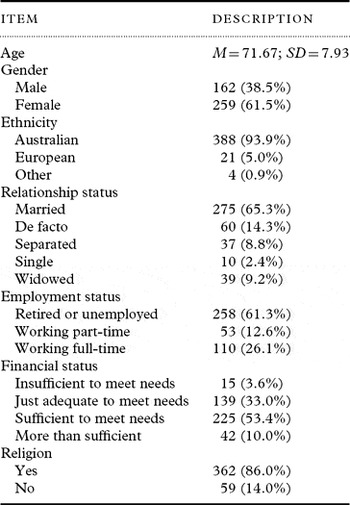
Community dwelling older adults (age ≥60) who were part of a larger study of health and aging in rural areas of Australia (N = 7,615; Murray et al., Reference Murray2004) were invited to participate in this study. These participants were individuals who were randomly selected from the electoral rolls of Victoria and New South Wales. Questionnaires were mailed to 1,206 participants with valid addresses who had agreed to be contacted for future waves of data collection and met the age criterion. There were no exclusion criteria. Valid consent and questionnaire responses were received from 421 participants, resulting in a response rate of 34.9%, of whom 38.5% were male and 61.5% female, with an average age of 71.67 years (SD = 7.93). The majority of participants were of Australian background (93.9%), endorsed a religious affiliation (86.0%), and were in married or de facto relationships (79.6%). Over half (61.3%) of the sample were retired, while the remainder were working full-time (27.0%) or part-time (11.7%). Only a small proportion of participants (3.6%) reported insufficient finances to meet needs, while others reported either having sufficient (86.4%) or more than sufficient (10.0%) financial resources for living. Please refer to Table 1 for detailed information on the characteristics of the sample.
Demographic characteristics of the sample

Measures
The Attitudes to Aging Questionnaire (AAQ)
The AAQ (Laidlaw et al., Reference Laidlaw, Power, Schmidt and WHOQOL-OLD Group2007) is a 24-item scale with eight questions in each of three domains: Psychosocial Loss (PSYSOLOSS) focuses on losses relevant to older adults in psychological and social aspects; for example, “old age is a time of loneliness,” “I do not feel involved in society now that I am older.” The Physical Change (PHYCH) subscale assesses attitudes toward physical functioning, and its items relate primarily to health, exercise, and the experience of aging itself; for example, “it is important to take exercise at any age,” “my health is better than I expected for my age.” Psychological Growth (PSYGRO) has a positive focus and could be summarized as “wisdom” or “growth” and reflect gains in relation to self and others; for example, “wisdom comes with age,” “I am more accepting of myself as I have grown older.” Participants were asked to rate each item on a five-point Likert scale, with 1 being “Not at all true” and 5 being “Extremely true.” Scores for the three domains were derived from computing the sums of corresponding items. The PHYCH and PSYGRO domains were positively worded with higher scores indicating more positive attitudes to aging, while the PSYSOLOSS was negatively worded with higher scores indicating more negative attitude. To assist interpretation, we defined scores ≥24 on the PHYCH and the PSYGRO, and scores ≤24 on the PSYSOLOSS as being in the positive range. Here, the cut-off of 24 suggests an average individual item score of 3, i.e. “Neither agree nor disagree.” The authors reported good psychometric properties for this scale. In this study, Cronbach's α for the overall AAQ and each of its subscales PSYSOLOSS, PHYCH, and PSYGRO was 0.61, 0.81, 0.76, and 0.72 respectively.
The Center for Epidemiological Studies Depression Scale (CES-D)
This is a widely used 20-item scale for assessing symptoms of depression, in which a score above 16 is indicative of clinically significant depressive symptoms (Hertzog et al., Reference Hertzog, Van Alstine, Usala, Hltsch and Dixon1990). It has been validated for use in the older Australian population (McCallum et al., Reference McCallum, Mackinnon, Simons and Simons1995). In this study, Cronbach's α for the Center for Epidemiological Studies Depression Scale (CES-D) was 0.89.
The Geriatric Anxiety Inventory (GAI)
This is a 20-item scale with items presented in a yes/no format for ease of completion in older samples. A cut-off score of 10/11 is used to detect the presence of generalized anxiety (Pachana et al., Reference Pachana, Byrne, Siddle, Koloski, Harley and Arnold2007). In this study, Cronbach's α for the Geriatric Anxiety Inventory (GAI) was 0.95.
SF-12 Health Survey
The Medical Outcomes’ 12-Item Short Form Health Survey (SF-12; Ware et al., Reference Ware, Kosinski and Keller1996) is a well-validated self-rated inventory of 12 items designed to assess disability due to both physical and mental health issues, and is scored to produce two weighted subscales: Physical Component Summary (SF-12Physical) and Mental Component Summary (SF-12Mental). Lower scores indicate greater disability. Australian adult norms have been reported with an SF-12Mental mean of 52.0 and an SF-12Physical means of 49.1 (Korten and Henderson, Reference Korten and Henderson2000). In this study, Cronbach's α for the SF-12Physical and SF-12Mental was 0.89 and 0.84 respectively.
Pain
Pain was assessed via a single binary question of whether or not the participant had experienced pain in the previous six months.
The Satisfaction with Life Scale (SWLS)
This scale (Diener et al., Reference Diener, Emmons, Larsen and Griffin1985) comprises five questions that are answered on a seven-point Likert scale. The questions, such as “I am satisfied with life,” are deliberately broad in order to capture overall evaluations of life satisfaction. In this study, Cronbach's α for the SWLS was 0.89.
Procedure
Data were collected between April and September 2010. Participants were mailed a questionnaire booklet, a copy of the plain language statement and consent form, and a prepaid envelope. They were asked to post the completed questionnaire booklet with written consent to participate. To improve the response rate, a reminder letter with a second copy of the same questionnaire booklet and consent form was sent to those who did not respond within six weeks. Ethical approval for the project was obtained from the Behavioral Sciences Human Research Ethics Committee of the University of Melbourne.
Data analyses
Raw data handling
Data were processed and analyzed using IBM SPSS Version 19.0. Scales that had more than two items (or 10%, whichever is lower) missing were considered incomplete and as a consequence, 14 (3.3%) responses from the AAQ, six (1.2%) from the CES-D, three (0.6%) from GAI, 11 (2.6%) from the SF-12, and five (1.2%) from the SWLS were not included in any analysis. This cut-off allowed for the inclusion of responses that had one (i.e. 27 on the AAQ, 11 on the CES-D, four on the GAI, and 20 on the SF-12) or two (two on the AAQ, one on the CES-D, and two on the GAI) items missing, thereby reducing bias toward complete responses while compromising relatively little on sample size or validity of the data. The rate of missing values for each questionnaire item after excluding incomplete responses was low (Mean = 0.2%, SD = 0.002), and Missing Value Analyses showed that these missing values were random and independent of age, gender, or financial/employment/relationship status. Multiple imputation was therefore applied to replace these missing values in questionnaires that were considered complete. All questionnaires were scored using standard scoring methods.
The following five blocks of variables were obtained from questionnaire data.
-
1. Demographics included age, gender, religiosity (yes/no), relationship (with/without partner), employment (working/not working), and financial status (insufficient/just enough/sufficient/more than sufficient).
-
2. Physical health included SF-12Physical and pain.
-
3. Mood included total CES-D score (depression) and total GAI score (anxiety).
-
4. Satisfaction with life contained one variable, i.e. total score of Satisfaction with Life Scale (SWLS).
-
5. Attitudes to aging included scores of the three subscales of AAQ, i.e. PSYLOSS, PHYCH, and PSYGRO.
Statistical methods
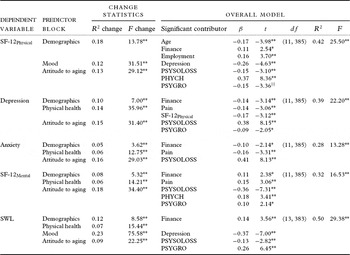
The role of gender, relationship, and employment status on mental/physical health, attitudes to aging, and SWL was examined using one-way analyses of variance (ANOVA), while the role of age was examined using Pearson correlation. One-sample t-tests were conducted to compare SF-12Physical and SF-12Mental in this sample with that of the Australian adult population. To examine the gender difference in the likelihood of pain reports, chi-square test was conducted. A series of linear and logistic hierarchical multiple regression analyses were performed to examine the relationship among physical health, mental health, and attitudes to aging with statistical diagnostic analyses showing the absence of collinearity and heteroscedasticity, as well as reasonable normal distributions of residuals. The regression models for each dependent variable are summarized in Table 2, with predictor blocks entered in top to bottom sequences.
Summary of multiple regression analyses predicting physical health, mental health, and satisfaction with life

Note: Variables included in the “Demographics” predicting block were age, gender, religion, relationship, employment, and financial status; “Physical health” block included SF-12Physical and Pain; “Mood” block included scores of depression and anxiety; “Attitude to aging” block included scores on PSYSOLOSS, PHYCH, and PSYGRO subscales; *p < 0.05, **p < 0.01 when more positive scores of the predictors were associated with more positive scores of the independent variable; †† p < 0.01 more positive PSYGRO was associated with more negative SF-12Physical.
SF-12 = 12-item Short From Health Survey; SWL = satisfaction with life.
Results
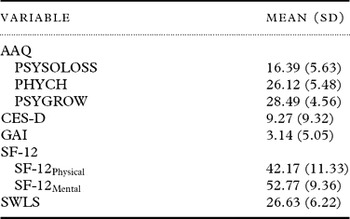
Means and standard deviations of variables discussed below are summarized in Table 3.
Means and standard deviations of variables

Note: AAQ = Attitudes to Aging Questionnaire; PSYSOLOSS, PHYCH, and PSYGROW stand for the Psychosocial Loss, Physical Change, and Psychological Growth domains of the AAQ, respectively; CES-D = Center for Epidemiological Studies – Depression Scale; GAI = Geriatric Anxiety Inventory; SF-12 = SF-12 Health Survey, with SF-12Physical and SF-12Mental being its physical and mental components; and SWLS = Satisfaction with Life Scale.
Attitudes to aging
Overall, attitudes to aging reported by our sample were positive. The majority of participants scored within the positive range for PSYGRO (n = 346, 85.2%), PSYSOLOSS (n = 356, 89.2%), and PHYCH (n = 273, 67.2%). Older age was significantly correlated with more negative scores on PSYSOLOSS (r = .16, p < 0.01), but not with PHYCH or PSYGRO, and no gender difference was found in attitudes to aging.
Overall well-being
Mental health
The mean score of SF-12Mental in this sample was 52.77, comparable to what was reported in the Australian adult population sample, with a mean score of 52.0, p = 0.10. Females (M ± SD: 53.58 ± 8.79) reported more positive SF-12Mental than males (51.46 ± 10.12), F(1, 408) = 5.01, p < 0.05, but age did not correlate significantly with perceived mental health. Mean score of CES-D in this sample was 9.27, and 78 (18.8%) participants scored above the cut-off for possible clinical depression. The mean score of GAI in this sample was 3.14, and 40 (9.6%) participants scored above the cut-off for possible Generalized Anxiety Disorder. No gender difference was found for either CES-D or GAI, and both scores were not correlated with age.
Physical health
The mean score of SF-12Physical in this sample was 42.17, significantly lower than the 49.1 (p < 0.01) reported in the Australian adult population. Older age was significantly associated with worse SF-12Physical (r = −.27, p < 0.01), but there was no gender difference in perceived physical health. Overall, 65.1% of the sample reported having experienced pain over the past six months, and females (69.5%) were more likely to report the presence of pain than males (58.0%), χ2(1, N = 421) = 5.77, p < 0.05.
Satisfaction with life
Participants in this study reported relatively high satisfaction with life, scoring on average 26.63 out of 35 on SWLS. Age did not correlate with SWL, and there was no gender difference.
Socio-demographic variables
Relationship status
While no significant difference in physical health was found between those who were single, separated, or widowed, and those who were married or in a de facto relationship, significant differences in attitudes to aging, mental health, as well as satisfaction with life were found between the two groups. Compared to participants who did not have a partner at the time of the survey (n = 86), those who had a partner (n = 335) expressed more positive attitudes to aging in domains of both PSYSOLOSS (15.99 ± 5.49 vs. 18.09 ± 5.97, F(1, 404) = 8.84, p < 0.01) and PSYGRO (28.71 ± 4.53 vs. 27.55 ± 4.59, F(1, 404) = 4.13, p < 0.05). Participants with partners also reported significantly better scores on SF-12Mental (53.25 ± 9.32 vs. 50.90 ± 9.35, F(1, 408) = 4.18, p < 0.05), lower symptoms of depression on the CES-D (8.77 ±9.02 vs. 11.26 ± 10.22, F(1, 413) = 4.85, p < 0.05), lower symptoms of anxiety on the GAI (2.86 ± 4.82 vs. 4.19 ± 5.78, F(1, 416) = 4.72, p < 0.05), as well as higher satisfaction with life on the SWLS (27.08 ± 5.99 vs. 24.86 ± 6.81, F(1, 414) = 8.79, p < 0.05). The two groups did not differ significantly on age.
Financial status
Better financial status was associated with more positive attitudes to aging, better outcomes on both mental and physical health, as well as higher satisfaction with life. Significant correlation coefficients were found between financial status and scores of PSYSOLOSS (r = −0.19, p < 0.01), PHYCH (r = 0.23, p < 0.01), CES-D (r = −0.29, p < 0.01), GAI (r = −0.20, p < 0.01), SF-12Mental (r = 0.25, p < 0.01), SF-12Physical (r = 0.28, p < 0.01), reports of pain (r = 0.13, p < 0.05), and SWLS (r = 0.31, p < 0.01).
Employment status
Compared to participants who were unemployed or retired (n = 258), those who were working full-time or part-time (n = 164) were younger (73.67 ± 7.65 vs. 68.50 ± 7.34, F(1, 419) = 47.08, p < 0.01), expressed more positive attitudes to aging on the PSYSOLOSS domain (16.89 ± 5.88 vs. 15.62 ± 5.16, F(1, 404) = 4.97, p < 0.05), and scored better on SF-12Physical (40.08 ± 11.54 vs. 45.47 ± 10.17, F(1, 408) = 23.27, p < 0.01).
Attitudes to aging and well-being
Results from a series of linear hierarchical regression analyses exploring the relationship between attitudes to aging and physical and mental health outcomes are summarized in Table 2.
After controlling for demographics and mood, more positive PSYSOLOSS and PHYCH, but more negative PSYGRO were significantly associated with better outcomes for SF-12Physical (all p < 0.01). Attitudes to aging accounted for 13% additional variance over and above that accounted for by demographics and mood. Logistic regression analysis showed that the overall model with demographics, mood, and AAQ significantly predicted the likelihood of pain report (χ2(13, N = 401) = 67.41, p < 0.01), explaining between 15.5% (Cox and Snell R2 ) and 21.4% (Nagelkerke R2 ) of the variance in pain report status, and correctly classified 70.8% of cases. Unique contributors to the model were gender (β = 0.88, p < 0.01), scores on CES-D (β = –0.07, p < 0.01), and PHYCH (β = 0.05, p < 0.05), with being female, having higher symptoms of depression, and having more negative PHYCH being associated with higher likelihood of reported physical pain.
After controlling for demographics and physical health, positive scores on all three subscales of AAQ were significantly associated with better outcomes on SF-12Mental (p < 0.01 for PSYSOLOSS and PHYCH, p < 0.05 for PSYGRO). More positive PSYSOLOSS (p < 0.01) and PSYGRO (p < 0.05) were significantly associated with lower levels of depression, while more positive PSYSOLOSS was also associated with lower levels of anxiety (p < 0.01). Attitudes to aging made unique contributions to the scores on SF-12Mental, depression, and anxiety above that accounted for by demographics and physical health, accounting for 18%, 15%, and 16% additional variances, respectively.
More positive PSYSOLOSS and PSYGRO were significantly associated with greater satisfaction with life (both p < 0.01), adding a 9% contribution to the variance accounted for by demographics, physical health, and mood.
Discussion
Previous studies employing the AAQ have examined the relationship between symptoms of depression and attitudes to aging (Chachamovich et al., Reference Chachamovich, Fleck, Laidlaw and Power2008), and between attitudes to aging and beliefs about mental illness and use of health behaviors (Quinn et al., Reference Quinn, Laidlaw and Murray2009; Law et al., Reference Law, Laidlaw and Peck2010). This study extends the knowledge gained from those studies by examining the unique contribution to well-being, as measured by depression, anxiety, and satisfaction with life, made by attitudes, after controlling for a range of demographic, physical, and mental variables. In this large sample of older adults, attitudes to aging were positive in the main, and more positive attitudes to aging were associated with higher levels of satisfaction with life and well-being. Our data therefore confirm the important link between attitudes to aging and physical health and emotional well-being.
Attitudes to aging
The majority of participants in this study scored in the positive range on all aspects of attitudes to aging assessed by the AAQ, although the percentage was smaller for the physical change domain (67%) than the growth and loss domains (85% and 89%, respectively). The mean scores reported by our sample were very similar to those reported by Quinn et al. (Reference Quinn, Laidlaw and Murray2009). The sample in that study was recruited in a relatively urbanized area of Scotland, and divided into a clinical (n = 24) and non-clinical group (n = 50), with the more comparable non-clinical group reporting a mean score of 17.2 on PSYSOLOSS (current study 16.4), 26.6 on PHYCH (current study 26.1), and 29.2 on PSYGRO (current study 28.5). Despite the differences in sampling, the similarities in these scores are striking, suggesting that our findings have the potential to be generalized to a broader group of older adults.
On the whole, our sample could be described as a relatively well-functioning and well-resourced group that, nonetheless, had to contend with some loss of physical functioning and mental health concerns. The mean score on the SF-12Mental was comparable with the Australian adult norm, and mean scores on the anxiety and depression measures were low. Nevertheless, almost one in five scored above the cut-off for clinically significant symptoms of depression. On the other hand, their physical health as measured by the SF-12Physical was significantly lower than the Australian adult norm, probably due to the older age of our sample; two-thirds reported experiencing pain in the previous six months. Nevertheless, our sample was characterized by a relatively high level of satisfaction with life.
Of the socio-demographic variables examined, both partnership and financial status appeared to be significantly associated with positive attitudes and mental well-being. Participants who lived with a partner were more satisfied with life, had higher scores on the growth and psychosocial loss domains of the AAQ, and scored better on all mental health measures (i.e. CES-D, the GAI, and the SF-12Mental). It is thought that a partner provides emotional and instrumental support that may act both as a buffer for stress and a direct source of positive emotion (Pressman and Cohen, Reference Pressman and Cohen2005). However, the literature addressing the benefits for mental health of co-habitation versus single status is mixed, with some studies showing that support from a partner adds to emotional well-being (Myers, Reference Myers, Kahneman, Diener and Schwarz1999), and others questioning this finding, especially for individuals who have good social networks (Michael et al., Reference Michael, Berkman, Colditz and Kawachi2001). It is possible that in this rural sample, more traditional views about relationships might prevail, and that living alone is less consistent with community norms, thus leading to our finding of an association between having a partner and emotional well-being.
Financial circumstances, but not partnership status, were associated with better self-reported physical health. The finding with respect to financial status is consistent with earlier literature since socio-economic status is a very well-established correlate of physical health (Britton et al., Reference Britton, Shipley, Singh-Manoux and Marmot2008). The finding with regard to partnership status is somewhat surprising, as most studies report that being in a relationship is beneficial for physical health (Marmot and Gjonça, Reference Marmot, Gjonça and Johnson2005). Although those who are healthy may be more likely to marry, thus confounding the effects of relationship status and health, a substantial literature attests to the protective benefits of marriage as a buffer to stress, as well as providing an incentive to carry out effective health behaviors (Robles and Kiecolt-Glaser, Reference Robles and Kiecolt-Glaser2003). There are a number of possible explanations for our finding. Firstly, 62% of our sample was female, and it has been suggested that the benefits of marriage are less substantial for women than they are for men (Michael et al., Reference Michael, Berkman, Colditz and Kawachi2001). Additionally, it may be that the effects of relationship status become attenuated as people age, and other variables, particularly socio-economic status, play a more prominent role in determining physical health (Grundy and Tomassini, Reference Grundy and Tomassini2010).
Relationships between attitudes to aging and well-being
Our primary interest was to examine whether attitudes would make a significant contribution to well-being, after taking into account possible confounding variables. We found that more positive attitudes to aging in the domains of psychosocial loss and physical change were strongly associated with better health after controlling for demographic variables and symptoms of depression and anxiety. In other words, older people's subjective evaluations of their aging process contributed to their overall physical functioning over and above the impact of variables that may not easily be amenable to change, such as increasing age, and financial and relationship status. Levy and Myers (Reference Levy and Myers2004) reported that individuals with more positive attitudes to aging engaged in more preventive health behaviors, such as taking exercise and controlling alcohol consumption and smoking. It is possible that participants in our study who had more positive attitudes, for example, to the physical changes associated with aging, had better health because they had a stronger belief in the utility of taking care of their health. One curious finding was that higher scores in the psychosocial growth domain were associated with poorer health. This counter-intuitive finding might be accounted for by individuals who have experienced poor health needing to generate effective coping responses, thereby developing their resilience.
We also examined attitudes as predictors of mental well-being, taking into account the effects of physical functioning. Our results showed that more positive scores on all three domains of the AAQ were associated with better outcomes on the SF-12Mental, and that more positive scores in the psychosocial loss domain were associated with lower levels of anxiety and depression. Importantly, attitudes made a significant and unique contribution to the model, after taking demographics and physical health into account. Levy and Myers (Reference Levy and Myers2004) argued cogently that internalized negative aging stereotypes have a deleterious effect on a range of physical and mental functions. Our study lends further support to the link between self-perceptions and subjective evaluations of one's own aging and better perceived health, by showing that holding more positive attitudes enables older adults to experience better psychological well-being.
This raises the interesting question of how older adults are able to arrive at positive perceptions of their health and satisfaction with life. Diverse studies have led authors to comment on the tendency toward positivity in older adults. For example, participants in the Berlin Aging Study were described as largely very satisfied with life, even when living with relatively high levels of functional limitation (Smith et al., Reference Smith, Fleeson, Geisleman, Setteresen, Baltes and Mayer1999), and most older adults described themselves as aging “successfully” (Bowling and Dieppe, Reference Bowling and Dieppe2005). It would appear that one of the changes that accompanies the aging process is the development of an emotional regulation process whereby positive emotions are favored over negative ones. This has been called the “positivity effect,” and been extensively researched by Carstensen and Mikels (Reference Carstensen and Mikels2005). Evidence for the positivity effect comes from a number of sources, including laboratory tests in which older adults are found to forget negative information more quickly than positive information (Kensinger et al., Reference Kensinger, Piguet, Krendl and Corkin2005).
Another notable finding was the particular importance of the psychosocial domain of the AAQ in predicting all indicators of well-being, except pain. This domain encompasses items that tap into social connectedness, and the sense of inclusion. Findings from earlier data collected on this cohort suggested that social participation as measured by membership of clubs was significantly associated with higher positive affect and greater satisfaction with life. This may serve to highlight the benefits of older adults remaining socially connected for as long as possible, and this is supported by a recent study by Lachman and Agrigoroaei (Reference Lachman and Agrigoroaei2010), as well as the findings of the Nurses’ Health Study (Michael et al., Reference Michael, Berkman, Colditz and Kawachi2001), which emphasizes the importance of social networks other than the immediate family for mental health.
Limitations
A number of limitations of the current study need to be acknowledged. Firstly, the return rate of the questionnaires was lower than desired. Even though this study was cross-sectional in nature, the way our data was collected resembled that of a longitudinal design due to participants’ prior contact with the larger project. The lower-than-desired response rate was comparable with other longitudinal studies (e.g. the ILSE study; Martin et al., Reference Martin, Grünendahl and Martin2001), where attrition is a common problem. Our sample size was large enough, however, to permit robust statistical analyses, but was arguably skewed toward better functioning individuals and those who had an open attitude to the research question. The sample was drawn from individuals living in rural and regional areas of south-eastern Australia, which may limit the generalizability of the findings, although the scores on the AAQ in our sample were remarkably similar to those reported by Quinn et al. (Reference Quinn, Laidlaw and Murray2009) for participants living in Scotland. The study was cross-sectional, which did not permit us to consider the potentially dynamic temporal relationships between attitudes, demographic variables, and mental and physical functioning – for example, the possibility that higher levels of depression contribute to more positive attitudes. We were also not able to assess the role of more distal determinants of attitude, most notably personality. Moor et al. (Reference Moor, Zimprich, Schmitt and Kliegel2006) reported that attitudes to aging mediated the relationship between personality, particularly neuroticism, and physical health, a possibility we will explore in future analyses. Finally, the SF-12 is a brief self-report measure of physical and mental functioning that we were not able to corroborate by physician-rated health evaluations, and our measure of pain was very brief, which may limit the reliability of our data on this variable.
Conclusion
These findings extend our understanding of attitudes toward a person's own aging and their significant contribution to specific aspects of well-being, such as symptoms of anxiety and depression, as well as more global evaluations of satisfaction with life. In this sample of older adults, attitudes to aging were generally positive. Although attitudes did contribute significantly to the outcomes of interest, the role of demographic variables, such as income, should not be ignored: there was a clear relationship between income status and physical health and satisfaction with life, so the economic conditions in which people live should not be disregarded. The importance of the psychosocial domain highlights the need for social policies that promote social inclusion. Hitherto, little attention has been paid to ways in which people might be prepared for, and educated about, old age beyond financial planning. It may be productive to place more emphasis on developing policies that challenge aging stereotypes, in order to promote more positive attitudes to aging, alongside encouraging involvement in well-established and modifiable predictors of successful aging, such as social participation and physical exercise.
Conflict of interest
None.
Description of authors’ roles
Dr Bryant and Professors Judd and Jackson formulated the research question and designed the study; Dr Bryant, Dr Bei, and Mrs Gilson carried out data collection; Ms Komiti was involved in the management of the database; Dr Bei was responsible for carrying out the statistical analysis; Dr Bryant and Dr Bei wrote the paper; and all authors contributed to its revision.
Acknowledgments
We thank the participants for their time and on-going interest in this study, and Sandra Brown for assistance with updating the database.