The partisan transformation on civil rights is arguably the most important twentieth-century case in American politics in which parties changed positions on an entire dimension of political conflict. At the turn of the twentieth century, the Democratic Party was widely viewed as the party that had initiated secession, obstructed Reconstruction, and institutionalized Jim Crow. As late as the 1930s, there were few signs that the party would represent the interests of African Americans. Though sponsoring the New Deal, which was popular among black voters, few Democratic leaders wanted a colorblind distribution of its benefits. Some in the party supported civil rights legislation, but Franklin Roosevelt was famously reticent on this subject, and the party's entrenched southern wing was adamantly opposed. All in all, the Democratic Party was little more promising as an ally to African Americans than was the party of Lincoln, which had not prioritized civil rights in decades. Yet, in the 1960s, Democratic Party leaders passed several landmark civil rights laws while Republicans became the party of states' rights. The civil rights transformation arguably presaged the future partisan division on cultural issues as well. How and when did the parties change?
Not long ago, leading scholarship held that that the fundamental change occurred in the 1960s. In particular, Carmines and Stimson argue that Republicans and Democrats resembled each other on civil rights until 1964, when Democratic Party elites led their party's evolution on civil rights.Footnote 1 Recent scholarship has challenged this account and argues that realignment took place in the 1940s. Among the revisionists, Farhang and Katznelson contend that southern Democrats began to ally with Republicans in the 1940s to limit the power of labor unions and the new political regime they were creating.Footnote 2 Chen, Mickey, and Van Houweling also find that California Republicans were more likely to oppose Fair Employment Practice Commissions (FEPCs) in the same decade, and Chen finds similar patterns in other states.Footnote 3 Feinstein and Schickler suggest that the Democratic Party coalition partners led state Democratic parties to adopt more racially liberal platforms than Republicans did.Footnote 4 Schickler, Pearson, and Feinstein provide evidence that “meso-level” party activists influenced the national party through Congress, where northern Democrats were more likely to support discharge petitions in favor of civil rights.Footnote 5
I concur with the revisionists in tracing the partisan transformation on civil rights to the 1940s. In the research presented below, I delve more deeply into the interest group origins of the civil rights movement. The Congress of Industrial Organizations (CIO) and the National Association for the Advancement of Colored People (NAACP), groups that were not initially friendly toward one another, forged a new alliance that aimed, as a matter of conscious strategy, to remake the Democratic Party as the vehicle of their policy interests. While the NAACP was one among many civil rights groups, it was the principal civil rights group working with the CIO in its effort to bring African Americans into the Democratic Party and drive out the agents of southern segregation. This paper examines both the cause of the alliance—changing organizational needs and goals—and the transformative effect of this alliance on the Democratic Party. The motives behind the alliance included both groups' policy agendas as well as the need to sustain themselves as organizations. The groups worked to finesse their differences in the interest of an effective political alliance.
Before the McGovern-Fraser reforms, national party conventions were the locus of national power within the parties. At party conventions of the 1940s and 1950s, the CIO sought to realign the party by gaining delegate support for nominees and platforms satisfactory to liberals and civil rights activists. Platforms and nominations do not, of course, bind the “party-in-government” to do anything whatsoever. But activists nonetheless viewed their convention struggles as meaningful, and correctly so. Extensive behind-the-scenes maneuvers at the 1944 convention led to the vice-presidential nomination of the racially moderate Harry S. Truman, rather than the South Carolina segregationist James Byrnes, as the back-up to the visibly moribund Franklin Roosevelt. Adoption of a racially liberal platform at the 1948 convention signaled a strengthening commitment to civil rights, which led directly to a walkout by many southern delegates.Footnote 6 Georgia Senator Richard Russell's failure to get his presidential nomination off the ground at the 1952 convention was another meaningful signal of the party's direction.
From the vantage point of the 1930s, the alliance between the NAACP and CIO that helped bring about these outcomes was anything but a forgone conclusion. Labor had a record of hostility to blacks. But the alliance overcame this history and forced the national Democratic Party to meet a minimum threshold of support for civil rights. This threshold was unacceptable to many Southerners, some of whom never supported national Democratic candidates after bolting the 1948 convention. Without strategic pressure from external groups, it is likely that African Americans would have spent more time without a party, and it is possible that the Democratic Party would have maintained the same balance between northern and southern interests as it had in the 1930s. Many northern Democratic leaders had shown themselves quite willing to continue cooperating with southern segregationists even after it was clear that the demographic base of the party was changing.
To use Barry Goldwater's metaphor of “hunting where the ducks are,” the alliance of the CIO and NAACP did not simply attract politicians to new hunting grounds. It created a hospitable ecosystem for ducks that changed the hunters' behavior. It was an environment in which labor and civil rights travelled together, so that disturbing one was likely to disturb the other. This new environment offered nourishment—door knockers, prestige endorsements, registration of friendly voters—to rising politicians who would commit to the cause.
Part of the reason that political scientists have overlooked the role of the CIO and the NAACP in changing the Democratic Party is that they have only recently focused on the role of groups, rather than national politicians, in defining parties. Political scientist E. E. Schattschneider asserted that pressure groups are “rarely organized to deliver votes” or “conduct an active campaign in the electorate.”Footnote 7 But he overlooked the possibility that groups could remake nominating coalitions. And he overlooked as well the active efforts of unions and civil rights leaders to mobilize their followers, some of whom were otherwise inattentive to politics, for this purpose. A political science and social movement literature, developed since Schattschneider wrote, has documented the influence of interest groups in intraparty conflict. McAdam argues that “embedded insiders” follow the cues of their group as they “are threatened with the loss of meaning and membership for failure to adopt the new ideational and behavioral requirements of the collective.”Footnote 8 Carsey, Layman, et al. show that interest groups can extend conflict to new domains by entering party primaries, nominating candidates committed to their policies, and thereby building leverage within the party. I concur with these insights, but go a step further: groups can change parties by working with each other to alter the incentives of ambitious politicians.
Feinstein and Schickler and Schickler, Pearson, and Feinstein also credit party change to a network of liberal interest groups, but do not specify nominating contests as the mechanism for change.Footnote 9 Similarly, Bawn et al.Footnote 10 espouse an innovative theory that parties are coalitions of “policy demanders” working for mutual advantage, rather than coalitions of politicians working together to win elections. Yet they do not draw out the mixture of interests that impelled unions to transform the Democratic Party on race, and offer few details on the mechanism of change. Nor do they flesh out the distinction between grassroots activists and interest-group leaders. Our evidence shows that group leaders mobilized followers politically at a grassroots level, and their members often followed the group's lead in spite of disagreements on issues such as labor unions and civil rights.Footnote 11
In summary, the research presented below shows that the Democratic Party did not become the party of civil rights by following the lead of ambitious politicians or responding to the inducements of individual interest groups. Nor were demographic changes sufficient to cause party leaders to change on their own. Two interest groups, leading rather than following their memberships, tacitly formed a pact and successfully pursued a joint strategy of party cooptation.
The next three sections will document the NAACP and CIO's strategic decisions on labor issues, civil rights issues, and political parties. Because the alliance of the two organizations was far from a foregone conclusion, the factors leading to the alliance were as responsible for the Democratic Party's transformation as the pressure the allies applied to the Democratic Party. After I establish the cause of the alliance, I examine the alliance's interactions with political parties in the 1940s, and its role in the pivotal 1948 Democratic National Convention. The subsequent section shows that civil rights supporters sustained their important place in the party from 1952 through 1960. Finally, alternate explanations are considered in light of the evidence presented.
THE BLEAK POLITICAL ARENA FOR AFRICAN AMERICANS
Before the transformative decade of the 1940s, African Americans confronted a barren political landscape. Politicians of both parties appealed to African American voters, but these efforts were generally half-hearted and ineffective. Politicians often appealed simultaneously to states' rights proponents in the South. African Americans learned to expect neglect and unfulfilled platform promises from their nominal Republican allies in the early twentieth century. Since they were a small voting bloc in the North and disenfranchised in the South, they had little to offer from an electoral standpoint.Footnote 12
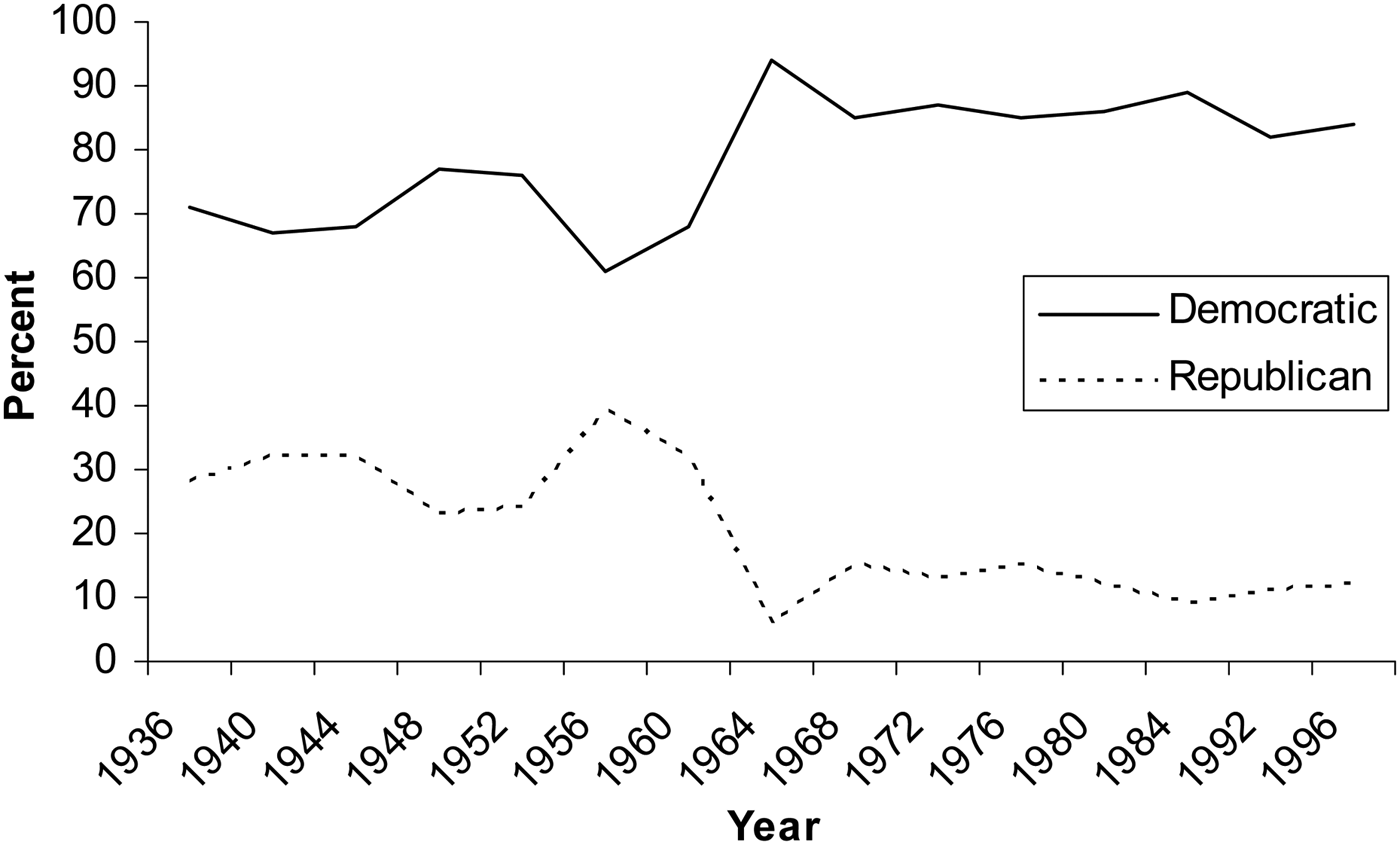
The Democratic Party institutionalized Jim Crow and filibustered Republican attempts to protect basic civil rights. Many blacks defected to the Democratic Party in the midst of the New Deal in 1936 (see Figure 1).Footnote 13 Despite their support, Roosevelt refused to address lynching and government discrimination, even when Congress brought them up. He explained to civil rights activists that southern members of Congress, whose support was essential for New Deal legislation, prevented him from playing an active role in civil rights.Footnote 14 The pursuit of civil rights could turn southern Democrats, who had accepted parts of the New Deal, against it.Footnote 15 Other national Democratic Party leaders, including party chairmen, paid little attention to blacks before World War II.Footnote 16 New York Senator Robert F. Wagner consistently supported civil rights, but did not attempt to transform the party.Footnote 17 In 1941, civil rights groups forced President Roosevelt to issue Executive Order 8802, which banned discrimination in defense industries, only by threatening a March on Washington.Footnote 18
African American Presidential Vote.

The most prestigious civil rights organization at the time, the NAACP, attempted to avoid overt partisanshipFootnote 19 and play both parties against each other. To the extent that parties represented the governed, the NAACP's only hope for representation was party realignment. Executive Secretary Walter White expressed his desire for “a new alignment with liberalism on one side and reaction on the other, and then minority groups like the Negro will very largely benefit in this new alignment of forces.”Footnote 20 Another member of the NAACP wrote that if Republicans consolidated conservative Southerners into their party, they would create a two-party system in the South in which black voters held “the balance of power.”Footnote 21 Such a system was the only way to depose entrenched Democratic incumbents.
The NAACP was not the only important civil rights organization. But several pieces of evidence indicate that it enjoyed broader support among African Americans than any other civil rights group. Politicians and opinion pollsters alike conceded its political clout after World War II, and it is the only African American civil rights organization that is mentioned with any frequency in our research on the national Democratic Party struggles that remade the party's position on civil rights. In 1952 pollster Elmo Roper said the NAACP's position was “held in respect by at least 45 percent of Negroes,” and argued it were capable of swaying the election. The NAACP was “far and away the most frequently mentioned organization” that held weight with African Americans.Footnote 22 Decades earlier, it had not only helped to defeat President Hoover's nomination of a segregationist to the Supreme Court in 1930, but helped defeat members of Congress who had supported the appointment. Segregationist Senator James Byrnes privately admitted that he funded a committee to investigate defense-industry discrimination to ward off an NAACP fight against his anticipated Supreme Court nomination.Footnote 23
To be sure, other African American groups fought vigorously for civil rights, but most of the politically active groups worked in close cooperation with the NAACP. The National Committee to Abolish the Poll Tax, for example, received significant assistance from both the NAACP and the CIO. The National Urban League, formed one year after the NAACP, specialized in employment, not politics. The Congress of Racial Equality, founded in 1942, focused on direct action and civil disobedience rather than elections and nominations. In 1957, black churches formed the Southern Christian Leadership Conference (SCLC) as a political arm. It, too, emphasized direct action over legislation and litigation; furthermore, other groups had laid the groundwork for a racially liberal Democratic Party by the time it was formed.Footnote 24 A. Philip Randolph's March on Washington Movement (MOWM) successfully pressured Presidents Roosevelt and Truman into signing executive orders in favor of civil rights. While these orders were pivotal events for party transformation, Randolph needed the help of the NAACP with President Roosevelt and the CIO-NAACP alliance with Truman. The radical National Negro Congress gained some traction with the CIO's help in the Great Depression, but the CIO worked to marginalize its influence after World War II. By that time, the CIO decided to work exclusively with the NAACP among civil rights organizations.Footnote 25 No other civil rights group had such a privileged arrangement with one of the Democratic Party's core coalition partners in the formative years of the 1940s and 1950s. When CIO and Democratic Party records mention civil rights during these transformative decades, the NAACP is the most frequently cited organization.
Considering a Labor Alliance
With both parties largely closed to African Americans, and neither party willing to take a stand against southern racial conservatives, the NAACP looked to powerful interest groups to gain access to the political arena. The strategy that ultimately provided access was set in motion in 1940, when the NAACP began working with the CIO, a core group of the Democratic Party. In the past, it focused mainly on civil rights issues, not labor or economic issues.Footnote 26 Blacks, who had scarcely any representation in the Democratic Party before this time, could never have achieved their national political goals without the help of the CIO. The CIO-NAACP alliance brought the NAACP more firmly into the camp of New Deal Democrats and provided the NAACP with additional political and financial clout.
The alliance forged between the NAACP and the CIO required an arduous effort to convince black workers to set aside their troubled history. The rank and file of both organizations followed their leaders reluctantly. Many black workers, churches, and newspapers distrusted most labor unions due to a record of exclusion that continued past the New Deal.Footnote 27 Editorials in the largest black newspapers, the Pittsburgh Courier and the Chicago Defender, were divided on unions in the 1930s.Footnote 28 Even the racially liberal CIO had difficulty making inroads among northern black workers.Footnote 29 Many CIO affiliates continued to practice discrimination and, wary of past discrimination, black leaders and workers waited before endorsing the new rival of the morally obtuse American Federation of Labor (AFL).Footnote 30 New Deal labor laws had the potential to exacerbate tensions between unions and black workers by legally empowering discriminatory unions.Footnote 31
Organizational interests at first drove the NAACP away from organized labor, but later brought them together. At the NAACP's 1933 Amenia Conference, W.E.B. Du Bois, the editor of the NAACP's publication, The Crisis,, recruited young intellectuals dubbed the “Young Turks” who wanted to shift the focus from race to class. Most were sympathetic to labor unions and wanted the NAACP to encourage mass political action among the black working class. During the 1930s, Executive Secretary Walter White prevented Du Bois and the Young Turks from implementing their progressive, pro-union economic agenda. White specialized in legal action to bring about integration, and the Young Turks' strategy would shift responsibility away from him. Realizing that he would not be the right person to mobilize workers, and determined to maintain his central role in the association, White steered the organization in a different direction.Footnote 32 He managed to keep the NAACP's focus on legal reform by portraying a workers' program as impractical and removing opposition within the organization.Footnote 33 Mary White Ovington, a socialist who had helped found the organization, called the Young Turks' strategy report a “revolutionary doctrine to which I for one of the Board subscribe, but those who want to bring it to the Negro will do best to bring it through the socialist or communistic organizations.” She asserted that if they used the NAACP for these goals, it would alienate middle-class supporters and the organization would “run ahead and then back water when dissension came.” She added that very few blacks supported socialism and the NAACP should put forward a program endorsed by most blacks.Footnote 34 Black workers and white union members had a common class, but the forthcoming nationwide alliance was the result of organizational strategy rather than a historical inevitability.
The CIO-NAACP Alliance
Civil rights groups and unions had rivalries with other like-minded groups and with each other that may have precluded the CIO from effecting changes in the Democratic Party until the 1940s. An alliance between labor unions and civil rights groups required considerable tact and strategy. Leaders in each organization had to shepherd their organizations toward issue positions that were consonant with those of the other organization.
The NAACP began vigorously supporting the cause of labor by 1940, reflecting its organizational interests. As the new decade approached, the NAACP held discussions about maintaining member interest and meeting mounting financial challenges. The organization was worried about competition from more radical groups such as the National Negro Congress and the MOWM.Footnote 35 At that time, and later, the NAACP refused to relinquish its dominant position over other civil rights groups.Footnote 36 In the first half of the 1930s, NAACP annual revenue was half of what it had been in the 1920s, and one study showed that declining middle-class contributions accounted for much of the loss. In 1939, the IRS disallowed tax deductions for donations to the NAACP because of its political “propagandizing,” forcing the NAACP to rely less on donations from large donors.Footnote 37 In contrast to the national organization, the Chicago, Detroit, and Baltimore NAACP branches greatly flourished by recruiting black laborers.Footnote 38 By 1940, the organization saw new advantages in becoming a mass organization, shifting from its reliance on middle-class whites and black professionals.Footnote 39
Working with unions would not only help the NAACP to recruit working-class blacks: the CIO had the ability to provide considerable “political muscle,” in Charles Houston's words. The CIO could distribute political literature, solicit donations, and recruit canvassers from a captive audience in a given workplace. Long before politicians used direct mailing, the CIO Political Action Committee (PAC) knew workers' home addresses and could target workers in pivotal precincts to volunteer for candidates and register to vote.Footnote 40
A turning point in the NAACP's behavior toward labor occurred in 1940. The NAACP's written records do not directly announce a decision to ally with labor, but they reveal a pattern of support that contrasts with the organization's earlier behavior. The NAACP considered proposing an antidiscrimination amendment to the Wagner Act, but worried that doing so would alienate labor and set a dangerous precedent for federal harassment of unions.Footnote 41 When Representative Howard Smith attempted to make changes to the Wagner Act, the NAACP dubiously claimed it had always supported the closed-shop union. It declared that the changes were intended to “emasculate” the Wagner Act rather than resolve disputes more fairly.Footnote 42 After a meeting with CIO President John L. Lewis and several other labor leaders, the NAACP suggested its own amendment to prevent Smith from using civil rights to discredit unions.Footnote 43 White wrote with hope that “I think such a step might conceivably strengthen our position with labor.”Footnote 44 The NAACP amendment was even revised for labor's benefit at the risk of making it more difficult to prove discrimination. The first draft denied legal benefits to unions that discriminated, but the later draft changed the phrasing to deny benefits to unions that “customarily” or “usually” discriminated. An NAACP memo read:
These changes leave a certain loophole in the bill. A Union might, for example, take in a few negroes to give lip service to the requirement and refuse admission to others. However, in view of the status of this proposed legislation and of the importance of labor support for it, I personally think it is all right.Footnote 45
NAACP leaders also agreed not to reveal the names of discriminatory unions to Congress, in order to avoid antagonizing them.Footnote 46 Lee writes that “the NAACP grew increasingly wary of challenging union discrimination lest its efforts play into the hand of . . . anti-labor forces” in the late 1940s and early 1950s.Footnote 47 However, these considerations influenced NAACP leaders early in the decade.
The Ford Strike of 1941 provided highly visible evidence of the NAACP's new attitude toward labor.Footnote 48 The hitherto anti-union Detroit chapter warned thousands of African Americans not to serve as replacement workers during the strike, and urged the blacks inside the Ford plant to leave. White wrote to the chapter president that blacks need to be aware of “the new order of things” represented by the union.Footnote 49 Seven years earlier, he had told Harry Hopkins that open shops were better for black workers, specifically mentioning Detroit's automobile industry.Footnote 50 After securing a pledge from the United Auto Workers (UAW) to reduce discrimination, White sent a telegram to the local NAACP branch president to continue “full cooperation” with the union.Footnote 51
White's correspondence during these trying months reveals his perceptions of the changing economic landscape and dilemmas that unions posed. In the wake of the Wagner Act, it seemed that the future of the working class lay with unionized workplaces.Footnote 52 To a Cleveland attorney, White wrote that some union would organize Ford and “the Negro worker had the grim choice of casting his lot with the union or having its hostility after they organized.”Footnote 53 Since most black Ford employees still voted against the UAW-CIO,Footnote 54 the local and national NAACP showed itself leading, rather than reflecting, grassroots opinion. African Americans were not pawns of larger interests; they were making a strategic decision with their eyes wide open to the risks. White acknowledged that supporting the CIO might lose “support . . . among more conservative folks who are pro-Ford” but the branch would “gain more than enough new members among the rank and file.”Footnote 55
Both the NAACP and the CIO took steps to improve relations with each other in the early 1940s. The NAACP altered its organizational identity to include labor interests. At the national level, the NAACP donated money to workers on strike, and urged local chapters to do the same.Footnote 56 Goluboff points out that after winning several cases against labor discrimination in the early 1940s, the NAACP withdrew from labor litigation for fear of aiding common political enemies.Footnote 57 The NAACP's new “labor secretary,” Clarence Mitchell, consistently told black “working people to join bona fide non-segregated labor organizations, to attend the meetings of such organizations, and to be good members in all respects.”Footnote 58 From the beginning, Mitchell “perceived the value of coalition-building with organized labor,” and later made great use of these contacts when he directed the Washington Bureau.Footnote 59 Frymer describes the labor department as “vigorous in a multitude of venues, lobbying Congress for greater civil rights protections, asking legislators to pay attention to the consequences of closed union shops, working with local NAACP branches around the country to respond to individual cases of discrimination, and working with both national and local unions to target civil rights abuses.”Footnote 60 In 1946, the NAACP removed Nation publisher Oswald Garrison Villard, the original financier of the NAACP, from the board of trustees partly for his hostility to labor unions.Footnote 61 Although a few members complained that the organization was losing its focus by helping organized labor and other liberal groups, membership flourished in the 1940s.Footnote 62
Honoring its new commitment to organized labor, the NAACP favored unions even when doing so meant sacrificing short-term civil rights considerations, ensuring that liberal groups within the Democratic Party moved in tandem. The NAACP was evolving into a multi-issue group. Goluboff contends that the NAACP had “repudiated class issues in the 1940s” and by the 1950s “succeeded in writing class out of their story.” In fact, the Association was so committed to progressive economic policies in the 1940s that they opposed civil rights amendments that threatened the passage of social welfare bills.Footnote 63 In the past, the NAACP had opposed social welfare measures such as the National Industrial Recovery Act (Section 7a) and Social Security when adequate safeguards for minority workers had not been included in those bills. In the future, the NAACP would oppose aid to education that did not exclude segregated schools. For most of the 1940s, however, the NAACP opposed antidiscrimination amendments, knowing that these amendments would cause liberal legislation to fail.Footnote 64 Walter White—joined by the CIO—also called for a Conference of Progressives in 1946. At this conference, White favored universal health care and the continuation of rent and price controls.Footnote 65 The NAACP vigorously opposed the Taft-Hartley Act, which disempowered unions that practiced discrimination. It would make extensive use of this provision beginning in 1964, but testified against the act in 1947.Footnote 66 An in-house exchange read that “it seems that we have a responsibility to keep the Negro community from getting confused on this issue. As you know there is strong feeling in the Negro community that the closed shop is harmful to Negroes.”Footnote 67 In the wake of Taft-Hartley, the NAACP sent members to public forums and registered voters to oppose “right to work” laws. AFL-CIO President George Meany thanked the NAACP for its campaigns against right-to-work referendums in 1958 and 1964.Footnote 68
By the mid-1940s, the NAACP not only broadened its mission to economic issues, but also demonstrated clear sympathy for the Democratic Party. While NAACP leaders privately favored New Deal Democrats and progressive causes before 1940,Footnote 69 they now made their preferences public and showed more interest in working in a coalition. Worrying that black support for Republicans would isolate their organization from existing and potential allies, President Arthur Spingarn said that “the Negro should align himself with all the liberal forces behind the New Deal,” and if “we in any way attack President Roosevelt (We have got to be realistic) we are helping to elect Dewey and so are cutting ourselves off from all association with liberal forces.”Footnote 70 The Republicans made a serious effort to win over black voters in 1944. The nominee, Thomas Dewey, helped introduce New York's Fair Employment Practices Commission (FEPC). The ambitious platform favored an anti–poll tax amendment, an antilynching law, desegregation in the armed forces, and a permanent FEPC. The 1944 Democratic Party platform merely contained a vague statement about honoring constitutional rights. Just the same, the NAACP publicly declared that “neither party platform on the Negro is satisfactory to intelligent Negroes.” White authored a syndicated column in the New York Herald that touted the Democrats over the Republicans. In 1948, he all but endorsed President Truman in his public statements, and when the NAACP board of directors voted on White's behavior, they decided to take no action.Footnote 71 At the same time, the NAACP terminated W.E.B. Du Bois for issuing public statements favorable to the racially liberal third-party candidate Henry Wallace, whom unions strenuously opposed as a spoiler candidate.Footnote 72 By 1952, the NAACP participated in an informal caucus of groups, including the CIO, which plotted strategy to move the 1952 Democratic platform in a liberal direction.Footnote 73
Like any other partnership, the commitment of both the NAACP and CIO to each other's agendas wavered. Antidiscrimination pledges among unions were seldom enforced, and the CIO failed to address racism at an institutional level, viewing it as a problem of individual members. Many white members of affiliated unions went on “hate strikes” when black workers were promoted. Nevertheless, the NAACP muted its criticisms, and even in-house conversations show consistent support. During the Packard “hate strike” of 1943, White placed the blame entirely on the management rather than the white laborers. Although he was aware of the instigating role that white workers had played in the strike, he chose to side with the UAW leadership and omit labor's role.Footnote 74 When the CIO purged more than a million members during the postwar Red Scare, it lost many of its most racially progressive leaders, including unions that had taken the most steps to prevent hate strikes.Footnote 75 The national organization even sided with racists to defeat Communist factions in some locals. This, too, failed to strain the alliance; in fact, the NAACP applauded the Communist purge and conducted one of its own.Footnote 76
In 1959, NAACP Labor Secretary Herbert Hill castigated the AFL-CIO for failing to meet several extended deadlines to address segregation at an institutional level. But for most of the decade, the NAACP remained hopeful and enthusiastic. In the past, Hill told black workers with grievances that the first steps in promoting fair practices were to join a union and become active members.Footnote 77 Union leaders Philip Murray, Walter Reuther, and George Meany were publicly honored by the NAACP many times and NAACP leaders spoke enthusiastically at labor conventions. Even in 1957, Hill wrote in the NAACP's annual report that “A close day-to-day working relationship between the NAACP and the organized labor movement was an important aspect of the Association's labor program.”Footnote 78 Polls showed that African Americans viewed labor unions in an increasingly positive light over the 1950s even as the general public viewed them with increasing suspicion.Footnote 79 By the time the NAACP was willing to publicly clash with the AFL-CIO, the place of the NAACP among liberal organizations—and the place of civil rights in Democratic Party politics—was secure. The strategy set in motion in 1940 had worked, so it seemed.
The CIO-NAACP alliance solidified the NAACP's reputation as the nation's most prestigious civil rights organization. It helped to isolate other civil rights organizations, including groups that they had originally funded.Footnote 80 In the early 1950s, the CIO provided essential funding for the Brown v. Board of Education decision, which many regard as the most important achievement in the NAACP's history. The NAACP ended 1952 with an operating deficit of $34,000 and sought to raise $100,000 in 1953 to prepare for whatever decision the Supreme Court made. The CIO readily advised the NAACP on which local unions and individuals were likely to be sympathetic to fundraising drives.Footnote 81 The NAACP raised $2,500 from the CIO in 1953 and $75,000 from the Philip Murray Memorial Foundation (headed by longtime CIO operative James Carey) in 1954.Footnote 82
In summary, the NAACP became far more vocal in its support for labor rights, economic progressivism, and New Deal Democrats in the 1940s. The timing of the NAACP shift closely precedes the Democratic Party's first major concessions and the change of blacks from swing voters to strong Democratic Party identifiers. (See Figure 2) Events occurring between 1937 and 1941 made a CIO-NAACP alliance more palatable, even pressing, than it would have been in the past. In participating in an alliance with the CIO, the NAACP addressed both community-level concerns, such as employment opportunities, and national political concerns, such as civil rights legislation. The CIO had a different balance of local and national concerns.
African American Party Identification.
While other allies were available to the NAACP, it saw working with the CIO as the best overall way of becoming a working-class organization, influencing politics, and integrating workplaces. Business interest groups had not shown the willingness to donate money that would match the contributions of labor unions. Even if they had, they lacked the manpower to assist with membership drives, voter registration, and workplace integration efforts.Footnote 83 The National Urban League's (NUL) history provides evidence that relying heavily on business donations would have likely been a suboptimal organizational strategy for the NAACP. The NUL received much of its funding from employers and cautious white philanthropists, and had a much more difficult time influencing unions to integrate. In 1934, it set up “Workers' Councils” to train blacks to establish and join unions and fight against discriminatory unions. Many affiliates refused to cooperate because of the tensions the councils produced with donors. In the end, the councils had less impact on union discrimination than the NAACP had, even though employment was an organizational niche for the NUL.Footnote 84 NUL Assistant Executive Secretary Lester Granger admitted in 1947 that legislation was a more effective solution than promoting integration in the workplace on a voluntary basis.Footnote 85
If the NAACP were allied with business, rather than labor, it would have had difficulty pushing for the FEPC.Footnote 86 Business might have been more receptive to fighting government discrimination against African Americans than to the FEPC, which regulated private employers. But even in the domain of government discrimination, most businesses showed themselves less willing than unions to fund the fight for civil rights. When the NAACP lobbied against discrimination in federally subsidized housing in 1954, few businesses joined the battle. The government financed thousands of homes that excluded blacks, such as Levittown, Pennsylvania, and would often clear black neighborhoods and exclude them from the new neighborhoods. The National Association of Real Estate Brokers supported the NAACP's position and asked Eisenhower to instruct housing agencies to revise their housing policies. Unlike organized labor, however, the Association did not provide funding for the NAACP or aid its lobbying effort in Congress.Footnote 87
THE CIO'S INTEREST IN CIVIL RIGHTS
The NAACP's overtures to the CIO would not have mattered if the CIO did not have a comparable interest in the alliance. The CIO was both a professional interest group, protecting its member interests, and an ideological group in the sense that it viewed its member interests as tied to a full-employment economy. According to CIO leaders, maintaining the purchasing power of all workers was necessary to protect their own.Footnote 88 The CIO could have become an AFL for unskilled workers, with a similar, narrow political agenda. Some of the most able left-wing organizers may have gone elsewhere, and it might have lost the enthusiasm of middle-class liberals. But the union leaders clearly supported a progressive agenda, while union workers often had to be dragged along. The group leaders were able to fuse their followers into a potent political force.
The findings presented in this section are based on written CIO records and secondary sources in labor history. Several labor historians have argued that local labor activists were surprisingly committed to racial egalitarianism and class consciousness; in their view, the CIO would have made more racial progress if only it had more committed leadership.Footnote 89 To the contrary, I argue that CIO leadership was sincerely committed to civil rights in the 1940s and 1950s in electoral politics, if not the workplace. The leadership's preferences differed from a large swath of their workers.Footnote 90 Even when the CIO merged with the AFL in 1955, the new organization continued to support civil rights and other liberal positions in the Democratic Party, though in a less confrontational manner. The AFL had been moving toward the CIO's ideological position and interest in political causes as the merger approached.Footnote 91
The CIO's Organizational Interests in Civil Rights
The CIO's labor needs influenced—but did not drive—its political alliance with civil rights groups. Both segregation and integration posed risks from the point of view of organizing more chapters. The CIO endeavored to unionize industrial workers and adopted a nondiscrimination policy in its first constitution in 1938. African Americans formed a sizeable portion of the workforce in some, though not all, unskilled workplaces. If a union did not include African Americans, they might vote against unionizing or vote for a competing union. Even if a discriminatory white union succeeded in organizing a workplace, blacks might serve as replacement workers and impede the success of strikes.Footnote 92 At the same time, workplace considerations do not fully explain the CIO's behavior. Former NAACP Labor Secretary Herbert Hill claims that they did, as have many labor historians.Footnote 93 However, the racially conservative AFL had great success in competing with the CIO in unskilled labor markets, while some CIO unions promoted racial equality even where black membership was low.Footnote 94 The CIO certainly did not have to promote civil rights legislation or progressive candidates to recruit new workers; African Americans were eager to accept employment where they could find it, whether the union was politically active or not.
In some places, appeals to racial conservatism were effective in winning an organization driveFootnote 95; in other places, the competition caused both unions to take African Americans more seriously.Footnote 96 On balance, competition between the CIO and AFL seems to have had a positive impact for black workers.Footnote 97 The competition elevated the NAACP's role in the workplace, since it played an important role in many elections. Tacit approval could often decide which union African Americans would support.Footnote 98 As the South urbanized from 1931 to 1954, the southern wing of the NAACP grew faster than either black churches or colleges by several institutional measures (northern branches also grew, but to a lesser degree). The national organization was able to influence its local branches with a high degree of tactical uniformity.Footnote 99
The leadership of the CIO pressured its skilled and unskilled unions to integrate, but did not adopt integrationist policies based on economic interests alone.Footnote 100 Persuading local chapters to give up segregated facilities or open all trades without regard to race was an absorbing task that often failed. Even in the left-wing UAW, most southern and border state regional directors used their influence to maintain segregation in their regions.Footnote 101 CIO leaders opted to push racial integration along where they could, though their efforts were not as extensive as some civil rights advocates would have liked.Footnote 102
The CIO's Political Interests in Civil Rights
It is not clear that the CIO needed to address workplace discrimination and support civil rights to organize its workplaces, but it needed to do both in order to carry out its political agenda. African Americans were part of the CIO's strategy to influence politics in a favorable direction.Footnote 103 As with politicians who logroll, interest groups gain political advantages through an alliance even if they have nothing in common, but if they do have something in common, the alliance will be stronger.Footnote 104 Unions and racial minorities had a common interest in voting rights, since voting restrictions affected both blacks and working-class whites. Moreover, both had a common interest in “civil rights,” which referred to the federal protection of the rights of union organizers and free association, and not just the rights of racial minorities.Footnote 105 Federal protection was essential when many southern police routinely harassed organizers, as White pointed out to CIO-PAC founder Sidney Hillman in 1940.Footnote 106 The wartime FEPC, strongly favored by civil rights groups, helped the CIO because it documented abuses of civil rights by its rival, the AFL.Footnote 107 While serving on the President's Committee on Civil Rights (PCCR), CIO Secretary Treasurer James Carey fought unsuccessfully for the report to include the names of discriminatory AFL unions.Footnote 108
Most CIO leaders saw the Democratic Party as the best political vessel for their interests, and hoped that African Americans would join them to influence the party based on their common interests. CIO-PAC founder Sidney Hillman believed that labor's corporatist gains during World War II depended on liberal Democrats remaining in power and the CIO obtaining a permanent role among the highest strategists and policymakers in the party. Hillman claimed that labor groups wielded considerable strength in party nominations in 1943, before the CIO-PAC was fully organized:
The Democratic Party is very open to the proposition of giving our groups a great deal of say right in the party—not merely on policies, but a discussion of the kind of people they are going to nominate before they nominate them. I think if we have real leadership we can work out, especially with the Democratic Party, some satisfactory arrangements so that we do not really have a choice between two evils. After my trip I have seen some of the top leadership of the Democratic Party, and I think there, too, there is a desire to discuss with us before instead of after. You know what happened in New Jersey where, because of the AFL and the CIO and the Brotherhoods working together, we have forced our nominee as the gubernatorial candidate.Footnote 109
Although Hillman had supported third-party efforts in the past, he sought to unite all such efforts into a coherent Democratic Party bloc with the CIO-PAC and scuttle third parties.Footnote 110 The CIO's involvement with the Democratic Party took many forms. It consulted with Democratic Party presidents and congressional leaders to suggest appointments, legislation, and political strategy.Footnote 111 It contributed funding, voter registration drives, and mobilization efforts to support like-minded candidates in Democratic primaries and defeat Republicans in the general election.Footnote 112 Finally, as we will see, both the CIO and affiliated unions influenced large blocs of delegates in nominating conventions.
The CIO viewed the southern wing of the Democratic Party as a hindrance. Southern members of Congress (MCs) began opposing Roosevelt's labor policies before they opposed other liberal economic policies.Footnote 113 While their opposition to labor only crystallized in response to related race issues, the CIO threatened other pillars of southern electoral politics. Southern officeholders benefited from elections that excluded working-class voters of both races with poll taxes and a one-party system.Footnote 114 The status quo enabled company towns and government intervention in strikes, and the beneficiaries of this system had ample reason to oppose the CIO regardless of civil rights. Politics aside, the South's low wages and hostility to unions threatened the CIO's ambitions.Footnote 115
CIO research indicated that antilabor MCs were elected in low-turnout elections.Footnote 116 African Americans were a large part of this group.Footnote 117 CIO activists believed southern blacks were far more likely to vote for progressive legislators.Footnote 118 In the North, the CIO feared that African Americans would revert to the Republican Party.Footnote 119 Polls attempting to measure party attachment support the view that blacks were divided in their party loyalties as late as 1944 (see Figure 2). In the 1946 midterm elections, the Democratic Party lost between 16 and 50 percent of the support it had received in black communities in 1944.Footnote 120 CIO-PAC Director Jack Kroll and other CIO leaders also worried about third parties that appealed to blacks, especially Henry Wallace's racially liberal Progressive Party. By adopting an agenda broader than labor rights and transforming the Democratic Party, the CIO-PAC could convince union workers, volunteers, and liberals outside of the labor movement that the CIO-PAC and the Democratic Party were visionary organizations that obviated the need for a third party. Civil rights were part of this agenda. Internal memos revealed that leaders adopted long-range, broadly progressive goals in part to attract non-union liberals and meet “the demands of those who seek to push us into third party adventures.”Footnote 121 The CIO-PAC influenced the development of other organizations that would rally non-union members to broad liberal causes, where labor rights and civil rights were subsets of the organizations' goals.Footnote 122 The most important such fledgling organization was Americans for Democratic Action (ADA), which helped to pass the civil rights plank at the 1948 Democratic Convention.
The decision to support civil rights did not mean that the CIO had to side with the NAACP in particular. But the CIO did. The NAACP proved, time and again, that it was a “team player.” It was willing to mute its criticisms of organized labor, support civil rights policies sensitive to labor concerns, and oppose Henry Wallace's third-party crusade. It even opposed Communist proposals to have separate seniority rules for blacks, which would have opened better jobs for African Americans who were only recently allowed into unions.Footnote 123 Both organizations advised each other on locations in which they were likely to find new members or sympathetic allies. The NAACP helped the CIO contact black churches to recruit blacks for political purposes.Footnote 124 The allies' lobbyists collaborated on many of the same bills and their lawyers filed amicus briefs for the same cases. Both organizations worked together to abolish poll taxes at the state level. The NAACP embarrassed labor's foremost congressional opponent, Senator Robert Taft, in an election year. When Taft opposed a “compulsory” FEPC in favor of one that merely publicized cases of discrimination, he tried to claim that a high-ranking official at the NAACP preferred his version. The NAACP repeatedly called upon him to name that official in public. Executive Secretary White wrote to the CIO that “I am delighted that we have caught him in such a vicious distortion of the truth and you may be sure that we are going to follow it through to the end.”Footnote 125
In addition, the NAACP was arguably more responsible than any other single organization for quadrupling the number of black voters in the South from 1940 to 1954. Newly registered black voters were important for unseating antilabor members of Congress and holding southern states for Adlai Stevenson in 1952.Footnote 126 In 1944, NAACP litigation led the Supreme Court to reverse a nine-year-old precedent and invalidate white primaries. The NAACP subsequently offered rewards for local chapters that registered the most voters, and bestowed a $50 prize for a Louisiana chapter that registered over 600 black voters in 1947. Historian John Kirk argues that in Arkansas, the NAACP was the most significant factor in increasing black voter registration from 4,000 to 47,000 between 1940 and 1947.Footnote 127 The Association and its local branches were officially nonpartisan, and could not tell new voters whom to support. But they helped coordinate (and in some cases, create) independent local groups that registered voters and endorsed liberal candidates sympathetic to civil rights. Among the groups were the Georgia Association of Citizens Democratic Clubs, the Mississippi Progressive Voters League, the Florida Progressive Voters League, and the Jefferson County Progressive Democratic Council in Birmingham.Footnote 128 The NAACP also helped some of these organizations sue election boards that impeded registration efforts.Footnote 129
Two episodes demonstrate the CIO's willingness to help the NAACP stay at the forefront of civil rights groups. MOWM leader A. Philip Randolph, who also led the National Council for a Permanent FEPC, prioritized the desegregation of the armed forces over the FEPC, and worked with Senator Taft on both issues. When Randolph was willing to settle for an FEPC without enforcement powers, the NAACP's Walter White and the CIO's James Carey contacted other groups in the Council and persuaded them to let the NAACP take over the FEPC fight.Footnote 130 When a Los Angeles CIO affiliate worked with the National Negro Congress, the national CIO strongly rebuked it, warning that “the organization with which we work very closely and successful is the NAACP” and that the chapter must discontinue its support of rivals or be in violation of rules passed by the governing council.Footnote 131
Would the CIO have transformed the Democratic Party on civil rights regardless of what the NAACP did? Probably not. First of all, the CIO would have grown less as a union. The NAACP assisted CIO membership and fundraising drives, and advised CIO locals on how to minimize racial discord in biracial workplaces. Second, the NAACP attested that civil rights measures favored by the CIO were authentic civil rights measures with widespread support among blacks. The NAACP cast doubt on the propriety of measures that sought to place the burden of integration on unions rather than employers, such as the Taft-Hartley Act. Finally, many political organizations have acted against their own interest by acceding to racial division, and the CIO might have chosen to follow in their footsteps. CIO workers would have easily been diverted away from civil rights if the most prestigious voice of civil rights in the nation undermined them. In one southern union that attempted to foster racial tolerance among members in 1946 an organizer found white members very resistant because of the local African American newspaper's steady opposition to the CIO.Footnote 132 Frymer shows the result of division such as this on a broader scale. When unions rejected NAACP recommendations for integration in the 1960s, the NAACP turned to the courts with their grievances, weakening union treasuries and seniority rules. NAACP litigation increased racial resentment in unions, led union members to support conservative politicians in some cases, and fractured the Democratic Party coalition.Footnote 133 Projecting Frymer's findings back in time, it is hard to imagine that the CIO-PAC or its liberal allies would have prioritized civil rights if the NAACP worked against unions or Democrats. For the CIO to prioritize civil rights with the assent of its members, the NAACP had to support unions without hesitation.
Given that support for civil rights would help remove the threat of black replacement workers and elect progressive politicians, the CIO consciously chose to promote workplace integration, lobby for civil rights, and work closely with the NAACP. Southern Public Relations Director for the CIO Lucy Mason Randolph argued that “a square deal on the part of white workers for Negro workers means that both will be interested in the same qualified candidates for public office and will vote together.”Footnote 134 The national CIO created a “Committee to Abolish Racial Discrimination” (CARD) in 1942. By 1945, one hundred state and local CARD committees existed among CIO unions.Footnote 135
Workplace integration alone had implications for politics, as many black workers voted in a one-person, one-vote system for the first time,Footnote 136 and Jim Crow politics arguably rested upon the separation of workers by race.Footnote 137 Some CIO unions implemented racially progressive policies before the NAACP took an interest in labor. However, the CIO did not implement institution-wide solutions such as a CARD until after the NAACP made an effort to cooperate. Hillman's biographer writes that “his approach” to union integration “was to equivocate and placate.” As a CIO operative working for the Roosevelt administration, Hillman's wartime “construction and shipbuilding stabilization agreements froze in place the all-white practices of the craft unions.”Footnote 138
With the creation of CARD, the CIO attempted to rectify union-wide injustices with varying success. Just as the NAACP tried to socialize its members to favor organized labor, CARD attempted to socialize its workers into favoring civil rights. A CIO conference on civil rights said that integration needed to be “sold to the CIO membership in the same manner as wage increases, shorter work week or any other benefit of trade unionism.” Some pamphlets emphasized that discrimination was unfair and un-American, but economic benefits were also stressed: a popular pamphlet was entitled “Discrimination Costs You Money.”Footnote 139 CARD discussed highlighting the role of blacks in World War II and unions to foster interracial solidarity. Their newsletters featured stories about employers approaching black workers offering paid positions as “scabs,” and the blacks dutifully turning down the offers.Footnote 140 One CIO pamphlet featured a cover with three workers—one black, one Asian, and one white—on the cover.Footnote 141 Civil rights were integrated into CIO summer school curriculums, although summer schools were typically attended by those already enthusiastic about the national CIO's mission. In 1950, the national CIO directed all locals to disobey state and local laws requiring segregation, since it considered them unconstitutional. Clearly, by asserting a civil rights jurisprudence ahead of the Supreme Court, the CIO was exceeding mere token or symbolic support for civil rights.Footnote 142
These efforts were a visible improvement from the 1930s, when neither CARD nor the CIO-PAC existed. Although the CIO professed its commitment to interracial organizing in the beginning, only a few of its affiliates, such as the United Mine Workers, consistently pushed forward racial progress after the organizing drives were over.Footnote 143 Even left-wing unions such as the Steelworkers and Garment Workers oscillated in their commitment. The CIO chose to begin its southern organization in the 1930s with lily-white textile unions to avoid being seen in the South as a racially progressive union.Footnote 144
Of course, historians debate the economic benefits unions provided to African Americans in the 1940s as well.Footnote 145 They question whether CARD and other steps taken by the CIO to address discrimination in its own ranks were adequate. CARD developed model antidiscrimination contracts that were seldom adopted, let alone enforced, by affiliates.Footnote 146 CIO leaders tended to view racism as a problem of uncooperative members, rather than institutional problems entrenched in seniority rules and the culture at large. If Murray, Reuther, and Meany did not think a rising tide for union workers could resolve most racial issues, integration at least had to take a back seat to full employment, union rights, and class issues more generally.Footnote 147 When the CIO purged Communist members and locals, they removed factions committed to addressing racism at an institutional level. Anti-Communist CIO leaders often addressed civil rights concerns in order to minimize Communist recruitment among black workers.Footnote 148 With the purge, this incentive to address black grievances was removed. Willard Townsend, who consistently sided with anti-Communist union factions, claimed that the Communists “did keep the civil rights question alive, even though we recognized why they were doing so.”Footnote 149 Politically, the CIO kept quiet about civil rights in places where it would be a liability for organizing drives. While southern CIO-PACs were politically active, the CIO preferred that organizers sent to unionize new workplaces keep a low profile politically.Footnote 150 CIO leaders declared that “Operation Dixie” would be “purely an organizational campaign,” with “no extra curricular activities—no politics . . . no FEPC.”Footnote 151
Whatever the real benefits of their alliance with the CIO by the 1940s, the NAACP at the time publicly commended the commitment of CIO leaders and its steps to address workplace integration.Footnote 152 Union integration programs and visible support for the NAACP earned the goodwill of many blacks toward the CIO. Limited progress in the workplace did not prevent African Americans from supporting the CIO's political agenda. Nor did it prevent their ascendance in the Democratic Party. Beginning with the 1948 platform, the party's symbolic commitments to African Americans exceeded any party's commitment to them since Reconstruction. Substantively, the party began addressing their concerns with the desegregation of the armed forces in 1948 and culminating with the Civil Rights Act of 1964. By the end of the 1940s, African Americans, for the first time, were more supportive of the Democratic Party than white workers (see Figures 1 and 2). The CIO's failure to address Jim Crow in its own house arguably sowed future divisions between the allies, and the siphoning of white workers from the Democratic Party.Footnote 153 More vigorous attempts to address union discrimination in the heyday of the alliance might have prevented this, but they may have also alienated white workers and stifled the coalition at its inception. As Zieger has written, the CIO did not “divert or defang” left-wing workers, and there is “little evidence that industrial workers had much stomach for the kinds of root-and-branch confrontation with the American state that a more radical program would have required.”Footnote 154 The alliance of labor and civil rights of the 1940s and 1950s, though containing the seeds of its own fracture, still accomplished life-changing reforms for African Americans. Before long, the cause of civil rights and labor unions would become “braided,” as Farhang and Katznelson describe it, in the eyes of many.Footnote 155
TRANSFORMING THE DEMOCRATIC PARTY
In the 1940s, the CIO and the NAACP self-consciously set out to realign the Democratic Party as the party of economic progressivism, labor rights, and civil rights. They sought to purge party elements that would block the representation of blacks and labor in the party. Future NAACP Executive Secretary Roy Wilkins wrote in 1946 that “It is the Democratic party whose basic philosophy fits the plight of the Negro both as a minority group and an economic group. The trouble with the Democrats . . . is that the carrying out of the basic philosophy is ham-strung by the southern wing.”Footnote 156 By the 1948 Democratic Convention, the national leadership of the CIO made their intentions public. After a strong civil rights plank was adopted at this convention, CIO political action committee (PAC) director Jack Kroll told a group of workers that the Democratic platform
will go a long way to separate the sheep from the goats . . . I think that the basis may have been laid for transforming the Democratic party as a whole into a genuine instrument for expressing the will of the vast majority of the people, unencumbered by civil war hangovers, unburdened by the magnolia and mint julep mentality, unhampered by sectional prejudices.Footnote 157
Echoing these sentiments, the CIO-PAC's field director told CARD to “read the Dixiecrats out of the party, they have shown their hands. Then we'd be in a better position to run liberal Democrats to oust these cases.”Footnote 158 UAW President Walter Reuther wrote to White that the 1949 filibuster of a civil rights bill was an “unholy alliance between the Dixiecrats and reactionary Northern Republicans” that “underscores the need to bring about fundamental political realignments in American politics.”Footnote 159
CIO-NAACP cooperation went a long way in effecting the party transformation desired. Both parties continued to equivocate on civil rights after the Great Migration. First, let us consider the Republicans. Republicans offered more consistent civil rights promises than Democrats in their platform, but never managed to enact them, even in the post–World War II Congress that they controlled. Senator Robert A. Taft, “Mr. Republican,” seemed to have written off the African American vote:
The Negro situation . . . is a very difficult one. I doubt if we can outbid Mrs. Roosevelt . . . Just at present the Negroes will be satisfied with nothing except the FEPC Bill. That is something which violates any possible party philosophy we could adopt.Footnote 160
Whatever lingering relationship remained between African Americans and the Republican Party was strained when the CIO and the NAACP focused on passing the FEPC over other goals.Footnote 161 The FEPC became a viable political issue when the MOWM and NAACP forced President Roosevelt to sign an executive order for a wartime FEPC. Republicans found the FEPC to be the most unpalatable civil rights proposal on the NAACP's agenda.Footnote 162 The FEPC resembled the Securities and Exchange Commission and National Labor Relations Board (NLRB), in which a panel of government experts regulated private businesses.Footnote 163 It was designed by progressives such as CIO-PAC founder Sidney Hillman and New York City Mayor Fiorello LaGuardia, and it even borrowed personnel from the NLRB.Footnote 164 One could have hardly invented a better institution for pitting the interests of business groups against the interests of civil rights groups. Republicans were as eager as ever to win black votes, but at this point, the most important item on the civil rights agenda produced great friction with business groups.
Democratic Party leaders in the early to mid 1940s also vacillated on civil rights despite being cognizant of the growing African American vote. An unsigned Roosevelt administration memo from 1940 claimed that blacks constituted 4–16 percent of the vote in thirteen swing states, so their vote was considered in the selection of the vice president in 1944.Footnote 165 Party insiders knew of Roosevelt's deteriorating health and selected a vice-presidential nomination after extensive discussion. The existing vice president, Henry Wallace, was widely popular with African Americans and unions, but his views were considered too radical to be president. Roosevelt and several party bosses worried that one of the top candidates to replace Henry Wallace, James Byrnes, would lose several swing states by alienating African Americans. After a series of mixed signals, Byrnes was nonetheless given a “green light” on the eve of the convention. The only black representative in Congress, William L. Dawson, said that he did not think blacks would leave the party over a Byrnes nomination. Roosevelt asked Byrnes to “clear” his candidacy with Phil Murray and Sidney Hillman. Both offered strenuous objections. The president and several party bosses decided to oppose Byrnes, emphasizing labor's opposition as the foremost reason.Footnote 166 Despite the increasing importance of black voters, the Democratic Party might have nominated a conservative Southerner except that organized labor had a proverbial seat at the table.
Democrats wrestled with whether to match the Republican plank on civil rights and risk alienating the South in 1944. Southern Democrats, animated by the Supreme Court's decision to invalidate white primaries, had discussed bolting the convention as early as 1944. Due to their influence, the 1944 platform included only a vague statement that some rights are guaranteed by the Constitution to all citizens. Roosevelt told Dawson that he would run on his record rather than on specific civil rights pledges, and persuaded him to rally liberals around the vague plank for party unity. Although Dawson had previously urged the removal of conservative Southerners from the party, party pressure channeled his reconstructive sympathies into maintaining the existing balance between North and South.Footnote 167 The party replaced a civil rights crusader with a border-state politician as vice president, and caved in to southern pressure in the 1944 platform.
The relatively even balance of northern and southern influence reflected in the 1944 ticket was later upset largely by the intervention of labor, civil rights, and liberal groups. At one point in Truman's presidency, it seemed as if the party recognized the need to prioritize African American votes over southern votes due to electoral calculations alone. On February 2, 1948, President Truman became the first Democratic president to issue a highly publicized statement in favor of civil rights. Special Counsel Clark Clifford had presented him with a report that southern Democrats would still vote Democratic even with a civil rights platform, but African Americans might vote Republican without one. Clifford therefore submitted to Truman an ambitious set of civil rights proposals.
Truman took some steps to implement Clifford's advice, but backpedaled under pressure from southern Democrats. In the February speech, he had promised he would issue orders to end discrimination in the federal government and the armed forces. In May, he denied ever supporting the desegregation of federal employees, drawing a distinction between discrimination and segregation.Footnote 168 According to Phileo Nash, special assistant to the president on minority problems, “the reaction in Congress to the February 2nd message was such that there was some question in everybody's mind as to whether the President would get the nomination if he didn't back off a little bit.”Footnote 169 The reaction had gone well beyond Congress, as the South witnessed several incidents of racial violence. A Southern Governor's Conference warned “The President must cease attacks on white supremacy or face full-fledged revolt in the South,” and each of Alabama's electors pledged to vote for a Democrat other than Truman. In South Carolina, half of one county's 4,000 white voters turned out for a rally and supported secession from the party in an overwhelming voice vote.Footnote 170
Pressure groups would not let Truman retreat. Americans for Democratic Action (ADA) had been plotting for months before the 1948 convention to ensure the continuation of the New Deal and Fair Deal by fighting for a strong Democratic nominee and a liberal plank. Even if Truman were to win the nomination and lose the general election, as most observers expected, the plank would help elect Democrats to Congress and establish the Democratic Party as the liberal party.Footnote 171 Director James Loeb told Franklin Roosevelt, Jr., that without a strong civil rights plank, “we face, not only a defeat, but a rout of such proportions as to mean the disintegration of the liberal-labor-Democratic-Party coalition which represented the support for the New Deal under your father's leadership.”Footnote 172 CIO President Phil Murray added, “If the party is defeated,” then “opportunity may be provided for sound reconstruction upon liberal lines.”Footnote 173 Decades later, race would become a wedge issue for unions and civil rights groups.Footnote 174 But in 1948, Loeb perceived civil rights as the issue that would unite liberals, laborers, and blacks, and motivate their participation.Footnote 175 The efforts of union leaders and civil rights groups to improve race relations at the workplace and cooperate politically seemed to defuse the potentially divisive impact of the issue.
ADA privately instructed Minneapolis mayor Hubert Humphrey to sign a statement in favor of civil rights and asked a wide variety of Democratic politicians, including New York Boss Ed Flynn, to sign it. It distributed this document to local chapters to obtain signatures from important figures in other states, so that its representatives could claim a mandate for the outlined civil rights policy at the convention.Footnote 176 It also urged local members to run as delegates for their precinct in order to constitute a formidable force on the convention floor. Ultimately, ADA delegates constituted 200 of the 1,200 delegates present.Footnote 177
At the 1948 convention, Truman told his supporters to present a platitudinous civil rights plank, similar to that of 1944. No one on the platform committee was a civil rights crusader, and members wrote the platform quietly during the week before the convention.Footnote 178 The platform committee adopted it against the objections of Humphrey and conservative Southerners, both of whom promised a fight on the convention floor. CIO Secretary Treasurer James Carey crafted a minority plank with stronger, more specific pledges to support civil rights. These pledges—including the FEPC—were opposed by a majority of the public, and even a plurality of Northerners.Footnote 179 Truman's operatives asked Carey if the CIO “intended to give a fight on the civil rights issue.” Carey “told him that there was another substantial group that would join us in that fight—ADA, and other groups.”Footnote 180 CIO-PAC Director Jack Kroll pushed the late-night ADA meeting that led ADA to fight for the minority plank on the convention floor.Footnote 181
Truman's convention managers lobbied against the minority plank late into the night. Truman himself called it a “crackpot amendment” in his diary and wrote that the “crackpots hope the South will bolt,” which turned out to be correct.Footnote 182 Congressional leaders and both former and then-current party chairmen opposed what Special Counsel Clark Clifford now called an “extreme” platform that would alienate the South.Footnote 183 Humphrey was worried that the plank would hurt his Senate campaign and the party, but ADA lobbyist Joseph Rauh convinced him that he was popular only because he was an outspoken advocate of liberal causes.Footnote 184 Humphrey remained uncommitted until 5:00 a.m. on July 14, when ADA inserted a statement in the minority plank praising Truman's record on civil rights. That day, Humphrey delivered an inspiring speech in favor of the minority plank. After hearing the speech, New York Democratic Party boss Ed Flynn told him, “Look, you kids are right. What you're trying to do is the only way we can wake up this country. We've got to stir up the interest of the minority groups in this election; otherwise we're dead.” One of the politicians from the Bronx serving Flynn's machine had recently been defeated by a Wallace supporter. When Flynn inquired whether other party bosses were behind the plank, they assured him of their support.Footnote 185 The convention passed the minority plank over the platform committee's plank with the support of ADA activists, party bosses, and even the author of the original plank.
The platform represented a branching point for Truman's support for civil rights. Truman's executive order to desegregate the armed forces on July 27, 1948, was an important milestone for civil rights. Unlike the nonbinding February 2 speech or the Democratic National Convention civil rights platform, it directly affected employment for many African Americans. When Truman passed the selective service act on June 24 without an antisegregation amendment, civil rights groups threatened marches in several black communities and at the Democratic Convention. Shortly after the Democratic Convention and the arrest of thirty draft protestors, Truman issued an order to desegregate the armed forces on July 27.Footnote 186 In addition to fearing the bad publicity that might come with protests, it seems likely that Truman no longer saw a point in a soft approach to civil rights.Footnote 187 Group pressure first initiated a platform that alienated Southerners. The incumbent president was forced to live with the platform. Groups then presented the president with the choice of alienating African Americans in addition to Southerners if he did not desegregate the armed forces.
Truman shifted his political decisions with the moving parts of the Democratic Party despite his legendary decisiveness. First, he focused on the need for black support, especially in the wake of Wallace's challenge. After a severe reaction from the South, Truman decided he needed to win the South after all, and layered their antithetical agenda on top of his original agenda. Finally, facing pressure from the CIO and ADA, he changed back. The growth of African American voters in important states does not explain the outcome.
The CIO and ADA-initiated civil rights plank of 1948 also set a precedent for future nominating contests. Past Republican platforms had made promises similar to the 1948 Democratic platform, but the Democratic Party had traditionally been the party of Jim Crow and states' rights. The platform provoked a historic walkout of many southern delegations, some of whom never fully returned.Footnote 188 ADA Director James Loeb declared that “the strangle hold of the South on the Democratic Party has finally been broken” and told a donor that he was proud that ADA divided the party and provoked the southern states to leave.Footnote 189 Truman won the election even though several southern states voted for a splinter faction. It was no longer speculation in a memo—the Democrats could win with a civil rights platform. African Americans had played no small part in winning states such as Illinois and Ohio, and the CIO-PAC had helped maximize voter turnout.Footnote 190 Party leaders needed to recognize these realities, which they might have otherwise never known about, in future elections.
The civil rights platforms served ADA's organizational interests as well as its policy ambitions. Loeb later recalled that the Truman plank was a “horrible compromise” that “didn't go whole hog.” “Frankly,” he told an interviewer, ADA was “looking for a fight.”Footnote 191 At a National Board meeting in April, ADA voted to support Eisenhower's nomination.Footnote 192 A poll of forty-seven chapters showed that sixteen favored William Douglas, fourteen favored Dwight Eisenhower, and only two supported Truman.Footnote 193 Many members were greatly disappointed that neither Eisenhower nor Douglas was nominated by the party, and some asked for a refund of their membership fees. The plank enabled Loeb to tell members that ADA attained the most liberal platform in the country's history, which transcended any candidate's nomination.Footnote 194 The New York Times, Time, and Newsweek also reported that the platform allowed ADA to leave the convention with an enhanced reputation.Footnote 195
Compared with ADA and the CIO-PAC, the NAACP played a small role in the day-to-day events of the 1948 convention. But clearly, this takes a narrow view of the NAACP's impact on politics that year. The FEPC, which had done the most to infuriate Southerners and conservatives, was made possible by the wartime order pushed by the MOWM and NAACP, and the NAACP's steady insistence on an FEPC with enforcement powers. CIO-PAC Director Jack Kroll acknowledged that the surge in black voter participation was necessary for the political realignment sought. The NAACP's legal victory invalidating white primaries made their voter mobilization possible.Footnote 196 And if the NAACP had clashed with labor organizations in the 1940s, civil rights would have become a wedge issue. Labor unions would not have pushed hard for a civil rights platform if the NAACP had supported the open shop or challenged unions with the Taft-Hartley Act.
In subsequent conventions, leaders of the liberal-labor alliance would view any retreat from the platform as a step backward. Democratic politicians, hoping to avoid another floor fight, were sensitive to their concerns. Many forces were necessary to assure the final outcome of the 1948 convention. Henry Wallace's third-party challenge enabled the CIO and ADA to work together. Party bosses would not have accepted the minority plank if they did not fear black defections to Wallace. The CIO-NAACP alliance is the most interesting cause, however. Vote-maximizing politicians should have acted on demographic considerations alone, without being coaxed by external groups. The carefully cultivated relationship between the NAACP and the CIO enabled civil rights to be the focal point of liberals at the 1948 convention.
MAINTAINING THE DEMOCRATIC TRAJECTORY IN CIVIL RIGHTS
Civil rights became a permanent fixture in Democratic Party platforms, just as African Americans were becoming a reliable voting bloc rather than a swing-voting bloc (see Figure 1). Future platforms were at least as liberal on civil rights as the 1948 platform. Never again would the party slouch into the bland promises of the 1944 platform. Future Democratic nominees also avoided antagonizing the groups that had forced a floor fight in 1948, even if it meant forsaking southern allies. Estes Kefauver, John F. Kennedy, and Lyndon Johnson changed substantially on civil rights in anticipation of presidential campaigns. In some cases, they were concerned about the general election, but in most cases, they worried about the influence groups wielded at conventions and occasionally, primaries. Sometimes, there are clear records of liberal groups rallying delegates at the convention behind one of the candidates or against another. At other times, the influence of the alliance was hard to pinpoint, as its members adopted a posture of nonpartisanship. Groups did not need to make explicit threats; candidates knew that they could disrupt a convention. Candidates and their running mates rose to meet their standards, anticipating the problems they might have without a marketable reputation on civil rights.
After 1948, only one Democratic contestant, Georgia Senator Richard Russell, ran as a southern conservative. In 1952, he did not expect to win, but hoped to gather a block of southern delegates and influence the convention. His racial conservatism allowed him to prevail over Kefauver, another Southerner, in the Florida primary. But Russell was unable to obtain support from any region outside the South, despite a trip to the Midwest. Not only did he fail to earn a space on the Democratic ticket, but he wielded no influence at the convention.Footnote 197 He warned his protégé, Lyndon Johnson, “don't ever let yourself become a sectional candidate for the presidency. That was what happened to me.”Footnote 198
The 1952 Democratic nominee, Adlai Stevenson, was an improvement over Truman in civil rights. Although Stevenson garnered more southern support than Truman, he had supported the ADA plank in 1948 and consistently favored the FEPC as governor of Illinois. He was supported as the liberal standard-bearer by notable civil rights supporters such as Eleanor Roosevelt, Agnes Meyer, Alfred Baker Lewis, and (privately) Roy Wilkins, who believed he was the only liberal who could retain southern support.Footnote 199 Conveying the concerns of other liberals, Arthur Schlesinger, Jr., pleaded with Stevenson to run even before Truman dropped out. Schlesinger told him that Truman could not win, but “any retreat from the President's platform to appease the southerners would be even more fatal. You appear the only solution.”Footnote 200 By February 1952, Stevenson won the plurality of support among ADA board members even though many were personal friends of Kefauver. In their view, Kefauver was “doomed first by his bad civil rights record.”Footnote 201 Stevenson's correspondence with liberal leaders was far more intimate and detailed than his correspondence with southern supporters such as Senators Richard Russell (GA) and William Fulbright (AK), and the governors of South Carolina and Mississippi. I found little evidence that civil rights opponents were corresponding with Stevenson to influence the Democratic campaign or the convention. Both ADA and the CIO-PAC were. Stevenson had no written contact with the racially conservative Southern States Industrial Council, the seventh-largest lobby in Washington, D.C.Footnote 202 Some former Dixiecrats supported Eisenhower over Stevenson; in South Carolina, delegates gathered 53,000 signatures to place Eisenhower on the ballot as an independent candidate, allowing conservative Democrats to vote against Stevenson without voting Republican.Footnote 203 Other Southerners simply viewed Stevenson as less objectionable than his rivals for nomination.
Several Democratic Party leaders met before the 1952 convention to craft a platform substantively committed to civil rights, but without language that would alienate the South.Footnote 204 Interestingly, they avoided conflict by providing the liberal groups most of what they wanted. The 1952 platform retained the 1948 platform's support for antidiscrimination laws, but added opposition to obstructionist Senate tactics, and federal legal support for victims of civil rights violations.Footnote 205 Reuther still attempted to organize a floor fight in favor of an even more ambitious platform, but most liberals held back. The NAACP considered the 1952 Democratic platform an improvement over the 1948 platform. Byrnes said that the platform was worse than the 1948 platform because it supported federal lawsuits on behalf of citizens claiming that their civil rights had been violated.Footnote 206
ADA members even passed a resolution at the convention that no delegate would be seated unless he signed a “loyalty oath” to place the national ticket on the state ballot, although this resolution was not enforced across the board.Footnote 207 The most important concession to the South in 1952 was the nomination of Alabama Senator John Sparkman for vice president.Footnote 208 Although Sparkman was consistently liberal on economic and labor issues, he opposed civil rights measures up to and including the Civil Rights Act of 1964. ADA condemned his stance on civil rights but said that he was better than any other potential running mate from the South.Footnote 209 Some, including Humphrey and Schlesinger, believed Sparkman was the best hope for a “New South,” since he had helped design and pass the 1952 civil rights plank. His economic liberalism and his willingness to meet with liberals to discuss civil rights suggested that he might be persuaded to support civil rights down the line, and he would be in a better position to rally southern MCs than they would. Humphrey said “it's important that the voice of liberalism in the South be given a chance to be heard.”Footnote 210 Sparkman was no Hubert Humphrey, but he was no James Byrnes, either.
In the contest for the Democratic nomination in 1956, no major candidate ran to Stevenson's right on racial issues. During the primaries, New York Governor William Averell Harriman vied for the liberal vote by opposing any federal aid to education that did not require schools to be desegregated.Footnote 211 Kefauver also attempted to remove liberal doubts by flanking Stevenson's left on civil rights, even though he had opposed the FEPC through the 1952 campaign.Footnote 212 Primaries took on a new level of importance when Kefauver defeated Stevenson in Minnesota's open primary.Footnote 213 South Carolina State Senator Edgar Brown warned Stevenson that “we can hold every Southern state in line this time” but “it won't do to lose” the California primary, where civil rights was an important issue.Footnote 214 The NAACP's West Coast representative told Stevenson that Kefauver would win unless he matched Harriman and Kefauver's position on civil rights. Stevenson's campaign aides believed the NAACP held considerable sway over white liberals in California.Footnote 215 Well ahead of the primaries, Stevenson had laid the groundwork to win over black voters. He tapped former NUL Treasurer Lloyd Garrison (the great-grandson of the abolitionist) to meet with NUL and obtain a list of important blacks to meet in the summer of 1955.Footnote 216 As the California primary loomed, Stevenson called for more executive leadership in desegregation and strengthened his critique of Eisenhower. With the support of Loren Miller, who owned three weekly black newspapers in Los Angeles, Stevenson won in most of the black districts in California by a two-to-one margin.Footnote 217 With the victory in California, Stevenson wrapped up the nomination.
The 1956 platform promised more than the 1952 platform, but it disappointed civil rights groups by not specifically supporting the enforcement of the Brown v. Board of Education decision. Convention Chair Sam Rayburn limited the speaking time of liberal groups that opposed the 1956 plank, including the UAW, the NAACP, and ADA. The voice vote was unclear and Rayburn ignored liberal pleas for a roll-call vote.Footnote 218 When unions and their allies lost the platform fight, Stevenson tried to counteract the disappointment by stressing the need for enforcement in his acceptance speech. He repeated this message in Little Rock and Harlem. Southern governors protested that these speeches made it difficult to hold Democratic Party loyalists in line, but Stevenson proceeded undeterred.Footnote 219
Unions and their allies also played a decisive role in choosing the vice president. Seeking southern support for a vice-presidential nomination, Senator Humphrey softened his stance on civil rights and tried to get delegates to focus on voting rights rather than desegregation. He urged Northerners to be “patient.” When Stevenson ultimately left the choice of the vice-presidential nomination to the convention, the UAW informed Humphrey that his weak stand on civil rights led the union to support Kefauver, and other industrial delegations also fell in line.Footnote 220 Kefauver had not only campaigned as a civil rights liberal, but investigated Tennessee's Crump machine, which had brutally and illegally suppressed civil rights and union activity.Footnote 221 Even though he lost southern delegates with these positions, he made the correct strategic choice.Footnote 222
As in 1956, serious contenders for the 1960 nomination recognized African American voters as an essential constituency for both the nomination and the general election, and hired staff members with extensive ties to black communities. Little Rock made school segregation a national political debate. The NAACP's Supreme Court victory against school segregation, aided by organized labor, created an issue that forced candidates to choose between African Americans and white Southerners. Candidates continued to seek some support from the South but avoided having the South as their primary base of support. Senate Democratic leader Lyndon Johnson, learning from Russell's campaign in 1952, became more supportive of civil rights. As the 1957 Civil Rights Act was taking shape, Johnson was bluntly advised that “if you vote against a civil rights bill, you can forget your presidential ambitions in 1960.”Footnote 223 Not only did he not oppose the bill, but he attempted to “transform the Eisenhower bill into the Johnson bill” and move into “the mainstream of the Democratic Party,” as two journalists described it.Footnote 224 Johnson persuaded some southern Democrats to vote for the Civil Rights Act of 1957 so that he could solidify his civil rights credentials and prevent Humphrey from winning the nomination in 1960. Strom Thurmond told an interviewer that Russell refrained from fighting the bill with his normal parliamentary tactics because “he was trying to help Lyndon get elected president.”Footnote 225 Russell later refused to campaign for Johnson in 1960, saying that “any concerted action . . . would stamp Lyndon as the Southern candidate.” It would cause Johnson “a great deal more harm than good.”Footnote 226
Johnson's willingness to ignore his Texas constituents and pass a historic civil rights bill was indicative of how far the national party had moved. Though a seasoned politician, Johnson still underestimated what it took to appease the dominant groups at the 1960 convention. Notwithstanding the Civil Rights Act of 1957, he was too conservative for the AFL-CIO and the UAW (which controlled more than one hundred delegates). A campaign adviser said that Johnson “really thought these guys were going to come around. Hell, as long as he wasn't with them on civil rights, they were never going to support him!”Footnote 227 ADA published a pamphlet entitled Lyndon Johnson Is Unqualified, and sent a letter to every delegate labeling him “a conservative, anti-civil rights, gas-and-oil Senator.”Footnote 228
As a presidential candidate, John F. Kennedy had to shed some of the support he sought from the South as a vice-presidential candidate in 1956. Kennedy's future southern campaign manager managed to rally southern delegates to his cause in 1956, mainly because they were strongly opposed to other candidates such as Humphrey and Kefauver.Footnote 229 Arkansas Governor Orval Faubus said that
the Kennedys at that time were sort of known to us as middle-of-the-road people, they were not extreme liberals, nor extreme conservatives. Kefauver had quite a bit of disfavor in the state because he's from the South and many southerners felt that he had been too liberal on some of the issues which vitally affected the region . . . Many of the people in the state felt that with the Kennedy background—his father was a free enterprise businessman and a member of the Roosevelt administration—he would not be an extremist on any issue.Footnote 230
Mississippi Governor James Coleman later said the senator was “sober and temperate on civil rights. He's no hell raiser or Barnburner.”Footnote 231 Kennedy quipped after the convention that “I'll be singing ‘Dixie’ the rest of my life.”Footnote 232 Kennedy associates wrote to thousands of former delegates and officeholders around the country leading up to the 1960 contest, asking about Kennedy's strength in their area. In the former Confederate states, more respondents brought up civil rights than the candidate's religion. In general, white Southerners believed that Kennedy was the most sympathetic of the candidates who could win over the liberal wing of the party, which they recognized as necessary for the nomination.Footnote 233 The South's most conservative senators, including John Stennis (D-MS), James Eastland (D-MS), and Harry Byrd (D-VA), pledged to support Lyndon Johnson on the first ballot but Kennedy on subsequent ballots.Footnote 234
Kennedy's support in the South caused grave concern among NAACP officeholders and delegates to their national convention.Footnote 235 They were also alarmed that Kennedy voted to refer the 1957 Civil Rights Act to the obstructionist Judiciary Committee and allow (white) juries to try civil rights violators, notwithstanding promises made to the NAACP's Clarence Mitchell.Footnote 236 During Kennedy's 1958 Senate re-election campaign, Mitchell and Wilkins emphasized his southern ties and his votes on the Civil Rights Act of 1957 to black audiences in Massachusetts. When Kennedy defended his record, Wilkins replied that black voters
know that ordinarily a Democratic candidate must not proceed so far as to destroy all his support in the Southern states; but they view with more than casual distress any events which seems to indicate close identity of the candidate with the well-known views of the Negro's traditional opponents. They swallowed Sparkman in 1952 because they had faith that Stevenson, while welcoming Deep South support, would not go along completely with Deep South sentiment on the Negro…They feel uneasy over this apparent entente cordiale between Kennedy of Massachusetts and Griffin, Timmerman, Talmadge, Eastland, et al, of Dixie.Footnote 237
The NAACP made it clear that Kennedy needed to choose either the civil rights coalition or the southern coalition in his anticipated race for the nomination.
Kennedy chose the civil rights coalition. To repair his standing with black voters, Kennedy recruited several Boston civil rights activists, who compiled a list of black community leaders throughout the nation and tried to arrange for meetings between them and the candidate.Footnote 238 Wilkins was apparently persuaded by Kennedy's allies in the NAACP to write a positive letter on his behalf, which was leaked to the press.Footnote 239 Kennedy also joined the Democratic Advisory Council, an official party apparatus designed to let liberals speak for the national party. He refused to join it when it was founded in 1957, as Southerners viewed the committee as a way to displace southern MCs as the voice of the party.Footnote 240 Whether NAACP opposition would have been the kiss-of-death in his upcoming presidential campaign, Kennedy treated it as if it could have been. In the fall campaign of 1960, Kennedy went to considerable lengths to avoid being photographed with southern supporters such as Faubus.Footnote 241 Kennedy was acting on electoral considerations, as candidate-centered theories of politics predict, but the NAACP changed those considerations by beginning to mobilize black public opinion against him. Without the interference of pressure groups, Kennedy would have leaned toward the southern side of the civil rights straddle.
As the convention approached, Kennedy seemed far more concerned with the black vote than with the southern vote. His aides said that pragmatism in civil rights would not satisfy blacks, and Southerners would support Johnson anyway. Kennedy told Schlesinger that it would be “absolutely fatal” to be nominated largely by Southerners. “I want to be nominated by the liberals. I don't want to go screwing around with all those Southern bastards.”Footnote 242 A prospectus on the convention ventured that Kennedy could win the nomination with no support from the ex-Confederate states. Furthermore, in an appendix on “The Relative Value of Liberal and Conservative Ties,” the prospectus argued that if Stevenson sought the nomination, the two-time nominee could win the nomination if he added Humphrey's votes. Humphrey's supporters, therefore, were more essential than Johnson's.Footnote 243 Kennedy therefore outlined a plan to win over liberal delegates to New York's Liberal Party. Since the plan made little effort to win over Southerners, a New York Times headline read “Kennedy Assures Liberals He Seeks No Help in the South,” largely foreclosing that option for him.Footnote 244
Kennedy deflected a move by liberal delegates, including Eleanor Roosevelt, to support Stevenson by packing the platform committee with liberals.Footnote 245 The platform committee wrote the most ambitious civil rights plank to date, supporting Brown explicitly and praising the civil disobedience tactics of the growing civil rights movement.Footnote 246 Reuther and Meany covertly rallied support for Kennedy while publicly denying any role.Footnote 247 Kennedy persuaded ADA and UAW liberals that they needed to unite behind him to defeat Johnson.Footnote 248 Kennedy's southern supporters quietly assured southern delegates that he was a gradualist in civil rights. In Senator Johnson's office, Kennedy promised Georgia's governor that he would never send troops into Georgia to enforce school desegregation.Footnote 249 Since 1944, the tables had turned. Roosevelt appeased the Southerners while Dawson quietly reassured blacks behind closed doors; Kennedy appeased the civil rights activists while quietly reassuring Southerners behind closed doors.
Kennedy's technique for maximizing delegate votes was to publicly support civil rights as understood by pressure groups such as the NAACP and New York's Liberal Party. Martin Luther King Jr. and the SCLC, which had formed since the previous presidential election, drew even more attention than the NAACP. Several southern governors warned the campaign that if Kennedy associated too closely with King, they would support Nixon, and Kennedy would lose their states.Footnote 250 After King was sentenced to four months of hard labor, his wife became hysterical. Kennedy aides prevailed upon Kennedy to call Coretta Scott King and offer consolation. After news of the call became public, Robert F. Kennedy was livid, and initially declared “You bomb-throwers have lost the whole campaign.” Upon learning the details of King's imprisonment, however, he called the judge and arranged for King's release.Footnote 251 Nixon's campaign did not intervene. The Democrats distributed two million copies of a pamphlet contrasting Nixon's and Kennedy's reactions to King's sentence, quoting Nixon with a “No Comment.”
Mississippi Governor Ross Barnett and White Citizens Council activist Roy Harris attempted to rally Southerners behind unpledged electors, but most segregationists viewed the attempt as quixotic and refused to participate.Footnote 252 Southern conservatives seemed resigned to their status as a minority. After Kennedy's victory, southern politicians realized that Kennedy won more black votes in the South than he lost white votes, and Democrats “gained a wider margin of freedom on racial issues.”Footnote 253
As the civil rights movement reached its crescendo in the 1960s, politicians experienced increased pressure to fight for civil rights. Among other organizations, the SCLC, Congress of Racial Equality, and Student Non-Violent Coordinating Committee generated public sympathy for the cause with civil disobedience and public demonstrations. By influencing public opinion, they contributed to the passage of landmark civil rights laws. But the CIO-NAACP alliance had realigned the party so that national leaders were prepared to take such steps when circumstances permitted. All of the civil rights organizations mentioned helped raise African Americans out of second-class citizenship, but the NAACP was by far the most important civil rights group in the quarter-century effort to convert the Democratic Party from the nation's premier defender of southern racism into a powerful force against it.
ALTERNATIVE EXPLANATIONS
Democratic tickets and platforms privileged black voters over southern voters beginning in 1948. What was responsible for this liberal trajectory? A powerful alternative to the view presented above is the “responsible parties” thesis, in which politicians respond rationally to voter preferences. As voters change, politicians change with them to win elections. In one example of this view, James argues that parties tailor their policy agenda so that their presidential candidates can win pivotal states in the Electoral College.Footnote 254 Parties evolve not because of group pressure, but because candidates determine what issues matter to key voters. As shown above, Roosevelt, Truman, and party bosses were acutely aware of the importance of the African American vote in important states in the general election. Stevenson, Kefauver, Kennedy, and Johnson knew that losing the votes of African Americans and labor could cost them the Democratic nomination.
But calculating which voters and which states are pivotal is often a murky undertaking. At first, Truman and his key adviser Clark Clifford thought Truman could win over black voters by supporting civil rights without facing serious defections from the South. But the southern response was so severe that Truman was forced to reconsider. Truman was willing to layer new groups on top of the party, but not to displace older groups. He therefore resisted supporting a strong civil rights platform until the end of the 1948 convention, prioritizing the liberal wing only after a polarizing civil rights plank was passed against his instructions. Group pressure at the convention, rather than general election calculations, forced him to side in favor of civil rights.
Even when electoral calculations are clear, parties are not always in a position to act on them. Republicans knew that African Americans were pivotal in the Electoral College in the 1940s, but did not support any civil rights legislation in the 80th Congress. Republican leaders believed that they had no chance of winning the South, which increased pressure on them to campaign for the votes of African American groups in northern states. However, business organizations aligned with the party sharply limited their ability to do so.
Another problem for the responsible parties thesis is that ambitious presidential candidates must win their party's nomination in the primaries before they get a chance to compete in the general elections. This seemed to be Kennedy's concern when he distanced himself from southern politicians in order to attract the support of black civil rights leaders for his nomination. As argued throughout this paper, the politics of nominations are often at least as important as the politics of general elections, and the responsible parties thesis speaks mainly to the latter.
The theory of responsible parties might explain the assent of Democratic Party bosses to the 1948 civil rights plank. As actors of pure political ambition, the bosses would more likely be acting from electoral calculation rather than succumbing to group pressure or commitment to civil rights.Footnote 255 And a basis for calculating that a strong civil rights plank would help the Democratic Party was present in Henry Wallace's Progressive Party candidacy, which threatened to help Republicans in swing northern states by attracting African American voters from the Democratic ticket. Yet regional party bosses were surely aware of the electoral needs of the party before the convention, and offered no discernible support for a strong plank until the ADA raised it—after which they might have feared that failure to support it would anger their black constituents. Since most party bosses have not left behind written records,Footnote 256 their intentions and alternate plans are opaque. But their willingness to support a stronger plank without initiating one is more consistent with the idea that outside pressure groups were the driving force.
It is also notable that even after the Wallace threat disappeared, the party continued to move leftward on race. In the 1950s, the labor–civil rights alliance boldly pressed Democratic leadership to support another polarizing policy that required them to marginalize their southern wing—school desegregation. After the Brown v. Board of Education decision, the allies might have simply accepted Stevenson and Kennedy's southern overtures as they walked a geographic tightrope to the Democratic nomination, but instead they forced the candidates to eschew gradualism and embrace liberal positions on civil rights. It was no longer possible to appease racial liberals with measures that would maintain the New Deal equilibrium between North and South. African Americans, who were an important group in pivotal states, had different policy demands because of the work of groups representing them. Goals that seemed impossible decades earlier were now within reach. These demands forced Democratic Party leaders to marginalize the South more than they would have otherwise, which in turn had its electoral cost: President Johnson reportedly said that the Civil Rights Act of 1964 would sink the Party's fortunes in the South for a generation.
Furthermore, the CIO and NAACP had the challenging task of making the alliance work. Had the civil rights groups and labor groups not worked together in a constructive manner, civil rights could have been a dividing issue among liberals, rather than a uniting issue. Past and future events proved that blacks, liberals, and white union workers could work against each other in politics. The labor–civil rights coalition was most influential when it presented a united front to politicians. President Roosevelt created the unprecedented wartime FEPC only with combined pressure from the NAACP and A. Philip Randolph, a labor and civil rights leader. When the wartime FEPC expired, the CIO and NAACP agreed to support an FEPC with enforcement powers over all other civil rights goals. Based on their cue, the Democratic Party leadership promoted it over less controversial goals such as voting rights and antilynching bills.Footnote 257
In addition to the responsible parties thesis, there is another group-centered explanation for the trajectory. It is possible to see ADA, and not the CIO, as the most important group behind the 1948 civil rights plank in the Democratic Party platform. However, it is not clear that ADA would have supported civil rights had the NAACP failed to participate constructively with liberal and labor groups in the 1940s.
ADA received a significant boon, if not an essential one, from the CIO. ADA was a small, poorly funded organization before the CIO supported it. An early ADA statement of strategy declared that “While it is true that labor cannot possibly win by itself in the present political composition of America, it is even more true that no progressive program can be successful without active support of the organized workers.”Footnote 258 ADA leaders complained that declining labor contributions in the 1950s were the most important part of its financial deficit and its declining influence.Footnote 259 Beyond contributions, the CIO could act as a veto player on ADA. CIO President Phil Murray refused to support the Union for Democratic Action's reorganization plan (to become ADA) in 1943 for fear of dividing anti-Communist and pro-Communist forces on the left. His opposition stopped the plan in its infancy. In 1946, the CIO was a major sponsor of the competing “Conference of Progressives” (along with the NAACP), but the CIO later forbade members from supporting either the Conference or ADA in order to avoid a split among progressives. When the third-party movement behind Wallace threatened to hurt Truman's reelection prospects in 1948, Murray finally authorized an alliance between the CIO and the anti-Wallace ADA.Footnote 260 The CIO-PAC then cooperated with ADA and shared political strategy and survey data.Footnote 261 In 1947, ADA's total revenue from labor unions was 22 percent of all donations; in 1948, the figure was 45 percent. Considerable overlap also existed between the leadership of both organizations.Footnote 262 Despite ADA's important role at the 1948 convention, its leaders admitted that they needed the help of organized labor more than it needed them.Footnote 263
CONCLUSION
What do you do if you belong to a small, unpopular group that wants something from the federal government? One answer is to join a political party. But what if powerful groups in both of the major parties are opposed to your group's program? That was the situation faced by African Americans in the 1930s. During the Great Depression, African Americans found themselves largely ignored in congressional and electoral politics.
Civil rights organization leaders decided to focus on alliances with other groups. They set aside longstanding grievances with labor unions and became their allies in the internecine fights of the Democratic Party, aiming to remake the Democratic Party as the vehicle of racial liberalism. By 1948, Democratic Party leaders were willing to unsettle a large, deeply entrenched faction of the party.
Impressive increases in black voter registration are insufficient to explain the behavior of northern Democrats. Democratic presidents, majority leaders, and party chairmen were more eager to keep peace between existing groups within the party than to satisfy the demands of a rising group. Civil rights groups were fortunate in that a new national union agreed that allying with blacks made strategic sense for them, too. The issue of civil rights became the uniting cause of the liberal-labor alliance. But the strategic decisions of civil rights groups, which were by no means obvious or easy at the time, were necessary to make it happen. For African Americans, the CIO became the most potent political supporter they had had since Reconstruction. The NAACP recognized the advantages of working with groups like the CIO over powerful politicians, rebuffing overtures from Republican leaders such as Taft and Dewey. National, hierarchical organizations deployed resources and mobilized people in the service of strategic decisions. The NAACP and the CIO were able to register and motivate voters who had been previously inactive, disenfranchised, or wavering. Both presented their members with political alternatives that affected their everyday lives in visible ways. In addition to these political advantages, the membership and financial resources of the two groups improved with their alliance.
Many historians and political scientists lament the opportunities the CIO and NAACP may have missed with the left. While they might have accomplished more with different choices, they accomplished much with the choices they made. African Americans still became a core constituency of the Democratic Party. The NAACP, its prestige enhanced by the Brown victory with labor's funding, became increasingly bold about challenging labor—a sign of its secure position in the Democratic Party and the liberal coalition. It publicly confronted the AFL-CIO to address discrimination in its own ranks even as it continued to receive funding for its legal and legislative work from unions. It used the hated Taft-Hartley Act to prosecute discriminatory unions.Footnote 264 Executive Secretary Roy Wilkins knew that the AFL-CIO needed to keep supporting the NAACP to maintain its liberal image and its role as a leader in the New Deal coalition.Footnote 265 In the 1960s, the civil rights movement had moved faster than UAW president Walter Reuther would have liked, but he could not slow its momentum if he wanted the union to maintain its legitimacy among progressives.Footnote 266
In other words, an underrepresented group used strategic organizational alliances to obtain representation in the Democratic Party. Political scientists are beginning to study the effect of organizations on the partisan civil rights transformation, but they have not examined the timing and motivation behind strategic organizational decisions. Politicians did not fully recognize the demands of a new group until strategic organizations mobilized them and forced parties to choose a side. Realigning before the party itself, groups were “first to the party.”