V. O. Key's magisterial Southern Politics in State and Nation, a chronicle of “the attempt to keep an illiberal social institution embedded in a putatively democratic polity” rightly has been considered “one of the great achievements of our discipline.”Footnote 1 Some six and a half decades after its appearance, it has yet to be equaled within political science as a rigorous and sustained intervention in public affairs. Its combination of provenance, purposes, and audiences distinguish it from even the best books of political science. Moreover, it can be read both as a primary historical source, a chronicle by a southern liberal of the political dynamics of Jim Crow just a half-decade before the unanticipated Brown v. Board decision, and as a mixed-methods model of how to conduct meaningful research on key themes in American political development. Southern Politics must also be the only major political science study to have been undertaken at the explicit encouragement of the director of the Bureau of the Budget and the president of the United States, both of whom wrote to Key. “The President,” recalled Key's collaborator Alexander Heard, wrote to say he “understood Key had an opportunity to serve the nation by studying the politics of the South, and that he (Truman) hoped that he (Key) would undertake it.”Footnote 2
It should be said at once that although its focus is on the racial dynamics of southern politics, this is a book nearly exclusively about the white South. The product of a large research enterprise funded by a $40,000 grant from the Rockefeller Foundation, the study was originated to examine the electoral process, with a special emphasis on the poll tax by the political scientist, Roscoe Martin, who directed the University of Alabama's Bureau of Public Administration, who recruited Key, then at Johns Hopkins. Unlike the other great 1940s research enterprise on race in America, Gunnar Myrdal's An America Dilemma, the vast southern landscape that came into view in Southern Politics is marked by particular absences.Footnote 3 Most notable are the voices of black southerners, perhaps a reflection of the all-white research team. W. M. Brewer, a reviewer for the Journal of Negro History, wryly noted how “the exploration resembles that of Myrdal's An American Dilemma without, of course, any such able colored participants as Dr. Ralph Bunche who would have been indispensable for reporting the realities regarding Negroes.” Strikingly, too, there is no mention of Myrdal's work by Key, though surely he knew its content thoroughly. Writing in the American Political Science Review, Arthur Holcombe observed that “there is method in this neglect.”Footnote 4
Indeed there was. Key's text was narrower than Myrdal's synoptic overview, within which, by contrast, politics played a relatively modest role. In centering attention on the strategic role and patterns of action within white-initiated and white-governed political institutions, most notably the region's anomalous electoral system, Key wished to reveal its implications for policy and political representation. A Texas-born southerner who had been trained in political science at the University of Chicago during the early period of the behavioral revolution, Key sought to disclose the systematic roots and expose the baneful consequences of the South's race-obsessed political arrangements. He revealed mechanisms that gave every advantage to the region's semi-modern plantation aspects, especially its black-belt counties, “the hard core of the political South,” where whites often were, or approached being, a demographic minority.Footnote 5 He wanted, most of all, to empower what he called “the unknown political South,” whose range included progressivism and populism, and a preference for urban and industrial modernization, as well as tendencies that were not obsessed with racial hierarchy.
In all, Key aimed to shape a discussion that would empower sympathetic southern moderates much like himself who yearned for steady if slow reform without external—that is, federal—intervention that might engender fierce white resistance. His hope and hedged prediction was that the growth of cities, the relative decline of agriculture, and the out-migration of blacks would prove to be “underlying trends that probably will in due course further free [the South] from the effects of the Negro on its politics,” thus making southern politics more like that of the rest of the nation.Footnote 6
Most historically minded Americanists know the central features of Key's analysis of what he labeled the “unfathomable maze” of political structures in the Jim Crow South.Footnote 7 “The presence of the Negro,” he wrote, “has created the conditions under which the political process operates.”Footnote 8 Southern politics based on a white regional consensus about racial supremacy was organized in a plethora of factional patterns under the umbrella of what he designated a nonparty system. Unguided by strong and competitive political parties, the character of the segregationist politics chronicled by Key varied from state to state, taking one of four principal forms: battles between a hegemonic machine and its opponents; battles between geographic areas; battles among competing colorful and often demagogic leaders; and completely unstructured patterns.
These patterns all operated as arrangements of minority rule, directed by leaders selected in Democratic Party primaries by small to moderate-sized, overwhelmingly or exclusively, white electorates. Overall, this patterning of political participation and competition was not equivalent to standard practices, but was characterized by Key as “no party at all.”Footnote 9 The nonmajoritarian rules of the game were organized above all to underpin the region's deepest and most intensely held racial commitments. It was, as a leading student of political parties has put the point, “the maintenance of an illiberal society—the withholding of the rights of citizenship from a sufficiently large number to assure minority elections in a putatively majority system—that was the goal” of what Key called one-party factionalism.Footnote 10
Southern Politics sought to unpack the mechanisms, processes, procedures, and consequences of this peculiar, semi-organized, and heterogeneous pattern of politics. But Key went beyond cataloguing the region's peculiar political diversity. While southern politics and its “nonparty” system was the great exception to ordinary two-party competitive politics in American life, the South was an integral—indeed, a powerful—actor within national politics, especially Congress. There, the white South, a community of shared fate and intention, acted to guard the region's autonomous capacity to regulate its system of racial hierarchy and humiliation. That responsibility demanded cohesion despite divisions of style, political practice, and ideology. “The one-party system of the South,” Key famously observed, “is an institution with an odd dual personality. In state politics the Democratic party is no party at all but a multiplicity of factions struggling for office. In national politics, on the contrary, the party is the Solid South; it is, or at least has been, the instrument for the conduct of ‘foreign relations’ of the South with the rest of the nation.” Further, he argued, “the maintenance of southern Democratic solidarity has depended fundamentally on a willingness to subordinate to the race question all great social and economic issues that tend to divide people into opposing parties.” Race, and only race, provided “the foundation of southern unity in national politics.”Footnote 11
In our reading, the enduring importance of Southern Politics lies primarily neither in its rich considerations of politics in the eleven states of the Old Confederacy, which amount to a time-bound snapshot based on more than five hundred interviews by the project's staff, nor in the detailed account it offers of how voting rights had been restricted by a wide array of laws and practices, both constituting hundreds of pages. Analytically and substantively, the book's comparatively concise chapters that deal with national political representation, composing fewer than 40 of the book's 675 pages, are of vital importance. These chapters constitute the text's central contribution to understanding why the peculiar politics of the South mattered not just for its residents, white and black, but for the country as a whole.Footnote 12
Thus it is primarily in “Solidarity in the Senate” and “The South in the House” that Key redeems the “in the nation” promise of the book's subtitle. These chapters demonstrate how the South was not merely one region among many, or simply an important component of the Democratic Party. The individuality of the country's most distinctive section shaped the preferences and powers of its representatives, sharply delineated how they would act across a range of policy arenas, and constrained how congressional coalitions could form. The congressional chapters elucidate the mechanisms by which southern diversity was transformed in Washington into the “Solid South,” and show how the absence of meaningful political parties and party competition came to be transmuted into a cohesive single quasi-party of regional representatives who defended the South's capacity to regulate segregation and restrict voting without federal regulation and control.
The diversity of southern interests, Key hypothesized, did not disappear in the legislature. Rather, the full range of interests and preferences was tamed, limited, and ordered by the paramount preference of southerners—as individual members, as constituency representatives, and as members of the Democratic Party—to defend the contours of the section's racial rules. In converting multiplicity to singularity when its representatives converged on Washington and guarded against what they perceived as external intrusion, the region became a “southern nation” within congressional debates and lawmaking.
Southerners gauged policies, Key argued, not only by common standards of party agendas, ideology, personal predilections, or constituency interests, but first and foremost by how they perceived implications for the racial order, which became constitutive of each of these other factors. These assessments guided which issue coalitions they were prepared to enter, and influenced when they united and when they divided in the face of cross-pressures, especially those that placed the majoritarian interests of their party in tension with their regional preferences. And these assessments had to be made on a recurring basis, charged by varying levels of anxiety. If substance matters, Key understood, it matters not in general, but inside historical time.
This article returns to, replicates, and seeks to advance Key's analysis at the institutional site—Congress—where the region's political diversity was wrought into an anvil of sectional unity. Our main goal is to press forward with Key's findings and hunches about sectionalism in Congress by staying close to how he worked, yet by extending the scope of his scholarship and the techniques he employed. Most simply, Key—like all of us—was limited by the available technology and measures. The effort involved in amassing roll calls and calculating summary quantities of legislator behavior was considerable, and rather than a comprehensive account of congressional voting in the period, Key made the reasonable choice to subset the data and reduce the task to manageable proportions. Accordingly, as a first step, we thicken Key's data. Heroically (before computers!), he analyzed 598 roll calls in seven Senate sessions (1933, 1935, 1937, 1939, 1941, 1943, and 1945) and 275 roll calls in four House sessions (1933, 1937, 1941, and 1945). We replicate his calculations for the House by utilizing the full set of roll calls for the period Key assessed, reproducing the questions and methods he deployed, but with fuller information.Footnote 13
Key's empirical analysis, as with other reexaminations of this period, relies heavily on Rice cohesion scores and related measures of roll call voting.Footnote 14 While these measures do convey important information about patterns of voting, they have been criticized as uninterpretable as measures of preference homogeneity, which is an animating concern of Southern Politics. And while the roll calls he analyzed were organized primarily by degrees of regional solidarity and the stability of party coalitions, Key also suggested that issue substance—including race, but extending well beyond—structured the behavior of representatives. While there is an episodic attention to policy substance in the congressional chapters of Southern Politics, there is no systematic analysis of how southern preferences varied across issue areas. What would Key have argued had he been able to systematically categorize roll call votes by their content, as well as estimate members' preferences?
Here we move beyond replicating Key's findings to focus directly on southern preferences and their variation across policies, periods, and geography. Drawing on the multilevel issue categorization first outlined in Katznelson and Lapinski, we examine the policy areas Key identified as invoking a greater or lesser degree of southern solidarity, cross-party coalitions, partisan polarization, and regional isolation.Footnote 15 We report cohesion and likeness scores, providing an extension of Key's descriptive analysis of southern voting patterns. But we also generate a set of issue specific and cross-time comparable ideal points that allow us to more directly examine the distribution and variation in southern preferences.
To these replications and extensions of Key's analysis, we make two additional adjustments. First, we enlarge Key's analysis in time by carrying on to the close of the Truman presidency and the 82nd Congress. With this move, we include the full twenty-year period of Democratic presidential rule that, but for the 80th Congress, was characterized by Democratic Party control of the legislature. A central theme of Southern Politics was the possibility of southern transformations, and extending the time frame allows us to better identify moments of inflection that presaged the eventual southern realignment.
Second, we broaden the geography of the South beyond the old Confederate states to include six more, treating the South as a distinctive racial order. Key made his selection not on the basis of secession, but on measures of distinctiveness in electoral behavior during presidential elections following Reconstruction. We prefer a legal and institutional standard. The seventeen states mandating racial segregation in schools before the Brown decision of 1954 match the fifteen that practiced slavery when the Civil War began, plus West Virginia and Oklahoma.Footnote 16 At the start of 1967, only the same seventeen states still outlawed interracial marriage, on the eve of the Loving v. Virginia ruling that such laws are unconstitutional. In identifying the South in terms of its shared and distinctive racial features under the law, we can compare the implications of an extended South to those Key discovered within a more compact region. This extension, of course, introduces a bias against findings of southern cohesion and collective power; the larger the region, the more likely a variety of behavior. But it also facilitates learning when roll call behavior mapped onto this diversity, and when it did not.
With these additions and shifts, we can discern if, how, and with respect to what there was more temporal and substantive variation to southern congressional behavior than Key discovered. By using new measures that directly examine members' preferences across time and across different issue areas, we are able to reground Key's motivating interest in the sources of southern homogeneity and diversity on a foundation especially suited for that task. The development and use of these measures, and the systematic attention to diversity and homogeneity in preferences across issue areas, distinguishes the contribution of this article from the recent literature on the South during this period.Footnote 17 We are not solely interested in assessing whether Key's findings stand under new specifications and with additional data. Rather, we believe that further comprehension of the role of the South in Congress is both essential for understanding the development of the American state and a necessary condition for the success of the historical turn among congressional scholars.Footnote 18
To preview our findings, we identify vital breakpoints in congressional behavior across different policy domains, locating the origins of the process by which southern representatives began distancing themselves from the core of the Democratic Party. When examined in the aggregate, the key moment comes with the attack on Pearl Harbor. When we probe member preferences at a closer level, across specific issue areas, we find that changing southern preferences were not primarily occupied with the conduct of the war or America's relations abroad. Rather the appearance of an aggregate southern movement away from the Democratic Party built on an earlier move toward the Right on domestic policy, in particular on issues relating to political economy and labor markets. This too has a relatively clear point of origin, first becoming evident in 1935, ratcheting up in 1937, in 1942, and again after the war. This divergence occurred for both a restricted eleven-state South as well as for the representatives of the six other southern states. But it persisted and grew more important over time for the former and not the latter, as what had been a coherent regional grouping became less so. Moreover, the region's fracturing occurred on precisely those issues where the threat posed by federal programs to the racial order were perceived as being the greatest. On these issues, the potential benefits of federal intervention came to be increasingly outweighed by the threat to white supremacy, at least for representatives of the Black Belt and the eleven-state South. While still largely supportive of white supremacy, representatives of the broader region were also more willing to support the activist agenda of their nonsouthern copartisans. The consequence of southern preference change was that by the end of the period examined here, southern Democrats were disproportionately in the median position in the House across a range of issue areas, and likely had an effective veto on organizing the country's political economy.
We proceed as follows. The initial section replicates Key's principal findings, extended to include more congresses and a more expansive definition of the South. It is the second and third sections, however, that constitute the empirical core of this paper. The second section builds on Key's identification of specific issue areas in which there were important regionally based divergences from straight party voting. We here introduce and employ a set of temporally comparable issue-specific ideal point scores that allow us to identify the moments and issues when southern preferences began to diverge from their copartisans. The third section looks more closely at the impact of the changes in southern preferences from the 73rd to 81st congresses, disaggregating these by racial geography and assessing the likelihood that southerners occupied the pivotal locations across different issue areas. We conclude by discussing the significance of these findings for our understanding of southern politics during this period, as well as the broader importance of the South to American political development.
I. Southern Politics Revisited
When Southern Politics first appeared, some critics worried about whether Key's roll call data was flawed by reason of selection and method. Might the choice of working exclusively with data generated by behavior during the first, as distinct from the second, session of each Congress bias the results? There is important literature in political science that suggests there are potentially larger first-term effects for lawmaking.Footnote 19 We probe the question of whether this move was consequential for Key's work. Party discipline and party voting are likely, it was thought, to be more robust during the periods measured by Key.Footnote 20 This concern, we will see, was wide of the mark. But another, the argument that the importance of southern behavior might have been better probed “through the utilization of finer classification,” we believe to be on target, and has served as one motivation for the development of the three-level coding of congressional votes discussed below.Footnote 21
Key opened his treatment of the South in Congress by identifying the degree to which southerners constituted a voting bloc whose cohesion was similar to the level achieved by nonsouthern Democratic and Republican members. In doing so, he chased a paradox. Could it be the case that the disorganized, factional politics of the region nonetheless could produce an organized and unified assemblage of representatives? Discovering that they were, in fact, equivalently united, he was empowered to turn to his central substantive question. If southern members did, indeed, form a comparably cohesive voting group, what were the issues that united them? He was particularly interested in discerning whether a Republican and southern Democratic “conservative coalition” was in fact showing signs of emergence.
Key relied on a variety of measures, notably Rice cohesion scores and a variant of party unity scores. As Keith Krehbiel has shown, these measures, along with many other commonly used indices of legislative behavior, are arbitrarily sensitive to the agenda.Footnote 22 The scores can change dramatically as a result of change in what is being voted on, even if member preferences are held fixed. Cohesion scores, for instance, can be low when a bloc of legislators' preferences are very similar but a proposal is such that it will divide this bloc, and can be high despite considerable diversity of preferences if a proposal is sufficiently extreme.Footnote 23 They are simply a summary of how often a given bloc voted together and do not anchor voting patterns in information about individual-level preferences or the relative location of policy proposals. As a result, they do not reveal the sources of cohesion, which may include the character of the agenda of the moment, party pressures, constituency characteristics and interests, and the personal predilections of representatives.
For these reasons, we turn to a set of preference-based measures in Section II. But cohesion and other scores can nonetheless convey important information about variation and changes in patterns of legislative voting. Systematic changes in these scores reflect either shifts in the agenda, in individual preferences, or in other factors such as caucus organization. As Key and many others have shown, used carefully and as invitations to further probes, such scores can be very revealing of when and on which issues such changes are occurring.
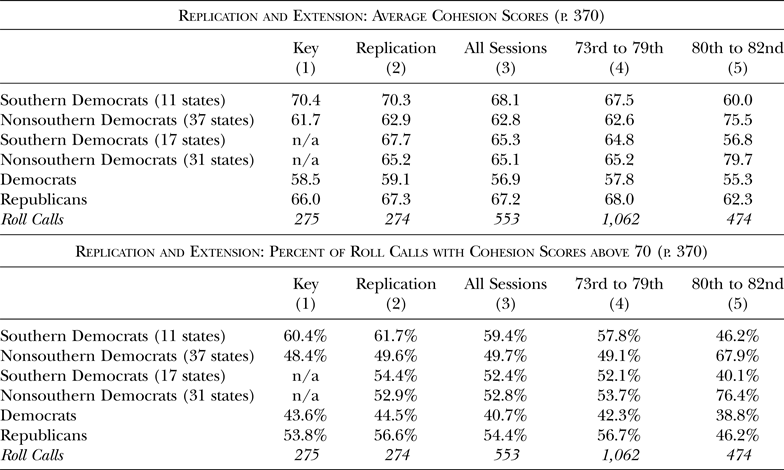
Key found that during the four House sessions he examined, southern Democrats scored highest, at a level of 70, a performance that compared with a Republican 66, and an even lower overall Democratic Party cohesion score of 59. Our replication, reported in the top section of Table 1, shows Key to have been uncannily accurate regarding the sessions he analyzed, and also puts to rest the idea that Key's data was compromised by a first-session bias.Footnote 24 Cohesion measured across all roll calls in the four congresses assayed by Key produces results nearly identical to those measured across only the first sessions. The addition of the three congresses in Key's time frame that he did not examine likewise does not substantially change his reported results. Cohesion measured across all roll calls in the four congresses assayed by Key produces results nearly identical to those measured across only the first sessions. By contrast, the temporal extension to the end of the Truman administration reveals a clear sign of change, as cohesion for the full seventeen-state South drops from approximately 65 to 57, from 68 to 62 for the Republicans, and increases dramatically from 65 to 79 for nonsouthern Democrats.
Replication and Spatial and Temporal Extensions

Column (1) reports Key's results, while column (2) reports our replication. Column (3) covers the same congresses as Key (73rd, 75th, 77th, and 79th), but includes votes across all sessions. Column (4) includes all votes in the 73–79th period, while column (5) examines all votes in the 80–82nd congresses. Roll calls with fewer than 10 percent of voting members in dissent are excluded, as are procedural votes.
Wanting to gauge regional and partisan cohesiveness from another perspective, Key calculated the percentage of votes in which southerners achieved cohesion scores of 70 and above. The bottom section of Table 1 reports our replication for the four sessions he analyzed; in addition, we offer results for a seventeen-state South. Key established that the southern bloc was the most persistently cohesive, voting above the high level above 70 more than 60 percent of the time. By contrast, Republicans did so on just 54 percent of the votes in the House, nonsouthern Democrats on 48 percent, and the Democratic Party as a whole on just 44 percent. A more complex pattern, though, comes into view when we extend the South to seventeen states. Although southerners, counted this way, continued to rank first in cohesiveness, the frequency of their high cohesion votes drops to 54 percent from 62, thus indicating intraregional heterogeneity that presses us to identify and distinguish issues on which high southern cohesion was maintained from those where it was not. Again, the temporal extension to the end of the 82nd Congress shows the clearest indication of changing voting patterns, as the percent of roll calls with high southern cohesion drops from 52 for the 73–79th to 40 for the 80–82nd congresses. Republicans show a similarly stark decline, while again the nonsouthern Democrats became more cohesive in their voting.
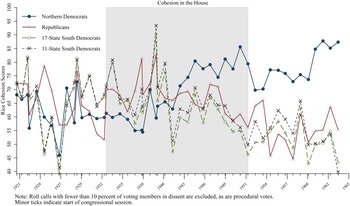
The basic patterns that we find of an initially high southern cohesion declining over time is summarized in Figure 1, which disaggregates cohesion scores by congressional session for both an eleven-state and seventeen-state South. The 1932–52 period is highlighted, but also placed in a longer historical perspective to underscore the degree to which the changes in voting that emerged in the period were of lasting significance. When viewed this way, a significant point of inflection leaps out. Measured absolutely and relatively, southern solidarity proved higher during the first New Deal Congress than at any later point during the Roosevelt and Truman presidencies, with the exception of the short second session of the 76th Congress in November 1939 when Congress voted on measures authorizing the president to restrict arms sales and enforce neutrality in response to the outbreak of war in Europe. From the start of the New Deal through to 1943 and the 77th Congress, the last considered by Key, southern members voted alike more often than nonsouthern Democrats and on par with the much reduced Republican faction.
Cohesion Scores in the House of Representatives, 1921–1965.

But a critical change set in just afterward, a difference Key's temporal span made it difficult to observe. Starting in the 78th Congress, an increasingly wide gap opened up between southern Democrats, who grew less cohesive, and nonsouthern Democrats, whose voting became more solid. These striking trends were similar both for an eleven-state and seventeen-state South, and continued well into the 1960s.
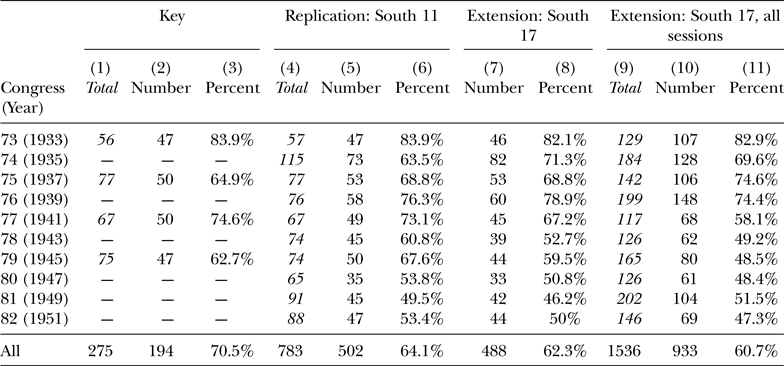
Key, of course, was interested in more than how southern cohesion compared to other partisan and regional groupings in the legislature. Above all, he wanted to identify when, and the extent to which, southerners opposed, or were opposed by, other coalitions. In Table 2 we replicate Key's report on the number of roll calls where a majority of southern Democrats opposed a majority of Republicans (columns 1–3).Footnote 25 Looking only at Key's four congresses during the first session, a large proportion of votes did pit southern Democrats against Republicans, a finding that endures when the region is expanded to the full South (columns 7–8).
Replication: Roll Calls with Majority of Southern Democrats Opposing Majority of Republicans (p. 371)

Key's scores use the first session of the73rd, 75th, 77th, and 79th congresses. Key's analysis for the 73–82nd congresses are replicated in columns (4–6). Columns (7–8) extend the analysis to the seventeen-state South, and to all sessions (9–10). Roll calls with fewer than 10 percent of voting members in dissent are excluded, as are procedural votes.
Consider, once again, the dramatic changes in roll call behavior that Key's data set could not distinguish. Table 2, column (11) highlights how opposition to Republicans from Democrats in the seventeen-state South was initially impressive, starting at 83 percent of roll calls. This level of disagreement remained high through the 76th Congress. With the 77th Congress at the start of World War II, however, this pattern began to alter, and the fraction of roll calls on which southerners voted against Republicans became much smaller, hitting a low of 47 percent in the 82nd Congress, never to return to the sharply polarized situation that had prevailed.
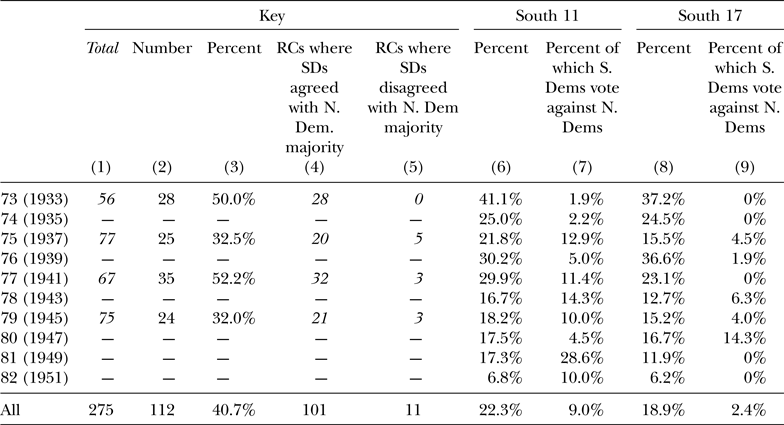
Wishing to evaluate the extent of disagreement between the southern Democrats and Republicans, Key also calculated the percentage of votes when at least 90 percent of southern Democrats voted together against a majority of Republicans; that is, votes on policies in which the South both was most cohesive and most likely to have had intense preferences. We replicate and extend his results in Table 3. With a relatively small N and a short time period being assessed, it is not surprising that Key found a significant degree of variation among the sessions he analyzed: a rate of about 32 percent in the 75th and 79th, and hovering at 50 percent and just above in the 73rd and 77th (column 3 of Table 3). He also established that even on these votes of intense disagreement with Republicans, southerners, who in the 73rd always voted with their fellow Democrats, started to oppose nonsouthern Democratic majorities in a small but not trivial number of roll calls in the other three congresses. The replication in columns (6–7) of Table 3 is based on many more votes, but the pattern largely remains as Key described it. There was a decreasing proportion of votes on which a cohesive South, either the former Confederacy or the full region, voted in opposition to Republicans; and of these, a greater number were in opposition to both Republicans and nonsouthern Democrats (columns 7 and 9).
Replication: Roll Calls with High Southern Democratic Cohesion (+90) in Opposition to Republican Majorities (p. 372)

Key's scores use the first session of the 73rd, 75th, 77th, and 79th congresses. Columns 6 and 8 shows the percent of roll calls with high southern cohesion in opposition to the majority of Republicans. Columns 7 and 9 shows the percent of these roll calls in which southern Democrats voted against the majority of nonsouthern Democrats. Roll calls with fewer than 10 percent of voting members in dissent are excluded, as are procedural votes. High southern Democratic cohesion is defined as roll calls on which less than 10 percent of southern Democrats deviated from the southern majority.
An alternative way to map potential coalitional dynamics is through the use of Rice's likeness scores.Footnote 26 Likeness scores have similar limits to cohesion scores and should not be interpreted as measures of preference convergence.Footnote 27 Moreover, because they score similarity only by calculating whether two blocs voted alike on a given measure or set of measures and do not integrate information about how other blocs voted, the scores for specific factional dyads should not be looked at in isolation from the scores for other pairings.Footnote 28 But as with cohesion scores, change in the scores over time or across issues points to potentially important developments, either in the location of the policies being voted on or in the preferences of the legislators.
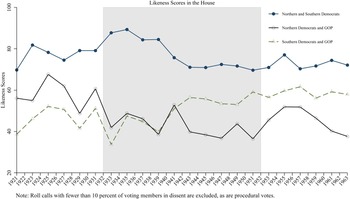
Treating Congress as a Republican, nonsouthern Democratic, and southern Democratic three-actor environment, Figure 2 traces cross-bloc likeness scores for each Congress, highlighting the New Deal to Fair Deal period, but again placing this in a longer historical context. As with measures of intrabloc cohesion, we see broadly common Democratic Party voting across regions in the early part of the New Deal.Footnote 29 In the 74th Congress (1935), southern and nonsouthern Democrats voted together with likeness scores as high as 89 and 92, respectively, for the Confederate eleven states and the Jim Crow seventeen (only the latter shown). Over the course of the two decades we examine, the Democratic Party exhibited more likeness despite regional variations than any other combination of members, but the gap between internal southern and nonsouthern similarity within the Democratic Party and the degree of likeness joining southern Democrats to Republicans narrowed very considerably.
Likeness Scores in the House of Representatives.

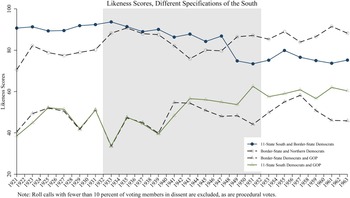
Figure 3 shows the same scores, but separates out the eleven-state South examined by Key and the six additional states that comprise the broader region. A few trends and moments of inflection are evident. Representatives in the eleven-state South had historically been very similar in their voting to the Democratic representatives of West Virginia, Kentucky, Missouri, Maryland, Oklahoma, and Delaware. This declined in the first part of the period examined here, but then dropped considerably in 1949, from a score of 87 to 75, about where it would stay for the next few decades. Nor were the representatives of the six southern states outside the Confederacy more similar to the GOP. In fact, their respective likeness scores with the GOP closely track each other until the late New Deal, at which point they diverge. Both the eleven-state South and the six states of the broader region became more like the Republican Party in their voting in 1941, but for the eleven-state South this continued to increase thereafter, while it fluctuated close to its historic levels for the representatives from the remaining six states.
Scores in the House of Representatives, Different Specifications of the South.

The above extensions invert Key's findings about relative cohesion, while allowing us to better pinpoint the likely temporal and geographic origins of the “conservative coalition” whose emergence was of particular interest to him. In so doing, these findings raise questions of considerable consequence about the substantive issues and concerns that led, simultaneously, to a diminishing southern cohesion and to an increasing nonsouthern Democratic Party unity, as well as to an increasing similarity between southerners and Republicans concentrated among a particular segment of the region.
The above replications should assuage any concerns about potential bias resulting from Key's subset of roll calls, while the temporal and geographic extensions generate additional questions about the content that underpinned the formation of congressional coalitions during the New Deal and Fair Deal. To pursue these questions, however, requires us to move beyond Key's original analysis, and in particular to turn to preference-based measures that allow us to better identify whether the changes we have seen so far were the result of changing southern policy preferences. But we proceed as we imagine Key would have, by employing measures suited to the problems of determining those issues on which southern preferences were most distinctive, and of locating the moments and issues on which the region began its historic shift.
II. Policy Content and Southern Preferences
One of the most notable features of the congressional chapters of Southern Politics is the role played by policy content. Key approached the substance of roll calls based on the structure of party and of intra- and interregional voting patterns in the House and Senate. Working inductively, he sought to identify the subject matter that was at stake for each type of roll call he analyzed, including those in which a majority of southern Democrats opposed a majority of Republicans, and those in which a southern Democratic and Republican coalition was present. He was particularly concerned to understand how and why particular policy issues induced southerners to tap into their most intense preference, what he called the “southern attitude toward the Negro [that] provides the bedrock of southern sectionalism.”Footnote 30 He also was alert to features that cross-pressured southern representatives. While acutely sensitive to emerging challenges to the racial order, these representatives were Democrats who shared with other party members a keen interest in electoral success and majority status. Additionally, their policy commitments in the main were close to those of fellow Democrats, in keeping with the core Democratic agenda that was broadly internationalist and, at home, could better deal with the widespread deprivation and poverty that gripped the South.
Despite his interest in the content of roll calls, Key discussed policy substance only with regard to a small number of votes, and his work lacked a template for the classification of policy substance. Without such a categorization, variations in regional and party behavior by the type of policy could not be identified systematically. With the book's restricted time frame, moreover, it was not possible to determine whether voting patterns with regard to a particular policy remained relatively fixed or altered over the course of the era.
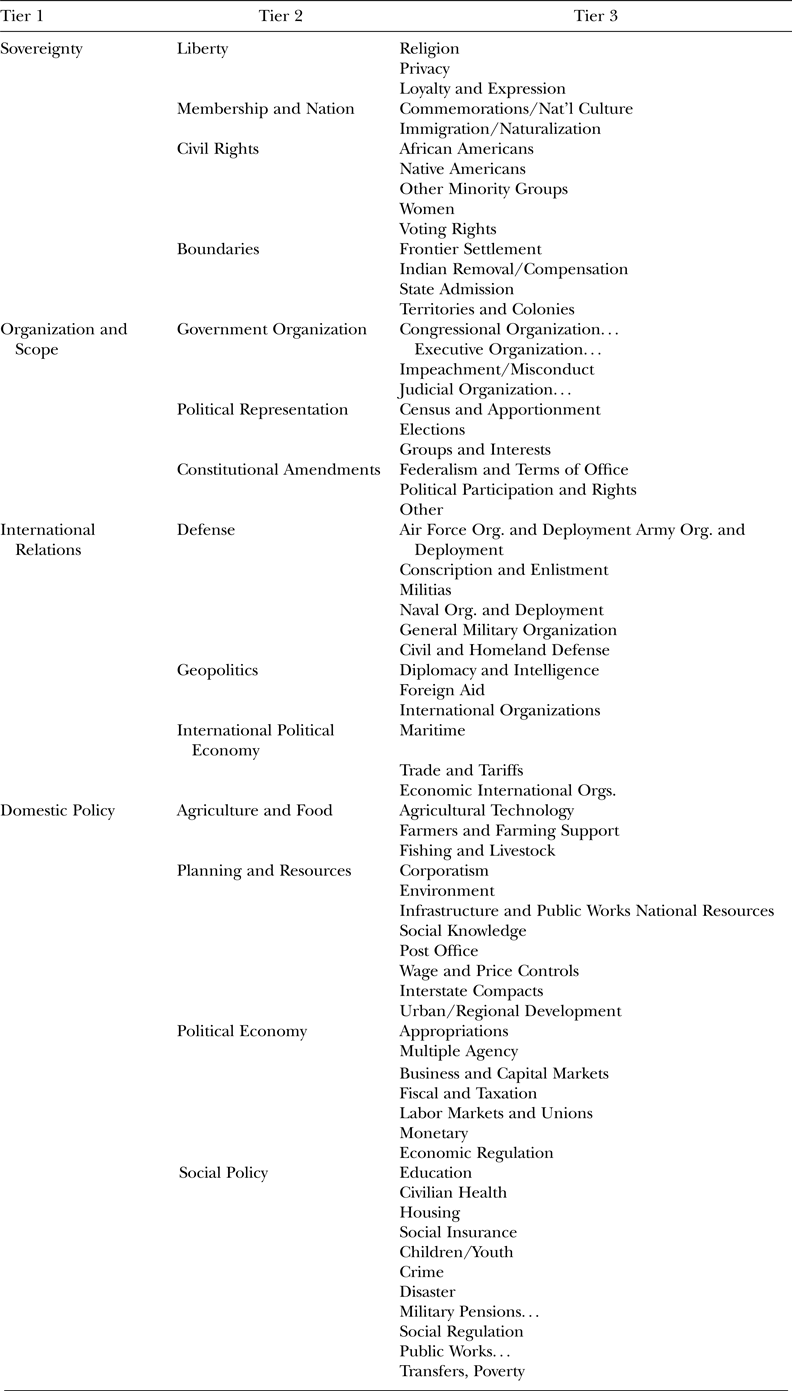
The classification scheme we employ is summarized in Table 4.Footnote 31 Tier 1 designates four basic elements common to policies in all modern states. The first category is sovereignty, the cluster of policies that bear directly on the state as a sovereign entity: the state's indivisible claim to rule legitimately over particular people and places, and thus the very existence, boundaries, and membership of the national regime. The second, organization and scope, concerns the substantive reach and range of activities and the institutional elaboration of the national government's instruments for governing. International relations refers to the geopolitical and economic transactions between the United States as a unit in the global system of states and other sovereign states, while domestic policy is the category concerned with public policies shaping both the ties between government and the economy and between government and the welfare of its citizens.
Policy Classification by Levels, Reduced

These four categories are bulky. At a second tier, these are divided into three or four “blueprint” subcategories. Thus, sovereignty in a representative democracy always entails decisions about liberty, membership and nation, civil rights, and physical boundaries. Organization and scope in such a regime is composed of decisions about constitutional amendments, government organization, and rules of political representation. International relations divide into the triad of defense, geopolitics, and international political economy, while domestic policy divides into policy judgments about agriculture and food, planning and resources, political economy, and social policy.
These distinctions still are not fine grained enough for many analytical purposes. Utilizing a detailed review of congressional committee responsibilities, budget categories, and the classifications of existing coding approaches, each second-tier category is subdivided into two to thirteen tier 3 substantive classifications intended to be mutually exclusive and comprehensive. Over time, the relative importance of policies at this level of detail varies quite a lot. The coding scheme thus provides policy classifications that can be applied to and combined at different levels of aggregation.
A finding of southern divergence on the tier 2 category of civil rights would hardly be novel. Nor was it the animating theme of Key's analysis. Key was not interested solely in whether southern members diverged from their nonsouthern copartisans on the issue of black rights, but whether the maintenance of white supremacy structured members' positions on a wider range of issues. He repeatedly raised the question of whether “the legislative record would show that southern solidarity contains elements other than a dominant attitude toward the Negro,” whether the “regional compulsion toward solidarity spreads out from the race question and induces a higher degree of solidarity on other matters than would otherwise prevail.”Footnote 32 In pursuing this question, he discovered that on specific policy issues—especially those relating to agriculture, aliens, relief, and labor—the votes of southern members diverged from their nonsouthern copartisans. And he suggested that a combination of an agrarian tilt combined with attitudes toward black Americans structured this behavior.
To push further, we examine the tier 3 issue areas that Key identified as having invoked different patterns of southern solidarity and coalition building. Key identified at least seventy-five distinct and atypical roll calls in the House and Senate. These included twenty-nine votes in which the South defected from the Democratic Party to vote with Republicans, three votes marked by notably low southern solidarity and twenty-four with especially high cohesion, and eighteen sectional votes in which the South stood alone against nonsouthern Democrats and Republicans.Footnote 33 Reclassifying these votes according to the coding scheme outlined above, Key found that southern members were most cohesive on votes about international relations and agriculture, most exceptional on votes about civil rights, and most likely to defect to the Republican position on votes about labor markets and unions. Pursuing this line of inquiry, we have examined whether these patterns hold across the full range of votes in these issue areas.Footnote 34
We subset roll calls by the different tier 1, 2, and 3 issue areas and use these to calculate quantities such as cohesion or likeness scores. Most importantly, we estimate issue-specific ideal points for each member of the House of Representatives using the item-response model model of Clinton, Jackman, and Rivers (CJR), allowing us to directly examine the degree to which preference change underlay the trends noted above.Footnote 35 We first estimate a single ideal point per member across a predefined set of roll calls, such as every roll call in a given Congress; or a subset of roll calls on a given issue, session of Congress, or across an interval of time, such as a six-month period. For each subset, a unique ideal point is estimated for every member.
But we are also interested in assessing how members' preferences changed across this period. Given that ideal points have no natural metric, we need to adjust these in order for them to be arrayed on the same dimension and made comparable across time. To do so, we rely on the technique developed by Tim Groseclose, Steven Levitt, and David Snyder (GLS) to adjust interest-group scores such as those compiled by Americans for Democratic Action. In contrast to other ideal point techniques such as DW-NOMINATE, which constrains members to a linear trend in their movements, the GLS-technique places a constraint on the aggregate chamber and allows members to move idiosyncratically over time. Crucially, this allows for inflection points in individual members' movement.Footnote 36
There is no obvious correct unit of time on which to estimate an ideal point, and most scholars estimate a score for a particular Congress. But there are limitations in doing so, most obviously that it constrains all change to that accompanying elections. Moreover, estimating Congress-level scores can also reduce the available number of roll calls. While this is not usually a problem when estimating scores across all votes, it is a problem when estimating issue-specific scores, as there will often not be a sufficient number of votes held on an issue in a given Congress to effectively discriminate between members. This problem is most acute for the fine-grained tier 2 and tier 3 categories, which are perhaps the more interesting levels of disaggregation.
We deal with both of these problems—the insufficiently fine-grained time periods generated from Congress-level scores and the occasionally insufficient number of roll calls in a given Congress for a given issue area—in the same way, by selecting units of time that will allow us to capture a sufficient number of roll calls while maximizing temporal granularity. We proceed along a few different tracks. We generate aggregate ideal-point scores across all issue areas—equivalent in this regard to the NOMINATE series—by selecting all roll calls within a six-month window. We advance this window one month at a time, so that the first set of scores covers months two to six, the second months two to seven, the third three to eight, and so on, for the entirety of the period. These scores are then adjusted using the GLS technique so that they are all on the same metric. They can be thought of as a moving snapshot centered on the date in the middle of the six-month interval.Footnote 37 This allows us to identify more temporally fine-grained changes than we would see in Congress-level or even session-level scores.
For the tier 1 and tier 2 issue-specific scores, in which the number of roll calls is a motivating concern, we adjust the range to a twelve-month or a fifty-roll-call interval in order to ensure a sufficient number of votes distributed across the policy space.Footnote 38 For the tier 3 categories, we select a series of adjacent congresses, based on the patterns discerned at the tier 1 and tier 2 levels, merge these together in an aggregated roll call matrix, and estimate a single score for this period.Footnote 39 Crucially, the patterns identified from higher-level aggregations guide our decisions about how to manage the trade-off between the need for sufficient roll calls and for scores that are rooted in discrete and relatively fine-grained periods of time. For instance, a single ideal point per member is estimated in the area of labor markets and unions from the 80th to the 82nd Congress, as well as for the period from the 70th to the 73rd Congress. But as we see evidence that an important shift in member preferences at the tier 2 level of political economy occurred sometime in the mid-1930s, we do not estimate a score that would cover the entire period, which would result in voting patterns from after the southern inflection on this issue informing the ideal points for earlier congresses, and vice versa.Footnote 40
We use these estimates to reground central themes in Key's analysis on measures that allow for a direct assessment of how members' preference changed over time: the importance of white supremacy in structuring southern preferences, on civil rights and other issues, and the importance of policy-issue substance more generally in structuring members' behaviors. We first look at the location of party and sectional medians at the aggregate level, using these to identify shifts in southern preferences. We move from these to the tier 1 and tier 2 issue areas encompassing those policy domains Key highlighted as areas in which the unique features of southern politics were most clearly expressed.
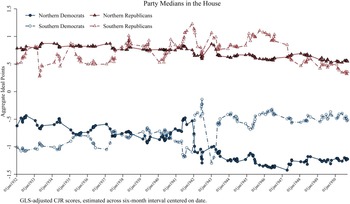
Figure 4 traces the location of the median northern Republican, southern Republican (almost exclusively from the six states of the broader region), northern Democrat, and southern Democrat. Each marker is located at the center of a six-month window, and so incorporates information from the immediate future and past. By limiting the temporal window to six months in which Congress was in session, we can better identify break points in time. The temporal inflections we saw in the cohesion and likeness scores are clearly evident in the party medians as well. While some of shifts in the location of the party medians reflect changes in the composition of Congress following elections, others do not.Footnote 41 The 77th Congress sat from January 1941 to December 1942, and during this period the southern Democrats went from the left side of the Democratic distribution—having in fact moved further away from the center than at any time since the New Deal began—to the right side. Closer inspection shows that their abrupt switch occurred in the months following December 1941 and the attack on Pearl Harbor. In the dying months of the 77th Congress, however, they once again switched locations, as debate over an anti–poll tax measure temporarily united northern Democrats and Republicans.
Location of Party and Regional Median Members, 1932–1952.

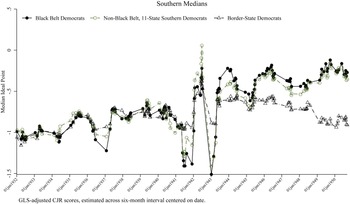
Key noted throughout Southern Politics that the Black Belt was the bedrock of southern cohesion, and the data allow us to directly compare the preferences of Democrats from the Black Belt congressional districts to those from constituencies with very few African Americans. Figure 5 traces the medians of three different blocs of southern Democratic representatives: those from congressional districts where African Americans constituted over 35 percent of the population; those where they were a smaller, usually much smaller proportion; and those from the six states of the broader region. In the early New Deal, and indeed for nearly the entirety of the period from 1877 to the New Deal (not shown), the median representatives of the different regional specifications of the South were remarkably similar. But the representatives of the six states of the full South began to diverge from their regional copartisans as the 1940s progressed. No such divergence occurred among the eleven-state representatives. What had been a coherent regional unit was, to a certain extent, fracturing.
Location of Median Members Across Southern Sub-Regions.

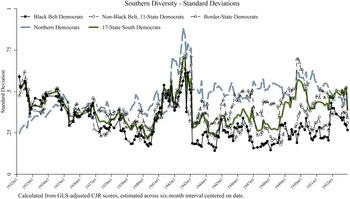
Preference-based measures such as ideal points also allow us to better assess whether the trends of a declining southern Democratic and increasing northern Democratic cohesion were the result of an increased heterogeneity of preferences, or whether the policies that were being voted on were simply more likely to divide southern representatives. One way to assess this is to look at the standard deviation of southern Democrats' ideal points: the greater the dispersion of southern preferences, the higher the standard deviation. Figure 6 traces the standard deviation for the Black Belt, the non–Black Belt in the Confederacy, and the six states of the full region. The standard deviations of the Democrats in the North and the full South are shown in the background.
Diversity in Democratic Preferences, Standard Deviations Across Regions.

Comparing Figure 1 and Figure 6, the limits of cohesion scores in measuring preference homogeneity are apparent. By the ideal-point measures, the northern Democrats became more heterogeneous in their preferences, despite their increasing cohesion, and, with the exception of the period immediately surrounding Word War II, southern Democrats remained consistently more homogenous in their preferences than their northern copartisans. And, insofar as the region's congressional representation was becoming more heterogeneous by the end of the Truman administration, this was largely a function of increasing dispersion among Democrats from the six states, and their increasing separation from the region's congressional delegation.Footnote 42
The cohesion score trends outlined above were less the result of changes to the dispersion of southern preferences than to the location of southerners relative to the broader chamber. As they moved away from their traditional position as the left wing of the Democratic Party, southern representatives were increasingly located near the median of the House. If we expect that roll calls are disproportionately intended to appeal to the median voter, then a group's being located near the median will decrease their cohesion score, as each vote will be more likely to divide them.Footnote 43 The region's representatives might have been less cohesive, in the sense that they voted together less frequently than before, but this was a function of their being pivotal on a greater range of votes.
The questions that remain, then, are on what issues were they diverging from the Democratic Party, when did these shifts occur, and to what extent and on what issues did this result in the “southern nation” becoming pivotal for the enactment of national policy? The remainder of this article disaggregates these measures by policy and period, situating the observed variation and break points in the context of the politics of the time.
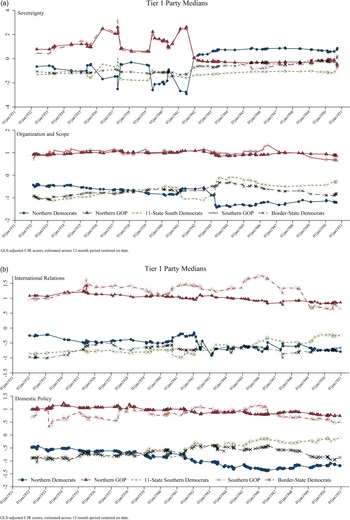
Aggregate scores mask considerable heterogeneity across issues. Figure 7 traces the party and sectional medians across the tier 1 issue areas of sovereignty, organization and scope, domestic policy, and international relations. The scores are calculated for a twelve-month window and advance one month at a time. Striking differences appear, even at the coding classification's bulkier first tier of analysis, in both the extent and timing of southern preference change. Southern members did not simply become more conservative across the board.
Location of Party and Regional Median Members, Tier 1 Issue Areas.

For one, we might have expected the coincidence of the attack on Pearl Harbor and the southern Democratic shift rightward to be the result of their supporting Republican measures in organizing the prosecution of the war. In fact, the divergence of the southern representatives from the Democratic coalition on international relations, while presaged perhaps in the late war period, becomes a clear trend only in the post–World War II years. The trend occurred in domestic policy, where the outbreak of war was accompanied by clear rightward shift. Roll calls on public works, on wage and price controls, on agriculture, on labor, and on social security saw greater similarity between Republicans and southern Democrats than between Democrats.Footnote 44 What is not shown, and which is beyond the scope of this paper, is that by the 1960s, the southern Democratic median on international relations was well to the right of the Republican median. Moreover, this rightward movement occurred first—and ultimately would be more dramatic—for the eleven-state South, although by the 1960s, the Democratic representatives of the six non-Confederate states would be to the right of the Republicans as well (not shown).
The difference in the South's rightward movement across issue areas helps explain the pattern observed in the aggregate figures, in which the South seemed to move left in 1941 before turning sharply to the right in 1942. In the two years preceding 1941, the bulk of votes had been on the tier 1 category of domestic policy (45%), and especially on the tier 2 category of political economy (13%). In the year surrounding 1941, the plurality of votes were on the tier 1 category of international relations (36%), and especially on the tier 2 category of defense, as the nation began providing for the possibility of war. Southerners strongly supported the administration. What appears to be a move to the left in fact reflects a sharp change in the agenda, one that altered the pattern of conflict.Footnote 45 This finding clearly underscores the need for more disaggregated measures.
Relative to the domestic policy and international relations measures, the ideal points estimated on the sovereignty subset of votes exhibit a jumpy quality early on, before settling into a stable pattern during and after World War II. This also is in part a reflection of the content of the agenda, as sovereignty votes in the initial period of the New Deal largely reflected the imperial and expansionist legacy of the preceding decades, while civil rights and civil liberties constituted the bulk of the sovereignty agenda thereafter. Thirty-four percent of the votes in the sovereignty category between 1932 and 1942 concerned the governing of the Philippines, Puerto Rico, the Hawaiian Isles, or American Indian communities; between 1942 and 1952 only 14 percent were concerned with these topics, while votes concerning civil rights had gone from 9 percent to 32 percent, and civil liberties from 11 percent to 48 percent.Footnote 46
But what is most important to note is the dramatic transformation on this issue, largely a function of the increased prominence on the agenda of civil rights for African Americans and civil liberties for various categories of Americans during the war. Civil rights first appears as an issue voted on during this period in the 75th Congress, after having been largely kept off the House agenda since the 67th Congress, when through December and January of 1921–22 the House debated and voted on an antilynching bill. When antilynching legislation was next considered by the 75th Congress, a sectional rift, already somewhat apparent in 1921–22, had opened up.Footnote 47 The South was prepared to stand alone when federal action to secure black rights was concerned, and as we shall see, increasingly stood with the Republican Party when civil liberties were at stake.
What we have observed at the tier 1 categories are different patterns by which the South diverged from the Democratic Party. They broke sharply with their historic role as the left wing of the coalition with the outbreak of war, a trend first evident in domestic policy. Only later did they begin to engage in cross-party voting on the issue of international relations. And while the full region, as well as the more confined subset analyzed by Key, diverged on domestic policy during wartime, only this more condensed region—where the vast majority of southern blacks also lived—continued on this trajectory for the next several decades.
The tier 2 categories allow us to more closely explore which issues in particular were accompanied by early and/or more complete southern divergence. Figure 8 unpacks the Tier 1 categories international relations and domestic policy, tracing the party and sectional medians for the tier 2 issue areas of defense, geopolitics, agriculture, planning and resources, political economy, and social policy. On defense votes, of which there were relatively few before hostilities began in 1939, there does not seem to be any evidence of a conservative coalition forming. On geopolitics votes, a category that includes foreign aid, the eleven-state South began diverging from the Democratic mainstream in 1943–44, and continued on this trajectory over the next few decades. On this issue—which included votes on the provision of relief to war-devastated countries and the prohibition of funds to countries dominated by the Soviet Union—eleven-state southerners began voting more clearly with the Republicans, and were largely unaccompanied by the Democratic representatives of the broader region.
Location of Party and Regional Median Members, Selected Tier 2 Issue Areas.

As with defense, there was no conservative coalition on agricultural policy, and the median preferences of the different factions of the Democratic Party were all relatively similar. In fact, on this issue the northern Democrats tended to be closer to the Republicans than their southern copartisans, and the end of the period saw a distribution of party and sectional medians not unlike that which had opened the period. The distinctive agrarian bent of southern representatives noted by Key worked against an alliance with the Republicans. But in the tier 2 domestic policy categories of planning and resources, political economy, and social policy there was a clear break toward the right before and in the early years of the war, one that occurred to varying degrees and longevity both in the eleven states of the Confederacy and across the full region. The northern and southern Democrats had switched places on political economy by mid-1935, occurring just as the Senate fought over whether to take up the antilynching legislation introduced by Democratic senators Edward Costigan (D-CO) and Robert Wagner (D-NY). They would split further in the 75th Congress of 1937–38 and after northern Democratic losses in the elections of 1938.Footnote 48 On some issues, these divergences in the Democratic coalition were nearly as much a result of the northern Democrats moving to the left, but for the most part the southern movement was more dramatic and began earlier than that of the nonsouthern Democrats.Footnote 49
Examining preferences at the tier 3 level is more difficult than for the aggregated tiers, as the relative sparseness of the roll call record requires a starker trade-off with temporal specificity in order to have sufficient votes to discriminate between members. We look more closely at tier 3 preferences in Section III, aggregating across congresses based on the temporal inflections identified here. But we can get a sense of the specific policy debates and legislative coalitions associated with these changes by examining issue-specific likeness scores for the three main blocs.Footnote 50
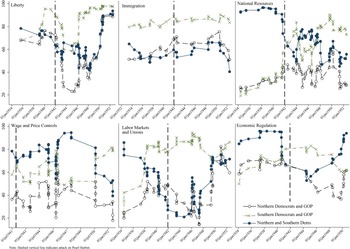
Figure 9 traces a set of six-vote moving average likeness scores from the 73rd to the 82nd Congress, with a dotted vertical line marking the attack on Pearl Harbor. Six tier 3 issue areas have been selected in which the voting showed a clear divergence of the South from the Democratic mainstream.Footnote 51 The policy areas associated with the tier 1 category of sovereignty showed the clearest sign of southern divergence from the Democratic Party, and the earliest splits in the party occurred in the tier 3 categories of African American civil rights—including voting rights (not shown)—immigration, and liberty.Footnote 52 Key had identified southern uneasiness about immigration as a possible source of defection from the Democratic Party, and our data bear out this hunch. Here a conservative coalition had formed in the early New Deal years.
Party and Regional Likeness Scores, Selected Tier 3 Issue Areas.

By 1938, such a coalition was evident on liberty issues as well. Citing Nazi summer camps and Communist organizing in New York City, and the recent painting of Plymouth Rock red, Martin Dies and other southern Democrats successfully urged the House to establish the House Committee on Un-American Activities on May 26, 1938. Over the next several years, southerners and Republicans would unite on a series of votes buttressing the committee.Footnote 53 In the area of national resources, which included policies such as enabling and regulating the requisition of property for prosecution of the war and later the reconversion of federal programs and property to peacetime, the impact of the war is immediately apparent. Wage and price controls appeared on the congressional agenda in June 1941, and then again more prominently in 1945–46, and were likewise an issue on which a conservative voting coalition was often apparent, although less so than the other issues examined here. Southern Democrats and Republicans joined on economic regulation votes during the war on issues such as affirming the intent of Congress that regulation of the insurance industry should stay under state control.
But it is on the issue of labor markets and unions that the South first and most dramatically diverged on domestic, nonsovereignty, policy. From the wave of “sit-down” strikes in 1936–37, the South had begun voting more and more with Republicans on labor issues. Throughout the 1940s, as Key anticipated, the likeness of southern Democrats and Republicans became dramatically and consistently higher than any other pairing. Southerners and Republicans sought to amend the Fair Labor Standards Act (whose passage had come only after more than a year of bitter fights in and outside of Congress), investigate the National Labor Relations Board, and compel arbitration by the Conciliation and Mediation Boards of labor disputes during the war.Footnote 54
The analysis of roll calls, if anything, understates the importance of southern opposition to New Deal labor legislation. Southern influence upstream in the legislative process was used not only to block further liberal policies but to advance conservative ones, on labor policy as well as on wage and price controls, farm policy, and taxation measures.Footnote 55 It was a coalition of Republicans and southern Democrats on the House Rules Committee that refused to report the Fair Labor Standards bill until a discharge petition had secured the needed 218 signatures. And only four days later, on December 17, 1937, 74 percent of southern Democrats and 93 percent of Republicans voted against three-quarters of nonsouthern Democrats to return the bill to the Labor Committee. Southern diversity was also revealed on this issue, at least at this juncture. Senator Hugo Black of Alabama was the sponsor of the bill in the Senate, and had initially proposed that businesses accept a thirty-hour workweek. And, after the bill's seeming demise in December, momentum was renewed with the primary election victories of Lister Hill and Claude Pepper in Alabama and Florida over two anti-New Deal opponents, with an opinion poll suggesting that a plurality of white southerners supported the bill. After a meeting in the White House, the Southeastern (later Southern, with the admission of Arkansas, Oklahoma, and Texas) Governors Conference announced their support for the bill.Footnote 56 But, for the most part, southern representatives protested the bill as undermining southern industry, because it required wages that could not be reasonably afforded by businesses in the region.Footnote 57
This southern conservatism on issues related to labor standards and organizing—and it was especially on issues relating to unions that the conservative coalition in voting appeared—radiated out to other issues that at first glance did not have an obvious connection. For instance, while Nazism had been central to Dies's defense of the House Committee on Un-American Activities, he moved quickly to direct the committee's attentions to the involvement of Communists in government agencies such as the Federal Theater Project and in the growing labor movement. Both contemporaneous and recent histories have shown that the conservative coalition supporting the Dies Committee—both in congressional voting and in committee activities—was organized around a concern with organized labor and the Congress of Industrial Organizations in particular.Footnote 58 Similarly, a conservative coalition first appeared around the issue of national resources on a bill prohibiting strikes, lockouts, or work stoppages in factories or mines used or operated by the United States for the prosecution of the war. This bill was opposed by nonsouthern Democrats and vetoed by the president, but the veto was overturned by southern Democratic and Republican votes.Footnote 59
The split in the Democratic Party opened up over specific policy proposals, reinforced by successive congressional elections. But the temporal ordering of these divisions was not an accident of the agenda. The differences between the party's regional wings emerged as national policy began to enter into policy domains formerly the prerogative of the states. Perhaps more important, the differences emerged as the positions taken by the swelling contingent of liberal northern Democrats, and the militant labor organizations from which they increasingly drew support, made it clear to the southern political elite that they could no longer rely on their copartisans to support them in their paramount policy concern.
After the elections of 1932, Senator Carter Glass worried that “the victory Tuesday was almost too overwhelming to be safe,” and a few years later noted that the “blue eagle [of the National Recovery Administration] was fast becoming a bird of prey,” a “black buzzard.”Footnote 60 The formation of the Southern Tenants Farmers Union in response to the Agricultural Adjustment Act, the CIO's decision to send organizers to build unions in southern factories, and the successes of the “sit-down” strikes in the North for union membership drives greatly heightened the anxieties of the southern political leadership, while the reaction against labor unions in national (and especially southern) public opinion encouraged them to break with an otherwise popular administration.Footnote 61 The CIO, moreover, was treading on ground that the AFL had long abandoned, supporting biracial unions and explicit organizing appeals to black workers. The first constitutional convention of the CIO in 1938 unanimously endorsed a resolution from a white unionist from Birmingham to work for the abolition of the poll tax, needed to gain the “aid and active support of the Negro people” and “the only guarantee of the continued existence and progress of the CIO in the South.”Footnote 62 It was on those issues most implicated in the threat posed by union organizing and federal labor reform—white supremacy and the region's low-wage economy—that southern representatives began to break with their copartisans.Footnote 63
Even a first cut through this descriptive data demonstrates how the substance of policy maps onto the types of coalitions that formed and identifies turning points when coalitional patterns altered with regard to distinctive policies. The analysis also invites us to examine in closer detail which policy areas were most implicated in the maintenance of white supremacy, and the consequences of these issue-specific shifts in southern representatives' preferences on lawmaking and the creation of the postwar policy regime.
III. The Pivotal South
A comparison of the 73rd and the 81st congresses, effectively bookmarking the New and Fair Deal period, allows us to look more closely at some of the trends noted above. The first question, one central to Key's project, is the degree to which southern anxiety over the preservation of its racial hierarchy structured attitudes on other issues as well. Key of course identified the Black Belt—those counties where African Americans constituted more than 35 percent of the population—as the bedrock of southern politics. While Key argued that many of the differences between the Black Belt and non–Black Belt were submerged in Congress, it is not unreasonable to expect that ideal points across different issues might nonetheless vary across this divide.
We examine the effect of three different regional groupings on member preferences: the six states of the broader South, the thirty-odd representatives of the Black Belt, and the seventy or so representatives from the non–Black Belt eleven-state South.Footnote 64 We limit the analysis to Democrats, and report the conditional marginal effect on a member's ideal point of being from one region rather than another.Footnote 65 This is the effect relative to the ideal point of nonsouthern Democrats. We are interested in two differences, that between nonsouthern Democrats and their copartisans across the South's racial geography, and that between southern Democrats in and outside the Black Belt.
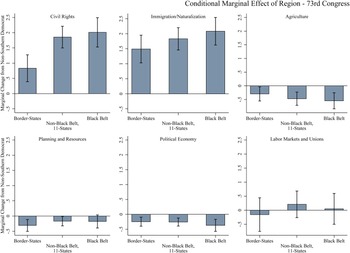
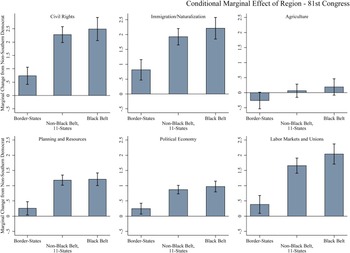
Figure 10 shows the marginal effects of different regional specifications on member ideal points for six tier 2 and tier 3 issue areas for the 73rd Congress.Footnote 66 With the exception of civil rights and immigration, southern representatives were consistently more liberal in this period than their northern copartisans. But only on civil rights was there any significant difference between the different regions of the South, and here there was no difference between the representatives of the Black Belt and other members of Congress from the former Confederacy. By the 81st Congress (Figure 11), however, the situation is quite different. On civil rights the difference between the eleven-state South and the full region had grown wider, while the smaller difference between Black Belt and non–Black Belt representatives, reflecting a series of votes on the poll tax, is statistically significant. It is worth noting, however, that while some southerners from the broader region were willing to enact antilynching legislation or a ban on the poll tax for federal office holding, not one congressional Democrat from any of the seventeen states publically opposed segregation.Footnote 67
Conditional Marginal Effect of Region on Ideal Point Relative to Mean Northern-Democrat, 73rd Congress.

Conditional Marginal Effect of Region on Ideal Point Relative to Mean Northern-Democrat, 81st Congress.

The difference among eleven-state southern representatives across the region's racial geography is also significant for labor policy: while almost all representatives from the eleven-state South were further to the right than the mean northern Democrat, this shift was especially pronounced among the representatives of the Black Belt. And across all of these issues except agriculture, where we again note the absence of any conservative tendency among southerners, the consistent effect of being from the eleven-state South and especially from the Black Belt was to push Democratic members toward the Republican Party. Different specifications of the analysis consistently show the same result. At both the beginning and end of the period, there was a clear relationship between representing a Black Belt congressional district and being further right on civil rights and immigration, whether looking at the full region or just the eleven states of the Confederacy. By the end of the period, however, this pattern had extended to labor policy, concerns over which—as we have seen—were implicated in a variety of other issue areas, and the eleven-state South had broken away on a range of domestic policy issues.
A relationship between the Black Belt and conservative policy positions had clearly emerged by the 81st Congress. This occurred just as the South was becoming the pivotal bloc in the House of Representatives, and on those issues where the influence that accompanies their holding the veto location was greatest. One advantage of the Bayesian IRT model used to estimate issue-specific scores is that they allow for a very straightforward identification of the location of the median member of the chamber, as well as the probability that a given member or a bloc of members will be located in the median position.Footnote 68 Figure 12 reports the proportion of times that the median member of the 73rd House of Representatives belonged to different regional and partisan blocs, across different tier 2 and 3 issue areas.
Probability of Issue-Specific Median Member Across Region and Party, 73rd Congress.

With the massive Democratic majorities of the 73rd House—approximately 73 percent of the seats were held by Democrats, as were 150 of the 152 seats in the South (35% of the chamber)—the South was potentially more important than they had been since the Wilson administration. Still, on most issues, it was northern Democrats who were most likely to be the pivotal bloc in the House. In the issue areas of geopolitics, agriculture, planning and resources, political economy, and labor markets and unions, the probability that the median member would be a nonsouthern Democrat was 56, 64, 54, 66, and 38 percent, respectively. Only on labor markets and unions did the South pull close to parity.
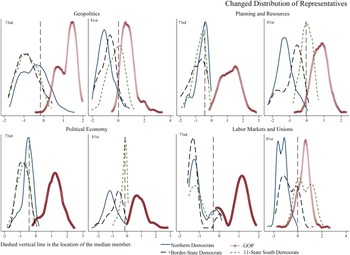
At least in the early stages of the New Deal, however, this heightened influence of the northern wing of the party was not particularly threatening, as across a range of issues the different factions had a remarkably similar distribution of preferences. Figure 13 plots the distribution of members' preferences for four tier 2 and tier 3 issue areas, for both the 73rd and 81st Congress.Footnote 69 In each, the different segments of the South had broadly similar preferences to nonsouthern Democrats. But in each, this had changed considerably by the 81st Congress, with the South—and especially the representatives of the former Confederacy—moving toward the right.Footnote 70
Changed Distribution of Preferences from 73rd to 81st Congress, Selected Tier 2 and 3 Issue Areas.

The 81st was a critical congress for many reasons. Elected in 1948 to follow the Republican congress that had challenged New Deal arrangements, it returned the country to unified government following the surprising victory of Harry Truman on a strong liberal Fair Deal platform. The election campaign had seen the adoption of a civil rights plank at the Democratic Party convention, the Dixiecrat revolt that produced the States Rights presidential ticket led by Strom Thurmond, as well as President Truman's Executive Order desegregating the military and his decision to campaign in Harlem. It also marked a historical moment when, as the section's leading journalist, John Temple Graves observed, “the balance of political power in the 80th and 81st Congress has belonged to the South.”Footnote 71
But the change in southern preferences that had placed the balance of power in the South's hands—the separation of the eleven-state from the seventeen-state South, and the divergence of both from the Democratic mainstream—was not equally important on all issues. This is supported by the patterns in Figure 14, which shows that southerners were now especially likely to be pivotal in matters of political economy and planning and resources, with a clear potential for a conservative coalition on labor. The region's influence over policy, accordingly, seems likely to have varied considerably across issue domains.Footnote 72 That southern representatives played an important role in shaping the New Deal and postwar policy regime is perhaps well recognized, but as yet we do not have a strong sense of how this role might have varied—either in the influence they exercised or in the forms of policy they were willing to support—across issue areas.
Probability of Issue-Specific Median Member Across Region and Party, 73rd Congress.

These results beckon us to follow Key's example of state-by-state analysis, and the close policy-by-policy analysis found in the congressional scholarship of Richard Bensel and Elizabeth Sanders.Footnote 73 Following their lead, we are particularly keen to pursue areas marked by unusual policy voting. Overall, we wish to understand better David Truman's finding, noted with regard to the Senate, that “collective dissent from the majority, as distinguished from random individual deviation, was a peculiarly Southern characteristic and one not confined to matters of race.”Footnote 74
IV. Beyond Southern Politics: The South in American Political Development
In Southern Politics, Key recognized that the hub of the relationship between southern and national politics lies in Congress, at the point where constituency representation and national participation join. And yet neither historians nor political scientists have sufficiently integrated the South into the larger American experience, despite a growing recognition that much in American political development cannot be adequately mapped and explained without a close attention to the influence of southern politics in both state and nation.
The recognition of the region's centrality to congressional politics is especially important in light of the turn toward history undertaken by scholars of Congress, as scholars seek to better understand institutional development and better test—with a longer time horizon—models of legislative behavior and output. Keith Poole and Howard Rosenthal, for instance, have noted the region's importance in understanding polarization and congressional politics, advising scholars to consider the “period from the late New Deal until the mid-1970s” as constituting the “only genuine three-political-party system in American history,” with the southern Democrats constituting an entirely distinct party from the nonsouthern Democrats.Footnote 75
Their admonition to treat the South as a distinctive region in congressional politics for an extended period in the twentieth century is fundamentally correct; but it is also only a beginning, and the broader set of issues upon which the supposedly solid South cohered and broke apart remains poorly understood. This deficiency limits our analyses of polarization over time or of the “end of Southern exceptionalism,” and potentially biases empirical models of lawmaking that treat the region's representatives as being arrayed on the same dimension as nonsouthern Democrats and Republican, or that treat NOMINATE's second dimension as relevant only on votes pertaining to civil rights.Footnote 76 It is crucial to “separate out the South” in historical analyses of Congress; but to do so in a way that is sensitive to changing patterns of southern behavior requires understanding how the substance of representation structured the willingness of southern members of Congress to engage in coalitional politics with their partisan adversaries and copartisans. The divergences we document here—of the South from the Democratic mainstream, and of the different regional groupings within the South—began at different times for different issues, highlighting the importance of a substantive understanding of the particular historical context in which these shifts occurred. But on many issues the South continued to vote with the broader Democratic coalition, and unless variation in southern preferences is taken into account, we risk getting the story wrong or misestimating our models of polarization and lawmaking.
Following Key's insight, this article and the larger project in which it is embedded seek to bring the South from the periphery to the center by emphasizing the region's role in Congress and by exploring the sources of regional unity and fragmentation. Our replication of Key's analyses demonstrates that his findings still hold, under more demanding specification and with more data than he had available. But we also demonstrate the importance of disaggregating across issue areas, raising further questions about the origins, content, and character of member preferences, and especially the role played by the distinctiveness of southern preferences in accounting for legislative behavior and outcomes. Over the course of the period examined here, southern Democratic representatives began to break with longstanding partisan commitments, and by the 78th Congress they had begun to move away from their long-held position anchoring the pole opposite the Republican Party. But this change did not occur simultaneously across policy areas or equally across the region's racial geography. It occurred earlier and was considerably more marked on some issues than others. Our findings also suggest the importance of another dynamic, one that was by no means distinct from the South's changing preferences: an increasingly cohesive and forceful left-wing nonsouthern Democratic Party. We do not believe these dynamics were unrelated.
Southern members of Congress, flanked by regional apartheid and an increasingly robust national liberalism, were far more intensely concerned with, and united about, the race question than virtually any other actors on the national political scene. Despite an overarching national indifference that set black rights aside or found ways to manage racial tensions during periods of great stress, southern fears that potentially effective external pressure might be brought to bear were not easily allayed. The result was a persistent southern exaggeration of threat, or so we believe to have been the case.Footnote 77 “Ironically,” David Brion Davis observed about antebellum America, “by continually overreacting to a somewhat neutral, complacent, and racist North, Southern militants created an antislavery North.”Footnote 78 Likewise, southern fearfulness ultimately made it impossible for Jim Crow and massive southern influence over most spheres of national public policy to persist. But in making that claim, we are moving well beyond the bounds of this article.