

1 Introduction
Independent regulatory commissions or agencies (IRCs) conduct rulemaking without the same level of oversight as executive branch agencies. IRCs are not subject to the rulemaking requirements established under Executive Order 12866 (and subsequently, Executive Orders 13563 and 13771), and the Office of Information and Regulatory Affairs (OIRA) does not review their regulatory analyses. However, the lack of OIRA oversight does not necessarily mean that independent agencies forego benefit-cost analysis (BCA) of their regulations completely. The Consumer Product Safety Commission (CPSC), for example, is obligated to conduct BCA under several of the statutes it administers. More specifically, under Section 9 of the Consumer Product Safety Act (1972),
“The Commission shall not promulgate a consumer product safety rule unless it has prepared, a final regulatory analysis of the rule containing … [a] description of the potential benefits and potential costs of the rule … and … shall not promulgate a consumer product safety rule unless it finds that the benefits expected from the rule bear a reasonable relationship to its costs.”
However, IRCs like the CPSC typically have much more discretion in choosing when to perform BCA as well as in the level of quality or complexity of the analyses that they conduct.
Previous studies analyzing the regulatory analysis practices of IRCs tend to focus on the quality of the analyses, to the extent that the agencies choose to conduct them. Copeland (Reference Copeland2013) reviews the analytical practices across independent agencies, and finds that they seldom quantify benefits and tend to focus on recordkeeping and paperwork costs, perhaps because many of their rules are predominantly paperwork-related. Fraas and Lutter (Reference Fraas and Lutter2011) examine broadly the analyses conducted at IRCs and compare them to the analyses of executive branch agencies, finding that the relative quality of the analyses prepared by IRCs is lower. They suggest that the higher quality analyses produced by executive branch agencies could reflect that centralized review (by OIRA under various executive orders) has resulted in improved regulatory analysis. Other studies review the analyses conducted at a single IRC in support of a specific rule. Schwartz and Nelson (Reference Schwartz and Nelson2016) critique the analysis conducted by the Securities and Exchange Commission in support of its Conflict Minerals Rule. Due to numerous inaccuracies and poorly based assumptions, they call into question the validity of the analysis as well as the whole approach of regulatory BCA in general. White (Reference White2016) also finds the Conflict Minerals Rule analysis flawed, but believes those flaws are specific to the procedures the agency followed, rather than due to limitations of the method of BCA.
In this study, I examine the regulatory analysis practices of the CPSC and how those practices changed when new legislation, the Consumer Product Safety Improvement Act (CPSIA), relaxed its statutory obligations to conduct regulatory BCA. When given discretion, the agency chose not to engage in the practice despite its years of institutional experience in conducting BCA and a historical reliance on BCA as a key input to decision making (Copeland, Reference Copeland2013, p. 109). The CPSIA not only relaxed BCA requirements, but also increased the agency’s rulemaking responsibilities and posed tight regulatory deadlines. In responses to public comments questioning the agency’s decision not to conduct BCA for CPSIA rules, the agency has provided its rationale:
“The CPSC did not conduct a cost-benefit analysis for the frame child carrier rule because the rule is being promulgated under the requirements of section 104 of the CPSIA, which does not require a cost-benefit analysis.” (CPSC, 2015, p. 11115)
And, in justifying its decision to forego BCA in its Testing and Certification rule (discussed below), the agency notes:
“by allowing … expedited rulemaking, Congress made it clear that it did not want the Commission engaging in any unnecessary delay in promulgating this rule.” (CPSC, 2011b, p. 69484)
Thus, the agency interpreted the legislative direction as meaning that regulatory BCA was not only unnecessary because it was not required, but also at odds with meeting the timeframes for completing the various rulemakings required by the law. In light of these views, the CPSC chose not to conduct regulatory BCA for any of the CPSIA rules.
The omission of BCA as an input to the regulatory process represents an important departure from CPSC’s historical practices. In contrast to the typical rule CPSC had supported with regulatory BCA, many of the CPSIA rules were projected to impose high burdens and have significant economic impacts. Moreover, for reasons discussed below, it is questionable whether the CPSIA rules yield much in terms of benefits in the form of improvements in product safety. Thus, the CPSIA appears to have prompted changes in CPSC’s regulatory portfolio that the agency would have been unlikely to pursue under a BCA-based regime, since the agency would not have been able to make the necessary BCA findings.
The CPSIA outcomes are illustrative of the substantive contribution of BCA to CPSC’s regulatory decisions, and they provide insights regarding the relative efficacy of alternative measures that have been proposed to prompt other IRCs to use BCA more consistently. For example, Copeland recommends that IRCs voluntarily adopt such practices as those covered in the Office of Management and Budget’s Circular A-4, and that these efforts be coupled with additional funding and other resources. However, CPSC’s case suggests that efforts directed solely at increasing IRC analytical capacity might not be sufficient, since the CPSC already had the needed institutional capacity and experience to conduct BCA as part of the CPSIA rulemaking process. IRCs like all regulatory agencies operate in a complex environment and must balance a variety of interests. One key external influence is the direction the agencies receive from Congress, which can, at times, involve mandates to pursue regulatory activities difficult to support with benefit-cost findings. In fact, when the need to regulate perceived as urgent due to the occurrence of a high-profile event, as was true with circumstances surrounding the CPSIA, the risk for Congress to give agencies such direction is increased. In this environment, it is not too surprising that an agency might view the efforts needed to conduct a BCA as at odds with goals of fulfilling its statutory obligations expediently. CPSC’s experience both highlights how external factors can create an incentive for IRCs to choose analytical shortcuts, and exemplifies the substantive role that Congress plays in regulatory decisions, not just for IRCs but regulatory agencies in general.
The rest of this paper is organized as follows. Section II describes the legal framework guiding CPSC regulation prior to the passage of the CPSIA. Section III overviews the key aspects of the CPSIA that changed regulatory practices at the agency. Section IV details specific rules promulgated under the CPSIA and provides evidence that the agency probably would not have been able to support most of the CPSIA rules with favorable benefit-cost findings. Given that CPSC’s stated purpose for omitting regulatory BCA was to ensure rulemaking proceeded without delay under the CPSIA, Section V discusses the extent to which CPSC has achieved this goal. Finally, Section VI provides concluding remarks and discusses the implications of CPSC’s experience for other IRCs and policy settings.
2 Regulation and the CPSC
The Consumer Product Safety Act (CPSA) established CPSC as an agency in 1972. The agency has five commissioners, one of whom serves as the chairman.Footnote 1 CPSC’s mission is to protect “the public against unreasonable risks of injury from consumer products” (see CPSC, 2011c, p. 4). The agency has jurisdiction over many thousands of types of consumer products, including children’s toys and electrical appliances used in homes among numerous others. In addition to the CPSA, CPSC regulates primarily under three other major statutes: (i) the Flammable Fabrics Act, under which CPSC sets flammability standards for clothing, upholstery, and other fabrics; (ii) the Federal Hazardous Substances Act, which authorizes CPSC to ban or regulate products containing substances that are toxic, corrosive, combustible, or otherwise hazardous; and (iii) the Poison Prevention Packaging Act (PPPA), which allows CPSC to require that certain household substances be packaged in containers that are difficult for children under the age of five to open.Footnote 2
In the process of developing standards or issuing bans under the CPSA, Federal Hazardous Substances Act, or Flammable Fabrics Act, the CPSC must conduct analysis of benefits and costs, and make certain findings, such as: (i) a rule is reasonably necessary to eliminate or reduce an unreasonable risk of injury; (ii) the relationship between benefits and costs are reasonable; and (iii) the regulation imposes the least burdensome alternative that would adequately reduce product risks. BCA is not required for rules promulgated under the PPPA, but the PPPA does not prohibit consideration of benefits and costs as a rulemaking criterion. Examination of the most recent PPPA rulemakings, covering the years 1995 through 2012, indicates that the CPSC does not conduct BCA for these rules.Footnote 3 Given these requirements and that PPPA rules are fairly infrequent, it is fair to say that the agency conducted regulatory BCA for “most rules prior to 2008” (see Copeland, Reference Copeland2013, p. 100).
In 2008, Congress passed the CPSIA,Footnote 4 primarily in reaction to a series of highly publicized recalls of toys imported from China, which contained higher than legally permissible levels of lead (Story & Barbozaaug, Reference Story and Barbozaaug2007). The sheer number of recalls (and number of items recalled) was much larger than for any previous year. As Freedman, et al. (Reference Freedman, Kearney and Lederman2012) note, the number of CPSC recalls for toys and other children’s products was 212 in 2007; in 2006, the number was 152 and in 2005, the number was 171. According to Durrett (Reference Durrett2015), the recalls covered 43 million units of children’s products in 2007 and 19 million and 28 million units of children’s products in 2006 and 2005, respectively.Footnote 5 The lead problem had been detected as part of normal and routine product testing procedures conducted by manufacturers, and had been traced to manufacturers in China. There were no reports or documented cases of harm to any children or other consumers (USA Today, 2007). In fact, many of the affected products never made it into the hands of consumers because they were pulled from the shelves of retailers or even earlier in the distribution chain.
The removal of large amounts of contaminated product prior to consumer purchase and the lack of injury suggests that some safeguards were already in place to prevent harm to consumers due to defective products inadvertently introduced into the marketplace. In addition, the Freedman study cited above provides statistical evidence that consumers responded to these recalls vigorously and substituted away from the specific toys involved. The Freedman study also shows that consumers reacted by reducing their overall toy purchases in the following months, and that stock market data suggest that the toy industry overall experienced a loss in value. Thus, market forces addressed the problem underlying the 2007 toy recalls at least to some degree. In fact, due to a lack of information regarding or confidence in the safety of toys remaining in the market, consumers reduced their consumption of untainted products, and producers experienced impacts beyond the extent of the problem.
Nonetheless, Congress reacted swiftly and passed the CPSIA within months of the recalls, following a “Catastrophe Model” much like the model of risk regulation that Pogue (Reference Pogue2007) uses to analyze congressional response to the Three Mile Island and Love Canal incidents.Footnote 6 While the 2007 toy recalls do not compare to events like Three Mile Island and Love Canal in terms of their consequences, Congress reacted to the recall crisis analogously and passed aggressive legislation mandating that CPSC engage in a series of rulemakings. As Ellig and Horney (Reference Ellig and Horney2016) observe, legislation adopted reactively to high-profile events tends not to consider the scope of the hazard, alternative approaches to addressing the hazard, or how benefits compare to the costs of regulation. When legislation is hastily crafted, any resulting regulatory outcomes are at high risk for generating unintended consequences and more importantly, completely missing the mark in terms of addressing the problem that created the catastrophe in the first place. For executive branch agencies, Executive Order 12866 requirements and OIRA review can serve to reveal when legislatively mandated regulation is costly or expected to yield low net benefits. But for IRCs, backstop measures to assess rationality in regulatory response to hazards do not necessarily exist.
The CPSIA influenced the direction of CPSC regulatory activity profoundly. Prior to the CPSIA, the agency engaged predominantly in discretionary rulemaking under the various broad statutes it administers. Under the CPSIA, the CPSC shifted focus from pursuing risk policies that have favorable benefit-cost relationships to fulfilling CPSIA mandates, which often are costly and in many cases, appear likely to yield very little in terms of benefits, particularly benefits in terms of improved product safety.Footnote 7 The shift in focus represents a path that the CPSC would have unlikely chosen in the absence of congressional intervention, because the agency would not have been able to make BCA findings, which are required by most of the major statutes it administers.Footnote 8
3 Elements of the CPSIA
As Flaherty notes, the CPSIA amended primarily the CPSA, but also affected rulemaking procedures under the Federal Hazardous Substances Act and Flammable Fabrics Act by making the advance notice of proposed rulemaking (ANPRM) stage of rulemaking under the three statutes optional. The CPSIA brought many other changes to the agency. It increased the agency’s funding and expanded staffing levels. The dollar amounts that the CPSC can impose as civil penalties for violating a standard are higher under the CPSIA, and the agency has a much broader recall authority. While these changes affected overall agency operations and procedures considerably, I focus on the changes that most influenced CPSC regulatory processes and on those CPSIA regulations most salient in terms of potential economic consequences.
Children’s products, defined as consumer products “designed or intended primarily for children 12 years of age or younger,” were most affected by the law. The CPSIA included provisions requiring more stringent limits for lead and banned certain phthalates in children’s products, and it directed CPSC to issue safety regulations related to the mechanical aspects of infant and toddler products. The law also mandated third-party testing by a CPSC-accredited laboratory to assure compliance with the new and stricter lead limits and phthalates bans as well as any applicable CPSC product safety standard. Based upon this third-party testing, manufacturers or importers of children’s products must issue a certificate certifying compliance, or a Children’s Product Certificate. The certificate must accompany the product shipment and be furnished to distributors and retailers as well as to the CPSC and Customs upon request, but there is no requirement to file the certificate with the CPSC or provide the certificate to consumers. Prior to the CPSIA, any testing requirements to the extent that they existed were specified within the context of applicable safety standard and typically did not call for third-party testing. Thus, the requirements for third-party testing and issuances of certificates were new elements added to the regulatory environment and attributable to the CPSIA.
The Act required manufacturers of durable infant and toddler products to provide consumers with a postage-paid product registration card, maintain records of certain information for the consumers that return the cards, and place certain manufacturer and product information permanently on each covered product. The purpose of requiring registration cards and the additional product information was to facilitate the process and improve the success rate of a product recall.
Other CPSIA requirements extended beyond children’s products and covered consumer products more generally. Non-children’s product producers are required to issue a General Conformity Certificate certifying compliance with any applicable CPSC rule, ban, or standard. The General Conformity Certificate is to be based on product tests conducted under a “reasonable testing plan,” which is not specifically defined, but does not require third-party testing as for children’s products. The law directed CPSC to create SaferProducts.gov, a publicly-searchable database to report product-related hazards.
Under the CPSIA, the CPSC has initiated and completed numerous rulemakings. The CPSIA did not address requirements for regulatory BCA, leaving the issue to the agency’s discretion and the agency has chosen not to conduct a regulatory BCA in support of any CPSIA rule. While the agency has chosen to forego BCA, many of the rules have required other types of analysis, such as those required by the Paperwork Reduction Act (PRA) and the Regulatory Flexibility Act (RFA). From those analyses, it is possible to piece together some sense of the overall magnitude of the costs and impacts due to the CPSIA. In addition, some of the rulemaking packages provide data and information that give insight into the expected benefits. The information obtained from the CPSIA analyses provides evidence that the change in CPSC’s direction has probably had limited impact on reducing risks associated with consumer products at best. In fact, it is quite possible that the CPSIA actually increased risks to consumers, depending on the policies that CPSC would have pursued in its absence, which is a key outcome of the Catastrophe Model of risk regulation.
4 CPSC Rulemaking under the CPSIA
4.1 Certificates of compliance and product testing
The first rule the CPSC promulgated under the CPSIA was its “Certificates of Compliance” rule. CPSC published the rule as a direct final rule on November 18, 2008, and it was not subject to public notice and comment. The rule implemented parts of the CPSIA that required manufacturers to issue certificates that assure that their products comply with all applicable consumer product safety rules. Manufacturers are to base their certificates on testing results but the rule added no new testing requirements; testing requirements are typically specified within an applicable product safety rule. The incremental impact of the rule was thought to be limited solely to the paperwork requirement of issuing a certificate:
“Manufacturers and retailers have always been required to know which rules apply to their products and to assure that their products comply with those rules.” (CPSC, 2008, p. 68329)
No analysis of benefits or costs associated with generating or providing the certificates was included to support this rule, and no PRA analysis was conducted, and hence no paperwork burden was computed. It is interesting to note that in a subsequent rulemaking, as discussed below, the agency attempted to correct the omission of a PRA analysis, perhaps reflecting that the lack of such analysis prevents the CPSC from enforcing Certificates, which again, is solely a paperwork rule.
The CPSIA required a more stringent basis for issuing a certificate of compliance for children’s products than for non-children’s products. In addition to the paperwork requirement of issuing certificates, the CPSIA added requirements for testing. Under the law, manufacturers and importers of children’s products need to test their products at a CPSC-accepted third-party testing laboratory and, based on the results of those tests, issue a Children’s Product Certificate. The definition of covered products is quite broad, and includes toys, children’s furniture, and clothing as well as child care articles like cribs and playpens. In addition, the CPSIA subjected children’s product suppliers to periodic testing and when there has been a material change in the manufacturing process. The CPSIA established limits for lead content and banned several phthalates. Manufacturers must test for compliance with the rules for lead and phthalates as well as conformity for other children’s product safety rules.
The CPSC issued the final Testing rule to establish the procedures for third-party testing of children’s products in 2011.Footnote 9 The CPSC did not conduct BCA in support of the final Testing rule, but despite the lack of a BCA, there are several indications that CPSC expected that the rule would be costly. As the agency noted in the preamble to the final rule, the
“rule is being promulgated under the Administrative Procedures Act and … the CPSIA; neither authority requires … a cost-benefit analysis … However, we agree that the final rule constitutes a major rule, as defined by the Congressional Review Act of 1996.” (CPSC, 2011b, p. 69484)
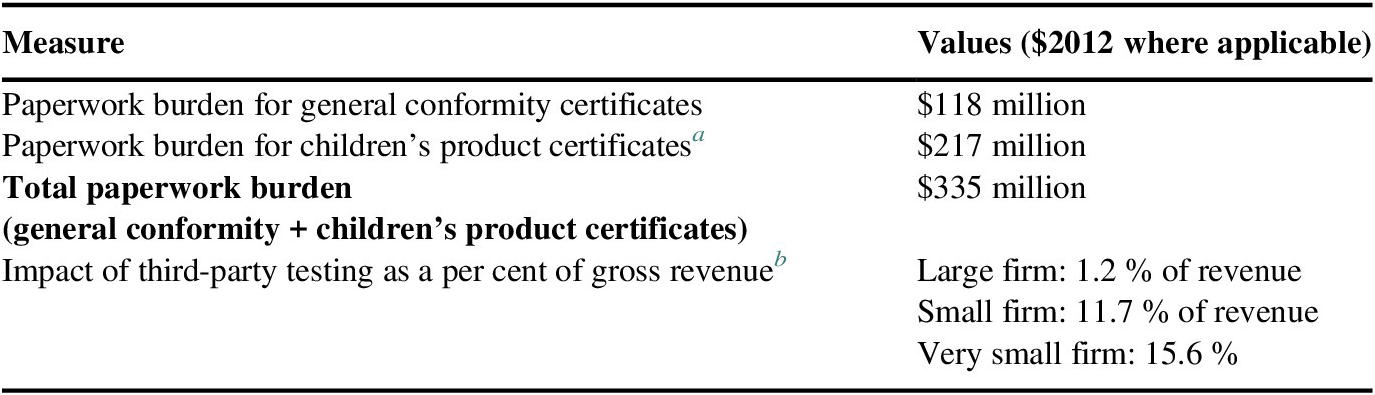
The agency was obligated to comply with the analytical requirements of the RFA and accordingly, produced a final regulatory flexibility analysis. CPSC’s analysis estimated adverse revenue impacts of 1.2 % for a large manufacturer, 11.7 % for a small manufacturer, and 15.6 % for a very small or “batch” producer. In addition, the agency was required to conduct a PRA analysis. For the paperwork burden alone, CPSC estimated an annual burden of roughly $197 million (5.4 million burden hours) for the production of certificates. Note that the requirements for third-party testing requirements and certificates were all due to the CPSIA, and as such, represent an incremental burden. That is, the burden due to these requirements are in addition to any requirements from an underlying product safety rule.
In 2013, the agency returned to the issue of compliance certificates and proposed a rule to amend the 2008 direct final rule (CPSC, 2013a). In that proposed rule, the agency conducted a PRA analysis and estimated the paperwork burden for producers of non-children’s products to issue certificates at 3.1 million burden hours, or $118 million annually. The agency also corrected the burden estimates for producers of children’s products, adding 400,000 annual burden hours or $15 million to the amount calculated in 2011.
Table 1 summarizes what CPSC analyses reveal about some of the expected costs and impacts of the Testing and Certificates rules. Clearly, the rules overall were expected to impose burdens considered significant by typical standards. If these rulemakings had been conducted under say, the unamended CPSA, the agency would have needed to justify these burdens by demonstrating the rules were expected to achieve commensurate benefits. The preamble to the final testing rule states its purpose “is to reduce the incidents of deaths and injuries associated with children’s products,” which would constitute the benefits of the rule. If CPSC had conducted the rulemaking according to its pre-CPSIA history, the agency would have produced an analysis to quantify (and likely monetize) these benefits.Footnote 10
Annual impacts of testing and certification.

a Burden hours from the Testing Rule are converted from 2011 to 2012 dollars.
b Third-party testing costs are incurred in addition to paperwork costs. These testing costs range from $102 to $1114 per test. Total testing costs for a firm depend on how many products it produces, overall production volume, and the number of product samples destroyed in the testing process.
Estimating benefits for the Testing and Certificates rules would have been problematic. Quantitative benefits assessment for a safety rule involves identifying the mechanism by which a possible safety intervention translates into an improved safety outcome, which in this case is a reduction in deaths and injuries due to the use of children’s products. A safety intervention might take the form of a mechanical standard or other engineering solution directed at the problem, and it may entirely eliminate or simply reduce an identified product safety hazard. Eliminating or reducing a hazard via an engineering solution directly reduces injuries and deaths because the safety problem no longer exists in the product (or is it reduced).Footnote 11
The mechanism by which the Testing and Certificates of Compliance rules could achieve a reduction in deaths and injuries would be difficult to establish. In contrast to engineering solutions targeted at identified product safety hazards, the rules imposed testing and certification requirements broadly on products already subject to CPSC safety standards. Presumably, these existing CPSC standards had been developed to eliminate, reduce, or otherwise address any known safety hazards. In addition, CPSC had authority to enforce these standards and apply penalties for noncompliance prior to the promulgation of the rules. In an environment where known product hazards had already been directly alleviated by regulation, the Testing and Certificates of Compliance rules could only improve safety under circumstances where consumers were exposed to products that created a safety hazard by violating existing CPSC standards. To meaningfully reduce product-related risks, the rules would need to correct a compliance problem and remove violative products from the market.
Large-scale noncompliance with CPSC standards was never asserted nor demonstrated to be an issue. In fact, there are many reasons to believe that the baseline levels of compliance with CPSC rules and standards were already quite high and that any impact of the Testing and Certificates of Compliance rules could only be marginal. As the U.S. Government Accountability Office (GAO) (1997) notes, CPSC relies heavily on voluntary or “consensus,” rather than mandatory, standards, which are developed by industry standard-setting organization groups. Despite not having “the force of law,” industry tends to overwhelmingly adopt these voluntary standards. In fact, for many of the nursery product rulemakings, which mandate industry voluntary standards and are discussed in more detail below, CPSC has estimated quite high levels of baseline compliance. If compliance levels for voluntary standards are generally high, then it is reasonable to expect that compliance levels for mandatory standards are at least similar, and probably higher, since in contrast to voluntary standards, the agency has more formal tools to enforce such standards and assess penalties for noncompliance.
Thus, it is not apparent how simply testing products and issuing certificates of compliance alone could achieve benefits adequate to justify the burdens imposed. The broad-brush nature of the intervention complicates establishing a functional relationship between the intervention and any resulting reduction in deaths and injuries, any impact on safety outcomes is ambiguous. Any underlying safety problems associated with the products to be tested had already been addressed by CPSC regulations targeted specifically at those hazards. In the absence of significant noncompliance with these standards, which does not appear to be the case, the agency would have had difficulty finding that the Testing and Certificates of Compliance rules yielded a favorable cost-benefit relationship.
4.2 Product registration cards
In 2009, CPSC issued a final rule requiring that durable infant and toddler product manufacturers (i) provide a postage-paid consumer registration form with each product sold; (ii) maintain records for consumers who register their products with the manufacturer; and (iii) permanently place the manufacturer’s name and contact information, model name and number, and the date of manufacture on each product (CPSC, 2009). The final rule was quite prescriptive in that it provided specific text and the format for the registration card. The objective of the rule was to improve recall participation rates.
As with all the CPSIA rules, the agency did not conduct BCA in developing the final rule. However, in this case, the agency did not examine the paperwork burden or produce an RFA analysis, because the CPSIA removed obligations to conduct such analyses.Footnote 12 The burden of the rule is overwhelmingly paperwork-related and given the number and scope of products covered, the overall PRA burden is necessarily quite substantial.Footnote 13 This burden is incurred by manufacturers, but the rule also relies on consumers incurring a burden to complete and return the registration cards. Even though participation by consumers would be considered voluntary, a PRA analysis would have estimated the size of the burden that consumers would need to incur. Evaluating consumer burden would have provided insight into whether that burden would be sufficiently onerous to discourage some consumers to participate, and limit overall effectiveness of the rule.
The statute required the CPSC to conduct a study to examine the effectiveness of the rule on recalls, including whether to expand the rule to other products. The first retrospective analysis, which was completed in 2012, analyzed 32 stroller and crib recalls from 2010 and 2011, and estimated that only about 20 % of the recalled products were effectively removed from use due to the recalls (CPSC, 2012f, pp. 11-12). Durrett (Reference Durrett2015) examines recalls for all children’s products in 2012 and 2013, and finds that of recalled children’s products in the hands of consumers, only 4.6 % in 2012 and 3.96 % in 2013 were corrected or destroyed.Footnote 14 The CPSC report and the Durrett study do not provide information on pre-CPSIA or baseline recall effectiveness rates for comparison. Thus, it is not possible to gauge the impact of the registration rule on recall participation rates. However, even if the rule significantly increased recall participations rates, by say, doubling or even quadrupling the rate, recall participation rates remain quite low. In fact, the CPSC continues to consider and research methods to increase recall participation rates, and many of the suggestions involve increasing convenience for consumers in providing needed information to manufacturers as well as harnessing newer technology.Footnote 15 In the meantime, the regulation requires manufacturers to provide a postage-paid consumer registration form with each product sold until CPSC changes the rule. This is costly to manufacturers and not particularly convenient for consumers, which limits the exchange of information between consumers and producers needed to increase recall participation.
4.3 Ban of certain phthalates in toys and child care articles
Phthalates are compounds used as plasticizers, which give plastics their properties like flexibility, but they have many uses and are ubiquitous in the environment. The CPSIA permanently prohibited the use of three specific phthalates in children’s toys and child care articles. It placed interim prohibitions on additional phthalates, which would remain in place until CPSC determines whether to make the interim prohibitions permanent, and accordingly, issues a final rule. The CPSC’s decision was to be based on recommendations from a Chronic Hazard Advisory Panel (CHAP), which would study the effects on children’s health of all phthalates and phthalate alternatives used in children’s toys and child care articles. Thus, any final rule would not necessarily be limited to the phthalates the CPSIA banned on an interim basis, but could apply to any phthalate (or alternative) that the CHAP found to adversely affect children’s health. In December 2014, CPSC proposed a rule that would expand the list of permanently banned phthalates to include five additional compounds and further restrict which phthalates are available for use to manufacturers. The ban of these additional compounds was not specifically required by statute, and was at the discretion of the Commission.
Like other CPSIA rules, the agency did not conduct a regulatory BCA. In addition, the agency did not conduct an RFA analysis, choosing to certify to no significant impacts on a substantial number of small entities instead:
“because these requirements area already in place by statute and will continue regardless of the proposed rule, the Commission expects that the proposed rule’s impact on small business would not be significant. Therefore, the Commission certifies that the proposed rule would not have a significant economic impact on a substantial number of small entities.” (CPSC, 2014a, p. 78341)
While the bulk of the burden of the rule was certainly imposed by statute, it is standard practice for formal analysis of regulatory burden to consider a “prestatutory” baseline. That is, OIRA guidance directs executive branch agencies to evaluate the burdens imposed by statutes, because such information is believed to be of value to Congress and to the public in general (OMB, 2003, pp. 15-16). In addition, the agency’s certification statement does not address whether the phthalates added to the list of permanently banned phthalates, which was a discretionary component of the rule, add to the expected impacts.
Statements Pertaining to Health Impacts of CPSC’s Phthalates Rule
“Overall, food, beverages, and drugs via direct ingestion, and not children’s toys and their personal care products, constituted the highest phthalate exposures to all subpopulations.” (CHAP, 2014, p. 3)
“The most sensitive and most extensively studied endpoint is male developmental toxicity in the rat, and therefore the CHAP focused on this toxicity endpoint.” (CHAP, 2014, p. 13)
“The CPSC staff supports the selection of male developmental reproductive toxicity for several reasons. Male developmental reproductive effects in animals are associated with many of the most common phthalates.” (CPSC, 2014a, Phthalates Rule NPR, p. 78326)
“In humans, the most sensitive period is thought to be late in the first trimester.” (CHAP, 2014, p. 6)
“these studies provide the first human data linking prenatal phthalate exposure (specifically DEP, DBP and DEHP) with antiandrogenic effects in male offspring.” (CHAP, 2014, p. 28, italics added)
“Based on the human data on gestational phthalate exposure and associations with poorer neurodevelopmental test scores, human exposure to DEHP, DBP, and DEP metabolites should be reduced.” (CHAP, 2014, p. 30, italics added)
“The CHAP explained that exposing pregnant female rodents to certain phthalates causes a suite of effects on the male reproductive tract in male pups, known as the ‘phthalate syndrome in rats.’” (CPSC, 2014a, Phthalates Rule NPR, p. 78326)
The CPSC also did not examine the benefits of the rule. Generally, a benefits analysis for the regulation of a chemical finds its basis in formal risk assessment, which in part, involves estimating dose-response functions relating chemical exposure to health outcomes. The CHAP’s report, however, did not quantitatively assess the relationship between phthalate exposure due to the use of toys and changes in children’s health outcomes. Exhibit 1 provides selected quotations from the CHAP report and the Federal Register notice for the proposed rule, which provide some sense of the overall benefits despite the lack of this dose-response relationship. While the rule bans phthalates in children’s toys and child care articles, both the CPSC and the CHAP are quite clear that the predominant route of exposure to these compounds is through direct ingestion via diet rather than through contact with toys (CHAP, 2014, p. 3). In addition, the major suspected health impacts are due to fetal exposure to phthalates, and mothers’ ingestion of phthalates during pregnancy (CHAP, 2014, p. 6; CPSC, 2014a, p. 78326). Removing phthalates from products that do not constitute a major source of exposure and are used by and for children that already have been born is at best, only an indirect means for addressing health outcomes that are due largely to exposure that occurs during gestation. Public commenters at the proposed rule stage raised these issues, noting that the studies that the CHAP based its report on “have not established a cause and effect relationship” (CPSC, 2017a, p. 49952), that “the fetus … is the population primarily at risk” (CPSC, 2017a, p. 49953), “the exposures of women … from children’s toys and childcare articles are negligible” (CPSC, 2017a, p. 49953), and that health effects due largely to fetal exposure are “not the appropriate endpoint for … a regulation on children’s toys” (CPSC, 2017a, p. 49951). For the final rule, CPSC did not attempt to correct or amend these observations, but simply responded that “establishing a causal relationship between exposure and effect are not required to conclude that a substance … is ‘probably toxic to humans’” (CPSC, 2017a, p. 49952).
The Phthalates Rule was analogous to the Testing and Certificates of Compliance rules in the sense that the relationship between the regulatory outcome and the intervention is ambiguous. Without established linkages between the regulated products, exposure to an identified hazard, the affected population, and changes in health outcomes, quantifying expected benefits from the rule is not possible and even a qualitative discussion would prove challenging. When the scientific information suggests that these linkages are weak, as in the Phthalates Rule, a regulatory BCA would have made that information explicit, and ideally have identified regulatory alternatives that could more effectively address the health outcome of concern. In addition, even though the rulemaking was conducted due to statutory mandate, the CPSC at its discretion expanded the restrictions to additional phthalate compounds. Evaluation of discretionary elements of a rule is one important reason to conduct BCA in a rulemaking mandated by statute.
In sum, CPSC proposed the phthalates rule with no analysis of costs to any regulated entity and it is impossible to gauge the economic impacts of the rule. However, any benefits to children’s health due to the rule are highly questionable because the CHAP did not establish a relationship between phthalates risks and health outcomes, and the use of toys and child care articles. Under the CPSIA, the agency was to issue a final rule within 180 days of the CHAP’s report, but missed that date due largely to industry complaints that the CHAP report did not use the most recent data on phthalate exposure, and that the underlying scientific approach was suspect (Logomasini, Reference Logomasini2015). In late 2016, the Natural Resources Defense Council and other groups filed suit to compel CPSC to issue its final rule (Stegon, Reference Stegon2017). CPSC published the final rule in August 2017.
4.4 Durable infant and toddler product safety standards
4.4.1 Costs and impacts of the rules
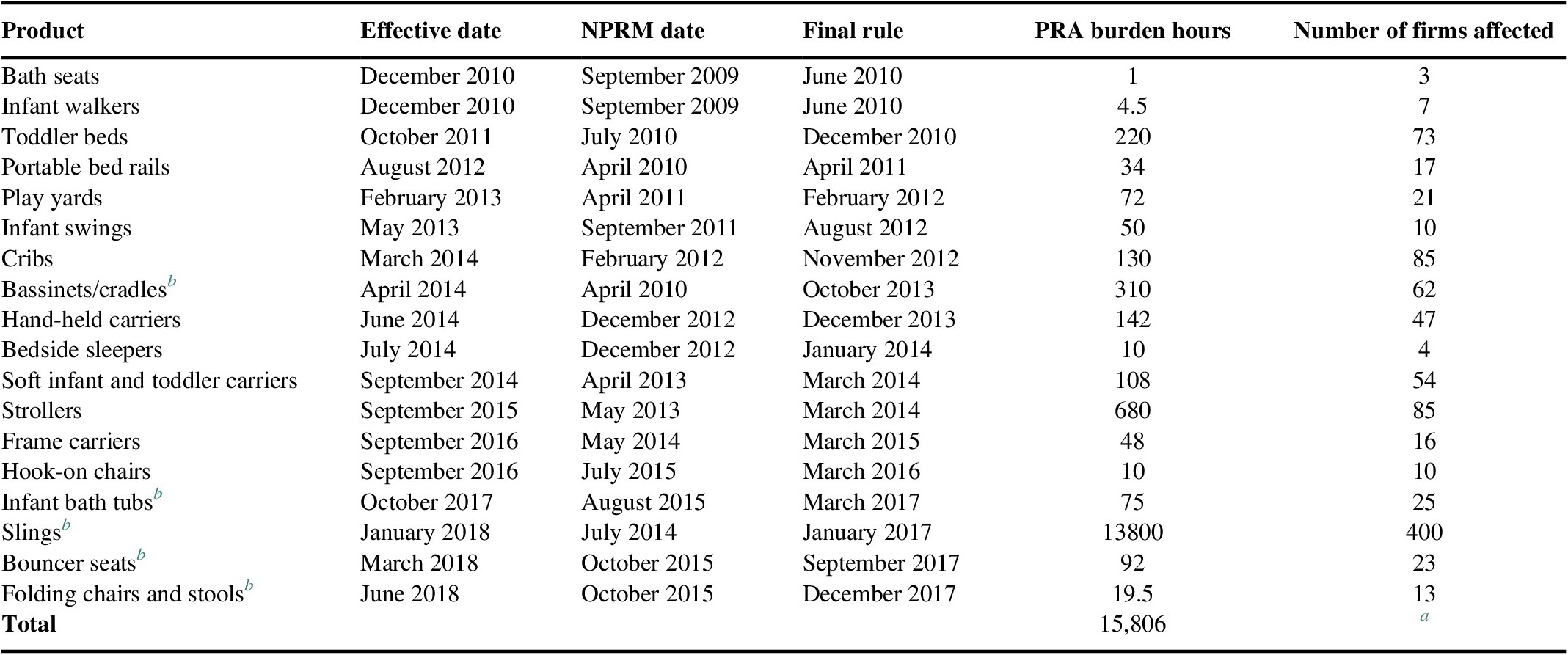
The CPSIA required the CPSC to promulgate numerous safety standards for durable infant and toddler products. These standards are to be “substantially the same as” applicable voluntary standards or more stringent, if the Commission finds that more stringent requirements would further reduce the product-related injury risk. The CPSIA included a streamlined process for updating and revising the standards in response to changes in the underlying voluntary standard. Once the voluntary standards organization (typically ASTM International, formerly known as the American Society for Testing and Materials) revises a standard, it must officially notify the CPSC. The revised voluntary standard becomes the new mandatory standard 180 days after the official notification unless the CPSC takes additional action. Within 90 days of notification of the revision, the CPSC can determine that the revised voluntary standard does not improve the safety of the product in question, and block it from becoming the new mandatory standard. As of May 2017, the CPSC had issued about 18 final rules pertaining to durable infant and toddler products. These rules, relevant dates, their estimated paperwork burdens, and the number of companies affected are listed in Table 2.

The CPSIA required that CPSC conduct these rulemakings in accordance with the Administrative Procedure Act and the agency interpretation has been that BCA findings are not required. However, the CPSC has conducted RFA analyses for nearly all these rules, and these analyses provide a general impression of the burdens the rules impose. In particular, it is apparent that the primary regulatory burden does not stem from the mechanical requirements in the underlying voluntary standard. Typically, the baseline level of compliance with the underlying voluntary standard is quite high, and the transition to a mandatory standard will only push only a few “marginal” producers into compliance or out of business. Thus, the actual increase in the costs of complying with the mechanical aspects of the standard is usually limited. However, as discussed below, this also means that the benefits of moving to a mandatory standard are also limited.
Even though many manufacturers experience little to no direct costs of complying with the mechanical standards of a nursery product safety rule because they are usually in compliance prior to the issuance of a rule, the promulgation of a nursery product safety rule triggers other events than can be costly.Footnote 16 That is, once the CPSC issues a final nursery product rule and the rule becomes effective, manufacturers then need to conduct third-party testing and certify compliance to the standard based upon these tests. These requirements stem from the Testing and Certificates of Compliance rules discussed above and are in addition to third-party testing for lead and phthalates content mandated by the CPSIA. Overwhelming, the costs of the nursery products rules are from increased third-party testing costs.
As part of the RFA analyses, the CPSC often presents estimates of the costs of these third-party tests. In the “frame carriers” rulemaking, for example, the agency estimates third-party testing costs (including lead and phthalate testing) to be $800 to $1300 per unit tested. While the requirements regarding the number of tests are not specific, most manufacturers will need to conduct more than one test in the process of certifying compliance. About 40 to 50 % of testing costs are due to the mechanical tests, so the major impact of a nursery product rule is to roughly double third-party testing costs. As noted above in the discussion of the Testing rule, the overall burden of third-party testing, particularly to small businesses, is thought to be quite high. In addition, some of these mechanical tests are destructive, and the tested sample becomes unsellable once subjected to the testing process. The “slings” RFA analysis notes that destructive testing can be especially problematic for very small producers for which the destruction of a single unit of a product can have significant revenue impacts (CPSC, 2017e, p. 8685).
The RFA analyses, of course, focus on impacts to small firms. However, some important costs of these rules may fall on consumers. In the infant bath tubs rulemaking, for example, the CPSC argues the impacts of the rule to individual suppliers will probably be nonsignificant, but alludes to an important cost that is not typically covered in an RFA analysis:
“The small domestic importer would most likely respond by discontinuing the import of its noncomplying bath seat, either replacing the bath seat with a complying product or another juvenile product (the firm currently imports approximately 165 juvenile products, of which three are substitutes for its imported bath seat). Hence, even if the cost of developing a compliant product did prove to be a barrier for individual small firms, the loss of bath seats as a product category is expected to be minor and would likely be mitigated by increased sales of competing products, such as multi-stage infant bathtubs, or entirely different juvenile products.” (CPSC, 2017c, p. 15625)
While many individual companies may not experience what is typically considered a significant economic impact, consumers could be affected adversely by having their choices reduced, in the form of the number of products they can buy or the number of sellers (resulting in higher prices) in the market. Both effects are clearly welfare-decreasing, but it is not possible to assess their importance without a more complete analysis.
4.4.2 Indicators of potential benefits
The safety standards for durable infant or toddler products are based on the applicable voluntary standards. The CPSC analyses suggest widespread compliance with the voluntary standards, which limits the regulatory burden of the mandatory rules alone. However, if there is widespread baseline compliance, then benefits will necessarily be limited as well. The primary burden of the rules stems from the increase in third-party testing costs, which suggests than this burden should be compared with the increase safety benefits achieved from testing. As noted above, third-party testing can only achieve additional safety benefits if it forces additional compliance with standards that are now mandatory. Shifting from voluntary to mandatory standards alone should increase the already high levels of baseline compliance by itself, leaving only very small, if any, residual benefits to be captured from a third-party testing regime. And again, compliance with CPSC standards does not seem to be a significant issue, particularly in the area of nursery products.
The CPSC, at least theoretically, could conduct an analysis of the benefits of mandating the mechanical standards covered in the voluntary standards, and the incremental benefits due to third-party testing. The agency tracks information and data regarding product-related injuries using several sources. The sources include reports from consumers and others compiled through the Consumer Product Safety Risk Management System and reports from retailers and manufacturers through CPSC’s Retailer Reporting System. In addition, the CPSC collects data via the National Electronic Injury Surveillance System (NEISS), which is a weighted national probability sample of injury visits to emergency departments related to consumer products. From NEISS, CPSC can generate national estimates of the number of injuries treated in U.S. hospital emergency departments for various consumer products. These estimates can serve as the basis for benefits analysis, and are, in fact what the agency uses when BCA is not discretionary.
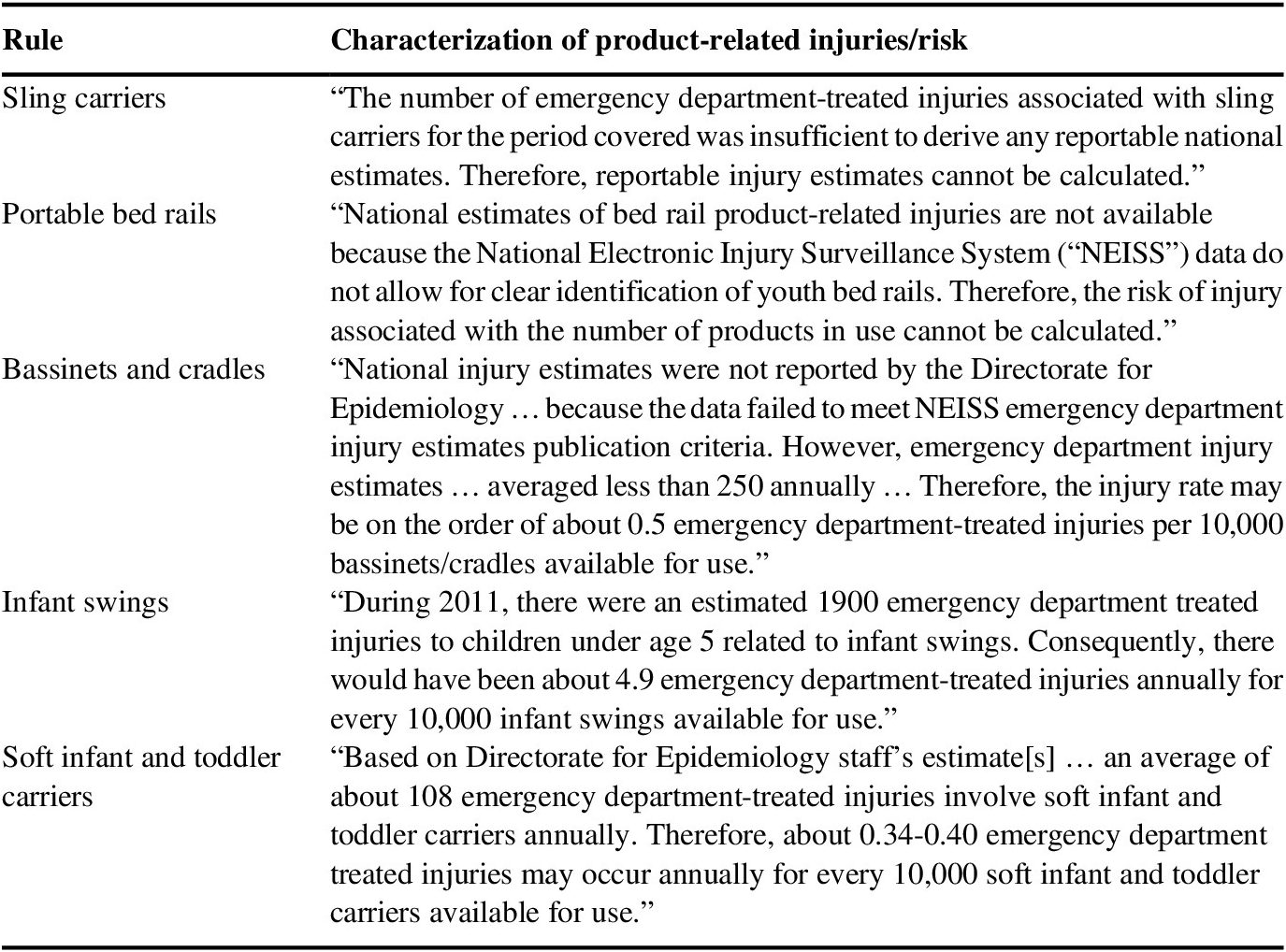
The nursery products rules typically present the known information regarding injuries and deaths related to the product. Table 3 presents some examples of how product-related injuries were characterized for selected nursery products rules. Note that the baseline levels of injuries for several products are generally quite low, and developing a statistically valid estimate of injury rates is not always possible. This means that reliably calculating any change in injuries due to a mandatory rule is challenging, especially considering that the observed injury levels already embody some, if not a large, degree of compliance with the standard to be mandated. Assessing the incremental benefits of third-party testing is even more challenging. What is clear though, is that the benefits of regulating each individual product cannot be too high since the “pool” to draw benefits from is necessarily small.
Description of injuries and risk for select nursery products.

In some of the early rules, the CPSC estimated product-related risk when the data permitted such calculation. Table 3 presents the product-related risk estimates in the three rules that CPSC provided such estimates. Again, these low initial values, which also reflect some level of compliance with the voluntary standard, suggest limited opportunity for meaningful risk reduction through mandating the voluntary standard, and even less opportunity to achieve additional risk reduction through third-party testing. The quantification of this risk reduction is what is needed in order to estimate benefits.
5 Discussion
The CPSIA increased CPSC’s rulemaking responsibilities and posed tight regulatory deadlines, while leaving the decision to conduct regulatory BCA to the agency’s discretion. The CPSC has significant experience and institutional capacity for conducting BCA due to its various statutory requirements, but the agency elected not to conduct BCA for any of the CPSIA rules. As the agency has expressed in responses to public comments requesting such analysis, the decision reflects a belief that the BCA exercise was not only optional, but directly in conflict with direction given by Congress because it would unnecessarily slow the rulemaking process. However, it is not clear that the agency’s choice to avoid BCA has facilitated promulgation of CPSIA rules in all cases.
Under the CPSIA, the CPSC has issued roughly 18 final rules pertaining to the safety of durable infant and toddler products. These rules are grounded in voluntary standards, which typically have widespread industry compliance prior to the rulemakings. Given that the durable infant and toddler products mandatory rules originate in widely embraced voluntary standards, the costs of complying with the mechanical aspects of the standards are usually limited and the transition to a mandatory standard is generally noncontroversial. Most of these rulemakings have proceeded quickly, with the time between the notice of proposed rulemaking (NPRM) and final rule being roughly one year and, in many cases, much less, as shown by the information presented in Table 2. For the majority of the nursery product rules, it does appear that the removal of the BCA requirement has expedited the rulemaking process, especially considering the number of nursery product rulemakings that CPSC has successfully completed since the passage of the CPSIA.
A few of the durable infant and toddler products rules required significantly longer timeframes than others to complete. The bassinets, infant bath tubs, bouncers, and folding chairs rules required additional time to allow CPSC to harness the voluntary standards process, and bring industry and other stakeholders together to make significant changes to the underlying ASTM standard. In these cases, the proposed rule diverged significantly from the voluntary standard that existed at the time. The extended time between the NPRM and the final rules reflects the additional effort required to bring all interested parties together to reach consensus on adjustments to the voluntary standard. Once the underlying ASTM standard was adjusted, the agency then adopted a final rule with little to no changes to the underlying voluntary standard.
The slings rulemaking is another exception, with the length of time between the NPRM and final rule being two and a half years. However, with the slings rule, the issue was not with the ASTM process. CPSC’s RFA analysis estimated that small businesses would experience significant adverse consequences, incurring revenue impacts of 2.4 % to 36 % (CPSC, 2016a). In addition, due to these impacts to small businesses, the rule was controversial among the Commission, who voted only 3–2 to publish the rule.
Aside from the nursery product rules, the CPSIA mandated that the CPSC publish the Testing and Certification rule within 15 months of its August 2008 passage date. The agency did not issue its final rule until November 2011, missing the deadline by nearly 3 years. While the agency did not conduct a regulatory BCA, it conducted an analysis of small business impacts as required under the RFA. Through this analysis, the agency uncovered compliance problems, particularly for very small producers for which compliance costs could be prohibitively high. Due largely to these findings, after the date of the proposed rule and prior to the date of the final rule, Congress made legislative changes to the CPSIA to provide some flexibility for the CPSC to grant relief to small producers. While the changes to the CPSIA allowed the CPSC to reduce the impacts of the final rule to small producers to some extent in the final rule, the rule remained costly and offered very little in terms of increased product safety. The lack of a full BCA represents a missed opportunity in this case. A complete analysis of the benefits and costs of the proposed testing rule would have provided valuable information to legislators who were open to making changes to the law. A BCA could have facilitated additional changes that would have allowed CPSC to develop an efficient standard that actually improved product safety for consumers.Footnote 17 Moreover, given the lengthy timeframe required for completing the rulemaking, it is possible that a BCA could have been completed without further slowing the rulemaking process. However, even if a BCA requirement would have slowed the rulemaking process, providing such feedback to Congress as it was contemplating legislative changes could have improved the regulatory outcome significantly.
The CPSC also missed the deadline for publishing the final phthalates rule by nearly three years, and completed the rulemaking after being sued to do so. The agency conducted no analysis of the economic impacts of the phthalates rule, not only choosing to forego BCA but also opting to certify under the RFA. Industry complaints about the underlying scientific data and beliefs that the agency lacked transparency are key factors that delayed the rule. One purpose of a regulatory BCA is to guard against these problems by “organizing the evidence on the key effects” (OMB, 2003, p. 1). CPSC may have been able to identify and address industry’s problems in advance had CPSC undertaken the BCA exercise. The agency’s decision to avoid all economic analyses did not expedite the rulemaking process, and perhaps even hindered it.
As a frame of reference, the agency had issued only one major regulation (i.e., a rule with more than a $100 million annual impact on the economy) prior to the CPSIA. The rule was its mattress flammability standard, which CPSC supported with BCA findings (CPSC, 2006a,b). The agency issued the NPRM in January 2005 and the final rule in March 2006, or about 15 months, which is close to the timeframes for most of the nursery product rulemakings. It is important to note that the mattress rule also benefited from input received from an ANPRM issued October 2001, a stage in the rulemaking process that the CPSIA eliminated as a requirement. The ANPRM initiated a process where CPSC, industry, and the state of California worked with the National Institute of Standards and Technology worked together to conduct research and develop a method to test open flame ignition of mattresses, which served a basis for the final rule. While the time between initiation of the rulemaking via the ANPRM to the final rule could be considered somewhat lengthy, taking about 4.5 years, the mattress standard timing reflects circumstances similar to the bassinets, infant bath tubs, bouncers, and folding chairs rules where BCA was not conducted. That is, the mattress standard needed the additional time taken at the ANPRM stage to coordinate stakeholders and generate necessary technical and scientific inputs, and it is not clear that removing the BCA requirement would have reduced the time to final rule significantly.
In sum, the evidence suggests that skipping BCA has expedited CPSC rulemaking in a limited set of circumstances. For most nursery product rulemakings, which are based upon voluntary standards, the CPSIA rulemakings were completed with roughly a year between proposed and final rules. In general, industry widely complies with these voluntary standards and the movement to a mandatory standard is noncontroversial. While these situations are unlikely to generate large compliance burdens, they are also unlikely to generate much in terms of improvements to product safety. It is worth considering whether the incremental value associated with moving from a widely followed voluntary standard warrants the effort required to complete a rulemaking. The bassinets, infant bath tubs, bouncers, and folding chairs rules and the mattress standard suggest that another important factor affecting the timing of CPSC rulemakings is whether the technical and scientific aspects of a rule are sufficiently developed. If industry and other stakeholder input is needed to refine the science or make significant technical changes to an underlying voluntary standard, then this, not the necessarily the need to conduct BCA, will slow the regulatory process.
Another issue that can slow down the regulatory process is that the underlying economics are truly unfavorable to certain stakeholders. In the case of the slings and Testing and Certification rules, the RFA analysis prepared at the NPRM stage indicated that small businesses would bear very large adverse consequences. For the phthalates rule, CPSC did not conduct any analysis of the economic burden posed, but it is unlikely that the agency could have justified the rule based on BCA findings (i.e., that “the benefits expected from the rule bear a reasonable relationship to its costs”) given the nature of the products regulated and population exposure patterns, and more specifically, that the CHAP did not provide the dose-response relationship needed for formal benefits analysis. CPSC’s slings, testing and certification, and phthalates rules suggest perhaps that it is not the analysis of benefits and costs, but the actual incidence of benefits and costs that impedes the rulemaking process. Again, any additional time a rulemaking requires to resolve questions pertaining to economic burden would seem to be well spent, especially when that rulemaking is expected to yield small or questionable benefits. In the case of regulations mandated by statute, the additional time to prepare formal economic analysis provides valuable feedback to ensure that regulation accomplishes its intended outcome. In addition, an agency still may add discretionary components to a mandatory rule, as was the case with CPSC’s phthalates rule, and BCA provides information that can be used to evaluate the discretionary elements.
6 Conclusion
Prior to the CPSIA, the CPSC historically was required to conduct BCA and support its rules with favorable findings regarding the relationship between benefits and costs for most of its rules, the exception being rules issued under the PPPA. The PPPA does not require BCA but also does not expressly prohibit consideration of benefits and costs, leaving the decision to conduct BCA to the agency’s discretion. Given that CPSC has chosen to forego BCA for PPPA rules where such analysis is voluntary, it is not too surprising that the agency would treat the CPSIA rules similarly.
The move away from BCA-based decisions to fulfilling CPSIA mandates represents a significant change in CPSC’s regulatory portfolio. Under the CPSIA, the agency has conducted major rulemakings, and none have been supported by BCA findings. Examination of these rulemakings suggests that it is unlikely that the agency could have made favorable BCA findings had such analyses been required. Thus, it is highly unlikely that the agency would have pursued many of these rulemakings had it not been directed to do so under the CPSIA.
The CPSC and its implementation of the CPSIA represent an additional illustration of Catastrophe Model of risk regulation and its consequences. As Pogue discusses in the context of the impacts of the Love Canal and Three Mile Island incidents on the regulatory programs of the Environmental Protection Agency and the Nuclear Regulatory Commission, this system tends to “misappropriate personnel and financial resources in the aftermath of a catastrophe and may have the unintended consequence of causing a net increase in the risk to the public’s health and safety.” In CPSC’s case, the CPSIA required the agency to shift focus from pursuing risk-based policies that have favorable benefit-cost relationships to fulfilling CPSIA mandates. The pursuit of CPSIA mandates has probably has had little effect in terms of reducing risks associated the use of consumer products. Without the CPSIA, the CPSC would have likely pursued other policies and regulations with demonstrable benefits in terms of product-related risk reductions, and based its decisions on BCA findings as is required under the major statutes it administers, with the exception of the PPPA. It is quite possible that the overall environment today is riskier than if the CPSC had been left to its own devices and Congress had never passed the CPSIA.
The potential increase in product-related risk to the public is not the only undesirable outcome of the Catastrophe Model that the CPSC case illustrates. The various analyses accompanying the CPSIA rules suggests that small companies rather than large companies were projected to experience at times, devastating economic impacts.Footnote 18 Given the size of some of the estimated impacts, it is possible that many small businesses have been pushed out of production, leaving only very large companies behind to serve the preferences of consumers.Footnote 19 As noted in the bath seat rulemaking, one alternative to exiting production is for businesses to reduce the number products they offer for sale to consumers, eliminating those for which compliance is particularly difficult. The resulting limitations on consumer choice in the form of the number of products available and the reduced number of sellers in the market are forms of the industry stifling effect that Pogue describes as one of the negative effects of the Catastrophe Model. At this point, the CPSC has not formally investigated the realized impacts of the CPSIA rules, but these are the effects that CPSC should consider if it conducts retrospective review any of the CPSIA rules.
Beyond representing another example of the Catastrophe Model, the CPSC case has broader policy implications. The CPSC’s decision to forego BCA for the CPSIA rules did not reflect a loss of analytical capability or an abrupt change in agency mission. If an agency like the CPSC chooses to abandon BCA when given discretion, then it is probably not too realistic to expect that other IRCs would voluntarily engage in BCA to support their rulemakings. This is especially the case for agencies that lack CPSC’s institutional capacity and have regulatory missions less amenable to BCA. Any effort to improve IRCs’ regulatory decisions though the use of BCA is unlikely to be successful if the decision to conduct such analysis is left to the agencies’ discretion. Eventually, any efforts to push IRCs to incorporate BCA into their regulatory processes may require some type of central oversight and review like what OIRA provides to executive branch agencies.
The CPSC case also illustrates a potential source of tension that can arise as an agency carries out its legislative direction. Regulating under a mandate can place an agency in a difficult position because, as noted above, Congress is not subject to the same analytical requirements. Congress is not required to consider whether regulation is necessary for or the best approach to addressing a hazard, or how the benefits of an intervention or any of its alternatives compare to costs. At the most basic level, Congress does not need to even examine whether a legislative solution even addresses the problem at hand, and this can lead to mandated solutions that miss the mark in terms of the outcomes sought. A hastily crafted legislative response to a catastrophe can prescribe solutions that agencies are unable to support with required analyses. Producing evidence of such legislative shortcomings places an agency at risk of a perception that it is attempting to undermine congressional intent, even when that evidence is based upon sound analysis. An easier course of action is to avoid producing the analysis in the first place, if that option exists as it did for CPSC under the CPSIA and as it does for most IRCs generally. The incentive for IRCs to avoid regulatory analysis is even stronger when Congress poses tight deadlines, as investing the time may seem incompatible with legislative direction. Executive branch agencies, of course, must conduct these analyses regardless, but they too may be tempted to reduce their BCA efforts in the face of a mandate with strict deadlines rather the produce analyses that challenges a statute’s instructions. Again, OIRA oversight guards against this pressure at least to some degree, but nonetheless, the CPSIA regulatory outcomes highlight the importance of conducting a thorough analysis of any mandate.
Finally, critics of the regulatory process often lay blame for poorly designed and costly regulation on the regulatory agencies. But as Ellig and Horney (Reference Ellig and Horney2016) note, roughly half of all economically significant regulations issued between 2008 and 2013 originated from a congressional mandate. CPSC’s experience with the CPSIA exemplifies the substantive role that Congress plays in quality of specific rules as well as in shaping an agency’s overall regulatory portfolio. Any hope to reign in regulatory costs through regulatory reform can only be partially successful if the sole target is regulatory agencies. True regulatory reform will need to acknowledge and address the legislative role in developing regulations.
Acknowledgments:
The author thanks Jerry Ellig, Ali Gungor, Mary Fitzpatrick, Ross Rutledge, and two anonymous referees for helpful comments on an earlier version.