Introduction
The majority of higher plants, including many crop species, depend on pollinators for reproduction (e.g. Klein et al., Reference Klein, Vaissière, Cane, Steffan-Dewenter, Cunningham and Kremen2007 and references therein). In turn, these plants provide forage for pollinators, mostly in the form of nectar and pollen. Pollination is, therefore, a major ecosystem service that is fundamental for the maintenance of global plant and animal diversity, as well as supporting food production in many key agricultural crops. The majority of animal-pollinated plants are pollinated by insects and, within those, bees (Hymenoptera: Apoidea) feature as the most prominent group.
During the last decade, several studies have revealed that pollinators and especially bees are in decline. This decline has been shown in wild, unmanaged bees (Biesmeijer et al., Reference Biesmeijer, Roberts, Reemer, Ohlemüller, Edwards, Peeters, Schaffers, Potts, Kleukers, Thomas, Settele and Kunin2006; Potts et al., Reference Potts, Biesmeijer, Kremen, Neumann, Schweiger and Kunin2010a), as well as in managed bees such as honeybees (Potts et al., Reference Potts, Roberts, Dean, Marris, Brown, Jones, Neumann and Settele2010b). It is still not fully clear what drives the decline of bees, but most likely it is a combination of causes. Important drivers include habitat loss, fragmentation and degradation, which affect the availability of key foraging and nesting resources needed by bee populations (Potts et al., Reference Potts, Biesmeijer, Kremen, Neumann, Schweiger and Kunin2010a and references therein). In order to be able to maintain or enhance bee populations and the services they provide, it is, therefore, essential to better understand how the surrounding landscape affects bee abundance and diversity, especially in agroecosystems, which cover large areas in the industrialized world. In this respect, the importance of spatial context has been pointed out in several studies. Bee diversity is explained by biogeographic drivers at different scales. At a continental scale, climate and topographic conditions shape species distribution (Michener, Reference Michener2000). At a landscape scale, the structure and composition of habitats, defined as the landscape context, and especially semi-natural and natural habitats, are the main drivers of bee diversity (e.g. Kremen et al., Reference Kremen, Williams and Thorp2002; Steffan-Dewenter et al., Reference Steffan-Dewenter, Münzenberg, Bürger, Thies and Tscharntke2002; Carré et al., Reference Carré, Roche, Chifflet, Morison, Bommarco, Harrison-Cripps, Krewenka, Potts, Roberts, Rodet, Settele, Steffan-Dewenter, Szentgyörgyi, Tscheulin, Westphal, Woyciechowski and Vaissière2009; Le Féon et al., Reference Le Féon, Schermann-Legionnet, Delettre, Aviron, Billeter, Bugter, Hendrickx and Burel2010). The surrounding landscape matrix may increase the amount of available resources or provide additional resources that do not occur within a local habitat fragment. Some bee species, for example, need different habitat types within their flight range to fulfil their specific requirements with respect to food resources, nesting sites and building material (Westrich, Reference Westrich, Matheson, Buchmann, O'Toole, Westrich and Williams1996; Steffan-Dewenter et al., Reference Steffan-Dewenter, Münzenberg, Bürger, Thies and Tscharntke2002; Steffan-Dewenter, Reference Steffan-Dewenter2003). Therefore, the surrounding matrix can significantly influence the ‘structural connectivity’ of habitat patches, thereby possibly increasing or decreasing local population density and even extinction risk (Gonzales et al., Reference Gonzales, Lawton, Gilbert, Blackburn and Evans-Freke1998; Ricketts, Reference Ricketts2001).
Body size has been shown to be a powerful trait to predict flight ranges, with small bees having smaller flight ranges than large bees (Van Nieuwstadt & Iraheta, Reference Van Nieuwstadt and Iraheta1996; Gathmann & Tscharntke, Reference Gathmann and Tscharntke2002; Greenleaf et al., Reference Greenleaf, Williams, Winfree and Kremen2007). Depending on bee size, resource utilisation, therefore, occurs over different spatial scales (e.g. Kremen et al., Reference Klein, Vaissière, Cane, Steffan-Dewenter, Cunningham and Kremen2007; Öckinger & Smith, Reference Öckinger and Smith2007; Winfree et al., Reference Winfree, Aguilar, Vazquez, LeBuhn and Aizen2009). However, as pollinators differ in their mobility, the effect of landscape structure and composition on their abundance and diversity will differ between bees with different flight ranges. Thus, larger flight ranges may offer bees the ability to persist within fragmented landscapes (Bommarco et al., Reference Bommarco, Biesmeijer, Meyer, Potts, Poyry, Roberts, Steffan-Dewenter and Öckinger2010; Öckinger et al., Reference Öckinger, Schweiger, Crist, Debinski, Krauss, Kuussaari, Petersen, Poyry, Settele, Summerville and Bommarco2010).
When investigating the influence of surrounding landscape on bee diversity and abundance, most studies to date have generally considered only a small number of land cover types selected a priori, or they have binarily grouped land cover types into beneficial or non-beneficial for bees (Roubik, Reference Roubik2000; Klein et al., Reference Klein, Steffan-Dewenter, Buchori and Tscharntke2002; Kremen et al., Reference Kremen, Williams and Thorp2002; Steffan-Dewenter et al., Reference Steffan-Dewenter, Münzenberg, Bürger, Thies and Tscharntke2002; Steffan-Dewenter, Reference Steffan-Dewenter2003; Westphal et al., Reference Westphal, Steffan-Dewenter and Tscharntke2003; Herrmann et al., Reference Herrmann, Westphal, Moritz and Steffan-Dewenter2007; Le Féon et al., Reference Le Féon, Schermann-Legionnet, Delettre, Aviron, Billeter, Bugter, Hendrickx and Burel2010). Where agricultural production is almost entirely extensive, such as on Lesvos Island (eastern Mediterranean, Greece), this approach is, however, not suitable. We know from our experience that most types of land cover in the Mediterranean have some value for bees, either because they provide floral resources, nesting sites or both (Potts et al., Reference Potts, Petanidou, Roberts, O'Toole, Hulbert and Willmer2006). When investigating the influence of landscape context on bee diversity and abundance in such regions, it is, therefore, important to assess the value of all types of land cover present. This approach also yields important indications of the effects of landscape context on wild plant and crop pollination. On Lesvos, olive farms cover most of the agriculturally used area and about one third of the total area of the island (Kizos et al., Reference Kizos, Dalaka and Petanidou2010). On Lesvos, the understoreys of olive groves constitute a rich community of flowering plants, which is why they are a hotspot for bee diversity and abundance (Potts et al., Reference Potts, Petanidou, Roberts, O'Toole, Hulbert and Willmer2006). In order to establish how the surrounding landscape structure impacts bee abundance in olive groves, we randomly selected a total of 13 sampling sites in olive groves in the south-eastern part of Lesvos Island.
The objectives of our study were (i) to evaluate the overall response of the wild bee fauna to the type and area of surrounding landscape, and (ii) to assess which landscape features explain the abundance and species richness patterns of five different bee categories consisting of three body size groups (small, medium and large bees), the most abundant bee species (Lasioglossum marginatum) and all species combined. Given that bees’ flight ranges depend on their body size, we predict that smaller bees’ abundance and species richness are likely to be influenced by landscape context at a smaller spatial scale than larger bees. In addition, we expect the presence of olive groves and phrygana at a landscape scale to have a positive effect on the abundance and species richness of pollinators, as they are both key providers of flowering plants (Potts et al., Reference Potts, Petanidou, Roberts, O'Toole, Hulbert and Willmer2006).
Methods
Study system and site selection
The Mediterranean is characterized by remarkable species richness in proportion to its area, especially in plants and pollinators (Proctor et al., Reference Proctor, Yeo and Lack1996; Petanidou & Lamborn, Reference Petanidou and Lamborn2005). The Mediterranean Basin of southern Europe contains 7.8% of the world's plant diversity, although it represents only 1.6% of the world's area (Blondel & Aronson, Reference Blondel and Aronson1999). This region is also a hotspot for bee diversity and is considered a centre of bee speciation (O'Toole & Raw, Reference O'Toole and Raw1991; Michener, Reference Michener2000).
Olive oil production is a major industry on Lesvos Island, Greece. Most of the agriculturally used land and 30% of the total area of the island are covered by olive groves (Kizos et al., Reference Kizos, Dalaka and Petanidou2010). On Lesvos Island, the understoreys of olive plantations are only very rarely cultivated with arable crops and nowadays are usually not grazed. The soil is superficially ploughed approximately every 2−3 years to prevent overgrowth and to minimise competition with understorey plants. The understoreys of olive groves constitute a rich community of flowering plants and support an equally rich pollinator community in which bees feature most dominantly, especially when the olive groves are actively managed (Potts et al., Reference Potts, Petanidou, Roberts, O'Toole, Hulbert and Willmer2006). In order to establish how the surrounding landscape structure impacts bee abundance in olive groves, we randomly selected a total of 13 sampling sites in olive groves, in a fragmented landscape in the south-eastern part of Lesvos Island. Sites were on average 15 km apart.
Insect sampling, identification and categorization
All bees were sampled in 2004 with two different sampling methods, standardized transect walks and variable transect walks (Westphal et al., Reference Westphal, Bommarco, Carré, Lamborn, Morison, Petanidou, Potts, Roberts, Szentgyörgyi, Tscheulin, Vaissière, Woyciechowski, Biesmeijer, Kunin, Settele and Steffan-Dewenter2008). For the standardized transect walks, a permanently marked corridor was established on the study sites. The corridor was a total of 250-m long and 4-m wide. The corridors were not always continuous and never in a straight line due to the structure of the terrain and so as not to depart too much from the centre of the respective site. All bees within the corridor were collected during a one-directional 50-min walk covering the full length of the corridor. For the variable transect walks, the surveyors were not restricted to a fixed transect line; instead, they walked at slow speed among any potentially attractive resource patches and collected bees during an observational period of 60 min. Again, care was taken not to depart substantially from the centre of the site. Both sampling methods were repeated twice per sampling round, once before and once after noon. In each site, a total of five rounds were performed starting from early March and lasting until late July to cover the main flowering periods of the majority of plants in the understorey of olive groves on the island. The sampling took place during the flight activity and suitable weather conditions for pollinators (minimum of 15°C, low wind, no rain, and dry vegetation). All insect records from both methods were pooled, as these two methods are complementary in surveying the bee fauna (Westphal et al., Reference Westphal, Bommarco, Carré, Lamborn, Morison, Petanidou, Potts, Roberts, Szentgyörgyi, Tscheulin, Vaissière, Woyciechowski, Biesmeijer, Kunin, Settele and Steffan-Dewenter2008). The sampling effort was the same in all sites and rounds. In all analyses, all insect data were pooled over round.
All bees were identified by expert taxonomists. Specimens are kept in the reference collection ‘Melissotheque of the Aegean’ (Petanidou & Lamborn, Reference Petanidou and Lamborn2005). We subsequently established the average full body length (frons to tip of the abdomen) of all collected bee species based on five female and five male specimens per species, if available, and assigned all collected specimens to three size groups (small bees: ≤7.5 mm; medium bees: >7.5 mm and ≤11.5 mm; large bees: >11.5 mm).
Mapping
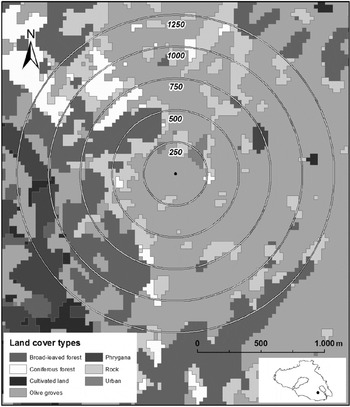
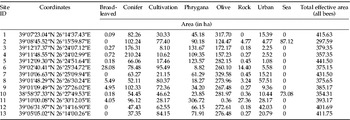
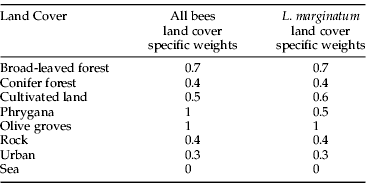
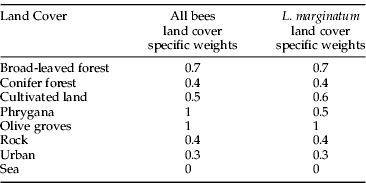
The landscape around the sites was assessed with the help of thematic maps of the area, which we generated specifically for this need (fig. 1). The maps were based on the satellite image Landsat TM5 (resolution: 30 m), taken on 24 June 2003. We classified all land according to eight land cover categories found within the study area using the software ERDAS Imagine 9.1 (ERDAS Inc., Georgia, USA): broad-leaved forest (consisting mainly of chestnut and oak forest), conifer forest, cultivated areas, phrygana, olive groves, rock, sea and urban settlement (fig. 1, table 1). The landscape classification was carried out up to 1250 m from the geographical centres of all 13 sites. The area covered by each of the habitat types was assessed using the software Fragstats 3.3 (University of Massachusetts, USA: McGarigal et al., Reference McGarigal, Cushman, Neel and Ene2002) and ArcMap 9.3 (ESRI Inc., California, USA) for each fragment inside a nested set of circles of 250, 500, 750, 1000 and 1500-m radius from the centre of each site to include the flight ranges of most Mediterranean bees based on their size (Greenleaf et al., Reference Greenleaf, Williams, Winfree and Kremen2007). Subsequently, the maps were smoothed with a convolution kernel size 3. In order to have a measurement of the suitability for bees of the whole area under study, taking into account all different land cover types simultaneously, we developed a single variable. To calculate this variable, the estimated areas occupied by each land cover type in ha at each radius and at each site were multiplied with habitat specific weights (from 0 (without value to bees) to 1 (with greatest value to bees)), which we had established prior to the conduction of the study based on our own experience (table 2). The obtained values were summed for each radius and site separately, and the resulting sums are hereafter called the ‘total effective area’ (TEA) of a radius. The rationale behind the habitat specific weights was that different land cover types have varying value for bees depending on their diversity and abundance in flowering plants, anthropogenic impact and provision of nesting sites. This approach differs markedly from previous studies where habitat types were binarily assigned to suitable or non-suitable habitat (e.g. Roubik, Reference Roubik2000; Kremen et al., Reference Kremen, Williams and Thorp2002; Le Féon et al., Reference Le Féon, Schermann-Legionnet, Delettre, Aviron, Billeter, Bugter, Hendrickx and Burel2010).
One representative study site (Site ID 6) showing the centre of the site where the sampling took place and the circles of five different radii (250, 500, 750, 1000 and 1250 m) within each of which the landscape context was assessed.

Coordinates, land cover in ha and total effective area at a 1250-m radius from the centre of each sampling site. The sums of all areas per site and radius multiplied with their land cover specific weights (table 2) are represented by the total effective area.

Land cover and bee species specific weights (from 0 (without value to bees) to 1 (with greatest value to bees)), which we had estimated prior to the conduction of the study based on our own experience. We based our assessment on the land covers’ average diversity and abundance in flowering plants, anthropogenic management and provision of nesting sites. These weights were used in conjunction with the areas of each land cover type per site and radius to obtain the respective total effective areas (table 1).
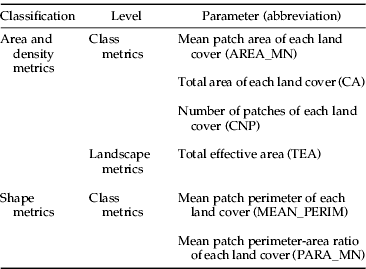
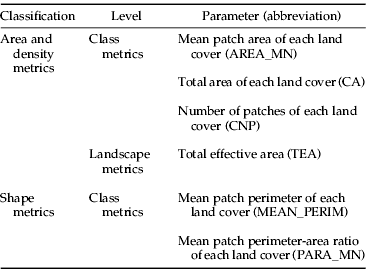
Subsequently, landscape parameters were calculated using Fragstats 3.3, considering class and landscape metrics (table 3). The metrics used belong to the categories: (i) area and density metrics and (ii) shape metrics, and all defining equations are given in the Fragstats documentation (McGarigal et al., Reference McGarigal, Cushman, Neel and Ene2002).
Landscape parameters extracted from thematic maps for each of the 13 sites at five radii (250, 500, 750, 1000 and 1250 m) from the centre of each sampling site.
Statistical analysis
We separately calculated Pearson's correlation coefficient r between the sites’ landscape parameters (table 3) at each radius and the log-transformed abundance in 13 sites of (i) bees within each body size group (small, medium and large bees); (ii) Lasioglossum marginatum (Brullé, 1832) (Apoidea: Halictidae), the most abundant bee species in our study, which is commonly found in olive groves; and (iii) all bees combined. In addition, we calculated Pearson's correlation coefficient r between the sites’ landscape parameters at each radius and the log-transformed total bee species richness in 13 sites. All analyses and the generation of graphical output were performed using the statistical software R 2.12 (R Development Core Team, Vienna, Austria).
Results
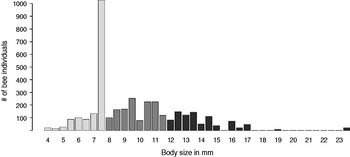
A total of 3673 wild bees belonging to 340 species were caught and identified by taxonomic experts. Bees in the small bee size group were the most abundant, mainly because this size group was dominated by the most abundant bee, Lasioglossum marginatum (average body length 7.5 mm, 661 caught individuals) in this study, which falls within this size group (fig. 2). To analyze the effect of landscape context, we tested for correlations between the bee abundance and diversity of (i) all three size groups, (ii) L. marginatum, and (iii) all species combined, and landscape parameters at five radii from the centre of each site (table 4).
Frequency of bees from all 13 sites according to their body sizes. The bees were assigned to three body size groups according to their body length (frons to tip of abdomen). The most abundant species, Lasioglossum marginatum (body length 7.5 mm), accounts for 661 individuals ( , Small bees (4–7.5 mm), Total bee abundance: 1490;
 , Medium bees (8–11.5 mm), Total bee abundance: 1327;
 , Large bees (12–23.5 mm), Total bee abundance: 856).

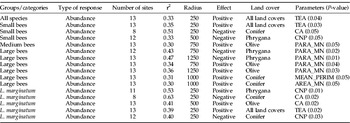
Land cover parameters with significant positive or negative effects in Pearson's correlation tests on bee abundance in three different size groups (small, medium and large bees), Lasioglossum marginatum and all species combined. Species richness was not correlated with any of the assessed landscape parameters at any of the five radii.

Small bees’ abundance was consistently impacted by landscape parameters at smaller scales, medium bees’ abundance at medium scales, and large bees’ abundance at larger scales. The abundance of all species combined was positively correlated with the total effective area (TEA) at a 250-m radius from the sites. Equally, the abundance of bees in the small-bee-size group was positively correlated with the total effective area (TEA) at a 250-m radius. Additionally, abundance of small bees was negatively correlated with the total area of conifer forest at a 250-m radius and the number of phrygana patches at a 500-m radius. Abundance of medium-sized bees was positively correlated with the perimeter-area ratio of olive grove at a 750-m radius. Abundance of large-sized bees was negatively correlated with the perimeter-area ratio of phrygana at a 750-m and at a 1250-m radius and positively correlated with the perimeter-area ratio of olive groves at a 750-m and a 1250-m radius, the mean perimeter of conifer forest at a 1000-m radius and the mean area of conifer forest at a 1000-m radius.
The abundance of L. marginatum was positively correlated with the number of phrygana patches and negatively correlated with the total area of conifer forest at a 250-m radius. Addtionally, the abundance of L. marginatum was positively correlated with the total area of olive groves and the total effective area at a 250-m radius and negatively correlated with the number of conifer patches at a 500-m radius.
Species richness was not correlated with any of the assessed landscape parameters at any of the five radii.
Discussion
Our objective was to analyze the influence of the surrounding landscape, at different radii, on the abundance of three size groups of bees, the most abundant species L. marginatum and all species combined, in olive groves embedded in a fragmented landscape. We found that the abundance of bee groups was influenced differently by different landscape parameters and land covers. In general, small bees’ abundance was impacted by landscape parameters at smaller scales, medium bees at medium scales and large bees at larger scales.
The finding that different landscape parameters and land covers influence different bee groups differently is not surprising. Body size has been shown to be a powerful trait to predict bee flight ranges, with small bees having smaller flight ranges than large bees (Van Nieuwstadt & Iraheta, Reference Van Nieuwstadt and Iraheta1996; Gathmann & Tscharntke, Reference Gathmann and Tscharntke2002; Greenleaf et al., Reference Greenleaf, Williams, Winfree and Kremen2007). Depending on bee size, resource utilisation, therefore, occurs over different spatial scales (Kremen et al., Reference Klein, Vaissière, Cane, Steffan-Dewenter, Cunningham and Kremen2007; Öckinger & Smith, Reference Öckinger and Smith2007; Winfree et al., Reference Winfree, Aguilar, Vazquez, LeBuhn and Aizen2009). Within a bee's flight range, all ecological requirements must be fulfilled (Westrich, Reference Westrich, Matheson, Buchmann, O'Toole, Westrich and Williams1996; Steffan-Dewenter et al., Reference Steffan-Dewenter, Münzenberg, Bürger, Thies and Tscharntke2002; Steffan-Dewenter, Reference Steffan-Dewenter2003). In case more than one type of land cover is needed for the fulfilment of their requirements (e.g. nesting and foraging), all types of land cover must be within the bees’ flight range. Due to their bigger flight range, larger bees are, therefore, less dependent on small-scale landscape context (Greenleaf et al., Reference Greenleaf, Williams, Winfree and Kremen2007), whereas small bees may be limited to patches of one single type of land cover. An increased ability of species to move over large distances, therefore, may increase the capacity to persist within fragmented landscapes (Hanski & Ovaskainen, Reference Hanski and Ovaskainen2000; Kotiaho et al., Reference Kotiaho, Kaitala, Komonen and Päivinen2005; Bommarco et al., Reference Bommarco, Biesmeijer, Meyer, Potts, Poyry, Roberts, Steffan-Dewenter and Öckinger2010; Öckinger et al., Reference Öckinger, Schweiger, Crist, Debinski, Krauss, Kuussaari, Petersen, Poyry, Settele, Summerville and Bommarco2010).
In our study, the abundance of all species combined was only positively correlated with the total effective area at a 250-m radius from the sites. This may be due to the fact that small pollinators, which are known to have small flight ranges (Greenleaf et al., Reference Greenleaf, Williams, Winfree and Kremen2007), were the most numerous bees in this study. Likewise, small bees’ abundance was positively impacted by the total effective area at a 250-m radius. This shows that bees up to 7.5 mm in body length have a very limited flight range, which is in accordance with previous studies (e.g. Greenleaf et al., Reference Greenleaf, Williams, Winfree and Kremen2007). In addition, the amount of area covered by conifer trees at a radius of 250 m had a negative effect on small bee abundance. This is not surprising as the understoreys of coniferous forests on the island have a relatively limited diversity of foraging plants and, therefore, may not attract and permanently support many bee species. Coniferous forests may also not be used for nesting by small bees, as their small flight ranges usually do not allow the utilisation of different types of land covers for nesting and foraging. In addition, coniferous forests may present natural barriers that cannot be passed by small bees, thereby limiting their range. Finally, small bees’ abundance was negatively impacted by the number of phrygana patches at 500-m radius. This seems surprising as phryganic systems in Greece are thought to be of outstanding value to bees (Petanidou & Lamborn, Reference Petanidou and Lamborn2005; Potts et al., Reference Potts, Petanidou, Roberts, O'Toole, Hulbert and Willmer2006). As all our sampling sites were, however, in olive groves, the collected species are obviously biased towards this type of land cover. Interspersed patches of phrygana naturally fragment the apparently preferred land cover type, which may have led to the negative response.
Medium-sized bee abundance was positively correlated with the perimeter-area ratio of olive groves at a 750-m radius. This shows that medium-sized bees are affected by landscape parameters on a larger spatial scale than small bees and, therefore, implies a relatively larger flight range. The fact that the perimeter-area ratio of olive groves affected bee abundance positively suggests that the caught medium-sized bee species utilise not only olive groves but also other land cover types, as a high perimeter-area ratio also leads to an increased amount of boundaries with other land cover types. It has been pointed out that species that can use multiple resources are expected to have a greater likelihood of fulfilling their resource requirements in a greater number of habitat patches (Roy et al., Reference Roy, Quinn and Gaston1998; Swihart et al., Reference Swihart, Gehring, Kolozsvary and Nupp2003). As a result, species having, for example, a broad diet are expected to have a larger geographical range (Gaston, Reference Gaston1988; Roy et al., Reference Roy, Quinn and Gaston1998).
Abundance of large-sized bees was negatively correlated with the perimeter-area ratio of phrygana at a 750-m and at a 1250-m radius. This negative response could again be due to the fact that all bees were caught in olive groves and may, therefore, contain specialists that do not utilise resources in phryganic systems. The perimeter-area ratio of olive groves at a 750-m and a 1250-m radius had a positive effect on large bee abundance, suggesting that these bees also utilise other land covers apart from olive groves and that they prefer large boundaries between olive groves and those land cover types. This is also supported by the positive effect the mean perimeter and mean area of conifer forest had at a 1000-m radius.
The abundance of L. marginatum, the most abundant species in the study, was positively correlated with the number of phrygana patches and negatively correlated with the total area of coniferous forest at a 250-m radius and the number of conifer patches at a 500-m radius. This suggests that this species utilises resources in phryganic systems in addition to resources in olive groves but does not utilise resources in coniferous forest. The former is further supported by the finding that the abundance of L. marginatum was positively correlated with the total area of olive groves and the total effective area at a 250-m radius. It has been shown that L. marginatum is closely associated with the presence of bare soil for nesting (Potts et al., Reference Potts, Vulliamy, Roberts, O'Toole, Dafni, Ne'Eman and Willmer2005). According to Westrich (Reference Westrich1989), their nests are situated in the soil at a depth of up to 90 cm. The ploughed soils in olive groves, therefore, may provide ideal nesting grounds for L. marginatum. While the thin layer of soft soil in phryganic systems may not be sufficient for nesting, this habitat type may provide valuable foraging resources, which could explain the correlation of the species’ abundance with both land cover types. Given the species’ small flight range, the optimal habitat, therefore, contains both land cover types in close vicinity.
Generally, it can be deducted that larger bees utilise, on average, more land cover types and, therefore, may often have a higher diet breadth. This is in accordance with previous studies showing that species having a broad diet also have a larger geographical range (Gaston, Reference Gaston1988; Roy et al., Reference Roy, Quinn and Gaston1998), which may in turn increase their capacity to persist within fragmented landscapes (Hanski & Ovaskainen, Reference Hanski and Ovaskainen2000; Kotiaho et al., Reference Kotiaho, Kaitala, Komonen and Päivinen2005; Bommarco et al., Reference Bommarco, Biesmeijer, Meyer, Potts, Poyry, Roberts, Steffan-Dewenter and Öckinger2010; Öckinger et al., Reference Öckinger, Schweiger, Crist, Debinski, Krauss, Kuussaari, Petersen, Poyry, Settele, Summerville and Bommarco2010).
Species richness was not correlated with any of the assessed landscape parameters at any of the five radii. This seems surprising as several previous studies have found a correlation between bee species richness and landscape context (e.g. Steffan-Dewenter, Reference Steffan-Dewenter2003; Carré et al., Reference Carré, Roche, Chifflet, Morison, Bommarco, Harrison-Cripps, Krewenka, Potts, Roberts, Rodet, Settele, Steffan-Dewenter, Szentgyörgyi, Tscheulin, Westphal, Woyciechowski and Vaissière2009; Bommarco et al., Reference Bommarco, Biesmeijer, Meyer, Potts, Poyry, Roberts, Steffan-Dewenter and Öckinger2010). As pointed out previously, most Mediterranean land cover types, including some anthropogenic land cover types such as extensively managed agricultural areas, have some value for bees (for a review see Petanidou & Lamborn, Reference Petanidou and Lamborn2005). In addition, even small areas of favourable habitat may support high bee species diversities (Petanidou & Lamborn, Reference Petanidou and Lamborn2005). In the absence of intensive agriculture and other land covers hostile to bees as on Lesvos Island, bee species richness in the Mediterranean, therefore, may be less affected by landscape context.
Our results provide evidence indicating which land cover types in the landscape can affect the abundance of bees in the Mediterranean and at which spatial scales. Using this knowledge, the landscape could be managed to maintain or increase vulnerable species by selectively protecting or restoring relevant land cover types. As mentioned before, olive groves on Lesvos Island have the highest value for bees when they are managed rather than abandoned (Potts et al., Reference Potts, Petanidou, Roberts, O'Toole, Hulbert and Willmer2006). It, therefore, would be vital, from the conservation point of view, to provide incentives for landowners to manage olive groves. As an added benefit, this can also be expected to increase agricultural production in areas where cultivated crops, dependent on pollination by bees, are in vicinity.
Acknowledgements
The research project was financed by the EU FP 6 Integrated Project ALARM (GOCECT-2003-506675) (Assessing LArge-scale environmental Risks for biodiversity with tested Methods, http://www.alarmproject.net: Settele et al., Reference Settele, Hammen, Hulme, Karlson, Klotz, Kotarac, Kunin, Marion, O'Connor, Petanidou, Peterson, Potts, Pritchard, Pysek, Rounsevell, Spangenberg, Steffan-Dewenter, Sykes, Vighi, Zobel and Kühn2005). We thank Hjalmar Dahm, Daniele Vivarelli and Marios Apostolopoulos for their help with collecting the field data and Holger Dathe, Andreas Ebmer, George Else, Andrew Grace, Peter Hartmann, Andreas Müller, Andrew Polaszek, Stephan Risch, Erwin Scheuchl, Max Schwarz and Paul Williams for their valued assistance with bee identification.