I. INTRODUCTION
High energy radiation poses hazards to the astronauts, spacecraft structural materials, and electronics and is one of the major concerns for long duration space exploration. Exposure to high energy radiation particles not only can result into serious biological damages to crew, such as carcinogenesis, cardiac problems and damages to the neural system, but also can induce damage to the structural materials and electronic components in spacecraft. Reference Cucinotta1–Reference Kennedy3 High energy particles can interact with materials to cause atomic displacements and electronic excitation, which can severely degrade the critical properties of structural materials such as mechanical, thermal, and optical properties. Reference Cucinotta4–Reference Marshall, Dale and Burke12
One of the main radiation hazards in space comes from neutron and gamma rays generated from the interaction of high energy particles with walls of the structures. These types of radiation are not only observed in the space explorations but also in other industries including nuclear reactors and related facilities, fusion reactors, cyclotrons etc. and can cause potential health hazards for workers and damage the instruments and structural materials. Reference Mertens, Kress, Wiltberger, Blattnig, Slaba, Solomon and Engle13–Reference Slaba, Blattnig, Aghara, Townsend, Handler, Gabriel, Pinsky and Reddell15
Current radiation shielding designs are composed of mostly the materials with high charge to mass ratio (Z/A) such as lead and aluminum alloys and are not able to block all types of radiation, especially the emission of neutron in the space or in the nuclear laboratories. In addition, there are possibilities of fragmentation of the nuclei of these high Z materials upon high energy radiation and generation of secondary radiations. Therefore, there is an increasing demand and urgent need to develop efficient, lightweight, cost effective multifunctional radiation shielding materials which can provide structural integrity and the damage tolerance. Reference Nambiar and Yeow16–Reference Adams, Hathaway, Grugel, Watts, Parnell, Gregory and Winglee18
Recently numerous studies have been conducted to investigate the use of polymer based composites incorporating nanomaterials as radiation shielding materials. Reference Jung, Lee, Hwang, Im, Shin, Kang and Choi19–Reference Özdemir24 Typically, polymers are high hydrogen content materials, which make them desirable candidate for radiation shielding. It has been known that hydrogen with the highest charge to mass ratio is effective at fragmenting HZE [high (H) atomic number (Z) and energy (E)] ions and slowing secondary neutrons. Reference Kodaira, Tolochek, Ambrozova, Kawashima, Yasuda, Kurano, Kitamura, Uchihori, Kobayashi, Hakamada, Suzuki, Kartsev, Yarmanova, Nikolaev and Shurshakov17 Moreover, polymers are lighter than metals and can be used as structural materials. A tungsten-epoxy composite was fabricated by Le Chang et al. Reference Chang, Zhang, Liu, Fang, Luan, Yang and Zhang25 They investigated effects of filler loading on shielding and mechanical properties of composite. They concluded that shielding properties increase with the increment of tungsten loading. Also, small amount of tungsten fillers can act as reinforcing materials for the epoxy resin. Reference Chang, Zhang, Liu, Fang, Luan, Yang and Zhang25 Among several different available nanomaterials, gadolinium nanoparticles have the highest thermal neutron cross section among other elements (49,000 barns) and 10B-containing materials are known to be excellent radiation absorbers especially neutron (neutrons cross section is around 4000 barns) and the composite filled with them have the advantage of convenient and safety in construction, operation, and reintegration. Reference Kipcak, Gurses, Derun, Tugrul and Piskin26–Reference Ghazizadeh, Estevez, Kelkar and Ryan29 Yiping Huang et al. Reference Huang, Zhang, Liang, Xu and Chen30 studied a sandwich type of neutron shielding carbon fiber reinforced composite filled with boron carbide. The proposed sandwich composite showed a considerable performance improvement in mechanical properties and neutron shielding efficiency. Reference Huang, Zhang, Liang, Xu and Chen30 The mechanical and radiation shielding performance of nano-B4C and -BN/HDPE (boron nitride/high density polyethylene) compared to their micro counterparts were investigated by Jaewoo Kim et al. Reference Kim, Lee, Uhm and Miller14 The results showed 20% enhancement in tensile and flexural strength of HDPE nanocomposites compared to that of their micro counterparts. The thermal neutron absorption was evaluated using a monochromatic 0.025 eV neutron beam and the results showed good enhancement in thermal neutron attenuation of HDPE nanocomposites.
The main objective and significance of the proposed research is to develop a multifunctional hybrid structure that can provide efficient radiation shielding and at the same time can provide excellent structural properties. The proposed sandwich composite comprises of a lightweight core composed of epoxy resin and selective nanoparticles in conjunction with strong plain weave face sheets made out of ultrahigh molecular weight poly ethylene (UHMWPE) fibers, which have advanced mechanical properties and excellent physical properties along with effective shielding properties. Reference Zhang, Wang and Cheng31–Reference Cao, Xue, Jiang, Li, Ding, Li and Yang33
Although several investigations have been done to disperse nanoparticle into epoxy, no attempt has been made to use gadolinium and boron nanopowder as thermal neutron absorption materials into the epoxy resin system. In the present work, the core materials of the sandwich panels were fabricated using three different particles (boron nanopowder, boron carbide, and gadolinium). Once the core material was fabricated, then sandwich structures were manufactured using face sheets made out of UHMWPE. At the present research the core panels were investigated to study the effects of radiation on the mechanical and thermophysical properties. Neutron radiation tests were performed to evaluate the shielding efficiency of the composite panels, also the effect of nanoparticles on morphology, thermal and mechanical properties of epoxy resin were studied to investigate the capability of manufactured composite panels as future materials for the construction of effective radiation shielding structure.
II. MATERIAL AND EXPERIMENTAL PROCEDURES
A. Material system
The epoxy resin used in this study, EPON™ Resin 862 (diglycidyl ether of bisphenol-F), which is a low viscosity, liquid epoxy resin manufactured from epichlorohydrin and bisphenol-F. The curing agent was diethyltoluenediamine (DETDA) EPIKURE W.
Three different particles were used including: boron nanopowder (B, 99.5+%, US research nanomaterial), boron carbide (electro abrasive LLC), gadolinium nanoparticles (Skyspring Nanomaterials. Inc). Particle size in the present investigation ranged from 500 nm to 700 nm.
B. Fabrication and processing
Four composite panels with dimensions of 20 × 20 × 0.5 cm were manufactured using simple resin casting method (Fig. 1). The particles were dispersed into epoxy using reversible shear mixture for 12 h at 60 °C followed by ultrasonic for 30 min at 40% of power. After that resin is mixed with the curing agent, in the pre-calculated percentage and were mixed by ultrasonic for 30 min at 40% of power. Before casting, the mixture was placed in a vacuum chamber, which was at approximately 5 torr and was degassed for about 30 min at 80 °C. Then the core sheets were fabricated through simple casting method following by a cure cycle for 3 h at 130 °C recommended by manufacturer. Detailed description of core sheet preparation can be found in Ref. Reference Galehdari, Mani and Kelkar34.
Fabrication set-up for simple casting of nanoparticle dispersed composite panels.

C. Characterization
The neutron attenuation testing was performed to evaluate the shielding performance of manufactured panels. In this neutron absorption testing equipment, Breazeale Nuclear Reactor is used as neutron source. Neutrons from the Breazeale reactor are thermalized (energy ∼0.025 eV) and collimated into three neutron beams and enter the neutron transmission attenuation testing system. The transmission system measures the number of neutrons that are transmitted through sample materials.
Differential scanning calorimetry (DSC) was performed using DSC Q200 (TA Instruments, New Castle, Delaware) with a constant heating rate of 10 °C/min under nitrogen atmosphere to analyze thermal behavior and specially glass transition temperature (T g) of each sample. The decomposition temperatures were measured by thermal gravimetric analysis (TGA; Q500, TA Instruments). Heating rate of 10 °C/min from room temperature to 700 °C was used. Dynamic mechanical analysis (DMA) was performed using PerkinElmer DMA 8000 machine (PerkinElmer, Waltham, Massachusetts) in the dual cantilever bending mode and the measurements were carried out from 30 °C to 200 °C at a heating rate of 2 °C/min. Typical dimension for DMA samples were 20 mm (length), 10 mm (width), and 4 mm (thickness). Tensile tests were performed on core sheets before and after radiation based on ASTM D638 using (Instron 3384, Instron manual grips, Instron, Norwood, Massachusetts). Microstructure of nanocomposites was obtained using AxioCam MRc 5 optical microscope (Carl Zeiss AG, Oberkochen, Germany) to represent the particle size and dispersion in the epoxy resin. Fracture surface of neat epoxy and corresponding composites were examined by Zeiss Auriga field emission scanning electron microscope (Carl Zeiss AG), and the samples were sputter coated with gold–palladium in thickness of 5 nm.
III. RESULT AND DISCUSSION
A. Neutron radiation testing
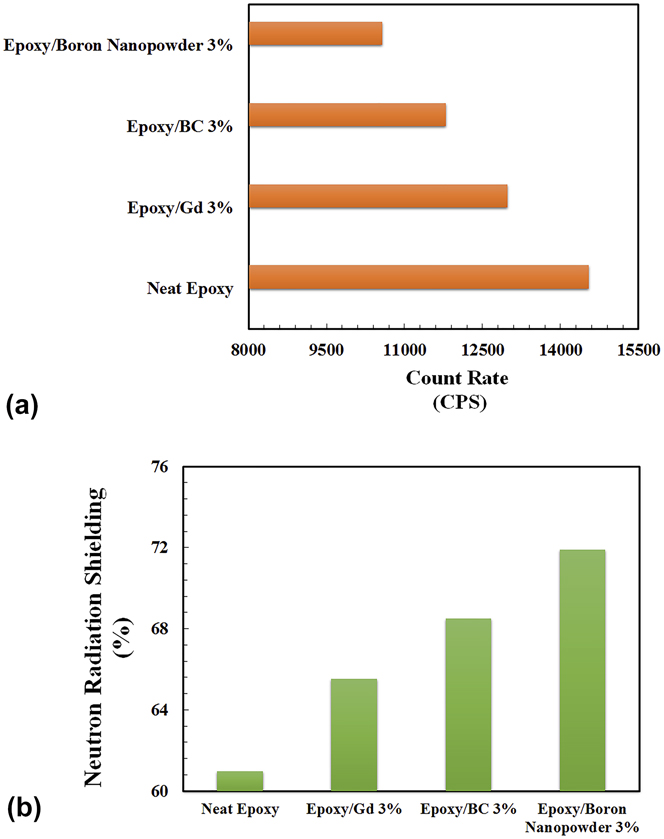
The neutron attenuation is measured using one or two independent counting systems, each consisting of a BF3 neutron detector. Since reactor flux is not constant, precision is improved by monitoring the incident neutron beam and normalizing the test counts and subtracting system background counts. The neutron attenuation results for four samples are shown in Figs. 2(a) and 2(b).
Neutron attenuation results, (a) corrected count rate and (b) shielding efficiency.

As it can be seen from Fig. 2(a), the neutron transmission decreased significantly in the samples that were nanoparticle enhanced, which clearly implies that the neutron shielding efficiency increased [Fig. 2(b)] by introduction of 3 (three) weight percentage of nanoparticles. The results also demonstrate that boron nanopowders provided the highest efficiency to absorb thermal neutrons. Although the gadolinium particles have highest neutron absorption cross section among all elements, they showed lower shielding efficiency in comparison to boron nanopowder, which can be attributed due to their larger particle size and relatively lower dispersion ability into resin matrix. Generally, the enhancement in radiation resistance upon addition of fillers is attributed to the type of filler as well as, uniform dispersion of the filler within the polymer matrix and the size effect of the filler. Reference Kim, Lee, Uhm and Miller14
B. Dynamic scanning calorimetry
DSC was performed to study the effect of particles on curing behavior and glass transition temperature (T g) of epoxy resin. Moreover, the effect of radiation on thermodynamic processes in the composite (such as T g) was investigated.
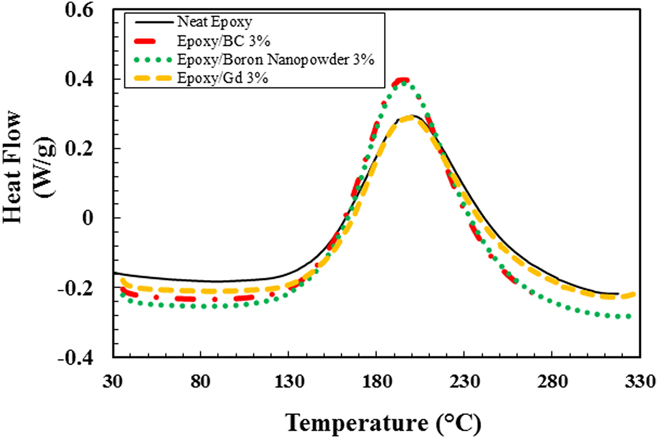
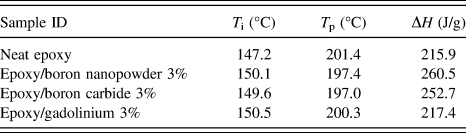
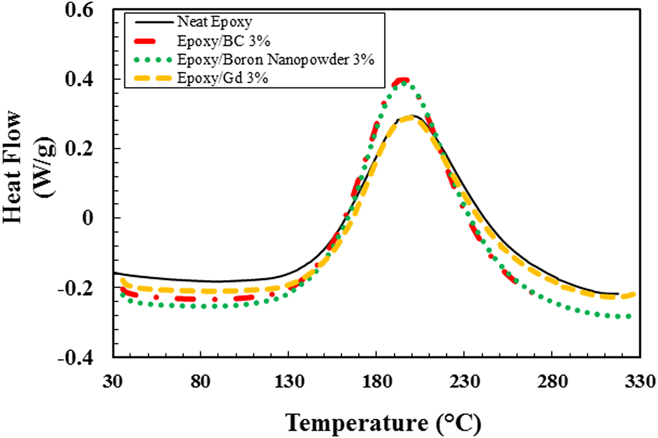
Figure 3 shows the DSC thermograms of EPON 862/W curing reactions and effect of particles on the enthalpy of cure (area under the peak ΔH). As it can be conceived from the DSC data represented in Table I, addition of 3 wt% of particles did not change the cure parameters such as starting temperature (T i) and also the peak temperature (T p). On the other hand, the heat of curing reaction ΔH increased by addition of particles (Table I), and this effect is more significant in case of boron nanopowder due to its smallest particle size and correspondingly larger surface area.
DSC graphs of uncured neat epoxy and its composites filled with 3 wt%: boron carbide nanoparticles; Gd nanoparticle; boron nanopowder.
DSC results for neat epoxy and its nanocomposites.

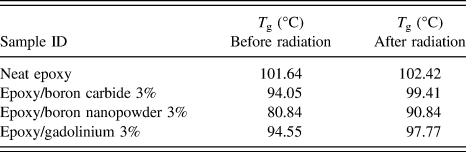
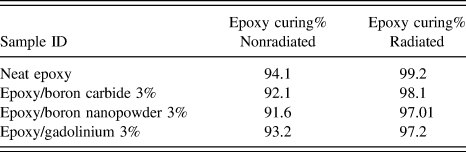
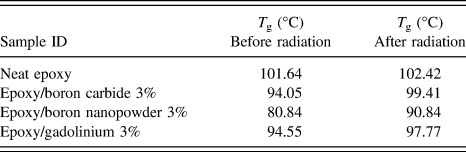
To evaluate the effect of particles on the molecular mobility of polymer chains before and after radiation, DSC (heating rate 10 °C/min) was performed on the fabricated core sheets before and after radiation. Accordingly, the DSC data in Table II show that T g decreases when particles are added to the resin. This can be due to incomplete curing process in epoxy resin molecules and reduction in crosslinking density, as particles hinder the reaction between the EPON 862 epoxy resin and curing agent W. The degree of epoxy curing is calculated based on the following equation considering the residual heat of cure which is usually obtained from the DSC thermographs of radiated and nonradiated nanocomposites:
 $$\% \;{\rm{cure}} = \left( {1 - {{\Delta H_{\rm{T}} - \Delta H_{\rm{R}} } \over {\Delta H_{\rm{T}} }}} \right) \times 100\quad ,$$
where ΔH T is the total enthalpy of the cure for uncured epoxy system, ΔH R is the residual heat of reaction. Table III represents the cure percentage calculations of epoxy resin composites before and after the radiation.
DSC results for T g of radiated and nonradiated samples.
Epoxy curing percentage of radiated and nonradiated samples.

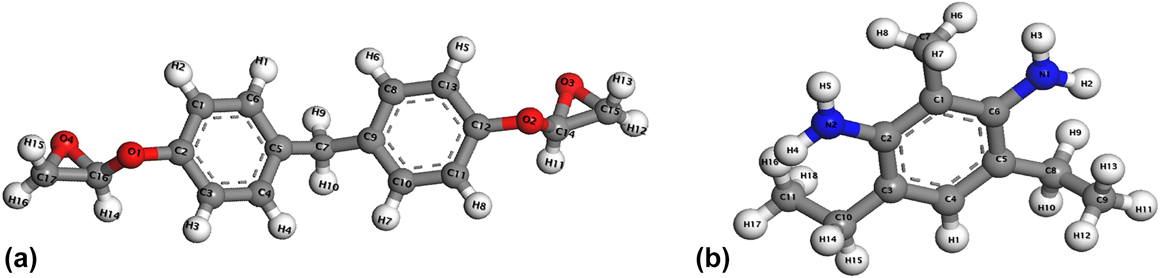
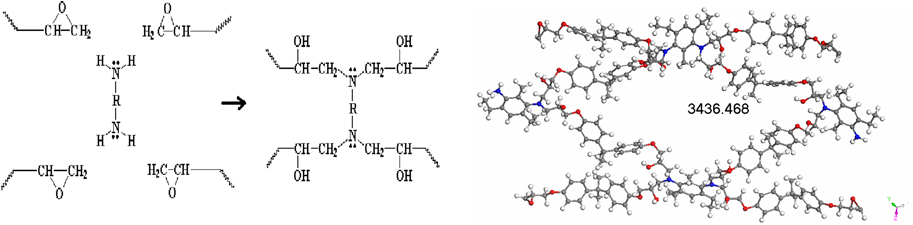
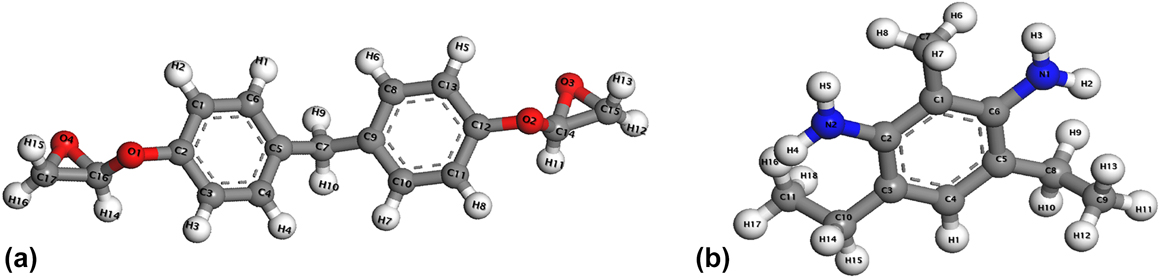
Basically, to achieve the optimum performance of the resin, the mixing ratio of EPON 862 (DGEBF) and W (DETDA) should be maintained as 100:26.4. Figures 4(a) and 4(b) show the molecular structure of EPON 862 and the curing agent W, respectively. Reference Kelkar, Komuves, Mohan and Kelkar35 To satisfy this weight percentage the quad cell typically 8 DGEBF and 4 DETDA are needed for fully cured model as shown in Fig. 5. Reference Kelkar, Komuves, Mohan and Kelkar35
(a) Molecular structures of EPON 862 and (b) curing agent W. Reference Kelkar, Komuves, Mohan and Kelkar35
Development of a unit cell (quad cell). Cure reaction model—on the left side, quad cell built using the cure reaction model—on the right side. Reference Kelkar, Komuves, Mohan and Kelkar35
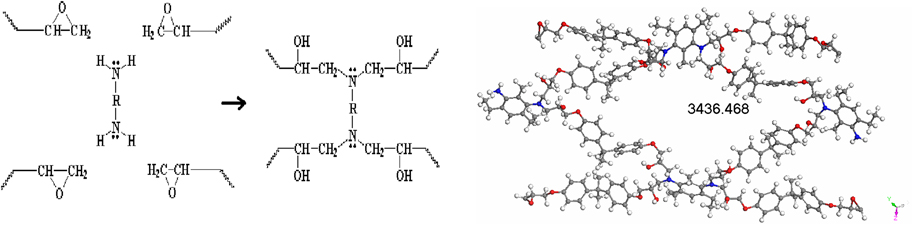
Apparently, the incorporation of nanoparticles into epoxy affects the formation of fully cured quad cell and correspondingly the lattice parameter of unit cell, which consequently changes the density of the mixture and ultimately results in variation of glass transition temperature T g. On the other hand, the increase in T g of each sample after radiation reinforces the aforementioned claim that cure reaction continues in epoxy nanocomposites while being exposed to the radiation resulting into higher crosslinking density in epoxy resin.
C. Thermogravimetric analysis (TGA)
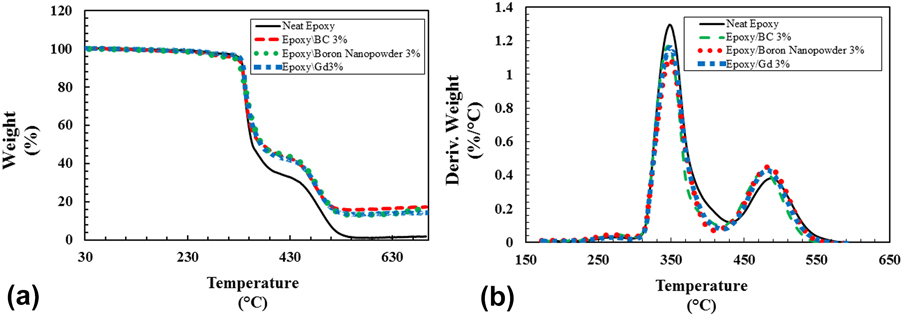
TGA is a valuable and simple technique for the evaluation of thermal stability and decomposition temperature of different materials. Figures 6(a) and 6(b) show the TGA and DTG thermograms of fabricated epoxy composites with various contents. It was observed that both neat resin and composites with 3 weight percentage of nanoparticle loading have similar decomposition profiles [ Figs. 6(a) and 6(b)]. In all four cases degradation took place in two stages. The first stage of degradation was due to the chain breakdown of polymer structure in epoxy cross-linked network and the second weight loss stage was due to the structure conversion or oxidation of aromatic rings in epoxy. Reference Zhang, Yan, Guo, Liu, Jiang, He, Wei, Gu, Colorado, Zhang, Wei and Guo36–Reference Jalali, Molière, Michaud and Wuthrich38
(a) TGA and (b) DTA curves of cured neat epoxy and its composites filled with 3 wt%: boron carbide nanoparticles; Gd nanoparticle; boron nanopowder.
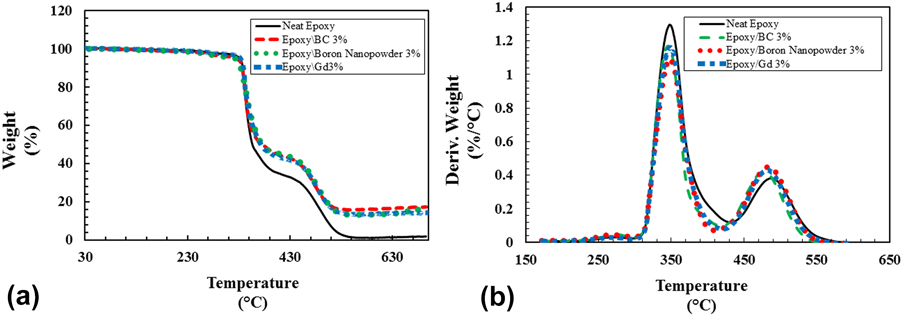
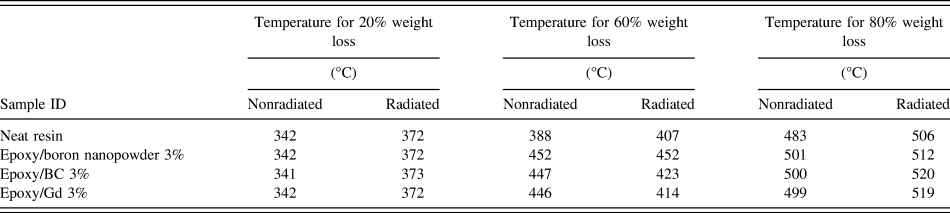
Table IV compares the temperatures for 20, 60, and 80% of weight loss in radiated and nonradiated neat epoxy and its nanocomposites. During first set of experiments epoxy and epoxy composites with nanoparticles were investigated. None of these samples underwent any exposure to the radiation. The results indicate that nanoparticles had little effect on the first degradation stage, as the temperature at which 20% of weight loss occurs was almost identical for all samples. On the other hand, nanoparticles had significant effect on the temperature for the second decomposition stage. It was observed that the temperature for 60% of weight loss ranged from 380 °C for neat epoxy sample to 448 °C in boron carbide, 452 °C in boron nanopowder and 446 °C in Gd nanocomposites. This clearly indicates that the addition of nanoparticles slightly enhanced the thermal stability of the composites and delayed the degradation process. Study shows that all three nanoparticles have very high thermal stability and can act as a heat resistance parts and mass transfer barrier, which results in obstructing thermal degradation process.
Temperatures for 20%, 60, and 80% mass loss of radiated and nonradiated samples.

In the second set of experiments epoxy and epoxy composites with nanoparticles were subjected to radiation. The results of the irradiated samples also indicated the similar trend. In addition, study shows that there was enhancement in thermal stability for irradiated composites with the presence of nanoparticles.
D. Dynamic mechanical analysis (DMA)
DMA can evaluate storage modulus (G′), loss modulus (G″) and tan δ, which are viscoelastic properties of polymers and show the molecular relaxation of the individual component and the interaction among the components in nanocomposite. Reference Lange and Radford39
Figures 7(a) and 7(b) represent the storage modulus and tan δ versus temperature for all four epoxy composites, respectively. As it can be seen, thermomechanical properties of epoxy resin slightly changed by the introduction of nanoparticles. Both storage modulus and the peak of tan δ decreased for epoxy composites when the composites were fabricated using nanoparticles. Nanoparticles can enhance the mobility of polymer chains by increasing the free volume between the interface of nanoparticles and polymer matrix. Moreover, nanoparticles can hinder the curing reaction between polymer and curing agent molecules and consequently decrease the density of crosslinking network. These all can result in slight reduction in storage modulus [Fig. 7(a)].
(a) Storage modulus (G′) and (b) tan δ versus temperature for cured neat epoxy and its composites filled with 3 wt%: boron carbide nanoparticles; Gd nanoparticle; boron nanopowder.

The data also revealed that nanocomposite incorporating boron nanopowder, which has the lowest particle size shows less storage modulus [Fig. 7(b)]. These results are consistent with the aforementioned DSC analysis that demonstrates that boron nanoparticles restrained the curing process of epoxy resin molecules more than other particles. The tan δ, which is the ratio of G″ to G′ is another important parameter related to phase transition and molecular motion. The peak of tan δ is often used to determine T g. Compared with the neat epoxy, nanocomposites showed slightly lower glass transition temperature (T g), which is consistent with the results obtained from DSC.
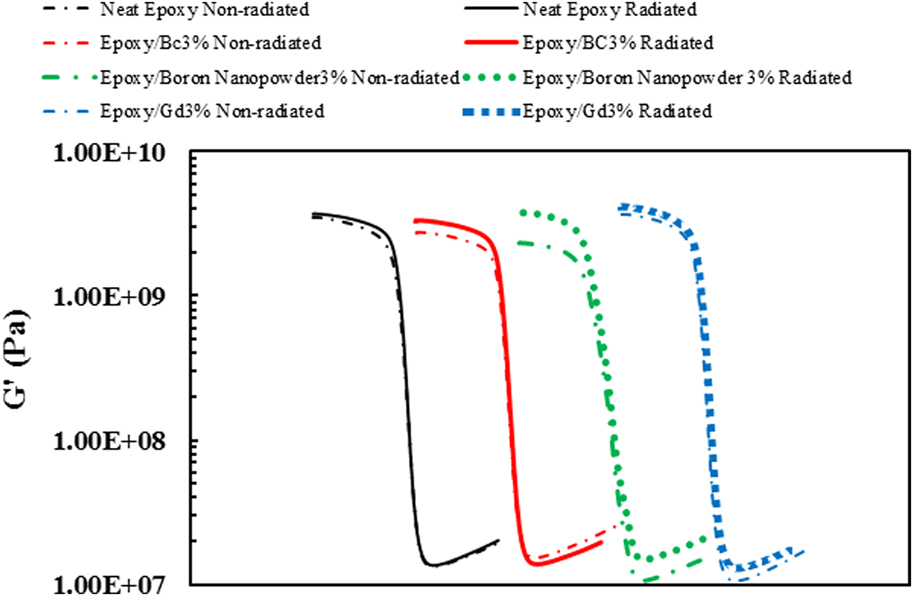
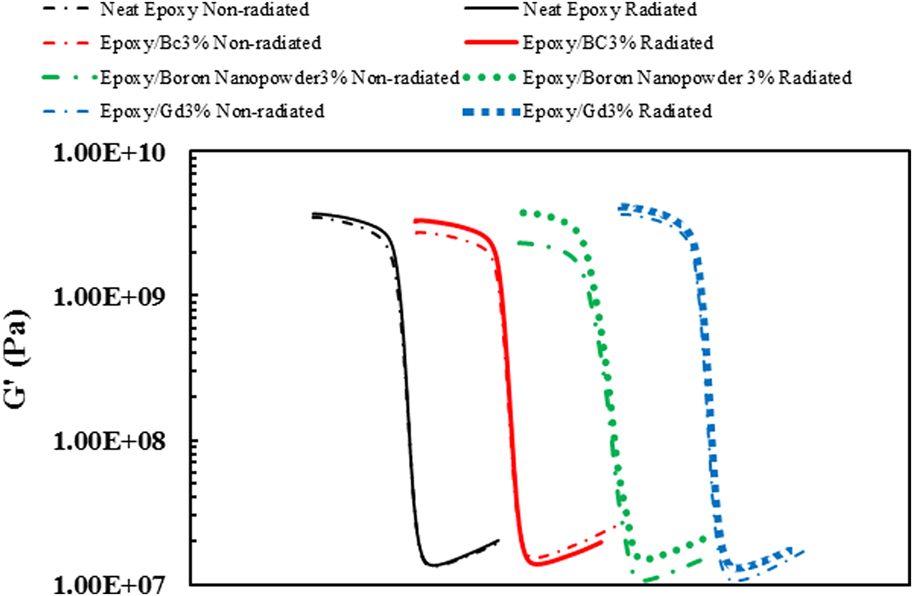
To evaluate the effects of radiation on viscoelastic properties of epoxy nanocomposites, DMA was performed on radiated samples. Figure 8 shows that in comparison with nonradiated samples, the storage modulus in glassy region slightly increased for all radiated samples, which can be attributed to the higher crosslinking as a result of being exposed to the radiation.
Comparison between storage modulus (G′) in radiated and nonradiated cured neat epoxy and its composites filled with 3 wt%; boron carbide nanoparticles, Gd nanoparticle, and boron nanopowder.
E. Morphology
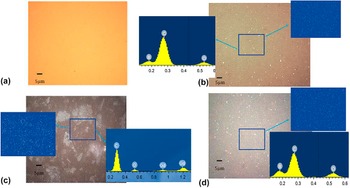
Microstructure of nanocomposites was studied using optical microscope. Figures 9(a)–9(d) show various microstructures of bottom surface of samples and represent the particle size and distribution inside the epoxy resin. It can be observed that the dispersion quality of nanoparticles into epoxy resin differs based on the type of nanoparticles. Although the mixing process was done long enough to ensure the uniform dispersion of particles into the epoxy matrix, due to the fact that the chemical structure and physical properties of particles are different, there are possibilities that particles would have settled down during the cure cycle due to higher volumetric density and/or lack of interaction or bonding with epoxy molecules. In fact, the density of Gd nanoparticles are known to be 7.9 g/cm3, which is much higher than that of epoxy resin (1.17 g/cm3) and higher than that of boron nanopowder (2.37 g/cm3) and boron carbide nanoparticles (2.52 g/cm3). Therefore, particle precipitation during the cure cycle is possible for this nanocomposite [Fig. 9(d)]. The energy dispersive X-ray spectroscopy (EDX) analysis also, as depicted in Fig. 9, shows mappings of boron [Figs. 9(b) and 9(c)] and Gd [Fig. 9(c)] elements at selected regions.
Optical micrographs obtained from the surface of (a) neat epoxy, epoxy composites filled with; (b) 3 wt% boron carbide nanoparticles, (c) 3 wt% Gd nanoparticle, (d) 3 wt% boron nanopowder. Inset in (b) shows the EDX spectra and elemental maps of epoxy/boron carbide nanocomposite, inset in (c) shows the EDX spectra and elemental maps of epoxy/Gd nanocomposite, inset in (d) shows the EDX spectra and elemental maps of epoxy/boron nanopowder nanocomposite.

To further analysis the microstructure of epoxy nanocomposites, fracture surface of neat epoxy and corresponding composites were observed by FESEM [Figs. 10(a)–10(d)]. Figure 10(a) exhibits the smooth and almost featureless fracture surface of unfilled epoxy, representing a brittle fracture behavior and accounting for low fracture toughness. On the other hand, the SEM images of the fracture surface of epoxy nanocomposites show considerably different features [Figs. 10(b)–10(d)]. Upon adding nanoparticles, the fracture surface is much coarser and rough. This rough surface corroborated by the energy dissipation and correspondingly higher fracture toughness, because the crack front needs to move around the particle and energy is required to increase the crack length. Reference Lange and Radford39,Reference McGrath, Parnas, King, Schroeder, Fischer and Lenhart40 Change in particle size and shape can alter the required energy for crack propagation, which can be taken into account as the reason for different fractographic features that are observed in epoxy composites with different nanoparticles.
SEM micrographs of fracture surface. (a) Neat epoxy, epoxy composites filled with 3 wt%, (b) boron carbide nanoparticles, (c) Gd nanoparticle, and (d) boron nanopowder.

F. Effect of radiation on tensile strength
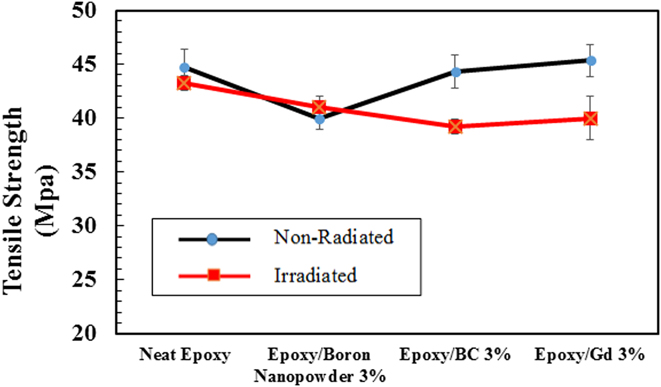
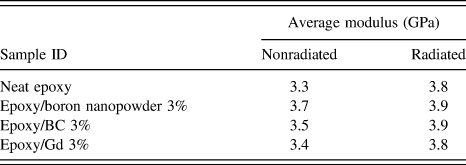
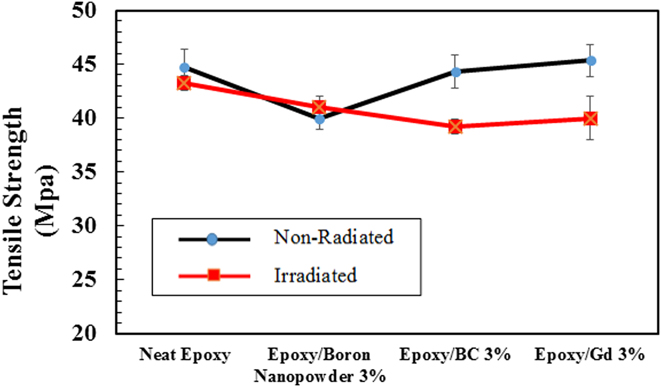
Tensile tests were performed on nonradiated and radiated samples to evaluate the changes in tensile strength and modulus of nanocomposites after being exposed to thermalized neutron radiation. It can be seen from Fig. 11 for nonradiated samples, the addition of nanoparticles had negligible changes in the tensile strength of epoxy, except the composite with boron nanopowder. The observed drop in the tensile strength for the composite contain 3% of boron nanopowder can be attributed to the less cross-linked density in epoxy matrix [Fig. 11]. After irradiation, the tensile strength for the neat epoxy and sample with boron nanopowder had a negligible change, whereas the tensile strength for samples with 3% Gd and boron carbide slightly decreased. This phenomenon can be explained by the fact that when thermalized neutron transmitted through the samples, the cure process continued in epoxy resin and increased the cross-linked density and the higher degree of crosslinking has imparted higher residual stress and resulted the reduction in tensile strength. Moreover, Table V exhibits that after being exposed to the radiation, the modulus remarkably enhanced for each of the tested samples, which agrees with the results from DSC (increase in T g) and as explained earlier that due to radiation, the cure process continues in epoxy resin resulting into higher crosslinking density for all four samples. Reference Arab and Shokuhfar41,Reference Li, Coons and Strachan42
Tensile strength of radiated and nonradiated cured neat epoxy and its composites filled with 3 wt%; boron carbide nanoparticles; Gd nanoparticle; boron nanopowder.
Elastic modulus of radiated and nonradiated samples.

IV. CONCLUSION
The neutron absorption testing was conducted on epoxy and its nanocomposites using thermalized neutrons. The results showed increase in neutron shielding efficiency for all three nanocomposites as compared to the neat epoxy panel. Among three nanoparticles, boron nanopowder provided highest efficiency, which can be attributed to its smaller particle size and inherent radiation shielding properties.
The effects of nanoparticles on viscoelastic properties of epoxy were investigated using DMA. The results showed that particles hinder the cure process in epoxy matrix and consequently decrease the storage molecule and T g, which is consistent with DSC results. In addition, the thermal stability of nanocomposites slightly increased in comparison with neat epoxy sample.
Thermal and mechanical testing was performed to study the structural integrity of nanocomposites after being exposed to the radiation. Thermophysical analysis revealed that T g of each sample increased after radiation as cure reaction completed while being exposed to the radiation, which resulted into higher crosslinking in epoxy matrix. Furthermore, the elastic modulus of nonradiated nanocomposites significantly increased. These studies indicated that the proposed epoxy nanocomposites have significant potential for possible use as neutron shielding structures.
ACKNOWLEDGMENTS
The authors acknowledge the financial support from Joint School of Nanoscience and Nanoengineering (JSNN) and Gateway University Research Park to carry out this research.