Introduction
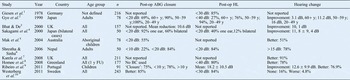
Myringoplasty performed on adults and children is a common operation in otolaryngology. The goal of myringoplasty is complete closure of the tympanic membrane. The principal indications for myringoplasty are threefold, and surgery is carried out with the aim of achieving: (1) a closed middle-ear cavity that is free from otorrhoea; (2) an improvement in hearing; and/or (3) an outcome that enables the patient to swim without having to take water precautions. Successful repair of the tympanic membrane eliminates recurrent or chronic aural discharge and allows the patient to get water in their ears without experiencing pain or discharge. The effect on hearing is less predictable; indeed, many papers on the subject do not report hearing results. Those that do include them report the results in different ways (Table I).Reference Giesen, Khan and Korinth1–Reference Westerberg, Harder, Magnuson, Westerberg and Hyden10 Hearing improvement is reported in a variable proportion of patients, but this is partly because of the different ways in which the results are presented. The degree of audiometric hearing improvement correlates with improved quality of life, as measured by the Glasgow Benefit Inventory, and is therefore a useful outcome measure.Reference Robinson, Gatehouse and Browning11
Case reports of hearing*

* Results following tympanic membrane repair. ABG = air–bone gap; HL = hearing level; y = year; FU = follow up; BC = bone conduction
The main aim of this study was to investigate the change in hearing following successful repair of the tympanic membrane, and to compare this outcome measure with a range of variables that might be expected to affect the hearing outcomeReference Donaldson and Snow12–Reference Ramakrishnan, Panda, Mohindra and Munjal20 using multivariate analysis. This method of analysis was chosen because it was considered likely that confounding variables would produce misleading results if univariate analysis was employed.
Materials and methods
Data from myringoplasty operations carried out in the Department of Otolaryngology of Edinburgh Royal Infirmary were collected prospectively between 1999 and 2009 using a computer database (Lotus Approach). This included data from operations on ears without cholesteatoma, and where no reconstruction of the ossicular chain, mastoidectomy or canalplasty was carried out at the same time. The indication for surgery was the elimination of chronic or recurrent discharge.
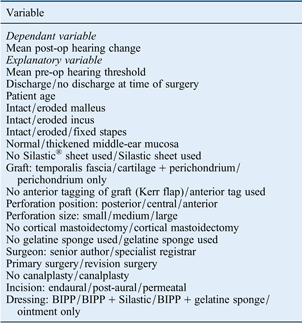
The assessment of the middle ear, tympanic membrane and ossicular chain at the time of surgery was carried out by the senior author (RPM). Perforations were classified as: small (less than 20 per cent of the drum area), medium (20–50 per cent) or large (more than 50 per cent). Pre- and post-operative air conduction thresholds, pre-operative bone conduction thresholds in the operated ear, and air conduction thresholds in the contralateral ear were recorded at 250, 1000 and 20 000 Hz. Mean post-operative air–bone gaps were calculated using pre-operative bone conduction thresholds. The mean change in hearing following surgery was calculated by subtracting the post-operative air conduction thresholds from those recorded pre-operatively. Because the aim of the study was to investigate the effect of successfully closing a tympanic perforation on hearing, only hearing data from ears with an intact tympanic membrane six months after surgery were included in the study. The relationship between the post-operative hearing change and 20 potentially relevant factors was explored using multiple regression analysis. The variables used in the model are listed in Table II.
Multiple Regression Variables
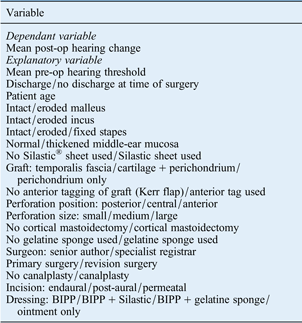
Post-op = post-operative; pre-op = pre-operative; BIPP = bismuth iodoform paraffin paste
Results
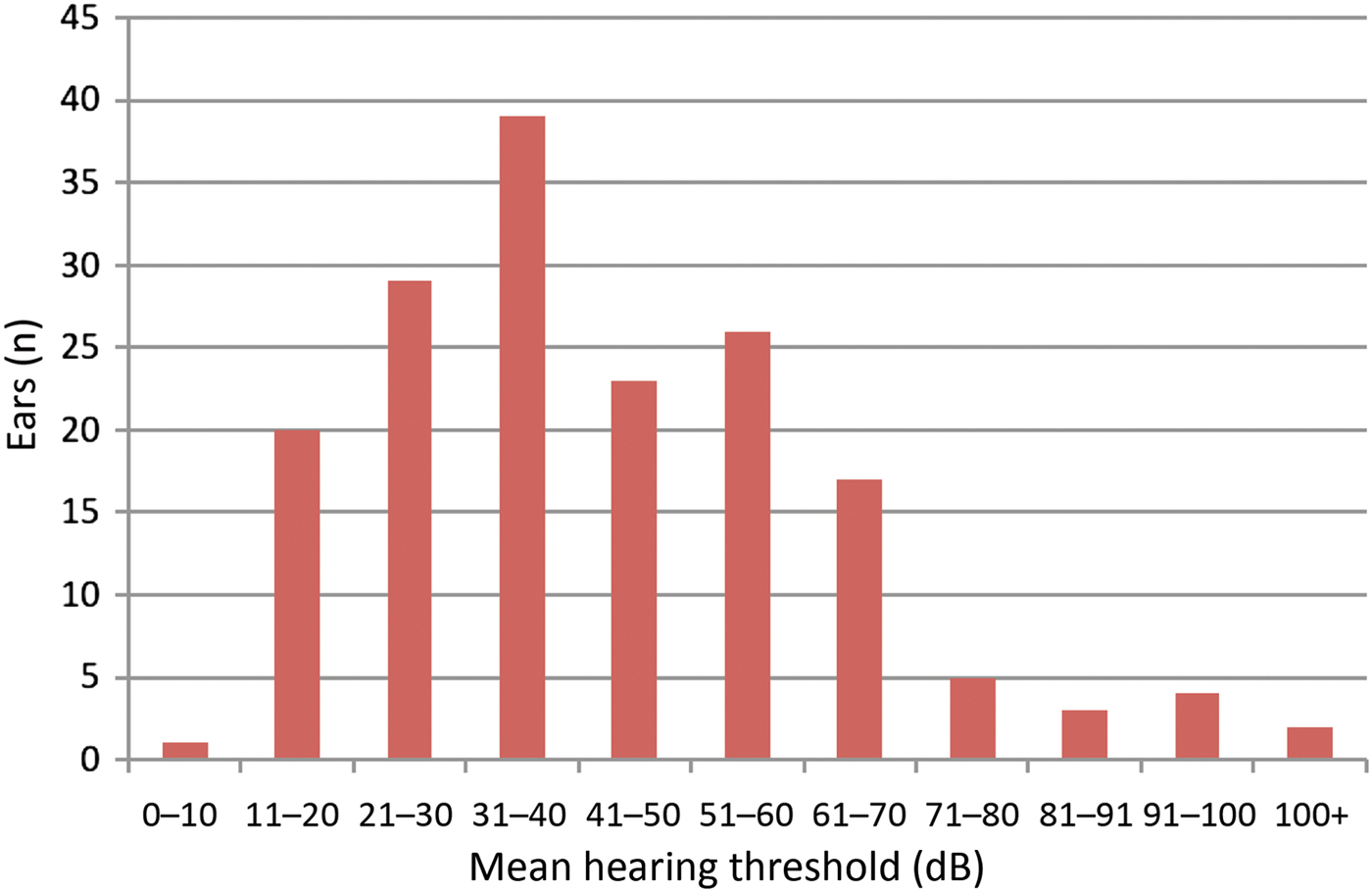
During the study period, 246 operations were carried out. Of these, 203 resulted in an intact tympanic membrane at 6 months post-surgery. The surgery was carried out either by the senior author (RPM) or a specialist registrar working under close supervision. Complete audiometric data were available for 169 operations on 160 patients (8 patients underwent 2 operations during the study period and 1 patient underwent 3). There were 85 males and 75 females in the group. The ages of the patients ranged from 15 to 86 years (mean 47 years). The distribution of pre-operative hearing loss within the study group is presented in Figure 1.
Distribution of pre-operative hearing loss within the study group (n = 169 ears).
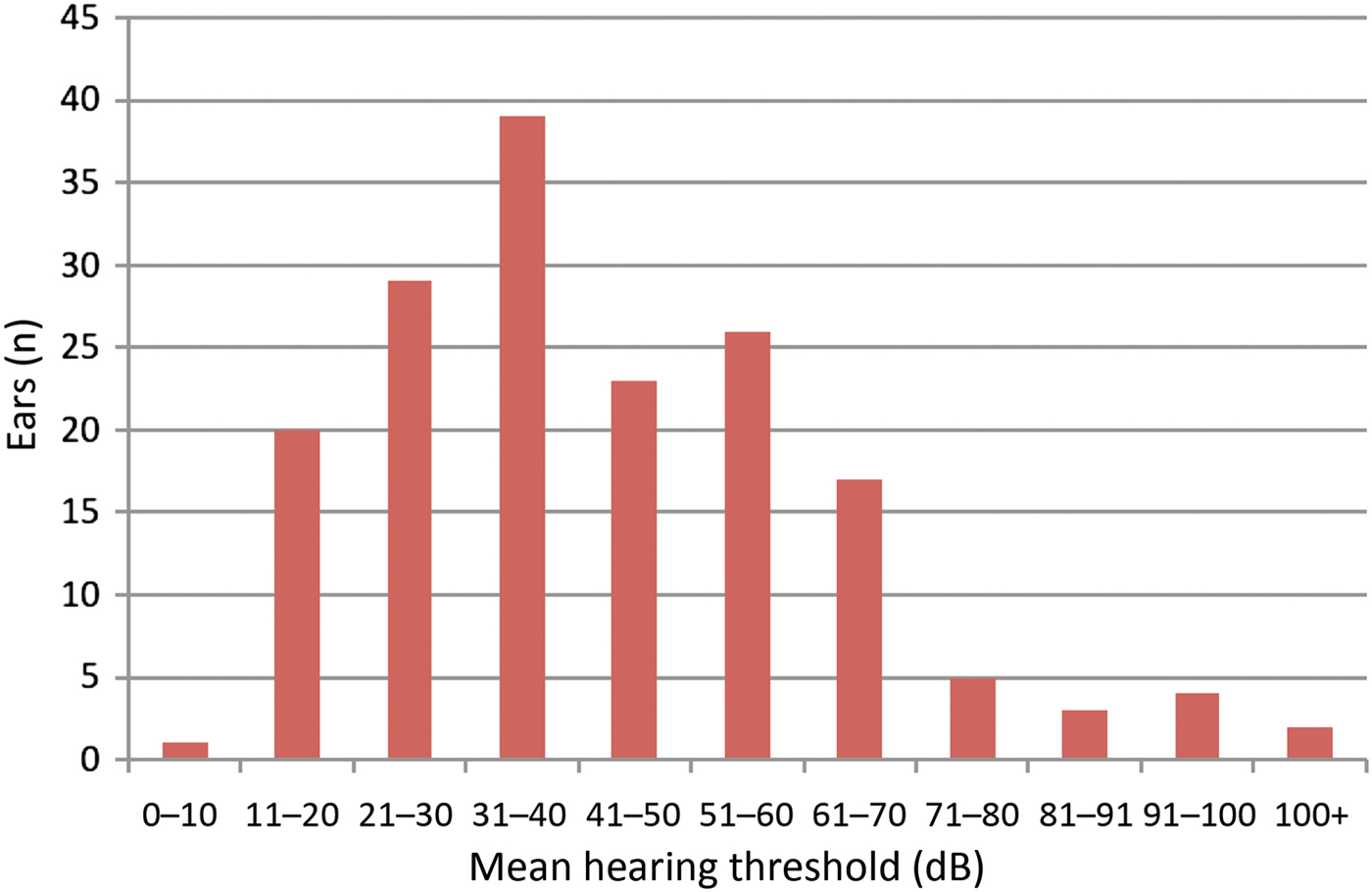
Eighty-nine operations (53 per cent) resulted in closure of the air–bone gap to within 10 dB and 112 operations (66 per cent) resulted in closure to within 15 dB. The mean post-operative hearing threshold was less than 20 dB in 58 ears (33 per cent) and less than 30 dB in 91 ears (54 per cent). Thirteen patients had worsening of hearing greater than 10 dB. Of these, six had erosion of one or more ossicles or ossicular fixation, and an additional five had mucosal disease within the middle ear, with an intact ossicular chain. Six of the patients had hearing losses of greater than 50 dB in the operated ear prior to surgery. Only two patients had a deterioration in their bone conduction thresholds following surgery, but neither of them developed total hearing loss.
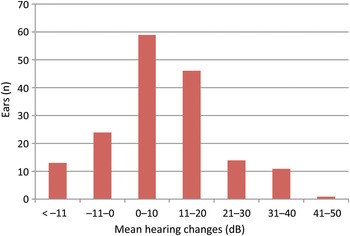
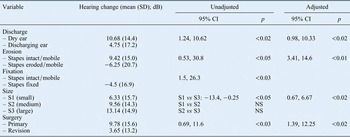
The mean hearing change for the group was +8.3 dB. The distribution of hearing gains is shown in Figure 2, in 10 dB bins. Multiple regression analysis indicated that smaller hearing gains occurred in ears with active discharge at the time of surgery (coefficient −7.2), in ears with erosion and/or fixation of the stapes (coefficient = −10.7), and in revision cases as opposed to primary surgery (coefficient = −6.7). There were greater hearing gains in ears with large perforations than in those with small perforations (coefficient = +3.4). There was no difference in the hearing outcomes between large- and medium-sized perforations or between medium-sized and small perforations. The detailed results for the significant variables are presented in Table III.
Distribution of post-operative hearing gains within the study group (n = 169 ears).

Multiple Regression Results*

* For significant variables. SD = standard deviation; CI = confidence interval; NS = not significant
The assessment of mean post-operative hearing losses using the Glasgow Benefit Plot indicated that 73 patients (45 per cent) had binaural normal hearing (less than 30 dB) following surgery, and 40 patients (25 per cent) had impaired hearing (more than 30 dB) in both ears. In 14 patients (9 per cent), only the operated ear had normal hearing following surgery, while in 35 patients (21 per cent), only the contralateral ear had normal hearing.
Discussion
The hearing results for the operations in this cohort cannot be described as impressive. However, half the operations resulted in technical success, as measured by air–bone gap closure, and in a hearing level sufficient for everyday hearing requirements (30 dB or less). It was clear pre-operatively that some of the patients would not achieve a useful hearing improvement and they were counselled accordingly.
The mean post-operative hearing thresholds were significantly poorer than those reported by previous authors. This may be because most previous study groups either included children or comprised only children, whereas this cohort was derived from an exclusively adult practice and included 54 patients over the age of 50 years and 30 patients over 60 years old. This in turn meant that many of the patients had long-standing chronic otitis media with severe middle-ear pathology and secondary cochlear damage. Gyo et al. Reference Gyo, Yanagihara, Saiki and Hinohira2 compared tympanoplasty results in patients over the age of 60 with those of younger patients. They found that almost half of the older patients presented with significant medical comorbidities. The patients in the older age group had less favourable results in terms of achieving hearing gain, closure of air–bone gap and social hearing. However, their pre-operative hearing levels were significantly lower than those of the younger age group. This was attributed to the high incidence of sensorineural hearing loss and the fact that middle-ear disease was found to be more severe in these patients. This is possibly due to the reluctance of elderly patients to undergo surgery unless absolutely necessary. Gyo et al. concluded that myringoplasty should be undertaken earlier in order to avoid further deterioration of hearing. However, technical advances mean that these patients can now be fitted with hearing aids. This is in keeping with our findings and conclusions.
The primary aim of surgery in this cohort was to eliminate recurrent or chronic aural discharge. The results showed that patients were less likely to obtain hearing improvement if they suffered from chronic discharge that was uncontrollable by medical treatment. However, these patients had more to gain from elimination of their discharge, which was more troublesome than in those cases whose discharge responded to medication. In addition, the fitting of a hearing aid to patients in this group was facilitated by achieving a dry ear. A secondary auditory benefit was thus provided. There were 34 cases without post-operative audiometry on record. This may have been because hearing was not a significant clinical issue in these cases.
Not surprisingly, erosion of the stapes arch and/or fixation of the stapes was associated with smaller hearing gains. Erosion of the incus did not affect the outcome in this way, probably because in such cases the tympanic membrane is able to attach to the stapes head and transmit sound to the cochlea, whereas this is not possible when the stapes arch is missing. Similarly, malleus handle erosion did not seem to have an effect, but this finding was only present in 12 cases so it is not possible to say whether this was a relevant factor in relation to hearing improvement. In addition, it is likely that minimal erosion of the malleus makes little difference to the functioning of the middle ear, whereas loss of the entire handle affects the shape of the tympanic membrane as well as altering the lever ratio.
Patients with large perforations (more than 50 per cent of the area of the drum) obtained larger hearing gains than those with small or medium ones, but only the difference between small and large perforations was statistically significant (Table III). This confirms a clinical impression derived from the senior author's thirty-year experience of otological practice, as well as the results of a previous study carried out in the same department.Reference Lee, Kelly and Mills21 However, in the previous study the perforations were classified as either small (less than 50 per cent of the drum area) or large (more than 50 per cent of the drum area). It is logical to postulate that increasing the effective area of the tympanic membrane by more than 50 per cent will have a greater impact on middle-ear function than an increase of less than 20 per cent.
• Around 50 per cent of tympanic membrane repair patients can be expected to have ‘normal’ hearing in the operative ear post-surgery
• In this series, greater hearing gains occurred following successful repair of large compared with small perforations
• Smaller hearing gains can be expected in patients with ear discharge, erosion and/or fixation of the stapes and in revision cases
The majority of the patients achieved post-operative hearing thresholds which were improved or unchanged, but a minority had worsening of their hearing. These were generally cases with severe disease and/or large pre-operative hearing losses. While the deterioration in hearing was evident from the post-operative audiogram, a number of the patients were unaware of it. This study was not designed to investigate the effect of myringoplasty on bone conduction thresholds, but this has been investigated in a prospective study by de Zinis et al. Reference de Zinis, Cottelli and Koka22
Acknowledgements
We would like to thank Catherine Thomson (Senior Audiologist) and Stamatia Staikoudi (Audiologist) for providing missing hearing data.