INTRODUCTION
Can ordinary citizens in a democracy evaluate the claims of scientific experts?Footnote 1 This problem often arises in multiple contexts, as when we choose our doctors or hear their diagnoses, when we evaluate evidence on juries, or when we assess scientific claims that bear on our votes in elections or our replies to opinion polls. This means that a detailed answer to my opening question will have to be given case by case, depending on specific institutions, historical circumstances, and political contexts.Footnote 2 Yet some scholars have attempted to give general answers to the question, answers which are sharply opposed: a skeptical “no” versus an optimistic “yes, no problem.” This article addresses this basic conflict, arguing that a satisfactory answer requires a first-order engagement in judging the claims of experts that both skeptics and optimists rule out in taking the issue to be one of second-order assessments only. Having argued that such first-order judgments are necessary, I will consider how they are possible, outlining a range of practices and virtues that can inform their success and likelihood.
I use the term “judgment” advisedly to denote an epistemic state distinct from knowledge.Footnote 3 A judgment is a practical assessment of a claim made by someone else or of a state of affairs: it is the assessment of someone who is inquiring into what she should decide or do. The ancient Greeks emphasized the role of the judge in contexts of persuasion which marked their politics, from the assembly to the council to the popular law courts. According to Aristotle, “we may say, without qualification, that anyone is your judge whom you have to persuade” (Aristotle, Rhetoric, II 18, 1391b; cf. I 2, 1356a; in Barnes Reference Barnes1984). But the context of persuasion need not be understood as restricted to deliberate rhetorical attempts. Even if a scientific claim is put forward simply assertorically, once it becomes a question whether or not a citizen believes it, we can consider it as in effect, even if not by external effort, an act of persuasion. When I ask whether I should believe A or not-A, I ask myself by which one I should be persuaded, whether or not those advancing the respective claims made them in order to persuade me or simply in order to record their view of the truth. “Judgment” denotes my exercise of that practical capacity.
But how are we to determine what constitutes good judgment? In this article, I argue that the general approach to answering this question has been unduly limited in the way it frames the question: namely, it focuses on how lay people can identify experts. I survey two opposed positions that have been staked out in this limited program. Both positions utilize what has been called a “novice – 2 expert” frame (Goldman Reference Goldman2001) in which the key issue is choosing between two (or sometimes more) rival putative experts. One camp is skeptical, arguing that the choice reduces to the evaluation of credentials but that such evaluation cannot be done by lay people incapable of understanding expertise in the relevant domain. The other camp is optimistic, contending that citizens are capable both of evaluating the credentials of experts and assessing experts' arguments without having full understanding of their expertise. Not only is each camp is internally unstable, an observation I develop below, but also, both consider the best prospects for citizen judgments to be second-order judgments only, restricted to observing features of the experts' claims and standing rather than to engaging directly with the substance of their arguments. Such unduly narrow limits exclude cases where citizens not only must choose among rival experts but must also evaluate and determine the implications of acting in light of the claims that the experts make. This broader problem of evaluating and determining implications for action generates an additional burden of judgment: citizens must also evaluate the multiple levels of uncertainty that attend most expert claims.
To address this broader and more fundamental conception of the problem of lay judgment of expertise, I develop my alternative account in four steps. Part I compares Alvin Goldman's influential account of the criteria for identifying experts with those offered by Socrates in the Platonic dialogues, demonstrating the considerable convergence between them. Part II contrasts these convergent moderate views with two more extreme views, offered by Scott Brewer (pessimistic) and Elizabeth Anderson (optimistic) about the prospects for lay identification of experts. Having diagnosed difficulties with both extremes and further developed a moderate alternative, Part III develops an account of the ethical norms attaching to both experts and laity in such an ongoing communicative relationship, while Part IV then explores the cognitive tendencies and biases which experts and laypeople tend to share, and the epistemic and aretaic strategies that can counteract these harmful tendencies for both groups. Collectively, Parts II–IV construct and apply the ethics of democratic judgment to which my title refers. Finally, Part V concludes by considering the application of the argument to the dramatic conviction of the members of an Italian scientific risk commission in L'Aquila.
I. CRITERIA FOR IDENTIFYING EXPERTS
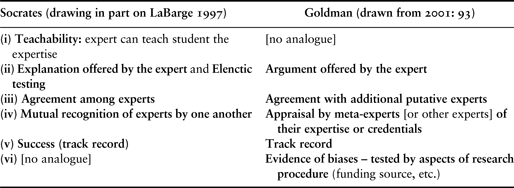
The framing of the question with which I began – whether and how laypeople can judge expert claims – is in fact more characteristic of the sociology of science than of debates in epistemology. In epistemological contexts, the question tends rather to be framed in terms of whether and how laypeople can identify experts, laid out as a “novice-2 experts” problem (Goldman Reference Goldman1999, Reference Goldman2001). Goldman's account of the identifying marks of expertise has striking affinities with the approach taken by Socrates in the Platonic dialogues, texts that are deeply preoccupied with how ordinary people can possibly identify genuine experts and forms of expertise, and how such specialized expertise relates to politics.Footnote 4 Consider the following list of marks of expertise that have been offered by Socrates, Goldman, or both. (I draw on my own analysis of Platonic texts but owe the specific wording and enumeration of items (i) – (v) in the Socratic list to LaBarge Reference LaBarge and McPherran1997; see also Gentzler Reference Gentzler1995.) I have ordered the criteria to bring out the parallels that exist in four out of the six cases: explanation offered; agreement among experts; mutual recognition of experts; and success or track record. Socrates adds one criterion (listed here first) – the expert's ability to teach the expertise – that has no parallel in Goldman, while Goldman adds one criterion (listed here sixth) – evidence of biases – which has no parallel in Socrates.
To the Socratic eye, the criteria of explanation, agreement, mutual recognition, and success are at once necessary and insufficient for the layperson to recognize a true expert (though they might be sufficient for one expert to recognize another). For how can the layperson be sure of what counts as a good explanation, or success – and how can she know whether agreement and mutual recognition constitute real evidence of expertise or simply a successful con game? Teachability seems to be the only failsafe route, though even that has a self-certifying aspect: teachability works either by converting the layperson herself into an expert and thereby dissolving the original terms of the problem, or by teaching someone else, in which case the original non-expert is still none the wiser.
Nevertheless, the Socratic versions of the criteria do play a useful role. In particular, the idea that claims offered by an expert can be tested as to whether they lead to contradiction of other claims that the same expert wishes to accept – the Socratic method of the elenchus – allows the non-expert a systematic route to discrediting would-be experts. If a putative expert cannot put forward an account of her expertise (in Socratic terms, a definition) which she wishes, and is able, to go on defending after its contradiction of other claims she accepts has been manifested, then it is a good bet that she is not an expert after all. This Socratic approach to enabling laypeople to test the first-order claims of experts is one that I will develop further below.
Goldman is less troubled than Socrates by the second-order and potentially circular nature of the agreement and mutual recognition criteria. In the modern world in which expertise is far more bureaucratically elaborated than it was in ancient Athens, the rationality of relying on professional recognition and accreditation seems more secure. But the con game problem cannot simply be met by general appeals to the inevitability of relying on testimony: we may not be able to escape our reliance on testimony, but that does not underwrite all testimony as inviolate, especially testimony offered by relatively closed professions with particular sectoral interests and concerns. Explanation, at least in the negative Socratic form, remains crucial. Track record – if we expand that to include relevant experience as well as putative successes – is also a valuable clue. True, one needs to have confidence that the goals and standards for success of a track record are appropriate and valuable. But pace Estlund (Reference Estlund, Copp, Hampton and Roemer1993, Reference Estlund2008), lay judges may be able to set and identify goals and to measure success without being able themselves to reproduce the means by which it was achieved.
II. OPPOSITE CAMPS: SKEPTICAL AND OPTIMISTIC APPROACHES TO NON-EXPERT JUDGMENT
Socrates and Goldman offer complementary moderate views of the possibility of identifying experts: Socrates probably mildly pessimistic, Goldman mildly optimistic. Yet at the extremes, we find two starkly opposed perspectives on the prospects for solving the “novice-2 expert” problem. At one extreme is the view that such identification of experts is so difficult as to be effectively impossible; at the other is the view that such identification of experts is relatively robust and straightforward. I will consider Scott Brewer (Reference Brewer1997–98) and Elizabeth Anderson (Reference Anderson2011) as exemplars of each respective pole. My analysis will suggest that Brewer effectively makes the “novice-2 experts” frame into a “novice-hired gun” frame in which either or both experts might be frauds, but the audience is forced to choose between them; Anderson by contrast converts it into a “novice-crackpot/expert” frame, treating the choice between 2 experts as actually a choice between an expert and a fraud. Anderson does not discuss the ways in which lay people might need or be able to engage with the substantive first-order claims, including the uncertainties, that the experts make; Brewer denies that they will be able to do so. (Another way of putting this is that Anderson lacks interest in cases where the competing experts are all genuine, while Brewer's skepticism means that he treats such cases as on a par with expert-fraud cases.)
Since the skeptical argument, if sound, would block both the possibility of epistemically warranted choice between rival experts and the possibility of any broader lay evaluation of expert claims, it is useful to consider it first. One classic expression of skepticism was advanced by John Hardwig (Reference Hardwig1985). But Hardwig was motivated by a concern with epistemic dependence, arguing that we exhibit an objectionable lack of “epistemic autonomy” when we rely on theoretical or practical experts at all. Hardwig's claim was not that we can't judge between experts but that in doing so, we deprive ourselves of the value of an autonomous life. Thus a more relevant example of the skeptical case is one offered by Scott Brewer (Reference Brewer1997–98). While Brewer's discussion focuses on the non-expert figures of both jury and judge in American courts of law and so is shaped in details by that particular context, the American courtroom is precisely a venue in which the “novice-2 experts” problem is pervasive.Footnote 5 Considering Brewer's skepticism about the severely epistemically constrained conditions of the American jury will exhibit its severe limitations, however, in helping us to think about the broader epistemic relations between laypeople and scientific experts.
Treating as rare cases in which a putative expert's explanatory reasoning can be uncontroversially seen to be rationally incoherent (Brewer Reference Brewer1997–98: 1617–18), Brewer takes as his standard case one in which two dueling experts are both so plausible in their arguments and explanations that it is impossible for the non-expert to distinguish between them on those grounds. That leaves the choice between experts to be made on the basis of “credentials, reputation, and demeanor” (and in fact reputation quickly collapses into credentials). Notice that this assortment of external criteria leaves out experience, argued by Collins and Evans (Reference Collins and Evans2007) to be the most reliable as well as the most appropriately inclusive such criterion. Demeanor, Brewer argues, can be mere posturing cultivated by the “market for demeanor.” Credentials, on the other hand, are not self-certifying: assessing credentials requires “a reasoning process” (Brewer Reference Brewer1997–98: 1538, emphasis in original) which laypeople are incapable of properly deploying. According to Brewer, to assess a credential one needs a full understanding of the expertise it certifies, but to gain that understanding one would need a credential, but to obtain and assess that credential, and so on, in an infinite regress.Footnote 6 Brewer sums up:
[T]he nonexpert's lack of epistemic competence threatens to deprive her of precisely the kind of understanding she would need to be able to confirm or disconfirm a hypothesis about credentials and their capacity accurately to identify which experts are capable of producing KJB [knowledge and justified belief, treated indiscriminately (1601)] and which are not. (Reference Brewer1997–98: 1669)
He concludes that there is “compelling reason to doubt” that non-expert judges or juries can make a non-arbitrary assessment of the epistemic issues at stake in expert testimony. Therefore, as a standard for legal legitimacy, “intellectual due process” requires an alternative procedure:
The only solution (actually, it is a family of solutions) I see requires that one and the same legal decisionmaker wear two hats, the hat of epistemic competence and the hat of practical legitimacy. That is, whether it is a scientifically trained judge or juror or agency administrator, the same person who has legal authority must also have epistemic competence in relevant scientific disciplines. (Reference Brewer1997–98: 1681, emphasis in original)
This solution is, however, doubly unstable. On the one hand, a scientifically competent judge who is in a position to evaluate scientific credentials properly would thereby be in a position to enter into the scientific reasoning and explanations as well: she would not limit herself merely to assessing credentials. So the solution would go beyond the narrow limits Brewer sets. On the other hand, precisely what level and specificity of scientific training would be required to wear the “hat of epistemic competence”? Brewer concedes that a PhD would not be required (he seems to be talking about something like a university degree in the sciences).Footnote 7 Furthermore, it is implausible that the degrees of such judges could be exactly matched to the expertise at stake in any given trial (not least because multiple disciplines may be relevant to a single case). So we must ask: how precisely would Brewer's envisioned requirement of an undergraduate degree in some scientific discipline equip a judge to assess the arguments of rival experts, let us say, in another discipline?
In fact, this conception of “epistemic competence” conflates diverse levels and sources of expertise. Following Collins and Evans (Reference Collins and Evans2007: 14, 35, and passim), we may distinguish between the “contributory expertise” needed to participate in the activity and advance its objectives, and the “interactional expertise” which involves an ability to talk about the activity and to understand talk about it without being able to contribute to its being done or to teach anyone else how to do it.Footnote 8 While not all laypeople will enjoy interactional expertise – its acquisition can be itself demanding – its existence opens the door to a spectrum of possibilities which cannot be arbitrarily restricted to a binary expert/lay divide. Instead of a “novice-2 expert problem,” we can develop a continuum of roles and experience which can afford novices certain competences distinct from those of the experts but not unrelated to them. Drawing a putative bright line between experts and non-experts, as Brewer attempts to do by putting those scientifically trained as undergraduates on the “expert” side for courtroom purposes, actually raises new possibilities as to how those two groups might be related, might interact, and might even be defined. Indeed, the idea of a continuous family of relationships to expertise means that we need not necessarily reject the possibility of a jury in favor of a single judge, as Brewer does. Especially in contexts allowing for the development of more two-way communication than is possible between a lay jury and testifying experts in a jury trial, we may be able to find grounds for further confidence in lay judgments of expert identity and claims.
We can turn once again to Aristotle to develop this point. In Politics book III, chapter 11 (translation in Reeve Reference Reeve1998), Aristotle's concern with expertise is brought out in his choice of analogy, defending the popular ability to judge experts such as doctors. (I argue in Lane Reference Lane, Deslauriers and Destrée2013 that the institutional manifestation of “judging” in this chapter is electing and inspecting officials.) He gives a stark statement of the objection that experts such as doctors can be inspected or audited only by their expert peers: “just as a doctor should be inspected by doctors, so others should also be inspected by their peers” (1282a1–3). To this he replies by distinguishing levels of education in most crafts including medicine. One might have a general education in a craft; be an ordinary practitioner of it; or be a master craftsman. All these can judge (it is implied) even the master craftsman.
Now what is striking about this passage is that Aristotle says that all three kinds of people are called “doctor,” and that he seems to take the status of a “general education in a craft” to apply very broadly (insofar as this conclusion is meant to defend the overall thesis endorsing participation of the general multitude in electing and inspecting officials) (1282a3–5). This can't be a specialized education. It must be more like the involvement of ordinary people, say, in medicating their children at home and so in sharing in medical practice and concerns. Aristotle's reply further erodes any sharp boundary between popular and expert knowledge, or what can be more properly considered popular judgment and expert knowledge. They are certainly distinct, but they fall on a continuum, and there will be certain habits of mind shared between them.
With such possibilities in mind, we may briefly turn to the opposite pole on the question of lay identification of experts: an extreme exemplified by Elizabeth Anderson (Reference Anderson2011). Anderson operates within the broad framework of reliance on testimony by others, setting up the problem as one in which ordinary people need “criteria of trustworthiness and consensus for scientific testifiers” (Reference Anderson2011: 145). Her approach is to agree with Brewer's official position (different, as I have argued, from the upshot of his view) that laypeople cannot enter into the substance of expert arguments and explanations. Nevertheless, she views credentials as only one of three routes for them to make reliable decisions about which experts to trust (and is untroubled by the thought of any regress here). Alongside credentials are two additional kinds of “second-order judgments” about whom to believe, relieving ordinary citizens of the need (to do which she assumes most are not capable) of engaging in first-order assessments of the merits of scientific claims (Reference Anderson2011: 145). These criteria are honesty, tested in practice by absence of evidence of external conflict of interest and also of misleading statements; and epistemic responsibility, which is tested in practice by the willingness to accept external peer review and to abide by evident canons of dialogic rationality in argument (not simply repeating a claim without acknowledging a prior objection, for example). Anderson herself insists that all these three routes – credentials, honesty, and epistemic responsibility – should be understood as wholly “second-order” (her term as well as mine). Laity need not understand the arguments of scientists in order to spot their conformity (or lack thereof) with these second-order canons.
As I argue below, Anderson's conceptions of honesty and epistemic responsibility are powerful and can be further expanded. Nevertheless, her account suffers from a more general flaw. For whereas Brewer stages his story as a duel between equally plausible hired guns, Anderson frames hers as a lopsided battle between a dominant group of credible scientists and a few “crackpots” (2011: 146–7). This seems part of what leads her to be untroubled by the prospect of rival credentials, since she envisages respectability – and widespread agreement among scientists – as the property of only one side.Footnote 9 While this may be an accurate portrayal of the dynamics of climate change science and its deniers, it is not adequate as a general portrayal of the problem of lay judgment of scientific expertise, even of the “technical scientific questions” on which she focuses here (Reference Anderson2011: 146). Not all cases in which citizens must judge expertise fit either Brewer's or Anderson's schemata. On the one hand, there may be a more even distribution of epistemically respectable views, and also a wider spectrum of them. On the other hand, citizens in many real-life scenarios do not need merely or primarily to choose between rival experts or to root out a few obvious frauds. Rather, they need to decide how to assess and use what the spectrum of scientific expertise on a given issue reveals, a broader problem which is likely to be accompanied by the need to cope with multiple levels of uncertainty. The presence and extent of uncertainty points to the need for a more intensive “first-order” engagement with scientific claims than Anderson's confident solution to a problem she conceives as wholly “second-order” allows.
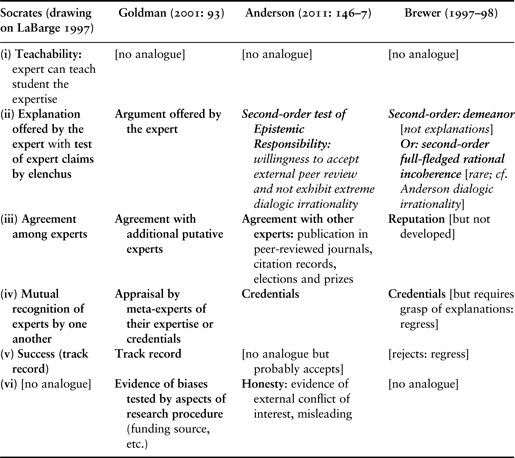
These points can be drawn out from Table 2, which summarizes the views we have canvassed so far. (The entries for Anderson and Brewer in row (ii) are italicized to show that they are not true analogues for the Socratic or Goldman criteria there: they are second-order substitutes for expert explanation, not expert explanation itself.)

We may draw three interim conclusions. First, the dominant framing of the problem of lay judgment of scientific expertise is skewed by its focus on the second-order problem of identifying experts, neglecting (or denying) the possibility and need for citizens to engage directly with experts' arguments and claims. Second, the internal undoing of a skeptical denial of citizens' capacity for first-order engagement points in a helpful direction, suggesting that a continuum of forms of judgment and knowledge may be cultivated. Third, the internal undoing of an overconfident anti-skepticism points in the same broad direction: any solution to the general problem cannot limit itself to second-order identifying marks, but must rather develop a richer conception of epistemic responsibility and honesty which is rooted in and makes possible an assessment of first-order scientific claims.
III. MODELING SCIENTIFIC–LAY COMMUNICATION
We are now in a position to recognize that, despite representing opposed camps on the question of whether laypeople can identify experts and expose frauds, Anderson and Brewer actually share an important unspoken presumption. Both envisage first-order scientific reasoning as effectively insulated from laypeople, who are reduced to being mere observers of external indicia about the scientists in order to decide whose package of arguments to accept, though Anderson thinks these indicia extend to eavesdropping, as it were, on debates among the scientists themselves to test whether dialogical rationality or irrationality is being exhibited. Even in Anderson's turn toward communicative norms, she identifies these norms as applying within settings of scientists debating among themselves, rather than applying directly to the communicative act between scientists and laypeople.
Lay judgment of scientific expertise, however, depends precisely on construing and assessing that expertise as communicated to a wider public. Such communication is misunderstood if it is conceived as simply the public overhearing internal scientific debates.Footnote 10 Rather, as science studies and the social studies of the science movement have emphasized, communication can only be understood when the norms, attitudes, and expectations of both parties are taken into account. Diverse publics do not merely accept or reject science, nor do they simply possess or lack scientific knowledge (Brossard and Lewenstein Reference Brossard, Lewenstein, Kahlor and Stout2010, Russell Reference Russell2010). Rather, they filter scientific communications through the lens of distinct frames, purposes, and preexisting knowledge and attitudes. (This may even include forms of “lay expertise,” a contradiction in terms for the problem as both Anderson and Brewer construe it, but the view that Collins and Evans defend.) If so far I have argued that lay judgment of scientific claims is sometimes necessary, I will now turn to explore how it is possible, and how the prospects for it might be enhanced. My discussion will focus on both the ethical and the epistemic norms that will inform successful lay judgment.
Lay judgment can be explicated by appeal to the “agency model” of communication developed by philosophers Neil Manson and Onora O'Neill in their work on bioethics, Rethinking Informed Consent in Bioethics (Reference Manson and O'Neill2007). Criticizing the prevalent “conduit” and “container” metaphors that treat informing as a one-way dumping of undifferentiated data, they explain that such metaphors obscure the fact that “communicating and informing are types of action and interaction, so depend on a normative framework against which such action succeeds or fails” (Reference Manson and O'Neill2007: 27, emphasis in original). They spell out the implications of this view as follows:
Acts of informing (and communication more generally) only succeed within a rich practical and normative framework in which speaker and audience (a) have certain practical and cognitive commitments; (b) know something of each other's cognitive and practical commitments; (c) adhere to, and act in accordance with, relevant communicative, epistemic, and ethical norms; and (d) assume that the other party is acting in accordance with such norms. The conduit and container metaphors hide, or radically downplay, these essential aspects of communicative activity. (Reference Manson and O'Neill2007: 40, emphasis in original)
On this understanding of the nature of communication, certain norms will be integral to the success of speech acts as such: they impose epistemic requirements that are also concomitantly ethical ones. While it is not possible to give an exhaustive list of such norms since norms can be divided in various ways, Manson and O'Neill develop in the same work a useful categorization of the more significant norms that are likely to be included in any classification (this listing is a direct quotation):
1. Norms needed for speech acts to be accessible and relevant to intended audiences (e.g., intelligibility, relevance);
2. Norms needed for speech acts, and especially those that make truth claims, to be adequately accurate and assessable by intended audiences (e.g., not lying, deceiving or manipulating; aiming for accuracy; not misleading in other ways; providing relevant qualifications and caveats). (Reference Manson and O'Neill2007: 64, emphasis in original)
These norms derive from the general nature of communication and, in particular, of communication intended to inform. In related work (Keohane, Lane and Oppenheimer, forthcoming), I develop with co-authors a list of the particular ethical norms relevant to scientists as they communicate with elite lay audiences such as policy-makers and the policy community (in particular, we consider the communication of the results of scientific assessment studies such as those produced by the IPCC). The list includes: honesty, precision, audience relevance, process transparency, and specification of uncertainty about conclusions. Our argument is that honesty (precluding misstatement and manipulation) is non-negotiable, whereas the other four may have to be traded off in order to achieve the overall goal of effective communication. We have developed this understanding of honesty in scientific communication along similar lines to (and inspired by) Anderson's norm of epistemic responsibility in scientific research itself. In both contexts, scientists must demonstrate not only transparency and honesty but also a willingness to subject themselves to external peer review and to evince dialogic rationality in their responses to criticism.Footnote 11
For present purposes, what matters is that the ethics of lay democratic judgment must broadly match the ethics of scientific communication, each giving rise to the other through a process of “reverse engineering.”Footnote 12 We can expect them to match most fundamentally because both speakers and auditors in the case of scientific communication with non-experts share the epistemic role of being inquirers (Fischer Reference Fischer2009: 160). Scientific speakers are sharing the results of past inquiry; lay auditors are engaging in current inquiry when they listen to and evaluate those results. They are therefore engaged in a mutually iterative process, even if a given act of communication is framed as directional, from speakers to auditors. (My adoption of the terminology of “speakers” and “auditors” below should be understood in this context, as referring to roles in one particular act of communication, but not ruling out reversal and exchange of roles in others. Whether the oral connotations of these terms is the best choice, or we should instead speak of “writers” and “readers” in the context of the web in which so much communication now takes place, is a matter for further consideration.) That mutually iterative framework offers a richer and more dynamic canvas for lay assessments of scientific expertise than the simple one-way container model that the Anderson and Brewer accounts, like many others, presuppose.
Without going into detail for each of the norms on the side of the scientists (which is not the focus of this paper), let us develop a set of corresponding norms for their lay addressees. In each case we will find that a set of epistemic virtues is required in order to develop the ability and disposition to comply with the norm.Footnote 13 To begin with honesty: honesty is not limited only to the disclosure of external conflict of interest and the avoidance of misleading statements on the part of scientists which Anderson classed under that name. As Linda Zagzebski explains:
[I]t is not sufficient for honesty that a person tell whatever she happens to believe is the truth. An honest person is careful with the truth. She respects it and does her best to find it out, to preserve it, and to communicate it in a way that permits the hearer to believe the truth justifiably and with understanding. (Zagzebski Reference Zagzebski1996: 158)
Zagzebski suggests that honesty (which she classes initially as a moral virtue) requires a range of intellectual virtues. And as their shared goals as inquirers would suggest, the virtues she describes are applicable to speakers and to auditors alike. The honest person “must be attentive, take the trouble to be thorough and careful in weighing evidence, be intellectually and perceptually acute, especially in important matters, and so on, for all the intellectual virtues” (Zagzebski Reference Zagzebski1996: 159).
Accuracy and process transparency are more one-sided in the way that they apply differentially to speakers and auditors, yet even here the communicative relation connects them. For speakers, accuracy and process transparency must be gauged in relation to the need to be intelligible to their intended audience. But speakers cannot, of course, always know that audience precisely or delimit it in advance. They have a responsibility to make clear their intended audience, so that auditors can gauge the trade-offs that have been made in aiming to communicate with the audience that the speaker envisioned. But auditors therefore have a corresponding responsibility to assess speakers in relation to their intended audiences, taking account of the limitations and possible misconceptions in the speaker's knowledge of the intended audience and of any divergence between that intended audience and the actual audience. This principle is especially important for cases of “overheard” speech or “over-the-shoulder” seen writing, such as leaked emails or leaked accounts of strategy sessions in formulating scientific assessments. In the “Climategate” emails, for example, advice about how to formulate communication was “overheard” in a way that cast doubt on the content of the communication itself. There are norms, of course, for formulating communication, and it is a separate question whether the emails breached those norms. The point is that every “speaker” goes through an internal process of fine-tuning her message before making it public; to fail to recognize the trial and error nature of such fine-tuning is to apply the wrong interpretative frame, which is likely then to distort the substantive and normative judgment of the fine-tuning process itself.
Of most interest for this article are the norms for communicating uncertainty, norms that are very much in play in the L'Aquila case. Neither Anderson nor Brewer takes any account of uncertainty as an important feature in scientific discourse. Anderson seeks to give people reason to trust evident experts against crackpots; Brewer is skeptical that people can tell the difference between plausible fakes and real experts, or choose between rival hired guns, at all. For neither is uncertainty central to the story. Yet uncertainty at multiple levels will be ineradicable from virtually any real-world incarnation of the fundamental problem we are considering. For these purposes, “uncertainty” is closely related to risk assessment. Although in some contexts scientists distinguish between uncertainty (in particular, Bayesian uncertainty, where frequencies of events are not known) and risk (where probabilistic assessments are made on the basis of known frequencies), this distinction is complicated by the fact that what is called “risk modeling” is undertaken precisely to offer a way of thinking about probabilities in the absence of frequency information. Many discussions of uncertainty and risk in practice tie them closely together, as in the important work on heuristics and biases in risk assessment (for a classic account, see Kahneman et al. Reference Kahneman, Slovic and Tversky1982).
For heuristic purposes, we may distinguish three different varieties of uncertainty as follows (far more finely grained classifications are also possible). First, there are uncertainties that are intrinsic to the scientific phenomenon being studied. For example, there are uncertainties in the weather system which no method of study could hope to eliminate. Second, there are uncertainties that are conditional on the present state and methods of scientific inquiry. These include both uncertainties about which model to use, and about how to set the parameters of a given model (“structural” or “model” uncertainty and “parameter” uncertainty, respectively). Third, there are what I will call “competitive uncertainties,” a special form of uncertainty which arises from the phenomenon of disagreement, whether between one scientific team and another in the same subfield, or between one subfield of science and another, or so on. These forms of uncertainty may be present at the same time or not. Competitive uncertainty often arises in part from some underlying intrinsic or conditional uncertainties.Footnote 14
Any or all of the three varieties of uncertainty distinguished above may be viewed differently by the speakers (presumed to be the scientific experts) and their auditors. Competitive uncertainty among scientists, for example, may or may not lead scientists to have less confidence in their own findings so far as they go. But lay audiences who hear about competitive uncertainty between scientists on certain points may become more uncertain about all the claims those scientists make, even those which scientists agree in regarding as relatively certain.
Despite these potential divergences between speakers and auditors in responding to uncertainties, I want to stress some important and deeply shared commonalities among both experts and non-experts in their typical responses. Expert speakers and lay auditors share a general tendency to what has been called an “overconfidence bias” (Sterman Reference Sterman2011: 816) in relation to uncertainty. A review article on climate change in Nature concludes that “uncertainty breeds wishful thinking” and “promotes optimistic biases,” leading individuals to “often misinterpret the intended messages conveyed regarding the probabilistic nature of climate change outcomes – and tend to do so over-optimistically” (Markowitz and Shariff Reference Markowitz and Shariff2012: 244). That review is focused on general human psychology and so relates most immediately to lay people. But two other psychologists specifically report that experts share the same tendency to over-confidence about uncertainty as laypeople: “There is clear experimental evidence that both experts and laypeople are systematically over confident when making judgments about, or in the presence of, uncertainty” (Morgan and Mellon Reference Morgan and Mellon2011: 709; see also Kusch Reference Kusch and Lewens2007).
Both experts and laypeople, then, are in need of norms that check and restrain their overconfidence in assessing uncertainty, and that can guide them in making more accurate assessments (for a model, see Kloprogge et al. Reference Kloprogge, van der Sluijs and Wardekker2007). Those norms include the explicit recognition of uncertainty in speaking and in receiving communications about scientific knowledge, and explicit self-reflection as to whether one is responding to such uncertainty correctly. There are special difficulties here in knowing how to measure such recognition in relation to the presumed goals of one's audience (as a speaker) and in making allowance for the speaker's likely inability to connect directly with one's own individual goals (as an auditor). Here, the norms of accuracy and of audience relevance must sometimes be traded off, in order to communicate in a way that will enable an auditor to overcome biases or resistances and to receive the full force of the communication. The role of rhetoric in such communication is well described by Victoria McGeer and Philip Pettit: “The central axiom of rhetoric can be summarised very simply: in persuading others of our point of view, it is often not enough just to make a good case for that point of view; it is also necessary to move or bend your hearers, letting them feel the force of what you have to say” (Reference McGeer, Pettit, Bourke and Geuss2009: 65).
Most important is discrimination between the varying kinds of scientific uncertainty and their sources, and refraining from taking one kind of uncertainty to bleed into another. Aristotle counseled long ago that one can expect only that level of precision for a given domain of expertise that is consonant with the nature of the subject matter it concerns (Nicomachean Ethics I.3, in Barnes Reference Barnes1984). Applying this Aristotelian insight, we may add that the very nature of modern science consists in model and parameter uncertainty since science advances by refining and challenging models and testing the appropriate parameters for them. The existence of such conditional (as well as some intrinsic) uncertainties is, prima facie, evidence of proper science being done rather than a reason to doubt its findings.
Competitive uncertainties for their part need to be addressed using the enriched conception of epistemic responsibility and honesty, as well as the necessary but not in themselves conclusive methods of credentials and agreement among scientists (this last somewhat neglected above, but important for both Socrates and Goldman). Most dangerous is the view that any uncertainty at all, in the form of competitive uncertainty provoked by fomenting conditional uncertainties and calling attention to intrinsic uncertainty, is ground for doubt of the results being put forward. For example, a widely reported 1998 “action plan” by a group calling itself the “Global Climate Science Communications Team” stated this as its goal:
Victory will be achieved when: Average citizens “understand” (recognize) uncertainties in climate science; recognition of uncertainties becomes part of the “conventional wisdom”; media “understands” (recognizes) uncertainties in climate science; media coverage reflects balance on climate science and recognition of the validity of viewpoints that challenge the current “conventional wisdom”; industry senior leadership understands uncertainties in climate science, making them stronger ambassadors to those who shape climate policy; and those promoting the Kyoto treaty on the basis of extant science appear to be out of touch with reality. (Congressional Record, vol. 144, no. 48 (House, April 27, 1998))
Here, the sheer recognition of uncertainties in climate science is presented as reason to prevent action. This stance is taken in respect of any uncertainties at all, without discrimination or reflection on their sources or their implications. A recent PBS “Frontline” documentary (Upin Reference Upin2012) surveyed cases of local political decision-making in which such strategic appeals to uncertainty were employed to block research or action on climate change. To avoid allowing these indiscriminate appeals to uncertainty, appropriate recognition of scientific uncertainty must be accompanied by robust explanations of the extent to which such uncertainty is appropriate to the nature of the science, and of just which implications and findings it does and does not call into question (on approaches to uncertainty in the media, see Friedman et al. Reference Friedman, Dunwoody and Rogers1999). This analysis provides another reason why our general accounts of lay judgment must attend to the way laypersons evaluate and determine the implications of acting on the claims that experts make, including experts' claims about uncertainty. That Brewer and Anderson ignore the implications of uncertainty for judgment and action provides another reason to move beyond their narrow frames.
IV. CULTIVATING COMMON EPISTEMIC NORMS WITHIN ETHICAL LIMITS
A shared tendency to overconfidence in the presence of uncertainty is but one of many other cognitive tendencies and biases that experts and laypeople share. Analyzing the climate-economy system, John Sterman argues that even “highly educated adults with substantial training in Science, Technology, Engineering and Mathematics (STEM) suffer from systematic biases in judgment and decision-making and in assessing the dynamics of the climate-economy system. There is no reason to believe policymakers are immune to these problems” (Reference Sterman2011: 814). These biases, resulting from common heuristics, are now well-known from the pioneering research of Daniel Kahneman and Amos Tversky and their followers. Sterman summarizes them thus:
We violate basic rules of probability and do not update our beliefs according to Bayes' rule. We underestimate uncertainty (overconfidence bias), assess desirable outcomes as more likely than undesirable outcomes (wishful thinking), and believe we can influence the outcome of random events (the illusion of control). We make different decisions based on the way the data are presented (framing) and when exposed to irrelevant information (anchoring). We credit our personal experience and salient information too highly and underweight more reliable but less visceral data such as scientific studies (availability bias, base rate fallacy). We are swayed by a host of persuasion techniques that exploit our emotions and our desire to avoid cognitive dissonance, to be liked, and to go with the crowd … (Sterman Reference Sterman2011: 816)
This catalogue does not even include other factors that Sterman discusses, such as the general failure to reason in accordance with sound scientific method; the effects of unconsciously processed conditions (e.g., weather) on our judgments; general ignorance; and faulty mental models. Most important for present purposes, Sterman acknowledges that “Scientists and professionals, not only “ordinary” people, suffer from many of these judgmental biases' (816). Compare the assessment of geologists attempting to develop methods of expert elicitation to reduce such biases: “all humans – experts included – are subject to natural biases when trying to estimate probabilities or risks mentally” (Curtis and Wood Reference Curtis, Wood, Curtis and Wood2004: 127; see also Polson and Curtis Reference Polson and Curtis2010).
The widespread recognition of cognitive biases in both experts and laypersons may tempt despair about the possibility of overcoming these challenges, but there is a silver lining to this analysis. Scientists are able to overcome or minimize these weaknesses by engaging in learning through the scientific method. Indeed, Sterman suggests that some part of the gulf between scientific experts and laypeople who reject or resist their testimony may arise simply from the fact that scientific experts are engaged in an “iterative, interactive learning process” in which the latter are not (823). But Sterman recognizes this is not an irremediable gulf. One possible solution, which Sterman develops for the case of climate change, involves engaging laypeople in a form of reasoning developed by considering “interactive, transparent simulations of the climate” (824). While such simulations are not the only tools scientists use in research, they are among their tools, and because they belong to the context of discovery as well as to the context of communication of results, engagement with these simulations can unite the two contexts in a mode of active understanding.
This kind of iterative engagement can afford members of the public an active sense of being what Aristotle called the “users” of the products of expertise, users who are entitled to a particular authority in judgment. In another part of the discussion in Politics III 11 referred to earlier, Aristotle defends the claim that “there are some crafts in which the maker might not be either the only or the best judge,” that is, in the case of crafts “where those who do not possess the craft nevertheless have knowledge of its products.” He gives three examples. A head of household judges a house better than its builder; a captain judges a rudder better than its carpenter; and a guest judges a feast better than its cook. Note that the primary verb at work here is the specific verb for judging (krinein: forms at 1282a18, a21), with the verb for knowing (gignôskein: forms at 1282a19, a20) being a general one which can mean knowing, but can also mean perceiving, recognizing, or judging, rather than a more specialized verb denoting a specifically theoretical kind of knowledge or understanding. As judges, the users are acquainted with the products of the arts and so are able to judge their merits although they lack the technê necessary to produce them (1282a19). By being invited to engage in such iterative learning processes, the “users” of scientific expertise – the broader public – will be able to grasp the general structure and nature of scientific reasoning, to gain a feel for uncertainty ranges and their implications, and to understand and assess the context from which scientific expert judgments emerge.
Simulations and similar forms of engagement, in other words, may offer a less demanding but still adequate version of the undergraduate education in science that Brewer required. Though more evidence is needed, such mechanisms may be able to furnish laypeople with the kind of habits of mind and scientific literacy which will enable them to judge experts, and expert claims, without going so far as to become experts themselves. This poses a more dynamic version of a point also defended by Alvin Goldman (Reference Goldman2001: 94–7, 107–9), who argues that non-experts can assess the indirect argumentative justifications offered by (competing) experts. Although laypeople cannot grasp the experts' premises as premises for themselves, Goldman suggests, they can nonetheless come to have reasons to judge one expert's views to be more likely to be true than another's.
Goldman claimed that this is in principle possible. We can go further, in identifying a skill and virtue of good judgment which will make more people likely to be able to develop such reasons. Zagzebski describes something close to this when she identifies a higher-order virtue of cognitive integration, which she celebrates as a matter of “good intellectual character” (Reference Zagzebski2012: 275). Philip Tetlock develops a similar idea in this space by describing good judgment as a “meta-cognitive skill” (Reference Tetlock2009: 23). Tetlock considers this skill as one that helps to explain the differential accuracy of experts (in his research, putative political experts) in terms of correspondence of their judgments to reality and the coherence of those judgments. He argues that the use of good judgment by “foxes” who use good judgment in attending to a wide range of factors and being open to a wide range of explanations, explains their higher accuracy in making judgments and avoiding undue defensiveness about their errors as compared with “hedgehogs” who cling to a single big idea. This is a kind of judgment of experts that ordinary citizens could learn to make. It is not restricted to second-order assessments of credentials and credibility, but rather reaches into first-order scientific explanations, attending to the range of factors considered and to the way that rival explanations are entertained or dismissed, and so going beyond the extreme cases of spotting sheer dialogic irrationality to which Anderson limits her second-order criterion. Such an assessment of explanation or argument, and of its success, does not require the auditors to share exactly the same cognitive competence and resources being assessed. But it does require an ability to engage in relevant forms of reasoning, and an ability to assess patterns of reasoning which may at least in principle be displayed by experts and non-experts alike.
Thus, a common self-awareness, a common engagement in learning (even if not at the same level of epistemic complexity and sophistication), and a common good intellectual character – with habits of epistemic virtue and associated skills – can bridge the capacities of the expert and non-expert (on the role of rhetoric in improving one's personal judgment; see McGeer and Pettit Reference McGeer, Pettit, Bourke and Geuss2009). Pushing further open the door inadvertently left ajar by Brewer, who allowed judges with a basic scientific education to judge outside their discipline, we can suggest that there is no sharp binary line between expert and non-expert that is pre-given. Rather, in different disciplines and contexts, non-experts may be able to develop the repertoire of skills, habits, and dispositions which can enable them to judge certain scientific claims well. Institutions of public policy, public deliberation, and public communication need to cultivate these capacities and virtues further, embedding and supporting them in a common culture of inquiry (Koppl Reference Koppl2005; Anderson Reference Anderson2006; Christiano Reference Christiano, Parkinson and Mansbridge2012).Footnote 15 There is no reason in principle to give up on the possibility of democratic judgment of expertise – but there is every reason in practice to try to create conditions in which it is more likely to be exercised well.
V. THE L'AQUILA CASE
The conviction of six seismologists and a government official on charges of manslaughter in an Italian court in L'Aquila on October 22, 2012 provides a tense and tragic case for consideration of these issues. All were members of the National Commission for Forecasting and Predicting Great Risks, which was called to hold a special meeting in L'Aquila on March 31, 2009, in which they were “asked to assess the risk of a major earthquake in view of many shocks that had hit the city in the previous months” (Nosengo Reference Nosengo2012). After the meeting, one of the scientists appeared at a press conference alongside Bernardo De Bernardinis, then vice-director of the Department of Civil Protection and the seventh convicted in the recent trial, and two local officials, and De Bernadinis offered press interviews both before and after the meeting. In the course of these public communications, he characterized the recent wave of seismic tremors in the region as “certainly normal” and posing “no danger” (Hall Reference Hall2011: 268), comments which, according to the later prepared minutes, do not accurately capture the remarks made by scientists at the meeting itself. Before the meeting, De Bernardinis also said that “the scientific community continues to assure me that, to the contrary, it's a favourable situation because of the continuous discharge of energy,” a claim from which several of the scientists have dissociated themselves and which does not appear in the official minutes. Those minutes were not written until after the earthquake, nor was the customary formal statement of the commission after a meeting issued at the time, so that the press conference and interviews were “the only public comments to emerge immediately after the meeting” (Hall Reference Hall2011: 268).
The comments by De Bernardinis above seem to be clearly inaccurate, though their inaccuracy pertains to him rather than to the views of the scientists recorded at the meeting. Their inaccuracy would constitute one ground for considering him, at least, to have engaged in misleading conduct. But let us say that the commission was accurate in its actual meeting, at which, according to the minutes, seismologist Boschi said, “It is unlikely that an earthquake like the one in 1703 [which had destroyed L'Aquila] could occur in the short term, but the possibility cannot be totally excluded” (Hall Reference Hall2011: 267). That claim raises a difficulty for how citizens and government should respond to events that are unlikely but possible. If scientific assessment is limited to probabilities that are themselves characterized by uncertainty, the question of the appropriate response remains to be determined by considerations of value and public policy. Here it is worth noting that another civil servant was investigated in Italy in 1985 for an opposite kind of failure. As one of the convicted men's lawyers was reported in Nature as saying: “[T]he then-head of civil protection, Giuseppe Zamberletti, was investigated for instigating a public panic when he ordered the evacuation of several villages in northwest Tuscany after a seismic swarm [the same phenomenon that had afflicted L'Aquila in the months before the big quake]; on that occasion, no major quake occurred” (Hall Reference Hall2011: 269, citing Alfredo Biondi).
The actual indictment, however, went beyond the question of the objective findings of risk by the commission. It charged the commission with failing to meet its legal charge “to avoid death, injury and damage, or at least to minimize them” (same). On this view, the commission's duties were not limited to making an assessment of the probabilistic risk of an earthquake (one which De Bernardinis seems to have reported inaccurately). Contrary to much press report, they were not indicted for failing to predict the terrible earthquake which struck on April 5, 2009, but for failing in the role of a scientific commission that was legally charged not only with informing but also with advising action to meet the goals of avoiding or minimizing death, injury and damage from natural hazards. Specifically, they were charged with having given “incomplete, imprecise, and contradictory information” to the residents of L'Aquila, including failing to take into account the nature of its fragile buildings and dense urban population in quantifying the risk that an earthquake of a certain magnitude would pose (Hall Reference Hall2011: 266). On this view, the duty of the commission was not only to estimate the probabilistic risk of an earthquake, but also to estimate the degree of damage that such an earthquake could cause, so estimating also what we might call the “social risk” of a quake and advising and reinforcing messages of earthquake preparedness in its light. A very small likelihood of a quake could still pose a significant risk in this particular town for these reasons: the prospect of great harm increases the risk posed even by a relatively unlikely event. Yet some critics have suggested that even such an assessment would still have concluded that “the hazard level in L'Aquila … was insufficient, by two to three orders of magnitude, to justify evacuation of even the weakest buildings” (Vidale Reference Vidale2011: 324), though any such judgment depends on the preexisting standards of socially justifiable risk being applied.
The overall charges against the convicted men might be broadly summed up in the claims that they failed to give a message of earthquake preparedness and to remind residents of the potential very great damage that an earthquake could cause. This raises the question of whether a panel of six seismologists and a civil servant, without a single civil engineer, was best suited to make those judgments, requiring value judgments as well as various kinds of architectural, engineering, and social policy knowledge. If there was a failure, it was not a failure as seismologists but as engineers and social scientists, roles imposed on the commission but arguably without the expertise to fulfill them.
In the absence of that sort of social-policy informed communication, the panel's acts and omissions leave open the question of how residents could and should have assessed the prospect of risk to their lives and property in light of the uncertainty attending earthquake prediction in general. One of the most striking and disturbing features of the case is the testimony offered by L'Aquila residents that the absence of such warnings – and the reassuring, optimistic messages received from the press conference and interviews – led them actually to disregard the accumulated “lay expertise” of the town about how to respond to tremors. Whereas their parents and grandparents had fled buildings on the least tremor, and many of the aged are said to have done so in April 2009, the more educated members of the L'Aquila public claim to have been swayed by what was, and wasn't, in the publicly transmitted press release and press conference message to read it as a message of reassurance, that it would be irrational to fear unduly, and so to stay inside on the fatal night (Hall Reference Hall2011). According to this testimony, the scientific communication and failure of communication led to muffling lay expertise rather than informing it.
One final feature of this disturbing case is what seems to have occasioned the extraordinary meeting of the commission in March 2009 in the first place. This was the activity of a local resident, Giampaolo Giuliani, who had begun to make unofficial public earthquake predictions on the basis of radon gas level measurements (Hall Reference Hall2011: 267). It has been alleged that the head of the Department of Civil Protection, Guido Bertolaso, called the extraordinary meeting to assuage the public unease and confusion being caused by Giuliani. This may explain why the procedures were not as normal, failing to offer a formal statement and so opening the door to the misinformation purveyed in the press conference and press interviews instead. If this is so, it means that in the attempt to refute a man whom they saw as a fraud and crackpot, the Italian authorities arguably neglected to furnish citizens with a sufficient public account of the reasoning and uncertainty of scientific experts that they could assess. In other words, the Italian state fell prey to the limitation of overemphasis on refuting crackpots that I have diagnosed in the philosophical literature. Because its officials failed to broaden the agenda of their public communications to provide citizens with a sound basis for exercising democratic judgment of the claims made by the genuine experts, the Italian state – perhaps in the composition of its risk commission, but also in failing to provide its full scientific view and instead offering only summary and arguably inaccurate reassurances – failed its citizens to disastrous effect. This catastrophe highlights the need to revise the current philosophical discussion of lay expertise to be more attentive to the challenges of uncertainty and the way citizens must assess expert claims in order to act. The tragedy in L'Aquila points to the high stakes of the problem and the need to develop approaches that recognize the value of lay judgment and responsible scientific communication.Footnote 16