Many gestures, which are meaningful hand movements, are produced concurrently with speech, conveying information complementing it (McNeill, Reference McNeill2005). Several studies demonstrate that viewing nonspontaneous representational gestures, which convey meaning via their visual form and motion, can enhance memory for novel second language (L2) words (see Macedonia, Reference Macedonia, Reevy and Bursten2014; Macedonia & von Kriegstein, Reference Macedonia and von Kriegstein2012, for reviews). In a separate but related vein, other work provides evidence that production of various types of spontaneous co-speech gestures can enhance communication of the meanings of novel L2 words (e.g., Lazaraton, Reference Lazaraton2004; McCafferty, Reference McCafferty2002; Morett, Reference Morett2014). However, it is unclear from previous research how the effects of nonspontaneous gesture viewing and spontaneous gesture production are related to one another and how they interface within L2 word learning.
This study investigates how viewing nonspontaneous representational gestures and producing different types of spontaneous co-speech gestures each benefit L2 word learning. On the one hand, gesture production facilitates retrieval of information from memory as well as communication via fluent speech (Frick-Horbury, Reference Frick-Horbury2002; Krauss, Chen, & Chawla, Reference Krauss, Chen, Chawla and Zanna1996; Lucero, Zaharchuk, & Casasanto, Reference Lucero, Zaharchuk, Casasanto, Bello, Guarini, McShane and Scassellati2014). On the other hand, gesture viewing facilitates comprehension of information conveyed via speech and formulation of conceptual representations in long-term memory (Lazaraton, Reference Lazaraton2004; McCafferty, Reference McCafferty2002; Sueyoshi & Hardison, Reference Sueyoshi and Hardison2005). In L2 word learning, the same individuals can both view gesture when committing words to memory and produce gesture when communicating words and their meanings to interlocutors. To date, no work has compared the impact of these effects of gesture viewing and production or examined their interface in the same individuals. Thus, it is currently unclear how viewing nonspontaneous gestures and producing spontaneous gestures can work together to contribute to L2 word learning.
By examining the effects of both nonspontaneous representational gesture viewing and spontaneous co-speech gesture production in the same individuals, this study demonstrates how these effects each contribute to representations of verbal information through natural conversation. In particular, this study provides insight into how L2 learners’ gesture viewing and production can each enhance learning and recall of novel words via classroom activities or interaction with fluent speakers outside the classroom. Thus, this study complements extant work examining the effects of gesture viewing and production on L2 word learning independently, indicating whether the findings of this work extend to interactive settings.
THEORETICAL BASES OF GESTURE'S EFFECT ON L2 WORD LEARNING
Several theories support the general claim that imagery and/or the body, both of which are important components of gesture, contribute to learning, memory, and communication. For instance, one such theory, dual coding theory, postulates that imagery and verbal information are processed separately (Paivio, Reference Paivio1990). According to dual coding theory, this processing results in superior learning due to redundancy in information and cues across modalities (Clark & Paivio, Reference Clark and Paivio1991). Consistent with this theory, many materials and techniques within L2 instruction use images, videos, or mental imagery to convey the meanings of unfamiliar words or verbal expressions to learners (Jones, Reference Jones2004; Salaberry, Reference Salaberry2001). Empirical support for the effectiveness of such materials comes from work showing that still images and videos depicting referents enhance the acquisition and recall of concurrently presented L2 words (Al-Seghayer, Reference Al-Seghayer2001; Carpenter & Olson, Reference Carpenter and Olson2011; Chun & Plass, Reference Chun and Plass1996). Further support for dual coding theory within L2 instruction comes from the effectiveness of verbal mnemonics incorporating mental imagery. One example of such a mnemonic is the keyword method, in which the meanings of L2 words and phonologically similar first language (L1) words are envisioned interacting (Atkinson, Reference Atkinson1975; Pressley, Levin, & Delaney, Reference Pressley, Levin and Delaney1982). These findings provide evidence that images of referents presented concurrently with corresponding L2 words facilitate learning. Although dual coding theory does not make specific predictions concerning the body, it nevertheless provides insight into the impact of gesture on L2 word learning because gesture conveys information visually and is produced concurrently with semantically related speech.
Like dual coding theory, the theory of embodied cognition focuses on the multimodality of language processing. However, embodied cognition goes a step further by postulating that sensorimotor perceptions from the body, rather than imagery and verbal information, in and of themselves contribute to representations of language (Barsalou, Reference Barsalou2008; Gibbs, Reference Gibbs2006). Furthermore, embodied cognition also claims that the body serves as an extension of the mind, allowing information to be manipulated and offloaded into the external environment (Goldin-Meadow, Reference Goldin-Meadow2003; Wilson, Reference Wilson2002). In the realm of L2 acquisition, one source of support for embodied cognition comes from the total physical response method of word learning (Asher, Reference Asher1969). In this method, instructors introduce L2 words by demonstrating their meanings using the body and subsequently prompt learners to repeat the same motions with their own bodies in response to words. Some evidence suggests that L2 words taught to beginning adult learners in classroom settings via the total physical response method can be learned just as effectively as L1 words learned in naturalistic settings by children (Asher, Reference Asher1972; Asher & Price, Reference Asher and Price1967). These findings suggest that conveying word meanings via representative body motions helps learners unfamiliar with the target language form robust representations of words and their meanings, facilitating communication, acquisition, and recall in the early stages of L2 learning.
Representational gesture has been shown to enhance L2 word learning in both laboratory experiments in which it is viewed (e.g., Kelly, McDevitt, & Esch, Reference Kelly, McDevitt and Esch2009; Macedonia, Müller, & Friederici, Reference Macedonia, Müller and Friederici2010; Tellier, Reference Tellier2008) and in classroom studies in which it is produced (e.g., Lazaraton, Reference Lazaraton2004; McCafferty, Reference McCafferty2002; Sime, Reference Sime2006). This enhancement is a result of representational gesture's iconicity, which refers to the similarity of its form and motion to the visual features and affordances of referents (McNeill, Reference McNeill2005). This, it is consistent with both dual coding theory and the theory of embodied cognition. Consistent with dual coding theory, complementary information about L2 words and their meanings is received simultaneously through the verbal and visual modalities via representational gesture and speech. Moreover, the body plays an integral role in activating motor imagery about L2 word meanings through representational gesture (Perniss & Vigliocco, Reference Perniss and Vigliocco2014), providing direct support for theories of embodied cognition. Currently, it is unclear whether dual coding theory or embodied cognition best accounts for the effects of gesture viewing and production on L2 word learning (and those possibilities are not distinguished between here). Nevertheless, these findings provide general support for the claim that gesture benefits L2 word learning.
EFFECT OF NONSPONTANEOUS GESTURE VIEWING ON L2 WORD LEARNING
To fully explain how gesture benefits L2 word learning, it is important to take several attributes of gesture into account, including iconicity, spontaneity, and mode of processing (viewing vs. production). Moreover, it is important to consider which of the cognitive processes underlying L2 word learning it benefits: communication or memory (Morett, Reference Morett2014). To date, much of the extant research on this topic has examined the impact of nonspontaneous representational gesture on memory for L2 words learned within a laboratory setting. This section reviews this research, explaining how it relates to theories of gesture's influence on cognition as well as its practical applications for gesture's impact on L2 instruction.
In the one of the earliest published studies that examined the effect of viewing gestures on L2 word learning, Allen (Reference Allen1995) found that English-speaking students who viewed nonspontaneous representational gestures conveying the meanings of French expressions recalled the English meanings of these expressions better than students who did not view such gestures. More recent research has revealed that children are better able to recall the meanings of words that they learn via videos in which representational gestures, rather than images depicting their meanings, were presented (Porter, Reference Porter2012; Tellier, Reference Tellier2008). In a related vein, adults are better able to recall the meanings of verbs learned via videos of a model producing representational gestures depicting their meanings than via videos of a model who either keeps her hands still or produces representational gestures depicting the meanings of other words (Kelly et al., Reference Kelly, McDevitt and Esch2009). Similarly, adults are better able to recall the meanings of words learned with meaningful representational gestures than with meaningless gestures (Macedonia & Knösche, Reference Macedonia and Knösche2011; Macedonia et al., Reference Macedonia, Müller and Friederici2010) or gestures tracing the shapes of referents (Mayer, Yildiz, Macedonia, & von Kriegstein, Reference Mayer, Yildiz, Macedonia and von Kriegstein2015). These benefits of viewing representational gestures depicting meaning on memory for L2 words even apply when gestures are conveyed via anthropomorphic virtual agents rather than videos of other people (Bergmann & Macedonia, Reference Bergmann, Macedonia, Aylett, Krenn, Pelachaud and Shimodaira2013). In contrast to these findings, a few studies have shown that representational gestures depicting L2 word meanings do not affect memory in adults (Krönke, Mueller, Friederici, & Obrig, Reference Krönke, Mueller, Friederici and Obrig2013) or children (Rowe, Silverman, & Mullan, Reference Rowe, Silverman and Mullan2013). Nevertheless, most extant research indicates that viewing nonspontaneous representational gestures depicting L2 word meanings enhances memory for these words, providing support for the dual coding theory as well as embodied theories of cognition.
In addition to representational gesture, there is some evidence that viewing other types of gesture may affect L2 word learning. So, Chen-Hui, and Wei-Shan (2012) examined the impact of viewing videos with representational and beat gestures (simple rhythmic gestures used to convey emphasis) on children's and adults’ memory for words. While children's memory was enhanced only by viewing representational gesture, adults’ memory benefited equally from viewing both representational and beat gesture. Using a different approach, Gullberg, Roberts, and Dimroth (Reference Gullberg, Roberts and Dimroth2012) and Gullberg, Roberts, Dimroth, Veroude, and Indefrey (Reference Gullberg, Roberts, Dimroth, Veroude and Indefrey2010) examined the impact of deictic (pointing) gestures on L2 word learning by presenting a video of continuous speech in an unfamiliar language (Mandarin) to Dutch-speaking adults. The meanings of frequently occurring, phonologically complex words accompanied by beat gesture were successfully recognized above chance, unlike words that lacked these characteristics. Both of these findings are consistent with theories of embodied cognition, suggesting that viewing nonrepresentational gestures can enrich adults’ representations of words, thereby enhancing memory.
Considered as a whole, the findings of the studies described above provide evidence that viewing nonspontaneous gesture enhances memory for L2 words. Because all of these studies were conducted in tightly controlled, noninteractive settings, however, it is unclear whether their findings generalize to the naturalistic, interactive settings in which L2 words are typically learned. In addition to viewing gesture, both learners and their interlocutors typically produce various types of co-speech gesture spontaneously in these interactive settings when communicating. Thus, to fully understand the impact of gesture on L2 word learning, it is also necessary to consider how spontaneous co-speech gesture production affects communication in L2 word learning.
EFFECT OF SPONTANEOUS GESTURE PRODUCTION ON L2 WORD LEARNING
Although the majority of studies investigating the impact of gesture on L2 word learning have focused on nonspontaneous gesture viewing, some work has examined spontaneous co-speech gesture production. Whereas gesture viewing involves visual perception and interpretation of semantic information (Lascarides & Stone, Reference Lascarides and Stone2009), gesture production involves formulation of a message and coordination of the motor system to convey this message via the hands, typically in conjunction with speech (Kita et al., Reference Kita, Özyürek, Allen, Brown, Furman and Ishizuka2007; Kopp, Bergmann, & Wachsmuth, Reference Kopp, Bergmann and Wachsmuth2008). Thus, spontaneous co-speech gestures are produced in the service of communication and are therefore ideal for investigating gesture's impact on the communication of L2 words and their meanings. Moreover, spontaneous gesture production may extend the cognitive resources of the producer, enhancing memory in addition to communication (Gillespie, James, Federmeier, & Watson, Reference Gillespie, James, Federmeier and Watson2014; Marstaller & Burianová, Reference Marstaller and Burianová2013). This section reviews extant research examining the influence of spontaneous co-speech gesture production on L2 word learning, focusing in particular on the contribution of these gestures to communication of L2 words and their meanings in interactive settings.
Several studies have investigated whether spontaneous co-speech gesture production can facilitate L2 word learning in interactive settings. In the classroom, when introducing L2 words, instructors often spontaneously produce representational gestures to convey their meanings to learners through iconicity (Lazaraton, Reference Lazaraton2004; Sime, Reference Sime2006). In addition, when communicating with an instructor, learners sometimes spontaneously reproduce these gestures in conjunction with the words (McCafferty, Reference McCafferty2002), demonstrating that they are effective in communicating the words’ meanings. Even in noninstructional conversational interactions, native speakers spontaneously produce more representational gestures in the presence of nonnative speakers than they do in the presence of other native speakers (Adams, Reference Adams1998). This finding suggests that native speakers use body movement and imagery as alternative channels of communication when communicating with nonnative interlocutors who may not understand their speech. Together, these findings demonstrate that spontaneous representational gesture production facilitates communication of L2 words via iconicity, consistent with both dual coding theory and embodied cognition.
In addition to representational gesture, several of the studies described above also examined how spontaneous production of nonrepresentational co-speech gesture affects L2 word learning. Instructors sometimes produce beat gestures to emphasize important attributes of L2 word definitions, such as to emphasize pay in relation to cost of living and have in relation to standard of living (Sime, Reference Sime2006). By contrast, they use deictic gestures to direct the instructional interaction, such as by designating students to work together or respond (Sime, Reference Sime2006) or even to draw attention to representational gestures produced by students (Lazaraton, Reference Lazaraton2004). In noninstructional interactions, native speakers produce more deictic gestures when speaking to nonnative than native interlocutors, suggesting that the discursive functions of deictic gesture are particularly instrumental in facilitating communication with nonnative speakers (Adams, Reference Adams1998). Because beat gesture was not examined in these interactions, it is unclear whether there are differences in native speakers’ beat gesture production when speaking to nonnative versus native interlocutors. Nevertheless, these findings indicate that spontaneous beat and deictic gesture production conveys information about importance and dialogue, thereby contributing to the communication of L2 words and their meanings.
In addition to facilitating communication, there is evidence that spontaneous gesture production enhances memory for producers. When performing challenging cognitive tasks, producers with low working memory capacity spontaneously gesture more than producers with high working memory capacity, suggesting that gesture can compensate for reduced working memory (Chu, Meyer, Foulkes, & Kita, Reference Chu, Meyer, Foulkes and Kita2014; Gillespie et al., Reference Gillespie, James, Federmeier and Watson2014; Marstaller & Burianová, Reference Marstaller and Burianová2013). Moreover, when gesture production is restricted, lexical retrieval for relevant words is impaired (Frick-Horbury & Guttentag, Reference Frick-Horbury and Guttentag1998; Rauscher, Krauss, & Chen, Reference Rauscher, Krauss and Chen1996), whereas when gestures are produced, lexical retrieval for relevant words is enhanced (Lucero et al., Reference Lucero, Zaharchuk, Casasanto, Bello, Guarini, McShane and Scassellati2014). Considered as a whole, these results provide evidence that spontaneous gesture production enhances memory for producers, suggesting that spontaneous gesture production may enhance producers’ recall of L2 words.
In light of the findings discussed above, it is an open question how the effects of gesture viewing on memory and gesture production on communication interface within the context of interactive L2 word learning. Some research has examined the relationship between gesture production and gesture viewing to illuminate how both processes jointly contribute to the cognition of producers and viewers. In general, this work has demonstrated that produced gestures have a form similar to viewed gestures and that these similarities in form reflect similarities in conceptual representations. For instance, producers are more likely to spontaneously produce gestures that are similar, rather than dissimilar, in form to nonspontaneous gestures that they previously viewed (Parrill & Kimbara, Reference Parrill and Kimbara2006). Furthermore, people are more likely to spontaneously produce gestures similar in form to spontaneously produced gestures when they can see their interlocutor, rather than when they cannot see their interlocutor (Holler & Wilkin, Reference Holler and Wilkin2011). These similarities in form between produced and viewed gestures appear to arise from conceptual representations rather than visual features of gestures. Representational nonspontaneous gestures conveying meaning consistent with accompanying speech are more likely to be reproduced than such gestures conveying meaning conflicting with accompanying speech (Mol, Krahmer, Maes, & Swerts, Reference Mol, Krahmer, Maes and Swerts2012). These shared conceptual representations demonstrate the interrelatedness of the effects of gesture production and gesture viewing on cognition. In particular, they provide evidence that viewing representational gesture contributes to representations, in turn affecting communication. Through this process, gesture helps to establish shared representations between gesture producers and viewers, allowing them to communicate more effectively (Clark & Brennan, Reference Clark, Brennan, Resnick, Levine and Teasley1991; Galati & Brennan, Reference Galati and Brennan2014; Holler & Wilkin, Reference Holler and Wilkin2009). These findings suggest that the effect of nonspontaneous gesture viewing on memory and spontaneous gesture production on communication are interrelated. However, the effects of gesture production and viewing have not yet been examined directly in relation to one another within the same individuals or within the context of L2 acquisition, so it is unclear how they affect word learning in interactive settings.
CURRENT STUDY
The current study had two major objectives. Objective 1 was to determine whether viewing nonspontaneous representational gesture and producing spontaneous co-speech gesture can facilitate L2 word learning in the same individuals and to compare the impacts of these effects. Objective 2 was to determine how viewing nonspontaneous representational gesture impacts production of spontaneous co-speech gesture, as well as how spontaneous gesture production impacts memory and communication.
This study addressed Objective 1 by examining whether L2 word recall improved as a result of nonspontaneous gesture viewing and spontaneous gesture production. In addition, it addressed Objective 1 by examining whether L2 word recall improvement differed as a function of nonspontaneous gesture viewing and spontaneous gesture production. With regard to Objective 1, it was hypothesized that both nonspontaneous gesture viewing and spontaneous gesture production would result in increased L2 word recall. Further, it was hypothesized that spontaneous gesture production would result in a greater increase in L2 word recall than nonspontaneous gesture viewing due to greater engagement of the motor system (Hostetter & Alibali, Reference Hostetter and Alibali2008; Kelly et al., Reference Kelly, McDevitt and Esch2009; Tellier, Reference Tellier2008). This study addressed Objective 2 by examining how spontaneous gesture production differed as a function of nonspontaneous gesture viewing and interlocutor visibility. With regard to Objective 2, it was hypothesized that nonspontaneous gesture viewing would impact spontaneous gesture production such that viewing specific types of gestures would result in production of similar gestures. Moreover, it was hypothesized that spontaneous gesture production would impact communication with other interlocutors, such that more gestures would be produced in the presence of a visible than a nonvisible interlocutor.
To achieve these objectives, this study used a novel design in which both the presence of gesture in instructional videos and interlocutor visibility were manipulated independently within a dialogic L2 word learning task. It is important to note that gestures presented in instructional videos were produced by a model on demand and were exclusively representational, whereas gestures produced by participants were spontaneous and were varied in type (see below for specifics). Thus, the gestures presented in instructional videos were arguably more similar to the gestures produced by instructors or native speakers than they were to gestures produced by L2 learners. The design of this study allowed assessment of the effects of gesture production and viewing in a task that, like naturalistic word learning, is conversational and interactive. Nevertheless, it also allowed maintenance of experimental control over the materials and study and test procedures.
By elucidating the impacts of gesture viewing and production on L2 word learning, this study provides insight into the mechanisms responsible for gesture's enhancement of the cognitive processes involved in learning, memory, and language processing. In addition, it informs the understanding of gesture's role in language production by clarifying how gesture affects cognition via viewing alone, production alone, or both viewing and production.
METHOD
Participants
Fifty-two undergraduates (21 males; mean age = 20.15 years; age range = 18–28) were recruited in pairs from the Psychology Department participant pool at a medium-sized university on the US West Coast, and were granted partial course credit in return for participation. All participants were fluent English speakers with no knowledge of Hungarian, the target language, and reported having normal or corrected to normal vision and normal hearing.
Materials
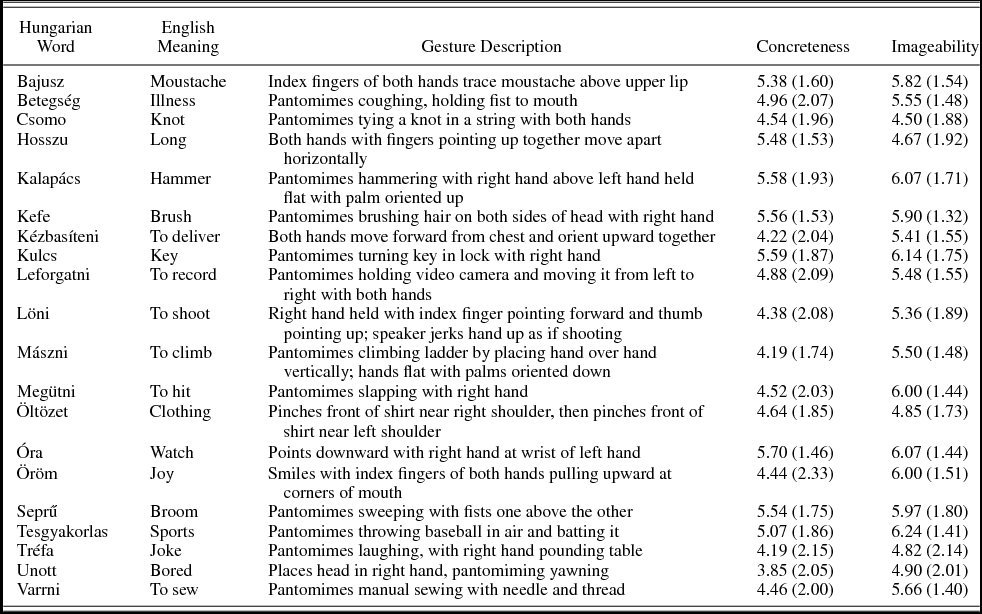
Hungarian was selected as the target language for this study because it is typologically unrelated to English, the native language spoken by all participants. Twenty Hungarian words (see Table 1) were selected for use in this study by the same process used in Morett (Reference Morett2014). In this process, 15 English speakers who did not participate in the current study were asked to rate the concreteness, imageability, and meaningfulness of the English glosses of a larger pool of candidate Hungarian words. To determine how well the words could be illustrated via representational gesture, these individuals were also asked to gesture in a way that represented the meaning of each English gloss of words within the larger pool. The 20 Hungarian words with English glosses that received the most consistent ratings (i.e., with the lowest standard deviation) and most consistent gestures were selected for inclusion in the study. Words were selected for use in the current study based on these criteria without regard to part of speech, and thus consisted of a mix of nouns, verbs, and adjectives. Thus, words selected for use in the current study were representative of words learned during early stage L2 acquisition in terms of their high concreteness and their different parts of speech (Van Hell & De Groot, Reference Van Hell and De Groot1998).
Hungarian words and gestures presented in learning task, with English meanings

For each of the 20 words, a video of a representational gesture depicting the word's meaning was created. Each video showed a fluent Hungarian–English bilingual (the model) saying a Hungarian word and its English gloss. While doing so, the model either reenacted the gesture produced by the greatest number of individuals in the norming session (gesture presentation condition) or kept her hands still (no gesture presentation condition). For example, the word kalapács (hammer) was demonstrated in the gesture presentation condition with a video of the model pantomiming hammering with the right hand above the left hand, which was held flat with the palm oriented up. In all videos, the model was instructed to maintain a neutral facial expression and body posture to avoid providing additional affective cues. In most cases, the model began producing the gesture slightly before saying the word, and the duration of the gesture mirrored the duration of the word. Thus, the temporal characteristics of spontaneous co-speech gesture were consistent with those of accompanying words (Morrel-Samuels & Krauss, Reference Morrel-Samuels and Krauss1992). In both presentation conditions, Hungarian words and English glosses were also presented as text at the bottom of the screen in each video.
Procedure
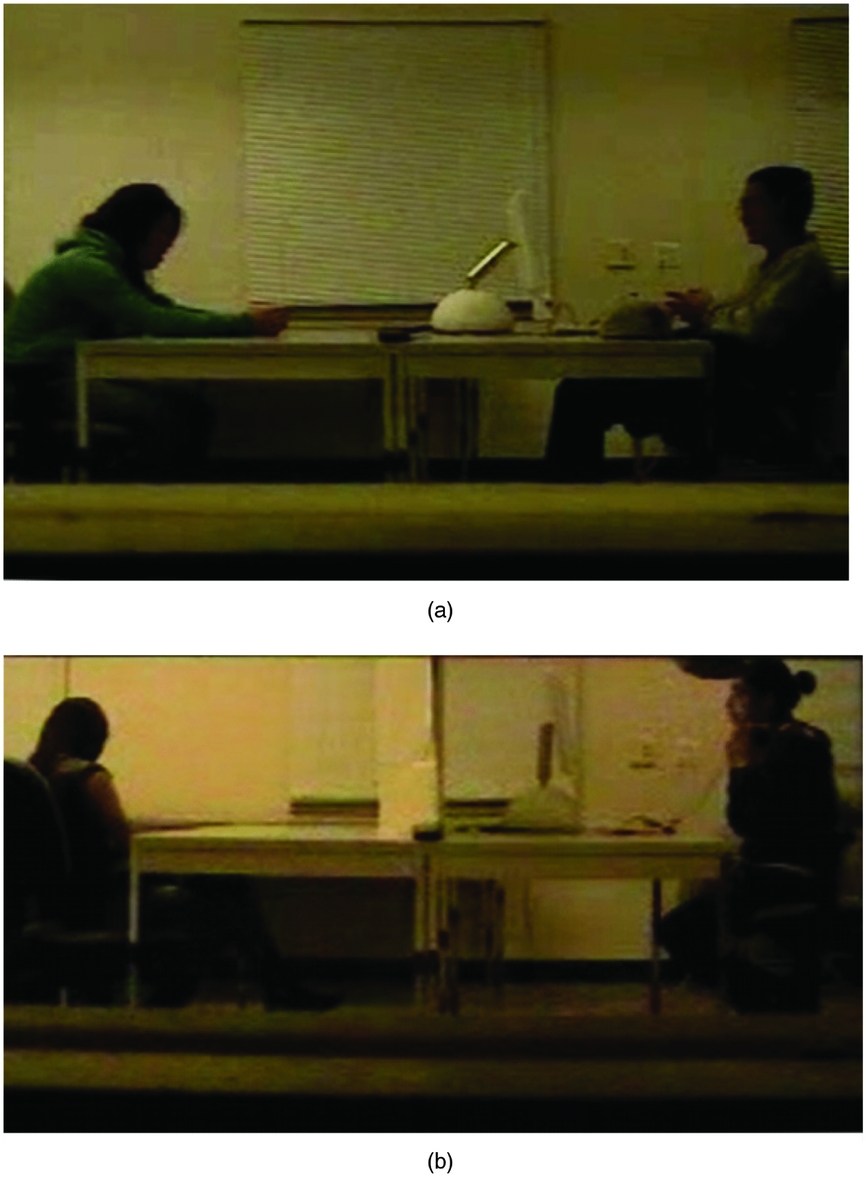
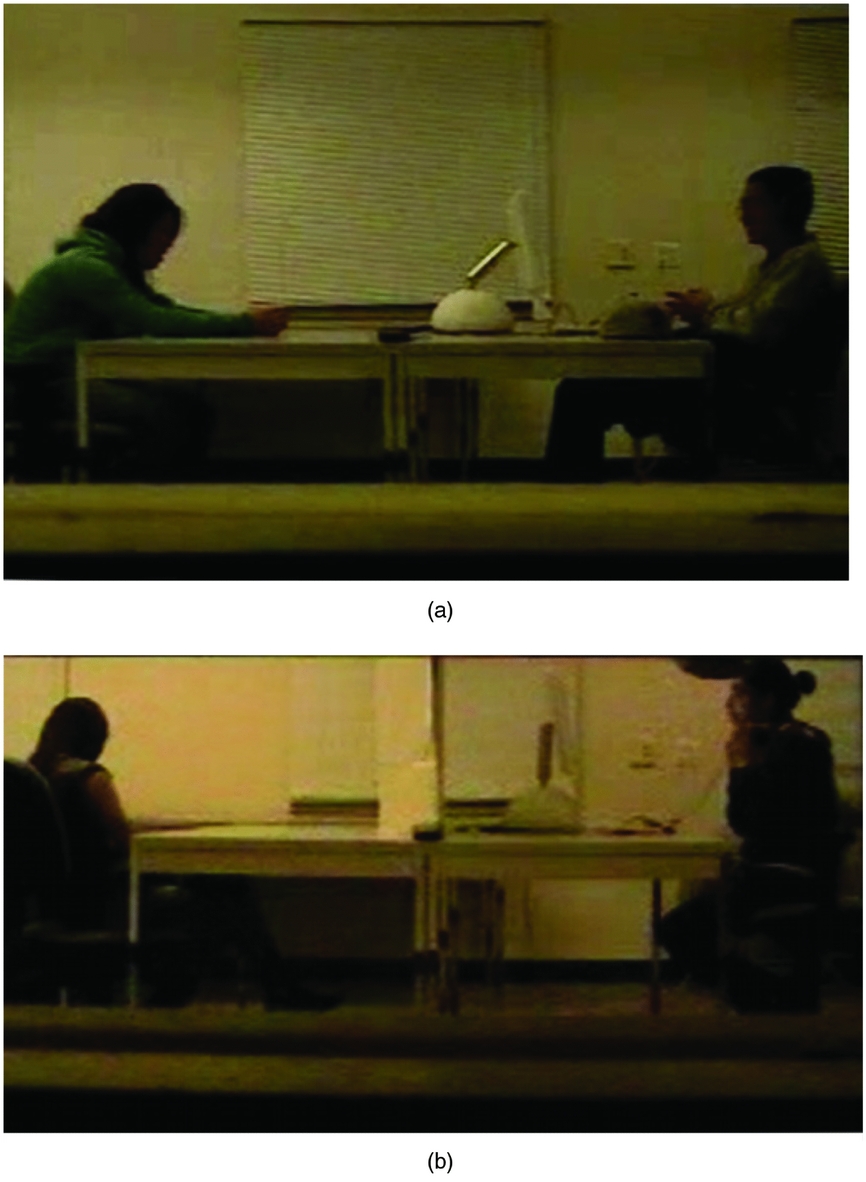
Prior to the experiment, each pair of participants was assigned to one of two visibility conditions (visible interlocutor or nonvisible interlocutor) to create a between-subjects manipulation. In the visible interlocutor condition, pairs were seated across a table without anything between them and thus could see one another. In the nonvisible interlocutor condition, pairs were seated across a table with an opaque cardboard screen between them and thus could not see one another. Within pairs, each participant was randomly assigned to one of two roles: explainer or interlocutor. Explainers, who were seated in front of a desktop computer with headphones, were told that they would learn 20 Hungarian words and that, after learning each word, they would be prompted to teach it to their interlocutor in whatever way they thought it would be best learned. Neither speech nor gesture was explicitly mentioned, and no examples of how to teach or learn words were provided. These instructions were used to avoid priming explainers to convey word meanings in any specific way, particularly concerning gesture. Participants were informed that their speech would be audio recorded to examine strategies used to learn L2 words. In addition, participants were covertly video recorded from behind a one-way mirror to examine gesture production (see Figure 1). This video recording was not disclosed until after completion of the recall task to ensure that any differences in gesture production resulted from manipulations of task design addressing the objectives rather than demand characteristics.
Configuration of participants in learning phase, showing (left) interlocutor and (right) explainer in (a) visible interlocutor and (b) nonvisible interlocutor conditions.
In each learning trial, a Hungarian word was presented to the explainer for 2500 ms, and after a 1000-ms interval, its English gloss was presented for 2500 ms. After a 2000-ms interval, this sequence was repeated. Half of the words were presented via videos showing the model saying them and producing representational gestures depicting their referents (gesture presentation condition). The other half of the words were presented via videos of the model saying them without moving her hands (no gesture presentation condition). Assignment of words to these presentation conditions (gesture and no gesture) was manipulated within subjects, and assignment by condition was counterbalanced on the basis of part of speech, length, imageabilty, and concreteness. Thus, the study used a 2 (visible vs. nonvisible interlocutor) × 2 (gesture vs. no gesture presentation) factorial design, with the first variable between pairs and the second variable within pairs (see Table 2). By independently manipulating whether explainers viewed gestures when learning L2 words and whether interlocutors were visible when explainers conveyed their meanings, this task was able to disentangle the effects of nonspontaneous representational gesture viewing (manipulated via gesture presentation) and spontaneous gesture production (manipulated via interlocutor visibility) on explainers’ L2 word learning.
Experimental design

Following word presentation, the explainer was prompted to teach the presented word and its meaning to the interlocutor, who had not seen or heard it. During interactions, participants were allowed to speak and gesture freely without restriction aside from that both participants remain seated at the table. After the explainer taught the word, interlocutors often provided (but were not required to provide) feedback concerning their understanding, many times by repeating the Hungarian word and its English translation. Explainers often responded by providing additional information concerning the word or feedback concerning interlocutors’ understanding (see supplementary material for an example). Explainers and interlocutors continued communicating in this manner on an as-needed basis until they believed the interlocutor had learned the word. At this time, the explainer proceeded to the next trial.
Following the learning phase, explainers were tested to determine how well they had learned the L2 words. In each trial of the test phase, a Hungarian word was presented aurally and as text. Explainers responded by saying the word's English gloss or by saying “skip” if they were unable to recall the word's meaning. Elicited L1 gloss production was chosen to measure memory for L2 words because it was likely to provide an optimal level of difficulty, minimizing both floor and ceiling effects. All responses were audio recorded for later analysis. After they had completed the test phase, explainers were informed of the purpose of the experiment and that they had been video recorded during the learning task. Explainers were offered the opportunity to discard their video recordings if they did not wish for them to be analyzed. However, all participants consented to analysis of their video recordings.
Coding
All speech and gesture produced by participants during this study were transcribed and coded by a single individual (the author). A second trained individual who was unaware of the purpose and design of the study independently coded 25% of the data (full sessions of 6 participant pairs). Using Landis and Koch's (Reference Landis and Koch1977) interpretation, agreement between the first and second coders using the Cohen κ was 0.72 (substantial) for gesture identification and 0.85 (excellent) for gesture categorization (n = 389). Intraclass correlation for number of words transcribed was 0.95 (excellent). This amount of coding and rate of agreement is consistent with that of other studies examining adults’ spontaneous gesture production in conjunction with fluent speech (Alibali, Heath, & Myers, Reference Alibali, Heath and Myers2001; Holler & Wilkin, Reference Holler and Wilkin2009; Hostetter & Alibali, Reference Hostetter and Alibali2010).
Gestures were identified as hand movements that conveyed information and were not self-adaptive (e.g., scratching or pushing backward from the table were considered self-adaptive). Gestures were individuated from one another on the basis of their stroke, that is, the principal component of gesture conveying information (McNeill, Reference McNeill1992). To control for differences in the amount of speech produced, gestures per 100 words was used as the dependent variable for gesture production (Alibali et al., Reference Alibali, Heath and Myers2001).
Gestures were categorized using McNeill's (Reference McNeill2005) taxonomy, a classification scheme widely used in gesture research. This taxonomy is ideal for examining the role of gesture in cognitively demanding tasks such as L2 word learning due to its focus on how gestures are used and the information that they convey. For this study, gestures were classified as representational, beat, or deictic based on their hand shape and articulation. Representational gestures (n = 620; 35%) were defined as gestures depicting semantic information. This category encompassed iconic gestures, which convey the physical affordances of concrete entities or actions (e.g., sweeping motions accompanying the word broom). In addition, it encompassed metaphorical gestures, which convey an abstract idea by physically expressing concrete attributes associated with it (e.g., moving the hands apart horizontally to convey length). Beat gestures (n = 1,000; 57%) were defined as simple rhythmic gestures reflecting speech prosody or emphasis (e.g., slight hand movements produced on stressed syllables of an utterance). Deictic gestures (n = 147; 8%) were defined as gestures directing attention to a concrete or abstract entity via one or more fingers extended in the direction of the entity (e.g., pointing to an object or a gap between objects). Given that these categories are not mutually exclusive, in some cases (n = 127; 7%), beat gestures were superimposed on representational gestures (e.g., sweeping motions produced in time with emphasized words in She was sweep ing the floor would be classified as both representational and beat gestures). For these cases, the initial gesture was coded as representational and subsequent movements were coded as beats.
Because this study focused on the effects of gesture rather than speech, speech produced by participants during the experimental task was not analyzed for quantity or content (but see Morett, Reference Morett2014, for analyses of some speech characteristics). Nevertheless, speech was transcribed to control for differences in total amount produced by normalizing the rate of gesture per hundred words (see below). Speech was transcribed using Codes for Human Analysis of Transcripts transcription format and standards (MacWhinney, Reference MacWhinney2000).
To quantify L2 word meaning recall, English glosses produced by explainers during test trials in response to Hungarian words were coded using a binary scheme. Each English gloss was scored as 1 if it was the correct translation of the preceding Hungarian word. Alternatively, it was scored as 0 if it was an incorrect translation of the preceding Hungarian word or if the trial was skipped. Scores for all 20 trials were summed to yield a continuous overall score representing the total number of L2 words correctly translated by each participant.
RESULTS
Based on the findings of a related paper (Morett, Reference Morett2014), it was anticipated that spontaneous gesture production would be nonnormally distributed due to skewness. Overall gesture production was nonnormally distributed, Shapiro–Wilk W (20) = 0.79, p = .005. Representational, W (20) = 0.75, p = .002, beat, W (20) = 0.82, p = .01, and deictic, W (20) = 0.54, p = .001, gesture production were nonnormally distributed as well. Because the distributions of production of most types of gestures were highly nonnormal, nonparametric tests are used to avoid violating assumptions of normality in analyses of gesture production data. In addition, all regression analyses were based on a generalized linear model to account for nonnormality.
Objective 1: Determine whether nonspontaneous representational gesture viewing and spontaneous gesture production can facilitate L2 word learning and compare their impacts
Having conducted the preliminary analyses described above, the data were analyzed in relation to the main experimental objectives. The first question that this study aimed to address concerned the impacts of nonspontaneous representational gesture viewing and spontaneous co-speech gesture production on L2 word learning. If viewing nonspontaneous representational gestures facilitates L2 word learning, then words learned while viewing these types of gestures should be recalled more accurately than words learned while not viewing them. If producing spontaneous gestures facilitates L2 word learning, then words learned while producing these types of gestures should be recalled more accurately than words learned while not producing them. If neither viewing nonspontaneous representational gestures nor production of spontaneous co-speech gestures facilitates L2 word learning, there should be no difference in recall accuracy for words learned with or without these accompanying gestures. If, however, both viewing nonspontaneous representational gestures and producing spontaneous co-speech gestures affect L2 word learning, the impact of these effects can be compared by examining their robustness and magnitude while taking into account the important differences between them.
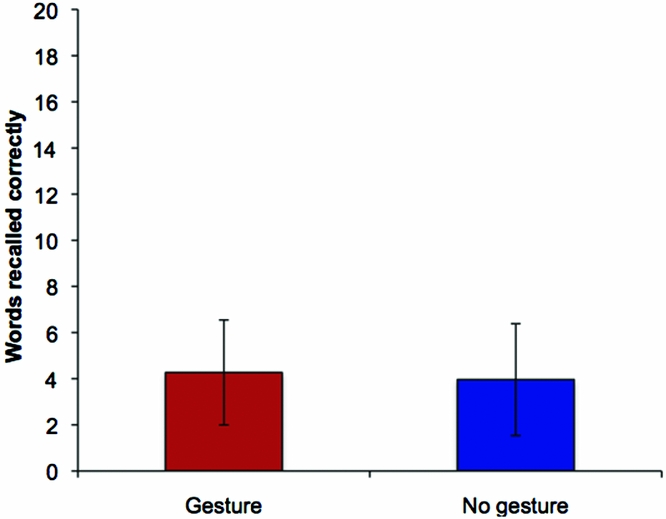
It was first examined whether viewing nonspontaneous representational gestures enhances L2 word recall. To do so, the effects of viewing these gestures in comparison to not viewing these gestures on L2 word recall were examined across visibility conditions (see Figure 2). Contrary to the hypothesis, L2 words presented with nonspontaneous representational gestures conveying their meanings in the gesture presentation condition were recalled with equivalent accuracy to words presented without these gestures in the no gesture presentation condition, Wilcoxon signed rank: t < 1. These results indicate that, in this study, L2 word learning did not benefit from viewing accompanying nonspontaneous representational gestures.
Effects of viewing gestures on explainers’ second language recall, as demonstrated by words recalled in the gesture and no gesture presentation conditions.

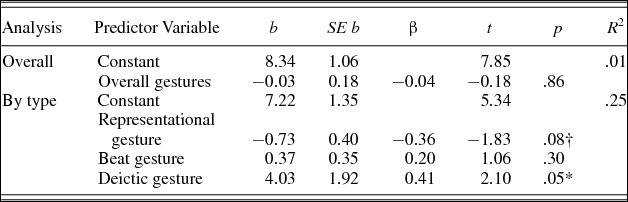
Next examined was the effect of spontaneous co-speech gesture production on L2 word learning (see Table 3). To do so, regression was used to determine how much variance in explainers’ L2 word recall could be explained by their spontaneous co-speech gesture production at the time of learning. In particular, it was of interest whether spontaneous production of representational gestures significantly predicts L2 word recall in adult learners, given that these gestures are similar in form to the nonspontaneous representational gestures presented in the gesture presentation condition. Across visibility conditions, spontaneous representational gesture production showed a nonsignificant trend toward predicting poorer L2 word recall (b = –0.73, t = –1.83, p = .08). In contrast, deictic gesture production positively predicted L2 word recall (b = 4.03, t = 2.10, p = .05). Beat gesture production failed to predict L2 word recall in either direction (b = 0.37, t = 1.06, p = .30). These results indicate that the effects of spontaneous co-speech gesture production on L2 word recall differed by gesture type, demonstrating the importance of taking the information that these gestures convey into account when considering their impact on L2 word learning.
Explainers’ second language word recall, as predicted by their gesture production

Note: Gesture production reflects gestures per 100 words.
†p ≤ .09. *p ≤ .05.
Together, these findings indicate that whereas viewing nonspontaneous representational gestures had no impact on L2 word learning, spontaneously producing co-speech gestures showed a tendency toward improving L2 word learning, but only in the deictic condition. By contrast, these findings suggest that viewing nonspontaneous representational gesture may not affect L2 word learning in some cases. These findings provide evidence that the mode of processing and the spontaneity of gesture as well as the information conveyed by it affect its impact on L2 word recall.
Objective 2: Determine how gesture viewing affects gesture production, as well as how gesture production affects memory and communication
The second question that this study addressed was whether viewing nonspontaneous representational gesture affects spontaneous co-speech gesture production. If nonspontaneous representational gesture viewing impacts spontaneous co-speech gesture production, gestures produced should predict, and should be similar in form to, gestures viewed. In contrast, if nonspontaneous representational gesture viewing does not impact spontaneous co-speech gesture production, gestures produced should fail to predict, and should differ in form from, gestures viewed.
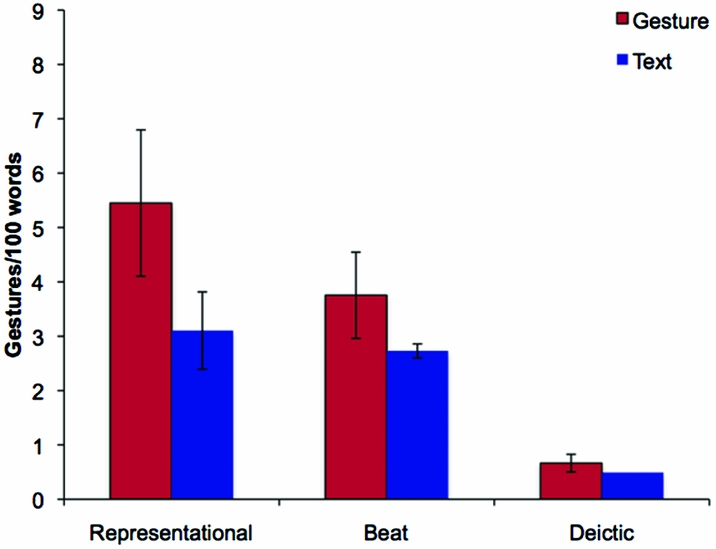
To address this question, it was first examined whether spontaneous co-speech gesture production differed in the gesture and no gesture presentation conditions (see Figure 3). The results suggested that viewing nonspontaneous representational gestures affects spontaneous co-speech gesture production. Specifically, the results showed that explainers spontaneously produced more gestures overall when conveying the meanings of words that they had learned with accompanying nonspontaneous representational gestures in the gesture presentation condition than words conveyed to them without such gestures in the no gesture presentation condition, Mann–Whitney U (26) = 2.84, p = .005, r = .56. When looking at individual gesture types, the difference in spontaneous gesture production in the gesture presentation condition and no gesture presentation condition was significant for representational gesture, U (26) = 2.70, p = .007, r = .53, and marginal for beat gesture, U (26) = 1.84, p = .07, r = .36. However, no difference in spontaneous gesture production under the gesture and no gesture presentation conditions was found for deictic gesture, U (26) = 1.42, p = .16, r = .28. These results provide evidence that viewing nonspontaneous representational and beat gestures influences spontaneous co-speech gesture production in interactive L2 word learning. Furthermore, they suggest that the influence of nonspontaneous gesture viewing on spontaneous gesture production is somewhat specific to gesture type.
Representational, beat, and deictic gestures per 100 words produced by explainers when communicating second language words learned in the gesture and no gesture presentation conditions.

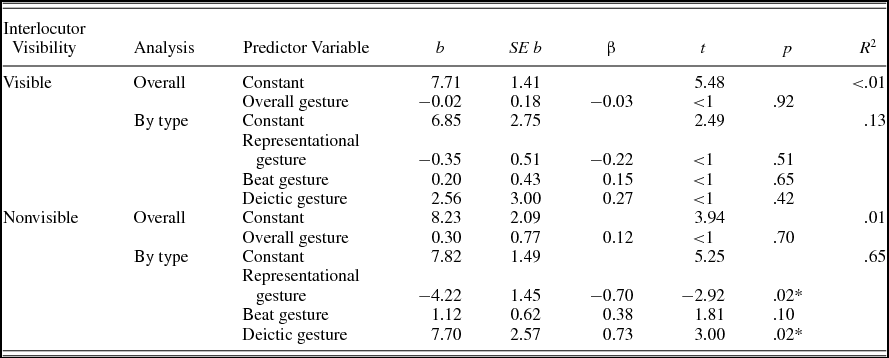
Finally, the impact of spontaneous gesture production on explainers’ memory and communication was examined by determining their L2 word recall within the visible and nonvisible interlocutor conditions (see Table 4). To do so, regression was used to determine how much variance in explainers’ L2 word recall could be explained by their spontaneous co-speech gesture production at the time of learning in the visible and nonvisible interlocutor conditions. The results provide mixed evidence that the communicative intent of explainers’ spontaneous gesture production affects their memory for L2 words. In both the visible (b = –0.02, t < 1) and nonvisible (b = 0.30, t < 1) interlocutor conditions, explainers’ overall spontaneous co-speech gesture production failed to significantly predict their L2 word recall. When looking at individual gesture types, explainers’ spontaneous representational (b = –0.35, t < 1), beat (b = 0.20, t < 1), and deictic (b = 2.56, t < 1) gesture production in the visible interlocutor condition failed to significantly predict their L2 word recall. In the nonvisible interlocutor condition, explainers’ spontaneous deictic gesture production significantly predicted an increase in their L2 word recall (b = 7.70, t = 3.00, p = .02). Moreover, in the nonvisible interlocutor condition, explainers’ beat gesture production failed to predict their L2 word recall (b = 1.12, t = 1.81, p = .10), and explainers’ representational gesture production significantly predicted a decrease in their own L2 word recall (b = –4.23, t = –2.92, p = .02). Together, these findings confirm that spontaneous deictic gesture production in the presence of a visible interlocutor affects explainers’ memory and communication, suggesting that the effects of spontaneous co-speech gesture production vary as a function of both the information conveyed via gesture and the dialogic context in which it is produced.Footnote 1
Explainers’ second language word recall, as predicted by their gesture production in the visible and nonvisible interlocutor conditions

Note: Gesture production reflects gestures per 100 words.
*p ≤ .05.
DISCUSSION
The purpose of the current study was to examine the impacts of nonspontaneous gesture viewing on memory and spontaneous gesture production on communication within L2 word learning in interactive settings. To achieve this goal, this study addressed two specific objectives. Objective 1 was to determine whether viewing nonspontaneous representational gestures and producing spontaneous co-speech gestures can facilitate L2 word learning in the same individuals and to compare the impacts of these effects. Consistent with the hypothesis that gesture production exerts more robust effects than gesture viewing due to more direct involvement of the motor system (Hostetter & Alibali, Reference Hostetter and Alibali2008; Kelly et al., Reference Kelly, McDevitt and Esch2009; Tellier, Reference Tellier2008), the results indicate that spontaneous gesture production impacted explainers’ L2 word recall, whereas nonspontaneous gesture viewing failed to do so. Objective 2 was to determine how viewing nonspontaneous representational gestures impacts production of spontaneous co-speech gestures, as well as how spontaneous gesture production impacts memory and communication. The results supported the hypothesis that gesture production and viewing are interrelated due to common underlying representations (Clark & Brennan, Reference Clark, Brennan, Resnick, Levine and Teasley1991; Galati & Brennan, Reference Galati and Brennan2014; Mol et al., Reference Mol, Krahmer, Maes and Swerts2012) by showing that viewing nonspontaneous representational gestures is more likely to result in gesture production than not viewing nonspontaneous representational gestures. Moreover, the results supported the hypothesis that spontaneous gesture production impacts communication with visible interlocutors as well as memory in producers by demonstrating that explainers’ differential gesture production in the presence of visible and nonvisible interlocutors affected their L2 word recall. Together, these results demonstrate that nonspontaneous representational gesture and spontaneous co-speech gesture produce partially related yet distinct effects on memory and communication, both of which contribute to effective L2 word learning.
Effect of nonspontaneous gesture viewing on L2 word learning
Contrary to the predictions, the results of this study indicate that viewing nonspontaneous representational gestures depicting referents did not benefit L2 word learning. Although this null result is consistent with the findings of a few other studies (Krönke et al., Reference Krönke, Mueller, Friederici and Obrig2013; Rowe et al., Reference Rowe, Silverman and Mullan2013), it is inconsistent with a substantial body of research indicating that viewing nonspontaneous representational gesture depicting referents enhances learning of novel L2 words (Allen, Reference Allen1995; Bergmann & Macedonia, Reference Bergmann, Macedonia, Aylett, Krenn, Pelachaud and Shimodaira2013; Kelly et al., Reference Kelly, McDevitt and Esch2009; Macedonia & Knösche, Reference Macedonia and Knösche2011; Macedonia et al., Reference Macedonia, Müller and Friederici2010; Mayer et al., Reference Mayer, Yildiz, Macedonia and von Kriegstein2015; Porter, Reference Porter2012; Tellier, Reference Tellier2008). There are several possible reasons for this discrepancy. Unlike most of these studies, participants were not prompted to reproduce the gesture that they viewed in the gesture presentation condition; thus, simply viewing gesture may have been insufficient to enhance L2 word recall. This interpretation is consistent with Mayer et al. (Reference Mayer, Yildiz, Macedonia and von Kriegstein2015), who found that simply viewing representational gestures depicting referents while learning L2 words was insufficient to enhance recall, whereas cued production of these gestures in addition to viewing them enhanced recall. Although at least one previous study has shown that simply viewing nonspontaneous representational gestures depicting referents can facilitate L2 word learning (Kelly et al., Reference Kelly, McDevitt and Esch2009), this study included a condition with nonrepresentative representational gestures, unlike the current study. Thus, it is possible that the contrast in representativeness between the gestures in these conditions may have contributed to the effect of gesture viewing on L2 word learning observed in this study. Another possibility is that the interactiveness of the experimental paradigm used in the current study may have negated the impact of viewing representational gestures on L2 word learning. In all of the previous studies cited above, participants did not interact with one another during L2 word learning. In the current study, the influence of the spontaneous co-speech gestures that explainers produced while communicating with interlocutors may have negated the effect of viewing nonspontaneous representational gestures on memory rather than enhancing it as nonspontaneous, noncommunicative cued representational gesture production does.
Despite that viewing nonspontaneous representational gesture did not affect L2 word recall, this study provides evidence that it affects spontaneous co-speech gesture production. Consistent with the predictions, explainers spontaneously produced more representational gestures when communicating words learned from videos with representational gestures than from videos without gestures. However, there was also a trend to produce more beat gestures in the representational gesture presentation condition even though no beat gestures were present in the videos. This result extends work by Mol et al. (Reference Mol, Krahmer, Maes and Swerts2012), who examined the relationship between viewing and spontaneous production of representational gestures only. Here, the relationships between spontaneous production of representational, beat, and deictic gestures were examined in relation to viewing nonspontaneous representational gestures. Because explainers were not limited to repeating the exact gestures they saw, this finding supports the claim that conceptual representations rather than visual features form the basis of gestural mimicry. Thus, these findings suggest that gesture mimicry arises from shared conceptual representations rather than from form-specific visual priming, as argued by Parrill and Kimbara (Reference Parrill and Kimbara2006).
The finding that gesture production and viewing impact one another demonstrates the importance of examining the cognitive effects of gesture in dialogue, in which the effects of both gesture production and viewing can be assessed in the same individuals. To date, the majority of studies of gesture's effect on L2 word learning have examined it by presenting nonspontaneous gesture in highly controlled, nondialogic experimental settings (but see Lantolf, Reference Lantolf and Batstone2010). As such, it is unclear whether the effects of nonspontaneous gesture on memory for L2 words generalize to the interactive settings in which spontaneous co-speech gestures typically occur. This is a particularly important issue because L2 words are often learned through conversations with native speakers (Swain, Reference Swain1997), who gesture more often when speaking to nonnative speakers (Adams, Reference Adams1998). Even in classroom settings in which learners learn L2 words via direct instruction from an expert, the uses and meanings of these words are often negotiated via dialogue with peers who have similar (or less) expertise than them (van Compernolle & Williams, Reference van Compernolle and Williams2011). The results of this study suggest that some of the effects observed in studies in which nonspontaneous gestures are used as instructional aids apply to conversation, whereas others may be constrained to direct instruction. Moreover, the results indicate that viewing nonspontaneous gestures impacts learners’ spontaneous gesture production in conversation, influencing them to produce gestures that enhance their recall more effectively. In summary, the results indicate that viewing nonspontaneous representational gesture affects learners’ spontaneous co-speech gesture production, thereby indirectly influencing their recall. However, the results also indicate that viewing nonspontaneous gesture does not only affect spontaneous production of gestures of the same type; rather, it primes gesture production more broadly.
Effect of spontaneous gesture production on L2 word learning
Consistent with the predictions, the results of this study indicate that spontaneous gesture production influences L2 word learning. In particular, the results showed that spontaneous production of deictic and representational gesture affected explainers’ L2 word recall. These results contrast with nonspontaneous representational gesture viewing, which failed to affect L2 word recall. While the data presented in this paper does not specifically address this issue, this discrepancy may have arisen from qualitative differences in gestures viewed and produced by explainers in this study. Gestures viewed by explainers, which were presented as an instructional aid, were nonspontaneous and were exclusively representational, depicting the meanings of accompanying L2 words. In contrast, gestures produced by explainers were spontaneous and were therefore more varied in type, consisting of beat and deictic gestures in addition to representational gestures. Furthermore, explainers produced these gestures in conjunction with speech when communicating the meanings of L2 words to interlocutors in an interactive setting. Taken together, these findings suggest that, in addition to communicating L2 words and their meanings, spontaneous production of deictic gestures affects memory for L2 words in producers, thereby enhancing word learning for producers as well as viewers.
The findings of this study inform the understanding of why deictic gesture production facilitates L2 word learning. Specifically, the finding that deictic gesture production enhances explainers’ L2 word learning suggests that spontaneous gesture production can increase the salience of conceptual representations even if gesture is noniconic. This may be the case because deictic gesture can serve as an iconic marker of attention, increasing the salience of words and their meanings (Goodwin, Reference Goodwin and Kita2003). Although it is more counterintuitive, the finding that production of representational gestures may hinder L2 word learning suggests that production of these gestures increases the salience of conceptual representations via iconicity when these gestures are not used to communicate. Given that learning the phonological forms of words from an unfamiliar L2 requires significant engagement of attention and working memory, this increased conceptual salience may interfere with L2 word learning by decreasing the amount of attentional and memory resources that can be devoted to word learning, as has been shown for learning of phonologically similar L2 words (Kelly & Lee, Reference Kelly and Lee2012). Together, these findings support embodied cognition theory (Barsalou, Reference Barsalou2008; Gibbs, Reference Gibbs2006) as well as indirectly supporting dual coding theory (Paivio, Reference Paivio1990) by demonstrating that gesture production contributes to conceptual representations of L2 words by evoking motor and visual imagery. Furthermore, the divergent effects of deictic and representational gesture on L2 word recall highlight the impact of the information conveyed via gesture on these conceptual representations. On a practical level, the results suggest that beginning L2 learners should be encouraged to produce deictic gestures while learning unfamiliar L2 words, particularly in a dialogic context.
With regard to the impact of gesture production on communication, the results show that the effects of gesture production on memory can be altered by whether gesture is produced in a communicative setting. In the nonvisible interlocutor condition, explainers’ spontaneous deictic gesture production predicted their L2 word recall. Moreover, in this condition, spontaneous representational gesture production trended toward predicting a decrease in L2 word recall. In contrast, in the visible interlocutor condition, explainers’ spontaneous gesture production failed to predict their L2 word recall. Together, these results suggest that gestures produced solely in the service of learning impact memory to a greater extent than gestures produced to communicate information to interlocutors. Therefore, they suggest that spontaneous gesture production in the service of communication may detract from its influence on speakers’ memory. Considered in conjunction with the finding that spontaneous gesture production, but not nonspontaneous gesture viewing, affects memory for novel L2 words, this finding suggests that the spontaneity and variation in the types of gestures produced may be responsible for their influence on L2 word learning in explainers. Future research should explore this issue further by comparing the effects of spontaneous and cued nonspontaneous representational gesture production on explainers’ L2 word learning.
Limitations
It is important to note that the current study assessed the effects of gesture production and viewing by examining L2 word recall. As such, it was beyond the scope of the current study to examine speech and its semantic relationship to gestures produced by explainers. Future research should examine the relationship between the meaning of gesture and co-occurring speech concerning L2 words given that it may provide further insight into the effects of gesture production and viewing on representations of verbal information.
Because the effects of nonverbal cues conveying affective information (e.g., facial expressions and body postures) were controlled for via the experimental design, it was also beyond the scope of the current study to systematically examine their impact on L2 word learning. Nevertheless, the finding that recall did not differ by interlocutor visibility suggests that production of these cues does not contribute to L2 word learning beyond the effect of gesture. Future research should manipulate these cues systematically to clarify how they affect L2 word learning independently and in combination with semantic information conveyed via gesture. Together, these investigations would clarify whether the effects observed in the current study are specific to gesture or whether they represent more general multimodal influences on L2 word learning, and perhaps on learning more broadly.
Although the current study controlled for the effects of word properties such as part of speech, familiarity, length, imageability, and concreteness through counterbalancing, it is important to note that these properties may affect gesture production and word recall (Baddeley, Chincotta, Stafford, & Turk, Reference Baddeley, Chincotta, Stafford and Turk2002; Gathercole, Frankish, Pickering, & Peaker, Reference Gathercole, Frankish, Pickering and Peaker1999). Thus, future research should examine how representational gesture and word learning differ as a function of these properties in beginning and more advanced L2 learners. Such investigations will clarify how these properties affect gesture's impact on L2 word learning, providing further insight into how these factors affect the relationship between gesture and speech, particularly within the context of L2 acquisition.
Finally, it is important to note that there are several important differences between the experimental task in the present study and L2 word learning in more naturalistic settings. Typically, in classroom settings, an expert instructor conveys the meanings of L2 words to learners who may be unfamiliar with them. Although learners may also convey L2 words and their meanings to one another, they may not always gesture when doing so. The present design was chosen to address the theoretical questions of interest because it allowed observation gesture production and viewing in the same learners in order to understand how they are related to one another. Moreover, although the experimental task was interactive like naturalistic word learning, this design offered control over the materials, study, and test procedures. It is likely that similar effects would be observed in more naturalistic settings, however. Accordingly, previous research indicates that nonnative speakers and their interlocutors often gesture when discussing unfamiliar words in instructional (McCafferty, Reference McCafferty2002; van Compernolle & Williams, Reference van Compernolle and Williams2011) and conversational (Adams, Reference Adams1998; Gass & Varonis, Reference Gass and Varonis1994) settings. Nevertheless, it would be prudent for future work to more directly test these questions in more naturalistic settings such as the classroom.
Conclusion
The results of the current study indicate that spontaneous gesture production affects L2 word learning to a greater extent than nonspontaneous gesture viewing and that gesture viewing and production influence one another. More specifically, they show that, in an interactive context, nonspontaneous gesture viewing does not affect memory for L2 words, whereas spontaneous gesture production affects both communication and memory of them. Moreover, the results suggest that the effects of spontaneous gesture production on L2 word recall vary by gesture type, demonstrating the impact of the information conveyed by these gestures. Finally, the results provide evidence that gesture production and viewing impact one another, demonstrating that they work together to shape representations of verbal information. Together, these findings demonstrate how gesture production and viewing each contribute to communication and memory for novel information in the same individuals. Thus, they provide insight into how both instructors and learners can take advantage of gesture to enhance recall of L2 vocabulary.
ACKNOWLEDGMENTS
This research was supported by a National Defense Science and Engineering Graduate Fellowship (32 CFR 168a) issued by the US Department of Defense, Air Force Office of Scientific Research, and a mini research grant from the University of California, Santa Cruz (to L.M.M.). Portions of this research were presented at the centennial meeting of the Eastern Psychological Association (March 2012); the 11th Conceptual Discourse, Structure, and Language Conference (May 2012); and the 34th meeting of the Cognitive Science Society (August 2012). I thank Rachel Fader, Theo Haugen, and Meagan Chisholm for assistance with data collection and Mariagrazia Zuccarini for assistance establishing interrater reliability. Thanks also to Ray Gibbs and Brian MacWhinney for guidance and discussion of this research, Jana Iverson for support for the transcription and coding of the data, and Scott Fraundorf for valuable feedback that helped to greatly improve this manuscript.