After decades of debate on the relationship between regime type and economic performance, a consensus has emerged: autocracies produce growth volatility, while democracies tend towards economic stability. Scholars provide convincing empirical evidence that democracies systematically differ from autocracies in that they produce more stable growth outcomes, which are neither extremely high nor extremely low.Footnote 1 One commonality in all these narratives – both past and present – is the tendency to lump countries into two broad categories of regime type. This is striking, since even casual observation suggests that there may be good reasons not to do so. The authoritarian growth miracles of the 1970s (such as Chile, Singapore, Hong Kong, South Korea, and Taiwan) continue to do as well today as many democracies; and while a large number of non-democratic countries remain relatively poor, the stable growth patterns in recent decades of countries such as Nigeria, Namibia, Uganda, and Zambia, not to mention China, have led to the conjecture that these repressive nations will be part of ‘the developing world's next great success story.’Footnote 2
Does the reality that many non-democratic nations perform as well as democracies render regime type meaningless, in terms of growth and stability? Why do authoritarian countries across the world have such contrasting records of economic performance?Footnote 3 It is surprising that, given the predominance of discussions on the relationship between various domestic institutions and economic outcomes, no studies have questioned the simple dichotomous classification of countries in the debate about the link between regime type and economic performance.
In this article, we caution that current research has overemphasized the role of regime type and paid insufficient attention to the key political factors driving national economic performance. The distinction between authoritarianism and democracy is simply too broad, and regime type alone does not explain why authoritarian regimes exhibit so much variation. Our analysis identifies a key political variable, public deliberation, which explains systematic variation both across and within regime type. We suggest that the level of public deliberation, while correlated with regime type, is more nuanced and, therefore, capable of capturing variations even within regime type. This article is thus distinct in that it identifies key elements of the decision-making process that explain variations in national economic performance across countries, and particularly within the group of non-democracies.
We begin by building on analyses of deliberative democracy in political theory, and argue that the underlying causal mechanism of stable economic performance is the level of ‘public deliberation’ that occurs during the chief executive's decision-making process.Footnote 4 Because higher public deliberation inevitably entails negotiation among partisans (for example, political leaders, citizens, voluntary associations, labor groups, business representatives, academics, technocrats, public administrators), with all its ensuing agreements, disagreements, and compromise, governing elites are served with greater information about the political pros and cons of a proposed new policy.Footnote 5 Leaders subsequently embrace ‘safe,’ incremental policy proposals in order to avoid engendering unpredictable and uncontrollable outcomes. It is important to emphasize that this outcome is likely to occur even if all the criteria of ‘good deliberation,’ such as equal participation in the political process, have not been met. We argue that it is the level, rather than the quality, of public deliberation that matters for economic policy outcomes.
This critical feature explains why some authoritarian regimes are capable of mimicking the characteristic stable and moderate growth performance of democratic regimes. Although the level of public deliberation is, on average, higher in democratic regimes, select authoritarian regimes permit a fair amount of public deliberation, encouraging (controlled) expression of citizen preferences and often, actively soliciting them (e.g., surveys, workshops). This is a unique feature of our analysis, and one that calls into question the conceptualization of regime type per se as a driver of economic performance. While we concur with current research that regime type is statistically associated with stability, we theoretically and empirically demonstrate that this association occurs because the degree of democracy is associated with the level of public deliberation, the underlying driver of stability in all democratic and some authoritarian nations. Moving forward, then, instead of regime type, scholars should consider the decision-making process and the extent of public deliberation that occurs – both between democratic and non-democratic regimes and within authoritarian regimes as a group – to explain variations in national growth outcomes.
We use this analysis to advance the political science literature in four important ways. First, we present novel predictions about and insights into the workings of the policy-making process of democratic and non-democratic regimes by building upon and then formalizing parts of the concept of deliberative democracy discussed in the political theory literature. Second, we test the specific and new predictions about the relationship between the extent of public deliberation and economic performance using frontier estimation methods and panel regression estimation techniques on a sample of data covering the time period 1961–2000.Footnote 6 The statistical tests that we use include methods that are new to the discipline (frontier estimation), and which enable the testing of models that emerge directly from the formal model. Moreover, they test a broad range of outcomes, not only examining comparisons between regime types, but also looking at differences within authoritarian regimes. Our third contribution is to apply an improved measure of economic performance, one not yet familiar to political science. For example, the existing literature commonly associates low volatility with good economic performance; however, it may be that a country with low volatility also has poor economic growth.Footnote 7 Our measure corrects for this possible simultaneity by accounting for both measures of performance: growth and stability. Finally, we establish, for the first time, a theoretical and empirical link between public deliberation and economic stability.
This article is organized as follows: in the next section, we discuss the literature on the link between regime type and economic growth and instability. After identifying some gaps in this literature, we present a theory in the second section which captures processes fundamental to explaining the distinction between growth and instability. In the following two sections, we present the formal model and empirical evidence to support our hypotheses. The final section summarizes the findings and significance of the article.
The Search for a Better Model and Theory
The literature on the link between regime type and economic performance is vast. Much of this scholarship centers on the relationship between democracy and growth. Disagreements abound regarding the validity of this association.Footnote 8 Recently, this aspect of the debate has begun to fizzle as a small group of scholars has been questioning why the focus has been on democracy's effects on economic growth rates. Rather, what distinguishes democracies from non-democracies, they argue, is sensitivity to economic volatility. It is of no small import that these scholars have reached a strong consensus that only democratic regimes are associated with stable economic performance (i.e., low volatility). However, this body of work is still burdened by two concerns: (1) disagreement on the causal mechanisms; and (2) no explanation of the vast variation in economic performance within authoritarian regimes.
Quinn and Woolley, for instance, argue that democracies have more stable rates of growth than non-democracies because politicians fear the electoral reprisals that may result from pursuing risky economic policies.Footnote 9 They posit that, while elites in both democracies and non-democracies are risk-takers, voter aversion to economic volatility drives political elites in democracies to adopt more conservative economic policies that reflect the risk preferences of the median voter.Footnote 10 This approach thus maintains that economic policies will be more volatile in authoritarian regimes because elites in these regimes have far greater institutional flexibility to pursue policies that reflect their preferences for risk.
The above analysis bridges an important gap in the existing literature. It sets the stage for exploring national economic performance in terms of economic stability. The problem is that Quinn and Woolley's approach, while appealing, encounters analytical limitations in two important ways.Footnote 11 First, given that authoritarian leaders are, in fact, frequently in a more uncertain position than democratic leaders, the assumption that autocrats tend to be risk-takers – particularly when it comes to the economy – is not at all obvious. Scholars fundamentally disagree on this point.Footnote 12 Indeed, historically, leaders of authoritarian regimes have faced far more punishing consequences for increased volatility than their democratic counterparts.Footnote 13 Why, then, might political leaders, particularly in authoritarian regimes, be risk takers, when their exit from power may be exceptionally costly in terms of permanent loss of access to resources, violence, imprisonment, or even death? Consequently, it becomes difficult to defend this explanation.
The second area of concern is that Quinn and Woolley do not fully explore the process that brings about differences in national economic performance, increasing the likelihood of neglecting important causal factors.Footnote 14 They state that the risk preferences of the median voter in democracies are likely to lead politicians to ‘create institutions that “automatically” diminish volatility.’Footnote 15 However, these highly-developed institutional mechanisms in democracies are ultimately never identified, and we are left with little explanation of how democratic leaders ultimately identify the ‘high growth strategies’ they must categorically avoid.
Rodrik comes closer to uncovering the process by explaining that democracies, through repeated interactions and consideration of ‘losers’ – particularly in societies marked by ethnic and/or class cleavages – induce a greater willingness of the public to cooperate and pursue moderate economic policies.Footnote 16 But social cleavages can be fluid; citizens do not always adopt policy positions on the basis of class or ethnicity.Footnote 17 In addition, both Rodrik's argument and the model require further elaboration, since the question of why cooperation necessarily leads to stable growth outcomes, rather than policies that simultaneously engender rapid growth and volatility, is ultimately left unanswered.Footnote 18 Certainly, significantly improved national economic performance may be particularly desirable in extremely poor democratic nations. It is thus feasible that compromise could occur on rapid-growth policies and, if so, Rodrik's analysis does not fully explain why the policy agenda in democracies is necessarily constrained.
Both Nooruddin and Henisz also seek to explain why democracies tend towards stability.Footnote 19 Their research significantly advances the literature by focusing on the decentralization of policy-making authority in democracies. Both scholars suggest that more diffuse political institutions constrain policy makers’ discretion and ensure long-term policy stability; the great benefit for democracies is, then, that they attract more investment and produce long-term growth.Footnote 20 Their analyses predict that leaders of more repressive regimes face minimal institutional checks and balances and will therefore tend towards poor economic performance, since decision making in authoritarian regimes is more centralized.Footnote 21
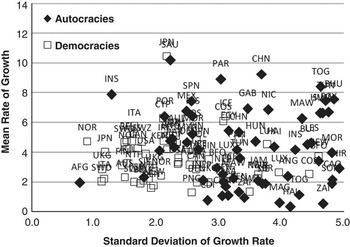
The outstanding issue, however, is that none of these recent studies explains the variation in outcomes within authoritarian regimes, and more particularly, why close to 30 percent of repressive regimes tend to perform similarly to democracies.Footnote 22 Given the enormous amount of attention devoted to this general subject, it is striking that scholars have not come closer to developing a systematic understanding of why some non-democracies consistently surpass – or equal – democracies in the realm of national economic performance. Another way to view this phenomenon is Figure 1, which shows the overlap between the performance of democratic and authoritarian regimes. Scholars focus instead on identifying a marked distinction in performance between democracies and non-democracies. Figure 1 questions their basic argument that democratic regimes experience stable economic performance, and underlines their tendency to ignore important distinctions amongst non-democracies. While a few authoritarian regimes have very low volatility, many do have intermediate volatility and others have high volatility; this variation in authoritarian regimes begs explanation.
Overlapping outcomes in democracies and authoritarian regimes Note: Country code sources for Figure 1 are available from the authors on request

Almeida and Ferreira, Weede, and Gandhi are exceptions that explore, theoretically and empirically, why authoritarian regimes exhibit such great variation in economic performance.Footnote 23 The first two of these studies build on Sah and argue that, since constitutional and institutional constraints are weak in centralized (authoritarian) societies, leaders can (more or less) unilaterally execute decisions that may be either good or bad for growth.Footnote 24 Sheer luck plays a major role in their analyses. Gandhi, by contrast, argues that dictatorships that allow political institutions (such as legislatures) will be more stable, attract more investment, and improve allocative efficiency.Footnote 25 These scholars ask the key question. However, they fall short of explaining the wide variation in growth rates within authoritarian regimes, and focus instead on explaining only the best and worst performers. They leave two fundamental questions unanswered: (1) why do some authoritarian regimes perform similarly to those of democracies; and (2) why do some autocracies do consistently well over time, despite changing leadership (for example, China)?
Our analysis seeks to fill this gap; we question the assumption in current literature that regime type is the driving force behind national economic outcomes, and that authoritarian regimes are unlikely to perform as well as democracies. We develop our analysis by building on the emphasis placed by Lindblom and by Rodrik on societal-based checks and balances on the executive's policies, rather than (formal) institutionally-based constraints (party and presidential systems, coalition-building, etc.).Footnote 26 We propose that an understanding of factors deeper than regime type is key. A rigorous theoretical and empirical model is required to explain all the possible variations in economic outcomes both between and within regime type.
Similarities in National Economic Performance in Democracies and Some Non-Democracies
Our central premise is that a policy-making system that allows some degree of public deliberation increases the portfolio of information about politically costly policies, thereby preventing leaders from advocating bold economic strategies. Public deliberation includes citizen discussion, negotiation, and reciprocity (i.e., compromise) among different citizens (or partisans). Leaders who place value on reaching non-coercive agreements particularly encourage this type of deliberation. Certainly, authoritarian regimes exhibit great variation in levels of public deliberation. We contend that regimes – including authoritarian ones – which permit relatively high levels will experience stable national economic performance. In other words, we posit that even moderate levels of public deliberation, which may be dominated by privileged groups, can provide valuable information about politically consequential issues for policy makers. This is why dictatorships that allow some level of discussion and negotiation experience more stable growth outcomes.
Political theorists set high standards for deliberative public discussions, such as tolerance, reciprocity, transparency, moral justification, and equal participation and access to decision making. According to deliberation scholars, public deliberation ideally involves relatively well-reasoned arguments, and makes an effort to link individual perspective, or positioning, to public interest.Footnote 27 The public nature of deliberation (versus informal private discussion) is critical because, according to Thompson, the more public the discussion, the more likely participants will (ultimately) attempt to use reason and relate their particular individual interest to more universal principles.Footnote 28 Public deliberation can take an endless variety of forms, such as interest group bargaining, protest, citizen assemblies, polling, public hearings, and civil society associations.Footnote 29 These ‘community groups’ – both formal and informal – go beyond facilitating societal cooperation, as suggested by social capital theory.Footnote 30 The predicted outcome of this deliberative process is two-fold. On an individual level, dissenting citizens will voluntarily change their preferences in response to persuasion (versus manipulation or coercion) and arrive at a consensus.Footnote 31 On a national level, both the legitimacy and effectiveness of law-making improve as policy makers receive public information from citizens regarding what policies they ought to pursue.Footnote 32
In practice, however, deliberation theorists are well aware of the challenges involved in achieving such high standards of deliberative discussion, particularly equality of participation.Footnote 33 One of the greatest concerns is that privileged members of society will dominate discussions and determine what information gets pushed to the top of the agenda.Footnote 34 Some scholars further argue that deliberation can lead to irreconcilable differences and greater divisiveness.Footnote 35 In consequence, many deliberation scholars concede that participants will not abandon their convictions and change their preferences. Rather, deliberation is more likely to facilitate policy compromise through the ongoing process of bringing more information and intelligence to convince opponents, and (mutually) adjusting partisan demands in the iterative process of negotiations.Footnote 36
We build on this strand of the deliberation literature and emphasize ‘public deliberative capacity,’ or the extent to which a political system allows non-coercive communication, which induces reflection and attempts to connect particular demands to general principles in the process of bargaining and compromise.
The value of this process is that participants and representatives achieve greater levels of information critical for policy making, even when influence matters and discussions do not meet ideal standards. Several empirical analyses based on surveys and experiments confirm that public deliberation results in higher levels of available information.Footnote 37 We argue that this information is particularly useful for political leaders, as they become exposed to the points of contention and, thereby, the political pros and cons of different policies. Arguably, economic policy proposals specifically encourage high levels of public deliberation, given that such policies have distributional and other wide-ranging consequences.
With valuable information in hand about which aspects of proposed policies are most acceptable, it is in policy makers’ interest to engage in consultations, if not necessarily abide by deliberative outcomes, and adopt economic policies that do not incur volatility. Charles Lindblom, whose theory on partisan mutual adjustment we interpret as also emphasizing the process of public deliberation, provides valuable insights on the link between deliberation and economic policy choices that promote stability.Footnote 38 He argues that a leadership sensitive to maintaining political stability applies the information gained from the deliberation process to select an incremental policy change, or a (relatively) rapid succession of small changes, in an effort to reflect the deliberative compromise and maintain political stability.Footnote 39 As policy makers are informed via public deliberation of the many variables – and, as a result, people – that may be affected by previously untried policies, they depress volatility (perhaps inadvertently) by implementing policies that are incrementally different from the status quo. Put simply, public deliberation produces information on acceptable policy compromises and prevents politicians from making irreparable and politically consequential mistakes; that is, they avoid the unpredictability of drastic policy proposals, which can create large losses or gains to society, thereby risking political upheaval.
Political elites may thus initially propose radical policy changes, but subsequent deliberation and the motivation to implement politically ‘safe’ agreements ultimately lead to incremental policy change. Whether a policy proposal is ‘radical’ or ‘incremental’ within a country depends on the policy status quo within that country's specific context, and is not generalizable across countries. In other words, a radical economic policy is a reform proposal that is unprecedented (in that country) and represents a significant departure from the status quo, as in Chile's implementation of neoliberal reform in the early 1970s.Footnote 40 The process of incrementalism, in comparison, induces slow-moving policy change. Yet incrementalism can also result in drastic changes to the status quo, which occur in the form of a rapid sequence of small changes that ultimately add up to a big change (see Lindblom), while maintaining stability in the process (for example, the New Deal).Footnote 41 This is in direct contrast to the predictions of veto player theory.Footnote 42
Our analysis is, therefore, distinct in that we emphasize the critical role of societal-based checks and balances on unilateral decision making, based on public reasoning and informed consent. In contrast, most scholars emphasize policy making (especially in democracies) as a product of particular formal institutions, such as party competition, coalition building, and veto players. The incremental changes that followed the proposed boycott of industries headquartered in Arizona (in response to their recent immigration law) and President Barack Obama's healthcare legislation are recent examples that reflect our predictions.Footnote 43
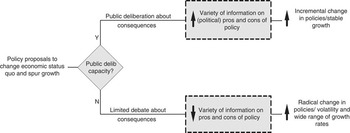
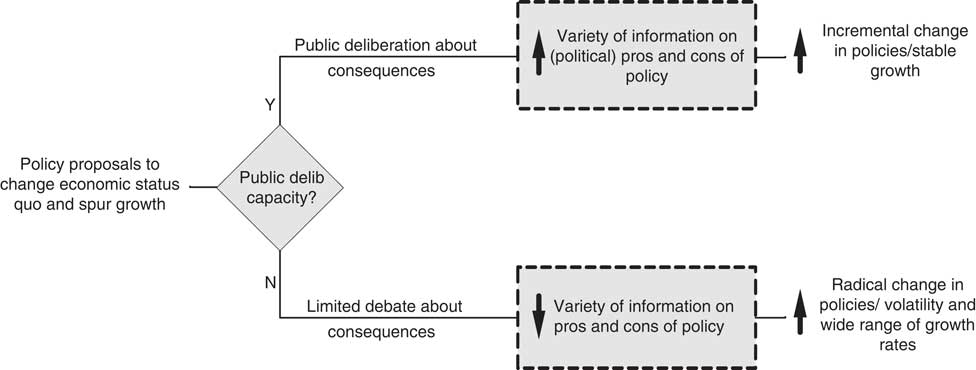
To summarize, because diverse concerns are distributed across different partisans (for illustrative purposes, it is useful to imagine this distribution as being random), public deliberative capacity allows more partisans with different sets of cautions to reveal their reservations about proposed economic policies. The greater the degree of public deliberation, the richer (or the more variety) the set of policy concerns that becomes part of the policy discourse accessible to decision makers. This process increases the ability of policy makers to navigate the policy space so as to arrive at incremental economic policy changes that ultimately avoid the undesirable outcome of volatility (see Figure 2).
Theoretical summary
Our first hypothesis is thus as follows:
HYPOTHESIS 1: Economic volatility is lower in environments with higher levels of public deliberation.
We do not suggest, however, that public deliberation in authoritarian regimes occurs in the same way as it does in democracies. Few scholars dispute the idea that public deliberation can reach its highest level (and potential) in democracies. Formal institutions in democracies underwrite deliberation, such as free media, courts, legislature, advocacy groups, etc.,Footnote 44 as do their key informal institutions, which emphasize non-coercive decision making.Footnote 45 In consequence, larger numbers of participants with varying perspectives and information are encouraged to contribute to the policy-making process, both informally and formally, which is a critical prerequisite for public deliberation. What is striking, and perhaps surprising to many, is that scholars are finding that deliberation also occurs in authoritarian societies, albeit to varying degrees.Footnote 46 But even before this new turn in the deliberative literature, it was well established that power sharing occurs in many dictatorships and that autocrats do tolerate some level of collective decision making.Footnote 47 As He and Warren argue, ‘deliberation can occur under authoritarian conditions when rulers decide to use it as a means to form preferences and policies, but do so without institutionalized distribution of democratic powers to those affected.’Footnote 48
Important differences with democracies exist, however. First, the average levels (and, likely, the quality) of deliberation will be systematically higher in democratic countries, where there is an underlying consensus amongst both elites and non-elites to pursue non-coercive agreements. Second, interests in non-democracies may not have direct access to the political arena. Dryzek's analysis suggests that formal decentralization of power, such as in the form of a legislature or political party, is not required for public deliberation to impact economic policy.Footnote 49 He demonstrates, for instance, how public deliberation impacted decision making in authoritarian Poland, Ukraine, and Georgia in the absence of formal legislature.Footnote 50 Government officials in China often solicit citizen opinions on policies through workshops, surveys, expert meetings and hearings (see Leib and He 2006). Dictators may be sensitive to information outcomes from public deliberation not (necessarily) out of goodwill, but to neutralize rebellion, either from within the ruling elite or from larger outside groups and, arguably, to pre-empt or limit formal power-sharing arrangements.Footnote 51 Allowing some public-minded deliberation can increase the variety of information available to the military juntas, consultative consuls, and political bureaux, who are the real decision makers in autocracies.Footnote 52 For these reasons, we predict that non-institutional forms of contestation (in effect, public deliberation) are more likely to enrich the portfolio of information and shape economic policy in certain authoritarian regimes.Footnote 53
In extreme authoritarian regimes, the motivation to gather information about the pros and cons of new policies and avoid politically divisive changes may be less powerful than in democratic regimes. Leaders of these authoritarian regimes have a greater tendency to avoid this type of power sharing and thereby pursue a more flexible policy agenda. Without partisan bargaining and policy compromises, autocrats have neither the drive nor the necessary information to adopt incremental policy changes and may inadvertently steer the nation towards more volatile economic policies. To elaborate, even if the autocrat is not a risk taker and prefers policies that have predictable consequences, if public deliberation is strictly repressed, he or she ultimately has less information by which to select an optimal policy for the majority in society. At the same time, if the authoritarian leader is more inclined to take risks, then little can constrain him or her from pursuing policies that will lead to great economic disruptions in terms of big gains or big losses for society. Importantly, this does not imply that dictators are necessarily less likely than decision makers in democracies to employ resources to gather information about policies (albeit in a more centralized fashion) or that they are more inclined to take risks. Rather, in the absence of more extensive deliberation, political leaders block out information on both satisfactory and unsatisfactory aspects of a given policy for different partisans, and may ultimately adopt radical policies that incur greater volatility. As a consequence, national economic performance will differ in non-democracies that allow some level of public deliberation in comparison to those that do not.
HYPOTHESIS 2: Democracies will tend towards stable national economic performance because of high levels of public deliberation.
HYPOTHESIS 3: Authoritarian regimes permitting relatively high levels of public deliberation will maintain stable economic performance.
HYPOTHESIS 4: Authoritarian regimes permitting low levels of deliberation will tend towards economic volatility.
Egypt represents a paradigmatic case of how some degree of public deliberation in authoritarian regimes can influence economic stability. In 1974, President Anwar el-Sadat announced the open door economic policy (ODEP) which focused on trade and capital liberalization. ODEP or Infitah was ‘radical’ in the sense that it marked Egypt as the first Arab country to embark upon economic openness policies and it represented a sharp retreat from Egypt's history of socialism under President Gamal Abdel Nasser. As would be expected, this type of non-incremental economic reform unleashed forces both for and against reform. Key for this analysis, however, is that during the same time frame in which the reforms had been initiated, Egypt experienced relatively high levels of public deliberation. In contrast to his predecessor, Sadat's regime was marked by greater, albeit ‘uninstitutionalized,’ pluralism.Footnote 54 The diversity of associations catering to citizen interests significantly expanded. Egypt experienced the greatest increase (41 percent) of its voluntary associations during the period 1976–1981.Footnote 55 The extent of public deliberation increased as groups such as professional syndicates (lawyers and engineers, for example), academics, and bank representatives spoke out in favor of the ODEP, while public sector managers, the rural and urban poor, workers, and several ministries (including the Ministry of Industry) took the position that such reforms would exacerbate inequality and social stability, as well as diminish the prestige of and opportunities for Egyptian elites.Footnote 56 By the late 1970s, the Egyptian government began to scale back the pace of reform and pursued more gradualist policies, such as (re)engaging subsidy support, maintaining policies of guaranteed employment for graduates and overstaffing, insisting on its own schedule for reform rather than the one dictated by the International Monetary Fund, and reinforcing public understanding that ODEP did not imply the repeal of socialism.Footnote 57 Analysts describe Egypt's policy-making process as incremental after the first round of ODEP policy reforms were initiated.Footnote 58 Consequently, as this study predicts, when public deliberation was high in the late 1970s and early 1980s, the decade that followed Egypt's implementation of incremental policies was marked by its most steady national performance (in terms of both growth and stability). In direct contrast, it is telling that during the period when ODEP was proposed, the existence of voluntary associations in Egypt was limited and deliberation was predictably low,Footnote 59 and Egypt experienced high growth-adjusted economic volatility.
It is worth emphasizing that Egypt's formal political institutions experienced no change during this period. Egypt has a long history of parliamentary systems, initiated as early as 1866, and many of the political parties currently in existence date back to the early 1970s. Egyptian scholars argue that parliamentary seats are coveted primarily because of the perks and privileges they provide, such as recruitment to higher elite levels or greater local control and influence. As Hinnebusch best put it, ‘parliament is viewed by members more as a channel to cultivate strategic personal connections higher up than as a base from which to challenge government decisions in the name of alternative conceptions of public policy.’Footnote 60 Sadat tolerated deliberation as long as elites did not mobilize mass support and acted individually, rather than as a large, cohesive group.Footnote 61
To summarize, it is ultimately public deliberation, or the constant interaction between the ongoing negotiations and compromises, and the penchant for proposing the proven, safe, and familiar that characterizes the broader policy-making process in democracies and certain authoritarian regimes. Regime type per se thus does not (pre)determine the specific policy content, but rather it is the extent of public deliberation which shapes policy formation and constrains policy systematically, that differs. Economic policies in democracies and authoritarian regimes that permit relatively high levels of public deliberation will tend to be incremental in the sense that they will sustain social change gradually and thereby avoid extensive losses by participating groups. The significant implication is that the policy choice set is always circumscribed in democracies and some dictatorships, making it unlikely for political authorities in these nations to adopt radical economic policies. This theoretical approach is unique because the extant literature focuses on variations in the policy-making process only within democracies (veto players, pluralism, etc.), within particular governance structures (federalism, for example), or across regime types (democracies vs. autocracies). This analysis attempts to address this gap in the political science literature not only by contrasting different policy-making conditions within authoritarian systems, but also by identifying similarities (and differences) between some authoritarian regimes and some democratic ones.
The Formal Model
We present a formal model which captures how and why greater public deliberation determines moderate and stable growth outcomes in all democracies and some non-democracies. Recall that, according to our argument, stable economic policies occur when participants with a variety of interests and information interact and influence the decision-making process. Policy makers avoid radical policies by taking into consideration information on the losses to the different partisans gained from the deliberation process. In this formal model, we demonstrate that, under very simple assumptions about partisan preferences and negotiation, greater public deliberation leads to moderate and stable outcomes, with specific and hitherto untested implications for policy outcomes (see Figures 3a and 3b). We show analytically how deliberation, through discussion and negotiation of partisan preferences, can lead to moderate policies with specific and testable predictions for policy stability and content.
Partisan preferences on growth

The growth–instability frontier and dependent variable

Figure 3a illustrates how different partisan positions towards a specific economic policy, based on diverse information and preferences, may range across a spectrum. This captures our notion of how deliberation with a diversity of partisan policy positions produces valuable information that is incorporated into the policy-making process. For illustrative purposes, we will assume that the various partisan policy positions can be arranged according to their impact on a particular outcome, in this case economic growth. Because these policies have impacts (such as lowering/increasing inequality, constraining non-wage benefits, etc.) other than the one under consideration (i.e., economic growth), some partisans may prefer to support policies that emphasize these other outcomes at the expense of the highest possible levels of growth.Footnote 62 This explains why not all partisans will favor only those policies that yield the highest rates of growth. Other partisans may support policies that promote high rates of growth if their preferences are not heavily weighted on other outcomes.
In Figure 3a, p 1 represents the growth outcome of the policy position of the partisan indexed as 1, p 2 represents the growth outcome of the policy position of the partisan indexed as 2, and so forth. Greater public deliberation occurs as a result of the interaction of the diverse partisans, which results in a policy outcome, p o.
Once partisan positions have been identified, Equations 1–3 capture the negotiation process associated with greater public deliberation. If each partisan i wields influence si in the process of public deliberations, then the consensus outcome will be a function of si and pi across all partisans i. In a purely democratic system, for example, si represents the share in the population of people who support policy pi and are, therefore, identified as partisan (group) i.Footnote 63 In an authoritarian regime, the determination of influence si will likely be determined by other factors, including closeness or usefulness to the ruling entity. A simple specification of the contribution of partisan i to the policy-making process, therefore, is the influence-weighted position si pi . We now define the ‘loss’ for each partisan, as a result of the chosen policy p o, as an increasing function of the weighted (in a pure democracy, this weight si is the share of the population supporting policy pi ) distance between the outcome reached as the result of public deliberation and the position of the partisan pi using a quadratic loss function.Footnote 64 This loss is
 $${{s}_i}{{({{p}_i}\,{\rm{ - }}\,{{p}_o})}^2}, $$
where po is the policy outcome. Ongoing public deliberations work to minimize the collective loss across partisans that the choice of a particular policy may yield. There are several mechanisms that can deliver such a result.Footnote 65 In other words, public deliberation can be modeled as solving the problem:
 $$ { \mathop {{\rm{Min}}} \limit_{{{p}_o}}\mathop{\sum}\limits_{i\, = \,1}^n {{{s}_i}{{{({{p}_i}\,{\rm{ - }}\,{{p}_o})}}^2} } .$$
The solution to this problem is
 $${{p}_o}\, = \,\mathop{\sum}\limits_{i\, = \,1}^n {{{s}_i}{{p}_i}} \, = \,\bar{p}.$$
i.e., the outcome is the influence-weighted mean of the partisan policy positions.Footnote
66
The outcome of the ongoing public deliberation can, therefore, be interpreted as producing a tendency for policies to gravitate to a ‘mean’ position. The incremental nature of policy change in systems characterized by high levels of public deliberation stems from the presence of large numbers of diverse empowered partisans, making
 $$$\bar{p}$$$
unlikely to vary drastically over short periods of time. The above model demonstrates that, under a simple definition of losses to partisans, a system that embodies high levels of public deliberation, whether democratic or autocratic, delivers moderate outcomes.
In addition to bringing about incremental policy outcomes that minimize or reduce losses to partisans, the process of public deliberation circumscribes policy outcomes in a specific manner that relates the particular outcome level (say rate of economic growth) with the variability of that outcome (say economic volatility). Specifically, it predicts that there is a minimum feasible level of economic instability associated with any specified level of economic growth. To see this, recall that policy positions of partisans vary with respect to one another, and demands are adjusted and negotiated in order to reach cooperative agreements. This can be seen by writing the policy outcome obtained above in vector form:
 $${{p}_o}\, = \,\bar{p}\, = \,\mathop{\sum}\limits_{i\, = \,1}^n {{{s}_i}{{p}_i}\, = \,} {\bf {{s^{\prime}p}}}.$$
where s′is the 1 × n vector of shares of the n different partisans and p is the n × 1 vector of policy positions of the various partisans. Policy outcome variability in this conceptualization can now be written as
 $${{V}_{{{p}_o}}}\, = \,{\bf {{s^{\prime}}}}{{{\bf {{V}}}}_{{{{{p}}}_{{i}}}}}{\bf {{s}}}.$$
where
 $$${{V}_{{{p}_o}}}$$$
is the variance of policy outcomes and V
pi
is the n x n variance–covariance matrix of policy positions across the n partisans. Interestingly, for any given matrix V
pi
this restricts the space of policy outcomes in a well-defined manner. Perhaps more interestingly, it also restricts the space of combinations of policy outcomes and their variability in a well-defined manner. Specifically, for any possible policy outcome, say
 $$$p_{o}^{\ast} $$$
, the minimum value of the variance of policy outcomes is given by the relationship
 $$\sigma _{{p_{o}^{\ast} }}^{2} \, = \,\frac{{a\,{\rm{ - }}\,2bp_{o}^{\ast} \, + \,cp_{o}^{{\ast2}} }}{{ac\,{\rm{ - }}\,{{b}^2} }}.$$
where
 $$$\sigma _{{p_{o}^{\ast} }}^{2} $$$
is the minimum variance possible given the policy outcome
 $$$p_{o}^{\ast} $$$
, and a, b, and c are constants. This is the equation of a parabola describing the relationship between policy variability and policy level.Footnote
67
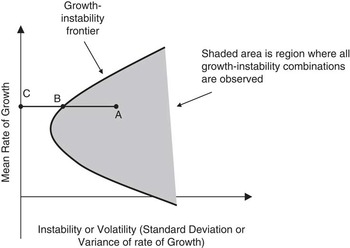
What is more, this outcome is the consequence of a particular value of the vector of relative power shares of the different partisans, s. Further, this variability-minimizing vector will tend to reflect a relatively diffuse power structure, as might be expected with the greater number and diversity of partisans associated with systems in which there is a high degree of public deliberation. Figure 3b depicts this frontier for the jointly determined outcomes of economic growth and economic instability.
Systems with High Versus Low Levels of Public Deliberation
We now examine, in the context of the above model, how democratic regimes and authoritarian regimes that have moderate-to-high (henceforth ‘high’) levels of public deliberation differ from other authoritarian regimes that have low levels of public deliberation, and why these differences may lead us to expect different economic outcomes. In the simplest case (for ease of exposition), these two types of systems may differ only in the power configuration represented by the vector of relative power shares, s, of the different partisans. In particular, in democracies and high public deliberation authoritarian regimes, the power to influence policy through public deliberation tends to be diffused across a greater number of partisans than in authoritarian regimes that place hard restrictions on formal and informal participation in the policy-making process. Hence, the distribution of si 's in a high public deliberation system tends to be less concentrated.Footnote 68 In general, this configuration lends itself to outcomes that are more stable than those in which the distribution of si 's is more concentrated.
In the above discussion, we implicitly assumed that the variance–covariance matrix of partisan positions, V pi , is constant across different systems. In reality, however, one would expect this not to be the case. In democracies and authoritarian regimes that have higher levels of public deliberation, because there is greater negotiation among diverse partisans, V pi will tend to have more of a mix of positive and negative covariances (i.e., the off-diagonal elements inV pi ). This occurs across partisan positions, and differs from the analogous matrix for a low- public deliberation authoritarian regime, whose elements, at least for those partisans with influence (high si 's) would tend to be more positive, indicating greater (and sometimes enforced) conformity.
To summarize, based on our formal model, since the variance of policy outcomes can be written as
 $$\sigma _{{{{p}_o}}}^{2} \, = \,{\bf {{s^{\prime}}}}{{{\bf {{V}}}}_{{{{{p}}}_{{i}}}}}{\bf {{s}}}\, = \,\mathop{\sum}\limits_{i\, = \,1}^n {s_{i}^{2} \sigma _{{{{p}_i}}}^{2} \, + \,2\mathop{\sum}\limits_{i\, = \,1}^n {\mathop{\sum}\limits_{j\, = \,1,j\, \ne \,i}^n {{{s}_i}{{s}_j}{{\sigma }_{{{p}_i}{{p}_j}}}} } }, $$
it follows that the variance of policy outcomes will tend to be higher for authoritarian regimes with low levels of public deliberation than it will for authoritarian regimes or democracies with high levels of deliberation. In low-deliberation authoritarian environments, the
 $$${{\sigma }_{{{p}_i}{{p}_j}}}$$$
terms are more likely to be positive and high. In addition, the product of a small number of high shares (each between 0 and 1), reflecting less inclusive decision making in politically less competitive systems, is likely to be higher than the product of a large number of small shares (again each between 0 and 1), which characterizes high public deliberation environments. This captures the diffusion of partisan discussions and information in politically competitive systems, be they democratic or authoritarian. As a result, this model illustrates the feasibility of a broader range of outcomes in politically uncompetitive systems than in politically competitive systems, from the more ‘familiar’ and incremental to more radical extremes.
Empirical Tests of the Model
In order to assess the predictions of the model, we test the four hypotheses proposed in this article using cross-national time-series data for developing countries, from 1960 to 2000. The statistical section proceeds in two steps. The first tests the prediction of the formal model regarding the existence of a non-linear frontier relationship between growth and instability (i.e., the dependent variable). The second section applies the dependent variable generated in the first step and uses panel data estimation techniques to assess the relationship between growth- adjusted volatility and the level of public deliberation, which varies both across and within regime-type. We estimate mixed models using maximum likelihood estimation and effects for time periods and, where technically possible, countries. We also control for domestic and international factors suggested by existing theory. The results provide strong evidence in support of our claim that the level of public deliberation helps explain the stability of national economic performance.
The Dependent Variable: Growth Adjusted Volatility
The formal model of public deliberation predicts a non-linear frontier relationship between growth and instability, illustrated in Figure 3b, which is used to generate the dependent variable of interest. The implication of the frontier is that, for any level of economic growth (shown by the y-coordinate of point C, for example), there is a corresponding minimum value of economic instability that is feasible (shown by the x-coordinate of point B). Therefore, the observed value of any country's instability (shown by the x-coordinate of point A) needs to be assessed in relation to this feasible minimum value of instability (the x-coordinate of point B). This is done by subtracting the feasible minimum value of instability (the x-coordinate of point B) from the actual level of instability (the x-coordinate of point A) observed for the country.
This method of estimating our dependent variable is different from conventional approaches to national economic performance, pursued by scholars such as Quinn and Woolley, Mobarak, and Henisz, which (arbitrarily) operationalize the instability that is generated by variations in regime type as the standard deviation of the growth rate.Footnote 69 Interpreted substantively, for any given rate of growth, we are eliminating that portion of instability that our formal model tells us cannot be explained by variations in public deliberation.Footnote 70 Hence, we are analyzing only that component of volatility that, for any given rate of growth, is idiosyncratic in the sense that a country is experiencing it as a consequence of country-specific characteristics (such as the level of public deliberation).Footnote 71 While this dependent variable will undoubtedly be correlated with the standard deviation of the growth rate, and this correlation will be reflected in similar results using our dependent variable and the standard deviation of the growth rate, it is generated directly from the theoretical model and is, therefore, the more appropriate of the two. In other words, as a first in the literature, our estimation enables us seamlessly to tie theory to empirics.
In this manner, our dependent variable measures national economic performance by simultaneously capturing a country's growth rate and the level of volatility. This approach is necessary because, as predicted by the theory, it allows us to capture the non-monotonic relationship depicted in Figure 3b (the growth–instability frontier) between these two variables, which previous studies have failed to do. Quinn and Woolley, for instance, estimate a linear relationship between volatility and growth, despite the fact that their Figure 1 illustrates the non-monotonic relationship of Chandra (Reference Chandra1998).Footnote 72 Our measure, while perhaps not as easy to interpret as the standard deviation of the rate of economic growth, allows us to capture growth-adjusted volatility. This refers to the degree of economic volatility that exceeds the minimum level of volatility (point A minus point B on the x-axis) that is possible for that rate of economic growth (point C on the y-axis), and that systematically varies with the rate of growth. ‘Good’ performance, therefore, entails levels of volatility that are low, given the rate of economic growth (or, equivalently, rates of economic growth that are high, given the level of volatility).Footnote 73 Hence, the empirics in this article follow directly from the formal model. This unique feature of our study enables us to evaluate our proposed hypotheses precisely.
Primary Causal Variable: Public Deliberative Capacity
The extent of actual public deliberation is a challenge to operationalize, especially in authoritarian regimes. To proxy this, we instead focus on deliberative capacity, and turn to data provided by Polity IV. We focus on PARCOMP, which measures ‘the degree to which political participation is free from government control’.Footnote 74 The Polity IV handbook states, ‘political competition implies a significant degree of public deliberation’. A high score reflects the degree to which the political system tolerates deliberation (scale of 1–5 with 1 being the least competitive). We can infer, therefore, that polities which score 5 allow high levels of public deliberation.Footnote 75 It is important to emphasize that our interpretation of PARCOMP differs from that of Pinto and Timmons.Footnote 76 Consistent with our theory, public deliberation will occur in countries that permit groups to organize, allow ideological and political rivalries, and that invite at least some participation in politics.Footnote 77 Additionally, we assume that actual public deliberation will be high when new economic policies are being proposed (in political systems that have public deliberative capacity, i.e, high PARCOMP scores), since such policies have distributional and other direct implications for a wide array of partisans.
To increase our confidence in this measure of public deliberation, we checked the correlation between PARCOMP and other existing efforts to measure how open the government is to citizen input. We are constrained from utilizing the latter in our models because both the temporal and geographic coverage are far more limited than PARCOMP. The first alternative, CIVICUS, developed by Heinrich, assesses ‘the enabling or disabling factors in the environment in which civil society functions (e.g., trust, tolerance, constraints on advocacy, etc.)’.Footnote 78 PARCOMP and the CIVICUS environmental index show a correlation of 0.53 (n = 39). Second, the John Hopkins University Sustainability and Impact Indexes represent two additional measures. The Sustainability Index assesses the ability of civil society to sustain itself over time, which includes the financial and human resources required to operate, as well as the enabling external environment (for example, self-generated income of the organization, government financial support, number of people volunteering, and legal environment). The civil society impact index measures the extent to which civil society is able to influence the government.Footnote 79 The correlation between PARCOMP and the Civil Society Sustainability Index is 0.56 (n = 35) and that between PARCOMP and the Impact index is 0.49 (n = 35).
Finally, to assess whether formal (rather than informal) power-sharing arrangements are aspects of the institutional milieu that engender stability, we also estimate the impact of an alternative variable: the degree to which the executive is ‘operationally independent’, or free from executive constraints (EXCONST, scale of 1–7 with 1 being the least constrained).Footnote 80 If public deliberation that is derived from formal institutions that decentralize power (such as political parties, legislature) is responsible for guiding economic performance, then executive constraint will have a positive and significant impact on national economic performance.
Our primary hypothesis, that public deliberation works independently of regime type to produce stability, will be confirmed if we find a statistically significant (and negative) relationship between the level of those aspects of public deliberation that represent informal power-sharing arrangements and growth-adjusted volatility. This suggests that countries with relatively high public deliberation will have more stable economic outcomes given a specified rate of economic growth. In Figure 3b, this means that the horizontal distance of an observation from the growth-instability frontier (for example, Point A minus Point B) would be larger if it is an outcome in a regime with low public deliberation than it would be in a regime with high public deliberation, controlling for the average rate of economic growth.
Control Variables
The theoretical model is a parsimonious representation of the relationship between public deliberation and economic outcomes. The literature on the drivers of economic outcomes is, of course, very large, and spans a correspondingly large set of causes that have economic effects. Hence, and in keeping with the related literature on the relationship between regime type and economic performance, it is necessary to include other variables whose exclusion could produce omitted variable bias. Our control variables, while fewer in number, are similar to those in Quinn and Woolley, Mobarak, and Henisz.Footnote 81 We use their models as a base-line because they are the most recent works on volatility–democracy. The controls we include are primary enrollment, economic openness (exports plus imports as a share of gross domestic product (GDP)), and GDP per capita (logged). In addition, we include the following controls: (1) a measure of sectoral diversity to capture the effects of sectoral diversification on economic volatility, as emphasized in a variety of literatures in economics, most notably the regional science literature;Footnote 82 (2) a measure of fuel exports, since countries dependent on natural resources can experience high economic volatility;Footnote 83 and (3) a proxy for civil war, which may also impact economic performance.Footnote 84
Finally, we also include Henisz's measure of veto players as a control to test the proposition, described above, that a broader definition of influence over policy formation than veto power is necessary to capture the influence of political institutions on economic performance fully.Footnote 85 We use the Political Constraint Index III, which covers the largest number of country-years and identifies the number of independent branches of government (executive, lower, and upper legislative chambers)Footnote 86 with veto power over policy change.
The Evidence
As discussed above, Figure 1 demonstrates that there is overlap between economic outcomes (i.e., growth and stability) for democracies and authoritarian countries. Taken together with the fact that there is also variation in the public deliberation variable across authoritarian regimes, this suggests (a) that regime type may not be the underlying driver of differences in economic outcomes across countries, and (b) there may be variables that underlie regime type that drive economic stability. We test such hypotheses.
Testing for and Estimating the Growth–Instability Frontier and the Dependent Variable
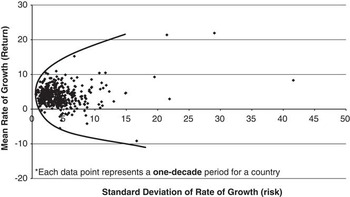
Figure 4 is a scatter plot of growth and instability for the set of countries using a one-decade time frame for each observation of average growth and instability.Footnote 87 The measure of instability is the standard deviation of the economic growth rate over the one-decade period. The growth data covers the period 1961–2000. Hence, up to four observations, one for each decade, are available per country.Footnote 88 Figure 4 is reminiscent of the convex frontier relationship depicted in Figure 3b.Footnote 89 In particular, the locus of the points on the left side of the scatter plot appears to be a convex curve.Footnote 90 Using the data displayed in Figure 4, we now proceed to estimate the shape of the frontier as predicted by the formal model. Two methods of frontier analysis, data envelopment analysis (DEA) and stochastic frontier estimation (SFE), are used for this purpose.
Mean rate of growth vs. standard deviation of rate of growth (World Bank Data : 1961–2000, n = 417)

Frontier Estimation Using Data Envelopment Analysis (DEA) and Stochastic Frontier Estimation (SFE)
DEA enables us to estimate our non-monotonic dependent variable. It involves the use of an algorithm in computational geometry to identify those points in a scatter plot that lie on the convex hull of the plot. In this application, the Quickhull algorithm was used to identify points on the convex hull. The points that lie on the left side of the hull are then used to estimate the shape of the frontier in growth–instability space. A series of successively internal hulls is stripped off the original scatter plot and collected until a set of points sufficient in size to provide robust statistical estimates of the shape (and curvature) of the frontier is created. This is akin to peeling off a few successive outer layers of an onion in order to estimate the shape of the bulb. For more details of data envelopment analysis, see Appendix A. This analysis uses the MATLAB software package.Footnote 91 Figure B2 in Appendix B is a plot of five successive convex hulls that were obtained from the scatter plot in Figure 4 using the algorithm described above and in Appendix A.Footnote 92
In the second step of the analysis, the points on the hulls are used to estimate the shape of the frontier using standard regression methods with fixed effects for each hull (i.e., first or outermost hull, second hull, third hull, fourth hull, fifth or innermost hull). The model is:
 $$S\, = \,{{\alpha }_i}\, + \,{{\beta }_1}G\, + \,{{\beta }_2}{{G}^2} \, + \,u$$
where i indexes the hull on which an observation lies, S is the standard deviation of the growth rate of an economy whose observation lies on a hull, G is the average growth rate associated with that observation, β 1 and β 2 are curvature parameters of the frontier, and u is an independently identically distributed random variable with normal distribution, mean 0, and standard deviation σu .Footnote 93
To test for robustness of the curvature of the hull, the models were estimated using the data obtained for all five hulls and for the four outermost hulls. The trade-off between using five hulls and four hulls is the following: with five hulls there are more observations from which the estimates can be generated, but the inclusion of the innermost hull involves the use of data that are farther inside the outermost hull than would be the case with only four hulls. Because the hull of a set of points is always convex, DEA cannot used as a hypothesis test of the convexity of the frontier.Footnote 94 It is, however, an effective method for estimating the shape of the frontier, characterized by the coefficients αi , β 1, and β 2. Table C1 in Appendix C contains the results of this analysis.Footnote 95 As might be expected, the frontier estimate is convex. The growth rate at which the turning point of the frontier occurs is between 3.91 percent and 4.41 percent. In order to test the hypothesis about the existence and shape of the frontier, and to generate an alternative set of observations on growth adjusted stability, we also use an alternative frontier estimation method, stochastic frontier estimation (SFE). Details of SFE are provided in Appendix D. The next step in the empirical analysis is to test hypotheses on the relationship between public deliberation and growth adjusted instability.
Testing Hypotheses
Our model predicts that political systems which permit some level of public deliberation will tend to lie closer to the left side of the frontier, within the feasible space of growth-instability outcomes (the shaded area in Figure 3b above). Because growth and instability are jointly caused by the underlying institutional structure, however, a precise way to test for a relationship between instability and the level of public deliberation would be to pick a level of growth (a value on the vertical axis of Figure 3b) and to test whether, given that level of growth, democracies and high- public deliberation authoritarian regimes tend to lie closer to the frontier than low-public deliberation authoritarian regimes. For this purpose, the dependent variable in an empirical model is the horizontal distance (the line AB in Figure 3b) from the frontier, and the independent variable of interest is the degree of public deliberation.
Unlike many earlier studies which use cross-sectional data, our model uses multiple (up to four) observations per country representing each of the four possible decades. The model is written as a standard panel data model
 $${{I}_{it}}\, = \,{{\beta }_0}\, + \,{{\beta }_1}{{P}_{it}}\, + \,{\bf {{\gamma C}}}_{{{\rm{it}}}}^{{}} \, + \,{{e}_{it}},\,i\, = \,1, \ldots, N,\,t\, = \,1, \ldots, T$$
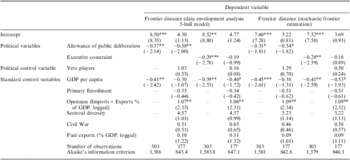
where Iit measures horizontal distance from the frontier for country i at time t, Pit is a proxy for ‘public deliberative capacity’, C it is a vector of control variables, β 0 and β 1 are parameters to be estimated, γ is the vector of parameters associated with the vector of control variables, and eit is a random (normally distributed) error term.Footnote 96 The estimation method used was maximum likelihood. Table 1 contains the results of the models estimated to test the null hypothesis of no relationship between public deliberation and horizontal distance from the growth-instability frontier computed from the data envelopment analysis and stochastic frontier estimates for the full sample; this includes all regime types, democratic, authoritarian, and intermediate. For the results to be consistent with our first hypothesis (Hypothesis 1), we would expect a negative and significant relationship between public deliberation and distance from the growth-instability frontier. This is indeed the case in all four models. It is worth emphasizing that the impact of public deliberation holds even when the veto players variable is introduced as a control, suggesting that our key explanatory variable outweighs the predicted impact of veto players on economic performance.Footnote 97
Determinants of Distance from the Growth–Instability Frontier, All Countries

Note: One decade per observation; t-statistics in parentheses; ***p < 0.01; **p < 0.05; *p < 0.10.
Table 1 also shows the results of models in which public deliberation is replaced by a variable that captures formal institutional structures to share policy-making power, executive constraint (XCONST). The coefficient estimate for executive constraint is negative in all four models but only significant in two (the ones that do not include the control variables), suggesting that formal power-sharing arrangements are not contributing to stability. Rather, in the context of Figures 3b or 4, the negative coefficient in the models demonstrates that, all else (including the mean rate of growth) being equal, a country with a measure of public deliberation that is higher by one point will experience a standard deviation of growth (or level of instability) that is between 0.31 and 0.58 points lower than that of a country that has a measure of public deliberation that is one point lower. This would be represented by a horizontal shift in the figures in the direction of the frontier (or to the left). These results confirm that countries that support high levels of deliberation tend towards stability (Hypothesis 1). Since democracies have high deliberative capacity, democracies generally maintain stable economic growth (Hypothesis 2).
Testing Hypotheses 3 and 4
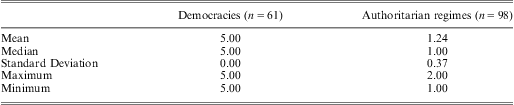
Next, our analysis departs significantly from the existing literature by establishing that, even within the authoritarian regime category, variation in levels of public deliberation matter. As a first check, we contrast the levels of public deliberation across ‘pure’ authoritarian regimes (those with a Polity IV democracy score of 0) with those in ‘pure’ democratic regimes (a Polity IV democracy score of 10). Table 2 demonstrates that, unlike democratic regimes, there is variation across authoritarian regimes in levels of public deliberation. As might be expected, democratic regimes maintain uniformly high levels of public deliberation compared to authoritarian regimes.
Allowance of Public Deliberation in Democracies vs. Authoritarian Regimes

Hence, if we were to analyze the subset of authoritarian regimes, we would still expect to find that those aspects of the policy-making process matter that are not defined by regime type, but instead vary within regimes of one type. These are the informal aspects of policy formation, captured by the degree of public deliberation permitted (i.e., PARCOMP), but not by the degree to which the regime formally regulates participation or constrains the executive (i.e., XCONST). This is the second prediction of the formal model, specifically, Hypotheses 3 and 4.
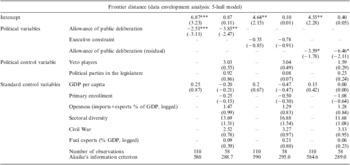
Table 3 repeats the analysis of Table 1, this time for the subsample of authoritarian regimes (i.e., those with a polity score of 0 in the Polity IV dataset). It shows confirmation of Hypothesis 3, namely that authoritarian regimes with a higher degree of public deliberation display outcomes that lie closer to the growth-instability frontier on the instability dimension than those with a lower degree. To be absolutely sure that our measure of public deliberation accounts for the contrast in national economic performance across authoritarian regimes, we take two additional precautions. First, we add Gandhi'sFootnote 98 measure of multiparty competition in authoritarian regimes to ensure that public deliberation has an impact distinct from opposition party participation. Second, to isolate the unique elements of deliberation in PARCOMP, we created a residual variable (after regressing PARCOMP on all the other components of Polity and extracting the residual from this regression) and reran the models using the residual. This residual captures information that is unique to PARCOMP and distinct from other components of Polity.
Determinants of Distance from the Growth-Instability Frontier, Authoritarian Regimes Only

Note: One decade per observation; t-statistics in parentheses; ***p < 0.01; **p < 0.05; *p < 0.10.
Table 3 confirms that the coefficients on the public deliberation variable are all negative and statistically significant, even with the inclusion of the Political Parties in Legislature variable, as well as the residual public deliberation variable. See Appendix E for similar results using growth-adjusted instability observations, generated using Stochastic Frontier Estimation (one-decade observations) as the dependent variable. Remarkably, apart from this phenomenon, which is consistently demonstrated across different methods of frontier estimation and model specification, no other robust relationships between controls and the dependent variables are evident for both operationalizations of the dependent variable. The coefficients on executive constraint, for instance, are not significant. These findings are striking; they suggest that even moderate levels of public deliberation can increase the stability of growth outcomes (Hypothesis 3) and that volatility worsens with low levels of deliberation (Hypothesis 4). In other words, some authoritarian regimes can consistently achieve stable growth outcomes.
Robustness Checks
Importantly, our results were robust to several fundamental changes to the model. First, in order to adjust for possible endogeneity in the institutional variables in Table 1, we followed Mobarak and estimated models using the proportion of Muslims in the population as an instrument for these variables.Footnote 99 This adjustment had no impact on the substance of the results. Second, we further ensured that PARCOMP is acting as a proxy for deliberation by re-running a basic version of our model in Table 1 using the John Hopkins University (JHU) civil society impact index in place of PARCOMP (see Appendix E, Table E2).Footnote 100 Third, we checked the effects of regime transitions (democratic to/from authoritarian). Since we are applying decadal averages, the data do not automatically allow us to detect if regime transitions are influencing our results. To test this, we created a dummy variable to represent regime transition and reran the model dropping observations for which the transition dummy variable was ‘1’.Footnote 101 As a fourth robustness check, we applied different methods to estimate the frontier, in addition to DEA; i.e., stochastic frontier estimation and fixed effects, as described in Appendix D. Fifth, we ran the model on a sub-sample of only non-OECD countries to control for possible bias, since high-income OECD democracies naturally tend towards lower rates of growth, while developing (non-OECD) nations are subject to the ‘catch up’ phenomenon. Sixth, we inserted controls for the ‘miracle economies’ of East Asia, Sub-Saharan Africa, and Latin America. Finally, we averaged the data according to several different time periods: one decade averages; two decade averages; and four decade averages. Importantly, the substance of our results was not affected by any of these changes (these results are available by request).
Conclusion
Why do authoritarian regimes vary so much in economic performance, with many performing as well as democracies? If regime-type, then, is not the driver of such variations, are there other systemic factors that give rise to this variation? This study is the first to predict and confirm that public deliberation can explain this variation both within authoritarian regimes and across all regime types. We suggest that higher levels of public deliberation in democracies and some authoritarian regimes essentially guarantee more stable rates of economic growth than in authoritarian regimes which have less public deliberation. More specifically, the negotiation process, coupled with the implicit caution of policy-makers while setting agendas, prohibits policy makers from implementing uninformed and untried economic policies likely to result in volatility.
The findings of this paper do not necessarily render regime type meaningless. Democracies do, on average, have higher levels of public deliberation than authoritarian regimes; and high public deliberation authoritarian regimes are nations that may not maintain extensive levels of public deliberation, particularly compared to democracies. But significantly, the level of public deliberation in some repressive regimes is high enough to produce similar growth outcomes as in democracies. The startling discovery is that, ultimately, the difference in national economic performance between dictatorships that allow some degree of public deliberation and democracies is relatively small, and even, in some cases, zero.
The broader contributions of this analysis are four-fold. First, we emphasize a different aspect of the governance process than the current literature. While most scholars link good governance outcomes with increases in civil and political rights, electoral competition, and well-performing (formal) institutions, we posit that allowing public debate also plays a non-negligible role. Second, the formal model presented in this study, parts of which are adopted from portfolio theory in finance, introduces an innovative tool that political scientists can apply to future formal modeling and data analyses. This approach enables us to demonstrate the parallel between systems with high levels of public deliberation and well-diversified financial portfolios – both are insulated from extreme outcomes because of the mutually buffering effects of multiple partisans (or, in finance, assets) in the portfolio. Third, this is the first study to empirically (and theoretically) analyze the impacts of public deliberation on national economic performance. Finally, the empirical section unveils the upper and lower boundaries of economic growth in the late-twentieth century by providing estimates of the growth-instability frontier. This enables us to precisely characterize the ‘universe of possibilities’ in terms of growth-instability combinations for poor (and rich) economies based on the level of participation in the policy-formation process.
Findings from this analysis provide much fodder for future research. For instance, while we follow the existing literature and assume that economic policies are directly linked to national economic performance, the next step is to assess how public deliberation affects policy variables per se. Education and health spending are good examples. Another advance would be to identify conditions under which civic debate might vary across democracies, and not just authoritarian regimes. It may well be that the processes of public deliberation in corporatist and consensus democracies work differently and engender different economic policies than in non-corporatist democracies. Finally, how might international financial institutions push radical policy changes in democratic countries with weak institutions, particularly when faced with severe economic crises? Bolivia's economic ‘shock therapy’ experience in the mid-eighties is an example. Pressure from the International Monetary Fund's stabilization plan led the Paz Estensorro government to institute the ‘New Economic Plan’, resulting in drastic government spending cuts, privatization, and the adoption of a rigid monetary policy.
The overarching purpose of this article is to improve our understanding of the political determinants of economic performance and, more specifically, the key feature of the policy-making process that contributes to this outcome. We are in an era in which countries with poor growth rates are at risk of being left farther and farther behind. At the same time, volatility is an increasing concern in a global economy as nations become more sensitive to the threat of contagion. This analysis confirms that increasing public deliberation for citizens can simultaneously address problems of economic instability and growth. We concur with Przeworski et al.'s conclusion that democratic regimes, which tend to have high levels of public deliberation, do not have to sacrifice economic development.Footnote 102 At the same time, however, findings from this analysis emphasize that there is indeed a trade-off between political freedom and extremely rapid economic growth. Ultimately, understanding the link between the extent of public deliberation and economic growth and volatility helps illuminate one important way that governments can ensure more stable outcomes in all regimes, be they democratic or authoritarian.