I. INTRODUCTION
Porous oxides especially, those based on alumina, have become widespread materials for a variety of applications, for instance, adsorbents, heterogeneous catalysis, sensors, and many other fields.Reference Cai, Yu, Anand, Vinu and Jaroniec1–Reference Varghese, Gong, Paulose, Ong, Grimes and Dickeya4 In recent years, great interest has been focused on porous alumina-based oxides as catalysts or catalyst supports because such pore structures are beneficial for the exposure of active sites during the catalytic reactions.Reference Ferreira Alves, Neto, Bessa, Oliveira, Filho, Campos and Oliveira3,Reference Li and Li5–Reference Ahrem, Wolf, Scholz and Kemnitz7
Owing to the high surface area, low cost, Lewis acidity, high thermal stability, and also inherent porosity, the alumina-based oxides have been used in catalytic reactions including C–H and C–C bond activation, hydrodesulfurization, glycerol transformations and isomerizations, among others.Reference Li and Li5–Reference Carvalho, Souza, Filho, Assaf, Thyssen, Campos, Hernandez, Raudel and Oliveira10 Specifically, in the case of glycerol transformation reactions, the esterification of glycerol with acetic acid (EG) is an interesting alternative to obtain monoacetin (monoacetylglycerol), diacetin (diacetylglycerol), and triacetin (tryacetylglycerol) products.Reference Ferreira Alves, Neto, Bessa, Oliveira, Filho, Campos and Oliveira3,Reference Costa, Decolatti, Legnoverd and Querini11 The diacetin and triacetin valuable compounds used as fuel additives and solvents, whereas triacetin is applied to improve the biodiesel viscosity and low-temperature properties.Reference Costa, Decolatti, Legnoverd and Querini11
Our previous report on binary oxides based on alumina has shown that the introduction of porosity in an ordered fashion with interconnectivity between the pores of different length scales would be advantageous for esterification of glycerol.Reference Ferreira Alves, Neto, Bessa, Oliveira, Filho, Campos and Oliveira3 This facilitates the reactant molecules, i.e., glycerol and acetic acid to access readily the interior pore to produce selectively the above-mentioned glycerol esters (acetins). However, the disadvantages of these alumina-based catalysts possessing mild acidic sites are the limitation of their pore sizes, reusability, and low selectivity toward the acetins, which are still unresolved issues due to leaching of the acid sites during the reaction.
Because sol–gel derived organic–inorganic hybrid nanocomposite materials have the drawback of the low stability, the addition of stabilizers to suspensions of different oxides such as SiO2, TiO2, and ZrO2 can effectively overcome these drawbacks. For instance, polyvinylpyrrolidone (PVP) is a nonionic and water-soluble polymer added as binders to improve the rheological properties of ceramic materials, enhance solids’ corrosion resistance, and avoid cracking of coatings thermal treatments, and use as additive to cosmetics or pharmaceuticals as well.Reference Feng, Wang, Yao, Webley, Smart and Wang12–Reference Jing and Hou14
To bolster and tune the catalytic performance of the porous solids, further modification of the binary oxide catalysts is needed. Thus, porous alumina and alumina-based oxides were synthesized by the sol–gel method and PVP was added as the stabilizer. The as-synthesized and calcined solids were applied in the esterification of glycerol with acetic acid. The procedure adopted to modify the porosity of the alumina-based catalysts was using introduction of structuring agents and pore expanding ones into the pores to solve the shortcoming of the low porosity, decrease the acid strength, and avoid leaching to enhance the catalytic performance.
Subsequently, the esterification performance of the prepared solids was further compared with that of a mesoporous alumina.
II. EXPERIMENTAL SECTION
A. Materials
Cetyltrimethylammonium bromide (CTAB), aluminum tri-sec-butoxide (Al(OC4H9sec)3), titanium isopropoxide (Ti[OCH(CH3)2]4), tetraethyl orthosilicate (Si(OC2H5)4), isopropanol and polyvinylpirrolidone (PVP), and sodium hydroxide (NaOH) were purchased from Sigma-Aldrich (St. Louis, Missouri). Glycerol (99.5%) and acetic acid (99.7%) were purchased from Vetec (São Paulo, Brazil) and Dinamica (São Paulo, Brazil), respectively. All chemicals are of analytical grade, and they were used for experiments without any further purification. Deionized water was also used.
B. Synthesis of the catalysts
The catalysts were prepared by a modified process of the sol–gel synthesis.Reference Ferreira Alves, Neto, Bessa, Oliveira, Filho, Campos and Oliveira3 Briefly, a 20 wt% solution of the CTAB surfactant was prepared under stirring at 40 °C for 5 min. Then, about 0.01 mol of (Ti[OCH(CH3)2]4) and 5 mL of isopropanol were added to the previous surfactant solution and vigorously stirred at 40 °C for 30 min. The resulting mixture had pH equal to 5.0. Then, a 10 wt% of PVP was added to the previous solution with a 0.01 mol of (Al(OC4H9sec)3) and NaOH solution (0.2 mL, 10 mol/L).
The whole mixture having pH = 8 was kept under stirring and aged for 1 h at room temperature. Afterward, the resulting gel was transferred into the Teflon-lined stainless steel in an autoclave. After the thermal treatment at 80 °C for 24 h, the autoclave was allowed to cool down to room temperature. The precipitate was further centrifuged and washed thoroughly with distilled water and ethanol more than four times and then dried at 60 °C for 12 h. The obtained as-synthesized solid was denoted as TAP, where the letters T and A represent titanium and aluminum, respectively.
The same procedure was applied to obtain the as-synthesized SAP, where the letters S and A represent that the (Si(OC2H5)4) and (Al(OC4H9sec)3) precursors were used for the synthesis. The letter P means that PVP remained in TAP and SAP as-synthesized catalysts.
The as-synthesized SAP and TAP solids were also submitted to calcination at 500 °C at a heating rate of 5 °C/min for 10 h to remove the PVP, alkoxide inorganic precursors, and CTAB from the pores. These solids were labeled as SAC and TAC, where the letter C represents the calcination process.
A mesoporous alumina (γ-Al2O3) was obtained by the sol–gel method, according to previous work.Reference Araujo, Zanchet, Rinaldi, Schuchardt, Hori, Fierro and Bueno15 The catalytic performance of the mesoporous γ-Al2O3 in the esterification of glycerol with acetic acid was compared to that of prepared solids.
C. Characterization
The morphology of the solids was determined by using a FEG Quanta 450 scanning electron microscope coupled to the energy-dispersive X-ray EDS/EBSD FEG (SEM-EDS) equipment (FEI, Hillsboro, OR, USA). Previously, the solids were sputter-coated with Au forming a 20 nm thick gold layer to impart electrical conductivity to the specimen surfaces.
X-ray diffraction patterns were collected on a Bruker D8 diffractometer (Bruker, Rheinstetten, Germany) using a Cu Kα radiation at 40 kV and 40 mA. The diffraction patterns were collected in the 2θ of 10–70° range with step-sizes of 0.02° and counting times of 2 s. Crystallographic phases were identified using the Joint Committee on Powder Diffraction (JCPDS) database.
The textural properties were determined from the adsorption–desorption isotherms of nitrogen in an ASAP 2000 apparatus (Micromeritics, Norcross, Georgia). The samples were pretreated in vacuum at 70 °C for 24 h, before the measurements. The surface areas were obtained from the Brunauer–Emmett–Teller (BET) method. The pore-size distribution was determined from the desorption branch by applying the Barret–Joyner–Halenda (BJH) method. The total pore volume was estimated from the total nitrogen uptake under a relative pressure e (P/P 0) of 0.9.
Fourier-transform infrared spectroscopy (FTIR) spectra were obtained on a FTIR VERTEX 70 from Bruker (Bruker, Karlsruhe, Germany). The KBr method was used to prepare the samples and the spectra were collected from 400 to 4000 cm−1 range. Before the measurements, about 1 mg of the sample was mixed with 300 mg of KBr powder. Then, the mixture was compacted into a thin pellet in a stainless steel die of 1 cm inner diameter.
Thermoprogrammed desorption of ammonia (NH3-TPD) was conducted over the alumina-based oxides to evaluate the strength and the density of the acid sites of the solids in a Micrometrics apparatus. About 100 mg of the catalyst was placed on a quartz U-tube microreactor and then degassed at 100 °C under He flow for 5 h. After that, the sample was cooled down to 40 °C followed by flushing the solid with a mixture NH3/He. Then, the ammonia was replaced by helium to remove the physisorbed ammonia. Next, the temperature was increased gradually and then, the ammonia was desorbed.
The acidity of the reference mesoporous γ-Al2O3 sample was obtained through FTIR of adsorbed CO, as found elsewhere.Reference Araujo, Zanchet, Rinaldi, Schuchardt, Hori, Fierro and Bueno15
D. Catalytic performance in the esterification of the glycerol reaction
The catalytic tests were carried out in a batch glass reactor in the esterification of glycerol with acetic acid (EG) at a temperature of 80 °C and glycerol to acetic acid molar ratio of 1:3.
The catalyst (about 50 mg) was introduced first in the reactor, followed by the addition of acetic acid (0.1 mol/L) and glycerol. The catalytic reaction was conducted for 6 h under a stirring speed of 370 rpm. Once the reaction was complete in 1 h intervals, the samples were withdrawn from the reactor, after being filtered and then were cooled to room temperature. The reaction products were analyzed with a GCrom 8000 gas chromatograph apparatus, which was connected to a flame ionization detector (GCrom, São Paulo, Brazil). Previously, the samples were diluted with 1 mL ethanol and analyzed in a capillary column. Also, the products were identified by gas chromatography coupled with a mass spectrometer QP 5050 Plus model from Shimadzu (Shimadzu, Kyoto, Japan). Besides, blank tests showed that under the experimental conditions used in this work, the esterification of glycerol with acetic acid could be neglected. The conversion and selectivity obtained in the steady state were calculated, as found elsewhere.Reference de Carvalho, Oliveira, Ferreira, Filho, Tehuacanero-Cuapa and Oliveira16
The recyclability studies were conducted by reusing the solids in four consecutive cycles of 24 h. Briefly, the catalysts were separated from the glycerol and acetic acid reaction mixture by centrifugation, washed to remove the unreacted acetic acid and dried, before being reused.
III. RESULTS AND DISCUSSION
A. Morphological aspects of the solids
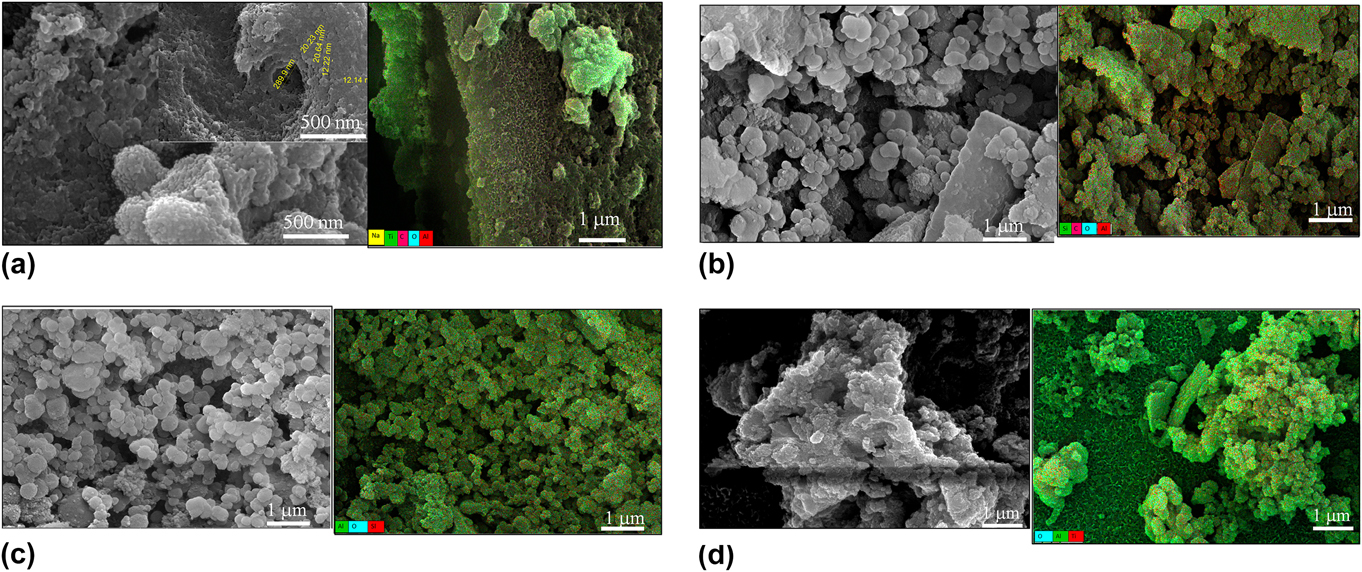
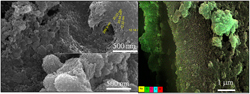
Figure 1 shows the morphological features of the samples. As can be seen in Fig. 1(a), the TAP morphology consists of spherical or pin-cushion like aggregates, some of them are in an uneven shape. Moreover, the porous structure comprising of pores with in the 22–289 nm range can be easily observed in the solid [Fig. 1(a) included], as a result of the use of PVP as the expanding pore agent. In agreement, the use of polymer stabilizing agents as polyvinyl alcohol may create a steric hindrance between inorganic particles to reduce their agglomeration and forming porous solids, as well.Reference Carvalho, Souza, Filho, Assaf, Thyssen, Campos, Hernandez, Raudel and Oliveira10,Reference Halder, Prasad, Khan, Goyat and Chauhan17 Also, a heterogeneous distribution of the Ti and Al is observed in the TAP surface, as illustrated by EDS. In addition, the Na and C elements come from the residual sodium hydroxide, CTAB, alkoxide inorganic precursors, and PVP used during the synthesis.
SEM-EDS images of the solids: (a) TAP, (b) SAP, (c) TAC, and (d) SAC. The included figure is the SEM image of the TAP sample.

In the case of SAP [Fig. 2(b)], the presence of spherical-like particles clearly reveals that varying the alkoxide inorganic precursor results in the morphological changes in the solid. The spherical morphology is commonly found for solids synthesized by the sol–gel method prepared through similar procedures.Reference Namkhang and Kongkachuichay18 Additionally, a homogeneous distribution of Si and Al elements on the solid surface is seen with C coming from the organic precursors.
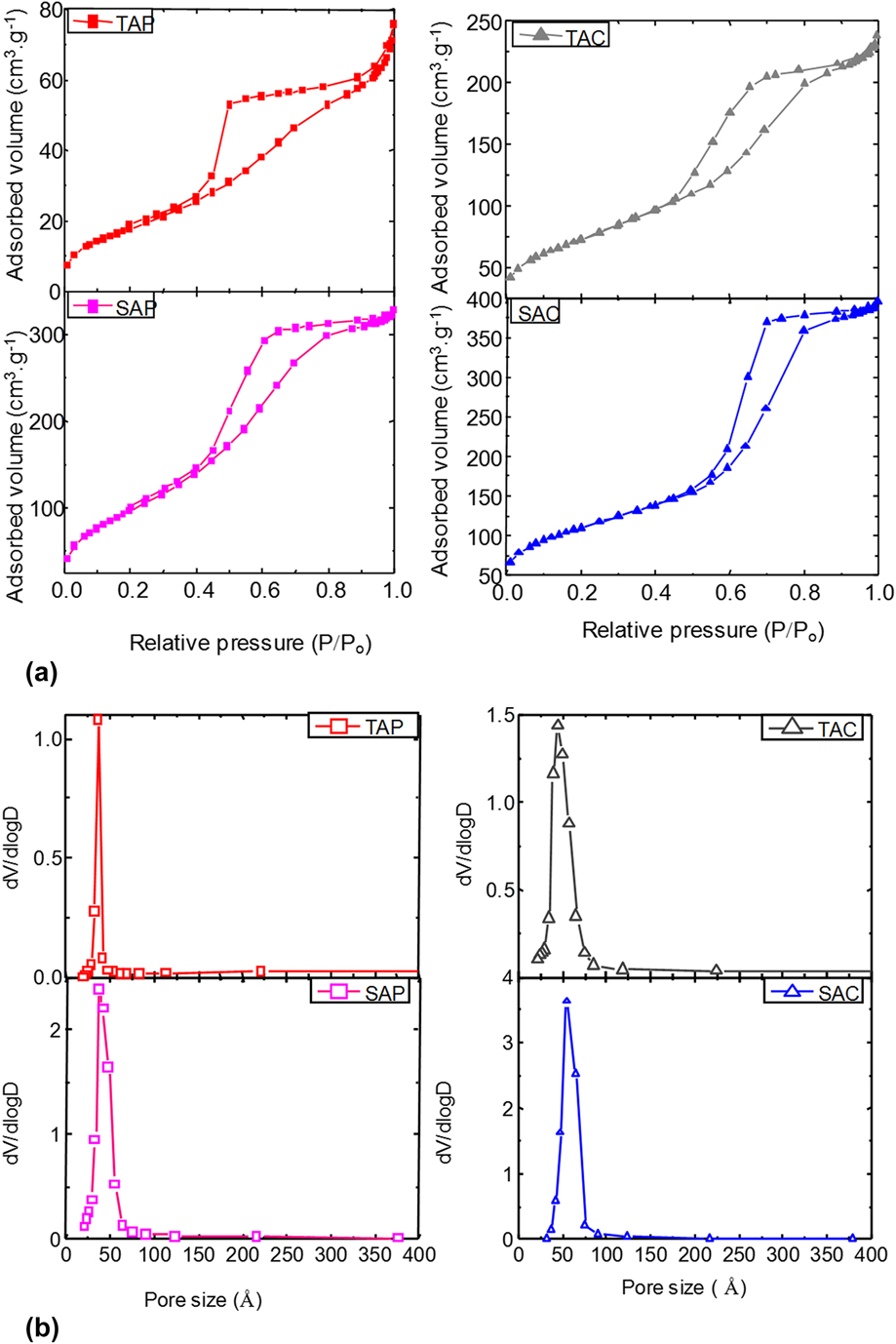
(a) Nitrogen physisorption isotherms and (b) the corresponding pore size distributions of the solids.

When calcinating the solids, no significant changes in the morphology is observed in SAC, as demonstrated by the SEM images [Fig. 1(d)]. Also, the porous features of the SAC seem to be preserved. The EDS images suggest that the distribution of the elements does not change drastically, after removing the PVP and CTAB precursors by calcination. After removing the organics to obtain TAC [Fig. 1(c)], the solid became slightly agglomerated with variation in the pore structure, as compared with the uncalcined TAP. This is further demonstrated by the textural properties. Indeed, both TAC and SAC do not display the carbon element, which indicates the successful organic removal from the solids. As a result, an additional porous system is created in the calcined materials, when PVP leaves from the pores through the controlled heating process.
From these results, it can be seen that the sol–gel method afforded to the preparation of tunable porous alumina-based solids with distinct shapes, depending on the inorganic precursor used. The calcination of the solids does not cause significant change in both porosity and morphological aspects of the solids.
B. Textural properties
The textural properties of the solids are obtained through the nitrogen adsorption–desorption isotherms [Fig. 2(a)].
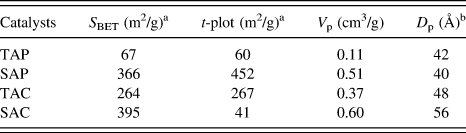
All solids display a type IV isotherm displaying the capillary condensation around the relative pressure range between 0.3 and 1.0, which is a characteristic of mesoporous materials.Reference Ferreira Alves, Neto, Bessa, Oliveira, Filho, Campos and Oliveira3,Reference Yanagishita, Imaizumi, Kondo and Masuda19 However, the solids exhibit different hysteresis loops in the higher relative pressure region. For instance, TAP has an asymmetric hysteresis loop with type H2 feature which is often associated with ink bottle-neck shaped pores.Reference Sing, Everett, Haul, Moscou, Pierotti, Rouquerol and Siemieniewska20 The other solids show a hysteresis loop between H1 and H4, which is associated with solids possessing large pores delimited by narrow necks formed from pore cavities inside the solid mass. In addition, these samples showed a relatively narrow mesopore size distribution [Fig. 2(b)], indicating that these solids are assembled in an ordered manner, even after the calcination. The textural parameters of all studied materials are summarized in Table I.
BET surface areas (S BET), pore volumes (V p), and pore sizes (D p) of the samples.

a BET method.
b BJH method.
The textural parameters of the as-synthesized samples indicate that their porosities are modulated by tuning the structure of inorganic alkoxide precursor, pore expanding agent, and surfactant. Accordingly, SAP has a high surface area and pore volume compared to those with TAP. A possible explanation for that could be the presence of the high concentration of carbon entities (e.g., PVP, CTAB, and alkoxydes from the inorganic precursors) unevenly distributed on the TAP surface, probably occluding the pores. Another fact is that the residual sodium present on the surface of TAP may decrease its textural properties (EDS results). On the contrary, SAP has a BET surface area of 366 m2/g and a pore volume of approximately 0.51 cm3/g, respectively. This suggests that the carbon is homogenously distributed on either on the solid surface or into the pores. Also, the carbon species do not alter the textural properties of the SAP sample.
In general, t-plot surface area values are superior to those of BET due to the predominance of micropores in the solids, being SAC an exception. Additionally, the pore diameter values of TAP and SAP are close to 40 Å, confirming the existence of the mesopores. Also, a fraction of the pore sizes is in larger pores, e.g., macropores at about 10.5 Å, in agreement with SEM results.
After removing the organics by calcination, both samples have their textural properties increased, as expected. As found elsewhere, the use of PVP as the template can promote an expansion of the pores and prevent random hard agglomeration of the synthesized particles with the solids showing good BET surface areas.Reference Krishna, Malty and Datta21,Reference Seo, Sinha, Novitskaya and Graeve22 This is attributed to the steric repulsive force of the PVP molecules on the surface of the metal oxide nanoparticles.Reference Seo, Sinha, Novitskaya and Graeve22 In addition, the values of the pore diameter are slightly increased indicating the removal of the organics do not change the porous properties of the solid, which is consistent with SEM-EDS results. Moreover, a possible cause for t-plot areas decreasing in SAC and TAC could be the release of organic compounds by calcination, expanding the mesopores. Consequently, the pore diameter curves are broadened after calcination, having an average value of 48 and 56 Å, respectively, for TAC and SAC.
C. Structural features by XRD and FTIR
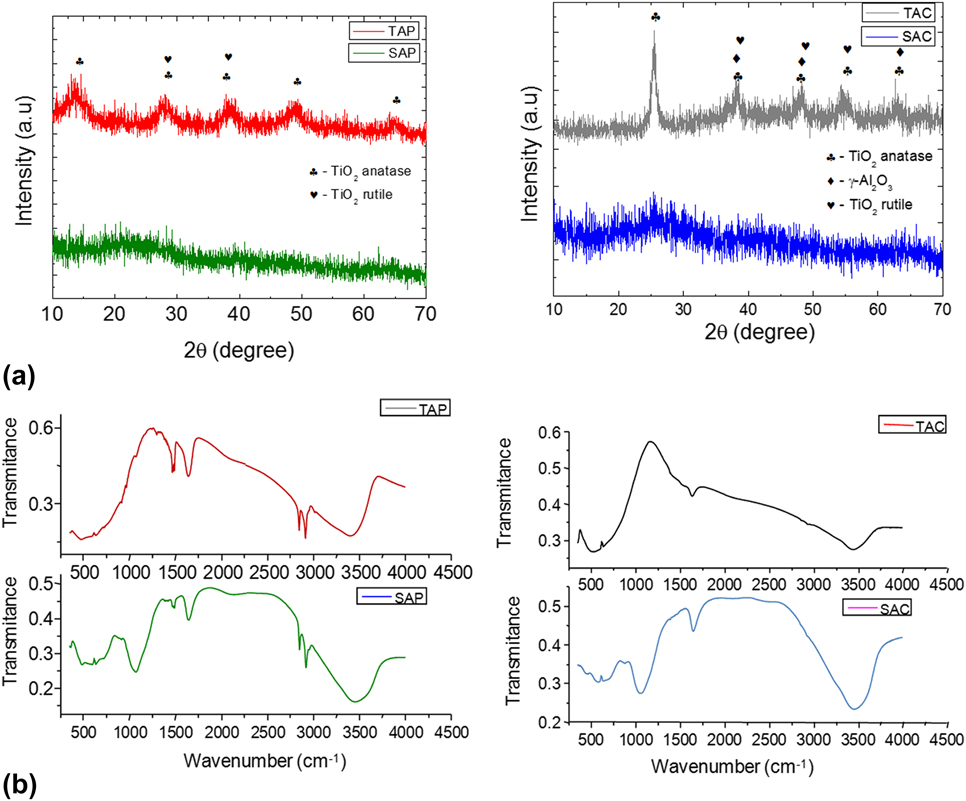
The structural features of the solids are observed through XRD and FTIR. Figure 3(a) shows the XRD patterns of as-prepared samples. It is evident that SAP is an amorphous sample, a typical feature of silicon-based solids.Reference Ferreira Alves, Neto, Bessa, Oliveira, Filho, Campos and Oliveira3 The diffractogram of SAC is essentially equivalent to that of SAP exhibiting an amorphous feature. On the contrary, TAP depicts badly resolved peaks of a semicrystalline solid, which can be indexed to the reflections of TiO2 anatase (JCPDS No. 71-1169) and TiO2 rutile (JCPDS, No. 76-1940).
(a) XRD patterns and (b) FTIR of the samples studied.

After removing of the pore expanding agent and the template via calcination at 500 °C, the structural regularity increases, but the weak intensities of the peaks prove that a short-range order exists in the semicrystalline TAC solid. In addition, the peaks at 2θ = 25.3, 36.7, 48.2, 54.5, and 62.8° are consistent with the (101), (004), (200), (211), and (213) planes of the tetragonal TiO2 anatase. Peaks of the TiO2 rutile also appears at 35.6, 40.8, 54.0, 54.9, 56.0, and 61.0° corresponding to the (101), (200), (111), (210), (220), and (002) planes. Moreover, some peaks matches well with those of γ-Al2O3 (JCPDS 10-425).
Based on the above-mentioned results, the samples possess low crystallinity and the elimination of the organics does not alter the structural, textural, and morphological features of the solids.
FTIR spectra of the solids are shown in Fig. 3(b). The as-synthesized samples depict a broad absorption band at about 3440 cm−1, which is ascribed to antisymmetrical and symmetrical stretching O–H vibrations.Reference Shek, Lai, Gu and Lin23 The band at around 1660 cm−1 is due to O–H groups, which evidences the presence of hydration water. This band can be associated with the asymmetric stretching mode of C–O vibrations from the alkoxides used during the synthesis.Reference Ferreira Alves, Neto, Bessa, Oliveira, Filho, Campos and Oliveira3 Moreover, the bands at around 2934, 1456, and 1421 cm−1 are assigned to C–H symmetric stretching and scissoring (bending) vibrations from the residual organic precursors, e.g., trisecbutoxy, PVP, isopropoxide, and tetraetoxy molecules. The bands at 2400 and 2150 cm−1, arising from the CTAB structuring agent would be seen in the as-synthesized samples. However, they are not observed probably due to the low amount used. At low frequencies, the bands associated with the Si–O–Si, Al–O–Al, and Ti–O–Al arise below to 1100 cm−1.
When the solids are submitted to calcination, the bands associated with the C–H, C–O, and O–H vibrations are vanished from the spectra, suggesting the removal of the organic precursors to form the solids. This is in line with XRD, SEM-EDS, and textural property results.
D. Catalytic performance in EG
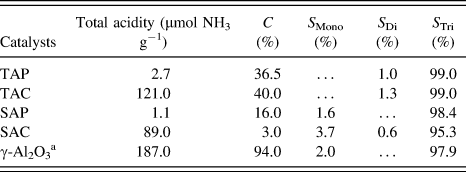
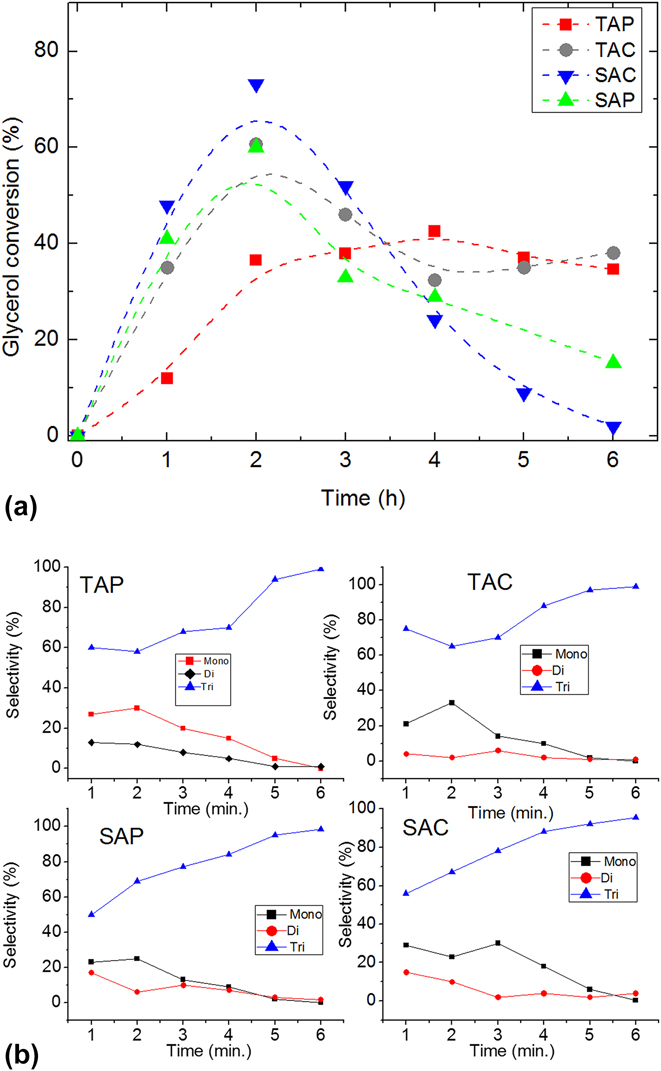
All solids are evaluated in the esterification of glycerol with acetic acid. The reaction conditions were as follows: 50 mg catalyst, glycerol to acetic acid ratio is 1:3, and reaction temperature 80 °C. Such reaction conditions were chosen as optimal after a series of initial experiments in various conditions.Reference Araujo, Zanchet, Rinaldi, Schuchardt, Hori, Fierro and Bueno15 It is noteworthy that all the alumina-based catalysts are active in the EG reaction, in 1 h of the reaction. This result indicates the fast glycerol reaction with acetic acid and the notable product formation in the early stage of the reaction, as found for acid catalysts in the EG.Reference Huang, Han, Hung, Lin, Wu, Wu and Liu24,Reference Kim, Kim and Lee25 As the reaction proceeds, a decline in the glycerol conversion is observed for all catalysts, except for TAP. At the end of each runs, good results are obtained for TAP and TAC with respect to the glycerol conversion of approximately 36 and 40%, respectively. On the other hand, the other solids gave poor performances, achieving conversion inferior to 16% due to the deactivation in 6 h of reaction, as in the case of SAP and SAC.
Table II demonstrates the total acidity measurements of the solids. The results illustrate that even in the absence of calcination, the as-synthesized solids have acid sites holding the low acidities, among the solids studied (lesser than 2.7 μmol NH3 per g of the catalyst). This is due to the presence of the basic structuring agent (CTAB) and pore expanding agent (PVP) into the pores, as observed by SEM-EDS and textural properties. In addition, the high porosity of SAC and SAP in combination with their acid sites of weak acidity do not favor the EG reaction in 6 h of reaction.
Total acidity of the solids measured by NH3-TPD. Glycerol conversion (C) and selectivity to monoacetin (S Mono), diacetin (S Di), and triacetin (S Tri) for the samples studied.

a FTIR of CO.
On the other hand, the influence of porosity and acidity on the conversion of glycerol is comparatively analyzed and correlated with catalytic properties, as in the case of TAP and TAC. On these catalysts, the acid phases such as TiO2 rutile, TiO2 anatase, and γ-Al2O3 (XRD results) are observed while TAC sustains the strong acidity of approximately 121 μmol NH3 per g of catalyst. This feature is highly desirable for the EG reaction and results in elevated conversion, as indicated by the findings.Reference Ferreira Alves, Neto, Bessa, Oliveira, Filho, Campos and Oliveira3,Reference Hua, Zhang, Huang, Wang, Gao and Xu26–Reference Serafim, Fonseca, Ramos and Castanheiro29 Comparing the performances of TAC against a mesoporous γ-Al2O3 possessing 187 μmol NH3,Reference de Carvalho, Oliveira, Ferreira, Filho, Tehuacanero-Cuapa and Oliveira16 it can be concluded that both the Brønsted and Al3+ acid sites seem to be beneficial to the reaction having 94% of glycerol conversion. This suggests that performance in the reaction is mostly influenced by the pore structure and acidity of catalysts.
Despite the low porosity, TAP is very active and stable in the reaction, due to the large pores likely facilitating a better contact of the glycerol and acetic acid substrates in the Ti and Al active centers.
The selectivities to the main products of the EG reaction are depicted in Fig. 4(b). As can be seen, monoacetin and diacetin are substantially easy formed along with the triacetin esterification product, in the first hours of the reaction [Fig. 4(b)]. The results are in agreement with the thermodynamic data that showed the favorable production of 1-monoacetin and diacetin than that of triacetin.Reference Tangestanifard and Ghaziaskar30 However, the enhancement of triacetin production is notably evident in all solid over the course of the reaction. This is also accompanied by the consistent decrease of 1-monoacetin and diacetin over all solids. In other words, the acidity and porosity of the solids affect the catalytic performances. Moreover, the product selectivity toward mono- and diacetin is low due to their further esterification into triacetin.
(a) Glycerol conversion and (b) product selectivities with respect to reaction time for the EG reaction. Reaction conditions: 50 mg catalyst, glycerol to acetic acid ratio is 1:3, and reaction temperature 80 °C in 6 h of reaction.

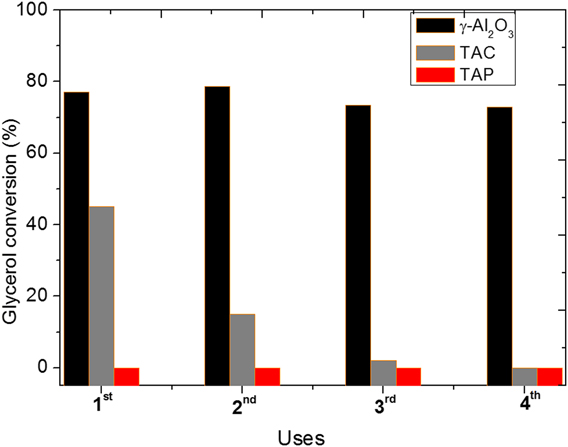
The recyclability studies are assessed to determine whether the catalysts have their structures integrity preserved during four consecutive cycles of 24 h (Fig. 5). The study is carried out using the most active catalysts, e.g.,TAP, TAC, and γ-Al2O3. Except for the TAP, all solids attain glycerol conversion superior to 45% within the 24 h period (e.g., 1st use). Thus, structure degradation of as-synthesized TAP is more serious than that over the other solids. A reasonable explanation for this result is based on the fact that the efficiency of the EG reaction is significantly influenced by the strength of the acidic sites of TAC and γ-Al2O3 and their stability, instead of their surface area.
Recyclability studies over the TAP, TAC, and γ-Al2O3 catalysts. Reaction conditions: 50 mg catalyst, glycerol to acetic acid ratio is 1:3, and reaction temperature 80 °C during four consecutive cycles of 24 h reaction.

Among the calcined samples, the γ-Al2O3 achieves high conversion in the first cycle of 1st use, and a slight drop in the conversion is observed during all runs. Conversely, TAC is partially dissolved in the reaction medium in a longer time reaction time (approximately 72 h, 3rd use). Meanwhile, γ-Al2O3 exhibits more Lewis acid sites than TAC and the reaction is more likely proceeding via the γ-Al2O3 Lewis acid sites and generating more triacetin, in the fourth cycle. Also, leaching of the γ-Al2O3 active sites may not occur due to their high stability, as compared with TAC, in four consecutive cycles (approximately 96 h, 4th use).
Therefore, a comparison of the catalytic properties of the solids in study with other solid acid catalysts described in the literature reveals that the reason for the decrease of catalytic performance in the EG reaction is the lack of stability of the solids.Reference Kim, Kim and Lee31,Reference Betiha, Hassan, El-Sharkawy, Al-Sabagh, Menoufy and Abdelmoniem32
From these results, it can be assumed that the unique structures and elevated acidity of the TAC and γ-Al2O3 solids favor the glycerol conversion, in terms of leaching control of active sites. Moreover, the selectivity for glycerol esters is a factor that is closely related to meso-and macroporous features of the solids and the reaction conditions, as well.
IV. CONCLUSIONS
The highly porous alumina-based catalysts were obtained by a modified sol–gel method. The as-synthesized and calcined solids were compared, regarding their performance in the esterification of glycerol with acetic acid. The solids possessing TiO2 rutile, TiO2 anatase, and γ-Al2O3 phases exhibited good stability and strong resistance to deactivation during the title esterification reaction. The high selectivity toward triacetin of more than 90% and the superior performance of the Ti-containing solids was compared with other catalysts. This was due to the mesoporous structure of the catalysts and the elevated acidity of the Brønsted and Lewis acid sites. Furthermore, the acidity and porosity of the catalysts play an essential role in terms of achieving superior performances.
AUTHOR CONTRIBUTIONS
The article was written with the contributions of all authors. All authors have given approval for the final version of the article.
ACKNOWLEDGMENT
The authors acknowledge support from CNPq-FAPES Grant No. DCR-0049-1.06/08.