The developmental psychopathology framework described by Cicchetti and colleagues (Cicchetti, Reference Cicchetti1993; Cicchetti & Toth, 1996, Reference Cicchetii and Toth2009) espouses the importance of a bridge between research and practice, as well as research on what is of value in practice settings. There is nothing more valuable in childcare practice than the development and evaluation of training for child care professionals. Such a bridge between research and practice also highlights the importance of a tenet of this framework: the need for evidence-based prevention programming, first implemented and evaluated with low-risk or diverse groups, and later extended into higher risk contexts. The current study examines the potential of an intervention based on emotional availability (EA) principles with childcare professionals (Project Secure Child in Child Care) to enhance the emotional climate of the classroom and child–professional attachment security.
Most North American children experience not only interactions with parents but also with professionals, such as teachers and childcare providers. In this light, Pianta (Reference Pianta1999) and Hamre and Pianta (Reference Hamre and Pianta2001) have found that the quality of relationships with teachers can be associated with a range of child outcomes, including academic grades, standardized test scores, ratings of work habits, and disciplinary referrals. Curby et al. (Reference Curby, LoCasale-Crouch, Konold, Pianta, Howes and Burchinal2009) also link classroom quality (fostered by the teachers’ overall style toward the children) to children's achievement and social competence.
For the 7 million children in center-based care (US Bureau of the Census, 2010), the quality of the attachment relationship with the childcare professional is important (Goosens & van IJzendoorn, Reference Goosens and van Ijzendoorn1990; Howes, Matheson, & Hamilton, Reference Howes, Matheson and Hamilton1994). Howes and Smith (Reference Howes and Smith1995) reported that although 68% of infants are securely attached to their mothers (and fathers), only 50% of children are securely attached to their childcare providers/teachers. What this finding suggests is that at least 50% of children may not be spending a large portion of their early development in an emotionally secure context, whereas this is the case only for 30% of children being raised solely by their parents. The greater likelihood of insecurity to the professional caregiver in childcare versus the primary caregiver at home is also echoed in a more recent and large meta-analysis, especially where the child is cared for in center-based care (Ahnert, Pinquart, & Lamb, Reference Ahnert, Pinquart and Lamb2006).
In contrast to the above picture, childcare professionals also have been characterized as compensatory attachment figures when the relationship with the mother is insecure (Howes, Rodning, Galluzzo, & Myers, Reference Howes, Rodning, Galuzzo and Myers1988; Spieker, Nelson, Petras, Jolley, & Barnard, Reference Spieker, Nelson, Petras, Jolley and Barnard2003; Wishard, Shivers, Howes, & Ritchie, Reference Wishard, Shivers, Howes and Ritchie2003). That is, a secure relationship to the professional caregiver has been shown to be predictive of adaptive developmental outcomes for the child (e.g., Howes et al., Reference Howes, Matheson and Hamilton1994; Howes, Philips, Whitebook, Reference Howes, Phillips and Whitebook1992; Cassibba, van IJzendoorn, & D'Odorico, Reference Cassibba, van Ijzendoorn and D'Odorico2000), independent of the relationship with the mother, suggesting the significance of the nonparental or professional caregiver in child care for child outcomes.
As a system that describes the level of healthy connection in the adult–child relationship, EA is “a relationship language,” particularly for the early years. The EA Scales (Biringen, Robinson, & Emde, Reference Biringen, Robinson and Emde1998) have been predictive of attachment security between a mother and child. For example, children of sensitive mothers are more often securely attached and children of less sensitive mothers are more often insecurely attached (Sagi, Koren-Karie, Gini, Ziv, & Joels, Reference Sagi, Koren-Karie, Gini, Ziv and Joels2002; Ziv, Aviezer, Gini, Sagi, & Koren-Karie, Reference Ziv, Aviezer, Gini, Sagi and Koren-Karie2000), and additional dimensions of EA (especially the child EA dimensions) also have been predictive of attachment security in infants (e.g., Easterbrooks & Biringen, Reference Easterbrooks and Biringen2000). In addition to the links with attachment security, EA with mothers during the prekindergarten year is predictive of higher expressive language performance as well as lower levels of aggression and victimization during the kindergarten year (Biringen, Skillern, Mone, & Pianta, Reference Biringen, Skillern, Mone and Pianta2005). Such findings suggest that EA with mothers is an important aspect of readying children for school.
It is therefore not surprising that in the context of in-home, family-based child care, EA between the child and the professional is predictive of attachment security with that professional (Shivers, Reference Shivers2008). We do not know whether the links are there in the context of center-based care, however, which is seen as a more risky nonparental context for infants and toddlers, compared to in-home, family-based care, potentially because children are usually in larger groups with numerous care providers who may not remain in the post for very long and often “age out” of particular classrooms at arbitrary time points. It is worthy of note that the negative effects of center-based childcare have been reported well into the early school years (Belsky et al., Reference Belsky, Vandell, Burchinal, Clarke-Stewart, McCartney and Owen2007).
Although the infants and toddlers in the current study were not necessarily “at risk,” center-based care has been found to be a more challenging context for this age group (Belsky et al., Reference Belsky, Vandell, Burchinal, Clarke-Stewart, McCartney and Owen2007), and thus an appropriate setting in which to intervene for infants and toddlers who are experiencing long hours of child care. We hypothesized that one way to improve the quality of center-based group care might be to train childcare professionals about attachment and EA. With the exception of one study (Howes, Galinsky, & Kontos, Reference Howes, Galinsky and Kontos1998), building and assessing secure attachments in group care has received very little attention (Maccoby & Lewis, Reference Maccoby and Lewis2003), despite evidence on the positive sequelae of attachment security with professional caregivers (e.g., Howes et al., Reference Howes, Matheson and Hamilton1994).
The EA intervention (referred to as Project Secure Child in Child Care) for the care providers included both information about attachment and EA and practice in EA skills, as will be described more fully later in this paper. As assessment tools, we used the EA Scales, the Attachment Q-Sort (AQS; Waters & Deane, Reference Waters and Deane1985), and the Caregiver Interaction Scale (CIS; Arnett, Reference Arnett1989), with the first two being measured in the context of specific adult–child pairings and the third being an assessment of the adult in the context of the whole classroom, as a way to understand the stylistic aspects of the professionals’ interactions with all children. The AQS has been used in previous research in the naturalistic contexts of home (Posada, Waters, Crowell, & Lay, Reference Posada, Waters, Crowell and Lay1995; Waters & Deane, Reference Waters and Deane1985), family-based home care (Shivers, Reference Shivers2008), and center-based care (Cassibba et al., Reference Cassibba, van Ijzendoorn and D'Odorico2000). The CIS is commonly used in the child care context (e.g., Layzer, Goodson, & Moss, Reference Layzer, Goodson and Moss1993; Perlman, Zellman, & Le, Reference Perlman, Zellman and Le2004). The EA Scales have been utilized in centers previously (e.g., Zimmerman & Fassler, Reference Zimmerman and Fassler2003), although their linkage with attachment and the commonly used CIS in center-based care has not been previously reported. Although numerous studies have examined changes in attachment as a result of parent–child intervention (Bakermans-Kranenburg, van IJzendoorn, & Juffer, Reference Bakermans-Kranenburg, van IJzendoorn and Juffer2003), to our knowledge, prior research has not investigated whether attachment and EA in the professional caregiver–child relationship can be changed through center-based emotional education.
We hypothesized that the EA intervention for child care professionals would help to enhance the emotional climate of the classroom and
1. the intervention group (IG) would show greater caregiver–child EA than those in the control group (CG) from pretest to posttest,
2. the IG would show greater child–caregiver attachment security compared to the CG, and
3. the IG would show a more positive emotional classroom climate as a whole compared to the CG.
Methods
Participants
Fifty-seven infants/toddler–child care provider pairings were included in the current study (33 in the IG and 24 in the CG). Approximately 60% of study children were male. Children ranged in age between 11 and 32 months at the start of the study. At the start of the project, enrolled infants were at least 11 months because attachment is clearly observed by this point (Ainsworth, Blehar, Waters, & Wall, Reference Ainsworth, Blehar, Waters and Wall1978) and because of prior work on parent–child interactions that interventions to alter relational quality seem to be more effective with older infants (Bakermans-Kranenburg et al., Reference Bakermans-Kranenburg, van IJzendoorn and Juffer2003). Because we wanted to select young children experiencing extensive center-based child care, our inclusion criteria involved those who spent a minimum of 20 hr per week at the centers. All children had been attending the particular child care setting and the specific room for a minimum of 1 month. Further, they were in the care of the target child care provider for a minimum of 1 month. The latter was the major reason for attrition: in child care, children “age out” of a particular room, and once the study children aged out, they were no longer included in the analyses. Hence, all of the study children included in analyses are those who have been paired with a familiar child care professional and familiar room. The reader should note that, because of consent issues, pairings were done on the basis of convenience.
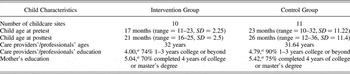
Professionals were on average 32 years of age, with 1 to 3 years of college experience. Ethnicity of care providers was generally Caucasian, with a small number of Hispanic care providers. Children were generally Caucasian, with approximately 81% in this category for the IG and 90% in the CG; 91% of care providers in each group were Caucasian. Full descriptions of sample characteristics for the two groups (intervention group, IG, and control group, CG) are shown in Table 1. Except for the information provided in Table 1, we did not have additional information about the consenting child care professionals (e.g., specific degrees, or salary levels).
Sample characteristics

aThese providers reported on their level of education using six categories: (1) <7 years, (2) 7–11 years, (3) high school, (4) 1–3 years of college, (5) 4 years of college, and (6) masters or above. The weighted mean is indicated in the columns for intervention group and control group. The control group was significantly higher in care providers' education using these broad categories (p < .05); but it was significantly correlated only with adult nonintrusiveness (p < .01), a teacher quality that did not figure prominently in the main analyses. The control group's children were significantly older than the intervention group's children (p < .05), but child age was unrelated to the outcome measures and did not contribute significantly to the models.
Procedures
Sites were contacted initially for participation in the intervention; thus, the intervention component of the project was implemented first. We then contacted additional sites to participate in the intervention, but with the understanding that we would first need to work with them as the comparison/control group. Thus, in this initial investigation, focusing on development, randomization was not used. The “assessment team” (which was separate from the EA coaches) conducted the pretest and posttest assessments, and were blind to group membership (IG vs. CG), and the same member of the team was not assigned to both the pretest and posttest sessions; they did know that an intervention was being implemented, but did not have additional information. Child care professionals in both groups knew which children were in the project and which target children were being observed with them. Right before the observations, all professionals were asked to go about their normal day and to interact with all the children using the skills they had practiced, and not to focus solely on the target child. No additional precautions were taken to lessen caregivers’ need to act in socially desirable ways, because the EA scoring itself is dyadic.
Consent
A letter of support was obtained from center directors and informed written consent was obtained from interested parents and care providers. Not all parents and care providers in a classroom were interested in this training opportunity and/or provided consent. The parents of the participating children and care providers provided demographic information (age, gender, ethnicity/racial identity) when they provided informed consent for the children. It was not uncommon to have one professional in the classroom participating and the other not participating. Over 70% of directors, care providers, as well as parents approached for participation did express interest and completed the written consent. Of those who chose not to provide consent (directors, care providers, or parents), the most significant reason was the need for videotaping.
Background characteristics
The IG received the EA intervention and the CG received the usual practice at a particular center and no EA intervention. A center was either IG or CG, and hence, there was no “contamination.” Information was obtained about each center's professional development opportunities in the past year. To the extent feasible, the IG and CG were matched with respect to demographic characteristics (IG professional's age, M = 32, CG care providers’ age, M = 31.64; IG professional's education, M = 1–3 years of high school education, CG professional's education, M = 1–3 years of high school education and some college). Attrition of IG and CG were comparable in the two groups (9 for IG, 10 for CG), with the most common reason for incomplete data being staff turnover or children moving to an older child classroom or leaving a center. Only where we had data on both time points did we include the care provider–child pair in analyses. We paired care providers with children in the same room based on who had provided informed consent in a specific classroom. We documented each center's professional development activities in the past year and the IG and CG were comparable in this regard, with three to four such activities in the past year. However, we had no way of knowing whether a particular child care professional actually attended the professional development opportunity, but merely, that the event was offered. Given the ethical rationale of withholding support, we offered the training to any center/provider in the CG who was interested, but after the end of the full data collection. We conducted such training but did not evaluate it because of small numbers and/or the inability to deliver the full dose. Great care was taken to keep the intervention separate from the assessment, to keep the EA coder blind to pretest versus posttest status, and to keep the assessment team and coders blind to IG and CG conditions, so that expectancies would not influence evaluations (Rosenthal, Reference Rosenthal1994).
Observations
Over 90% of observations were scheduled 9:00–11:30 a.m., when children would be well rested and so that we could obtain a full 2 hr of observation before the morning nap time. Both the IG and CG were assessed at two occasions of measurement (pre- and postintervention for the IG and simply 2 to 3 months apart between the first and second occasions for the CG), using the same measures. The child care professionals were encouraged to go about their normal activities and to interact as they normally would with all of the children, not just the target children. Two observers were present for each session and were careful not to interfere with the activities or to actively engage with others, except to initiate brief (a few minutes at best) interactions with a child to score specific items of the AQS protocol, as indicated by Waters and Deane (Reference Waters and Deane1985). They unobtrusively took notes in a spiral notebook that would help them score the AQS immediately after the session. Each care provider–child pair was observed for 2 consecutive hr, and 0.5 hr of this time was filmed. The 0.5-hr film was used for later EA scoring by an independent scorer blind to other information and the full 2 hr was used for later scoring of the AQS. After the first occasion of measurement, the EA intervention was implemented for the IG (range = 1.4–2.2 months, M = 1.7 months), whereas the CG did not receive the intervention, literature, or visits from our team. At the end of the intervention period, the IG was visited again for the second occasion of measurement, with EA, AQS, and CIS assessed once again. The CG also was visited at the end of 3 months (range = 2.1–6.5 months, M = 2.9 months) and the same assessments were completed. The posttest immediately followed the training for IG or the allowed time limit for the CG. Posttest assessments were identical to those of the pretest (EA Scales, AQS, and CIS).
Intervention (Project Secure Child in Child Care)
The IG received two 1-hr informational sessions in a group format. At first, they were invited to the university, but given low attendance, we took the informational component to them during lunch or break times right at the centers. In each session, the IG was given information about EA and its links with attachment, as well as how to recognize different types of attachments in their classrooms. They were given handouts that described the attachment styles of “secure children” (e.g., seems happy in the classroom), “insecure/avoidant children” (e.g., seems as if he does not need to be taken care of), “insecure/resistant children” (e.g., needs most of your attention so that it is difficult for you to attend to others in your class), and “disorganized children” (e.g., is aggressive, knocking down bookcases or picking on other children, or shows aggressive play). The first author conducted these sessions. To enhance the capabilities and confidence of the care providers, we emphasized during this informational component that we perceived them as interventionists, who could work with each child to continue and maintain a child's security and/or to help the child construct security for the first time in his/her life.
The intervention also included a practice component, which was administered to the IG over a short time period (2–3 months) because of heavy turnover in child care contexts (e.g., infants leaving a classroom to move to an older age classroom at the same center where new relationships would need to be developed, infants leaving the centers, or similar to other low-wage professions, high staff turnover). This is a short period of time, but one that was realistic, given the instability of child care (Howes & Smith, Reference Howes and Smith1995; Whitebrook, Howes, & Phillips, 1998; US Department of Labor, 2004–2005). The practice component consisted of three to four visits to the IG centers by the EA Coach and was designed to hone the practice of EA skills learned during the informational sessions (all IG participants received four visits, with the exception of one participant who received three). The main way in which the practice component was honed at the centers was through the use of the EA Checklist, which includes each of the four caregiver dimensions (see Appendix A for an example for the nonhostility dimension); the child dimensions were noted in terms of behaviors of the adult, which indicate that the adult understands the child's cues in those areas (e.g., tries to see things from infant's point of view, using emotion language; “Did that hurt your feelings?” “Gerry clearly does not enjoy being pushed—she likes gentle touches”). The EA Checklist was completed after each session, with extensive narrative written by the EA coach, and given to the professional so that she could see which items were checked (indicating an area of strength) and which showed no checks (indicating the need for improvement). The narrative focused on both the strengths (checked items) as well as what the professional can do to receive checks. At the core of the intervention was relationship building over time. In addition to the use of the EA Checklist, on one visit the professional and EA coach watched the pretest video together and the child care professional was given the opportunity to narrate what she saw and how to improve interactions. The EA coach remained in a supportive and nondirective role. The intervention was conducted by two leaders in the early care community or two graduate students with prior training in therapy. Interventionist training included basic information about EA through available readings and bimonthly face to face supervision sessions within the intervention team and first author. It is worthy of note that the practice component involved coaching, rather than didactic instruction. As described further in Biringen et al. (Reference Biringen, Moorlag, Meyer, Wood, Aberle and Altenhofen2008) biweekly group supervision meetings (with all interventionists present) created the context for uniformity of implementation across professionals and treatment fidelity.
Measures
The EA Scales, Version 3
EA is a global measure of caregiver–child relational quality (Biringen, Reference Biringen2000; Biringen et al., Reference Biringen, Robinson and Emde1998), and focuses on child as well as caregiver qualities. The four caregiver qualities are sensitivity, structuring, nonintrusiveness, and nonhostility, and two child qualities are responsiveness to the caregiver and involvement of the caregiver (Table 2). EA captures the relational/dyadic quality of the interaction, and therefore, observations are made of one relationship at a time. These global scores are assigned directly after two viewings of the videotape. Numerous studies have established the stability of the measure over time and its construct validity (e.g., Aviezer et al., Reference Aviezer, Sagi, Joels and Ziv1999; Bornstein et al., Reference Bornstein, Gini, Leach, Haynes, Painter and Suwalksky2006; Easterbrooks & Biringen, Reference Easterbrooks and Biringen2000, Reference Easterbrooks and Biringen2005). Interrater reliability was maintained at r > .80. EA Scales’ training was conducted by the use of the Biringen training materials (Biringen, Reference Biringen2005) and after obtaining interrater reliability with Biringen (r > .80), scoring was done centrally by one assistant who was blind to other information, including the AQS and CIS, and blind to the occasion of measurement as well as the group membership.
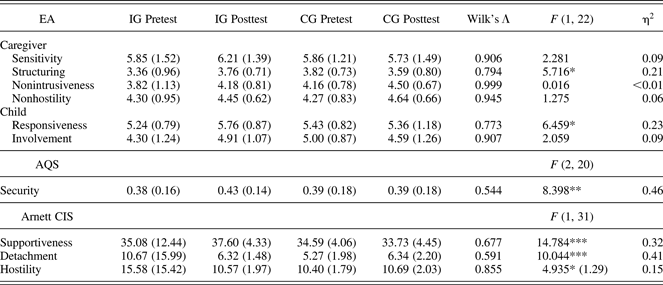
Means (standard deviations) for dependent measures
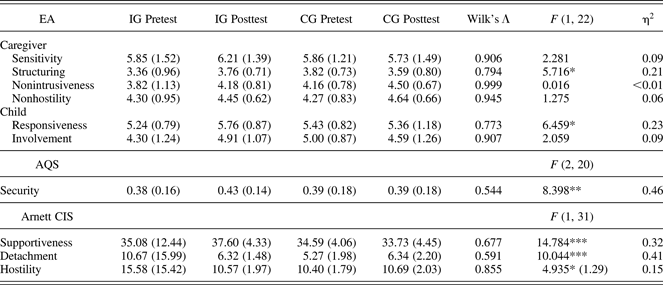
Note: EA, Emotional Availability Scales (Biringen et al., Reference Biringen, Robinson and Emde1998); IG, intervention group; CG, control group; AQS, Attachment Q-Sort (Waters & Deane, Reference Waters and Deane1985); Arnett CIS, Child Interaction Scale (Arnett, Reference Arnett1989).
*p < .05. **p < .01. ***p < .001, two-tailed tests.
AQS
The current version of the AQS is Version 3.0, which includes 90 items, where each describes the child's attachment-relevant behaviors to the adult; the focus is on the child's behaviors in relation to a specific adult. Most items describe aspects of secure base behavior, whereas a small number are considered “filler” items that were included because a Q-Sort will not sort easily if all the items are about the same topic. Although the AQS has been used in previous research in childcare contexts (Cassibba et al., Reference Cassibba, van Ijzendoorn and D'Odorico2000; Shivers, Reference Shivers2008), a detailed manual was not available to aid training. We developed a manual for each of the 90 items so that observers would have a clear guide for the child care context, receiving guidance from Everett Waters and German Posada (personal communication, 2005) during this process; the manual can be requested from Everett Waters.
Trained objective observers, rather than caregiver reports were used, because objective observers have been found to be more reliable than caregiver reports (Cassibba et al., Reference Cassibba, van Ijzendoorn and D'Odorico2000). Training for the AQS spanned several months, with a trainee first watching three to four videotapes that were coded by a master trainer (second and third authors, who were senior doctoral students at the time of the study). Then, the trainee began to accompany the master trainer to actual childcare observations, and the process of reliability checks was implemented. Each observer completed their sort and reliability checked after every single visit (r > .70 maintained over each visit, but on average r > .80), with a final conferenced score entered into the computer. Whenever the reliability was in the 0.70–0.80 range after a visit, the project coordinator contacted each of the observers and recommended supplemental training discussions, whenever possible, before the next scheduled visit.
Prior research indicates that 2 hr is the minimum amount of time needed for reliable AQS observations (Howes & Smith, Reference Howes and Smith1995). If a particular observation needed to end before this time, a separate observation was scheduled so that all sessions were a full 2 hr. After 2 hr of direct (unfilmed) observation, the observer ranked the child's behaviors on that day in terms of “most descriptive of the child” to “least descriptive of the child.” Items not seen that day were placed in the middle pile, per instructions by Waters and Posada (2005, personal communication).
To obtain security scores the raw scores from the AQS were correlated with the criterion scores of “attachment experts” provided by Waters and Deane (Reference Waters and Deane1985). The correlation coefficients are the children's security scores. Security scores vary from −1.0 to 1.0, with a higher score indicating greater security. All AQS observations occurred after the target child's parent dropped off the child and before morning nap time. The AQS and the process of scoring is presented in exquisite detail on Waters’ website (www.psychology.sunysb.edu/attachment). To reduce bias, the AQS observers of course were blind to EA and pre- versus posttest (so that expectancies would not inflate scores), and IG versus CG membership.
CIS
The CIS (Arnett, Reference Arnett1989) was used to rate each caregiver's overall style within the whole classroom. This rating scale consists of 26 items rated on 4-point scales. The Supportiveness Scale includes such items as “encourages the child to try new experiences” (α = 0.86); Hostility includes such items as “seems unnecessarily harsh when scolding or prohibiting children” (α = 0.88); and detachment includes such items as “spends considerable time in activity not involving interaction with the children” (α = 0.92). The percentage of agreement was assessed on 10 cases and remained at r > .80. The same observers scored the AQS and CIS on the full 2 hr of observations, but, as noted above, the members of the “assessment team” were blind to EA, pretest/posttest, and group membership, as well as the purpose of the study.
Analytic procedures
Program implementation was separated from the evaluation component, and the latter done by the last author who was blind to hypotheses and condition of treatment. Comparability of groups at baseline was determined using independent t tests across the set of dependent variables. For those dependent variables for which no differences were observed at baseline, a repeated-measures analysis of variance with nesting within care providers was conducted using the generalized linear model procedure in SPSS17. For dependent measures that were not comparable at baseline, a repeated-measures analysis of covariance with nesting within professional, and the baseline measure as a covariate was conducted with the generalized linear model procedure. We also examined other potential covariates (child, parent, and professional characteristics) for both of the above models based on their correlation with the dependent variables. Of 60 correlations conducted between demographic variables (mother's age, father's age, child's age at pretest, child's gender, child's birth order, family structure) and the dependent measures (six EA, one AQS, and three CIS measures, six were significantly correlated [later born children were more likely to have higher security, child gender was associated with Child responsiveness, with girls being more responsive, father's age was associated negatively with CIS hostility, and an intact family structure was associated positively with CIS supportiveness, and, curiously, with detachment and hostility]). None of these potential covariates was used either based on violation of assumptions or failure to contribute substantially to the models. For the CIS variables, which were measures of the care providers, there was no nesting factor within provider. Because this was a small-sample size, exploratory study, we wanted to maximize power. Thus, we thought it reasonable to keep alpha at a standard level (p < .05). For tests of differences between treatment groups, nested within provider, we had power of 0.80 to detect effect sizes of 0.23. This translates to a small effect size as defined by Cohen (Reference Cohen1988) and indicates that we had sufficient power to detect effects that would reflect meaningful differences between groups.
Results
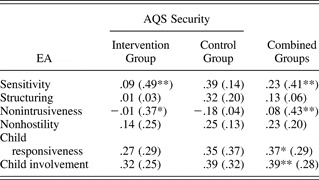
For analysis of covariance models, each of the covariates described earlier for which significant correlations with dependent variables were found was examined for inclusion in the model for its respective dependent variable. Tests of assumptions were conducted first, which resulted in elimination of intact family structure as a potential covariate due to failure to meet the linearity of regression assumption. The remaining covariates (child age with security; child gender with child responsiveness; father's age with CIS hostility) were initially included as covariates, but they did not contribute significantly to the models and were removed. Correlations were conducted between EA and the AQS, with significant links found, particularly at posttest (see Table 3) and with EA and the CIS at both pretest and posttest (see Table 4).
Relations between the Emotional Availability (EA) Scales and the Attachment Q-Sort (AQS)

Note: The posttest score is in parentheses next to the pretest score. Intervention group versus control group correlations were compared using the Fisher r to z transformation, with no significant differences between the two groups.
*p < .05. **p < .01, two-tailed tests.
Relations between Emotional Availability (EA) Scales and the caregiver Child Interaction Scale (CIS)

Note: The difference in correlations between the intervention and control groups is significant in two cases only: child responsiveness with CIS caregiver supportiveness and child involvement with CIS caregiver hostility.
*p < .05. **p < .01, two-tailed tests.
Tests of comparability at baseline using independent t tests resulted in nonsignificant differences in seven of the 10 dependent variables (EA caregiver sensitivity, structuring, nonintrusiveness, and nonhostility; child responsiveness and involvement; AQS security; CIS support, CIS detachment, CIS hostility). Only one EA variable (child involvement) was found to be significantly different at baseline (t = −2.15, p = .04). Among the remaining measures, two variables were significantly different at baseline (detachment: t = 4.771, p < .001; hostility: t = 3.42, p = .001).
Here, we report group by time interactions to provide information on whether the IG showed improvements that were not seen for the CG. Note that we are not reporting the significance of pre- to postchanges for each group but the Group × Time interaction only. Among the EA caregiver variables, one significant difference (structuring) was found over Time × Group, Wilk's Λ = 0.794, F (1, 22) = 5.716, p = .03, η2 = 0.21, indicating a difference between the IG and CG. In the IG, caregiver structuring increased over time, whereas in the CG, structuring decreased in terms of mean values. A similar pattern of mean changes was observed for sensitivity, but the Time × Group interaction was nonsignificant (p = .15).
Among the EA child variables, Child Responsiveness was significantly different over Time × Group. Child Responsiveness increased among the IG, whereas it showed a slight decline in mean values among the CG, Wilk's Λ = 0.773, F (1, 22) = 6.459, p = .02, η2 = 0.23. The same pattern of changes over time was found for Child Involvement for which the baseline level was treated as a covariate, but results were not significantly different over Time × Group (p = .17).
AQS security was significantly different over Time × Group. Security increased over time in the IG, while it remained virtually the same in terms of mean values for the CG, Wilk's Λ = 0.544, F (2, 20) = 8.398, p =.002, η2 = 0.46. These results suggest that infants and toddlers in the IG become more emotionally responsive (higher child EA) and more emotionally secure over the 3- to 4-month period, whereas infants in the CG did not show such improvement.
Each of the CIS measures of care providers also resulted in significant differences over Time × Group. Supportiveness increased in the IG, but decreased in terms of mean values in the CG, Wilk's Λ = 0.677, F (1, 31) = 14.784, p = .001, η2 = 0.32. Hostility decreased in the IG, but actually showed an increase in mean values in the CG, Wilk's Λ = 0.855, F (1, 29) = 4.935, p = .03, η2 = 0.15, and detachment decreased in the IG, but increased in the CG, Wilk's Λ = 0.591, F (1, 29) = 10.044, p < .001, η2 = 0.41; detachment and hostility baseline levels were treated as covariates. These findings suggest that the care provider's overall style in the classroom improved significantly in the IG, but showed a decline over the course of a similar amount of time in the CG.
Discussion
A child's earliest relationships with parents can greatly influence the development of mental health and illness and have long held an important role in the developmental psychopathology framework (Cicchetti & Toth, Reference Cicchetti and Toth1995; Lyons-Ruth, Reference Lyons-Ruth2008; Mahler, Pine, & Bergman, Reference Mahler, Pine and Bergman1975; Winnicott, Reference Winnicott1965). However, with approximately 7 million children in center-based care at least part time in the United States (US Bureau of the Census, 2010), research has moved some of its focus from the home and into the child care situation (Anhert et al., Reference Ahnert, Pinquart and Lamb2006; Belsky et al., Reference Belsky, Vandell, Burchinal, Clarke-Stewart, McCartney and Owen2007; Howes & Spieker, Reference Howes, Spieker, Cassidy and Shaver2008; Marty, Readdick, & Walters, Reference Marty, Readdick and Walters2005; Sagi-Schwartz & Aviezer, Reference Sagi-Schwartz, Aviezer, Grossmann, Grossmann and Waters2005) and the developmental psychopathology framework needs to include nonparental professionals as an aspect of individual mental health as well as relationship risk. Relationships between children and nonparental caregivers outside the home have been shown to have a significant impact on developmental outcomes (Belsky, Reference Belsky2009; Belsky et al., Reference Belsky, Vandell, Burchinal, Clarke-Stewart, McCartney and Owen2007; Howes & Spieker, Reference Howes, Spieker, Cassidy and Shaver2008), and need to be investigated within the developmental psychopathology framework. Security of attachment to a caregiver in center-based care has been found to predict social competence with peers (Howes et al., Reference Howes, Matheson and Hamilton1994; Howes & Smith, Reference Howes and Smith1995; Marty et al., Reference Marty, Readdick and Walters2005) and teachers (Howes, Phillipsen, & Peisner-Feinberg, Reference Howes, Phillipsen and Peisner-Feinberg2000) during the school years, as well as child–teacher attachment security (Howes et al., Reference Howes, Matheson and Hamilton1994), decreased behavior problems (Howes & Ritchie, Reference Howes and Ritchie1999), and school satisfaction and achievement (Baker, Reference Baker1999).
Infants and toddlers are seen as particularly vulnerable as related to child care caregiving, due to the rate at which they develop social, emotional, and cognitive competencies (Timmerman, Reference Timmerman, Gayle, Preiss and Allen2006), and have been found to be at an increased risk of developing insecure attachments (Deklyen & Greenberg, Reference DeKlyen, Greenberg, Cassidy and Shaver2008; Sagi et al., Reference Sagi, Koren-Karie, Gini, Ziv and Joels2002) and aggression (Belsky et al., Reference Belsky, Vandell, Burchinal, Clarke-Stewart, McCartney and Owen2007) in low quality center-based care. Thus, the present study examined whether this training for professional caregivers could enhance the quality of center-based care.
The current study extended EA research by implementing the EA intervention with child care professionals (Biringen et al., Reference Biringen, Moorlag, Meyer, Wood, Aberle and Altenhofen2008). The aspect of caregiver EA that was enhanced through this training was “structuring.” It may be easier to change the caregiver's ability to structure interactions than caregiver sensitivity to a child. The structuring component of EA, however, includes the adult's ability to modify and adapt one's behavior based on the child's emotional cues and has been found to be of predictive value for child outcomes, such as attachment security (Biringen, Damon, Pipp-Siegel, Grigg, & Stratton, 2000) or child aggression (Biringen et al., Reference Biringen, Damon, Pipp-Siegel, Grigg and Stratton2005). Thus, the improvement in child care professionals’ ability to structure is a very important enhancement for the emotional climate in child care, as all of the EA dimensions include “emotional” features. Further, the additional adult dimensions were all in the expected direction, though not significantly so. On the child's side of EA, child responsiveness was enhanced, with infants/toddlers becoming more emotionally connected with, and emotionally responsive to, the care providers caring for them. Further, attachment security increased over time in the IG.
Although we are not speaking of dramatic improvements during this short period of time, this study illustrates the feasibility of doing a brief emotional education training (only three to four sessions) to sufficiently alter both care provider–child EA and attachment security to the care provider, with a moderate effect size. We believe that we were not “teaching to the test” because we saw improvements in aspects of child behavior, both child EA and child attachment security! We also do not believe that merely providing attention (the Hawthorne effect) can explain these findings, as we did not interact at all with the children, and it is the children who were most impacted. That the control group either remained the same or declined during the same span of time is worthy of note. This may speak to the difficult work of caring for a group of infants and toddlers, combined with low pay and status of the profession. Despite these difficulties of the profession, we believe that the care providers in the intervention group began to find their jobs more rewarding, because they began to have emotionally available relationships with the children (e.g., children seeking them out when distressed, children bringing and showing them toys, children smiling and giggling with them). The potential for greater satisfaction with their jobs is an important hypothesis that future research should directly test. It is also possible that the child care providers in the CG became disinterested or demoralized with their jobs, and hence, some of the decrements over time.
It is important that the study's findings about the child's side of the relationship suggest a genuine change in the professional–child relationship, rather than superficial performance on the day of the observations. In other words, if these care providers were performing solely for the camera, and did not utilize their EA skills when off camera, the children's unresponsive and uninvolved behaviors toward them would depreciate their relationships. For example, if a care provider decided to be sensitive and appropriately structuring on the morning of the filming but typically was not (that is, “faked it” for the camera), the target child accustomed to an insensitive and unstructuring caregiver might move away as the performing care provider asks for a hug. Instead, what we were observing at the intervention sites was children being engaging and involving of the adults in their daily lives.
This study also documented the EA–AQS linkage in the context of center-based child care, with multiple caregivers and multiple children, underscoring the feasibility of using EA assessments in a “distributed attachment” context. These findings extend Shiver's (Reference Shivers2008) initial investigations using EA and AQS with in-home, family care providers and infants, and are in contrast with Ahnert et al. (Reference Ahnert, Pinquart and Lamb2006)'s finding that caregiver sensitivity in specific relationships is predictive of attachment only in the context of in-home care.
EA was significantly related to not only the AQS but also the CIS, adding to the information on validity in the context of child care. The IG's caregiver CIS hostility and detachment decreased over the intervention window, and support significantly increased. Collectively, these findings buttress the notion of transactional processes in the nonparental caregiver–child relationship in which an increase in emotional structuring and support by the caregiver is associated with an increase in the child's responsiveness toward the caregiver. In this transactional or relational view, child and caregiver characteristics and behaviors are never considered independent of one another, because each influences and draws upon the other (Biringen, Reference Biringen2000; Lewis, Reference Lewis, Sameroff, Lewis and Miller2000).
Past research has highlighted the importance of the dual-risk hypothesis (e.g., insecure child–caregiver relationship coupled with low maternal sensitivity or poverty) in explaining the development of children attending center-based child care (Anhert et al., Reference Ahnert, Pinquart and Lamb2006; Belsky, Reference Belsky2009; Belsky et al., Reference Belsky, Vandell, Burchinal, Clarke-Stewart, McCartney and Owen2007; Howes & Spieker, Reference Howes, Spieker, Cassidy and Shaver2008; Scher & Mayseless, Reference Scher and Mayseless2000). Prior research indicates that children who have insecure attachments with their mothers may bring negative attachment behaviors into the child care setting (Belsky et al., Reference Belsky, Vandell, Burchinal, Clarke-Stewart, McCartney and Owen2007). Using the child care context as a corrective emotional experience may lead to a positive developmental trajectory by helping the child to experience a different, more emotionally enriched template of relationships (Belsky et al., Reference Belsky, Vandell, Burchinal, Clarke-Stewart, McCartney and Owen2007; Howes & Spieker, Reference Howes, Spieker, Cassidy and Shaver2008) that can be transferred to other relationships, including potentially those in the home setting (Lewis, Reference Lewis, Sameroff, Lewis and Miller2000), a hypothesis beckoning future empirical inquiry.
Although the present study used a largely normative sample, such data from typical contexts can inform development about atypical contexts. Normative data are needed to provide a starting point from which to launch intervention efforts in at-risk and diverse samples (Cicchetti & Cohen, Reference Cicchetti and Cohen2006). Investigations under more at-risk contexts (as, for example, centers where a substantial portion of the families are receiving public assistance) are needed. Further, in at-risk groups, outcome variables in addition to attachment (e.g., externalizing behavior problems, aggression) would seem important, especially as one moves beyond infancy.
The essence of our findings is that the group receiving the training improved in EA and attachment over the intervention period, whereas the control group did not show this pattern. The implication is that infants receiving the intervention improved significantly in their EA and emotional security, whereas those receiving the “usual practice” did not show this enhancement in secure attachment or EA toward their attachment figures in child care, with whom they spend at least 20 hr per week.
Concerning is the behavior of the CG care providers, who often became less structuring and supportive and more detached over time, this despite the fact that all of these early childhood settings offered significant professional development. We did not, however, have information on the attendance of the target providers in this sample at those events. These findings nonetheless point to the importance of relationship-based interventions for children and nonparental caregivers in center-based care, particularly to impede developmental risks such as the formation of an insecure attachment. Many current child care facilities’ curricula emphasize education, play, social skills, school readiness, or a combination of these, leaving little room for training in “emotional connection” (Timmerman, Reference Timmerman, Gayle, Preiss and Allen2006). Without preventive intervention, children's sense of emotional vacancy with a nonparental caregiver has the potential to interact with other risk factors in the child's life (e.g., insecure attachment with mother, high-risk contexts such as poverty, or genetic susceptibility) and create an at-risk developmental trajectory (Belsky & Fearon, Reference Belsky and Fearon2002; Deklyen & Greenberg, Reference DeKlyen, Greenberg, Cassidy and Shaver2008) and perhaps even psychopathology (Cicchetti & Rogosch, Reference Cicchetti and Rogosch1997). This is a concerning message for social scientists, policy makers, and parents, but also a message about the promise of preventive models.
Our findings are in support of previous work on attachment with mothers and infants, which have shown that less than five intervention sessions with caregivers can be sufficient for change (Bakermans-Kranenberg et al., Reference Bakermans-Kranenburg, van IJzendoorn and Juffer2003) and that even one video feedback experience (rarely did we have more than one), can be part of that promising change process. Our findings depart from prior attachment research, however. In our project, we more clearly changed EA “structuring” rather than EA sensitivity, typically seen as the salient component of the transmission of attachment. These results highlight that professional–child relationships are not the same as parent–child relationships and that the exploratory and independence-promoting qualities of the nonparental caretaker (Cassibba et al., Reference Cassibba, van Ijzendoorn and D'Odorico2000), rather than only caregiver sensitivity, need more emphasis in future work. The current findings also indicate the need to measure the child's side of the relationship, as some of the clearest changes occurred not in the adults but in the children.
The findings contribute to the discussion on professional/teacher education and behaviors in the classroom (e.g., Whitebrook et al., Reference Whitebrook, Howes and Phillips1990). Research has indicated that it is not more education for teachers per se, but education or specialized training in areas relevant for early childhood education that lead to higher teacher quality in the classroom (Whitebrook et al., Reference Whitebrook, Howes and Phillips1990). It would be instructive for future work to see whether a degree in early childhood education (AA or BA), information we did not garner, might translate into more optimal EA or attachment security at centers, regardless of specialized relationship training for care providers of infants and toddlers.
Past research has highlighted the need of emotional development training for professional caregivers, particularly in center-based care (Aviezer, Reference Aviezer2008; Kent, Reference Kent2003; Shonkoff & Phillips, Reference Shonkoff, Phillips, Jones and Jones2002; Timmerman, Reference Timmerman, Gayle, Preiss and Allen2006). Caregiver emotional education, such as training in EA, may help promote a child's healthy socioemotional development (Aviezer, Reference Aviezer2008; Timmerman, Reference Timmerman, Gayle, Preiss and Allen2006). In child care, many caregivers focus on extinguishing negative behaviors by applying a behaviorist type approach to caregiving (e.g., ignoring, negative statements in the face of misbehavior). As mentioned, the training in EA allowed caregivers to structure in a relational way, which includes the child's side of the relationship and brings the child to a higher level emotionally (Biringen, Reference Biringen2000). Given that security of attachment was enhanced in the intervention (but not the control) group, emotional education may be just as important for professional caregivers as is formal education, and should be considered alongside trainings about behavior management strategies.
Other programs focusing specifically on teacher sensitivity also have been developed. For example, Rimm-Kaufman, Voorhees, Snell, and La Paro (Reference Rimm-Kaufman, Voorhees, Snell and La Paro2003) described a pilot program for improving teacher sensitivity with children with disabilities, so little emphasized in Early Childhood Special Education Programs. Similarly, Denham and Burton (Reference Denham and Burton1996) also described an intervention for teachers of 4 year olds, which explicitly focused on relationship building and the regulation of emotions, with findings that children whose teachers were involved in this 32-week program showed less negative emotions and more initiative in peer relationships. The description of such programs (Rimm-Kaufman et al., Reference Rimm-Kaufman, Voorhees, Snell and La Paro2003) and their efficacy (Denham & Burton, Reference Denham and Burton1996) suggest that more attention needs to be given to this potentially elusive and yet important teacher quality, particularly because teacher–child relationships predict long-lasting achievement outcomes for children (Hamre & Pianta, Reference Hamre and Pianta2001). The additional contribution of the current system of intervention is that of a components approach that goes beyond sensitivity and with components including the child's view of the relationship.
Future work should include larger sample sizes in order to test mediators and moderators of the relations between the intervention and outcomes, and to explore the possibility of developmental cascades across domains. In other words, the self-organization that occurs when an emotionally secure relationship is formed may cause the reorganization of other developmental areas (e.g., cognitive and language abilities, motor skills, social skills, emotion regulation; Biringen, Emde, Campos, & Appelbaum, Reference Biringen, Emde, Campos and Appelbaum1995; Pressman, Pipp-Siegal, Yoshinaga-Itano, Kubicek, & Emde, 1999) in various contexts and developmental periods, creating a “snowball effect.”
Like attachment, primary relationships that are emotionally available also can positively affect other relationships (Biringen, Reference Biringen2000; Howes & Spieker, Reference Howes, Spieker, Cassidy and Shaver2008). For example, children who have an emotionally secure relationship with their primary caregiver tend to develop emotionally competent functioning (Kogan & Carter, Reference Kogan and Carter1996; Lehman, Steier, Guidash, & Wanna, Reference Lehman, Steier, Guidash and Wanna2002), create healthier peer relationships (Biringen, Reference Biringen2000), and display less aggressive behaviors during the school years (Belsky et al., Reference Belsky, Vandell, Burchinal, Clarke-Stewart, McCartney and Owen2007; Biringen et al., Reference Biringen, Damon, Pipp-Siegel, Grigg and Stratton2005). As previously noted, secure nonparental caregiver–child behaviors are associated with more optimal peer (Marty et al., Reference Marty, Readdick and Walters2005) and teacher relationships (Howes et al., Reference Howes, Phillipsen and Peisner-Feinberg2000). Competencies achieved through the development of EA and attachment may self-organize to yield adaptive developmental outcomes across multiple domains, an area worthy of future empirical inquiry.
This initial observational study that incorporates numerous components of caregiver style as well as the child's side of the relationship implies a need for future work, using randomized control trials, to investigate whether (a) these effects last over a longer period of time, such as 3 months, 6 months, or more after the end of the intervention; (b) efficacy is enhanced with administering boosters of the intervention (e.g., “boosters” over a longer span of time); (c) effects are seen for other child qualities that also “matter,” particularly children's social/emotional school readiness, such as lower levels of aggression; and (d) the effects of simultaneous intervention with the parents, using the parent complement to this intervention (Biringen et al., Reference Biringen, Batten, Neelan, Altenhofen, Swaim and Bruce2010), can bolster what transpires in the child care setting. These applications could affect outcomes and enhance the permanency of intervention effects.
One possible “limitation” of this study is that the comparison group did not receive any type of intervention. A future study could compare two different interventions in the child care setting, to offset the possibility that “attention” was the main ingredient for change. Although this explanation might be well suited to the changes in caregiver behavior, it is unlikely to explain why the child changed, as the EA coach actually had no interactions with the children in this study, only with the caregivers. Another limitation is that the outcome measures were based on the same observation sessions. One counterargument to this method variance explanation is that the AQS and CIS fully overlapped and yet showed no relationship with one another, whereas the EA was based on the first 0.5 hr and was coded by not the filmer but an independent coder blind to other data and scorings. The AQS and EA were therefore independently assessed.
The findings of the current study suggest that when adults are trained using the current approach, significant changes in both adult and child EA are observed. Future research, using randomized control trials, should investigate not only normative and at-risk samples, but also the cultural differences in teacher–child EA. Although there are well over 100 publications on the EA Scales, and many of these papers are from different cultural contexts, as yet we do not know the role of culture in relation to teacher–child relationships. Collaborative efforts among researchers and communities may lead to a culture fair or culturally sensitive adaptation of this brief intervention, addressing the needs and developmental risks in communities. Given that the developmental psychopathology framework (Cichetti, Reference Cicchetti1993; Cicchetti & Toth, Reference Cicchetii and Toth2009) needs to embrace not only the influence of parents but also of nonparental caregivers, intervention efforts with a child's wider social world are appealing. In addition, intervention with teachers may offer a window for improving relationships when parents may be hard to reach or involve in intervention.
Worthy of mention is the omission of children with disabilities in this sample, although not by design. Emotion or attachment-based interventions in the context of special education are rare (Rimm-Kaufmann et al., Reference Rimm-Kaufman, Voorhees, Snell and La Paro2003). The field of special education has a critical need for research on the effects of teacher style on child attachment and adjustment.
The use of the EA Scales as a measurement tool seems well suited to this endeavor, with high interrater reliability and a system that is tried and true. The fourth edition of the system (Biringen et al., Reference Biringen, Moorlag, Meyer, Wood, Aberle and Altenhofen2008) has both global scales as well as more discrete scales, facilitating the process of identifying what may need to be enhanced through intervention. Although few researchers and practitioners would question the value of a general quality of “EA” in teacher–child relationships, the present study brings us closer to both its clear assessment and the promise of intervention.
Appendix A: Sample of EA Checklist
Nonhostility: Nonverbal level
___Tries not to feel or seem bored
__x_ Does not seem overwhelmed and stressed; uses smiling and breathing exercises to take care of herself/himself
__x_ Hugs and works to soothe other babies if distressed, creating greater peace in the room
__x_ Does not ignore babies/toddlers in distress and responds without a delay, suggesting “You are number 1.”
This provider is doing a much better job of “self-care” today (because she seems to know that without taking care of herself, she will not be able to regulate her affect) and tries to take her breaks on time to “recharge” for the kids. Provider responded to a crying child in the background right away and held her on her lap till she was calm—I could see that this affection really helped the other kids to calm down, too. Good for you!