Introduction
In 1991, in a review of the effects of neuroleptic drugs on the course of schizophrenia, Richard Wyatt asked: ‘Is there something about being psychotic that is toxic to the individual beyond the immediate psychotic episode?’ (Wyatt, Reference Wyatt1991, p. 347). Wyatt found that early intervention in first-onset schizophrenia patients increased the likelihood of an improved long-term course, and based on the association between the duration of untreated psychosis (DUP) and outcome, he hypothesized that psychosis may be biologically toxic to the brain.
Sheitman & Lieberman (Reference Sheitman and Lieberman1998) postulated that neurotoxicity develops after sustained overstimulation of neurons, thereby suggesting a three-stage model of the pathophysiological processes that underlie the disease pathogenesis and progression. An endogenous neurochemical sensitization, resulting from an inability to regulate a presynaptic dopamine release in the limbic striatum, may in the last stage result in a response refractoriness in schizophrenia patients. This last stage involves the development of structural neuronal changes consequential to prolonged sensitization.
It has also been proposed that an active psychosis may be neurotoxic by reducing neuronal connectivity (Goldberg et al. Reference Goldberg, Burdick, McCormack, Napolitano, Patel, Sevy, Goldman, Lencz, Malhotra, Kane and Robinson2009). Moreover, it is conceivable that an active psychosis leads to the experiencing of stress and the release of stress-related hormones, both of which can affect functional and structural changes in the brain (Wood et al. Reference Wood, Pantelis, Yung, Velakoulis and McGorry2009).
There has been continuous interest in this hypothesis during the past two decades. One of the reasons for this interest may be that the neurotoxicity hypothesis has been used to support the view that it is important to receive early drug treatment because an untreated psychosis may be harmful to the brain. Some have even advocated that people at high risk of developing schizophrenia should be medicated. A Cochrane review by Marshall & Rathbone (Reference Marshall and Rathbone2011) concluded that there is emerging evidence that people in the prodrome of psychosis can be helped by interventions.
Several studies have addressed the neurotoxicity hypothesis. McGlashan (Reference McGlashan2006) provided a theoretical review of the question, ‘Is active psychosis neurotoxic?’ He argued that certain manifestations in the further course of the illness would be expected if an active psychosis was indeed neurotoxic, and claimed that there is little evidence for any such manifestations. The present paper is the first systematic review of relevant empirical studies to assess the validity of the hypothesis.
Whether DUP is causally related to, or a marker of, poorer outcomes remains unclear (McGlashan, Reference McGlashan2006). To prove the causality in the hypothesis that untreated psychosis causes damage to the brain, more than correlational designs are needed. Testing a causal hypothesis requires disproving the alternative hypothesis that a person who is neurobiologically vulnerable to a severe form of schizophrenia develops the disease in ways that lead to later detection and treatment. Research designs that could test a causal hypothesis would require the prospective prediction of schizophrenia caseness, in addition to long-term follow-up of a large prospective birth cohort sample (McGlashan, Reference McGlashan2006). No such study has been carried out; hence, the investigations to rely on when assessing the validity of the neurotoxicity hypothesis are studies with a correlation design.
The reports that have been used to substantiate or reject the hypothesis are studies in which functional or structural brain data have been correlated with DUP. Those that have found significant associations between DUP and deficits in functional or structural brain functions have been taken as evidence that untreated psychosis has a toxic effect. Conversely, studies that have found no such correlations have been taken as not supporting the hypothesis.
Quantitative meta-analysis has become the most common approach for assessing overall effects in multiple studies that have examined the same issue. In the present review, a meta-analytic approach was not deemed suitable for several reasons: first, there was considerable variation with respect to measures, neuropsychological (NP) tests and brain areas in the different reports. Second, only a few observations were made in many of the studies, which would probably result in substantial random fluctuations in effect size measures. The major problem, however, is that for many of the studies in which no statistically significant associations between DUP and neurocognitive/morphological variables were found, sufficient data for a meta-analysis were not reported. For example, non-significant effects are usually reported without any further detail. Trying to disentangle the possible sources of variability in effect size measures by a formal quantitative meta-analysis, given these restrictions, was not considered informative. A systematic review was judged to be a more appropriate approach.
As a backdrop for an assessment of the hypothesis, we know that there is an extensive amount of empirical evidence that functional and structural brain changes occur before the onset of illness and continue after the debut of the psychosis (Rund, Reference Rund2009; Olabi et al. Reference Olabi, Ellison-Wright, McIntosh, Wood, Bullmore and Lawrie2011). A neurodevelopmental disturbance probably begins perinatally, and continues pre-morbidly, prodromally and after the onset of psychotic symptoms. The question in relation to the neurotoxicity hypothesis is rather whether active psychotic symptoms accelerate the damage to the brain.
The question asked in this review is: Assessing all relevant studies in which functional or structural brain data have been correlated with DUP, what is the empirical evidence for the hypothesis that active psychosis, as indexed by DUP, causes damage to brain functions or structure?
Method
We aimed to identify all studies available where the neurotoxicity hypothesis had been addressed empirically. Only studies in which functional or structural brain data were correlated with DUP have been included because only these have addressed the neurotoxicity hypothesis empirically. Relevant reports were identified by a literature survey using the search terms ‘schizophrenia’, ‘psychosis’, ‘neurotoxicity’, ‘neurocognition’, ‘morphology’ and ‘DUP’. All the terms were combined in separate surveys. A database search was performed on PubMed/Medline, PsycINFO and the Web of Science. To include all relevant papers, regardless of publication date, no date specification of the search criteria was used; the relevant papers identified were those published between 1998 and 2013. Additionally, the articles found during these search procedures were studied for relevant citations, and a few relevant publications came to our attention in other ways. With respect to neurocognition, a minimum requirement for inclusion was that NP tests were applied. For instance, Scully et al. (Reference Scully, Coakley, Kinsella and Waddington1997) was excluded from the review because cognitive function was not assessed by NP tests. Similarly, studies with very heterogeneous diagnostic samples of psychoses were excluded. Thus, the study of Lawoyin et al. (Reference Lawoyin, Gaynor, Dooley, Lawelor, Clarke and O'Callaghan2007) was excluded because their sample included several diagnoses outside the schizophrenia spectrum, among them substance-induced psychosis. In total, 33 papers of relevance were found, with two of them including both neurocognitive and morphological measures.
The papers were assessed against the following methodological issues: (a) Is the research design cross-sectional or longitudinal? (b) Is there a sufficient number of participants? (c) Is DUP adequately defined? (d) Is DUP long enough to expect any toxic effect? (e) Are the number of significant associations greater than would be expected by chance given the number of correlations computed? (f) Were the patients treated with antipsychotics?
Results
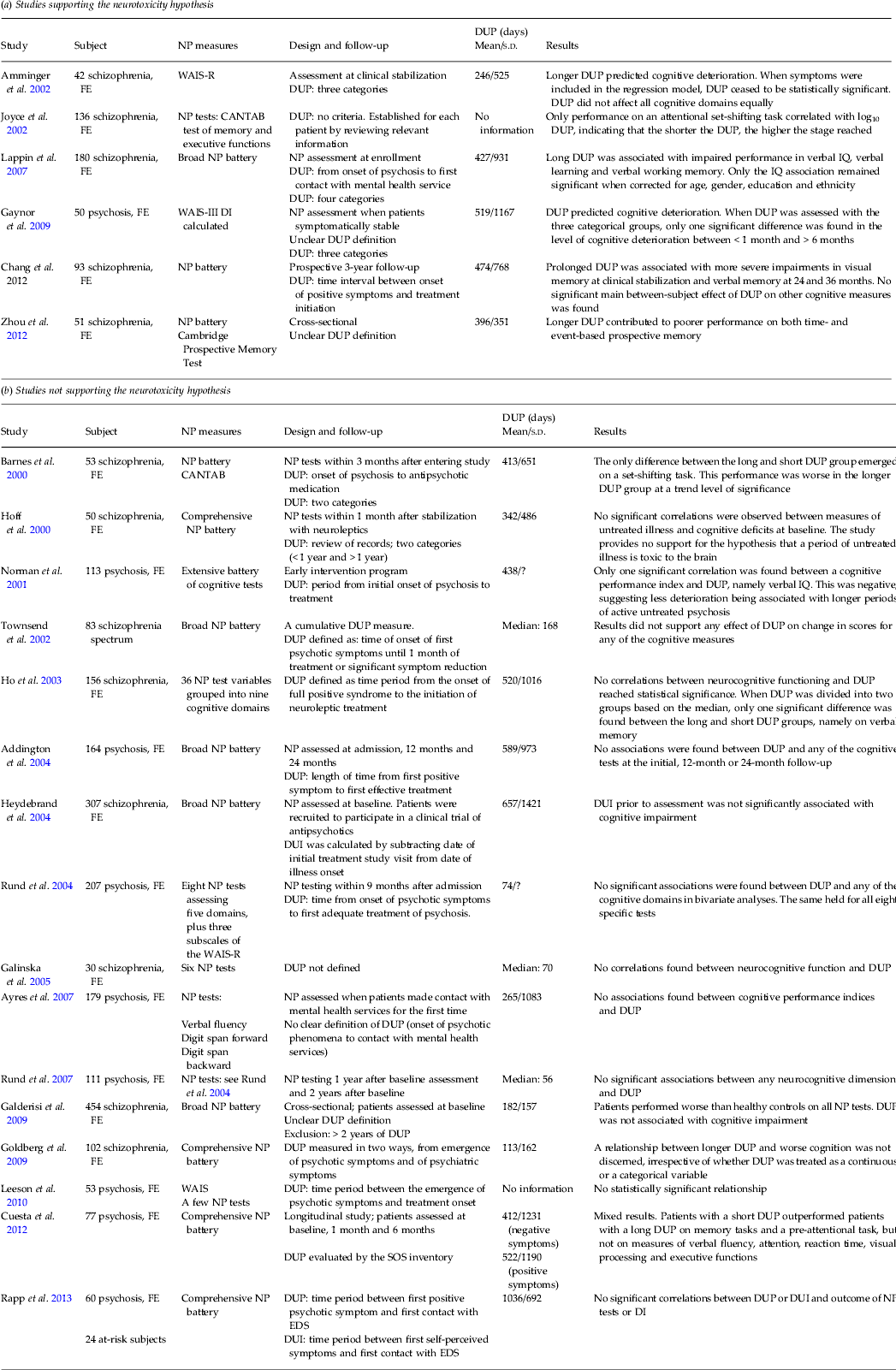
Neurocognitive studies supporting the hypothesis (Table 1a)
Amminger et al. (Reference Amminger, Edwards, Brewer, Harrigan and McGorry2002) provide limited support for the view that psychotic symptoms might be neurotoxic. An association between DUP and an estimate of cognitive deterioration was reported. When symptoms were included in the regression model, DUP ceased to be statistically significant. Furthermore, an untreated psychosis of up to 4 weeks showed no signs of cognitive deterioration.
Associations between duration of untreated psychosis (DUP) and neurocognitive measures in patients with psychosis

FE, First episode; WAIS-R, Wechsler Adult Intelligence Scale – Revised; NP, neuropsychological; CANTAB, Cambridge Neuropsychological Test Automated Battery; WAIS-III, Wechsler Adult Intelligence Scale – Third Edition; DI, deterioration index; DUI, duration of untreated illness; SOS, Symptom Onset in Schizophrenia; EDS, early detection service; s.d., standard deviation.
The study by Joyce et al. (Reference Joyce, Hutton, Mutsatsa, Gibbins, Webb, Paul, Robbins and Barnes2002) is an expansion of the Barnes et al. (Reference Barnes, Hutton, Chapman, Mutsatsa, Puri and Joyce2000) study and has several limitations, including no criteria-based definition of DUP. A robust association between DUP and attentional set-shifting ability was found. Patients who failed the test had a mean DUP that was almost twice as long as those who passed. However, this was the only task that correlated significantly with DUP. This study should therefore be seen as a very limited confirmation of the neurotoxicity hypothesis.
Lappin et al. (Reference Lappin, Morgan, Morgan, Dazzan, Reichenberg, Zanelli, Fearon, Jones, Lloyd, Tarrant, Farrant, Leff and Murray2007) provide a well-designed examination with adequate DUP criteria. The study lends some support to the prediction that a longer DUP is associated with a poorer neurocognitive ability in schizophrenia participants at first presentation. However, several neurocognitive domains were not associated with DUP. In addition, significant associations between DUP and verbal learning and verbal working memory at the time of the first episode disappeared after correction for age, gender, education and ethnicity. Only the association with IQ remained significant. The authors interpret their findings as supporting the conclusion that impairments in neurocognitive function lead to a longer DUP through delayed effective help-seeking, while also pointing out that a longer DUP may be the result of other poor prognostic factors.
Gaynor et al. (Reference Gaynor, Dooley, Lawlor, Lawoyin and O'Callaghan2009) found that the length of DUP predicted neurocognitive deterioration. When DUP was assessed in three categories, only one significant difference was found in the level of neurocognitive deterioration between the group with DUP <1 month and the group with DUP >6 months. The authors interpret this finding as an indication that there may be a potential treatment window for neurocognitive deterioration. If DUP is reduced to <6 months, the risk of significant cognitive deterioration may also be reduced. The study has several limitations, including unclear DUP criteria.
Chang et al. (Reference Chang, Hui, Tang, Wong, Chan, Lee and Chen2013) provide supportive evidence that delayed treatment of first-episode psychosis is associated with poorer cognitive outcome. They examined patients in a longitudinal design and found that memory deficits were the most related to DUP. Prolonged DUP was associated with more severe impairments in verbal memory at both 24- and 36-month follow-up assessments.
The cross-sectional study of Zhou et al. (Reference Zhou, Xiang, Wang, Dickerson, Au, Zhou, Zhou, Shum, Chiu, Man, Lee, Yu, Chan and Ungvari2012) of first-episode schizophrenia patients and healthy controls found DUP to have an adverse effect on prospective memory.
Neurocognitive studies not supporting the hypothesis (Table 1b)
In general, the study of Barnes et al. (Reference Barnes, Hutton, Chapman, Mutsatsa, Puri and Joyce2000) does not support the hypothesis. However, very limited evidence of an association between DUP and neurocognitive function was found. When DUP was split around the median, patients in the long DUP group performed worse on an attentional task at a trend level of significance.
In Hoff et al. (Reference Hoff, Sakuma, Razi, Heydebrand, Csernansky and DeLisi2000), estimates of DUP were reached by a consensus of two researchers after independent review of all records, which was probably not a very reliable method. Statistical analyses were carried out with DUP as both a continuous and a dichotomous variable, with 1 year as the cut-off point. No significant correlations were found between measures of untreated illness and the severity of neurocognitive deficits at baseline. The authors conclude that the study provides no support for the hypothesis that a period of untreated illness is toxic to the brain.
Norman et al. (Reference Norman, Townsend and Malla2001) found no relationship between DUP and performance on any component of an extensive battery of cognitive tests. One significant correlation appeared between DUP and an index of neurocognitive deterioration. The correlation was negative, suggesting that less deterioration is associated with longer periods of active untreated psychosis. The authors suggest that this finding could reflect the ability of individuals with less deterioration to function for longer periods without treatment, which contradicts the hypothesis of psychosis having toxic effects.
In the study of Townsend et al. (Reference Townsend, Norman, Malla, Rychlo and Ahmed2002), DUP was not related to the degree of change in cognitive functioning. One limitation of this study is that symptom reduction was clinically defined through an interview with the program staff.
Ho et al. (Reference Ho, Alicata, Ward, Moser, O'Leary, Arndt and Andreasen2003) carried out analyses with DUP as both a continuous and a dichotomized variable on the basis of median DUP (13 weeks). Only one significant difference was found between the long and short DUP group; for verbal memory. The absence of strong correlations suggests that untreated initial psychosis has no toxic effects. A strength of this study is the large study sample.
Addington et al. (Reference Addington, Van Mastrigt and Addington2004) initially assessed neurocognitive functioning when psychosis patients were admitted to a psychosis program, and at 12- and 24-month follow-ups. No associations were found between the log10 DUP and any of the neurocognitive tests at any of the three assessments.
In the study by Heydebrand et al. (Reference Heydebrand, Weiser, Rabinowitz, Hoff, DeLisi and Csernansky2004), schizophrenia patients who were recruited to participate in a clinical trial were assessed with a comprehensive NP battery at baseline before assignment to a double-blind treatment. Duration of untreated illness (DUI), the time period from the date of the onset of illness to the date of the initial treatment study visit, was not significantly associated with cognitive impairment.
Rund et al. (Reference Rund, Melle, Friis, Larsen, Midbøe, Opjordsmoen, Simonsen, Vaglum and McGlashan2004) assessed a large number of first-episode psychosis patients with an NP battery within 9 months of admission. No association was found between DUP and any neurocognitive dimension or specific tests.
Galinska et al. (Reference Galinska, Szulc and Czernikiewicz2005) assessed a small sample of first-episode schizophrenia patients with six NP tests. DUP was not defined but is reported to be 10 weeks (median). No correlations between neurocognitive function and DUP were found.
Ayres et al. (Reference Ayres, Busatto, Menezes, Schaufelberger, Coutinho, Murray, McGuire, Rushe and Scazufca2007) tested first-onset psychoses patients with three NP tests in a population-based study. The cognitive performance revealed no relationship to DUP.
In the study of Rund et al. (Reference Rund, Melle, Friis, Johannessen, Larsen, Midbøe, Opjordsmoen, Simonsen, Vaglum and McGlashan2007), 54% of the patients assessed at baseline (Rund et al. Reference Rund, Melle, Friis, Larsen, Midbøe, Opjordsmoen, Simonsen, Vaglum and McGlashan2004) were reassessed 1 and 2 years later with the same NP battery. The median DUP was 8 weeks. Only data for the patients with follow-up at three points were included. No associations between neurocognitive functions and DUP were found. The authors concluded that neurocognitive functioning was an independent domain, not related to DUP.
Galderisi et al. (Reference Galderisi, Davidson, Kahn, Mucci, Boter, Gheorghe, Rybakowski, Libiger, Dollfus, López-Ibor, Peuskens, Hranov and Fleischhacker2009) examined a large study sample of 454 first-episode patients with minimal or no prior exposure to antipsychotics. DUP was not associated with cognitive impairment.
Goldberg et al. (Reference Goldberg, Burdick, McCormack, Napolitano, Patel, Sevy, Goldman, Lencz, Malhotra, Kane and Robinson2009) assessed schizophrenia patients with a NP battery at the study's entry point. DUP was measured in two ways: in weeks, from the emergence of psychotic symptoms to the initiation of pharmacological treatment and from the emergence of any psychiatric symptoms to pharmacological treatment. No relationship between longer DUP and worse neurocognition was discerned, irrespective of whether DUP was treated as a continuous or a categorical variable, or whether DUP was measured from the emergence of psychotic or psychiatric symptoms.
Although investigating the relationship between DUP and neurocognition was not among the research aims of the report by Leeson et al. (Reference Leeson, Barnes, Harrison, Matheson, Harrison, Mutsatsa, Ron and Joyce2010), where first-episode psychosis patients were examined on several cognitive variables, both variables were measured. No significant relationship was found between them.
Cuesta et al. (Reference Cuesta, de Jalòn, Campos, Ibanez, Sanchez-Torres and Peralta2012) assessed drug-naïve, first-episode patients with a NP battery at baseline, 1 month and 6 months. To assess the effect of DUP on the NP status of the patients, a linear mixed-effect model was fitted to each NP dimension. Patients with a short DUP outperformed patients with a long DUP on memory tasks and a pre-attentional task. On most NP dimensions, including measures of verbal fluency, attention, reaction time, visual processing and executive functions, a long DUP was not significantly related to levels of improvement in cognitive function. Because the results were mixed in this report, importance is not given to weighting for or against the neurotoxicity hypothesis.
The study of Rapp et al. (Reference Rapp, Studerus, Bugra, Aston, Tamagni, Walter, Pflueger, Borgwardt and Riecher-Rössler2013) included 60 first-episode psychosis patients and an at-risk mental state with later transition to psychosis (ARMS-T) sample of 24 subjects. Associations between DUP and neurocognitive performance were tested by three different operationalizations of cognition, among them a deterioration index (DI). No significant correlations were found between DUP and outcome of the NP tests or DI. However, longer DUP was significantly associated with stronger negative symptoms. It is suggested that no significant relationships between DUP and neurocognition were found because schizophrenic psychoses are neurodevelopmental disorders in which most cognitive deficits exist before the onset of symptoms.
Craig et al. (Reference Craig, Bromet, Fennig, Tanenberg-Karant, Lavelle and Galambos2000) reported no significant association between the 24-month illness course and outcome in 349 first-episode psychosis patients. The study is not included in this review because it lacked an adequate NP assessment.
Becker et al. (Reference Becker, Nieman, Wilting, Dingemans, van de Fliert, Velthorst, de Haan, van Amelsvoort and Linszen2010) and Hawkins et al. (Reference Hawkins, Keefe, Christensen, Addington, Woods, Callahan, Zipursky, Perkins, Tohen, Breier and McGlashan2008) studied persons at ultra-high risk for psychosis. These two studies did not assess the association between DUP and neurocognition but give important support to the claim that psychosis does not result in neurocognitive deterioration. They found that persons who developed psychosis between two assessments of cognitive functioning did not perform significantly worse at the second assessment than at the first on any neurocognitive measure. This shows that the participants did not deteriorate cognitively after they had experienced their first psychotic episode, which gives no support to the neurotoxicity hypothesis.
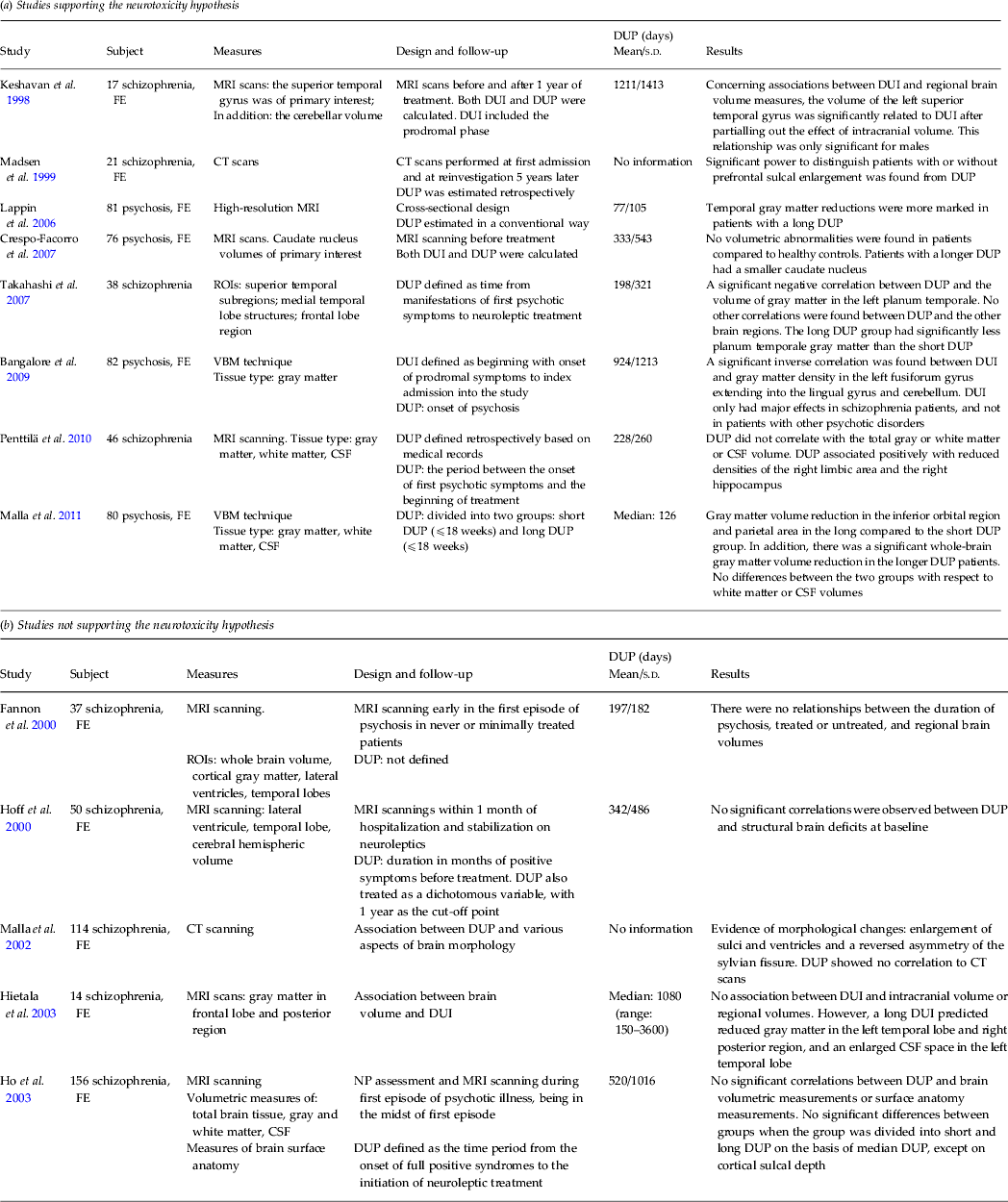
Morphology studies supporting the hypothesis (Table 2a)
Keshavan et al. (Reference Keshavan, Haas, Kahn, Aguilar, Dick, Schooler, Sweeney and Pettegrew1998) carried out magnetic resonance imaging (MRI) scans before and after 1 year of treatment, and in addition to the cerebellar volume, the superior temporal gyrus was the main area of interest. Both DUP and DUI were estimated. DUI was inversely related to the volume of the left superior temporal gyrus, a finding that was strictly confined to males. The authors conclude that it is possible that the untreated, early course of schizophrenia may be associated with progressive neurobiological deficits.
Associations between duration of untreated psychosis (DUP) and brain morphology in patients with psychosis

FE, First episode; MRI, magnetic resonance imaging; DUI, duration of untreated illness; CT, computed tomography; ROI, region of interest; CSF, cerebrospinal fluid; VBM, voxel-based morphometry; NP, neuropsychological; s.d., standard deviation.
Madsen et al. (Reference Madsen, Karle, Rubin, Cortsen, Andersen and Hemmingsen1999) examined the interaction of the clinical course in schizophrenia and brain structure with computerized tomography (CT) at first admission and 5 years later. The frontal enlargement at first admission depended on DUP, although this finding should be interpreted with caution because of the retrospective nature of the information about DUP. A limitation of this study is the method used to investigate brain structures.
Lappin et al. (Reference Lappin, Morgan, Morgan, Hutchinson, Chitnis, Suckling, Fearon, McGuire, Jones, Leff, Murray and Dazzan2006) examined first-episode psychosis patients with high-resolution MRI and voxel-based methods of image analysis. A longer DUP was associated with gray matter reductions in the left middle and inferior temporal, left occipital and left fusiform cortices, and with gray matter excess in the left basal ganglia. The limitation observed in this study is that some of the patients were being treated with antipsychotics.
Caudate nucleus volumes were of primary interest in the study by Crespo-Facorro et al. (Reference Crespo-Facorro, Roiz-Santiáñez, Pelayo-Terán, Gonzalez-Blanch, Perez-Iglesias, Gutierrez, de Lucas, Tordesillas and Vázguez-Barquero2007). Of note, no volumetric abnormalities were found in patients when compared to healthy controls. Both DUP and DUI were calculated. Patients with a longer DUP had a smaller caudate nucleus. A limitation is that patients had been treated prior to the MRI acquisition. Antipsychotics may have produced changes in the caudate brain volume, causing the observed association between DUP and a smaller caudate nucleus volume.
Takahashi et al. (Reference Takahashi, Suzuki, Tanino, Zhou, Hagino, Niu, Kawasaki, Seto and Kurachi2007) divided schizophrenia patients into long and short DUP groups based on the median DUP. There was a significant inverse correlation between DUP and the relative volume of gray matter in the left planum temporale, although other regions of interest (ROIs) did not correlate with DUP. A major limitation is that many of the patients were not assessed in their first episode, and some patients were medicated. There is increasing evidence that antipsychotic medication has an independent effect on brain morphology (Cahn et al. Reference Cahn, Pol, Lems, van Haren, Schnack, van der Linden, Schothorst, van Engeland and Kahn2002).
The type of tissue of interest in the study by Bangalore et al. (Reference Bangalore, Goradia, Nutche, Diwadkar, Prasad and Keshavan2009) was gray matter. Both DUI and DUP were calculated. A significant inverse correlation was found between DUI and gray matter density in the left fusiforum gyrus, extending into the lingual gyrus and cerebellum. This finding was only seen in first-episode schizophrenia patients. DUI did not have any major effect on the brain structure of patients with other psychotic disorders.
Penttilä et al. (Reference Penttilä, Jääskeläinen, Haapea, Tanskanen, Veijola, Ridler, Murray, Barnes, Jones, Isohanni, Koponen and Miettunen2010) examined a population-based sample with psychosis subjects with several years of illness. They were scanned using MRI after an 11-year follow-up. DUP was assessed from medical records and regressed against global and local tissue density measurements. DUP did not correlate with volumes of total gray or white matter or cerebrospinal fluid (CSF). However, DUP was positively associated with reduced densities in the right limbic area and the right hippocampus. This result was present after adjusting for several potential confounding and mediating factors. Hence, the findings were mixed, but are interpreted by the authors as supporting the hypothesis that a long DUP could be a marker of different disease trajectories, including subtle morphometric changes.
Gray matter, white matter and CSF were the types of tissue of interest in the study by Malla et al. (Reference Malla, Bodnar, Joober and Lepage2011). DUP was divided into two: < 18 weeks and > 18 weeks. Gray matter volume reduction in the inferior-orbital region and parietal area in patients with long compared to short DUP is reported. In addition, a whole-brain gray matter volume reduction was found in the long DUP group. No differences were found between the two groups with regard to white matter or CSF.
Morphology studies not supporting the hypothesis (Table 2b)
Fannon et al. (Reference Fannon, Chitnis, Doku, Tennakoon, O'Ceallaigh, Soni, Sumich, Lowe, Santamaria and Sharma2000) examined schizophrenia patients in their first episode of psychosis. ROIs in the MRI scans were whole brain volume, cortical gray matter, lateral ventricles and temporal lobes. The conclusions that can be drawn from this study concerning neurotoxicity are limited because the patient population was a mix of both treated and untreated patients. No associations were found between the duration of psychosis and regional brain volumes.
Hoff et al. (Reference Hoff, Sakuma, Razi, Heydebrand, Csernansky and DeLisi2000) conclude that there is no support for the hypothesis that a period of untreated illness is toxic to the brain structure or function. Fifty patients were examined on brain structure volumes. The ROIs in the MRI scans were the lateral ventricle, the central hemisphere and the temporal lobe. No statistically significant correlations were found between DUP and baseline brain structure volumetric measurements. Furthermore, no statistically significant differences were found between patients with < 1 year and > 1 year of untreated psychosis on any brain structure variable.
Malla et al. (Reference Malla, Mittal, Lee, Scholten, Assis and Norman2002) reported CT scan ratings of various aspects of brain morphology in a sample of first-episode schizophrenia patients, finding a modest enlargement of the sulci and ventricles and a reverse asymmetry of the sylvian fissure in comparison with a sample of patients with chronic schizophrenia. CT ratings were not related to DUP.
Hietala et al. (Reference Hietala, Cannon, Sylvalathi, Vilkman, Laakso, Vahlberg, Alakare, Räkköläinen and Salokangas2003) examined a small sample of schizophrenic first-admission patients and concluded that DUP was not associated with measures of morphology.
Ho et al. (Reference Ho, Alicata, Ward, Moser, O'Leary, Arndt and Andreasen2003) examined schizophrenia spectrum patients with analyses of MRI scans, including volumetric measures of total brain tissue, gray and white matter and CSF, and measures of brain surface anatomy. DUP was treated as a continuous variable and was also divided into two groups on the basis of the median. No significant correlations or differences between groups were found, with the exception of one patient with a short DUP who had a significantly thicker sulcal cortical depth. The authors conclude that the absence of strong cortical relationships suggests that untreated initial psychosis has no toxic neural effect.
Discussion
Six neurocognitive studies supported the hypothesis; 16 did not. The studies supporting the hypothesis vary greatly in terms of quality and methodology. The study by Amminger et al. (Reference Amminger, Edwards, Brewer, Harrigan and McGorry2002) provides only weak support to the neurotoxicity hypothesis, suggesting that the correlation between symptoms and DUP is of greater importance than between neurocognition and DUP. By contrast, the study by Cuesta et al. (Reference Cuesta, de Jalòn, Campos, Ibanez, Sanchez-Torres and Peralta2012) lends some support to an association between DUP and memory, although an overall assessment suggests no support for the hypothesis. The studies that can be given importance as confirmation of the hypothesis are those by Lappin et al. (Reference Lappin, Morgan, Morgan, Dazzan, Reichenberg, Zanelli, Fearon, Jones, Lloyd, Tarrant, Farrant, Leff and Murray2007), Gaynor et al. (Reference Gaynor, Dooley, Lawlor, Lawoyin and O'Callaghan2009), Zhou et al. (Reference Zhou, Xiang, Wang, Dickerson, Au, Zhou, Zhou, Shum, Chiu, Man, Lee, Yu, Chan and Ungvari2012) and Chang et al. (Reference Chang, Hui, Tang, Wong, Chan, Lee and Chen2013), all of which have a sufficient number of patients. However, only one of them (Chang et al. Reference Chang, Hui, Tang, Wong, Chan, Lee and Chen2013) is longitudinal, and the significant relationships between DUP and neurocognitive variables are limited in number. In the study by Lappin et al. (Reference Lappin, Morgan, Morgan, Dazzan, Reichenberg, Zanelli, Fearon, Jones, Lloyd, Tarrant, Farrant, Leff and Murray2007), the correlation between IQ and DUP is the only robust finding whereas Gaynor et al. (Reference Gaynor, Dooley, Lawlor, Lawoyin and O'Callaghan2009) provide a certain support for the hypothesis, but only when the DUP is greater than 6 months.
There are numerous neurocognitive studies that do not provide any empirical support for the hypothesis. Many of them (Townsend et al. Reference Townsend, Norman, Malla, Rychlo and Ahmed2002; Addington et al. Reference Addington, Van Mastrigt and Addington2004; Rund et al. Reference Rund, Melle, Friis, Johannessen, Larsen, Midbøe, Opjordsmoen, Simonsen, Vaglum and McGlashan2007; Cuesta et al. Reference Cuesta, de Jalòn, Campos, Ibanez, Sanchez-Torres and Peralta2012) are longitudinal, and all have a sufficient number of patients. A comprehensive assessment suggests that, in general, the neurocognitive studies do not provide substantial support for the hypothesis.
When it comes to the morphology studies, the picture is not as clear. Eight studies supported the hypothesis, five did not. These studies are also difficult to assess, in part because there are progressive structural changes during the development of psychosis (Rund, Reference Rund2009) that increase around the time of onset (Ziermans et al. Reference Ziermans, Schothorst, Schnack, Koolschijn, Kahn, van Engeland and Durston2010). Some of the studies have serious shortcomings. For instance, Keshavan et al. (Reference Keshavan, Haas, Kahn, Aguilar, Dick, Schooler, Sweeney and Pettegrew1998) included the prodromal phase in addition to DUI, which makes it impossible to determine what has been added in structural changes after the onset of illness and what was present before psychosis onset.
Some morphology studies have a small number of patients (Keshavan et al. Reference Keshavan, Haas, Kahn, Aguilar, Dick, Schooler, Sweeney and Pettegrew1998; Hietala et al. Reference Hietala, Cannon, Sylvalathi, Vilkman, Laakso, Vahlberg, Alakare, Räkköläinen and Salokangas2003). Another problem is that ROIs have varied from one study to another, and different studies have found changes in different brain structures. Another limitation is that some studies included participants on antipsychotic medication (Crespo-Facorro et al. Reference Crespo-Facorro, Roiz-Santiáñez, Pelayo-Terán, Gonzalez-Blanch, Perez-Iglesias, Gutierrez, de Lucas, Tordesillas and Vázguez-Barquero2007; Takahashi et al. Reference Takahashi, Suzuki, Tanino, Zhou, Hagino, Niu, Kawasaki, Seto and Kurachi2007). In addition, patients other than first-episode patients were included sometimes, thereby making it difficult to know when the structural changes took place. Lastly, the diagnostic criteria for inclusion vary between studies.
The studies that provide the clearest support for the hypothesis are those of Crespo-Facorro et al. (Reference Crespo-Facorro, Roiz-Santiáñez, Pelayo-Terán, Gonzalez-Blanch, Perez-Iglesias, Gutierrez, de Lucas, Tordesillas and Vázguez-Barquero2007), Takahashi et al. (Reference Takahashi, Suzuki, Tanino, Zhou, Hagino, Niu, Kawasaki, Seto and Kurachi2007), Bangalore et al. (Reference Bangalore, Goradia, Nutche, Diwadkar, Prasad and Keshavan2009) and Malla et al. (Reference Malla, Mittal, Lee, Scholten, Assis and Norman2002), which all had sufficient numbers of participants and adequate DUP assessments and brain scanning techniques. These studies all found associations between DUP and restricted areas of the brain, including a smaller caudate nucleus (Crespo-Facorro et al. Reference Crespo-Facorro, Roiz-Santiáñez, Pelayo-Terán, Gonzalez-Blanch, Perez-Iglesias, Gutierrez, de Lucas, Tordesillas and Vázguez-Barquero2007), and a reduction in gray matter volume in the left planum temporale (Takahashi et al. Reference Takahashi, Suzuki, Tanino, Zhou, Hagino, Niu, Kawasaki, Seto and Kurachi2007), gray matter density in the left fusiforum gyrus (Bangalore et al. Reference Bangalore, Goradia, Nutche, Diwadkar, Prasad and Keshavan2009) and gray matter in the inferior-orbital region and parietal area (Malla et al. Reference Malla, Mittal, Lee, Scholten, Assis and Norman2002).
The most serious challenges encountered in assessing these studies is that the morphological changes (e.g. gray matter loss) precede the onset of overt psychotic symptoms and that treatment with antipsychotics may affect brain structures. It is difficult to separate the changes that would have happened anyway, regardless of whether the person had received treatment or not.
The studies that support the hypothesis have, on average, slightly longer DUP than those who do not (459 v. 414 days). This may imply that there is a threshold value for a toxic effect of psychosis (Amminger et al. Reference Amminger, Edwards, Brewer, Harrigan and McGorry2002; Gaynor et al. Reference Gaynor, Dooley, Lawlor, Lawoyin and O'Callaghan2009), and not a linear relationship between DUP and a neurotoxic effect.
Conclusions
There is limited evidence for a relationship between DUP and changes in neurocognitive functioning or brain structures. Some analyses have shown significant correlations between these variables, but far more studies have shown no such associations. Definite conclusions cannot be drawn because of methodological limitations and a lack of relevant information in existing studies.
Acknowledgments
D. E. Eilertsen has contributed significantly to evaluating the suitability of the studies for quantitative meta-analysis.
Declaration of Interest
None.