Introduction
Within mainstream policy discourses, ‘ageing in place’ is touted as the most desirable living arrangement in later life (Wiles et al., Reference Wiles, Leibing, Guberman, Reeve and Allen2012; Rowles and Bernard, Reference Rowles and Bernard2013). Ageing in place eludes clear definition, but most commonly refers to situations where people remain living in their long-term dwellings as they grow older, adjusting to changes in health status and ability in this environment, rather than moving to institutional settings (Carstairs and Keon, Reference Carstairs and Keon2009; Granbom et al., Reference Granbom, Himmelsbach, Haak, Löfqvist, Oswald and Iwarsson2014; Dupuis-Blanchard and Gould, Reference Dupuis-Blanchard and Gould2018; Martens, Reference Martens2018). Receiving care at home is typically considered a more cost-effective use of health resources; in part because (mostly female) unpaid family members take significant responsibilities for care provision (Keefe, Reference Keefe2011; Funk, Reference Funk2013). Many older people also indicate a preference to age at home or ‘in place’, as they associate the home environment with feelings of security, privacy and autonomy (Angus et al., Reference Angus, Kontos, Dyck, McKeever and Poland2005; Barrett et al., Reference Barrett, Hale and Gauld2012; Wiles et al., Reference Wiles, Leibing, Guberman, Reeve and Allen2012; Rowles and Bernard, Reference Rowles and Bernard2013; Golant, Reference Golant2015). By contrast, socio-cultural discourses often present moving to congregate or institutional housing as a failure on the part of individuals and families to care for themselves, and as a last resort (Guberman, Reference Guberman, Grant, Amaratunga, Armstrong, Boscoe, Pederson and Willson2004; Leibing et al., Reference Leibing, Guberman and Wiles2016).
Gerontologists have challenged these assumptions surrounding later-life housing options, drawing attention to the socio-economic, cultural and political factors underlying older people's desire and capacity to age in their own homes (Means, Reference Means2007; Golant, Reference Golant2008; Grenier et al., Reference Grenier, Barken and McGrath2016; Leibing et al., Reference Leibing, Guberman and Wiles2016; Martens, Reference Martens2018). They also make visible the diverse housing alternatives developed for older persons with chronic health conditions and disabilities, which blur the boundaries between ageing ‘at home’ and ‘in a home’ (Mcdermott et al., Reference Mcdermott, Linahan and Jean2009; Martens, Reference Martens2018). Across many jurisdictions, housing and support options include private dwellings (with home care as necessary); age-segregated elder housing such as retirement homes and assisted living residences that provide varying levels of assistance with housekeeping, meals and personal care; and long-term residential care facilities (i.e. nursing homes) that provide more intensive levels of personal and/or clinical care (Golant, Reference Golant2015). This range of housing options is positive in that older people potentially have many choices that extend beyond binaries between home and medically oriented facilities such as nursing homes (Rowles and Bernard, Reference Rowles and Bernard2013). Yet, housing options are marked by inequality given that not all people have access to the same supports depending on where they live and the costs associated with different housing options.
This article examines the time work undertaken by older people with chronic health conditions and disabilities to navigate present and future support arrangements. From an interactionist sociological perspective, time work refers to the actions people do to negotiate, manipulate and control the duration, order and timing of events within particular social and individual contexts (Flaherty, Reference Flaherty1999, Reference Flaherty2011). Exploring the temporal aspects of mobility intentions adds an important dimension to gerontological literature on ageing in place and relocating. Within this body of research, environmental and ecological perspectives give insight into the ‘fit’ between housing situations and health and wellbeing, as well as the meaning older people associate with particular places (Rowles and Bernard, Reference Rowles and Bernard2013; Golant, Reference Golant2015). Temporal dimensions are an undercurrent in many studies on the meaning of home and ageing in place (Golant, Reference Golant2011; de Medeiros et al., Reference de Medeiros, Rubinstein, Doyle, Rowles and Bernard2013; Granbom et al., Reference Granbom, Himmelsbach, Haak, Löfqvist, Oswald and Iwarsson2014; Leibing et al., Reference Leibing, Guberman and Wiles2016). Yet, very little research uses an interactionist perspective on time to explore how older people using home care contemplate their present and future support arrangements.Footnote 1 Focusing specifically on time work enriches understandings of the ways older people make sense of housing and care not only in relation to physical, social and psychological capacities, but also in relation to perceptions of the past, present and future.
To extend existing literature, I address the following questions:
(1) What meanings do older people with chronic health conditions and disabilities associate with their present and future support arrangements?
(2) How do past, present and future time horizons inform decisions about housing and care?
(3) What social contexts (e.g. policies, cultural practices) shape the temporal aspects of mobility intentions?
Drawing on an interpretive analysis (Corbin and Strauss, Reference Corbin and Strauss2015) of interviews with 22 older people in Ontario, Canada, I highlight structural, cultural and relational dynamics that underlie time work where mobility intentions are concerned. All of the participants in this study were using home care services for a range of chronic health conditions and disabilities. As persons receiving care, these participants were residing in what Leibing et al. (Reference Leibing, Guberman and Wiles2016) refer to as ‘liminal homes’ because they had already lost some degree of the independence and privacy typically associated with the home space. Their perspectives offer important insights into actions and interactions undertaken to contend with present needs and future uncertainties.
Background
Places and ageing
Understandings of later-life housing, including ageing in place and relocating, stem primarily from ecological theory or environmental gerontology (Greenfield, Reference Greenfield2012; Wahl et al., Reference Wahl, Iwarsson and Oswald2012; Golant, Reference Golant2015). These allied perspectives provide insight into the congruence between an individual and the places in which they live and spend time, with the aim of predicting the appropriateness of an individual's home and community for their physical and psychological health (Lawton and Nahemow, Reference Lawton, Nahemow, Eisdorfer and Lawton1973; Lawton, Reference Lawton1990; Greenfield, Reference Greenfield2012; Golant, Reference Golant2015). For example, Golant's (Reference Golant2015: 18) residential normalcy model assesses the extent to which individuals ‘feel that their residential arrangements are satisfying their needs and goals’. When older people perceive a good fit between the environment and their needs, they can achieve a sense of residential comfort or residential mastery (Golant, Reference Golant2011, Reference Golant2015; Granbom et al., Reference Granbom, Himmelsbach, Haak, Löfqvist, Oswald and Iwarsson2014). Environmental gerontologists consider the relationship between the environment and the individual as dynamic. While environments influence individual outcomes, people can exercise agency vis-à-vis their surroundings ‘to meet their own needs and to maintain independence’ (Wahl et al., Reference Wahl, Iwarsson and Oswald2012).
Within environmental gerontology, some qualitative approaches account for the experiential, constantly evolving meanings associated with the settings in which people age (Rowles and Chaudhury, Reference Rowles and Chaudhury2005; Rowles and Bernard, Reference Rowles and Bernard2013). This includes the ways individuals transform physical spaces into meaningful places (Rowles and Watkins, Reference Rowles, Watkins, Schaie, Wahl, Mollenkopf and Oswald2003; Cristoforetti et al., Reference Cristoforetti, Gennai and Rodeschini2011). Here, researchers focus on the diverse housing environments people consider home. Cutchin (Reference Cutchin, Rowles and Bernard2013), for example, describes how people who reside in assisted living ‘become at home’, a process that fosters feelings of security, comfort and belonging following a move in later life (see also Leith, Reference Leith2006).
Drawing on these gerontological frameworks, researchers have poignantly illustrated the limits of policy frameworks and cultural discourses that present one's long-term dwelling as the ideal place for ageing. Studies suggest many older people lack homes or ‘places’ in which they can safely live and receive care in their later years (Means, Reference Means2007; Golant, Reference Golant2008; Mcdermott et al., Reference Mcdermott, Linahan and Jean2009; Strohschein, Reference Strohschein2012; Hillcoat-Nallétamby and Ogg, Reference Hillcoat-Nallétamby and Ogg2014; Grenier et al., Reference Grenier, Barken and McGrath2016; Willis et al., Reference Willis, Raithby and Maegusuku-Hewitt2018). Poorly maintained housing conditions as well as family conflict can lead to vulnerability at home, particularly for those who are economically disadvantaged (Means, Reference Means2007). Individuals living at home may also experience loneliness and/or social exclusion when they are cut off from the wider community and from social networks (Barrett et al., Reference Barrett, Hale and Gauld2012). This situation can occur when community-based services and amenities such as grocery stores, pharmacies and banks are out of reach (Bigonnesse et al., Reference Bigonnesse, Beaulieu and Garon2014). Homes and neighbourhoods that are inaccessible (e.g. steep stairs, showers without railings) or that feel unsafe (e.g. lack of security systems, poorly maintained infrastructure, fear of crime) can present barriers to ageing in place (Golant, Reference Golant2008; Bigonnesse et al., Reference Bigonnesse, Beaulieu and Garon2014). Finally, a lack of viable transportation options can make it very difficult for some individuals to obtain essential and desirable resources when living at home (Golant, Reference Golant2011). Despite the rhetoric of consumer choice and individual empowerment underlying frameworks on ageing and care, ageing in place becomes a necessity – rather than a choice – for people who have no option other than to remain in their own home (Means, Reference Means2007; Strohschein, Reference Strohschein2012; Leibing et al., Reference Leibing, Guberman and Wiles2016; Martens, Reference Martens2018).
Given the challenges with ageing in place, researchers have explored several factors that shape older people's decisions about and experiences of relocating. Moving can be a positive experience for some older people, particularly when chronic health conditions, impairments and needs for care make it difficult to remain in one's long-term dwelling (Hillcoat-Nallétamby and Ogg, Reference Hillcoat-Nallétamby and Ogg2014; Martens, Reference Martens2018; Seifert and Schelling, Reference Seifert and Schelling2018). In a comprehensive review of the literature on care preferences, Lehnert et al. (Reference Lehnert, Heuchert, Hussain and König2019) find that most older people prefer to live at home when care needs are moderate, but in a residential environment if their needs become more intensive. In the latter situation, Lehnert et al. (Reference Lehnert, Heuchert, Hussain and König2019: 1901) explain, ‘the presumed benefits of living at one's home, for instance, higher levels of freedom, independence, belonging and connectedness, may not prevail over the disadvantages, for instance, more personal responsibilities, safety concerns and less control than in residential facilities’. Moving to a dwelling with universal or accessible design, as one example, can promote a sense of independence (Martens, Reference Martens2018), and can allow for greater congruence between individual needs and the environment (Golant, Reference Golant2015).
Care and housing in Ontario
In Canada, provinces and municipalities hold some responsibility for long-term support in later life. The province of Ontario funds some home care services including medical and personal care, home-making and end-of-life care. Home care services such as these are considered to foster ‘supported independence’ as assistance with daily activities can allow individuals ‘to maintain continuity in the living environment, in the organisation of daily life and in social networks’ (Barrett et al., Reference Barrett, Hale and Gauld2012: 362). In the language of environmental gerontology, home care services can help to achieve residential normalcy (Golant, Reference Golant2011; Granbom et al., Reference Granbom, Himmelsbach, Haak, Löfqvist, Oswald and Iwarsson2014). Provincial and municipal governments also fund nursing homes that provide 24-hour nursing and personal care. Individuals must meet eligibility criteria and often join lengthy waiting lists to access this type of care. Residents are responsible for paying accommodation costs in nursing homes, although a subsidy is available for those who qualify based on financial need (Government of Ontario, 2018). Finally, housing and support options are also available through the private market for individuals who have the financial means to pay for care. These include retirement homes and communities designed specifically for older people, and home care where clients are responsible for the costs of services (Canadian Home Care Association, 2013; Government of Ontario, 2018).
Interactionism and time
Time is an important, yet often unacknowledged, aspect of mobility intentions. To understand how individuals make sense of living at home and relocating in later life, it is necessary to consider how past, present and future time horizons play into subjective, socially situated decision-making processes. Broadly, interactionist sociologists consider individuals to be reflexive agents who engage in interpretive and communicative processes to actively create and maintain meanings in their lives (Blumer, Reference Blumer1969; Jaffe and Miller, Reference Jaffe, Miller, Gubrium and Sankar1994; Gubrium and Holstein, Reference Gubrium, Holstein, Bengtson and Schaie1999).
Within the interactionist tradition, scholars have theorised the temporal dimensions of lived experience. Interactionist researchers understand time not simply as an external force that exerts pressure on individual lives. Rather, time is a socially constructed, negotiated process (Mead, Reference Mead1938; Flaherty and Fine, Reference Flaherty and Fine2001; Barken, Reference Barken2014). People engage in present actions that reflect their interpretations of the past and future. They simultaneously craft future time projects that correspond with the past and present (Flaherty and Fine, Reference Flaherty and Fine2001; Mische, Reference Mische2009). While one cannot change the past, the meaning of events that have already occurred shifts as people reinterpret them from the standpoint of the present (Natanson, Reference Natanson1973; Maines et al., Reference Maines, Sugrue and Katovich1983; Barken, Reference Barken2014). The future, moreover, is premised on uncertainty because it is continuously shaped by novel, emergent events. Since people are constantly reinterpreting the future, the present does not concretely determine the future. Interpretations are like working hypotheses that correspond with the meaning attributed to future events (Flaherty and Fine, Reference Flaherty and Fine2001). People engage in time work (i.e. actions and interactions) to make sense of their circumstances and to exert some agency over the duration, order and timing of events within particular social contexts (Flaherty, Reference Flaherty1999, Reference Flaherty2011).
Time work is particularly relevant where mobility intentions are concerned. People negotiate their future housing and care arrangements from the standpoint of the (constantly shifting) present. At the same time, they construct meanings of their present environments based on interpretations of the past and future. While all people engage in time work, disability and chronic health conditions follow uncertain time horizons and make temporal processes particularly evident. One cannot easily predict how health-related needs will change in the coming years, months, weeks and sometimes even days (Barken, Reference Barken2014; Altomonte, Reference Altomonte2016). To enrich understandings of late-life mobility intentions, I explore how older people engage in time work as they contemplate present and future needs for housing and care. Furthermore, I consider how structural, cultural and relational contexts inform interpretations of time and decision-making processes.
Methods
This paper emerges from my doctoral thesis, which engaged a critical interpretive perspective to explore the experiences of 34 older people at the intersections of formal home care services, family care and self-care practices (Barken, Reference Barken2017, Reference Barken2019). An interpretive approach seeks to understand research participants’ perspectives, acknowledges the existence of multiple realities, and examines the links between immediate actions and the social contexts in which they occur (Charmaz, Reference Charmaz2014; Corbin and Strauss, Reference Corbin and Strauss2015). Using this perspective, I gathered data on the meanings associated with present and future support arrangements. I paid close attention to the broader contexts informing individuals’ choices (or lack of choices) about housing and care, and to the temporal dimensions of everyday experience.
Following approval from the McMaster Research Ethics Board, I recruited participants through multiple means including, in the majority, presenting at seniors’ groups and day programmes. A research associate at a home care agency also contacted clients directly. I then conducted intensive interviews with individuals who were using formal home care for a range of chronic health conditions and disabilities. Charmaz (Reference Charmaz2014) conceptualises intensive interviews as contextual and negotiated processes that allow researchers to gain an in-depth understanding of the participant's subjective, socially situated viewpoint. Although I used a semi-structured guide (Kelly, Reference Kelly, Bourgeault, Dingwall and De Vries2010), the interviews were conversational, allowing participants to share information they felt was relevant (Holstein and Gubrium, Reference Holstein and Gubrium1995). Guiding questions focused on the importance of home care for older persons’ daily lives as well as their hopes and concerns for the future. For example, I asked participants to tell me about the kinds of home care they received, their relationships with care providers and how they thought their needs might change over time. Perceptions of alternative housing options such as nursing homes were not an explicit focus but frequently emerged as emic concerns, highlighting the extent to which future support arrangements permeate individuals’ thoughts, actions and social interactions.
I conducted all interviews in 2014. While most interviews were one-on-one, in three cases family members were involved at participants’ request. In these cases, the interviews resembled a conversation between the research participant (i.e. the older person using home care), their family member and myself. The interviews averaged one hour in length, were audio-recorded with consent and professionally transcribed. I used pseudonyms to protect confidentiality.
I conducted most interviews in participants’ homes, with the exception of two where participants requested telephone interviews. Entering home spaces provided an essential context for examining present and future needs. In addition to telling me about housing and care, these older people were able to show me features of their homes and to reflect on the meanings associated with these spaces. Some individuals gave me a tour of their homes, pointing out adaptations to make everyday life easier (e.g. rails in the bathtub) or features that made it difficult to live safely and comfortably (e.g. cramped spaces, snow-covered entrances).
Data analysis
I used an interpretive framework to analyse data on older people's subjective perceptions of living at home and relocating. This involved three steps. First, I read the interviews in their entirety and extracted excerpts focusing on perceptions of present and future support arrangements. Such discussions appeared in 22 of the 34 interviews and form the basis for this paper. Second, I inductively developed three categories, which reflected the temporal aspects of mobility intentions: (a) maintaining continuity with the past and present, (b) constructing alternative futures, and (c) facing precarity. Finally, I coded data using these three categories.
Throughout the analysis I engaged in constant comparison (Corbin and Strauss, Reference Corbin and Strauss2015), which made visible diverse meanings and experiences among data falling under the same code and between different codes. Using constant comparison, I moved from the particularities of individual experience to an abstract level that accounts for commonalities across experiences. I recorded analytic memos throughout the coding process, which aided with interpreting data and developing themes. I used QSR International's NVivo 10 (http://www.qsrinternational.com/product), a qualitative analysis software package, to organise data under different codes.
Findings
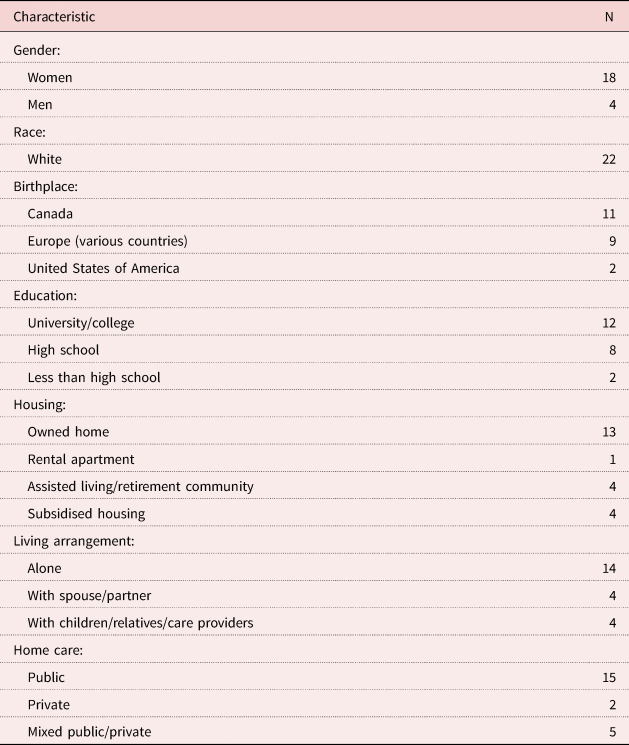
Table 1 provides a demographic profile of the 22 interviews analysed for this paper. Eighteen of the participants were women and four were men. They ranged in age from 65 to 100, and the average age was 81. Nine participants were born outside Canada and all were White. All participants lived in in the Greater Toronto and Hamilton Area, a densely populated urban region. All participants were using home care services for a range of chronic health conditions and physical disabilities. Fifteen participants used only publicly funded home care, while two used only home care they paid for themselves. The remaining five participants used a combination of public and private home care.
Demographic profile

Note: N = 22.
Reflecting diverse meanings of ‘ageing in place’, four of the 22 participants owned or rented places in age-segregated retirement communities or assisted living residences, and received home care in these settings. They considered these places ‘home’ and reflected on their perceptions of remaining there or potentially moving elsewhere (e.g. to a nursing home) to access more support in the future. The remaining participants lived in privately owned houses and condominiums or rental apartments.
Through an interpretive thematic analysis, I developed three themes that demonstrate the diverse ways participants engaged in time work, understood as actions to control and manipulate the duration, order and timing of events associated with ageing in place and/or relocating. Further, I consider contextual features that informed participants’ time work. These include structural factors shaping access to support and financial resources, cultural ideals about home and independence, and relational connections with families and communities.
Maintaining continuity with the past and present
Consistent with policy frameworks on ageing in place, nine participants clearly noted a preference for staying in their current homes as long as possible. Their perspectives align with dominant cultural and policy narratives that present living in one's own dwelling as the ideal means of ageing ‘successfully’ (Dalmer, Reference Dalmer2019). They felt living at home, with formal and informal support, promoted their independence as well as their connections with family, friends and broader social networks. Some individuals indicated relocating – especially to a setting offering more care, like a nursing home – would signal a loss of meaningful life. While findings illustrate how the dominant cultural emphasis on ageing in place shapes individual perceptions (Golant, Reference Golant2015), interview data also suggest older people idealise living at home because they perceive the alternatives so negatively. From a temporal perspective, their actions may be interpreted as a means to craft futures oriented around continuity with the past and present.
Many older persons valued living in places where they had meaningful opportunities for inclusion and participation. When they contemplated their futures, some participants were concerned that moving to a retirement or care home would place constraints on their social connectedness. Anne, a very wealthy 100-year-old woman living alone in a condominium in downtown Toronto, wanted to stay in her current residence which was directly attached to shops, restaurants, a movie theatre and public transportation. This location, Anne felt, was highly beneficial because it allowed her, as well as other older people living in her community, to remain socially connected and to access amenities easily. Anne wanted to keep living in the same place because of the benefits it provided:
This is the only place that I could live that I wouldn't have to be in a rest home … I mean the food is downstairs; everything that is needed is right here. The transportation is good … I just feel that this particular place, but there are other places like this and I think almost all of them are situated in places where the old people aren't isolated and I think the isolation is a very bad thing.
Other participants were deeply committed to remaining in their long-term homes to maintain marital partnerships. Consider Phillip, 84, who received some home care services for complications from arthritis at the same time as he cared for his wife, Kathryn, 89, who had advanced dementia. While Kathryn was immobile and had a very limited ability to communicate, Phillip cared for her to sustain their long-term relationship. He carefully selected nice, brightly coloured clothing for Kathryn to wear, continued to have conversations with her even though she could ‘only answer with her eyes’, planned birthday celebrations, regularly took her out for lunch with the assistance of the care workers he hired and ensured she could watch her favourite television programmes. Staying in their condominium (i.e. ageing in place) was particularly important because a relocation could potentially mean Phillip and Kathryn would no longer be able to live together. These concerns shaped Phillip's present actions, which involved co-ordinating a complex system of formal and informal support to ensure he and Kathryn could remain living at home in the present and future:
I've had her at home … it'll be 11 years in June of 2014 … my purpose was to keep her at home, give her a happy life and bring in good care-givers … But, fortunately for us, my mind has been very, very alert. My body is not as good but my mind is very alert and I've been able to take care of Kathryn, call the shots, make decisions, provide for her whatever would be in her best interest and for her best safety and for her happiest way of life so, we still have her in our home, even as of this moment, and I've got wonderful … care-givers that take good care of her.
Participants sometimes related their desire to remain living at home to concerns about a poor quality of life and care in nursing homes. These concerns shaped their outlook for a future premised on avoiding institutional care. Participants had developed these negative perceptions when visiting nursing homes and as they learned about scandals related to the quality of care and staffing. Suzanne, 80, explained:
All of us have that very awful feeling about being put in a nursing home. And I'm not saying there aren't any good nursing homes, but people without money are not being put in the [good nursing homes] … you're in a nightmare in a couple of them … And places that have been privatised and are cutting staff, a lot of them are trying to take the RN [registered nurse] out of the hospital.
Hannah, 90, feared relocating because she had observed a loss of meaningful life when friends moved to nursing homes. Although it was increasingly difficult for Hannah to manage living alone in her two-storey house, she constructed a future based on staying put because she felt it was a better option than moving to access more support, especially given financial concerns:
She was 94 when she died … All of a sudden, she had osteoporosis, she had a pacemaker … doctors told her, she had to leave her apartment; she couldn't live alone anymore. That's what I'm afraid of … So, she went to one of these big houses. Now, that is another thing, I could afford it but I hate to leave my own house for $2,500 a month … The people [in nursing homes] seem to be so hungry; they sit there.
These participants engaged in actions to minimise the possibility of future disruptions to present realities. Hannah described how she faithfully followed an exercise routine so she could maintain enough mobility to get around her two-storey home and to bathe with minimal assistance and, therefore, to ensure continuity with the present in the future:
I started gymnastics … And if I wouldn't have done that, I would not be able to climb out and into the bath all by myself.
Hannah's time work may also be considered in relation to her past, which informed the high value she placed on living independently at home. As a single woman and an immigrant from Germany, Hannah had worked very hard to purchase her own home, taking in boarders to make ends meet. Her biography informed her strong desire to age in place and to avoid moving to access more care, even when health professionals encouraged her to relocate:
In the beginning when I got this here and heart trouble and whatever, they wanted to get me into a home. I said, ‘I am not going into a home as long as I…’ if I get a stroke, if I get dementia, something like that but as long as I can handle myself, I stay here.
In these examples, participants constructed binaries between their present support arrangements and institutional environments. They crafted futures based on continuity with the present not only to maintain something positive (i.e. independence and sustained relationships at home), but also to avoid what they perceived as a future devoid of meaningful life and good care. Participants engaged in specific activities, such as physical exercise and hiring care workers, in attempts to realise this future.
Constructing alternative futures
Contrasting with the presumed preference for ageing in place, five participants voiced serious concerns about their capacity to remain living at home as chronic health conditions and disabilities worsened. For this reason, they derived a sense of comfort and security as they crafted futures based on plans to move should their care needs increase. While their plans could potentially change, future-oriented time work still shaped present meanings, actions and interactions.
Although Maggie, 89, still lived relatively independently in the home she had occupied for 50 years and where she had raised her family, she was contemplating joining a waiting list for a place in a nursing home to ensure access to support if her health worsened. Maggie valued having open and honest conversations on this topic with home care co-ordinators and with her family. Talking about the future eased her concerns about relocating and needing more care. In other words, imagining an alternative future provided Maggie with a sense of security in the present:
I called the [care co-ordinator] … And said ‘Could you come and talk to me?’, and she did. And I said ‘I have to know what I should be doing for my future. Like, should I be putting my name down on somebody's list like … a nursing home or something?’ … But she said ‘No, you don't want a nursing home because you're still too alert. And a nursing home wouldn't have people maybe to converse with you’ … So, we left it that I would think about putting my name somewhere before too long. Certainly you can get beginning Alzheimer's and you can get an unexpected injury or whatever.
Kate, 77, suffered from stenosis which made it a growing challenge to get around the small, three-storey townhouse she shared with her daughter and granddaughter. Kate was planning to move to a seniors’ community that offered a continuum of housing options, including independent living apartments, assisted living and long-term residential care. She was looking forward to moving to a setting where she could access a range of secure supports, amenities and community services. Kate also noted the importance of being close to friends, some of whom already lived in this community. She felt moving could ensure care and social connectedness, even with changes to her health and mobility. Kate constructed a future that reflected a desire to change, rather than to maintain continuity, with her present circumstances. Crafting an alternative future gave her feelings of both hope and security for the years to come:
I'm sort of looking forward to it because I have two or three friends who already live there … so I know a bit about it. There's a great social life, apparently, and there's a dining room, cafeteria if you don't want to cook your meals … when I was visiting, I saw two different sort of coffee bars and they have a pharmacy and a shop and banking machines and, you know, and they have a library in there but it's also next door to [the public] library … it's the sort of place where I think you don't really have to go outside during the winter if you don't want to.
One participant, originally from Estonia, felt secure in knowing she could access culturally and linguistically appropriate long-term care options. Ingrid, who at 91 lived with her daughter in a condominium, was on a waiting list for an Estonian care home. While Ingrid had declined to move thus far when a space was available, she valued knowing she could get care at a place where friends from her tight-knit Estonian community already lived. Ingrid and her daughter Heidi, who also took part in the interview given Ingrid's limited English, commented:
Ingrid: I would like to go to the Estonian…
Heidi: Retirement home.
Ingrid: I would go, gladly, there.
Heidi: So once a year, they phone and say, ‘Are you ready to make that change?’
Ingrid: And I say no I'm not ready yet.
Heidi: But it's very comfortable because all the residents there are Estonian.
Ingrid: It's nice place, you know? … And even now, there's lots of things to do, you know, I have even lots of friends already there.
While Ingrid had not acted on this future plan, she made present decisions (choosing to remain at home for one more year) based on the knowledge that an alternative would be available should her care needs increase. This sense of security meant Ingrid could enjoy the present without having to worry about the future.
Many participants highly valued support options that extended beyond basic clinical and personal care to also account for cultural and social needs. The availability of a range of appropriate forms of assistance sometimes eased their concerns about their present and future support arrangements. These participants were not committed to ageing in place. They planned for and exerted some control over a future based on the potential for change, rather than a desire to maintain continuity with the present. Their sense of control made everyday life less stressful, highlighting the dynamic relationship between present and future time horizons.
Facing precarity
Despite the agency sometimes associated with making plans to move, eight participants described relocating as the only option in the face of worsening health and constrained access to formal and informal support. Some older persons described how any change to their health or mobility would necessitate a move to a nursing home. Uncertainty about the future informed the meanings these participants associated with their present support arrangements. Their current situations felt precarious as they were living ‘on the edge’ of a potential relocation, and they conceptualised this move as beyond their control. It is notable that these participants were in relatively disadvantaged positions. Seven out of eight participants lived in subsidised low-income housing, and they had fairly small support networks.
Angela, 65, had many complicated health conditions including herniated discs, arthritis and asthma. Angela had recently moved into an apartment in an assisted living facility, but with a low income and no family support, noted she would ‘end up in a nursing home’ if her mobility worsened or if her wheelchair broke. These conditions informed Angela's time work, as she crafted a future based on events beyond her control – the wheelchair breaking – rather than a future based on continuity with the present (the first theme) or intentional change (the second theme):
I'll probably end up in a nursing home … As long as I can keep active then I'm okay. That'll be all right. And as long as I'm going out a lot. As long as the [wheel]chair works. Yeah. The chair breaks down a lot. When you depend … just like a car. You know, when you depend on it, it'll break down.
Others indicated they would inevitably move to a nursing home – by necessity rather than by choice – should their needs exceed the home care services they currently received as well as their family's caring capacities. Judy, 75, expressed concerns about being forced out of her safe and comfortable apartment in subsidised seniors’ housing if there were changes to her current support network:
Interviewer: And with the help that you get from home care and, you know, your son, how important is that? Like, what would you do if that wasn't available?
Judy: I think what I would actually do is sign myself into a nursing home … Because I'm no good to myself here … And I don't really want to go into a nursing home … it took me years and years to get the furniture that I've got here and it's all been new at one time … I've been happy here.
While Judy wanted to maintain continuity with the past and present, a lack of support restricted her capacity to build a desired future. This future uncertainty meant Judy had little security regarding her present situation.
Josie, 82, similarly worried about the perceived demands her care needs placed on her daughter. While Josie did not particularly want to move, she felt relocating to a retirement home would be more desirable than ‘imposing’ on her daughter. Josie, therefore, constructed a future based on minimal options:
So, for the future … my only choice would be to a retirement home … if I am at the stage where I need it, I would not go to live with [my daughter] because I don't think it's fair. They work full time, number one; number two, they're not around. And what if I needed, if I really had to go into a retirement home, I would need care more than … say a couple of hours here and there … See, right now I get the meals-on-wheels which I'm fine. But I would think, for the future that would be my only choice.
Participants sometimes felt moving would be inevitable due the inadequacy of formal and informal support at home. These individuals did not engage in agentic time work concerning their support arrangements. Rather, they crafted time horizons based on feelings of precarity in both the present and the future.
Discussion
Mainstream cultural discourses privilege home as the ideal living environment in later life. Many researchers have challenged this assumption. They have made visible the incongruence that sometimes exists between individual needs/desires and the home environment (Golant, Reference Golant2008), as well as the ways marginalised social locations such as homelessness challenge the very existence of ‘home’ as a location for ageing (Means, Reference Means2007; Grenier et al., Reference Grenier, Barken and McGrath2016). Further, they show how individuals sometimes become attached to living environments other than long-term dwellings (Leith, Reference Leith2006; Cutchin, Reference Cutchin, Rowles and Bernard2013). This article expands this literature through an examination of the time work undertaken by older people with chronic health conditions and disabilities as they navigate needs for housing, health and social care. The purpose of this article is not to predict the appropriateness of different housing environments, but rather to broaden understandings of older people's thought processes as they contemplate their present and future support arrangements.
The three themes presented in this paper – (a) maintaining continuity with the past and present, (b) constructing alternative futures, and (c) facing precarity – illustrate how perceptions of time inform mobility intentions within particular structural, cultural and relational contexts. Structural factors such as access to formal support and financial resources, cultural values about homes and institutions, and relational connections to family and informal support all shaped participants’ temporal horizons where housing and care are concerned. These contextual factors intersected to shape individuals’ capacity to construct a sense of security in the present and future.
Some participants indicated deep feelings of attachment to their long-term dwellings and strongly voiced a preference for ageing in place. They felt relocating would compromise their wellbeing and connections with communities and social/familial networks, including spouses. Many of these older people were well positioned to age ‘in place’ because they lived in safe and accessible homes and neighbourhoods, and because they had social supports and financial resources to access the care needed to live comfortably at home. Logically, these participants crafted futures that represented continuity with their present circumstances and, in some cases, past identities.
An important finding from this study is that participants constructed futures based on maintaining continuity with the past and present not only because they were attached to their homes and neigbourhoods, but also because they perceived a future in a nursing home would signal the end of meaningful life and a poor quality of care. This insight echoes the analysis of Leibing et al. (Reference Leibing, Guberman and Wiles2016: 15), which suggests older people construct a sense of home that contrasts with perceptions of nursing homes characterised by an ‘imagined lack of intimacy and autonomous decision-making, and the idea of being surrounded by sick and dying others’. It is perhaps too simplistic to assume these individuals were ageing in place by choice. Rather, it is possible they were ‘stuck in place’ because they perceived few viable alternatives to remaining in their current dwelling (Guberman, Reference Guberman, Grant, Amaratunga, Armstrong, Boscoe, Pederson and Willson2004; Leibing et al., Reference Leibing, Guberman and Wiles2016).
In theory, a range of housing and support options blur the boundaries between ‘home’ and ‘institution’. In reality, individuals may not know what options are available, or the options that do exist may be inaccessible by virtue of location and/or cost. Some participants voiced concerns about the high fees of retirement homes that offer housekeeping, prepared meals and social activities, noting they could not afford to pay for more than the limited care available in publicly funded nursing homes. Their concerns about the poor quality of life and care in the latter facilities were not unfounded. In many Canadian nursing homes, conditions such as understaffing are linked with increased incidences of violence and reduced opportunities for personalised care (Armstrong et al., Reference Armstrong, Banerjee, Szebehely, Armstrong, Daly and Lafrance2009; Pedersen and Mancini, Reference Pedersen and Mancini2019). It is therefore unsurprising that participants’ views echo dichotomies between living ‘at home’ or ‘in a home’ (Mcdermott et al., Reference Mcdermott, Linahan and Jean2009; Martens, Reference Martens2018), rather than the ideals of choice and empowerment which are purported to underlie community care policies (Hooyman et al., Reference Hooyman, Mahoney, Sciegaj, Bengston and Settersten2016).
Although some participants constructed future time horizons oriented around continuity with their current living environments, others voiced concerns about their capacity to care for themselves and to access enough support in the future. These findings point to an interesting and under-explored contradiction. Ageing in place is traditionally connected to discourses of active or successful ageing as individuals are considered to take responsibility for their own housing, health and care needs (Leibing et al., Reference Leibing, Guberman and Wiles2016; Martens, Reference Martens2018). Yet, making even tentative plans to relocate bolstered some older persons’ feelings of self-sufficiency. They were particularly concerned about the perceived demands their care needs placed on family (see also Barken, Reference Barken2017). While the future represented a break from the present in terms of living place, participants crafted futures that were perhaps oriented around continuity with independent identities, particularly where expectations of family are concerned.
Finally, other participants’ time horizons were shaped by precarity. As they contemplated the future, they indicated they would have no choice but to relocate because they lacked the support necessary to remain living at home over the long term. ‘The possibility of having to move’ therefore threatened ‘the certainty of being at home’ (Leibing et al., Reference Leibing, Guberman and Wiles2016: 12). These findings illustrate how less-advantaged older people find themselves in precarious positions as they live longer lives with a range of chronic health conditions, within socio-political contexts that restrict access to care (Grenier et al., Reference Grenier, Phillipson, Laliberte Rudman, Hatzifilalithis, Kobayashi and Marier2017). Precarity was likely a factor in many choices over the lifecourse for individuals from lower socio-economic backgrounds, not just in old age. This precarity constrains some older people's engagement in agentic time work, as they perceived futures that were beyond their control. In turn, these less-advantaged older people expressed feelings of dependency concerning housing and care.
Home care policies typically assume families play an intensive role in care provision (Funk, Reference Funk2013; Peckham et al., Reference Peckham, Williams and Neysmith2014). It was very challenging for people who lacked family support – and the money to pay for care privately – to access the care needed to remain living at home. For this reason, some participants felt a nursing home was the only option. It must be noted, however, that there are often long waiting lists for a place in Ontario nursing homes, as in many other jurisdictions (Armstrong et al., Reference Armstrong, Armstrong and Macleod2016); and, with low staff to resident ratios, many nursing homes rely on families to supplement paid work (Barken et al., Reference Barken, Daly and Armstrong2016). The rationing of care across settings – not just at home – leaves less-advantaged older people with few viable health, housing and support options. In both the home and long-term care sectors, funding cutbacks and the private provision of government services have diminished the quality and availability of services (Martin-Matthews et al., Reference Martin-Matthews, Sims-Gould and Tong2013; Daly et al., Reference Daly, Armstrong and Lowndes2015). In this context, some individuals may feel they have no choice but to stay put, while others are forced to relocate to access care.
The concept of mastery is useful for interpreting distinctions between the first two themes – (a) maintaining continuity with the past and present and (b) constructing alternative futures – and the third theme – (c) facing precarity. Social psychologists broadly define mastery as a sense of personal control over one's life circumstances (Pearlin et al., Reference Pearlin, Schieman and Milkie2007; Ross and Mirowsky, Reference Ross, Mirowsky, Aneshensel, Phelan and Bierman2013). Within environmental gerontology, Golant (Reference Golant2011) has further elaborated on residential mastery, which involves feelings of competence and control, specifically over one's living arrangement in later life. Mastery typically decreases with age due to experiences such as physical impairment and care-giving responsibilities. Yet, greater socio-economic status, educational attainment and social support throughout the lifecourse are associated with increased feelings of personal control (Pearlin et al., Reference Pearlin, Schieman and Milkie2007; Ross and Mirowsky, Reference Ross, Mirowsky, Aneshensel, Phelan and Bierman2013). It is notable that participants who constructed time horizons based on precarity were in less-advantaged positions: living on low incomes and with little informal support, and in some cases, very low levels of education. While the concept of residential mastery is typically used to predict the appropriateness of a given housing environment for individual needs, integrating a sociological perspective highlights social inequalities. This perspective helps explain, in part, why some less-advantaged participants interpreted the future as being precarious, while others felt self-sufficient as they maintained some agency over their present and future support arrangements.
Policy implications
This research makes clear the need to strengthen the continuum of publicly funded home and long-term care so older people from all backgrounds may feel more secure when contemplating their present and future support arrangements. Novel approaches are needed to provide older people with meaningful options that account for personal and clinical needs while also promoting social inclusion and participation. Expanding community-based services offered through nursing homes (e.g. transportation, meals, day centres) has been suggested as a cost-effective way to support older people living at home (Dupuis-Blanchard and Gould, Reference Dupuis-Blanchard and Gould2018). Establishing housing alternatives such as nursing homes in central community locations, adjacent to services used by the wider population, can also bolster social participation and secure access to a range of supports for long-term care residents as well as older people living at home (Struthers, Reference Struthers, Armstrong and Braedley2016). Finally, ethnic-specific nursing homes, as identified by one participant, provide benefits including opportunities for residents to communicate in their native languages, to enjoy familiar foods and to take part in culturally appropriate activities. Ethnic-specific care homes are in short supply in Ontario, with applicants facing longer wait times for entry in comparison to mainstream care homes (Kwong et al., Reference Kwong, Buchanan and Miskonoodinkwe Smith2018). These various approaches are promising for the development of an integrated continuum of housing and care that responds to diverse needs in a range of settings, rather than siloed approaches with clear distinctions between different places.
Strengths and limitations
This study's major strength is that it provides insight into the temporal aspects of mobility intentions, thus picking up on an undercurrent in much gerontological literature (e.g. Golant, Reference Golant2011; de Medeiros et al., Reference de Medeiros, Rubinstein, Doyle, Rowles and Bernard2013; Granbom et al., Reference Granbom, Himmelsbach, Haak, Löfqvist, Oswald and Iwarsson2014; Leibing et al., Reference Leibing, Guberman and Wiles2016). An interpretive qualitative approach brings into view the interconnections between everyday experiences, actions and interactions; and the broader contexts informing subjective perceptions. While interviews did not focus explicitly on perceptions of ageing in place or relocating, the fact that these topics emerged as emic concerns demonstrates their importance to many participants. It also suggests a need for more in-depth research examining time work where later-life mobility is concerned, to address these issues in a more comprehensive manner.
This study's major limitation is that I was the sole researcher responsible for data collection, analysis and interpretation. This could potentially raise concerns over the trustworthiness of findings. Additionally, findings reflect the experiences of some older persons using home care services in one Canadian region and are not generalisable. While I interviewed women and men from diverse class and cultural backgrounds, the sample was racially homogeneous and more research is needed to explore how people from diverse racial backgrounds make sense of the places in which they age.
Conclusion
Through an interpretive analysis of qualitative interviews with older persons receiving home care services, this paper has explored the temporal aspects of mobility intentions. An interactionist perspective on time provides a valuable framework for thinking through subjective perceptions, including the ways future time projections simultaneously shape (and are shaped by) past and present realities. Findings also highlight how intersecting structural, cultural and relational factors inform temporal horizons where housing and care are concerned.
To ensure older people's access to a range of housing and support options, long-term health and social care must be considered a right of citizenship. This is challenging in countries like Canada, where home care and non-medical long-term care are excluded from the Canada Health Act that guarantees equitable access to certain health-care services provided by physicians and hospitals (Lanoix, Reference Lanoix2017). As the population ages, the health-care system must shift from its curative model focused on acute conditions to helping people live meaningfully, in diverse environments, with long-term health conditions and disabilities.
Acknowledgements
I thank Margaret Denton, Amanda Grenier and Lori Campbell for their support with this research, and Candace Kemp and Deborah van den Hoonard for comments on earlier versions of the manuscript. I am indebted to the participants who took part in this study.
Financial support
This work was supported by a Canada Graduate Scholarship from the Social Sciences and Humanities Research Councille and an Award for Home Care Research from SE Health.
Ethical standards
The McMaster Research Ethics Board approved this study.