Diaphragmatic paralysis is a potentially life-threatening complication after surgery for congenital heart disease.Reference Smith, Ezeokoli, Kipps, Azakie and Meadows 1 Damage to the phrenic nerve during the surgical procedure itself is well-known, but paralysis may also occur after chest tube placement for post-operative pleural drainage.Reference Hwang, Chu and Su 2 In this situation, direct compression of the nerve by a deeply positioned chest tube causes the paralysis; however, chest tube-induced paralysis may follow a benign course if promptly recognised. We report a case of reversible diaphragmatic paralysis caused by a malpositioned chest tube, with the aim of raising awareness of this rare complication.
Case report
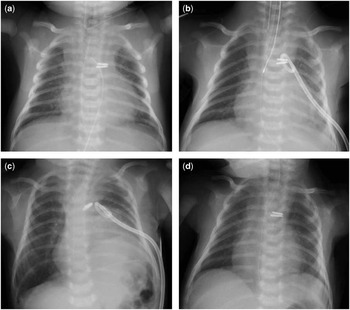
A male infant was delivered after 41 weeks of gestation, with a birth weight of 3129 g. He was diagnosed with double-outlet right ventricle with a rudimentary left ventricle, mitral stenosis, and coarctation of the aorta. Staged palliation was planned for the functionally univentricular heart. On the 3rd day of life, he underwent pulmonary artery banding and coarctectomy with end-to-end anastomosis. On the 4th day after surgery, he was successfully extubated (Fig 1a). He remained stable until late re-accumulation of pleural effusion occurred (Fig 1b). Respiratory effort worsened and a chest tube was inserted (8.3 Fr pigtail catheter; Cook Medical, Bloomington, IN, USA). Despite successful pleural drainage, the patient failed to wean from non-invasive positive pressure ventilation. An X-ray taken 4 days after tube placement showed marked elevation of the left diaphragm and a deeply inserted chest tube reaching the spinal column (Fig 1c). Through examination of the series of X-rays, we assumed that the inserted chest tube was causing damage to the phrenic nerve. Diagnosis of left diaphragmatic paralysis was confirmed by ultrasound examination, and the malpositioned chest tube was promptly removed. Diaphragm plication was withheld. Daily monitoring by ultrasound showed gradual recovery, and 2 weeks later his left diaphragm was functioning normally (Fig 1d). While waiting for the diaphragm to recover its motion, his cyanosis was managed with non-invasive positive pressure ventilation. The patient was successfully weaned off ventilatory support and showed a satisfactory percutaneous oxygen saturation in the high 70’s on discharge from the hospital.
Series of X-rays demonstrating the changes in diaphragm position. ( a ) Fourth post-operative day after successful extubation, with diaphragm in neutral position. ( b ). After successful drainage of pleural effusion. ( c ) Four days after drainage tube placement. Eventration of the left diaphragm is shown. ( d ) After removal of the malpositioned tube, position of the diaphragm is normalised.

Discussion
Diaphragmatic paralysis is potentially life-threatening, especially in infants, as compensation using accessory respiratory muscles is insufficient. Prolonged intubation and mechanical ventilation may be needed, leading to significant morbidity. Cardiac surgery is often the cause, showing an incidence of around 5%. Surgically created diaphragmatic paralysis is often permanent or, if at all transient, it requires months or even years for the diaphragm to recover its function. Patients exhibiting respiratory insufficiency undergo diaphragm plication.
Although quite rare, diaphragmatic paralysis has been reported to occur after pleural drainage.Reference Hwang, Chu and Su 2 – Reference Ayalon, Anner, Moghilner and Schiller 10 The phrenic nerve courses along the pericardium bilaterally, and therefore any chest tube reaching the mediastinal border may cause compression of the nerve. In previously reported cases, chest tubes were all too deeply placed reaching the mediastinum, possibly impinging on the phrenic nerve directly. Progressive respiratory distress, unexplained weaning failure, and diminished breathing sounds over the affected thorax, despite successful drainage, are key symptoms in diagnosis.
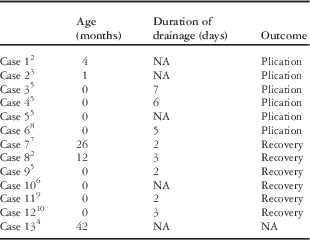
A systematic literature search was conducted using MEDLINE to identify previously reported cases of diaphragmatic paralysis due to chest tube malposition. Search terms were “diaphragmatic paralysis”, “phrenic nerve paralysis”, “phrenic nerve injury”, and “eventration of the diaphragm”, combined with either “chest tube” or “drainage”. A total of 13 pediatric cases were documented, mostly consisting of neonates and young infants (Table 1). Unlike surgically created paralysis, prognosis was not always poor. In six of the 13 cases caused by chest tube compression, the paralysis was reversible and did not require plication. In cases with favourable outcome, including ours, the malpositioned chest tube was removed within 4 days from insertion. The duration of compression to the nerve may be a crucial factor in determining the reversibility of neural damage.
Reported cases of diaphragmatic paralysis caused by a malpositioned chest tube.

NA=not available
Interestingly, the time course of recovery was quite variable. The case that took the most indolent course required 3 months to recover.Reference Arya, Williams, Ponsford and Bissenden 6 Decisions on surgical intervention must be made carefully to avoid unnecessary plication in potentially benign cases.
Conclusion
We reported the case of an infant with reversible diaphragmatic paralysis caused by a malpositioned chest tube. When unexplained respiratory failure occurs following drainage of pleural effusion, its diagnosis must always be considered. Prompt recognition and removal of the tube led to successful recovery of complete diaphragm function.
Acknowledgement
None.
Financial Support
This research received no specific grant from any funding agency, commercial, or not-for-profit sectors.
Conflicts of Interest
None.
Ethical Standards
The authors assert that all work reported complies with the Helsinki Declaration, and written informed consent for publication has been obtained from the patient’s family.