Introduction
Some of the earliest extant poetry written in Japan is included in an anthology known as the Man'yōshū 万葉集, or “Collection of Ten Thousand Leaves”. This anthology in twenty volumes contains some 4,500 poems that are thought to span about 350 years to 759 ce. Many of them were probably transmitted orally at first, using the styles and devices of pre-literate oral tradition. The poems were composed by people with a range of social backgrounds, from farmers and frontier guards to emperors. While the identity of the compilers of this anthology is not entirely clear, it is believed that Ōtomo no Yakamochi 大伴家持 (717?–785) played a prominent role. The vast majority of the poems are esteemed for their elegance, refinement and fine sentiment, but some seem to have been included for their humour.
The composing of poetry was an art form that clearly predated extant written records: it appears to have developed as one genre of orally transmitted verbal art, comprising many sub-genres, of which many are identifiable in the Man'yōshū anthology. One such art form involved the display of wit and humour. The present article will analyse the poem catalogued as Volume 16 Number 3828, with the aim of furthering: (1) our interpretation of the meaning of the poem itself; (2) our understanding of wit and humour in ancient Japanese literature; and (3) our appreciation of the verbal arts in ancient Japanese orality.
Humour, punning, satire and double entendre in Japanese orality
The art of punning has long been one of the sources of humour in Japan as is clear from the earliest extant written records. Puns have been defined in various ways, but Sherzer (Reference Sherzer2002: 29) describes them as “a form of speech play in which a word or phrase unexpectedly and simultaneously combines two unrelated meanings”. According to Redfern (Reference Redfern1984: 9, 23, 24, 82), puns are an “uncovering”, with a second meaning of the word or phrase rotating around the first; they make us stretch our minds and double our attention, being a kind of code which the listener is challenged to crack.
What precipitates appreciation of humour in any given setting, from the wry smile to the loud guffaw, is still poorly understood, but it seems that humorous appreciation is sparked ubiquitously and predominantly by sexual content, followed by themes of derision and ridicule, dominance and exploitation (Wilson Reference Wilson1979: 80 ff.; Wells Reference Wells1997: 3). Humour of the latter type is, broadly speaking, what we categorize as satire. Wells (Reference Wells and Davis2006: 195–8) discusses subtleties in the differences between satire as defined in English and as conceived in Japanese. She observes that the Japanese word for “satire”, fūshi 諷刺, is written with Chinese characters meaning “to lampoon” and “to stab”. It centres on indirect criticism of the shortcomings of individuals, institutions, society or the times, and is fundamentally disparaging without seeming to be so. It is never done for pure amusement, but is a deadly serious critique of reality.
Jokes, whether satirical, or punning or not, “involve an intense condensation of multiple presupposed meanings as well as some ambiguity of interpretation” (Sherzer Reference Sherzer2002: 40). Puns intensify that condensation and ambiguity: those that pivot on taboo subjects are funny precisely because they shock and subvert through cleverly attacking the sacredness of taboo words and expressing obscenity with apparent innocence (Redfern Reference Redfern1984: 91). Regarding obscene humour in Japan, Davis (Reference Davis2006: 9) notes that “Unfortunately, the basic research on the subject is still to be done, and, although the material for such research is vast, very little has yet been published, in either language [Japanese or English], about Japanese obscenity”.
Legman (Reference Legman1975: 20, 21) goes so far as to argue that:
Jokes originate as hostile impulses of free-floating aggression in the teller of jokes, as a response to or an expression of social and sexual anxieties they are otherwise unable to absorb or express. … It is seldom consciously realized that the laughter which greets the “punchline” of jokes is really an expression of the anxiety of all concerned over the taboos that are being broken, both in the story and in its telling, and by both the teller and his listeners. Anxieties as to cruelty, hostility, “dirt” or sexuality. If this were understood there would seldom be any laughter.
Simply put, humour and jokes may act as psychological safety valves for releasing pent-up tensions about taboo topics.
Elsewhere I have demonstrated that the artistic devices of orality in ancient Japan (even only those that we have so far identified, and there are probably many more) were astonishingly highly developed (Palmer Reference Palmer2000; 2001; Reference Palmer2008; Reference Palmer2009). Millett's explanation could equally apply to the ancient period in Japan as to the seventeenth century, of which she writes:
Much of the meaning of traditional Japanese writing resides outside the immediate flow of sounds, words and images before the reader. Such writing is non-linear. Poets from this tradition are praised for their use of intra-textual associations and extra-textual allusions that extend the apparent, or linear, meaning of their compositions. Significant meaning has been embedded within the interaction of text and context (Millett Reference Millett1997: 327).
Word play, in treating both humorous and serious matters, played a fundamental role in conveying meaning both directly and indirectly. This kind of device is little short of essential when referring to subjects that are taboo at both extremes: that is, at the extremes of sacredness – too sacred to utter overtly (Palmer Reference Palmer2000), and profanity – too profane to utter overtly (as in the present case study), or a combination of both (Palmer Reference Palmer2007; Reference Palmer2008; Reference Palmer2009). It is imperative, therefore, that we bear in mind that punning as a part of orality was (and is) not necessarily humorous but was often very serious (Wells Reference Wells1997: 56).
When it came to writing down humorous speech, the earliest scribes in Japan were faced with certain challenges. The orthography of Old Japanese is basically a hybrid style of classical Chinese. This is a complex mixture that employs some Chinese characters (kanji) as logograms to convey an intended meaning, interspersed with others employed as phonograms, to convey an approximation of the pronunciation of Japanese as it was spoken at the time. Hearing a word (such as saki for example) may open the listener's mind to all its possible meanings, and it is this openness upon which punning depends; whereas reading the same word as a logogram (such as 先・前・埼・崎 ・割・裂・咲) tends to close the reader's mind to all meanings except that which is visually displayed. The result of this is that readers are prone to miss puns and simply not “get” the joke. Ancient Japanese written literature is clearly residual oral literature, so that much of the meaning may be overlooked unless one reads the logograms with homonymic alternatives in mind. It cannot be sufficiently stressed that when reading any text of ancient Japanese writing, the reader should constantly be alert to the possibility that a word is being used for its homophonic connotations rather than just for the surface semantic associations of the Chinese character with which the sound is expressed. Further, it is also instructive to listen for puns on synonyms. Since this is residual oral literature, it is at least as important to hear the words as to read them: double entendres may reveal a whole subset of relevant but previously unrecognized meanings (Palmer Reference Palmer2000; Reference Palmer2007; Reference Palmer2008; Reference Palmer2009).
Critics might perhaps argue that this approach means that one can read into the text virtually anything one wishes; but to the contrary, this method of analysis is closely constrained by the limitations of attested contemporaneous homonyms. Another reservation might be that it is highly selective, choosing to focus only on the meanings of homonyms that seem to fit the bill. That, however, is the point: in practice that is precisely how puns “work”. In English we become familiar in childhood with punning jokes like “Why did the tomato turn red?” – “Because it saw the salad dressing”. Even small children immediately “get” the puns on “turning red” as ripen and blush, and on “salad dressing” as vinaigrette and putting on clothes. It is even a little risqué, which adds to the amusement. But another connotation is just as possible, such as dressing meaning a bandage; but that is not a thought association that fits the context and is not relevant, so it does not readily come to mind. Puns, therefore, are virtually self-selective in context.
Further, as Sherzer (Reference Sherzer2002: 14) stresses, humour may also arise from the “play”, in the sense of looseness or leakiness, in the grammar: “Like irregularity, ambiguity is an example of grammar leaking and is a source of play, humor and verbal artistry”. It is the thought associations that matter here, not precision in grammar.
Humour in Japanese poetry
There is little space here to explore humour in Japan in general (for this, see Mayer Reference Mayer1982; Wells Reference Wells1997; Davis Reference Davis and Jessica Milner2006; Nagashima 2006), but Japanese commentators conclude that humour has been associated with earthiness for most of Japan's written history (Wells Reference Wells1997: 32), and the humorous Man'yōshū poems, known as dōkeka 道化歌, are some of the oldest recorded examples, setting the tone for later developments. Early comic waka 和歌 31-syllable poems were known as gishōka 戲笑歌 (Tanaka Reference Tanaka and Davis2006: 112), but arguably the heyday of the humorous Japanese poem came with the development of the senryū 川柳 poem in 5-7-5 syllabic form in the late seventeenth century; since then it has never entirely lost its appeal as a satirical, ironic or sardonic form of haiku 俳句 (Kobayashi Reference Kobayashi and Jessica Milner2006: 171). Parody that included ribald references became increasingly overt and popular until well into the Edo period (Hibbett Reference Hibbett1960–61: 84). Blyth (Reference Blyth1971: 32) observed perceptively:
The difference between the humour of haiku and of senryū is obvious, but far from easy to state in words. Both lie to a great extent in contradiction and paradox, but senryū is the easily seen opposition of intention and result, ideal and real, body and spirit, dignity and impudence.
Blyth (Reference Blyth1971: 37–8) further points out that “Nothing brings out the difference between senryū and haiku more clearly than their relation to the subject of sex. To haiku, sex hardly exists; to senryū it is all-pervading”. We might add that such sexual humour is typically through innuendo rather than explicit verbal obscenity (see, for example, Palmer Reference Palmer2007; Reference Palmer2008). I will return to Blyth's insights later, for, as we shall see, they are apposite to the present discussion.
The poet: Naga no Imiki Okimaro
The poem that forms the object of the present study is by court poet Naga no Imiki Okimaro  (fl. 690–707 ce), Okimaro also scripted as
 and
 . The kabane 姓 name Imiki suggests that he belonged to an aristocratic family of Korean immigrant provenance based in Kii 紀伊 Province, who were granted the fourth grade of kabane under the eight-grade revisions of courtiers' ranks carried out in 684 ce (Ōbunsha 2000: entry for imiki 忌寸).
Fourteen of Okimaro's poems are included in Man'yōshū, and all of them are at least loosely in tanka 短歌 (5-7-5-7-7) form. Eight of these are of the type known as eibutsuka 詠物歌, butsumeika 物名歌 or mono no na no uta 物名歌, “names of things verse”, whereby themes were designated and the poet was challenged to extemporize a poem on the designated words for the occasion, in order to entertain the assembled company (http://asuka.huuryuu.com/kiroku/teireikai-10/teireikai10-repo2.html). Often the theme words were prosaic, commonplace, workaday objects, not normally eulogized in poetry: no doubt this intrinsically added to the amusement.Footnote 1 Such poems in the Man'yōshū are accompanied by an explanatory heading, daishi 題詞, informing the reader of what the theme words of the challenge were. By the late Heian period, in many cases the “cleverness” lay in the inclusion of a pun on one of the specified words, called a kakushi-dai 隠し題. “The topics vary widely, but within each poem one or more words are hidden, the syllables often forming parts of two or more other words and frequently running over from one line to the next” (Rodd Reference Rodd and Mary Catherine Henkenius1984: 22–3). The skill lay partly in the conveyance of meaning in covert and cryptic ways. Historically, then, the production of puns has played no small part in Japanese literature.
While Okimaro is not regarded as one of the greatest of the Man'yō poets, he nevertheless gained a reputation as a considerable wit. For example, poem 16–3826 is as follows:
 はかくこそあるもの
 が家なるものは
 の
 にあらし (Kojima et al., vol. 4, 1975: 129; Aoki et al., vol. 4, 1982: 244).
Honda's (Reference Honda1967: 282) translation is as follows:
Cranston's (1993: 280) rendition is:
This comic verse plays on the fact that taro leaves bear more than a passing resemblance to lotus leaves, though the latter are much bigger. The lotus is symbolic of Buddhist enlightenment and other-worldliness, since it grows in the mud but produces extraordinarily large beautiful flowers – a trope for the potential for Enlightenment by all sentient beings that dwell in this sordid world. Lotus also had connotations of love (Jōdaigo Jiten Henshū Iinkai 1967: 583). By contrast, taro is merely a down-to-earth and unattractive root vegetable. (In later times, imo connoted a country bumpkin. This poem suggests that perhaps it already had those connotations by the seventh century.) The word for taro, umo or imo 芋, plays on the word imo 妹, referring to one's wife. Implied then is self-deprecating humour complimenting the addressee to the effect: “How refined and elegant is your wife, like lotus – she makes mine seem as unattractive and ignorant as taro!” Indeed the import of the joke and the meaning of the poem are only appreciated if the audience is attuned to the pun on imo (http://www.asahi-net.or.jp/~sg2h-ymst/yamatouta/sennin/okimaro.html). This poem hints, moreover, at sexual innuendo, since Okimaro seems to be confessing that he is attracted to the other man's wife. Simultaneously his jibe at his own wife implies that he may have ambivalent feelings towards women.
Poem 16–3828
The tanka poem in question by Okimaro is as follows:

The scholarly Manyōshū Kōhon Database 万葉集校本データベース displays facsimiles of eight manuscripts regarding this poem for comparative purposes. It also cites thirteen published scholarly renditions into modern Japanese, the general purport of which is “Oh, you painful slave girl / who eats the shitty silver carp / from the riverside latrines – / do not approach the fragrantly smeared pagoda!”
Honda's (1967: 283) translation is:
Cranston (Reference Cranston1993: 281), by contrast, translates this poem as:
It is evident from the heading that Okimaro was challenged to compose a poem that included all of the designated words in the designated order. Poetry games and contests appear to have been enjoyed by Japanese people in various forms more or less continuously from before the introduction of writing until the present (Philomène, Reference Philomène1983: 2–5).Footnote 3 Hashimoto (Reference Hashimoto and Aoki1982: 289–91) argues that some of the linked verses in the Manyōshū collection were playful exchanges at parties: they should not all be taken at face value, as many were intended as role-plays, teasing and flirtatious banter, and as mock-flirtatious entertainment. Whether Okimaro's challenge was part of a poetry contest or whether it was some kind of extempore “forfeit”Footnote 4 for being beaten at some other game is not recorded.
On the face of this, then, Okimaro is challenged to compose a poem on words with the following meanings (which I interpret a little differently from the translations provided above): incense, pagoda, lavatory, excrement, silver carp, female slave. What a challenge for Okimaro! If composition of verse on commonplace and vulgar objects was the very point of such challenges, surely this one could hardly have been more challenging.
This poem has hitherto been dismissed as nonsense verse, a kokoro no tsuku tokoro naki uta  , a piece of meaningless doggerel (Nakayama Reference Nakayama1983: 274; Kudō Reference Kudō Rikio1992: 16). Keene (Reference Keene1993: 123) refers to it as being “more notable for its ingenuity than its sense”.
What seems to make it funny? It is perhaps amusing partly for its juxtaposition of unlikely verbal collocations,Footnote 5 and partly because of the overt expression of scatological content that was no doubt normally taboo. Even so, given that Okimaro was acclaimed as a wit and poet in his own day, why would such nonsense verse merit inclusion in an anthology like Man'yōshū? Is this the best a great poet could come up with? Or are we perhaps missing something here?
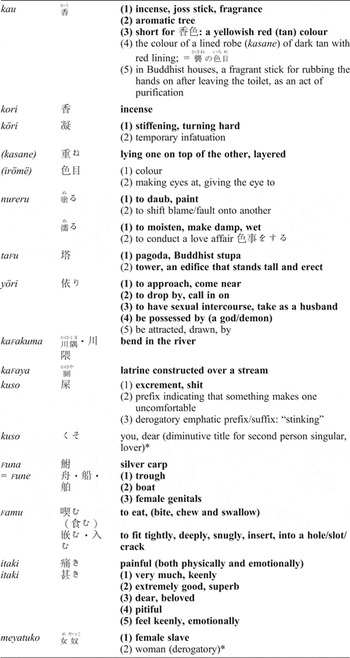
Unlike previous commentators, I think this is far from meaningless nonsense verse. Analysis of the puns, both overt and covert, contained in this verse, requires some explication (see Table 1), but as I shall demonstrate, they overlap and reinforce each other as kakushi-kotoba 隠し詞 “hidden meanings”, in a complex manner subtly to evoke a coherent and subversive scene.
Attested Old Japanese meanings and homonyms of vocabulary items

Source: The table is a concordance of definitions in Jōdaigo Jiten Henshū Iinkai 1967; Nakada Norio et al. Reference Norio1983; Nakamura et al. 1982–99; Miyakoshi et al. Reference Masaru, Masami and Mitsuru1999.
Puns in this poem
It is my contention that this poem hangs on a series of puns that ultimately must be “read” holistically; however, I believe the two most important puns are on the characters 香 “incense” or “perfume”, and 鮒 “silver carp”. As I shall explain, these are keys to unlocking understanding of the rest of the poem.
In modern Japanese 香 is pronounced kō, but in Old Japanese it was both kau and kori, and it is not entirely clear which reading Okimaro intended here. The manuscripts that are accompanied by glosses all have kau. Sasaki (Reference Sasaki1956: 184), Nakada et al. (1983: 657), and Nakamura et al. (vol. 1, 1982: 668) all specify kori, though none explains the reason for the choice. The Manyōshū Kōhon Database lists the glosses supplied by the major commentaries. Eleven of them gloss the character as kau, while nine opt to read it as kori.Footnote 6 Ōta (Reference Ōta2005: 131–2) debates this point in detail, and comes down in favour of kori, largely on the grounds that only two of the forty-two nouns in the eight eibutusuka-type poems by Okimaro in Man'yōshū are glossed with Chinese-style on readings rather than Japanese-style kun readings. I also postulate that it is better glossed as kori here, mainly because I believe this is a play on the word köri 凝り meaning “stiffening”.Footnote 7 As I have demonstrated elsewhere, punning in Old Japanese ignored kō and otsu vowel distinctions (here: o and ö). So this appears to be a double entendre with sexual undertones.
What matters in punning more than exact phonemic reproduction is sufficient similarity to facilitate the listener to make relevant thought associations based on that word. Regardless of whether it was pronounced kau or kori, the meaning of “incense” or “perfume” would inevitably have raised certain thought associations in the minds of the audience. The devices of orality, including punning, tend to become lost, devalued or “degraded” when superseded by those of written literature. Thought associations that are no longer obvious to modern readers were part of the everyday artistic cultural heritage of societies prior to mass diffusion of writing, to which contemporaneous audiences would have been highly attuned (Basso Reference Basso1996). Such thought associations were the mental furniture of poet and audience alike; the formulaic utterances and their slight variations that evoked those thoughts were often employed in sets or themes to produce what Wang (Reference Wang1974: 100) describes as “concatenations of imagery”. Wang (Reference Wang1974: 98–125), for example, explains this elegantly in respect of China's oldest anthology, the Shī Jīng (詩経 J: Shi Kyō):
The use of themes in oral narrative poetry is … to benefit the audience (or in our times, the reader) who may receive the manifold bearings of a given passage through reminiscence and mental juxtaposition of all the collective thematic implications that they know, without the singer having to express all his exact intents (Wang Reference Wang1974: 99).
This was so in the vestigial oral culture of the newly emergent Japanese state in the latter part of the seventh century. The mere mention of incense by Okimaro would have been sufficient to bring to the minds of his listeners a cultural complex associated with that item, regardless of how it was uttered. While we cannot necessarily be certain now what all of those mental associations were – and perhaps we have lost many – it is likely that they included the word kauirö, and possibly the further connotation of kasane nö irömë, meaning the colours of a certain kind of lined kimono (see Table 1). This in turn calls to mind another meaning of irömë, “making eyes at” someone. Thus it may be surmised that by means of mental leap-frogging through related meanings, the mere mention of incense to the Japanese audience connoted the theme of an attempt at amorous seduction.
Added to this, later in the poem there is the clear reference to the latrine, and it hardly forces the imagination that in this particular poem the reference to incense would also have brought to the contemporaneous audience's mind the fragrant stick rubbed on the hands as an act of purification after leaving the lavatory. In a sense, therefore, the reference to incense cleverly prefigures the later reference to the latrine.
So what of the reference to 厠 kafaya, or latrine? The word literally means “river hut”, because early lavatories were simple constructions for communal use built over a cesspool in a stream for natural flushing. Okimaro uses the concept designated in his challenge, but he modifies it to the word kafakuma 川隈, which means, literally, a bend or meander in the river – almost certainly because latrines were most frequently constructed at such sites. Cranston (Reference Cranston1993: 281) comments: “The derogatory term used for the carp combines with the river bend to get across the essentials of the required word “privy” (kawaya). We can also surmise that the latrines were the one place where men might chance to glimpse a woman exposing herself, as a matter of necessity or through clumsiness, or by accident or even by design.
Ōta (Reference Ōta2005: 133) emphasizes that the stench of the open sewer would have been appalling. Thus, in this poem, the audience is first asked to recall the fragrance of the most expensive of perfumes, and then to imagine the worst of odours, evoking extremes of olfactory stimulation. His analysis focuses exclusively on this aspect, such that he suggests a new modern translation along the following lines: “Do not approach the fragrant pagoda which has been oiled with incense – you, reeking slave woman, who eats the smelly carp that grow in the shit of the stinking river latrine!” (2005: 136; my English translation).
At the same time as the connotations of incense in ancient Japan would have led the listener to the toilet, so to speak, they also led to sexual innuendo through the pun on kori and köri. Again, that innuendo is continued. Incense is associated with Buddhist worship, as are tō (OJ: tafu) 塔 pagodas, so on one level incense forms a semantic link with pagoda; the precious perfume intensifies the sense of sanctity of this sacred place (Ōta Reference Ōta2005: 133). However, tafu may also be defined as “an edifice/erection that stands tall” (Sasaki Reference Sasaki1956: 246), so arguably this is a covert phallic reference.
Then interposed between the puns on “incense/stiff” and “pagoda/phallus” there is the word nureru 塗る, meaning “painted/smeared/daubed”. Fragrances were produced in various ways, one of which was in an unguent or ointment preparation that was smeared or rubbed into the item to be perfumed. The “surface” meaning of 香塗れる塔 is therefore “pagoda which has been daubed with fragrant incense ointment”. Possibly the thought associated with the concept of “rubbing” on perfumed ointment was of itself suggestive, and sufficient to raise a titter. On the other hand, nureru may also be interpreted as 濡れる, meaning “to be damp/moist/wet”, which gives us the double entendre of “stiff, moist erection”.
The woman (or women) causing this arousal is the (OJ) meyatuko at the end of the poem. Kojima et al. (1973, vol. 3: 220–21) note that there are other Man'yōshū poems (11–2574, 12–2907) that refer to yatsuko “slave” as a metaphor for Love personified.Footnote 8 It is of course possible to construe meyatsuko here, too, as a metaphor for Love. Given that it appears with this usage in more than one other Man'yōshū poem, the mention of “slave” may have connoted “love” in the minds of the audience.
Be that as it may, in Okimaro's poem the literal meaning seems to be retained. Slavery was not officially abolished until the beginning of the tenth century, and meyatsuko were female slaves. They were untouchable to those of higher social status, and would have been considered to defile anything sacred that they touched. Hence the poem's prohibition of the slave-girl's approaching a sacred structure like a pagoda. Cranston (Reference Cranston1993: 281) comments: “In the midst of their ambitious strivings for high civilization, the people of the time would pause to give a wink to the natural man. This is not to overlook the fact that no. 495 [this poem] is highly abusive to a member of the lower classes”. Indeed, she is more than this: an outcaste.
To a man of court rank like Okimaro, then, a slave was ostensibly untouchable in affairs of the heart. He is of the highest social rank, she of the lowest. Metaphorically expressed in this poem, his arousal at the sight of her at the latrine stirs his desire; but, despite being attracted to her, he is forbidding her to seduce him further.
It is not entirely clear what the word itaki, which might be taken to mean “very”, qualifies: one possibility is that it emphasizes the lowly status of the slave, and another that it stresses her impurity (Ōta Reference Ōta2005: 135). On the other hand, it also means “painful” and “dear”, which could describe the poet's feelings towards this slave girl. Given that “leakiness of grammar” is admissible when punning, all three meanings may have been intended. The result is that we sense his attraction, confusion and ambivalence towards her.
Meyatsuko in the poem is modified by fameru 喫る, which means “eat/drink/swallow”. In other words, the audience is told that the slave girl eats funa 鮒, the silver carp that scavenge in the accumulated filthy mud of the river bed under the latrine. This description could hardly evoke more strongly the sense and degree of defilement associated with this slave girl. Arguably, on account of eating stinking fish, she herself was so smelly that she was unapproachable: itaki may even emphasize her body odour (Ōta Reference Ōta2005: 135).
But yet again, there is a double entendre with fameru, which may also be interpreted as fameru 嵌める, meaning the action when something fits snugly or tightly round something else that is inserted inside it. Thus we hear not only “painful slave-girl who eats the silver carp” but “dear slave-girl within whose vagina one is enveloped snugly”.
Written with the Chinese character 鮒, funa unequivocally refers to a species of freshwater fish of the genus Carassius endemic to Japan's internal waterways and lakes, known as silver or crucian carp. Unlike koi carp, it has no barbels (beard-like feelers). In ancient times, this fish was preserved as funazushi through a malodorous fermentation process, and the connotations of this would not have been lost upon Okimaro's audience (Ōta Reference Ōta2005: 134).
In a homonym, however, funa is a variant of fune, which has various meanings related to the hollowing out of a log, such as “dugout canoe/boat” and “trough” (such as for brewing saké) in Old Japanese (Nakamura et al. vol. 5, 1999: 227, 232–3). Fune was also by connotation a euphemism for vagina in Old Japanese, since metaphorically, female genitalia are both boat-shaped and ridden, while the penis was considered to be the “mast” (Nakamura et al. vol. 5, 1999: 227, 232–3). Thus, by homonymic word association, carp/funa ≡ funa/fune ≡ vagina. This interpretation, linking carp metaphorically to female lust and seduction, is corroborated by a somewhat parenthetical tale in Nihon Shoki (720 ce). The entry for the fourth day of the ninth month of the sixth year of the reign of Emperor Ninken provides no fewer than three versions of a story which, summarized, goes as follows. A woman called Funame (“Carp Woman”) marries a man by whom she has a daughter, who in due course marries a man called Yamaki. They in turn produce a daughter called Akitame (= Funame's granddaughter). Funame's husband and daughter both die, and Funame beds her son-in-law, Yamaki, by whom she has a son called Araki. Eventually her granddaughter Akitame marries her son, Araki. This makes Araki both the maternal uncle and paternal half-brother of Akitame. As a result of this complicated family incest initiated by Funame, Akitame is described as being in great distress (Aston Reference Aston1896, vol. 1, 396–7). Funame (“carp woman”) in this tale is excessively lustful and seductive, in a manner that disrupts the social functions of marriage – in this case resulting in incest. From these examples we can deduce that the silver carp seems to be a metaphor in ancient Japanese texts – perhaps, we might add, through its form and large frequently-opened mouth – for the vagina of a seductive woman of loose morals (Palmer Reference Palmer2010: 109–11).
The identification of fish with the vagina occurs frequently within folk tales classified under the motif of vagina dentata, or the toothed vagina. The motif involves a sexually voracious woman, whose vagina has teeth or in whose vagina she has inserted a sharp-toothed fish such as a pike, eel or herring, with the result that she may castrate her male partners. These tales are geographically centred on the Pacific Rim and are thought to have been transmitted from great antiquity (Ho Reference Ho1964: 43–5; Thompson 1993, F547.1.1; Legman Reference Legman1975: 431–5). Lévi-Strauss (Reference Lévi-Strauss, John and Weightman1978: 167, 186), for example, cites a South American myth in which the fish is a piranha, the vagina is “gaping”, and the story is aetiological for the origins of sexual intercourse among humans. It could be postulated therefore that the association of vagina with carp in the most ancient of Japanese texts is a vestige of the vagina dentata motif.
There is yet another observation to be made about funa “silver carp”. I have demonstrated elsewhere that synonymic substitution played a large part in generating puns in the orality of ancient Japan; further, I demonstrated that the set of puns in a given tale, both overt and covert, all ingeniously revolve around a particular theme or themes (Palmer Reference Palmer2000, Reference Palmer2007, Reference Palmer2008, Reference Palmer2009). The nearest synonym for funa 鮒 “silver carp” is undoubtedly a different species of carp, koi 鯉. An entry for Kashima Kōri in Hitachi Fudoki lists funa and koi together in the context of delicious foods (Akimoto 1958: 70–71; Uegaki 1997: 394–5; Aoki Reference Aoki1997: 61). With barbels (i.e. a “beard” as conceptualized in China and Japan), the koi species of carp is well known in East Asia as representing masculinity. In China it was called the king of freshwater fish, which could climb the famous waterfalls called the Dragon Gate on the Yellow River (Eberhard 1986: 57). Koi and funa thus form a symbolic male–female dyad.
The word for carp koi (Old Japanese: kofi) is a play on koi (OJ: kofï) 恋 meaning “love” or “yearning” for someone or something. Here again, with i and ï, the pun disregards the kō-otsu distinctions of Old Japanese vowels. And here, again, the connotations of the pun are entirely apposite to the poem, and moreover, contribute to the understanding of it. That koi was employed as a double entendre regarding an amorous encounter between a man and a woman in ancient Japan is confirmed by another episode that appears in Nihon Shoki, in the entry for Keikō 4, spring, eleventh day, second month (Aston Reference Aston1896, vol. 1: 190).
Nakanishi (Reference Nakanishi1976: 272–4) draws a distinction between koi “love” and ai “love” as portrayed in the Man'yōshū, claiming that the former alludes to the yearning that precedes sexual encounters, while the latter is the emotion that develops as a result. He also observes that sexual references are explicit in the Man'yōshū only in the poems of Volume 14 categorized as Azuma uta 東歌, “Poems of the Eastern Lands” that have a more “folksy” tone, while the more “refined” poems of the Court and capital conceal them. It is to be expected, then, that Okimaro, as a court poet, would employ innuendo in this way.Footnote 9
Okimaro's challenge was to include the word kuso 屎, excrement. Ōta discusses and largely dismisses Higashi's (1943) theory that kusofuna or kusobuna was some kind of freshwater fish that was less palatable (2005: 134). As we have already seen, the majority of commentators take it that the poet has used this expression simply to describe the silver carp that scavenge in the cesspool under the latrine. But in ancient Japan as now, kuso could also be used as an emphatic prefix with connotations of either familiarity or contempt, or both at once.Footnote 10 Ōta interprets it in this way to qualify “silver carp”, and that its use here emphasizes that these fish stank (2005: 135). However, if we apply it to funa with its other meaning of “vagina”, it evokes a double entendre in this context with sexual innuendo.
This now leaves us to deal only with the word yöri, which in one sense means “to approach, draw near”, but in ancient Japan also had the meaning of “to have conjugal relations”, between a man and woman.
Before leaving this analysis of puns in this poem, I should like to draw attention to one more possibility. If mention of incense could call to mind reference to kasane nö irömë  , a kind of lined kimono, the word kasane is a double entendre for 重ね, meaning “lying on top of each other”. Since irömë means a “come hither look”, kasane nö irömë forms another complete double entendre with sexual innuendo relevant to the overall cryptic message of this poem.
Conclusions
It seems unlikely that such a concentration of interrelated plays on words associated with this poem occurred by mere coincidence. Even if only half of them were intended (and I think an accomplished wit like Okimaro would probably have intended them all), they still lead to taboo subject matter. Packed into this brief tanka are references to several taboo subjects: sex, defecation, genitalia, social stigma and forbidden social relationships. As analysed above through plays on words, this so-called meaningless nonsense poem takes on an almost weblike intricacy of detailed meaning with scatological and sexual innuendo. It is only when other meanings of the words of the poem are considered as relevant and are “heard” holistically that the poem's overall meaning can be decoded. Indeed, the genius in this poem is that every single word seems to have been carefully selected by the poet for at least one double entendre to contribute to the total mental picture he evokes:
Ah, you painfully sweet slave girl, lowly as the silver carp that scavenge in the shit below the river latrine. How seductive you are with your tight cunt! Don't tempt my manhood so, that rises, hard and moist at the sight of you, for by contrast it is sacred as a fragrant pagoda!
The poem is above all a complex and subversive riddle that the listener must decode to appreciate. The humour in this poem lies in a number of factors. The main subject matter – sex and other scatological content – is itself the object of humour. The poet's wit at evoking a much larger scenario on the basis of punning on a small number of prescribed and seemingly incongruent words is a tour de force in economy of expression that seems little short of breathtaking.
The observations by Blyth noted above apply to this poem in their entirety. One might even argue that Okimaro's “subversive” verse prefigures the later development of senryū in content and style. “A whiff of the scatological serves as a reminder of the esthetic breadth for which Man'yōshū is famous, and of how far back the roots of the haikai spirit probe. A sexually explicit graffito found in a Nara temple makes the same point” (Cranston Reference Cranston1993: 281).
The poem is a “concatenation of imagery” based on a stock of words that would have been predicted by the poet to elicit stock thought associations and a conditioned response from the audience. Those associations and allusions are not linear, but criss-cross back and forth in a complex manner to form a network: an overall context that is much greater than the sum of its individual parts. On the surface, the poem is humorous, and its humour ribald. At a deeper level, however, this is not light humour. It is a depiction of extremes: olfactory and social. The affluence of the aristocratic male affords him access to the most expensive of perfumes, while the slave girl's poverty allows her access to only the most defiled source of fish. This is a serious commentary on gender and social relations, on human weakness and the human condition. In this poem we see both sexual and social tension, the extreme gulf between the aristocratic man and the outcaste woman; the inner conflict of lofty ideals pitted against physical lust; his resolve not to be seduced, but the recognition that in his weakness he will inevitably succumb despite his best intentions; his sense of his own “dignity” in his aristocratic social position and of her “impudence” as a lowly outcaste girl. Okimaro thereby establishes a delicately balanced counterpoint by means of social and sexual tension between extreme polarities, a tension that is relieved only with the audience's “safety valve” – laughter. This is not nonsense verse but deeply satirical “sub verse” (pun intended).
In the wider sense, analysis of this poem instructs us of the need to reinterpret ancient Japanese texts through paying greater attention to the word play they contain: overt puns, covert puns, and puns on synonyms – and the themes that they connote. Through this we can understand more deeply both the humour and the “world of meaning” of ancient Japan.
 忘れだにもえすやと
 りて打てども
 りず恋といふ
 (Kojima et al. 1973, vol. 3: 220)