


There are several different things that a book titled The phonology of contrast could be about. Although contrast is widely held to play an important role in phonology, there is considerably less agreement as to exactly what kind of contrast is important, or what exactly that role is (see Hall Reference Hall2011 for an overview and discussion). Some theories of contrast (e.g. Dresher Reference Dresher2009) posit a special status for features that serve to distinguish phonemes; others (e.g. Flemming Reference Flemming, Hayes, Kirchner and Steriade2004) posit constraints that mandate perceptual distinctness in the phonetic realisation of contrasting segments.
This book, revised and expanded from Łubowicz's dissertation (Reference Łubowicz2003), focuses primarily on contrast at the level of the word, and explores cases of contrast transformation, in which words that contrast underlyingly in one property are mapped onto surface forms that differ in some other property, while the original contrast is neutralised. Łubowicz argues for what she calls PC (‘preserve contrast’) theory, a version of Optimality Theory in which there are constraints specifically mandating the preservation of input contrasts (as distinct from traditional faithfulness constraints, which mandate the preservation of various properties of individual input forms). The theory is illustrated by application to three kinds of phenomena, each of which involves some form of opacity, a perennial problem for classic Optimality Theory. Chapter 2, which introduces most of the formal apparatus of the theory, looks at chain shifts, primarily in Finnish vowels, Chapter 3 deals with the interaction between epenthesis and stress in Arabic dialects and Chapter 4 presents an analysis of allomorph selection in Polish. These three case studies are bracketed by a brief introductory chapter, which outlines the premise and motivation of the theory, and a very brief conclusion.
1 The theory and its applications
The central idea of PC theory has a clear and intuitive motivation. Opaque input–output mappings often improve the recoverability of underlying contrasts. Classic Optimality Theory has difficulty accounting for certain types of opaque mappings that arise naturally in derivational models of phonology, but it is very well suited to expressing functional desiderata. If it is possible to formulate constraints that mandate the preservation of contrast, then perhaps opacity can be accommodated within a purely parallel version of OT.
To take a concrete example from Chapter 3, consider the pair of words from Syrian Arabic in (1) (data from Cowell 1964: 28, 32).
-
(1)


The underlying contrast between medial /CVCC/ and /CCC/ is neutralised by epenthesis. (Here and below, underlining indicates epenthetic segments.) However, it is recoverable from the surface difference in stress: the schwa in the penultimate syllable of (1a), which has an input correspondent, bears stress, while the epenthetic schwa in (1b) does not.
If constraints are to be able to evaluate the preservation of contrasts between forms, then the constraint grammar cannot simply consider individual input– output pairs. Instead, the candidates for evaluation are sets of input–output mappings, which Łubowicz calls scenarios. In keeping with the OT principle of Richness of the Base, the inputs in these scenarios include not only actual underlying forms of the language, but all other potential input strings as well (subject to an arbitrary length restriction to ensure that scenarios are finite, on which more below).Footnote 1 This means that in a case such as Syrian Arabic, the grammar is concerned not only with preserving the actual distinction between the words in (1), which additionally differ in consonantal melody, but also with preserving the potential distinction between /ʔəbn-kon/ and a hypothetical minimally different counterpart /ʔəbən-kon/. PC theory is thus concerned with categorical phonological systems of underlying and surface contrasts, rather than with gradient factors (such as frequency) that might influence the confusability of forms in performance, or with the vagaries of particular lexical neighbourhoods (cf. the phonetic approach to contrast taken by Wright Reference Wright, Local, Ogden and Temple2003, among others).
The theory includes three types of contrast-preservation constraints. PCIN constraints penalise a scenario for each pair of distinct inputs mapped onto the same output, PCOUT constraints penalise a scenario for each output that corresponds to multiple inputs and PCREL constraints penalise output contrasts that do not correspond to analogous contrasts in the input. Individual instances of each of these three general types of constraints are relativised to particular properties of the forms in question, where a property may be a distinctive feature, the presence or absence of a segment at a particular position, or any other atomic aspect of phonological form.
In the Syrian Arabic example, the crucial ranking is of PCIN(V/Ø) over the markedness constraint Weight-By-Position (WBP). It is more important to map inputs that differ in the presence or absence of a vowel onto distinct outputs than it is for coda consonants to be moraic; accordingly, the winning scenario is one in which the coda of the epenthetic syllable is weightless, yielding antepenultimate stress in the form with the epenthetic vowel. (A candidate with no epenthesis, as in (2c), would also preserve the relevant contrast, but is ruled out by high-ranking *Complex.)
-
(2)
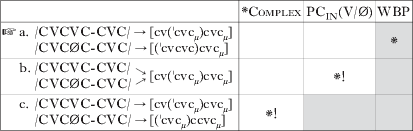
In addition to their special role in accounting for opaque mappings, PC constraints perform some, but not all, of the functions of traditional faithfulness constraints. Chapter 2 proposes that PC constraints and markedness constraints are interleaved, while generalised faithfulness constraints, which are similar to traditional input–output faithfulness, are relegated to the bottom of the constraint hierarchy, where they crucially serve to prevent gratuitous reversals of form.
The tableau in (3) illustrates this schematically. Consider a pair of contrasting properties, X and Y, of which Y is the more marked. Depending on the relative ranking of PC and markedness constraints, input /X/ and /Y/ may either merge to [X], as in (3a), or be realised faithfully, as in (3b). Candidate (3c), in which /X/ surfaces as [Y] and /Y/ as [X], cannot be distinguished from (3b) by either contrast preservation or markedness, but generalised faithfulness ensures that it is harmonically bounded by the faithful candidate.
-
(3)
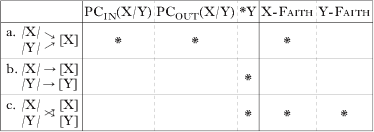
X-Faith requires that any output with property X must be fully faithful to its corresponding input(s), and Y-Faith imposes the same requirement on outputs with property Y. In addition to ruling out candidates like (3c), generalised faithfulness constraints also serve to determine the direction of neutralisation in other situations in which scenarios are tied on PC and markedness.
Chapter 2, in addition to setting out the key mechanisms of PC theory, explores the predictions they make for the typology of chain shifts. The primary example discussed in this chapter is the Finnish pattern schematised in (4): before /i/, long vowels shorten, and underlying short /a/ becomes [o]; underlying /o/ is realised faithfully.
-
(4)

Chain shifts of this sort are problematic for classic OT. If [ai] is the optimal output for the input /aa+i/, then we would expect it to be optimal for /a+i/ as well, because as a candidate output for /a+i/, it would incur exactly the same markedness violations and fewer faithfulness violations. Łubowicz shows that contrast preservation can motivate the shift: realising /a+i/ as [oi] causes the underlying contrast between /aa+i/ and /a+i/ to be transformed rather than neutralised. This preservation of the /aa/–/a/ distinction comes at the expense of the /a/–/o/ distinction. Indeed, every time any input contrast is transformed in the output, some other (actual or potential) contrast must be neutralised in order to accommodate it: every chain must end somewhere. The essence of PC theory, then, is not that the grammar seeks to maximise the overall preservation of contrast (a goal that would best be served by perfect faithfulness to the input), but rather that the preservation of one contrast can serve to motivate the neutralisation of another, depending on the relative ranking of the constraints in question.
One interesting consequence of this approach, discussed in §2.6.2, is that it predicts that all chain shifts must be push chains rather than pull chains. The initial unfaithful mapping, which in (4) is the mapping from /aa+i/ to [ai], is driven by markedness, and it, in combination with PC constraints, drives the unfaithful mapping of /a+i/ to [oi]. The chain cannot propagate in the opposite direction; the mapping of /aa+i/ to [ai] cannot cause some other input to be mapped onto [aai], as in a pull chain. Nor can a chain be entirely circular; for example, mapping /a+i/ to [aai], which would invert the /aa/–/a/ contrast instead of neutralising it, would be harmonically bounded by a fully faithful scenario, as in (3), and longer circular shifts are ruled out by an extension of the same logic.Footnote 2
Chapter 2, supplemented by an additional tableau in Appendix A.1, shows the typological range of chain shifts and other related scenarios predicted by the theory, and cites some examples to show that patterns of the predicted types are indeed attested. The focus is primarily on synchronic input–output mappings, although pages 42–43 mention a historical change in the Polish nasal vowels as an example of one of the predicted patterns.Footnote 3 The claim that the grammar cannot generate pull shifts is thus not a direct challenge to previous work positing diachronic pull chains (e.g. Martinet Reference Martinet1952, Labov Reference Labov1994); as Łubowicz (Reference Flemming, Hayes, Kirchner and Steriade2011: 1728) points out, such a chain can occur as a sequence of changes at different stages in a language. Łubowicz's approach does, however, directly rebut King (Reference King1969: 8), who proposes that only pull chains are possible and dismisses the idea ‘that the speaker, or some mechanism internalized in the linguistic system of the speaker, possesses the capability of acting in specific ways to prevent potential merger’. King's scepticism about merger avoidance rests in part on the observation that mergers do in fact occur; Łubowicz, by formulating contrast preservation as violable, and indeed as something that is violated in every push shift, renders this objection irrelevant.
Chapter 3, which deals with Arabic stress–epenthesis interactions like the one illustrated in (1), will be discussed in detail below. (Other cases of contrast preservation in Arabic epenthesis are discussed by Ouwayda Reference Ouwayda2010.) Chapter 4 presents a case study of allomorph selection in Polish. The Polish masculine and neuter locative singular suffix has two allomorphs, [-e] and [-u]. Noun stems ending in underlying alveolar consonants select the [-e] allomorph, and undergo concomitant palatalisation, surfacing with prepalatal consonants. Noun stems ending in underlying prepalatals, on the other hand, select [-u]. A purely surface-oriented approach would have trouble explaining why some nouns with surface prepalatals have [-u] and others [-e]. Given the mechanisms of PC theory that have already been introduced, however, a relatively straightforward account is possible: the realisation of underlyingly alveolar stems is driven by markedness, and the selection of [-u] with underlyingly prepalatal stems is driven by contrast preservation. Because the suffix itself is represented in the lexicon as a set of alternatives {+e, +u}, the underlying consonant-place contrast in the stems can be transformed into a surface contrast in suffix-vowel quality without encroaching on the phonemic distinction between /e/ and /u/; each allomorph counts as a fully faithful realisation of the suffix.
2 Some apparent problems
While the theory set out in this book is an interesting one, the case studies are not always wholly convincing. The account of Arabic in Chapter 3, in particular, seems to me to have significant gaps in the discussion, and the other two central chapters also introduce ideas that really should be explored in greater depth. I will begin by discussing the Arabic case in some detail, and then briefly mention some of the other questions.
The interaction between stress and epenthesis in (1) has a straightforward account in a rule-based derivational framework: stress assignment applies before epenthesis, and so the epenthetic vowels are invisible to stress because they are simply not present when stress is calculated (Kiparsky Reference Kiparsky and Fujimura1973). §3.7.1 argues that there are two cross-dialectal generalisations that the rule-ordering account fails to capture. First, all Arabic dialects in which syllables created by epenthesis are open have transparently regular stress in forms with epenthesis (Broselow Reference Broselow, Broselow, Eid and McCarthy1992, Farwaneh Reference Farwaneh1995). That is, if /…VCCCV…/ is realised as […VC.CV.CV…], words with epenthetic vowels consistently have the same stress pattern as words without epenthesis; the opaque pattern occurs only in dialects where /…VCCCV…/ surfaces as […V.CVC.CV…]. Second, there are some dialects in which epenthesis into medial /C__CC/ results in regular stress, but epenthesis into word-final /C__C#/ produces opaque stress. This pattern is illustrated by the Iraqi Arabic data in (5), from Erwin (Reference Erwin2004).Footnote 4
-
(5)
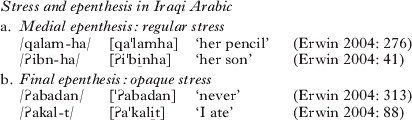
These two patterns motivate the claim that in the opaque interaction, the underlying contrast between a vowel and the absence of a vowel is mapped onto a surface contrast between a moraic coda and a non-moraic coda. In dialects where epenthesis creates open syllables, this mapping is simply not an option, because there is no coda after the epenthetic vowel; hence the first pattern. The second pattern, in Łubowicz's account, arises from a constraint called Mora-Contiguity, which penalises non-moraic codas word-medially but not word-finally.Footnote 5 Depending on how this constraint is ranked, a dialect may have opaque stress in all epenthetic forms (as in Syrian Arabic), opaque stress only in forms with final-syllable epenthesis (as in Iraqi Arabic) or transparent stress in all cases (as in Omani Arabic).
To the extent that it succeeds in accounting for these two patterns, the PC approach appears to offer a clear advantage over the rule-ordering account. However, PC theory requires some additional theoretical devices to account for aspects of the pattern that are wholly unproblematic in a rule-based framework. Furthermore, it is not entirely clear from the description in Chapter 3 that the proposed PC account even succeeds in selecting the right mappings.
First, PC theory relies on two additional types of constraints to avoid the ‘too-many-solutions’ problem (on which see e.g. Steriade Reference Steriade, Hume and Johnson2001 and Blumenfeld Reference Blumenfeld2006). These are recoverability constraints, which restrict how a displaced contrast is realised, and locality constraints, which govern where it is realised.
In the rule-ordering account of Syrian Arabic, the fact that the forms with epenthetic vowels are the ones with exceptional stress follows automatically from the opaque ordering: only in forms with epenthesis is it possible for there to be a surface vowel that seems to have been invisible to stress assignment. The PC account, on the other hand, posits that an underlying V/Ø contrast is mapped onto a surface μ/Ø contrast. It thus needs to explain why it is the forms with epenthetic vowels that have non-moraic codas, rather than the forms with underlying vowels. PCIN(V/Ø) is too weak to accomplish this – it requires only that the two inputs map to different outputs – and regular faithfulness would be too strong, requiring the output forms to differ in exactly the same way as the input forms. Accordingly, the recoverability constraint in (6) is proposed on page 69.
-
(6)

Unfortunately, it is not obvious that this measure is sufficient. The outputs in the winning candidate (2a) contrast in μ/Ø, but not minimally: they also have different foot structure and different stress.Footnote 6 Perhaps the apparent problem can be solved simply by removing the second instance of the word ‘minimally’ from the definition of Recover(V/Ø). Alternatively, it might be possible to identify the μ/Ø contrast as the primary reflex of the V/Ø contrast, and the differences in foot structure and stress as mere side-effects of the μ/Ø contrast. This, however, might take the theory in a more derivational direction, with the generation of non-moraic codas effectively preceding the construction of metrical feet.
A similar question arises in determining the locus of the non-moraic coda within the relevant forms. In dialects in which epenthesis creates open syllables, or in which Mora-Contiguity is ranked too high to allow word-medial non-moraic codas, it would hypothetically be possible to satisfy PCIN(V/Ø) by generating a non-moraic coda in a syllable other than the one containing the epenthetic vowel. To rule this out, §3.6 proposes a fixed ranking of the locality constraint PC-Syllable(V/Ø) over PCIN(V/Ø). The locality constraint requires that whenever two inputs differ minimally in V/Ø, any differences in their corresponding outputs must be contained within the same syllable as the output correspondents of that minimal input difference.Footnote 7 The fixed ranking ensures that it will always be preferable to neutralise the underlying contrast altogether, rather than to displace it by generating a non-moraic coda in some other syllable. However, some of the attested outputs seem to violate the locality constraint as well. For example, the Iraqi Arabic words in (5b) differ not only in whether the coda of the final syllable is moraic, but also in whether it is the penult or the antepenult that bears stress.
Again, perhaps this question could be resolved by somehow stipulating that the μ/Ø contrast is the one that matters for the purposes of the PC constraints. This, however, might cause other problems for the analysis of Iraqi Arabic. From the discussion in Chapter 3, it is not fully clear exactly how the non-moraic final coda in a form such as [ʔaˈkalit] gives rise to penultimate stress. In Iraqi Arabic, as in the other dialects discussed here, the regular pattern is that stress is on the penult if it is heavy, and otherwise on the antepenult. Łubowicz assumes that this pattern is generated by constructing a moraic trochee that is as close as possible to the right edge of the word without actually being word-final. But if word-final syllables are normally excluded from footing, why does a word-final syllable with a non-moraic coda exceptionally serve as the weak member of the foot, as in the analysis of [ʔa(ˈkalit)]? The tableau given on page 68 for forms of the type in (5b) considers only two scenarios – one with the attested output forms, and one in which the underlying contrast is wholly neutralised, as in (7).
-
(7)
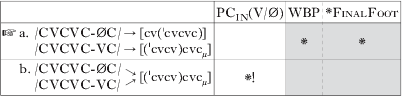
The winning candidate in (7a) should lose to the alternative in (8), in which the input V/Ø contrast is still realised on the surface as a μ/Ø contrast, but stress is antepenultimate in both forms.
-
(8)

The non-moraic status of the final consonant makes it possible for the final syllable to be the weak branch of a well-formed moraic trochee, but it is not clear what makes this footing necessary; the violation of *FinalFoot in (7a) has no obvious motivation. Ordinary word-final light syllables are not footed in Iraqi Arabic, as the examples in (9) illustrate (data from Erwin Reference Erwin2004: 41; footing as given by Łubowicz on page 73).
-
(9)

If the candidate in (8) is not optimal, then it seems as if PCIN(V/Ø) must require the input contrast to be realised as an audible difference, rather than a purely representational one. But this interpretation of PCIN(V/Ø) would render the output μ/Ø contrast irrelevant, undermine the typological predictions made by the locality constraint and contradict the assertion on page 65 that ‘the PC constraint would be satisfied if two outputs had a different moraic structure but the same stress’. On the other hand, this assertion is followed by a reference to note 5 (p. 86), which says, in part: ‘as long as epenthetic and non-epenthetic outputs are distinct in stress or some other audible property in this language, the PCIN(V/Ø) constraint is satisfied’ [emphasis added]. PCIN constraints are fundamental to the theory; it is unfortunate that the book does not provide a more unequivocal declaration of what it takes to satisfy them. On the whole, it is not obvious to me that the PC account of stress and epenthesis in Arabic offers any clear advantage over the rule-ordering approach, or even that it succeeds on its own terms.
More could also be said about recoverability constraints like the one in (6). In general, these constraints require that when an input contrast is mapped onto a different output contrast, the positive member of the input contrast corresponds to the positive member of the output contrast, and the negative to the negative. In the case of a privative contrast like the ones in (6), this seems straightforward enough: the presence of a vowel corresponds to the presence of a mora, and the absence of a vowel to the absence of a mora. When the properties involved are two different binary features, however, it is less obvious that there is any natural affinity between the values labelled as positive.Footnote 8 The analysis of Polish allomorph selection in Chapter 4 uses a recoverability constraint to ensure that, when the input contrast between prepalatal and alveolar consonants maps onto an output contrast between the vowels [u] and [e], the underlyingly prepalatal forms correspond to [u]. Here, the feature that makes the mapping natural is claimed to be [±high]: prepalatals and [u] are [+high], while alveolars and [e] are [−high]. Note 18 (p. 111) mentions that a reviewer raised the question of how the mapping would work if the vowels in question were [e] and [o] instead of [e] and [u], and posits that ‘the relevant Recover constraint would need to refer to a property in the alveolar/prepalatal contrast that is related to the e/o contrast, for example [+/−anterior]’. Will there always be a way of saying that one property is related to another in this way, or are there some pairs of properties for which no well-motivated recoverability constraint exists? (For example, suppose the vowels in the Polish case were [e] and [ø].) In Chapters 3 and 4, recoverability constraints are introduced as they are needed, but no general theory of recoverability is set out in any detail. Because these constraints play an important role in determining how one contrast may map onto another, it is hard to know what kinds of contrast transformation PC theory does or does not predict without knowing what is or is not a possible recoverability constraint.
Also worth exploring in greater detail is the mechanism by which scenarios are generated. As explained in §2.2.1, scenarios need to be finite in order to be evaluable. Accordingly, a set of scenarios is generated for each underlying form submitted to the grammar. If the underlying form is n segments long, then Gen creates a set of input forms whose lengths range from zero to 2n+1. In each scenario, the inputs in this set are mapped onto outputs drawn from the same set: ‘Outputs in a scenario are a subset (whether proper or improper) of the input. There is nothing in the output of a scenario that is not also in the input’ (p. 15). This property of scenarios does not play a salient role in the remainder of the book, but it has some potentially interesting consequences. For example, in a scenario generated from an underlying form of length n, no input of length 2n+1 can ever undergo epenthesis (unless, of course, it also undergoes compensatory deletion). Since this maximal input is never the actual underlying form whose surface realisation is being calculated, perhaps this peculiarity of the system ultimately has no real effect. Nonetheless, it is striking enough to merit some discussion. The statement that the outputs in a scenario are a subset of the input would also seem to imply that prosodic structure is included in the input, although this is not consistent with the representations shown in the tableaux in Chapter 3. (One possibility is that prosodic structure is present in the input, but that there are no faithfulness or PCIN constraints that refer to it, and so it is never relevant.)
Finally, it would be interesting to see a fuller discussion of the role that contrast preservation plays in accounting for opacity in OT, particularly when it interacts with other phenomena. Chapter 1 mentions the opaque interaction between flapping and vowel length in some dialects of English as one example of contrast transformation: in a pair such as rider and writer, the underlying voicing contrast on the medial stop is neutralised by flapping, but is recoverable from the length of the vowel (yielding the surface forms [raːyɾər] and [rayɾər] in the transcriptions given on page 5). However, the same difference in vowel length also exists in the surface forms of ride and write, where flapping does not apply. In the base forms, vowel length is conditioned by the voicing of the following stop, and the pattern is presumably driven by markedness constraints. If the vowel-length pattern in the derived forms with flapping is driven by contrast preservation, as suggested by the discussion in §1.2, that would seem to imply a non-unified analysis. Other approaches would make an explicit connection between the length difference in ride/write and the one in rider/writer; for example, in Sympathy Theory (McCarthy Reference McCarthy1999), it is possible to formulate a constraint that says, in effect, that each vowel in the derived forms should have the same length that it would have if the following consonant were realised faithfully. A full analysis of this or some similar case would make it easier to see how PC theory compares to other ways of dealing with opacity in OT.
3 Form and presentation
The book is written to allow the reader to dip into the case studies individually rather than reading straight through from beginning to end. To this end, the central ideas of PC theory are recapitulated at least once in every chapter. The repetition is sometimes excessive; for example, the following two sentences appear sixteen lines apart on page 53:
Both PC theory introduced in this book and DTC [the Dispersion Theory of Contrast] recognize contrast as a formal principle of the grammar and formulate it, albeit in a slightly different form, as a family of rankable and violable constraints.
Though both DTC (Flemming Reference Flemming1995, Reference Flemming, Hayes, Kirchner and Steriade2004) and PC theory recognize contrast as a formal principle of the grammar and formulate it as a family of rankable and violable constraints, they differ on a number of points.
As in the two sentences quoted above (and another that appears between them), the reader is frequently reminded that constraints are ‘rankable and violable’; given that the book is part of a series titled ‘Advances in Optimality Theory’, this seems unnecessary. Apart from the repetitiousness, the prose is generally lucid and readable.
On the purely physical side, the printing, by MPG Books Group, is at a surprisingly low resolution, and there are many small alignment errors that are visible as distorted letters in the text and uneven horizontal lines in the tableaux. Modern digital printing technology makes books like this easier to produce, but it should not make them harder to read; indeed, for about the list price of this book (£60/$95), one can buy a low-end desktop laser printer capable of producing significantly higher-quality output.
4 General comments
On the whole, the idea of contrast preservation seems worth pursuing, and Optimality Theory is a particularly suitable framework in which to formalise it. Its implementation in PC theory, however, quickly becomes very complex, and a 134-page book is not really enough to do justice to all the theoretical apparatus and its ramifications. As discussed above, the case studies in this book leave several pertinent questions unanswered, and in some cases unasked. Chapter 5, the concluding chapter, begins on page 113 with an assertion that it ‘summarizes the results of this work and deals with any remaining questions’; it ends less than a page and a half later, having repeated the main points of the book, but without having identified any remaining questions.
It would also be good to do more to situate PC theory in a broader theoretical context, particularly in relation to other work on the typology of chain shifts and other OT approaches to opacity. There is some theory comparison, but it is mostly limited to the treatment of individual cases, apart from some very general remarks on Dispersion Theory in §2.7. I was surprised, for example, to see no reference to Baković's (Reference Baković2007) insightful discussion of opaque phenomena and their implications for serial and parallel models of phonology.
Chapter 5 ends with the hope ‘that this book has provided a formal way to discuss contrast in phonology and morphophonology and has opened many avenues for further research’. By this standard, I believe the book is a qualified success; it does indeed set out a formal theory of one aspect of phonological contrast, and it certainly suggests many new questions to contend with in future work. Some of these questions, though, might better have been addressed within the scope of the book itself.


