


John Comer was terrified of smallpox. Like most of his fellow Bostonians, he learned in early May 1721 that the dreaded disease had arrived two weeks earlier aboard HMS Seahorse, a British naval ship sailing from the West Indies. Before it tapered off in December, the epidemic would sicken nearly 6,000 people in Boston, killing 8 percent (841) of the city’s 11,000 residents.Footnote 1 The scope of the disease, however, was only gradually revealed to Comer and others. In the early summer months, several of his young friends “were taken away by death”; suddenly the danger seemed frighteningly real. Comer spent his seventeenth birthday, August 1, performing a ritual that many pious Bostonians turned to during the epidemic: he “set [the day] apart as a day of solemn fasting and supplication in my chamber.” Examining his soul for sin, he prayed for protection and made a solemn promise to God that, should he get smallpox and survive, he would become a full member of his church and participate in the Lord’s Supper.Footnote 2
Even though this was an intensely private devotional practice—the youth alone in his room, praying and reading—Comer experienced his faith in a social context. The ritual he vowed to strive toward was also called “communion,” partly signifying the union between a participant and Jesus, but also referring to the love that bound congregants together. In fact, laypeople sometimes vexed their ministers by refusing to participate in communion if bad feelings existed among members.Footnote 3 In addition, Comer spent some of his fast day “in close examination” of Christ’s Certain and Sudden Appearance to Judgment (1667), a popular book by the English puritan Thomas Vincent, written in the wake of London’s devastating 1665 plague epidemic. Comer likely read the tenth edition, published in Boston in 1718, and he almost certainly discussed this widely circulated book with family members and pious friends. Moreover, the first thing he did after the sun went down and his fast day ended was to visit his dying grandfather (stricken with “the infirmities of old age,” not smallpox).Footnote 4
Laypeople’s religious responses to the epidemic cannot be easily separated into “individual” and “social” practices: the two were tightly intertwined. With this in mind, I argue that religion helped maintain social cohesion at a time when rampant disease threatened to sunder ties of community. But one must also recognize that religion was not only a force for cohesion. In several ways it reinforced divisions based on class and race. These arguments add texture to our understanding of how religion and epidemic disease intersected. Historians of religion in early America have paid little attention to the role of epidemics in shaping people’s devotional practices. At the same time, historians of disease often overlook the role that religion played in people’s responses to epidemics.Footnote 5 This article contributes to the smaller body of scholarship at the crossroads of religion and disease in early America by illuminating the lived experience of Bostonians during the 1721 smallpox epidemic.Footnote 6
My goal is to center non-elites, insofar as a creative use of sources will allow. We already know a lot about elites in this epidemic because numerous historians have written about the “inoculation controversy,” the fierce debate over whether to purposely infect people with smallpox to protect them from getting deadlier cases the natural way.Footnote 7 This controversy generated reams of material written by physicians, ministers, and other societal leaders. By contrast, this article attempts to uncover the experiences of Boston residents who did not participate in public polemics. Lay sermon notes, letters, diaries, probate records, poor relief records, account books, and other sources reveal that non-elites helped build social cohesion through their religious practices, though not as an explicit goal. During the 1721 epidemic, ordinary Bostonians sought comfort in their religion, participating in rituals they hoped would protect them, their loved ones, and their community. Social cohesion was not the goal but rather the unintended outcome of these practices.
At the same time, religion could also divide. Some people sought cures through magical healing, which their ministers vociferously opposed. Others were unable to attend public worship because of illness, fraying the bonds between themselves and neighbors. And religion shaped and was shaped by social divisions along familiar lines of race, class, and gender, as well as less frequently remarked differences of denomination. This article focuses on religious practices that served to build social cohesion, while paying attention to countervailing moments of religious discord. Surviving sources put Anglo-American Congregationalists at the center of the story. Quakers and Huguenots, not to mention those who practiced African and Indigenous religions, await later, more speculative treatment.
Social Cohesion
First, a definition of “social cohesion” is in order. Scholarship on the connections between religion and social cohesion (though without using that phrase) dates back to the very origins of sociology. Émile Durkheim’s foundational Elementary Forms of Religious Life (1912) posits that religion is “an eminently collective thing,” something that is “essentially social.”Footnote 8 That may seem self-evident, but this insight encourages scholars to go beyond focusing on the inner beliefs of individuals or the genealogy of theological ideas disconnected from practice. For Durkheim, members of a society are bound together by their “mutual dependence.” People “cannot live together . . . without tying themselves to one another with strong, durable bonds.”Footnote 9 This mutual dependence was a key feature of religion during the 1721 smallpox epidemic.
In religious practice, according to Durkheim, people are especially likely to thicken social bonds through what he calls “piacular rites” (from the Latin piaculum, meaning “atonement”). Scholars often think of these as mourning rituals, but they are broader than that: “sad celebrations” whose object is to “meet a calamity.” Funerals are thus one form of piacular rite, but so are public fasts, thanksgivings, and rituals of group prayer in the face of an epidemic. All these responses to disease—and more—bring individuals together, and, as Durkheim insists, “human sentiments are intensified when affirmed collectively.”Footnote 10
Recent sociological work on religion and social cohesion tends to focus on the “problem” of religious pluralism in present-day democracies.Footnote 11 For this reason, some definitions of social cohesion are not applicable to the early modern period. Still, it is possible to craft a workable definition by limiting oneself to period-appropriate concepts in the literature. A 2017 meta-analysis of 350 books and articles in English and German offers three dimensions along which to gauge the cohesiveness of societies: social networks, namely the quantity and quality of social interactions with family, friends, and community members; identification, meaning attachment to the social unit in question; and orientation toward the common good.Footnote 12 Whereas the first dimension refers to relations among individuals, the second and third are about connections between individuals and the larger group(s) of which they are a part. In this case study, those groups range from the neighborhood and congregation to the town of Boston. On balance, religion increased social cohesion during the 1721 smallpox epidemic, but not uniformly so. My analysis reveals the social context of devotional practices, which worked to ameliorate the potentially centrifugal effects of widespread disease.
Public Devotions
During early modern epidemics, it was not a given that people could participate in church services and other forms of public religious expression. For example, when, in 1636, plague came to Newcastle, England, most ministers fled the city; it is not even clear that public worship continued.Footnote 13 But there was one major difference between plague and smallpox: a bout of smallpox confers lifelong immunity. This is not to diminish the exertions of Boston’s ministers, who continued to preach and conducted endless visitations of the sick and dying. But ministers who had had smallpox before—the previous epidemic was in 1702—knew they were not going to catch it again.
This allowed laypeople to participate in the full range of public practices that sustained their piety and promoted social cohesion. They could post prayer bids, asking their fellow worshippers to pray for them. They could hear sermons and join in public fasts and thanksgivings. They could have their children baptized, become full members of the church, and, if eligible, participate in the Lord’s Supper. If they sickened, they could receive pastoral visits. And, when friends and loved ones died, they could attend funerals, usually alongside large numbers of their neighbors. I will examine these practices in depth, focusing on how they deepened social ties, but also pointing out moments when that was not the case.
A highly visible expression of religion during the epidemic was the humble prayer bid. These small pieces of paper with requests for prayers were not an epidemic innovation: they appear in puritan sources dating back to the 1620s in England and the 1630s in New England.Footnote 14 Laypeople sometimes handed prayer bids directly to their ministers, though most commonly they posted them on the church door, as captured in the conventional wording that they “put up a prayer bid.”Footnote 15 I have not found any surviving prayer bids from the epidemic, but we do know that they were widely used, thanks to Cotton Mather’s accounting. As smallpox mortality dramatically worsened in early autumn, laypeople posted 202 prayer bills at Mather’s Old North Church on October 1. The following two Sundays, the epidemic’s peak, they put up an astonishing 315 and 322. After that, the numbers began to decline, with 180 on the 22nd and “little more than 50” two weeks after that.Footnote 16 Thus, in four weeks in October, at just one Boston church, people posted more than a thousand requests for prayers.
The wording of prayer bids shows how scraps of paper could serve as a medium of social cohesion: they are clear examples of Durkheim’s “mutual dependence.” One can imagine this simple prayer bid (actually from Northampton, Massachusetts, a decade after the epidemic) being posted on the door of Old North Church: “The widow Southwill Being Sik of a Feavour desires the Prayers of the Congregation.” Or this one, following the death of two beloved family members: “moses parsons togather with his parents desier the prayers of the congrigation that god would sanctifey his holy holy hand unto them in taking away his wife and thare datter by deth.”Footnote 17 Laypeople almost always asked for the “prayers of the congregation,” trusting their neighbors to invest time and effort for them, and thereby deepening the bonds that united them. And at a time when physicians had little to offer those afflicted with smallpox, people widely considered prayer to be efficacious. When Samuel Sewall asked a sick man in 1717 whether Sewall should post a prayer bid for him, the man “seem’d very desirous of it; and said he counted it the best Medicine.”Footnote 18
Sewall’s pious friend considered prayer to be the best medicine, but other Bostonians were not so sure. Some almost certainly turned to magical means of healing that earned the scorn of their ministers—and perhaps also of their more orthodox lay neighbors. I have not found any documented examples of magical healing from the 1721 epidemic, but ministerial warnings in the 1720s suggest that such practices were widespread. Cotton Mather complained about magical healing in The Angel of Bethesda, a medical compendium he completed in 1724. He lamented, “How frequently is Bleeding Stancht, by writing of Something, with Some Ceremonies, on the Forehead! How frequently is a Toothache Eas’d, and an Ulcer Stop’d, and an Ague Check’d, by Papers, with some Terms and Scrawls in them, sealed up and worn about the Neck.”Footnote 19 Rev. Ebenezer Turell likewise took aim at magical healing in 1728: “’Tis an evil thing to hang witch Papers on the Neck for the Cure of Ague . . . and many things of the like Nature, which some in the World are fond of.”Footnote 20 When thousands of Bostonians sickened with smallpox in 1721 and conventional medicine proved ineffective, some undoubtedly turned to magical healers.Footnote 21 But most of them probably combined this with orthodox prayer. Thus, the impact of magical healing on social cohesion is unclear.
Whether people used magical healing, posted prayer bids, or did both, those who attended worship services on Sunday gathered with their neighbors in spaces ranging from the imposing First Church to the more intimate stone French Huguenot meetinghouse.Footnote 22 In these various locations, worshippers were able to maintain their social networks during the epidemic. For Congregationalists, the service centered around the morning and afternoon sermons. Only one surviving source offers the view from the pew during the epidemic, and, though it is hardly a representative source, it is valuable nonetheless. It is the notebook in which twenty-six-year-old Edward Bromfield Jr. recorded remarkably detailed summaries of the sermons he heard in 1721 (Figure 1), one of four extant notebooks he filled between 1713 and 1721. Bromfield’s father was a successful merchant and the son would follow in his footsteps toward wealth and influence. But during the epidemic Bromfield Jr. was still unmarried and not yet a full member of Boston’s Old South Church (a.k.a. the Third Church), which he would join in 1729. It is this status, under the baptismal covenant and striving toward full membership, that is the key to understanding his notebooks.Footnote 23 Sermon attendance was a “means of grace,” a way of making progress toward the hoped-for moment of justification, and, as such, pious laypeople strove to pay close attention. Bromfield had the material resources to afford paper, ink, and probably a little lap desk; the privilege of an education that allowed him to write quickly and confidently; and the spiritual tenacity to produce 196 pages of sermon notes during the epidemic.Footnote 24
Edward Bromfield Jr.’s sermon notebook, opened to Benjamin Colman’s lecture sermon of June 8, 1721. Collection of the Massachusetts Historical Society, Boston.

Bromfield began this volume of his notebooks on April 30, a week after HMS Seahorse arrived from the West Indies but ten days before Boston residents realized that smallpox had entered their city. He filled the notebook from flyleaf to flyleaf until November 15; the presumed subsequent notebook is lost. In those six and a half months, Bromfield attended forty-four sermons, thirty-one of which were on the Sabbath. Almost all those Sundays featured sermons by the Old South Church ministers Thomas Prince and Joseph Sewall. Bromfield also attended eleven sermons as part of Boston’s Thursday lecture, where he recorded the words of numerous Boston ministers. Overall, he recorded sermons by ten Congregational ministers during the epidemic. Unlike some laypeople who took sermon notes, he never offered editorial comments.Footnote 25 Instead, his main concern was to record the sermons as fully as possible, presumably for later study and contemplation. The result is a view, both panoramic and highly detailed, of the words laypeople heard during the epidemic.
To simplify only a little, Boston’s Congregational ministers emphasized two complementary points during the epidemic: that God punishes sinners with plagues and other afflictions; and that God hears prayers, and thus sinners are not powerless in the face of death and disease. Neither of these were new themes. Ministers turned to them precisely because they were time-tested and resonated with many laypeople. A few examples, filtered through Bromfield, give a sense of how ministers sought to stimulate their parishioners’ piety. On May 28, when only one person had died from the disease,Footnote 26 Joseph Sewall preached on Psalms 119:120, which Bromfield rendered as, “My flesh trembleth for fear of thee & am Afraid of thy Judgements.” Sewall warned his audience, “surely you have reason to tremble for fear of God lest he sho’d bring some terrible plague upon you in this life or reserve you in Chains of wrath to the Judgement of the great day.”Footnote 27 Even if a person did not get smallpox—and the risk may still have seemed slight—God had the power to condemn that person to hell.
A few months later, with the death toll rising exponentially, the warnings grew steadily more dire. In a Sabbath sermon on September 24, Thomas Prince asserted that “the Almighty maker of heaven & Earth can easily destroy the life he made.” This was a function of God’s absolute power. “God alone is the Sovereign cause that kills, he makes us mortal & subjects us to death.” One week later, Samuel Checkley visited from the New South Church to deliver a barn-burner of a sermon. Unsurprisingly drawing on Job, whose “sore boils from the sole of his foot unto his crown” (2:7, KJV) were often interpreted as being smallpox, Checkley offered this simple proposition: “when [God] chastens a people it must be because they have offended.”Footnote 28 The arrival of smallpox in Boston was not random but rather a sign of God’s displeasure.
Unlike a classic jeremiad, Checkley did not include a long list of Boston’s sins, at least in Bromfield’s rendering. But, in another sermon on Job the following month, one of only two manuscript sermons I have found from the epidemic, Checkley offered a list of “such open scandalous Sins as those of Lying, Swearing, Drinking to Excess, unlawfull Gaming, Sabbath breaking and the like.”Footnote 29 These were the same sins that New England’s ministers had been railing against for nearly a century, and, even if Checkley did not invoke them explicitly in the version that Bromfield heard, the audience would have known what he meant when he said they had “offended.” There is evidence that, in light of warnings such as Checkley’s, some assumed that their fellow parishioners who sickened with smallpox deserved their punishment. In fact, in a book that Cotton Mather gave to a “Kinswoman” with smallpox in June 1721, he warned against just this sort of behavior: “We must use a due Caution, in passing a Judgment on the Sick.”Footnote 30 Whether or not laypeople frequently had such judgmental thoughts, they certainly would have anticipated Checkley’s conventional conclusion to his sermon: to avoid the wrath of a sin-provoked God, who has “laid Cities wast[e] without an Inhabitant,” they should reform, repent, and close with Christ.Footnote 31
Boston’s ministers thus hoped to use the epidemic to inspire unconverted congregants such as Bromfield to join the church as full members. But, to do so, clergymen did not leave their audiences only with images of cities laid waste. They also turned to their second theme: that God would listen to prayers if they were offered in a spirit of true repentance. At Bromfield’s Old South Church, Joseph Sewall followed Checkley’s fire-and-brimstone morning sermon on October 1 with an afternoon sermon that was much gentler. Maybe it was just a coincidence, but the two ministers probably planned it that way. Sewall drew his text from the book of Psalms, which was far and away the most frequent source for the sermons Bromfield attended during the epidemic: Psalms provided the texts for twelve of the forty-four sermons in his notebook; no other book of the Bible provided more than three (one of which was Job). Deeply loved by many parishioners, Psalms offered numerous registers for ministers to draw on.Footnote 32 These ranged from the imprecatory psalms and their invocations of God’s judgment (such as 69 and 109), to the psalms of comfort such as 91, which supplied Sewall’s text on October 1. According to Bromfield, Sewall reassured his listeners “that God will graciously Answer his people that call upon him . . . God’s Ear is always open to the fervent Cry’s of his people.” Laid low by smallpox, they should pray to a healing God, who would listen to them. “Sometimes he gives them the very things they ask for,” Sewall insisted.Footnote 33 This was a much more forgiving message than congregants had heard just a few hours earlier, and Sewall crafted it to inspire people to trust in God, hoping they would eventually feel the stirrings of piety that would lead them to join the church as full members.
There is no doubt that the epidemic intensified the piety of at least some laypeople. Scattered evidence exists of people who looked back on this period as a turning point in their journey toward grace. In July 1746, Jonathan Willis of Boston remembered that “25 years agone I was about this time in a Low & daingerous State being vissited with the small pox in a Greivous Degree & mannor[,] no words can exspress what I then underwent thereby, but God allmighty he spared & healed my shaking dying body & having obtained help from him continew to this day.”Footnote 34 The memory of such powerful emotions lasted the rest of his life, but they did not lead Willis to become a full member of a church, because he had already joined the Brattle Street Church in 1709.Footnote 35
By contrast, seventeen-year-old John Comer, introduced at the start of this essay, traced a direct line from smallpox to full membership. With this result, he deepened his relationship with a larger group: the “saints” in his congregation. On August 1, Comer made his vow that if he survived smallpox he would become a full member. Just as he predicted, he was laid low from November 22 to December 10 with the disease. After his recovery, he kept his promise and joined his church in February 1723.Footnote 36 This was the precisely the outcome that Samuel Checkley, Joseph Sewall, and other ministers hoped for when they preached during the epidemic.
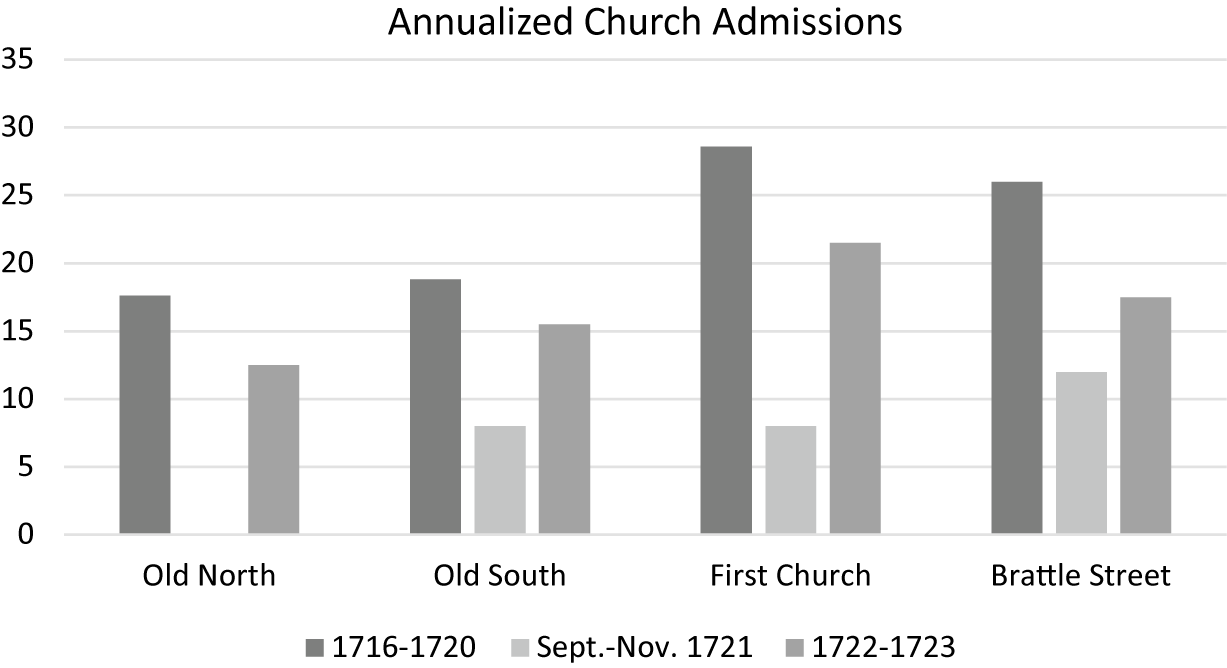
Boston’s clergymen, however, did not see their hopes fully realized. This is something of a surprise. Douglas Winiarski and others have shown how laypeople were often spurred to join churches by the deaths of loved ones. Winiarski argues that “no providential dispensation played a larger role in stirring men and women to join the church than the deaths of parents, siblings, spouses, children, neighbors, and ministers.” Nearly a quarter of the 235 conversion narratives from eighteenth-century Haverhill, Massachusetts, invoke a loved one’s death.Footnote 37 So one might expect 841 deaths in Boston to have caused a spike in admissions among survivors, but that did not happen in the four churches for which detailed records are extant. Boston’s Old North (Second) Church admitted no new members at all between June 4, 1721, and January 7, 1722. Nor was there a great surge in 1722 and 1723, when fourteen and eleven people joined the church respectively (in the five years preceding the epidemic, 1716–20, Old North had averaged 17.6 new members per year).Footnote 38 The situations at Old South Church, First Church, and Brattle Street Chuch were similar. All experienced sharp drop-offs in admissions during the epidemic’s worst months, with no post-smallpox surge (Figure 2).Footnote 39 The epidemic was thus unlike another traumatic event: the earthquake of October 29, 1727 that struck Boston and the north shore of Massachusetts. In Haverhill alone, the earthquake led dozens of people to join the church by the end of that year, with several dozen more in the first few months of 1728.Footnote 40
Annualized church admissions in Boston, 1716–23. See n. 39 for the data sources.

If death had long inspired New Englanders to join churches, why did smallpox not lead to more new admissions, either during the epidemic or in the following two years? Possible answers point to ways in which the disease eroded social cohesion. One barrier was that some people stopped attending church while smallpox raged, either out of fear or because they were sick or caring for the ill. Even a dedicated churchgoer such as Bromfield did not make it to church between July 13 and September 10. The simplest explanation is that he had smallpox, speculation given weight by the smallpox death of his sister, Frances, on September 14.Footnote 41 Another possibility is that Bromfield, like an unknown number of generally well-off Bostonians, fled to a nearby town to escape the disease.Footnote 42 Or perhaps both are true: he left Boston, caught smallpox, and returned to Boston and his church in September, knowing he was immune. And, even though Bromfield left no evidence that he disagreed with anything in the sermons he heard, some laypeople were probably not convinced that their sins were the cause of God’s displeasure, or that they should be thankful for God’s mercies even as friends and family members were dying around them.Footnote 43 If that is true, these individuals would not have been spurred to examine their souls for sin and join the church. In any case, when laypeople missed worship services or refrained from joining the church, they lost out on opportunities to strengthen social ties with their neighbors.
This probably happened even more frequently among those on Boston’s margins. Margaret Gurren, for example, worked as a maid in the house of John Tobee during the epidemic. She caught smallpox and was fortunate to survive, but Tobee “charged her Three pounds for Attendance,” that is, for the care of a nurse or physician. This was a sum the young maid could never hope to scrape together; she had been paid only two pounds during the whole nine months she had worked for him. So, when she left his service (probably after her annual contract was up), he held her clothes ransom. According to Gurren’s petition to the court, “the said Tobee Detains and withholds from her, her Cloaths and will not make up & settle their Accompt.” It was humiliating enough for Gurren to be without her clothes, but perhaps even worse was that “for want of which she has been keept from Meeting Three quarters of a year.”Footnote 44 Without attire suitable for the Sabbath, Gurren felt unable to attend church. She could not participate in the rituals that sustained her faith, nor could she enjoy the fellowship that the meetinghouse ordinarily provided her. These circumstances surely did not help her progress toward full membership.
Court records also show the difficulties that some people faced balancing care work with church attendance. Take Joseph Andrews, who lived in Dorchester, just south of Boston (today it is part of the city). In January 1722 he was brought before the county court, accused of “neglecting the Publick Worship of God for six Weeks or Two Months last past.” Standing before the gentlemen of the court, he “pleaded that he was detained therefrom upon account of his looking after & watching with several persons . . . who were sick of the smal pox.”Footnote 45 The court showed mercy and dismissed the charges, but Andrews, like Margaret Gurren and others, was unable to draw strength from public worship during the worst months of the epidemic.
Similar challenges seem to be behind a significant drop in baptisms during the epidemic. Again, one might think that this ritual would have continued unabated. After all, the birth rate did not decline, given that children born in the second half of 1721 had been conceived months before smallpox arrived in Boston. The number of people who left town and lost access to baptism seems to have been fairly small. And, most importantly, lay women and men generally believed that baptism offered their children some degree of protection—perhaps from disease, perhaps from being consigned to hell.Footnote 46 As a result of these beliefs, parents ordinarily presented their children for baptism as soon as possible: in one analysis of nearly 3,000 baptisms carried out in the early eighteenth century in Massachusetts, 49 percent were found to have been performed within one week of birth, with another 10 percent in the second week of life.Footnote 47
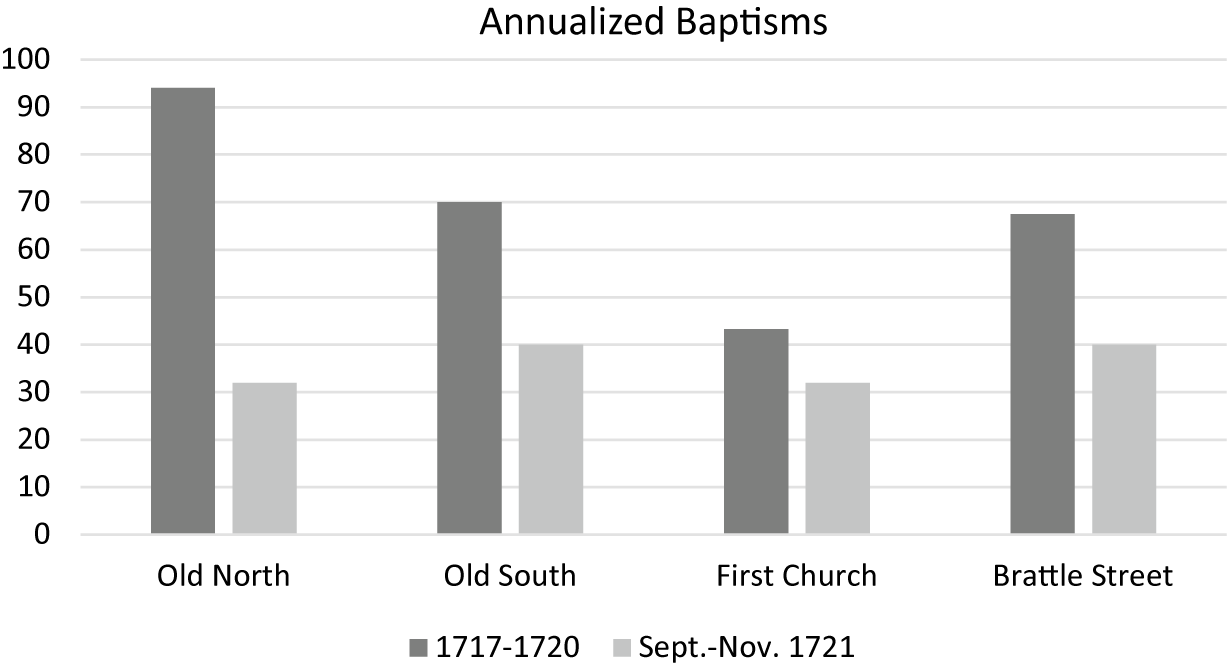
All this suggests that, during an epidemic, it would be especially important to baptize one’s newborns, but the numbers do not reflect this. To the contrary, the Old North Church offers clear evidence of a decline. Prior to the epidemic, baptisms had been remarkably steady: ninety-nine, ninety-two, ninety-one, and ninety-four in the years 1717 through 1720. Then, in the three deadliest months from September through November 1721, only eight infants were baptized, for an annual rate of thirty-two, just over one-third (34 percent) of the earlier rate.Footnote 48 The declines at three other churches were not as steep but still significant (Figure 3).Footnote 49
Annualized baptisms at four Boston churches, 1717–21. See n. 49 for the data sources.

It is unclear what happened to all these unbaptized newborns—dozens of them in just these three congregations. As with church admissions, there was no spike in baptisms when smallpox abated. To the contrary: there were fewer at all four meetinghouses in 1722–23 than before the epidemic.Footnote 50 Some newborns undoubtedly died during the epidemic before they could be baptized, as is suggested by this entry in the Kings Chapel burial register: “October 28, [blank], of Thomas & Rooksby Creese.”Footnote 51 The unnamed child almost certainly died before being baptized; no corresponding entry exists in the baptismal register. But infant deaths cannot explain all the drop-off in baptism numbers. Some portion of the decline must have been due to the fear of bringing vulnerable babies to church, and this fear strained the bonds of social cohesion that baptism ordinarily strengthened.
So, whereas posting prayer bids helped to solidify community bonds by enacting mutual dependence, sermons, church admissions, and baptisms had mixed impacts during the epidemic. Some laypeople found their piety intensified by the looming threat of death and by their ministers’ calls for repentance. A subset of those individuals vowed to join a church in full communion if their lives were spared, and a few such as John Comer did just that. People who were already full members continued to participate in the Lord’s Supper if they remained in town—Old North Church, for example, held communion every four weeks as usual during the epidemic, from May 14 to December 24.Footnote 52 These people were able to maintain their identification with the larger social group of “saints” or full members in their congregations. But smallpox did not lead to a revival with its attendant surge in admissions, as the earthquake six years later would. Rather, the disease suppressed admissions in the second half of 1721. Baptism was subject to similar dynamics. Some parents decided it was worth the risk of infection to bring their newborns to the meetinghouse during the epidemic. But many others neglected the ritual.
Private and Semi-Private Devotions
In addition to the public components of religious practice, pious laypeople turned to private and semi-private devotional practices while the epidemic raged. At the most private end of the spectrum were individual days of fasting and prayer that pious laypeople set aside for themselves, separate from the days of general fasting and thanksgiving that ministers and government officials called. Aside from John Comer’s devotions described at the outset of this article, I have not found lay descriptions of individual fast days in 1721, but two fasts from less than three years before the epidemic offer additional details of what these private rituals entailed. John Barnard was a successful housewright and a deacon at Old North Church. To examine his soul for sin, he kept detailed spiritual diaries, of which only the 184-page volume written from January 1716 to October 1719 is extant. In the winter of 1718–19, Barnard held two days of fasting and prayer that were connected to his fear of smallpox. On December 27, 1718, preparing for the Lord’s Supper the next day, he worried about “the anger of god against this towne, in that he thretins us with the spreding of the small pox.” The cause for his concern is illuminated by Samuel Sewall’s diary. Just a few weeks before Barnard’s fast, Sewall noted, “Dr. Clark says the Small pocks is in Town. Capt. Sargent of Newbury, his daughter, has it in Charter-street. The Lord be Mercifull to Boston!”Footnote 53 Charter Street in the North End was only a few blocks from Barnard’s house in Clarke’s Square, so he had reason to be alarmed. Indeed, he remained fearful four weeks after his first fast, so, on January 24, 1719, when next preparing for the Lord’s Supper, he again lamented “the state of poore New England, & more particulerly, boston, now thretend with the small pox.” Even this most private religious ritual, “a day of prayer with fasting in secrit before the lord,” maintained a social component. Barnard believed that God chastened his entire community by sending providential punishments such as smallpox.Footnote 54
Barnard (who lived until 1732) and other pious Bostonians must also have observed private days of fasting and prayer in 1721, and their practices likely resembled those of Barnard in the winter of 1718–19.Footnote 55 After family prayer, he “withdrew,” either to a private room or to a “closet,” a small, enclosed space dedicated to private worship. Given that Barnard possessed a deep piety—and the skills to build such a space—he likely had a closet set aside for just this purpose. When he settled into his private room, he strove “to humble my selfe before the lord, & to cry unto him for mercy.”Footnote 56
But, even though Barnard’s fast days were intensely private affairs, they were firmly embedded in a social matrix. During his December fast, he prayed for divine assistance for “sume of my particuler frinds who are in great distrese.” Elaborating on that theme, he wrote that “the Comunion of Saints is desirabl & delightfull . . . I Desir to be a Companion of them that fear god, I would make non[e] but such my familirs, & Intimate Companions.” As smallpox threatened his neighborhood and his town, he redoubled his commitment to his pious circle of friends, the visible “Saints” on earth with whom he loved to pray. Even though this was before 1721, Barnard and other pious Bostonians must have likewise thought about their earthly and heavenly communities during their private devotions while the epidemic raged. The very ferocity of the disease heightened their mutual dependence.
Whereas individual fasts were on the private end of the devotional spectrum, there were numerous semi-private practices that laypeople drew on during the epidemic. These activities did not build social cohesion to the extent that public rituals such as baptism and the Lord’s Supper did, but they were not without social implications. Family prayer must have been a support for many, as it was before and after 1721, although I have not found descriptions of lay family prayer during the epidemic.Footnote 57 When families connected with one another via letters, they reported on whether anyone in their household had caught smallpox and what the outcome was. They usually invoked God’s providential hand, no matter whether family members had been spared the sickness altogether, had caught it and recovered, or had died from it. As Ann Lechmere wrote to her brother in Connecticut on June 29, “throw the goodness of god my Children hold up still I am in daly fears for them[,] there is three at Mr Belchers have had the Smal pox and well againe.”Footnote 58 Lechmere’s prayers for protection were answered at first, but in October her youngest daughter, Polly, caught smallpox. As Ann’s husband, Thomas, reported on October 30, “my poor Girl is now God be thanked on the mending hand, none else taken down tho’ hourly expected.”Footnote 59 While these invocations of God’s providence were conventional—“throw the goodness of god,” “God be thanked”—they represent sincere expressions of religious belief, and they suggest the language that these family members probably used when they prayed together. Even more than that, conventional beliefs are shared beliefs; by including these providential sentiments in letters sent near and far, Bostonians strengthened social bonds deriving from shared religious convictions.Footnote 60
Visiting and praying with the sick was another semi-private way in which laypeople maintained and even strengthened their social networks during the epidemic. There is no question that many pious laypeople wanted their ministers to pray with them when they were unwell. But laypeople also valued visits from their friends and relatives. These dynamics are hinted at in Samuel Sewall’s diary, after Sewall learned on November 18 that Susanna (“Susan”) Thayer was sick with smallpox. Thayer was forty-nine years old and had, as Sewall noted, “serv’d me and my family faithfully fifteen years,” likely in some sort of domestic capacity. Although Sewall wrote that Thayer “serv’d” him, their relationship evidently was deeper than usual for servants and masters. They were both pious: Thayer had joined Sewall’s Old South Church four years before the epidemic, “admitted to full communion” on March 3, 1717.Footnote 61
So on November 18, when Sewall heard that Thayer had smallpox, he sprang into action. The next day he “visited Susan.” This brief entry obscures the details of what must have been a prayerful encounter. Thayer seems to have been unmarried and childless, so she likely welcomed Sewall’s company. A week later, Sewall reported optimistically, “Visited Susan and had great hopes of her Recovery.” Sewall probably included prayers of thanks along with prayers for her full return to health. Just three days later, however, she died, and the next day Sewall accompanied the hearse to the Granary Burial Ground. This one example can stand for the countless prayerful visits that friends, neighbors, and relatives offered the nearly six thousand people who caught smallpox in Boston, each visit demonstrating how the epidemic heightened mutual dependence.
There were additional semi-private ways in which people engaged with religion outside the church. It is true that the epidemic put a temporary end to some of these sources of religious community. The Society for Promoting Regular and Good Singing, for example, dedicated to helping people sing psalms more harmoniously, suspended its meetings during the epidemic.Footnote 62 By contrast, other formal and informal religious groups continued to gather. We know this because Cotton Mather complained that their members were endangering their health. He mentioned “several Societies of young People, meeting for the Exercises of Religion on the Lords-day-Evenings,” whose members were “obnoxious to the Danger of the Small-Pox.”Footnote 63 The youthful participants undoubtedly enjoyed the social aspects of these groups, perhaps joking and flirting in addition to discussing religious topics. Eager to maintain social bonds, they were reluctant to give up their meetings.
The sense that life could go on during the epidemic extended to the world of commerce. This, too, had religious implications, as presses continued to print pious literature and booksellers continued selling devotional works. Daniel Henchman’s shop in Cornhill, Boston’s busiest commercial district, was one such business. Cornhill was also the geographical center of the city’s Congregationalist establishment: Henchman’s corner shop was “over against the Brick Meeting House” or First Church, and the thirty-two-year-old bookseller was a deacon at Old South, just two blocks away. Fittingly, Henchman stocked a wide range of devotional tracts, some of which he himself published.
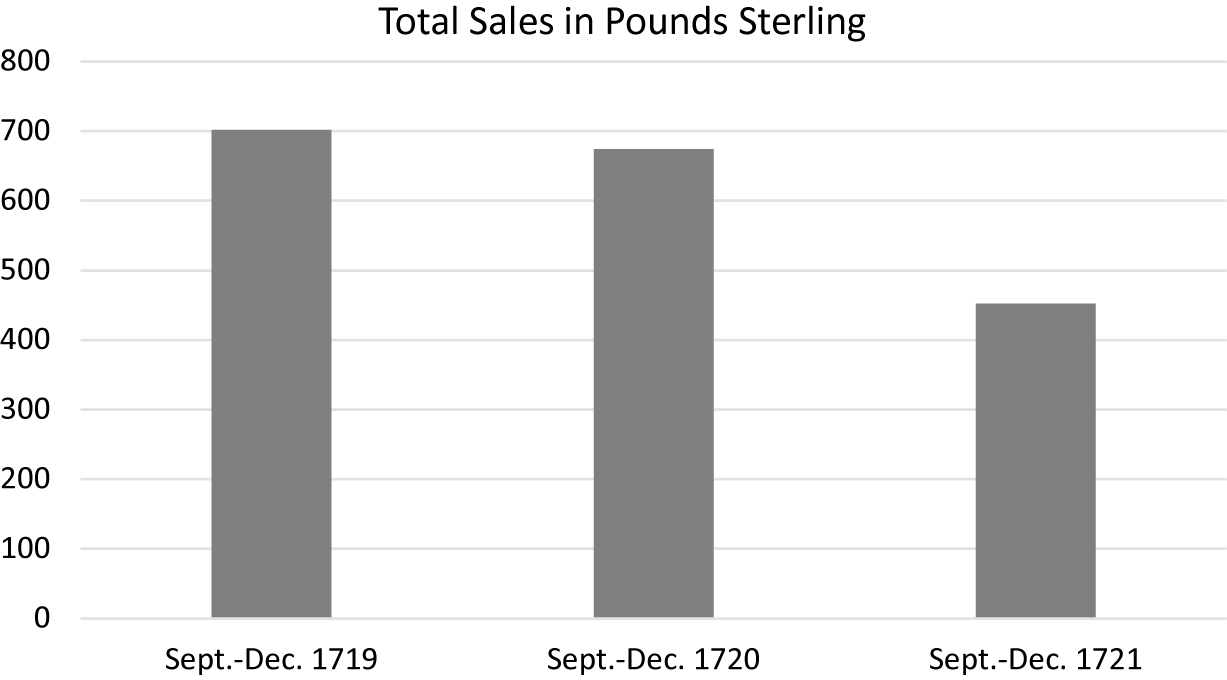
There is no question that the epidemic was bad for Henchman’s business. Comparing the period September through December in the years 1719, 1720, and 1721, his sales during the epidemic decreased by just over one-third compared to what they had averaged the previous two years (a 35 percent decline, from a £692 9s. 6d. average to £452 1s. 1d.—see Figure 4).Footnote 64 But, even with a decline from the previous two years, it is important to note that Henchman remained open for business throughout the epidemic. For Boston residents seeking Bibles, Psalters, and devotional works new and old, this was good news.
Sales figures for Daniel Henchman’s bookshop, 1719–21. Daniel Henchman, Waste Book (Accounts), 1718–1725, Hancock Family Papers, Baker Library Special Collections and Archives, Harvard Business School.

The religious books that Henchman sold during the epidemic give a sense of what pious Bostonians sought out in dark times. Fourteen times from September through December, customers purchased one or more copies of “Psalms” or “Psalm books” or “Psalters.” The likeliest candidates are the Bay Psalm Book, still going strong eighty years after its first publication, now in its twentieth edition (1720); and Cotton Mather’s Psalterium Americanum, a recent translation (1718) into blank verse rather than the aggressively rhythmic versification of the Bay Psalm Book. Footnote 65 The title pages indicate that both were printed for “D. Henchman.” The other religious titles that Henchman sold were a mix of puritan classics, newer sermons, and one recent bestseller. The oldest was The Godly Man’s Ark (1657), by the English Presbyterian Edmund Calamy. Henchman was probably selling the eighteenth edition, printed in London in 1709. Henchman’s customer knew how to pick an appropriate title for an epidemic. Calamy warned his readers, “It is the grand Sin of most People, to delay and prorogue their solemn Preparation for Affliction and Sickness, till they come to be sick, and in Affliction.”Footnote 66 This customer evidently hoped to begin that preparation before it was too late.
Even more popular in these decades was Joseph Alleine’s Alarm to the Unconverted (1673), one of the most widely read puritan texts. It was said to have sold 70,000 copies “in the space of a few years” and continued to be reprinted well into the nineteenth century.Footnote 67 Alleine did not try to lure his readers with flattery. Instead, he addressed his book “To all the Ignorant, Carnal and Ungodly, who are Lovers of Pleasure more than God.”Footnote 68 If this did not entice readers, perhaps the book’s alternate title did: A Sure Guide to Heaven. Footnote 69 Alleine offered his readers concrete steps they could take to help them close with Christ before they died: something on the minds of many Boston residents in November 1721, when Benjamin D’hommedieu paid two shillings sixpence for his copy of Alleine.
Although reading might seem like the quintessential individual activity, that was not necessarily the case in early eighteenth-century Boston. Books like The Godly Man’s Ark and Alarm to the Unconverted joined readers in a common effort to turn away from sin and embrace Christ while God’s providential punishments were everywhere apparent. Even more tangibly, “steady sellers” like Calamy and Alleine allowed readers to discuss with pious friends the books they had read in common.Footnote 70 As John Barnard wrote in his spiritual journal, eulogizing a recently deceased friend, William Robey was “well red in the Scripturs, & other good bookes, & was able to giv a good account of what he red.” Barnard knew that Robey could speak intelligently about “good bookes” because they belonged to a small circle of men who gathered “often” for “sperituall conversation.”Footnote 71 Because Henchman and other booksellers remained open for business during the epidemic, pious readers like Barnard could purchase titles that seemed well suited to the moment.
Henchman’s bestselling book of sermons in the second half of 1721 was particularly timely. Whereas he sold only one copy each of Calamy, Alleine, and other classic titles, he sold thirty-five copies to thirty-one different customers of a book hot off the presses: A Course of Sermons on Early Piety, which appeared at the very end of July.Footnote 72 The enthusiasm for this book left an immediate mark on Henchman’s accounts: an advertisement appeared in the July 31 issue of the Boston Gazette, and that same day Henchman sold his first copy.Footnote 73 He sold two more the next day and a total of ten by the end of August. Realizing he had a hot commodity on hand, he prepared a gilt edition. Instead of four shillings sixpence for the plainest edition, gilt volumes cost six shillings sixpence. Henchman sold his first on September 6 and seven more by the end of the year.
A Course of Sermons was a collection of eight sermons preached by the eight ministers who offered the Thursday lecture, plus a brief concluding sermon by the éminence grise Increase Mather. Attendance was voluntary at the Thursday lecture, so it attracted an especially pious audience, including Edward Bromfield, notebook in hand. Cotton Mather was the driving force behind the coordinated series of sermons, but the others all signed on enthusiastically, offering lengthy and rigorous cases for the importance of cultivating piety from an early age. In order from the oldest (Cotton Mather, age fifty-eight) to the youngest (Thomas Foxcroft, twenty-four), the ministers delivered their sermons over the course of eight weeks in 1721, from March 23 to May 18.Footnote 74
Those dates demonstrate both how smallpox fit easily into the religious frameworks long established by New England’s clergy, and why the collection was so popular among readers. The lecture series began in March, before the disease arrived in April. Around May 10 is when most Bostonians learned that smallpox had “got into the Town.”Footnote 75 But there is no great difference between the six sermons delivered before and the three (including Increase Mather’s) after that date. Whether or not their congregants were faced with an epidemic, Boston’s clergy used fear of death to inspire piety. Take, for example, Cotton Mather’s March 23 sermon. He posed questions directly to young listeners to heighten the emotional impact of his words: “Is there any Report more common than this; ‘The Young Ones are dead.’ Are not our Golgothas full of Graves, that reach not unto your Dimensions!” To support his argument he drew on tabulations that had appeared just three days earlier in the Boston Gazette: “Of the Six Thousand, Four Hundred and Odd, that have Dyed in our City within Twenty Years . . . were there not probably more than Three Thousand, who had not reached unto their middle-age!”Footnote 76
The ministers who delivered their sermons after people knew about smallpox simply had a more specific hook upon which they could hang ideas like Cotton Mather’s. Twenty-seven-year-old William Cooper was not that much older than the target audience for his sermon, entitled “Objections Answered.” Structured as responses to nine objections young people might raise against embracing piety, the sermon concluded with what Cooper said was the most common objection—that young people have plenty of time to become religious. “I am Young, and have many Years before me,” he imagined members of his audience saying. The recent arrival of smallpox gave Cooper a persuasive response: “Methinks the Providence of God silences the Objection at this Time, when the Angel of Death stands with a drawn Sword over the Town.” Like Mather, Cooper invoked the Angel of Death, whose sword likely seemed sharper in light of the news about smallpox. Fear of the disease was especially acute among young people, because the town had not had an epidemic since 1702. As phrased in the printed edition Henchman sold, “Scarce a Quarter part of the Town (’tis tho’t) have had it, And none of the Youth under Nineteen or Eighteen Years of Age.”Footnote 77
This message about the necessity of early piety is what Henchman offered the dozens of customers who purchased the book as smallpox invaded their city. Those pious readers, plus those who bought their copies from other booksellers, plus those who borrowed a copy, plus those who heard the sermons when originally preached, could discuss these timely topics with like-minded friends and family members, deepening the bonds that already connected them.
Funerals
As the disease spread, a ritual that is likewise usually seen as deepening bonds of social cohesion became disturbingly common. That ritual was the funeral, Durkheim’s piacular rite par excellence, which “results in bringing individuals together” and “putting them into closer relations with one another.”Footnote 78 As with church services, the continuation of funerals was not a given during an early modern epidemic. Newcastle’s 1636 plague epidemic, for example, led to countless burials in mass graves without solemnities.Footnote 79 There are no reports of anything similar from Boston in 1721. The city’s death infrastructure was robust enough to handle more than eight hundred funerals in a short time. During the epidemic, funerals undoubtedly helped strengthen social connections. The religious aspects—prayers for the living, elegies to remember the dead, sermons about the glories of heaven—drew participants together with common thoughts of mortality and the afterlife. But funerals also highlighted and even exacerbated pre-existing fault lines within the city.
To demonstrate that funerals were rituals of social cohesion, it is easier to find sources about the top of the social hierarchy than the bottom. Historians have long used Samuel Sewall’s diary and the writings of other elites to understand the “large funeral,” where great numbers of mourners attended and bereaved families gave select participants leather gloves, silk scarves, and gold rings. These pricey items were meant to help mourners remember the deceased and to cement social ties among the living.Footnote 80 But Bostonians of modest means also worked hard to meet the deceased’s expectations to be “decently buried,” in the conventional phrase. Probate records are a virtually untapped source for learning about the mortuary practices of those who did not leave behind letters and diaries. Inventories and wills show that some people toward the bottom of the social scale spent more on funerals as a percentage of their wealth than did elites, suggesting the great importance of funerals’ social aspects.
Take, for example, the funeral for the “spinster” Mehitable Hayward, who died of smallpox on November 8. Her sister, Silence, also described as a “spinster,” was the executor of the will. Out of Mehitable’s modest estate, Silence paid for a handsome funeral: one pound for “Coach hire & horse hire,” twelve shillings for a pall, five shillings to have the grave dug, twenty-eight shillings for the porters, thirty shillings for a coffin, one shilling to have the bell rung, one pound ten shillings for wine, and three pounds for “Gloves for the Funeral” (at the usual price of four shillings per pair, that would have provided fifteen pairs). Many of these expenses were directly related to social connections: money for the porters, those entrusted to carry the coffin; bell-ringing to alert the community; wine to lubricate attendees at the funeral feast; and gloves as special tokens to fifteen of the closest friends and relatives. The burial’s total costs came to £10 0s. 6d. This was out of an estate valued at only £65 17s. 6d., in the middle of the bottom quartile. Hayward’s funeral expenses thus represented a sizable 15 percent of her estate’s total value.Footnote 81
This figure was not unusual; in fact, Silence showed restraint in planning her sister’s funeral. Other families of decedents in the bottom quartile spent even higher percentages of their estates on funeral expenses. Fifty-one-year-old Nathaniel Emmons was both a tailor and innholder. His estate’s total value was only £46 7s. 7d., in the lower portion of the bottom quartile.Footnote 82 After Nathaniel died, his wife, Mary, did her best to economize on the funeral, in part by making her own mourning suit. But still, Mary wanted a decent funeral for her husband, and that included wine, porters, fifteen pairs of gloves, and all the other usual expenses, which came to £38 5s. 9d.Footnote 83 Every penny that Mary spent on Nathaniel’s funeral ultimately came out of her own pocket because, as the wife of a man who died intestate (without a will) and childless, she would inherit everything after Nathaniel’s debts and funeral expenses were paid off. That left her with less than ten pounds, because Nathaniel’s sickness and funeral ate up 83 percent of his estate’s value. Participants up and down the economic scale understood funerals as rituals with significance both religious and social. Those who received gloves at Hayward’s and Emmons’s funerals likely felt themselves drawn more tightly into their social circles, even as smallpox killed their loved ones.
Hayward and Emmons were of modest means by the standards of those whose estates were probated in the 1720s, but they were not destitute. Poor relief records allow some insight into the funerals of Boston’s most indigent residents. The records of Boston’s Overseers of the Poor do not exist prior to 1733, but sources documenting the humbler efforts of Boston’s First Church do survive. They demonstrate that the social cohesion generated by funerals extended to include some of Boston’s neediest residents. Poor relief is a clear example of the “orientation towards the common good” that is a key element of social cohesion.Footnote 84
Seventy-five-year-old Judith Allen had been a widow for twenty-five years in 1721. Long reliant on poor relief from her church, she received a special payment of one pound on June 26 because she was “sick of the Small Pox.”Footnote 85 Within a week, however, Allen was dead, and the church set aside £1 4s. for her funeral. That was a very modest sum, given that a coffin alone cost most people £1 10s. Thus she must have had additional support, perhaps from relatives, because a headstone and footstone were erected in her honor in Granary Burial Ground (see Figure 5), and they usually cost a pound or two for both. Allen’s was one of six funerals that the First Church subsidized during the epidemic, and all of them would have strengthened social bonds among the congregants. The impulse to provide hospitality at even the humblest pauper funerals is evident at the burial of Widow Ranger on October 30, when the church provided £1 5s. for the “grave, pall, bell & wine.” This last item highlights the social cohesion that funerals sustained. The sum given by the church was not enough for the “feast” that better-off families offered funeral attendees, but it was enough for some wine. As Widow Ranger’s fellow congregants gathered after the funeral, they drank and remembered what she had meant to them.
Headstone and footstone for Judith Allen, Granary Burial Ground. Headstone: “Here Lyes ye Body of / Judeth Allen Wife / to Deacon Henry / Allen Aged 76 / Years Died / July ye 2d / 1721”. Footstone: “J. A.” Granary Burial Ground. Photos courtesy Bill Parker.

But precisely because funerals were religious rituals with social implications, they reflected the divisions present in early eighteenth-century Boston. That funerals could reify or even strengthen societal divisions is overlooked by Durkheim and many other scholars who focus on the ritual’s integrative aspects. Boston’s most obvious fault line in 1721 was race. There were some 600–800 African Americans in Boston at that time, roughly 5–7 percent of the town’s residents.Footnote 86 Black people made up 7.4 percent of smallpox deaths in the early months of the epidemic, which would work out to sixty-two fatalities if that rate held throughout 1721.Footnote 87 Whatever the exact numbers, this was a group that mourned many during the epidemic.
Evidence from the 1720s suggests that Black Bostonians shared with their white neighbors a taste for the large funeral, with its lengthy procession, gifts, and feast.Footnote 88 A key aspect was the tolling of church bells, but, as the epidemic worsened in September, town leaders took steps to reduce what they felt was an aural assault of constant bell-ringing. Instead of allowing multiple churches to ring bells for a funeral, the selectmen ruled that only one church bell could toll, for a maximum of six minutes. That was for white Bostonians; “Indians, Negros & mollattos” were allowed but one peal of the bell per funeral. The same law decreed that funeral processions for people of color could not wend their way through the city, as African American mourners liked to do, perhaps as a visible manifestation of space-claiming. Instead, the selectmen ordered people of color to “pass the nearest way” from the deceased’s home to the burial ground.Footnote 89 Magistrates thus made it clear that, even if funerals could build social cohesion within the Black community, they would be singled out for discriminatory treatment that highlighted pre-existing lines of division.
No descriptions of African American funerals survive from the epidemic, save Samuel Sewall’s bare notice on October 20: “We met a Niger Funeral.”Footnote 90 As a result, one can only speculate about the religious rituals that accompanied such burials. Manhattan’s eighteenth-century African Burial Ground contains both African and Euro-American objects, but New York and Boston are not easily comparable.Footnote 91 People of African descent made up roughly 20 percent of New York’s population in the eighteenth century, as compared to Boston’s 5–7 percent. Likewise, Boston did not have a separate African burial ground, perhaps suggesting the less pronounced presence of African religious practices. This speculation is supported by the lack of any statement from Boston’s clergy comparable to the 1713 complaint of New York’s Anglican minister John Sharpe about the “Heathenish rites” that Africans “performed at the grave” in his city.Footnote 92
There is a greater degree of certainty about Boston’s Black Christians—congregants and sometimes full members in the churches—who were buried in the city’s burial grounds. When the First Church paid thirteen shillings tenpence for “Samsons wifes funarall” in January 1720, or six months later when they gave one pound to the African American Richard Pollow “for Relefe & his Son[’s] funerall,” they were helping to build ties of Christian community across racial lines. Pollow, a member of the First Church since 1708, likely offered prayers similar to those of his Anglo-American co-religionists. Despite the ideology behind Boston’s discriminatory bell-tolling laws, African American funerals sometimes fostered cross-racial social interactions.
Conclusion
Having lived through the COVID pandemic, we are perhaps now in a better position to understand that widespread disease has mixed impacts on social cohesion. We certainly recognize epidemics’ divisive potential, owing to angry debates over mask mandates, reopening schools, and, just as three centuries earlier, vaccination. We can also remember, if perhaps more dimly, moments of social unity such as public applause for frontline healthcare workers, or the sense of shared danger and isolation during Zoom calls with loved ones during lockdowns.
It may be a fair generalization to say that COVID led to more contention than consensus. By contrast, during Boston’s 1721 smallpox epidemic, social cohesion survived the threats of atomization and social division, if one turns one’s attention away from the inoculation controversy. After all, the fight over inoculation was of minor importance to most Boston residents; only 2 percent (227) were inoculated by the end of 1721.Footnote 93 Instead, religion framed lay responses to the disease. People expressed their mutual dependence by turning to their loved ones and neighbors for prayers, whether by posting prayer bids or by receiving their visits while they lay ill. Many continued to attend church services, finding in their meetinghouses religious fellowship and ministerial words to help them understand the epidemic’s meaning. The sermons they heard were not always comforting, at least in their portrayal of an angry God punishing people for their sins. But even the most fire-and-brimstone sermons gave people the sense that they were in this together, and that they could take steps to avoid sin and pray for forgiveness. Devotional practices likewise fostered social cohesion: even private rituals such as fast days were embedded in a social matrix and involved prayers for loved ones and neighbors, while family prayer and visiting the sick necessarily involved multiple individuals. Larger groups participated in funerals, where prayers remembered the deceased’s relationships with the living, and gift-giving cemented social bonds. There is no question that funerals, like other religious rituals, sometimes reinforced pre-existing divisions based on race and class. But, among those who participated, funerals demonstrated that the epidemic could not destroy social bonds. Boston’s residents simply refused to allow the dead to remain unburied or to bury them in mass graves.
Smallpox did not fundamentally change devotional practices in 1721. That year does not mark a chronological watershed in Boston’s religious history, with a particular denomination or worship style newly emerging from the devastation of the disease. Instead, laypeople used their religion to make sense of the epidemic and to provide comfort when they or their loved ones were ill. In so doing, they did not set out to strengthen social ties, but their actions had that outcome.