Introduction
With the recent deployments to Iraq and Afghanistan, there has been increasing concern about mental health problems and suicidal behavior among active military personnel and veterans (Hoge et al. Reference Hoge, Castro, Messer, McGurk, Cotting and Koffman2004; Dohrenwend et al. Reference Dohrenwend, Turner, Turse, Adams, Koenen and Marshall2006). A large body of literature has focused on deployment-related factors, such as combat exposure, physical injury, witnessing atrocities and length of deployment, as risk factors for mental health problems post-deployment (Sareen et al. Reference Sareen, Belik, Afifi, Asmundson, Cox and Stein2008, Reference Sareen, Stein, Thoresen, Belik, Zamorski and Asmundson2010). However, there has also been strong interest in understanding pre-deployment risk and resilience factors for mental illness, including temperament, personality traits and adverse childhood experiences (ACEs) (Michel et al. Reference Michel, Lundin and Larsson2005; Cabrera et al. Reference Cabrera, Hoge, Bliese, Castro and Messer2007).
There is a burgeoning literature on the relationship between childhood adversity and adult health outcomes. Studies from around the world have demonstrated that ACEs (e.g. sexual abuse, physical abuse, neglect) are associated with numerous mental and physical health problems, suicidal behavior and mental health service use in adulthood (Dube et al. Reference Dube, Anda, Felitti, Chapman, Williamson and Giles2001, Reference Dube, Anda, Whitfield, Brown, Felitti, Dong and Giles2005; Felitti, Reference Felitti2009). Our group (Afifi et al. Reference Afifi, Cox, Enns, Asmundson, Stein and Sareen2008) used the United States (US) National Comorbidity Survey Replication (NCS-R) to estimate the proportion of mental disorders that could be attributed to ACEs. Approximately 20–30% of Axis I mental disorders and suicidal behavior may be attributable to ACEs in the US general population (Afifi et al. Reference Afifi, Cox, Enns, Asmundson, Stein and Sareen2008). Recent work from the World Mental Health (WMH) Survey demonstrated that ACEs increase the likelihood of persistence of mental disorders and suicidal behavior across developed and undeveloped countries (Kessler et al. Reference Kessler, McLaughlin, Green, Gruber, Sampson, Zaslavsky, Aguilar-Gaxiola, Alhamzawi, Alonso, Angermeyer, Benjet, Bromet, Chatterji, de Girolamo, Demyttenaere, Fayyad, Florescu, Gal, Gureje, Haro, Hu, Karam, Kawakami, Lee, Lepine, Ormel, Posada-Villa, Sagar, Tsang, Ustun, Vassilev, Viana and Williams2010).
There is emerging literature on the relationship between ACEs and adult mental disorders in veteran samples. One of the first studies to describe the importance of childhood abuse in relation to post-traumatic stress disorder (PTSD) symptoms was conducted in a clinical sample of 297 US Desert Storm veterans (Engel et al. Reference Engel, Engel, Campbell, McFall, Russo and Katon1993). Pre-combat sexual and physical abuse was associated with pre-combat psychiatric history and combat-related PTSD. Among those veterans who endorsed pre-combat abuse, female veterans were substantially more likely to have PTSD symptoms than male veterans (Engel et al. Reference Engel, Engel, Campbell, McFall, Russo and Katon1993). Another study examined the prevalence of ACEs among 133 male veterans with combat-related PTSD from a psychiatric in-patient unit (Lapp et al. Reference Lapp, Bosworth, Strauss, Stechuchak, Horner, Calhoun, Meador, Lipper and Butterfield2005), and found that 60% of this sample reported childhood physical abuse and 41% reported childhood sexual abuse. A larger clinical sample study of 422 male veterans examined the relationship between lifetime trauma exposure in relation to PTSD symptoms (Clancy et al. Reference Clancy, Graybeal, Tompson, Badgett, Feldman, Calhoun, Erkanli, Hertzberg and Beckham2006). Their study demonstrated that childhood physical abuse was associated with PTSD symptom severity. Although these studies show the importance of ACEs in relation to mental disorders among veterans, they are limited by selection biases associated with treatment seeking.
Fewer studies have investigated ACEs in active military personnel. A large cohort of male service members from the UK was used to examine the relationship between ACEs and several screening measures of mental health: the General Health Questionnaire (GHQ), the Alcohol Use Disorder Inventory Test (AUDIT) and the PTSD Checklist – Military Version (PCL-M) (Iversen et al. Reference Iversen, Fear, Simonoff, Hull, Horn, Greenberg, Hotopf, Rona and Wessely2007). They found that increasing level of exposure to ACEs was associated with increased likelihood of caseness for mental health problems, alcohol abuse, and physical health problems. Similarly, in a male sample of US active military pre- and post-deployment to Iraq, increasing levels of ACEs were associated with caseness based on the PCL and GHQ (Cabrera et al. Reference Cabrera, Hoge, Bliese, Castro and Messer2007). Another study of 1000 active US military personnel found that childhood physical abuse was associated with GHQ caseness (Fritch et al. Reference Fritch, Mishkind, Reger and Gahm2010). By contrast, a recent study of 204 active US soldiers did not find any association between childhood abuse and PTSD symptoms or functioning (Seifert et al. Reference Seifert, Polusny and Murdoch2011).
Although most of the above studies demonstrate that ACEs are associated with distressing mental health symptoms, these studies were limited by the use of screening tools that were not designed for the assessment of mental disorders. We speculate that the mixed findings in this literature might be due to the use of different instruments in the assessment of ACEs and the outcomes across studies. Furthermore, most of these studies have not included female service members, a growing and important part of the military.
It has been postulated that ACEs might increase vulnerability to adult stressful life events (Brewin et al. Reference Brewin, Andrews and Valentine2000). For example, it has been hypothesized that ACEs might interact with exposure to combat in increasing the likelihood of mental health problems (Sareen et al. Reference Sareen, Stein, Thoresen, Belik, Zamorski and Asmundson2010). On the contrary, some authors have posited that exposure to ACEs may have a protective or ‘inoculating’ effect that improves the capacity of soldiers to cope with combat stress (Stein et al. Reference Stein, Tran, Lund, Haji, Dashevsky and Baker2005; Fritch et al. Reference Fritch, Mishkind, Reger and Gahm2010). Two studies have examined this issue in military samples, with contradictory results. First, one study demonstrated that increasing levels of ACEs interacted with higher levels of combat exposure to increase the likelihood of PTSD and GHQ caseness in male service members (Cabrera et al. Reference Cabrera, Hoge, Bliese, Castro and Messer2007). Although Cabrera et al. (Reference Cabrera, Hoge, Bliese, Castro and Messer2007) found a significant interaction effect, the findings were opposite to what they had theorized. Individuals with no history of ACEs were more likely to have distress and PTSD symptoms in the context of higher levels of exposure to combat than those with a history of ACEs. Nonetheless, individuals with both ACEs and combat exposure had overall the highest levels of distress in comparison to the other groups (Cabrera et al. Reference Cabrera, Hoge, Bliese, Castro and Messer2007). Another smaller study found that both childhood physical abuse and combat were associated with poor mental health (Fritch et al. Reference Fritch, Mishkind, Reger and Gahm2010). However, there was no interaction between these experiences on the outcomes. The latter study was limited in that it did not include a range of ACEs (i.e. lack of inclusion of sexual abuse and neglect) and did not have enough power to examine women separately from men.
To address these gaps in the literature, we used a nationally representative sample of active military men and women to assess a range of ACEs and DSM-IV disorders. We hypothesized that not only would ACEs have a strong direct association with mood and anxiety disorders but there would also be a significant positive interaction between childhood adversity and level of deployment-related traumatic exposure relative to the likelihood of mental disorders.
Method
Survey
Data came from a cross-sectional population-based survey of Canadian Forces personnel collected between May and December 2002, the Canadian Community Health Survey – Canadian Forces Supplement (CCHS-CFS). At the time of the design of the survey (May 2001), the total population of the Canadian Forces included approximately 57 000 full-time regular force members and approximately 24 000 reserve force members. The survey used a multi-stage sampling framework to ensure the representativeness of the sample in relation to the Canadian military (Sareen et al. Reference Sareen, Cox, Afifi, Stein, Belik, Meadows and Asmundson2007). The sample consisted of 5155 regular force members (response rate 79.5%) and 3286 reserve force members (response rate 83.5%). Reserve members were included in the target population if they had served in the Canadian Forces within the 6 months prior to data collection. The age range of the sample was 16–54 years. For the purposes of our study, because military personnel less than 18 years old cannot be deployed, we restricted the analysis to 18- to 54-year-olds (n = 8340).
For the sake of anonymity, no information was available regarding the specific location of deployment of these soldiers. However, based on the age range of the sample, it is likely that the respondents included were involved in several different missions, including those to Iraq (i.e. the first Gulf War), Rwanda, Somalia and the former Yugoslavia. None of the participants in the survey were deployed to the current Iraq and Afghanistan missions.
Measures
ACEs
There were two sections in the CCHS-CFS assessing ACEs. In the first, all questions were prefaced with the statement: ‘The next few questions ask about some things that may have happened to you while you were a child or a teenager, before you moved out of the house. Please tell me if any of these things have happened to you.’ Following this statement each respondent was asked the following seven questions: (1) ‘Did you spend two weeks or more in the hospital?’, (2) ‘Did your parents get a divorce or separate?’, (3) ‘Did your father or mother not have a job for a long time when they wanted to work?’, (4) ‘Did either of your parents drink or use drugs so often that it caused problems for the family?’, (5) ‘Were you apprehended by a child protection service?’, (6) ‘As a child, were you ever badly beaten by your parents or the people who raised you?’, and (7) ‘When you were a child, did you ever witness serious physical fights at home, like your father beating up your mother?’ The second section assessed sexual trauma with the following two questions: (1) ‘The next two questions are about sexual assault. We define sexual assault as anyone forcing you or attempting to force you into any unwanted sexual activity, by threatening you, holding you down, or hurting you in some way. Has this ever happened to you?’ and (2) ‘Has anyone ever touched you against your will in any sexual way? By this I mean unwanted touching or grabbing, to kissing or fondling?’ Follow-up questions assessed the age at which the sexual traumas first happened. We combined these two sexual trauma questions to create an ‘any childhood sexual abuse’ variable, in which individuals who endorsed either sexual trauma and reported that it first occurred before the age of 18 were classified as having experienced childhood sexual abuse. A composite measure of the number of ACEs was created based on responses to childhood physical abuse, childhood sexual abuse, childhood economic deprivation, exposure to domestic violence, parental divorce/separation, parental alcohol or drug problems, hospitalization as a child, and involvement with a child protection service. As there is evidence that childhood adversity increases the risk for a broad range of mental disorders, we examined the relationship between ACEs and each of the mental disorders assessed in the CCHS-CFS. Additionally, we created a dichotomous ACEs variable based on the median number of ACEs experienced by respondents (median number of ACEs = 1). Respondents who did not experience any ACEs were categorized as ‘no ACEs exposure’ and those who experienced one or more ACEs were categorized as having ‘ACEs exposure’.
Deployment-related traumatic exposures (DRTEs)
We created a composite measure of DRTEs based on responses to a question regarding number of deployments and also exposure to three specific combat-related events. Participants were asked: ‘How many deployments lasting 3 months or more have you had in your career? Include deployments as a Regular or Reserve Canadian Forces member.’ Additionally, three separate yes/no questions assessed whether respondents were ever involved in peacekeeping operations, combat, or had ever witnessed atrocities (Sareen et al. Reference Sareen, Cox, Afifi, Stein, Belik, Meadows and Asmundson2007): (1) ‘Have you ever participated in combat, either as a member of a military, or as a member of an organized non-military group?’, (2) ‘Have you ever served as a peacekeeper or relief worker in a war zone or in a place where there was ongoing terror of people because of political, ethnic, religious, or other conflicts?’, and (3) ‘Have you ever seen atrocities or massacres such as mutilated bodies or mass killings?’ Responses to these questions were used to create a summary count variable of DRTEs (range = 0–9, median = 1). A dichotomous DRTEs variable was created based on the median number of DRTEs experienced by respondents (no DRTEs versus one or more DRTEs). To examine the additive effect of ACEs and DRTEs, the dichotomous ACEs and dichotomous DRTEs variables were combined to create a four-level categorical variable describing respondents' exposure to both ACEs and DRTEs (no ACEs and no DRTEs, ACEs without DRTEs, DRTEs without ACEs, both ACEs and DRTEs).
Mood and anxiety disorders
The content of the survey was based partly on a selection of mental disorders from the WMH Survey initiative (Kessler & Ustun, Reference Kessler and Ustun2004; Kessler et al. Reference Kessler, Berglund, Demler, Jin and Walters2005). The World Health Organization Composite International Diagnostic Interview (WHO-CIDI) Version 2.1 was used to generate diagnoses according to the definitions and criteria of both ICD-10 and DSM-IV. The CIDI is a fully structured instrument for use by lay interviewers who do not have clinical experience and has been shown to have high levels of reliability and consistency with clinician-based diagnoses of the DSM disorders assessed in this survey. The interviewers were trained according to WMH standards (Kessler et al. Reference Kessler, Abelson, Demler, Escobar, Gibbon, Guyer, Howes, Jin, Vega, Walters, Wang, Zaslavsky and Zheng2004). Lifetime and past-year presence of the following DSM-IV mood and anxiety disorders was assessed: major depressive disorder, panic attacks/panic disorder, social phobia, generalized anxiety disorder (GAD) and PTSD. The WHO-CIDI also collected information on age of onset of mental disorders. We chose to include panic attacks and panic disorder because previous literature has shown that both conditions are impairing (Kinley et al. Reference Kinley, Walker, Mackenzie and Sareen2011) and there is no obvious threshold differentiating panic attacks from panic disorder (Eaton et al. Reference Eaton, Kessler, Wittchen and Magee1994).
Measurement of mental disorders in this survey did not allow determination of the temporal relationship between onset of mental disorder and exposure to DRTEs. Because of the possibility that a lifetime mental disorder could have occurred before being involved in the military, we only included an examination of past-year mood and anxiety disorders for analyses involving DRTEs. To ensure that ACEs occurred before mental disorder onset, only those cases with an age of onset of ⩾18 years were included in the analyses. Although specific age-of-onset information was not available for PTSD diagnoses, information was collected regarding the respondent's age when the traumatic event spurring the PTSD occurred and how long after the event PTSD symptoms first appeared. This information was used to compute age of onset of PTSD symptoms, and only cases where the respondent's symptoms began at age ⩾18 years were included. These adult-onset disorder diagnoses were also used to create any adult-onset mood and/or anxiety disorder and any past-year mood and/or anxiety disorder variables. Mood and anxiety disorders that had an onset before age 18 years were included as covariates in the analysis (n = 1250).
Sociodemographic characteristics
The sociodemographic variables included as covariates in the analysis were age (18–24, 25–34, 35–44 or ⩾45 years), sex, education (high school or less, any postsecondary, or bachelors or more), income (⩽$29 999, $30 000–$49 999, $50 000–$79 999, >$80 000), race (White or other), and marital status [never married (single), married, or separated, widowed or divorced]. Military variables including regular or reserve status, military rank (junior, senior or officer) and type of environment (land, air, sea or communications) were also included in the models as control variables.
Analyses
We used the appropriate statistical weights supplied by Statistics Canada to ensure that the data were representative of the Canadian Forces population (Sareen et al. Reference Sareen, Belik, Afifi, Asmundson, Cox and Stein2008). To account for the complex sampling design used by the CCHS-CFS, we used the balanced repeated replication procedure of variance estimation in the SUDAAN program for all analyses (SUDAAN, 2005). All analyses were stratified by sex. All logistic regression analyses were adjusted for sociodemographic factors, military variables and childhood-onset mood and anxiety disorders with an α of p < 0.01 because of the multiple comparisons.
Cross-tabulations were used to determine the prevalence of ACEs and DRTEs among men and women. We entered DRTEs and ACEs into the same model to see whether any of these variables were independently associated with any past-year mood and/or anxiety disorders. We then added a DRTEs × ACEs interaction term to this multiple logistic regression model. The additive effect of ACEs and DRTEs were examined in relation to any past-year mood and/or anxiety disorders by using adjusted logistic regression models. Separate adjusted logistic regression models were constructed to examine the associations between each ACE in relation to presence/absence of each adult-onset mood or anxiety disorder. In the latter models, we did not adjust for DRTEs because the survey did not assess the age of onset of first deployment. Because the adult-onset mood and anxiety disorder could have occurred before the deployment, we did not adjust for the effects of DRTEs. We also calculated population attributable fractions (PAFs) for each ACE on each mood or anxiety disorder. Although causal inferences cannot be made with cross-sectional data, PAFs of outcomes represent the percentage of all cases of each mental disorder among military personnel exposed to ACEs that would not have occurred if the ACE exposure had not occurred. Although there are multiple methods of calculating PAFs, we chose the following method based on consultations with various biostatistics and population health researchers (Young, Reference Young2005). The formula used in the analysis was:
 $${\rm PAF } \equals \lsqb p\lpar {\rm OR} \minus 1\rpar \sol \lsqb p\lpar {\rm OR} \minus 1\rpar \plus 1\rsqb \comma \hfill$$
where p is the proportion exposed in the entire cohort and OR is the odds ratio equal to the OR of outcomes given ACEs exposure. ORs were calculated based on multiple logistic regression analyses, where the presence or absence of each ACE was the independent variable and each mood or anxiety disorder was the dependent variable. Finally, we used adjusted logistic regression models to examine the relationship between number of ACEs and mental disorders.
Results
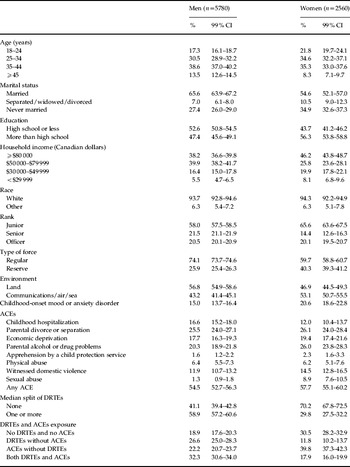
Table 1 illustrates the sociodemographic characteristics of the sample and prevalence of ACEs and DRTEs. Exposure to parental divorce/separation and parental alcohol or drug problems were the most prevalent ACEs among both men and women. The greatest difference in prevalence of ACEs was for childhood sexual abuse, which was much more common in women than in men. Exposure to DRTEs was more common in men than women.
Prevalence of sociodemographic variables, adverse childhood experiences (ACEs) and deployment-related traumatic exposures (DRTEs)

CI, Confidence interval.
All ACEs occurred before the age of 18 years. All percentages are based on weighted data.
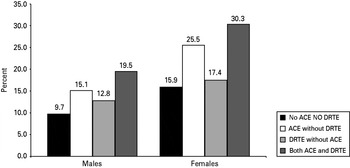
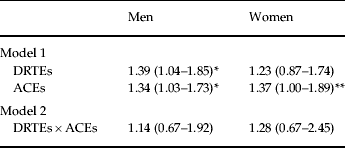
Table 2 shows the models that simultaneously entered DRTEs and ACEs in the same regressions to predict past-year mood and/or anxiety disorders. Among men, both ACEs and DRTEs were independently associated with past-year mood and anxiety disorders. Among women, neither DRTEs nor ACEs remained significantly associated with past-year mood or anxiety disorders. However, there was a significant effect for ACEs in women [adjusted OR (aOR) 1.37, 99% confidence interval (CI) 1.00–1.89, p = 0.01]. In the second model, we tested whether there was a DRTEs × ACEs interaction. None of the interactions were significant. Fig. 1 displays the prevalence of past-year mood and/or anxiety disorders across the four groups of individuals categorized according to their exposure to ACEs and DRTEs.
Additive effects of adverse childhood experiences (ACEs) and deployment related traumatic events (DRTEs) on past-year mental disorders stratified by sex.

Multivariable models examining the relationship between deployment-related traumatic exposures (DRTEs) and adverse childhood experiences (ACEs) on past-year mood and anxiety disorders for men and women
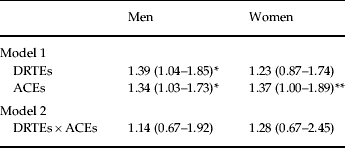
Model 1: adjusted logistic regressions adjusted for age, marital status, income, education, race, military rank, type of force, military environment, and childhood-onset mood and anxiety disorders with DRTEs and ACEs entered in the same model.
Model 2: same variables as model 1 with the addition of the interaction term for DRTEs × ACEs.
Values given as adjusted odds ratios (99% confidence interval).
* p < 0.01, ** p = 0.01.
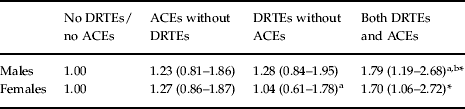
Table 3 presents aORs for the relationship between the four-level DRTEs/ACEs variable with past-year mood and/or anxiety disorders. Among men and women, exposure to ACEs with DRTEs was associated with increased odds of mood and anxiety disorders compared to participants without either ACEs or DRTEs. Among males, exposure to ACEs and DRTEs was also associated with increased odds of mood and anxiety disorders in comparison with those exposed to ACEs without DRTEs, or those exposed to DRTEs without ACEs. Among women, those exposed to ACEs without DRTEs had significantly higher odds of mood and/or anxiety disorders than those exposed to DRTEs without ACEs.
Additive effects of adverse childhood experiences (ACEs) and deployment-related traumatic exposures (DRTEs) on past-year mood and anxiety disorders stratified by sex
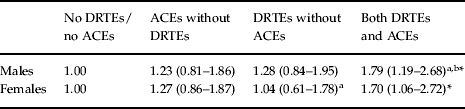
Adjusted logistic regressions adjusted for age, marital status, income, education, race, military rank, type of force, military environment, and childhood onset mood and anxiety disorders.
Values given as adjusted odds ratios (99% confidence interval).
a Significantly different from the ACEs without DRTEs group.
b Significantly different from the DRTEs without ACEs group.
* p < 0.01.
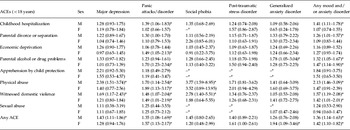
Table 4 demonstrates the associations between each of the ACEs assessed in the survey with each adult onset mood and anxiety disorder. Among the different ACEs, physical abuse was most consistently associated with the majority of adult mood and anxiety disorders across both men and women. Although there was no clear pattern of relationship between particular ACEs and mental disorders, the majority of ACEs were associated with any mood and/or anxiety disorder diagnosis.
Association between adverse childhood experiences (ACEs) and adult mood and anxiety disorders stratified by sex

M, Male; F, female.
Values given as adjusted odds ratios (99% confidence interval).
All mental disorders had an age of onset ⩾18 years. Adjusted logistic regressions adjusted for age, marital status, income, education, race, military rank, type of force, military environment, and childhood-onset mood and anxiety disorders.
* p < 0.01.
a Cell size too small to be reported.
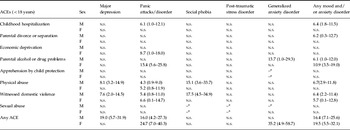
Table 5 shows that the PAF for ACEs on any adult-onset mood and/or anxiety disorder was 16.4% for men and 19.5% for women. PAFs for each of the ACE events with each of the mood or anxiety disorders demonstrated a wide range of associations, from being non-significant to the strongest for GAD for women (34%).
Population attributable fractions (PAFs) for each adversity in relation to adult mood and anxiety disorders

M, Male; F, female; n.s., non-significant relationship, PAF not calculated.
Values given as PAF (99% confidence interval).
All mental disorders had an age of onset of ⩾18 years. Population attributable fractions based on adjusted odds ratios, adjusted for age, marital status, income, education, race, military rank, type of force, military environment, and childhood onset mood and anxiety disorders.
a Cell size too small to be reported.
Discussion
The present study is the first to examine a broad range of ACEs in relation to adult mood and anxiety disorders in a representative sample of military personnel. Our study is a significant advance over previous studies in this area, which have been limited by the use of screening tools to assess adult distress, the selection bias involved in using clinical samples and the inability to examine these relationships separately for male and female soldiers. Several main findings emerge that have both clinical and policy implications.
First, the present study can shed light on the relationship between ACEs and reactions to deployment experiences. Although some authors (e.g. Stein et al. Reference Stein, Tran, Lund, Haji, Dashevsky and Baker2005) have suggested that exposure to ACEs might be an important resilience factor (i.e. soldiers exposed to ACEs may be better able to cope with combat stress), our findings did not support this hypothesis. On the contrary, we found that participants exposed to both DRTEs and ACEs had increased odds of mood and anxiety disorders compared to those without DRTEs and ACEs. However, based on previous literature in clinical samples and theoretical models, we had hypothesized that there would be a synergistic effect (i.e. significant interaction) between exposure to ACEs and DRTEs. Our analysis did not support this hypothesis. These findings are consistent with previous work that found independent effects of combat exposure and physical abuse on mental health outcomes among US male soldiers but also failed to show a significant interaction between these two variables (Fritch et al. Reference Fritch, Mishkind, Reger and Gahm2010). Nonetheless, our findings suggest that there might be an additive effect of DRTEs and ACEs on post-deployment mood and anxiety disorders. Because of the cross-sectional nature of this study, we cannot make causal inferences. Future prospective studies are required to address this issue.
Second, we were able to demonstrate a relationship between ACEs and adult-onset mood and anxiety disorders across male and female soldiers. These findings extend the previous literature in this area and demonstrate the important association between a wide range of ACEs and several adult mood and anxiety disorders. Among the different ACEs assessed in the survey, physical abuse, witnessing domestic violence, parental alcohol and drug problems had the most consistently significant associations with adult mood and anxiety disorders. These findings are consistent with emerging literature that suggests that physical abuse has a greater impact on mental and physical health problems than other forms of ACEs, such as neglect (Scott et al. Reference Scott, Von Korff, Angermeyer, Benjet, Bruffaerts, de Girolamo, Haro, Lepine, Ormel, Posada-Villa, Tachimori and Kessler2011). It is important to emphasize that because we were unable to determine the temporal relationship between ACEs and childhood-onset disorders, we could only examine the relationship between ACEs and adult-onset mental disorders. This methodological limitation might have biased our findings. Because childhood-onset disorders may be particularly associated with poor outcomes and chronic mental health and physical outcomes (Scott et al. Reference Scott, Von Korff, Angermeyer, Benjet, Bruffaerts, de Girolamo, Haro, Lepine, Ormel, Posada-Villa, Tachimori and Kessler2011), it is likely that the current study underestimates the association between ACEs and mental disorders in military personnel. Furthermore, we were unable to adjust for the effects of DRTEs in examining the relationship between ACEs and adult-onset mood and anxiety disorders. The survey did not collect information about the age of onset of first deployment, and we could not determine the temporal relationship between DRTEs and outcomes. Future studies need to address these issues across different military samples.
Third, given the emerging role of women in the military, it is important to consider the risk factors for mental health problems in this subpopulation. To the best of our knowledge, the present study is the first to have sufficient power to be able to examine risk factors in female personnel separately from male personnel. We found very similar findings across men and women in the relationship between ACEs and adult mood and anxiety disorders. The majority of ACEs were associated with adult mood and anxiety disorders among women.
Fourth, although causal inferences cannot be made, approximately 20% of the adult mood and anxiety disorders in the military sample could be attributable to ACEs. These estimates are similar to rates found in general population samples, where ACEs were attributable to approximately 20% of mood disorders in the WMH Surveys (Kessler et al. Reference Kessler, McLaughlin, Green, Gruber, Sampson, Zaslavsky, Aguilar-Gaxiola, Alhamzawi, Alonso, Angermeyer, Benjet, Bromet, Chatterji, de Girolamo, Demyttenaere, Fayyad, Florescu, Gal, Gureje, Haro, Hu, Karam, Kawakami, Lee, Lepine, Ormel, Posada-Villa, Sagar, Tsang, Ustun, Vassilev, Viana and Williams2010). Nonetheless, these PAFs are likely to be underestimates of the impact of ACEs on adult mental disorders in the military because information about substance use disorders was not available in this dataset. Alcohol use disorders are highly prevalent in military samples (Hotopf et al. Reference Hotopf, Hull, Fear, Browne, Horn, Iversen, Jones, Murphy, Bland, Earnshaw, Greenberg, Hughes, Tate, Dandeker, Rona and Wessely2006; Jacobson et al. Reference Jacobson, Ryan, Hooper, Smith, Amoroso, Boyko, Gackstetter, Wells and Bell2008), but only past-year alcohol dependence was assessed in this dataset. In samples from the UK, alcohol use disorders have been shown to be more common than PTSD (Hotopf et al. Reference Hotopf, Hull, Fear, Browne, Horn, Iversen, Jones, Murphy, Bland, Earnshaw, Greenberg, Hughes, Tate, Dandeker, Rona and Wessely2006). Future studies should examine the relationship between ACEs and adult alcohol use disorders in military samples.
Our study also has several limitations. First, although the diagnoses made by the WMH-CIDI are highly reliable, they may not match the accuracy of trained clinician-based assessments (Haro et al. Reference Haro, Arbabzadeh-Bouchez, Brugha, de Girolamo, Guyer, Jin, Lepine, Mazzi, Reneses, Vilagut, Sampson and Kessler2006). The specific reliability of the CIDI in this sample was not determined. Second, personality traits (e.g. neuroticism) and personality disorders (e.g. borderline) were not assessed in the survey and are strongly linked with both childhood abuse and prognosis of Axis I disorders (Kendler & Myers, Reference Kendler and Myers2010; Pagura et al. Reference Pagura, Stein, Bolton, Cox, Grant and Sareen2010). Third, because of the cross-sectional nature of the data, causal inferences cannot be made. However, because ACEs occurred before age 18 and analyses were restricted to mental disorders with onset at age ⩾18, we ensured that ACEs preceded the onset of these disorders. Fourth, the assessment of ACEs might be affected by recall biases. Nonetheless, there is evidence that severe abuse is often remembered well and that false-positive reports are probably rare, whereas less severe adversities are likely to be under-reported (Hardt & Rutter, Reference Hardt and Rutter2004). Fifth, the survey did not collect information such that we could determine the temporal relationship between exposure to DRTEs and onset of mental disorders. Thus, we limited our analysis to past-year mood and anxiety disorders. Sixth, the specific assessment of ACEs and DRTEs in this study might differ from other studies of trauma. The language used to assess potentially traumatic events can substantially affect the prevalence of outcomes of interest. Seventh, PAFs are estimates based on prevalence of exposure in the population and the strength of the association between exposure and outcome (Young, Reference Young2005). In cases where the prevalence of exposure is high (e.g. parental divorce), the PAFs might be exaggerated (Afifi et al. Reference Afifi, Cox, Enns, Asmundson, Stein and Sareen2008). Eighth, the findings from the present study may not be generalizable to other countries that have different military structures and systems than Canada. For example, applicants to the Canadian military are screened for current and past history of chronic mental health problems (e.g. depression requiring medications, bipolar illness and schizophrenia). Other countries that do not screen for psychiatric disorders during recruitment may have different findings. Finally, the sample analyzed in this survey was not involved in the current missions in Afghanistan and Iraq, which have substantially higher amounts of exposure to combat. Further studies are required to examine the associations between ACEs and mental disorders among samples involved in the current missions.
In conclusion, the present study demonstrates a strong association between ACEs and adult mood and anxiety disorders in the military. It also demonstrates that ACEs have an independent effect on mental disorders after adjusting for the effects of deployment. These findings underscore the importance of considering ACEs in pre-deployment and post-deployment intervention strategies for soldiers. Recent empirical work suggests that pre-deployment screening for mental health problems may reduce the risk of post-deployment mental health problems (Warner et al. Reference Warner, Appenzeller, Parker, Warner and Hoge2011). However, this screening program did not include assessment of ACEs. We suggest that future screening programs test the utility of adding measures of ACEs in pre-deployment screening.
Acknowledgments
The preparation of this article was supported by a Canadian Institutes of Health Research (CIHR) operating grant (no. 184490), a New Investigator Award (no. 152348), a Manitoba Health Research Council Chair award (J. Sareen), a Manitoba Health Research Council Graduate Studentship (C. A. Henriksen), a CIHR Fredrick Banting and Charles Best Canada Graduate Scholarship – Doctoral Award (S.-L. Bolton) and a Manitoba Health Research Council Establishment Award (T. O. Afifi). We acknowledge the thoughtful comments of C. Katz, L. Roos, N. Mota and the peer-reviewers. Drs M. Zamorski, R. Jettly and M. Bilodeau provided important information relating to the screening processes in the Canadian Forces. The opinions expressed in this article do not represent the opinions of Statistics Canada.
Declaration of Interest
None.