Exposure to environmental factors during pregnancy can impact on the growth and development of fetuses and their later health (Capra, Tezza, Mazzei, & Boner, Reference Capra, Tezza, Mazzei and Boner2013; Mund, Louwen, Klingelhoefer, & Gerber, Reference Mund, Louwen, Klingelhoefer and Gerber2013). This led to the Developmental Origins of Health and Disease concept. In brief, the concept is that the fetus adapts to its in utero environment to optimize its growth and minimize the potentially adverse effects of environmental exposures by subtly modifying the development of organs and body structures (Gluckman & Hanson, Reference Gluckman and Hanson2004). However, as well as being potentially adaptive, such fetal programming can have adverse implications on later health outcomes.
Mounting evidence from animal models and human observational studies has shown that maternal mental well-being during pregnancy is associated with a wide range of adverse outcomes in the offspring. For example, in rodent pups, exposure to prenatal distress is associated with developmental (Beydoun & Saftlas, Reference Beydoun and Saftlas2008) and behavioral disturbances (Weinstock, Reference Weinstock2001), changes in immune function (Gotz & Stefanski, Reference Gotz and Stefanski2007), and a heightened cardiovascular response (Igosheva, Taylor, Poston, & Glover, Reference Igosheva, Taylor, Poston and Glover2007). In humans, adverse maternal prenatal mental well-being, including high levels of perceived distress, adverse major life events, anxiety, and depression, has been linked to an increased risk of preterm birth and low birth weight (Grote et al., Reference Grote, Bridge, Gavin, Melville, Iyengar and Katon2010), and potentially with neurodevelopmental delays (Grigoriadis et al., Reference Grigoriadis, VonderPorten, Mamisashvili, Tomlinson, Dennis and Koren2013; Grote et al., Reference Grote, Bridge, Gavin, Melville, Iyengar and Katon2010). Children born to mothers reporting higher distress or depression during pregnancy have an increased risk of attention-deficit/hyperactivity disorder (Rodriguez, Reference Rodriguez2005), internalizing symptoms, attention problems (Sharp, Hill, Hellier, & Pickles, Reference Sharp, Hill, Hellier and Pickles2014), and depressive symptoms (Slykerman et al., Reference Slykerman, Thompson, Waldie, Murphy, Wall and Mitchell2014), which may persist into adolescence (Bureau, Easterbrooks, & Lyons-Ruth, Reference Bureau, Easterbrooks and Lyons-Ruth2009). There is also evidence that children exposed to adverse maternal mental well-being have disrupted hypothalamus–pituitary–adrenal (HPA) axis signaling through overactivation (Entringer, Kumsta, Hellhammer, Wadhwa, & Wust, Reference Entringer, Kumsta, Hellhammer, Wadhwa and Wust2009), possibly linked to heightened exposure to maternal cortisol levels in utero (Jacobson, Reference Jacobson2014).
Although the mechanisms through which in utero mental well-being exposure alters the developmental trajectory in association with fetal “programming” are unknown, epigenetic modification of relevant genes is a plausible candidate. A seminal study in rats showed that low levels of maternal care (licking and grooming) early in life was associated with increased methylation of the glucocorticoid receptor gene (NR3C1) in the hippocampus of pups, and that this increased methylation remained stable over time. Increased methylation of NR3C1 was linked with an attenuated HPA axis stress response (Weaver et al., Reference Weaver, Cervoni, Champagne, D'Alessio, Sharma and Seckl2004). NR3C1 plays a central role in the stress response, as glucocorticoids such as cortisol that are released through activation of the HPA axis bind to glucocorticoid receptors to inhibit further HPA axis activation (Kapoor, Dunn, Kostaki, Andrews, & Matthews, Reference Kapoor, Dunn, Kostaki, Andrews and Matthews2006). Dysregulated HPA axis activation is implicated in a range of emotional and psychological disorders such as attention-deficit/hyperactivity disorder, bipolar disorder, and anxiety disorder (Geuze, Reference Geuze2005). Subsequent studies have explored the link between maternal/neonatal distress, epigenetic change, and altered neurodevelopment in progeny. The majority of human observational studies have focused on DNA methylation of NR3C1 in cord blood (Hompes et al., Reference Hompes, Izzi, Gellens, Morreels, Fieuws and Pexsters2013; Mulligan, D'Errico, Stees, & Hughes, Reference Mulligan, D'Errico, Stees and Hughes2012; Non, Binder, Kubzansky, & Michels, Reference Non, Binder, Kubzansky and Michels2014; Oberlander et al., Reference Oberlander, Weinberg, Papsdorf, Grunau, Misri and Devlin2008), and have reported negative correlations between maternal well-being and infant DNA methylation (Turecki & Meaney, Reference Turecki and Meaney2014), albeit at varying sites of the NR3C1 promoter region. However, important limitations must be considered when interpreting these findings to date. Most studies have involved fewer than 100 infants, the focus has been on specific measures of mental well-being that differed across studies, and effect sizes have been small. Furthermore, there has been a general failure to adequately control for the multiple comparisons investigated (number of CpG sites, genes, and exposures), increasing the risk of a Type 1 error.
In our large population-based cohort of mothers and their children, we measured the association between DNA methylation of the NR3C1 gene in cord blood mononuclear cells and maternal mental well-being using three validated measures. Further, we controlled for the number of associations investigated using Bonferroni correction. The findings raise some interesting general issues in relation to methylation-based association studies exploring the link between exposures and offspring epigenetic profile in humans.
Materials and Methods
Participants
The Barwon Infant Study (BIS) is a population-derived birth cohort of 1,074 mother–infant dyads that was established in 2010 with the aim of studying the developmental and early life origins of noncommunicable disease (Vuillermin et al., Reference Vuillermin, Saffery, Allen, Carlin, Tang and Ranganathan2015). Women were recruited between 15 and 28 weeks pregnancy from the Barwon region of Victoria, but excluded if they (a) were not an Australian permanent resident, (b) had moved from the Barwon region before giving birth, (c) were <18 years old at 28 weeks of pregnancy, (d) were unable to complete questionnaires or give informed consent, (e) already had another child in the BIS cohort (with the exception of twins), or (f) were planning to privately store their child's cord blood. Infants were excluded if they (a) were born before 32 completed weeks of gestation, (b) were diagnosed with a serious illness at birth, or (c) had a major congenital malformation or genetically determined disease. For our study, twins were excluded. Ethical approval for this study was granted by the Barwon Health Human Research Ethics Committee.
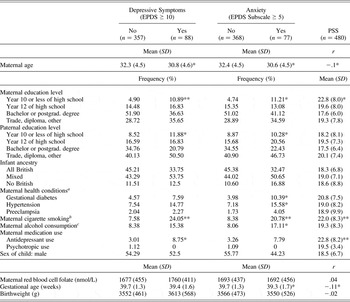
At 28 weeks gestation, mothers were administered questionnaires to gather physical and mental health information, family medical history, demographic, lifestyle, and medication and chemical exposures. Potential confounding factors considered were maternal age, maternal and paternal education, maternal drinking during pregnancy, maternal smoking during pregnancy, and medication use (including psychotrophics and antidepressants; Table 1). Infant ancestry (defined based on the ancestry of their grandparents) was also considered to account for possible genetic differences in populations that could potentially modify the association between mental well-being and methylation levels. At birth, information including infant's gender, gestational age, and birth weight, was gathered from medical records. Pregnancy-related health conditions, such as preeclampsia, hypertension, and gestational diabetes (based on standard criteria), were also obtained.
Characteristics of the study population according to stress exposure

a Recorded in each trimester of pregnancy and defined here as the presence of this condition at any stage over pregnancy.
b Participants classified their level of cigarette smoking into one of three categories (no cigarettes; 1 to 10 per day; more than 10 per day) over the different trimesters of pregnancy, but the analysis considered only use versus no use at any stage of pregnancy.
c Participants classified their alcohol consumption into one of four categories (no standard drinks, <1 per week, between 1 and 6 per week, ≥1 per day) over the different trimesters of pregnancy, but the analysis considered only use versus no use at any stage of pregnancy.
*p < .05. **p < .01.
Maternal measures of mental well-being during pregnancy
We assessed maternal mental well-being using the Perceived Stress Scale (PSS) questionnaire and maternal mental health using the Edinburgh Postnatal Depression Scale (EPDS) questionnaire administered at 28 weeks pregnancy. The PSS is a 14-item self-report questionnaire that indicates the level of perceived distress a mother experiences in the previous month. Scores on the PSS range from 0 to 50, with higher scores indicative of a greater degree of distress. The PSS is a commonly used and well-validated scale with a Cronbach α (a measure of reliability) of 0.78 (Cohen, Kamarck, & Mermelstein, Reference Cohen, Kamarck and Mermelstein1983) and more accurately reflects the biological impact of psychological distress than measuring stressful life events (Hedegaard, Henriksen, Secher, Hatch, & Sabroe, Reference Hedegaard, Henriksen, Secher, Hatch and Sabroe1996; see online-only supplementary Figure S.1).
The 10-item EPDS questionnaire was used to assess symptoms of depression and anxiety. EPDS is a widely validated measure of depression (Cox, Holden, & Sagovsky, Reference Cox, Holden and Sagovsky1987) that assesses mood and feelings over a 1-week period. Depression scores on the 10-item questionnaire ranged from 0 to 30, with a score of 10 or more the most commonly used cutoff to indicate clinical significant levels of depression (see online-only supplementary Figure S.2). This cutoff has also been shown to provide an optimal balance between sensitivity and specificity (Bergink et al., Reference Bergink, Kooistra, Lambregtse-van den Berg, Wijnen, Bunevicius, van Baar and Pop2011). Three of the 10 items on the EPDS form an anxiety subscale, with total scores ranging from 0 to 9. A cutoff of 5 or greater on the anxiety subscale was used to define women with anxiety in the current study as previously described (Matthey, Reference Matthey2008; Swalm, Brooks, Doherty, Nathan, & Jacques, Reference Swalm, Brooks, Doherty, Nathan and Jacques2010). This anxiety subscale has been shown to reliably distinguish anxiety from depression (Matthey, Fisher, & Rowe, Reference Matthey, Fisher and Rowe2013).
Blood sampling and processing
Umbilical cord blood was collected from participants at the Geelong Hospital (public) and St. John of God Hospital (private), Geelong, Victoria. Where possible, blood was collected before placenta delivery by syringe. Up to 20 ml of cord blood was added to a 50 ml Falcon tube that already contained 20 ml of RPMI medium (Gibco, Life Technologies) and 200 IU preservative-free sodium heparin (Pfizer). Bloods were maintained at room temperature on a roller and processed within 18 hr of collection. The mononuclear cells (MNCs) were isolated from the whole blood sample using density gradient centrifugation (Lymphoprep, AxisShield), and cell number and viability assessed by Trypan Blue staining. Approximately 1 × 10⁶ MNCs were removed and stored at –80 °C for future DNA extraction, and another 5 × 10⁴ MNCs were used for flow cytometric assessment of MNC.
Flow cytometry
Antibodies were purchased from BD Biosciences (San Jose, CA) and cells stained with antibodies to CD3-FITC, CD4-PE, and CD45-PerCP. Cell populations were gated based on CD45 positivity and granularity (SSC) to evaluate the relative frequency of lymphocytes, monocytes, and any contaminating nucleated erythrocytes. Isotype controls were used to set up the instrument, and these settings were maintained throughout.
NR3C1 promoter methylation assay
DNA was extracted from 200 μl of cord blood samples using the QIAamp DNA Mini Kit (QIAGEN). Genomic DNA was bisulfite converted using the MethylEasy DNA conversion kit (Human Genetic Signatures, Sydney, Australia).
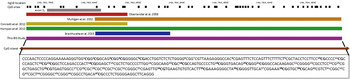
Primers were designed to amplify a 403 base pair region of the NR3C1 promoter (hg_18: chr5:142763696-142764098), spanning 47 CpG sites and including the 1F exon (spanning across CpGs 6–9). This region was chosen based on the sites most frequently identified as differentially methylated in three prior studies, as shown in Figure 1. The amplicon generated methylation data for 23 CpG units by Sequenom Mass Array, including many sites reported in previous studies. Assays were designed using the EpiDesigner software (http://www.epidesigner.com), and cleavage patterns were determined using the ampliconPrediction function in R. The forward primer contained a balance tag (AGGAAGAGAG) and the reverse primer contained a T7 tag (CAGTAATACG ACTCACTATA GGGAGAAGGC T). The primers used were F-5′ TTTAATTTTTTAGGAAAAAGGGTGG 3′ and R-5′ CCCTAAAACCTCCCCAAAAA AC 3′.
(Color online) The NR3C1 promoter region showing the 1F exon (gray) and the region assayed in our study (purple online only) in comparison with prior studies. The sequence of the region assayed and CpG sites are also indicated.

Polymerase chain reaction amplification of the region of interest was performed in technical triplicates for all participant samples. Following in vitro transcription and cleavage, DNA methylation was quantified for each triplicate sample using the SEQUENOM MassARRAY EpiTYPER platform (Ehrich et al., Reference Ehrich, Nelson, Stanssens, Zabeau, Liloglou and Xinarianos2005), and the mean methylation value was used after discarding any outlying values (deviation of ±10% methylation from the median; Martino et al., Reference Martino, Loke, Gordon, Ollikainen, Cruickshank and Saffery2013).
Analysis
This investigation was conducted on 481 mother–infant dyads with prenatal mental well-being measures of maternal mental well-being and a complete set of NR3C1 methylation data (passing our in-house quality control threshold with methylation values for >70% of CpG units assayed). This group did not differ from the overall BIS population in terms of the depression, anxiety, or distress scores, or any of the key covariates such as age and maternal smoking.
A student t test, analysis of variance, and pairwise correlation tests (as appropriate) were initially used to examine the raw associations between mental well-being exposures and methylation values or covariates. Multivariate linear regression models were used to examine the association between maternal mental well-being and cord blood NR3C1 methylation, adjusting for potential confounding factors. Covariates that were associated with both mental well-being exposures and methylation levels at a more conservative level of p < .1 were considered as potential confounders: gestational diabetes, hypertension, alcohol use, and gestational age. Key covariates known to influence methylation levels based on prior studies (maternal smoking, antidepressant use, age, folate levels, infant sex, and birth weight) were also considered regardless of their univariate associations. Interaction effects with infant sex and birthweight were tested. The viability of the MNCs was >99.5%. The cell composition of each cord blood MNC sample (lymphocyte, monocyte, and/or contaminating erythrocytes) was determined by flow cytometry and considered as a covariate to account for cell heterogeneity in samples, but this data did not influence the overall result. Stata 13 IC version (StataCorp) was used for all of the statistical analysis. The nominal (uncorrected) significance level was <.05 and the Bonferroni-corrected p value was .00079 (three maternal well-being measures and 21 CpG units investigated).
Results
Study population
The characteristics of the cohort used in this study are summarized in Table 1. Mothers were on average in their early thirties and generally well educated. Prenatal smoking and drinking prevalence was low. PSS data was available for 480 of the 481 women and was normally distributed with a mean score (±SD) of 18.8 (±7.1; see online-only supplementary Figure S.1). Of the 445 women who completed the EPDS, 88 (19.8%) were classified as depressed (see online-only supplementary Figure S.2), and 77 (17.3%) classified as anxious. The three mental well-being exposures were strongly correlated with each other (p < .001 for all). Compared to the cohort mean PSS score of 18.8 (±7.1), depressed mothers had a mean PSS score of 28.18 (±7.3) and anxious mothers had a mean of 25.50 (±6.6). The overall incidence of depression and anxiety in the cohort was 19.8% and 17.3%, respectively, but within the depressed mothers group, 65% were also anxious. For anxious mothers, 74% were also depressed.
Younger maternal age, a lower level of education, and higher cigarette smoking during pregnancy were associated with worse mental well-being (Table 1). Women with increased levels of anxiety were also more likely to drink than nonanxious women and had a higher frequency of hypertension and gestational diabetes. Anxiety and increased perceived distress were associated with lower gestational age, and antidepressant use was more common in women reporting adverse mental well-being.
Methylation levels
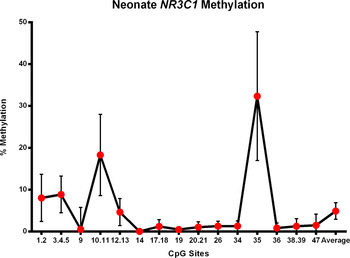
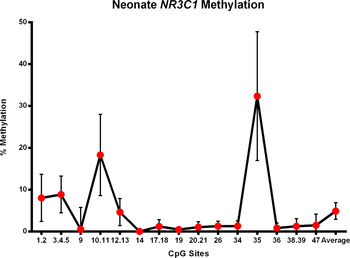
The mean methylation value for each analytical unit of the NR3C1 1F assay is shown in Figure 2. With the exception of analytic units CpG 10.11 and CpG 35, the mean methylation of each unit was below 10%; and for two sites (CpG 14 and 19), the methylation levels were below 1% for all samples. These were thus excluded from further analysis. CpG 35 showed the greatest variability in methylation levels with a median of 34.5% (interquartile range = 18.6–44.5). Eight samples had high methylation levels relative to the rest of the population at various CpG units (four originating from the same participant), and these were therefore considered outliers in sensitivity analysis. Most units had a negatively skewed distribution, so the methylation levels were log-transformed to approximate a normal distribution. The majority of methylation levels at CpG analytical units were correlated with other units from the same individual (p < .01, data not shown).
(Color online) Methylation levels across the NR3C1 promoter 1F region for all study participants. The mean percentage of methylation for each analytical CpG unit of the assay is given, and error bars indicate the standard deviation.
Associations between stress exposures and methylation levels
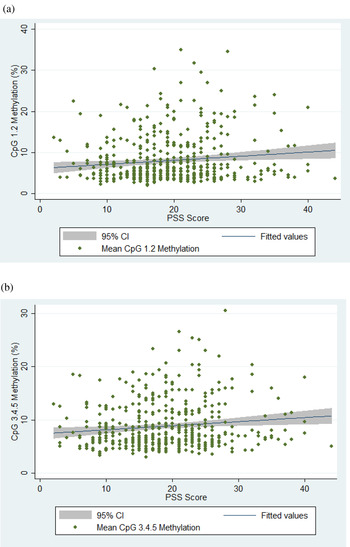
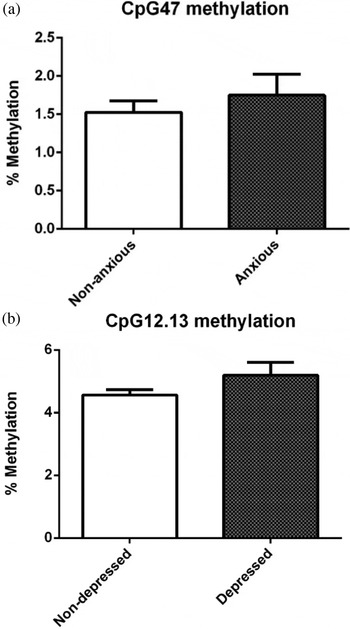
Adverse maternal mental well-being during pregnancy was nominally associated with increased NR3C1 methylation in neonatal cord blood at three CpG units. PSS scores positively correlated with methylation levels at CpG 1.2 (r = .11, p = .02) and CpG 3.4.5 (r = .12, p = .01; Figure 3a,b, respectively). Comparing mean methylation levels according to mental well-being exposure, anxiety (EPDS anxiety subscale score ≥5) was nominally associated with a 0.22% increase in mean CpG 47 methylation (95% confidence level [CI] = 0.10–0.34, p = .03). Children born to mothers who were depressed (EPDS score ≥ 10) versus those not depressed had a small (0.62%) increase in CpG 12.13 methylation (95% CI = 0.04–1.14, p = .05; Figure 4a,b, respectively). Sensitivity analysis, excluding outliers and mothers that used antidepressants during pregnancy, did not materially alter the magnitude or direction of associations (data not shown). Excluding the 18 preterm infants (<37 weeks gestation) marginally strengthened the association between anxiety and CpG 47 methylation (Δ = 0.31%, 95% CI = 0.16–0.46, p = .02) and the associations between perceived distress and methylation of both CpG 1.2 (r = .12, p = .01) and CpG 3.4.5 (r = .13, p = .004). However, it is important that none of these associations remained significant after taking into account the multiple comparisons and the Bonferroni corrected p value threshold of .00079.
(Color online) Correlation between mothers perceived stress scores and cord blood NR3C1 methylation at CpG 1.2 (A, r = .11) and CpG 3.4.5 (B, r = .12). The blue line (online only) represents the line of best fit, and the shaded area is the associated 95% confidence interval.

NR3C1 methylation levels at specific CpG units in cord blood from infants born to mothers with and without high levels of (a) anxiety or (b) depression.

Association between maternal and infant characteristics and methylation levels
Many of the covariates were independently associated with NR3C1 methylation at individual CpG units. For example, maternal hypertension was associated with increased methylation of CpG 14 (95% CI = 0.01–0.14, p < .001) and decreased methylation of CpG 35 (95% CI = –0.36 to 3.20, p = .05). Preeclampsia was associated with decreased methylation at CpG 36 (95% CI = 0.12–0.81, p = .02), but increased methylation at CpG 35 (95% CI = 0.78–8.04, p = .03) and CpG 47 (95% CI = –0.40 to 1.14, p = .05). Mode of delivery (vaginal, planned caesarean, or unplanned caesarean) was not associated with NR3C1 methylation, but higher birth weight was associated with increased CpG 17.18 methylation (r = .12, p = .01) and to a lesser extent with CpG 10.11 (r = .09, p = .1) and CpG 38.39 (r = .08, p = .09). Maternal age was associated with decreased methylation at CpG 12.13 (r = .09, p = .07), while maternal smoking during pregnancy was associated with increased methylation at both CpG 14 (95% CI = 0.05–0.17, p < .001) and CpG 38 (95% CI = 0.16–1.19, p = .08). Antidepressant use during pregnancy was associated with increased methylation at CpG 35 (95% CI = 2.50–16.28, p < .001). However, inclusion of any of these covariates in multivariate-adjusted linear regression models for the association between maternal prenatal mental well-being and neonate NR3C1 methylation levels did not strengthen the associations. No gender-specific effects were found either.
Discussion
This study is the largest investigation to date of the prospective association between maternal mental well-being in pregnancy and NR3C1 methylation in cord blood. Using the approach consistent with previous studies in the field, we report evidence of a weak association between maternal prenatal mental well-being and increased NR3C1 methylation, with variable effects at specific sites within the 1F promoter region that differed according to the type of mental well-being exposure. However, after taking into account the multiple comparisons investigated (three exposures and numerous individual CpG units), none of the associations remained significant. This is an important consideration that highlights the potential limitations of previous studies, predominantly of small sample sizes that did not consider the implications of multiple testing. These limitations may also help account for the divergent findings of prior studies in terms of the specific CpG sites found to be differentially methylated, and the variable effect sizes.
The first human study to explore the link between maternal mental health and infant epigenetic profile in humans investigated four measures of maternal mood in two trimesters of pregnancy and methylation levels at 13 CpG sites (Oberlander et al., Reference Oberlander, Weinberg, Papsdorf, Grunau, Misri and Devlin2008). They reported a nominally significant positive correlation between prenatal EPDS scores treated as a continuous measure in 82 women and increased methylation levels at sites equivalent to CpG 11, 12, and 13 in our study. At CpG 12.13 we also found a weak positive association with maternal depression, but this not did remain following correction for the multiple comparisons performed. In their study of 83 women, Hompes et al. (2013), also reported positive correlations between maternal depression and NR3C1 cord blood methylation at CpG 9, 10.11, and 36, as well as anxiety and CpG 47 methylation. However, they acknowledge that these associations would not stand correction for the false-discovery rate, given the 696 comparisons employed. Previous work investigating placental tissue (n = 482) reported an association between self-reported depression and increased CpG 12 methylation at nominal significance levels (Conradt, Lester, Appleton, Armstrong, & Marsit, Reference Conradt, Lester, Appleton, Armstrong and Marsit2013). A recent study of 57 women was the first to examine buccal tissue from infant swabs and found that maternal depression (EPDS ≥ 10) was associated with higher average NR3C1 methylation across the assayed region (covering CpGs 9–18) in boys only (Braithwaite, Kundakovic, Ramchandani, Murphy, & Champagne, Reference Braithwaite, Kundakovic, Ramchandani, Murphy and Champagne2015). However, there was no evidence of a difference in methylation at individual CpG sites, and none of the findings would survive correction for multiple comparisons. Two genome-wide methylation association studies have been undertaken, and neither reported an association between maternal mental well-being and NR3C1 promoter methylation at genome-wide corrected levels (Non et al., Reference Non, Binder, Kubzansky and Michels2014; Schroeder et al., Reference Schroeder, Smith, Brennan, Conneely, Kilaru and Knight2012). As part of their study, Non et al. (Reference Non, Binder, Kubzansky and Michels2014) also extracted methylation values from the genome-wide data for a number of specific candidate genes, including NR3C1. They reported an association between maternal depression/anxiety and NR3C1 methylation at 1 of the 39 probes, a region close to that investigated in our study. The association (p = .0019) was close to being significant at corrected levels when taking into account the number of probes investigated (adjusted cutoff 0.0013), but not if the number of candidate genes examined (n = 10) was also considered. However, the platform used in these studies does not directly measure methylation at the specific sites targeted by most of the candidate gene analyze; thus, it is difficult to directly compare the significance of these results.
While the consistency of associations reported across several independent studies are encouraging and provide some degree of confidence that the associations may represent true rather than chance findings (Turecki & Meaney, Reference Turecki and Meaney2014), the results from our study emphasize the need for caution when interpreting findings to date. Positive publication bias invariably leads to reporting of studies with significant findings, even those with nominally significant p values obtained from small sample sizes. These are less likely to represent the true nature of exposure–outcome relationships and often overestimate the effect size (Button et al., Reference Button, Ioannidis, Mokrysz, Nosek, Flint and Robinson2013). Further, most studies have reported relatively small effect sizes, and have been underpowered to find significant associations after adjusting for multiple comparisons.
Assuming that adverse maternal mental well-being in pregnancy is associated with specific methylation changes in cord blood, there remains the question of biological relevance. The exact mediator or processes that could be responsible for the transmission of maternal mental well-being during pregnancy to differential NR3C1 methylation in the fetus is not known, but a possible candidate is cortisol. Cortisol is a steroid hormone that is released in response to stress, and has been linked to both psychological distress and depression (Herbert, Reference Herbert2013). Increased maternal cortisol likely results in increased neonate cortisol exposure in utero, and may be involved in mediating fetal programming. Increased maternal cortisol during pregnancy has previously been associated with differential NR3C1 methylation in the neonate (Hompes et al., Reference Hompes, Izzi, Gellens, Morreels, Fieuws and Pexsters2013). Little is known about the long-term effects of very small changes in DNA methylation on phenotypic outcomes. Further, the relevance of methylation differences measured in tissues, such as cord blood or placenta to a complex system such as the HPA axis, remains to be ascertained. Of interest, an observational study in humans found that differential methylation of infant cord blood in association with maternal depression during pregnancy overlapped with differential methylation patterns observed in postmortem adult hippocampi (Nemoda et al., Reference Nemoda, Massart, Suderman, Hallett, Li and Coote2015), thus providing proof of concept that methylation levels in peripheral tissue such as blood could be an indicator of brain methylation levels. However, the correlation between cord blood and brain NR3C1 methylation is yet to be established.
A potential limitation to our study is that participants were questioned about mental well-being at only one point in pregnancy (28 weeks gestation), which may not reflect infant exposure to maternal stress across the pregnancy. Depression, anxiety, and distress scores may be at their lowest during the second trimester of pregnancy, but they have been shown to be highly correlated with measures made at other time points over pregnancy (Rallis, Skouteris, McCabe, & Milgrom, Reference Rallis, Skouteris, McCabe and Milgrom2014). Previous findings have also identified stress occurring in the second trimester, when our measure was made, as a predictor of NR3C1 methylation levels in the neonate (Hompes et al., Reference Hompes, Izzi, Gellens, Morreels, Fieuws and Pexsters2013). Mothers with chronic distress or long-term depression would be anticipated to differ from those with temporary symptoms, particularly in terms of the HPA axis dysregulation and cortisol response (Pariante & Lightman, Reference Pariante and Lightman2008). It is possible that other factors not considered in our study may have influenced our findings, such as maternal steroidal medication use or illicit drug use during pregnancy. Further, no studies to date in this area, including ours, have considered genetic variation in combination with DNA methylation levels, which can have an important influence on DNA methylation patterns (Potter et al., Reference Potter, McKay, Groom, Ford, Coneyworth and Mathers2013; Teh et al., Reference Teh, Pan, Chen, Ong, Dogra and Wong2014), although this varies across genes and gene regions. The extent that variation in NR3C1 genotype could influence the association between mental well-being and NR3C1 methylation remains to be determined. Despite the limitations, our study has a number of strengths. This is the largest population-based study to prospectively investigate maternal prenatal mental well-being exposures and infant NR3C1 methylation in cord blood. This makes it more representative of the general population and mental well-being exposures commonly experienced by mothers during pregnancy, with greater power to identify any associations if they were present. Furthermore, three different and distinct mental well-being exposures were measured using validated instruments (Cohen et al., Reference Cohen, Kamarck and Mermelstein1983; Cox et al., Reference Cox, Holden and Sagovsky1987). There was also data available on a large range of covariates enabling adjusted analyses to be performed to examine the effect of adverse maternal prenatal mental well-being independently of other associated environmental factors such as antidepressant use and maternal smoking. In addition, the region investigated in our study covered not only the 1F exon but also a broader region of the NR3C1 1F promotor than most prior studies, allowing analysis of 23 CpG sites. We observed a number of associations between lifestyle and pregnancy-related variables with small, site-specific changes in methylation, which is likely indicative of the broader relationships of methylation with specific and complex phenotypes.
Although this study provides some weak evidence for an association between adverse maternal prenatal mental well-being and infant methylation at NR3C1, it remains unclear whether this mediates the association between mental well-being and offspring outcomes. Further, we have not determined whether the observed methylation variation alters gene expression status. This limitation is shared by each of the existing studies to investigate the relationship between maternal stress and offspring NR3C1 methylation. Without a functional link, it is unclear whether the differential methylation is a marker for gene expression or a downstream effect not directly related to NR3C1 expression. Because methylation changes over early development, longitudinal studies investigating differential methylation patterns in infants over the first few years of their life are needed to determine if the differences in methylation persist. If stable methylation differences are observed into childhood, and are correlated with child phenotypes, this would provide stronger evidence for a “fetal programming” interpretation of the methylation differences observed in association with adverse maternal mental well-being exposure.
In conclusion, our study confirms some previous reports of a nominally significant association between adverse maternal prenatal mental well-being during pregnancy and infant NR3C1 methylation. However, the observed effect sizes were small, and despite the large sample size, associations did not remain significant after correction for multiple testing. Caution must therefore be taken in the interpretation of previous findings in this area, which may not have included rigorous statistical control, and thus leave open the possibility of Type 1 errors (false-positive findings). Our data highlights the inherent difficulties associated with replicating previously reported associations between specific maternal exposures and specific epigenetic change in neonates. Much of this can likely be attributed to variable study design, but also the preponderance of small, underpowered studies. Future studies in this area must be adequately powered to detect the likely small effect changes, while controlling for multiple comparisons, which will enable more robust estimates of the true association between early life stress and NR3C1 methylation to be determined. Functional studies are also needed to fully explore the biological significance of the potential effects of maternal mental well-being exposures during pregnancy on infant epigenetic profile in peripheral (accessible) tissues, particularly in genes such as NR3C1.
Supplementary Material
To view the supplementary material for this article, please visit http://dx.doi.org/10.1017/S0954579416000183.