The chronic threat of terrorist attacks, with potential for catastrophic harm, imposes extraordinary challenges on policymakers. To serve the country’s interests responsibly and effectively, they have to provide enhanced security against varieties of threat that the country rarely contemplated, much less encountered, before September 11, 2001. In particular, they have to enable government authorities to prevent the worst attacks on civilian targets before they occur—not just apprehend and punish those who have already committed crimes.
At the same time, competent policymakers need to protect deeply valued, constitutionally established rights and prevent security measures from undermining democratic politics. A government that can investigate citizens without constraints and can apprehend merely suspected potential criminals can also use these powers to intimidate dissenters and stifle criticism. It could use such methods not only to suppress dissidents or radical movements but even to weaken and subordinate a mainstream opposition party. At the extreme, partisan abuse of investigatory authority could lead to a Putin-style, one-party democracy. Unless policymakers find ways to reconcile dramatically expanded security capabilities with robust political liberties and privacy protections, the health of American democracy is at risk.
Reconciling the interests in security and privacy requires competent deliberation on surveillance policy and thorough oversight of intelligence practices. Both responsibilities fall primarily to Congress. But does Congress have the capacity to perform these tasks? Does it use information and analysis competently and weigh the relevant concerns in a balanced, discriminating way? Or do legislators distort deliberations either to pursue ideological agendas or to pander to public fears? Under what circumstances do legislators perform their deliberative tasks better or worse? And does the quality of congressional deliberations ultimately shape policy outcomes?
To answer these questions, we examine congressional deliberations on national security letters (NSLs). NSLs are a means authorized by law for investigators to obtain an array of private records on U.S. persons, often from third parties—such as banking statements, phone records, credit reports, and so on—without the requirement of a court order. In the aftermath of the 9/11 attacks, Congress sought to improve the ability of intelligence agents to identify and monitor terrorism suspects. With the passage of the USA Patriot Act, it dramatically simplified the process for issuing NSLs and thus enabled the Federal Bureau of Investigation (FBI) to collect vast amounts of private data without a judge’s approval.Footnote 1 Because Congress has renewed the Patriot Act multiple times since 2001, it has had ample opportunity to consider the merits of NSLs over a nearly fifteen-year period.
We find that legislators, in debating NSLs, consistently disregarded and misrepresented important issues. They demonstrated little understanding of the relevant laws, failed to collect basic policy information, and neglected to determine how authorities stored, shared, and analyzed captured data. With jurisdiction over the Patriot Act split across multiple committees, Congress conducted uneven, often superficial oversight of intelligence-gathering practices and only learned about widespread misuse of NSLs when the press reported on thousands of apparent privacy violations. Furthermore, Congress failed to pass straightforward reforms to curtail investigative abuses once they were known, relying instead on the executive branch to develop new safeguards. Even after major intelligence leaks by Edward Snowden prompted Congress to reconsider all surveillance authorized under the Patriot Act, legislators decided to ignore the long-standing problems with NSLs.
Overall, we conclude that Congress lacks the capacity to identify severe defects in counterterrorism policy and that it struggles, because of partisan polarization and institutional gridlock, to pass even modest privacy reforms. Unless Congress takes serious steps to improve its deliberative capabilities in this area, it will likely continue to mishandle surveillance policy and permit a largely unnecessary erosion of civil liberties.
Assessing Congressional Deliberations
Before we can evaluate deliberations on NSLs and the Patriot Act, we need to set out some criteria and standards for our assessment. The few scholars who have directly investigated legislative deliberation have employed sharply differing approaches.Footnote 2 At one extreme, influential quantitative studies have used systematic content analyses of legislative debates to determine whether they met various requirements of Habermasian “discourse ethics,” such as being inclusive, respectful, and logical in form.Footnote 3 Focusing on matters of directly observable comportment, such analyses have no reference to any independent information or substantive analysis of arguments. For example, they will not notice if an advocate ignores an important criticism or makes a claim that flies in the face of available evidence. Simply put, this approach cannot assess substantive soundness, intelligence, or competence.Footnote 4 In an era in which political commentators lament the ascendancy of “post-truth” politics, this omission is costly.Footnote 5
In sharp contrast to a Habermasian content-analytic approach, other scholars conduct case studies focused on a particular policy issue and perform open-ended evaluations of the policy deliberations. They consider the relevant knowledge that lawmakers and officials have and the validity or credibility of the judgments they make in the course of policy development.Footnote 6 While this approach can compare arguments and decisions to real-world substantive evidence, it potentially gives free reign to ideological predispositions of the analyst. Liberal scholars will find deficiencies, disproportionately, in the deliberations of conservative policymakers, and conservative scholars in those of liberal policymakers. Readers will have difficulty judging whether, for example, an analyst’s finding of overlooked considerations reflects his or her own ideological biases. In truth, even the analyst will not know.
To study deliberation in a useful way, scholars need to find approaches that neither bracket substantive evidence and reasoning, as beyond the scope of inquiry, nor merely indulge idiosyncratic or ideologically driven judgments about them. As one such approach, Mucciaroni and Quirk combined extensive collection of expert-based, real-world information with systematic coding to score debates.Footnote 7 The resulting scores were highly pertinent for comparisons of debate quality over time, across issues, and between institutional settings (for example, the House versus the Senate), and for getting a handle on overall deliberative performance in Congress. However, because the approach focuses on specific features of debate—namely, empirical claims about the effects of policies—it does not provide comprehensive accounts of decision making.
In the present study, our approach is open-ended, yet cautious or restrained. Rather than adopting some narrower focus, we examine congressional committee hearings, floor debates, and other speeches holistically to identify the issues that legislators considered, and to weigh the arguments, appeals, and evidence that they used in seeking to persuade other legislators and the public. To provide the basis for independent judgment, we examine press reports, legal journals, independent audits, and other sources of research to identify the relevant, publicly available information.
On the basis of all this material, we are able to ask and answer pointed, evaluative questions on both procedural and substantive features of the deliberations. Regarding procedures, for example, did the committees hold substantial, reasonably balanced hearings? Did the House and Senate have full-scale floor debates, with consideration of important amendments? Regarding the substance of the issues, did the members accurately understand existing law and the legal effects of proposed changes? Did they consider the potential consequences of policies for relevant outcomes? Did they adopt defensible interpretations of available evidence? Did they seek to clarify and improve proposals? And did they provide for auditing and research on the operation of the program to enhance understanding and improve decisions over time? Stated more broadly, we use the same criteria for competence that participants in deliberations themselves, or lay observers, would employ to evaluate the proceedings—thoroughness, accuracy, and, above all, the intelligence of judgments and decisions. This inclusive, open-ended approach enables us to deal with the almost endless variety of failures of deliberation, without collecting systematic measures of all the pertinent features.Footnote 8
These questions appear to call for controversial judgments and invite a great deal of subjectivity, with obvious potential for political bias. We use caution and restraint, however, by applying heavy doses of modesty, openness to alternative views, and agnosticism in our assessments. That is, even though we assess policy arguments and positions, we endeavor to avoid using our own beliefs, values, or policy preferences as criteria of assessment and sharply constrain the effects of any partisan or ideological bias on our parts. Thus we find deliberative deficiencies in arguments, claims, proposals, or decisions only if we can present what we believe are compelling, nonpartisan and nonideological grounds for judging them uninformed, reckless, tendentious, severely unbalanced, or the like. We give a wide berth for legitimate disagreement, including partisan and ideological differences—especially the general liberal-conservative differences over the relative priority of privacy and security. Where such disagreements exist, our expectation is merely that deliberations should address them honestly and intelligently.
Of course, no judgment is free of perspective—least of all judgments about the intelligence of a debate. We seek to apply values, assumptions, and interpretations that have been widely shared among politically sophisticated individuals representing a fairly broad range of the American political spectrum: from the rational, evidence-based left to the rational, evidence-based right. Moreover, we do not trade in subtleties or fine points or take positions on the kinds of issues that divide well-informed, serious participants in policy debate. We thus expect that our assessments should elicit broad, if not necessarily unanimous, agreement among those presented with the relevant information.
The proof, however, is in the pudding—that is, in the narrative. At each stage when we point out a satisfactory or unsatisfactory feature of deliberative performance, we include the grounds for our assessment in the narrative. Readers, therefore, can and should make their own judgments. In the remaining sections of this article, we will present evidence that in fourteen years of policy development on NSLs, Congress failed to meet reasonable standards of competent deliberation, with adverse consequences for both privacy and security.
National Security Letters Before the Patriot Act
Stretching over several decades, the complex history of NSLs includes multiple laws that predate the September 11 attacks. Similar to administrative subpoenas, NSLs allow the FBI to gather customer information and consumer-transaction records in foreign-intelligence cases. The collected data are commonly used by authorities to generate leads, identify and eliminate suspects, and provide supporting evidence in warrant applications for physical searches and electronic surveillance.Footnote 9 Under various statutes, NSLs have never required judicial approval or supervision. FBI officials simply issue a letter ordering a business to surrender a customer’s or client’s information. In some respects, the Patriot Act’s provision on NSLs merely streamlined the many overlapping laws on FBI records seizures; in other ways, however, it considerably strengthened the FBI’s ability to collect and stockpile the private information of U.S. persons.Footnote 10
Although Congress did not establish NSLs until the mid-1980s, their history began with the Right to Financial Privacy Act of 1978. In passing this legislation, Congress sought to speed up foreign-intelligence investigations by weakening confidentiality protections for banking customers.Footnote 11 Specifically, Congress gave the FBI authority to issue certificates for the purpose of requesting bank records of suspected spies. However, because the act did not require financial institutions to comply with the certificates, many banks, citing state privacy laws, declined FBI requests.Footnote 12
In 1986, Congress passed an intelligence bill that created NSLs and enabled federal agents to seize, without court approval, a customer’s financial statements in espionage cases.Footnote 13 Congress specified that only the FBI director or his designee had authority to issue a letter and that, before signing off on any request, they needed to review “specific and articulable facts” that the target of the investigation was a foreign agent. Additionally, Congress restricted the FBI from sharing any captured information with other federal agencies, unless the seized records were somehow relevant to an agency’s duties. Aside from these stipulations, Congress provided no guidelines on how the FBI should manage or process collected intelligence. So authorities could keep seized records indefinitely, even in cases where agents ultimately determined that a suspect had no foreign political ties (although, prior to 9/11, the practice was to discard nonrelevant information).Footnote 14 Finally, NSLs came with a nondisclosure requirement or “gag order”; banks were barred not only from telling customers that the FBI had collected their files, but also from contacting lawyers to challenge a letter in court.Footnote 15
That same year, Congress also passed legislation allowing the FBI to issue NSLs for all types of communication billing records, including telephone and computer services. Under the Electronic Communications Privacy Act, the FBI was able to issue letters compelling telephone service providers to hand over the names, addresses, length of service, and long-distance phone records of targeted customers.Footnote 16 Later, in response to a court decision, Congress specified that both local and long-distance call information attributed to a targeted number could be collected with an NSL.Footnote 17 As with the capture of bank statements, the FBI director and his designee were permitted to issue a letter for call records only if “specific and articulable facts” indicated that the suspect was a foreign agent. These letters also came with a gag order, preventing phone companies from notifying customers or contacting legal counsel.Footnote 18
In 1996, Congress passed another intelligence bill that further expanded the scope of NSLs.Footnote 19 This legislation granted the FBI authority to obtain credit agency records on suspected foreign operatives. FBI officials asked Congress for the expanded authority because, without it, investigators struggled to identify the financial institutions used by suspected spies and terrorists. They noted that, while counterintelligence agents could not obtain credit histories, the private sector had easy access to them. Persuaded by these arguments, Congress broadened the reach of NSLs to include the capture of credit reports, specifying that these new letters came with the same restrictions and evidentiary standards as all other letters.Footnote 20
Because of intelligence failures that led to 9/11, Congress developed the Patriot Act to enhance investigative tools in espionage and terrorism cases. Among the many changes to surveillance laws, Congress made it easier for the FBI to issue NSLs in two major ways. First, it eliminated the need for agents, in preparing a request to superiors, to provide “specific and articulable facts” that a suspect was a spy or terrorist. To obtain a national security letter now, authorities would simply need to stipulate that the records were relevant to a foreign-intelligence investigation. Second, Congress increased the number of officials who could authorize these letters—from the FBI director and his designee to every special agent in charge of an FBI field office, fifty-six in all.Footnote 21 These two modifications were intended to accelerate the approval process and increase the number of letters issued.
Likely, these two reforms were necessary. Before the Patriot Act, it would take agents about a year to obtain an NSL, encouraging many to withdraw their applications and seek other investigative options.Footnote 22 But as we discuss in subsequent sections, while Congress sensibly gave the FBI greater access to banking, credit, and communication billing records, it placed no safeguards on the newly enhanced NSLs. The FBI could keep all records indefinitely and impose gag orders on all recipients of letters. This combination of expanded surveillance, unchecked stockpiling of data, and imposed secrecy increased the opportunity for investigative abuse.
9/11 and the Patriot Act
In the 2001 Patriot Act, Congress included more than two-dozen measures that expanded the investigative powers of foreign-intelligence agents. Although rushed, the initial legislative debates did cover some important surveillance provisions in the act. In fact, during these early discussions, the only major provision completely neglected by Congress was the one on NSLs.
Some deliberative failures were understandable, if not unavoidable, considering the many difficult tasks that Congress faced immediately after September 11. Above all, Congress needed to identify the most effective measures for preventing further terrorist attacks without unduly eroding civil liberties. Several difficult issues, therefore, had to be contemplated simultaneously, including how to crack down on money laundering, enhance border security, improve intelligence gathering, and maintain effective oversight of national-security programs. Congress, moreover, had to weigh these reforms quickly, in a panicky atmosphere, because of genuine concerns that al-Qaeda would strike again, possibly with a nuclear device.Footnote 23 And it had to negotiate these reforms with a Justice Department interested in radically expanding executive power. In a forty-page bill drafted eight days after 9/11, the George W. Bush administration proposed a set of extreme measures that included the warrantless capture of emails and the indefinite detention of noncitizens.Footnote 24 The few hearings that Congress held on the draft focused primarily on these aggressive measures—none of which made it into a final bill.
Because Congress needed to act quickly, it used much of this forty-page draft as a starting point for the Patriot bill. In the Senate, Patrick Leahy, a liberal Democrat from Vermont, and Orrin Hatch, a conservative Republican from Utah, took control of bill development and put together one version of the legislation while, in the House, the Judiciary Committee drafted another version that all thirty-six members supported. Both versions were completed in early October, less than a month after the attacks, and both were the product of an unusual degree of bipartisan compromise. The Leahy-Hatch bill incorporated more proposals from the Bush administration than the House bill did; and it made all surveillance measures permanent, whereas the House bill set its surveillance provisions to expire after three years. Preferring the Senate version, Bush officials pressured Republican House leaders to quash the Judiciary Committee’s bill and to submit the Leahy-Hatch bill in its place.Footnote 25 After a four-year sunset was added to most surveillance provisions in the Senate bill, Speaker Dennis Hastert (R-Ill.) made the substitution the morning of the floor debate in the House.Footnote 26 Inexplicably, the measure on NSLs was one of the few surveillance provisions that included no sunset.Footnote 27
Since the bill had been drafted in haste, without hearings or markups, the floor debates represented the main stage of formal deliberations. These debates, at best, were cursory. For one thing, the House considered the bill under suspension of the rules and the Senate tabled all amendments, ensuring that neither chamber had the opportunity to revise the legislation. For another thing, House members had little opportunity to review the substitute bill, and many legislators readily admitted that they did not know what provisions it contained. Of the senators familiar with the legislation, only a handful offered detailed, substantive criticism. Russ Feingold (D-Wis.), the sole senator to vote against the Patriot bill, argued that its lower evidentiary standard for court-sanctioned surveillance would lead to significant privacy violations. Pointing to several provisions, he argued that lower thresholds for eavesdropping would enable authorities to “go on a fishing expedition and collect information on anyone.”Footnote 28
Feingold raised important privacy concerns that few other legislators voiced in the 2001 debates. But if he was worried about courts approving surveillance based on minimal evidence, he should have been doubly worried about NSLs being issued without any judicial scrutiny whatsoever. Among the Patriot bill’s many provisions, the risk of privacy violations and fishing expeditions was greatest from these letters. Yet neither Feingold nor any other legislator mentioned them during the debates. Failure to discuss NSLs represented perhaps the biggest deficiency in this round of congressional deliberations. Moreover, because no one discussed the letters, no one questioned why they were being made permanent when most other surveillance provisions came with a four-year sunset.
Given the uncertainty over al-Qaeda’s capabilities at the time, Congress made a reasonable decision to rush passage of the Patriot Act. The decision to act quickly, in order to deal with presumed immediate threats, led Congress to overlook major policy questions as it broadened the government’s investigative powers. Yet, deliberations on NSLs continued to be inadequate well after the initial security crisis had passed.
The Republican Reauthorization, 2005–2006
In the spring of 2005, eight months before the Patriot Act’s scheduled sunset, Congress assessed all surveillance provisions—including permanent ones—as it drafted a reauthorization bill.Footnote 29 Legislators in this round of deliberations focused on two fundamental questions: How well did the Patriot Act help authorities deter or capture terrorists, and had the act led to significant rights violations? There were twenty-three congressional hearings focused on reauthorization, and members on the Judiciary and Intelligence panels used them to learn about the legislation in detail. Many committee witnesses were Justice Department officials, who provided some evidence that the Patriot Act had aided terrorism investigations. House and Senate committees also made an effort to hear from a diverse collection of policy experts, including conservative scholars, civil-liberties activists, corporate lawyers, and immigrant groups. Additionally, the Congressional Research Service drafted a series of briefs that provided detailed legal analysis of the Patriot Act.
The quantity of deliberations this time was impressive, but the quality suffered because of intense partisan conflict—especially in the House. Opposed to the Bush administration’s use of torture, extraordinary rendition, and the Guantánamo Bay prison, some Democrats used the reauthorization debates to challenge the broader war on terrorism. As members of the minority party, they had little opportunity otherwise to push their concerns onto the Republican-controlled agenda. Determined to shield Bush from criticism, Republicans accused Democrats of grandstanding and running wildly off topic. In one episode, Republican leaders cut microphones to shut down a committee hearing on the Patriot Act, silencing Democratic witnesses.Footnote 30
Partisan rancor did not initially extend to issues about NSLs. Members could not engage in fierce disagreements in this case because, generally, they did not know enough about the letters to develop, let alone clash over, major reform proposals. Early concerns over NSLs, voiced by a handful of members from both parties, were focused on relatively minor considerations. Only in late 2005, when government leaks exposed widespread abuse of NSLs, did partisan disagreements take over. Democrats quickly sought to curb the use and scope of the letters, while Republicans opposed all reforms and defended the Bush administration’s record on domestic surveillance.
The bipartisan coalitions that emerged in the early stages of deliberations, well before the scandals broke, pushed for two NSL reforms: higher evidentiary requirements and an end to gag orders. Neither effort was viewed as an attack on the Bush administration. Spearheading reform on evidentiary requirements, Senator Larry Craig (R-Ida.) sponsored a bill that would revive the pre-Patriot Act “specific and articulable facts” standard, so that officials could only issue letters against confirmed foreign agents.Footnote 31 Craig worried about FBI abuses, but offered no facts, at least in public discussions, to support his concerns. A bipartisan group of fifteen senators cosponsored his bill, including Russ Feingold, Chuck Hagel (R-Neb.), and Barack Obama (D-Ill.). Pushing for even more extensive reforms, some legislators wanted the Foreign Intelligence Surveillance Court, a secret judicial panel that monitors domestic spying, to take over the approval of NSLs.Footnote 32 A veto threat from President Bush encouraged the Senate Judiciary Committee, under Chairman Arlen Specter (R-PA), to set aside the Craig bill and to block proposals for new judicial controls.Footnote 33
The second reform—ending gag orders on NSLs—had widespread support in Congress. In 2004, after receiving an NSL, an Internet provider had asked the America Civil Liberties Union to challenge the order in a federal court. The lawsuit represented a violation of the letter’s nondisclosure terms, but, rather than penalize the provider, the court ruled in its favor, deciding that NSLs undermined free-speech rights by “imposing permanent silence on targeted companies.”Footnote 34 Large majorities in the House and Senate approved the ruling and agreed that allowing recipients to challenge NSLs in court would not unduly burden terrorism investigations. Rep. Jeff Flake (R-Ariz.) offered a floor amendment that would curtail the gag orders; it passed the House with a nearly four-hundred-vote bipartisan majority and was included in the final version of the reauthorization bill.Footnote 35
Consensus on NSLs was short lived, however. In late 2005, as a conference committee worked against the deadline for sunset, the Washington Post reported that a tremendous spike in the number of NSLs had occurred since 9/11. Citing anonymous government sources, the Post reported that the FBI had been making more than thirty thousand requests for NSLs per year—“a hundredfold increase over historic norms.”Footnote 36 This increase, the paper explained, had enabled the FBI to investigate tens of thousands of U.S. residents in the last four years, the vast majority of whom likely had no criminal or terrorist ties.Footnote 37 The paper also reported that some FBI agents had used NSLs improperly by asking for documents that legally could only be obtained by court order. It further alleged that the government kept all seized materials and added them to a massive databank that was widely accessible to federal investigators.
Republican defenders of the reauthorization bill challenged the accuracy of the Post story and dismissed calls to add stronger safeguards to NSLs. Chairman Specter assured the Senate that the Post’s report of thirty thousand NSLs was “out of line and not accurate.” He urged senators to “go to the Department of Justice—they will give you a classified briefing and tell you what the facts are.”Footnote 38 But Leahy, who had helped draft both the Patriot Act and its reauthorization, disputed Specter’s claims, noting that the Bush administration had repeatedly refused to provide Congress with complete records on NSLs. “As to the 30,000,” Leahy explained, “it is difficult to get an answer to this because the Justice Department has been remarkably tightlipped. They have not answered questions.”Footnote 39 He then argued that classified briefings would be unsatisfactory at this point, because legislators lacked sufficient information to question and assess any data presented to them in a closed session.
It is unclear whether the Bush administration had withheld reports from all of Congress, or only from most of the members.Footnote 40 Under the two 1986 statutes on NSLs, the Justice Department was required to inform only the House and Senate Intelligence committees about the FBI’s use of records requests.Footnote 41 Importantly, the 2001 Patriot Act did not alter or expand this reporting requirement. Even though the Judiciary committees were primarily responsible for drafting the reauthorization bill, their members—including Specter and Leahy—may not have had access to even partial reports on the use of NSLs.
A month after the NSL revelations, the press reported that the National Security Agency (NSA) was secretly recording thousands of U.S. phone calls without warrants.Footnote 42 The combination of these two surveillance scandals prompted Senate Democrats to threaten a filibuster against the reauthorization of the Patriot Act unless a new oversight provision was added. Republicans capitulated and the bill passed, finally, in March 2006. The new measure in the reauthorization bill stipulated that the inspector general of the Justice Department would conduct retroactive and annual reviews of NSLs, as well as other investigative tools in the Patriot Act. No other changes were made to the NSL provision.Footnote 43
This last-minute inclusion of the auditing requirement revealed a major deficiency in congressional deliberations up to this point. Between 2001 and 2005, Congress had failed to ask for detailed reports on the government’s use of NSLs, and therefore had no idea how many letters had been issued over the years or for what purposes. As a consequence, Congress had no knowledge of whether the use of NSLs had led to abuses, the capture of terrorists, or both. Questions of abuse and effectiveness were both important and yet, at five years into the implementation of the Patriot Act, Congress had no concrete information about either outcome. It appears that Leahy and other critics had pressed for information about NSLs behind the scenes, but no one had raised concerns about them in the many public hearings on the Patriot Act.
Stalled Democratic Reforms, 2007–2010
The first audit resulting from the 2006 oversight requirement, completed in 2007, verified the Post’s report and confirmed that the FBI had regularly misused NSLs in several ways. It also showed that, the year before, legislators had discussed and reauthorized the provision on NSLs without the most basic facts. Embarrassed by the findings, Congress was pushed into reconsidering the Patriot Act shortly after having renewed it. This time, however, Republicans were no longer in charge of Congress. The 2006 midterm elections had given Democrats majorities in both the House and the Senate, largely because voters blamed President Bush for mishandling the Iraq War.Footnote 44 Now, with control of both chambers, Democrats held a series of hearings on NSLs that explored and drew attention to FBI abuses. Despite this initial zeal, however, the Democratic majority failed to pass any legislative reforms.
In the first report, the inspector general noted that FBI officials had granted more than one hundred and forty thousand requests for NSLs between 2003 and 2005, enabling agents to collect and keep private documents on almost twenty-four thousand U.S. persons.Footnote 45 Information from these files was added to searchable databanks that seventeen thousand federal agents could access.Footnote 46 At the same time, the FBI had underreported its use of NSLs and in many cases could not identify which set of seized records belonged to which terrorism investigations, if any at all—often because they used the letters in exceptionally broad ways.Footnote 47 In one example, FBI agents collected records on all individuals who had a vehicle parked at a hotel where a suspect had booked a room.Footnote 48
Additionally, the inspector general found that authorities had committed significant, and in some cases intentional, privacy violations with NSLs. Agents had obtained documents that they were not entitled to seize, sometimes because recipients had handed over too much information and sometimes because agents had asked for inappropriate data.Footnote 49 In one case, agents had received and retained all the messages from a target’s e-mail account—even though they knew that a court order was required for such a seizure.Footnote 50 In another case, agents had deliberately circumvented the FISA Court by issuing NSLs for documents that the court had already ruled off limits to authorities.Footnote 51 The inspector general identified serious FBI violations in 22 percent of investigations that he examined.Footnote 52
In hearings that followed the 2007 report, members of Congress questioned Justice Department officials, the director of the FBI, privacy-rights advocates, and several former FBI lawyers about the use of NSLs. Their main interest was to determine the extent of the privacy violations and to assess the value of NSLs as investigative tools. Both current and retired FBI officials provided very similar answers in their testimony. They explained that, while some FBI agents had purposely broken the rules, most had likely committed violations inadvertently; an abundance of legal complexities made it easy to make mistakes. As one former official pointed out, investigators could obtain a suspect’s telephone records using eight different kinds of court orders and subpoenas, depending on the circumstances of the case. Each order came with its own unique evidentiary standards and processing requirements, which inevitably created confusion.Footnote 53
The witnesses also agreed that keeping seized documents and adding them to an electronic database for an indefinite period posed a threat to privacy. Given that most targets of NSLs had little or no connection to suspected terrorists, several witnesses suggested that Congress adopt a common set of investigative restrictions from foreign-intelligence law—termed “minimization procedures”—and impose them on the letters to limit the possibility of agents building watch lists.Footnote 54 Effectively, the minimization procedures would require authorities, within a short period of collection, to discard all information captured on individuals with no meaningful links to foreign agents or foreign organizations.Footnote 55
At the same time, former and current Justice Department officials argued that NSLs were an essential tool in terrorism investigations and should remain available to agents. During the hearings, they insisted that it would seriously impede investigations if authorities had to seek court approval for them. They argued that agents needed at least one tool that they could use quickly to confirm and disconfirm suspects. The inspector general provided support for this argument in his committee testimony. A major finding in the audit, he noted, was that even a low evidentiary standard often presented a major investigative obstacle to agents. He pointed out that FISA Court orders for business records had been issued only twenty-one times to the FBI in the three-year period under review.Footnote 56 As he explained, this was because agents, for a number of reasons, had experienced “processing delays” as they prepared court applications.Footnote 57 On average it took more than 150 days to process an order, often because of sloppy internal procedures within the FBI or because of disagreements between FBI and Justice Department lawyers over application requirements.Footnote 58 To place similar court oversight on NSLs would likely produce the same delays and make them similarly unusable.
Within months of receiving the first audit in March 2007, Democrats in the House and Senate Judiciary committees drafted bills aimed to address the overcollection of private records. They proposed to place minimization procedures on NSLs that would require agents to discard all nonrelevant information within a short period.Footnote 59 In effect, the proposals would allow the FBI to continue issuing tens of thousands of NSLs each year but compel the agency to reduce its databanks of seized records.
Although legal experts and lawmakers broadly agreed on how to limit FBI intrusions, congressional Democrats did not bring a bill for that purpose to the floor while President Bush remained in office. They may have anticipated a presidential veto or feared a partisan debate on national security during the 2008 election year. As a result, they failed to amend NSL provisions that were widely considered problematic.
Moreover, Democrats made no attempt to enact restrictions on NSLs in 2009 or 2010—despite having large majorities in the House and Senate and a Democrat, Barack Obama, in the White House. Instead, congressional Democrats deferred to the Obama administration on the issue. Justice Department officials eventually drafted classified minimization procedures for NSLs,Footnote 60 and the FBI instituted about two-dozen additional reforms on the basis of the inspector general reports.Footnote 61 Furthermore, by failing to revise the NSL provisions, Congress allowed the auditing requirement for the letters to lapse—although the inspector general continued to conduct regular reviews.Footnote 62
In short, after easing the requirements for issuing NSLs in the 2001 Patriot Act, Congress took six years to learn how the executive branch was using the authority, recognize the rampant abuses, and develop proposals to bring them under control. That Congress did not demand audits until 2006 undermined its ability to assess the FBI’s surveillance practices. Finally, at the point when the Democratic Congress had become well informed and had formulated a broadly accepted set of reforms, it froze—and deferred all changes in surveillance to the executive.
After the Snowden Revelations, 2013–2015
Congress in 2011 renewed the Patriot Act, without change, for another four years.Footnote 63 Although a handful of Democratic senators had pushed for greater restrictions on surveillance tools, including NSLs, most legislators saw little reason to pass additional privacy safeguards. Prominent Republicans even called for making the entire Patriot Act permanent, arguing that its surveillance measures were well understood and posed no significant threat to privacy. Two years later, however, extraordinary revelations demolished these claims. Documents released by Edward Snowden in June 2013 showed that the NSA had used secret interpretations of the Patriot Act to spy indiscriminately on Americans—collecting everyone’s phone and Internet communication records, or “metadata,” to map out vast social networks. It turned out that most members of Congress, including many of the act’s most ardent supporters, had no idea about the domestic eavesdropping programs.Footnote 64 Struggling to understand the enormity of NSA abuses, many legislators decided to review all record-collecting tools in the Patriot Act—including NSLs.
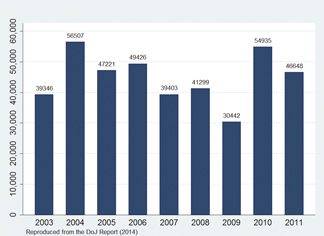
The Snowden leaks did not uncover new information about national security letters. However, a 2014 audit by the inspector general reported that the FBI still used them widely and at times violated their statutory limits. According to the audit, agents consistently requested more than thirty thousand letters per year, indicating that the 2005 scandals had not deterred the FBI from using this tool very broadly (see Figure 1).Footnote 65 Although investigators generally followed statutory procedures, some agents used NSLs in unauthorized cases or issued letters without seeking proper approval from a senior official.Footnote 66 Furthermore, the FBI continued to have difficulty keeping track of which letters were used for which investigations.Footnote 67 The inspector general concluded that violations were no longer as widespread or severe as in the past, but he noted that the FBI often worked slowly to identify, report, and remedy problems.Footnote 68
Annual FBI Requests for National Security Letters.

Between the Snowden revelations and the independent audit, some legislators renewed calls to impose judicial oversight on NSLs. President Obama’s Review Group on domestic surveillance, launched in response to the Snowden leaks, concurred. In its assessment of the Patriot Act and other surveillance legislation, the group recommended that the FBI no longer issue NSLs and that, instead, the FISA Court gain authority over them. The panel argued that foreign-intelligence investigations often seek particularly sensitive documents, making judicial supervision in such cases especially necessary for the protection of privacy.Footnote 69
In an early 2014 hearing before the House Judiciary Committee, Deputy Attorney General James Cole was asked about the value and feasibility of having the FISA Court approve NSLs. He answered, “I do not think it would provide any significant protection against privacy invasions for citizens.” The reason, he explained, is that authorities would simply avoid using the letters and instead seek other, easy-to-obtain records requests. He argued that grand jury subpoenas would serve as an attractive alternative, because investigators—not grand jury members—have the authority to issue the subpoenas. He also pointed out that various types of administrative subpoenas could likely be used as substitutes for NSLs.Footnote 70 These alternative tools, however, did not match the investigative efficiency of the letters; otherwise, the FBI would have opted to use them alongside NSLs after 9/11.
Several months after this hearing, the House and Senate unveiled proposals for a USA Freedom Act as the main legislative response to the Snowden revelations.Footnote 71 Although differing in various respects, both bills contained a lengthy section on NSLs, and thus represented the first serious attempt by Congress to reform them since 2007. This reform effort was rather narrow, however. Overlooking the main issues about the letters, lawmakers failed to include the 2007 proposals that would force agents to discard nonrelevant information collected in the course of an investigation. Instead, they included provisions that would prevent the NSA from gathering phone and e-mail metadata with a letter.Footnote 72 While the NSA had not used the letters for its bulk-collection programs, Congress reasonably sought to prevent the agency from abusing them in the future. Yet, in focusing exclusively on NSA violations, legislators ignored obvious ways to implement a permanent check against FBI records seizures. Although a Republican filibuster prevented passage of the USA Freedom Act in 2014, Congress passed the bill, with the same minimal restrictions on NSLs, the following year.Footnote 73
Appraisals and Conclusions
In the fourteen years of policymaking since the September 11, 2001, terrorist attack, Congress failed any test of competent deliberation on national security letters. To begin with, legislators completely overlooked the NSL provision in the 2001 debates. Early critics of the Patriot bill questioned other surveillance measures but failed to consider how the enhanced letters would facilitate the FBI’s seizing vast amounts of personal data on U.S. persons. Members of Congress not only lacked understanding of how the bill would modify NSLs; they were apparently unaware that the bill even dealt with this investigative tool.
Four years later, during the 2005 reauthorization, legislators understood the basic procedures and evidentiary standards for NSLs, but they still had little notion of how, and how extensively, the FBI used them, and with what effects. How many NSLs were being issued each year? Had they helped investigators identify terrorists? What safeguards prevented the abuse of NSLs? Members of Congress failed to raise these questions for much of the 2005 debates. In more than a dozen public hearings, they lacked the initiative to ask the FBI for data on their investigative practices in foreign-intelligence investigations. Only after press reports exposed widespread and serious abuse did Congress, skeptical of the reports, call for audits of the NSL program.
After the audits came out in 2007 and 2008, confirming and elaborating the evidence of abuse, the new Democratic Congress still failed to act. As the reports detailed, investigators retained all private information gathered from the tens of thousands of NSLs issued each year and stockpiled in massive, searchable databases. Surveillance and civil-liberties experts—and even FBI officials—agreed that Congress should impose minimization procedures on NSLs. Several legislators drafted bills to do so. But Democratic leaders let them die in committee.
The failure to act—reflecting the Democrats’ trust in President Obama and fear of a partisan debate on terrorism security—was a missed opportunity to strike a deliberate balance between the competing concerns of privacy and security. The administration adopted minimization procedures for NSLs. But by deferring to the executive, Congress gave Obama and his successors unfettered ability to weaken or eliminate these procedures, and to restart the stockpiling of citizens’ records, at any time. Presidents are not reliable defenders of privacy rights.
In its otherwise dismal fourteen-year performance, Congress made one reasonable policy decision over NSLs: none of the failed reform bills sought to strip approval powers from FBI officials and place the letters under judicial control.Footnote 74 Given the many delays that agents had experienced trying to obtain FISA Court orders, authorities needed at least one speedy means for jump-starting investigations. A court application for NSLs would have produced a contradictory legal regime in which authorities, seeking customer records, would face greater investigative barriers and higher evidentiary requirements in terrorism cases than in traditional criminal probes. The added difficulties would have had significant costs in the effectiveness of counterterrorism investigations.
What are the broader lessons about the deliberative capability of Congress? To be sure, the main lesson is that Congress lacks the ability to monitor, assess, and reform complex investigatory procedures, with potentially important effects on both privacy and security. In managing one of the central long-term challenges affecting the health of American democracy, the country’s chief democratic institution, Congress, fails. This failure, moreover, has not been subtle—a matter of exaggerated inferences from evidence, overlooking indirect effects, ignoring lower-probability outcomes, or the like. Far more elemental, the failure of deliberation has comprised several kinds of gross neglect: not discussing important decisions at all, not providing for the collection of pertinent information, making strong claims on the basis of no information, and—after information had become available and relatively broad consensus had emerged—declining to act. Institutional gridlock, sometimes due to actual partisan standoff, sometimes merely due to majority-party fear of partisan criticism, has preserved the statutory status quo on NSLs despite dramatic revelations of clear-cut abuse. Except for the elimination of the gag rule, the NSL provision has effectively been locked in place since 2001.
In part, Congress’s failure in setting policy for national security letters has been an instance of a broader, widely recognized incapacity of contemporary American national government—the result of severe, ideologically polarized party conflict in an institutional system that requires compromise and cooperation in order to act.Footnote 75 But it has also reflected specific institutional problems in policymaking for counterterrorism investigations and surveillance. The specific problems include a lack of monitoring and review of investigatory practices, constraints on legislative discussion of necessarily secret information, and collective inattention resulting from the sharing of jurisdiction among multiple committees. With the issue-specific difficulties added to the polarization-induced general incapacity, Congress’s failures in defining the limits of governmental investigatory authority have been pervasive and profound.