INTRODUCTION
Much recent research on social protection in Ethiopia has focused on the cash- and food-for-work Productive Safety Net Programme (PSNP), which constitutes a key part of the government's Food Security Programme (FSP). Nevertheless, the PSNP is not the only policy that aims to provide a form of social protection in rural Ethiopia. Indeed, the Ethiopian government justifies state land ownership specifically in terms of the protection that it provides to small farmers. While these policies are based on very different rationales, there are clear links between land tenure, the system of agricultural production that it helps to define and food insecurity. This paper examines the implementation of these policies through a case study of a food-insecure site in Tigray, highlighting the links in terms of social protection, agricultural production and political motivations.
Existing research on land tenure and food security has paid insufficient attention to the links between the two issues (Maxwell & Wiebe Reference Maxwell and Wiebe1999). Similarly, in Ethiopia research on the PSNP has tended to focus on impact evaluations, assessing the programme's performance in terms of its own rather narrow objectives. Much of this emerging literature makes no mention of land (Gilligan et al. Reference Gilligan, Hoddinott and Taffesse2009) or limits discussion to the use of land access as a criterion for targeting assistance (Devereux et al. Reference Devereux, Sabates-Wheeler, Tefera and Taye2006; Sharp et al. Reference Sharp, Brown and Teshome2006; Bishop & Hilhorst Reference Bishop and Hilhorst2010; Berhane et al. Reference Berhane, Hoddinott, Kumar, Taffesse, Diressie, Yohannes, Sabates-Wheeler, Handino, Lind, Tefera and Sima2011). The few studies on the PSNP that do acknowledge a link between land shortages and poverty, do not explore the relationship between the two policies in depth (Kebede Reference Kebede2006; Slater et al. Reference Slater, Ashley, Tefera, Buta and Esubalew2006; IDL Group 2010).
Meanwhile, research on land tenure has focused on economic efficiency under different forms of land ownership, in particular the implications of subjective tenure security for investment in agricultural production (Deininger & Jin Reference Deininger and Jin2006; Ayalew Ali et al. Reference Ayalew Ali, Dercon and Gautam2007) and the inability of the most effective farmers to accumulate land under state ownership (Rahmato Reference Rahmato2009). There has been much less research on the relevance of land tenure for food insecurity (Rahmato Reference Rahmato and Rahmato2003) and little or no consideration of the links between land and the PSNP. This study directly addresses these gaps, examining the potential for synergy and conflict between agricultural and social protection policies (Sabates-Wheeler et al. Reference Sabates-Wheeler, Devereux and Guenther2009).
The paper pursues a case-based approach, analysing data from multiple sources with convergent lines of enquiry to provide a more complete picture of the case. The main qualitative data sources are semi-structured interviews with policymakers and residents of the case study site, conducted in March and April 2010. Respondents from the community were purposively selected based on criteria of class, age, ethnicity and gender. Key informant interviews were conducted with local and regional government officials, representatives of donor and non-governmental organisations. The case study is also one of the sites where the Ethiopian Rural Household Survey (ERHS)Footnote 1 has been conducted since 1994. While the qualitative fieldwork sought breadth of coverage, examining policy impact on different types of household, the ERHS provides complementary quantitative data, which are statistically representative of the site. Cases are analysed as ‘configurations of aspects’ (Ragin Reference Ragin2000), emphasising that the impact of one intervention takes place in the context of other policies and the overall socioeconomic system that generates insecurity (Bevan et al. Reference Bevan, Dom and Pankhurst2009).
The paper argues that the land policy is a key determinant of the agricultural system of production, which, in turn, has vitally important implications for the production and distribution of food, and the nature of Ethiopia's food insecurity problem. While the PSNP has made important advances by providing reliable, medium-term support to vulnerable households, in certain parts of the country, the government has used the programme to support failing policies, avoiding difficult choices regarding agricultural reform, while contributing to growing food insecurity. In doing so, the PSNP supports the political objectives of the land policy, namely limiting urban migration and ensuring state control over the rural population.
The paper is organised as follows. The next section outlines contrasting approaches to social protection as represented by the PSNP and land tenure. The paper then presents the case study of policy implementation, before discussing the relevance of the findings for food security, social protection and politics. The final section concludes.
CONTRASTING APPROACHES TO RURAL SOCIAL PROTECTION
The Ethiopian government uses two very different discourses to justify contrasting social protection policies in rural highland areas. These are the PSNP, which provides targeted assistance to address food insecurity, and state land ownership, which, according to the government, has the potential to promote egalitarian growth and provide universal protection to smallholders.
Food security and the PSNP
According to the governing Ethiopian Peoples' Revolutionary Democratic Front (EPRDF), food insecurity is the result of unpredictable rainfall, ‘land degradation and high population pressure’, and inadequate knowledge of the farmers, who have ‘lost the capacity to be productive’ (MoFED 2005: 95). This framing identifies food insecurity as a naturally occurring problem, separate from other government policies, necessitating a targeted social protection programme to address the problem, rather than more fundamental changes involving the re-evaluation of government agricultural policies.
The FSP distinguishes between chronic and transitory food insecurity. While people suffering from temporary problems receive emergency assistance, the PSNP is a cash and food-for-work programme established in 2005 to provide medium-term support to chronically food-insecure households. By securing the consumption needs of these households, the programme aims to prevent distress sales of productive assets, which would damage future production (MoARD 2009). Furthermore, the FSP includes programmes that complement the PSNP and designate paths to food security for different types of food-insecure household. If correctly followed, these are expected to provide a minimum income, enabling them to ‘graduate’ from assistance.
Able-bodied men and women are required to participate in public works to qualify for the PSNP, which along with the capital-intensive Complementary Community Investments (CCI), are geared towards improving community resources and infrastructure. Meanwhile, the Household Asset Building Programme (HABP) offers extension packages and credit to PSNP participants to improve households' productive assets. Although the HABP includes packages for agricultural and off-farm livelihoods, the plans for off-farm activities are at an early stage of elaboration, with no clear policy prescriptions (MoARD 2009). In contrast agricultural packages are well established, providing livestock, improved seeds and fertilisers. These complementary programmes aim to raise the agricultural and off-farm income of food-insecure households to the point at which they are self-sufficient without the PSNP. The objectives of the FSP are, therefore, closely related to the agricultural resources available to food-insecure households.
Those who are unable to work, including elderly and disabled people, and pregnant women, receive ‘direct support’ from the PSNP, free of the obligation to participate in public works. Finally, for the poorest households who lack sufficient land for agricultural production, the FSP includes a voluntary resettlement programme that relocates households from land-scarce communities to areas where land is more plentiful, providing access to the agricultural inputs required to achieve food security.
Land tenure as social protection
Very different rationales are used by the government to frame land tenure as a social protection issue. The government justifies state land ownership and the prohibition of land sales based on the protection of peasants from market forces in land, which might otherwise result in distress sales, class differentiation and exploitative labour relations (MoFED 2002, 2003). In addition to these social objectives, state land ownership underpins Agricultural Development-Led Industrialisation (ADLI), the government's longstanding development strategy. This strategy argues that labour-intensive, smallholder agriculture, supplemented by technologies such as fertiliser, irrigation and improved seeds, which raise yields but do not replace labour, is more productive than large-scale, capital-intensive agriculture (MoFED 2003). State land ownership is therefore required to prevent the consolidation of smallholdings into larger, less efficient farms (MoFED 2003: 24).Footnote 2 ADLI claims to offer the possibility of egalitarian agricultural growth to achieve food security and generate a surplus to finance industrialisation (MoFED 2003). As such, while the PSNP is residual to economic policy and provides targeted assistance, the land policy aims to integrate social and economic objectives and to provide protection, which is, in principle, universal, since anyone willing to farm is entitled to land.
Past research has also noted the government's political motivations for retaining state ownership. The EPRDF coalition is dominated by the Tigrayan People's Liberation Front (TPLF), which originated in a peasant insurrection against the former Derg regime (1974–91) (Young Reference Young1997). As such, the land policy constitutes a populist policy, which appeals to the party's original base. Furthermore, critics have argued that the land policy prevents land consolidation and the emergence of powerful economic actors who might threaten the ruling party, while ensuring the dependence of the rural population on the state for land access (Rahmato Reference Rahmato2009).
The protection provided by the land policy varies based on the stage in a household's life cycle and the agricultural inputs to which it has access. ADLI aims to achieve broad-based growth based on the expectation that the majority of rural households will be able to produce sufficient food for their consumption and a surplus for sale if they follow the advice of government development agents (DAs) and farm using government-supplied improved inputs (MoFED 2003). Consequently, I argue that ADLI is based on an implicit assumption that households with access to a minimum set of agricultural inputs required to sustain a household and to invest in purchased inputs, constitute the norm. I refer to these households as ‘ideal’, from the perspective of ADLI. In the ox-plough agricultural system, this ‘ideal’ set of inputs would include sufficient farmland, oxen, male labour and, in rainfall deficit areas, irrigation.
The amount of land required for a household's subsistence and, consequently a household's wealth, fluctuates based on its position in the life cycle and the number of dependents. Nevertheless, given constraints on land transfers, the minimum requirement for an ‘ideal’ household should be the amount of land required to meet household demand at any point in the life cycle. Naturally this size varies by soil quality and type of crop. However, for the purposes of subsequent analysis, a minimum of one hectare, suggested by several experts on Ethiopian agriculture (Nega et al. Reference Nega, Adenew and Gebreselassie2002; Mellor & Dorosh Reference Mellor and Dorosh2010), is used as a rough estimate, of which at least 0·5 hectares should be irrigated in rainfall deficit areas.
For farmers with this ideal set of inputs, who in most circumstances can reproduce from year-to-year, the land policy is intended to provide a form of protection by preventing distress sales of land, should they experience shocks. These shocks might be community-wide – such as adverse weather – or household-specific – such as medical expenses. The land policy also permits farmers to rent part of their land to obtain money or sharecrop their land, helping landholders to overcome short-term problems after which they can return to farming.
The land policy also permits households that lack male labour to sharecrop their land to a man from outside the household, since in most parts of the country women are not expected to plough. In the final stage of the ‘standard’ life cycle, households are frequently unable to plough, while in other cases, the death or disablement of the man in a household constitutes a divergence from the standard life cycle, becoming prematurely dependent on others for cultivation. In such cases, the government sees the land policy as providing a form of social protection since it ensures an income through sharecropping. Indeed, one objective of recent land proclamations has been to improve women's land rights, with women and men now entitled to equal rights and the names of both husband and wife required on land certificates.
While government policy focuses on ‘ideal’ households and those lacking male labour, other households are also affected. First, some landholders have no oxen to plough their land. These households must borrow or rent livestock, or, if this is not possible, sharecrop their land. Second, many households lack the ‘ideal’ set of agricultural inputs but nevertheless have the basic inputs required for some agricultural production – some land, though not necessarily sufficient, male labour and at least one ox. These households may be able to expand their production through rental agreements or supplement agricultural production with off-farm income. Finally, since the last land redistribution, in the 1980s in most parts of the country, rapid population growth has led to land shortages and landlessness, especially among young adults. The only means of accessing land for these people is to rent or sharecrop the land of those unable to farm.
Although based on very different rationales, there are nonetheless important links between these two approaches to social protection. Land tenure is a key determinant of the system of agricultural production, which in turn has vitally important implications for productivity and distribution, and consequently the nature of the food insecurity problem, which the PSNP is designed to address. The following case study examines a food-insecure site in Tigray, in northern Ethiopia, analysing how these policies interact in practice.
SOCIAL PROTECTION IN A FOOD-INSECURE SITE
Case context
Geblen tabiya, the lowest level of administration in Tigray, is based around a narrow promontory at an altitude of 2,600–2,700 m that steeply descends to 2,000 m in surrounding valleys. Much of the agricultural land lies on narrow hillside terraces and consequently is highly fragmented, with an average of five plots per hectare, according to the 2009 ERHS. The area is subject to erratic rainfall, with frequent droughts broken by heavy downpours. The short sugum rains (March–April) rarely take place, while the main kiremti rains (June–August) are unreliable. Despite the difficult conditions, population density is extremely high. Due to the mountainous topography, intense land utilisation and the deluges that take place when it does rain, soil erosion is a major problem and in many fields the soil is only a few inches deep.
Geblen lies 20 km from the nearest paved road and the nearest market town along a dry-weather road. The tabiya is located near the Eritrean border and, before the 1998–2000 Ethiopia–Eritrea war, many people travelled to Asmara in search of employment. The expulsion of Ethiopians from Eritrea and the border closure in 1998 damaged the local economy, particularly in Adigrat, the largest town in the area.
Although the site is part of the ox-plough, grain-producing agricultural system on which most of Ethiopia's population depends, as a result of these factors, Geblen is an extreme case. It is one of the most food-insecure tabiya in a region which itself is among the most food insecure in the country.
Partly due to its remote location, the area around Geblen was one of the TPLF's first bases in its fight against the Derg, and the TPLF has controlled Geblen since the late 1970s. The TPLF's strategy involved building close relations with the peasantry and mobilising them through affiliated mass associations (Young Reference Young1997). To the present day there are few organisations in the community that are truly independent of the party-state.
The agricultural system of production
Unpredictable rainfall means that irrigation is an important source of differentiation, enabling those with access to produce two reliable harvests annually, including cash crops such as onions and tomatoes (respondents GF4, GM4, GM23, ints). There are a number of water sources, although only 12% of respondents to the 2009 ERHS had access to irrigable land and none had half a hectare or more. Water sources include small springs (respondents GM8, GM23, ints), a well that irrigates land shared by 48 farmers (respondent GM4, int.) and a small dam used primarily for drinking water (respondent GM22, int.). According to the DAs, there is insufficient groundwater to dig more wells (respondent GT5, int.).
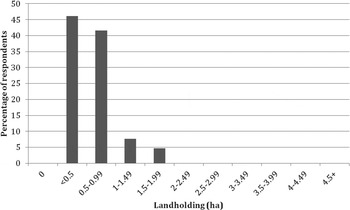
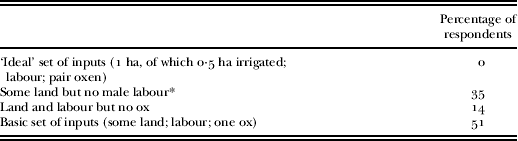
The irrigation shortage is one reason why none of the respondents to the 2009 ERHS had access to the ideal set of agricultural inputs – one hectare of land of which half is irrigated, male labour and a pair of oxen (Table 1). Indeed, only one of my interview respondents had this ideal set of inputs. In addition to irrigation, Figure 1 shows that land shortages are also a major problem since only a handful of respondents have one hectare or more and nearly half have less than half a hectare. As such, most lack sufficient land for any stage of the life cycle.
Distribution of landholdings Source: ERHS 2009.

Access to agricultural inputs

Source: Ethiopian Rural Household Survey.
* The presence of a man between the ages of 16 and 70 is used to indicate the availability of male labour. Fieldwork and the ERHS showed that many men continue to plough into their late 60s.
ERHS sampling was conducted in 1994, soon after the last land redistribution in 1990. Consequently, there are no landless households in the sample. However, according to the wereda administration – the district, above the tabiya – of 630 households in the tabiya, 481 have some land, leaving 149, or 24%, landless. For these people the only access to agricultural production is by sharecropping.
According to the 2009 ERHS, 35% of households lack male labour. This high proportion is unusual in Ethiopia where the male household head plays such an important socioeconomic role. Female-headed households include those whose male members were killed during past conflicts or never returned from them, or have since migrated in search of employment. These households either sharecrop land to men or hire labourers. Meanwhile, 14% of landholders with male labour do not have any oxen and must therefore either borrow oxen, hire them or sharecrop their land.
A few households pursue non-agricultural activities to make ends meet. For women these include brewing, weaving baskets and making pottery, while some men do day labour, cutting stone and building houses. Among the wealthiest people are the few that have limited their reliance on agriculture by establishing successful off-farm businesses, including mills, shops and restaurants (respondents GM2, GF9, GM27, ints), or a handful who receive remittances from relatives with good jobs in Ethiopian cities or abroad. Overall, however, there are very limited opportunities for livelihood diversification, a common risk-management strategy of poor households (Dorward et al. Reference Dorward, Sabates-Wheeler, MacAuslan, Penrose-Buckley, Kydd and Chirwa2006). Indeed, government and NGO public works are reported as the main source of off-farm ‘employment’.
Social protection in practice
During the first phase of the PSNP (2005–09), Geblen differed from government targeting policy. The community decided that rather than selecting all members of the poorest households, a few members of every household were included, a universal approach described by the head of the wereda PSNP desk as providing a ‘democratic right’ to support (respondent GW2, int.). Nonetheless, the extremely low graduation rate during the first phase prompted the regional government to order local administrators to change in the second (2010–14), selecting only the most in-need households and providing support for all their members (respondent GW2, int.). This selection is conducted broadly in line with PSNP guidelines, which require the formation of a Food Security Task Force (FSTF) from members of the tabiya administration and elected community representatives. This task force draws up a list of the most food-insecure households, which is discussed and potentially revised at a community meeting.Footnote 3
As of 2010, according to the wereda PSNP desk, of 630 households in Geblen, 339 are involved in the public works, while an additional 201 receive direct support, for six months from January to June each year. Many of those excluded receive assistance from the Catholic Mission, which runs a similar cash-for-work programme providing 80 days' work for 284 people (respondent GN1, int.). According to the responsible official in the mission, the tabiya administration selects programme participants, focusing on the poorest who are not in the PSNP (respondent GN1, int.).
The land policy and the guarantee of a livelihood
Despite the government's implicit assumption that households with the ‘ideal’ set of agricultural inputs constitute the norm, in Geblen there are only a handful of such households and just one among my respondents. GM22 is an Orthodox priest who was a local administrator for 38 years, stepping down in 2009. He has one hectare located next to a dam built by the Catholic Mission to provide drinking water, which he has been given special dispensation to use for irrigation. He has a generator to power a pump and hires a labourer to grow potatoes, barley and vegetables. He has several children and receives remittances from a son who is a doctor in Mekele and a daughter working in Kuwait.
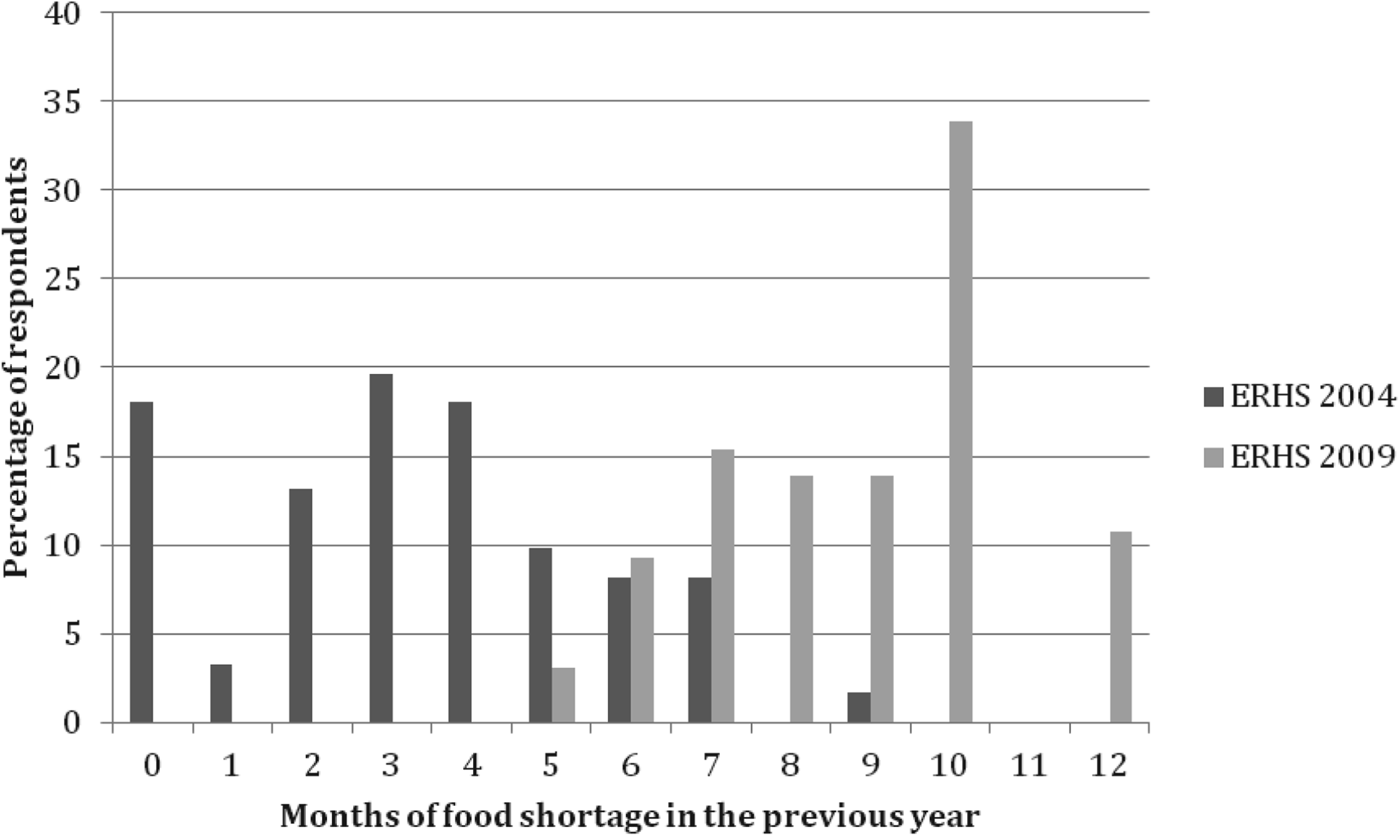
The shortage and poor quality of the land is such that this man was the only one of my respondents who claimed to be able to produce sufficient food for their household for the entire year. In contrast, the vast majority of respondents claimed to produce between one and five months' food per year. Similarly, all respondents to the 2009 ERHS, following a long period of drought, reported food shortages for at least five months, with many facing shortages throughout the year (Figure 2). While respondents reported that rainfall was better in 2004, more than 80% nevertheless faced shortages, indicating that food shortages cannot be solely attributed to adverse weather.
Months of food shortage Source: ERHS.

For landholders, the land policy provides a form of ‘protection’ by preventing distress sales of land resulting from shocks. However, in Geblen agricultural production is so problematic that, with the exception of GM22 and perhaps a handful of others, the land policy guarantees a small part of household subsistence, rather than a self-sufficient livelihood. In addition, the protection provided by the land policy, in the context of local gender norms, is inherently biased. Since women are not expected to plough, female-headed households, who must sharecrop their land, receive only half the income of those with a man who is able to plough. Households lacking oxen face a similar situation. For these households the ‘protection’ provided by the land policy is even more inadequate.
Food insecure households and graduation
The large gap between households' production and their subsistence requirements is met by the PSNP and, to a lesser extent, the Catholic programme. In Geblen the PSNP payment is split between three months' cash and three months' in-kind. According to the head of the wereda PSNP desk, cash payments are only periodically adjusted for inflation (respondent GW2, int.), which, in the context of rising food prices, means that the payment falls behind food prices (Sabates-Wheeler & Devereux Reference Sabates-Wheeler and Devereux2010). Nevertheless, due to the problematic agricultural production, the PSNP is by far the most important income source. In 2009, a drought year, the PSNP constituted 60% of average household income.Footnote 4 In contrast crop production contributed just 14%, compared with 27% from livestock and minimal amounts from off-farm sources. In Geblen, therefore, rather than addressing a naturally occurring food insecurity problem, the PSNP compensates for the limitations of the land and agricultural policies, filling the gap in household consumption.
The universal approach to PSNP distribution was an understandable response given that no household could objectively be described as wealthy and only a handful, at most, are food secure. Although those excluded during the second phase may be relatively better off, many are still unable to produce sufficient food in a good year (respondents GT7, GM23, ints). Each year, the FSTF estimates the number of households that require PSNP support and these numbers are aggregated at the wereda and then regional levels. Nonetheless, targeting is ultimately constrained by top-down quotas according to the availability of resources at each level of administration, with the result that each tabiya is likely to have to limit the number included (Sharp et al. Reference Sharp, Brown and Teshome2006).
Public works programmes focus on preventing erosion through the construction of terracing, drainage ditches and check dams. PSNP households are expected to provide five days of labour per month for each member. Consequently some family members contribute 20–30 days a month in public works to cover the quota for their dependents (respondents GM4, GF5, GF10, GM15, GM21, ints). Yet, while the scale of the terracing and drainage systems constructed is undeniably impressive, these anti-erosion works protect the soil from further deterioration, rather than making a substantial contribution towards improved production.
Given the serious challenges to crop production, the wereda administration encourages farmers to focus on animal production through its extension packages (respondent GW1, int.). These packages are not so dependent on the standard agricultural inputs of oxen, male labour and even land. According to the DAs, most packages are provided as cash loans to enable farmers to buy animals in local markets, providing stimulus to the local economy (respondent GT5, int.). The DAs provide other extension packages, including beehives and colonies, ‘exotic’ breed cows and treadle pumps, which are unavailable locally, in-kind. Loans must be repaid within four years and are subject to interest of 18%.
Beehives are by far the most widely adopted package. However, they have also been negatively affected by drought. GM16, a man in his 40s, was mentioned by several respondents as the most successful beekeeper. With his wife, he has one gebri (the local unit for land)Footnote 5 of non-irrigated land from which he produces three months' food in a good year and takes part in the PSNP. He has taken two beehives but has only produced honey once in three years. The first colony produced 30 kg of honey, which he sold for 40 birr Footnote 6 per kg. However, he has had no production since due to the drought and his bees are said to be the only ones that have not left. Having had limited success with his first beehive, he was reluctant to take the second but says that, ‘they intimidate me and tell me that I will be removed from the PSNP if I don't take the packages, so I had to take them. The government is looking to make a business out of beehives, they know that they aren't productive’ (respondent GM16, int.).
GM27 is a former tabiya administrator in his 50s. He has 1·5 gebri but no irrigation and is able to produce a maximum of three months' food. He is not involved in the PSNP but is part of the Catholic programme. He has also taken a total of four beehives because the tabiya, which selects participants in the Catholic programme, threatened to remove him if he did not. He has never produced any honey.
Based on the experience of GM16, if production and output markets were reliable,Footnote 7 beekeepers would be able to pay off the cost of the hives and colonies, and make a profit within two years. Nevertheless, beekeeping, like other agriculture, is dependent on rainfall and, given the drought-prone climate, has thus far been spectacularly unsuccessful with no honey production in the entire tabiya in the last two years. Many people now use empty hives as household furniture.
Attempts to promote other livestock have not been quite as disastrous, although there have been considerable problems. For example, GM21, who is in his 50s, has one and a half gebri from which he produces three months' food. In addition to two beehives, which have never produced honey, he borrowed 900 birr to buy a cow. However, due to the drought and limited grazing land available, the cow never produced milk and, with the loan repayment looming, he sold the cow. He insists that he took the packages under pressure, ‘we are forced to take them. If we don't take them we will be out of the PSNP. I refused but was told that I was out of the PSNP so I accepted and was brought back in’ (respondent GM21, int.).
GF10 is a single mother in her 30s and is currently pregnant. She previously worked in a restaurant in Eritrea but was forced to leave during the war and returned to be near her parents. She has no land and was working in the public works until her pregnancy. In order to remain in the PSNP she was told to take an extension package and bought an ‘exotic’ breed cow for 1,200 birr. Although these cows are expected to produce large amounts of milk, to do so they require good grazing land, which is limited at the best of times but especially during droughts. Her cow has never produced milk and the breed is poorly regarded locally with very low resale values: ‘the area is drought affected. The government is convincing us to take the packages but I bought the cow and now it cannot be sold. This area does not have the potential for bees or goats. We don't want to take the packages because it brings debt and we cannot pay it back’ (respondent GF10, int.).
The livestock packages failed to make positive contributions to the incomes of any of my respondents. Sheep and goats appear to be more suited than cattle to grazing on the rocky hillsides. However, during regular droughts all livestock are threatened by starvation and are more vulnerable to disease. Despite the high take-up rates based on coercion, with virtually every household having taken at least one and often several packages, they remain subject to the same limitations as crop production – land shortages and unreliable rainfall.
The experience of the extension packages serves to highlight the implausibility, for most people in the area, of graduation through agricultural production. As of early 2010, the responsible wereda official reported that no one in the entire wereda had graduated (respondent GW2, int.). Indeed, tabiya officials acknowledge that ‘there is no possibility of graduation’ through agriculture in Geblen (respondents GT1, GT4, GT5, ints). Therefore, not only does the PSNP compensate for the failings of the land policy, but the policies are also linked since the land shortages constitute an obstacle to government extension programmes and the achievement of graduation from PSNP support.
Nevertheless, during my fieldwork, the same tabiya officials were apparently planning to stage the ‘graduation’ of one person – GM22, the only one of my respondents with the ideal set of agricultural inputs who received remittances from his children. He was one of the only people in the tabiya who were never food insecure in the first place and his ‘graduation’ was due to the change from universal to targeted provision, rather than the extension packages.
The high take-up rate of extension packages, despite their poor performance, can be attributed to the top-down nature of policymaking, the system of targets and quotas by which tabiya officials are assessed (Segers et al. Reference Segers, Dessein, Hagberg, Develtere, Haile and Deckers2009) and the complete dependence of local people on state organisations for survival. Each year the wereda sets the tabiya various targets, among which is the number of extension packages to be distributed, repayment of credit and the level of production achieved (respondent GT5, int.). The performance assessments and promotion prospects for officials are determined by their ability to meet these targets (respondent GT5, int.).
For the first few years at least, the tabiya administration admits that PSNP participation was conditional on taking extension packages (respondents GT1, GT4, GT5, GT11, ints). Regarding current practice, respondents in the wereda and tabiya were divided, with some saying that the requirement has ended (respondents GT1, GT4, GT5, ints), while others maintained that it continued (respondent GW4, int.). In any case, most of my interview respondents who lived in Geblen believed that PSNP participation remained conditional on taking extension packages, so any change has not been clearly communicated. Last year the tabiya met the wereda's target of distributing 200 beehives and, despite scoring 0% on its production assessment, the wereda, which itself is subject to similar assessments, has increased this year's quota to 250 beehives (respondent GT5, int.).
The extent to which residents rely on the state for every aspect of their livelihoods – land, the PSNP and Catholic programme, agricultural inputs and credit – is such that there is no option but to accept government policy as presented to them by the tabiya administration. Indeed, people are so compliant that on two occasions the tabiya has been given a regional award for most closely adhering to government policy (respondents GW3, GM22, ints).
Despite the food insecurity problems, there are no plans for capital-intensive CCIs in the tabiya. Arguably, this is a more accurate reflection of the wereda's assessment of the area's potential than attempts to expand animal farming and prevent erosion. When pressed, wereda and tabiya officials are well aware that agriculture has little potential. In the words of the former tabiya chairman, now working for the wereda, ‘the government, everyone knows that this area does not have potential to meet the objectives. There are few areas with less potential than here for graduation’ (respondent GW3, int.). Nonetheless, institutional incentives require them to distribute extension packages. CCIs, however, are a different matter since they ‘would demand money’ (respondent GW2, int.) and have little chance of success.
Landless households and resettlement
For the landless, the paths laid out in the government's social policy strategy involve sharecropping the land of those unable to farm, pursuing education in the hope of finding off-farm employment or joining a resettlement programme. The expectation that young landless can sharecrop, however, ignores the land shortage and the fact that poor families also frequently lack oxen (Habtu Reference Habtu, Bryceson and Jamal1997). In addition, the reliance on sharecropping has important gender implications since for landless women the only way to access an agricultural livelihood is through dependence on a man.
There is a school in Geblen that covers grades 1–8 and, if their families are able to support them, students can continue to grade 12 in local towns. Nonetheless, continuing in education is by no means a guarantee of employment since youth unemployment rates can be as high as 50% in Ethiopian towns (Serneels Reference Serneels2007) and many respondents reported difficulty finding work.
In Tigray a resettlement programme operated until 2006, relocating people from heavily populated highlands to sparsely populated western lowlands, in particular Humera. Each farmer was allocated two hectares in an area suitable for growing sesame. Farmers were given a two-year trial without losing land in their place of origin. After two years, they were forced to choose – either permanently relocate or return home. However, between the resettlement programme and the expansion of large-scale agricultural investment the supply of so-called ‘unused’ land in Tigray has been exhausted and the programme has ended (Lavers Reference Lavers2012a).
Although the tabiya took part in the resettlement programme, few people joined and even fewer were permanently resettled. For example, GM11 is in his 50s. He previously had one gebri with his wife, but was allocated two hectares in Humera, which he claims was ‘free’ forest land. After two years, GM11 was asked to choose between Humera and Geblen, and he chose Humera. Nevertheless, he only goes to Humera to farm during the rainy season, spending the rest of the year with his family in Geblen. Indeed, the tabiya only took away GM11's half gebri, putting the other half in his wife's name. Only the man therefore has been ‘resettled’ and the rest of his family remain in the PSNP.
GM24 is in his 40s and was previously landless. He was allocated two hectares in Humera where he resides from June to November, spending the rest of his time with his family who stayed in Geblen because of the malaria risk in Humera. Although he earns 12,000 birr from his sesame crop, he says that this is insufficient to support the entire family after paying for inputs and transport. Consequently, although he has been ‘resettled’, his family remains in the PSNP.
Surprisingly, given the government's emphasis on graduation, there is no pressure from the tabiya administration either for families of resettled farmers to join their husbands in Humera or for them to stop receiving the PSNP. Therefore, while this process may succeed in bringing lowland areas under cultivation, contributing to increased export crop production, ‘resettlement’ is a misnomer, and it does little to address Geblen's food insecurity problem.
Alternatives to government-prescribed paths
For the vast majority, the land policy and FSP fall well short of their objectives in Geblen. This has led a number of people to pursue strategies that go beyond the paths to graduation outlined in government policy, either to make ends meet in the short term or in the hope of making long-term changes in their fortunes.
A common tactic has been to apply for extension packages provided in cash and to ‘misuse’ the money. Indeed, one such example constitutes one of the few success stories of the extension packages. GM2 and GF9 are a landless married couple in their 20s. Several years ago they borrowed 3,000 birr under the pretence of buying cows and goats. Instead, they used the money to set up a shop, cafe and grain mill. These businesses have been successful and they have repaid all the money and were removed from the PSNP during re-targeting. Indeed, they claim that their success directly contributed to the creation of off-farm packages, with tabiya and wereda administrators so impressed that they allowed others to borrow up to 7,000 birr, based on approval of the plans.
More commonly, several respondents who farm and receive the PSNP still find it necessary to misuse cash loans to make ends meet. For example, GM16 borrowed 1,500 birr to buy food, and GM21 borrowed money to buy food and to support his children in education. Finally, some respondents took loans just to repay the money they owed for previous failed livestock packages. The chances of being able to repay these additional loans seem slim.
A few landholders have made the decision to leave the area. For example, GM14 is in his 40s. He has half a gebri, yet 10 years ago, unable to feed himself, he moved to Adigrat and secured a loan from a local bank to start a grocery store and establish himself as a trader. Since that time he has sharecropped his land to relatives. However, based on the latest Tigray land proclamation, which states that landholders will lose their land if they are absent from the tabiya for more than two years (TNRG 1998 (Ethiopian Calendar)), the tabiya administration has contacted him, warning him that they will confiscate the land if he does not return to farm it.
GM17 is also in his 40s and has one and a quarter gebri. He was a soldier in the civil war and, when the conflict ended, became a judge in Adigrat and is now a legal adviser. He has been absent for nearly 20 years during which time he has sharecropped his land. However, the tabiya administration recently contacted him, warning him to return or have it confiscated. Meanwhile, his sister, who works in a pharmacy in Adigrat, has already had her land taken away instead of returning.
All of the absentee landholders whom I contacted had managed to pursue education leading to better opportunities than that afforded by agricultural life in Geblen. So far, many people in Adigrat have been able to defy the warnings by returning for a month and then leaving once the attention of the Land Administration Committee (LAC) has moved on (respondent GT7, int.). Nevertheless, the issue is being taken seriously by at least some people in the tabiya administration and, according to one LAC member, the failure to redistribute the land of absentees was one reason why the LAC was dissolved in 2007 and a new one elected (respondent GT7, int.).
Although those with good opportunities elsewhere will not be restrained by the potential confiscation of land, at the margins it does present a considerable barrier to those considering seeking opportunities elsewhere. Those with access to the basic set of agricultural inputs and the PSNP can achieve a minimal, dependent form of security, which, though deeply problematic, is preferable to leaving given levels of unemployment elsewhere. Migration would mean loss of the PSNP and land, and without this protection, failure to find better opportunities elsewhere would leave them destitute. This logic is not lost on local administrators, who recognise the role of the PSNP and land in stemming the flow of urban migration. A former chairman of Geblen tabiya, promoted to the wereda based on his performance, was very clear that ‘the sense of the PSNP is to make people stay for a period of time’, while the ‘land proclamation is intended to keep people in their place to retain the fertility of the soil’ (respondent GW3, int.). The confiscation of the land of absentees, meanwhile, was justified in egalitarian terms, ‘if anyone prefers to get a better job elsewhere they have a right but they cannot have both opportunities … they should leave one to those that have none’ (respondent GW3, int.).
However, the policy makes no sense from the perspective of addressing food insecurity – as things stand the government and its foreign donors will have to continue to provide food aid indefinitely unless there is rapid expansion of off-farm activities. Meanwhile, many young people, who have no land of their own, are faced with a choice between insecure, unreliable and poorly paid day labour in towns, and the possibility of inheriting their parents' land and the minimal, dependent security of agriculture. Consequently, the land policy and the PSNP combine to present a barrier to migration, prolonging and deepening rural food insecurity.
SOCIAL PROTECTION, FOOD SECURITY AND POLITICS
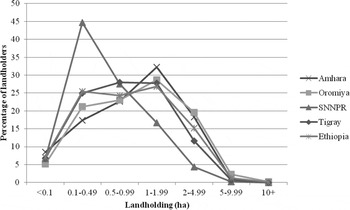
Although the land shortage in Geblen is severe, it is not exceptional. Data from the Central Statistical Agency (CSA 2009) show that 60% of landholders in Tigray, 49% in Amhara and Oromiya, and 79% in the Southern Nations, Nationalities and Peoples' Region (SNNPR) have less than one hectare (Figure 3). Even taking into account the intensive land utilisation in enset cultivation, common in SNNPR, given that 51% of landholders have less than half a hectare, land shortages are a major challenge.
Distribution of landholdings by region Source: CSA (2009).

Although rural population growth and acute land shortages are common throughout the country, the impact of these contingent processes on food security will inevitably vary based on the local context. Nevertheless, comparison between Geblen and the other five ERHS sites included in the PSNP suggests that although Geblen is extreme, it is not entirely exceptional. Harresaw, the other ERHS site in Tigray is broadly comparable in terms of land shortages, dependence on the PSNP and the degree of food shortages, with the PSNP constituting the main income for most respondents. Meanwhile in the other sites, although a smaller proportion of households rely heavily on the PSNP, overall the programme is of lesser importance.
The PSNP is undoubtedly an improvement on the previous system of emergency relief. However, recognition of its successes should not prevent acknowledgement of its shortcomings. While past research has rightly highlighted positive impacts on household consumption and distress sales of productive assets, the FSP has had little success in achieving graduation and finding a sustainable solution to food insecurity (Gilligan et al. Reference Gilligan, Hoddinott and Taffesse2009; IDL Group 2010; Berhane et al. Reference Berhane, Hoddinott, Kumar, Taffesse, Diressie, Yohannes, Sabates-Wheeler, Handino, Lind, Tefera and Sima2011). Only 56,895 households graduated in the first five-year round (MoARD 2009), despite the target for all to achieve food security within the first phase.
Land tenure is a defining characteristic of any system of agricultural production. In contrast to government attempts to frame food insecurity as a naturally occurring phenomenon or the result of a dependency syndrome (Brown & Teshome Reference Brown and Teshome2007), in Geblen, the nature of the extreme food insecurity problem is at least partly the result of state land ownership. In particular, restrictions on land transfers and past redistributions in the context of land shortages have resulted in ‘equality under poverty’ (Rahmato Reference Rahmato and Rahmato2003: 9; Planel Reference Planel2007). The PSNP, meanwhile, has become a key part of this system of production, constituting the main income for many households, without which the continuation of the government's policies towards the smallholder sector would be implausible. Between them, the land policy and the PSNP do provide a minimal form of security to most smallholders, at the cost of dependence on the state. Nevertheless, by linking access to land and the PSNP to residence within the community, these policies also limit migration, while the HABP focuses almost exclusively on agricultural rather than off-farm livelihoods, in spite of their limited potential. In doing so, the PSNP enables the maintenance of the status quo and, in the context of rapid population growth, leads to increasing numbers of food-insecure households.
My fieldwork was unable to confirm whether the regional or federal government had instructed local government officials to use the PSNP to limit migration, or whether this was merely the tabiya's interpretation of government policy. However, senior officials in Tigray's Environmental Protection, Land Administration and Use Agency (EPLAUA) replicated the views of local government officials in Geblen regarding the use of the land policy to limit migration. According to the head of the EPLAUA,
even now landless people are coming to urban areas, there is limited urban infrastructure and capacity so removing the restrictions [on land transactions] would increase unemployment. These people have knowledge and experience of rural areas, he doesn't have knowledge of urban life and poverty reduction. So this [land] policy is to keep the farmer working in the rural area. (Respondent IR1)
Indeed, a central concern of ADLI has been to limit urban migration until industrial growth creates sufficient employment to absorb surplus labour and, to this end, unrestrained migration is framed as the ‘source of economic, political and social instabilities’ (MoFED 2002: 56). These concerns are particularly related to urban migration, which is expected to lead to the ‘urbanisation of rural poverty’ (Meles Zenawi cited in Devereux et al. Reference Devereux, Teshome and Sabates-Wheeler2005: 122) and consequently the growth of a politically dangerous class of under- and unemployed urban migrants. However, concerns also relate to the dangers of migration across the boundaries of ethnic regions and the potential for ethnic conflict. In compensating for the socioeconomic limitations of the land policy, therefore, the PSNP also supports its political objectives – limiting migration and ensuring state domination over a dependent rural population.Although the restriction of migration is anticipated to be temporary, awaiting industrial employment creation, thus far ADLI has failed to achieve its economic objectives. In particular, the use of improved inputs remains low and agriculture generates a very small surplus, which has been insufficient to stimulate rapid industrial growth (Lavers Reference Lavers2012b). In the absence of urban employment, however, the state is apparently prepared to use the land policy and the PSNP as indefinite barriers to migration.
While the donors funding the FSP focused on establishing the PSNP during the first five-year phase, now that the delivery mechanism is relatively well established, the head of food security for the Development Assistance Group (DAG) representing Ethiopia's foreign donors reported that they are turning their attention to the HABP and the goal of graduation (respondent FD5, int.). Nevertheless, to date the DAG ‘takes the land policy as a given’ in its approach to food insecurity (respondent FD5, int.). This is largely the result of the vehemence with which the Ethiopian government has in the past dismissed all discussion of land privatisation, with former Prime Minister Meles Zenawi stating that privatisation would only take place ‘over the EPRDF's dead body’ (cited in Devereux et al. Reference Devereux, Teshome and Sabates-Wheeler2005: 122).
The case study also highlighted the coercive nature of the HABP and the lack of meaningful participation of the farmers in the programme. Previous studies have drawn similar conclusions regarding past extension programmes in Ethiopia (Belay & Abebaw Reference Belay and Abebaw2004), while the programme is indicative of the hierarchical and stratified nature of Ethiopian politics in general, with local government officials accountable first to senior managers rather than local people (Vaughan & Rafanell Reference Vaughan and Rafanell2012). In the Ethiopian context, therefore, ‘participation’ is frequently limited to the mobilisation of rural populations in government campaigns (Williamson Reference Williamson2011; Vaughan & Rafanell Reference Vaughan and Rafanell2012), while ‘agricultural extension remains focused on technology transfer’ from the state to the peasantry, with little space for consultation (Segers et al. Reference Segers, Dessein, Hagberg, Develtere, Haile and Deckers2009: 97). In this respect, also, Geblen is something of an extreme case. Tigray, and in particular the area around Geblen, constitute the TPLF's original base where the movement's aim to foster close relations with the peasantry was most successful. Research in nearby parts of Tigray concludes that the government manipulates this ‘loyalty to the TPLF's revolutionary ideals and institutions’ in order to mobilise people for current government development programmes (Segers et al. Reference Segers, Dessein, Hagberg, Develtere, Haile and Deckers2009: 104).
CONCLUSIONS
This paper has highlighted very different rationales used by the government to justify two forms of social protection in highland Ethiopia, as well as key links between the policies in practice. The PSNP has been used to compensate for the failings of the land and agricultural development policies by filling the gap in household consumption, while the land shortage constitutes a significant obstacle to government extension programmes, which aim to achieve food security. Furthermore, the government has used both the PSNP and the land policy to limit the flow of urban migration and, as such, the PSNP has been used to support the political objectives of the land policy, namely, to ensure social stability and state domination over a dependent rural population. Nevertheless, past research has largely neglected these connections. In particular, research and policy on food insecurity has treated the problem as a naturally occurring phenomenon, rather than an outcome of government policy, focusing on the efficiency of targeted and temporary social protection policies.
The land policy is a key part of a development strategy that aims to raise the productivity of smallholder agriculture, addressing food insecurity and contributing to industrial expansion. One important objective of the land policy is therefore to allow the state control over migratory processes, limiting urban migration until industry has created jobs in the interests of social and political stability. While the strategy has, as yet, fallen short of these economic objectives, local government officials continue to use the land policy and the PSNP to limit migration from the case study area, slowing the growth of urban unemployment, but in doing so ensuring the continuation of rural food insecurity.
These findings are of relevance both to researchers and policymakers searching for a sustainable solution to the food insecurity problem in Ethiopia and the growing literature on social protection in developing countries. Targeted, conditional cash transfer programmes have become very popular in Africa in recent years. Nevertheless, as this paper has shown, the effectiveness of a single safety net policy cannot be assessed without analysis of the broader socioeconomic system that generates insecurity (Cook Reference Cook2002). Despite the wave of enthusiasm for cash transfer programmes, in practice they remain tied to a limited, residual approach to social policy. Consequently, they frequently address the symptoms of poverty, rather than structural causes of insecurity. For the vast majority, therefore, these targeted programmes are in themselves unlikely to be transformative (Devereux & Sabates-Wheeler Reference Devereux and Sabates-Wheeler2004).