Introduction
The exploration of Zemlya Frantsa-Iosifa took several decades and involved many different nations and expeditions during the heroic age of polar exploration. This included three separate American expeditions that operated in the islands in the years 1898–1905. These were the Wellman polar expedition in the years 1898–1899, the Baldwin-Ziegler polar expedition from 1901–1902, and the Ziegler polar expedition from 1903–1905.
In the spring of 1902, the second of these American expeditions, led by Evelyn Briggs Baldwin, created a small supply camp on Ostrov Grili, in the approximate centre of the archipelago. Baldwin named it Kane Lodge after the American polar explorer Elisha Kent Kane (1820–1857). Two other main depots were established farther north, on Ostrov Koburg [Coburg Island] and at Mys Auk [Cape Auk] on Ostrov Rudol'fa, which became the northernmost point reached by the expedition. Between the end of January and the end of March, 1902, Baldwin led a near continuous pack train of humans, dogs and ponies between Ostrov Aldzher and Ostrov Rudol'fa, establishing depots that, when completed, he eventually decided not to use.
When Baldwin returned to northern Norway in the summer of 1902, his patron, William Ziegler, removed him from any further involvement and replaced him with Anthony Fiala, a commercial artist who had been photographer during Baldwin's expedition. Fiala did reach Bukhta Teplitsa on the western shore of Ostrov Rudol'fa by means of the expedition ship America (the expedition itself referred to the vessel as a steam yacht) in the late summer of 1903. There he established a base camp named Camp Abruzzi after his Italian predecessor on the island, Luigi Amedeo of Savoy, Duke of the Abruzzi.
This was a major leap from Baldwin's limited efforts, but very soon thereafter matters deteriorated for Anthony Fiala. Over the course of two years in the islands, Fiala went little further than the northeast coast of Ostrov Rudol'fa at Mys Fligeli [Cape Fligely]. He lost the ship in a storm at Bukhta Teplitsa (Fiala Reference Fiala1906b: 355) and mounted three attempts on the pole (two in March of 1904 and one in 1905) that were little more than extended day trips across the Ostrov Rudol'fa ice dome. After the 1904 attempts, with no unified leadership, the expedition disintegrated into various factions. The men scattered in a disorganised triangle bounded by Mys Flora [Cape Flora], Bukhta Teplitsa, and Camp Ziegler on Ostrov Aldzher.
After a second winter in the islands, Fiala made another brief attempt on the pole in March 1905. Before leaving for the north, Fiala ordered the party of men remaining at Camp Abruzzi to begin to lay down supplies at points between Ostrova Rudol'fa and Aldzher, in anticipation of the whole expedition moving southwards after the polar attempt. This retreat came quickly, with Fiala abandoning the polar attempt on 22 March after just a week in the field and before reaching 82°N. By the first of April, the polar party had returned to Camp Abruzzi and prepared its journey homeward.
Fiala's line of retreat would follow the trail of supply caches that had been laid between Ostrov Aldzher and Ostrov Rudol'fa by Baldwin's expedition in the spring of 1902. Before initiating his retreat, however, Fiala received a letter from his men at Mys Flora begging for ‘tobacco and supplies’ (Fiala Reference Fiala1906: 180); ‘supplies’ on this expedition generally being a euphemism for whatever alcohol was left in the Camp Abruzzi stores.
On 11 April, Fiala sent a team with two sledges loaded with these supplies to Mys Flora. After delivering them, he ordered this party to head for Kane Lodge on Ostrov Grili ‘and spend the spring and early summer hauling food and supplies from there to Camp Ziegler. [Fiala] arranged for still another party to work between Camp Abruzzi and Kane Lodge and to move the larger part of the cache on Ostrov Koburg to the latter place. From Kane Lodge both parties would unite in moving the stores to Camp Ziegler’ (Fiala Reference Fiala1906: 180–181).
The Mys Flora team consisted of three men led by assistant engineer Anton Vedoe, two sledges and fourteen dogs; the Kane Lodge team comprised of three men led by the expedition doctor, Charles L. Seitz, with three sledges and dog teams. After depositing their food stores at Kane Lodge, Seitz's team would then return to Camp Abruzzi and a cache on Ostrov Koburg and bring those stores down to Kane Lodge. The two teams would then join forces to shuttle supplies between Kane Lodge and Camp Ziegler.
Seitz's team, having killed three walrus for dog food as well as three interfering polar bears, returned to Bukhta Teplitsa on 17 April, the same day that a third team left Camp Abruzzi for Kane Lodge. By 20 April, Seitz's team left on their final supply run to Kane Lodge, leaving only Fiala and engineer H.P. Hartt at Camp Abruzzi. Hartt and Fiala tidied up the camp by dragging a kayak, a sledge, a rifle and some ammunition to the higher ground of the expedition's scientific observatory and stowing them there. They then closed the main expedition building and, on 26 May, left for Camp Ziegler by way of the northwestern coasts of Ostrov Karla-Aleksandra [Karl Alexander Island] and Ostrov Dzheksona [Jackson Island].
Fiala found that their pemmican cache on Ostrov Solsberi [Salisbury Island] had been largely destroyed by polar bears, and arrived on Ostrov Aldzher on 19 June relieved to learn that his relay teams had brought thousands of pounds of food from the caches spread throughout the archipelago to Camp Ziegler. A week later, Vedoe's team made a last visit to Camp Abruzzi. The main base of the Ziegler polar expedition was then shuttered for good on 2 July 1905.
On 30 July, a relief ship appeared off Mys Dillona [Cape Dillon]. After picking up the part of the expedition stranded at Mys Flora, it returned to take Fiala and his remaining men away from Camp Ziegler and back to Norway. The expedition's attempts on the pole had been little more than a farce, but it did not come away from the islands entirely empty handed. Russell Porter had done some important mapping of the islands (see Fiala Reference Fiala1906: endpapers), and this allowed Fiala to name several new islands and straits in the archipelago, including islands named for both Ziegler (Ostrov Tsiglera) and Ziegler's personal assistant, William Champ (Ostrov Champ).
Sites associated with the Ziegler polar expedition
With its nearly unlimited budget, long stay in the islands, fragmented parties, and access to previously constructed expedition camps and caches, the Ziegler polar expedition left a large scatter of archaeological sites across the length and breadth of Zemlya Frantsa-Iosifa (Fig. 1).
Detail from Porter's chart of the archipelago, showing the routes taken by the Ziegler expedition between 1903–1905, with the exception of the initial cruise to Ostrov Rudol'fa in late summer, 1903 (Fiala Reference Fiala1906).

The Mys Flora site, where much of Fiala's crew endured the miserable winter of 1904–1905, was the locus of nearly every expedition to explore the islands since it was discovered by Benjamin Leigh Smith in 1880 and he was forced to overwinter there in 1881–1882. It was several hundred feet above this site, on the cliffs that overlook Mys Flora, where Fiala's men discovered a seam of coal and mined and dragged several hundred kilograms of it down to their camp. This was the second spot in the archipelago where coal was discovered by the expedition. Russell Porter identified a seam of coal on a small island Fiala later named Ostrov Ugol'naya Shakhta [Coal Mine Island] just west of Ostrov Grili.
At Camp Ziegler on Ostrov Aldzher, there are the remains of the main camp from the Baldwin-Ziegler polar expedition of 1901–1902, which became an important cache and rendezvous point for Fiala during his expedition in its second year in the archipelago from 1904–1905. Two huts erected by Baldwin were used and refurbished by Fiala, and then stocked with supplies and locked shut when Fiala departed in the summer of 1905.
The main Ziegler base camp, Camp Abruzzi at Bukhta Teplitsa, consisted of two main structures as well as pony stables and a dog enclosure. There were several associated smaller structures, including a magnetic observatory and a stellar observatory. This observatory structure was located on a ridge above and behind the main buildings, and is a spot where Fiala wrote that he had cached a rifle, ammunition, sledge, clothing, a kayak and other camping gear prior to his final retreat in May of 1905. A newspaper was printed at the camp using a substantial printing press.
Of sites associated with the expedition that have not yet been located, the West Camp on Ostrov Aldzher was an ancillary camp and cache built by Baldwin and also used by Fiala. Fiala notes that is was six miles west of Camp Ziegler, and he reached Camp Ziegler from West Camp by sledge in 1.5 hours. Here the expedition stored coal and provisions, and Fiala also cached a canoe at the site.
The steamer America was heavily damaged by ice in Bukhta Teplitsa in November 1903. The ship finally disappeared at its mooring in a fierce storm sometime between 21–23 January 1904. Before the ship was torn apart, a 682 kgs (1500 lbs) galley stove was moved ashore from the ship. Also moved ashore were machine tools, dynamos, spars, sails, a lathe, a small engine, all of which were used to create a machine shop. A steam boiler was created by jury rigging one of the surviving gas generating tanks from a failed experiment by the Duke of the Abruzzi to use balloons on his expedition. This boiler was used to light Fiala's camp and, later, to turn a whale boat into a steam launch which was used for a summer trip through the islands before it, too, was wrecked and lost.
So-called ‘temporary camps’ were established in the spring of 1904 as the expedition straggled southwards to Mys Flora following the two failed attempts to proceed north that April. These were located on Ostrov Koburg, a cache that had been built originally by Baldwin's expedition, then occupied by Fiala in 1904, and then enlarged by Fiala in 1905; at Mys Ruzvel'ta [Cape Roosevelt], on the western side of Ostrov Payera [Payer Island]; at Mys Richthofen [Cape Richthofen] on Ostrov Luidzhi [Luigi Island] at a mid-point between Zaliv Tvidi [Alec Tweedie Bay] and Mys Armtidzha [Cape Alice Armitage]; at Point Arthur [now Mys Polyarnogo Siyaniya] on the northern point of Ostrov Ketlitsa [Koettlitz Island]; at Mys Dillona [Cape Dillon] on Ostrov Mak-Klintoka [McClintock Island]; and at Mys Fishera [Cape Fisher] on Ostrov Solsberi. A depot was also created at Mys Mak-Klintoka [Cape McClintock], on the northwest corner of Ostrov Solsberi. None of these temporary encampments has been subsequently explored and recorded.
Other undiscovered sites include the supply cache on the southern tip of Ostrov Iton [Eaton Island], where a small party was trapped for three weeks from 4–24 August 1904; and Camp Point [now Mys Lagernyy], the northern tip of Ostrov Nortbruk [Northbrook Island], where the Ostrov Iton party cached a canoe.
Description and inventory of caches between Camp Abruzzi and Ostrov Viner-Neyshtadt [Wiener Neustadt Island]
Yevgeny Federov (Federov Reference Federov1983: 103–106) marveled at the extent of the material Fiala had left behind on Ostrov Rudol'fa, as did Mikhail Vodopyanov, who flew from the island toward the pole in the 1930s. Vodopyanov visited Fiala's base after some of his colleagues had cleared it of snow, noting the large amount of expedition gear along with ‘wine, alcohol and books, including eighteen Bibles,’ and then follows these with a list that includes: ‘top-hats, tail-coats, patent-leather shoes, shirt-fronts, neckties, combs and even gold-plated skis’ (Vodopyanov Reference Vodopyanov2001: 189).
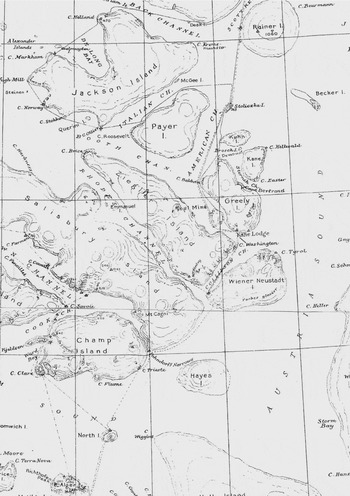
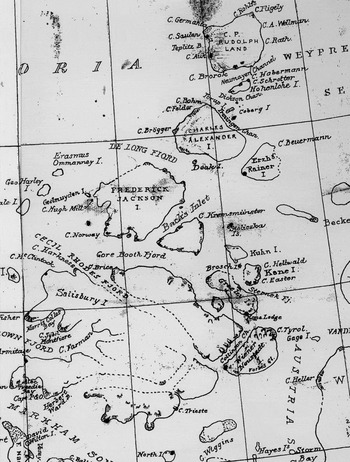
Vodopyanov's list seems to be only slightly exaggerated by Soviet era views regarding the wealth of Americans. The annotated maps in the papers of geographer Ernest Leffingwell, a member of the Baldwin expedition, and the lists of supply caches in the papers of Anton Vedoe, a Swedish member of both the Baldwin and Fiala expeditions, confirm the impression of an American polar expedition with almost as many potato chips as pounds of pemmican. The lists in the Vedoe papers, transcribed directly here, also contain brief geographical descriptions of the locations of the caches, locations confirmed by Leffingwell's annotated map of the supply route (Fig. 2).
Detail from Ernest Leffingwell's chart of the archipelago, annotated with dots showing the locations of the Ziegler cache sites.

The centrepiece of these sites is clearly the major supply depot of Kane Lodge on Ostrov Grili. A structure was constructed here by Baldwin and used by Fiala during the 1905 retreat. But neither expedition seems to have photographed the site or described it in any detail so it is not known just how large the actual structure was. Fiala describes it only as a ‘shelter’ (Fiala Reference Fiala1906a: 477).
Vedoe's list of the supplies cached there, however, suggests that it must have been a substantial expedition hut and one that functioned as the main point of resupply on the sledge route from Camp Ziegler on Ostrov Aldzher north to Camp Abruzzi on Ostrov Rudol'fa. The only other cache site in Vedoe's records that could hold potentially substantial remains is that located on the southwest corner of Ostrov Viner-Neyshtadt, where Fiala's expedition cached a 3m boat, some oars, and a horse sled, among other supplies. Vedoe's list is as follows.
1. Coburg Island
Location: on the extreme eastern end of the southern Coburg Island among the rocks.
Inventory: 140–14lbs. tins dog pemmican; 16–14lbs. tins man pemmican; 3 cases cut loaf sugar; 2 cases granulated sugar; 6 cases dog biscuit; 26–5qt. tins paraffin (1 or 2 empty); 1 case tomatoes (open); 1 tin matches (sealed); 1 sledge (short).
2. Rainer Island
Location: on the top of a rock close to the ice foot on the southwest end of the island. There is a small outcrop of rock here, and the only one on this part of the island.
Inventory: 126 lbs. bagged dog pemmican.
3. Big Stoliczka Island
Location: on the extreme northern end of the larger of the two Stoliczka Islands. This cache is placed upon the rocks about 15 ft above sea level and 50 ft from it. 30 or 40 ft to the north is the face of an incipient glacier.
Inventory: 4–14lb. tins dog pemmican.
4. Kane Lodge
Location: southeastern end of Greeley Island.
Inventory.
Clothing: 1 bag containing 15 pairs new finskoe; 1 bag containing 15 pairs new finskoe; 1 bag containing 16 pairs goat hair socks; 1 bag containing 18 pairs new finskoe; 1 bag containing 2 silk tents (8ft. square, with bottom, one without bottom); 2 silk sails; 1 bag containing 16 pairs komager; 1 bag containing 7 pairs reinskin trousers; 1 bag containing 22 pairs reinskin trousers; 1 bag containing 24 sweaters (‘Icelanders’); 1 bag containing 9 pairs goat hair socks; 9 pairs drawers (‘Jaeger’); 6 undershirts (‘Jaeger’); 20 felt hats; 1 bag containing 41 pair heavy woolen socks; 9 pair brown knit mitts (finger); 10 pair brown knit mitts (without fingers); 10 pair ‘Vodmal’ mitts; 14 pair light blue cloth mitts; 2 pair canvas blue cloth mitts; 38 pair ‘Khaki’ mitts; 3 pair woolen knit mitts; 22 sets ‘Finkso’ bindings; 1 man sleeping bag; 1 man sleeping bag; 2 reinskin coats
Provisions: emergency rations: 8 dog biscuit boxes full; 6 cases full 3 bags full.
In bulk: 15 small potato chip tins full; 2 large potato chip tins full; 4 cases Dissen food; 17 tins hardbread (army and crew); 2 cases bakers eggs; 3 cases malted milk lunch tablets; 6.5 tins unground coffee; 1 case Kato coffee (chip. beef box; Diamond soups; 5 coffee tins full; 11 small cases; 2 cases chipped beef; .5 cases beef and vegetable extract tablets; case Zomoss tablets; 1 case lime juice nodules; 4 cheeses; 3 cases Borden's condensed coffee; 1 case tomatoes; 2/3 case sugar corn; 17 small tins evaporated onions; 5–3 gallon pails evaporated fruits; 2 tins H and P biscuits; 1 tin cut loaf sugar; 1 tin oatmeal; 35 14lb. tins dog pemmican; kerosene 35 gallons. 1 tin (coffee size) tea; 2 kegs butter.
Ammunition: 200 rounds mixed of Ely 45 and W.R.A.Co's 45–70; 80 rounds. 30 W. ‘smokeless’ 160 gr. 1894 model; 50 rounds 45–15-325 Ely revolver; 100 rounds 20 gauge shot BB; 100 rounds 20 gauge shot sso (Buck);
100 rounds Bland ‘Dum-Dum’; 1 Henry rifle; 1 Winchester rifle (stock gone); 40 rounds 20 gauge shot No.1.
Miscellaneous: 1500lbs. soft coal (estimated); 1 coal stove; 1 copper boiler (10 gallons); 2 3in. Khotal stoves. 1 coffee grinder; 3 large shovels; 1.5 dozen candles; 1 coil fine steel wire; 20 feet telephone wire; 1 package rubberoid tacks; 1.5 rolls rubberoid; 16lbs. wire nails; 4 rolls wire netting; 2 red tins matches (sealed); 1 roll canvas (50ft) estimated; 1 water barrel; 1 crowbar; 1 ice axe; 1 saw; 1 broom; 1 rit brace; 1 soldering kit; 3 bundles sail twine; 100 ft whale line (estimated); 5 quart stew pot, enameled; 45 pemmican boxes (empty); 1 whet stone
5. Wiener Neustadt Island
Location: on the southwest end of Wiener Neustadt island among a pile of rocks that lie on the shore only a few hundred feet off a huge basalt rock where there is a rookery. The cache is on the summit of this pile of rocks and marked by an Expedition flag.
Inventory: 1 boat, about 16ft. long and 5 ft. beam; 3 pairs oars; 1 mast; 1 boom; 1 high horse sled; 4 cases emergency rations. 4 14lb. tins dog pemmican.
Formation processes at the Ziegler sites
Since 1929, Zemlya Frantsa-Iosifa has been under the sovereignty of Russia and Russian cultural resource management regimes. Recorded visits to the remains of the major Ziegler sites were rare in the Soviet period, when the archipelago was closed to westerners. But they clearly occurred, perhaps regularly, since the few recorded visits describe the general looting and chaos evident at the sites. The unpublished description of a visit to Bukhta Teplitsa in August 1929, by the steam icebreaker Georgy Sedov, after establishing the station at Bukhta Tikhaya, reads as follows:
Another attempt was then made to visit Bukhta Teplitsa, this time successful: a landing party got ashore with considerable difficulty, leaping from floe to floe or bridging leads with planks taken along for the purpose. The large hut from the Ziegler/Fiala expedition was found to be more or less intact, as was the framework of the stable and the scientific hut. Vast amounts of equipment and canned goods, much of it still in good condition, were scattered around. [Otto] Shmidt entered the main hut through a hole in the roof and found it almost completely filled with ice, derived from snow which had drifted in. However, it was still possible to crawl into most of the rooms. Shmidt was astounded at the obvious affluence of the Ziegler expedition which extended even to a telephone system between the buildings. He justifiably contrasts this with the miserable results achieved, especially when compared with what Nansen and Johansen had achieved with the absolute minimum of equipment and supplies. He was also quite amazed by evidence of Ziegler's [Fiala's] bureaucratic mind. ‘Everywhere there were order books, receipts and “guides” to the stores, i.e. small books of examples of the symbols on the various types of equipment (e.g. a black cross for veterinarian equipment).’ However, he admitted ruefully that ‘This latter is very sensible; it is something that we lack and therein lies our mistake’ (Shmidt Reference Shmidt1962: 35–36).
Shmidt also instituted perhaps the first cultural resource rules for an historic site in the islands. ‘Shmidt gave permission for everyone to go ashore, but also issued strict instructions about pilfering. Each member of the expedition could take only one small, discarded item as a souvenir, e.g. a label from a broken case, a rusted knife, or a notebook. Before leaving the party erected a memorial tablet to Querini, Stöcken and Ollier, the support party for Cagni's polar attempt in 1900, who went missing on the return journey to Bukhta Teplitsa’ (Wiese Reference Wiese1929: 128).
In the past decade, ice-breaking and ice-strengthened ships have begun regular tourist excursions, bringing an increasing number of visitors in contact with the archaeological fabric of the archipelago. Visits to several historic sites in the archipelago in 2006, including Mys Flora, the Nansen hut on Ostrov Dzheksona [Jackson Island], and the Wellman base camp on Ostrov Gallya, indicate that little if anything has been done in the way of offering basic protection to the historical archaeology of polar exploration in the islands, such as established tourist pathways around features or wayside panels explaining the significance of the sites.
It is a condition of affairs that has been long recognised. As early as August 1930, when another expedition on Georgy Sedov searched the Camp Ziegler site on Ostrov Aldzher, ‘two boatloads of sightseers’ found to their dismay that it had been heavily disturbed (Sokolov-Mikitov Reference Sokolov-Mikitov1951: 46–47). A number of buildings were explored, and inside was a confusion of expedition gear, medical supplies and cans of spoiled food. ‘As at Mys Flora remains of equipment and food were strewn about in total disorder. However Urvantsev did find some cases of pemmican and chocolate in good condition in a store hut; these were appropriated for the Severnaya Zemlya expedition’ (Wiese Reference Wiese1930: 62).
The Russians decried the looting apparent at Baldwin's base camp (even as they engaged in it) and implored the Soviet government to protect these artifacts that were seen as being ‘of great historical interest’ (New York Times 5 August 1930: 18).
Of the sites of the various depot scattered throughout the islands by the Ziegler polar expedition, some were destroyed during the expedition itself. Much of a large cache of supplies placed near Mys Auk on Ostrov Rudol'fa during the northernmost advance of the Baldwin expedition was retrieved by the crew of the America in late 1903. The remaining material at the depot was destroyed in a landfall in early 1904. Other sites, like the wreck of the America in Bukhta Teplitsa or the West Camp site on Ostrov Aldzher, have never been located.
The area around Bukhta Teplitsa eventually became a substantial Soviet weather station and, in the 1930s, a staging point for research flights to the North Pole. Working on the island during this time, Yevgeny Federov described the remains of Camp Abruzzi and the other polar expedition base camps arrayed around Bukhta Teplitsa as ‘a museum telling about the race to the Pole at the turn of the century’ and added that this was a museum in great need of being put in order (Federov Reference Federov1983: 106). Federov, like the visitors from Georgy Sedov, realised that such sites as Camp Abruzzi, Camp Ziegler, and Mys Flora, had been pillaged for reusable materials by visitors from other scientific and military expeditions since their abandonment.
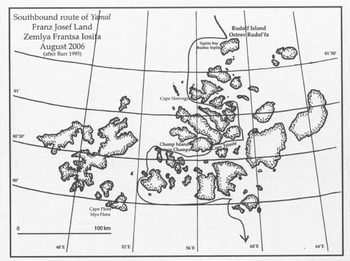
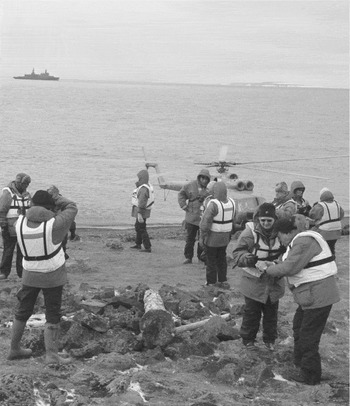
Mys Flora today serves as the entry point of most tourist cruises to the islands and for those tourist laden Russian icebreakers transiting the islands on the way to and from the North Pole (Figs. 3). As such, the archaeological remains at Mys Flora have been steadily reduced in character and content by both cultural and natural formation processes (see, for example, Hansson and Norris Reference Hansson, Norris and Barr1995: 155; Fig. 4). The original Jackson-Harmsworth expedition huts have been reduced to outlines in the soil, while the overwintering hut of Leigh Smith that was located near the steep sea-side cliff has been washed into the sea.
The 2006 southbound route through Zemlya Frantsa-Iosifa of the Russian icebreaker Yamal. One of several such cruises that summer and the first of two in August alone. It carried tourists from Murmansk to the North Pole and back with stops at Mys Fligeli on Ostrov Rudol'fa, at the Nansen site on Ostrov Dzheksona, at Ostrov Champ, and at Rubini Rock (after Barr 1995).

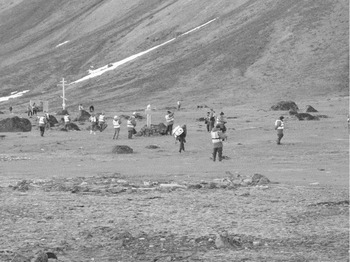
Tourists from Yamal wandering around the archaeological remains of Mys Flora in August 2006 (photograph by the author).

Current tourist cruises in the islands, such as those in which the author participated in 2006, have a more or less predictable routine that includes a first stop at Mys Flora, followed by an almost ritualised visit to the Nansen hut on Ostrov Dzheksona (Fig. 5). Then, depending on ice conditions, tours try to visit the bird colonies at Skala Rubini [Rubini Rock], the rounded stone formations of Ostrov Champ, and the Wellman camp remains at Ostrov Gallya. Little meaningful cultural resource guidance is given to these substantial groups of tourists, which numbered more than 100 visitors to a site at a time.
Tourists at the Nansen hut site at Mys Norvegia, August 2006 (Photo by the author).

Likewise, historical background materials were scant. In fact, in these instances, there was a deliberate attempt not to place too much emphasis on historic remains. It was thought that tourists would not stand for too much history without balancing visits to historic sites with a roughly equivalent number of visits to sites of natural history interest such as Skala Rubini and Ostrov Champ.
This ‘touristic balance,’ as it were, currently serves to keep the tourist cruises away from all of the Ziegler polar expedition sites with the exception of the occasional visit to Camp Ziegler. In 26 days on board Yamal in 2006, less than five hours in total was spent at the remains of historic sites in the islands and, as noted, these visits followed a pattern that, for now, appears unlikely to change.
Given the almost complete obscurity of the American exploration of Franz Josef Land, it seems unlikely that tourist cruises to the islands in the near term will substantially vary these programmes. Historical obscurity does serve a useful role in helping to shield any archaeological remains of the era from the interest of large tour operators, as opposed to earlier Soviet expeditions that were on the lookout for both supplies and souvenirs. However, as such tourist itineraries inevitably become stale, it cannot be discounted that such cruises will venture more deeply into the more obscure parts of the archipelago's place in Arctic history and exploration. This will lead such tours, sooner or later, into the cluster of sites that we can refer to as the ‘American supply trail.’ Here, sites like Kane Lodge hold the potential to reveal, in the words of Mikhail Vodopyanov, that ‘the wealthy American [Ziegler] had spared no expense to gratify his vanity’ (Vodopyanov Reference Vodopyanov2001: 188–189).
In contrast to the heavily visited or re-used sites related to the Ziegler, the chain of sites that comprise the ‘American supply trail’ of the spring of 1905, which had Kane Lodge as its fulcrum, has never been recorded or explored as the unified set of archaeological sites that it is. An example of the type of evidence that might still be found along the trail is the turn of the century ski found by Magnus Forsberg on Ostrov Champ in 2006 (Capelotti 2007).
When speaking of this ‘American supply trail’, we need to separate out the northern terminus at Camp Abruzzi and the southern terminus at Camp Ziegler. As noted, these two sites have seen heavy visitation by scientists and military personnel (Camp Abruzzi) and scientists and tourists (Camp Ziegler). Of the remaining sites in the trail, there is no recorded history of use during either the post Ziegler polar expedition period (1906–1928) or in fact any Soviet era (1929–1991) or post Soviet era (1991–present) scientific or military reuse or tourism visitations (Krenke Reference Krenke and Barr1995: 129–147). They are therefore potentially unique in the historical archaeology of polar exploration.
When Fiala's expedition began its retreat from Ostrov Rudol'fa in 1905, it used and greatly expanded upon the trail built by Baldwin's expedition in 1901–1902. This 160 km long supply route from Camp Abruzzi to Camp Ziegler offers the greatest potential for significant future archaeological finds related to the American attempts to the reach the pole from Zemlya Frantsa-Iosifa between 1898–1905. The level of detail in the cache lists suggests a comprehensive material culture of polar exploration at the turn of the 20th century. This includes technologies related to both overland and maritime travel, food supplies and processing, clothing, animal feed, communications, shelter, and weaponry with nearly 700 rounds of unused ammunition.
This ‘American supply trail’, if studied as a unified archaeological site and afforded a level of cultural resource protection consistent with its unique character, could set an important precedent in the study, preservation and management of sites of exploration in the Russian Arctic. Other undiscovered sites, such as the ‘temporary camp’ on Ostrov Payera used by Fiala as a brief encampment for his entire party during his first retreat from Camp Abruzzi on 4 May 1904, would also be worth searching for any traces of a temporary encampment by a large polar party.
Given that any new archaeological research in the islands must originate, coordinate or cooperate with Russian cultural resource management authorities, such a conception and plan will be fraught with challenges both local and international. One such project that holds the potential as a model of such a venture is the International Marine Arctic Complex Expedition (IMACE), a joint Russian-Swiss expedition with plans to search for archaeological evidence of historic polar expeditions that have staged in Zemlya Frantsa-Iosifa, the Ziegler expedition included (IMACE 2009).
This expedition's purpose is announced as the ‘finding and examination of the historical sites evidencing discovery and development of the Arctic’ along with studies of climate change and other natural history subjects. The cache lists from the Ziegler expedition can provide guidance to such expeditions, as well as to local cultural resource authorities, to both the location of comparative archaeological data and to such practical concerns as the potentially lethal ammunition that might remain in the cache sites.
The lists serve both to narrow potentially enormous survey areas for archaeological field research and to alert archaeologists to known quantities of hazardous materials. If this research could lead to both survey and preservation, as well as actual demarcation of the trail with historical particulars and brief historical publications, it will have accomplished the kinds of necessary precautions against mass disturbance that are now a commonplace in similar heavy Arctic tourist areas such as Svalbard.
Conclusions
Recently located cache lists from the Ziegler polar expedition suggest the existence of numerous potential archaeological sites created or expanded by the expedition as it made its marches through the islands of Zemlya Frantsa-Iosifa. These data reveal a supply route that stretches 160 km from the remains of Camp Ziegler on Ostrov Aldzher to the remains of Camp Abruzzi on Ostrov Rudol'fa that has never been explored as the continuous line of potential archaeological evidence of American polar exploration that it is.
Since these sites are little known or marked, and poorly understood within the history of Arctic exploration, a single careless landing by over a hundred heavily clad tourists could permanently alter the original character of the sites and make future historical archaeology studies problematic. The level of detail in the lists of these cache sites can be employed by cultural resource management authorities involved in the preservation of the historical archaeology of the islands to mitigate adverse affects to the sites from the recent increase in tourist expeditions.
The lists also provide warnings with regard to potentially hazardous materials located in these cache sites in terms of unused ordnance. By facilitating the discovery and inventory of any surviving archaeological materials, these can now be identified, catalogued and possibly recovered and preserved with greater accuracy and benefit to the study of the material culture of American polar exploration.
Acknowledgements
My research student in 2008–2009, Mariya Gudima, helped to research the ‘American supply trail’ and then translated the Ziegler cache lists into Russian. This work will facilitate future international cultural resource management collaboration between Russian and western scientists and cultural resource managers. The author is also greatly indebted to the anonymous referees for help with the Russian spellings of the islands, and for Russian and German source materials.