The National Institute for Occupational Safety and Health reports that the exact number of bloodborne pathogen (BBP) exposures in the United States is unknown.Reference Panlilio, Orelien, Srivastava, Jagger and Cohn 1 , 2 The incidence of hepatitis C (HCV) transmission after BBP exposure from an HCV patient is estimated to be 1.8%.Reference Grebely, Page and Sacks-Davis 3 Because no HCV vaccine exists nor does the Centers for Disease Control and Prevention recommend post-exposure prophylaxis (PEP) for HCV, long-term health threats from exposure to HCV remain for healthcare personnel (HCP). New direct-acting antiretrovirals (DAAs) effectively treat chronic HCV, but it is unknown whether they should be used as HCV PEP or whether healthcare institutions should include HCV PEP in BBP policies. We hypothesized that the lack of data to support the use of DAAs as PEP, the low burden of HCV seroconversion among HCPs, and the potential cost of HCV PEP with DAAs are the main variables influencing institutional BBP policies. This study was performed to determine the influences on healthcare institution policies regarding HCV prevention following occupational exposure among HCPs.
METHODS
We used a mixed-methods study design to qualitatively examine institutional BBP policy regarding HCV prevention and to quantitatively examine actual BBP exposures at the largest teaching institutions in the Philadelphia region during November 2015 and February 2016. We reviewed and thematically coded the BBP policy of 3 hospitals (1 institution declined to share its policy), and we conducted structured interviews with the occupational health directors and infection control representatives of the 4 institutions. We recorded, transcribed, and thematically coded the interview content. All 4 institutions submitted data regarding BBPs over the previous year; 3 hospitals reported exposures over a 10-year period (the other institution’s 10-year data were unavailable). We obtained data regarding inpatient bed and staff numbers from the institution’s website or from requests via media relations personnel.
RESULTS
BBP Policy Analysis
Our review of the 3 submitted BBP policies revealed that 1 did not directly address PEP. The policies of the other 2 institutions used particular wording to address PEP: “There is no immediate treatment for exposure to hepatitis C” and “Prophylaxis will be provided according to OM [Occupational Medicine] protocols and the most recent recommendations from the US Public Health Service and [the institution’s] Infectious Disease experts.”
Data from Structured Interviews
Responses from the interviewees reflected both the experts’ personal opinions and their institutions’ BBP policies. The survey questions addressed maintenance of each institution’s BBP policy, factors influencing BBP policy, whether the policy specifically addressed HCV PEP, and the number of BBP exposures per year and over the previous 10 years.
Need for Guidelines
The interviewees highlighted the need for data regarding the use of DAAs as HCV PEP and/or published updated guidelines from the CDC or another regulatory agency that recommended HCV PEP. One interviewer stated, “The easiest and most straightforward would be a CDC or US Public Health Service Statement about post-exposure prophylaxis for hepatitis C.”
Low Transmission Rates
The interviewees noted that despite the transmission risk reported in the literature, HCV seroconversions rarely occur as a result of BBP exposure; thus, there may not be a compelling need for HCV PEP. One interviewee stated, “We really have treatment options that are benign and effective that might decrease the urgency for PEP for the relatively rare seroconversion.”
High HCV Cure Rate With DAAs
The interviewees addressed the high HCV cure rates with the new DAAs. They mentioned that given the effectiveness of DAAs, HCPs who did seroconvert after an occupational exposure could be cured, which obviates the need to use PEP for all exposures. One interviewee declared, “Experts say the treatment is so good. . . Why not wait until seroconversion to avoid potential adverse effects or cost?”
Cost of Treatment
Interviewees discussed the cost of treatment, but they were divided on its effect on HCV PEP policy. Some interviewees noted that the expense of the DAAs was a deterrent to HCV PEP policy; however, others mentioned that a worker’s compensation insurance would likely cover PEP, thereby limiting costs to institutions.
BBP Exposure
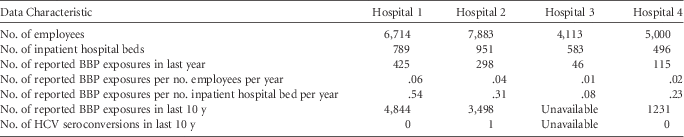
Table 1 presents the number of employees, inpatient beds among the 4 institutions, and the reported number of BBP exposures over the previous year and previous 10 years. Among the 4 hospitals, 884 BBP exposures occurred over the previous year; rates per employee and number of beds ranged from 2% to 6% and from 8% to 54%, respectively. One seroconversion occurred in the previous 10 years (Table 1).
Hospital Profiles and Bloodborne Pathogen (BBP) ExperienceFootnote a

NOTE. HCV, hepatitis C virus; HIV, human immunodeficiency virus.
a Hospitals did not provide data of pathogen source, eg HIV, HCV, etc.
DISCUSSION
The interviewees believe that before adopting new HCV PEP policy, it is necessary to obtain appropriate data, which would aid clinical guidelines. The larger question remains: Is HCV PEP necessary? First, better national data on HCV seroconversion rates from BBP exposure are needed. Secondly, we believe that in an era of needleless systems, the rate of HCV exposure through needlestick may continue to decrease, but the seroconversion frequency will only decrease when there is effective PEP. Finally, it is important to accept that in the current DAA era, HCV is a curable disease. Perhaps it is time to refocus BBP policy research on institutional BBP policy for treatment of HCV seroconversion instead of HCV PEP.
This study is the first to examine hospital HCV-related BBP policies. The study’s limitations derive from its exploratory nature: the study population was small and included only teaching hospitals in 1 city, so they may not be generalizable. Additionally, details of BBP policy were lacking for 1 hospital, and BBP exposure data were missing with another, thereby affecting the validity of the study findings.
ACKNOWLEDGMENTS
Financial support: No financial support was provided relevant to this article.
Potential conflicts of interest: All authors report no conflicts of interest relevant to this article.