Provision of care for children with congenital heart defects remains a challenging medical field in developing countries. Limited facilities, limited human resources, and restricted accessibility to devices and medications make it difficult to help children, including those with simple but critical congenital malformations.Reference Kumar 1 – Reference Grossfeld, Greenberg and Saw 3 The time and costs required to establish open heart surgery, with its need for a multiple disciplinary team including surgeons, physicians, anaesthesiologists, perfusionists, intensivists, and nurses, etc., renders such an approach impractical; consequently, access to open heart surgery is extremely limited in Mongolia. We believe that catheter interventions for simple but critical congenital cardiac malformations are an effective alternative to surgery and are economically practical for developing countries.
Since October 2001, members of a group of Japanese paediatric cardiologists have made regular visits to Mongolia, once or twice a year, to perform diagnostic and interventional catheterisations. We report the 11-year history of this innovative programme designed to provide interventional catheterisation and other services to Mongolian children.
Materials and methods
Beginning in 2001, every year, a team of Japanese paediatric cardiologists has visited Mongolia to perform children's cardiac catheterisation at Ulaanbaatar, as well as for screening of children for cardiac diseases in some rural areas, and our activity is mostly supported by a donation from the Japanese people. This programme is now called the Heart Saving Project. Recognising the limited medical resources in Mongolia, as well as cost, risk, and benefit to the patient, we focused our activities on four areas, that is, diagnostic consultation by echocardiography for patients screened by Mongolian doctors; transcatheter closure of persistent arterial duct; balloon dilation of valvar pulmonary stenosis and aortic coarctation; and diagnostic catheterisation. Patients for diagnostic or interventional catheterisations were selected using echocardiography at the State Research Center on Maternal and Child Health. For the first two visits, catheter interventions for persistent arterial duct and valvar pulmonary stenosis were performed at that centre. The centre was not equipped for cine angiography, and thus all procedures were performed in the operating theatre under monitoring with a portable fluoroscope, which lacked any recording capability. We judged the size and morphology of the persistent arterial duct solely on the fluoroscopic image during a rapid hand injection. On the third visit, we moved our catheterisations to the Shastin Central Clinical Hospital, an adult cardiology and cardiovascular surgery centre equipped with the only cine angiography machine in Mongolia. Until the fifth visit, we used only coils for persistent arterial duct closure, but on the sixth visit in 2005 we introduced the Amplatzer™ Duct Occluder (St. Jude Medical Co., St. Paul, Minnesota, United States of America) for moderate-sized persistent arterial ducts. We began screening children for cardiac diseases in rural areas in 2003, and since then we have visited one to three prefectures each year for this screening.
Results
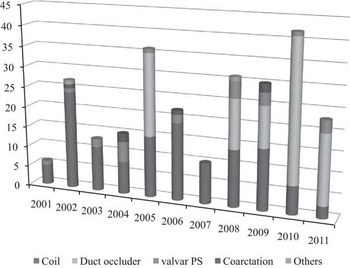
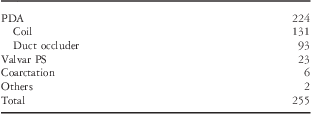
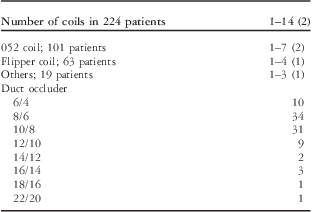
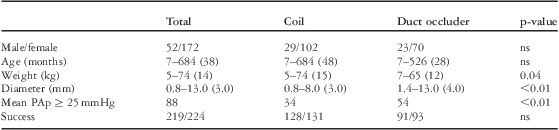
Currently, the annual number of catheter interventions has been around 20 to 30 patients/year, and since 2008 we have mainly used the Cera™ Patent Ductus Arteriosus Occluder (Lifetech Scientific Co., Shenzhen, China) for persistent ducts (Fig 1). Up to 2011, we have completed diagnostic consultation by echocardiography in 1200 patients. Among them, we performed diagnostic catheterisations for 59 patients, catheter interventions for 255 patients, including 224 for persistent arterial duct, 23 for valvar pulmonary stenosis, 6 for aortic coarctation, and several others (Table 1). We have visited 14 rural areas to screen for children's cardiac diseases. Coil occlusion, mainly with 0.052-inch Giantruco coils (Cook Medical Co., Bloomington, Indiana, United States of America), was completed in 131 patients, either type of duct occluder was used for 93 patients. Relatively large duct occluders, such as 8/6 and 10/8, were used in Mongolia compared with Japan, although the largest duct occluder we emplaced in our project was 22/20 (Table 2). Using duct occluders, we could close larger persistent arterial ducts in smaller children than we could using coils, while more patients were complicated by pulmonary hypertension (mean pulmonary artery pressure greater than or equal to 25 millimetres of mercury) in duct occlude patients than in coil patients (Table 3). During coil occlusion, coils could not be deployed in a stable position in two patients, whereas in one patient coils migrated to the main pulmonary artery and were successfully retrieved surgically. In one patient, a duct occluder could not be stably deployed, as an appropriate specification was not available at that time. The device embolised to the left pulmonary artery 48 hours after being deployed. Unfortunately, the patient died after surgical retrieval of the device and persistent arterial duct ligation on cardiopulmonary bypass. Balloon dilations for valvar pulmonary stenosis and aortic coarctation were performed in 23 and 6 patients, respectively. Although all procedures were successful and effective, one patient developed re-coarctation, which was subsequently stented.
Annual number of catheter interventions. PS, valvar pulmonary stenosis.

Catheter interventions.

PDA = persistent arterial duct; PS = pulmonary stenosis
Devices for PDA occlusion.

PDA = persistent arterial duct
052 coil, 0.052-inch Gianturco coil; ( ), median
Devices for PDA occlusion.

ns = not significant; PAp = pulmonary artery pressure; PDA = persistent arterial duct
Diameter, minimum diameter; ( ), median
Discussion
In 2010, Mongolia's population was 2,780,800, approximately 40% of whom live in the capital, Ulaanbaatar. Children under the age of 14 years make up about 27% of the total population. The number of live births is estimated to be 63,270 newborns per year. 4 In 2009, life expectancy at birth was 69 years, whereas the probability of dying under 5 years was 29/1000 live births. 5 The estimated incidence of congenital anomalies in Mongolia is 2.7/1000 live births, whereas congenital cardiac malformations comprise 39% of all congenital anomalies. The Human Development Index of this country defined by the United Nations Development Program was 0.653 in 2011, which is typical for a medium human development country. 6
Patients older than 1 year with simple congenital heart defects such as persistent arterial duct and older children with atrial septal defects are sent to the adult cardiothoracic hospital for surgery in Mongolia. A cardiac surgical team from a foreign country occasionally visits Mongolia to perform cardiac catheterisations or open heart surgery for selected children. Other children with complex or severe diseases and children under 2 years of age are usually referred abroad for treatment. Currently, there are three major projects for children with congenital heart diseases in Mongolia. Up to 2010, the Children's Heart Project of Mongolia and Korea Rotary Club sponsored a total of 150 children with congenital heart diseases who went to Korea for cardiac surgery. Since 2000, the American Children's Heart Project has supported open heart surgeries either in the United States or in Mongolia. The third programme is our Heart Saving Project, which targets catheter interventions for simple but critical congenital heart diseases such as persistent arterial duct, valvar pulmonary stenosis, and aortic coarctation, as well as screening for paediatric cardiac diseases in rural areas. Before this project began, there had never been a persistent arterial duct closure by catheterisation in Mongolia, although it had been done surgically, which was associated with considerable risk.
Initially, we could only use coils to occlude persistent arterial ducts; subsequently, we introduced the duct occluder, which is more effective for moderate to large ducts, thereby expanding the indications for transcatheter occlusion of persistent arterial ducts. Although catheter interventions in children can be carried out with acceptable safety, even in resource-limited situations like in Mongolia, it could be life threatening if complicated by serious events because of limited surgical back-up. Consequently, both patient and device selection are critical in such circumstances. After 10 years, the use of both coils and the duct occluder has become an established procedure; next we aim to promote transfer of skills for using the duct occluder to Mongolian doctors. Our final goal is to establish good programmes in paediatric cardiology for Mongolian children, staffed by Mongolian doctors and nurses, which will be more important than providing medical service.
We conclude that, under the limited healthcare environment in a developing country such as Mongolia, that is, limited facilities, human resources, medications, etc., catheter intervention is an effective means of saving the lives of children with simple but critical congenital heart diseases. Introduction of the duct occluder extended the indications for transcatheter occlusion of persistent arterial ducts in Mongolia, overcoming the limitations of relying on multiple coils.
Acknowledgement
The authors thank Dr Peter M. Olley, Professor Emeritus of Pediatrics, University of Alberta, and Dr Setsuko Olley for helping with the English language.