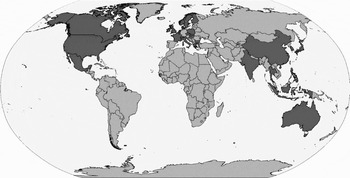
Environmental degradation limits the prospects of sustainable economic development and the pursuit of a better quality of life.Footnote 1 The public incurs the costs of pollution. According to neo-institutional economic theories, they should be given the power to make decisions on how to deal with pollution together with the necessary information to make informed decisions.Footnote 2 Besides being justified on theoretical grounds, an informational approach to environmental regulation has exhibited positive effects on pollution reduction in North America, South-East Asia and China.Footnote 3 Since 1995, this approach has been exported from the developed world to more than ten developing countries by international policy advisors (see Figure 1).
Countries that have Adopted Environmental Information Disclosure Programmes

China started experimenting with environmental information disclosure in 1999 and gradually institutionalized this policy. Informed by a policy advisor from the World Bank, Zhenjiang 镇江, Jiangsu province and Hohhot 呼和浩特, Inner Mongolia were selected for pilot experiments between 1999 and 2000. The results have been mixed. The disclosure programme was sustained in Zhenjiang but was stopped in Hohhot after only the pilot phase. Inspired by the Zhenjiang experience, a Ministerial Circular was published by the State Environmental Protection Administration (SEPA, upgraded to Ministry of Environmental Protection in 2008) in November 2005 to introduce technical guidelines and require all urban municipalities to rate industrial environmental performance and to make that information publicly available by 2010.Footnote 4 In December 2005, the State Council published its Decision on Embarking on a Scientific Approach to Development and Enhancing Environmental Protection. Article 27 explicitly requires provincial, municipal and city governments to report information on environmental quality and ecological vitality regularly, report accidents promptly, and create opportunities for public participation.Footnote 5 On 5 April 2007, the State Council promulgated the first Open Government Information Decree in Chinese history.Footnote 6 One week later, SEPA enacted its Measures of Environmental Information Disclosure (Trial).Footnote 7
Promulgating sunshine laws reflected the commitment of the central government to put governments and polluting industries under public scrutiny. Article 6 of the Measures of Environmental Information Disclosure (Trial) requires environmental protection agencies at the county level and above to set up an office specifically for environmental information disclosure. The Pollution Information Transparency Index evaluated a total of 113 cities on their adherence to the national environment information disclosure measures that came into effect on 1 May 2008. The average score for 2008 was only 30 out of 100, and just four cities scored more than 60.Footnote 8 To make sense of the less than optimal implementation and further inform future practice, it is necessary to look into past experiences with environmental information disclosure programmes.
Adopting a combination of the “cultural roots” and “webs of dialogue” analytical frameworks, this article compares and contrasts the pilot environmental information disclosure programmes in Zhenjiang and Hohhot. It first reviews the literature to ground the comparative case study in the empirical work on environmental information and enforcement. It then presents the research design and analytical frameworks adopted in the case analysis, while explaining how the idea of disclosing environmental information was introduced into China to highlight policy learning and the role of leadership. The case analysis itself looks at the perception of the disclosure programme by advocates and implementers, resources at their disposal for implementation, and the context in which the programmes were implemented. Finally, the article puts environmental information disclosure in perspective, as a policy instrument to extend local monitoring and enforcement systems beyond environmental protection agencies to engage more stakeholders. It concludes with a discussion on the impact of the disclosure programmes on webs of dialogue in environmental enforcement.
Environmental Information and Enforcement
Disclosing and revealing the environmental performance of industry aims to acknowledge good performers and pressure bad ones to make progress because they are assumed to be concerned about their economic gains and reputation. Upon receiving the disclosed information, residents in the same neighbourhood as polluters (as well as consumers, investors and business partners) react, and their reactions have economic or reputation implications for polluters. In China, given that environmental protection agencies rank low in the government hierarchy, more public attention on the environment would strengthen the position of environmental protection bureaus (EPBs) in dealing with relevant economic and industrial agencies.
Using disclosed information, environmental NGOs actively engage in compelling polluting firms into compliance. For example, in the United States the Massachusetts Public Interest Research Group targeted the Raytheon company in a public accountability campaign in 1990 after data revealed that Raytheon was the state's largest emitter of ozone-destroying chemicals such as chloroflourocarbons (CFCs) and methyl chloroform. In 1991, the Research Group obtained a pledge from Raytheon to switch to water-based alternatives to CFCs.Footnote 9
In countries where civil society is able to pursue bad environmental performers in the courts, such as the United States, Canada, Korea, Mexico, Chile, Argentina and the Philippines, the capital markets were found to value disclosed environmental performance information. Stock prices fluctuated in response to disclosed firm-specific information on environmental performance or relevant environmental lawsuits. Good performers were rewarded by increased stock market prices and noncompliant ones punished by a lower stock market value.Footnote 10
Existing research on the informational approach to environmental regulation mainly focuses on the relationships between disclosure and pollution discharge, disclosure and stock market value, or disclosure and democracy. However, there is only a limited understanding of how environmental information disclosure programmes were implemented and how disclosed information could change stakeholder behaviour, especially in a developing country context. A comparative case study of the pilot environmental information disclosure programmes in China will seek to fill this void.
Research Questions, Analytical Frameworks and Data
This study seeks to answer the following two questions and to examine the suggested propositions. First, what factors resulted in the Zhenjiang pilot disclosure programme being expanded and sustained and the Hohhot programme being stopped after only the pilot phase? It is proposed that, according to the cultural roots framework, implementation of the Zhenjiang and Hohhot pilot disclosure programmes was largely determined by how the programmes were perceived by implementers (tasks), the resources that were at their disposal, and the contexts in which the disclosure programmes were embedded.
Secondly, did the implementation of pilot environmental information disclosure programmes affect the dynamics of environmental monitoring and enforcement in Zhenjiang and Hohhot, and if so, through what channels? The proposition is that the pilot disclosure programmes work through webs of dialogues among programme stakeholders and potentially involve the public, industry and government in environmental monitoring and enforcement.
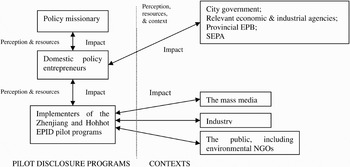
Two analytical frameworks were adopted in the comparative case analysis: Anne Khademian's “cultural roots” framework and a “webs of dialogue” framework synthesized from John Braithwaite and Peter Drahos’ Global Business Regulation.Footnote 11Figure 2 illustrates how the two analytical frameworks were woven together in the case analysis.
How “Cultural Roots” and “Webs of Dialogue” Frameworks are Woven Together in the Case Analysis

According to Anne Khademian, three elements — an organization's task, resources and context — are the “roots” of that organization's culture, and public managers weave the three elements together to influence perceptions, commitments and programme outcomes. In the study, “task” means the way in which the pilot disclosure programme implementers understood the programme and how they made sense of it and related it to their regular work. “Resources” refers to the administrative capacity of the Zhenjiang and Hohhot EPBs, the financial and human capital at the disposal of the implementers, their professional competency and working relationships, the match between their authority and responsibility for carrying out the disclosure programmes, and the availability of technical support. Contexts in which the pilot disclosure programmes were carried out include the following important players and institutions: city governments and relevant economic and industrial agencies of the same level as the Zhenjiang and Hohhot EPB, SEPA, provincial EPBs, industry, and the public, including environmental NGOs.
Braithwaite and Drahos indicated that epistemic communities play an important role in disseminating scientific knowledge, standards and regulatory instruments on the environment and in forming international environmental issue networks. The members of the epistemic communities can be industry representatives, academics and government officials as long as they have a substantial understanding of the subject. Dialogues and interactions among the members make international standards or regulations possible. This framework helps to illuminate the introduction of pilot disclosure programmes into China and their effects on stakeholders’ participation in environmental enforcement.
Zhenjiang and Hohhot were the first two cities in China piloting environmental information disclosure programmes at the same time, in different locations and with different outcomes. Hence a comparative analysis of the two cases is an appropriate way to search for a better understanding of how and why this difference came about.
Data were collected through individual interviews and a review of official documents and newspaper articles between October 2004 and December 2005. The 53 interviewees include SEPA officials, officials of the Zhenjiang and Hohhot EPBs, officials of city government and relevant economic and industrial agencies, academics, and industry representatives who were involved in the pilot disclosure programmes. Both open-ended and structured questions were asked, grouped into five categories: basic information; evaluation of resources available for the programme implementation; evaluation of working relationships with relevant parties in implementing the programmes; difficulties and/or obstacles incurred; and evaluation of the impact of the pilot disclosure programmes on their businesses and on public participation in environmental protection.
Introducing the Idea of Disclosing Environmental Information into China
The 1990s was a period of rising awareness and acceptance of public access to environmental information in both developed and developing countries. Dr Wang Hua picked up the idea of involving the public in environmental enforcement and aimed to introduce it into China in the hope that it would achieve cost-effective pollution control.Footnote 12 Adapted from the Programme for Pollution Control, Evaluation and Rating in Indonesia,Footnote 13 China's environmental information disclosure programme aimed to disclose via the mass media the environmental performance of polluters, which in turn would encourage the public to get involved in helping to keep industry clean.Footnote 14
Wang Hua was invited to give a talk at the “Agenda 21 Conference” held by the Department of Science and Technology in October 1998 in Beijing. His speech focused on environmental performance information disclosure and stimulated very positive responses from the audience. Wang knew Professor Lu Genfa 陆根法 of Nanjing University and Wang Jinnan 王金南, the chief engineer of the Chinese Research Academy of Environmental Sciences (CRAES), from previous collaborations. Having consulted them on pilot choices, Wang gave talks to the Hohhot and Zhenjiang EPB, two tentative pilot sites, to see if the EPB officials were interested in experimenting with environmental information disclosure within their jurisdictions. As hoped, the officials welcomed the idea.Footnote 15
In October 1998, the World Bank approved the “Chinese Industrial Pollution Predicting and Environmental Management Information System.” The project was contracted to the CRAES in Beijing, a research organ of SEPA. The project's purpose is to establish an industrial pollution prediction system; identify cost-effective pollution control instruments in China; and experiment with information-based pollution control instruments and disseminate the results through the internet or CD-ROMs to promote the system across China.Footnote 16
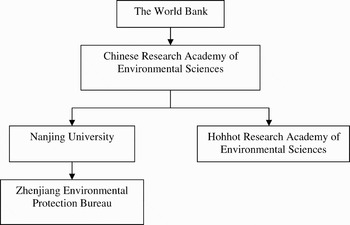
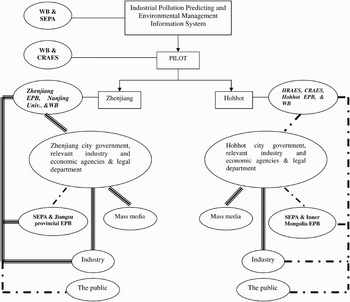
As an extension of this project, two grants were made separately to the CRAES and Nanjing University for piloting environmental information disclosure in Hohhot and Zhenjiang (see Figure 3). The idea was to rate the environmental performance of individual enterprises using five colours – green (best), blue, yellow, red and black (worst) – and make the results publicly available. The major goals were to facilitate public participation in environmental protection through better access to information; exert public pressure on industries to keep clean by disclosing their environmental performance information; improve the environmental management capacity of EPBs through informational strategy; and experiment with information disclosure and share the experiences of the two pilot cities with other localities in China.Footnote 17 The two pilots were chosen based on considerations of location (northern versus southern), level of economic development (less developed versus developed), and the major environmental protection challenges faced by each city (air pollution in Hohhot versus water pollution in Zhenjiang).Footnote 18
Contractual Relationship Involved in China's Pilot Environmental Information Disclosure Programmes

Wang Hua 王华 has been promoting environmental information disclosure in numerous municipalities across China since 1998. He has also talked to officials of SEPA to solicit an administrative ordinance or legislation on disclosure on a national scale. Between 1 and 3 September 2005, a national conference on environmental performance information disclosure was held by SEPA in Beidaihe 北戴河, Hebei province. SEPA has been encouraging localities to institute disclosure measures on a voluntary basis and issued an administrative circular in November 2005.Footnote 19
Comparing the Pilot Environmental Information Disclosure Programmes in Zhenjiang and Hohhot
If you ask Qu Xinhua 曲新华, a Zhenjiang EPB official, to talk about the environmental information disclosure pilot, she will give you, off the top of her head, a full list of events from the conception, planning and preparation stages, through implementation to scaling up and evaluation. She will provide a full list of local EPBs who have come to Zhenjiang to learn what the pioneer has to offer.Footnote 20 She obviously takes a lot of pride in this project as both a designer and an implementer.
When I telephoned my informant in Hohhot to schedule my fieldwork to learn more about their experiences with the pilot disclosure programme, he said: “You may come here for sightseeing. We have vast grasslands and the Mongolian people whose lifestyle is worth experiencing. But I guess you will be disappointed in conducting fieldwork. We really don't have much to tell you.”Footnote 21
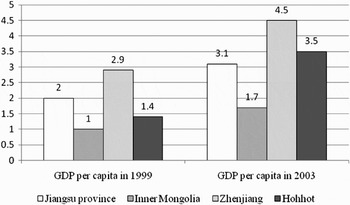
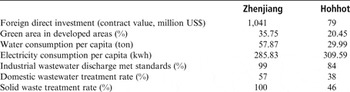
Jiangsu province, where Zhenjiang is located, is on the east coast, adjacent to Shanghai, one of the two global mega-cities in China, while Hohhot in Inner Mongolia is a northern inland region far away from ports or transportation hubs. Both Zhenjiang and Hohhot are highly developed municipalities within their regions, although Jiangsu province is more economically advanced than Inner Mongolia. In terms of per capita GDP, both cities were about 40 per cent higher than their provincial averages in 1999, and both margins became even larger in 2003 (see Figure 4). However, Zhenjiang is more open to the global market than Hohhot. In 2002, foreign direct investment (contract value) in Zhenjiang was 13.18 times that in Hohhot (see Table 1). In other respects, such as natural resources and environmental protection, Zhenjiang has generally performed better than Hohhot. On average, people in Zhenjiang consumed twice as much water as those in Hohhot in 2002, although electricity consumption was almost the same. The green area in the developed area was about 36 per cent in Zhenjiang, while that of Hohhot was only 20.45 per cent. The treatment rates of wastewater and solid waste from domestic sources were much higher in Zhenjiang than in Hohhot. Also, industrial wastewater discharge meeting standards in Zhenjiang was 15 percentage points higher than that of Hohhot (see Table 1).
Comparison of per capita GDP between Jiangsu, Inner Mongolia, Zhenjiang, and Hohhot (10,000 yuan)

Socio-Economic Conditions in Zhenjiang and Hohhot in 2002

Source: China City Statistical Yearbook 2003.
Among the 31 regions in China, Jiangsu ranked sixth in 2002 in terms of the potential institutional capacity of its local EPBs and fifth in terms of their realized capacity. In contrast, Inner Mongolia ranked 20th and 21st in these categories. On average, local EPBs in Jiangsu province have more staff members and a larger percentage of them are environmental professionals. In 2002, an average local EPB in Jiangsu province had 12.3 employees in contrast with only 9.5 in Inner Mongolia; professional staff constituted 60.2 per cent of EPB staff in Jiangsu, while in Inner Mongolia they formed only 45.7 per cent.Footnote 22
Specifically, the Zhenjiang EPB has a total of about 70 staff members and the Hohhot EPB has 25. The annual budget of the Zhenjiang EPB had almost doubled from 1999 to 2004.Footnote 23 The annual budget of the Hohhot EPB has been rather static and its size was only about one-tenth of that of the Zhenjiang EPB in 2004.Footnote 24 In terms of facilities owned, the Zhenjiang EPB was equipped with four mobile continuous monitors by 2004, but even in 2006 Hohhot did not have one.Footnote 25
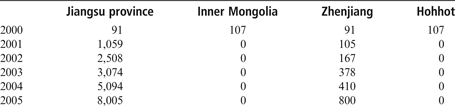
Looking at the number of participant enterprises, Zhenjiang and Jiangsu have steadily expanded their disclosure programmes between 1999 and 2004 (see Table 2). In contrast, the adaptation of disclosure in Hohhot and Inner Mongolia became stagnant after 1999. So it is quite understandable that people of Hohhot are rather modest about their pilot programme.
Number of Enterprises Participating in Environmental Information Disclosure Programmes, 1999–2005
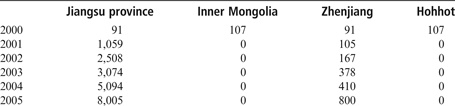
Sources: Jiangsu Environmental Quality Report 1999, 2000, 2001, 2002, 2003, 2004; Zhenjiang Environmental Quality Report 2001, 2002, 2003, 2004.
Do the differences in levels of socioeconomic development and administrative capacity of the EPBs between Zhenjiang and Hohhot tell the full story of why the pilot disclosure programme was sustained and scaled up to be applied province-wide in Jiangsu but was stopped after only the first year in Hohhot? Does the wide programme participation by industry in Jiangsu province imply a wide acceptance of and support for this programme? Can one simply judge the success or impact of pilot disclosure programmes by the number of enterprises colour-rated by their environmental performance and the amount of information made publicly available? The short answer to all of these questions is “no.” The statistics cited above do not explain the whole issue; more in-depth research is warranted to explore and make sense of the differences in the perception, implementation and, consequently, impact of environmental information disclosure in Zhenjiang and Hohhot.
Zhenjiang: prepared ears and collaborative efforts
Industrial pollution poses a major challenge for environmental protection in Zhenjiang. Chu Guiming 褚桂明 became leader of the Zhenjiang EPB in 1994, having worked there since 1981 and becoming a deputy director in 1985. Chu believes that human activities are the driving forces behind pollution but that human beings and their welfare are also the ultimate purpose of environmental protection. So, he argues, it is in the self-interest of every individual to protect the environment, and open access to environmental information is necessary to keep the public involved.Footnote 26
In the past, Chinese government officials were accustomed to only announcing good news because they feared the advancement of their political careers would be jeopardized by negative publicity. As a result, the public was not aware of the state of the environment or failures in environmental protection. Director Chu stands against the culture of environmental secrecy. “Environmental issues,” he said, “should be made public no matter whether they convey good news or bad news. There is nothing that can be hidden forever. Air, water and land are so openly accessible and so indispensable to people's lives. The government should make environmental information publicly available!”Footnote 27
The Zhenjiang city government plays a major role in making decisions concerning the whole city. As the plan was to implement environmental information disclosure city-wide in Zhenjiang, it was necessary to gain the city government's support. In addition, the Zhenjiang People's Congress oversees the work of all government agencies and can influence policymaking in Zhenjiang. Without its support, it would be impossible to carry out the programme on a city-wide basis. Realizing this, Chu Guiming worked persistently towards gaining the agreement of the top leadership of Zhenjiang to disclosure.Footnote 28 Chu said:
Immediately after Wang Hua talked to us, I thought environmental information disclosure would be a promising policy tool for us to promote public participation as well as to give the Zhenjiang EPB better means to steer environmental protection efforts. I began to spread the word about the idea among officials of the Zhenjiang city government. I talked about disclosure every time when I went to meetings with officials of the city government and industrial and economic agencies. They want local industries to make profits and local economy to grow. But the key aspect of the programme is that it publicizes the names of businesses whose environmental performance is poor. Such bad publicity could hurt these businesses’ profitability and shame directors who are in charge of industry and economic development. So we need to obtain support from the Zhenjiang city government. By keeping talking about disclosure, I intended to familiarize them with this idea and begin to understand the long-term benefit of it so that they would later accept it and grant us the authority to carry it out.Footnote 29
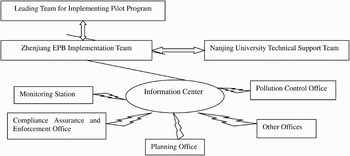
At the same time, Chu asked Qu Xinhua to work closely with the Nanjing University technical support team to develop a work plan. Implementing the pilot disclosure programme in Zhenjiang was a learning-by-doing process that involved specifying environmental information requirements by constructing a rating mechanism and a computerized colour rating system, selecting industrial enterprises, data collection and verification, rating, and finally disclosing. The leading group was headed by Director Chu and Professor Lu of Nanjing University. It guided two teams working in collaboration, an implementation team led by Qu Xinhua of the Zhenjiang EPB, and a technical support team led by Wang Yuan 王远, then one of Professor Lu's doctoral students from Nanjing University (see Figure 5).
Implementing Pilot Environmental Information Disclosure Programme in Zhenjiang: A Collaborative Project

In August 1999, the Zhenjiang EPB and Nanjing University prepared an implementation manual on indicator selection, rating methods and colour rating results using environmental performance data from 1998.Footnote 30 By April 2000, when the mayor of Zhenjiang considered officially adopting environmental information disclosure in the city, the Zhenjiang EPB had finished the trial rating (based on 1999 data), and the implementation manual had been finalized.Footnote 31
The Zhenjiang city government approved a proposal to hold a formal press conference on 26 July 2000 to make the rating results public. The following people were invited: officials of Jiangsu provincial EPB and municipal EPBs of the 13 prefecture-level cities across Jiangsu province, and officials of other Zhenjiang government agencies; representatives from the 91 enterprises being colour rated; Professor Lu and Wang Yuan of Nanjing University, Wang Hua from the World Bank; and reporters from more than 30 local and national news agencies.Footnote 32
The mayor of Zhenjiang gave the opening speech. He talked about the importance of environmental protection, how necessary it is for industry to be environmentally responsible, and what promise environmental information disclosure could bring to Zhenjiang to involve the public and industry in environmental protection.Footnote 33 Director Chu of Zhenjiang EPB announced the rating results. CEOs of green-rated enterprises were asked to deliver talks, and the CEOs of black-rated enterprises made public promises to improve their environmental performance.Footnote 34
Seven news agencies picked up on the Zhenjiang pilot disclosure programme, and it made ten headlines between 20 July and 22 September 2000. The news agencies included local newspapers and television stations such as the Zhenjiang Daily and Zhenjiang TV Station, and national newspapers such as China Environment Newspaper.
On the same day as the press conference, while the disclosure programme was still fresh in the minds of the directors of the 13 prefecture-level city EPBs who had been there, Jiangsu provincial EPB called a meeting in Zhenjiang to advocate the implementation of environmental information disclosure province-wide. On 19 September 2000, the Jiangsu provincial EPB issued an administrative ordinance to adopt disclosure programmes in all the prefecture-level cities in Jiangsu. SEPA had joined the effort on 7 August 2000 by taking EPB directors to Zhenjiang to learn how the disclosure programme was implemented.
Since 1999, the Zhenjiang EPB has transformed the pilot programme into a standard operation and adapted it to facilitate its environmental management practice. In 2002, the Zhenjiang EPB and Nanjing University together explored an indicator system to colour rate the environmental performance of the tertiary industry, and in 2004, the colour rating results of the service sector were made public. In 2005, 800 enterprises were colour rated and the results made public, of which about 10 per cent were tertiary industry enterprises. Both the size and scope of environmental information disclosure in Zhenjiang have been expanded. Now, new explorations are under way to make use of the colour rating results to target bad performers and push them to take pollution control measures. Over the years, EPB officials from 24 municipalities across China have come to Zhenjiang to learn from their experiences.
Hohhot: diverted attention and interests
In late 1998, Wang Hua contacted the chief engineer of the CRAES, Wang Jinnan, for collaboration on a research project on industrial pollution control and environmental information disclosure. Wang Jinnan showed great interest. Since Zhenjiang had been selected to be a pilot, Wang Hua thought it was important to have another pilot that served as a contrast. During the follow-up discussions, Wang Jinnan suggested Hohhot because it is located in northern China, it is relatively undeveloped and its severe air pollution is representative of cities in northern China. Since the CRAES had worked with the Hohhot Research Academy of Environmental Sciences (HRAES) on a United Nations Environmental Programme project in 1996, Wang Jinnan thought the HRAES would be a good collaborator.Footnote 35
In late 1998, Wang Jinnan asked the director of the HRAES if he would be interested in conducting a pilot environmental information disclosure programme in Hohhot. As expected, the answer was positive: “Yes, we would be happy to be a part of the World Bank project.” At that time, a US$10,000 fund was provided to the CRAES for piloting disclosure in Hohhot.Footnote 36
The World Bank, to most Chinese people, stands for money, authority and knowledge. Participating in a World Bank research project improves a research institute's standing and further enhances its credentials. Moreover, the embedded capacity-building component, which would bring major project participants to Washington, DC for a one-week workshop, was attractive.Footnote 37 Given all these tangible and intangible benefits, the HRAES was willing to take charge and assume the leadership in the Hohhot pilot.Footnote 38
A project launch workshop was held in February 1999, and officials from the Hohhot city government and other government agencies were invited. The HRAES and CRAES then worked out a preliminary indicator and computerized colour rating system, and in August 1999 three project-leading groups were formed. Environmental performance information was collected between September and October 1999 with help from the Hohhot EPB. Between November and December 1999, the environmental performance of 100 organizations was colour rated with black ratings almost across the board, which was unacceptable. A Hohhot EPB official suggested adopting target pollutants of the environmental campaign required by SEPA, “Control one, meet two standards.” This campaign was of high priority for the Hohhot EPB in 1999 because by the end of 2000, the final benchmark was that total pollution discharges had to meet national standards, and ambient environmental quality had to meet standards in functional areas.
After limiting indicator pollutants of the pilot disclosure programme to target pollutants of the environmental campaign, the distribution of colour rating results, although skewed to black, became acceptable. The trial rating was completed in January 2000. The HRAES and Hohhot EPB planned to disclose the results formally to the public through a well-publicized press conference in March.
The Yili Corporation, a leading, publicly traded Hohhot dairy producer, which contributed almost one-third of the city's total tax revenue, was originally rated black but was later upgraded to red. The Hohhot city government did not want to risk a negative impact on Yili's image, stock price or profitability. As a result, public disclosure of the colour rating results of 1998 was prohibited. On 24 March 2000, a meeting was held in a conference room in a Hohhot city government office building between officials of relevant government agencies, selected news agencies and representatives of programme participant organizations.
Between the trial rating in January 2000 and the final rating in March 2000, the colour rating results of programme participant organizations changed. Overall, the rate of compliance had increased from 1 per cent to 10.3 per cent, noncompliance increased from 50 per cent to 60.7 per cent, and partial compliance decreased from 49 per cent to 29 per cent. Reasons for these changes are unclear.
Five news agencies picked up on the pilot environmental information disclosure programme in Hohhot, and it made five headlines between March and May 2000. These news agencies included local newspapers and television stations such as Hohhot Daily and Hohhot TV Station, and national newspapers such as China Environment Newspaper. Unfortunately, disclosure in Hohhot was stopped after the pilot phase.
This analytic narrative has exhibited the differences in the implementation processes of the pilot environmental information disclosure programmes in Zhenjiang and Hohhot. The next section presents the differences in the three elements of “cultural roots,” perception of task, resources and contexts, and the webs of dialogue in the two programmes.
Perception, resources, contexts and webs of dialogue do matter
Professor Lu Genfa of Nanjing University is the person who signed the contract with the CRAES and was supposed to be officially responsible for the Zhenjiang pilot programme. However, he sensed the programme would serve as a new policy instrument to control pollution and suggested the Zhenjiang EPB should take the lead. As stated in the memorandum to the Zhenjiang city government from the Zhenjiang EPB, environmental information disclosure is a policy innovation for achieving cost-effective environmental protection by harnessing the forces of the market and community and further stimulating better industrial environmental behaviour. It will enable harmonious development featuring advancements in both economic growth and environmental protection.Footnote 39
The deputy director of the Hohhot EPB who headed the advisory group and tried his best to help with the pilot disclosure programme recalled:
Environmental information disclosure is a research project contracted to HRAES. Disclosure needs firm level pollution data but HRAES doesn't have it. So I was invited to participate in this project to co-ordinate data issues. I was also asked to comment on the colour rating mechanism proposed by HRAES. Apart from that, Hohhot EPB didn't get involved in any project details.
As for Hohhot city government, no, it was not really involved. I won't say they did not support the project. First of all, nobody with the research team reached out to the city government. Secondly, in 1999, we had a big company which didn't have time to build its pollution treatment facility. If it was given a bad rating, the image of this company will be damaged. This would be bad for the local economy of Hohhot.
To the Hohhot EPB, the pilot disclosure programme was officially contracted to the HRAES as a research project, not a management tool to advance their capacity to control pollution. Already swamped with regular and urgent tasks, the Hohhot EPB assisted the HRAES with readily available resources such as pollution information, prioritizing pollutants that need to be included and administrative approval whenever required. In general, the Hohhot EPB viewed the pilot disclosure programme as an extra – and unimportant – task.
The Hohhot EPB felt that the pilot disclosure programme was not able to stand alone as a meaningful project; to make sense of it, the implementers connected it to the environmental campaign “Control one, meet two standards” which was a policy priority for them at that time. When this campaign ended in 2000, the disclosure programme became redundant. As a result, the Hohhot EPB discontinued it after its first year's pilot.
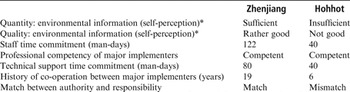
“Resources” refers to the administrative capacity of an EPB to gather and process pollution information, the competency of programme implementers, the level of technical support available for establishing a computerized colour rating system, and the match-up of authority and responsibility to implement the disclosure programmes. Table 3 compares the resources available in Zhenjiang and Hohhot.
Comparing Resources at the Disposal of Pilot Environmental Information Disclosure Implementers in Zhenjiang and Hohhot

Notes: *Author administered a semi-structured survey. Interviewees were asked to evaluate the quantity and quality of environmental information for implementing the pilot disclosure programmes on a 1–5 scale with 1 the best and 5 the worst. The self-perceived quantity of environmental information of Zhenjiang and Hohhot was 1.4 versus 3.3; self-perceived quality was 2.3 versus 3.5.
The administrative capacity of the Zhenjiang and Hohhot EPBs to gather and process pollution information is different. The budget size, percentage of environmental professionals and monitoring facilities of the Zhenjiang monitoring station are superior to those of Hohhot. Consequently, environmental information available for disclosure in Zhenjiang was perceived to be much more comprehensive and of better quality than that in Hohhot.
All the key pilot disclosure programme implementers in both Zhenjiang and Hohhot are college graduates. They have all worked in environmental protection since the early 1980s so they understand their jobs and the operation of their EPBs very well. However, the Zhenjiang EPB committed twice the amount of staff time as the HRAES and the Hohhot EPB to implementing the pilot programme. In addition, the distance between the HRAES and its technical support team is about seven times further than the distance between the Zhenjiang EPB and its technical support team. As a result, the Zhenjiang pilot programme had much better access to technical support than the Hohhot pilot.
Finally, the way the authority and responsibility to implement the pilot matched up differed between the two. The trust built over a long-term working relationship between Director Chu and Qu Xinhua of the Zhenjiang EPB made Qu the de facto decision-maker in the pilot programme.Footnote 40 As a result, she took initiatives as she saw fit, which made the implementation of the Zhenjiang pilot programme smooth and productive. In Hohhot, the administrative authority required to implement the pilot resided with the Hohhot EPB but was not delegated to the HRAES, which was responsible for programme implementation. Consequently, as the Hohhot EPB was not able to participate in live discussions on environmental information disclosure, it lost the opportunity to integrate it into its regular work. With all these factors playing together, it is clear that the implementers of the Zhenjiang pilot disclosure programme had better resources at their disposal than did their counterparts in Hohhot.
Figure 6 illustrates how the major actors in the Zhenjiang and Hohhot pilot disclosure programmes were embedded in their social contexts. Peter Ho has correctly observed “the central authorities and environmentalists often find themselves partners in the same struggle against local government.”Footnote 41 In Zhenjiang, implementers worked with Jiangsu provincial EPB and SEPA, and co-opted the Zhenjiang city government and industry. In contrast, the programme implementation team in Hohhot worked in isolation and did not establish strong ties with other actors. Hence the local government was able to block the colour rating results being made public.
Major Actors and their Levels of Connectedness in Implementing the Pilot Programmes
Notes: ————— stands for connections between the international policy advisor and domestic policy entrepreneurs;  stands for strong ties;
 stands for weak ties; Italics in bold highlight the teams responsible for implementing the pilot environmental disclosure programmes.

In conclusion, how the following factors were woven together underscored the different implementation of the two pilot programmes: the value and relevance of environmental information disclosure to the current work; the match between authority and responsibility; the quantity and quality of environmental information; access to technical support; commitment by programme implementers and mutual trust based on shared values and personal ties; and reach out by policy entrepreneurs to other actors.
To a large extent, the dialogues on environmental information disclosure between the policy missionary, domestic policy entrepreneurs, and officials of the Zhenjiang and Hohhot city government affected the perceptions, mobilized the resources and shaped the contexts. Dialogues on the pilot programmes between government, industry and the public proved to be not only valuable for implementation but are themselves part of the policy goal for a pilot disclosure programme to realize its potential in transforming environmental monitoring and enforcement. The next section discusses how environmental information disclosure transformed the webs of dialogue in environmental compliance and enforcement.
The Impact of the Disclosure Programmes on Webs of Dialogue in Environmental Enforcement
Of the 845 survey respondents in 2000, 56 per cent were aware of the pilot environmental information disclosure programme in Zhenjiang but only 8.3 per cent understood what it was about.Footnote 42 The Hohhot pilot programme did not include any public education programmes either. But in business circles, firm managers paid attention to each others’ companies’ ratings. For example, in 2002, the CEO of a “black” construction materials manufacturing company in Zhenjiang decided to invest in wastewater treatment because he could not stand his friends at dinner parties asking why his company was “black.” In 2003, this company became “blue.”Footnote 43 Thus, disclosure-derived dialogue between the government, industry and the public did spark improvements here and there, although not in a systematic way.
It is not surprising that the public was not substantially involved when the political force behind the pilot disclosure programmes was a relatively small group of insiders and participation by industry was voluntary. The biggest breakthroughs that the Zhenjiang and Hohhot pilot programmes made are, first, that the government did make more environmental information publicly accessible, and secondly, that the five-colour coding system made technical environmental information comprehensible to ordinary citizens. This is a remarkable stride forward in public administration in China because the disclosure programmes reflect the willingness of the government to share environmental information with the public and to invite public help on government work.
China has now moved to a new phase of visible environmental damage, vocal citizenry, a rising “green public sphere”Footnote 44 and nationwide mandatory disclosure by the government of environmental information. This has the potential to initiate webs of dialogue among stakeholders of China's environment and further enable network-based environmental governance.
The pilot disclosure programmes in Zhenjiang and Hohhot were managed from the top down with the public being almost absent. The commitment, perception and resources of leadership determined each programme's success. At that time, nondisclosure did not receive any public attention. Now, environmental NGOs are actively engaged in this work.Footnote 45 The Pollution Information Transparency Index uncovered the poor implementation of the Measures of Environmental Information Disclosure (Trial) that fell short of its potential in establishing webs of dialogue and involving the public in environmental decision-making and enforcement. Environmental NGOs can become agents of change to pressure governments and force them to form a commitment to, perceive the indispensability of, and allocate resources for environmental information disclosure. Then the public can be transformed from passive receiver to active seeker and user of environmental information in development decision-making and redressing pollution harms.Footnote 46