


Introduction
Recent years have witnessed a renewed interest in the very early stages of psychosis and numerous clinical and research efforts have been focused on intervening in the so-called At-Risk Mental State (ARMS) for psychosis (e.g. Cannon et al. Reference Cannon, Cadenhead, Cornblatt, Woods, Addington, Walker, Seidman, Perkins, Tsuang, McGlashan and Heinssen2008). An individual can meet ARMS criteria in one or more of three ways: (1) a recent decline in functioning coupled with either schizotypal personality disorder or a first-degree relative with psychosis; (2) ‘attenuated’ positive psychotic symptoms; and (3) a brief psychotic episode of less than 1 week's duration that resolves without antipsychotic medication (Yung et al. Reference Yung, Phillips, McGorry, McFarlane, Francey, Harrigan, Patton and Jackson1998). Early detection services aim at offering help in this very early stage to reduce prodromal symptoms and disability, prevent transition to psychosis and improve outcome if psychosis develops. Evidence suggests that moving towards identifying and treating adolescents and young adults who seem to be clinically ‘at risk’ or in a prodromal phase to their first episode of psychosis may be beneficial. Treatment may reduce ‘attenuated’ psychotic phenomena (Woods et al. Reference Woods, Breier, Zipursky, Perkins, Addington, Miller, Hawkins, Marquez, Lindborg, Tohen and McGlashan2003; McGlashan et al. Reference McGlashan, Zipursky, Perkins, Addington, Miller, Woods, Hawkins, Hoffman, Preda, Epstein, Addington, Lindborg, Trzaskoma, Tohen and Breier2006) and reduce the duration of untreated psychosis (DUP) if the person subsequently develops psychosis, which may improve long-term outcomes (Drake et al. Reference Drake, Haley, Akhtar and Lewis2000) or delay or even prevent the onset of psychosis (McGorry et al. Reference McGorry, Yung, Phillips, Yuen, Francey, Cosgrave, Germano, Bravin, McDonald, Blair, Adlard and Jackson2002; Morrison et al. Reference Morrison, Bentall, French, Walford, Kilcommons, Knight, Kreuz and Lewis2002, Reference Morrison, French, Walford, Lewis, Kilcommons, Green, Parker and Bentall2004).
A clinical audit of Outreach and Support in South London (OASIS), a service for those at risk of psychosis in South London, concluded that it is possible to identify and manage people with an ARMS for psychosis, even in a deprived inner-city area with a high proportion of people from ethnic minorities (Broome et al. Reference Broome, Wooley, Johns, Valmaggia, Tabraham, Gafoor, Bramon and McGuire2005). The authors argue that services for people with prodromal symptoms work to complement first-episode psychosis services and help to meet the objectives of the National Service Framework for schizophrenia. However, a key criticism of this work is that empirical studies are based on those subjects who are successfully engaged with clinical services (i.e. ‘help-seeking’) and therefore the results may not be representative of the total vulnerable population. Current international agreement and practice dictates that clients themselves must be help-seeking before any formal assessment or intervention can be implemented (International Early Psychosis Association Writing Group, 2005). Therefore, little is known about individuals who refuse input from ‘at-risk services’. Although early detection services are designed to be accessible, not all those at high risk are willing to engage with treatment. It is therefore possible that those who do not engage differ demographically or in terms of their clinical features. How representative, for example, are those who seek help compared to the wider referral demographic? Are those who turn down help identifying themselves correctly as ‘false positives’? Or, are they as in need as those who do seek help but lose out on support and intervention at this early stage because of the constraints around service accessibility?
In this report we present data collected from referrals to the OASIS service between the start of the service in January 2002 and September 2007. We aimed to define the size of the unengaged population and characterize this group in relation to those who are seen in terms of sociodemographic and clinical features.
We tested the following hypotheses:
(1) Despite providing an accessible, assertive service, a proportion of referrals will not attend or engage.
(2) These individuals will be similar to those who did engage with the service, with respect to:
(a) sociodemographic features;
(b) pathways to care;
(c) severity of mental health problems/need for care.
Method
The OASIS service
OASIS is a multidisciplinary team that offers rapid and individually tailored assessment and treatment for young people in South London between the ages of 14 and 35 years who meet criteria for an ARMS for psychosis. At-risk clients are identified using the Comprehensive Assessment of At-Risk Mental States (CAARMS; Yung et al. Reference Yung, Yuen, McGorry, Phillips, Kelly, Dell'Olio, Francey, Cosgrave, Killackey, Stanford, Godfrey and Buckby2005) and a consensus meeting with the clinical team. Clients can be referred from general practitioners (GPs), schools and colleges, social and faith groups, adolescent and adult mental health services and by themselves or their relatives and clinical work is carried out within the client's GP surgery or at the clinic base. OASIS also has close links with first-episode psychosis services in South London. Following referral, a rapid response and assessment is conducted (within 1 week) usually by a clinical psychologist or a psychiatrist. ‘At-risk’ clients are seen by the team over a period of 2 years, the period of maximum risk, and offered a range of interventions including cognitive behavioural therapy, low-dose antipsychotics, advice on antidepressants and also practical advice around housing, benefits, etc.
Protocol
We examined all referrals to OASIS between January 2002 and September 2007. Three groups were defined: (1) ‘Engaged ARMS’: those who were offered an assessment, met criteria for the ARMS, offered treatment and engaged; (2) ‘Referred but non-attenders’: those who were offered an assessment but did not attend; and (3) ‘Disengaged ARMS’: those who were offered an assessment, met criteria for the ARMS, offered treatment but subsequently disengaged.
The groups were first compared on demographic and referral pathway data. Clinical activity subsequent to referral to, or disengagement from, OASIS in groups 2 and 3 was then recorded, using information in their GP and mental health records. The latter involved the electronic Patient Journey System (e-PJS), an electronic notes system used in the South London and Maudsley National Health Service (NHS) Foundation Trust (SLaM). We thus identified (a) any diagnosis of mental illness and (b) use of mental health services for difficulties after the initial referral to OASIS.
A case-by-case search was performed using e-PJS to identify any ‘referred but non-attenders’ or ‘disengaged ARMS’ who had received input within the SLaM services for mental health difficulties since their referral to OASIS. e-PJS contains detailed information regarding an individual's current and past contacts with SLaM services. For those not logged on e-PJS, up-to-date GP information was identified for each individual using the National Strategic Tracing Service (NSTS). GPs were then approached by letter and asked to complete and return a brief checklist on their patient's known contact with services and mental health diagnoses since the referral to OASIS. Checklists were anonymized and identifiable only by a number unique to the OASIS team.
Ethical approval
OASIS had received ethical approval from the joint South London and Maudsley/Institute of Psychiatry research ethics committee to follow up patients and evaluate the service, including patients who did not engage or disengaged (reference 2002/069).
Statistical analyses
Data were analysed using SPSS for Windows version 15.0.0 (SPSS Inc., USA). A χ2 analysis was performed to explore any differences in demographics between the groups. These analyses were weighted to account for the uneven case frequencies between groups.
Results
Sample
From January 2002 to September 2007 OASIS received 512 referrals. Of those referred, 82 (16.0%) had been screened out as inappropriate; for example because they lived outside the service's catchment area, were outside the age range for the service, or were already experiencing a first psychotic episode, or had a previous history of psychosis. The remaining 430 clients were offered an assessment. Seventy-five (17.4%) declined to be seen. Of the 358 clients assessed, 137 (38.3%) met criteria for an ARMS (Yung et al. Reference Yung, Phillips, McGorry, McFarlane, Francey, Harrigan, Patton and Jackson1998), and 133 were offered treatment. Four clients were not offered treatment within OASIS because they either moved out of the area following assessment or were referred to other more appropriate services; for example one person was referred to an Eritrean counselling service. Of these 133 clients, 16 (12.0%) declined or disengaged from treatment, and the remaining 117 (88%) engaged with the service.
Therefore, the number of cases in each of the three groups as defined above were as follows: (1) Engaged ARMS (n=117); (2) Referred but non-attenders (n=75); (3) Disengaged ARMS (n=16).
Missing data and exclusions
A small number of cases (n=6) could not be followed up, as the current GP could not be identified through the NSTS, and there were no notes on e-PJS. A further five cases were excluded from the GP follow-up, as it was established through further investigation that these individuals had already been given a diagnosis of psychosis prior to their referral to OASIS. Clients identified through follow-up on e-PJS (n=14) had more detailed notes available concerning their secondary care service involvement, but were not followed up with their GP, and therefore data relating to primary care contacts for mental health problems after referral to OASIS were missing. The total GP response rate was 72.7% (n=66), 14 GPs did not respond, two did not consent to provide further information, and two responded but did not provide information as the client was no longer registered with their practice.
In summary, of the 91 clients followed up (i.e. those in the ‘referred but non-attenders’ and ‘disengaged ARMS’ groups), data were available for 62 cases (68.1%).
Group comparisons
Demographic characteristics (Table 1)
There was a significant group difference in occupational status (employed versus unemployed versus student) (χ2=13.67, df=2, p=0.001). A greater proportion of the ‘engaged ARMS’ group were employed than in the other groups. There were no differences between the ‘engaged ARMS’, ‘referred but non-attenders’ and ‘disengaged ARMS’ groups in terms of age [F(2)=1.39, p=0.25], gender (χ2=3.92, df=2, p=0.14), ethnicity (White British versus Black and Ethnic Minority) (χ2=0.17, df=2, p=0.92), place of birth (within UK versus outside UK) (χ2=1.76, p=0.42) or marital status (single, including divorced or separated versus married or living with partner) (χ2=0.58, df=2, p=0.75).
Demographic characteristics of participants

ARMS, At-Risk Mental State; s.d., standard deviation.
a Incorporates all cases identified as Black British, Black African, Black Caribbean and Black Other.
b Incorporates all cases identified as Asian, Middle Eastern and Mixed Race.
c Incorporates all cases identified as never married, separated or divorced.
d Incorporates all cases identifies as married or living with a partner.
Referral source and pathway to care among the groups (Table 2)
Of the three groups, the ‘disengaged ARMS’ group was the least likely to have been referred from primary care but the most likely to have self-referred. The ‘referred but non-attenders’ group was more likely to be referred by relatives or emergency services than the ‘engaged ARMS’ group, but these differences were not significant (χ2=17.65, df=12, p=0.13). There was a significant relationship between group and pathway to care (χ2=19.67, df=10, p=0.03). Clients in the ‘engaged ARMS’ group were more likely to have been in contact with more than three services prior to referral than those in the other two groups.
Referral source and pathways to care (number of services consulted before referral to OASIS) for groups
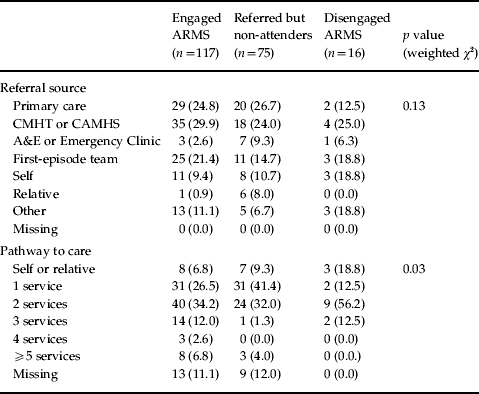
ARMS, At-Risk Mental State; CMHT, Community Mental Health Team; CAMHS, Child and Adolescent Mental Health Services; A&E, Accident and Emergency.
Values given as n (%).
Follow-up of ‘referred but non-attenders’ and ‘disengaged ARMS’ (n=62)
Diagnosis of psychosis
Fourteen individuals (22.6%) who had either not attended their assessment with OASIS or had disengaged subsequent to assessment had a diagnosis of psychosis. Eight of this subgroup had received a diagnosis of schizophrenia, one had a diagnosis of schizo-affective disorder, one bipolar affective disorder, one delusional disorder, one acute and transient psychotic disorder and two ‘other’ non-organic psychosis. Diagnoses were made by clinical teams, although because of the nature of the audit, little is known about how these diagnoses were reached, that is using which diagnostic criteria.
The median number of months between the date of referral to OASIS and assignment of a psychotic diagnosis was 10 (mean=13.5, s.d.=10.9, range=0.25–35 months). This was similar to the median interval in the ‘engaged ARMS’ group, which was 12 months (mean=14.7, s.d.=11.3, range=0.25–40 months), and there was no difference in the time to transition between those who engaged (‘engaged ARMS’) and those who did not (‘referred but non-attenders’ and ‘disengaged ARMS’) [t(34)=0.35, p=0.73].
Other psychopathology
After referral to OASIS, some individuals (from the ‘referred but non-attenders’ and ‘disengaged ARMS’) who had been assigned a diagnosis of psychosis also received diagnoses of depression (n=2, 14.3%), personality disorder (n=1, 7.1%) and autistic spectrum disorder (n=1).
Of the individuals who had not developed psychosis (n=48, 77.4%), 19 (39.6%) had received a diagnosis of another mental illness. Twelve (25%) individuals had received a diagnosis of depressive disorder (including one case of postnatal depression), six (12.5%) an anxiety disorder, one with attention deficit/hyperactivity disorder (ADHD) (2.1%), one with ‘stress’, one with a manic episode, one with adjustment disorder, one with substance misuse and one with ‘mental disorder not otherwise specified’.
An incident of self-harm was noted in seven cases (11.3%) and a suicide attempt in three of these cases. No suicide attempts were completed. Two of these three cases had a diagnosis of depression.
Overall, 33 (53.2%) of the ‘referred but non-engagers’ and ‘disengaged ARMS’ had some formal psychiatric diagnosis at follow-up.
Primary and secondary care contact since initial referral to OASIS
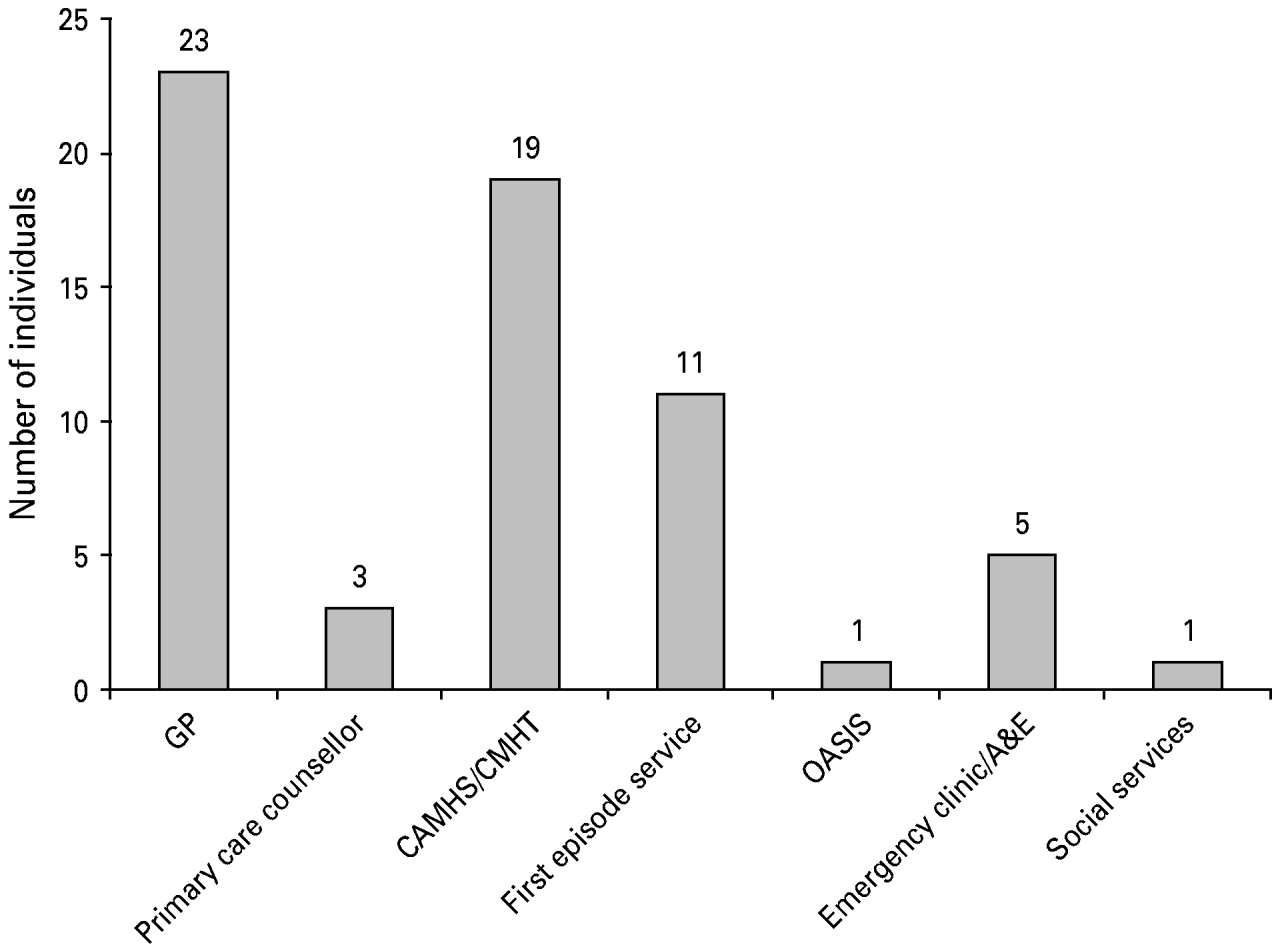
Nineteen (30.6%) individuals had not been in contact with any mental health services since their referral to OASIS, 43 (69.4%) had been in touch with at least one service (26, 41.9% in touch with only one service), 17 (27.4%) had been in touch with two services and three (4.8%) had been in touch with three services (see Fig. 1). The types of services contacted are shown in Fig. 1.
Types of services contacted by ‘referred but non-attenders’ and ‘disengaged At-Risk Mental State (ARMS)’ since initial referral to Outreach and Support in South London (OASIS). GP, general practitioners; CAMHS, Child and Adolescent Mental Health Services CMHT, Community Mental Health Team; A&E, Accident and Emergency.
Of those who had contacted secondary care mental health services after referral to OASIS (n=31, 50.0%), the average (median) length of time from referral to contact was 4.5 months (s.d=9.9, range=0–36 months); 16 individuals (25.8%) were known to have been involved with secondary care services at the time of their referral to OASIS. Eight individuals (12.9%) were still in contact with secondary care services at the time of this audit. The average (median) length of contact with secondary care services since referral to OASIS was 6.5 months (mean=10.6, s.d=12.0, range=0–35).
Hospital admissions
Twelve people (19.4%) had been admitted to hospital in the period after their referral to OASIS. Ten had a diagnosis of psychosis, one had depression and one had a manic episode. Seven people had had one admission, four people two and one person had had six admissions. Thirteen (61.9%) of these admissions were involuntary, that is under a section of the Mental Health Act. The average (median) time spent in hospital was 2.3 months (mean=3.6, s.d=4.7, range=0.2–16 months).
Discussion
To our knowledge, this is the first analysis of non-attenders to a service for individuals at high risk of developing psychosis. Of the 512 people referred, 430 were offered an assessment and 133 were deemed ‘at risk’ and offered treatment. Out of the 430 people, 75 declined assessment by OASIS despite the GP concerns and a further 16 out of the 133 disengaged from treatment. These figures are encouraging and suggest that OASIS does well to create an accessible and acceptable service for the majority of young people referred. This is a particularly positive result as OASIS mainly serves the area of South London that is socio-economically deprived, has a high proportion of ethnic minorities and an often difficult relationship between service users and mental health services (Broome et al. Reference Broome, Wooley, Johns, Valmaggia, Tabraham, Gafoor, Bramon and McGuire2005). However, given the high levels of morbidity in those who did not attend or disengaged from treatment, it is important to find ways of improving the proportion of referrals who are engaged. OASIS is a relatively accessible service that tries hard to accommodate referrals, seeing clients in their local GP surgery, seeing them at out-of-hours times, and offering several appointments when they do not attend. This illustrates how ambivalent some of those who agree to be referred are about contacting mental health services, and the need for teams to make a particular effort to engage them. The relatively few referrals from Emergency services is probably accounted for by lack of awareness of the OASIS service. Since this audit we have had more contact with liaison psychiatry at local Accident and Emergency (A&E) departments to raise awareness of the service.
A key issue in the interpretation of data from studies in clinical high-risk subjects is that most of the findings are in subjects who are ‘help-seeking’ (and can therefore be recruited through clinical services), who might be unrepresentative of the total population at high risk, some of whom may not be help-seeking, and may not present to services. We found no differences in ethnicity, age, gender or marital status between those who accepted help from OASIS and those who disengaged after the initial referral. This suggests that those who engage with such services are demographically similar to those who do not, but we cannot comment on people who may have had similar clinical features but did not come into contact with potential referrers. What might explain the differences in help-seeking behaviour between the groups? The ‘engaged ARMS’ group had had more contact with services prior to referral to OASIS and were also more frequently referred by a psychosis or Community Mental Health Team (CMHT) service. Could these factors indicate that they were somehow more unwell, closer to psychosis, and therefore more willing to receive intervention? A recent paper (Phillips et al. Reference Phillips, Nelson, Yuen, Francey, Simmons, Stanford, Ross, Kelly, Baker, Conus, Amminger, Trumpler, Yun, Lim, McNab, Yung and McGorry2009) suggests that the more symptomatic patients at an ARMS service were more likely to agree to participate in a randomized controlled trial of antipsychotic medication. However, in our sample, those who did not engage with the service (‘disengaged ARMS’ and ‘referred but non-engagers’) also showed significant levels of psychopathology prior to referral. We believe it is more likely that other factors, such as a network of support and level of social functioning, may account for differences in help-seeking behaviour. Indeed, there were significantly higher levels of employment in the ‘engaged ARMS’ group.
Very little is known about what happens to people who are referred to high-risk services but do not attend, or fail to engage with them. One possibility is that these outcomes might be more likely in individuals who are relatively well; it is also possible that it might be more common in subjects who are more severely unwell. We found that nearly 70% of those who were referred to OASIS but did not engage subsequently contacted other services with mental health problems (range of time to contact: 0–36 months). Usually this was their GP or a CMHT. In the period following the original referral, over 50% of this group were subsequently found to have some form of mental illness, 22.6% had acquired a diagnosis of psychosis, and approximately 20% had been admitted to hospital due to mental illness, mostly on a compulsory basis. However, around a quarter of the sample were already in contact with secondary care services at the time of the original referral, and a similar number were referred to OASIS by secondary care services. This suggests that some individuals who did not engage may have felt their mental health needs were being met elsewhere, or may not have understood why they were being referred to another mental health team. It also suggests that some of the sample already had psychiatric disorders, including psychosis, when they were referred.
Overall, these data suggest that there were similar levels of psychiatric morbidity in referrals who were not engaged by OASIS as in those that were. In particular, the rate of psychosis among this group was high, at 22.6%, and similar to a transition rate of 19% in the help-seeking group (Valmaggia et al., unpublished data). It is likely that at least some of these individuals were already psychotic at the time of referral, and in these individuals their symptoms are likely to have progressed after this point. These findings seem to run contrary to the argument that many of those referred to ‘at-risk services’ are in fact ‘false positives’ (Warner, Reference Warner2005). Rather, GPs are accurate by referring to OASIS. Unfortunately, however, some vulnerable individuals are missing out on the help and support they may need early on because they choose not to engage, only later to return to mental health services for further input, some suffering costly hospital admissions.
These findings seem to implicate a need for increased assertiveness, both among referrers and ‘at-risk services’. Individuals who have raised concerns with referrers but then fail to engage should perhaps be pursued more assertively. Improving engagement at this early stage could help to reduce the duration of untreated symptoms and the need for later crisis intervention. This would also have positive time and cost implications in the longer term for both primary and secondary services as a whole (Valmaggia et al. Reference Valmaggia, McCrone, Knapp, Woolley, Broome, Tabraham, Johns, Prescott, Bramon, Lappin, Power and McGuire2009). One way to increase assertiveness would be for GPs and ‘at-risk services’ to work more in partnership; that is, to place assessors within primary care practices. This way, individuals who present with mental health concerns and may be at risk of psychosis can be assessed quickly in a setting that is non-stigmatizing and accessible. Worried relatives would also have a familiar setting within which to raise their concerns.
The current study has some limitations. First, information was collected retrospectively and indirectly. Although the response rate from GPs was very good (72.7%), there were some missing data, and rates of psychopathology and service contact may therefore have been underestimated. Future studies could consider the possibility of trying to reassess ‘referred but non-attenders’ and ‘disengaged ARMS’ directly. It would also be useful to assess and follow up individuals who are at high risk but do not contact any health agency for help. This would require the screening of a large sample from a non-help-seeking population. Data were combined in the follow-up of the ‘referred but non-attenders’ and ‘disengaged ARMS’ groups because of the small sample size of the ‘disengaged ARMS’ group.
As some referrals were received by OASIS more recently than others, the period of follow-up varied from 2 to 7 years. Thus, in some cases GPs were asked to review a period of several years, whereas in others the review related to a shorter, more recent period. This may have affected the accuracy of estimated rates of psychopathology and service contact.
Acknowledgements
Thanks are extended to all GPs who took time to provide us with follow-up data. The OASIS service is supported by the Guy's and St Thomas' Charitable Foundation and by the South London and Maudsley Trust.
Declaration of Interest
None.



