INTRODUCTION
The genus Hacelia Gray, 1840 currently comprises five species with three of them occurring in the Atlantic Ocean: Hacelia capensis Mortensen, 1925 (South Africa), H. attenuata Gray, 1840 (Mediterranean Sea, Macaronesian Islands, Gulf of Guinea, the Azores and Cap Blanc to southern Angola) and H. superba H.L. Clark, Reference Clark1921, the latter probably displaying the widest geographical distribution (Mah, Reference Mah2009). The ophidiasterid H. superba is considered an amphi-Atlantic species with a distribution in the Atlantic Ocean that includes North Carolina, northern Gulf of Mexico, Barbados, St Helena and also Cape Verde to the Gulf of Guinea and Angola on the African coasts at depths of 91–200 m (Clark & Downey, Reference Clark and Downey1992). Two living specimens were also found on sandy bottoms around Gran Canaria (Canary Islands) at depths of 270–295 m (Garrido et al., Reference Garrido, Hernández, Espino, Herrera and Tavío2004), increasing the scarce information on its distribution in the eastern Atlantic, compared to the western part (Clark & Downey, Reference Clark and Downey1992). The species is also included in a faunistic list of marine fauna from Morocco with no detailed information on locations and bottom characteristics (Menioui, Reference Menioui1998). Its presence at other Macaronesian Islands (Azores and Madeira) and at the coasts of the Iberian Peninsula has never been reported.
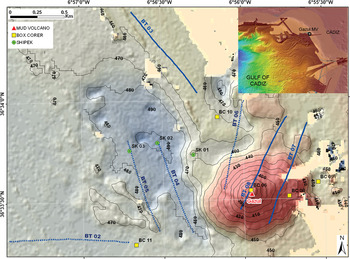
In this study we document the collection of three living specimens of Hacelia superba in June 2010 on the Gazul mud volcano (GMV) (Gulf of Cadiz, southern Iberian Peninsula) at depths of 380–487 m (Figure 1). The collection took place during a sampling survey by the INDEMARES/CHICA project in order to study and characterize different habitats and associated communities of mud volcanoes and adjacent bottoms within Spanish waters of the Gulf of Cadiz for establishing areas that may deserve environmental conservation. Mud volcanoes are conduits for fluid venting towards the seabed surface, mainly methane and fine sediments with consequent carbonate precipitation within the sediments or at the sea-floor due to microbial activity (Hovland & Judd, Reference Hovland and Judd1988). Mud volcanoes have recently been considered among structures that deserve protection within the Natura 2000 network (code 1180, submarine structures made by leaking gases), emphasizing the importance of carrying out studies on their different habitats and species.
Location of the different trawls carried out at Gazul mud volcano, adjacent bottoms and depression. Continuous lines represent those trawls where Hacelia superba was found. Squares and circles indicate the location of sediment samples taken using a Box-corer or a Shipek grab, respectively, and used for sedimentological characterization.

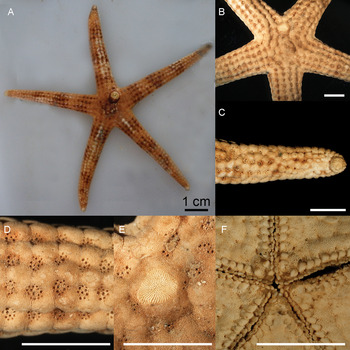
Hacelia superba H.L. Clark, Reference Clark1921. (A, B) Abactinal view; (C) distal tip of ray; (D) papular areas; (E) madreporite; (F) actinal view. All white scales are 0.5 cm.

The GMV is the shallowest structure (450 m depth) made by leaking gases within the Gulf of Cadiz and has an oval-shaped morphology with a diameter of 1 km in a south-south-west/north-north-east direction that reaches a height of 85 m above the sea-floor. Small collapse depressions ranging 10–20 m deeper than the surrounding bottoms can be recognized around the volcano. The surficial sediment at the top of GMV is characterized by more than 77% of clay that shifts to muddy-sand towards the flanks, where the coarse fraction (>2 mm) is mainly composed of shell fragments. In contrast, the sediment found in the depression is muddy-sand, where the sand and gravel fractions are more than 80%, and sand to clayey-sand in adjacent bottoms from south to north. Seawater temperature ranges from 12.5 to 14°C and salinity is around 36.2‰. Trawling fisheries of the rose shrimp Parapenaeus longirostris (Lucas, 1846), the Norway lobster Nephrops norvegicus (Linnaeus, 1758) and the hake Merluccius merluccius (Linnaeus, 1758) in the vicinity of this mud volcano may have a negative impact on the associated benthic communities. Benthic assemblages occurring on this mud volcano have never been studied in previous sampling surveys, therefore information is absent unlike that for other mud volcanoes (Van Reusel et al., Reference Van Reusel, Andersen, Boetius, Connelly, Cunha, Decker, Heeschen, Hilario, Kormas, Maigniem, Olu, Pachiadaki, Ritt, Rodrigues, Sarrazin, Tyler, Van Gaever and Vanneste2009).
MATERIALS AND METHODS
All Hacelia superba individuals were collected with a beam trawl (2 m width and 0.6 m height, mesh size 10 mm) that covered a sampling area of ~2000 m2 on each occasion (15 minutes at a speed of 2–3 knots) on-board RV ‘Emma Bardan’ (Secretaría General del Mar). A total of eight trawls were carried out: three trawls sampled the volcano, two trawls sampled the depression and three trawls sampled the adjacent bottoms. Individuals from all species collected in each sample were counted and weighed and those individuals of H. superba were also photographed, fixed in 70% ethanol and measured.
MATERIAL EXAMINED
Three specimens: 1 female (R (major radius) = 54 mm, r (minor radius) = 11 mm, R/r = 4.9), 460–462 m depth, BT03; 1 female (R = 48 mm, r = 10 mm, R/r = 4.8), 420–459 m, BT07; and one undetermined sex (R = 36 mm, r = 7 mm, R/r = 5.1), 380–455 m, BT08. All individuals were collected during the Indemares Chica 0610 sampling campaign of Instituto Español de Oceanografía.
All specimens display five arms that are rounded abactinally and flattened actinally, with eight rows of papular pore areas (generally ten rows in large specimen R > 55 mm) that contain 6–20 papulae. The papulae are also located in actinal and abactinal surfaces. Abactinal surface is ridged with sunken papular areas. The adambulacral plates contain two thick and slightly flattened furrow spines and a single and flattened subambulacral spine. The madreporite is larger than adjoining plates, circular in the largest specimen but somewhat triangular in the smallest one.
TAXONOMIC AND ECOLOGICAL REMARKS
All the collected individuals of Hacelia superba displayed rays that were flattened actinally with eight rows of papular areas, probably due to their small size (with R < 55 mm in all cases) as already indicated by Miller (Reference Miller1984) or to a geographical variety as it was also found off Cape Fear (North Carolina) (individuals with R > 50 mm and only eight rows) (Clark & Downey, Reference Clark and Downey1992). In general, large specimens of H. superba seem to display ten rows of large and conspicuous papular areas (Miller, Reference Miller1984). The papular areas are lying in depressions with around 6–20 papulae per area which is in accordance with Miller (Reference Miller1984) (R = 45–60 mm, 1–15 papulae per area) and Clark & Downey (Reference Clark and Downey1992) (8–22 papulae per area). This number is lower than in other ophidiasterids occurring in the Gulf of Cadiz such as Hacelia attenuata (35 papular pores) or Ophidiaster ophidianus (Lamarck, 1816) (40–50 pores), both inhabiting shallower bottoms (1–150 m) than H. superba (91–295 m) (Clark & Downey, Reference Clark and Downey1992; Garrido et al., Reference Garrido, Hernández, Espino, Herrera and Tavío2004). Another ophidiasterid is the bathyal species Ophidiaster reyssi Sibuet, Reference Sibuet1977 that has only been found at the Azores (350 m depth) and at Sicily (Mediterranean Sea) (128 m), but in this species the number of pores is also higher (40–50) and similar to O. ophidianus (Sibuet, Reference Sibuet1977; Clark & Downey, Reference Clark and Downey1992).
Colour patterns were similar in all collected individuals, being light orange at distal parts of rays and dark orange at proximal part of rays, with generally three to four reddish brown transversal bands that result in a banded pattern. Nevertheless, the smallest individual collected presented a banded colour pattern of dark orange and red. The actinal surface was white to light-yellow in all cases. These colour patterns were very similar to individuals collected in the Canary Islands by Garrido et al. (Reference Garrido, Hernández, Espino, Herrera and Tavío2004) as well as to those indicated by Miller (Reference Miller1984) and Clark & Downey (Reference Clark and Downey1992). Nevertheless, they are different to other ophidiasterids occurring in the area such as H. attenuata (uniformly orange to red) or O. ophidianus (uniformly orange, pink, dark-red or with some irregular darker blotches).
This ophidiasterid was only found in three of the seven trawls that were carried out on GMV and adjacent bottoms, indicating that it is rare in the area (Figure 1). The first specimen was collected on bottoms adjacent to the mud volcano (clayey-sand, 460–462 m depth, BT3). The epibenthic and demersal community was dominated by the echinoid Cidaris cidaris (Linnaeus, 1758) (39.2% individuals), the coral Flabellum chunii Marenzeller, 1904 (19.6%), the polychaete Hyalinoecia tubicola (O.F. Müller, 1776) (15.5%), the decapod Inachus sp. (2.84%) and the fish Helicolenus dactylopterus (Delaroche, 1809) (2.21%), among other species. Other echinoderms were Luidia sarsi Düben & Koren, 1845, Gracilechinus acutus (Lamarck, 1816) and Parastichopus regalis (Cuvier, 1817).
The second and third individuals were collected on the mud volcano itself, including one trawl that sampled the eastern side of GMV (420–459 m depth) and another one that reached the summit (380–455 m depth). The sediment of these bottoms is mixed with the presence of some carbonate chimneys and slabs as well as mud breccia, especially at the summit of the volcano. The benthic community is mainly dominated by four different species of sponges (>50% biomass and individuals) including Asconema setubalense Kent, 1870, Haliclona mucosa (Griessinger, 1971) and Petrosia sp., the crinoid Leptometra cf. celtica (17.0%), the coral Madrepora oculata Linnaeus, 1758 (5.8%), the anemone Actinauge richardi (Marion, 1882) (3.3%), the serpulid polychaete Filograna sp. (2.4%), the hydrozoan Polyplumaria sp. (2.2%), the fish Helicolenus dactylopterus (1.1%), and the echinoids Cidaris cidaris (3.3%) and Echinus acutus Lamarck, 1816 (0.7%), among other species. Other echinoderms occurring on these bottoms were Chaetaster longipes (Retzius, 1805) and Astropecten cf. irregularis as well as the ophiuroid Ophiothrix cf. fragilis.
DISCUSSION
The presence of Hacelia superba in the Gulf of Cadiz extends its known geographical range in the eastern Atlantic Ocean, with previous records restricted to tropical waters of eastern Africa and the Canary Islands (Clark & Downey, Reference Clark and Downey1992; Garrido et al., Reference Garrido, Hernández, Espino, Herrera and Tavío2004). A large number of papers concerning new records of African species in Spanish and Portuguese waters are considering global warming as the main cause of these new findings in upper latitudes. It is difficult to attribute this new record to global warming effects such as the expected shift on the distribution of some species towards the poles as found in other coastal species (Perry et al., Reference Perry, Low, Ellis and Reynolds2005). Nevertheless, the Gulf of Cadiz and the Alboran Sea, due to their location and specific oceanographic characteristics, represent a limit in the geographical distribution towards northern Europe and the Mediterranean Sea for western African species such as the gorgonian Ellisella paraplexauroides (Stiasny, 1936), the molluscs Nassarius elatus (Gould, 1845) and Gari pseudoweinkauffi Cosel, 1989, the decapods Panopeus africanus A. Milne-Edwards, 1867 and Acantharctus posteli (Forest, 1963) or the fish Parapristipoma octolineatum (Valenciennes, 1833) and Acanthurus monroviae Steindachner, 1876, among a group of more than 50 species (Rueda et al., Reference Rueda, Urra, Marina, Mateo and Reina-Hervás2010). This could also be the case for this ophidiasterid that may display populations in certain areas of the Gulf of Cadiz. In February and March 2011, another sampling campaign sampled other mud volcanoes and adjacent rocky and soft bottoms at deeper locations (from 500 to 1000 m depth) using the same methodology but the species was not found, suggesting that it probably occurs locally at shallower depths.
The scarcity of previous findings of this species could be related to the fact that it may be rare in this area of its distribution. Another reason could be previous misidentification and confusion with the congeneric species H. attenuata as had happened with H. superba specimens that had lain misidentified in the collection of the Museum of Comparative Zoology (Harvard University, USA) for nearly half a century before being recognized and described as a new species (Clark, Reference Clark1921). A contributing factor may be the scarcity of intensive sampling surveys on these types of bottoms, because most previous faunistic surveys carried out in Spanish bathyal waters of the Gulf of Cadiz were located in fishing grounds (mainly soft bottoms) (ARSA campaigns, semi-annual from 1993, Instituto Español de Oceanografía), on soft and rocky bottoms at generally larger depths (80–90% of trawls and rock dredges at depths >500 m) (Balgim, May–June 1984, Muséum National d'Histoire Naturelle, Paris) or on much shallower soft and rocky bottoms (mostly 30 to 300 m) (Fauna, July 1989, Instituto de Investigaciones Marinas, CSIC, Vigo). Most sampling campaigns carried out on mud volcanoes from the Gulf of Cadiz were located in Portuguese (located at larger depths ~900–1000 m) and, especially, in Moroccan waters because they seem to be the most active ones (Van Reusel et al., Reference Van Reusel, Andersen, Boetius, Connelly, Cunha, Decker, Heeschen, Hilario, Kormas, Maigniem, Olu, Pachiadaki, Ritt, Rodrigues, Sarrazin, Tyler, Van Gaever and Vanneste2009). Nevertheless, some of these studies indicated the presence of new species of molluscs, crustaceans and also of echinoderms (13 ophiuroid species including one new species) (Hilário & Cunha, Reference Hilário and Cunha2008; Rodrigues et al., Reference Rodrigues, Oliver and Cunha2008, Reference Rodrigues, Paterson, Cabrinovic and Cunha2011; Van Reusel et al., Reference Van Reusel, Andersen, Boetius, Connelly, Cunha, Decker, Heeschen, Hilario, Kormas, Maigniem, Olu, Pachiadaki, Ritt, Rodrigues, Sarrazin, Tyler, Van Gaever and Vanneste2009). This resulted in a lack of information on benthic communities, especially those of Spanish mud volcanoes, emphasizing the need for carrying out the INDEMARES/CHICA project.
The presence of H. superba on GMV does not seem to be directly linked to fluid venting as found for some bivalves (e.g. Thyasira spp., Acharax sp.) and polychaete species (e.g. Siboglinidae) on other mud volcanoes (Hilário & Cunha, Reference Hilário and Cunha2008; Rodrigues et al., Reference Rodrigues, Oliver and Cunha2008). The GMV could probably be included in the group of those with ‘latent conditions’, in accordance to León et al. (Reference León, Somoza, Medialdea, González, Díaz-del-Río, Fernández-Puga, Maestro and Mata2007), with the presence of hard-grounds (chimneys and slabs) formed during moderate seepage, and occurring nowadays on the seabed after soft sediments' erosion. These hard structures are colonized by non-chemosynthetic organisms such as deep-water corals (e.g. Madrepora oculata Linnaeus, 1758), sponges (e.g. Asconema setubalense Kent, 1870, Petrosia sp.) and gorgonians (e.g. Swiftia sp., Acanthogorgia spp.), promoting a shift from chemosynthetic to filter feeding dominated communities. This starfish species could benefit from the indirect effects of previous ventings due to an increase in the complexity of the soft bottoms of GMV in comparison to the contouritic soft bottoms that are abundant within the Gulf of Cadiz (Díaz-del-Río et al., Reference Díaz-del-Río, Somoza, Martínez-Frías, Mata, Delgado, Hernández-Molina, Lunar, Martín-Rubí, Maestro, Fernández-Puga, León, Llave, Medialdea and Vázquez2003; Rueda et al., in press). This also increases the number of species, total abundance and biomass of the benthic components on some mud volcanoes, compared with adjacent soft bottoms, promoting a wide variety of food sources for epibenthic invertebrates and demersal species (Fernández-Zambrano, Reference Fernández-Zambrano2010). Moreover, most of these mud volcanoes are located under the influence of the Mediterranean Outflow Water nearbottom current that is warmer and seems to promote the local destabilization of gas hydrate-rich sediments. These warm currents could probably favour the presence of bathyal fauna from the Mediterranean Sea or from lower latitudes of the Atlantic Ocean in some areas of the Gulf of Cadiz.
ACKNOWLEDGEMENTS
We would like to thank our colleague Francisco J. López (IEO-Málaga) as well as the crew of RV ‘Emma Bardán’ during the faunistic sampling campaign. Thanks are due to Gerardo Bruque (IEO-Málaga) for GIS data processing and design of figures and to David L. Pawson and Christopher Mah (Smithsonian Institution) for offering interesting information and literature regarding ophidiasterids. Three anonymous referees gave interesting comments in earlier versions of this manuscript. This study was supported by the INDEMARES/CHICA Project, EC contract INDEMARES-LIFE (07/NAT/E/000732).