Introduction
Tobacco smoking is the leading risk factor for death and disease in Australia (Australian Institute of Health and Welfare, 2016). Smoking rates in Australia had been decreasing since 1991 but recent surveys indicate that the decline has plateaued, with a non-significant reduction of the daily smoking rate from 12.8% to 12.2% between 2013 and 2016 (Australian Institute of Health and Welfare, 2017). Of the current smokers surveyed in 2016, 28.5% had tried to quit but did not succeed (Australian Institute of Health and Welfare, 2017). The lack of significant decline in smoking rates in recent years and the proportion of individuals who had an unsuccessful quit attempt suggest that there is scope to trial different models of care in smoking cessation.
All health professionals, including pharmacists, can have a role in offering smoking cessation advice and support (The Royal Australian College of General Practitioners, 2011). Pharmacists, in particular, possess skills that enable them to assess the suitability of pharmacotherapy to support quit attempts. Additionally, they may be trained in motivational interviewing (MI) and behavioural counselling (George & Thomas, Reference George and Thomas2014). Non-dispensing pharmacists working in general practice are becoming more common in Australia and internationally. These practice pharmacists can deliver a range of predominantly clinical activities (Deeks et al., Reference Deeks, Naunton, Tay, Peterson, Kyle, Davey, Dawda, Goss, Cooper, Porritt and Kosari2018c), improve outcome measures (Tan, Stewart, Elliott, & George, Reference Tan, Stewart, Elliott and George2014), and are acceptable to patients, general practitioners (GPs) and other healthcare workers (Deeks et al., Reference Deeks, Kosari, Naunton, Cooper, Porritt, Davey, Dawda, Goss and Kyle2018b; Tan, Stewart, Elliott, & George, Reference Tan, Stewart, Elliott and George2013).
The integration of pharmacists in general practice may also provide an opportunity to utilise their skills in smoking cessation in an environment that is acceptable to patients. Pharmacists are an established provider of smoking cessation services in multiple settings, with evidence of effectiveness in community pharmacies (Sinclair, Bond, & Stead, Reference Sinclair, Bond and Stead2008), Veterans Health Administration community-based outpatient clinics (Dent, Harris, & Noonan, Reference Dent, Harris and Noonan2009) and hospitals (Dobrinas et al., Reference Dobrinas, Blanc, Rouiller, Christen, Coronado, Tagan and Schalie2014), but evidence for smoking cessation interventions offered by general practice pharmacists is lacking. Therefore, the aim of this pilot study was to determine whether a pharmacist can provide effective smoking cessation services within general practice. The study was nested in a larger project evaluating the feasibility, acceptability and impact of three part-time non-dispensing pharmacists in general practices in the Australian Capital Territory (ACT), Australia, that has been reported elsewhere (Deeks et al., Reference Deeks, Kosari, Naunton, Cooper, Porritt, Davey, Dawda, Goss and Kyle2018b, Reference Deeks, Naunton, Tay, Peterson, Kyle, Davey, Dawda, Goss, Cooper, Porritt and Kosari2018c).
Methods
The site for this study was one general practice business across three sites in the ACT, Australia. One practice pharmacist (AD) worked 15.2 hours per week and undertook extra training to become the designated healthcare professional for smoking cessation at the practice. This comprised completion of: a smoking cessation course at a teaching hospital; training in health behaviour change methods to support person-centred care and self-management; and a MI workshop.
De-identified recorded data on the nature and outcomes of all pharmacist-conducted smoking cessation consultations were retrospectively analysed. Information collected from the initial consultation included date of consultation, gender, age, source of referral, current smoking type/amount, pack years smoked, Fagerstrom Test for Cigarette Dependence (Heatherton, Kozlowski, Frecker, & Fagerstrom, Reference Heatherton, Kozlowski, Frecker and Fagerstrom1991), carbon monoxide (CO) breath level (using the piCO smokerlyzer™, range 0–150 ppm; https://www.bedfont.com/shop/smokerlyzer/pico), previous quit attempts, confidence to quit (Likert scale of 1–10) (Rollnick, Butler, & Stott, Reference Rollnick, Butler and Stott1997), motivation to quit (1–10) (Rollnick et al., Reference Rollnick, Butler and Stott1997) and pharmacist intervention(s). For follow-up consultations, data collected were quit attempt progress, details of further pharmacist interventions (e.g., MI, pharmacotherapy changes) and CO level.
Each patient was contacted by telephone at least 6 months after their intended quit date and asked about their current smoking status. Those who self-reported abstinence were invited to have a CO breath level determination at the general practice to verify their quit status. We defined a successful quit as self-reported abstinence verified by a CO breath test level of 7 ppm or less after at least 6 months (MacLaren et al., Reference MacLaren, Conigrave, Robertson, Ivers, Eades and Clough2010). All other participants were considered to be continuing smokers.
Statistical analyses were conducted with SPSS version 23 (IBM, Armonk, NY, USA). Demographic and behavioural characteristics were compared between the successful and unsuccessful groups, using χ 2, Mann–Whitney, or independent t-tests as appropriate. The effect of medications on abstinence was assessed using logistic regression test. A P value of <0.05 was considered statistically significant. The University of Canberra Human Ethics Research Committee had approved the study (Project number 15-235).
Results
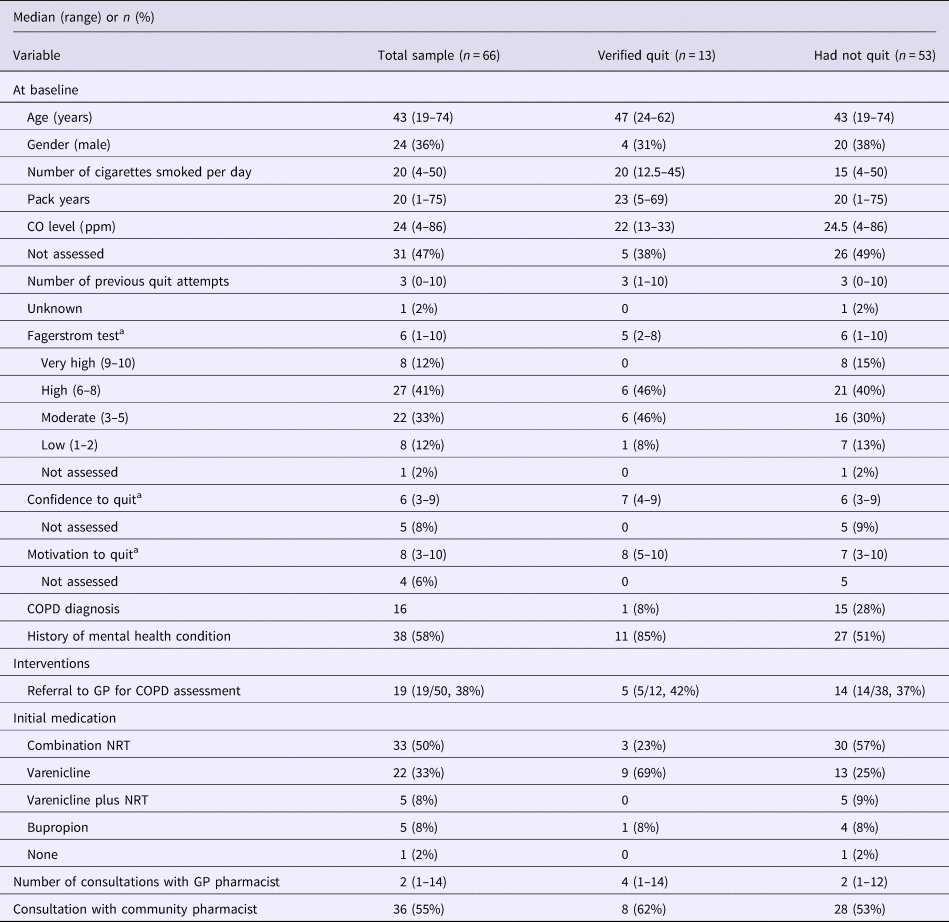
Data were collected for 66 consecutive patients with pharmacist-conducted smoking cessation consultations between 14 September 2016 to 29 August 2017 (Table 1). Patients were referred by their GP (n = 58), dietician (n = 3), self- (n = 2), medication review pharmacist (n = 1), practice nurse (n = 1) and a combination of spouse and GP (n = 1). The referrals from other health care professionals followed discussions with the patient about desire to quit or reduce smoking during a consultation. The self-referrals followed promotion of the pharmacist intervention via an education session, word of mouth or the general practice newsletter.
Characteristics of participants

a 0–10.
CO, carbon monoxide; ppm, parts per million; COPD, chronic obstructive pulmonary disease; GP, general practitioner; NRT, nicotine replacement therapy.
The consultations were face-to-face with the patient or patient plus carer in a consulting room at the general practice where the pharmacist offered interventions tailored to the individual patient. Medication options were discussed and offered to all patients and supplemented by quit coaching based on MI in all but one case, where the patient was unsuitable for mental health reasons. The pharmacist collaborated with the patients’ community pharmacies to ensure there was pharmacist support when accessing pharmacotherapy and in-between consultations.
Follow-up after at least 6 months determined a self-reported point prevalence abstinence rate of 30% (20/66). Verification by a CO level of 7 ppm or less occurred for 65% (13/20) of the patients who had self-reported quitting (accounting for all those who attended for a CO level); all other patients who self-reported quitting were unable to attend an appointment for a CO level. The biochemically verified smoking abstinence rate was therefore 20% overall (13/66) and all other patients (53/66) were classified as having an unsuccessful quit.
In addition to the 30% who self-reported smoking abstinence, 40% patients (26/66) reportedly reduced their smoking, whilst 17% (11/66) were lost to follow-up (seven did not return telephone calls, four had left the general practice). There was no reduction in smoking reported for 12% (8/66) and one patient died during the follow-up period.
There were several statistically significant differences in characteristics and interventions between the patients who had a verified successful quit and those who were classified as unsuccessful (Table 1). A practice pharmacist recommendation of varenicline as the initial pharmacotherapy was associated with abstinence (OR = 6.7, 95% CI 1.6–28.9, P = 0.011 using binary logistic regression), as were a higher median number of visits to the practice pharmacist (P = 0.006, Mann–Whitney test) and the presence of a mental health diagnosis (P = 0.028, χ 2 test).
Discussion
Pharmacists in general practice can provide smoking cessation services which patients will attend. Smoking cessation interventions from one practice pharmacist resulted in a self-reported point prevalence abstinence rate of 30% (20/66) and a verified abstinence rate of 20% (13/66) after at least 6 months.
Our data compare favourably with other service providers in general practice. A cluster-randomised trial in Sydney and Melbourne determined self-reported 12-month point prevalence rates of 17.1% for practice nurse intervention, 18.8% for telephone support referral and 16.4% for usual GP care (Zwar et al., Reference Zwar, Richmond, Halcomb, Furler, Smith, Hermize, Blackberry, Jayasinghe and Borland2015). Although our follow-up period was shorter (6 v 12 months) and sample size smaller, our pilot study suggests that interventions by a pharmacist in general practice may be comparable in efficacy or even superior to that provided by practice nurses, telephone support or GPs. It should be noted that the effect in our study may have been under-stated, as not all the self-reported quitters could attend for a follow-up CO level and were consequently categorised as non-quitters according to our pre-defined criteria.
Pharmacists can also provide smoking cessation services in other settings. Similar abstinence rates with pharmacist-led smoking cessation programmes have been reported when services were delivered in community pharmacies at 1–12 months follow-up periods (11.6–36.4%) (Saba, Diep, Saini, & Dhippayom, Reference Saba, Diep, Saini and Dhippayom2014) and in an outpatient setting at 6 months (28%) (Dent et al., Reference Dent, Harris and Noonan2009).
There is evidence that smoking cessation services are cost-effective, delivering cost savings and net gains to individuals and primary health care providers (Ekpu & Brown, Reference Ekpu and Brown2015). Ongoing funding for smoking cessation could be part of a broader respiratory focus for practice pharmacists. In addition to supervising patients to a successful quit attempt, appropriate patients were referred for a chronic obstructive pulmonary disease (COPD) assessment in our study, potentially identifying patients with undiagnosed disease. Elsewhere in the ACT, another practice pharmacist has demonstrated that pharmacist asthma interventions are feasible and acceptable with benefits to patients, including improvements in control and probable hospital admission avoidance (Deeks et al., Reference Deeks, Kosari, Boom, Peterson, Maina, Sharma and Naunton2018a). An English study demonstrated that a specialist respiratory pharmacist visiting general practices reduced asthma and COPD exacerbations, drug costs and other associated healthcare costs (Khachi, Reference Khachi2014).
A component of this pilot study was that the pharmacist had undertaken extra training in smoking cessation with MI. MI assists individuals to overcome ambivalence about behaviour change, and can improve outcomes compared to brief advice or usual care (Lindson-Hawley, Thompson, & Begh, Reference Lindson-Hawley, Thompson and Begh2015). Studies have demonstrated that as the number of MI sessions increases, so do quit rates (Siu, Reference Siu2015), as was the case in our study. Whilst MI could be offered by psychologists, a suitably trained pharmacist can provide both pharmacotherapy advice and MI, thereby potentially reducing the number of appointments with different healthcare professionals required.
Factors linked to successful quits in our study were varenicline pharmacotherapy recommendation at the start of quit attempts, increased consultations with the practice pharmacist and a mental health diagnosis. The observed superior outcome with varenicline is broadly consistent with the findings of a Cochrane network meta-analysis (Cahill, Stevens, Perera, & Lancaster, Reference Cahill, Stevens, Perera and Lancaster2013). Increased visits to a smoking cessation practitioner have been associated with successful outcomes previously (Siu, Reference Siu2015). The finding that the practice pharmacist can support patients with a mental health diagnosis to quit smoking should be further explored in studies which target this patient group.
There were several important strengths of this pilot study. The pharmacist intervention was based on evidence of effectiveness of smoking cessation programmes (pharmacotherapy and behaviour support). Data from one pharmacist were interrogated, so all patients received an equivalent service. The pharmacist was placed in a general practice surgery which may have encouraged patients to attend multiple sessions, which is associated with better outcomes (Costello et al., Reference Costello, Sproule, Victor, Leatherdale, Zawertailo and Selby2011). In accordance with good practice, we determined abstinence after at least 6 months with biochemical validation using CO breath test monitors (Bittoun, Reference Bittoun2008; Lancaster & Stead, Reference Lancaster and Stead2017) to demonstrate sustainability. Quit status was determined for some patients at more than 6 months post-quit, potentially lowering the success rate.
This study was conducted in one Australian city and so may not be generalisable, as population demographics including smoking habits and prevalence vary throughout Australia and overseas. Compliance with pharmacotherapy was not measured. Pharmacists in Australia cannot prescribe, whereas some overseas pharmacists can prescribe varenicline or bupropion, possibly reducing barriers to obtaining medication and increasing quit rates. There was no comparative group. Assessing other factors that may have contributed to the outcome of quit attempts was beyond the scope of this study.
Conclusion
The practice pharmacist in this pilot study became a specialist smoking cessation practitioner and provided an effective smoking cessation intervention in the general practice setting. Abstinence rates were similar or better than those obtained by practice nurses and pharmacists in community, hospital or outpatient settings. A larger randomised controlled trial is required to validate these promising findings.
Acknowledgements
None.
Financial support
We acknowledge the Capital Health Network for undertaking the pilot program using funding provided by the Australian Government under the Primary Health Network Program.
Conflicts of interests
None.
Ethical standards
The authors assert that all procedures contributing to this work comply with the ethical standards of the relevant national and institutional committees on human experimentation and with the Helsinki Declaration of 1975, as revised in 2008.