Introduction
The management of offending type behaviour in persons with an intellectual disability poses a major challenge to service providers. This challenge is further compounded by the fact that many persons presenting with such behaviour are non-adjudicated by the criminal justice system.
There is currently no Forensic Intellectual Disability Service in Ireland (Irish College of Psychiatrists, 2007). However, the first post in Ireland for a Consultant Forensic Psychiatrist with a special interest in intellectual disability has been sanctioned by the health Service Executive and this is a welcome development and the first step in the development of a national service.
There is also a significant lack of acute inpatient mental health services (approved centres) for people with intellectual disability and severe mental health problems (Leonard et al. Reference Leonard, Hillery and Staines2007). These factors and the continuing absence of appropriate enacted capacity legislation in Ireland (Leonard & McLaughlin, Reference Leonard and McLaughlin2009) further complicate the clinical management of offending behaviour in people with an intellectual disability as this practice largely occurs outside of a legal framework.
The association between ‘criminal offending’ and intellectual disability has for many years been the subject of scrutiny and some speculation. The received wisdom of the early and mid 19th century was based on opinion and prevailing social mores rather than methodologically sound research. The following quotation from Lindsay (Lindsay, Reference Lindsay2002) is attributed to L.M. Terman in 1916 and illustrates the thinking of the time:
There is no investigator who denies the fearful role of mental deficiency in the production of vice, crime and delinquency … [N] ot all criminals are feeble minded but all feeble minded are at least potential criminals
A number of factors have complicated attempts to investigate and establish the precise relationship between offending and intellectual disability. These mainly comprise inconsistencies in the definition and measurement of both ‘intellectual disability’ and ‘offending’.
In particular, the inadequacy of brief IQ measures has previously been reported (Thompson et al. Reference Winter, Holland and Collins1979). Thompson et al. found that the Slosson Intelligence Test and the Wechsler Adult Intelligence Scale (WAIS) over-estimated the prevalence of intellectual disability in a prison population when compared with the WAIS full scale IQ.
It is also a challenge to distinguish a criminal offence from ‘challenging behaviour’ (Simpson & Hogg, Reference Simpson and Hogg2001a ). Challenging behaviour has been defined by Emerson as: ‘culturally abnormal behaviour of such an intensity, frequency or duration that the physical safety of the person or others is likely to be placed in serious jeopardy, or behaviour which is likely to seriously limit use of, or result in the person being denied access to, ordinary community facilities’ (Emerson, Reference Emerson1995).
For a crime to be committed criminal intent known in legal terminology as mens rea is required in addition to a specific criminal behaviour known as actus rea (Lindsay, Reference Lindsay2002). Those with an intellectual disability may be considered by carers and close contacts as incapable of criminal intent due to lack of decision-making capacity and their behaviour is then viewed within the ‘challenging behaviour’ paradigm and consequently never reaches the attention of the criminal justice system (Simpson & Hogg, Reference Simpson and Hogg2001a ).
However, the issue of decision-making capacity is not black and white. The person’s ability to make a decision depends on the match between the complexity of the decision and the cognitive abilities of the person in question at the material time. Other important factors are the context of the decision and the demand characteristics or level of stress or duress the person experiences at the time of making the decision.
Added to this, the concept of varying degrees of impairment of decision-making capacity has now been enshrined in the Irish Assisted Decision Making (Capacity) Bill 2013 (Irish Statute Book, 2013). This Bill envisages varying levels of impaired decision-making capacity being matched with corresponding decision making supports rather than the current binary situation where a person is either deemed to be legally capable of decision making or lacking decision-making capacity. The Irish statute which deals with ‘fitness to be tried’ is the Criminal Law (Insanity) Act of 2006 (Irish Statute Book, 2006) and this Act still applies binary a approach to ‘fitness’; however, this too may change with future revision of the law.
The extent of the reluctance to report behaviours as criminal acts amongst those working with the intellectually disabled has been highlighted by Lyall et al. (Reference Lyall, Holland and Collins1995) who reported that ‘tolerance levels towards offending behaviour was extremely high’ in the group homes and day centres that he surveyed. This reluctance was so intense that ‘staff at one residential establishment said they would hesitate to report rape’.
Consequently, because this behaviour is often viewed within a non-legalistic paradigm, a wealth data is available with respect to rates of ‘challenging behaviour’ in this population rather than specific criminal offences.
The prevalence of ‘challenging behaviour’ in persons with an intellectual disability has been estimated between 5.7% and 14% but again is subject to variations in case definition and sample populations (Xenitidis et al. Reference Xenitidis, Russell and Murphy2000). Rates of aggressive and self-injurious behaviour have also been estimated to be higher in those with more severe intellectual disability.
It is worth noting that criminal offending in the general population is similarly underreported. This was recognised over half a century ago by Grunhut who referred to the ‘dark figure (of unreported crime)’ (Holland et al. Reference Holland, Clare and Mukhopadhyay2002).
Over the last four decades research evidence has emerged exploring an association between intellectual disability and offending. Hodgins studied a historical cohort of >15 000 Swedish-born children (Hodgins, Reference Hodgins1992). Those with an ID were defined as those who were ‘placed in special classes for intellectually deficient children in high school and were never admitted to a psychiatric ward’. Those men who fell into this category were reported to be three times more likely to have a conviction by the age of 30 and women were nearly four times more likely. These conclusions are weakened by the fact that intellectual disability was not defined in terms of generally accepted criteria, that is, impairment of overall intelligence and impairment in adaptive behaviour, which were manifest in the developmental period.
Levels of Intellectual Disablilty may be further catagorised in terms of standardised IQ score: Mild=50–69, Moderate=35–49, Severe=20–34, Profound=<20 (World Health Organisation, 1992). The further category of ‘ borderline’ intellectual disability is not contained in ICD-10 but is widely used and is denoted by an IQ score of between 70 and 80 (American Psychiatric Association, 1994).
West & Farrington (Reference West and Farrington1973) studied two groups with IQ over 110 and IQ <90. Although the latter group does not precisely map onto an Intellectually disabled group the results were interesting in that the less able group were twice as likely to have a police record and 10 times more likely to re-offend. However, it has been reported that some of the association between lower IQ and delinquency may be accounted for by social deprivation that links both variables (Simons, Reference Simpson and Hogg1978).
However, Moffit et al. (Reference Moffit, Gabrielli, Mednick and Schulsinger1991) used data from a Danish birth cohort and found a small but significant correlation between IQ and delinquency, which was independent of social deprivation.
It should be noted that the association between IQ and offending is not linear as it is likely that below a certain level of ability the risk of offending drops off significantly. An early study illustrates this point. In the late 1950s a group of American investigators studied under-privileged boys in Massachusetts (McCord & McCord, Reference McCord and McCord1959). The group was split into a treatment and control group and into bands according to IQ levels. The investigators found that those with an IQ >110 had a 26% conviction rate while those with an IQ of between 80 and 90 had a 44% conviction rate and those with an IQ of <80 had a conviction rate of 35%, which is intermediate with respect to the other groups.
There have been varying estimates of the proportion of people held on police custody who have an intellectual disability. These range from 1% (Winter et al. Reference Xenitidis, Russell and Murphy1997) to 8% (Gudjonnson et al. Reference Gudjonnson, Clare, Rutter and Pearse1993).
The proportion of those with an intellectual disability presenting to court has also been studied by Susan Hayes (Reference Hayes1993, Reference Hayes1996) in Australia and has been estimated as high as 24% for urban and rural Australian Magistrates’ Courts. However, in rural areas the aboriginal group was overrepresented within the population having an IQ <70 and also constituted a population for whom the test battery had not been validated.
The estimates of the prevalence of intellectual disability in the prison population have varied greatly both within and between jurisdictions. The conclusions of these studies are often undermined by the methodology being limited to a non-standardised clinical assessment of intellectual disability or estimates of IQ, which are of variable validity.
An English-based study (Gunn et al. Reference Gunn, Maiden and Swintion1990) found that <1% of those in the prison population had an intellectual disability but those studied were deemed to have an intellectual disability based on ‘clinical impression’.
In another study (Coid, Reference Coid1988) it was reported that 5.1% of those requiring psychiatric reports while on remand were known to Intellectual Disability Services.
A later study (Murphy et al. Reference Murphy, Harrold and Carey1995) studied 157 men on remand and did not find any to have an IQ <70.
In contrast, Brown & Courtless (Reference Brown and Courtless1968) studied the US prison population and found that 10% may have had an intellectual disability. In a later publication the same investigators estimated that 1.6% of inmates within a US prison study sample had an IQ of <50 (Brown & Courtless, Reference Brown and Courtless1971).
Fazel conducted a systematic review of the prevalence of intellectual disability amongst 12 000 prisoners (Fazel et al. Reference Fazel, Xenitidis and Powell2008). Although no summary estimate of prevalence was calculated due to study heterogeneity, the authors found that typically 0.5–1.5% of the prison populations studied internationally were diagnosed with an intellectual disability (range 0–2.8% across studies).
There is extremely limited evidence in relation to the prevalence of intellectual disability within the Irish prison population. Murphy et al. (Reference Myers2000) reported from a sample of 10% of the Irish prison population that as many as 28.8% of Irish prisoners may have a Learning Disability as measured using the Kaufmann Brief Intelligence test, wide range achievement test and the vocabulary subtest of the Weschler Adult Intelligence Scale–Revised. On the face of it this appears to be a very high figure and the limitations of brief tests have already been noted above.
If this figure is accurate it may reflect historical service provision issues, in that those with a mild intellectual disability have not traditionally been catered for within Intellectual Disability Services in Ireland and so are more likely to have instances of unacceptable behaviour viewed within a criminal offending paradigm.
Simpson & Hogg conclude their Systematic Review of the evidence regarding offending amongst people with ID with the following comments: ‘there is no convincing evidence that the prevalence of offending among people with ID is higher than for the wider population … offending among those with IQ less than 50 is rare’ (Reference Simpson and Hogg2001a ).
People with an intellectual disability have historically been associated with particular offences, most notably sex offences and arson. With this in mind it may be more useful to ask the question: ‘is there a link between levels of Intellectual Disability and specific offence types?’.
Lindsay (Reference Lindsay2002) reviewed the literature on sex offenders with Intellectual Disabilities and concluded that there is ‘no clear evidence for the over or under representation of people with developmental disabilities amongst sex offenders’. Although Simpson & Hogg concluded that ‘there is some evidence to suggest that the relative prevalence of sexual offending, criminal damage and burglary, although not theft, are higher among people with an IQ in the “borderline” range than the general population’ (Reference Simpson and Hogg2001a ).
The characteristics of offenders with learning disability have been the subject of much interest. Holland et al Reference Holland, Clare and Mukhopadhyay. (Reference Holland, Clare and Mukhopadhyay2002) have outlined the characteristics that offenders with an intellectual disability display and these are for the most part in common with their counterparts in the general population. They are overwhelmingly young, male, and have histories of psychosocial disadvantage, offending in other family members, self-reported behavioural problems dating back to childhood and high rates of un-employment.
Simpson & Hogg commented that the evidence linking psychiatric history in those with ID and offending behaviour is ‘highly variable and no conclusions are suggested’ (Reference Simpson and Hogg2001b ).
In his review of ‘dual diagnosis’ in offenders with ID O’Brien described high rates of mental illness but the evidence is limited to case reports and clinical samples that are prone to selection bias (O’Brien, Reference O’Brien2002).
O’Brien also discussed the link between Autism spectrum disorders and offending. He emphasised that this evidence is limited by its poor quality and is based on case reports including Asperger’s original observations. Putative mechanisms for offending behaviour in those with autism were also described by O’Brien in terms of the core clinical features of autism.
It has not been established that predisposing factors are the same for all offences. A case in point is sex offending. Lindsay (Reference Lindsay2002) makes particular reference to the propensity of abusers to have suffered abuse themselves. Despite this it should be noted that the evidence for victim–offender cycles in sexual offending in the general population is inconclusive and such a link can unwittingly lead to the stigmatisation of those who have been abused as potential offenders. Lindsay also describes an inclusive list of group characteristics that again reflect social deprivation, family dysfunction, poor social adjustment and poor understanding of sexuality.
To date no previous study has been untaken to estimate the level of offending behaviour amongst service users of Irish mental health services who have an intellectual disability.
The Forensic Intellectual Disability Working Group of the Irish College of Psychiatrists was established in order to establish the level of need for a Forensic Intellectual Disability Service in Ireland and develop a College position paper. Basic data from this national survey was combined with focus group data and feedback from plenary conference proceedings to inform the conclusions and recommendations set out in the position paper People with a learning disability who offend: forgiven but forgotten? (Irish College of Psychiatrists, 2007).
Aims of this study
-
1. To establish the number of persons with an intellectual disability in Ireland who are attending mental health services and also present with offending behaviour.
-
2. To establish the characteristics of the above population in terms of level of disability, age range, gender and offence type.
Methodology
Operational definitions of offending behaviour and intellectual disability
The items of data measured comprised demographic details specifically gender and age range (18–25 years, 25–55 years, 55 years and over). For each subject a level of disability was requested and this was defined as per DSM-IV criteria for mental retardation.
An explanatory note was also included in the postal survey stating that target behaviour was behaviour of such severity that in the absence of an intellectual disability criminal proceedings would likely ensue. The purpose of this approach was to capture all offending behaviour without reference to issues of an individual’s capacity or criminal intent.
Catagories of offence were also defined (Box 1). Inspite of the clear guidance given to potential respondents, it is acknowledged that a degree subjectivity was necessarily inherent in responses.
Categories of Offending Behaviour
Offence types
Offences against property
-
∙ Arson/fire setting
-
∙ Criminal damage
-
∙ Larceny/burglary
-
∙ Car theft/joyriding
Offences against person
-
∙ Drug/alcohol related offences
-
∙ Assault/battery
-
∙ Manslaughter
-
∙ Murder
-
∙ Indecent exposure
-
∙ Stalking/dangerous threatening behaviour
-
∙ Sexual assault on a child
-
∙ Sexual assault on an adult
-
∙ Prostitution/soliciting
In addition, we requested that each respondent state their catchment area population. This posed a difficulty as some services did not have a precise geographical catchment area.
Informants
Irish Adult Mental Health Services comprise sectorised local Adult Mental Health Services, the National Forensic Mental Health service based at the Central Mental Hospital in Dundrum in Dublin and unevenly distributed Intellectual Disability Psychiatry Services provided by a number of voluntary bodies and the Irish public health service (Health Service Executive). The lead clinicians of all General Adult Psychiatry, Intellectual Disability Psychiatry and Forensic Psychiatry services were identified. This totalled 52 informants.
Materials
Two initial meetings of the working group took place in order to review the scientific literature in relation to Intellectual Disability and Offending. A self-completed questionnaire was then drafted for distribution. The Management Committee of the Irish College of Psychiatrists then reviewed this questionnaire before distribution.
Procedure
A postal survey was undertaken targeting the lead clinicians of all Intellectual Disability Psychiatry, General Adult Psychiatry and Forensic Psychiatry Services in the Republic of Ireland. A second mail shot was sent out 6 weeks before the closing date for receipt of responses. This survey requested anonymous data on service users with an intellectual disability and offending behaviour.
Data analysis
All data returned was coded and analysed for descriptive statistics using the Statistical Package for Social Sciences version 14.1.
Results
Response rate
Of the original 52 services contacted 28 responded giving an overall response rate of 56%. The response rate was best for the Intellectual Disability Sector (93%) and worst for the Adult Mental Health Services (33%). There was a 100% response rate from the Irish National Forensic Mental Health Service.
Service user characteristics
Overall, data relating to 431 service users nationally was returned; 349 service users (81%) were male and 82 (19%) were female. The vast majority of service users were aged 25–54 years (73.8%), followed by those aged 18–24 years (17.6%). Those aged 55 years and over only constituted 8.6% of our sample.
The most overrepresented group in our sample were those reported to have an IQ in the severe range (45%), while those with an IQ in the moderate range constituted 41.3% and those in the mild range were in a minority of only 13.7%.
Offence types
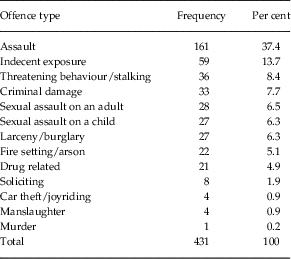
The vast majority of offences reported were against the person (80%) rather than against property (20%). The most frequent offence type was assault (37.4%) followed by indecent exposure (13.7%). All offences and their frequencies are illustrated in Table 1.
Rates of Specific Offences

Serious offences
A significant number of extremely serious offences were reported. These were five instances of unlawful killing, 28 instances of sexual assault on an adult, 27 instances of sexual assault on a child and 22 instances of fire setting/arson.
Only three subjects of this study who come within this category were located within the Irish Forensic Mental Health Services and consequently the vast majority of service users presenting with these severe offending behaviours are being managed within either Intellectual Disability Services or Adult Mental Health Services.
Epidemiological data
Owing to the fact that most Intellectual Disability Services in Ireland are not catchment area based, very few returns were received in relation to exact catchment populations. Because of this it was not possible to estimate a prevalence of offending in relation to the overall population.
However, the Irish National Intellectual Disability Database (NIDD) produces an annual report of the population of persons with an intellectual disability in Ireland who are in receipt of an Intellectual Disability Service. Of our study sample only those attending Intellectual Disability Services would be likely to come within the remit of the NIDD as the other services are unlikely to have submitted returns for this database.
The NIDD report of 2006 (Health Research Board, 2006) gave a population of 24 556 in receipt of ID services (prevalence of 6.51/1000 population). We received data on 431 persons from ID services with offending behaviour. This indicates that our study sample constituted 1.75% of the population of persons within ID services in Ireland and is most likely an underestimate of this offending population given that the survey response rate was not 100%.
Discussion
The results of this survey indicate that there is a significant population of 431 service users with an intellectual disability who present with behavioural problems, which service providers catagorise as ‘offending’. This constitutes a very significant unmet need in the absence of a Forensic Intellectual Disability Service in Ireland.
The demographic characteristics of our sample population resemble those of other forensic populations with an intellectual disability, which have been reported by Holland et al. (Reference Holland, Clare and Mukhopadhyay2002) as predominantly young and of male gender.
A comparison with an offending population more representative of the general public is possible by referring to the National Crime Council statistics (National Crime Council of Ireland, 2006) for 2006, which gives data regarding prison committals for that year. When compared with the prison population in general our study cohort comprised less males having an age of 25 years or below (17.6% compared with 27%). In addition, 73.8 of our study population were aged between 25 and 55 years, while the prison population comprises 58% of committal between the ages of 25 and 50, with only 4% for that year >50 years of age. Both populations are predominantly male.
The level of disability within our study sample very much reflects the population of persons attending Intellectual Disability Services in Ireland and is predominantly constituted by persons in the moderate to severe range of ability.
Although greater degrees of disability will likely correlate with a diminished likelihood of culpability, offending behaviours still require a clinical response in the absence of access to a criminal justice process.
We consider that those offenders in the mild range may be attending General Adult Psychiatry services for which our survey response rate was poor. In addition, it is likely that many of offenders with a mild intellectual disability may in fact be found within the Irish prison service.
This conclusion is supported by the alarming rates of intellectual disability measured by Murphy et al. (Reference Myers2000) in what is the only available study of a sample of the Irish prison population. In addition, the fact that there is no screening or court diversion system in place within the criminal justice system in Ireland for persons with an intellectual disability further explains why the rates of intellectual disability in Irish prisons may be so elevated.
Unfortunately a survey of the prison population was beyond the scope of our study.
It may be argued that those persons with an intellectual disability who currently receive a custodial sentence would possibly spend longer in a Forensic Intellectual Disability Service with prolonged deprivation of liberty. To some extent this may be the case, but given the vulnerability of this group and the lack of adapted offence related treatment in the prison service, it can also be argued that a specialist secure service is more likely to benefit this group.
The benefit for the service user/offender is through appropriate care and treatment and such an approach is also more likely to benefit society in the long run as long-term risk may be mitigated to some extent and such a service can ensure an appropriate long-term care package is put in place in conjunction with appropriate health and social care services, based on a detailed risk management plan.
Our study found that offences against the person were reported much more frequently than offences against property. Assault was by far the most frequent offence but our survey did not provide a mechanism for precisely recording the seriousness of an assault.
Of this study population, a minority of 82 service users are reported to have a record of extremely serious offending behaviour (e.g. unlawful killing, sexual assault, arson). The demographic characteristics of this group resemble the overall study population. As only three of these services users were reported to be in the care of the National Forensic Mental Health Service the vast majority of this population is presenting with a clinical risk which is being managed without ongoing expert input from Forensic Intellectual Disability Services and in settings where a most vulnerable peer group is potentially exposed to grave harm.
This paper has identified a significant numbers of persons who would benefit from a Forensic Intellectual Disability Service. Our study focuses on the needs of people who are already in receipt of a service but require specialist input and support. This input may initially be based on a consultancy model as it is unrealistic to expect that such large numbers of service users would move to a specialist secure service when service development is starting from such a low base.
It is acknowledged that the population studied very much reflects those attending Intellectual Disability Services and to this extent there is a significant selection bias. This means that a causal association cannot be inferred between level of disability and risk of offending as those in the mild range are effectively excluded.
In addition, although operational definitions of ‘intellectual disability’ and ‘offending’ were provided, the definition of ‘offending’ was open to some degree of subjective interpretation.
Conclusions
It is recognised internationally that service development for offenders with an intellectual disability is hampered by the tendency for this population to ‘fall between stools’ in relation to placement within programmes and dedicated revenue streams (Myers, 2004).
It is welcome that the current Irish Mental Health Policy A Vision for Change (Department of Health and Children, 2006) has for the first time acknowledged the need for an Irish Forensic Learning Disability Service but only recommends the provision of one 10 bedded inpatient unit for the whole of the Republic of Ireland.
Day has recommended that an adequate sub-regional service would require 30 (medium secure) beds for Intellectually Disabled offenders per 500 000 population (Day, Reference Day1993). Nearly two decades ago the Irish Department of Health (Department of Health, 1996) suggested three regional 10 bedded units would be adequate.
More recent recommendations from the Irish National Disability Authority (National Disability Authority, 2003) favoured four regional units affiliated to the Irish National Forensic Mental Health Services.
Useful data is available from the United Kingdom that gives guidance in relation to the likely numbers of secure beds, which may be required in Ireland (Alexander et al. Reference Alexander, Hiremath, Chester, Green, Ganuratna and Hoare2011).
Alexander et al. estimated that in England in 2009 there were 48 high secure beds, 418 medium secure beds and 1356 low secure beds. As Ireland has a population roughly one-tenth that of England that would translate to five high secure beds, 42 medium secure beds and 135 low secure beds.
The authors welcome current plans for the development of a Forensic Intellectual Disability Service for the Republic of Ireland in keeping with stated government mental health policy. It is also heartening to see that at least one consultant Forensic Psychiatrist post with a special interest in intellectual disability has been sanctioned by the Health Service Executive.
An estimate of the number of consultant posts required for a country such as Ireland can be calculated from a guidance document provided by the Royal College of Psychiatrists (2012).
In general terms, for approximately every 15 high secure, medium secure or low secure beds one consultant post is required and additional duties such as court work and assessment of referrals/community liaison are included within each post. It is also recommended by the Royal College of Psychiatrists that one dedicated community Forensic Intellectual Disability consultant post should be established per 300 000 population.
We recommend that a national service should be delivered by fully resourced multidisciplinary teams across settings of varying therapeutic security (from high to low and community environments). In terms of bed capacity, two 30 bedded inpatient units would be a minimum initial requirement in addition to dedicated step-down community residential facilities to prevent silting of the service.
Court Diversion schemes similar to those in place for mentally disordered offenders (O’Neill, Reference Simons2006) should also be developed.
In order to progress the development of an Irish National Forensic Intellectual Disability Service multi-agency collaboration will be required between relevant Government Departments and chief stakeholders within the Irish Health Service, Healthcare professions, Prison service, Criminal Justice System and organisations representing persons with an intellectual disability.
Future research
In conducting our study we received reports of at least nine individuals in receipt of Forensic Intellectual Disability Services in the United Kingdom. However, we believe that this is an underestimate. Work is underway to establish more precisely how many service users are placed in Forensic Learning Disability Services abroad and then use this data to estimate how much revenue funding is currently being committed as these funds could form the basis for the development of an Irish Forensic Intellectual Disability Service.
The alarming numbers of service users presenting with extremely serious offending behaviour requires a further follow-up study to see what clinical inputs are being provided for this population and what risk management systems, if any, are in place.
Once a Forensic Intellectual Disability Service is established it will be possible to assess the volume and type of national referrals and better assess the precise requirements in terms of secure beds at a national level. It would also be possible then to measure demographics, psychiatric co-morbidity, levels of aggression and risk and lengths of stay for this clinical population.
In addition, if appropriate funding was made available a prison in-reach service could be established with part of its initial remit being an assessment of the precise level of need for specialist Forensic Intellectual Disability Services within the Irish Prison Service.
Acknowledgement
The authors wish to acknowledge the assistance of the Irish College of Psychiatrists (now College of Psychiatrists of Ireland) and to thank both Lorna O’Callaghan and Patricia Vahey in particular for their help.
Conflicts of Interest
None.
Financial Support
None.
Statement of informed consent
Not applicable.