Introduction
Aphids are serious pests in agriculture, causing the use of large amounts of pesticides (Van Emden & Harrington, Reference Van Emden and Harrington2007). Their damage is due both to direct effects on the plants and to the transmission of viruses causing plant diseases.
In a recent study, we showed that treatments of plants with the vitamin thiamine reduced aphid reproduction and settling to about 60% of that on control plants (Hamada & Jonsson, Reference Hamada and Jonsson2013). The effects were shown on barley towards the cereal aphids bird cherry-oat aphid (Rhopalosiphum padi L.) and grain aphid (Sitobion avenae F.) and on pea towards pea aphid (Acyrthosiphon pisum Harris). The findings are in line with effects of thiamine treatments of plants towards various pathogenic microorganisms in a number of plant species (Ahn et al., Reference Ahn, Kim and Lee2005, Reference Ahn, Kim, Lee and Suh2007; Pushpalatha et al., Reference Pushpalatha, Sudisha, Geetha, Amruthesh and Shetty2011; Bahuguna et al., Reference Bahuguna, Joshi, Shukla, Pandeby and Kumar2012; Boubakri et al., Reference Boubakri, Wahab, Chong, Bertsch, Mliki and Soustre-Gacougnolle2012). There are also reports of thiamine plant treatments being efficient in reducing nematode infection (El-Zawahry & Hamada, Reference El-Zawahry and Hamada1994; Hamada et al., Reference Hamada, El-Zawahry and Al-Hakimi2001; Huang et al., Reference Huang, Ji, Gheysen and Kyndt2016).
It has been suggested that the mechanism for the thiamine effect is priming of defence. Priming implies that the plant defence responses are quicker and stronger (Conrath et al., Reference Conrath, Beckers, Langenbach and Jaskiewicz2015). In support of this suggested explanation, thiamine treatments have been shown to cause earlier appearance and higher transcript abundance of defence-related genes (Ahn et al., Reference Ahn, Kim and Lee2005, Reference Ahn, Kim, Lee and Suh2007; Hamada & Jonsson, Reference Hamada and Jonsson2013). In addition, Huang et al. (Reference Huang, Ji, Gheysen and Kyndt2016) reported higher H2O2 accumulation and lignin deposition in rice roots after root drench with thiamine and subsequent nematode inoculation than in the control inoculated plants (despite a smaller number of nematodes and root galls).
In this study, we are aiming to explore further the potential of thiamine in the treatment against aphids. In the previous studies, we used soaking of seeds, addition to liquid culture or spraying of plants with thiamine for the application (Hamada & Jonsson, Reference Hamada and Jonsson2013). However, these methods are not suitable for large-scale usage in agriculture. Soaking of seeds will start the germination process and thus requires sowing directly after the treatment. Spraying of plants in the field has disadvantages such as time of labour, fuel usage and soil compaction. Furthermore, it requires monitoring aphid infestation levels in the field before deciding whether to treat the growing crops. An alternative method that eliminates the drawbacks of both seed soaking and spraying would be to treat dry seeds with formulations containing thiamine, i.e. seed dressing. This method allows for storage of the seeds after treatments until sowing and is common in both chemical and biological treatments. One type of biological treatment contains the Pseudomonas chlororaphis strain MA 342 (MA 342). It is part of commercial formulations used on wheat, barley, oat and pea, based on its effect to reduce seed-borne diseases (Johnsson et al., Reference Johnsson, Hökeberg and Gerhardson1998). To test thiamine seed treatments in an established system, we have here studied the effects of thiamine seed treatments, alone or in combination with MA 342.
Beneficial rhizobacteria are widely used in seed treatment formulations in agriculture. The beneficial effect may be due to direct toxicity against seed pathogens, but there are also many examples of induced systemic resistance where the bacteria trigger plant defences that might help protect the whole plant against pathogens and insects (Pineda et al., Reference Pineda, Zheng, van Loon, Pieterse and Dicke2010; Cabanás et al., Reference Cabanás, Schilirò, Valverde-Corredor and Mercado-Blanco2014; Pieterse et al., Reference Pieterse, Zamioudis, Berendsen, Weller, van Wees and Bakker2014). In the context of our study, it was a concern that recent studies have shown that certain bacterial plant treatments might have different effects on generalist and specialist aphids. For example, it was reported that inoculation of Arabidopsis with the rhizobacterium Pseudomonas fluorescence WCS417r, resulted in somewhat higher weight and intrinsic rate of increase of the generalist green peach aphid (Myzus persicae Sulzer) whereas there was no effect on the performance of the specialist aphid, the cabbage aphid (Brevicoryne brassicae L.) (Pineda et al., Reference Pineda, Zheng, van Loon and Dicke2012). A second objective of our study was therefore to find out whether the thiamine treatment is efficient against both generalist and specialist aphids. As a generalist, we used M. persicae, which feeds and reproduces on plants in more than 40 families (Blackman & Eastop, Reference Blackman and Eastop2000). It can use legumes as hosts (Edwards, Reference Edwards2001) as well as the cereals wheat and barley, but does not infest oat (Davis & Radcliffe, Reference Davis and Radcliffe2008). As specialist aphids with restricted host choices, bird cherry-oat aphid (R. padi) and pea aphid (A. pisum) were selected. R. padi alternates between bird cherry (Prunus padus L.) as the primary host and grasses as secondary hosts but can use a relatively broad range of species, such as wheat, barley, oat and wild grasses (Blackman & Eastop, Reference Blackman and Eastop2000). Pea aphid is mainly feeding on species in the Fabaceae family (Blackman & Eastop, Reference Blackman and Eastop2000).
Our questions in this study are thus (a) whether seed dressing treatments with thiamine would have similar effects on aphid performance on crop plants as found earlier using seed soaking or spraying of plants and (b) whether seed treatments of thiamine alone or in combination with MA342 would have similar effects on a generalist as on specialist aphids.
Materials and methods
Plant material and growth
Seeds of wheat (Triticum aestivum L.) cv Dacke, barley (Hordeum vulgare L.) cv TamTam and oat (Avena sativa L.) cv Kerstin were used. Pea (Pisum sativum L.) cv Clara seeds were obtained from Findus Sverige AB, Bjuv. All seeds for the experiments were considered healthy, meaning there were no noticeable associated fungal pathogens. Seed treatments were carried out at BioAgri AB, Uppsala, using CerallR for wheat, CedressR for pea and CedomonR for barley and oat. Thiamine hydrochloride (Sigma-Aldrich) was added in water or in the formulations used for MA 342 treatments. Controls were treated with water or with the vegetative oil used for MA 342 formulations on barley and oat. Thiamine was added at 4, 5.5, 6.7 or 8.0 mM in 10 ml per kg seed for wheat and pea and at 5.3, 7.1, 8.9 or 10.7 mM in 7.5 ml per kg seed for barley and oat. Seeds were kept at 4°C until sowing. Cereal seeds were germinated and the seedlings planted in pots with a mixture of vermiculite and perlite and watered with nutrient solution as described before (Hamada & Jonsson, Reference Hamada and Jonsson2013), but without seed sterilization. Pea seeds were sown and the plants grown in pots with soil (Blomjord, Hammenhög, Sweden). The plants were cultivated in a growth chamber with a L16:D8 photoperiod and 200 µmol photons m−2 s−1 at 20–22°C.
Aphid rearing
Individuals of R. padi and M. persicae were collected in the field near Uppsala and pea aphids near Bjuv. Aphids were reared on plants in a growth chamber at 20°C, 50% humidity, a photoperiod of L16:D8 with 150 µmol photons m−2 s−1. Bird cherry-oat aphids were reared on oat cv Belinda, pea aphids on pea cv Fintva and green peach aphids on kohlrabi (Brassica oleracea L. cv Delikatess weisser). Visual inspection of the rearing plants showed no symptoms of plant virus infection.
Aphid population growth
For population growth tests on cereals, 20 adult apterous aphids (mixed instars) were added to 7 days old plants when the first leaf was fully expanded and the second leaf (first true leaf) was expanding. A plastic cylinder (5 cm long and 3 cm diameter) was placed around the first leaf. The cylinder was attached to a wooden stick to support the plant and the bottom was closed by foam plastic. Using a thin painter's brush, the aphids were carefully placed within the cylinder and it was then closed at both ends by foam plastic. A slit allowed penetration of the leaf. After 2 h, the upper foam plastic was removed and after 24 h, the small cage and stick were removed to allow free movement of the aphids on the plants (Supplementary Figure 1). The plants were placed in a transparent polycarbonate large cage (10 × 10 × 40 cm3), which was open at the top and had a round opening (7 cm diameter) on one side to allow for air diffusion. The openings were sealed with nylon net. For experiments on pea plants, adult apterous aphids (mixed instars) were placed on plastic foam fixed on the shoot between first and second leaves of pea plants within the large cage. Ten pea aphids were added on 15 days old plants and 20 peach aphids on 23 days old plants. The tests were carried out in growth chambers under conditions as described for plant growth above. The number of adults and nymphs on each plant were counted after 7 days. Each experiment consisted of six replicates and two or more independent repetitions were carried out for each plant-aphid species combination.
Aphid lifespan and fecundity
Adult apterous aphids were placed individually on the second leaves of plants at the 2–3 leaf stage, confined inside a 50-ml transparent polystyrene tube and kept in a growth chamber under conditions as described for plant growth above. Further procedures were as in Ban et al. (Reference Ban, Ahmed, Ninkovic, Delp and Glinwood2008). Each treatment consisted of 12 replicates and the experiment was conducted twice on wheat and once on barley and oat. The intrinsic rate of increase (r m) was calculated according to Wyatt & White (Reference Wyatt and White1977) as 0.738 (log Nd)/d, where Nd is the number of progeny produced by an aphid until its own first progeny reproduce and d is the pre-reproductive period in days.
Aphid acceptance
Aphid acceptance was evaluated in a no-choice settling test. Ten mixed-instar adult apterous aphids were placed inside the cylinder as described for the population growth test and the number of aphids settled (i.e. not walking) on the leaf was counted after 2 h. The experiments were carried out once for each plant-aphid combination, with 10 replicates for pea aphid on pea and 12 for all other plant-aphid combinations. Wheat, barley and oat plants were 7 days old. Pea plants were 15 or 23 days old, for experiments with pea aphid and peach aphid, respectively. The tests were carried out under the same conditions as the population growth tests.
Statistical analysis
The Kolmogorov–Smirnov test showed a normal distribution of the results from the population growth tests and the r m data, but not the other results. The effects of MA 342 and thiamine were analyzed using two-way ANOVA with Tukey HSD or Tukey Kramer as post hoc test. The effect of different concentrations of thiamine was analyzed using one-way ANOVA with Scheffé as post-hoc analysis. Both these tests were with the StatPlus program. For the data that did not show normal distribution, the Kruskal–Wallis test with post-hoc analysis was applied, using the MedCalc statistical software.
Results
Aphid population growth
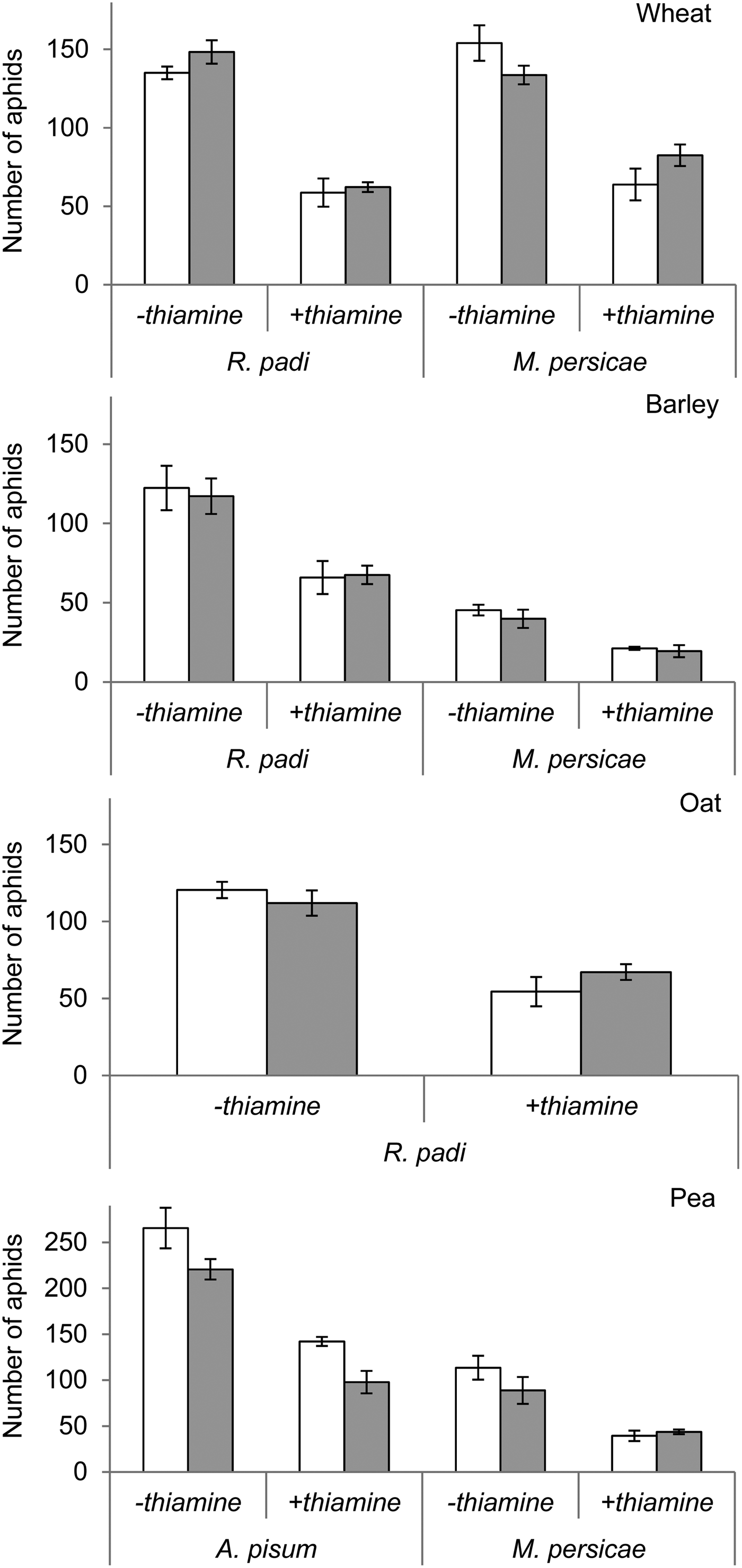
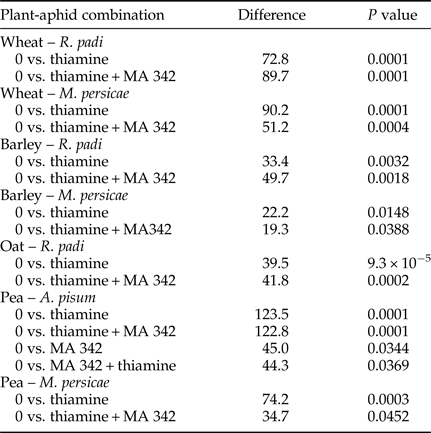
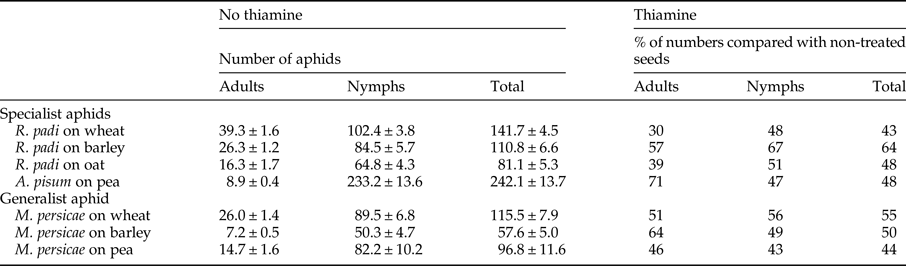
The results showed that total aphid numbers on plants grown from thiamine-treated seeds were consistently lower than on plants from seeds not treated with thiamine (fig. 1). The analysis using two-way ANOVA showed that thiamine gave a highly significant effect (P ≤ 0.05 or lower) in all plant-aphid combinations (table 1). There was no interaction between thiamine and MA 342. In the case of pea aphid on pea plants, MA 342 also gave a significant effect, but with a much higher P value than thiamine (P values 0.0344 and 0.0369 as compared with 0.0001) (table 1). Table 1 shows representative differences found significant at a similar P-level in at least two independent experiments for each plant-aphid combination. The significant differences were the same when the numbers of adults or nymphs were analyzed (not shown). The effect of varying the treatment concentrations of thiamine was analyzed on wheat and barley with R. padi and M. persicae using a series of different concentrations in seed treatments between 4 and 10.7 mM. The results showed consistent effect at P ≤ 0.005, except for the combination barley-M. persicae where the P value was 0.013 between groups but only ≤ 0.1 in the post-hoc test (table 2). Next, the relative reduction of aphid numbers on plants from thiamine-treated seeds vs. non-thiamine treated seeds was calculated for the three categories adults, nymphs and total number of aphids (table 3). The average total number of aphids on plants from thiamine-treated seeds varied between ca. 45 and 65% of that on plants from seeds not treated with thiamine. There was no obvious difference in the reduction related to aphid category or plant-aphid combination (table 3).
Mean number of aphids (± SEM) 7 days after adding adult apterous aphids to wheat, barley, oat or pea grown from seeds with different treatments. Grey bars represent treatments with MA 342 and white bars controls, with or without thiamine as indicated. For wheat, barley and oat, 20 aphids were added to 7 days old plants. For pea, ten pea aphids were added to 15 days old plants or twenty green peach aphids to 23 days old plants. The experiments were carried out in at least two independent repetitions (n = 6 in each).

Significant differences in total aphid numbers after addition of aphids to wheat, barley, oat or pea plants, grown from seed with different treatments

Seed treatment factors MA 342 and thiamine were analyzed for significant effects. Analysis by two-way ANOVA followed by Tukey HSD or Tukey Kramer (for peach aphid on wheat and barley) as post-hoc test (n = 6).
Mean number of total aphids (±SE) on wheat or barley plants grown from seeds treated with different concentrations of thiamine.

On each horizontal row, significant differences found between seeds treated with thiamine (thiamine or MA 342 + thiamine) in comparisons with non-thiamine treated seeds (control or MA 342) are indicated with stars: *P ≤ 0.05; *** P ≤ 0.005. Analysis by one -way ANOVA with Scheffé pair-wise comparisons for post-hoc analysis (n = 6, except wheat-R. padi where n = 8).
Mean number of aphids (±SE) on plants grown from seeds not treated with thiamine and the corresponding % of aphid numbers on plants grown in parallel from seeds treated with thiamine.

Twenty aphids were added on each plant, except pea aphids on pea where 10 were added. n = 12 on wheat and pea, n = 18 on barley and oat. The data are from one representative experiment with each plant-aphid combination.
R. padi lifespan and fecundity
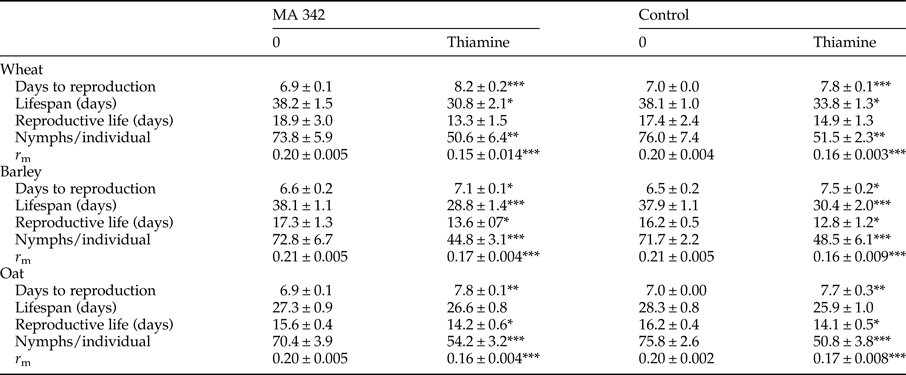
Life span and fecundity tests can give more detailed information about which reproduction parameters are affected by plant or seed treatments. Such tests were therefore carried out with R. padi on plants from seeds with different treatments on wheat, barley and oat (table 4). The treatment with thiamine caused an increase in days to the start of reproduction (P ≤ 0.05 for barley, ≤ 0.01 for oat and ≤ 0.005 for wheat), fewer nymphs produced per individual (P ≤ 0.01 for wheat, ≤ 0.005 for barley and oat) and a lower intrinsic rate of population growth (P ≤ 0.005 for all three cereals) (table 4). The aphid lifespan and reproductive life was also shorter on plants from thiamine-treated seeds, but this was not significant for all cereals (table 4). In contrast, treatments with MA 342 did not cause any effects and there were no interactions between MA 342 and thiamine.
Mean (±SE) life span and fecundity of R. padi aphids on wheat, barley and oat plants grown from seeds treated with MA 342, thiamine or combinations thereof.

On each horizontal row, significant differences found between seeds treated with thiamine (thiamine or MA 342 + thiamine) in comparisons with non-thiamine treated seeds (control or MA 342) are indicated with stars: *P ≤ 0.05: **P ≤ 0.01; ***P ≤ 0.005. Analysis by Kruskal–Wallis with post-hoc test (n = 12). r m = intrinsic rate of increase.
Aphid acceptance
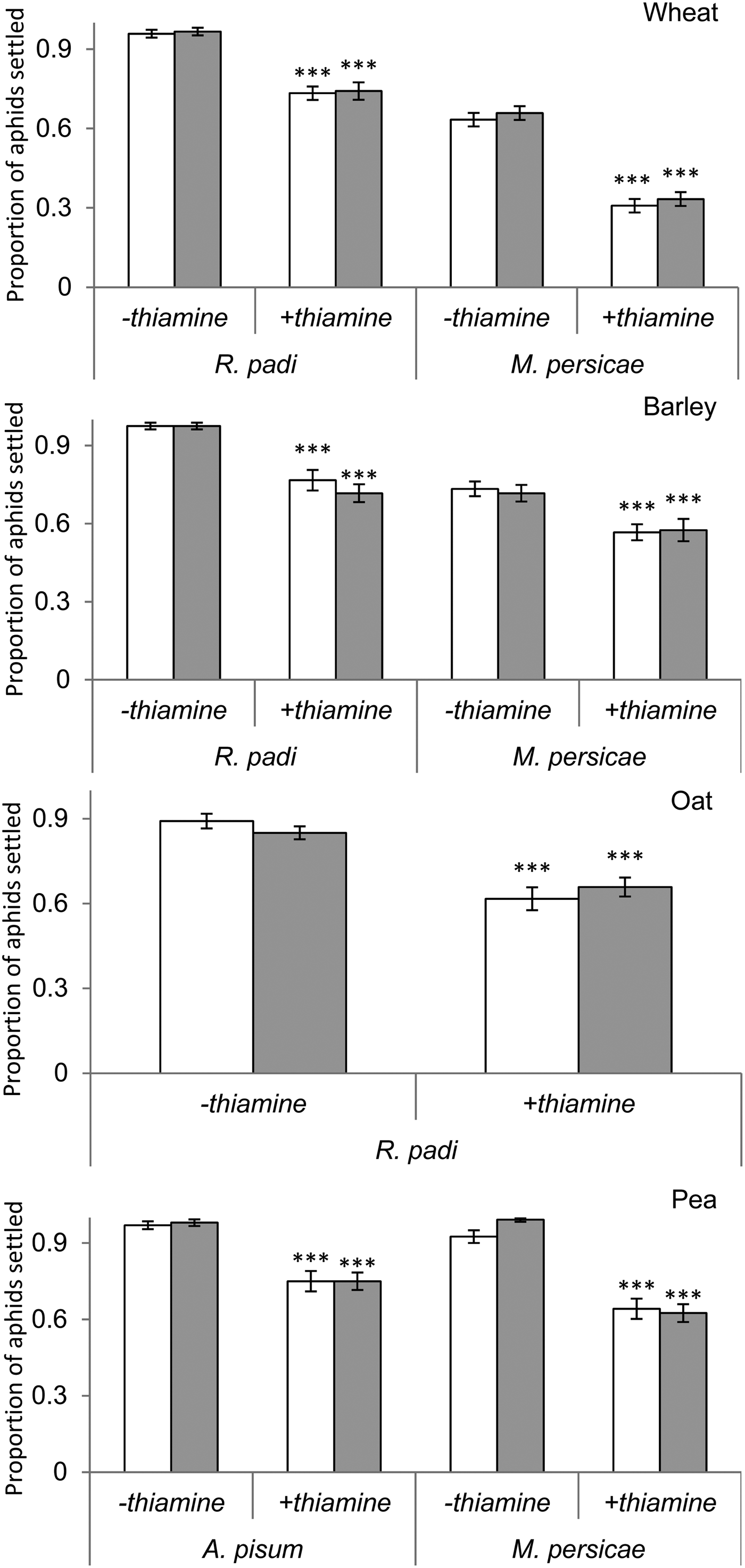
To investigate possible effects of seed treatments on aphid acceptance of the host plants, we counted the number of aphids settled on the plant within 2 h. For all plant-aphid combinations, we found that the number of settled aphids was lower on plants grown from seeds treated with thiamine than from seeds not treated with thiamine (fig. 2). The effect was significant at P ≤ 0.005 for treatments with thiamine vs. other treatments. Treatments with MA 342 did not show any significant effect and no interaction with thiamine.
The proportion of adult apterous aphids settled (± SEM) on wheat, barley, oat or pea 2 h after addition on plants grown from seeds with different treatments. Grey bars represent treatments with MA 342 and white bars controls, with or without thiamine, as indicated. Ten aphids were added to 7 days old wheat, barley or oat plants. Pea plants were 15 days old (for A. pisum) or 23 days old (for M. persicae). The number of replicates was 12, except pea aphid on pea where n = 10. Significant differences between thiamine as compared to no thiamine for a certain plant-aphid combination is indicated with stars: ***P ≤ 0.005 shown by Kruskal–Wallis test with post-hoc analysis.

Discussion
The present study was set up to find out whether it would be possible to treat seeds of agricultural crops with thiamine in order to grow plants with an increased resistance towards aphids. The idea was based on previous results where we had shown that soaking of seeds in thiamine solution, spraying plants with thiamine solution or adding thiamine to nutrient solutions had adverse effects on aphids (Hamada & Jonsson, Reference Hamada and Jonsson2013).
The earlier study had shown reduction of population growth of R.padi and A.pisum when seeds of barley or pea were soaked in thiamine at concentrations of 150 µM and no increased effect at higher concentrations. In the present study, the thiamine concentration was estimated to be similar as earlier used for seed soaking, based on the volume of seeds. Thus, the thiamine concentration in the treatment solution was 4 mM in 10 ml used per kg wheat or pea and 5.3 mM in 7.5 ml used per kg barley or oat. Such seed treatments caused a clear reduction of aphid fecundity in all plant-aphid combinations and with no increase of the effect using higher concentrations in the treatment, as studied on wheat and barley. In the previous studies, we found a reduction of aphid numbers to 60 or 70% of that on control plants when seeds were soaked in thiamine solution. The present results show reductions in agreement and exceeding these effects, with total numbers of aphids varying between 45 and 65% of the numbers on control plants. We showed earlier that soaking of seeds with thiamine caused a decrease in the life span, the reproductive life, the number of nymphs per individual and the intrinsic rate of reproduction for R. padi on barley. These parameters were now investigated using R. padi not only on barley but also on wheat and oat and it was found that except the reproductive life on wheat and the lifespan on oat, all parameters of life span and fecundity were significantly reduced on plants grown from seeds treated with thiamine.
It was earlier reported that thiamine soaking of seeds caused lower proportion of R. padi settling on barley (Hamada & Jonsson, Reference Hamada and Jonsson2013). In the present study, we likewise found reduced acceptance on plants grown from seeds treated with thiamine with or without MA 342 for all plant-aphid combinations on wheat, barley, oat and pea with both specialist and generalist aphids.
With regard to our main objectives, firstly, the results show clearly that plants grown from seeds treated with thiamine will support a lower reproduction and lower settling of the specialist aphids R. padi and A. pisum.
Secondly, we found that the effect of seed treatments with thiamine with or without MA 342 were as efficient towards the generalist aphid M. persicae as towards the specialist aphids. This is in contrast to treatments with the P. fluorescence WCS417r P strain, which had no effect on the specialist cabbage aphid but increased the susceptibility for M. persicae on arabidopsis (Pineda et al., Reference Pineda, Zheng, van Loon and Dicke2012) and inoculation with P. fluorescence WCS417rP, which caused enhanced performance of the generalist phloem feeder, the whitefly Bemicia tabaci on tomato (Shavit et al., Reference Shavit, Ofek-Lalzar, Burdman and Morin2013). It was recently shown that the effects of P. fluorescence WCS417rP towards generalist insects may be influenced by the type of soil used with an increase in insect susceptibility in potted soil, but a reduction of insect performance in soil mixed with sand (Pangesti et al., Reference Pangesti, Pineda, Dicke and van Loon2015). Since we were using seed treatments as the method of inoculation and not inoculation in the soil, we believe that the soil substrate did not influence our results. The finding that MA 342 did not interfere with or enforce the thiamine effect supports the earlier suggestion that it mainly exerts its action against pathogenic fungi directly in the seed glume via an antifungal substance (Tombolini et al., Reference Tombolini, van der Gaag, Gerhardson and Jansson1999) and indicates that it probably does not induce any systemic effects in the plants. This confirms earlier reports of variations between the mechanisms of action of different Pseudomonas strains (Van Loon, Reference Van Loon2007).
Thiamine treatment as a method to enhance resistance in plants has mainly been studied with pathogens (Ahn et al., Reference Ahn, Kim and Lee2005, Reference Ahn, Kim, Lee and Suh2007; Pushpalatha et al., Reference Pushpalatha, Sudisha, Geetha, Amruthesh and Shetty2011; Bahuguna et al., Reference Bahuguna, Joshi, Shukla, Pandeby and Kumar2012; Boubakri et al., Reference Boubakri, Wahab, Chong, Bertsch, Mliki and Soustre-Gacougnolle2012). For pathogen-induced defences in general (also called immunity), it has been proposed that there are two different mechanisms: pattern-triggered (basal) immunity and effector-induced immunity (Chisholm et al., Reference Chisholm, Coaker, Day and Staskawicz2006; Bent & Mackey, Reference Bent and Mackey2007). Basal immunity is induced upon plant recognition of pathogen-associated molecular patterns. It is broad and non-specific and restricts the pathogens, but does not totally prevent them. Effector-induced immunity is strong and specific. It is induced upon plant recognition of effector molecules from the pathogen and suppresses the induced responses (Chisholm et al., Reference Chisholm, Coaker, Day and Staskawicz2006). Similar models have been applied in the study of aphid-induced defences. One molecule involved in pattern-triggered immunity was identified and comes from the aphid symbiont Buchnera aphidicola (Chaudhary et al., Reference Chaudhary, Atamian, Shen, Briggs and Kaloshian2014). Candidate aphid effector proteins have also been identified (Hogenhout & Bos, Reference Hogenhout and Bos2011; Pitino & Hogenhout, Reference Pitino and Hogenhout2013; Thorpe et al., Reference Thorpe, Cock and Bos2016). The thiamine seed treatments in our study inhibited all three aphids species, similarly to a certain degree studied in different plants, thus exhibiting the characteristics of pattern-triggered immunity. In earlier studies, priming, i.e. earlier or stronger defence reactions in thiamine-treated plants were demonstrated in some plant/pathogen combinations (Ahn et al., Reference Ahn, Kim and Lee2005, Reference Ahn, Kim, Lee and Suh2007). In our previous study, we showed differences in aphid-induction of selected genes between control and thiamine-treated barley (Hamada & Jonsson, Reference Hamada and Jonsson2013), but before any genes have been confirmed to enhance resistance, the mechanism remains to be explained.
Thiamine treatments led to a decrease of aphid performance in three types of tests, including settling within 2 h; population growth during a 7 days test and for R. padi also the life span and reproduction test. To remain with the hypothesis that priming of defences is the explanation to the thiamine effect, we need to consider whether defences are induced in these different tests. The trigger (s) of the defence reactions are presumed to be components in the aphid saliva, which is delivered in the plant tissue before settling. Before reaching the sieve elements, the aphid stylet is penetrating the plant tissue via an intercellular pathway (Tjallingii, Reference Tjallingii2006; Hewer et al., Reference Hewer, Becker and van Bel2011). The aphid exudates small droplets of gel saliva, which harden to form a saliva sheath and facilitates stylet penetration (Will et al., Reference Will, Steckbauer, Hardt and van Bel2012). The aphid stylet also probes cells along the pathway and secretes watery saliva intracellularly (Tjallingii, Reference Tjallingii2006). Proteins or other components in both the gel and the watery saliva may trigger or suppress defences (van Bel & Will, Reference Van Bel and Will2016). With regard to our settling test, the first question is whether it is likely that aphid infestation would trigger defence responses already within 2 h. Such quick responses have indeed been found in at least two experiments using Arabidopsis and one with maize. In one study with Arabidopsis, only two genes were upregulated at 2 h upon M. persicae infestation (Couldridge et al., Reference Couldridge, Newbury, Ford-Lloyd, Bale and Pritchard2007). However, in a study by Jaouannet et al. (Reference Jaouannet, Morris, Hedley and Bos2015), a large number of genes were upregulated at 3 h upon infestation by either M. persicae or R. padi. The differences may be explained by different aphid morphs and different infestation loads. The first study used ten nymphs (Couldridge et al., Reference Couldridge, Newbury, Ford-Lloyd, Bale and Pritchard2007) and the second used 25 mixed age apterous aphids for the infestation (Jaouannet et al., Reference Jaouannet, Morris, Hedley and Bos2015). A study in maize showed a high number of changes at both transcript and metabolite level at 2 h after adding R. maidis to maize plants at ten adult aphids per plant (Tzin et al., Reference Tzin, Fernandez-Pozo, Richter, Schmelz, Schoettner, Schäfer, Ahern, Meihls, Kaur, Huffaker, Mori, Degenhardt, Mueller and Jander2015). Thus, it is very likely that our experimental set-up with ten mixed instar adult apterous aphids would trigger defences within 2 h.
In our 7 days population growth tests, the aphids added are a mixed population and they will produce nymphs continuously. The newborn nymphs all need to establish feeding and are therefore expected to induce new responses within the experimental period.
In the life span test, only one aphid is added on each leaf and once it produces offspring, one of the nymphs is kept. The newly born nymphs from this single mother are expected to induce defences when they establish feeding after birth. Such induction of nymphs will decrease during the life span, because the nymph production decreases during the reproductive life and eventually stops. However, during this later period of the life, drinking periods increase; i.e. from time to time the aphids stop feeding to drink from the xylem (Pompon et al., Reference Pompon, Quiring, Giordanengo and Pelletier2010). After drinking, the aphids need to probe the tissue again to establish feeding in the phloem. Thus, we might expect that new defence responses are induced in the tissue during the total life span of each individual aphid, although they might become weaker with time. This might be the reason why the aphid parameters total lifespan and days of reproductive life did not show significant differences between thiamine treatments and controls on all three host plants with R. padi (table 4).
The patterns of aphid-induced responses have been studied at transcript level in a large number of plant/aphid interactions (Giordanengo et al., Reference Giordanengo, Brunissen, Rusterucci, Vincent, van Bel, Dinant, Girousse, Faucher and Bonnemain2010; Louis & Shah, Reference Louis and Shah2013; Smith & Chuang, Reference Smith and Chuang2014). Genes belonging to the category of defence-related are commonly induced, e.g. genes coding for pathogenesis-related proteins or enzymes involved in the oxylipin pathway. However, there are large differences depending on the plants and aphids studied. For example, a comparative study with R. padi on four different barley genotypes, showed large differences in the transcripts induced in two equally susceptible cultivars (Delp et al., Reference Delp, Gradin, Åhman and Jonsson2009). On the other hand, considerable overlap in transcripts induced by three different aphid species was found in Arabidopsis (Jaouannet et al., Reference Jaouannet, Morris, Hedley and Bos2015). Two of them were M. persicae, which reproduces well on Arabidopsis and R. padi, which does not survive on this plant (Jaouannet et al., Reference Jaouannet, Morris, Hedley and Bos2015). Until now, very few of the genes found upregulated by aphids have been confirmed to contribute to aphid resistance. Two examples are TPSII (trehalose- 6-phosphate synthase) in the Arabidopsis–M. persicae interaction (Singh et al., Reference Singh, Louis, Ayre, Reese and Shah2011) and α -DIOXYGENASE 1 in the tomato–potato aphid (Macrosiphum euphorbiae) interaction (Avila et al., Reference Avila, Arevalo-Soliz, Lorence and Goggin2013). TPSII had an effect both on settling and on fecundity (Singh et al., Reference Singh, Louis, Ayre, Reese and Shah2011), whereas antixenosis effects were not studied with regard to α -DIOXYGENASE (Avila et al., Reference Avila, Arevalo-Soliz, Lorence and Goggin2013). Aphids are also known to induce the emittance of plant volatiles, of which some may effect aphid behaviour. It has been shown that aphid infestation enhances the production of terpenes (e.g. Tzin et al., Reference Tzin, Fernandez-Pozo, Richter, Schmelz, Schoettner, Schäfer, Ahern, Meihls, Kaur, Huffaker, Mori, Degenhardt, Mueller and Jander2015), green leaf volatiles such as (E)-2-hexenal (Gosset et al., Reference Gosset, Harmel, Göbel, Francis, Haubruge, Wathelet, du Jardin, Feussner and Fauconnier2009) and methyl salicylate (Zhu & Park, Reference Zhu and Park2005). Negative effects of volatiles have been shown in various plants against a number of aphid species. For example, limiting the production of the volatile aldehydes hexanal and (E)-2-hexenal in potato by suppression of a hydroperoxide lyase gene, caused much better performance of M. persicae (Vancanneyt et al., Reference Vancanneyt, Sanz, Farmaki, Paneque, Ortego, Castañera and Sánchez-Serrano2001). In a recent study with the same aphid species, application of the volatile terpenes α-ionone and linalool caused the aphids to spend relatively more time on non-probing and the success rate in reaching sieve elements and feeding was lower (Dancewicz et al., Reference Dancewicz, Sznajder, Zaluski, Kordan and Gabrýs2016). Methyl salicylate was shown to be a repellent against R. padi migrants (Glinwood & Pettersson, Reference Glinwood and Pettersson2000) and higher levels of the terpenes limonene and E-β-farnesene were found correlated with negative performance of R. padi in rice where a terpene synthase gene was suppressed or overexpressed (Sun et al., Reference Sun, Huang, Ning, Jing, Bruce, Qi, Xu, Wu, Zhang and Guo2017). In summary, there is increasing evidence from various plant-aphid studies that triggered responses may affect aphid settling as well as aphid proliferation in short time fecundity tests. Considering the life span tests, which last about 1 month, we presume that either volatiles, the composition of the phloem sap or both, are the major factors affecting the fecundity and life span parameters. There are several reports of phloem-specific resistance against aphids, but the actual resistance component(s) remain to be identified (Klingler et al., Reference Klingler, Powell, Thompson and Isaacs1998, Reference Klingler, Creasy, Gao, Nair, Calix, Jacob, Edwards and Singh2005; Greenslade et al., Reference Greenslade, Ward, Martin, Corol, Clark, Smart and Aradottir2016).
The results show that seed treatment with the non-toxic vitamin thiamine results in reduction of the settling as well as the reproduction of both a generalist and two specialist aphids. These two effects together can be expected to reduce aphid infestation levels considerably. This opens for seed treatments with thiamine with or without MA 342 as a method to reduce aphid infestations. Seed treatment is a convenient and cost-efficient way of treating plants in order to enhance the effects of induced defence (Walters et al., Reference Walters, Ratsep and Havis2013). In the current study, the treatment was in the form of coating together with a bacteria formulation. This method of seed treatment is currently used in large-scale commercial applications and reduces the time and labour needed. Furthermore, seeds can be kept dry until sowing. Combinations of thiamine with other seed formulations might work as well, but should be examined for each such combination. We like to point out that this study was carried out under controlled conditions in growth chambers. It is well known that seed treatments with the aim to increase plant defence against pathogens or insects may not lead to the desired results in the field, with differences depending on the plant species or cultivar, abiotic stress and other environmental factors (Walters et al., Reference Walters, Ratsep and Havis2013). Thus, field trials should be carried out before any recommendations can be given for using seed treatments with thiamine in sustainable aphid pest control.
Supplementary material
The supplementary material for this article can be found at https://doi.org/10.1017/S0007485317000529
Acknowledgments
The authors thank Rolf Stegmark, Findus Sverige AB for providing A. pisum aphids, and Velemir Ninkovic and Robert Glinwood at SLU, Uppsala for providing R. padi and M. persicae aphids. They thank Lantmännen Research Foundation for funding (grant number 20120021).