INTRODUCTION
During the last two decades the interest of behavioural ecologists in the effect of parasites on host fitness has increased. Parasites may affect host body condition (Hall, 1985; Gulland, 1995; Delahay et al. 1995), survival probabilities (Vorísek et al. 1998; Murray et al. 1997), some reproductive parameters (Newey and Thirgood, 2004; Albon et al. 2002) or population dynamics (Holmes, 1982; Hudson et al. 1998; Tompkins et al. 2001). Therefore, parasites seem to be an important factor in host life-history and may exert a strong selective force on host evolution (Clayton and Moore, 1997).
This relatively recent focus on host-parasite interaction has led to an increasing number of empirical studies in which parasite burden is related to different measures of host fitness. Determining the prevalence and intensity of ectoparasite infection can be considered as relatively easy (except in the case of hairy or densely feathered animals), as this kind of parasite can be directly counted or estimated by exploring the skin, hair or feathers of the individual. In contrast, determining the level of infestation by endoparasites is more difficult, particularly when non-invasive sampling methods have to be employed. The most common approach for the quantification of endoparasite burdens is to estimate prevalence and intensity of the infestation by the analysis of faecal samples and the quantification of parasite propagules, typically eggs or larvae (Gordon and Whitlock, 1939; Shaw and Moss, 1989; Guyatt and Bundy, 1993). However, propagule counts in faeces may be subjected to a great within-individual variation due to factors like host reproductive status (Ruiz de Ybañez et al. 2004), weather (Rickard and Zimmerman, 1992; Vicente et al. 2005), season (Shaw and Moss, 1989; Theodoropoulos et al. 1998; Kumba et al. 2003), random day-to-day variations (Yu et al. 1998; Giver et al. 2000), phase of the parasitic infection (Giver et al. 2000; Cordero del Campillo and Rojo, 1999) or hour of sampling (Boughton, 1933; Brawner and Hill, 1999). For example, Brawner and Hill (1999) showed that a single factor such as the hour of the day at which samples are collected can drastically alter the results of assessment of coccidian prevalence and individual parasite burden in the house finch (Carpodacus mexicanus).
Therefore, determination of the effect of these variables on propagule excretion and standardization of sampling methods is essential for a correct assessment of parasitic infestation and for successful testing of the hypotheses studied. Unfortunately, accurate information for this kind of variation is scarce for most host and parasite taxa.
In this paper we analyse the day-to-day and daily variation in the excretion of parasite propagules in red-legged partridges (Alectoris rufa) naturally infested with two different intestinal parasites: coccidia of the genus Eimeria and the capillarid nematode Aonchoteca caudinflata. Nematodes and Protozoa are among the most frequently considered parasites in ecological studies. Eimeria coccidia exhibit both sexual and asexual phases in their life-cycle. The asexual phase may occur in the intestinal epithelium or as a diffuse infection in several other organs. The sexual phase takes place only in the epithelium of the intestine or intestinal caeca (depending on the coccidian species) and results in the production of oocysts that are released with the faeces of the host (Cordero del Campillo and Rojo, 1999). The two species of coccidia infecting our captive population of red-legged partridges have been identified as E. colchici and E. tenella (D. Villanúa, unpublished data), two species whose sexual phase takes place in the caeca or small intestine of the avian host. A. caundinflata is a heteroxenous parasite of the small intestine of gallinaceous and anatid birds (Anderson, 2000). Female worms lay eggs that mature after ingestion by earthworms, the necessary intermediate hosts.
In many avian taxa, like Galliformes and Anseriformes, the caeca are elongated. In these species, caecal faeces represent a significant proportion of the total amount of faeces produced and can be easily distinguished from intestinal faeces by their appearance (Clarke, 1979). In this paper we also analyse the differences in propagule content of both kinds, caecal and intestinal faeces in the red-legged partridge. We finally discuss the implications of our results for the design of and analysis of data in empirical studies involving parasite burden estimation from faecal propagule counts.
MATERIALS AND METHODS
Data collection took place during October 2004 in the experimental red-legged partridge farm of the IREC in Ciudad Real, Spain. During late summer-autumn of that year there was an outbreak of capillariasis in one of the outdoor aviaries of the farm. As soon as the parasite was identified and before starting any medication, a sample of 15 birds of the affected aviary was isolated in individual elevated outdoor cages and individual samples of faeces were collected. The coprological analysis showed that 8 of the birds (6 females and 2 males) were shedding capillarid ova and these were subsequently employed for the experiment. Six of these partridges were also shedding coccidian oocysts, allowing the combined analysis of the daily variation of excretion of propagules of both parasites in the same sample of birds.
On the 5th, 6th, 12th, 13th, 14th, 15th and 16th of October individual faecal samples were collected from all birds (except from 1 of them the on Day 14 due to a sampling mistake) at 08:00, 12:00, 16:00 and 19:30 h. Faecal samples were obtained by placing a large piece of fresh paper on the ground just below each of the cages no longer than 5 min before the sampling times indicated above. The first droppings produced by each bird during the following 30 min were collected and stored in Eppendorf tubes at 4 °C for 2 days until parasite propagule counts. Most of the faeces obtained were intestinal faeces, which is the most common type of faeces produced by gallinaceous birds. However, when caecal faeces (n=37 samples) where also found, they were collected separately for comparison. Caecal faeces can be easily and unambiguously distinguished from intestinal faeces by their colour (dark brown in the former, green-pale brown in the later), texture (soft and homogeneous in the former, granular in the later) and by their more intense odour, and are primarily eliminated at the end of the day (Clarke, 1979).
Quantitative analysis of the parasite propagules (oocysts in the case of coccidia, eggs in the case of capillarids) found in each faecal sample was carried out using a flotation technique according to Mehlhorn et al. (1992). Approximately 0·5 g of faeces (depending on the amount of sample collected) were homogenized and suspended in 10 ml of in a saturated ZnSO4 solution (specific gravity 1·18). Egg and oocyst counts were performed using a MacMaster chamber (Mehlhorn et al. 1992) and their concentration (eggs or oocysts per gram faeces) was calculated taking into account the exact weight (to the nearest 0·001 g) of sample analysed.
Capillarid nematodes cannot be identified up to the species level using egg size and morphology. Therefore, at the end of the experiment, birds were sacrificed humanely as a part of another experiment and adult worms were identified according to Skryabin (1991), confirming the presence of Aonchoteca caudinflata in all cases.
Statistical analysis
We used General Linear Models and General Linear Mixed Models (GLMs and GLMMs) for the analysis of the effect of sampling time on oocyst and capillarid egg counts. Parasite propagule counts were normally distributed after square root (in the case of capillaria) or cubic root (in the case of coccidia) data transformation (Kolmogorov-Smirnov normality test: D=0·057, P=N.S., and D=0·098, P=N.S., for capillaria and coccidia respectively).
To test whether there was an effect of the hour and day of sample collection on propagule concentration in faeces, we performed 2 GLMMs in which either capillarid eggs or coccidian oocysts counts (per gram of faeces) were introduced as dependent variables and hour and day of sampling where introduced as categorical fixed factors. Also, to analyse whether the hypothetical effect of hour of sampling was consistent over consecutive days, the interaction between day and hour of sampling was also entered in the model as a fixed factor. Individual was entered in the model as a random factor.
Propagule excretion may vary with time due to changes in the degree of infection of the individual. Therefore, to minimize the effect of this factor on our analysis, we restricted our analysis to data from the 5 consecutive days (12th to 16th).
To test whether the daily pattern found in the previous model (see Results section) was consistent between individuals, 2 further GLMs were performed. Either capillarid eggs or coccidian oocyst counts (per gram of faeces) were again introduced as dependent variables. Individual, day and hour of sampling were introduced as fixed factors. To test whether the effect of the day detected in the previous model (see Results section) responded to a common tendency during the 5 consecutive days, day was now entered as a continuous variable. The interactions between day and individual and between hour and individual were also entered in the model. The interaction between hour and day was removed from the model a priori as it revealed to be non significant in previous analyses (see Results section). As in the previous case, this analysis was restricted to data from 5 consecutive days (12th to 16th) to minimize the effect of possible changes in the degree of infection of the individual. Non-significant terms were sequentially removed from the model in a stepwise backward manner.
Finally, to test for differences between caecal and intestinal faeces, 2 new GLMMs were performed, 1 for each parasite. In this analysis we considered only data obtained when both ceacal and intestinal faeces were obtained from 1 bird at the same hour and day. Given the larger amount of zero values in this data set, the number of capillarid eggs or coccidian oocysts per gram of faeces had to be cubic root transformed to achieve normal distribution (Kolmogorov-Smirnov normality test: D=0·144, P=N.S., and D=0·20, P=N.S., for Capillaria and coccidia respectively after transformation). Day, hour and type of faeces (caecal or intestinal) were entered as fixed factors whereas individual was entered as a random factor. Data from all the days of study (from 5th to 16th) were employed in this analysis.
RESULTS
Effect of the time of day and day-to-day variation on propagule excretion
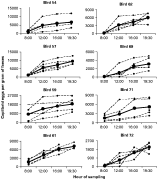
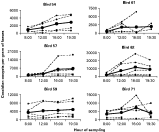
Results of GLMMs for capillarid eggs and coccidian oocysts (controlling for the effect of individual by considering it as a random factor) revealed a significant effect of the hour (F3,131=19·1, P<0·001 and F3,89=8·50, P<0·001) for Capillaria and coccidia, respectively) and day of sampling (F4,131=5·01, P<0·001 and F4,89=22·4, P<0·001 for Capillaria and coccidia, respectively). The hour of the day at which samples where collected exerted an important effect, explaining 27·4% of the variance in the case of capillarid eggs and 11·9% in the case of coccidian oocysts. Parasite propagule shedding followed the same temporal pattern in all birds, showing a clear and constant increase from dawn to dusk (Figs 1 and 2) that was particularly evident in the case of capillarid eggs, which were on average 27·4±14·2 times higher in samples collected at 19:30 than in those samples collected at 8:00 from the same birds. Day of sampling exerted a significant effect for capillarid eggs (9·5% of the variance explained), but specially for coccidia oocysts, explaining the 41·5% of the deviance of the data set. The interaction between day and hour of sampling was non-significant in both cases (F12,131=0·31, P=0·98 and F3,101=1·05, P=0·41) indicating that the daily pattern of excretion was consistent between days.

Fig. 1. Number of capillarid eggs per gram of faeces from 8 red-legged partridges collected at 4 different hours of the day and during 5 consecutive days. Dashed lines show daily patterns whereas solid lines indicate mean values. Error bars have been eliminated for clarity.

Fig. 2. Number of coccidian oocysts per gram of faeces from 6 red-legged partridges collected at 4 different hours of the day and during 5 consecutive days. Dashed lines show daily patterns whereas solid lines indicate mean values. Error bars have been eliminated for clarity.
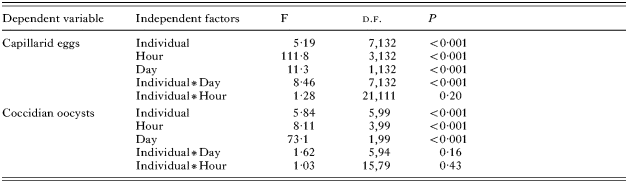
We performed 2 GLMMs to analyse whether there was consistency in the pattern of parasite propagule excretion between individuals whose results are shown in Table 1. In the model for capillarid eggs, we found a significant effect of the hour and day of sampling as single factors (as found in the previous model), but the interaction between individual and hour was not significant, indicating that the pattern of daily variation found was consistent in all the infected birds. However, regarding the effect of the day, as can be observed in Fig. 1, in some individuals (e.g. individuals 54 and 59) the line signalling the daily pattern for some days was almost 5 times higher than for other days, showing a strong day-to-day variation. In contrast, such day-to-day variation was minimal in other individuals (e.g. individuals 61 and 72). Consequently, the interaction between day and individual was significant in this model (Table 1), suggesting that although a common trend to increase (Beta=0·30) was found, not all individuals followed that trend and day-to-day variations were partially independent for each bird.
Table 1. GLMs for capillarid eggs and coccidian oocysts per gram of faeces (Hour of the day and day (as a continuous variable) and individual were included as factors, as well as the interaction between individual and day and individual and hour. The model for capillarid eggs explained 91·1% of the original variance, whereas the model for coccidia oocysts explained 66·7%. Statistics for non-significant variables correspond to the step at which they were rejected from the model.)

Regarding coccidian oocysts, the results were similar to those reported for capillarids (Table 1). The interaction between individual and hour of sampling was again non-significant, thus supporting again the consistency of the daily pattern between birds. However, in this case, although the day of sampling exerted a significant positive effect (Beta=0·56), the interaction between day and individual was non-significant, indicating that there was a common pattern to increase pattern which was common for all individuals infected with coccidia.
Effect of type of faeces on propagule counts
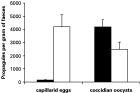
In 37 cases we were able to collect both intestinal and caecal faeces of the same bird and at the same hour and day. We did not detect any tendency to produce more caecal faeces at any specific hour of the day (χ2=1·59, D.F.=3, P=0·66). After controlling for the effect of individual, sampling hour and day, capillarid eggs were much more abundant in intestinal faeces compared to caecal faeces (F1,59=68·0, P<0·001, Fig. 3), the type of faeces explaining 39% of the total variance in the model. In contrast, an inverse pattern was observed when the abundance of coccidian ococysts was analysed (effect of type of faeces: F1,68=18·4, P<0·001, 16% of the variance explained by this factor), the oocysts being more abundant in caecal than in intestinal faeces (Fig. 3). Propagule counts of both types of faeces were neither correlated in the case of capillarids (Pearson correlation: r=0·28, n=37, P=0·09) nor regarding coccidian oocysts (r=0·23, n=37, P=0·160). In fact, 54·5% (6 cases out of 11) of the caecal samples where we failed to find any capillarid eggs were false negatives (i.e. at least 1 capillarid egg was found in intestinal faeces collected from the same individual at the same hour of the same day), whereas only 16% (1 out of 6) of the intestinal samples where we failed to find any capillarid egg were false negatives (i.e. at least 1 capillarid egg was found in the caecal sample collected from the same bird at the same hour of the same day). Regarding coccidian oocysts, 100% (n=11) of the intestinal samples where we did not find any oocyst were false negatives, whereas no false negative was found among caecal samples.

Fig. 3. Mean number of oocysts and capillarid eggs in caecal (solid columns) and intestinal faeces (open columns). Bars indicate standard errors.
The daily distribution of false negtives was not biased (i.e. false negatives were not more common in certain hours of the day than in others) neither in the case of capillarid eggs (χ2=3·33, D.F.=3, P=0·34) nor regarding coccidian oocysts (χ2=1·91, D.F.=3, P=0·59). After that, we tested whether false negatives corresponded to those samples with lower concentration of parasite propagules. However, capillarid egg concentration in intestinal faeces collected at the same time as the cloacal samples that yielded false negatives did not differ from that of the rest of the samples (Student's t-test: t=0·37, D.F.=35, P=0·71). The results were the same when the equivalent comparison was performed for coccidian oocysts in cloacal faeces (t=−0·07, D.F.=35, P=0·94). These results suggest that false negatives were randomly distributed in our data set.
Finally, when false negatives were excluded from the analysis, parasite propagule counts in intestinal and caecal samples were positively and significantly related both in the case of capillarid eggs (Pearson correlation: r=0·45, n=30, P<0·05) and coccidian oocysts (r=0·36, n=30, P=0·05).
DISCUSSION
Our results indicate that the hour of the day at which samples are collected may exert a very strong effect on parasite propagule excretion. This point was confirmed in 2 different parasite species coming from 2 extremely different taxa (Nematoda and Protozoa) infecting the same bird host species (the red-legged partridge). In both cases propagule shedding increased as the day progressed, reaching maximal values in the late afternoon. Not many studies have paid attendion to the existence of this kind of daily pattern in parasite propagule excretion. Furthermore, most of those few are focused on coccidia oocyst shedding (Brawner and Hill, 1999; Hudman et al. 2000; Misof, 2004), describing a temporal pattern of oocyst excretion consistent with the one we described. Hudman et al. (2000) and Misof (2004) limited their study to comparison of the oocyst content of faeces produced in the morning versus faeces produced in the afternoon. In contrast, the methodological approach of Brawner and Hill (1999) was similar to that followed by us, reporting a continuous increase during the day. However, the diurnal trend found for coccidia in our case does not seem to be as pronounced as that found by Brawner and Hill (1999). This may be due to intrinsic differences between host-parasite systems, or to the fact that the intensity of coccidian infection in our experimental birds was not as high as in the study by Brawner and Hill (1999).
Apart from these studies focused on coccidia, the knowledge about daily variation in the excretion of propagules of other kinds of parasites is almost non-existent. For example, Giver et al. (2000) found no consistent pattern across individuals when comparing morning and afternoon egg counts in faeces of domestic pigs artificially infected with the trematode Schistosoma japonicum Katsurada. In fact, to our knowledge, this is the first report of the existence of a consistent within-day pattern of excretion in a nematode parasite of a bird species. This pattern may reflect a strategy of the parasite as its intermediate hosts, earthworms are more active during the night (Whitford et al. 1995). However, more detailed experimental studies would be needed to determine the cause of this trend. Likewise, coccidia of the genus Eimeria are known to induce gut stasis (McKenzie et al. 1987) and, on the other hand, depend on certain temperatures and humidity for the onset of sporulation after exiting the host (Graat et al. 1994), the time of onset of which is essential for their propagation. Both these facts could be implied in the observed circadian rhythm, but further studies would be necessary for confirmation.
Although the hour was by far the most influential factor in both parasites, we also found an effect of the day of sampling. In particular, we found a tendency to increase parasite propagule excretion during the course of the study which was stronger for coccidian oocysts than for capillarid eggs. In our study, samples were collected during 5 consecutive days just to exclude the effect of any seasonal variation in propagule excretion as described in other studies (e.g. Shaw and Moss, 1989; Theodoropoulos et al. 1998; Vicente et al. 2005). It is widely known that propagule excretion varies throughout the course of a parasitic infection (Cordero del Campillo and Rojo, 1999). Birds employed in this study were naturally infected during an outbreak of capillariasis that affected our captive population. As a result, birds may have been in different phases of the parasitic infection when sampled, explaining why some birds showed a tendency to increase the amount of capillarid eggs excreted whereas others did not show this pattern. Unlike capillarids, infection by coccidia seemed to be more benign, as revealed by the low number of oocysts counted and the absence of individuals showing clinical signs compatible with coccidiosis in the preceding and following months. Probably this difference in the type and degree of infestation may explain the absence of interaction between day and individual in the case of coccidia, although it may not be coherent with the fact that an increasing between-day pattern was found in both parasites. One further possible explanation is that repeated sample collection (that required the investigator to crawl under the cages 4 times each day) may have stressed the individuals during the 5 days of study. It is known that physiological stress may lead to immunosuppression (Sapolsky, 1992; Besedowsky and del Rey, 1996), leading parasites to take advantage of the host and increase their reproductive rate and propagule production. This stress-induced effect on parasite propagule production may be effective relatively quickly, and can be detected in less than a week both for nematodes and coccidia, as reflected by a recent study in ring-necked pheasants (Phasianus colchicus Linnaeus) (Villanúa et al. 2006).
Apart from the effect of time of sampling, we found important differences in propagule counts between types of faeces. In particular, capillarid eggs were much more abundant in intestinal faeces than in caecal faeces, whereas the pattern was the opposite for coccidian oocysts. This tendency was expected considering the part of the intestinal tract where the adult reproductive forms of each parasite live. Adults of the capillarid Aonchoteca caudinflata live in the intestine and therefore females release eggs into the intestinal contents. In contrast, the oocysts found in our captive red-legged population belong to species with sexual phases that replicate in the epithelium of the caeca or in the caeca and final portion of the intestine (Cordero del Campillo and Rojo, 1999). As a result, the total number of oocysts was higher in caecal than in intestinal faeces. Unfortunately, in the case of coccidia, the scarce number of caecal samples collected prevented us from testing whether the temporal pattern found was the same for that type of faeces, in which oocyst concentration was higher.
Apart from ectoparasites, intestinal parasites are the most commonly studied ones as possible factors affecting several components of host fitness. Interestingly, both coccidia (Hillgarth, 1990; Buchholz, 1995; Vorísek et al. 1998) and nematodes (Hudson et al. 1998; Murray, 2002; Newey and Thirgood, 2004) are the most common endoparasite taxa employed in such ecological studies, and most of those surveys that do not involve culling the animal require indirect parasite load estimates based on counts of the number of propagules in faeces. In parasites from these two taxa we have found a marked diurnal periodicity in propagule excretion. However, despite the fact that the hour of the day at which samples are collected may be of vital relevance for the outcome of a particular study, only very rarely is the time of sampling standardized or controlled for in subsequent analyses.
The great magnitude of within-individual variation in propagule excretion during the day may convey serious errors in non-invasive parasite load estimates. Experiments in captivity may easily control for this effect by sampling all the birds approximately at the same hour, preferentially in the late afternoon, when propagule shedding is maximal and therefore differences between individuals are maximized. However, this kind of data standardization is difficult in the wild. Moreover, most wild birds are trapped in the morning hours, when propagule shedding is minimal, thus diminishing the power to detect differences in intensities of parasite excretion between individuals. As parasite estimates from birds sampled at morning and late afternoon hours may not be comparable, the best way to solve this problem in studies in the wild is to control statistically for the hour of sampling in all the analyses by including it as a covariable. Either the methodological standardization or the statistical control of the effect of this variable may prevent fatal errors and will lead to more reliable results. Similarly, studies where faecal samples are collected from the environment instead of directly from the animal should take into account this source of variability. Collection of fresh droppings exclusively and during the same hour of the day may be a good option, although the effect of weather on faecal drying time should also be considered. Alternatively, sample collection from places where individuals stay only during a determinate and known period of the day (roosts, for example) may facilitate increased reliability of the results obtained.
With regards to the differences in parasite counts between types of faeces, the main implication of our findings is that researchers should pay attention to the life-cycle of the parasite to develop the most appropriate protocol for sample collection in species with long caeca like gallinaceous birds or anseriforms. In our particular case, we have shown that parasite counts coming from intestine or caeca are not comparable for these two parasite species. The ideal procedure should be to count each parasite only in the type of faeces in which it is more abundant. In our case, consistent collection of intestinal faeces is suitable for capillarid egg counts, whereas, caecal faeces are recommended for counting coccidia oocysts. The problem is that caecal faeces are only a minor proportion of the total amount of faeces produced by a bird (in the red-legged partridge, we obtained caecal drops only in 38 cases out of the 224 samplings performed for this study). Furthermore, we have not detected any tendency to excrete caecal faeces at any particular hour of the day. Therefore, it is very difficult to have the opportunity to choose what type to collect, especially in the wild, and the researcher will have to be satisfied with the type of sample excreted by the bird when trapped (usually an intestinal drop). However, it should be noted that, despite the fact that our levels of infection were very low and we performed our analysis in the type of faeces where oocysts were less abundant, we detected the same daily pattern of oocyst excretion as described in previous studies (Brawner and Hill, 1999; Hudman et al. 2000; Misof, 2004). This may suggest that, given the dificulty of obtaining caecal samples in species like this, oocyst counts from intestinal faeces may provide useful information. We have found that after eliminating false negatives from the analysis, oocyst counts from intestinal and caecal faeces are correlated. Also, this relationship is expected to be more significant when infection levels are higher than the low ones reported here. Therefore, when possible (e.g. in studies in captivity), repeated sampling may help to identify and correct false negatives. When this is not feasible (the most common situation in studies carried out on wild birds) a possible approach could be to restrict the analysis to individuals found to be infected. We have found that false negatives are not biased according to sampling hour or levels of infection, but other types of bias should be considered in the case of following this approach. In any case, consistent collection of the same type of faeces seems to be mandatory.
Although in the two parasites studied here the hour of the day and the type of faeces were by far the most important factors affecting individual variation in propagule counts, other possible factors may also have an effect. As stated above, we found an effect of the day of sampling that varied between individuals in the case of capillarids. Other authors have found a day-to-day variation in propagule counts that seems to be due to variations in propagule production by the parasite or to aggregation of the propagules in the faeces, leading to sampling errors (e.g. Yu et al. 1998; Giver et al. 2000). Also, great differences in propagule excretion may occur along the course of infection (Cordero del Campillo and Rojo, 1999; Giver et al. 2000). Moreover, in some parasite species, faecal propagule counts may not necessarily reflect the number of adult parasites present in the body of the individual (Welch et al. 1991). Density-dependent constraints may also alter the relationship between parasite burden and faecal counts (Anderson and Shad, 1985; Tompkins and Hudson, 1999). Hence, the use of propagule counts to indirectly estimate parasite burden should ideally be assessed a priori in any host-parasite system before being employed.
It is remarkable that we found identical circadian trends in two extremely different taxa of parasites. Although previous studies in other coccidian species showed the same pattern (Boughton, 1933; Brawner and Hill, 1999; Hudman et al. 2000; Misof, 2004), more research involving different parasite and host taxa is required to confirm whether such diurnal variation is common across host-parasite systems. This study highlights the point made by other authors (McLennan and Brooks, 1991; Zuk, 1992; Brawner and Hill, 1999) about the necessity of gathering more information about the host-parasite systems studied. A survey to identify the best method for assessing parasite prevalence and burdens is recommended as a previous step for any host-parasite study (e.g. Seivwright et al. 2004; Brawner and Hill, 1999). A better a priori assessment of the dynamics of infestation as regards, for example, fluctuations in propagule number within and between days, or between types of faeces, may lead to collection of more reliable data and give the opportunity to perform more robust analyses.
We thank Elisa Pérez, Salvador Jesús Luna and Paqui Talavera for assistance during sample collection and analysis and Jesús Martínez-Padilla for statistical advice. Financial support was provided by the Research Project PAI-02-006 of the Junta de Comunidades de Castilla-La Mancha and by the agreement between CSIC and Principado de Asturias. Lorenzo Pérez-Rodríguez was supported by a FPU grant from the Ministerio de Educación y Ciencia.