

Introduction
Biofertilizers are biological products containing living microorganisms that can promote plant growth (Vessey Reference Vessey2003) and can be used to complement mineral fertilizers (Canbolat et al. Reference Canbolat, Bilen, Çakmakçı, Şahin and Aydın2006). Among the biofertilizers that have been intensively studied are vesicular-arbuscular mycorrhizal fungi (AMF), symbiotic microorganisms that colonize roots of most agricultural crops and are capable of forming a complex and intricate network of fungal hyphae that can be likened to an extension of plant root systems (Ryan & Graham Reference Ryan and Graham2002). Mycorrhizal infection may directly enhance plant mineral nutrition by increasing the volume of soil explored and by penetrating small soil cores with the thin diameter hyphae (Jakobsen et al. Reference Jakobsen, Gazey and Abbott2001). These ubiquitous fungi may significantly increase the plant uptake of phosphorus (P) through extra-radical hyphae (Bolan Reference Bolan1991). Besides the phosphates, a capacity for the external hyphae to take up and deliver nutrients to the plants has been demonstrated for other nutrients, such as potassium (K), calcium (Ca), sulphur (S) and magnesium (Mg) and some trace elements such as iron (Fe), copper (Cu), manganese (Mn) and zinc (Zn) (Liu et al. Reference Liu, Hamel, Hamilton, Ma and Smith2000). The role of AMF in total nitrogen (N) uptake is still debated (Thirkell et al. Reference Thirkell, Cameron and Hodge2016), but it has been demonstrated that they transfer N to their host (Hawkins & George Reference Hawkins and George1999; Hawkins et al. Reference Hawkins, Johansen and George2000) and that plants are able to take up N from the mycorrhizal interface (Toussaint et al. Reference Toussaint, St-Arnaud and Charest2004; Govindarajulu et al. Reference Govindarajulu, Pfeffer, Jin, Abubaker, Douds, Allen, Bücking, Lammers and Shachar-Hill2005; Jin et al. Reference Jin, Pfeffer, Douds, Piotrowski, Lammers and Shachar-Hill2005; He et al. Reference He, Xu, Qiu and Zhou2009). There are also non-nutritional advantages for the host plants, as AMF can improve plants’ resistance to abiotic (drought, salinity, heavy metals) and biotic (root pathogens) stressors (Gianinazzi et al. Reference Gianinazzi, Gollotte, Binet, van Tuinen, Redecker and Wipf2010). Therefore, AMF can play a key role in plant survival.
Forage is the basic feed for ruminants and must represent at least 0.50 of dry matter (DM) in rations for lactating ruminants (Van Soest Reference Van Soest1994), and their quality can have a significant impact on milk yield and composition. In intensive livestock systems, fertilizers are used extensively to maximize forage yield, but potentially increasing the risk of nutrient losses. Concerns regarding food safety and environmental pollution, along with soaring prices of fertilizers, act to moderate nutrient supply to crops (Powell et al. Reference Powell, Gourley, Rotz and Weaver2010).
The rationale of the present study is the assumption that the plant–mycorrhizal fungi relationship might help to reduce the use of fertilizers in forage production. Therefore, the combined effect of AMF and low fertilizer application on yield, economic benefit and energy balance of two forage crops was evaluated under intensive conditions of crop and livestock farming. The use of mycorrhizal forages in diets for lactating cows and buffaloes was also examined. The study consisted of two trials, carried out on two sites, that are presented separately.
Materials and methods
Study sites, forage species and mycorrhizal treatment
The study sites were two farms situated in Campania Region, southern Italy, hereafter termed A and B (40°31′N, 14°57′E, 13 m a.s.l. and 41°16′N, 15°05′E, 760 m a.s.l., respectively). Farm A is a buffalo (Italian Mediterranean buffaloes) dairy farm (154 ha Utilized Agricultural Area (UAA), 368 buffalo cows), located on an irrigated flat area. The climate is Mediterranean maritime (zone Csa, according to Köppen Reference Köppen, Köppen and Geiger1936) with a relatively dry summer (84 mm) and a mean annual rainfall of 988 mm, with monthly mean temperatures ranging from 23.6 °C (August) to 9.0 °C (January). Farm B is a dairy cattle farm (60 ha UAA, 60 cows) situated on an area in the foothills of the Apennine mountains under Mediterranean sub-continental climate conditions (zone Csb, according to Köppen Reference Köppen, Köppen and Geiger1936). The mean annual rainfall (1001 mm) is concentrated in autumn and winter; summer is generally warm (15–20 °C).
The forages investigated were maize (Zea mays L., cv Indaco, class FAO 600, Limagrain, Busseto, PR, Italy) and sorghum (Sorghum sudanense Piper, cv Hermes, medium–early hybrid Sudangrass-Sudangrass, Padana Sementi Elette, Tombolo, PD, Italy) for farms A and B, respectively. Seeds of the two forages were inoculated on-farm (May 2014) with the same microbial complex (Aegis, Italpollina, Rivoli Veronese, VR, Italy) containing the mycorrhizal fungi Glomus intraradices (700 spores/g) and Glomus mossae (700 spores/g). The microbial product, mixed with a green adhesive powder and a solution containing vegetal amino acids and peptides, was sprayed on sorghum and maize seeds in a cement mixer at the dose of 20 g inoculum/kg seed.
Maize trial
Mycorrhizal and non-mycorrhizal maize seeds were sown on 7 June 2014, with two plots of 1.5 ha each per treatment. The soil had a clay loam texture (clay 64.6%, silt 18.4%, sand 17.0%), alkaline reaction (pH 8.2, 1 : 5 soil/water extract) with the following properties before seeding: total N 2.3 g/kg (Kjeldhal method), organic matter 36.0 g/kg (Walkley & Black method), total carbonate 30.0 g/kg (manometric method), available phosphorus pentoxide (P2O5) 30.0 mg/kg of (Olsen method). The maize control treatment (MC) was the non-mycorrhizal maize fertilized with both N (250 kg/ha) and P2O5 (100 kg/ha). The full dose of P2O5 was applied at seedbed preparation, while one-third of N was applied at the time of sowing and the remaining two-thirds at 4th leaf stage, growth stage (GS) 14, according to the BBCH scale (Lancashire et al. Reference Lancashire, Bleiholder, van den Boom, Langelüddeke, Stauss, Weber and Witzenberger1991). The doses were calculated on the basis of expected uptake (3.9 kg N/t yield and 1.5 P2O5/t yields) and yield (65.0 t/ha) suggested by the Department of Agriculture of Campania Region (Mori & Di Mola Reference Mori and Di Mola2012). The maize experimental treatment (ME) was the mycorrhizal maize fertilized with an only half dose of N (125 kg/ha). The crop was irrigated as and when required, for a total irrigation volume of 6000 m3/ha. The Control and inoculated maize were harvested at the kernel dent ripening phase (GS 85) on 25 September 2014 and put into four silobags, one per plot, two per treatment. Forage was chopped to 1.50 cm theoretical length of cut using the same harvester.
The maize feeding trial lasted 16 days and was carried out on 40 lactating buffaloes. Animals were assigned to one of two treatment groups fed the same total mixed ration (TMR), differing only in the use of inoculated (ME group) or control (MC group) maize silage (Table 1). The groups were balanced for number (20), parity (2.2 ± 0.62 and 2.3 ± 0.64, respectively, for ME diet and MC diet), days in milk (98 ± 18.6 and 98 ± 18.0 days) and milk production (12 ± 2.4 and 12 ± 4.9 kg/head/day). Animals were housed in two free stall barns furnished with feed manger, automatic drinker and outdoor paddock and were handled in a similar way in terms of feeding (once daily at 07:00 h) and milking (twice/day at 05:00 and 17:00 h). No pasture was available for grazing on the external paddocks. After 10 days of adaptation to the diets, a period deemed to be adequate for feeding trials on lactating cows (Valadares Filho et al. Reference Valadares Filho, Broderick, Valadares and Clayton2000), DM intake was measured over six consecutive days on a group basis, and milk yield and quality were determined on an individual basis. The yield was recorded daily by a computerized system and milk samples were automatically collected at morning and evening milking.
Ingredients and chemical characteristics of diets fed to lactating buffaloes (maize trial) and dairy cows (sorghum trial)
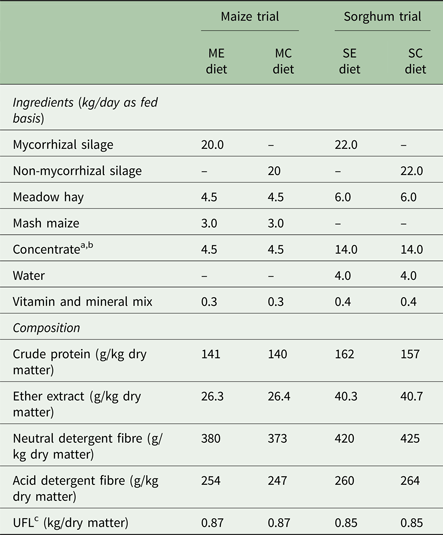
ME diet, diet containing Inoculated Maize (mycorrhizal maize and reduced fertilizer dose); MC diet, diet containing Control Maize (non-mycorrhizal maize and full fertilizer dose); SE diet, diet containing inoculated sorghum (mycorrhizal sorghum and reduced fertilizer dose); SC diet, diet containing control sorghum (non-mycorrhizal sorghum and full fertilizer dose).
a Maize trial: Mixture meal based on soybean, maize, sunflower and barley meals.
b Sorghum trial: Commercial concentrate based on maize meal, soybean meal, sunflower meal, beet pulp, barley meal, wheat flour shorts, flaked maize, hydrogenated palm fat.
c Unité Fourragère Lait: 1 UFL = 7.11 MJ/kg of net energy for lactation. Calculated on the basis of chemical composition of feedstuffs.
Sorghum trial
Mycorrhizal and non-mycorrhizal sorghum seeds were sown on 3 June 2014 on four plots, two per treatment, 1.5 ha each. The soil was sandy-silty-loam (sand 57.4%, silt 21.3%, clay 21.3%), alkaline (pH 8.3, 1 : 5 soil/water extract), with the following characteristics at the beginning of the experiment: total N 1.2 g/kg, organic matter 10.0 g/kg, total carbonate 70.7 g/kg, available P2O5 3.3 mg/kg. The sorghum control treatment (SC) was the non-mycorrhizal sorghum fertilized with the recommended dose of P2O5 and N (i.e. N 120 kg/ha, P2O5 50 kg/ha) calculated as described previously (expected uptake 3.0 kg N and 1.25 kg P2O5/t yield; expected biomass 40.0 t/ha). The full dose of P2O5 was applied at seedbed preparation, while half N was applied at the time of sowing and the remaining half at 5th leaf stage (GS 15). The sorghum-inoculated treatment (SE treatment) was fertilized with only half dose of N (60 kg/ha). Sorghum grew under rainfed conditions (cumulated rainfall 196 mm) and was harvested at the flowering stage (GS 61) (30 August 2014). The SE and SC forages were ensiled in bales wrapped in polyethylene film, marked appropriately for the plot of origin.
In the sorghum feeding trial (16 days long) a total of 28 lactating cows (Italian Friesian cattle) were used. Animals were assigned equally (n 14) to SE and SC groups (parity 3 ± 1.6 and 3 ± 1.8; days in milk 151 ± 30.0 and 150 ± 26.4 days; milk production 27 ± 4.7 and 27 ± 3.7 kg/head/day) and fed the same TMR, differing only with respect to the presence of SE or SC sorghum silage (Table 1). Animal handling and milk sampling were as for the maize trial.
Sampling and analysis
The percentages of root colonization by AMF were measured at 30 days after seeding on three samples/plot, each consisting of three plants, according to Giovannetti & Mosse (Reference Giovannetti and Mosse1980).
Yield components and plant traits were estimated at harvesting on three strip lines/plot. For each line (10 m long), the maize and sorghum plants were cut manually at 10 cm above the ground level and weighed to determine biomass yield. Thereafter, plants were chopped and sampled to determine the yield of DM, crude protein (CP) (AOAC 1990), and energy. The concentration of net energy for lactation was calculated on the basis of chemical composition according to Andrieu et al. (Reference Andrieu, Demarquilly, Sauvant and Jarrige1988) and expressed as Unité Fourragère Lait (1 UFL = 7.11 MJ).
Plant traits (height, number of leaves, culms, cobs and panicles) were evaluated on three samples/plot, each consisting of three plants. Area of green leaves of maize was determined by Leica Quantimet 500 image analyser (Leica, Deerfield, Illinois, USA). Plants were separated into culms, leaves and cobs and DM determined. Silage sampling was carried out 4 months after harvesting, just before the start of feeding trials. The pH of silages was measured by a portable Crison 507 pH-meter (Crison Instruments, SA, Barcelona, Spain). Three samples/plot were collected and analysed for DM, ash, ether extract (Soxhlet apparatus), CP (AOAC 1990), soluble protein (SP) and non-protein nitrogen (NPN) (Licitra et al. Reference Licitra, Hernandez and Van Soest1996). An Ankom220 Fibre Analyser (Ankom, Tech. Co., Fairport, NY, USA) was used to determine neutral detergent fibre including residual ash (aNDF) and acid detergent fibre (ADF). Acid detergent lignin (ADL) was also determined (Van Soest et al. Reference Van Soest, Robertson and Lewis1991). Starch was determined by using a Polax-2l polarimeter (Atago Co., Ltd., Tokyo, Japan) in a 200-mm long observation tube.
The in vitro digestibility of DM (IVDMD) and NDF (IVNDFD) were determined by the procedure of Wilman & Adesogan (Reference Wilman and Adesogan2000) based on a 48-h incubation in a Daisy II system (Ankom, Tech. Co., Fairport, NY, USA) with buffered rumen fluid followed by an aNDF determination of the residues. Briefly, 250 mg of milled sample (1 mm) were put into filter bags (Ankom F57), in triplicate, and placed in four digestion jars (24 bags/jar) filled with pre-warmed (39 °C) buffer solutions (1600 ml) and rumen inoculum. Inoculum from dairy cows and buffaloes was used for maize and sorghum, respectively, according to the feeding trial protocols. Two cycles were performed for each forage species, and the averaged data were used for statistical analysis. In each cycle, the ruminal fluids were collected post-mortem at a slaughterhouse from four lactating animals (about 500 ml of rumen fluid from each animal). In vitro DM and NDF degradability data were calculated as the coefficients between the concentration of each nutrient in the residues and the original samples.
During the feeding trial, milk from each cow was collected in sterile plain jars kept refrigerated at 4 °C and sent to the laboratory for milk composition analyses (MilkoScan FT 6000, Foss Electric, Hillerød, Denmark) to be conducted on the same day of collection. Samples from morning and evening milking were separately analysed and the mean values used for statistical analysis.
Crop economic benefit and energy balance
Costs and benefits of each treatment were calculated by the partial budgeting technique. Gross income was calculated from biomass yields and the farm gate prices on local markets. The net benefit was computed as the difference between the gross income and the local input costs. The energy balance was evaluated by the process analysis method, which traces the energy inputs (direct and indirect) and outputs based on physical material flows (Jones Reference Jones1989). The direct energy inputs were fuels and lubricants, the indirect inputs encompassed energy embodied in seeds, fertilizers, chemicals (insecticides, fungicides and herbicides) and field machineries. Energy from human labour was considered negligible compared to the other inputs (Hülsbergen et al. Reference Hülsbergen, Feil, Biermann, Rathke, Kalk and Diepenbrock2001). The input material fluxes were converted into energy fluxes using the specific energy equivalents taken from the literature sources (Meul et al. Reference Meul, Nevens, Reheul and Hofman2007; Bechini & Castoldi Reference Bechini and Castoldi2009; Mihov & Tringovska Reference Mihov and Tringovska2010). The energy outputs were calculated from the contents of carbohydrate, protein and lipid of the forages (Merrill & Watt Reference Merrill and Watt1973). Finally, the following efficiency indicators (Tellarini & Caporali Reference Tellarini and Caporali2000) were calculated: net energy (the difference between total energy outputs and inputs, MJ/ha) and the energy use efficiency (the ratio of energy output and energy input, non-dimensional).
Statistical analysis
Data from maize and sorghum trials were analysed separately using the SAS statistical package, version 8.1 (SAS Institute, Cary, North Carolina, USA). Effect on crop yields, plant traits and forage quality were analysed with the GLM procedure as a completely randomized design with sub-sampling, where the plot was treated as the experimental unit. Two-way analysis of variance per repeated measures (Mixed procedure) was used to test the effect of diet on milk traits with treatment as non-repeated factor and day of sampling as a repeated factor. The cow variance was considered as random and utilized as the error term to test the main effect of treatment.
Results
Field trials
The soils of the two experimental sites differ substantially in terms of fertility. In farm A, the high availability of N and P2O5 and the presence of well-humified organic matter indicate a fertile soil. Conversely, the low nutrient availability and the limited presence of humified organic matter denote a rather limited fertility in soil B. Although the growing seasons of both maize and sorghum were cooler and more rainy than usual, water deficit conditions occurred at tasselling (GS 51) and silking (GS 69) stages for maize, whereas sorghum grew with no water deficit (Table 2). The results of the cropping experiments are shown in Table 3. Both SE and ME had higher percentages of root infection compared with the respective controls (P < 0.05), with values above 25%, i.e. the threshold to validate the effectiveness of inoculation process according to regulations of the Italian Republic Ministerial Decree 23 September (2011).
Climatic condition during the 2014 growing season
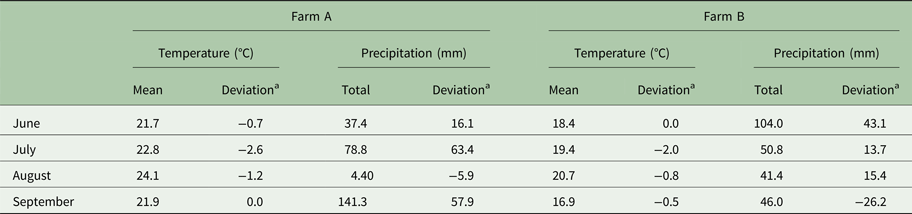
a Deviation: actual minus 10-yr monthly average.
Rate of infection, plant traits, and yield parameters of the inoculated and control treatments
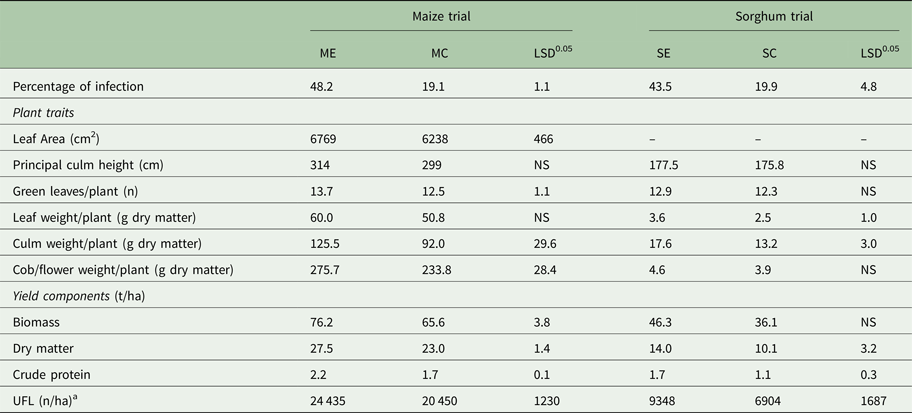
ME, inoculated maize: mycorrhizal maize and reduced fertilizer dose; MC, control maize: non-mycorrhizal maize and full fertilizer dose; SE, inoculated sorghum: mycorrhizal sorghum and reduced fertilizer dose; SC, control sorghum: non-mycorrhizal sorghum and full fertilizer dose; NS, not significant.
a Unité Fourragère Lait: 1 UFL = 7.11 MJ/kg of net energy for lactation. Calculated on the basis of chemical composition of the silages.
With regard to the maize trial, the culm and cob weights, the number of green leaves and, consequently, the leaf area were significantly higher (P < 0.05) in ME. These differences resulted in higher (P < 0.05) yields/ha of biomass, DM, CP and UFL. Table 4 reports chemical composition and in vitro rumen degradability of ME and MC silages. No differences (P > 0.05) were observed either for a chemical parameter or for IVDMD and IVNDFD. In the feeding trial, DM intake was very close in ME and MC groups (16.0 ± 0.25 kg v. 16.1 ± 0.47 kg/head/d, respectively). The average milk production was similar in the two groups, as well as fat, protein and lactose contents (Table 5).
Chemical characteristics and in vitro rumen degradability of the inoculated and control silages
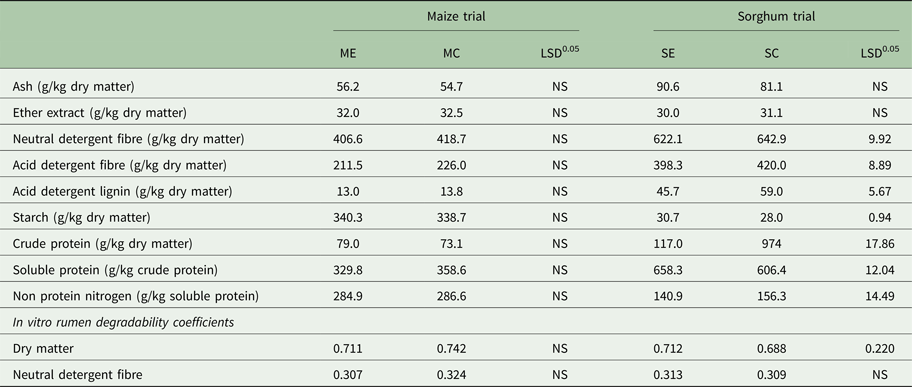
ME, inoculated maize: mycorrhizal maize and reduced fertilizer dose; MC, control maize: non-mycorrhizal maize and full fertilizer dose; SE, inoculated sorghum: mycorrhizal sorghum and reduced fertilizer dose; SC, control sorghum: non-mycorrhizal sorghum and full fertilizer dose; NS, not significant.
Milk yield and composition of buffaloes (maize trial) and dairy cows (sorghum trial) fed the inoculated and control diets

ME diet, diet containing inoculated maize: mycorrhizal maize and reduced fertilizer dose; MC diet, diet containing control maize: non-mycorrhizal maize and full fertilizer dose; SE diet, diet containing inoculated sorghum: mycorrhizal sorghum and reduced fertilizer dose; SC diet, diet containing control sorghum: non-mycorrhizal sorghum and full fertilizer dose.
In the sorghum trial, statistically higher values (P < 0.05) were observed in SE for leaf and culm weights and DM, CP and UFL yields (P < 0.05) (Table 3). The SE silage showed lower fibre (aNDF, ADF, ADL) along with higher starch and CP contents (Table 4). Furthermore, CP characteristics were influenced by the experimental treatment, with higher SP and lower NPN content displayed by SE. In vitro DMD was significantly (P < 0.05) higher for SE, but no differences were observed for IVNDFD. Dry matter intake of sorghum-based diets was 21.0 ± 0.71 v. 20.7 ± 0.50 kg/head/day, respectively, for SE and SC. Milk yield and quality was not influenced by the use of SE (Table 5).
Crop economic benefit and energy balance
The higher forage yield coupled with lower fertilizer application of the experimental treatments determined an increment of net benefit/ha for both crops (+670.6€ and 731.9€ for ME and SE, respectively) (Table 6). The strongest factor determining the change in profitability was the increment of forage yield, whereas the saving due to reduced use of fertilizers was remarkable for ME (140.6 €/ha), but rather limited for SE (17.9 €/ha), because of the lower fertilizer rate applied in SC. Similarly, the experimental crops showed both an increment of the energy outputs (+70 378 and +66 655 MJ/ha for ME and SE, respectively) and a reduction of the energy inputs (−8410 and −4025 MJ/ha). As a consequence, the inoculated treatments showed increments of net energy (+24 and +60%) and energy use efficiency (+53 and +85%) (Table 7). The incidence of indirect inputs was lower in inoculated crops (49 v. 60% for ME and MC, respectively; 42 v. 52% for SE and SC, respectively) due to energy consumption from fertilizers being more than halved (−55 and −54% for maize and sorghum, respectively).
Mycorrhizal inoculum-related benefits and costs of the inoculated and control treatments

ME, inoculated maize: mycorrhizal maize and reduced fertilizer dose; MC, control maize: non-mycorrhizal maize and full fertilizer dose; SE, inoculated sorghum: mycorrhizal sorghum and reduced fertilizer dose; SC, control sorghum: non-mycorrhizal sorghum and full fertilizer dose; Δ, calculated as difference across the treatments.
a Includes other materials (seeds, diesel and chemicals) used in constant quantity across the treatments.
Crop energy balance and efficiency indicators in the experimental and control treatments
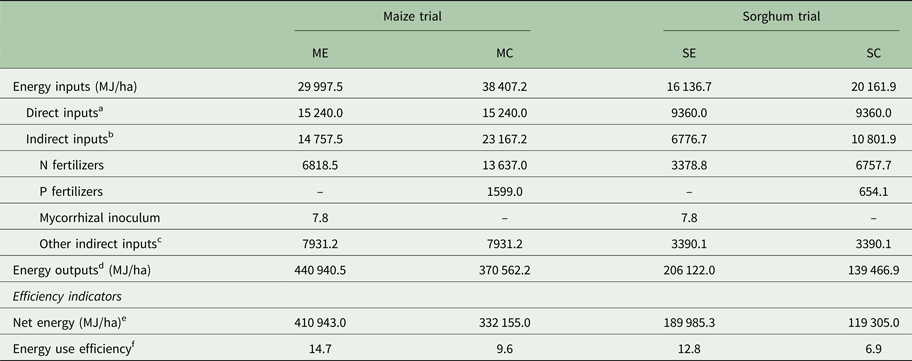
ME, Inoculated Maize: use of mycorrhizal maize and reduced fertilizer dose; MC, control maize: use of non-mycorrhizal maize and full fertilizer dose; SE, inoculated sorghum: use of mycorrhizal sorghum and reduced fertilizer dose; SC, control sorghum: use of non-mycorrhizal sorghum and full fertilizer dose.
a Includes the energy contents of diesel and lubricants.
b Includes the energy contents of seeds, chemicals, fertilizers and field machinery.
c Includes the energy contents of all indirect energy inputs except energy from fertilizers.
d Includes the energy contents of biomass forages.
e Calculated as the difference between energy outputs and energy inputs.
f Calculated as the ratio between energy outputs and energy inputs.
Discussion
For both maize and sorghum crops, the introduction of commercial AMF inoculants maintained or improved forage yield and quality under low fertilization input. The observed higher yield parameters were due to the positive effect of the inoculated treatment on several plant traits. The results for sorghum were of particular interest since the forage grew on a soil with low N and, particularly, low P availability. Furthermore, since sorghum was cultivated under rainfed conditions, it is possible to exclude nutrient input through irrigation water. Many papers have studied the effect of mycorrhizal colonization on harvestable yield. The meta-analysis carried out by Lekberg & Koide (Reference Lekberg and Koide2005) pointed out that mycorrhizal colonization can increase overall yield in the field (on average, +23 ± 8%), irrespective of plant type and management practice. The basis of these improvements may be due, among the functions explicated by AMF towards higher plants, to an increment of the exchange of nutrients due to extra-root mycelium (Selosse et al. Reference Selosse, Baudoin and Vandenkoornhuyse2004; Miransari et al. Reference Miransari, Bahrami, Rejali, Malakouti and Torabi2007; Finlay Reference Finlay2008; Daei et al. Reference Daei, Ardekani, Rejali, Teimuri and Miransari2009). Usually, forage quality tends to decline as DM yield improves (Van Soest Reference Van Soest1994), but in the sorghum trial, the greater yield was accomplished by a significant improvement of forage quality in terms of protein increment and fibre reduction. These observations indicate that mycorrhizal sorghum had a greater accumulation of DM and nutrients, without any quality deterioration. Other authors (Martínez-López et al. Reference Martínez-López, Vázquez-Alvarado, Gutiérrez-Ornelas, del Río, López-Cervantes, Olivares-Sáenz, Vidales-Contreras and Valdez-Cepeda2009; Cazzato et al. Reference Cazzato, Laudadio and Tufarelli2012; Sabia et al. Reference Sabia, Claps, Napolitano, Annicchiarico, Bruno, Francaviglia, Sepe and Aleandri2015a , Reference Sabia, Claps, Morone, Bruno, Sepe and Aleandri b ) found an increment of DM yield and CP percentage in forages without any increment of fibre. Furthermore, similarly to the current observations for SP and NPN, Cazzato et al. (Reference Cazzato, Laudadio and Tufarelli2012) detected an influence of mycorrhizal fungi inoculation on protein fractions. A better suitability of N adsorbed from fungal hyphae could explain both the higher content and the different quality of protein in SE silage (Mishra et al. Reference Mishra, Sharma and Vasudevan2008; Cazzato et al. Reference Cazzato, Laudadio and Tufarelli2012). The lack of consistency between the sorghum and maize trial for forage quality may be due, besides differences in pedological conditions and agronomic techniques, to the stage of maize cutting, which as previously reported was at the kernel dent stage (GS 85). Lestingi et al. (Reference Lestingi, De Giorgio, Montemurro, Convertini and Laudadio2007) reported that the positive effect of bio-activators, including spores of mycorrhizal fungi belonging to the species Glomus, is more evident during the plant first phenological stages. The advanced vegetative stage of maize at harvesting is also evident through higher contents of NDF and starch of the ME and MC silages compared to the values listed by Mazzinelli et al. (Reference Mazzinelli, Valoti, Redaelli, Alfieri, Mascheroni and Facchinetti2015) for the same hybrid Indaco 600. In accordance with the observations on chemical composition, IVDMD of maize silage was also not affected by the experimental treatment, whereas IVDMD of SE was statistically higher compared with SC. Dry matter degradability is one of the major determinants of feed utilization. It is a complex trait that reflects the whole chemical characteristics of a feed, where a single parameter provides only a partial indication. The IVDMD results observed for sorghum confirm the better quality of SE.
With regard to the feeding trials, there were no problems of palatability, since the observed DM intake values were in line with the typical data of lactating cows and buffaloes at similar stages of lactation. No effects of inoculated treatments were observed on milk yield and quality of both buffaloes and cows. This result could be due to the small differences between the control and the inoculated silages for Energy and CP contents, namely the main dietary factors affecting milk traits (Van Soest Reference Van Soest1994). To the authors’ knowledge, the current report is the first to examine the effect of mycorrhizal inoculation on milk yield.
Cost analysis showed that fertilizer expenditure constitutes one of the main items of total input costs for both crops. Fertilization is often mentioned as the key factor to increase forage yield (Ryan et al. Reference Ryan, Hennessy, Murphy and Boland2010; Gourley et al. Reference Gourley, Aarons and Powell2012), whereby farmers are strongly encouraged to apply fertilizers to offset yield uncertainty (Buckley & Carney Reference Buckley and Carney2013), so increasing farm dependency on the use of commercial fertilizers (Rotz et al. Reference Rotz, Satter, Mertens and Muck1999). Since revenue maximization is the main objective for farmers, the possibility of introducing biofertilizers into local farming practices to reduce fertilization costs is subject to the condition that their benefits outweigh their costs (Soha Reference Soha2014). The current analysis has shown that the use of AMF can be an opportunity to reduce costs and increase profits in forage production. In addition, the use of AMF did not result in additional investment, as it was fully compatible with the equipment normally found on a farm.
Net energy and energy use efficiency were influenced both by the reduction of energy inputs and the gain in energy output. These results contrast with those reported by other authors, according to which the net energy is primarily influenced by the amount of energy outputs (Rathke et al. Reference Rathke, Wienhold, Wilhelm and Diepenbrock2007) while the energy use efficiency depends primarily on the reduction of energy inputs (Helander & Delin Reference Helander and Delin2004). Nevertheless, the current results are difficult to compare with other existing reports since they evaluated the effects of low fertilizer application (Kuesters & Lammel Reference Kuesters and Lammel1999; Hülsbergen et al. Reference Hülsbergen, Feil and Diepenbrock2002; Angelini et al. Reference Angelini, Ceccarini and Bonari2005; Rathke et al. Reference Rathke, Wienhold, Wilhelm and Diepenbrock2007; Alluvione et al. Reference Alluvione, Moretti, Sacco and Grignani2011) or the impact of other crop management practices (Clements et al. Reference Clements, Weise, Brown, Stonehouse, Hume and Swanton1995; Sartori et al. Reference Sartori, Basso, Bertocco and Oliviero2005; Boehmel et al. Reference Boehmel, Lewandowski and Claupein2008; Deike et al. Reference Deike, Pallutt and Christen2008; Angelini et al. Reference Angelini, Ceccarini, Nassi o Di Nasso and Bonari2009; Nassi o Di Nasso et al. Reference Nassi o Di Nasso, Bosco, Di Bene, Coli, Mazzoncini and Bonari2011), whereas the current study examines the combined effect of a biofertilizer and low chemical fertilizer application on crop energy budget. The energy use analysis showed that the energy consumption was crop-specific and mainly influenced by N inputs. In addition, Alluvione et al. (Reference Alluvione, Moretti, Sacco and Grignani2011) and Nassi o Di Nasso et al. (Reference Nassi o Di Nasso, Bosco, Di Bene, Coli, Mazzoncini and Bonari2011) identify N fertilizer as the input that strongly influences energy requirement in many annual herbaceous species grown in Italy. It follows that development of alternative fertilization techniques may decrease energy inputs in crop production. The yield increment despite the input reduction represents a desirable objective both from an environmental and an economic perspective, especially where there is a shortage of arable land (Conforti & Giampietro Reference Conforti and Giampietro1997), as in the case of most intensive plain dairy farms that compete with cropping activities, and expansion of industrial and urban areas.
Conclusion
The artificial inoculation of seeds with AMF (Glomus spp) combined with low fertilizer application improved both maize and sorghum forage yields. These results are of interest, also considering that they were obtained in different environmental and soil fertility conditions. The experimental treatment displayed limited or no effect on the chemical composition and in vitro degradability of forages or on milk produced by both buffaloes and cows. Compared with conventional management, the low fertilizer rates coupled with AMF rate provide economic benefits due to increased saleable products and reduced costs. From an environmental sustainability perspective, the experimental crops reduced dependency on non-renewable energy sources while improving energy use efficiency and net energy. Moreover, the positive effect of the experimental fertilization regime on eutrophication potential reduction is undeniable. It is concluded that seed inoculation with mycorrhizal fungi combined with low rates of fertilizers could be a viable solution to increase the eco-efficiency and profitability in forages production without affecting forage quality and lactating cow productivity.
Acknowledgements
The study was supported by Campania Region, PSR 2007–2013 Misura 124, project CEREAMICO.



