INTRODUCTION
Pottery produced by mobile hunter-gatherer-fisher groups in the northeast European forest zone is among the earliest in Europe, probably appearing by the end of the 7th millennium cal BC in some regions (Hartz et al. Reference Hartz, Kostyleva, Piezonka, Terberger, Tsydenova and Zhilin2012; Mazurkevich and Dolbunova Reference Mazurkevich and Dolbunova2012; Vybornov et al. Reference Vybornov, Zaitseva, Kovaliukh, Kulkova, Possnert and Skripkin2012). The emergence, dispersal, and further development of these early ceramic traditions are of great relevance also for central European questions. The earliest ceramic vessels in the east emerged in a cultural environment that was based on a foraging economy and seasonal mobility, while in southern, central, and western Europe the earliest pottery is mostly associated with the transition towards a productive economy, residential sedentism, and the emergence of more complex forms of society. In the eastern research tradition, pottery is seen as the main defining marker of the Neolithic period (Oshibkina Reference Oshibkina2006), while in western archaeology a different definition of the Neolithic based on a food-producing economy is preferred (Scharl Reference Scharl2004). This article follows the local, eastern terminology. The fact that hunter-gatherer ceramic traditions have not only left their traces in eastern Europe but probably also reached west as far as northern Germany and southern Scandinavia, where they influenced the adoption of pottery in the Ertebølle culture, has increasingly been understood and triggered an immense interest in this complex (see e.g. Jordan and Zvelebil Reference Jordan and Zvelebil2009; Hartz et al. Reference Hartz, Lüth and Terberger2011; Povlsen Reference Povlsen2013).
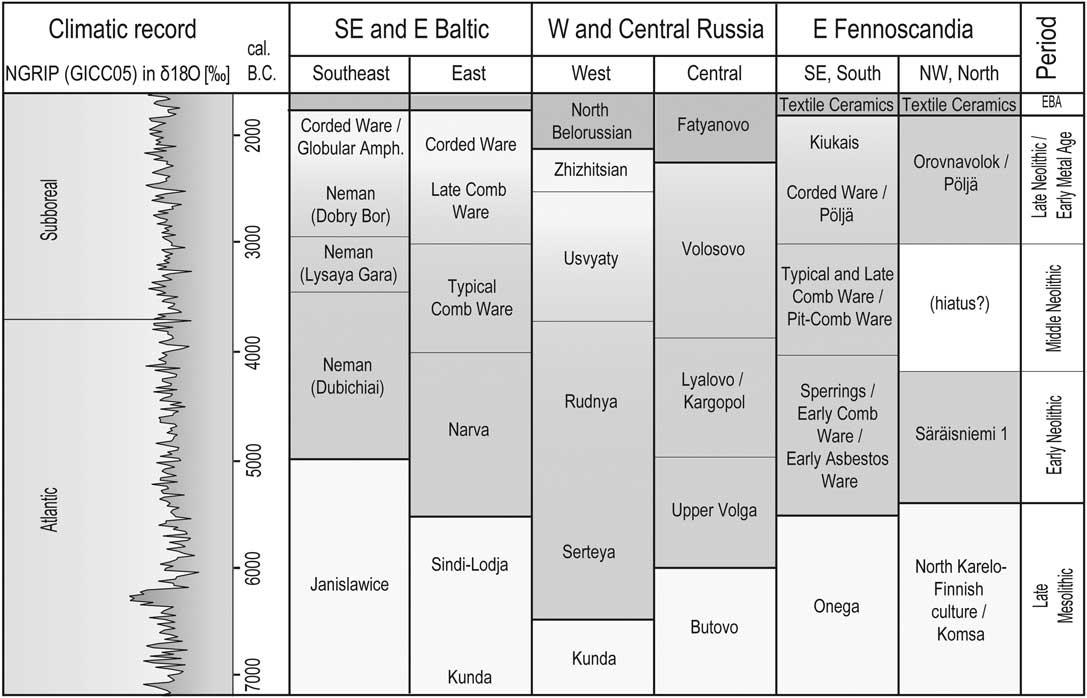
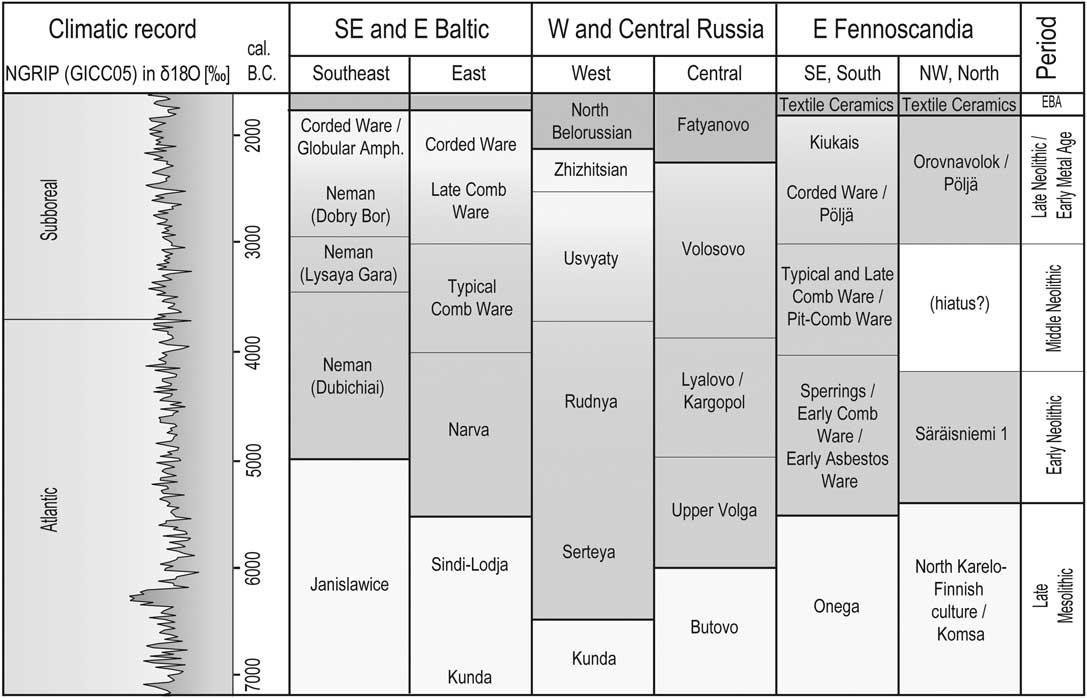
Stratigraphic observations and the typological evolution of pottery styles provide the main tools for building relative archaeological chronologies. On this basis, regional sequences of prehistoric cultural units have been worked out in more or less detail for various parts of northeastern Europe (for an overview see Piezonka Reference Piezonka2015) (Figure 1). Absolute chronologies, however, are still subject to debate due to a general lack of dependable dates and reliable contextual information. Therefore, one of the foremost tasks in current research is to build a reliable chronological framework for the emergence and further evolution of early ceramics and their cultural contexts. A second set of questions concerns the use of early pottery. Connected to this are more general questions of economic developments, and in particular the unsolved problem of when food production (animal husbandry and arable farming) was introduced in the various parts of the northeastern European forest zone.
Sequence of archaeological cultures in northeastern Europe from the Late Mesolithic to the Early Metal Age. The onset of the Early Neolithic is defined, according to the eastern scientific tradition, by the first appearance of pottery vessels in the archaeological record, initial evidence for domesticates is indicated by shading (illustration: H Piezonka).
Until relatively recently, the absolute chronology of the appearance, dispersal, and evolution of early pottery in this region was based on radiometric radiocarbon measurements, often with large uncertainties, from samples such as charcoal, wood, and organic sediment, found in questionable temporal association with the pottery concerned. Procedures have been developed to date carbon found in the pottery fabric itself, by dissolving the matrix and combusting the residue, with frequently plausible but not always convincing results (Zaitseva et al. Reference Zaitseva, Skripkin, Kovaliukh, Possnert, Dolukhanov and Vybornov2009). The results are often less precise than those from samples of wood and organic sediment, and more importantly, any organic carbon present would contribute to the 14C age, not only food residues, soot, or organic temper (Karmanov et al. Reference Karmanov, Zaretskaya and Volokitin2014:736).
Direct accelerator mass spectrometry (AMS) 14C dating of carbonized foodcrusts on pottery appears to solve many of the potential problems (Piezonka Reference Piezonka2008), but forces us to confront another: that carbon in freshwater food chains is often subject to large and variable reservoir effects, which may be expected to lead to freshwater reservoir effects (FRE) in some foodcrust dates. The issue cannot be ignored, as it is clear from archaeological evidence that fishing was an important part of the subsistence economy among the earliest pottery-using communities (see below), and FRE have been demonstrated in human remains in this region (e.g. Wood et al. Reference Wood, Higham, Buzilhova, Suvorov, Heinemeier and Olsen2013). If fish was cooked in pots, therefore, some 14C-depleted carbon is likely to have been incorporated in foodcrusts.
In order to obtain accurate absolute chronologies for early pottery from the 14C dating of carbonized food remains, we need to establish which 14C results are potentially subject to reservoir effects and to what extent. Various tools can address this question: (1) discrepancies between calibrated 14C ages and the relative chronology of the samples based on archaeological information (typology, stratigraphy) can suggest which samples, if any, have a higher risk of FRE; (2) paired samples of different materials can be dated (e.g. carbonized surface residue and terrestrial macroremains embedded in it); (3) the percentage of carbon in each sample derived from aquatic sources can be estimated from elemental analysis-isotope ratio mass spectrometry (EA-IRMS) results (%C, %N, δ13C, and δ15N), if these parameter values are sufficiently different in terrestrial and aquatic foods, and if charring and diagenesis do not mask these differences; (4) qualitative and semi-quantitative analytical techniques (microscopy and biomolecular analyses) may be used to attribute components of the foodcrust to terrestrial or aquatic sources.
In this paper, we focus on isotopic signals and elemental concentrations in 14C-dated foodcrusts from the stratified complexes of the northern Russian Stone Age sites of Veksa 3, Karavaikha 1 and 4, and Tudozero 5, and Estonian material from Kääpa. In addition, new isotopic results from the central Russian sites of Sakhtysh 2a and Ozerki 17 will be discussed against the background of the already published AMS dates of the same samples (see Hartz et al. Reference Hartz, Kostyleva, Piezonka, Terberger, Tsydenova and Zhilin2012).
MATERIALS AND METHODS
Stone Age Pottery from the Forest Zone of Northeastern Europe
Veksa 3, Russia
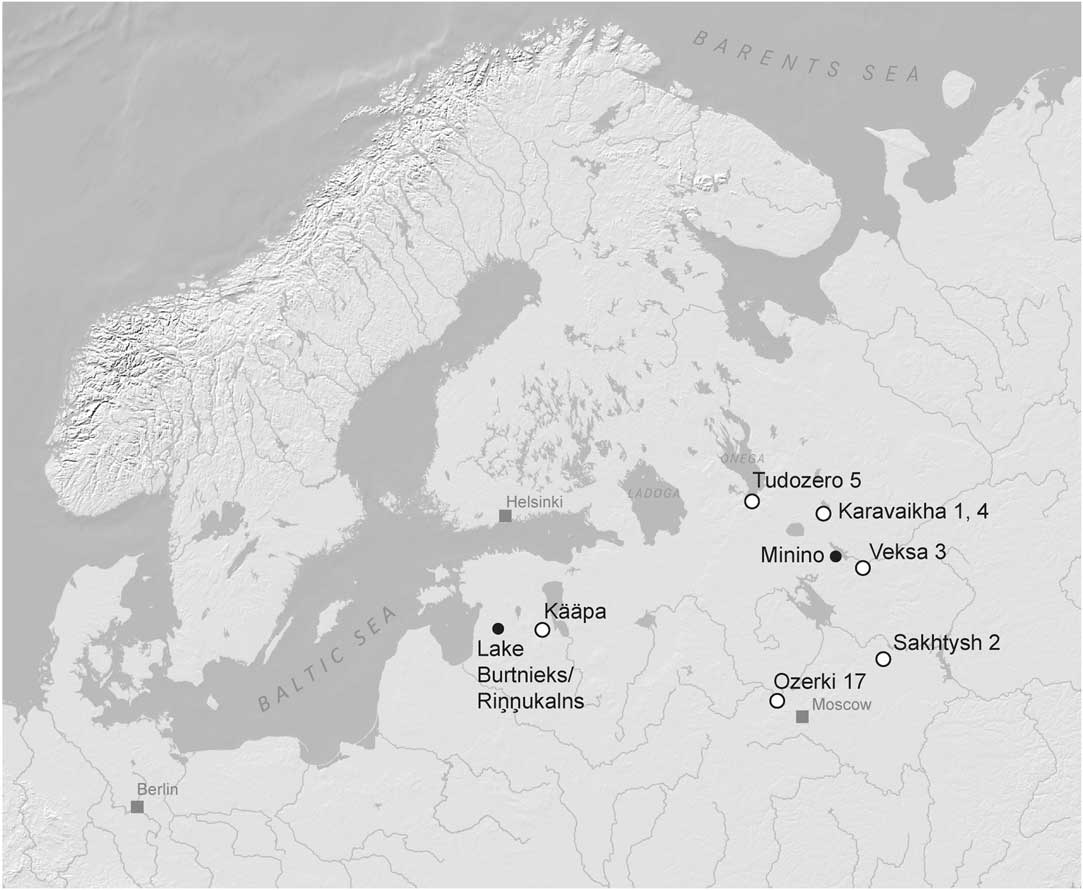
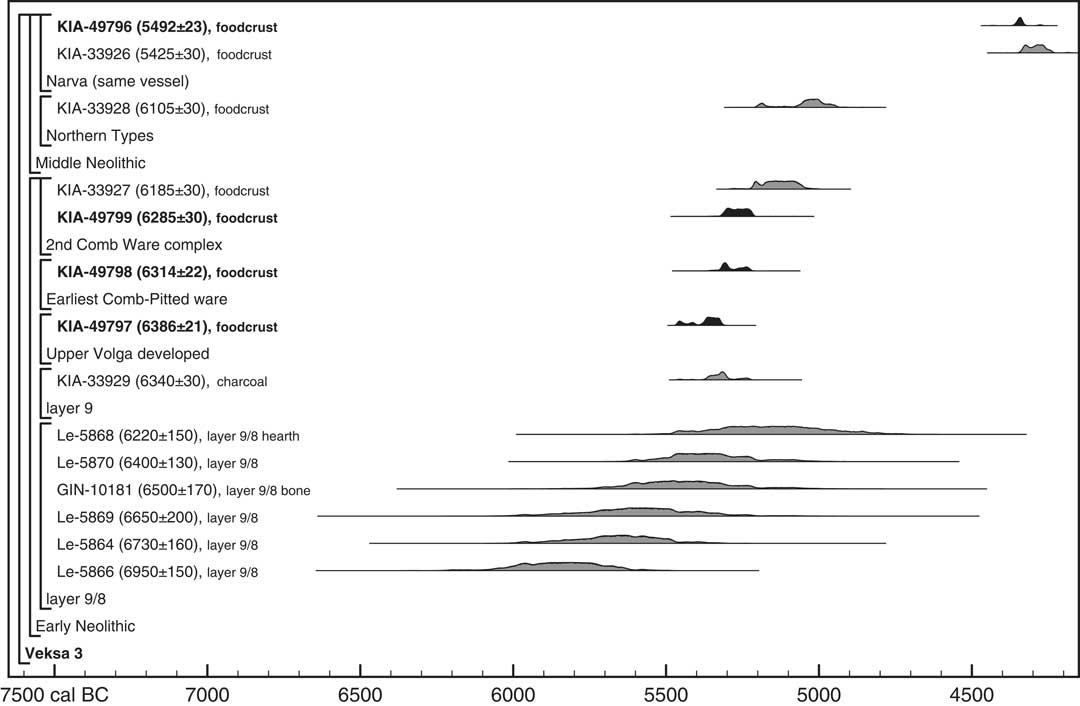
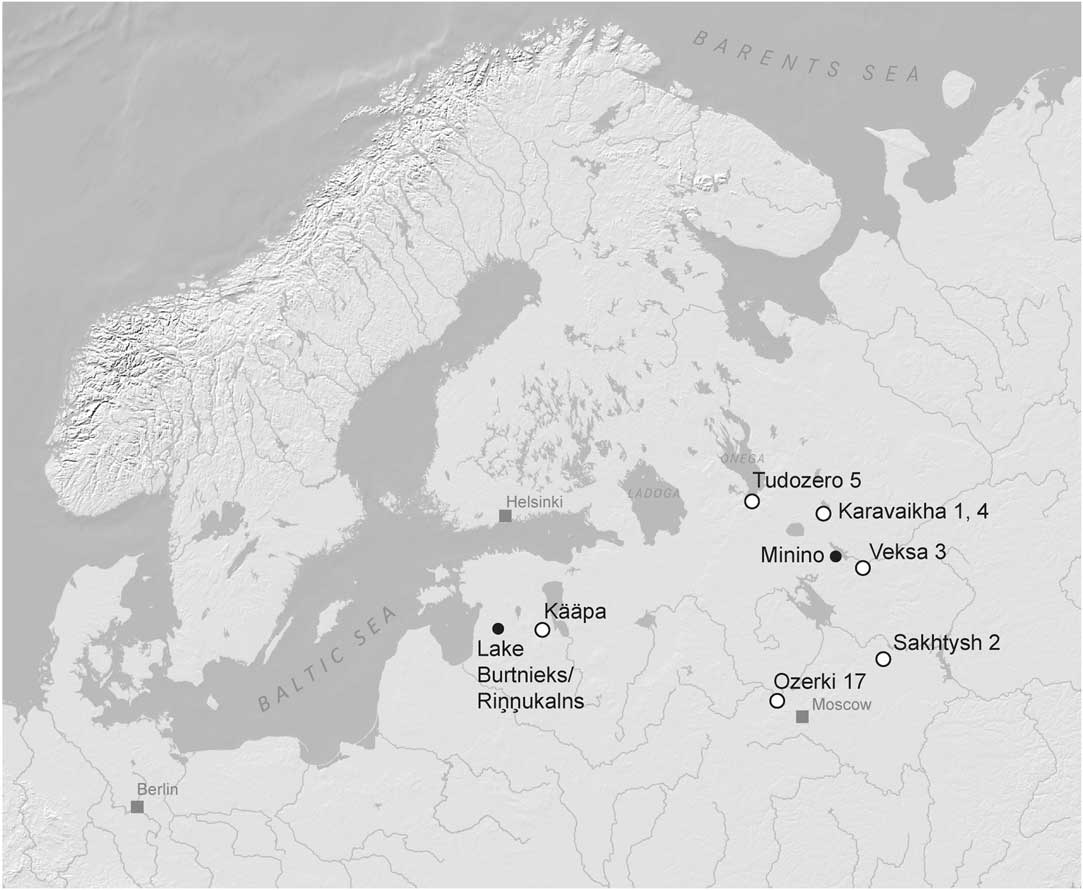
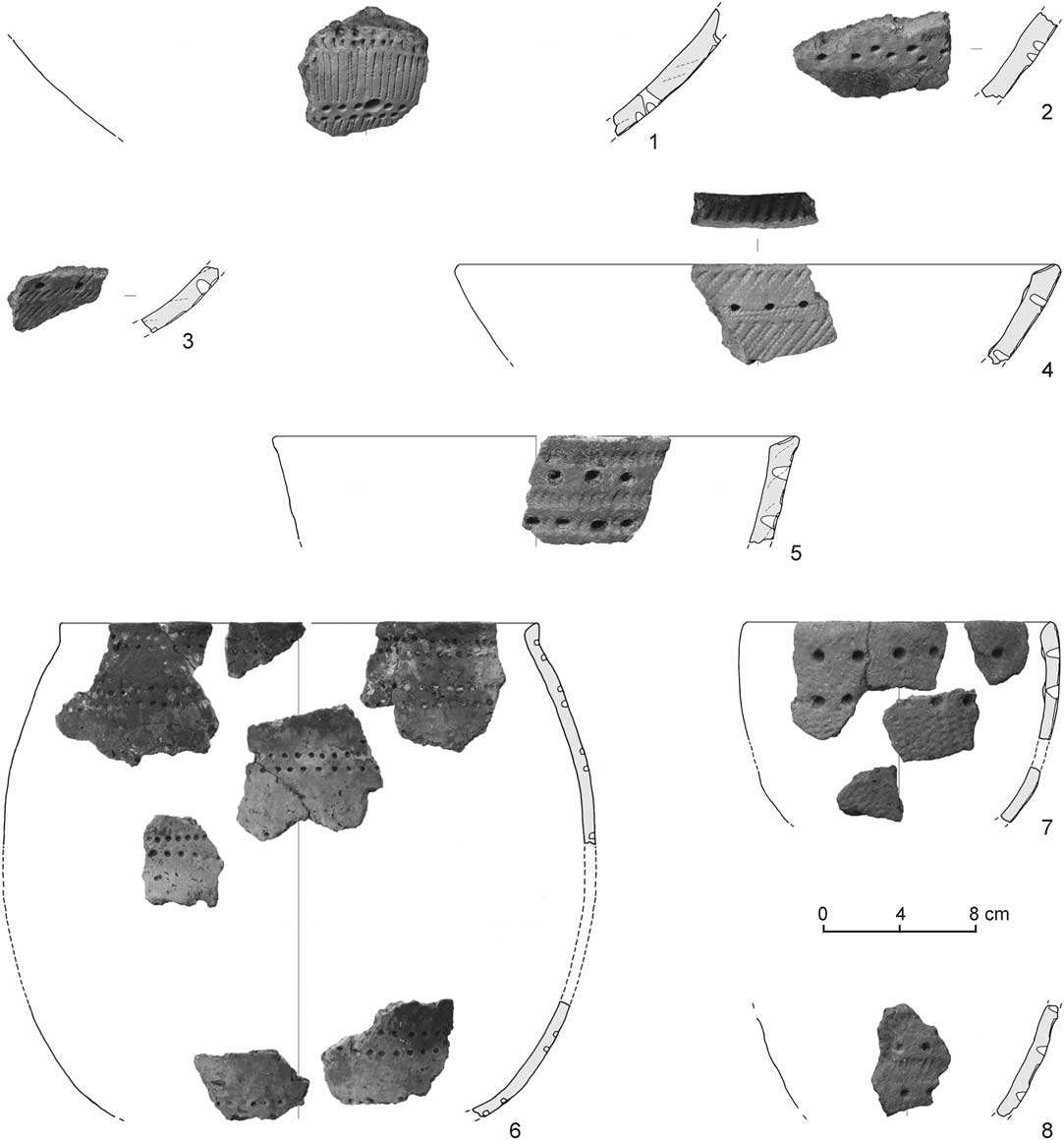
The pre- and early-historic settlement of Veksa 3 is a pivotal site with regard to the cultural development of northwestern European Russia. Located in the upper Sukhona basin, ~20 km east of the provincial capital of Vologda (Figure 2), the site extends along the left bank of River Vologda. The exceptional importance of Veksa 3 is due to the clearly stratified sequence of archaeological layers spanning 8 millennia (Nedomolkina Reference Nedomolkina2004; Lorenz et al. Reference Lorenz, Nedomolkina and Piezonka2012). Foodcrusts on eight Early and Middle Neolithic pottery vessels from the Veksa 3 section of the site have been sampled for the present paper (Table 1; Figures 2 and 3). Although most of these sherds are from surface collections, they can be associated with the respective stratigraphic units on the basis of their typology (Piezonka Reference Piezonka2015: Figure 41). Of the vessels investigated, two were 14C dated previously, and %C, %N, δ13C, and δ15N have now been measured in the dating extracts (KIA-33927; KIA-33928; Piezonka Reference Piezonka2008). Of one vessel of which the interior charred crust had been dated previously (KIA-33926; Piezonka Reference Piezonka2008), we have now dated the outer crust (KIA-49796), and obtained EA-IRMS results from both dating extracts. Three new sherds (KIA-49797, KIA-49798, KIA-49799; Piezonka Reference Piezonka2015) are dated here for the first time, and EA-IRMS results are reported for two further foodcrusts, which were unfortunately too small to date (KIA-49789, KIA-49790; Piezonka Reference Piezonka2015). Charcoal from a pit in layer 9, the lowest cultural horizon, was also dated, to provide a terminus post quem for the entire sequence (KIA-33929; Piezonka Reference Piezonka2008).
Sites in northeastern Europe with prehistoric ceramics from which organic residue on pottery was analyzed (white dots) and other sites mentioned in the text (black dots) (illustration: H Piezonka).
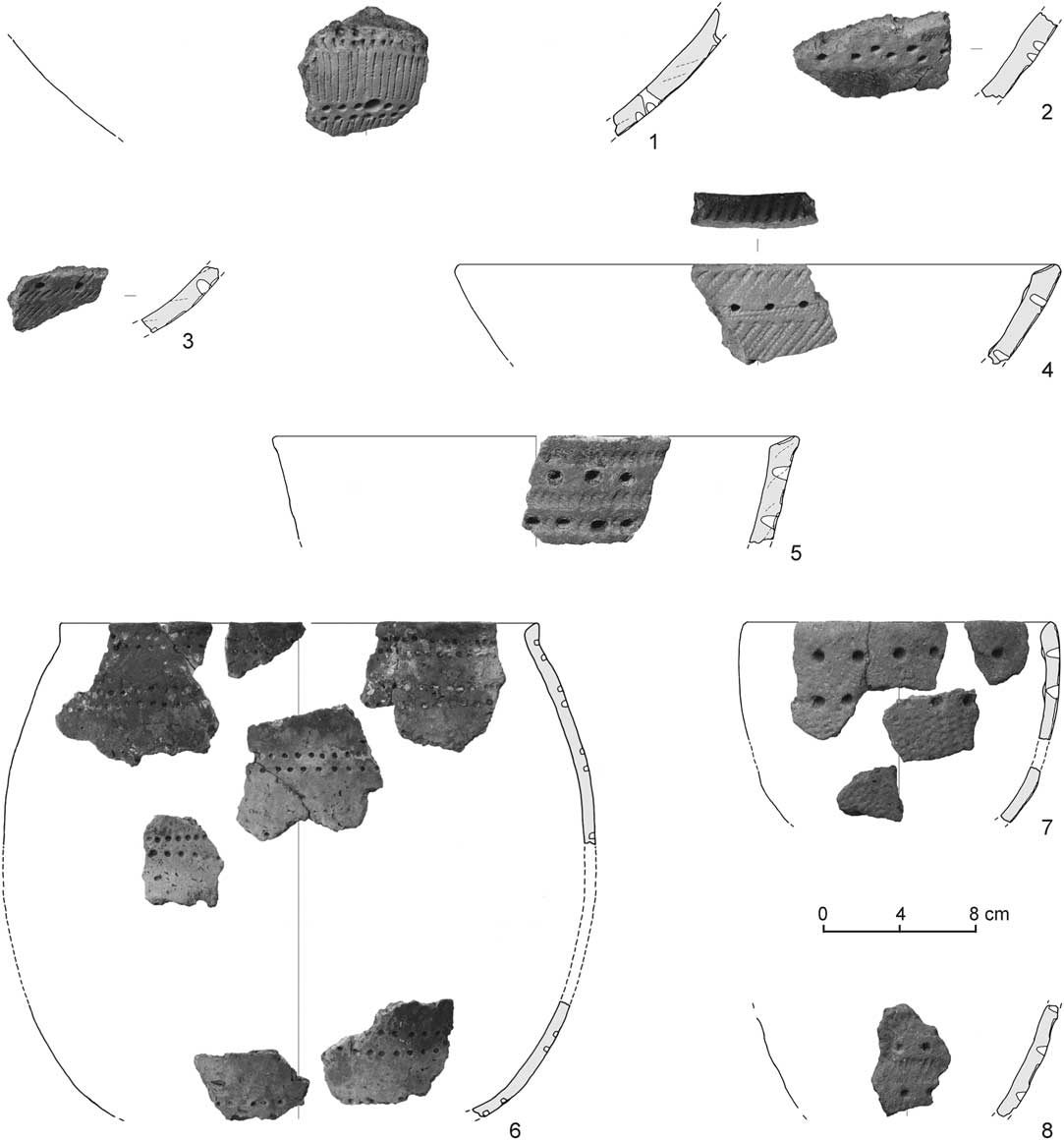
Veksa 3, Vologda province, Russia. Fragments of pottery from which organic residue samples were taken. 1 – sample KIA-49797, Upper Volga culture; 2 – sample KIA-49798, Earliest Comb-Pitted ware; 3 – sample KIA-49799, 2nd comb ceramic complex; 4 – sample KIA-33927, 2nd comb ceramic complex; 5 – sample KIA-33928, “Northern types”; 6 – samples KIA-33926 and KIA-49796, Narva; 7 – sample KIA-49790; 8 – sample KIA-49789, Comb-Pitted ware (illustration: H Piezonka).
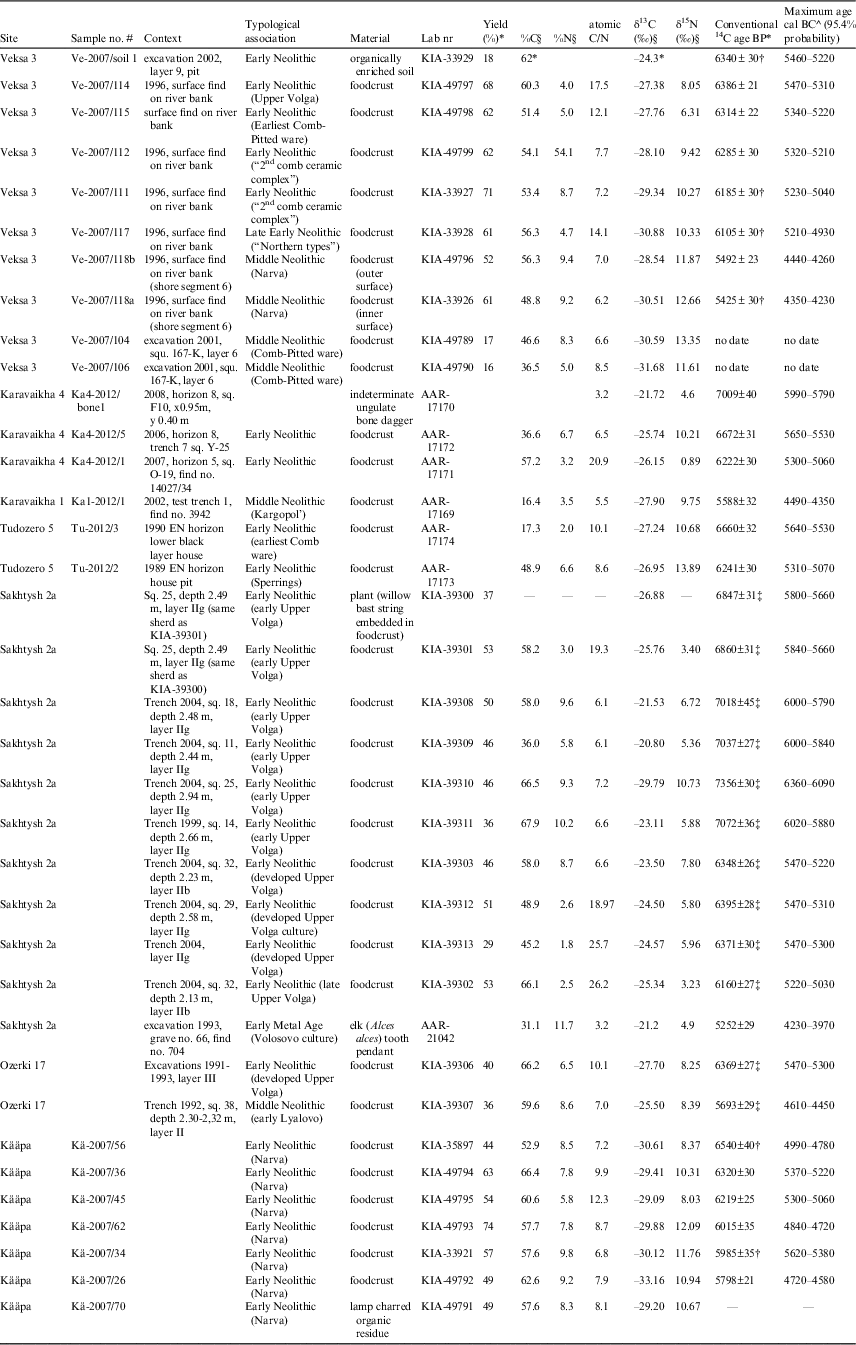
EA-IRMS and AMS results on organic material from Stone Age sites in northwest European Russia and Estonia. Previously unpublished data, except for † (14C age from Piezonka Reference Piezonka2008) and ‡ (14C age from Hartz et al. Reference Hartz, Kostyleva, Piezonka, Terberger, Tsydenova and Zhilin2012).

§ EA-IRMS measurements from the Natural History Museum, Berlin, Germany (Ozerki 17, Sakhtysh 2a), School of Life Sciences, University of Bradford, England (Kääpa, Veksa 3) and AMS 14C Dating Centre at Aarhus University, Denmark (Karavaikha, Tudozero).
* Measurements from the Leibniz Labor for AMS Dating and Stable Isotope Research, Christian Albrechts University, Kiel, Germany (KIA-) or the AMS 14C Dating Centre at Aarhus University, Denmark (AAR-).
^ The results have been calibrated using OxCal v 4.2.4 (Bronk Ramsey Reference Bronk Ramsey2009) and the IntCal13 (Reimer et al. Reference Reimer, Bard, Bayliss, Beck, Blackwell, Bronk Ramsey, Grootes, Guilderson, Haflidason, Hajdas, Hatté, Heaton, Hoffmann, Hogg, Hughen, Kaiser, Kromer, Manning, Niu, Reimer, Richards, Scott, Southon, Staff, Turney and van der Plicht2013) calibration data, with date ranges rounded outwards to the nearest 10 yr. The carbonized surface residue cannot be older than this date range. If the 14C age is subject to a freshwater reservoir effect, the true date of the carbonized surface residue could be significantly more recent.
# Sherd numbers for Veksa 3 and Kääpa in Table 1 follow those used in Piezonka (Reference Piezonka2015); there are some differences between this publication and Piezonka (Reference Piezonka2008), in which some of the 14C results discussed here were originally presented.
Karavaikha 1 and 4, Russia
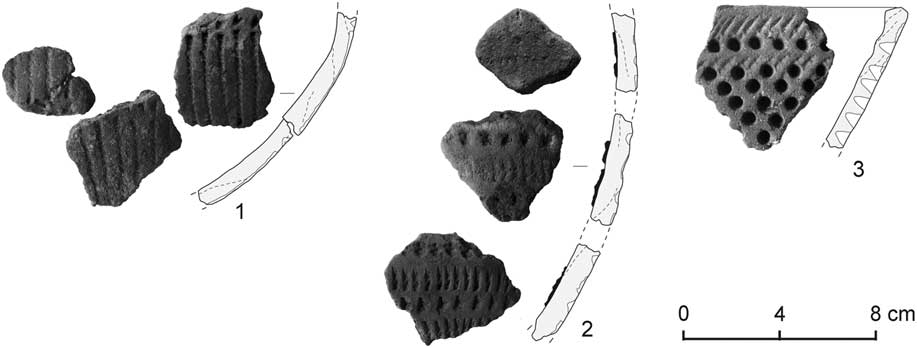
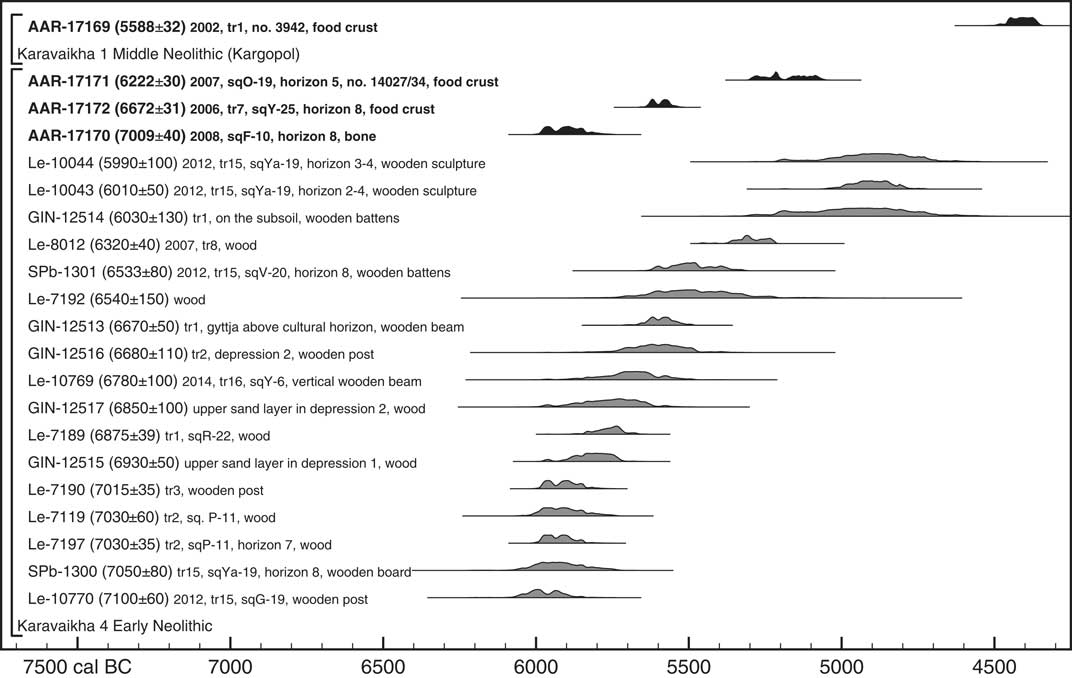
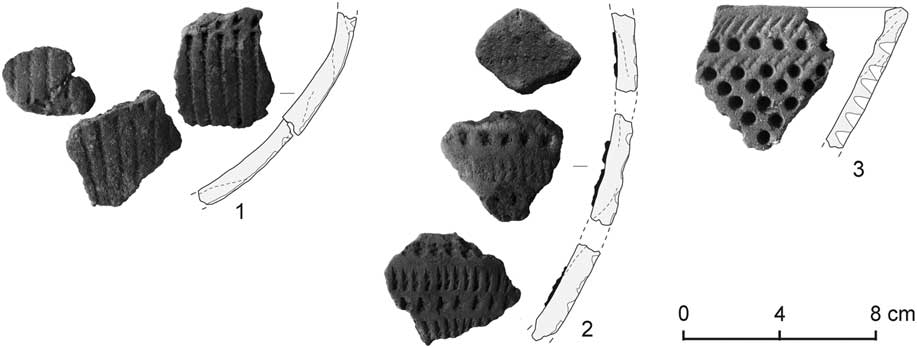
The archaeological complex of Karavaikha is situated in the north of Vologda province on the banks of the River Eloma, a few kilometers upstream from its mouth at Lake Vozhe (Figure 2). At Karavaikha 4, excavations have revealed a lower cultural horizon with well-preserved wooden constructions probably connected to fishing activities; associated finds include a small number of pot sherds (Kosorukova Reference Kosorukova2007; Kiryanova and Kosorukova Reference Kiryanova and Kosorukova2013). Although this lower cultural horizon has been regarded as a closed context, stemming from a confined episode of human activity in the Early Neolithic, conventional 14C dates on samples attributed to this layer span a long period from the beginning of the 6th to the first third of the 5th millennium cal BC. Foodcrusts of two vessels were investigated for the present study, among them one vessel resembling comb-decorated ware of the middle Upper Volga culture (AAR-17172) and one typologically less specific vessel, decorated with various imprints of natural materials (AAR-17171). In addition, one animal bone from this complex was dated (AAR-17170) (Table 1, Figure 4). A second cultural horizon is thought to belong to a later phase of the Stone Age; two conventional 14C dates cover the end of the 6th and the beginning of the 5th millennium cal BC. At Karavaikha 1, on the opposite bank of the river, a Neolithic–Early Metal Age cemetery and settlement remains from various periods have been excavated (Utkin and Kostyleva Reference Utkin and Kostyleva2001). Recent test trenches at this site have yielded settlement evidence of the Middle Neolithic Kargopol culture. Charred residue from a Kargopol potsherd was dated and analyzed (AAR-17169; Table 1).
Karavaikha, Vologda province, Russia. Fragments of pottery from which organic residue samples were taken. 1 – Karavaikha 4, sample AAR-17172, Early Neolithic ware; 2 – Karavaikha 4, sample AAR-17171, Early Neolithic ware; 3 – Karavaikha 1, sample AAR-17169, Kargopol’ (illustration: H Piezonka).
Tudozero 5, Russia
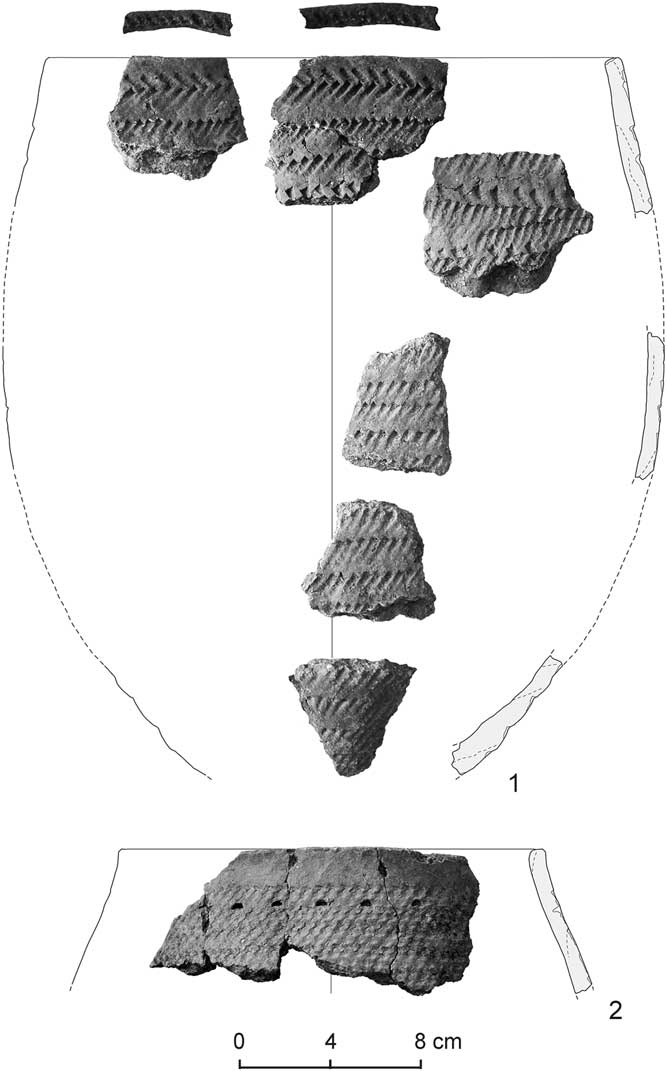
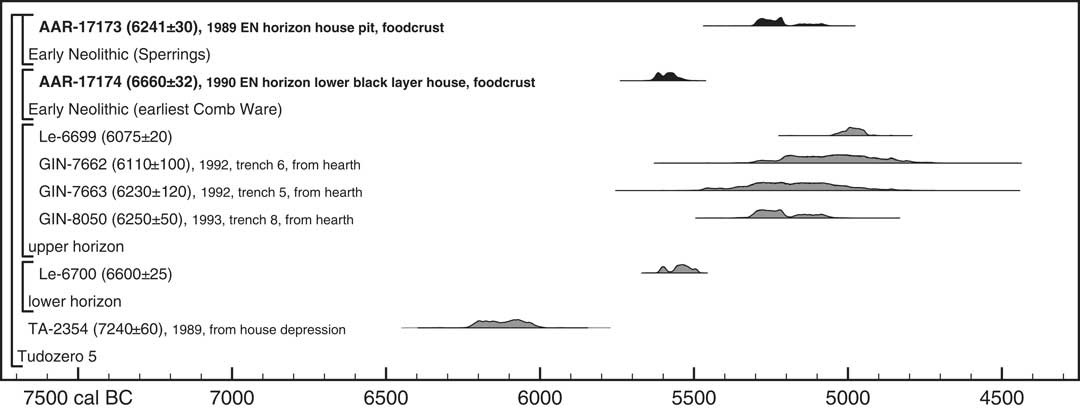
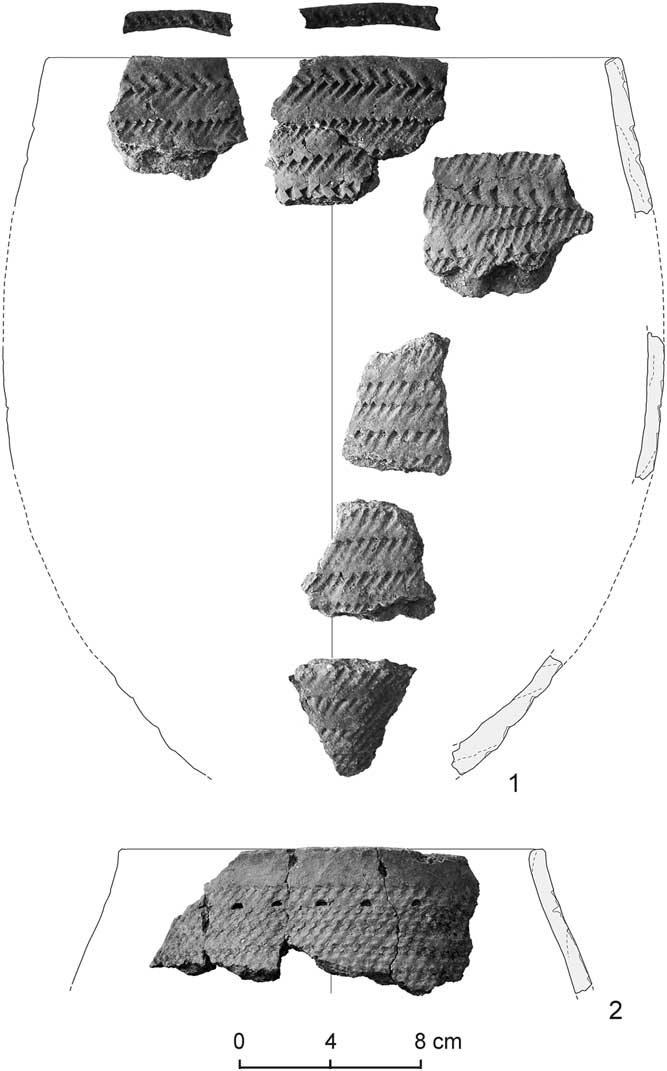
Tudozero 5 is located at the southeastern bank of Lake Onega in the north of Vologda province (Figure 2). The stratified archaeological remains encompass evidence from the Mesolithic through to Medieval times. With regards to the introduction and development of Early Neolithic pottery in this region, the stratigraphic separation by a sterile layer of the earliest, comb-decorated ware from an overlying layer with pottery resembling the Sperrings ware of Russian Karelia (Ivanishchev and Ivanishcheva Reference Ivanishchev and Ivanishcheva2000; Ivanishcheva et al. Reference Ivanishcheva, Kulkova and Sapelko2015) is especially important. Conventional 14C dates from the associated cultural layers suggest a chronological position of the early Comb Ware complex in the second quarter of the 6th millennium cal BC and a time bracket for the Sperrings complex in the last quarter of the 6th and the beginning of the 5th millennium cal BC.Footnote 1 In this paper, AMS dating results and %C, %N, δ13C, and δ15N values are reported for foodcrust samples of a Comb Ware vessel from the lower layer (AAR-17174) and of a Sperrings vessel from the upper Early Neolithic layer (AAR-17173) (Table 1, Figure 5).
Tudozero 5, Vologda province, Russia. Fragments of pottery from which organic residue samples were taken. 1 – sample AAR-17174, Earliest Comb ware; 2 – sample AAR-17173, Sperrings (illustration: H Piezonka).
Sakhtysh 2a and Ozerki 17, Russia
Sakhtysh 2a and Ozerki 17 are among the well-investigated stratified peat-bog sites in the Upper Volga region (Figure 2). Their archaeological sequences start in the Mesolithic and cover several prehistoric periods. In a previous study, nine samples of organic residue adhering to Early Neolithic Upper Volga culture pottery from Sakhtysh 2a were AMS dated; from Ozerki 17, foodcrusts from one Upper Volga culture sherd and one Middle Neolithic Lyalovo culture sherd were dated (Hartz et al. Reference Hartz, Kostyleva, Piezonka, Terberger, Tsydenova and Zhilin2012). Here, we report the results of the %C, %N, δ13C, and δ15N values measured in the dated samples (Table 1).
Kääpa, Estonia
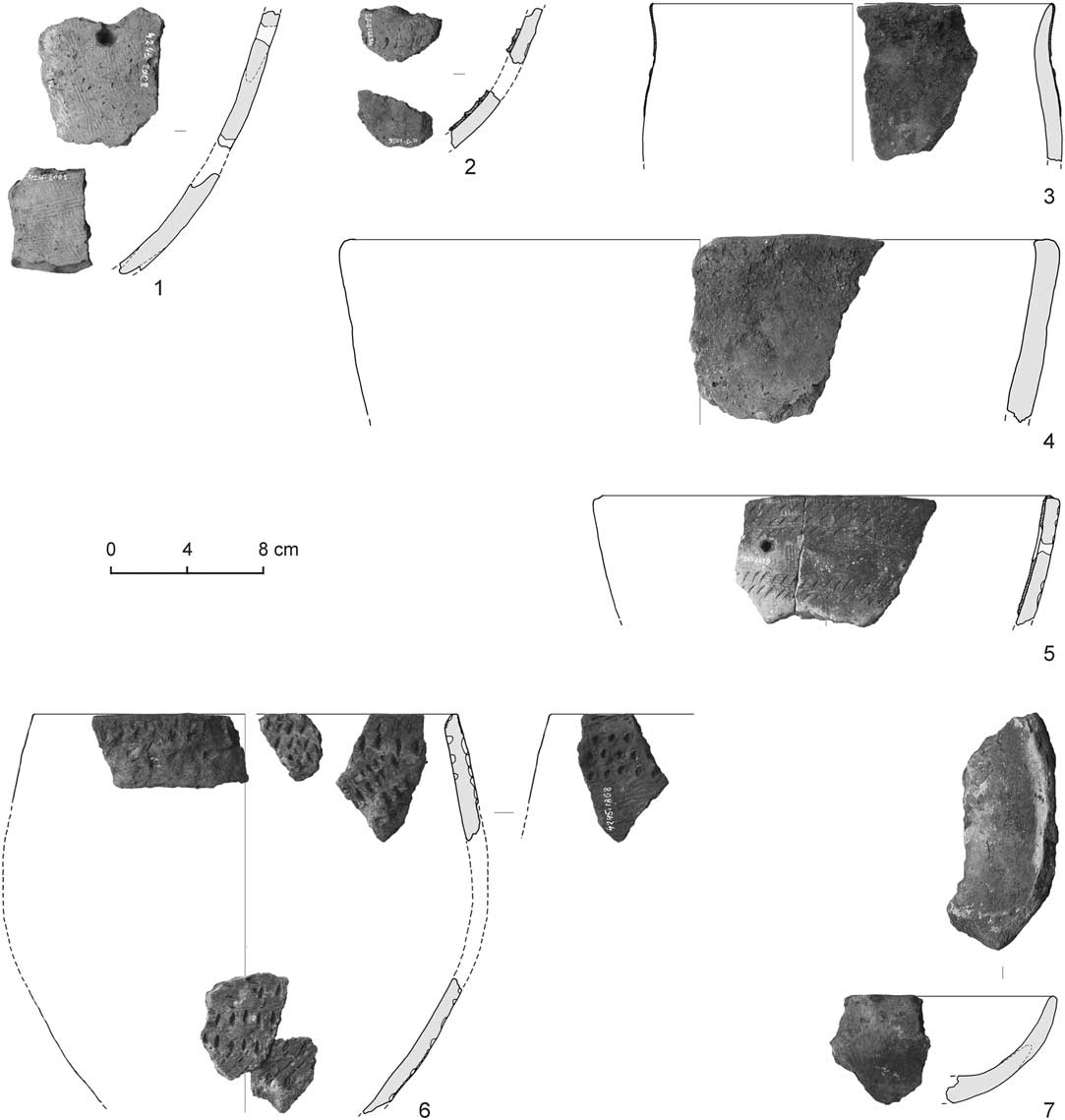
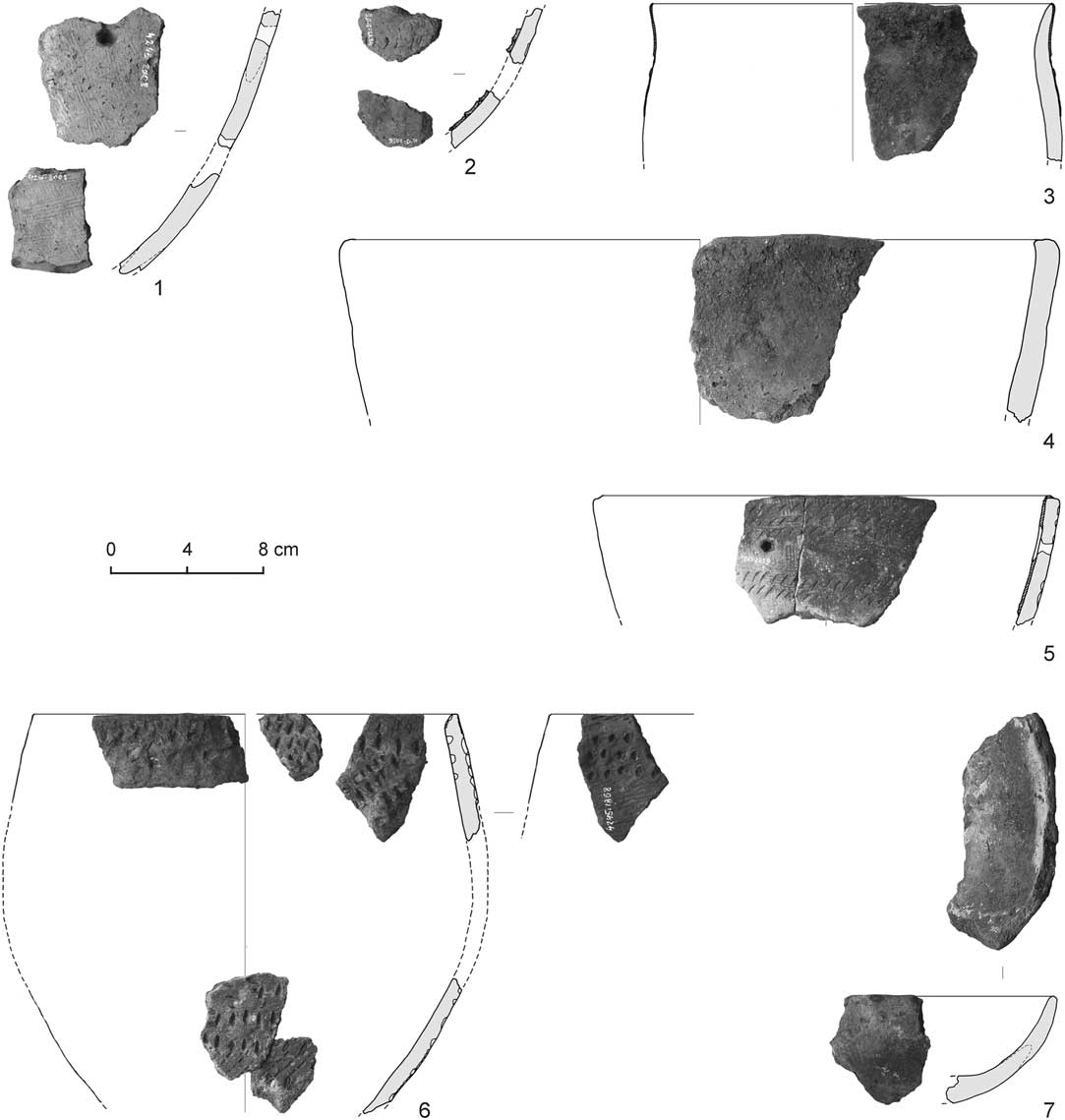
The Stone Age settlement of Kääpa on the left bank of River Võhandu in southeastern Estonia (Figure 2) has yielded abundant archaeological finds including thousands of fragments of Early Neolithic Narva pottery (Jaanits Reference Jaanits1968; Yanits Reference Yanits1976). The Early Neolithic complex is associated with a cultural horizon between the mineral subsoil and an overlying peaty layer, while later material of the Middle Neolithic Typical Comb Ware culture has been found at higher levels within the peat. Previous 14C dates from Kääpa (Liiva et al. Reference Liiva, Ilves and Punning1966) probably relate to the Typical Comb Ware phase, with the exception of one wild horse tooth dated to 4790–4550 cal BC (KIA-35737, 5820±45 BP; Sommer et al. Reference Sommer, Benecke, Lõugas, Nelle and Schmölcke2011). Of seven Narva vessels investigated here, two were dated previously and %C, %N, δ13C, and δ15N have now been measured in the excess dating extracts (KIA-33921, KIA-35897; Piezonka Reference Piezonka2008). Four sherds are dated here for the first time (KIA-49792, KIA-49793, KIA-49794, KIA-49795; Piezonka Reference Piezonka2015), and EA-IRMS results are reported for one further sample of charred residue from a Narva lamp that was too small to date (Kä-2007/70; Piezonka Reference Piezonka2015) (Table 1, Figure 6).
Kääpa, Estonia. Fragments of Narva pottery from which organic residue samples were taken. 1 – sample KIA-35897; 2 – KIA-49794; 3 – sample KIA-49795; 4 – sample KIA-49793; 5 – sample KIA-33921; 6 – sample KIA-49792; 7 – sample KIA-49791 (illustration: H Piezonka).
Radiocarbon Dating and Isotopic Analysis (AMS and EA-IRMS)
The samples listed in Table 1 were submitted for AMS 14C dating to the Leibniz Laboratory for Radiometric Dating and Stable Isotope Research, Christian Albrechts University Kiel, Germany, in 2007 and 2013 (Ozerki 17, Sakhtysh 2a, Veksa 3, Kääpa), or to the AMS 14C Dating Centre at Aarhus University, Denmark, in 2013 (Tudozero 5, Karavaikha 1, 4). One sample (KIA-33929) consisted of sediment from a pit, containing bone (including small fragments of fish bone), burnt bone, and charcoal fragments; part of the charcoal was selected for dating. Aside from AAR-17170 (bone dagger), AAR-21042 (perforated elk tooth), and KIA-39300 (plant fiber), the other samples discussed here were all identified as carbonized surface residues adhering to the inner or outer surfaces of typologically diagnostic pottery (see Table 1 for details), and ~50 mg of material was selected. Carbonized surface residues from the inner and outer surfaces of one vessel were sampled separately (KIA-33926 and KIA-49796).
The Sakhtysh 2a and Ozerki 17 samples were initially treated with a sequence of solvents (Bruhn et al. Reference Bruhn, Duhr, Grootes, Mintrop and Nadeau2001) to remove lipids. The subsequent chemical pretreatment for all samples, in both Kiel and Aarhus, was the conventional acid-base-acid (ABA) treatment (1% or 1M HCl at 60°C or 80°C for an hour, 1% or 0.5M NaOH at 60°C or 80°C for an hour, and again 1% or 1M HCl at room temperature overnight), in order to remove secondary carbonate and mobile organic components. The insoluble residue was then dried and weighed (Table 1; “yield” is expressed as a percentage of the starting weight of pretreated material). Of samples processed in Kiel, most produced extracts above 60% of the starting weight, but the charcoal sample KIA-33929 and foodcrust samples KIA-49789 and KIA-49790 gave poor yields (16–18%). There was insufficient extract from these samples for both stable isotope and AMS analysis.
We intentionally analyzed by EA-IRMS aliquots of the same chemical fraction of each foodcrust used for 14C dating, in order to be able to comment on the likely origin of the carbon in the AMS targets. Samples from Veksa 3 and Kääpa were measured at the School of Life Sciences, University of Bradford, in duplicate on a Thermo Flash 1112 elemental analyzer coupled to a Thermo Delta plus XL mass spectrometer, to measure %C and %N contents, and 13C/12C and 15N/14N ratios (δ13C and δ15N). Samples from Ozerki 17 and Sakhtysh 2a were measured at the Berlin Natural History Museum, using a Thermo/Finnigan MAT V isotope ratio mass spectrometer, coupled to a Thermo Flash EA 1112 elemental analyzer. Samples from Karavaikha 1 and 4 and Tudozero 5 were analyzed at the AMS 14C Dating Centre at Aarhus University, by combustion in a EuroVector elemental analyzer coupled to an IsoPrime stable isotope ratio mass spectrometer. Typical measurement errors of better than ±0.2‰ are quoted for δ13C and δ15N in samples and standards. Atomic C/N ratios were calculated from the elemental concentrations (Table 1).
RESULTS AND DISCUSSION
Vessel Use or Dietary Changes: Implications from EA-IRMS Results
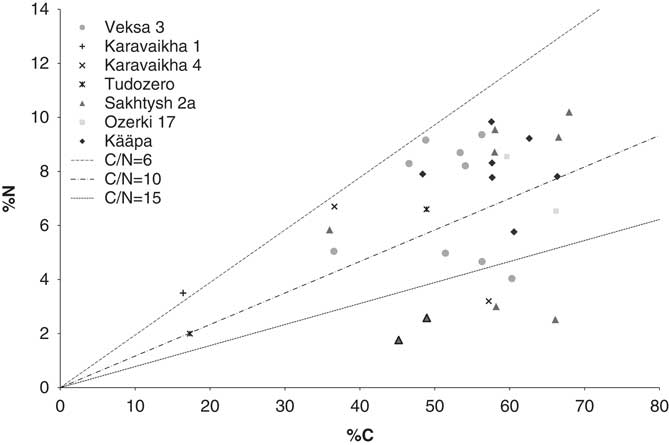
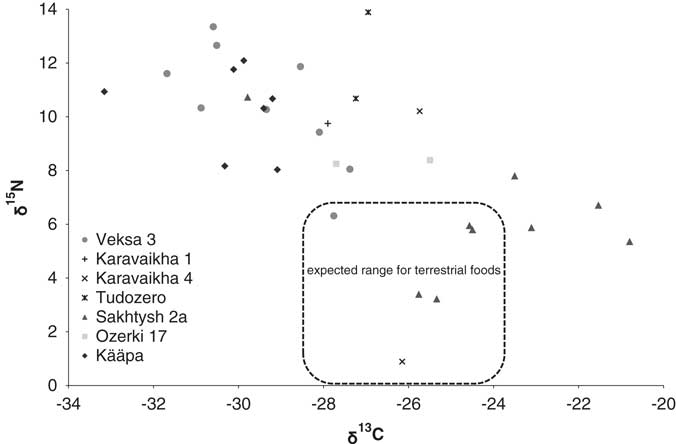
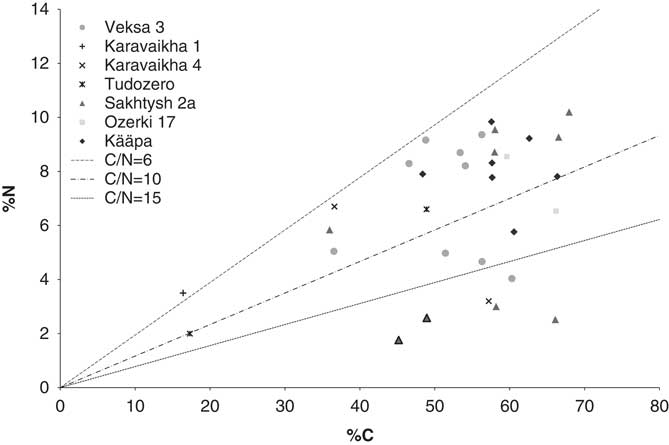
Figure 7 shows the elemental concentrations in foodcrust extracts. The high %N values, and correspondingly low C/N values in most foodcrusts, are typical of extracted foodcrusts from hunter-gatherer-fisher pottery in the Baltic region (Philippsen Reference Philippsen2013a; Philippsen and Meadows Reference Philippsen and Meadows2014; J Meadows, unpublished data). Figure 8 shows the foodcrust stable isotope ratios. The lowest δ13C values are associated with the highest δ15N values and low C/N ratios, and the lowest δ15N values with moderate δ13C values and the highest C/N ratios. A small group of samples from Sakhtysh 2a has low C/N ratios, moderate δ15N values, and the highest δ13C values.
Elemental concentrations (by % weight). With the exception of the two outlined triangles (KIA-39311-39312: acid-insoluble, alkali-soluble residues), all foodcrust extracts analyzed were acid- and alkali-insoluble residues. The dashed lines represent atomic C/N ratios; most samples fall between C/N=6 and C/N=10, regardless of differences in %C and %N (graph: J Meadows).
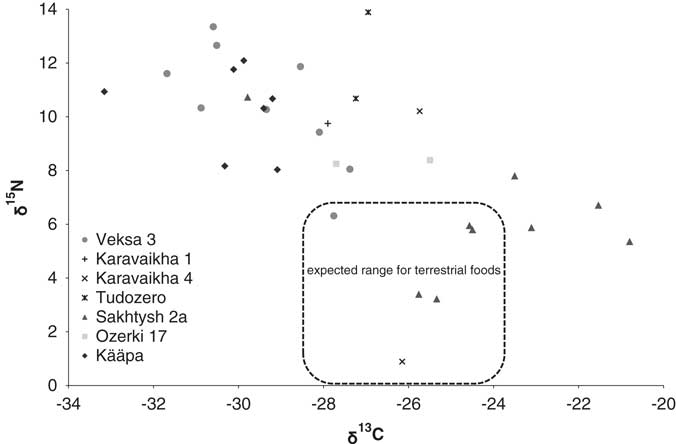
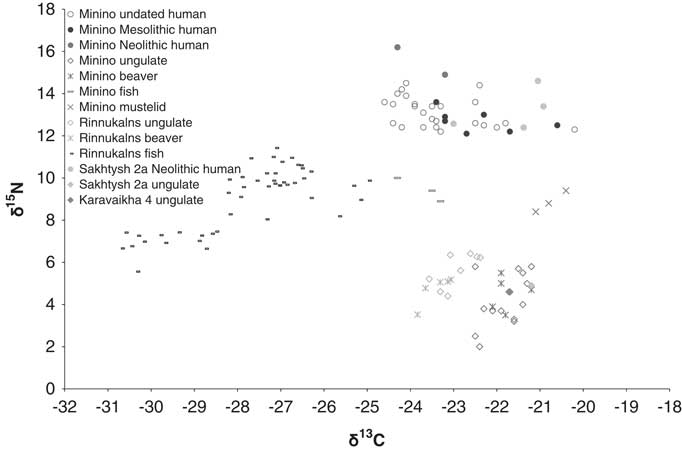
Stable isotope values in prehistoric fauna and flora from the Vologda region where Veksa 3 is located are unknown, but we can infer from collagen δ13C and δ15N values in animal bones from the prehistoric burial ground at Minino, on Lake Kubena (Wood et al. Reference Wood, Higham, Buzilhova, Suvorov, Heinemeier and Olsen2013), ~50 km northwest of Veksa 3, that δ13C values in plants and meat from terrestrial herbivores were quite restricted, as we would expect, given that native vegetation uses only the C3 photosynthetic pathway (Figure 9). An elk tooth from an Early Metal Age burial at Sakhtysh 2a backs up this picture (Piezonka et al. Reference Piezonka, Kostyleva, Zhilin, Dobrovolskaya and Terberger2013) (Table 1). Equally, there is no reason to suspect that the conventional model of δ15N enrichment according to trophic level is invalid in this region, although, due to the northern climate, the baseline soil δ15N may perhaps be lower than in central and southern Europe (Amundson et al. Reference Amundson, Austin, Schuur, Yoo, Matzek, Kendall, Uebersax, Brenner and Baisden2003). Three fish bones and one aquatic bird bone from Minino indicate that freshwater resources were relatively depleted in δ13C and enriched in δ15N, but it is particularly the range of human bone δ13C and δ15N values that shows that most fish in this catchment must have had much lower δ13C and much higher δ15N values than terrestrial foodstuffs. The pattern is similar (for example) to that seen at Riņņukalns in the Lake Burtnieks region of Latvia, where we have much more isotope data for fish (Figure 9). Although the Minino material covers a wide date range, the two human individuals directly dated to the Early Neolithic period (M1 4 and 13) have among the lowest δ13C and the highest δ15N values, confirming that the isotopic differences between aquatic and terrestrial species apply during the period of interest at Veksa 3. Two Middle Neolithic and two Early Metal Age human individuals from Sakhtysh 2a in the Upper Volga region have produced comparable isotopic values, which are seen as indicating a diet rich in aquatic resources (Figure 9; Piezonka et al. Reference Piezonka, Kostyleva, Zhilin, Dobrovolskaya and Terberger2013).
Collagen stable isotope results from early- to mid-Holocene fauna and human remains from Minino, Vologda province, Russia (Wood et al. Reference Wood, Higham, Buzilhova, Suvorov, Heinemeier and Olsen2013); Karavaikha 4, Vologda province, Russia (this paper); Sakhtysh 2a, Ivanovo province, Russia (Piezonka et al. Reference Piezonka, Kostyleva, Zhilin, Dobrovolskaya and Terberger2013 and this paper); and fauna from Riņņukalns, Latvia (Bērziņš et al. Reference Bērziņš, Brinker, Klein, Lübke, Meadows, Rudzīte, Schmölcke, Stümpel and Zagorska2014; Meadows et al. Reference Meadows, Bērziņš, Lübke, Schmölcke, Zagorska and Zariņa2016; Schmölcke et al. Reference Schmölcke, Meadows, Ritchie, Bērziņš, Lübke and Zagorska2016) (graph: J Meadows).
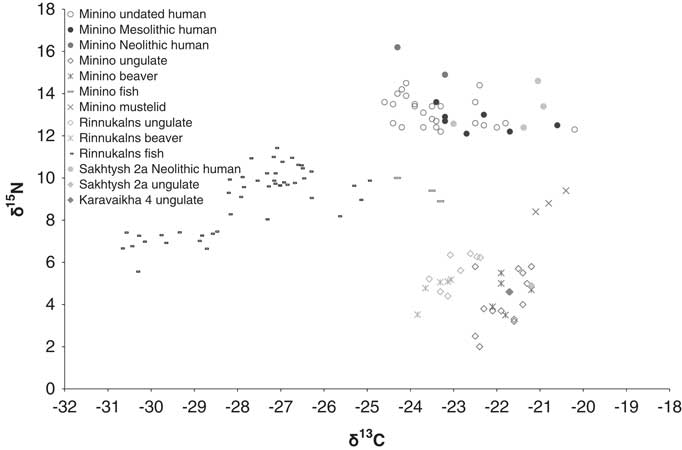
Foodstuffs consist mainly of carbohydrates, fats, proteins, and (in the case of plants) fiber. Fats and carbohydrates are nitrogen-free, and only protein is nitrogen-rich. Thus, a food with high fat or carbohydrate content should have a higher C/N value than one that is rich in protein. In theory, foodcrust δ15N values will be determined by the ingredients with the highest protein contents, but δ13C values (and 14C ages) may also reflect the carbon content of sugary, starchy, or fatty ingredients, which may not be from the same organisms as proteins. Even within a single organism, lipids have significantly lower δ13C values than proteins. However, low C/N values (Figure 7) suggest that high-protein ingredients predominated in most of our foodcrusts, and we may therefore use δ15N and δ13C values in herbivore collagen (Figure 9) to estimate the relevant isotopic range for terrestrial foods (Figure 8).Footnote 2 An important distinction between interpreting stable isotope data from foodcrusts and from human bones is that whereas the average isotope values of different food groups are relevant to human bone collagen, the range of values is more pertinent to foodcrusts. Such variability may reflect not only the complexity of food webs but also factors such as seasonality (which may affect e.g. fat content), the number of cooking events incorporated in individual crusts, etc.
A further complication in the interpretation of the stable isotope data from bulk foodcrusts is that some fractionation is possible, both during cooking and charring, and perhaps during burial. Experimental work with fish (Fernandes et al. Reference Fernandes, Meadows, Dreves, Nadeau and Grootes2014), cereals (e.g. Fraser et al. Reference Fraser, Bogaard, Charles, Styring, Wallace, Jones, Ditchfield and Heaton2013), and artificial foodcrust (Philippsen Reference Philippsen2013b) does not suggest large isotopic shifts during cooking and charring, but there are few data for diagenesis (Heron and Craig Reference Heron and Craig2015). When comparing samples from the same burial environment, we may argue that it is unlikely that differences in diagenesis would create coherent patterns in the stable isotope results, although we should be wary of overinterpreting the results from individual samples. More specific information on food and non-food products in pottery vessels can be provided by biomolecular analysis of foodcrusts and/or organic residues within the pottery matrix, when preservation conditions favor the survival of characteristic molecules known as biomarkers. Gas chromatography (GC), gas chromatography mass spectrometry (GCMS), and/or gas chromatography-combustion-isotope ratio mass spectrometry (GC-C-IRMS) allow lipids in particular to be attributed to oils, waxes, and fats from terrestrial plants, terrestrial animals, marine mammals, and fish (Craig et al. Reference Craig, Forster, Andersen, Koch, Crombé, Milner, Stern, Bailey and Heron2007, Reference Craig, Steele, Fischer, Hartz, Andersen, Donohoe, Glykou, Saula, Jones, Koch and Heron2011; Evershed Reference Evershed2008; Heron and Craig Reference Heron and Craig2015). These techniques, however, do not quantify the contribution of the specific constituents to the overall carbon content.Footnote 3
Notwithstanding the aforementioned qualifications, stable isotope values from almost all the Kääpa, Veksa 3, Ozerki, Karavaikha, and Tudozero foodcrusts (Table 1, Figure 8) are more consistent with freshwater species than with the meat of terrestrial herbivores, as δ13C values are depleted while δ15N values are enriched. The same pattern in foodcrusts on Ertebølle pottery from inland sites in Schleswig-Holstein is associated with what appear to be large FREs (Philippsen and Meadows Reference Philippsen and Meadows2014), and it is therefore sensible to regard the calibrated foodcrust dates reported in Table 1 as termini post quos for the dates of the pots.
The Sakhtysh 2a results do not fit the general pattern, as only one sample (KIA-39310) is depleted in δ13C and enriched in δ15N, but this is the same sample that Hartz et al. (Reference Hartz, Kostyleva, Piezonka, Terberger, Tsydenova and Zhilin2012) identified as having an unacceptably high 14C age, and thus (most probably) a significant FRE. The only foodcrust 14C age that we can confidently say is not subject to a significant FRE is KIA-39301 (also from Sakhtysh 2a), as it is consistent with KIA-39300, the 14C age of a willow string embedded in the foodcrust of the same pot (Figure 10). The EA-IRMS results from KIA-39301 (Table 1) are entirely consistent with this outcome: the low δ15N and moderate δ13C place this sample within the expected range for terrestrial foods (Figure 8), and the high C/N value suggests that plant ingredients may have been important (Yoshida et al. Reference Yoshida, Kunikita, Miyazaki, Nishida, Miyao and Matsuzaki2013). Three Sakhtysh 2a samples (KIA-39308, -39309, and -39311) are unusual in the overall scheme, having relatively enriched δ13C, moderate δ15N, and low C/N values. Their 14C ages are the earliest for Upper Volga pottery deemed acceptable by Hartz et al. (Reference Hartz, Kostyleva, Piezonka, Terberger, Tsydenova and Zhilin2012).
Calibration of 14C results (reported in Table 1) using OxCal v 4.2.4 (Bronk Ramsey Reference Bronk Ramsey2009) and the IntCal13 data (Reimer et al. Reference Reimer, Bard, Bayliss, Beck, Blackwell, Bronk Ramsey, Grootes, Guilderson, Haflidason, Hajdas, Hatté, Heaton, Hoffmann, Hogg, Hughen, Kaiser, Kromer, Manning, Niu, Reimer, Richards, Scott, Southon, Staff, Turney and van der Plicht2013) (graph: J Meadows).

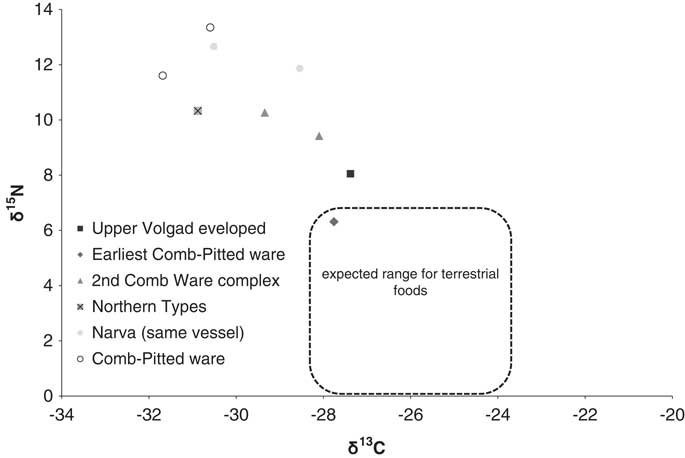
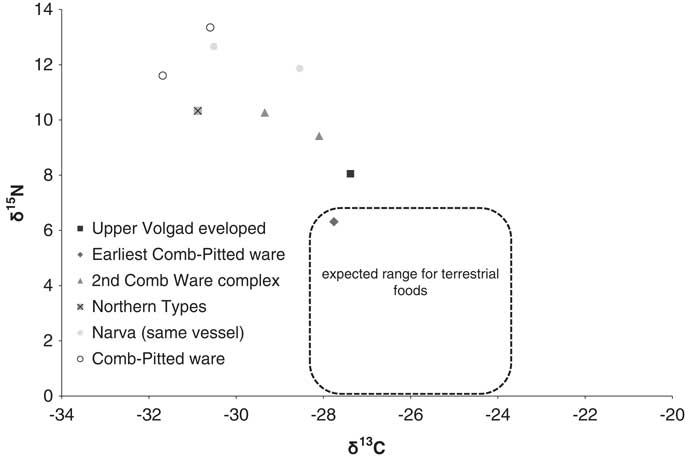
We see an interesting trend in the EA-IRMS results: isotope values appear to become more aquatic over time (Figure 8), even within the Early Neolithic. At Veksa 3, for example, samples from the oldest pottery types (KIA-49797, Upper Volga culture and KIA-49798, “Earliest Comb-Pitted Ware”) are least depleted in δ13C and have at the same time the lowest δ15N values, and among the highest C/N values (Figure 11). The slightly younger “2nd Comb Ware complex” samples (KIA-33927 and KIA-49799) have lower δ13C values and are more enriched in δ15N. The sample from the “Northern Types” vessel (KIA-33928) is even more depleted in δ13C. The two samples taken from the Narva-type vessel (KIA-33926 and KIA-49796) have some of the highest δ15N values in the series, and the most “fishy” EA-IRMS results come from the two Comb-Pitted Ware pots found in layer 6, which unfortunately could not be dated due to the low carbon contents (KIA-49789 and KIA-49790). While the number of samples is still too small to draw firm conclusions, the isotopic data allow us to further advance a hypothesis put forward by Hartz et al. (Reference Hartz, Kostyleva, Piezonka, Terberger, Tsydenova and Zhilin2012) that in the northeast European forest zone the intensity of processing aquatic products in ceramic containers increased gradually in the 6th and 5th millennia cal BC. Interestingly, the Mesolithic and Early Neolithic human bone samples from Minino show a similar pattern, of becoming more depleted δ13C and more enriched δ15N over time, which is seen as a possible sign of an increase in the consumption of freshwater fish (Wood et al. Reference Wood, Higham, Buzilhova, Suvorov, Heinemeier and Olsen2013:173–4). Other possible explanations, such as climatic and ecological developments or changes in the exploitation strategies of natural resources, must also be taken into account, and further research into the isotopic values of natural resources from the period in question is needed to better understand the mechanisms that lie behind the observed pattern.
Stable isotope results from Veksa 3 foodcrusts (Table 1). Symbols represent the typological sequence from Upper Volga (earliest) to Comb-Pitted wares (latest) (graph: J Meadows).
Stratigraphy, Pottery Typology, and Absolute Chronology
As the presence of carbon from aquatic species can only produce older dates, a gradual increase over time in the use of aquatic resources could lead to spurious “reversals” in the 14C ages of foodcrusts, i.e. could make foodcrusts on more recent pottery appear to be older than foodcrusts on earlier sherds. Most results we have are consistent with stratigraphy and the expected typological sequences, however (Figure 10). The number of samples dated is small relative to the period of time spanned by this study, and it would be easy to overlook moderate FREs, particularly if most samples were affected to some degree, but altogether there is surprisingly little evidence of large FREs in foodcrust dates.
We have no direct evidence yet that there was a significant FRE at Veksa 3. The evidence from nearby Minino (Wood et al. Reference Wood, Higham, Buzilhova, Suvorov, Heinemeier and Olsen2013, see discussion above), however, implies large FRE offsets in fish. Thus, the 14C ages of foodcrusts from this region in which fish was a major source of carbon should be several centuries too old. Nevertheless, the relative sequence at Veksa 3 suggested by the 14C results is in accordance with the stratigraphic and typological information (Figures 3, 7; see Nedomolkina Reference Nedomolkina2004; Piezonka Reference Piezonka2015:43–5). KIA-49797 (6386±21 BP, apparently the oldest date on foodcrust) is from a vessel of the developed Upper Volga culture, a type that is associated mainly with the upper part of cultural layer 9 and the lower part of layer 8 above. In addition to KIA-33929 (6340±30 BP), from charcoal in layer 9, six conventional 14C dates reported to stem from layers 9/8 range between 6950±150 BP (Le-5866) and 6220±150 BP (Le-5868) (Figure 12; Timofeev et al. Reference Timofeev, Zaiceva, Dolukhanov and Shukurov2004; Piezonka Reference Piezonka2008). Although detailed information on context or dated material is not available, these results support the idea that any FRE in KIA-49797 is probably negligible. KIA-49798 (6314±22BP) is from a sherd of a rare type preliminarily named “Earliest Comb-Pitted Ware” at Veksa 3 that is concentrated in the horizon between the upper part of layer 9 and the lower part of layer 8. KIA-49799 (6285±30 BP) and KIA-33927 (6185±30 BP) both belong to the so-called “2nd Comb Ware complex,” which is mainly found in the upper part of cultural layer 8. The next date in the sequence, KIA-33928 (6105±30 BP) comes from a vessel associated with the “Northern Types” pottery that is mainly found in layer 7. Finally, two statistically consistent results (KIA-33926, 5425±30 BP, and KIA-49796, 5492±23BP) were obtained on the internal and external foodcrusts of a vessel that is typologically comparable to ceramics of the eastern Baltic Narva culture of the second half of the 5th millennium cal BC and thus is also well in accordance with the expected age (Piezonka Reference Piezonka2008, Reference Piezonka2015:48).
Calibration of 14C dates from the Neolithic layers at Veksa 3. Black: new results (this paper, Table 1); gray: previously published dates (Timofeev et al. Reference Timofeev, Zaiceva, Dolukhanov and Shukurov2004; Piezonka Reference Piezonka2008) (graph: J Meadows).

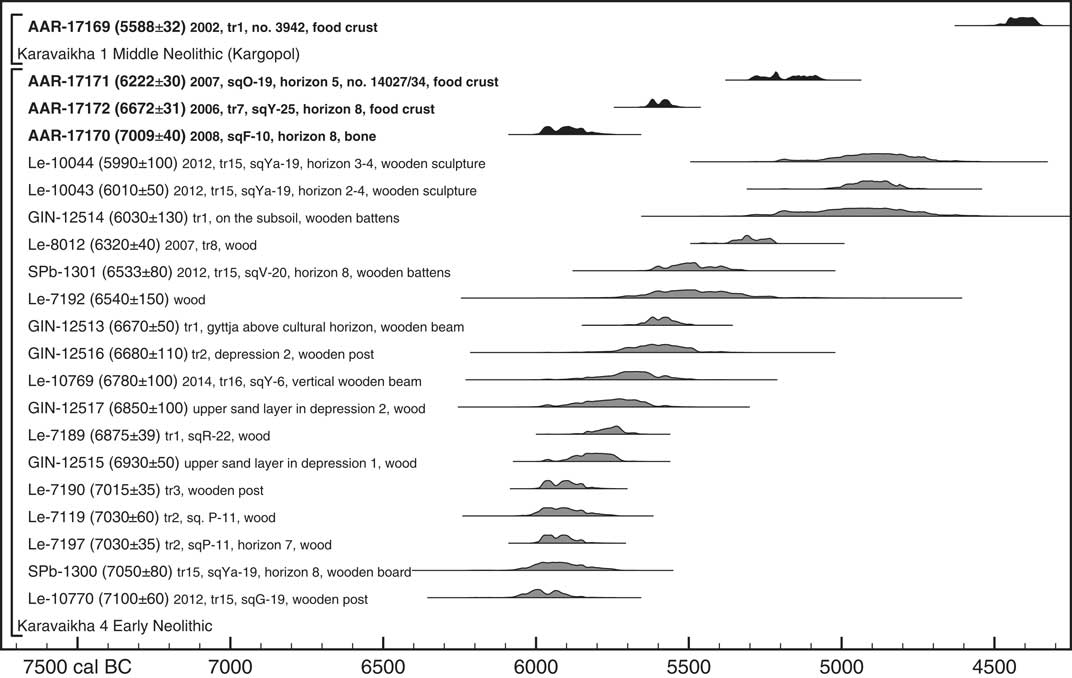
At Karavaikha 4, 14 14C dates from the lower cultural horizon, most of them on wooden artifacts, span from 7050±80 BP (SPb-1300) to 6030±130 BP (GIN-12514), contradicting the assumption that this horizon represents a confined Early Neolithic episode of human activity (Figure 13). The date of the bone dagger (AAR-17170, 7009±40 BP) is among the oldest (Table 1), indicating human presence at the site in the first third of the 6th millennium cal BC, a period associated with the aceramic Late Mesolithic in these parts of northern European Russia (Filatova Reference Filatova2006). The earliest date directly associated with pottery stems from the foodcrust of vessel 5 (AAR-17172, 6672±31 BP), which is typologically similar to pottery of the second phase of the Upper Volga culture. This date forms a group with four broadly contemporary conventional dates from wood samples. Compared to dates for the developed phase of Upper Volga pottery elsewhere, however, the date from Karavaikha 4 seems too early. Foodcrust dates for typologically connected wares and their contexts from Veksa 3, Sakhtysh 2a, and Ozerki 17 (Hartz et al. Reference Hartz, Kostyleva, Piezonka, Terberger, Tsydenova and Zhilin2012) are ~400 14C yr younger (Figure 10). A significant FRE could therefore have affected AAR-17172. The second foodcrust date from Karavaikha 4 (AAR-17171, 6222±30 BP) is the second-youngest date associated with the lower cultural horizon. Its typological attribution is not as straightforward as with other sherds discussed here. While the composition of the decoration stylistically resembles the “Northern Types,” the use of irregular stamps instead of large, deep pits is an atypical feature. The dating result appears marginally older than that for “Northern Types” pottery from Veksa 3 (KIA-33928). There are no other dates for contexts with this type of pottery at Veksa 3 or in the Upper Volga region. Altogether, the chronology of the lower cultural horizon at Karavaikha 4 is not fully understood, and it seems likely that several phases of activity in the Late Mesolithic and Early Neolithic are represented. To understand the chronological setting of the pottery associated with it and to judge the possible presence of FRE in its foodcrusts, dating of securely associated terrestrial material (e.g. plant fibers and resins used to repair broken pots) will be necessary. The 14C age of the foodcrust on the Kargopol culture sherd from Karavaikha 1 (AAR-17169, 5588±32 BP) is in broad accordance with its expected position in the early phase of this Middle Neolithic culture (Piezonka Reference Piezonka2015), although the contextual and typological information on chronology is in this case not detailed enough to decide whether a FRE might have affected the date or not.
Calibration of 14C dates from Karavaikha 1 and 4. Black: new results (this paper, Table 1); gray: previously published dates and unpublished conventional dates (Kosorukova Reference Kosorukova2007; Kiryanova and Kosorukova Reference Kiryanova and Kosorukova2013; this paper) (graph: J Meadows).
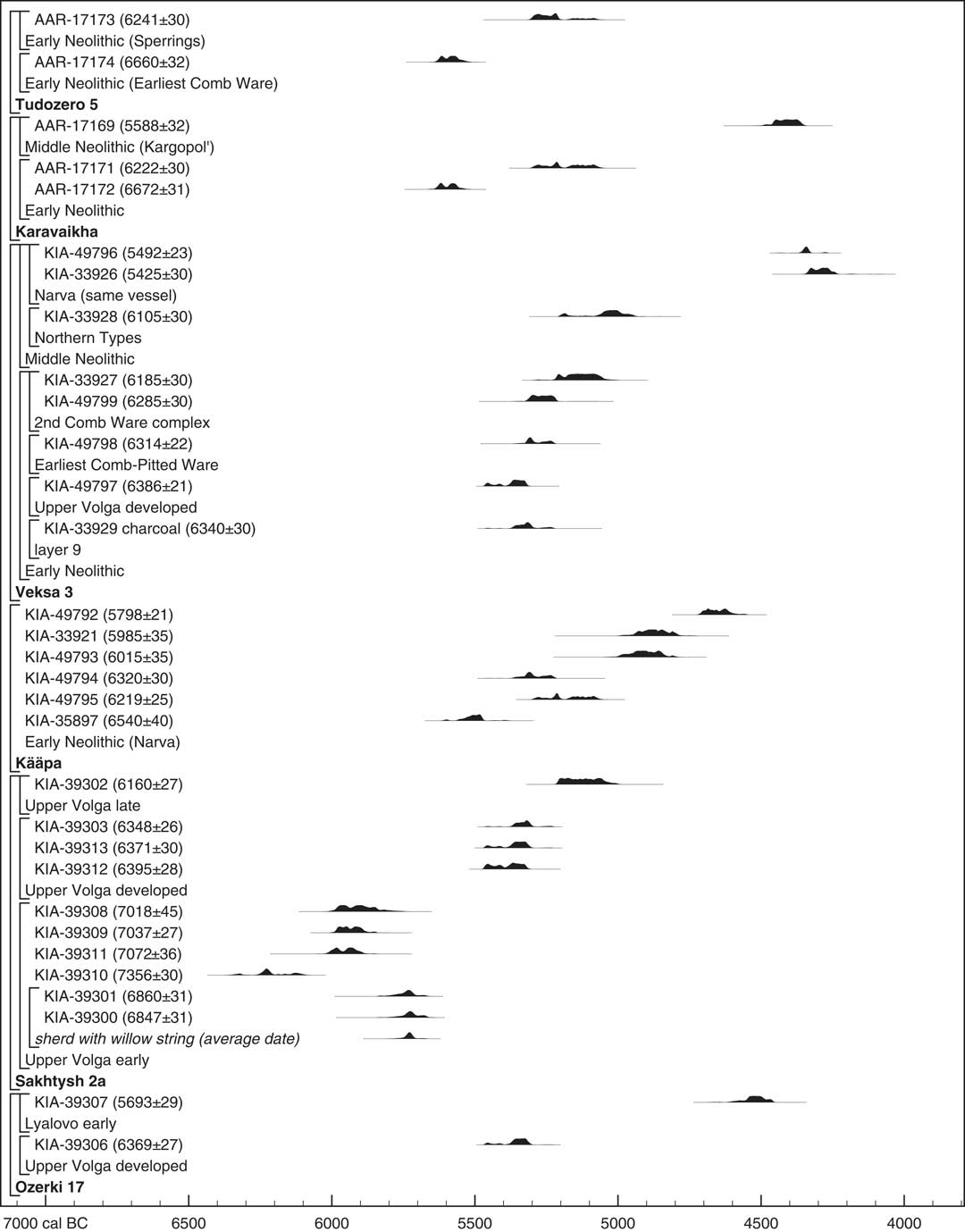
The two foodcrust dates from Tudozero 5 fit both the stratigraphic sequence and existing conventional 14C dates from the respective layers (Figure 14). They thus confirm the assumption that the local early Comb Ware is associated with an Early Neolithic horizon dating to the second quarter of the 6th millennium cal BC, while Sperrings pottery belongs to a later phase of the Early Neolithic in the last third of the 6th millennium cal BC. Altogether, stratigraphic and typological evidence and associated 14C dates suggest that no substantial FRE has affected the foodcrust dates from Tudozero 5. At the same time, the EA-IRMS results and especially the high δ15N values suggest a significant aquatic component.
Calibration of 14C dates from the Early Neolithic layers at Tudozero 5. Black: new AMS results (this paper, Table 1); gray: previously published dates (Ivanishchev and Ivanishcheva Reference Ivanishchev and Ivanishcheva2000) (graph: J Meadows).

The chronological implications of the AMS dates on pottery crusts from Sakhtysh 2a and Ozerki 17 have been discussed elsewhere (Hartz et al. Reference Hartz, Kostyleva, Piezonka, Terberger, Tsydenova and Zhilin2012). Here, we stress again the significance of the very good correlation of the expected presence/absence of FRE and of the isotopic signals of some samples at Sakhtysh 2a.
Foodcrusts on typologically more-or-less uniform Narva pottery from the Early Neolithic cultural horizon at the Estonian site of Kääpa have 14C ages between 6540±40 BP (KIA-35897) and 5798±21 BP (KIA-49792) (Figure 10), representing offsets of between zero and 720±60 14C yr relative to the date of the horse tooth (KIA-35737, 5820±45 BP; Sommer et al. Reference Sommer, Benecke, Lõugas, Nelle and Schmölcke2011). All EA-IRMS data from the dated foodcrusts suggest a high freshwater aquatic component, but there is no correlation between foodcrust 14C ages and EA-IRMS results that might be used to estimate FREs. Highly variable FREs were recorded in studies of modern freshwater fish in Ireland and Germany (Keaveney and Reimer Reference Keaveney and Reimer2012; Philippsen Reference Philippsen2013a) and in recent lake sediment upstream of Kääpa (Alliksaar and Heinsalu Reference Alliksaar and Heinsalu2012). As foodcrusts may represent single cooking episodes, such variability might account for the scatter of foodcrust 14C ages at Kääpa, but we cannot assume that the dated sherds are contemporaneous with each other or the horse tooth. Without more dates on terrestrial material from the Early Neolithic complex, we cannot decide at the moment whether, and if so, to what extent, the dates have been affected by FRE.
CONCLUSIONS AND PERSPECTIVES
Our EA-IRMS results, in the context of stable isotope and 14C data from Minino and other prehistoric sites in the northeastern forest zone, serve to emphasize that a significant proportion of the carbon in many (if not most) Stone Age foodcrust samples in this region is likely to have been derived from aquatic resources. While it appears that both δ13C and δ15N values are useful indicators of the presence of freshwater fish, much more detail about their variability in local terrestrial and aquatic food chains (as well as a larger number of foodcrust and human bone samples) would be required to confirm our impression that reliance on aquatic resources increased in the course of the Neolithic. If valid, however, this trend would imply that 14C dates for the earliest pottery in this region would generally be the least affected by FRE.
The magnitude of FRE in individual foodcrusts is almost impossible to estimate without independent evidence of the absolute dates of pot sherds concerned, particularly in complex freshwater systems where the variability in FRE in aquatic species is unknown. At Veksa 3, we can infer the chronological sequence of the sherds, based on typological development and stratigraphy, but the only AMS 14C date from a terrestrial sample so far simply provides an upper age limit for all the sherds. Without a lower age limit, or terminus ante quem, it is impossible to exclude large FREs, even in the Early Neolithic foodcrusts.
Nevertheless, the experimental approach followed by Philippsen et al. (Reference Philippsen, Kjeldsen, Hartz, Paulsen, Clausen and Heinemeier2010) to better understand the relationship between foodcrust ingredients and dating results is promising, suggesting that EA-IRMS of foodcrusts can identify those most likely to be subject to FREs, provided that isotopic values in the local food ingredients are sufficiently well known and distinctive. Two foodcrust samples from Sakhtysh 2a clearly support this approach: KIA-39300 gave EA-IRMS results consistent with mainly plant ingredients, and a 14C age fitting that from a plant fiber in the same vessel, whereas KIA-39310 produced an implausibly old 14C age and EA-IRMS results suggesting that fish was the main ingredient. Three other samples from Sakhtysh 2a gave relatively high 14C ages and EA-IRMS results that are difficult to interpret, and do not correspond to those from other sites.
Future research should therefore focus on measuring the range of isotopic values in relevant materials (bones of terrestrial animals, fish bones, mussel shells, plant remains, etc.) from the same region and period or, if possible, even from the same context as the foodcrust samples. Paired dates of foodcrusts and terrestrial material associated with the same vessel (e.g. Piličiauskas and Heron Reference Piličiauskas and Heron2015) can also help to shed more light on FREs and their relation to EA-IRMS data, and paired human-herbivore (or plant) 14C samples from closed contexts in the same region and period also provide useful information about the scale of local FREs. To understand the potential variability in foodcrust FREs, however, we also need to date multiple fish remains from closely dated contexts. At Veksa 3 and Sakhtysh 2a, new fieldwork will address these questions in the near future.
ACKNOWLEDGMENTS
EA-IRMS measurements and the 2013 AMS dates for Veksa 3 and Kääpa were funded by the Center for Baltic and Scandinavian Archaeology, Foundation of the Schleswig-Holstein State Museums, Schloss Gottorf, as part of the Man and Environment research theme. This paper has benefited substantially from discussions with Dr Oliver Craig, University of York, and the comments of three anonymous reviewers.